Patently Strategic
Musings
Ty F. Davis | November 29, 2022
This presentation is for information purposes only and does not constitute legal advice.
Foreign Filing - Overview
•Foreign Filing Licenses
•Types of Countries
•Strategy
•Potential Conflicts
•Examples
•Takeaways
Foreign Filing License
Why we care:
§ Some countries have foreign filing license requirements before patent
applications can be made in other countries
§ As stated by WIPO: “In most cases, you are considered to have
permission to file with another [patent office] if either you have filed an
application for the same invention at the relevant national [patent
office] a certain amount of time previously (which varies from [patent
office] to [patent office]) and have not received a security notice stating
that you should not file elsewhere, or if you have explicitly requested
and been granted permission.”
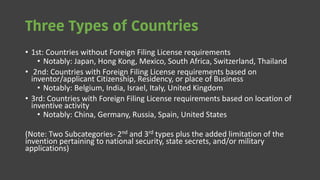
Three Types of Countries
• 1st: Countries without Foreign Filing License requirements
• Notably: Japan, Hong Kong, Mexico, South Africa, Switzerland, Thailand
• 2nd: Countries with Foreign Filing License requirements based on
inventor/applicant Citizenship, Residency, or place of Business
• Notably: Belgium, India, Israel, Italy, United Kingdom
• 3rd: Countries with Foreign Filing License requirements based on location of
inventive activity
• Notably: China, Germany, Russia, Spain, United States
(Note: Two Subcategories- 2nd and 3rd types plus the added limitation of the
invention pertaining to national security, state secrets, and/or military
applications)
Practitioner Strategy
• WHO?
• WHERE?
• WHAT?
Who?
Identify:
• Inventor(s) citizenship/residence
• Location of Business if the Business entity is the applicant
Where?
Identify:
Where the inventive activity occurred?
Note: Portions could be in different locations. Increase teleconferences have
added recent complexity.
What?
Identify what has been invented:
• Is it a military application?
• Relate to a national security?
• A state secret?
Potential Conflicts
• Two or more inventors/applicants having different citizenship/residence with
countries from the 2nd category
• Two or more inventors performing inventive activity in two or more
countries from the 3rd category
• Inventor(s) with citizenship/residence in a country from the 2nd category but
conceiving the invention or inventive portions within a country from the 3rd
category
Example Conflicts and Resolutions
First Example.
• A US company has an in-person workshop at their US based headquarters.
As part, two company employees attend. Employee A is a Chinese resident
working for a Chinese branch of the company. Employee B works for 5
months of the year in the US and returns to his family in India for 7 months
of the year. During the workshop, the two employees invent a manufacturing
process that greatly increases the efficiency of the company’s
manufacturing.
First Example Resolutions
• Chinese FFL Jurisdiction: No
• US FFL Jurisdiction: Yes, inventive activity in the US
• Indian FFL Jurisdiction: Yes, Employee B is a tax resident of India
First Example Resolutions-Continued
• First option: File requisite documents with IPO wait for permission (typically
within 3 weeks), then file at USPTO
• Second option: File requisite documents with USPTO wait for permission
(typically within 3 days from receipt of expedited petition), then file at IPO
Example Conflict and Resolution
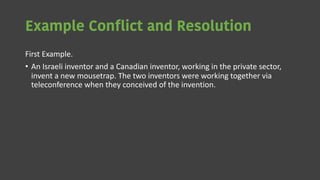
First Example.
• An Israeli inventor and a Canadian inventor, working in the private sector,
invent a new mousetrap. The two inventors were working together via
teleconference when they conceived of the invention.
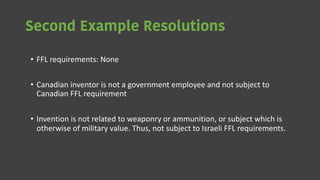
Second Example Resolutions
• FFL requirements: None
• Canadian inventor is not a government employee and not subject to
Canadian FFL requirement
• Invention is not related to weaponry or ammunition, or subject which is
otherwise of military value. Thus, not subject to Israeli FFL requirements.
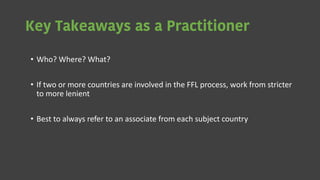
Key Takeaways as a Practitioner
• Who? Where? What?
• If two or more countries are involved in the FFL process, work from stricter
to more lenient
• Best to always refer to an associate from each subject country
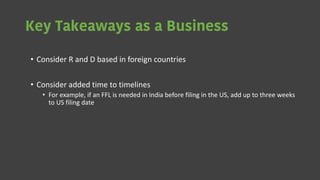
Key Takeaways as a Business
• Consider R and D based in foreign countries
• Consider added time to timelines
• For example, if an FFL is needed in India before filing in the US, add up to three weeks
to US filing date

Foreign Filing Licenses

  • 1.
    Patently Strategic Musings Ty F.Davis | November 29, 2022 This presentation is for information purposes only and does not constitute legal advice.
  • 2.
    Foreign Filing -Overview •Foreign Filing Licenses •Types of Countries •Strategy •Potential Conflicts •Examples •Takeaways
  • 3.
    Foreign Filing License Whywe care: § Some countries have foreign filing license requirements before patent applications can be made in other countries § As stated by WIPO: “In most cases, you are considered to have permission to file with another [patent office] if either you have filed an application for the same invention at the relevant national [patent office] a certain amount of time previously (which varies from [patent office] to [patent office]) and have not received a security notice stating that you should not file elsewhere, or if you have explicitly requested and been granted permission.”
  • 4.
    Three Types ofCountries • 1st: Countries without Foreign Filing License requirements • Notably: Japan, Hong Kong, Mexico, South Africa, Switzerland, Thailand • 2nd: Countries with Foreign Filing License requirements based on inventor/applicant Citizenship, Residency, or place of Business • Notably: Belgium, India, Israel, Italy, United Kingdom • 3rd: Countries with Foreign Filing License requirements based on location of inventive activity • Notably: China, Germany, Russia, Spain, United States (Note: Two Subcategories- 2nd and 3rd types plus the added limitation of the invention pertaining to national security, state secrets, and/or military applications)
  • 5.
  • 6.
    Who? Identify: • Inventor(s) citizenship/residence •Location of Business if the Business entity is the applicant
  • 7.
    Where? Identify: Where the inventiveactivity occurred? Note: Portions could be in different locations. Increase teleconferences have added recent complexity.
  • 8.
    What? Identify what hasbeen invented: • Is it a military application? • Relate to a national security? • A state secret?
  • 9.
    Potential Conflicts • Twoor more inventors/applicants having different citizenship/residence with countries from the 2nd category • Two or more inventors performing inventive activity in two or more countries from the 3rd category • Inventor(s) with citizenship/residence in a country from the 2nd category but conceiving the invention or inventive portions within a country from the 3rd category
  • 10.
    Example Conflicts andResolutions First Example. • A US company has an in-person workshop at their US based headquarters. As part, two company employees attend. Employee A is a Chinese resident working for a Chinese branch of the company. Employee B works for 5 months of the year in the US and returns to his family in India for 7 months of the year. During the workshop, the two employees invent a manufacturing process that greatly increases the efficiency of the company’s manufacturing.
  • 11.
    First Example Resolutions •Chinese FFL Jurisdiction: No • US FFL Jurisdiction: Yes, inventive activity in the US • Indian FFL Jurisdiction: Yes, Employee B is a tax resident of India
  • 12.
    First Example Resolutions-Continued •First option: File requisite documents with IPO wait for permission (typically within 3 weeks), then file at USPTO • Second option: File requisite documents with USPTO wait for permission (typically within 3 days from receipt of expedited petition), then file at IPO
  • 13.
    Example Conflict andResolution First Example. • An Israeli inventor and a Canadian inventor, working in the private sector, invent a new mousetrap. The two inventors were working together via teleconference when they conceived of the invention.
  • 14.
    Second Example Resolutions •FFL requirements: None • Canadian inventor is not a government employee and not subject to Canadian FFL requirement • Invention is not related to weaponry or ammunition, or subject which is otherwise of military value. Thus, not subject to Israeli FFL requirements.
  • 15.
    Key Takeaways asa Practitioner • Who? Where? What? • If two or more countries are involved in the FFL process, work from stricter to more lenient • Best to always refer to an associate from each subject country
  • 16.
    Key Takeaways asa Business • Consider R and D based in foreign countries • Consider added time to timelines • For example, if an FFL is needed in India before filing in the US, add up to three weeks to US filing date