Erin Duffy Pastore Teaching Writing with Technology February 12, 2008
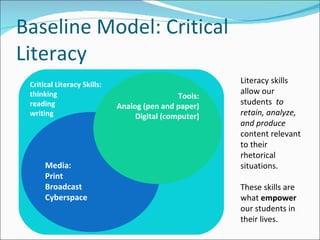
Baseline Model: Critical Literacy Critical Literacy Skills:  thinking reading writing Media: Print  Broadcast Cyberspace Tools: Analog (pen and paper) Digital (computer) Literacy skills allow our students  to retain, analyze, and produce  content relevant to their rhetorical situations.  These skills are what  empower  our students in their lives.
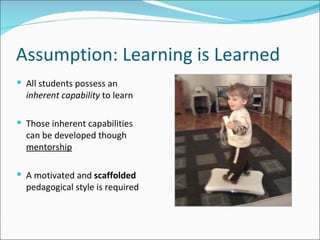
Assumption: Learning is Learned All students possess an  inherent capability  to learn Those inherent capabilities can be developed though  mentorship A motivated and  scaffolded  pedagogical style is required
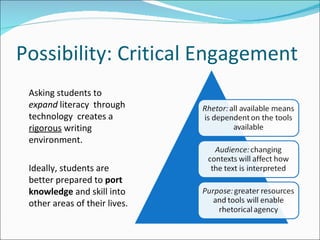
Possibility: Critical Engagement Asking students to  expand  literacy  through technology  creates a  rigorous  writing environment. Ideally, students are better prepared to  port knowledge  and skill into other areas of their lives.
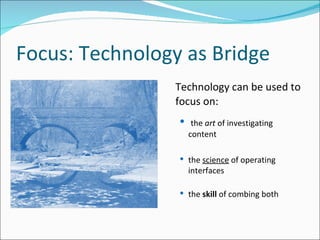
Focus: Technology as Bridge Technology can be used to focus on: the  art  of investigating content  the  science  of operating interfaces the  skill  of combing both
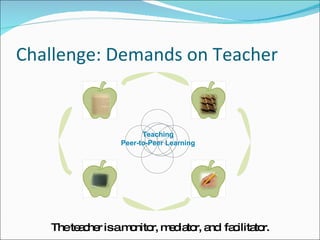
Challenge: Demands on Teacher The teacher is a monitor, mediator, and  facilitator. Teaching Peer-to-Peer Learning
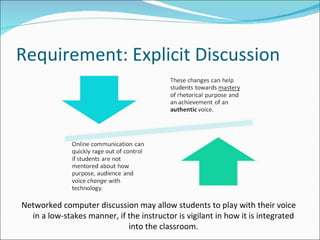
Requirement: Explicit Discussion  Networked computer discussion may allow students to play with their voice in a low-stakes manner, if the instructor is vigilant in how it is integrated into the classroom.
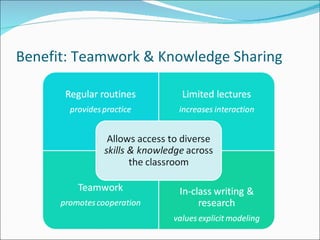
Benefit: Teamwork & Knowledge Sharing
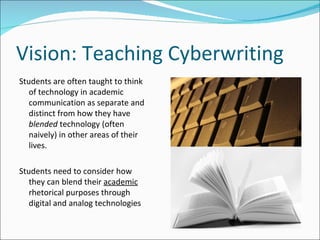
Vision: Teaching Cyberwriting Students are often taught to think of technology in academic communication as separate and distinct from how they have  blended  technology (often naively) in other areas of their lives.  Students need to consider how they can blend their  academic  rhetorical purposes through digital and analog technologies
References McKee, Heidi. “’YOUR VIEWS SHOWED TRUE IGNORANCE!!!’:  (Mis)Communication in an online interracial discussion forum.”  Computers and Composition  19.4 (December 2002): 411- 434.   Palmquist, Mike, Kate Kiefer, James Hartvigsen and Barbara Goodlew. “Curriculum Design: Doing More with Less.”  Transitions: Teaching Writing in Computer-supported and Traditional Classrooms . Santa Barbara, CA: Greenwood Publishing Group, 1998.   Porter, James. “Why technology matters to writing: A cyberwriter’s tale.”  Computers and Composition  20.4 (December 2003): 375- 394. Images courtesy of: http://www.freefoto.com http://www.freedigitalphotos.net/

Pastore Teachnology Statement

  • 1.
    Erin Duffy PastoreTeaching Writing with Technology February 12, 2008
  • 2.
    Baseline Model: CriticalLiteracy Critical Literacy Skills: thinking reading writing Media: Print Broadcast Cyberspace Tools: Analog (pen and paper) Digital (computer) Literacy skills allow our students to retain, analyze, and produce content relevant to their rhetorical situations. These skills are what empower our students in their lives.
  • 3.
    Assumption: Learning isLearned All students possess an inherent capability to learn Those inherent capabilities can be developed though mentorship A motivated and scaffolded pedagogical style is required
  • 4.
    Possibility: Critical EngagementAsking students to expand literacy through technology creates a rigorous writing environment. Ideally, students are better prepared to port knowledge and skill into other areas of their lives.
  • 5.
    Focus: Technology asBridge Technology can be used to focus on: the art of investigating content the science of operating interfaces the skill of combing both
  • 6.
    Challenge: Demands onTeacher The teacher is a monitor, mediator, and facilitator. Teaching Peer-to-Peer Learning
  • 7.
    Requirement: Explicit Discussion Networked computer discussion may allow students to play with their voice in a low-stakes manner, if the instructor is vigilant in how it is integrated into the classroom.
  • 8.
    Benefit: Teamwork &Knowledge Sharing
  • 9.
    Vision: Teaching CyberwritingStudents are often taught to think of technology in academic communication as separate and distinct from how they have blended technology (often naively) in other areas of their lives. Students need to consider how they can blend their academic rhetorical purposes through digital and analog technologies
  • 10.
    References McKee, Heidi.“’YOUR VIEWS SHOWED TRUE IGNORANCE!!!’: (Mis)Communication in an online interracial discussion forum.” Computers and Composition 19.4 (December 2002): 411- 434.   Palmquist, Mike, Kate Kiefer, James Hartvigsen and Barbara Goodlew. “Curriculum Design: Doing More with Less.” Transitions: Teaching Writing in Computer-supported and Traditional Classrooms . Santa Barbara, CA: Greenwood Publishing Group, 1998.   Porter, James. “Why technology matters to writing: A cyberwriter’s tale.” Computers and Composition 20.4 (December 2003): 375- 394. Images courtesy of: http://www.freefoto.com http://www.freedigitalphotos.net/

Editor's Notes

  • #2 FDP- www.freedigitalphotos.net