Past perfect


• You had studied English before you moved to
New York.

• Had you studied English before you moved to
New York?

• You had not studied English before you moved
to New York.
Use 1: completed action before
      something in the past


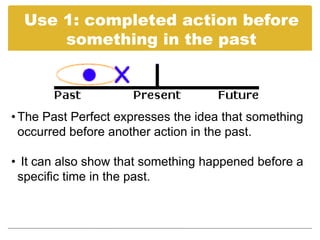
• The Past Perfect expresses the idea that something
  occurred before another action in the past.

• It can also show that something happened before a
 specific time in the past.
Use 1: completed action before
      something in the past
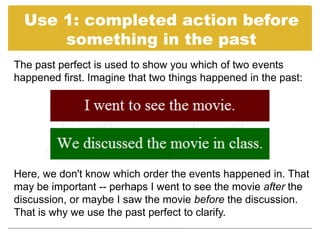
The past perfect is used to show you which of two events
happened first. Imagine that two things happened in the past:


Here, we don't know which order the events happened in. That
may be important -- perhaps I went to see the movie after the
discussion, or maybe I saw the movie before the discussion.
That is why we use the past perfect to clarify.
Use 1: completed action before
      something in the past


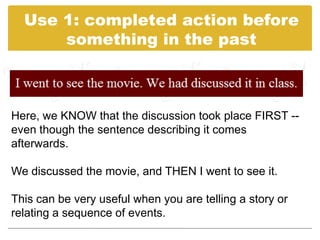
Here, we KNOW that the discussion took place FIRST --
even though the sentence describing it comes
afterwards.

We discussed the movie, and THEN I went to see it.

This can be very useful when you are telling a story or
relating a sequence of events.
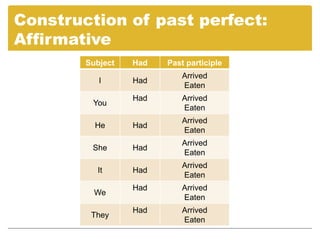
Construction of past perfect:
Affirmative
        Subject   Had   Past participle
                            Arrived
           I      Had
                            Eaten
                  Had       Arrived
         You
                            Eaten
                            Arrived
          He      Had
                            Eaten
                            Arrived
         She      Had
                            Eaten
                            Arrived
          It      Had
                            Eaten
                  Had       Arrived
          We
                            Eaten
                  Had       Arrived
         They
                            Eaten
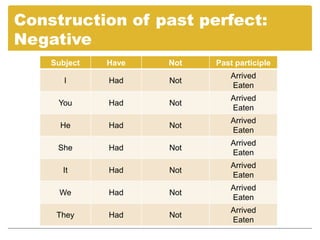
Construction of past perfect:
Negative
    Subject   Have   Not   Past participle
                               Arrived
       I      Had    Not
                               Eaten
                               Arrived
     You      Had    Not
                               Eaten
                               Arrived
      He      Had    Not
                               Eaten
                               Arrived
     She      Had    Not
                               Eaten
                               Arrived
      It      Had    Not
                               Eaten
                               Arrived
      We      Had    Not
                               Eaten
                               Arrived
     They     Had    Not
                               Eaten
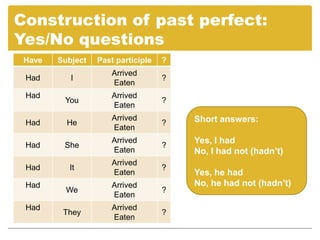
Construction of past perfect:
Yes/No questions
 Have   Subject   Past participle   ?
                      Arrived
 Had       I                        ?
                      Eaten
 Had                  Arrived
         You                        ?
                      Eaten
                      Arrived           Short answers:
 Had      He                        ?
                      Eaten

 Had     She
                      Arrived
                                    ?
                                        Yes, I had
                      Eaten             No, I had not (hadn’t)
                      Arrived
 Had      It                        ?
                      Eaten             Yes, he had
 Had                  Arrived           No, he had not (hadn’t)
          We                        ?
                      Eaten
 Had                  Arrived
         They                       ?
                      Eaten

Past perfect

  • 1.
    Past perfect • Youhad studied English before you moved to New York. • Had you studied English before you moved to New York? • You had not studied English before you moved to New York.
  • 2.
    Use 1: completedaction before something in the past • The Past Perfect expresses the idea that something occurred before another action in the past. • It can also show that something happened before a specific time in the past.
  • 3.
    Use 1: completedaction before something in the past The past perfect is used to show you which of two events happened first. Imagine that two things happened in the past: Here, we don't know which order the events happened in. That may be important -- perhaps I went to see the movie after the discussion, or maybe I saw the movie before the discussion. That is why we use the past perfect to clarify.
  • 4.
    Use 1: completedaction before something in the past Here, we KNOW that the discussion took place FIRST -- even though the sentence describing it comes afterwards. We discussed the movie, and THEN I went to see it. This can be very useful when you are telling a story or relating a sequence of events.
  • 5.
    Construction of pastperfect: Affirmative Subject Had Past participle Arrived I Had Eaten Had Arrived You Eaten Arrived He Had Eaten Arrived She Had Eaten Arrived It Had Eaten Had Arrived We Eaten Had Arrived They Eaten
  • 6.
    Construction of pastperfect: Negative Subject Have Not Past participle Arrived I Had Not Eaten Arrived You Had Not Eaten Arrived He Had Not Eaten Arrived She Had Not Eaten Arrived It Had Not Eaten Arrived We Had Not Eaten Arrived They Had Not Eaten
  • 7.
    Construction of pastperfect: Yes/No questions Have Subject Past participle ? Arrived Had I ? Eaten Had Arrived You ? Eaten Arrived Short answers: Had He ? Eaten Had She Arrived ? Yes, I had Eaten No, I had not (hadn’t) Arrived Had It ? Eaten Yes, he had Had Arrived No, he had not (hadn’t) We ? Eaten Had Arrived They ? Eaten