Password Cracking tools
Sadhasivasubramanian H
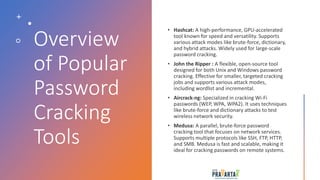
Overview
of Popular
Password
Cracking
Tools
Hashcat
What is Hashcat?
• Hashcat:
• A high-performance, open-source password recovery
tool.
• Purpose:
• Used to recover passwords by cracking password
hashes.
• Key Feature:
• GPU-accelerated, making it one of the fastest tools
available.
• Supports:
• A wide variety of hashing algorithms (MD5, SHA-256,
WPA, etc.).
Hashcat
Attack
Modes
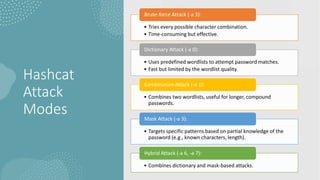
• Tries every possible character combination.
• Time-consuming but effective.
Brute-force Attack (-a 3):
• Uses predefined wordlists to attempt password matches.
• Fast but limited by the wordlist quality.
Dictionary Attack (-a 0):
• Combines two wordlists, useful for longer, compound
passwords.
Combination Attack (-a 1):
• Targets specific patterns based on partial knowledge of the
password (e.g., known characters, length).
Mask Attack (-a 3):
• Combines dictionary and mask-based attacks.
Hybrid Attack (-a 6, -a 7):
Popular
Hash
Types
Supported
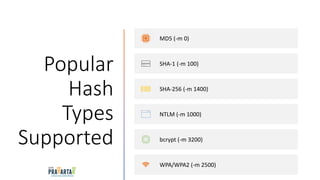
MD5 (-m 0)
SHA-1 (-m 100)
SHA-256 (-m 1400)
NTLM (-m 1000)
bcrypt (-m 3200)
WPA/WPA2 (-m 2500)
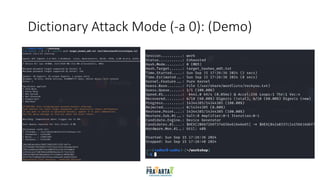
Dictionary Attack Mode (-a 0): (Demo)
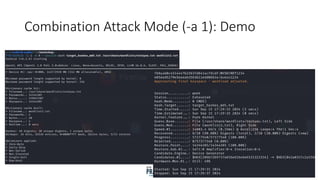
Combination Attack Mode (-a 1): Demo
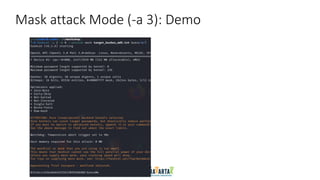
Mask attack Mode (-a 3): Demo
John the Ripper
What is John the Ripper?
• John the Ripper is a popular open-source password cracking
tool.
• Initially developed for Unix-based systems.
• Designed to detect weak passwords and crack password
hashes.
• Supports many operating systems, including Unix,
Windows, and macOS.
• Hash Support: Cracks multiple hash types, including:
• Unix-based hashes (DES, MD5)
• Windows LM/NTLM
• SHA hashes, bcrypt, and more.
• Customizable: Supports plugins and extensions to add more
functionality.
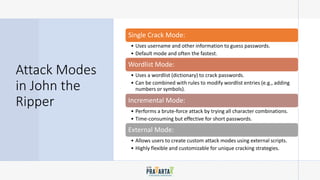
Attack Modes
in John the
Ripper
Single Crack Mode:
• Uses username and other information to guess passwords.
• Default mode and often the fastest.
Wordlist Mode:
• Uses a wordlist (dictionary) to crack passwords.
• Can be combined with rules to modify wordlist entries (e.g., adding
numbers or symbols).
Incremental Mode:
• Performs a brute-force attack by trying all character combinations.
• Time-consuming but effective for short passwords.
External Mode:
• Allows users to create custom attack modes using external scripts.
• Highly flexible and customizable for unique cracking strategies.
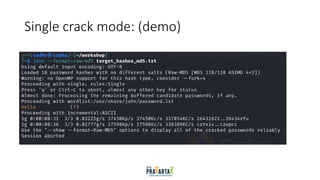
Single crack mode: (demo)
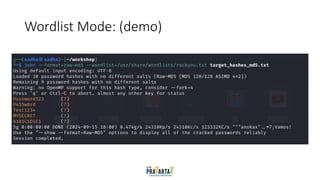
Wordlist Mode: (demo)
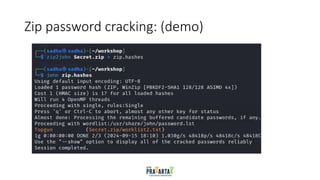
Zip password cracking: (demo)
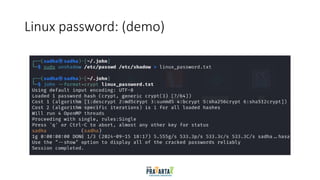
Linux password: (demo)
Thanks

Password-crackingtool todiscoverpwds.pdf

  • 1.
  • 2.
  • 3.
  • 4.
    What is Hashcat? •Hashcat: • A high-performance, open-source password recovery tool. • Purpose: • Used to recover passwords by cracking password hashes. • Key Feature: • GPU-accelerated, making it one of the fastest tools available. • Supports: • A wide variety of hashing algorithms (MD5, SHA-256, WPA, etc.).
  • 5.
    Hashcat Attack Modes • Tries everypossible character combination. • Time-consuming but effective. Brute-force Attack (-a 3): • Uses predefined wordlists to attempt password matches. • Fast but limited by the wordlist quality. Dictionary Attack (-a 0): • Combines two wordlists, useful for longer, compound passwords. Combination Attack (-a 1): • Targets specific patterns based on partial knowledge of the password (e.g., known characters, length). Mask Attack (-a 3): • Combines dictionary and mask-based attacks. Hybrid Attack (-a 6, -a 7):
  • 6.
    Popular Hash Types Supported MD5 (-m 0) SHA-1(-m 100) SHA-256 (-m 1400) NTLM (-m 1000) bcrypt (-m 3200) WPA/WPA2 (-m 2500)
  • 7.
    Dictionary Attack Mode(-a 0): (Demo)
  • 8.
  • 9.
    Mask attack Mode(-a 3): Demo
  • 10.
  • 11.
    What is Johnthe Ripper? • John the Ripper is a popular open-source password cracking tool. • Initially developed for Unix-based systems. • Designed to detect weak passwords and crack password hashes. • Supports many operating systems, including Unix, Windows, and macOS. • Hash Support: Cracks multiple hash types, including: • Unix-based hashes (DES, MD5) • Windows LM/NTLM • SHA hashes, bcrypt, and more. • Customizable: Supports plugins and extensions to add more functionality.
  • 12.
    Attack Modes in Johnthe Ripper Single Crack Mode: • Uses username and other information to guess passwords. • Default mode and often the fastest. Wordlist Mode: • Uses a wordlist (dictionary) to crack passwords. • Can be combined with rules to modify wordlist entries (e.g., adding numbers or symbols). Incremental Mode: • Performs a brute-force attack by trying all character combinations. • Time-consuming but effective for short passwords. External Mode: • Allows users to create custom attack modes using external scripts. • Highly flexible and customizable for unique cracking strategies.
  • 13.
  • 14.
  • 15.
  • 16.
  • 17.