Passive Voice 
Use of Passive 
Passive voice is used when the focus is on the action. It is not important or not known, however, 
who or what is performing the action. 
Example: My bike was stolen. 
In the example above, the focus is on the fact that my bike was stolen. I do not know, however, 
who did it. 
Sometimes a statement in passive is more polite than active voice, as the following example 
shows: 
Example: A mistake was made. 
In this case, I focus on the fact that a mistake was made, but I do not blame anyone (e.g. You 
have made a mistake.). 
Form of Passive 
Subject + finite form of to be + Past Participle (3rd column of irregular verbs) 
Example: A letter was written. 
When rewriting active sentences in passive voice, note the following: 
 the object of the active sentence becomes the subject of the passive sentence 
 the finite form of the verb is changed (to be + past participle) 
 the subject of the active sentence becomes the object of the passive sentence (or is 
dropped) 
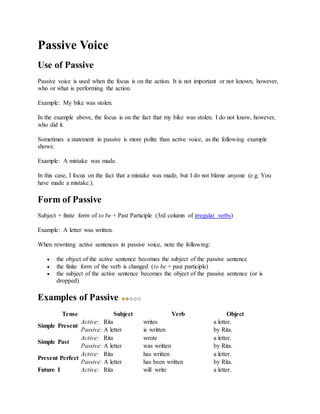
Examples of Passive 
Tense Subject Verb Object 
Simple Present 
Active: Rita writes a letter. 
Passive: A letter is written by Rita. 
Simple Past 
Active: Rita wrote a letter. 
Passive: A letter was written by Rita. 
Present Perfect 
Active: Rita has written a letter. 
Passive: A letter has been written by Rita. 
Future I Active: Rita will write a letter.
Passive: A letter will be written by Rita. 
Hilfsverben 
Active: Rita can write a letter. 
Passive: A letter can be written by Rita. 
Examples of Passive 
Tense Subject Verb Object 
Present 
Progressive 
Active: Rita is writing a letter. 
Passive: A letter is being written by Rita. 
Past Progressive 
Active: Rita was writing a letter. 
Passive: A letter was being written by Rita. 
Past Perfect 
Active: Rita had written a letter. 
Passive: A letter had been written by Rita. 
Future II 
Active: Rita will have written a letter. 
Passive: A letter will have been written by Rita. 
Conditional I 
Active: Rita would write a letter. 
Passive: A letter would be written by Rita. 
Conditional II 
Active: Rita would have written a letter. 
Passive: A letter would have been written by Rita. 
Passive Sentences with Two Objects 
Rewriting an active sentence with two objects in passive voice means that one of the two objects 
becomes the subject, the other one remains an object. Which object to transform into a subject 
depends on what you want to put the focus on. 
Subject Verb Object 1 Object 2 
Active: Rita wrote a letter to me. 
Passive: A letter was written to me by Rita. 
Passive: I was written a letter by Rita. 
. 
As you can see in the examples, adding by Rita does not sound very elegant. That’s why it is 
usually dropped.
Personal and Impersonal Passive 
Personal Passive simply means that the object of the active sentence becomes the subject of the 
passive sentence. So every verb that needs an object (transitive verb) can form a personal 
passive. 
Example: They build houses. – Houses are built. 
Verbs without an object (intransitive verb) normally cannot form a personal passive sentence (as 
there is no object that can become the subject of the passive sentence). If you want to use an 
intransitive verb in passive voice, you need an impersonal construction – therefore this passive is 
called Impersonal Passive. 
Example: he says – it is said 
Impersonal Passive is not as common in English as in some other languages (e.g. German, 
Latin). In English, Impersonal Passive is only possible with verbs of perception (e. g. say, think, 
know). 
Example: They say that women live longer than men. – It is said that women live longer than 
men. 
Although Impersonal Passive is possible here, Personal Passive is more common. 
Example: They say that women live longer than men. – Women are said to live longer than men. 
The subject of the subordinate clause (women) goes to the beginning of the sentence; the verb of 
perception is put into passive voice. The rest of the sentence is added using an infinitive 
construction with 'to' (certain auxiliary verbs and that are dropped). 
Sometimes the term Personal Passive is used in English lessons if the indirect object of an active 
sentence is to become the subject of the passive sentence.
Penggunaan Pasif 
Pasif digunakan ketika fokusnya adalah pada tindakan. Hal ini tidak penting atau tidak diketahui, 
bagaimanapun, siapa atau apa yang melakukan tindakan. 
Contoh: sepeda saya dicuri. 
Dalam contoh di atas, fokusnya adalah pada kenyataan bahwa sepeda saya dicuri. Aku tidak 
tahu, bagaimanapun, siapa yang melakukannya. 
Kadang-kadang pernyataan dalam pasif lebih sopan dibandingkan suara aktif, seperti contoh 
berikut menunjukkan: 
Contoh: Sebuah kesalahan dibuat. 
Dalam hal ini, saya fokus pada fakta bahwa kesalahan itu dibuat, tapi saya tidak menyalahkan 
siapa pun (misalnya Anda telah melakukan kesalahan.). 
Bentuk Pasif 
Subject + bentuk terbatas menjadi + past participle (kolom 3 dari kata kerja tak beraturan ) 
Contoh: Sebuah surat ditulis. 
Ketika menulis ulang kalimat aktif dalam suara pasif, perhatikan hal berikut: 
 objek kalimat aktif menjadi subjek kalimat pasif 
 bentuk kata kerja terbatas berubah (menjadi + past participle) 
 subjek kalimat aktif menjadi objek kalimat pasif (atau turun) 
Contoh Pasif Level: intermediate yang lebih rendah 
Tegang Subjek Kata kerja Objek 
Sederhana Hadir 
Aktif: Rita menulis surat. 
Pasif: Huruf A ditulis oleh Rita. 
Telah Sederhana 
Aktif: Rita menulis surat. 
Pasif: Huruf A ditulis oleh Rita. 
Present Perfect 
Aktif: Rita telah menulis surat. 
Pasif: Huruf A telah ditulis oleh Rita. 
Masa Depan Saya 
Aktif: Rita akan menulis surat. 
Pasif: Huruf A akan ditulis oleh Rita. 
Hilfsverben 
Aktif: Rita dapat menulis surat. 
Pasif: Huruf A dapat ditulis oleh Rita.
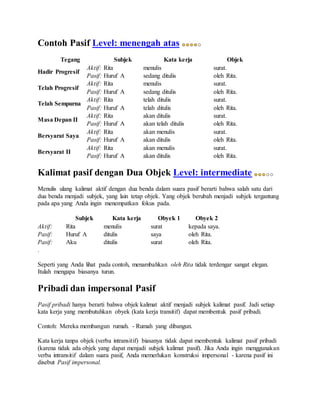
Contoh Pasif Level: menengah atas 
Tegang Subjek Kata kerja Objek 
Hadir Progresif 
Aktif: Rita menulis surat. 
Pasif: Huruf A sedang ditulis oleh Rita. 
Telah Progresif 
Aktif: Rita menulis surat. 
Pasif: Huruf A sedang ditulis oleh Rita. 
Telah Sempurna 
Aktif: Rita telah ditulis surat. 
Pasif: Huruf A telah ditulis oleh Rita. 
Masa Depan II 
Aktif: Rita akan ditulis surat. 
Pasif: Huruf A akan telah ditulis oleh Rita. 
Bersyarat Saya 
Aktif: Rita akan menulis surat. 
Pasif: Huruf A akan ditulis oleh Rita. 
Bersyarat II 
Aktif: Rita akan menulis surat. 
Pasif: Huruf A akan ditulis oleh Rita. 
Kalimat pasif dengan Dua Objek Level: intermediate 
Menulis ulang kalimat aktif dengan dua benda dalam suara pasif berarti bahwa salah satu dari 
dua benda menjadi subjek, yang lain tetap objek. Yang objek berubah menjadi subjek tergantung 
pada apa yang Anda ingin menempatkan fokus pada. 
Subjek Kata kerja Obyek 1 Obyek 2 
Aktif: Rita menulis surat kepada saya. 
Pasif: Huruf A ditulis saya oleh Rita. 
Pasif: Aku ditulis surat oleh Rita. 
. 
Seperti yang Anda lihat pada contoh, menambahkan oleh Rita tidak terdengar sangat elegan. 
Itulah mengapa biasanya turun. 
Pribadi dan impersonal Pasif 
Pasif pribadi hanya berarti bahwa objek kalimat aktif menjadi subjek kalimat pasif. Jadi setiap 
kata kerja yang membutuhkan obyek (kata kerja transitif) dapat membentuk pasif pribadi. 
Contoh: Mereka membangun rumah. - Rumah yang dibangun. 
Kata kerja tanpa objek (verba intransitif) biasanya tidak dapat membentuk kalimat pasif pribadi 
(karena tidak ada objek yang dapat menjadi subjek kalimat pasif). Jika Anda ingin menggunakan 
verba intransitif dalam suara pasif, Anda memerlukan konstruksi impersonal - karena pasif ini 
disebut Pasif impersonal.
Contoh: ia mengatakan - dikatakan 
Pasif impersonal tidak umum dalam bahasa Inggris seperti dalam beberapa bahasa lain (misalnya 
Jerman, Latin). Dalam bahasa Inggris, Pasif impersonal hanya mungkin dengan verba persepsi 
(misalnya katakan, pikirkan, tahu). 
Contoh: Mereka mengatakan bahwa wanita hidup lebih lama daripada pria. - Dikatakan bahwa 
wanita hidup lebih lama daripada pria. 
Meskipun pasif impersonal yang mungkin di sini, Pasif pribadi adalah lebih umum. 
Contoh: Mereka mengatakan bahwa wanita hidup lebih lama daripada pria. - Perempuan 
dikatakan untuk hidup lebih lama daripada pria. 
Subjek klausa bawahan (perempuan) pergi ke awal kalimat, kata kerja dari persepsi yang 
dimasukkan ke dalam suara pasif. Sisa kalimat ditambahkan menggunakan konstruksi infinitif 
dengan 'untuk' (verba bantu tertentu dan yang menjatuhkan). 
Kadang-kadang Pasif Pribadi istilah yang digunakan dalam pelajaran bahasa Inggris jika objek 
tidak langsung dari kalimat aktif menjadi subjek kalimat pasif.
Passive voice

Passive voice

  • 1.
    Passive Voice Useof Passive Passive voice is used when the focus is on the action. It is not important or not known, however, who or what is performing the action. Example: My bike was stolen. In the example above, the focus is on the fact that my bike was stolen. I do not know, however, who did it. Sometimes a statement in passive is more polite than active voice, as the following example shows: Example: A mistake was made. In this case, I focus on the fact that a mistake was made, but I do not blame anyone (e.g. You have made a mistake.). Form of Passive Subject + finite form of to be + Past Participle (3rd column of irregular verbs) Example: A letter was written. When rewriting active sentences in passive voice, note the following:  the object of the active sentence becomes the subject of the passive sentence  the finite form of the verb is changed (to be + past participle)  the subject of the active sentence becomes the object of the passive sentence (or is dropped) Examples of Passive Tense Subject Verb Object Simple Present Active: Rita writes a letter. Passive: A letter is written by Rita. Simple Past Active: Rita wrote a letter. Passive: A letter was written by Rita. Present Perfect Active: Rita has written a letter. Passive: A letter has been written by Rita. Future I Active: Rita will write a letter.
  • 2.
    Passive: A letterwill be written by Rita. Hilfsverben Active: Rita can write a letter. Passive: A letter can be written by Rita. Examples of Passive Tense Subject Verb Object Present Progressive Active: Rita is writing a letter. Passive: A letter is being written by Rita. Past Progressive Active: Rita was writing a letter. Passive: A letter was being written by Rita. Past Perfect Active: Rita had written a letter. Passive: A letter had been written by Rita. Future II Active: Rita will have written a letter. Passive: A letter will have been written by Rita. Conditional I Active: Rita would write a letter. Passive: A letter would be written by Rita. Conditional II Active: Rita would have written a letter. Passive: A letter would have been written by Rita. Passive Sentences with Two Objects Rewriting an active sentence with two objects in passive voice means that one of the two objects becomes the subject, the other one remains an object. Which object to transform into a subject depends on what you want to put the focus on. Subject Verb Object 1 Object 2 Active: Rita wrote a letter to me. Passive: A letter was written to me by Rita. Passive: I was written a letter by Rita. . As you can see in the examples, adding by Rita does not sound very elegant. That’s why it is usually dropped.
  • 3.
    Personal and ImpersonalPassive Personal Passive simply means that the object of the active sentence becomes the subject of the passive sentence. So every verb that needs an object (transitive verb) can form a personal passive. Example: They build houses. – Houses are built. Verbs without an object (intransitive verb) normally cannot form a personal passive sentence (as there is no object that can become the subject of the passive sentence). If you want to use an intransitive verb in passive voice, you need an impersonal construction – therefore this passive is called Impersonal Passive. Example: he says – it is said Impersonal Passive is not as common in English as in some other languages (e.g. German, Latin). In English, Impersonal Passive is only possible with verbs of perception (e. g. say, think, know). Example: They say that women live longer than men. – It is said that women live longer than men. Although Impersonal Passive is possible here, Personal Passive is more common. Example: They say that women live longer than men. – Women are said to live longer than men. The subject of the subordinate clause (women) goes to the beginning of the sentence; the verb of perception is put into passive voice. The rest of the sentence is added using an infinitive construction with 'to' (certain auxiliary verbs and that are dropped). Sometimes the term Personal Passive is used in English lessons if the indirect object of an active sentence is to become the subject of the passive sentence.
  • 4.
    Penggunaan Pasif Pasifdigunakan ketika fokusnya adalah pada tindakan. Hal ini tidak penting atau tidak diketahui, bagaimanapun, siapa atau apa yang melakukan tindakan. Contoh: sepeda saya dicuri. Dalam contoh di atas, fokusnya adalah pada kenyataan bahwa sepeda saya dicuri. Aku tidak tahu, bagaimanapun, siapa yang melakukannya. Kadang-kadang pernyataan dalam pasif lebih sopan dibandingkan suara aktif, seperti contoh berikut menunjukkan: Contoh: Sebuah kesalahan dibuat. Dalam hal ini, saya fokus pada fakta bahwa kesalahan itu dibuat, tapi saya tidak menyalahkan siapa pun (misalnya Anda telah melakukan kesalahan.). Bentuk Pasif Subject + bentuk terbatas menjadi + past participle (kolom 3 dari kata kerja tak beraturan ) Contoh: Sebuah surat ditulis. Ketika menulis ulang kalimat aktif dalam suara pasif, perhatikan hal berikut:  objek kalimat aktif menjadi subjek kalimat pasif  bentuk kata kerja terbatas berubah (menjadi + past participle)  subjek kalimat aktif menjadi objek kalimat pasif (atau turun) Contoh Pasif Level: intermediate yang lebih rendah Tegang Subjek Kata kerja Objek Sederhana Hadir Aktif: Rita menulis surat. Pasif: Huruf A ditulis oleh Rita. Telah Sederhana Aktif: Rita menulis surat. Pasif: Huruf A ditulis oleh Rita. Present Perfect Aktif: Rita telah menulis surat. Pasif: Huruf A telah ditulis oleh Rita. Masa Depan Saya Aktif: Rita akan menulis surat. Pasif: Huruf A akan ditulis oleh Rita. Hilfsverben Aktif: Rita dapat menulis surat. Pasif: Huruf A dapat ditulis oleh Rita.
  • 5.
    Contoh Pasif Level:menengah atas Tegang Subjek Kata kerja Objek Hadir Progresif Aktif: Rita menulis surat. Pasif: Huruf A sedang ditulis oleh Rita. Telah Progresif Aktif: Rita menulis surat. Pasif: Huruf A sedang ditulis oleh Rita. Telah Sempurna Aktif: Rita telah ditulis surat. Pasif: Huruf A telah ditulis oleh Rita. Masa Depan II Aktif: Rita akan ditulis surat. Pasif: Huruf A akan telah ditulis oleh Rita. Bersyarat Saya Aktif: Rita akan menulis surat. Pasif: Huruf A akan ditulis oleh Rita. Bersyarat II Aktif: Rita akan menulis surat. Pasif: Huruf A akan ditulis oleh Rita. Kalimat pasif dengan Dua Objek Level: intermediate Menulis ulang kalimat aktif dengan dua benda dalam suara pasif berarti bahwa salah satu dari dua benda menjadi subjek, yang lain tetap objek. Yang objek berubah menjadi subjek tergantung pada apa yang Anda ingin menempatkan fokus pada. Subjek Kata kerja Obyek 1 Obyek 2 Aktif: Rita menulis surat kepada saya. Pasif: Huruf A ditulis saya oleh Rita. Pasif: Aku ditulis surat oleh Rita. . Seperti yang Anda lihat pada contoh, menambahkan oleh Rita tidak terdengar sangat elegan. Itulah mengapa biasanya turun. Pribadi dan impersonal Pasif Pasif pribadi hanya berarti bahwa objek kalimat aktif menjadi subjek kalimat pasif. Jadi setiap kata kerja yang membutuhkan obyek (kata kerja transitif) dapat membentuk pasif pribadi. Contoh: Mereka membangun rumah. - Rumah yang dibangun. Kata kerja tanpa objek (verba intransitif) biasanya tidak dapat membentuk kalimat pasif pribadi (karena tidak ada objek yang dapat menjadi subjek kalimat pasif). Jika Anda ingin menggunakan verba intransitif dalam suara pasif, Anda memerlukan konstruksi impersonal - karena pasif ini disebut Pasif impersonal.
  • 6.
    Contoh: ia mengatakan- dikatakan Pasif impersonal tidak umum dalam bahasa Inggris seperti dalam beberapa bahasa lain (misalnya Jerman, Latin). Dalam bahasa Inggris, Pasif impersonal hanya mungkin dengan verba persepsi (misalnya katakan, pikirkan, tahu). Contoh: Mereka mengatakan bahwa wanita hidup lebih lama daripada pria. - Dikatakan bahwa wanita hidup lebih lama daripada pria. Meskipun pasif impersonal yang mungkin di sini, Pasif pribadi adalah lebih umum. Contoh: Mereka mengatakan bahwa wanita hidup lebih lama daripada pria. - Perempuan dikatakan untuk hidup lebih lama daripada pria. Subjek klausa bawahan (perempuan) pergi ke awal kalimat, kata kerja dari persepsi yang dimasukkan ke dalam suara pasif. Sisa kalimat ditambahkan menggunakan konstruksi infinitif dengan 'untuk' (verba bantu tertentu dan yang menjatuhkan). Kadang-kadang Pasif Pribadi istilah yang digunakan dalam pelajaran bahasa Inggris jika objek tidak langsung dari kalimat aktif menjadi subjek kalimat pasif.