Presented By: Nida Khan
Subject: Advanced Immunology
Assigned By: Dr.Basit Zeeshan
Program: MS Biotechnology
Roll Number: L1S20MSBT0010
University Of Central Punjab
Immunization and its Types
Passive immunization
Coronavirus
Introduction
Classification
 Causes and symptoms
Trails
“Immunization is the process whereby a person is
made immune or resistant to an infectious disease,
typically by the administration of a vaccine.
Vaccines stimulate the body's own immune system to
protect the person against subsequent infection or
disease.” - WHO
COVID-19
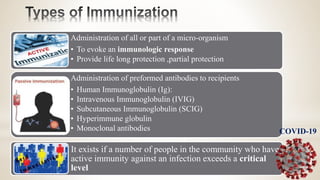
Administration of all or part of a micro-organism
• To evoke an immunologic response
• Provide life long protection ,partial protection
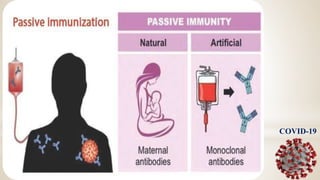
Administration of preformed antibodies to recipients
• Human Immunoglobulin (Ig):
• Intravenous Immunoglobulin (IVIG)
• Subcutaneous Immunoglobulin (SCIG)
• Hyperimmune globulin
• Monoclonal antibodies
It exists if a number of people in the community who have
active immunity against an infection exceeds a critical
level
COVID-19
COVID-19
COVID-19
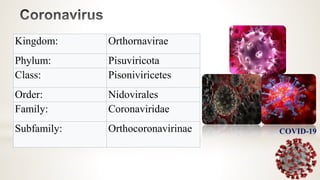
Kingdom: Orthornavirae
Phylum: Pisuviricota
Class: Pisoniviricetes
Order: Nidovirales
Family: Coronaviridae
Subfamily: Orthocoronavirinae
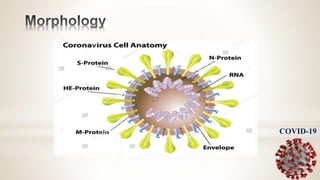
They are enveloped viruses with a positive- sense
single-stranded RNA genome,
The name corona virus is derived from the Latin
corona, meaning "crown" or "halo“.
COVID-19
Coronaviruses are classified into three groups,
The HCoVs 229E and HCoV NL63 are group 1
coronaviruses[6]
HCoV OC43, HCoV HKU-1 and SARS
coronaviruses are classified in group 2[6]
GROUP 3 Is avian strains Causing infection in
chickens
COVID-19
COVID-19
It is caused by SARS-CoV-2 is closely related to
Sever Acute Respiratory Syndrome Corona Virus
which was outbreaks in 2003.
It is thought to have a zoonotic origin.
COVID-19
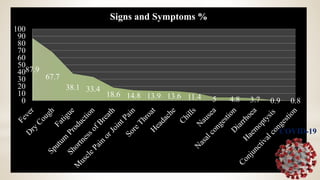
87.9
67.7
38.1 33.4
18.6 14.8 13.9 13.6 11.4 5 4.8 3.7 0.9 0.8
0
10
20
30
40
50
60
70
80
90
100
Signs and Symptoms %
COVID-19
 Mild illness
 Pneumonia
 Severe Pneumonia
 Acute respiratory distress Syndrome
 Sepsis
 Septic Shock
COVID-19
Infection by the virus can be provisionally diagnosed
on the basis of symptoms, though confirmation is
ultimately by reverse transcription polymerase chain
reaction (rRT- PCR) of infected secretions ,
(71% sensitivity) and CT imaging (98 % sensitivity)
COVID-19
COVID-19
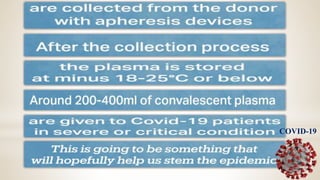
The NIBD head, Dr Tahir Shamshi, who had proposed
the technique to the government authorities for the
treatment of COVID-19 last month, told [1]
The Express Tribune that the process to extract plasma
from recovered coronavirus patients[2]
COVID-19
Clinical trials are under way,
One vaccine called mRNA-1273 would tell your cells
to pump out a protein that will kick-start your immune
system to fight the virus. It’s worked well in animals
and is ready to test in humans
COVID-19
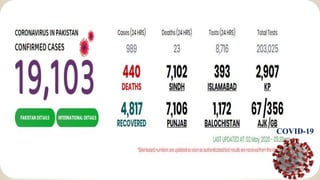
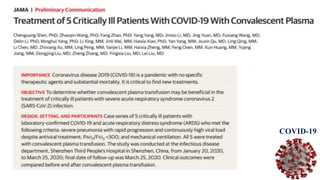
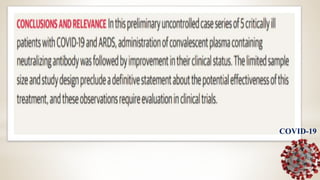
Caregivers are resorting to using century-old
Convalescent plasma therapy — siphoning blood
from survivors and reinfusing it into the sick[3]
COVID-19
COVID-19
COVID-19
COVID-19
COVID-19
COVID-19
COVID-19
COVID-19
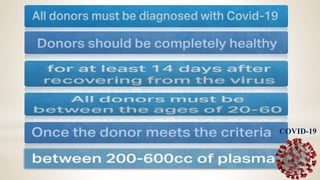
Recovered patient can donate his blood plasma after
every two weeks which could save the live of at least
one patient.[1]
COVID-19
1. https://tribune.com.pk/story/2194441/1-nidb-set-treat-
covid-19-patients-passive-immunisation/
2. https://tribune.com.pk/
3. https://www.theverge.com/2020/4/13/21216513/plasma-
blood-coronavirus-treament-drug-development-antibodies
4. Covid-19: FDA approves the use of convalescent plasma
to treat critically ill patients. BMJ 2020; 368 doi:
https://doi.org/10.1136/bmj.m1256
5. Treatment of 5 Critically Ill Patients With COVID-19 With
Convalescent Plasma. JAMA. 2020 Mar 27. doi:
10.1001/jama.2020.4783
6.https://www.ncbi.nlm.nih.gov/books/NBK7782/
7. International Committee on Taxonomy of Viruses
(2010-08-24). "ICTV Master Species List 2009—v10"
passive immunization corona virus.pptx

passive immunization corona virus.pptx

  • 2.
    Presented By: NidaKhan Subject: Advanced Immunology Assigned By: Dr.Basit Zeeshan Program: MS Biotechnology Roll Number: L1S20MSBT0010 University Of Central Punjab
  • 3.
    Immunization and itsTypes Passive immunization Coronavirus Introduction Classification  Causes and symptoms Trails
  • 4.
    “Immunization is theprocess whereby a person is made immune or resistant to an infectious disease, typically by the administration of a vaccine. Vaccines stimulate the body's own immune system to protect the person against subsequent infection or disease.” - WHO COVID-19
  • 5.
    Administration of allor part of a micro-organism • To evoke an immunologic response • Provide life long protection ,partial protection Administration of preformed antibodies to recipients • Human Immunoglobulin (Ig): • Intravenous Immunoglobulin (IVIG) • Subcutaneous Immunoglobulin (SCIG) • Hyperimmune globulin • Monoclonal antibodies It exists if a number of people in the community who have active immunity against an infection exceeds a critical level COVID-19
  • 6.
  • 7.
    COVID-19 Kingdom: Orthornavirae Phylum: Pisuviricota Class:Pisoniviricetes Order: Nidovirales Family: Coronaviridae Subfamily: Orthocoronavirinae
  • 8.
    They are envelopedviruses with a positive- sense single-stranded RNA genome, The name corona virus is derived from the Latin corona, meaning "crown" or "halo“. COVID-19
  • 9.
    Coronaviruses are classifiedinto three groups, The HCoVs 229E and HCoV NL63 are group 1 coronaviruses[6] HCoV OC43, HCoV HKU-1 and SARS coronaviruses are classified in group 2[6] GROUP 3 Is avian strains Causing infection in chickens COVID-19
  • 10.
  • 11.
    It is causedby SARS-CoV-2 is closely related to Sever Acute Respiratory Syndrome Corona Virus which was outbreaks in 2003. It is thought to have a zoonotic origin. COVID-19
  • 12.
    87.9 67.7 38.1 33.4 18.6 14.813.9 13.6 11.4 5 4.8 3.7 0.9 0.8 0 10 20 30 40 50 60 70 80 90 100 Signs and Symptoms % COVID-19
  • 13.
     Mild illness Pneumonia  Severe Pneumonia  Acute respiratory distress Syndrome  Sepsis  Septic Shock COVID-19
  • 14.
    Infection by thevirus can be provisionally diagnosed on the basis of symptoms, though confirmation is ultimately by reverse transcription polymerase chain reaction (rRT- PCR) of infected secretions , (71% sensitivity) and CT imaging (98 % sensitivity) COVID-19
  • 15.
  • 16.
    The NIBD head,Dr Tahir Shamshi, who had proposed the technique to the government authorities for the treatment of COVID-19 last month, told [1] The Express Tribune that the process to extract plasma from recovered coronavirus patients[2] COVID-19
  • 17.
    Clinical trials areunder way, One vaccine called mRNA-1273 would tell your cells to pump out a protein that will kick-start your immune system to fight the virus. It’s worked well in animals and is ready to test in humans COVID-19
  • 18.
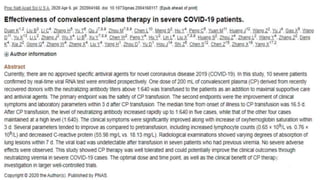
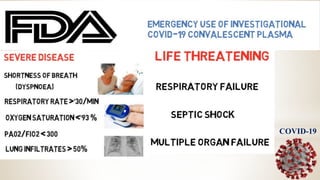
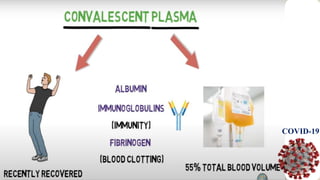
    Caregivers are resortingto using century-old Convalescent plasma therapy — siphoning blood from survivors and reinfusing it into the sick[3] COVID-19
  • 19.
  • 20.
  • 22.
  • 23.
  • 24.
  • 25.
  • 26.
  • 27.
    Recovered patient candonate his blood plasma after every two weeks which could save the live of at least one patient.[1] COVID-19
  • 28.
    1. https://tribune.com.pk/story/2194441/1-nidb-set-treat- covid-19-patients-passive-immunisation/ 2. https://tribune.com.pk/ 3.https://www.theverge.com/2020/4/13/21216513/plasma- blood-coronavirus-treament-drug-development-antibodies 4. Covid-19: FDA approves the use of convalescent plasma to treat critically ill patients. BMJ 2020; 368 doi: https://doi.org/10.1136/bmj.m1256 5. Treatment of 5 Critically Ill Patients With COVID-19 With Convalescent Plasma. JAMA. 2020 Mar 27. doi: 10.1001/jama.2020.4783
  • 29.
    6.https://www.ncbi.nlm.nih.gov/books/NBK7782/ 7. International Committeeon Taxonomy of Viruses (2010-08-24). "ICTV Master Species List 2009—v10"

Editor's Notes

  • #5 Immunizations can be divided as: •Pediatric •Adult Ways to achieve, SHORT-TERM :Disease prevention in individuals. LONG-TERM: Extermination of disease from the world.
  • #6 Active Immunization: The administration of all or part of a micro-organism or a modified product of that organism(toxoid or purified antigen) to evoke an immunologic response that mimics that of the natural infection but usually presents little or no risk for the recipient. It may provide life long protection ,partial protection or may require administration at regular intervals. It is a concentrated antibody-containing Human solution prepared from plasma obtained   Immunoglobulin (IG) from normal donors. Primarily consists of Ig G.                   Prophylaxis for:   Hepatitis A   Measles     Varicella (in immunocompromised patients when varicella-zoster IG is unavailable)   Rubella exposure during the 1st trimester of pregnancy         Side Effects • Anaphylaxis • Local inflammatory reaction     Intravenous Immunoglobulin (IVIG)                         Indications                               Side Effects To provide larger and repeated doses of human immune globulin in treating severe bacterial and viral infections as well as immune deficiency disorders.                   Kawasaki disease   HIV infection in children   Chronic B-cell lymphocytic leukemia   Primary immunodeficiencies   Immune thrombocytopenia   Prevention of graft-vs-host disease                 Hypersensitivity   Anaphylactic reactions   Coughing   Volume overload   Subcutaneous Immunoglobulin   (SCIG)                                           Hyperimmune globulin       For home use in patients with a primary immunodeficiency.   Can Local Inflammatory reactions.                             Prepared from the plasma of people with high titers of antibody against a specific organism or antigen. Available for Hepatitis B Infant botulism Rabies Tetanus CMV Varicella-zoster Can cause Anaphylactic reactions. Monoclonal Antibodies Indications Antibodies produced by a single clone of cells or cell line and consisting of identical antibody molecules. Mostly experimental role so far. Prophylaxis against RSV infection in certain high-risk children. Herd immunity If this level is achieved, then, non-vaccinated individuals are protected from the disease. In this way, transmission fails or stops without universal immunity.
  • #9 2.which refers to the characteristic appearance reminiscent of a crown when viewed under electron microscopy, due to the surface covering in club-shaped protein spikes 1. Coronaviruses are a group of related RNA viruses that cause diseases in mammals and birds. In humans, these viruses cause respiratory tract infections
  • #10 , Initially based on antigenic relationships of the spike (S), membrane (M) and nucleocapsid (N) proteins and now re-enforced by viral genetic phylogeny v
  • #11 MORPHOLOGY v Coronaviruses are large pleomorphic spherical particles with surface projections. v The diameter of the virus particles is around 120 nm. v The viral envelope consists of a lipid bilayer where the membrane (M), envelope (E) and spike (S) structural proteins are anchored. v A subset of coronaviruses (specifically the members of betacoronavirus subgroup A) also have a shorter spike-like surface protein called hemagglutinin esterase(HE). v Inside the envelope, there is the nucleocapsid, which is formed from multiple copies of the nucleocapsid (N) protein, which are bound to the positive-sense single-stranded RNA genome in a continuous beads-on-a-string type conformation. v The lipid bilayer envelope, membrane proteins, and nucleocapsid protect the virus when it is outside the host cell
  • #12 How Does the New Coronavirus Spread? SARS-CoV-2, the virus, mainly spreads from person to person. Most of the time, it spreads when a sick person coughs or sneezes. They can spray droplets as far as 6 feet away. If you breathe them in or swallow them, the virus can get into your body. Some people who have the virus don't have symptoms, but they can still spread the virus. You can also get the virus from touching a surface or object the virus is on, then touching your mouth, nose, or possibly your eyes. Most viruses can live for several hours on a surface that they land on. A study shows that the COVID-19 coronavirus can last for several hours on various types of surfaces: Copper: 4 hours Cardboard up to 24 hours Plastic or stainless steel: 2 to 3 days That’s why it’s important to disinfect surfaces to get rid of the virus.
  • #13 Signs and Symptoms… Symptom % Fever 87.9% Dry cough 67.7% Fatigue 38.1% Sputum production 33.4% Shortness of breath 18.6% Muscle pain or joint pain 14.8% Sore throat 13.9% H3/e19a/2d02a0che 13.6%
  • #17 The NIBD hospital in Karachi is equipped with four machines which can extract plasma of 40 patients per day,” Dr Shamsi said. 2. The similar technique had been used in the past for the treatment of viral diseases like influenza, polio and measles before the introduction of vaccines 3. For example, every person who survives an infection will have a slightly different mix of immune substances in their plasma. Each sick person treated with plasma, then, is getting a slightly different treatment. That can make it really difficult for researchers to tell whether plasma therapy is generally effective (or ineffective) or whether it depends on if a patient gets a really good (or bad) batch of plasma. Medical researchers are trying to address this issue by only allowing survivors with high levels of antibodies to donate plasma, but the plasma will still vary from donor to donor. In addition to the general uncertainty over how well these transfusions will work, there are also risks to any blood plasma transfusion: serious side effects can include lung injuries and allergic reactions.
  • #18 Not yet, but clinical trials are under way in the U.S. and in China to test vaccines for SARS-CoV-2/COVID-19. One vaccine called mRNA-1273 (which was developed by using messenger RNA) would tell your cells to pump out a protein that will kick-start your immune system to fight the virus. It’s worked well in animals and is ready to test in humans
  • #19 Convalescent mean a person is just recover from a disease “I think of it as a bridge, until we can develop a vaccine or pharmaceutical that can be shown to be safe, and effective, and can be produced in mass quantities,” says Elliott Bennett-Guerrero, who is studying the use of this convalescent plasma in COVID-19 patients at Stony Brook Medicine. 2. Now, doctors hope it can help people with COVID-19. Preliminary data on a handful of patients in China showed that they got better after receiving a plasma infusion from survivors, but there’s still not enough data to say for sure that it works. Researchers in the US are running controlled studies to see if patients who receive the plasma improve faster than patients who don’t.
  • #28 Cost, Rs50,000 expenses are incurred for extracting plasma from one patient but NIBD will do it free of charge.