Cost Modeling for Sustainable Services
Stephen Abrams
Patricia Cruse
John Kunze
University of California Curation Center
California Digital Library
Preservation and Archiving Special Interest Group
Dublin, October 16-19, 2012
 Understanding costs in order to plan for and
implement sustainable preservation services
 Investigating the possibility of paid-up pricing in
order to address
► Boom-or-bust budget cycles
► Fixed-term, grant funded projects
Source: www.sharedidiz.com/
Goals
 Accounting for incurred costs is hard
► Existing administrative accounting generally is not aligned
with curation services
 Projecting anticipated costs is really hard
► “What will I spend someday to do something in response
to some kind of situation …”
Source: Getty Images
Anticipating the future
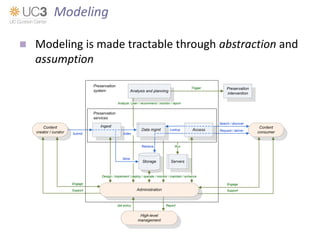
 Modeling is made tractable through abstraction and
assumption
Modeling
Ingest
High-level
management
Content
consumer
Content
creator / curator Submit
Support
Search / discover
Support
Engage
Request / deliverAccess
Administration
Data mgmt
Storage
Index
Store
Lookup
Retrieve
ReportSet policy
Analysis and planning
Preservation
system
Analyze / plan / recommend / monitor / report
Engage
Preservation
services
Preservation
intervention
Servers
Run
Trigger
Design / implement / deploy / operate / monitor / maintain / enhance
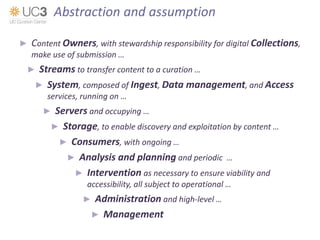
► Content Owners, with stewardship responsibility for digital Collections,
make use of submission …
► Streams to transfer content to a curation …
► System, composed of Ingest, Data management, and Access
services, running on …
► Servers and occupying …
► Storage, to enable discovery and exploitation by content …
► Consumers, with ongoing …
► Analysis and planning and periodic …
► Intervention as necessary to ensure viability and
accessibility, all subject to operational …
► Administration and high-level …
► Management
Abstraction and assumption
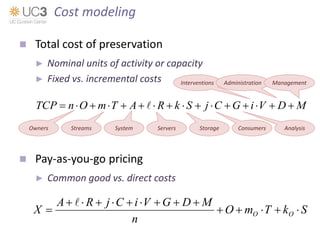
 Total cost of preservation
► Nominal units of activity or capacity
► Fixed vs. incremental costs
 Pay-as-you-go pricing
► Common good vs. direct costs
MDViGCjSkRATmOnTCP  
SkTmO
n
MDGViCjRA
X OO 



Cost modeling
Owners Streams System Servers Storage Consumers Analysis
Interventions Administration Management
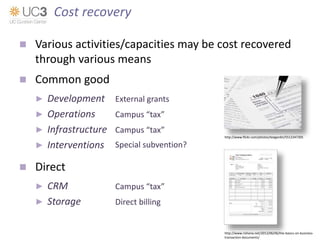
 Various activities/capacities may be cost recovered
through various means
 Common good
► Development External grants
► Operations Campus “tax”
► Infrastructure Campus “tax”
► Interventions ?
 Direct
► CRM Campus “tax”
► Storage Direct billing
Cost recovery
http://www.flickr.com/photos/teegardin/5512347305
http://www.rishona.net/2012/06/06/the-basics-on-business-
transaction-documents/
Special subvention?
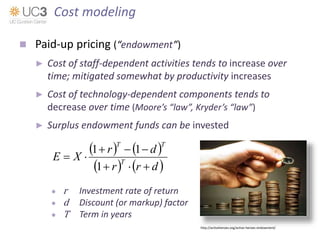
 Paid-up pricing (“endowment”)
► Cost of staff-dependent activities tends to increase over
time; mitigated somewhat by productivity increases
► Cost of technology-dependent components tends to
decrease over time (Moore’s “law”, Kryder’s “law”)
► Surplus endowment funds can be invested
● r Investment rate of return
● d Discount (or markup) factor
● T Term in years
   
   drr
dr
XE T
TT



1
11
Cost modeling
http://activeheroes.org/active-heroes-endowment/
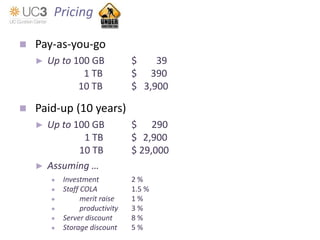
 Pay-as-you-go
► Up to 100 GB $ 39
1 TB $ 390
10 TB $ 3,900
 Paid-up (10 years)
► Up to 100 GB $ 290
1 TB $ 2,900
10 TB $ 29,000
► Assuming …
● Investment 2 %
● Staff COLA 1.5 %
● merit raise 1 %
● productivity 3 %
● Server discount 8 %
● Storage discount 5 %
Pricing
Cost Modeling for Sustainable Services
http://wiki.ucop.edu/display/Curation/Cost+Modeling
UC Curation Center
http://www.cdlib.org/uc3
uc3@ucop.edu
Stephen Abrams Mark Reyes
Patricia Cruse Abhishek Salve
Scott Fisher Joan Starr
Erik Hetzner Tracy Seneca
Greg Janée Carly Strasser
John Kunze Marisa Strong
Margaret Low Adrian Turner
David Loy Perry Willett
Information

Pasig cost-modeling-for-sustainable-services

  • 1.
    Cost Modeling forSustainable Services Stephen Abrams Patricia Cruse John Kunze University of California Curation Center California Digital Library Preservation and Archiving Special Interest Group Dublin, October 16-19, 2012
  • 2.
     Understanding costsin order to plan for and implement sustainable preservation services  Investigating the possibility of paid-up pricing in order to address ► Boom-or-bust budget cycles ► Fixed-term, grant funded projects Source: www.sharedidiz.com/ Goals
  • 3.
     Accounting forincurred costs is hard ► Existing administrative accounting generally is not aligned with curation services  Projecting anticipated costs is really hard ► “What will I spend someday to do something in response to some kind of situation …” Source: Getty Images Anticipating the future
  • 4.
     Modeling ismade tractable through abstraction and assumption Modeling Ingest High-level management Content consumer Content creator / curator Submit Support Search / discover Support Engage Request / deliverAccess Administration Data mgmt Storage Index Store Lookup Retrieve ReportSet policy Analysis and planning Preservation system Analyze / plan / recommend / monitor / report Engage Preservation services Preservation intervention Servers Run Trigger Design / implement / deploy / operate / monitor / maintain / enhance
  • 5.
    ► Content Owners,with stewardship responsibility for digital Collections, make use of submission … ► Streams to transfer content to a curation … ► System, composed of Ingest, Data management, and Access services, running on … ► Servers and occupying … ► Storage, to enable discovery and exploitation by content … ► Consumers, with ongoing … ► Analysis and planning and periodic … ► Intervention as necessary to ensure viability and accessibility, all subject to operational … ► Administration and high-level … ► Management Abstraction and assumption
  • 6.
     Total costof preservation ► Nominal units of activity or capacity ► Fixed vs. incremental costs  Pay-as-you-go pricing ► Common good vs. direct costs MDViGCjSkRATmOnTCP   SkTmO n MDGViCjRA X OO     Cost modeling Owners Streams System Servers Storage Consumers Analysis Interventions Administration Management
  • 7.
     Various activities/capacitiesmay be cost recovered through various means  Common good ► Development External grants ► Operations Campus “tax” ► Infrastructure Campus “tax” ► Interventions ?  Direct ► CRM Campus “tax” ► Storage Direct billing Cost recovery http://www.flickr.com/photos/teegardin/5512347305 http://www.rishona.net/2012/06/06/the-basics-on-business- transaction-documents/ Special subvention?
  • 8.
     Paid-up pricing(“endowment”) ► Cost of staff-dependent activities tends to increase over time; mitigated somewhat by productivity increases ► Cost of technology-dependent components tends to decrease over time (Moore’s “law”, Kryder’s “law”) ► Surplus endowment funds can be invested ● r Investment rate of return ● d Discount (or markup) factor ● T Term in years        drr dr XE T TT    1 11 Cost modeling http://activeheroes.org/active-heroes-endowment/
  • 9.
     Pay-as-you-go ► Upto 100 GB $ 39 1 TB $ 390 10 TB $ 3,900  Paid-up (10 years) ► Up to 100 GB $ 290 1 TB $ 2,900 10 TB $ 29,000 ► Assuming … ● Investment 2 % ● Staff COLA 1.5 % ● merit raise 1 % ● productivity 3 % ● Server discount 8 % ● Storage discount 5 % Pricing
  • 10.
    Cost Modeling forSustainable Services http://wiki.ucop.edu/display/Curation/Cost+Modeling UC Curation Center http://www.cdlib.org/uc3 uc3@ucop.edu Stephen Abrams Mark Reyes Patricia Cruse Abhishek Salve Scott Fisher Joan Starr Erik Hetzner Tracy Seneca Greg Janée Carly Strasser John Kunze Marisa Strong Margaret Low Adrian Turner David Loy Perry Willett Information

Editor's Notes

  • #3 The UC Curation Center is a CDL program whose mission is to provide innovative curation services to the UC community, the people of California, and the general public. Like many of you, we are being asked to transition to a partial cost-recovery operating mode, and to do so we need to understand fully our costs in order to place our service offerings on a truly sustainable footing. To further this goal, we needed to support two different pricing options: pay-as-you-go and paid-up. Pay-as-you-go pricing, as the name implies, is the operating mode of billing for preservation service on a periodic basis, generally annually. Paid-up pricing, on the other hand, is based on a one-time, up-front payment that is sufficient to fund all subsequent preservation activities over the contracted service period. Pay-as-you-pricing is only sustainable if your customer base has predicable and reliable funding sources. The economic reality at the University of California, and I suspect, at many of your institutions, lends itself towards boom-or-bust budget cycles. Additionally, much of the content that is coming our way is the result of grant funded research projects with fixed-term budgets. Given these circumstances, it is important that we can offer a paid-up option: a one-time, as a means to try to avoid “orphaned” content or risk possible data loss.
  • #11 As mentioned, there is more information available on the UC3 curation wiki. Thank you for your attention, and I’d be happy to answer any questions you may have.