Parts of Speech
Bruce Bennett
STUS 011 Basic English
Why Learn Parts of Speech?
They are the
building blocks of
English grammar.
Understanding and
applying a process
is learning to learn.
It is a foundation to
improve your writing.
The Eight Parts of Speech
Nouns
Adjectives
Pronouns
Verbs
Conjunctions
Prepositions
Adverbs
Interjections
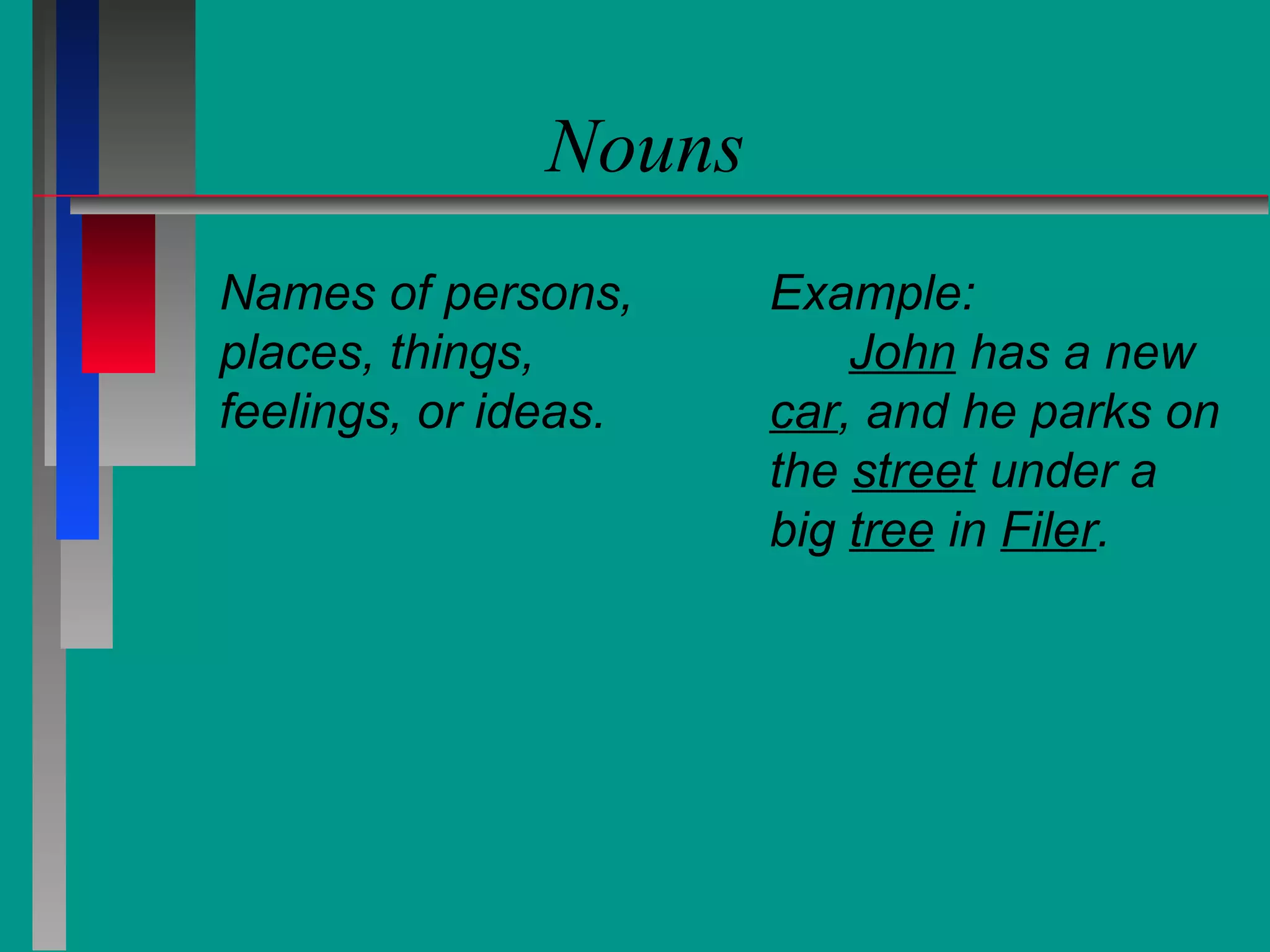
Nouns
Names of persons,
places, things,
feelings, or ideas.

Example:
John has a new
car, and he parks on
the street under a
big tree in Filer.
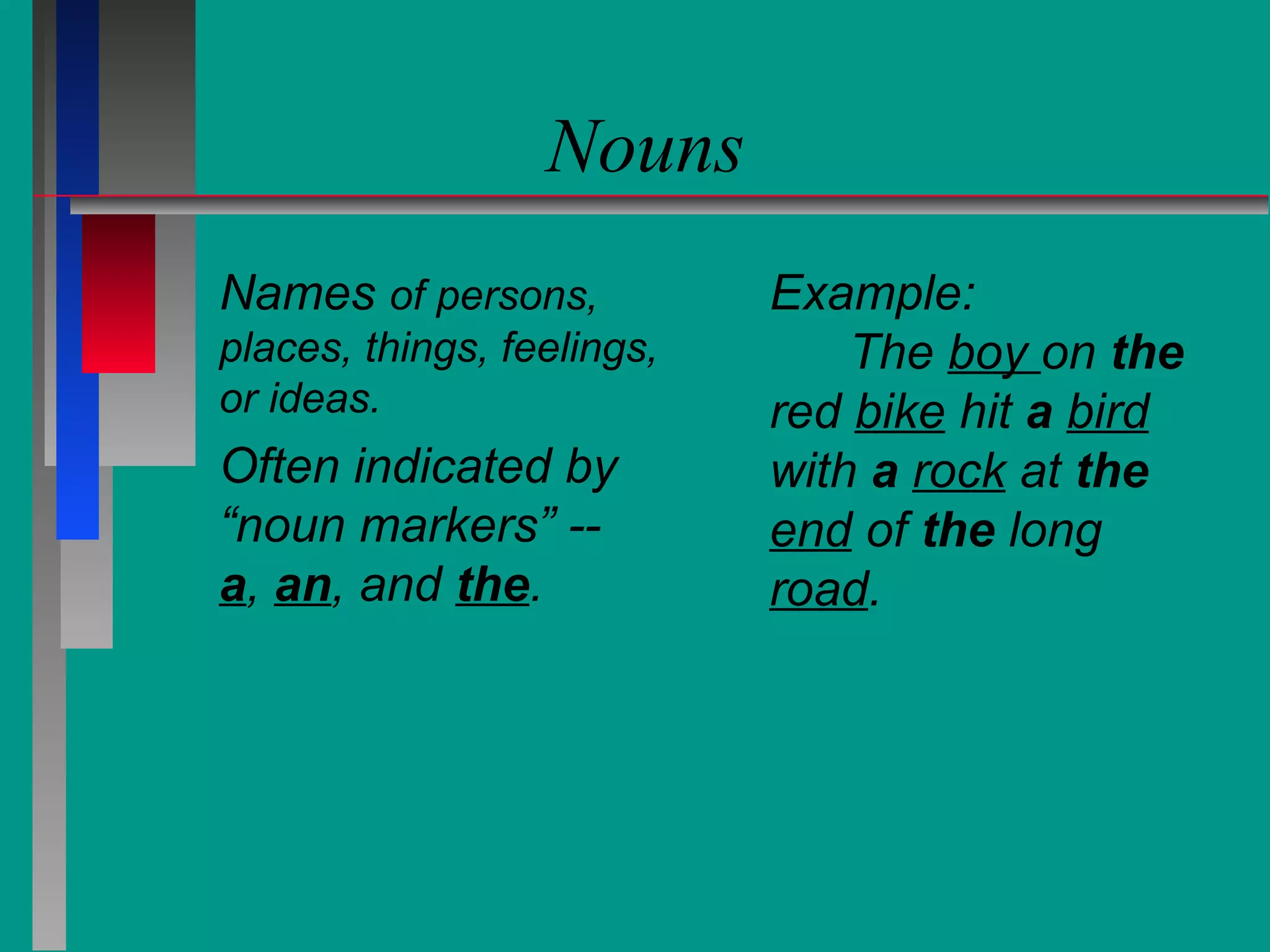
Nouns
Names of persons,
places, things, feelings,
or ideas.

Often indicated by
“noun markers” -a, an, and the.

Example:
The boy on the
red bike hit a bird
with a rock at the
end of the long
road.
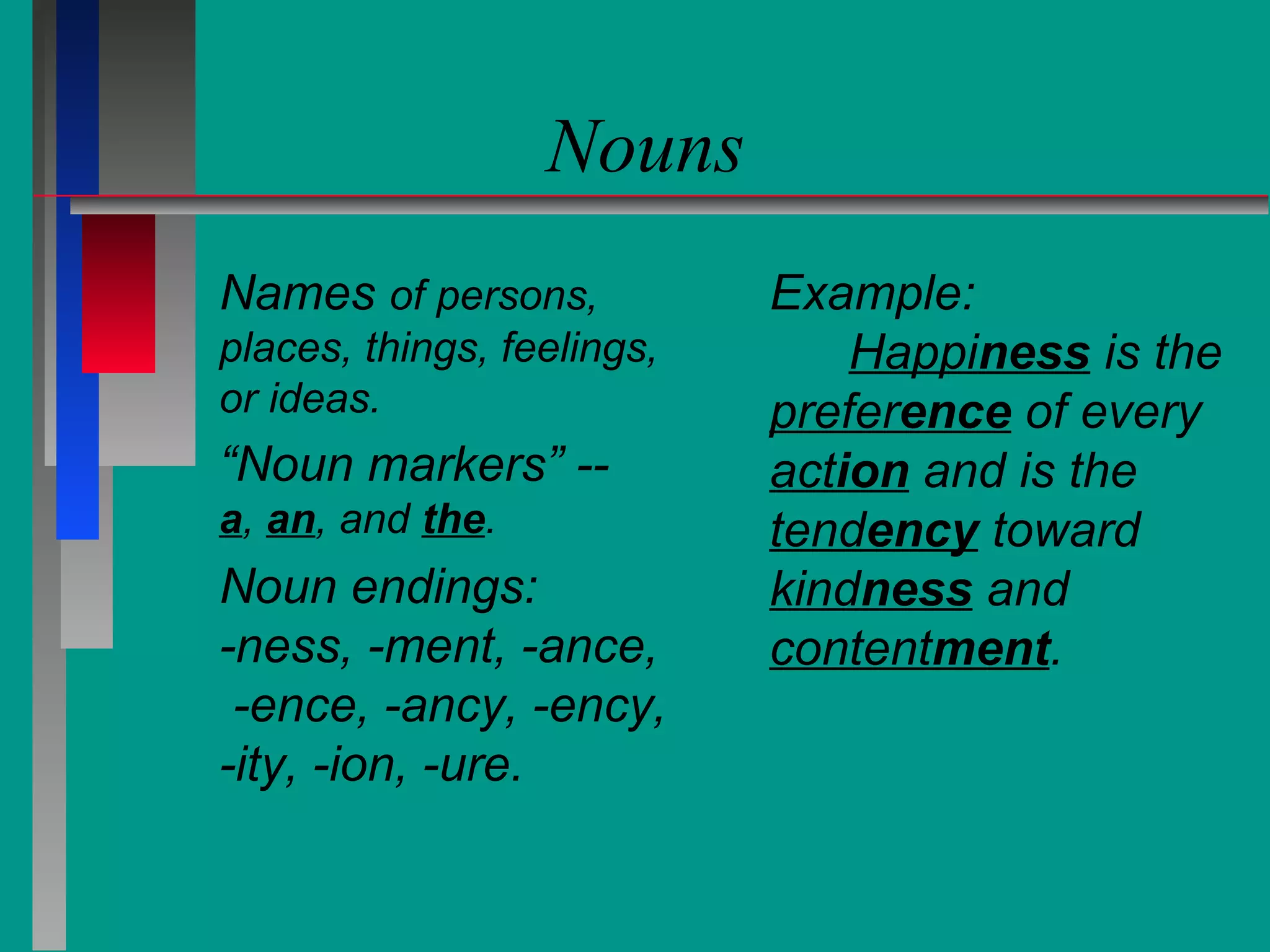
Nouns
Names of persons,
places, things, feelings,
or ideas.

“Noun markers” -a, an, and the.

Noun endings:
-ness, -ment, -ance,
-ence, -ancy, -ency,
-ity, -ion, -ure.

Example:
Happiness is the
preference of every
action and is the
tendency toward
kindness and
contentment.
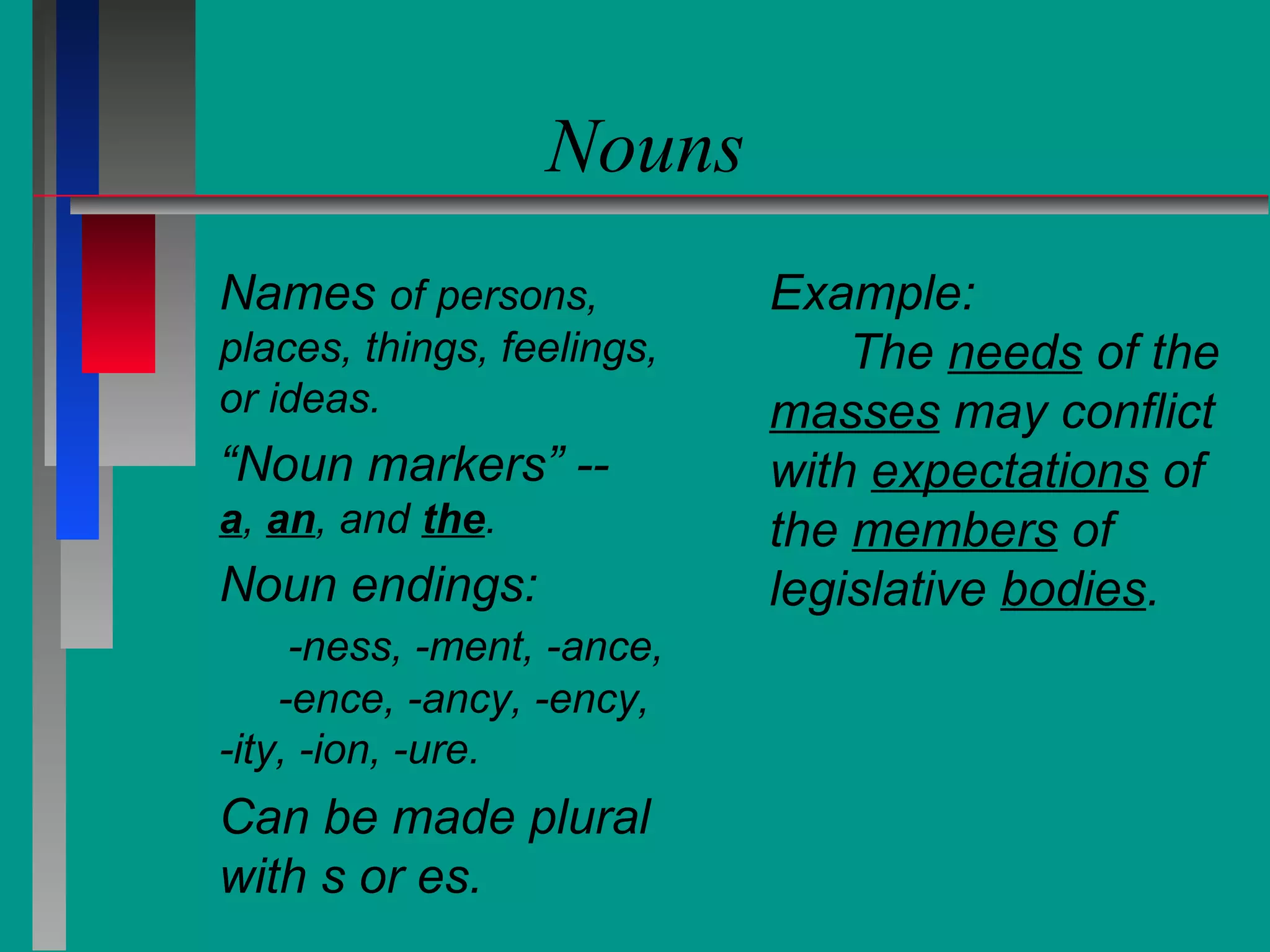
Nouns
Names of persons,
places, things, feelings,
or ideas.

“Noun markers” -a, an, and the.

Noun endings:
-ness, -ment, -ance,
-ence, -ancy, -ency,
-ity, -ion, -ure.

Can be made plural
with s or es.

Example:
The needs of the
masses may conflict
with expectations of
the members of
legislative bodies.
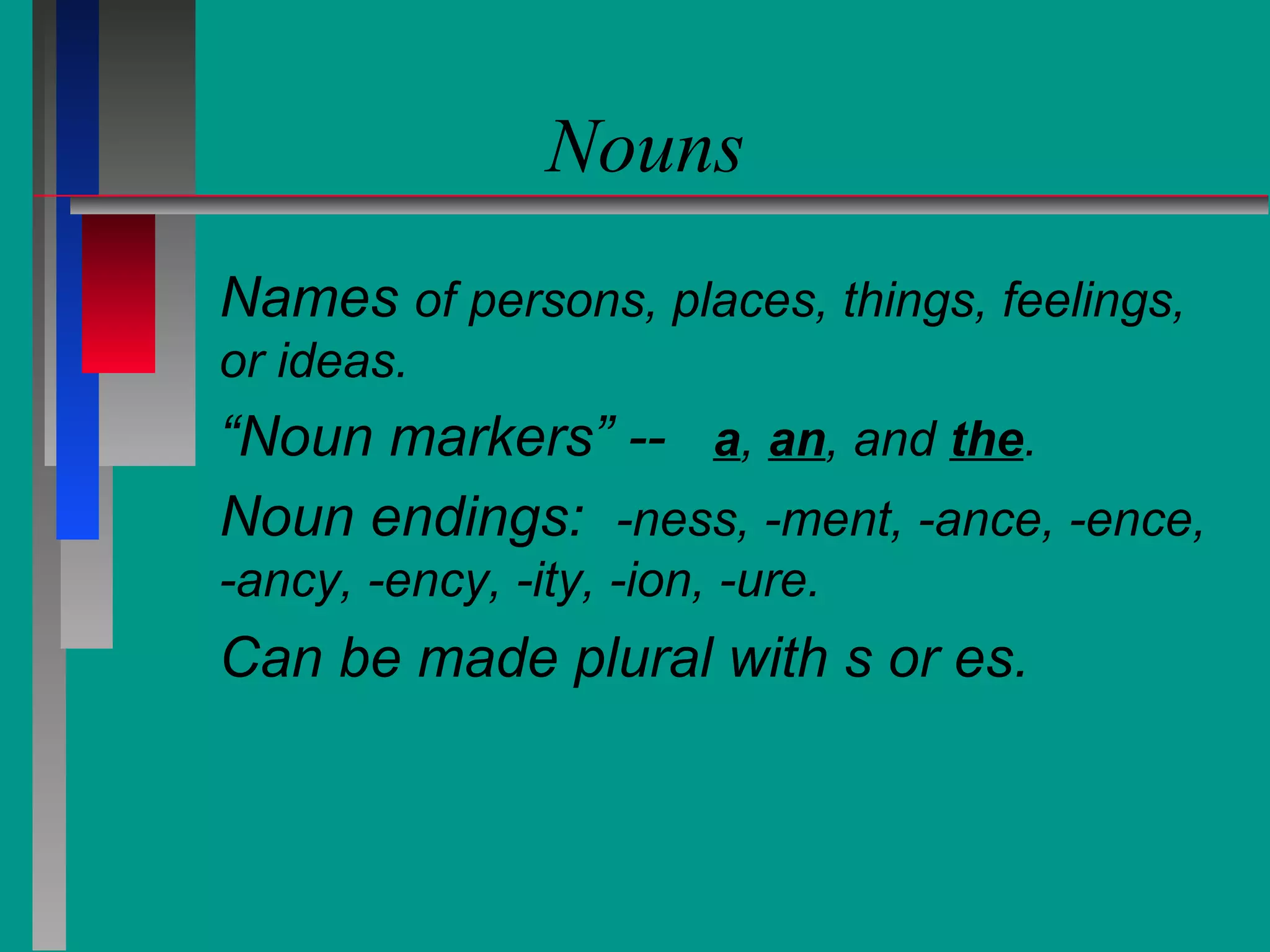
Nouns
Names of persons, places, things, feelings,
or ideas.

“Noun markers” -- a, an, and the.
Noun endings: -ness, -ment, -ance, -ence,
-ancy, -ency, -ity, -ion, -ure.

Can be made plural with s or es.
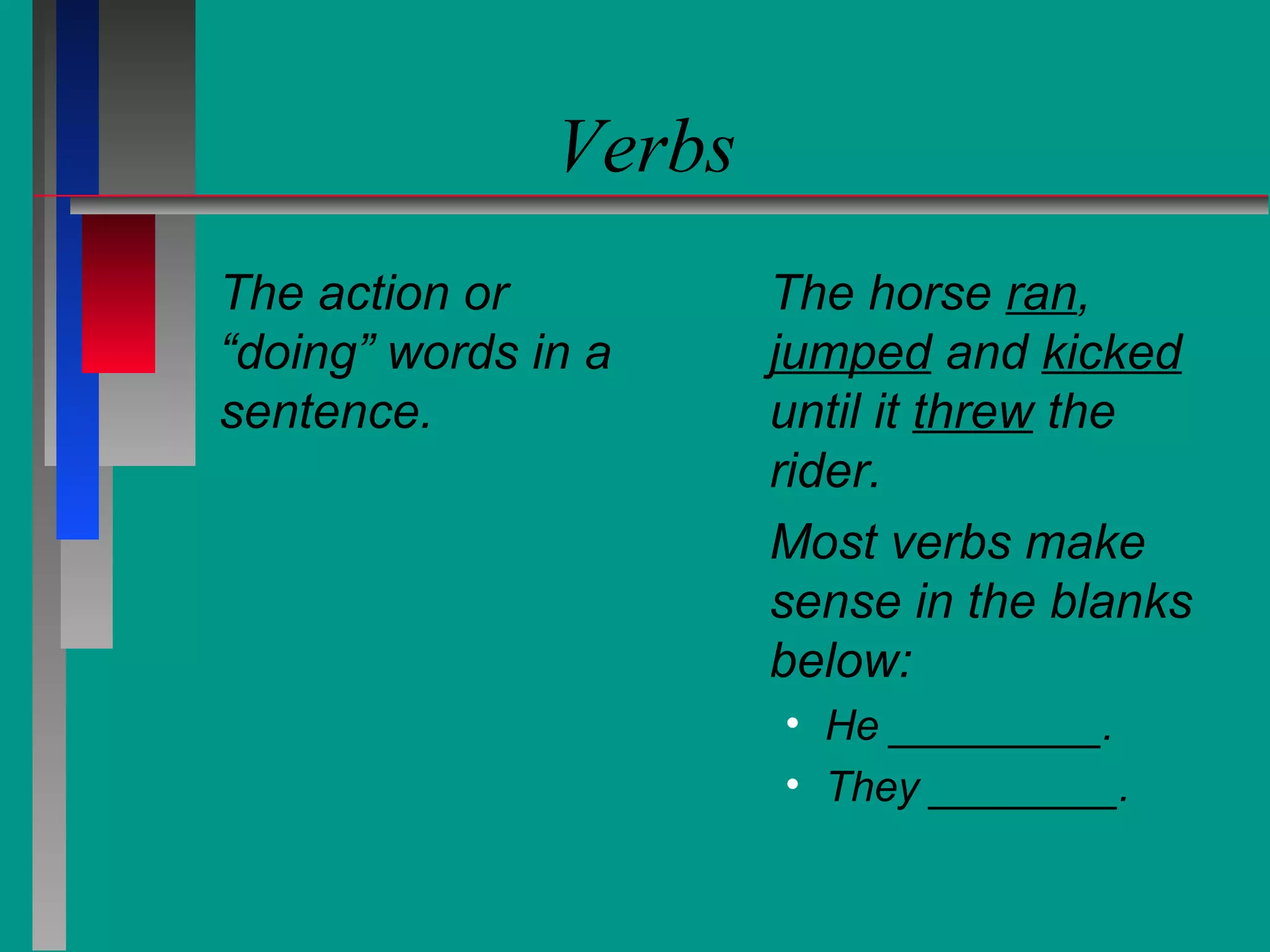
Verbs
The action or
“doing” words in a
sentence.

The horse ran,
jumped and kicked
until it threw the
rider.
Most verbs make
sense in the blanks
below:
• He _________.
• They ________.
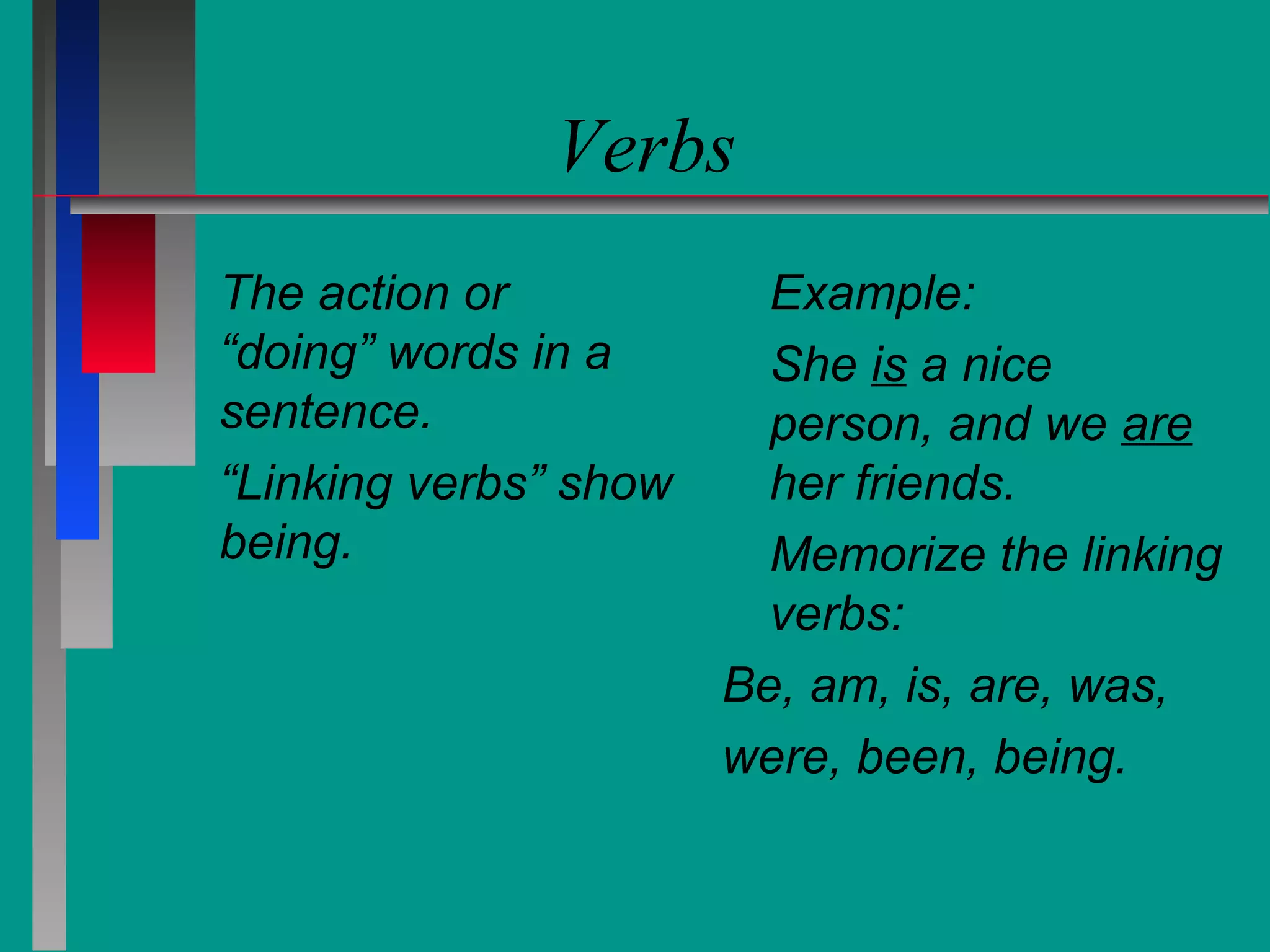
Verbs
The action or
“doing” words in a
sentence.
“Linking verbs” show
being.

Example:
She is a nice
person, and we are
her friends.
Memorize the linking
verbs:
Be, am, is, are, was,
were, been, being.
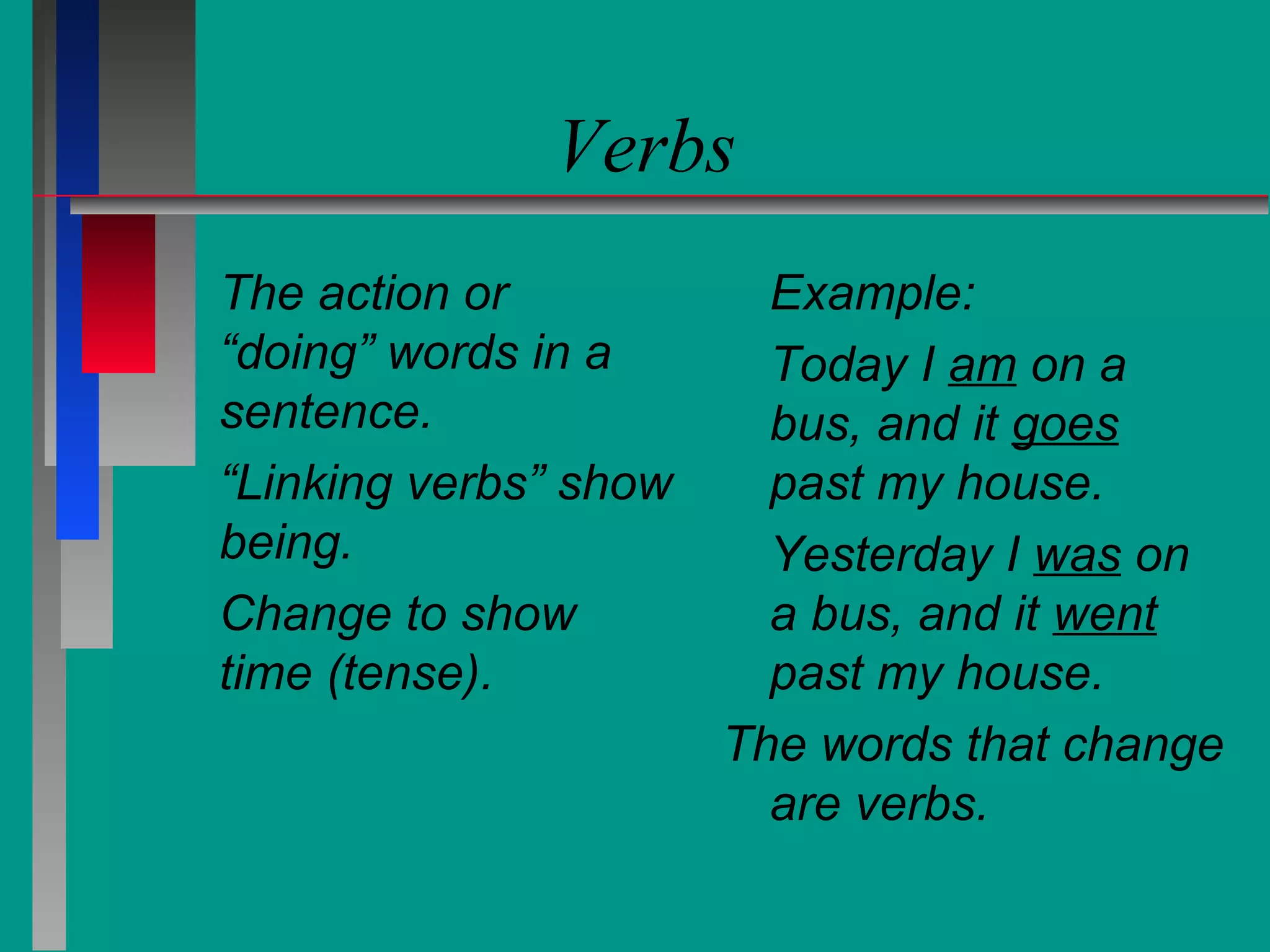
Verbs
The action or
“doing” words in a
sentence.
“Linking verbs” show
being.
Change to show
time (tense).

Example:
Today I am on a
bus, and it goes
past my house.
Yesterday I was on
a bus, and it went
past my house.
The words that change
are verbs.
Verbs
The action or
“doing” words in a
sentence.
“Linking verbs” show
being.
Change to show
time (tense).
Complete verbs
include “helping
verbs.”

Always helping verbs:
Can Will
Shall May
Could Would Should Might
Must

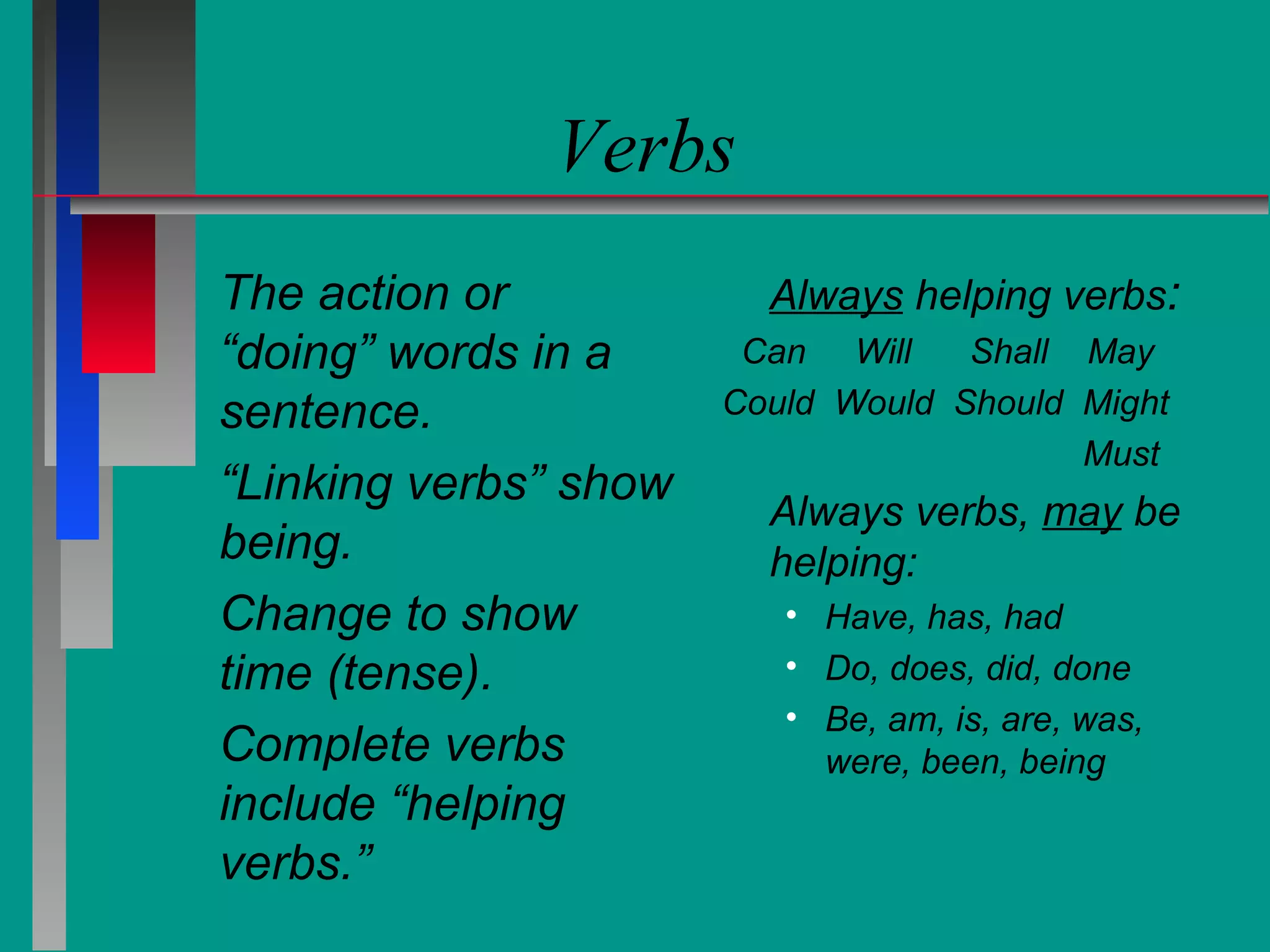
Always verbs, may be
helping:
• Have, has, had
• Do, does, did, done
• Be, am, is, are, was,
were, been, being
Verbs
The action or
“doing” words in a
sentence.
“Linking verbs” show
being.
Change to show
time (tense).
Complete verbs
include “helping
verbs.”

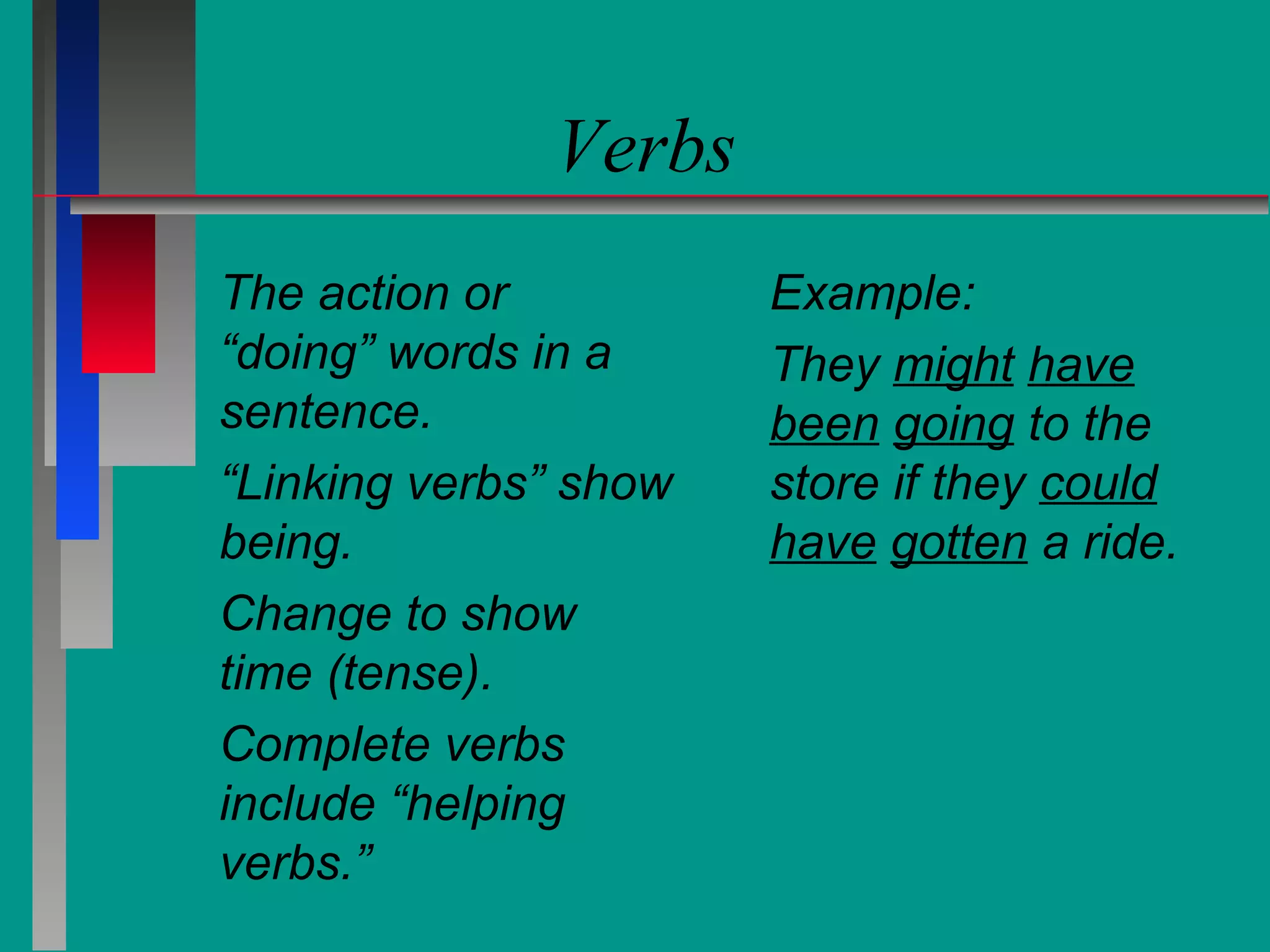
Example:
They might have
been going to the
store if they could
have gotten a ride.
Verbs
The action or “doing” words in a
sentence.
“Linking verbs” show being.
Change to show time (tense).
Complete verbs include “helping
verbs.”
Adjectives
Describe or modify
only nouns.

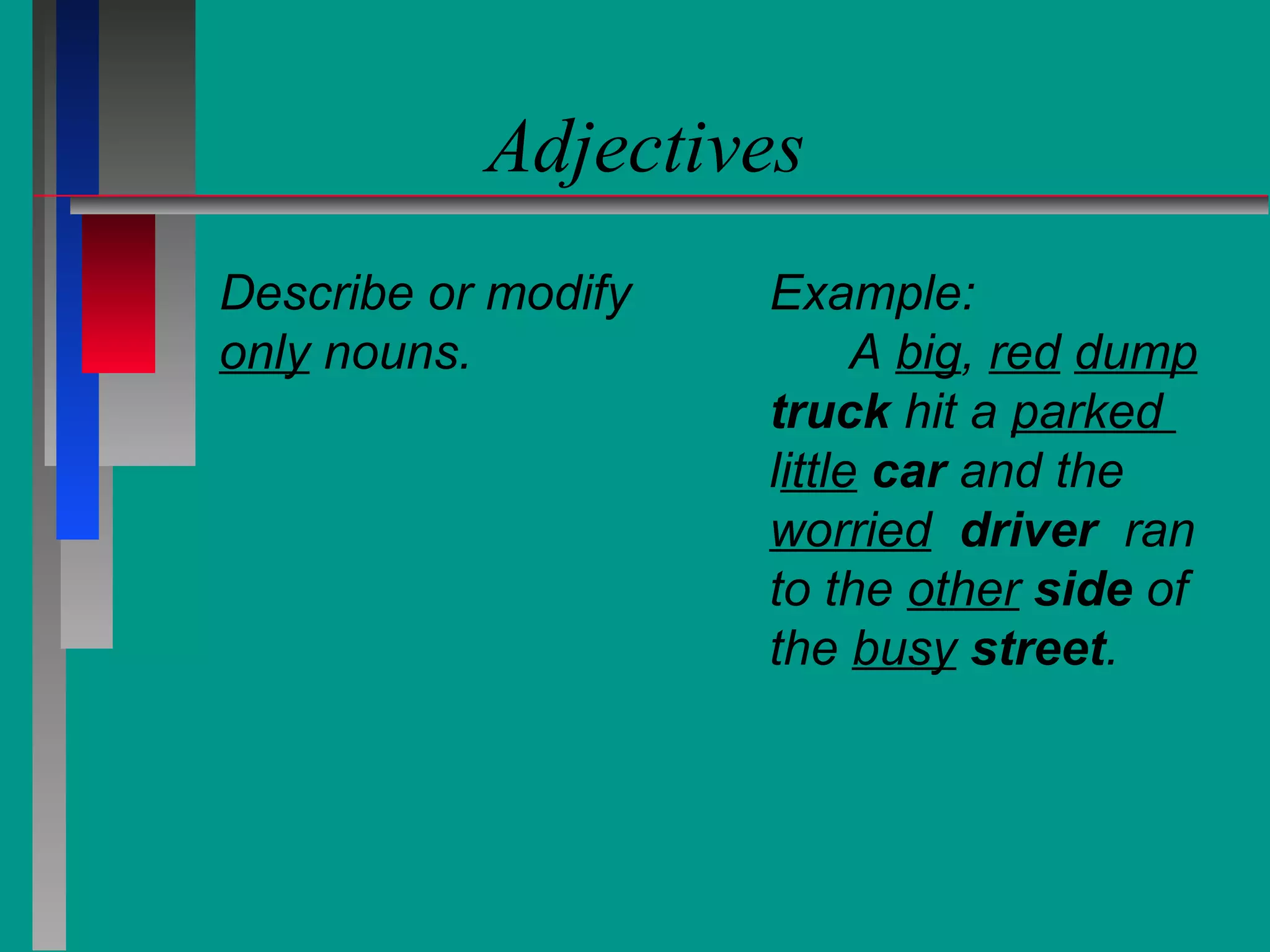
Example:
A big, red dump
truck hit a parked
little car and the
worried driver ran
to the other side of
the busy street.
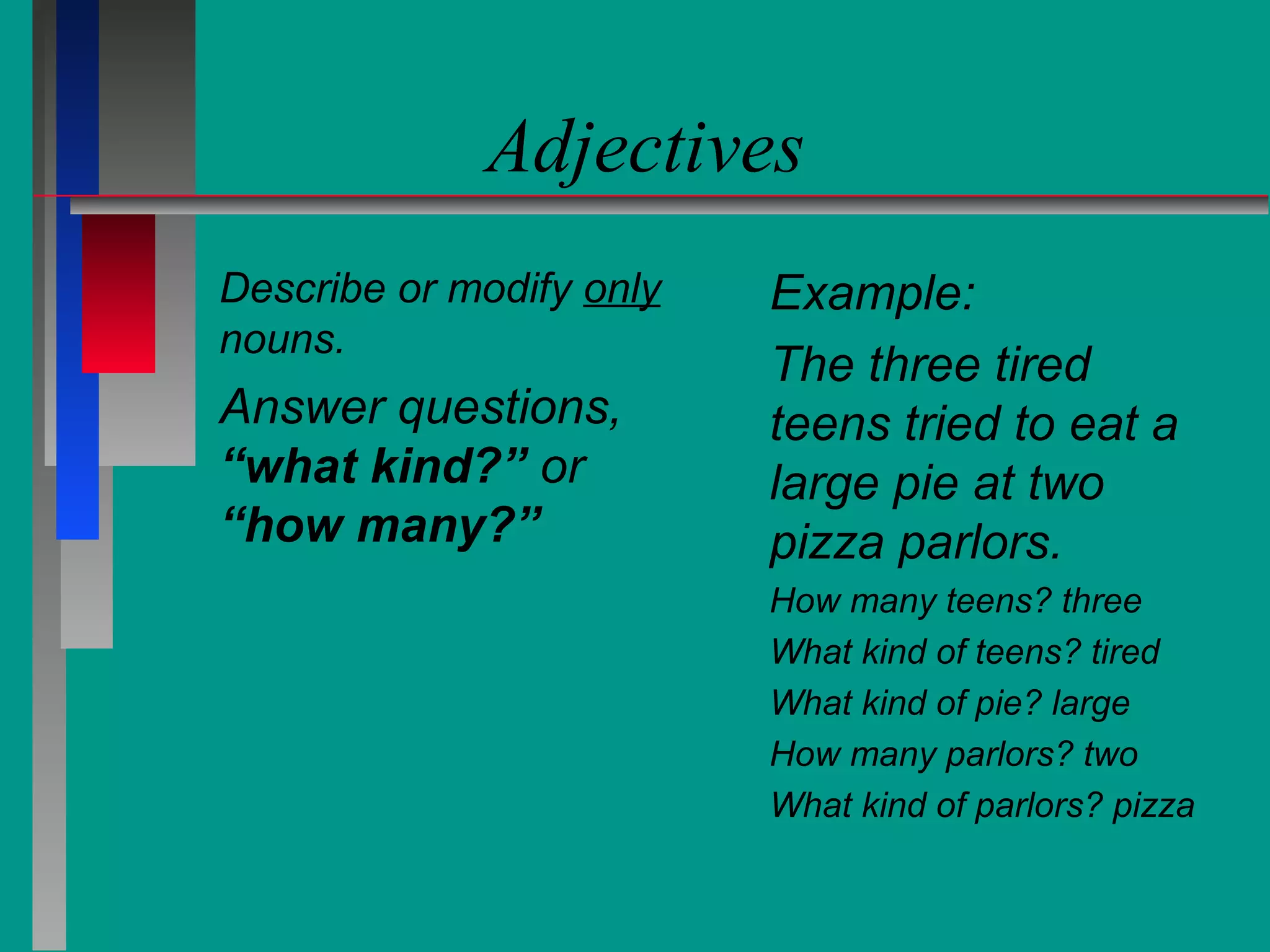
Adjectives
Describe or modify only
nouns.

Answer questions,
“what kind?” or
“how many?”

Example:
The three tired
teens tried to eat a
large pie at two
pizza parlors.
How many teens? three
What kind of teens? tired
What kind of pie? large
How many parlors? two
What kind of parlors? pizza
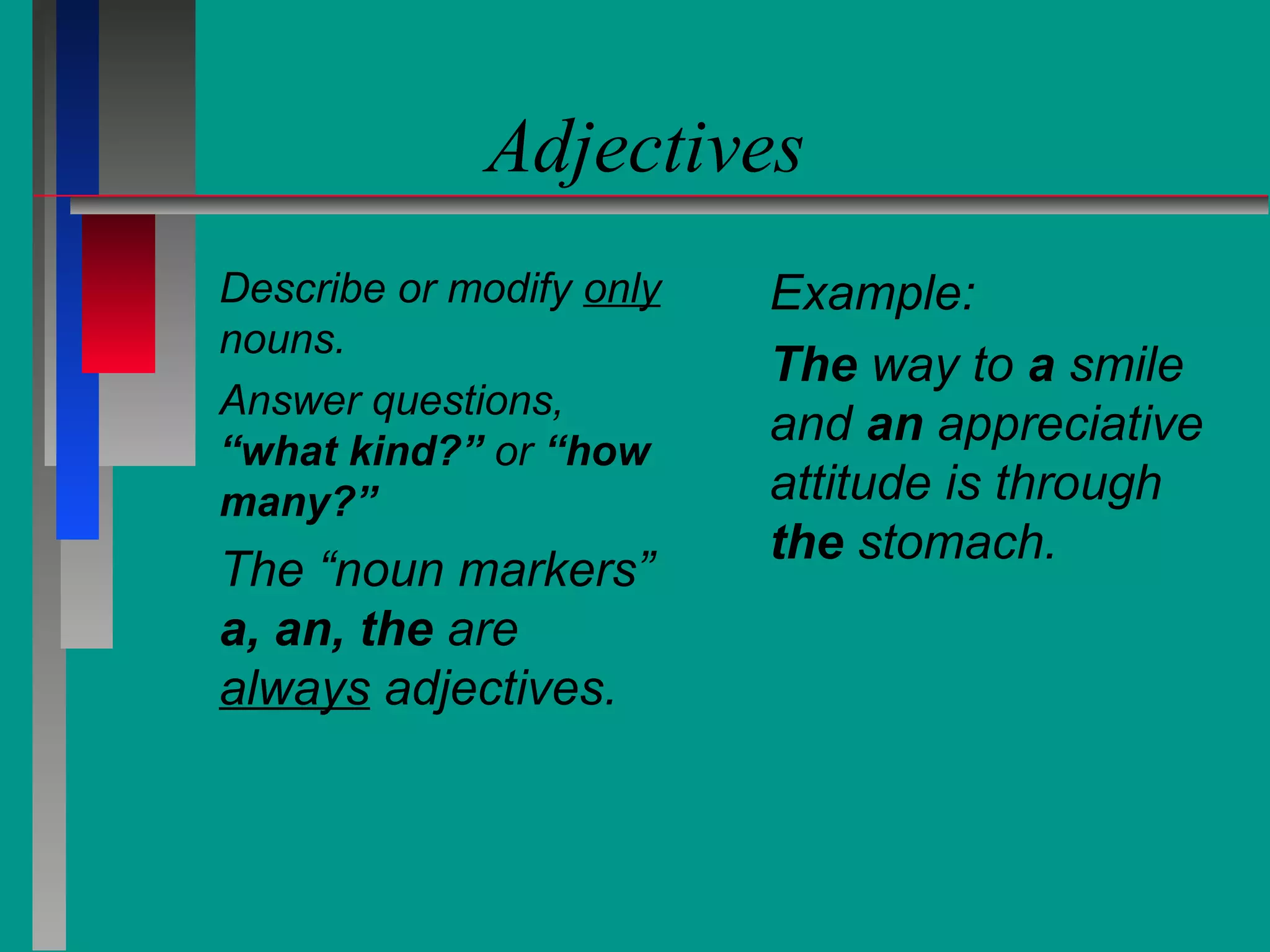
Adjectives
Describe or modify only
nouns.
Answer questions,
“what kind?” or “how
many?”

The “noun markers”
a, an, the are
always adjectives.

Example:
The way to a smile
and an appreciative
attitude is through
the stomach.
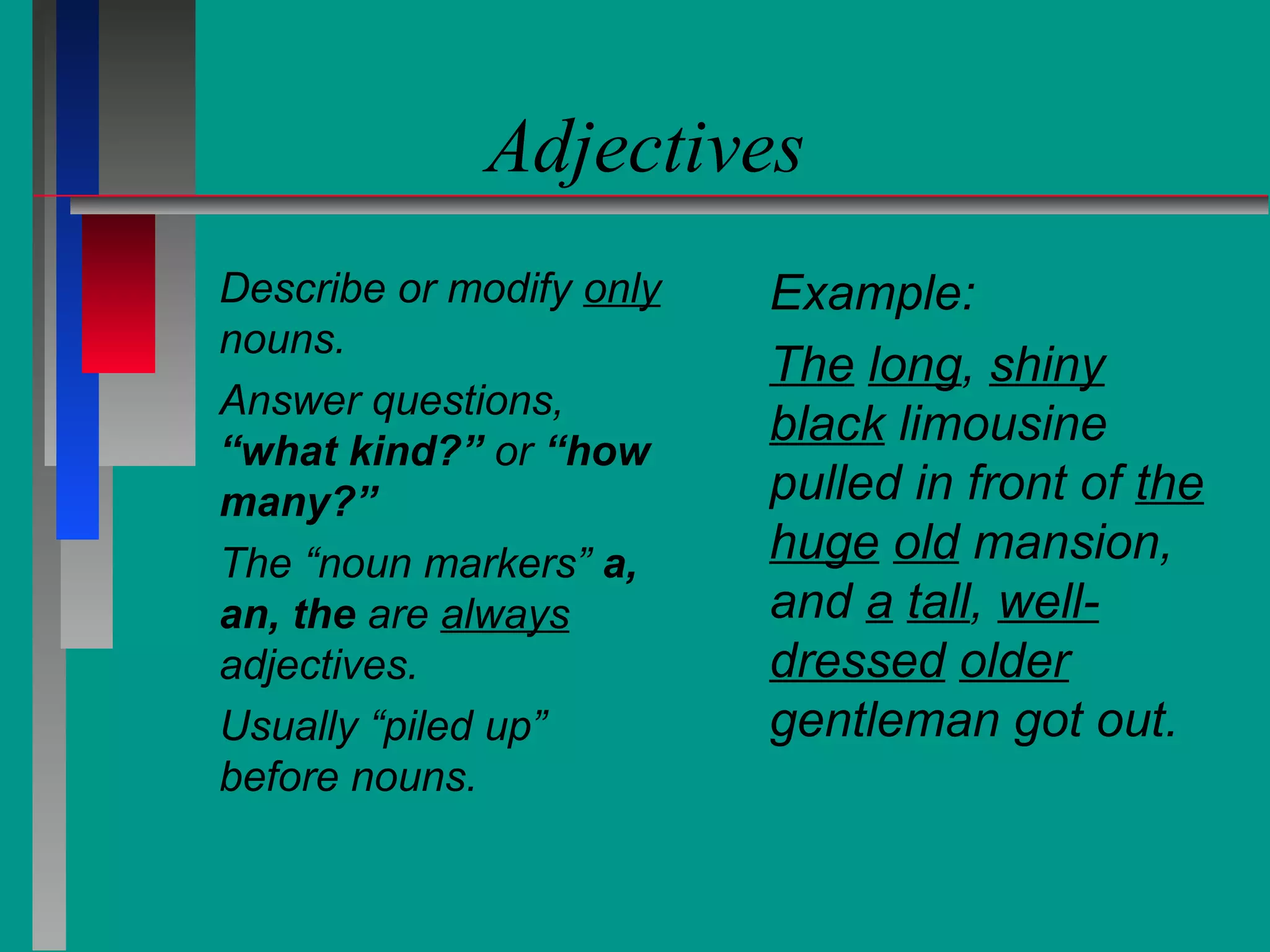
Adjectives
Describe or modify only
nouns.
Answer questions,
“what kind?” or “how
many?”
The “noun markers” a,
an, the are always
adjectives.
Usually “piled up”
before nouns.

Example:
The long, shiny
black limousine
pulled in front of the
huge old mansion,
and a tall, welldressed older
gentleman got out.
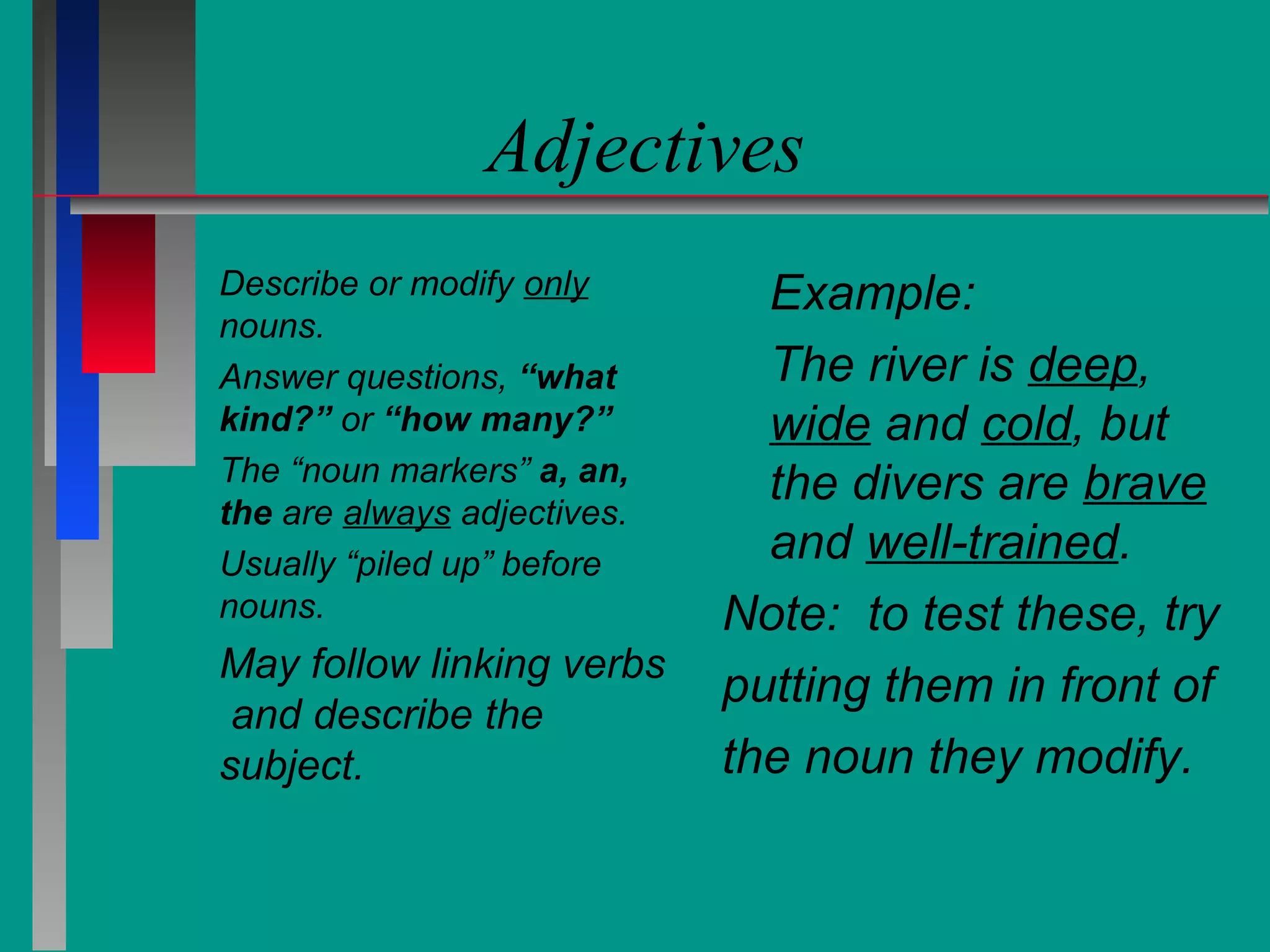
Adjectives
Describe or modify only
nouns.
Answer questions, “what
kind?” or “how many?”
The “noun markers” a, an,
the are always adjectives.
Usually “piled up” before
nouns.

May follow linking verbs
and describe the
subject.

Example:
The river is deep,
wide and cold, but
the divers are brave
and well-trained.
Note: to test these, try
putting them in front of
the noun they modify.
Adjectives
Describe or modify only nouns.
Answer questions, “what kind?” or
“how many?”
The “noun markers” a, an, the are
always adjectives.
Usually “piled up” before nouns.
May follow linking verbs and describe
the subject.
Pronouns
Specialized words to
take the place of
nouns.

Example:
Paul gave Emily
stationery because
he wanted her to
write to him when
she could.
Pronouns
Specialized words to
take the place of
nouns.
Often refer to people
and have several
forms.

Memorize:
I he we she they
me him us her them
Other common
pronouns:
• you, it, this, that,
who, what, someone,
everything, anyone,
and many other
similar words.
Pronouns
Specialized words to
take the place of nouns.
Often refer to people
and have several forms.

May be possessive,
showing ownership
and working like an
adjective.

Example:
Her red car is faster
than my old Ford,
but their new Honda
cost more than ours.
Note the form:
I he we she they
me him us her them
my his our hers theirs
Others: yours, its, whose
Pronouns
Specialized words to take the place of
nouns.
Often refer to people and have several
forms.
May be possessive, showing ownership
and working like an adjective.
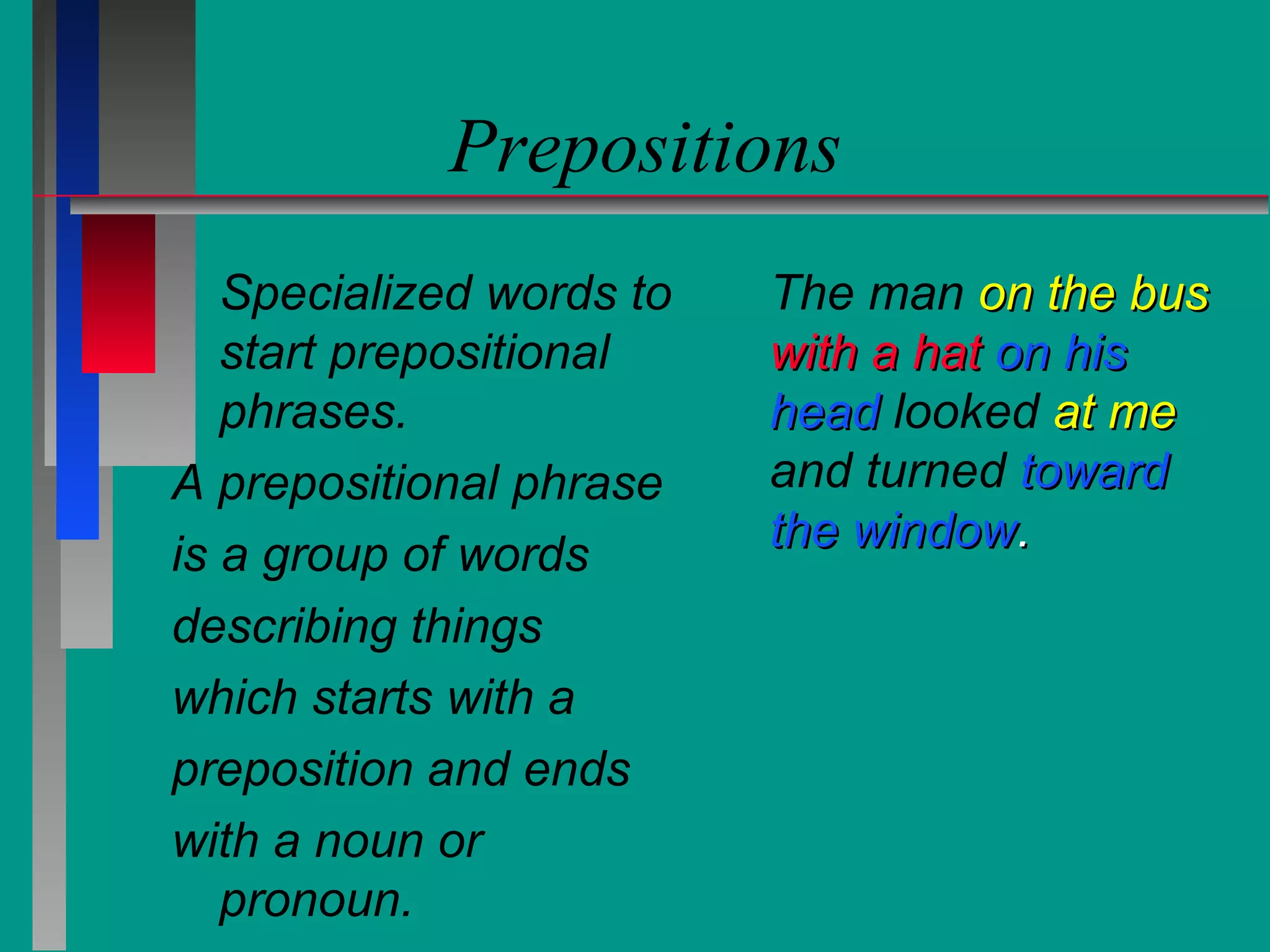
Prepositions
Specialized words to
start prepositional
phrases.
A prepositional phrase
is a group of words
describing things
which starts with a
preposition and ends
with a noun or
pronoun.

The man on the bus
with a hat on his
head looked at me
and turned toward
the window.
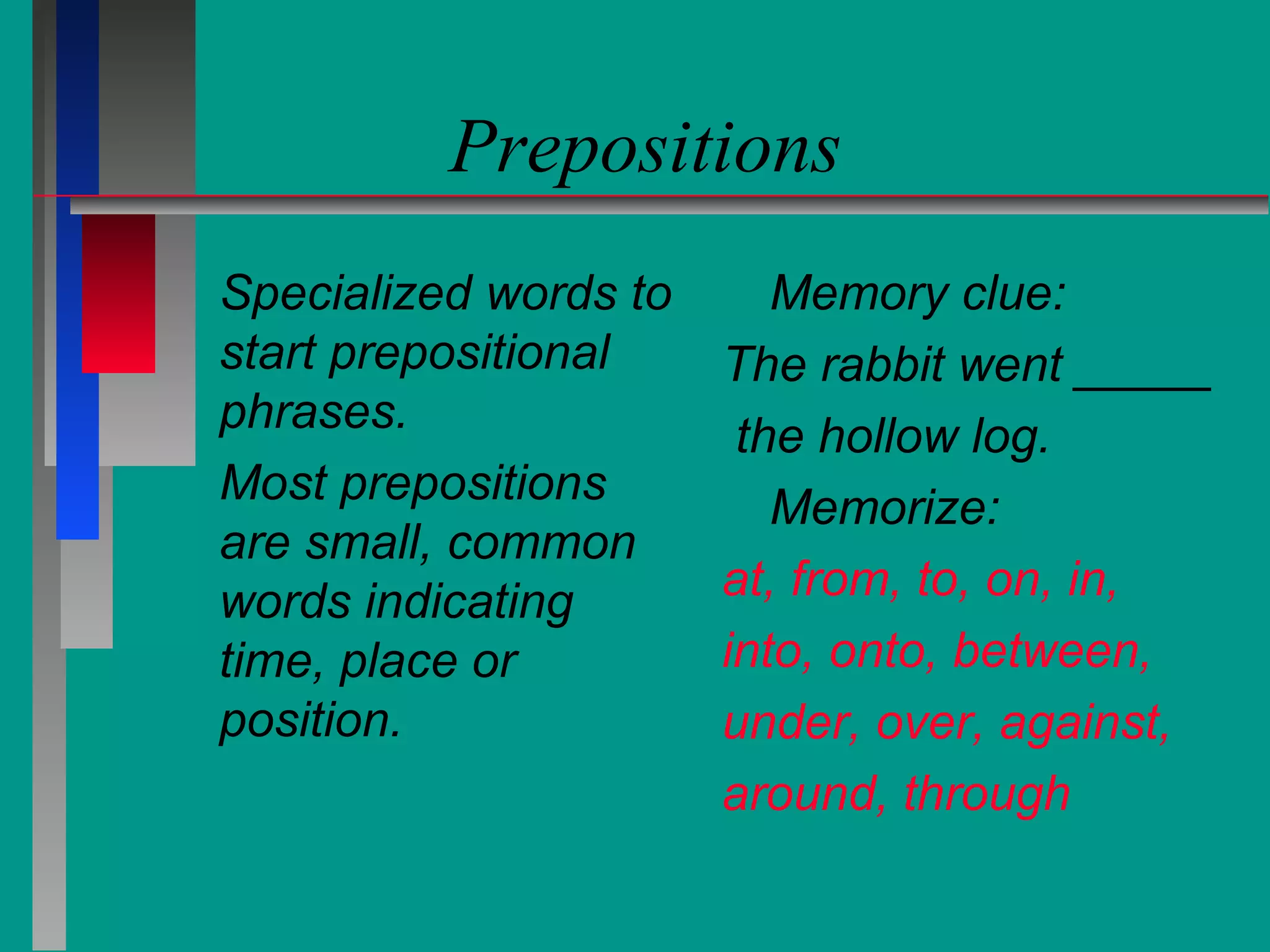
Prepositions
Specialized words to
start prepositional
phrases.
Most prepositions
are small, common
words indicating
time, place or
position.

Memory clue:
The rabbit went _____
the hollow log.
Memorize:
at, from, to, on, in,
into, onto, between,
under, over, against,
around, through
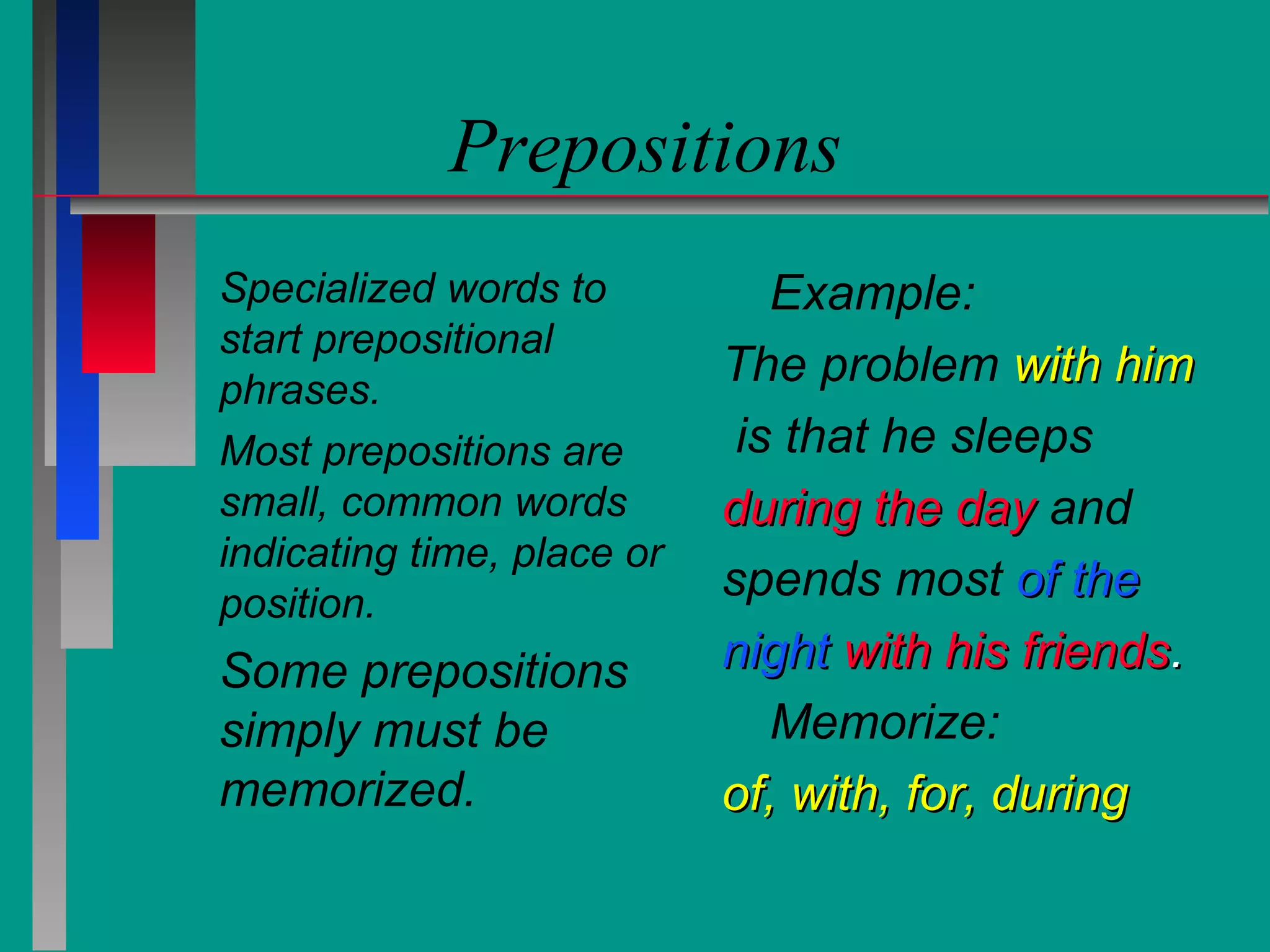
Prepositions
Specialized words to
start prepositional
phrases.
Most prepositions are
small, common words
indicating time, place or
position.

Some prepositions
simply must be
memorized.

Example:
The problem with him
is that he sleeps
during the day and
spends most of the
night with his friends.
Memorize:
of, with, for, during
Prepositions
Specialized words to start prepositional
phrases.
Most prepositions are small, common
words indicating time, place or position.
Some prepositions simply must be
memorized.
Conjunctions
Words which “hook”
words, phrases, or
sentences.
Memory clue: FAN BOYS.
For
But
And
Or
Nor
Yet
So

Example:
She and I left, but they
stayed, for Joe or Ted
was coming on the
bus, yet not on time.
Conjunctions
Words which “hook
together” words,
phrases, or
sentences.
Some conjunctions
only hook clauses.
They include:
when, as, if, since,
because, while, after,
although, before

Example:
I ran when I saw her
because I was happy
since she was home.
Memory clue:
She is cute _____ she
smiles.
Conjunctions
Words which “hook together” words,
phrases, or sentences.
Some conjunctions only hook clauses.
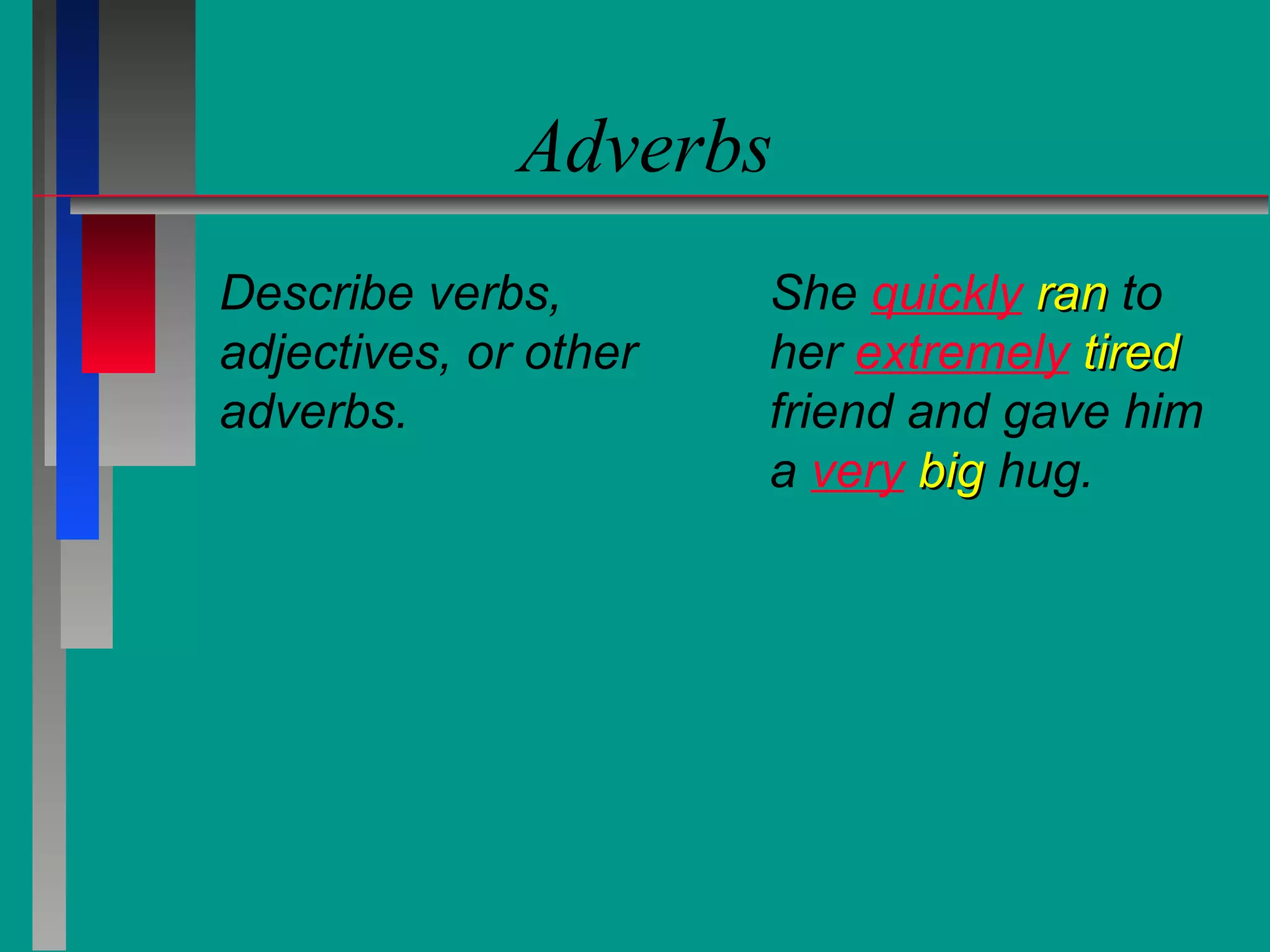
Adverbs
Describe verbs,
adjectives, or other
adverbs.

She quickly ran to
her extremely tired
friend and gave him
a very big hug.
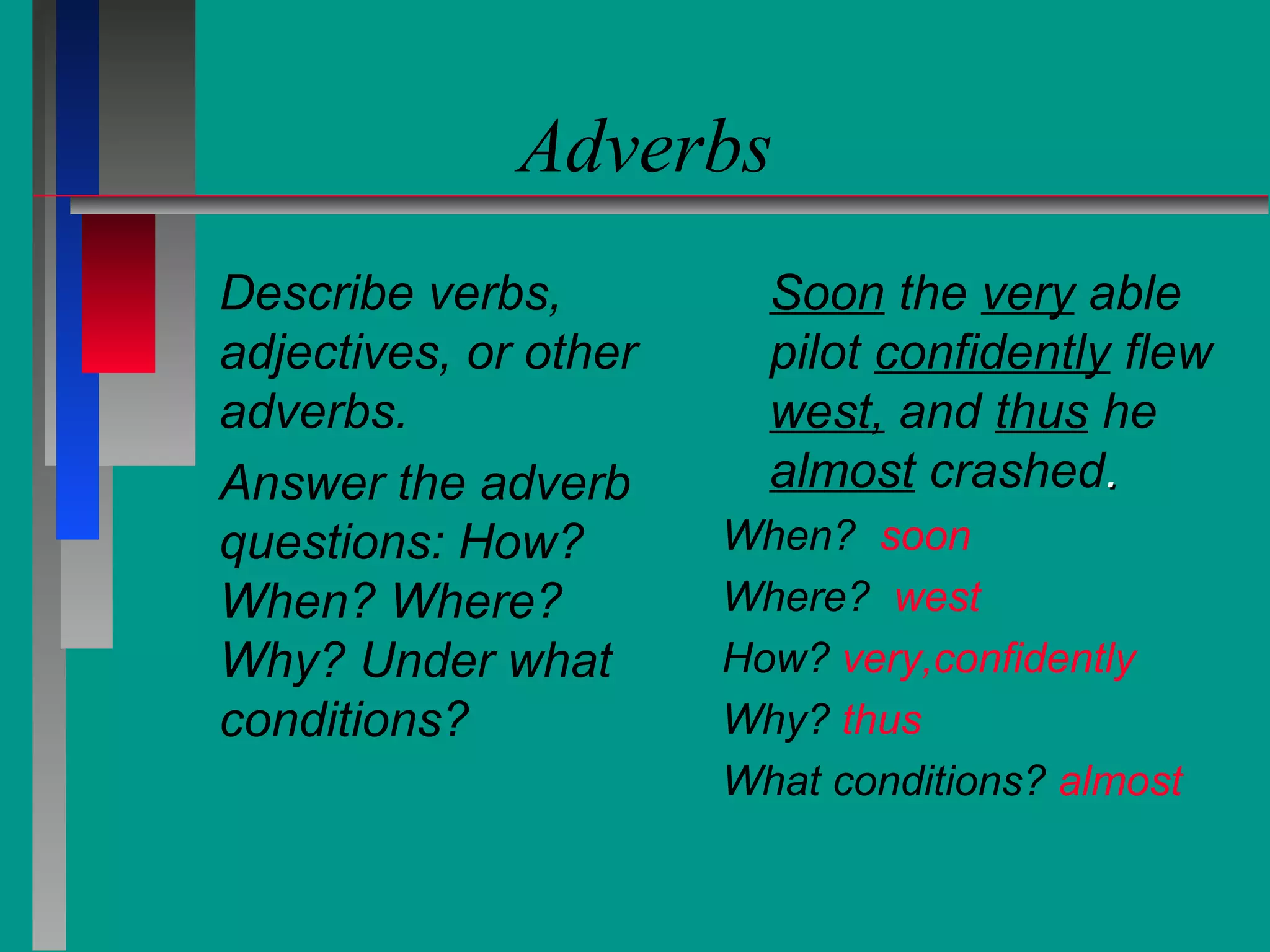
Adverbs
Describe verbs,
adjectives, or other
adverbs.
Answer the adverb
questions: How?
When? Where?
Why? Under what
conditions?

Soon the very able
pilot confidently flew
west, and thus he
almost crashed.
When? soon
Where? west
How? very,confidently
Why? thus
What conditions? almost
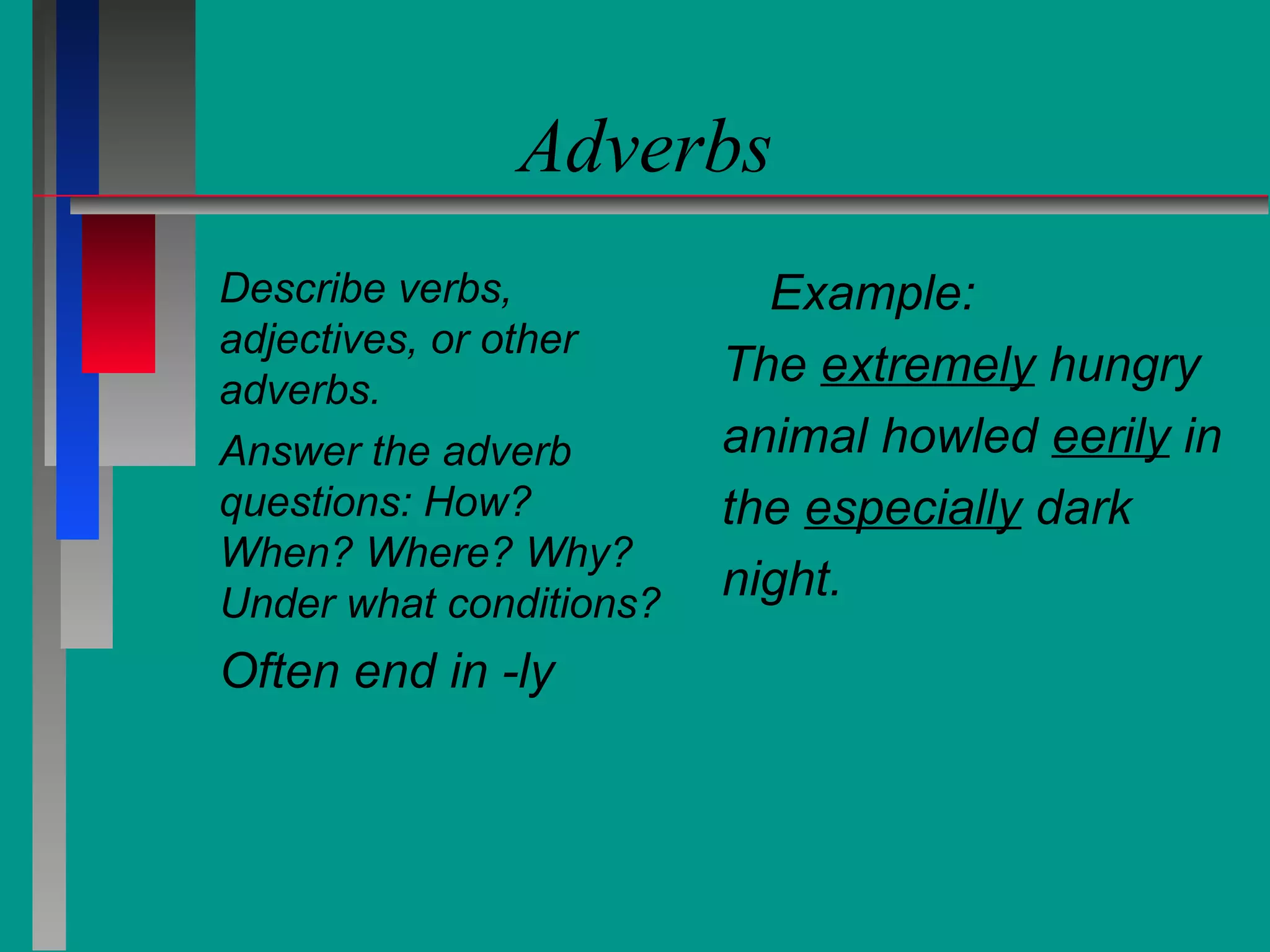
Adverbs
Describe verbs,
adjectives, or other
adverbs.
Answer the adverb
questions: How?
When? Where? Why?
Under what conditions?

Often end in -ly

Example:
The extremely hungry
animal howled eerily in
the especially dark
night.
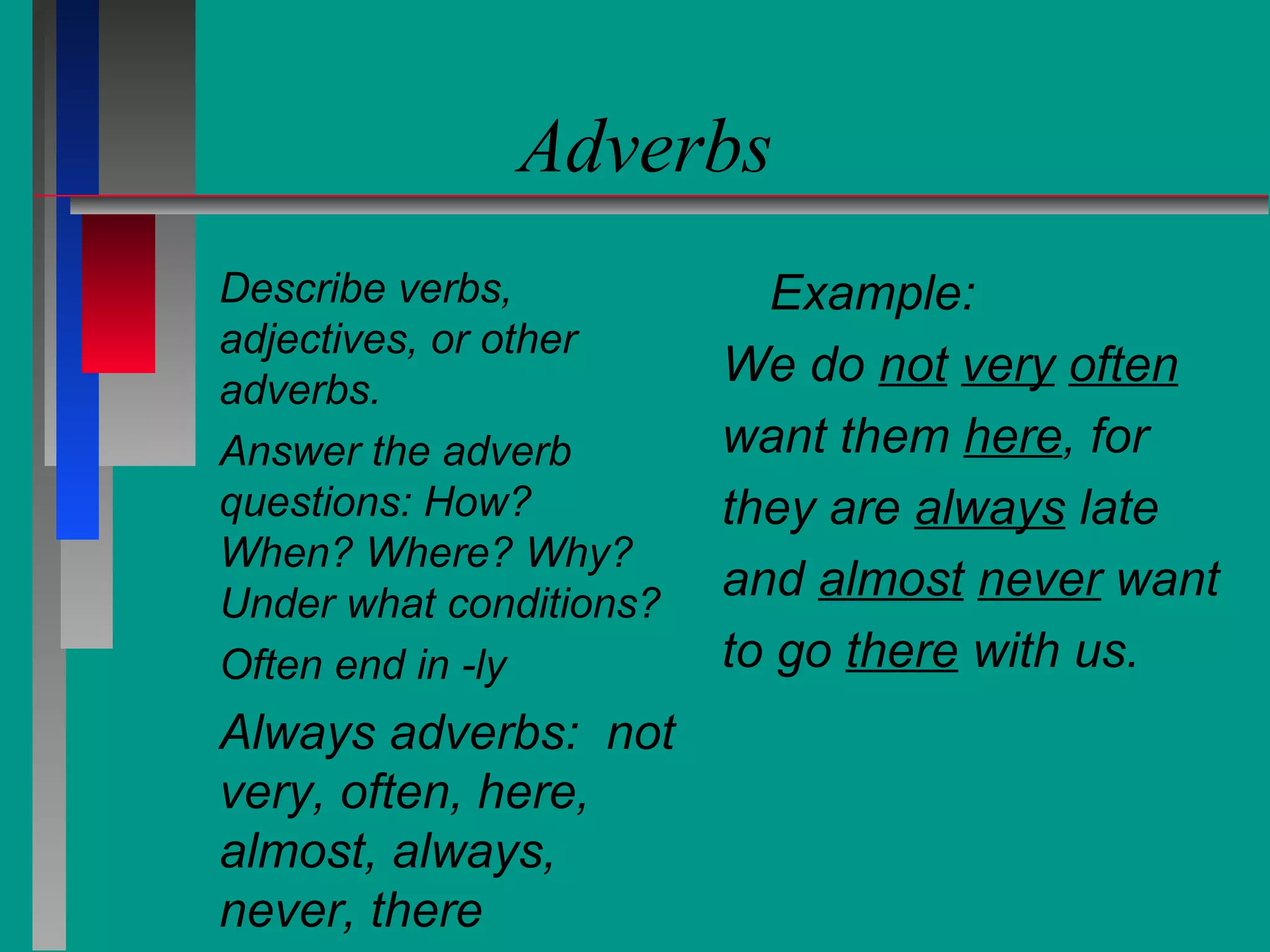
Adverbs
Describe verbs,
adjectives, or other
adverbs.
Answer the adverb
questions: How?
When? Where? Why?
Under what conditions?
Often end in -ly

Always adverbs: not
very, often, here,
almost, always,
never, there

Example:
We do not very often
want them here, for
they are always late
and almost never want
to go there with us.
Adverbs
Describe verbs, adjectives, or other
adverbs.
Answer the adverb questions: How?
When? Where? Why? Under what
conditions?
Often end in -ly
Always adverbs: not very, often, here,
almost, always, never, there
Interjections
Words which show
emotion or are
“fillers” with no other
function.

Example:
Oh, I am surprised, but
please don’t do it
again. Ouch, you hurt
me.

Parts of speech

  • 1.
    Parts of Speech BruceBennett STUS 011 Basic English
  • 2.
    Why Learn Partsof Speech?
  • 3.
    Why Learn Partsof Speech? They are the building blocks of English grammar. Understanding and applying a process is learning to learn. It is a foundation to improve your writing.
  • 4.
    The Eight Partsof Speech Nouns Adjectives Pronouns Verbs Conjunctions Prepositions Adverbs Interjections
  • 5.
    Nouns Names of persons, places,things, feelings, or ideas. Example: John has a new car, and he parks on the street under a big tree in Filer.
  • 6.
    Nouns Names of persons, places,things, feelings, or ideas. Often indicated by “noun markers” -a, an, and the. Example: The boy on the red bike hit a bird with a rock at the end of the long road.
  • 7.
    Nouns Names of persons, places,things, feelings, or ideas. “Noun markers” -a, an, and the. Noun endings: -ness, -ment, -ance, -ence, -ancy, -ency, -ity, -ion, -ure. Example: Happiness is the preference of every action and is the tendency toward kindness and contentment.
  • 8.
    Nouns Names of persons, places,things, feelings, or ideas. “Noun markers” -a, an, and the. Noun endings: -ness, -ment, -ance, -ence, -ancy, -ency, -ity, -ion, -ure. Can be made plural with s or es. Example: The needs of the masses may conflict with expectations of the members of legislative bodies.
  • 9.
    Nouns Names of persons,places, things, feelings, or ideas. “Noun markers” -- a, an, and the. Noun endings: -ness, -ment, -ance, -ence, -ancy, -ency, -ity, -ion, -ure. Can be made plural with s or es.
  • 10.
    Verbs The action or “doing”words in a sentence. The horse ran, jumped and kicked until it threw the rider. Most verbs make sense in the blanks below: • He _________. • They ________.
  • 11.
    Verbs The action or “doing”words in a sentence. “Linking verbs” show being. Example: She is a nice person, and we are her friends. Memorize the linking verbs: Be, am, is, are, was, were, been, being.
  • 12.
    Verbs The action or “doing”words in a sentence. “Linking verbs” show being. Change to show time (tense). Example: Today I am on a bus, and it goes past my house. Yesterday I was on a bus, and it went past my house. The words that change are verbs.
  • 13.
    Verbs The action or “doing”words in a sentence. “Linking verbs” show being. Change to show time (tense). Complete verbs include “helping verbs.” Always helping verbs: Can Will Shall May Could Would Should Might Must Always verbs, may be helping: • Have, has, had • Do, does, did, done • Be, am, is, are, was, were, been, being
  • 14.
    Verbs The action or “doing”words in a sentence. “Linking verbs” show being. Change to show time (tense). Complete verbs include “helping verbs.” Example: They might have been going to the store if they could have gotten a ride.
  • 15.
    Verbs The action or“doing” words in a sentence. “Linking verbs” show being. Change to show time (tense). Complete verbs include “helping verbs.”
  • 16.
    Adjectives Describe or modify onlynouns. Example: A big, red dump truck hit a parked little car and the worried driver ran to the other side of the busy street.
  • 17.
    Adjectives Describe or modifyonly nouns. Answer questions, “what kind?” or “how many?” Example: The three tired teens tried to eat a large pie at two pizza parlors. How many teens? three What kind of teens? tired What kind of pie? large How many parlors? two What kind of parlors? pizza
  • 18.
    Adjectives Describe or modifyonly nouns. Answer questions, “what kind?” or “how many?” The “noun markers” a, an, the are always adjectives. Example: The way to a smile and an appreciative attitude is through the stomach.
  • 19.
    Adjectives Describe or modifyonly nouns. Answer questions, “what kind?” or “how many?” The “noun markers” a, an, the are always adjectives. Usually “piled up” before nouns. Example: The long, shiny black limousine pulled in front of the huge old mansion, and a tall, welldressed older gentleman got out.
  • 20.
    Adjectives Describe or modifyonly nouns. Answer questions, “what kind?” or “how many?” The “noun markers” a, an, the are always adjectives. Usually “piled up” before nouns. May follow linking verbs and describe the subject. Example: The river is deep, wide and cold, but the divers are brave and well-trained. Note: to test these, try putting them in front of the noun they modify.
  • 21.
    Adjectives Describe or modifyonly nouns. Answer questions, “what kind?” or “how many?” The “noun markers” a, an, the are always adjectives. Usually “piled up” before nouns. May follow linking verbs and describe the subject.
  • 22.
    Pronouns Specialized words to takethe place of nouns. Example: Paul gave Emily stationery because he wanted her to write to him when she could.
  • 23.
    Pronouns Specialized words to takethe place of nouns. Often refer to people and have several forms. Memorize: I he we she they me him us her them Other common pronouns: • you, it, this, that, who, what, someone, everything, anyone, and many other similar words.
  • 24.
    Pronouns Specialized words to takethe place of nouns. Often refer to people and have several forms. May be possessive, showing ownership and working like an adjective. Example: Her red car is faster than my old Ford, but their new Honda cost more than ours. Note the form: I he we she they me him us her them my his our hers theirs Others: yours, its, whose
  • 25.
    Pronouns Specialized words totake the place of nouns. Often refer to people and have several forms. May be possessive, showing ownership and working like an adjective.
  • 26.
    Prepositions Specialized words to startprepositional phrases. A prepositional phrase is a group of words describing things which starts with a preposition and ends with a noun or pronoun. The man on the bus with a hat on his head looked at me and turned toward the window.
  • 27.
    Prepositions Specialized words to startprepositional phrases. Most prepositions are small, common words indicating time, place or position. Memory clue: The rabbit went _____ the hollow log. Memorize: at, from, to, on, in, into, onto, between, under, over, against, around, through
  • 28.
    Prepositions Specialized words to startprepositional phrases. Most prepositions are small, common words indicating time, place or position. Some prepositions simply must be memorized. Example: The problem with him is that he sleeps during the day and spends most of the night with his friends. Memorize: of, with, for, during
  • 29.
    Prepositions Specialized words tostart prepositional phrases. Most prepositions are small, common words indicating time, place or position. Some prepositions simply must be memorized.
  • 30.
    Conjunctions Words which “hook” words,phrases, or sentences. Memory clue: FAN BOYS. For But And Or Nor Yet So Example: She and I left, but they stayed, for Joe or Ted was coming on the bus, yet not on time.
  • 31.
    Conjunctions Words which “hook together”words, phrases, or sentences. Some conjunctions only hook clauses. They include: when, as, if, since, because, while, after, although, before Example: I ran when I saw her because I was happy since she was home. Memory clue: She is cute _____ she smiles.
  • 32.
    Conjunctions Words which “hooktogether” words, phrases, or sentences. Some conjunctions only hook clauses.
  • 33.
    Adverbs Describe verbs, adjectives, orother adverbs. She quickly ran to her extremely tired friend and gave him a very big hug.
  • 34.
    Adverbs Describe verbs, adjectives, orother adverbs. Answer the adverb questions: How? When? Where? Why? Under what conditions? Soon the very able pilot confidently flew west, and thus he almost crashed. When? soon Where? west How? very,confidently Why? thus What conditions? almost
  • 35.
    Adverbs Describe verbs, adjectives, orother adverbs. Answer the adverb questions: How? When? Where? Why? Under what conditions? Often end in -ly Example: The extremely hungry animal howled eerily in the especially dark night.
  • 36.
    Adverbs Describe verbs, adjectives, orother adverbs. Answer the adverb questions: How? When? Where? Why? Under what conditions? Often end in -ly Always adverbs: not very, often, here, almost, always, never, there Example: We do not very often want them here, for they are always late and almost never want to go there with us.
  • 37.
    Adverbs Describe verbs, adjectives,or other adverbs. Answer the adverb questions: How? When? Where? Why? Under what conditions? Often end in -ly Always adverbs: not very, often, here, almost, always, never, there
  • 38.
    Interjections Words which show emotionor are “fillers” with no other function. Example: Oh, I am surprised, but please don’t do it again. Ouch, you hurt me.