MANAGEMENT OF LABOUR
WITH PARTOGRAM
OBJECTIVES
At the end of this session you are expected to be able to:
1. Define the partogram
2. Explain the importance of using partogram in labour.
3. Describe the principles that are used to design the
partogram
4. Describe the principles of using the partogram at the
basic and comprehensive health facilities.
5. Describe the protocol for labour management with
the WHO partogram
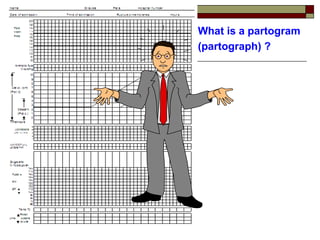
What is a partogram
(partograph) ?
Definition
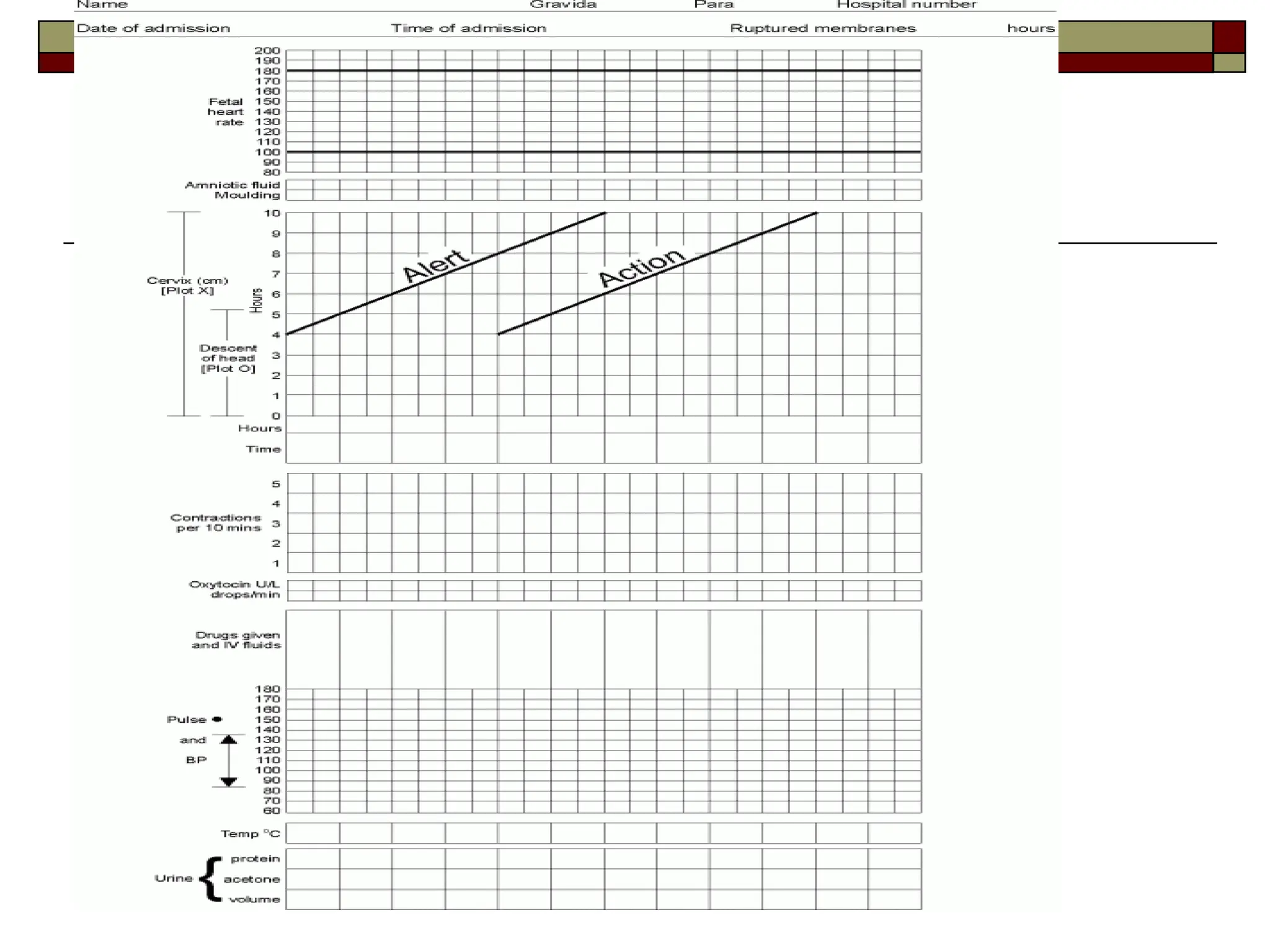
The partogram
Is a graph used in labour to
monitor the parameters of
progress of labour, maternal and
fetal wellbeing, and treatment
administration
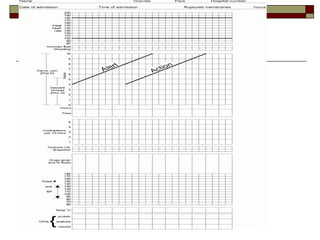
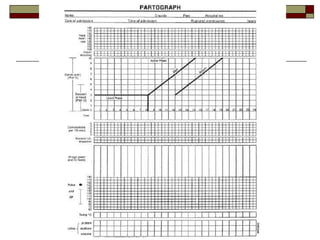
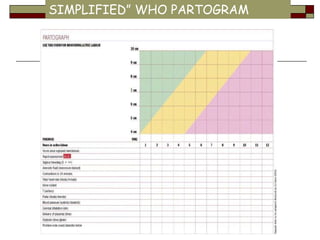
SIMPLIFIED” WHO PARTOGRAM
PRACTICAL VALUE OF USING THE
PARTOGRAM
 Offers an objective basis for overtime
monitoring the progress of labour,
maternal and fetal wellbeing.
 Enables early detection of abnormalities
of labour
 Prevention of obstructed labour and
ruptured uterus.
PRACTICAL VALUE OF PARTOGRAM cont
 Complications of obstructed labour and
ruptured uterus contribute up to 30% of
maternal deaths in some areas.
 Proper use of partogram has proved so
useful in reduction of both maternal and
perinatal mortalities and morbidities
RECOMMENDATIONS ON THE USE OF
PARTOGRAM
Based on the evidence-based reports on its
effectiveness in monitoring of labour.
WHO
Recommends its use in all labour wards and
for all women (WHO 1994)
Tanzania
Its use is obligatory at all levels of obstetric
care
PRINCIPLES USED TO DESIGN THE PARTOGRAM
The partogram depends on the principles that;
1. The latent phase should not last longer than 8
hours
2. The latent phase ends and active phase starts
when the cervix is 3cm (4cm is sometimes
used)
3. During active phase – the cervix should dilate
at not less than 1 cm per hour
PRINCIPLES cont
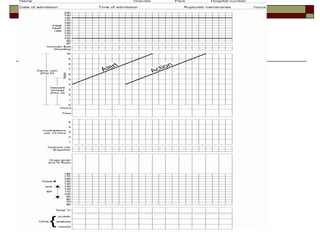
4. A lag time of 4 hours is usually
acceptable the slowing of labour and the
need to intervene; this is the distance
between alert line and the action line.
PRINCIPLES OF USING THE PARTOGRAM
1. Basic health facilities
 Used to monitor labour which is expected to be
normal.
 Those with risk factors should already have been
referred.
 Referral is decided when the progress line of the
cervical dilatation deviates to the right of an alert
line.
2. Health facilities with comprehensive EmOC.
 Used to monitor both high and low risk labour
PROTOCOL FOR LABOUR
MANAGEMENT WITH THE
WHO PARTOGRAM
EXCLUSIONS
Don’t complete the partogram in case of:
 Prematurity (<34/40)
 Cervical dilatation 9 -10 cm on admission
 Elective CS
 Emergency CS on admission
STARTING THE PARTOGRAM
1. Latent phase
 Contractions at least 2 in 10, lasting ≥ 20 sec
2. Active phase
 Contractions at least 1 in 10, lasting ≥ 20 sec
3. SRM but no contractions
 When oxytocin is started or when labour commences
4. Inductions
 At Artificial rapture of membrane ± oxytocin
 When induction is medical start when labour commences
(see 1 and 2) or membranes rapture.
DESIRED UTERINE CONTRACTIONS
 The desired rates of uterine contractions
in labour = 4 - 5 in 10 minute, each
lasting 40-50 seconds.
 It may be maintained at that rate
throughout 2nd and 3rd stage of labour
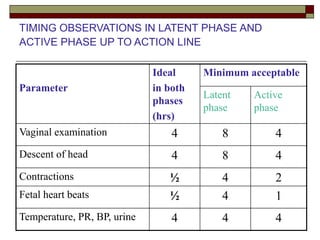
TIMING OBSERVATIONS IN LATENT PHASE AND
ACTIVE PHASE UP TO ACTION LINE
Parameter
Ideal
in both
phases
(hrs)
Minimum acceptable
Latent
phase
Active
phase
Vaginal examination 4 8 4
Descent of head 4 8 4
Contractions ½ 4 2
Fetal heart beats ½ 4 1
Temperature, PR, BP, urine 4 4 4
TIMING OBSERVATIONS IN LATENT
PHASE AND ACTIVE PHASE
 Vaginal examination may be carried
out more frequently in advanced first
stage 7+cm or if problems develop
MANAGEMENT OF LABOUR BETWEEN ALERT
AND ACTION LINES
 Known as Alert or Referral zone
1. Health facilities with Basic EmOC
 Transfer the woman to hospital unless the cervix is
almost fully dilated
 ARM may be performed if membranes are still intact
and first stage of labour is advanced and delivery is
expected soon.
MANAGEMENT OF LABOUR BETWEEN ALERT
AND ACTION LINES
2. Health Facility with Comprehensive EmOC
 Perform ARM at vaginal examination
 Continue routine monitoring
 Repeat vaginal examination 4 hrs or earlier if
delivery is expected sooner
 Do not intervene or augment – unless
complications develop
MANAGEMENT OF LABOUR AT OR BEYOND THE
ACTION LINE
1. Full medical and obstetric assessment
2. Consider IV infusions/ catheterization/ analgesics
(pethidine)
3. Options
 Perform CS - if fetal distress or obstructed labour or
operative vaginal delivery if in 2nd stage without severe
fetal distress and/or obstructed.
 Oxytoxin – if no contraindications
 Supportive therapy only – if satisfactory progress is
established and dilatation could be anticipated at 1cm/hr
or faster.
FURTHER REVIEW - in cases continuing in labour
 Vaginal exam after 2 hours, then in 2 more
hours, then in 2 more hours
 Failure to make satisfactory progress,
measured as cervical dilatation of < 1cm/hr
between these examinations, means delivery
is indicated
 Fetal heart while on oxytocin must be
checked at least every ½ hour
INTERVENTION OF LABOUR
Considerable factors for intervention of labour
1. Cervical dilatation and descent
2. Presentation,
3. Fetal condition e.g. fetal distress
4. Maternal condition
5. Strength and frequency of uterine contractions
6. Moulding/caput formation score
INTERVENTION OF LABOUR cont
 Consider all these factors, do not be guided only by
the dilatation of the cervix in relation to the action
line and by the descent of the fetal head, critical
though these are.
 Intervention needs to be earlier in a multip than in a
prim.
 Some partograms have two action lines one at 3
hours for multips and one at 4 hours for prims
ABNORMAL PARTOGRAPM
Include the following
1. Prolonged latent phase
2. Protracted dilatation of cervix
3. Arrested dilatation of cervix
4. Protracted descent of the presenting part
5. Arrested descent of the presenting part
6. Prolonged second stage of labour
CAUSES OF ABNORMAL PARTOGRAPM
Divided into 3 Ps
1. Passenger related
o Refers to the fetus: Big baby, hydrocephaly,
2. Power related
o Refers to the expulsive efforts of the uterus and mother:
Poor uterine contractions etc
3. Passage related
o Refers to the bony and soft tissue of the pelvis, vagina
and perineum: Contracted pelvis - CPD
SPECIAL CASES ON THE PARTOGRAM
 Breech
 Twins
 IUFD
 Pre-eclampsia
 Previous scar
 Diabetes
 Cardiac diseases
NOTE:
 Plot the labour on the
partograph but specific
WHO partogram may not
apply
 Such cases are managed
individually
MANAGEMENT OF LABOUR IN SPECIAL CASES
1. BREECH
 Exclude reasons for immediate CS
 previous CS, contracted pelvis
 Manage latent phase normally
 CS may be indicated if the 8 hour latent phase “action line”
is reached
 In the active phase, dilatation slower than 1cm/hr is a
worrying sign
 Consider oxytocin if dilatation moves to the right of the alert
line
 Reaching the action line is normally the indication for CS
MANAGEMENT OF LABOUR IN SPECIAL CASES cont
2. Multiple pregnancy
 Guidelines for breech apply i.e. prolonged
latent phase or reaching the action line is
indication for CS
3. Pre-eclampsia
 Induction , augmentation and ARM may be
indicted early i.e. in the latent phase before 8
hours or before the action line
MANAGEMENT OF LABOUR IN SPECIAL CASES cont
4. IUFD
 Usually the WHO protocol can be
followed
 Only perform ARM in the active phase
 When intervention is indicated as per
WHO protocol– consider destructive
delivery rather than CS
MANAGEMENT OF LABOUR IN SPECIAL CASES cont
5. Previous scar
 2 previous CS or classical CS →
immediate CS
 Otherwise use WHO protocol but do not
use oxytocin
 Reaching the action line usually an
indication for CS
SUMMARY
Proper use of partogram is associated
with prevention of abnormalities of
labour as associated complications
and consequently reduction of both
maternal and perinatal mortalities and
morbidities

Partogram2.ppt

  • 2.
  • 3.
    OBJECTIVES At the endof this session you are expected to be able to: 1. Define the partogram 2. Explain the importance of using partogram in labour. 3. Describe the principles that are used to design the partogram 4. Describe the principles of using the partogram at the basic and comprehensive health facilities. 5. Describe the protocol for labour management with the WHO partogram
  • 4.
    What is apartogram (partograph) ?
  • 5.
    Definition The partogram Is agraph used in labour to monitor the parameters of progress of labour, maternal and fetal wellbeing, and treatment administration
  • 8.
  • 9.
    PRACTICAL VALUE OFUSING THE PARTOGRAM  Offers an objective basis for overtime monitoring the progress of labour, maternal and fetal wellbeing.  Enables early detection of abnormalities of labour  Prevention of obstructed labour and ruptured uterus.
  • 10.
    PRACTICAL VALUE OFPARTOGRAM cont  Complications of obstructed labour and ruptured uterus contribute up to 30% of maternal deaths in some areas.  Proper use of partogram has proved so useful in reduction of both maternal and perinatal mortalities and morbidities
  • 11.
    RECOMMENDATIONS ON THEUSE OF PARTOGRAM Based on the evidence-based reports on its effectiveness in monitoring of labour. WHO Recommends its use in all labour wards and for all women (WHO 1994) Tanzania Its use is obligatory at all levels of obstetric care
  • 12.
    PRINCIPLES USED TODESIGN THE PARTOGRAM The partogram depends on the principles that; 1. The latent phase should not last longer than 8 hours 2. The latent phase ends and active phase starts when the cervix is 3cm (4cm is sometimes used) 3. During active phase – the cervix should dilate at not less than 1 cm per hour
  • 13.
    PRINCIPLES cont 4. Alag time of 4 hours is usually acceptable the slowing of labour and the need to intervene; this is the distance between alert line and the action line.
  • 14.
    PRINCIPLES OF USINGTHE PARTOGRAM 1. Basic health facilities  Used to monitor labour which is expected to be normal.  Those with risk factors should already have been referred.  Referral is decided when the progress line of the cervical dilatation deviates to the right of an alert line. 2. Health facilities with comprehensive EmOC.  Used to monitor both high and low risk labour
  • 15.
    PROTOCOL FOR LABOUR MANAGEMENTWITH THE WHO PARTOGRAM
  • 16.
    EXCLUSIONS Don’t complete thepartogram in case of:  Prematurity (<34/40)  Cervical dilatation 9 -10 cm on admission  Elective CS  Emergency CS on admission
  • 17.
    STARTING THE PARTOGRAM 1.Latent phase  Contractions at least 2 in 10, lasting ≥ 20 sec 2. Active phase  Contractions at least 1 in 10, lasting ≥ 20 sec 3. SRM but no contractions  When oxytocin is started or when labour commences 4. Inductions  At Artificial rapture of membrane ± oxytocin  When induction is medical start when labour commences (see 1 and 2) or membranes rapture.
  • 18.
    DESIRED UTERINE CONTRACTIONS The desired rates of uterine contractions in labour = 4 - 5 in 10 minute, each lasting 40-50 seconds.  It may be maintained at that rate throughout 2nd and 3rd stage of labour
  • 19.
    TIMING OBSERVATIONS INLATENT PHASE AND ACTIVE PHASE UP TO ACTION LINE Parameter Ideal in both phases (hrs) Minimum acceptable Latent phase Active phase Vaginal examination 4 8 4 Descent of head 4 8 4 Contractions ½ 4 2 Fetal heart beats ½ 4 1 Temperature, PR, BP, urine 4 4 4
  • 20.
    TIMING OBSERVATIONS INLATENT PHASE AND ACTIVE PHASE  Vaginal examination may be carried out more frequently in advanced first stage 7+cm or if problems develop
  • 21.
    MANAGEMENT OF LABOURBETWEEN ALERT AND ACTION LINES  Known as Alert or Referral zone 1. Health facilities with Basic EmOC  Transfer the woman to hospital unless the cervix is almost fully dilated  ARM may be performed if membranes are still intact and first stage of labour is advanced and delivery is expected soon.
  • 22.
    MANAGEMENT OF LABOURBETWEEN ALERT AND ACTION LINES 2. Health Facility with Comprehensive EmOC  Perform ARM at vaginal examination  Continue routine monitoring  Repeat vaginal examination 4 hrs or earlier if delivery is expected sooner  Do not intervene or augment – unless complications develop
  • 23.
    MANAGEMENT OF LABOURAT OR BEYOND THE ACTION LINE 1. Full medical and obstetric assessment 2. Consider IV infusions/ catheterization/ analgesics (pethidine) 3. Options  Perform CS - if fetal distress or obstructed labour or operative vaginal delivery if in 2nd stage without severe fetal distress and/or obstructed.  Oxytoxin – if no contraindications  Supportive therapy only – if satisfactory progress is established and dilatation could be anticipated at 1cm/hr or faster.
  • 24.
    FURTHER REVIEW -in cases continuing in labour  Vaginal exam after 2 hours, then in 2 more hours, then in 2 more hours  Failure to make satisfactory progress, measured as cervical dilatation of < 1cm/hr between these examinations, means delivery is indicated  Fetal heart while on oxytocin must be checked at least every ½ hour
  • 25.
    INTERVENTION OF LABOUR Considerablefactors for intervention of labour 1. Cervical dilatation and descent 2. Presentation, 3. Fetal condition e.g. fetal distress 4. Maternal condition 5. Strength and frequency of uterine contractions 6. Moulding/caput formation score
  • 26.
    INTERVENTION OF LABOURcont  Consider all these factors, do not be guided only by the dilatation of the cervix in relation to the action line and by the descent of the fetal head, critical though these are.  Intervention needs to be earlier in a multip than in a prim.  Some partograms have two action lines one at 3 hours for multips and one at 4 hours for prims
  • 27.
    ABNORMAL PARTOGRAPM Include thefollowing 1. Prolonged latent phase 2. Protracted dilatation of cervix 3. Arrested dilatation of cervix 4. Protracted descent of the presenting part 5. Arrested descent of the presenting part 6. Prolonged second stage of labour
  • 28.
    CAUSES OF ABNORMALPARTOGRAPM Divided into 3 Ps 1. Passenger related o Refers to the fetus: Big baby, hydrocephaly, 2. Power related o Refers to the expulsive efforts of the uterus and mother: Poor uterine contractions etc 3. Passage related o Refers to the bony and soft tissue of the pelvis, vagina and perineum: Contracted pelvis - CPD
  • 29.
    SPECIAL CASES ONTHE PARTOGRAM  Breech  Twins  IUFD  Pre-eclampsia  Previous scar  Diabetes  Cardiac diseases NOTE:  Plot the labour on the partograph but specific WHO partogram may not apply  Such cases are managed individually
  • 30.
    MANAGEMENT OF LABOURIN SPECIAL CASES 1. BREECH  Exclude reasons for immediate CS  previous CS, contracted pelvis  Manage latent phase normally  CS may be indicated if the 8 hour latent phase “action line” is reached  In the active phase, dilatation slower than 1cm/hr is a worrying sign  Consider oxytocin if dilatation moves to the right of the alert line  Reaching the action line is normally the indication for CS
  • 31.
    MANAGEMENT OF LABOURIN SPECIAL CASES cont 2. Multiple pregnancy  Guidelines for breech apply i.e. prolonged latent phase or reaching the action line is indication for CS 3. Pre-eclampsia  Induction , augmentation and ARM may be indicted early i.e. in the latent phase before 8 hours or before the action line
  • 32.
    MANAGEMENT OF LABOURIN SPECIAL CASES cont 4. IUFD  Usually the WHO protocol can be followed  Only perform ARM in the active phase  When intervention is indicated as per WHO protocol– consider destructive delivery rather than CS
  • 33.
    MANAGEMENT OF LABOURIN SPECIAL CASES cont 5. Previous scar  2 previous CS or classical CS → immediate CS  Otherwise use WHO protocol but do not use oxytocin  Reaching the action line usually an indication for CS
  • 34.
    SUMMARY Proper use ofpartogram is associated with prevention of abnormalities of labour as associated complications and consequently reduction of both maternal and perinatal mortalities and morbidities