POST GRADUATE PROGRAM
Theory of coloration
Seminar on:- understanding about partition co-
efficient
Worku Tegegene
First Year MSc. in Textile Chemistry
Submitted to: Dr.Abera k.
January,2021
.
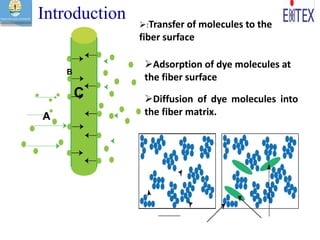
Introduction
B
C
A
:Transfer of molecules to the
fiber surface
Adsorption of dye molecules at
the fiber surface
Diffusion of dye molecules into
the fiber matrix.
Dye molecules having diffused
into substrate, displacing fibers
The movement of molecules
from one phase to another is
called partitioning
The partition coefficient, (K), is the partition or distribution of
the dye between the dye bath and fiber phases.
(Partition coefficient) K = 𝐶𝑜𝑛𝑐𝑒𝑛𝑡𝑟𝑎𝑡𝑖𝑜𝑛 𝑜𝑓 𝑑𝑦𝑒 𝑖𝑛 𝑓𝑖𝑏𝑟𝑒
𝐶𝑜𝑛𝑐𝑒𝑛𝑡𝑟𝑎𝑡𝑖𝑜𝑛 𝑜𝑓 𝑑𝑦𝑒 𝑖𝑛 𝑠𝑙𝑜𝑢𝑡𝑖𝑜𝑛
It is the ratio of concentration of a dye in fiber phase to the
concentration of a dye in dye bath phase at constant temperature
s
[Df] [[Ds] k= [Df]/[Ds]
If two phases are placed adjacent to
each other, the solute/dye will distribute
itself between two phases until
equilibrium is attained;
 at equilibrium there is no further
transfer of solute/dye occurs.
The distribution or partition of a solute/dye between two
phases is known as Nernst’s distribution law or simply
distribution law or partition law
Dye adsorption isotherms are obtained by measuring how much
dye is in the fiber [D]f and how much remains in solution [D]s, when
the dyeing has been allowed to proceed, at a constant temperature,
to equilibrium
Three types of adsorption isotherm can be identified, as Nernst,
Freundlich and Langmuir isotherms,
The simplest of the three types
 the graph of [D]f plotted against
[D]s is a straight line
The ratio [D]f/[D]s is called the
partition coefficient,
graph is linear, remains constant
until the saturation point of the dye
in the fiber is reached.
no more dye can be taken up by the fiber, no matter how
much more dye is put into the dye bath
Synthetic fiber dyeing (PES)
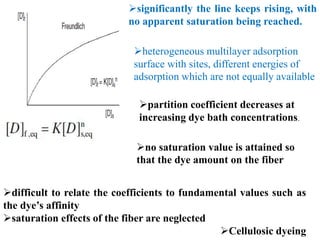
significantly the line keeps rising, with
no apparent saturation being reached.
heterogeneous multilayer adsorption
surface with sites, different energies of
adsorption which are not equally available
partition coefficient decreases at
increasing dye bath concentrations.
no saturation value is attained so
that the dye amount on the fiber
difficult to relate the coefficients to fundamental values such as
the dye’s affinity
saturation effects of the fiber are neglected
Cellulosic dyeing
This model is valid for monolayer
sorption onto a surface with a finite
number of identical sites
based on the assumption that
fixed number of dye sites ,one to one
no preferential adsorption at particula
sites
no interaction
limited number of sorption sites, [ D
]sat [mol.kg −1 ], and that the dye takes
place on specific sites in the fiber
dye molecule occupies a site that site is saturated and incapable of
further adsorption
Protein dyeing
In order to understand the dyeing mechanism of these fibers
better, it is needed to know thermodynamic and kinetic aspects of
the dyeing such as
Partition coefficient
aggregation and adsorption of
dyes
 rate, standard affinity of dye, enthalpy (standard heat) and
entropy of dyeing
summery
Ingamells W. Colour for Textiles a User’s Handbook Society of Dyers and Colourists
ISBN 0 901956 56 2 1993
Gong R., Liu Y., Jiang Y., Li C. Isothermal, Kinetic and Thermodynamic Studies on Basic
Dye Sorption onto Tartaric Acid Esterified Wheat Straw African Journal of
Biotechnology 2009;8(24) 7138-7147.
Johnson A. The Theory of Coloration of Textiles Second Edition Society of Dyers and
Colorists 1989
Von Bergen W., Krauss W. Textile Fiber Atlas: A Collextion of Photomicrographs of
Common Textile Fibers American Wool Handbook Company New York 1942
Marti M., Barsukov L.I., Fonollosa J., Parra J.L., Sukhanov S.V., Coderch L.
Physicochemical Aspects of the Liposome-Wool Interaction in Wool Dyeing Langmuir
2004;20 3068-3073.
Feughelman M. Introduction to the Physical Properties of Wool, Hair and Other α-
Keratin Fibers in: Mechanical Properties and Structure Of Alpha-Keratin Fibers: Wool,
Human Hair and Related Fibers UNSW Press 1997; 1-14
References
partition cofficent

partition cofficent

  • 1.
    POST GRADUATE PROGRAM Theoryof coloration Seminar on:- understanding about partition co- efficient Worku Tegegene First Year MSc. in Textile Chemistry Submitted to: Dr.Abera k. January,2021 .
  • 2.
    Introduction B C A :Transfer of moleculesto the fiber surface Adsorption of dye molecules at the fiber surface Diffusion of dye molecules into the fiber matrix.
  • 3.
    Dye molecules havingdiffused into substrate, displacing fibers The movement of molecules from one phase to another is called partitioning The partition coefficient, (K), is the partition or distribution of the dye between the dye bath and fiber phases. (Partition coefficient) K = 𝐶𝑜𝑛𝑐𝑒𝑛𝑡𝑟𝑎𝑡𝑖𝑜𝑛 𝑜𝑓 𝑑𝑦𝑒 𝑖𝑛 𝑓𝑖𝑏𝑟𝑒 𝐶𝑜𝑛𝑐𝑒𝑛𝑡𝑟𝑎𝑡𝑖𝑜𝑛 𝑜𝑓 𝑑𝑦𝑒 𝑖𝑛 𝑠𝑙𝑜𝑢𝑡𝑖𝑜𝑛 It is the ratio of concentration of a dye in fiber phase to the concentration of a dye in dye bath phase at constant temperature s [Df] [[Ds] k= [Df]/[Ds]
  • 4.
    If two phasesare placed adjacent to each other, the solute/dye will distribute itself between two phases until equilibrium is attained;  at equilibrium there is no further transfer of solute/dye occurs. The distribution or partition of a solute/dye between two phases is known as Nernst’s distribution law or simply distribution law or partition law Dye adsorption isotherms are obtained by measuring how much dye is in the fiber [D]f and how much remains in solution [D]s, when the dyeing has been allowed to proceed, at a constant temperature, to equilibrium
  • 5.
    Three types ofadsorption isotherm can be identified, as Nernst, Freundlich and Langmuir isotherms, The simplest of the three types  the graph of [D]f plotted against [D]s is a straight line The ratio [D]f/[D]s is called the partition coefficient, graph is linear, remains constant until the saturation point of the dye in the fiber is reached. no more dye can be taken up by the fiber, no matter how much more dye is put into the dye bath Synthetic fiber dyeing (PES)
  • 6.
    significantly the linekeeps rising, with no apparent saturation being reached. heterogeneous multilayer adsorption surface with sites, different energies of adsorption which are not equally available partition coefficient decreases at increasing dye bath concentrations. no saturation value is attained so that the dye amount on the fiber difficult to relate the coefficients to fundamental values such as the dye’s affinity saturation effects of the fiber are neglected Cellulosic dyeing
  • 7.
    This model isvalid for monolayer sorption onto a surface with a finite number of identical sites based on the assumption that fixed number of dye sites ,one to one no preferential adsorption at particula sites no interaction limited number of sorption sites, [ D ]sat [mol.kg −1 ], and that the dye takes place on specific sites in the fiber dye molecule occupies a site that site is saturated and incapable of further adsorption Protein dyeing
  • 8.
    In order tounderstand the dyeing mechanism of these fibers better, it is needed to know thermodynamic and kinetic aspects of the dyeing such as Partition coefficient aggregation and adsorption of dyes  rate, standard affinity of dye, enthalpy (standard heat) and entropy of dyeing summery
  • 9.
    Ingamells W. Colourfor Textiles a User’s Handbook Society of Dyers and Colourists ISBN 0 901956 56 2 1993 Gong R., Liu Y., Jiang Y., Li C. Isothermal, Kinetic and Thermodynamic Studies on Basic Dye Sorption onto Tartaric Acid Esterified Wheat Straw African Journal of Biotechnology 2009;8(24) 7138-7147. Johnson A. The Theory of Coloration of Textiles Second Edition Society of Dyers and Colorists 1989 Von Bergen W., Krauss W. Textile Fiber Atlas: A Collextion of Photomicrographs of Common Textile Fibers American Wool Handbook Company New York 1942 Marti M., Barsukov L.I., Fonollosa J., Parra J.L., Sukhanov S.V., Coderch L. Physicochemical Aspects of the Liposome-Wool Interaction in Wool Dyeing Langmuir 2004;20 3068-3073. Feughelman M. Introduction to the Physical Properties of Wool, Hair and Other α- Keratin Fibers in: Mechanical Properties and Structure Of Alpha-Keratin Fibers: Wool, Human Hair and Related Fibers UNSW Press 1997; 1-14 References