PARTICIPATORY
BUDGETING
José A. Alcalde
VIDEO
https://www.participatorybudgeting.org
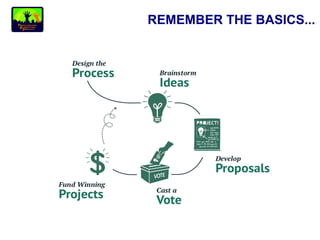
REMEMBER THE BASICS...
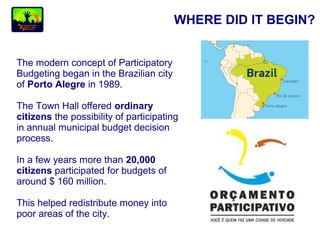
WHERE DID IT BEGIN?
The modern concept of Participatory
Budgeting began in the Brazilian city
of Porto Alegre in 1989.
The Town Hall offered ordinary
citizens the possibility of participating
in annual municipal budget decision
process.
In a few years more than 20,000
citizens participated for budgets of
around $ 160 million.
This helped redistribute money into
poor areas of the city.
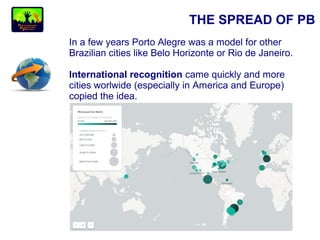
THE SPREAD OF PB
In a few years Porto Alegre was a model for other
Brazilian cities like Belo Horizonte or Rio de Janeiro.
International recognition came quickly and more
cities worlwide (especially in America and Europe)
copied the idea.
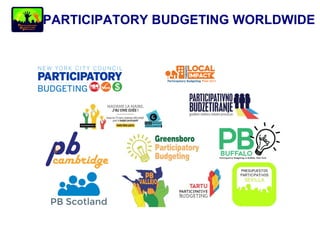
PARTICIPATORY BUDGETING WORLDWIDE
PARTICIPATORY BUDGETING EXAMPLES
The possibilities are endless. Here are some examples:
Wall gardens, urban renewal projects, coworking for
students and young entrepreneurs, improved waste
sorting, school gardens, composting and recycling
initiatives, improved local schools, streets, parks and
playgrounds, and other public spaces, street
lighting, road repairs, park improvements, youth and
senior programs, expanding the facilities for people with
disabilities at a local sports center, creating community
projects to stop bullying and school violence, installing
gas safety valves in homes of the low-income
retirees living alone, creating a community restaurant, art
walls, laptops for local high schools, a skate park…
ADVANTAGES
Participatory Budgeting implies many advantages like:
* Involvement in the local community
* Paying attention to real problems that people see
everyday in their community
* Sense of belonging and team-work
* Having a say in the taxes (money) we all give and
where they go
* More critical and participative citizens
* Increase of democracy when we can vote for the
best projects
SHALL WE BEGIN?
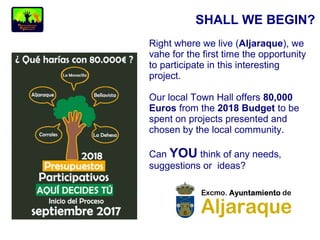
Right where we live (Aljaraque), we
vahe for the first time the opportunity
to participate in this interesting
project.
Our local Town Hall offers 80,000
Euros from the 2018 Budget to be
spent on projects presented and
chosen by the local community.
Can YOU think of any needs,
suggestions or ideas?
YOUR PROJECT
1) In groups (3-4 students) go around the municipality to detect some
needs, problems, etc. Take photos, ask people's opinions, get information...
In short, create a dossier.
2) Decide on your top priority and brainstorm different ways to give an
answer to this “problem”.
3) Ask experts or go on-line to find out how much can the project be and
present a budget.
4) Prepare a digital presentation about your project (also print it on paper
to be displayed in the school corridors). Remember to include modal verbs
to express obligation, weak/strong possibility, advice, suggestion,
necessity...
5) The school community will vote for the best projects and they will
eventually be sent to Aljaraque Town Hall.

Participatory Budgeting

  • 1.
  • 2.
  • 3.
  • 4.
    WHERE DID ITBEGIN? The modern concept of Participatory Budgeting began in the Brazilian city of Porto Alegre in 1989. The Town Hall offered ordinary citizens the possibility of participating in annual municipal budget decision process. In a few years more than 20,000 citizens participated for budgets of around $ 160 million. This helped redistribute money into poor areas of the city.
  • 5.
    THE SPREAD OFPB In a few years Porto Alegre was a model for other Brazilian cities like Belo Horizonte or Rio de Janeiro. International recognition came quickly and more cities worlwide (especially in America and Europe) copied the idea.
  • 6.
  • 7.
    PARTICIPATORY BUDGETING EXAMPLES Thepossibilities are endless. Here are some examples: Wall gardens, urban renewal projects, coworking for students and young entrepreneurs, improved waste sorting, school gardens, composting and recycling initiatives, improved local schools, streets, parks and playgrounds, and other public spaces, street lighting, road repairs, park improvements, youth and senior programs, expanding the facilities for people with disabilities at a local sports center, creating community projects to stop bullying and school violence, installing gas safety valves in homes of the low-income retirees living alone, creating a community restaurant, art walls, laptops for local high schools, a skate park…
  • 8.
    ADVANTAGES Participatory Budgeting impliesmany advantages like: * Involvement in the local community * Paying attention to real problems that people see everyday in their community * Sense of belonging and team-work * Having a say in the taxes (money) we all give and where they go * More critical and participative citizens * Increase of democracy when we can vote for the best projects
  • 9.
    SHALL WE BEGIN? Rightwhere we live (Aljaraque), we vahe for the first time the opportunity to participate in this interesting project. Our local Town Hall offers 80,000 Euros from the 2018 Budget to be spent on projects presented and chosen by the local community. Can YOU think of any needs, suggestions or ideas?
  • 10.
    YOUR PROJECT 1) Ingroups (3-4 students) go around the municipality to detect some needs, problems, etc. Take photos, ask people's opinions, get information... In short, create a dossier. 2) Decide on your top priority and brainstorm different ways to give an answer to this “problem”. 3) Ask experts or go on-line to find out how much can the project be and present a budget. 4) Prepare a digital presentation about your project (also print it on paper to be displayed in the school corridors). Remember to include modal verbs to express obligation, weak/strong possibility, advice, suggestion, necessity... 5) The school community will vote for the best projects and they will eventually be sent to Aljaraque Town Hall.