Cells carry out the basic
functions of living things
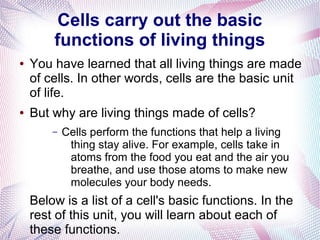
● You have learned that all living things are made
of cells. In other words, cells are the basic unit
of life.
● But why are living things made of cells?
– Cells perform the functions that help a living
thing stay alive. For example, cells take in
atoms from the food you eat and the air you
breathe, and use those atoms to make new
molecules your body needs.
Below is a list of a cell's basic functions. In the
rest of this unit, you will learn about each of
these functions.
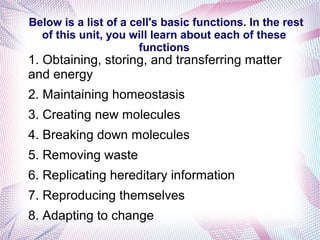
Below is a list of a cell's basic functions. In the rest
of this unit, you will learn about each of these
functions
1. Obtaining, storing, and transferring matter
and energy
2. Maintaining homeostasis
3. Creating new molecules
4. Breaking down molecules
5. Removing waste
6. Replicating hereditary information
7. Reproducing themselves
8. Adapting to change
Each separate cell is its own system,
and all of the cells in an organism
make up another system
● Each cell is a system, meaning it is composed of a
group of connected parts. The parts of a cell work
together to accomplish the functions of a cell.
● The cell is a system: Materials come in and materials
go out.
● All of the cells in an organism also make up a system.
They work together to keep the organism alive.
● Materials go in and out of a cell system, depending on
what is needed inside a cell. Some parts of the cell
take in oxygen, water, and nutrients.
● Other parts of a cell make new molecules, send
signals to other cells, or get rid of wast
Cells maintain a stable internal
environment
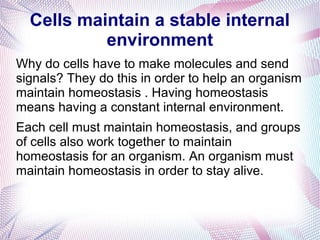
Why do cells have to make molecules and send
signals? They do this in order to help an organism
maintain homeostasis . Having homeostasis
means having a constant internal environment.
Each cell must maintain homeostasis, and groups
of cells also work together to maintain
homeostasis for an organism. An organism must
maintain homeostasis in order to stay alive.

Part 3 basic functions

  • 1.
    Cells carry outthe basic functions of living things ● You have learned that all living things are made of cells. In other words, cells are the basic unit of life. ● But why are living things made of cells? – Cells perform the functions that help a living thing stay alive. For example, cells take in atoms from the food you eat and the air you breathe, and use those atoms to make new molecules your body needs. Below is a list of a cell's basic functions. In the rest of this unit, you will learn about each of these functions.
  • 2.
    Below is alist of a cell's basic functions. In the rest of this unit, you will learn about each of these functions 1. Obtaining, storing, and transferring matter and energy 2. Maintaining homeostasis 3. Creating new molecules 4. Breaking down molecules 5. Removing waste 6. Replicating hereditary information 7. Reproducing themselves 8. Adapting to change
  • 3.
    Each separate cellis its own system, and all of the cells in an organism make up another system ● Each cell is a system, meaning it is composed of a group of connected parts. The parts of a cell work together to accomplish the functions of a cell. ● The cell is a system: Materials come in and materials go out. ● All of the cells in an organism also make up a system. They work together to keep the organism alive. ● Materials go in and out of a cell system, depending on what is needed inside a cell. Some parts of the cell take in oxygen, water, and nutrients. ● Other parts of a cell make new molecules, send signals to other cells, or get rid of wast
  • 4.
    Cells maintain astable internal environment Why do cells have to make molecules and send signals? They do this in order to help an organism maintain homeostasis . Having homeostasis means having a constant internal environment. Each cell must maintain homeostasis, and groups of cells also work together to maintain homeostasis for an organism. An organism must maintain homeostasis in order to stay alive.