BOTTOM-UP PARSING
Bottom-Up Parsing
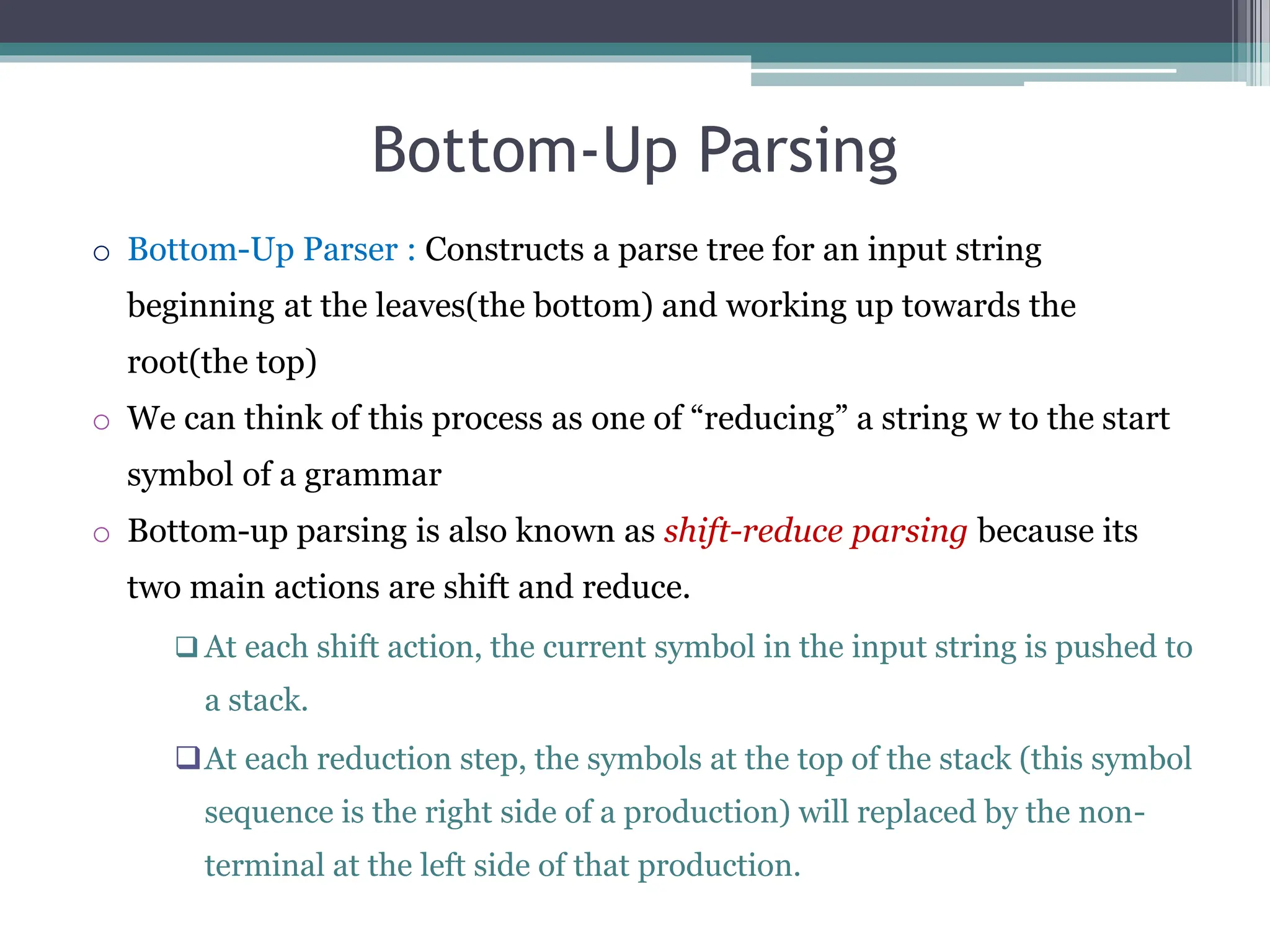
o Bottom-Up Parser : Constructs a parse tree for an input string
beginning at the leaves(the bottom) and working up towards the
root(the top)
o We can think of this process as one of “reducing” a string w to the start
symbol of a grammar
o Bottom-up parsing is also known as shift-reduce parsing because its
two main actions are shift and reduce.
 At each shift action, the current symbol in the input string is pushed to
a stack.
At each reduction step, the symbols at the top of the stack (this symbol
sequence is the right side of a production) will replaced by the non-
terminal at the left side of that production.
Shift-Reduce Parsing
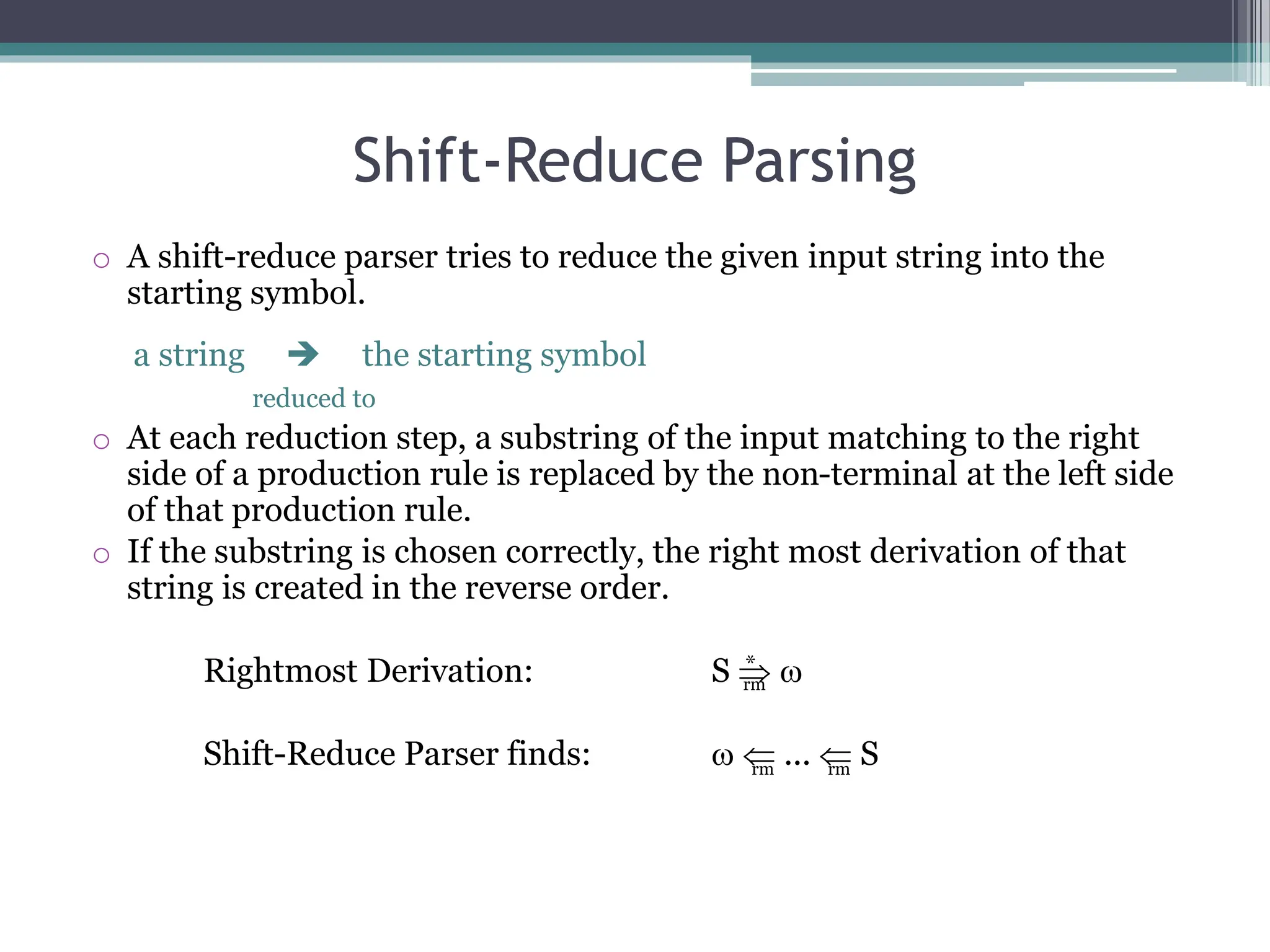
o A shift-reduce parser tries to reduce the given input string into the
starting symbol.
a string  the starting symbol
reduced to
o At each reduction step, a substring of the input matching to the right
side of a production rule is replaced by the non-terminal at the left side
of that production rule.
o If the substring is chosen correctly, the right most derivation of that
string is created in the reverse order.
Rightmost Derivation: S  
Shift-Reduce Parser finds:   ...  S
rm
rm
rm
*
Shift–Reduce Parsing-Example
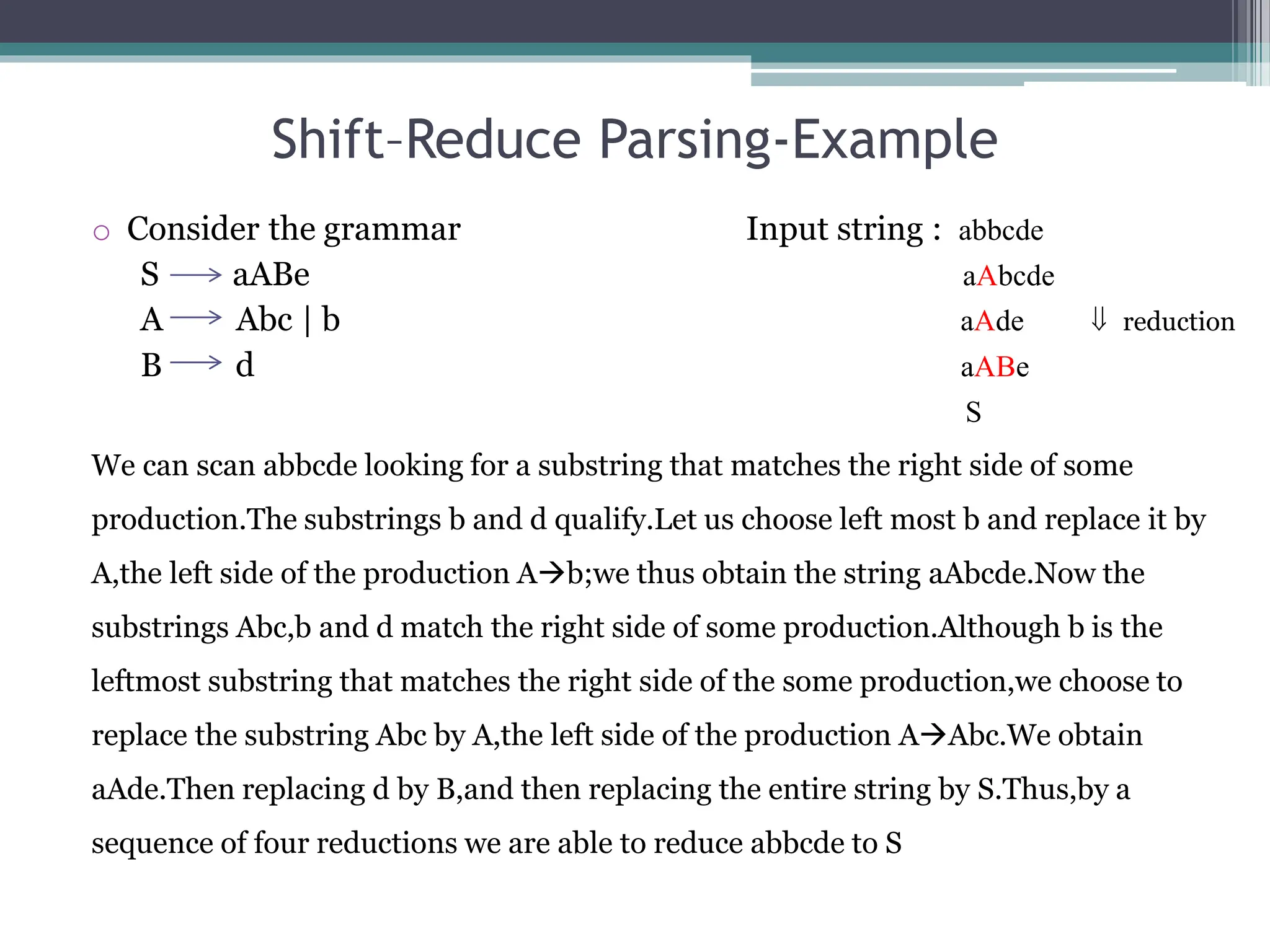
o Consider the grammar Input string : abbcde
S aABe aAbcde
A Abc | b aAde  reduction
B d aABe
S
We can scan abbcde looking for a substring that matches the right side of some
production.The substrings b and d qualify.Let us choose left most b and replace it by
A,the left side of the production Ab;we thus obtain the string aAbcde.Now the
substrings Abc,b and d match the right side of some production.Although b is the
leftmost substring that matches the right side of the some production,we choose to
replace the substring Abc by A,the left side of the production AAbc.We obtain
aAde.Then replacing d by B,and then replacing the entire string by S.Thus,by a
sequence of four reductions we are able to reduce abbcde to S
Shift–Reduce Parsing-Example
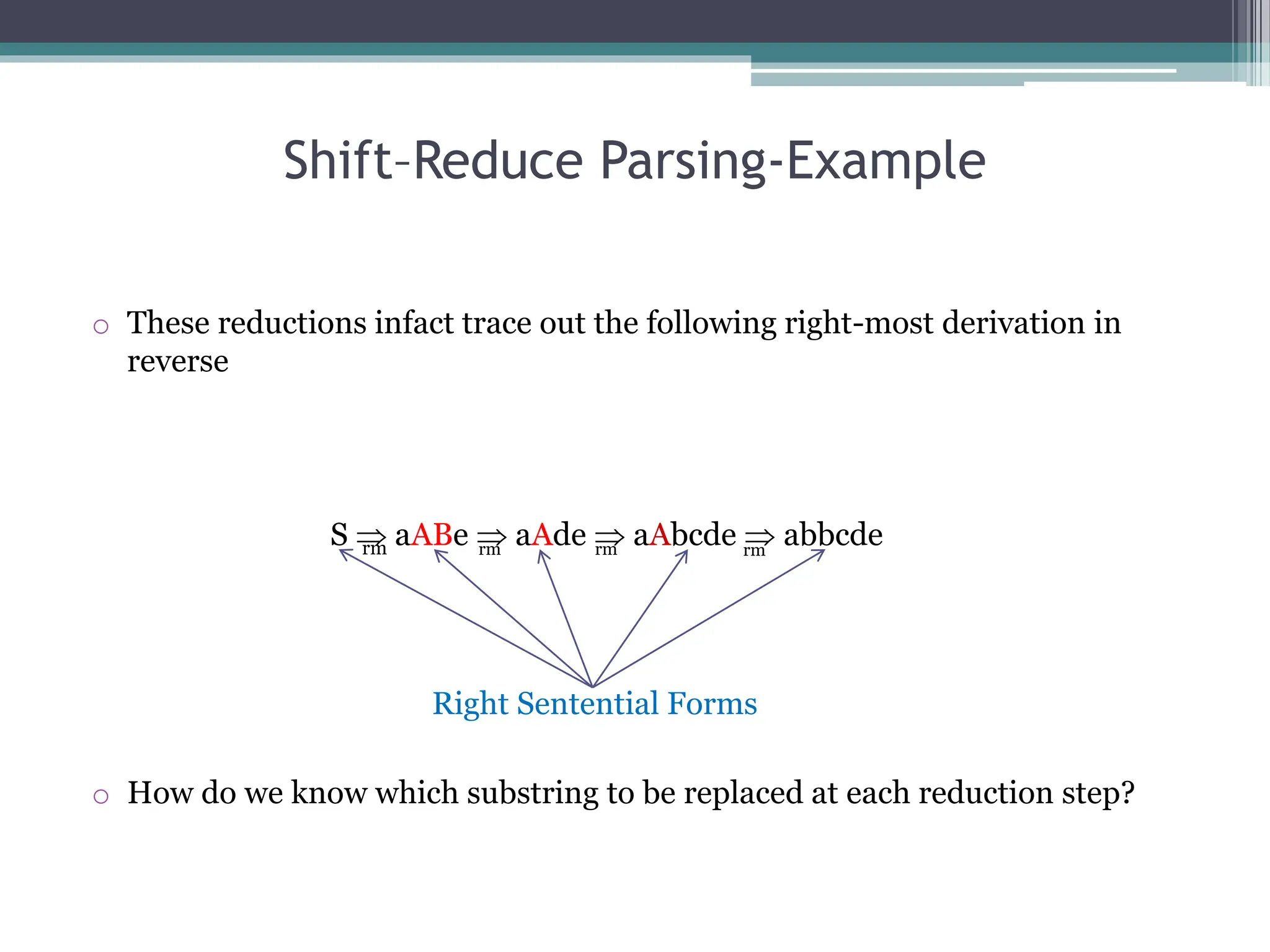
o These reductions infact trace out the following right-most derivation in
reverse
S  aABe  aAde  aAbcde  abbcde
o How do we know which substring to be replaced at each reduction step?
rm rm rm rm
Right Sentential Forms
Handle
rm rm
*
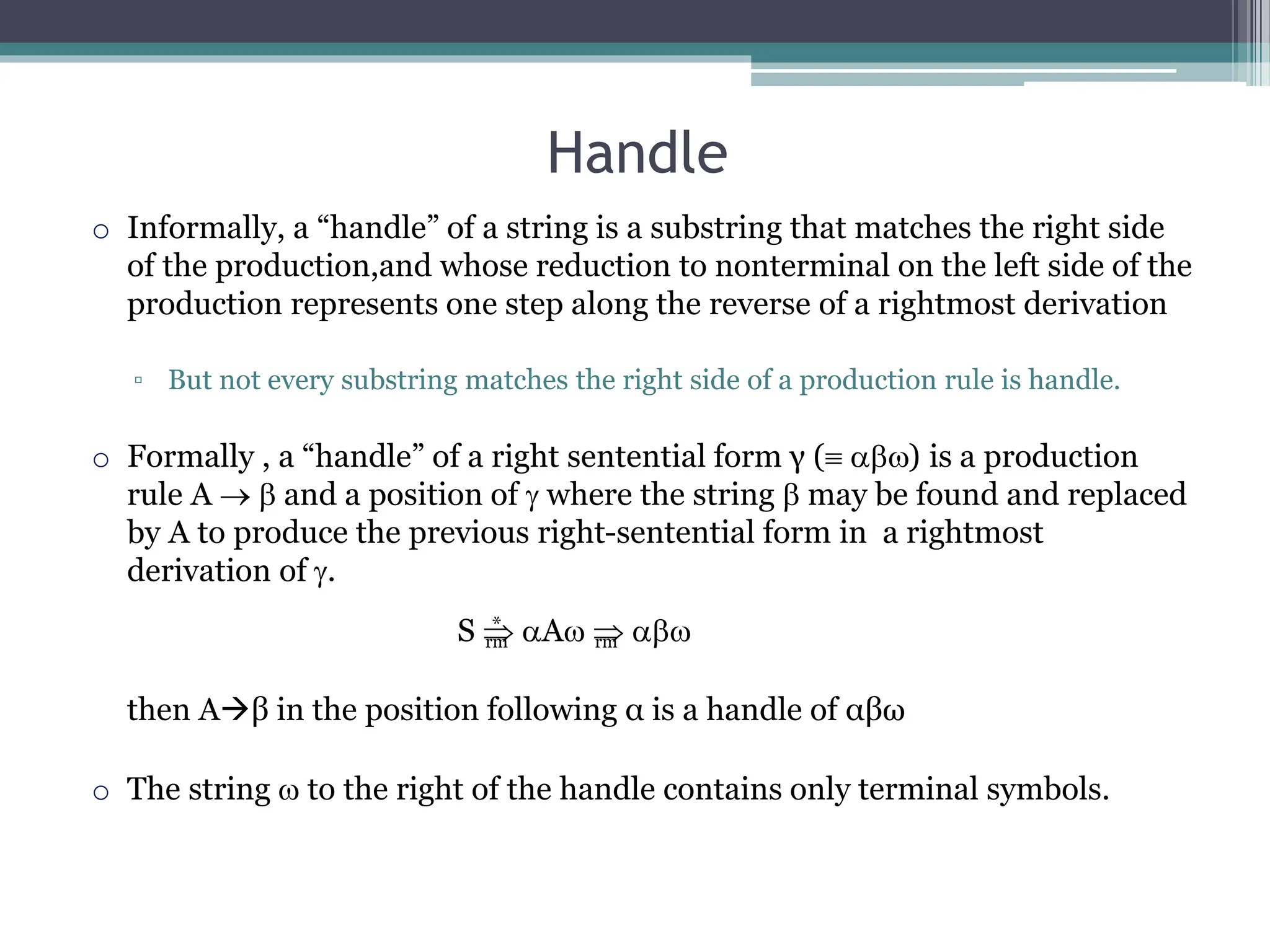
o Informally, a “handle” of a string is a substring that matches the right side
of the production,and whose reduction to nonterminal on the left side of the
production represents one step along the reverse of a rightmost derivation
▫ But not every substring matches the right side of a production rule is handle.
o Formally , a “handle” of a right sentential form γ ( ) is a production
rule A   and a position of  where the string  may be found and replaced
by A to produce the previous right-sentential form in a rightmost
derivation of .
S  A  
then Aβ in the position following α is a handle of αβω
o The string  to the right of the handle contains only terminal symbols.
Example
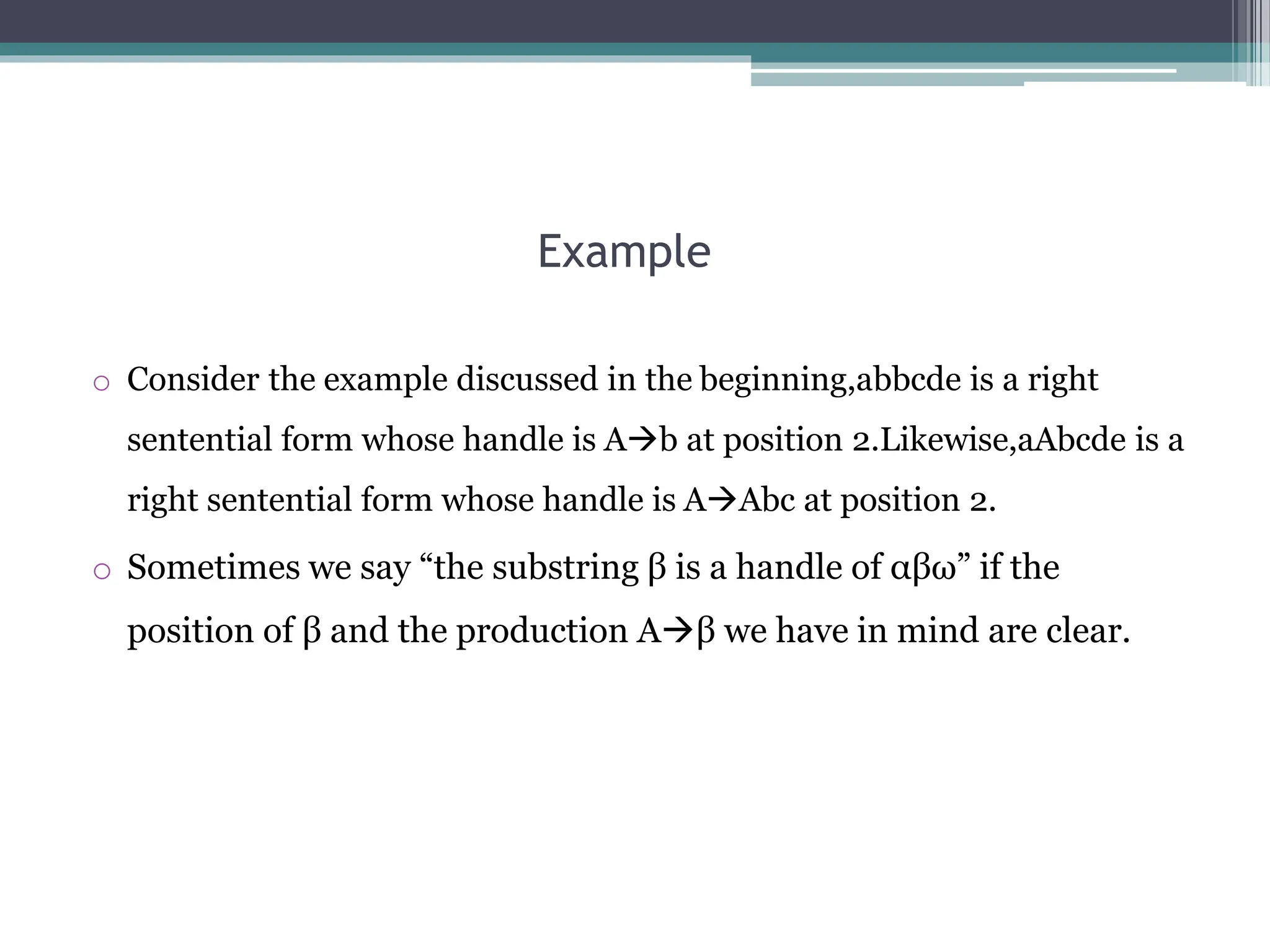
o Consider the example discussed in the beginning,abbcde is a right
sentential form whose handle is Ab at position 2.Likewise,aAbcde is a
right sentential form whose handle is AAbc at position 2.
o Sometimes we say “the substring β is a handle of αβω” if the
position of β and the production Aβ we have in mind are clear.
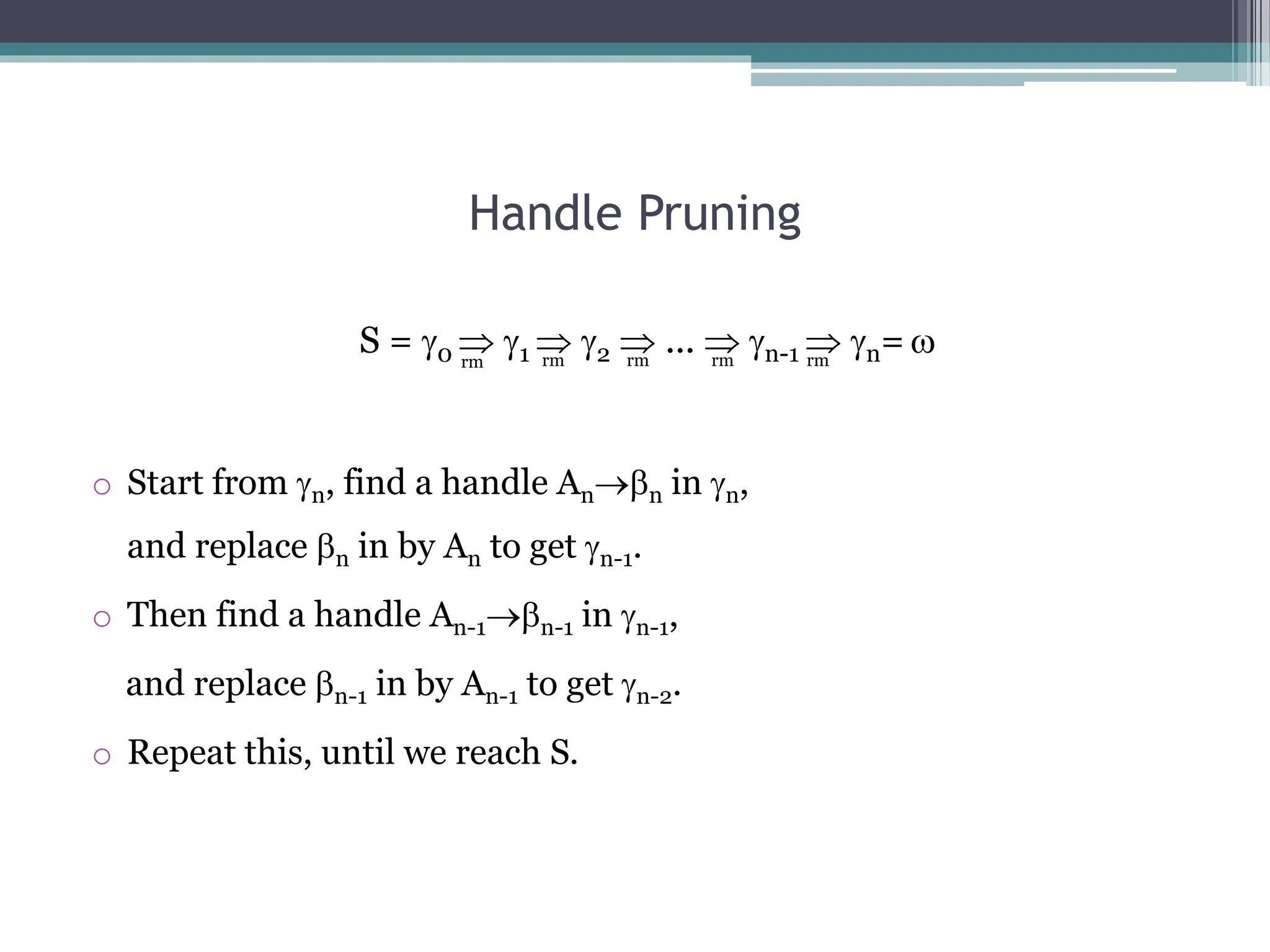
Handle Pruning
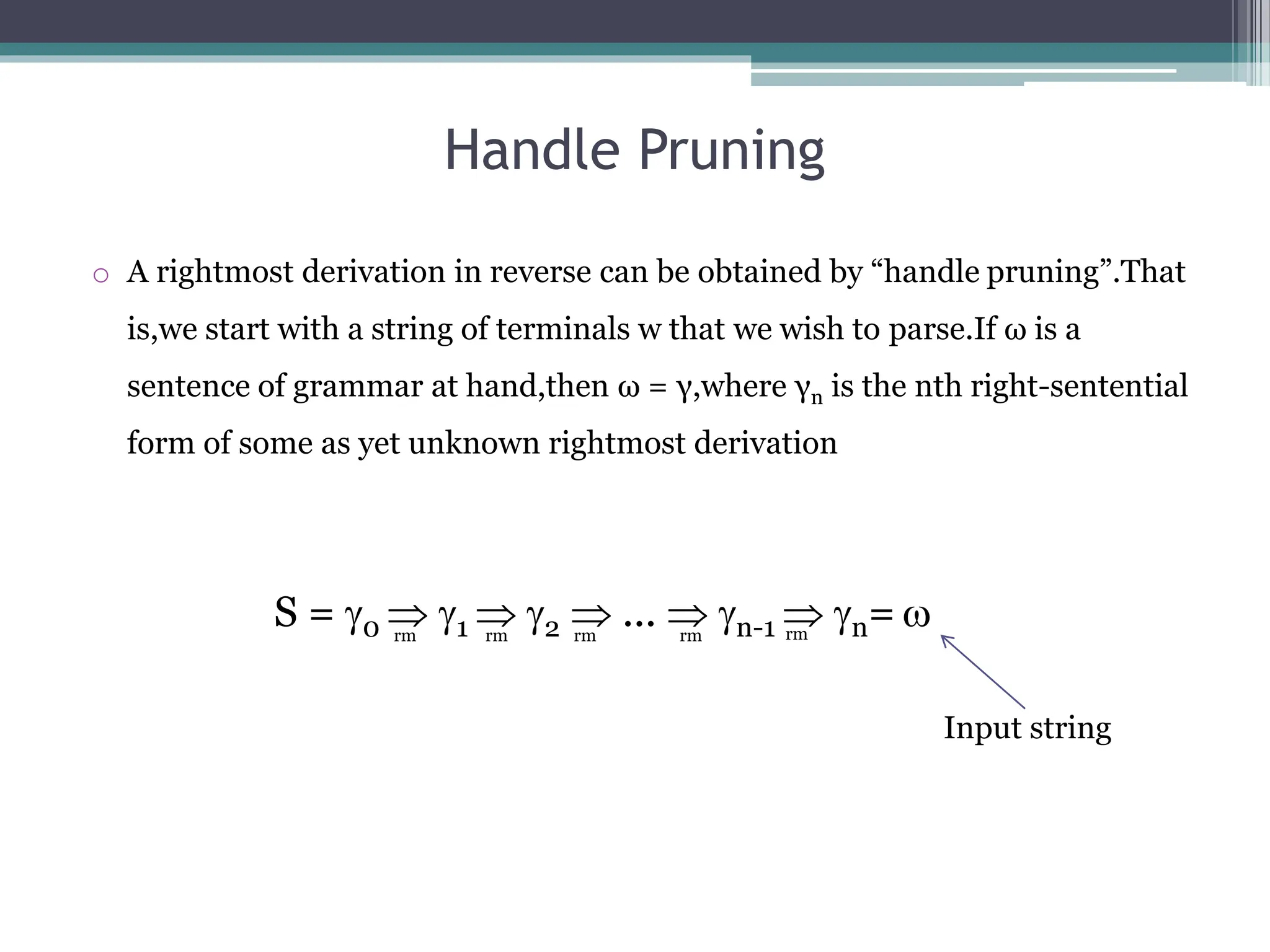
o A rightmost derivation in reverse can be obtained by “handle pruning”.That
is,we start with a string of terminals w that we wish to parse.If ω is a
sentence of grammar at hand,then ω = γ,where γn is the nth right-sentential
form of some as yet unknown rightmost derivation
S = 0  1  2  ...  n-1  n= 
Input string
rm rm rm rm rm
Handle Pruning
S = 0  1  2  ...  n-1  n= 
o Start from n, find a handle Ann in n,
and replace n in by An to get n-1.
o Then find a handle An-1n-1 in n-1,
and replace n-1 in by An-1 to get n-2.
o Repeat this, until we reach S.
rm rm rm rm
rm
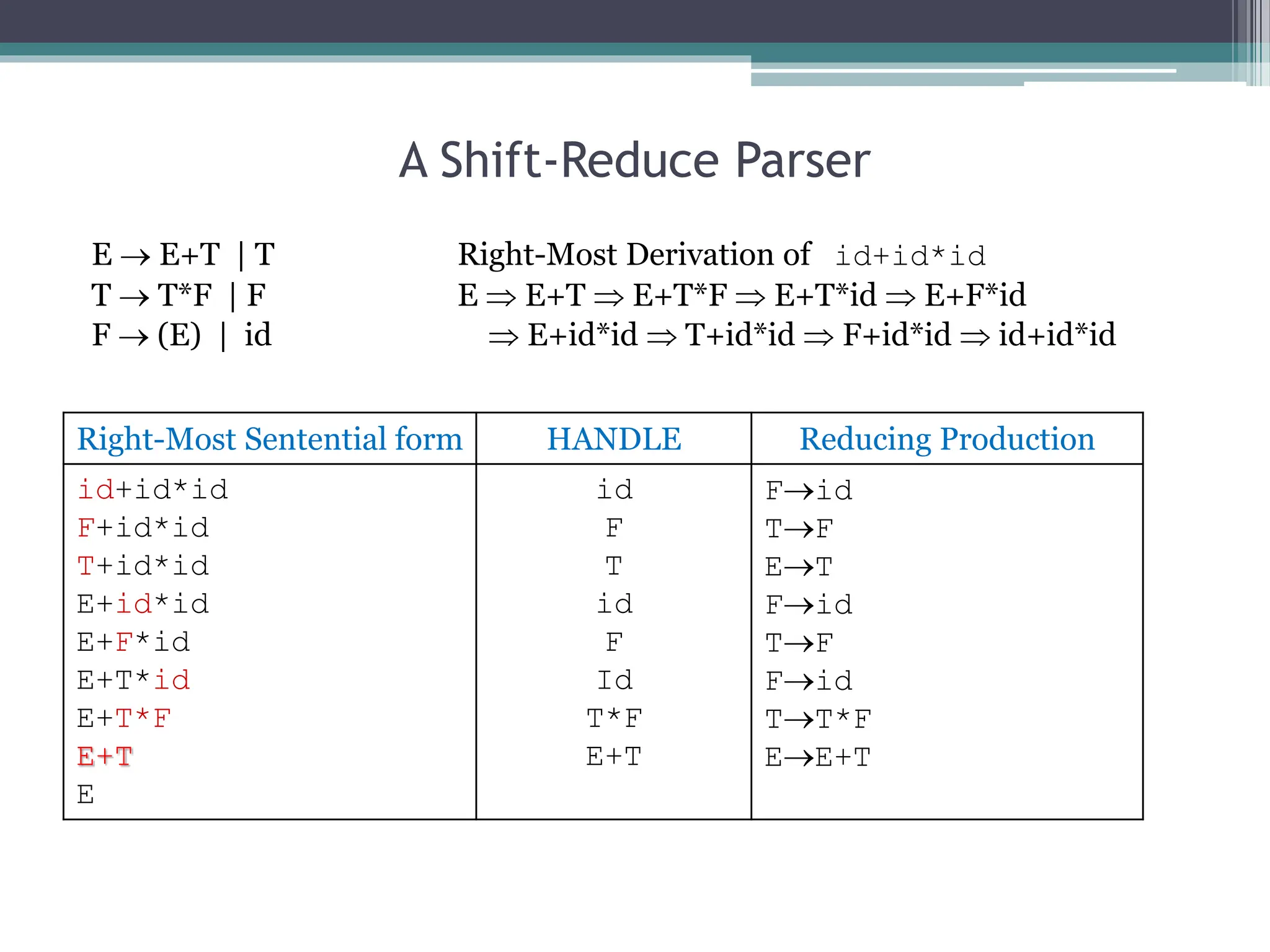
A Shift-Reduce Parser
E  E+T | T Right-Most Derivation of id+id*id
T  T*F | F E  E+T  E+T*F  E+T*id  E+F*id
F  (E) | id  E+id*id  T+id*id  F+id*id  id+id*id
Right-Most Sentential form HANDLE Reducing Production
id+id*id
F+id*id
T+id*id
E+id*id
E+F*id
E+T*id
E+T*F
E+T
E
id
F
T
id
F
Id
T*F
E+T
Fid
TF
ET
Fid
TF
Fid
TT*F
EE+T
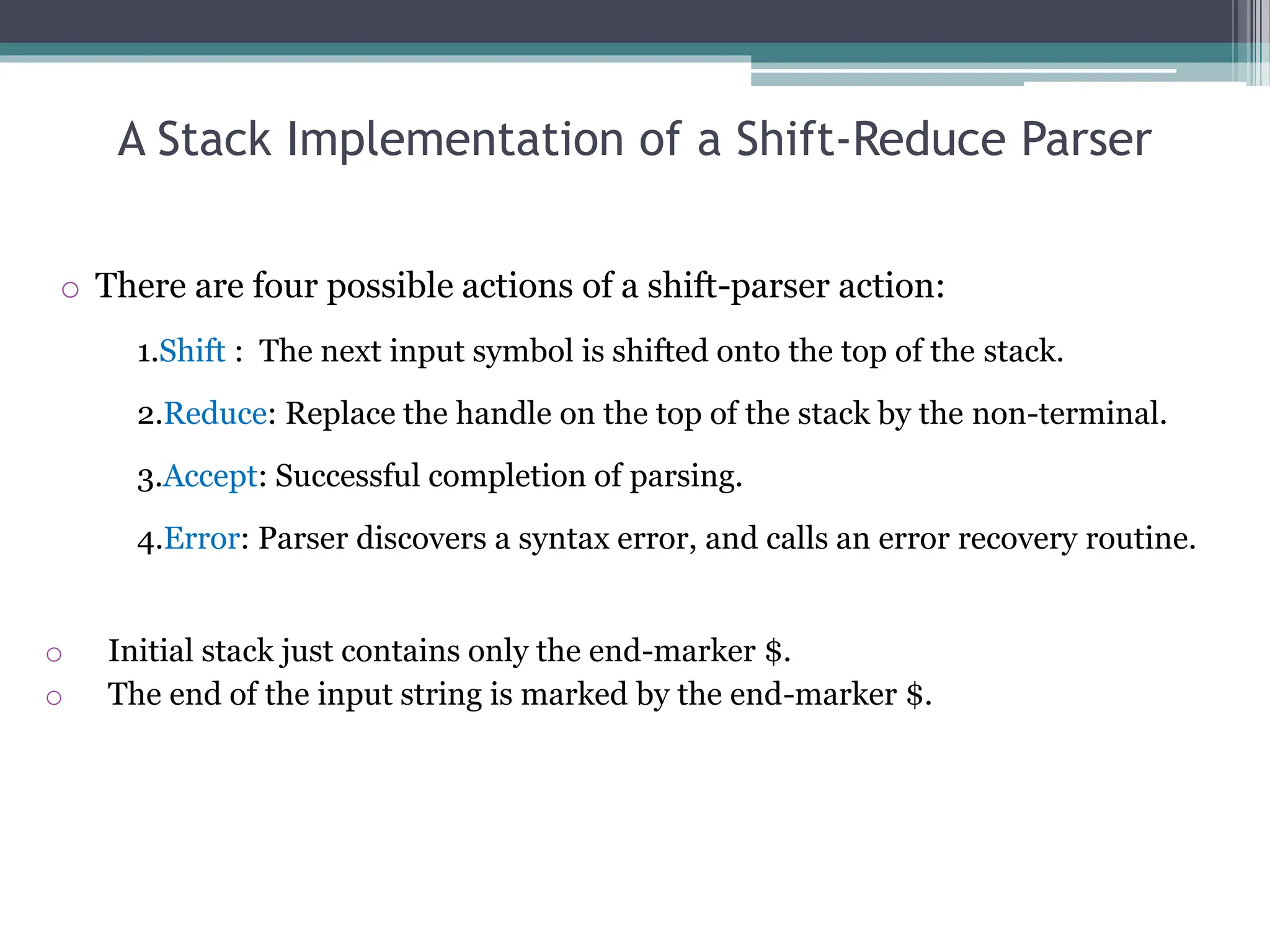
A Stack Implementation of a Shift-Reduce Parser
o There are four possible actions of a shift-parser action:
1.Shift : The next input symbol is shifted onto the top of the stack.
2.Reduce: Replace the handle on the top of the stack by the non-terminal.
3.Accept: Successful completion of parsing.
4.Error: Parser discovers a syntax error, and calls an error recovery routine.
o Initial stack just contains only the end-marker $.
o The end of the input string is marked by the end-marker $.
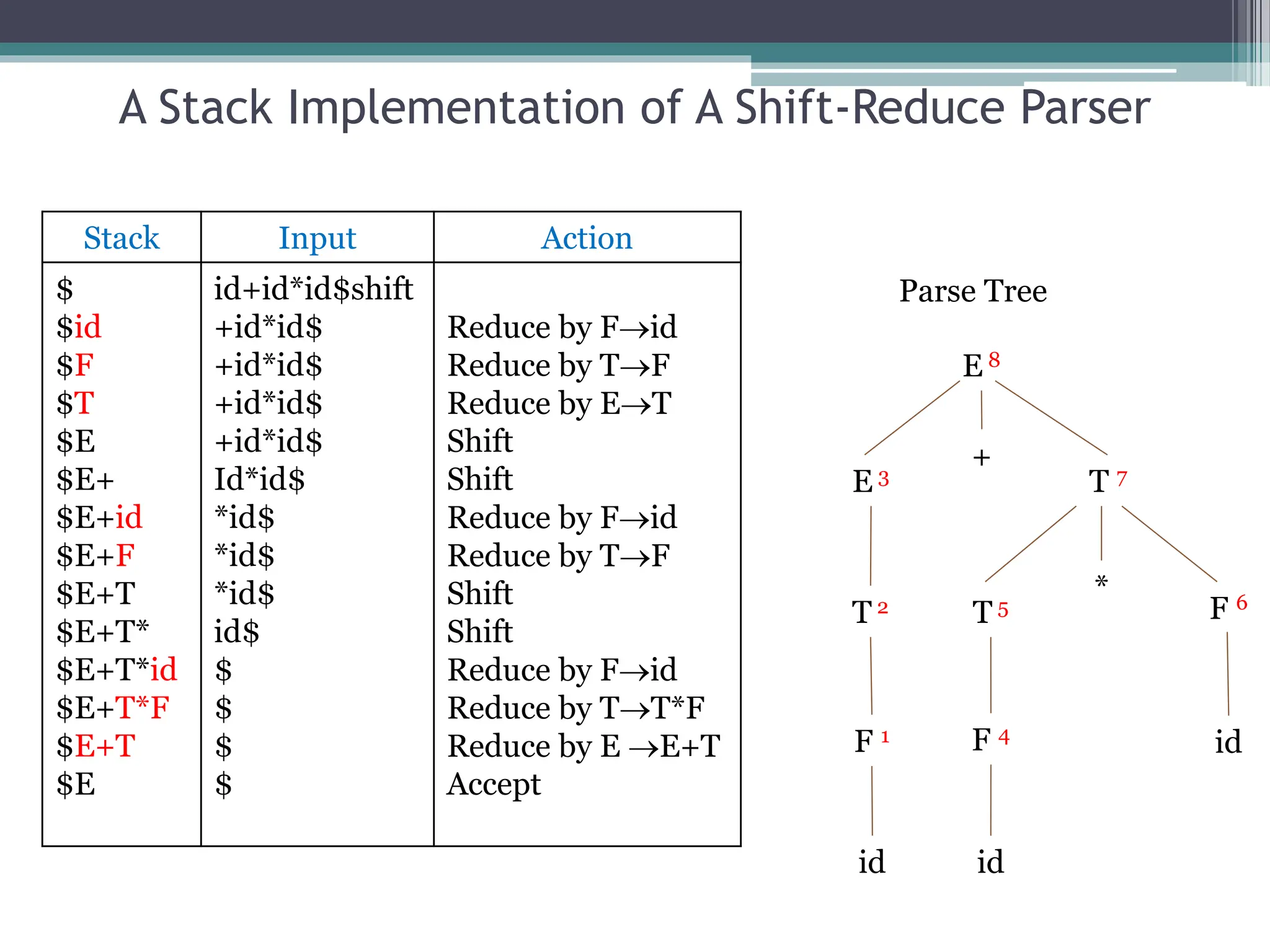
A Stack Implementation of A Shift-Reduce Parser
Stack Input Action
$
$id
$F
$T
$E
$E+
$E+id
$E+F
$E+T
$E+T*
$E+T*id
$E+T*F
$E+T
$E
id+id*id$shift
+id*id$
+id*id$
+id*id$
+id*id$
Id*id$
*id$
*id$
*id$
id$
$
$
$
$
Reduce by Fid
Reduce by TF
Reduce by ET
Shift
Shift
Reduce by Fid
Reduce by TF
Shift
Shift
Reduce by Fid
Reduce by TT*F
Reduce by E E+T
Accept
Parse Tree
E 8
E 3 T 7
+
T 5 F 6
*
F 4
F 1
T 2
id id
id

parsing in compiler design presentation .pptx

  • 1.
  • 2.
    Bottom-Up Parsing o Bottom-UpParser : Constructs a parse tree for an input string beginning at the leaves(the bottom) and working up towards the root(the top) o We can think of this process as one of “reducing” a string w to the start symbol of a grammar o Bottom-up parsing is also known as shift-reduce parsing because its two main actions are shift and reduce.  At each shift action, the current symbol in the input string is pushed to a stack. At each reduction step, the symbols at the top of the stack (this symbol sequence is the right side of a production) will replaced by the non- terminal at the left side of that production.
  • 3.
    Shift-Reduce Parsing o Ashift-reduce parser tries to reduce the given input string into the starting symbol. a string  the starting symbol reduced to o At each reduction step, a substring of the input matching to the right side of a production rule is replaced by the non-terminal at the left side of that production rule. o If the substring is chosen correctly, the right most derivation of that string is created in the reverse order. Rightmost Derivation: S   Shift-Reduce Parser finds:   ...  S rm rm rm *
  • 4.
    Shift–Reduce Parsing-Example o Considerthe grammar Input string : abbcde S aABe aAbcde A Abc | b aAde  reduction B d aABe S We can scan abbcde looking for a substring that matches the right side of some production.The substrings b and d qualify.Let us choose left most b and replace it by A,the left side of the production Ab;we thus obtain the string aAbcde.Now the substrings Abc,b and d match the right side of some production.Although b is the leftmost substring that matches the right side of the some production,we choose to replace the substring Abc by A,the left side of the production AAbc.We obtain aAde.Then replacing d by B,and then replacing the entire string by S.Thus,by a sequence of four reductions we are able to reduce abbcde to S
  • 5.
    Shift–Reduce Parsing-Example o Thesereductions infact trace out the following right-most derivation in reverse S  aABe  aAde  aAbcde  abbcde o How do we know which substring to be replaced at each reduction step? rm rm rm rm Right Sentential Forms
  • 6.
    Handle rm rm * o Informally,a “handle” of a string is a substring that matches the right side of the production,and whose reduction to nonterminal on the left side of the production represents one step along the reverse of a rightmost derivation ▫ But not every substring matches the right side of a production rule is handle. o Formally , a “handle” of a right sentential form γ ( ) is a production rule A   and a position of  where the string  may be found and replaced by A to produce the previous right-sentential form in a rightmost derivation of . S  A   then Aβ in the position following α is a handle of αβω o The string  to the right of the handle contains only terminal symbols.
  • 7.
    Example o Consider theexample discussed in the beginning,abbcde is a right sentential form whose handle is Ab at position 2.Likewise,aAbcde is a right sentential form whose handle is AAbc at position 2. o Sometimes we say “the substring β is a handle of αβω” if the position of β and the production Aβ we have in mind are clear.
  • 8.
    Handle Pruning o Arightmost derivation in reverse can be obtained by “handle pruning”.That is,we start with a string of terminals w that we wish to parse.If ω is a sentence of grammar at hand,then ω = γ,where γn is the nth right-sentential form of some as yet unknown rightmost derivation S = 0  1  2  ...  n-1  n=  Input string rm rm rm rm rm
  • 9.
    Handle Pruning S =0  1  2  ...  n-1  n=  o Start from n, find a handle Ann in n, and replace n in by An to get n-1. o Then find a handle An-1n-1 in n-1, and replace n-1 in by An-1 to get n-2. o Repeat this, until we reach S. rm rm rm rm rm
  • 10.
    A Shift-Reduce Parser E E+T | T Right-Most Derivation of id+id*id T  T*F | F E  E+T  E+T*F  E+T*id  E+F*id F  (E) | id  E+id*id  T+id*id  F+id*id  id+id*id Right-Most Sentential form HANDLE Reducing Production id+id*id F+id*id T+id*id E+id*id E+F*id E+T*id E+T*F E+T E id F T id F Id T*F E+T Fid TF ET Fid TF Fid TT*F EE+T
  • 11.
    A Stack Implementationof a Shift-Reduce Parser o There are four possible actions of a shift-parser action: 1.Shift : The next input symbol is shifted onto the top of the stack. 2.Reduce: Replace the handle on the top of the stack by the non-terminal. 3.Accept: Successful completion of parsing. 4.Error: Parser discovers a syntax error, and calls an error recovery routine. o Initial stack just contains only the end-marker $. o The end of the input string is marked by the end-marker $.
  • 12.
    A Stack Implementationof A Shift-Reduce Parser Stack Input Action $ $id $F $T $E $E+ $E+id $E+F $E+T $E+T* $E+T*id $E+T*F $E+T $E id+id*id$shift +id*id$ +id*id$ +id*id$ +id*id$ Id*id$ *id$ *id$ *id$ id$ $ $ $ $ Reduce by Fid Reduce by TF Reduce by ET Shift Shift Reduce by Fid Reduce by TF Shift Shift Reduce by Fid Reduce by TT*F Reduce by E E+T Accept Parse Tree E 8 E 3 T 7 + T 5 F 6 * F 4 F 1 T 2 id id id