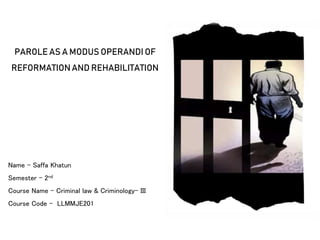
PAROLE AS A MODUS OPERANDI OF
REFORMATIONAND REHABILITATION
Name – Saffa Khatun
Semester – 2nd
Course Name – Criminal law & Criminology- III
Course Code - LLMMJE201
INTRODUCTION
WRONG RIGHT
FREE WILL
Parole is a method where a prisoner is
temporarily release after he served a part of the
sentence. (before end a sentence)
Requires periodic reporting to the authorities
for a set period of time
The release is granted if prisoner shows good
behaviour
Specific reason for parole is necessary
It is not the suspension of sentence
Regulated by- Prison Act 1894, Prisoner Act
1900. Although all states have their own prison
rule.
PAROLE
To make ties with outer world
To protect the society
To transform their mind setup
To rehabilitate prisoners
OBJECTIVES
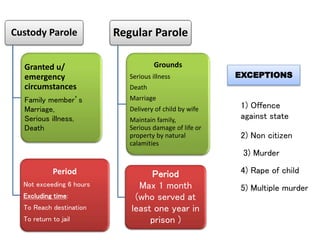
Custody Parole
Granted u/
emergency
circumstances
Family member’s
Marriage,
Serious illness,
Death
Period
Not exceeding 6 hours
Excluding time:
To Reach destination
To return to jail
Regular Parole
Grounds
Serious illness
Death
Marriage
Delivery of child by wife
Maintain family,
Serious damage of life or
property by natural
calamities
Period
Max 1 month
(who served at
least one year in
prison )
EXCEPTIONS
1) Offence
against state
2) Non citizen
3) Murder
4) Rape of child
5) Multiple murder
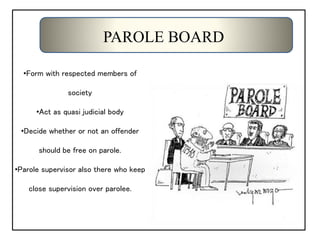
PAROLE BOARD
•Form with respected members of
society
•Act as quasi judicial body
•Decide whether or not an offender
should be free on parole.
•Parole supervisor also there who keep
close supervision over parolee.
CRITICAL ISSUES IN PAROLE
1
2
Misuse of Parole
Refusal of grant of parole
CONCLUSION
Political & administrative pressure reduce the effectiveness of parole.
So there is a need of:
Perfect procedural application
Psychological test to determine suitability for being parole out
Verified by multiple agencies & high level of security
Clear judicial policy

PAROLE.pptx

  • 1.
    PAROLE AS AMODUS OPERANDI OF REFORMATIONAND REHABILITATION Name – Saffa Khatun Semester – 2nd Course Name – Criminal law & Criminology- III Course Code - LLMMJE201
  • 2.
  • 3.
    Parole is amethod where a prisoner is temporarily release after he served a part of the sentence. (before end a sentence) Requires periodic reporting to the authorities for a set period of time The release is granted if prisoner shows good behaviour Specific reason for parole is necessary It is not the suspension of sentence Regulated by- Prison Act 1894, Prisoner Act 1900. Although all states have their own prison rule. PAROLE
  • 4.
    To make tieswith outer world To protect the society To transform their mind setup To rehabilitate prisoners OBJECTIVES
  • 5.
    Custody Parole Granted u/ emergency circumstances Familymember’s Marriage, Serious illness, Death Period Not exceeding 6 hours Excluding time: To Reach destination To return to jail Regular Parole Grounds Serious illness Death Marriage Delivery of child by wife Maintain family, Serious damage of life or property by natural calamities Period Max 1 month (who served at least one year in prison ) EXCEPTIONS 1) Offence against state 2) Non citizen 3) Murder 4) Rape of child 5) Multiple murder
  • 6.
    PAROLE BOARD •Form withrespected members of society •Act as quasi judicial body •Decide whether or not an offender should be free on parole. •Parole supervisor also there who keep close supervision over parolee.
  • 7.
    CRITICAL ISSUES INPAROLE 1 2 Misuse of Parole Refusal of grant of parole
  • 8.
    CONCLUSION Political & administrativepressure reduce the effectiveness of parole. So there is a need of: Perfect procedural application Psychological test to determine suitability for being parole out Verified by multiple agencies & high level of security Clear judicial policy