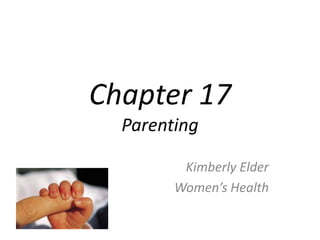
Chapter 17ParentingKimberly ElderWomen’s Health
Today more than ever the choice to become a parent exists because of access to birth control, legal abortion and reproductive technology.
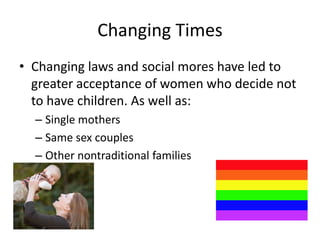
Changing TimesChanging laws and social mores have led to greater acceptance of women who decide not to have children. As well as:Single mothersSame sex couplesOther nontraditional families
Decisions….The decision weather to have a child is influenced by:Our Families…Our Culture…The society in which we live…
Government SupportUS Society presumes that motherhood is central to women’s identity and fulfillment, yet our government provides little concrete support for children and families. The US unlike other industrialized countries has:No paid family leaveNo guaranteed health careLittle affordable high quality child care
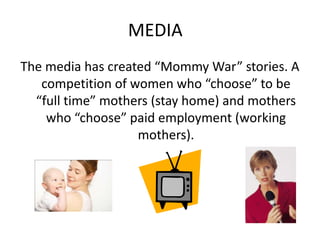
MEDIA	The media has created “Mommy War” stories. A competition of women who “choose” to be “full time” mothers (stay home) and mothers who “choose” paid employment (working mothers).
Statistics	US Census reports in 2002 over 50% of women with infants and 72% of other mothers were in the work force.Currently there are 10 million single mothers in the United States.
The PLUS sideChildren are engaging, inventive, interesting and funny.Teach us as they grow and change. We change and grow with them.Challenge and inspire us to make the world better.Give us a way to be part of the continuity of life.Tremendously moving and satisfying adventure.
The NOT so PLUS sideParenting involves exchanging spontaneity and relative control of everyday life for huge responsibility.Complicated schedules, relative chaos.May not enjoy the day to day reality of being with children.Fear bringing up children in a troubled world.Want to pursue dreams incompatible with child rearing.More personal freedom, time, money, work, interests and passions.
Questions to ask yourself….How will children affect my relationship?How will children affect my economic security?Do I have a stable household?Are there any family medical problems that could be passed on genetically?Do I have parenting skills ? Am I eager to learn them?How will I juggle work and child care?Do I have adequate health care?What would I do if my child developed disabilities?What values would I encourage in my child?What kind of community would I raise my child in?Am I ready to prepare a child for the difficulties of life?
Support SystemsTalk to your partner. What is your plan? Would someone be a stay at home parent?Who would provide childcare?How will you both balance work and parenting?Evaluate other emotional support systems:Friends	Co-workers	ChurchFamily	Neighbors
Common Challenges1- Avoiding a conscious decision.2- Letting your partner decide for you.3- Thinking your partner will change.4- Thinking it’s a decision between no children and two children.5- Making the decision without knowing what children are really like.6- Worrying that you won’t be a good parent.
Dividing Your TimeOne way to help make the decision is for you and your partner consider how your life would change. On a sheet of paper make 2 columns. Column one write down the amount of time you spend now, column two the amount of time you would spend after you have a child at:WorkRecreation & SocializingHobbiesRelaxation (yoga/meditation)SportsPolitical ActivitiesReligious activitiesTime alone with your partnerSLEEPAre you willing to change your schedule in these and other ways?
Now to become a mother…..Become aware of fertility and chart your menstrual cycle. Take care of yourself as you try to conceive. Depending on your situation you may consider insemination to conceive.Adoption
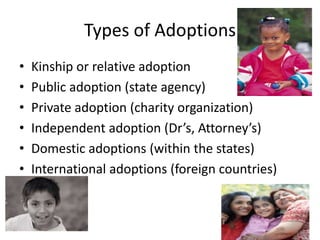
Types of AdoptionsKinship or relative adoptionPublic adoption (state agency)Private adoption (charity organization)Independent adoption (Dr’s, Attorney’s)Domestic adoptions (within the states)International adoptions (foreign countries)
What will you decide?Will you become a parent?

Parenting- Chapter 17

  • 1.
  • 2.
    Today more thanever the choice to become a parent exists because of access to birth control, legal abortion and reproductive technology.
  • 3.
    Changing TimesChanging lawsand social mores have led to greater acceptance of women who decide not to have children. As well as:Single mothersSame sex couplesOther nontraditional families
  • 4.
    Decisions….The decision weatherto have a child is influenced by:Our Families…Our Culture…The society in which we live…
  • 5.
    Government SupportUS Societypresumes that motherhood is central to women’s identity and fulfillment, yet our government provides little concrete support for children and families. The US unlike other industrialized countries has:No paid family leaveNo guaranteed health careLittle affordable high quality child care
  • 6.
    MEDIA The media hascreated “Mommy War” stories. A competition of women who “choose” to be “full time” mothers (stay home) and mothers who “choose” paid employment (working mothers).
  • 7.
    Statistics US Census reportsin 2002 over 50% of women with infants and 72% of other mothers were in the work force.Currently there are 10 million single mothers in the United States.
  • 8.
    The PLUS sideChildrenare engaging, inventive, interesting and funny.Teach us as they grow and change. We change and grow with them.Challenge and inspire us to make the world better.Give us a way to be part of the continuity of life.Tremendously moving and satisfying adventure.
  • 9.
    The NOT soPLUS sideParenting involves exchanging spontaneity and relative control of everyday life for huge responsibility.Complicated schedules, relative chaos.May not enjoy the day to day reality of being with children.Fear bringing up children in a troubled world.Want to pursue dreams incompatible with child rearing.More personal freedom, time, money, work, interests and passions.
  • 10.
    Questions to askyourself….How will children affect my relationship?How will children affect my economic security?Do I have a stable household?Are there any family medical problems that could be passed on genetically?Do I have parenting skills ? Am I eager to learn them?How will I juggle work and child care?Do I have adequate health care?What would I do if my child developed disabilities?What values would I encourage in my child?What kind of community would I raise my child in?Am I ready to prepare a child for the difficulties of life?
  • 11.
    Support SystemsTalk toyour partner. What is your plan? Would someone be a stay at home parent?Who would provide childcare?How will you both balance work and parenting?Evaluate other emotional support systems:Friends Co-workers ChurchFamily Neighbors
  • 12.
    Common Challenges1- Avoidinga conscious decision.2- Letting your partner decide for you.3- Thinking your partner will change.4- Thinking it’s a decision between no children and two children.5- Making the decision without knowing what children are really like.6- Worrying that you won’t be a good parent.
  • 13.
    Dividing Your TimeOneway to help make the decision is for you and your partner consider how your life would change. On a sheet of paper make 2 columns. Column one write down the amount of time you spend now, column two the amount of time you would spend after you have a child at:WorkRecreation & SocializingHobbiesRelaxation (yoga/meditation)SportsPolitical ActivitiesReligious activitiesTime alone with your partnerSLEEPAre you willing to change your schedule in these and other ways?
  • 14.
    Now to becomea mother…..Become aware of fertility and chart your menstrual cycle. Take care of yourself as you try to conceive. Depending on your situation you may consider insemination to conceive.Adoption
  • 15.
    Types of AdoptionsKinshipor relative adoptionPublic adoption (state agency)Private adoption (charity organization)Independent adoption (Dr’s, Attorney’s)Domestic adoptions (within the states)International adoptions (foreign countries)
  • 16.
    What will youdecide?Will you become a parent?