Parental Drinking:
keeping the child in mind
Alcohol Action Ireland
27th May 2009

Wendy Robinson
Children & Families Substance Misuse Consultant
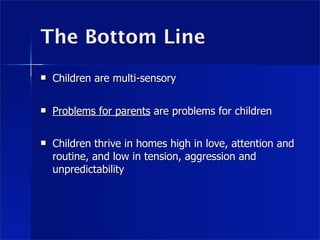
The Bottom Line
   Children are multi-sensory

   Problems for parents are problems for children

   Children thrive in homes high in love, attention and
    routine, and low in tension, aggression and
    unpredictability
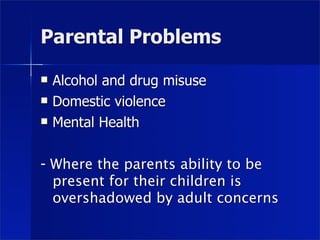
Parental Problems

   Alcohol and drug misuse
   Domestic violence
   Mental Health

- Where the parents ability to be
  present for their children is
  overshadowed by adult concerns
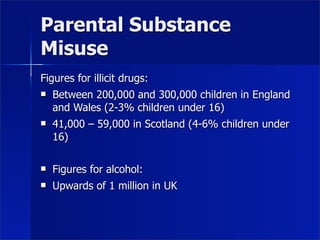
Parental Substance
Misuse
Figures for illicit drugs:
   Between 200,000 and 300,000 children in England
    and Wales (2-3% children under 16)
   41,000 – 59,000 in Scotland (4-6% children under
    16)

   Figures for alcohol:
   Upwards of 1 million in UK
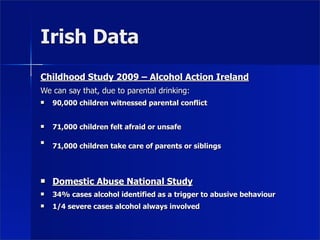
Irish Data
Childhood Study 2009 – Alcohol Action Ireland
We can say that, due to parental drinking:
   90,000 children witnessed parental conflict


   71,000 children felt afraid or unsafe


    71,000 children take care of parents or siblings


   Domestic Abuse National Study
   34% cases alcohol identified as a trigger to abusive behaviour
   1/4 severe cases alcohol always involved
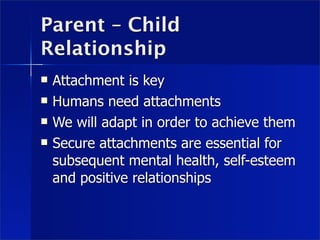
Parent – Child
Relationship
   Attachment is key
   Humans need attachments
   We will adapt in order to achieve them
   Secure attachments are essential for
    subsequent mental health, self-esteem
    and positive relationships
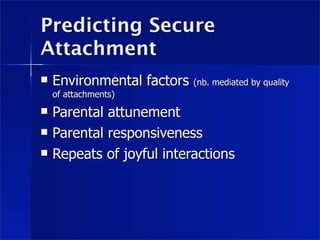
Predicting Secure
Attachment
   Environmental factors   (nb. mediated by quality
    of attachments)
   Parental attunement
   Parental responsiveness
   Repeats of joyful interactions
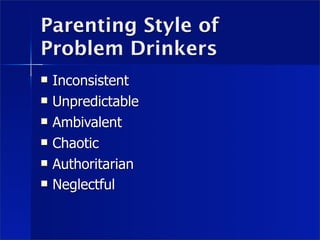
Parenting Style of
Problem Drinkers
   Inconsistent
   Unpredictable
   Ambivalent
   Chaotic
   Authoritarian
   Neglectful
Family Environment
   Violence in the home
   Marital Conflict
   Separation, divorce, loss of parent
   Inconsistent and ambivalent parenting
   Unpredictability
   Role reversal
   Lack of routines and rituals
Childs Experience
Childs Experience
   Parents arguing, unhappy and preoccupied
Childs Experience
   Parents arguing, unhappy and preoccupied
   Violence between parents
Childs Experience
   Parents arguing, unhappy and preoccupied
   Violence between parents
   Parents not united in parenting role
Childs Experience
   Parents arguing, unhappy and preoccupied
   Violence between parents
   Parents not united in parenting role
   Inconsistent boundaries and rules
Childs Experience
   Parents arguing, unhappy and preoccupied
   Violence between parents
   Parents not united in parenting role
   Inconsistent boundaries and rules
   Negative family atmosphere
Childs Experience
   Parents arguing, unhappy and preoccupied
   Violence between parents
   Parents not united in parenting role
   Inconsistent boundaries and rules
   Negative family atmosphere
   Low level of enjoyable family activity
Childs Experience
   Parents arguing, unhappy and preoccupied
   Violence between parents
   Parents not united in parenting role
   Inconsistent boundaries and rules
   Negative family atmosphere
   Low level of enjoyable family activity
   Financial hardship
Childs Experience
   Parents arguing, unhappy and preoccupied
   Violence between parents
   Parents not united in parenting role
   Inconsistent boundaries and rules
   Negative family atmosphere
   Low level of enjoyable family activity
   Financial hardship
   Poor relationship with one or both parents
Childs Experience
   Parents arguing, unhappy and preoccupied
   Violence between parents
   Parents not united in parenting role
   Inconsistent boundaries and rules
   Negative family atmosphere
   Low level of enjoyable family activity
   Financial hardship
   Poor relationship with one or both parents
   Increased risk of abuse and neglect
Resulting Problems for
Children?
   Anti-social behaviour
   School problems
   Emotional difficulties
   Friendship/relationship difficulties
   Adolescence
   Transition to adulthood
Wider impact:

   Schools and education
   Safeguarding children/CPR
   Fostering and Adoption
   Youth Offending
   Primary Care
   Community Safety
   Workforce
Trauma and distress
   ‘When children are distressed they are at the mercy of these
    states. Until these states are brought under control, the child
    must use all their resources to cope. While they are doing
    that, they can do nothing else.’
                                       Tronick and Weinberg, 1997


   When caregivers not only fail to
    provide comfort at times of extreme
    stress, but are themselves the
    principal source of that stress.
Key Issues for children
   Attachment and Bonding
Key Issues for children
   Attachment and Bonding
Key Issues for children
   Attachment and Bonding

   Identity and Self Image
Key Issues for children
   Attachment and Bonding

   Identity and Self Image
Key Issues for children
   Attachment and Bonding

   Identity and Self Image

   Separation and Loss
Key Issues for children
   Attachment and Bonding

   Identity and Self Image

   Separation and Loss
Key Issues for children
   Attachment and Bonding

   Identity and Self Image

   Separation and Loss

   Control and Suppression of Needs/Feelings
Key Issues for children
   Attachment and Bonding

   Identity and Self Image

   Separation and Loss

   Control and Suppression of Needs/Feelings
Key Issues for children
   Attachment and Bonding

   Identity and Self Image

   Separation and Loss

   Control and Suppression of Needs/Feelings

   Trust
Protective Factors
   A non-drinking parent - time and attention

   Cohesive parental relationship - united front

   Cohesive family - activities and affection

   Rituals maintained - special occasions

   Influence of important others - stable adults

   Things outside the home - own interests

   Deliberate planning for the future              
                                                       Vellerman & Orford
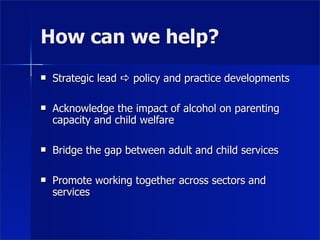
How can we help?
   Strategic lead  policy and practice developments

   Acknowledge the impact of alcohol on parenting
    capacity and child welfare

   Bridge the gap between adult and child services

   Promote working together across sectors and
    services
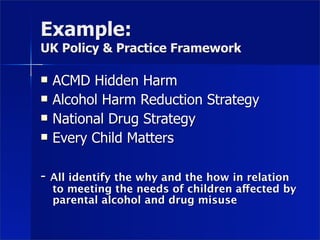
Example:
UK Policy & Practice Framework

   ACMD Hidden Harm
   Alcohol Harm Reduction Strategy
   National Drug Strategy
   Every Child Matters

-   All identify the why and the how in relation
    to meeting the needs of children affected by
    parental alcohol and drug misuse
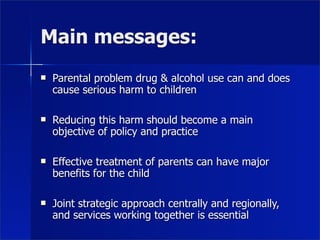
Main messages:
   Parental problem drug & alcohol use can and does
    cause serious harm to children

   Reducing this harm should become a main
    objective of policy and practice

   Effective treatment of parents can have major
    benefits for the child

   Joint strategic approach centrally and regionally,
    and services working together is essential
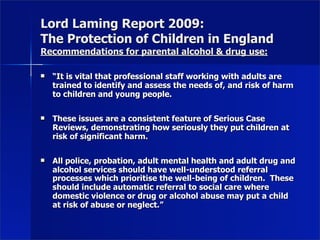
Lord Laming Report 2009:
The Protection of Children in England
Recommendations for parental alcohol & drug use:

   “It is vital that professional staff working with adults are
    trained to identify and assess the needs of, and risk of harm
    to children and young people.

   These issues are a consistent feature of Serious Case
    Reviews, demonstrating how seriously they put children at
    risk of significant harm.

   All police, probation, adult mental health and adult drug and
    alcohol services should have well-understood referral
    processes which prioritise the well-being of children. These
    should include automatic referral to social care where
    domestic violence or drug or alcohol abuse may put a child
    at risk of abuse or neglect.”
Safeguarding children
and supporting families
Safeguarding children
and supporting families
1. Huge challenge to accurately and fairly assess and intervene
   effectively
Safeguarding children
and supporting families
1. Huge challenge to accurately and fairly assess and intervene
   effectively
Safeguarding children
and supporting families
1. Huge challenge to accurately and fairly assess and intervene
   effectively

2. Important to remember that keeping the well-being of children
    as paramount usually means supporting parents and keeping
    families together
Safeguarding children
and supporting families
1. Huge challenge to accurately and fairly assess and intervene
   effectively

2. Important to remember that keeping the well-being of children
    as paramount usually means supporting parents and keeping
    families together
Safeguarding children
and supporting families
1. Huge challenge to accurately and fairly assess and intervene
   effectively

2. Important to remember that keeping the well-being of children
    as paramount usually means supporting parents and keeping
    families together

3. Should not and need not be an either/or
Safeguarding children
and supporting families
1. Huge challenge to accurately and fairly assess and intervene
   effectively

2. Important to remember that keeping the well-being of children
    as paramount usually means supporting parents and keeping
    families together

3. Should not and need not be an either/or
Safeguarding children
and supporting families
1. Huge challenge to accurately and fairly assess and intervene
   effectively

2. Important to remember that keeping the well-being of children
    as paramount usually means supporting parents and keeping
    families together

3. Should not and need not be an either/or

4. Requires a high degree of multi-agency partnership working,
   and open minded professional approach
And more….
And more….

5. Services working with problem alcohol users should see the
   well-being of children as being of paramount importance
And more….

5. Services working with problem alcohol users should see the
   well-being of children as being of paramount importance
And more….

5. Services working with problem alcohol users should see the
   well-being of children as being of paramount importance

6. Those working with children and families should understand
   why and how to act when a parent has alcohol problems.
And more….

5. Services working with problem alcohol users should see the
   well-being of children as being of paramount importance

6. Those working with children and families should understand
   why and how to act when a parent has alcohol problems.
And more….

5. Services working with problem alcohol users should see the
   well-being of children as being of paramount importance

6. Those working with children and families should understand
   why and how to act when a parent has alcohol problems.

7. Need to develop united strategic and service approaches
   despite timescale and priority conflicts.
Why is it hard to
respond?
   Normalisation of alcohol in society

   Illicit drugs seen as more risky

   Knowledge and competence

   Professional legitimacy

   Complex and multidimensional needs

   Culture of specialists and experts
A pessimists problem is
an optimists opportunity!
   Collaboration towards common goal – we all want
    the same thing

   Bridge the gap between adult alcohol treatment
    and child welfare - vigilant towards professional
    bias

   The family is the client and children are the priority

   Changes in parenting now, changes in alcohol use
    over time
Best Practice Guidance
No need to reinvent the wheel!

   Supporting children affected by parental alcohol misuse: A Toolkit
    www.alcoholandfamilies.org.uk


   Working with children and families of problem alcohol users: A Service
    Development Toolkit www.bath.ac.uk


   Adult Drug Problems, Children’s Needs: Assessing the impact of parental drug
    use www.ncb.org.uk


   Seeing & Hearing the Child: Rising to the challenge of parental substance
    misuse www.nspcc.org.uk


   Building Resilience in Families Under Stress: Supporting Families affected by
    parental substance misuse www.ncb.org.uk
Challenges &
Opportunities
Challenges:
   Change is slow…for individuals, for families, for communities
   Cross sector issue – no-one solely responsible
   Children need to believe all is well – parents are perfect!
   “It never did me any harm”


Opportunities:
   New evidence points the way
   Small changes- big impact
   Working together
   Everyone benefits when families do well
For more information please
contact:

Wendy Robinson Consultancy
9a Nelson Road
Whitstable
Kent
England
CT5 1DP


01227 772712

Parental Drinking: Keeping The Child in MInd

  • 1.
    Parental Drinking: keeping thechild in mind Alcohol Action Ireland 27th May 2009 Wendy Robinson Children & Families Substance Misuse Consultant
  • 2.
    The Bottom Line  Children are multi-sensory  Problems for parents are problems for children  Children thrive in homes high in love, attention and routine, and low in tension, aggression and unpredictability
  • 3.
    Parental Problems  Alcohol and drug misuse  Domestic violence  Mental Health - Where the parents ability to be present for their children is overshadowed by adult concerns
  • 4.
    Parental Substance Misuse Figures forillicit drugs:  Between 200,000 and 300,000 children in England and Wales (2-3% children under 16)  41,000 – 59,000 in Scotland (4-6% children under 16)  Figures for alcohol:  Upwards of 1 million in UK
  • 5.
    Irish Data Childhood Study2009 – Alcohol Action Ireland We can say that, due to parental drinking:  90,000 children witnessed parental conflict  71,000 children felt afraid or unsafe  71,000 children take care of parents or siblings  Domestic Abuse National Study  34% cases alcohol identified as a trigger to abusive behaviour  1/4 severe cases alcohol always involved
  • 6.
    Parent – Child Relationship  Attachment is key  Humans need attachments  We will adapt in order to achieve them  Secure attachments are essential for subsequent mental health, self-esteem and positive relationships
  • 7.
    Predicting Secure Attachment  Environmental factors (nb. mediated by quality of attachments)  Parental attunement  Parental responsiveness  Repeats of joyful interactions
  • 8.
    Parenting Style of ProblemDrinkers  Inconsistent  Unpredictable  Ambivalent  Chaotic  Authoritarian  Neglectful
  • 9.
    Family Environment  Violence in the home  Marital Conflict  Separation, divorce, loss of parent  Inconsistent and ambivalent parenting  Unpredictability  Role reversal  Lack of routines and rituals
  • 11.
  • 12.
    Childs Experience  Parents arguing, unhappy and preoccupied
  • 13.
    Childs Experience  Parents arguing, unhappy and preoccupied  Violence between parents
  • 14.
    Childs Experience  Parents arguing, unhappy and preoccupied  Violence between parents  Parents not united in parenting role
  • 15.
    Childs Experience  Parents arguing, unhappy and preoccupied  Violence between parents  Parents not united in parenting role  Inconsistent boundaries and rules
  • 16.
    Childs Experience  Parents arguing, unhappy and preoccupied  Violence between parents  Parents not united in parenting role  Inconsistent boundaries and rules  Negative family atmosphere
  • 17.
    Childs Experience  Parents arguing, unhappy and preoccupied  Violence between parents  Parents not united in parenting role  Inconsistent boundaries and rules  Negative family atmosphere  Low level of enjoyable family activity
  • 18.
    Childs Experience  Parents arguing, unhappy and preoccupied  Violence between parents  Parents not united in parenting role  Inconsistent boundaries and rules  Negative family atmosphere  Low level of enjoyable family activity  Financial hardship
  • 19.
    Childs Experience  Parents arguing, unhappy and preoccupied  Violence between parents  Parents not united in parenting role  Inconsistent boundaries and rules  Negative family atmosphere  Low level of enjoyable family activity  Financial hardship  Poor relationship with one or both parents
  • 20.
    Childs Experience  Parents arguing, unhappy and preoccupied  Violence between parents  Parents not united in parenting role  Inconsistent boundaries and rules  Negative family atmosphere  Low level of enjoyable family activity  Financial hardship  Poor relationship with one or both parents  Increased risk of abuse and neglect
  • 21.
    Resulting Problems for Children?  Anti-social behaviour  School problems  Emotional difficulties  Friendship/relationship difficulties  Adolescence  Transition to adulthood
  • 22.
    Wider impact:  Schools and education  Safeguarding children/CPR  Fostering and Adoption  Youth Offending  Primary Care  Community Safety  Workforce
  • 23.
    Trauma and distress  ‘When children are distressed they are at the mercy of these states. Until these states are brought under control, the child must use all their resources to cope. While they are doing that, they can do nothing else.’ Tronick and Weinberg, 1997  When caregivers not only fail to provide comfort at times of extreme stress, but are themselves the principal source of that stress.
  • 25.
  • 26.
    Key Issues forchildren  Attachment and Bonding
  • 27.
    Key Issues forchildren  Attachment and Bonding
  • 28.
    Key Issues forchildren  Attachment and Bonding  Identity and Self Image
  • 29.
    Key Issues forchildren  Attachment and Bonding  Identity and Self Image
  • 30.
    Key Issues forchildren  Attachment and Bonding  Identity and Self Image  Separation and Loss
  • 31.
    Key Issues forchildren  Attachment and Bonding  Identity and Self Image  Separation and Loss
  • 32.
    Key Issues forchildren  Attachment and Bonding  Identity and Self Image  Separation and Loss  Control and Suppression of Needs/Feelings
  • 33.
    Key Issues forchildren  Attachment and Bonding  Identity and Self Image  Separation and Loss  Control and Suppression of Needs/Feelings
  • 34.
    Key Issues forchildren  Attachment and Bonding  Identity and Self Image  Separation and Loss  Control and Suppression of Needs/Feelings  Trust
  • 35.
    Protective Factors  A non-drinking parent - time and attention  Cohesive parental relationship - united front  Cohesive family - activities and affection  Rituals maintained - special occasions  Influence of important others - stable adults  Things outside the home - own interests  Deliberate planning for the future  Vellerman & Orford
  • 36.
    How can wehelp?  Strategic lead  policy and practice developments  Acknowledge the impact of alcohol on parenting capacity and child welfare  Bridge the gap between adult and child services  Promote working together across sectors and services
  • 37.
    Example: UK Policy &Practice Framework  ACMD Hidden Harm  Alcohol Harm Reduction Strategy  National Drug Strategy  Every Child Matters - All identify the why and the how in relation to meeting the needs of children affected by parental alcohol and drug misuse
  • 38.
    Main messages:  Parental problem drug & alcohol use can and does cause serious harm to children  Reducing this harm should become a main objective of policy and practice  Effective treatment of parents can have major benefits for the child  Joint strategic approach centrally and regionally, and services working together is essential
  • 39.
    Lord Laming Report2009: The Protection of Children in England Recommendations for parental alcohol & drug use:  “It is vital that professional staff working with adults are trained to identify and assess the needs of, and risk of harm to children and young people.  These issues are a consistent feature of Serious Case Reviews, demonstrating how seriously they put children at risk of significant harm.  All police, probation, adult mental health and adult drug and alcohol services should have well-understood referral processes which prioritise the well-being of children. These should include automatic referral to social care where domestic violence or drug or alcohol abuse may put a child at risk of abuse or neglect.”
  • 41.
  • 42.
    Safeguarding children and supportingfamilies 1. Huge challenge to accurately and fairly assess and intervene effectively
  • 43.
    Safeguarding children and supportingfamilies 1. Huge challenge to accurately and fairly assess and intervene effectively
  • 44.
    Safeguarding children and supportingfamilies 1. Huge challenge to accurately and fairly assess and intervene effectively 2. Important to remember that keeping the well-being of children as paramount usually means supporting parents and keeping families together
  • 45.
    Safeguarding children and supportingfamilies 1. Huge challenge to accurately and fairly assess and intervene effectively 2. Important to remember that keeping the well-being of children as paramount usually means supporting parents and keeping families together
  • 46.
    Safeguarding children and supportingfamilies 1. Huge challenge to accurately and fairly assess and intervene effectively 2. Important to remember that keeping the well-being of children as paramount usually means supporting parents and keeping families together 3. Should not and need not be an either/or
  • 47.
    Safeguarding children and supportingfamilies 1. Huge challenge to accurately and fairly assess and intervene effectively 2. Important to remember that keeping the well-being of children as paramount usually means supporting parents and keeping families together 3. Should not and need not be an either/or
  • 48.
    Safeguarding children and supportingfamilies 1. Huge challenge to accurately and fairly assess and intervene effectively 2. Important to remember that keeping the well-being of children as paramount usually means supporting parents and keeping families together 3. Should not and need not be an either/or 4. Requires a high degree of multi-agency partnership working, and open minded professional approach
  • 50.
  • 51.
    And more…. 5. Servicesworking with problem alcohol users should see the well-being of children as being of paramount importance
  • 52.
    And more…. 5. Servicesworking with problem alcohol users should see the well-being of children as being of paramount importance
  • 53.
    And more…. 5. Servicesworking with problem alcohol users should see the well-being of children as being of paramount importance 6. Those working with children and families should understand why and how to act when a parent has alcohol problems.
  • 54.
    And more…. 5. Servicesworking with problem alcohol users should see the well-being of children as being of paramount importance 6. Those working with children and families should understand why and how to act when a parent has alcohol problems.
  • 55.
    And more…. 5. Servicesworking with problem alcohol users should see the well-being of children as being of paramount importance 6. Those working with children and families should understand why and how to act when a parent has alcohol problems. 7. Need to develop united strategic and service approaches despite timescale and priority conflicts.
  • 56.
    Why is ithard to respond?  Normalisation of alcohol in society  Illicit drugs seen as more risky  Knowledge and competence  Professional legitimacy  Complex and multidimensional needs  Culture of specialists and experts
  • 57.
    A pessimists problemis an optimists opportunity!  Collaboration towards common goal – we all want the same thing  Bridge the gap between adult alcohol treatment and child welfare - vigilant towards professional bias  The family is the client and children are the priority  Changes in parenting now, changes in alcohol use over time
  • 58.
    Best Practice Guidance Noneed to reinvent the wheel!  Supporting children affected by parental alcohol misuse: A Toolkit www.alcoholandfamilies.org.uk  Working with children and families of problem alcohol users: A Service Development Toolkit www.bath.ac.uk  Adult Drug Problems, Children’s Needs: Assessing the impact of parental drug use www.ncb.org.uk  Seeing & Hearing the Child: Rising to the challenge of parental substance misuse www.nspcc.org.uk  Building Resilience in Families Under Stress: Supporting Families affected by parental substance misuse www.ncb.org.uk
  • 59.
    Challenges & Opportunities Challenges:  Change is slow…for individuals, for families, for communities  Cross sector issue – no-one solely responsible  Children need to believe all is well – parents are perfect!  “It never did me any harm” Opportunities:  New evidence points the way  Small changes- big impact  Working together  Everyone benefits when families do well
  • 61.
    For more informationplease contact: Wendy Robinson Consultancy 9a Nelson Road Whitstable Kent England CT5 1DP 01227 772712