PARENT AND CHILD
CLASSES IN OOP
UNDERSTANDING INHERITANCE IN OBJECT-ORIENTED PROGRAMMING
INTRODUCTIONTO OOP
• Object-Oriented Programming (OOP) is a paradigm based on
the concept of "objects.“
• It helps in organizing code in reusable and modular
components.
• Key concepts: Encapsulation, Abstraction, Inheritance, and
Polymorphism.
WHAT ARE PARENT AND CHILD CLASSES?
• Parent Class (Base/Superclass): A general class that
contains common attributes and methods.
• Child Class (Derived/Subclass):A class that inherits the
properties and methods of the parent class and can
have additional specific attributes or methods.
INHERITANCE IN OOP
• Inheritance allows a child class to reuse the methods
and properties of a parent class.
• Promotes code reuse and reduces redundancy.
• Child classes can extend or modify the behavior of the
parent class.
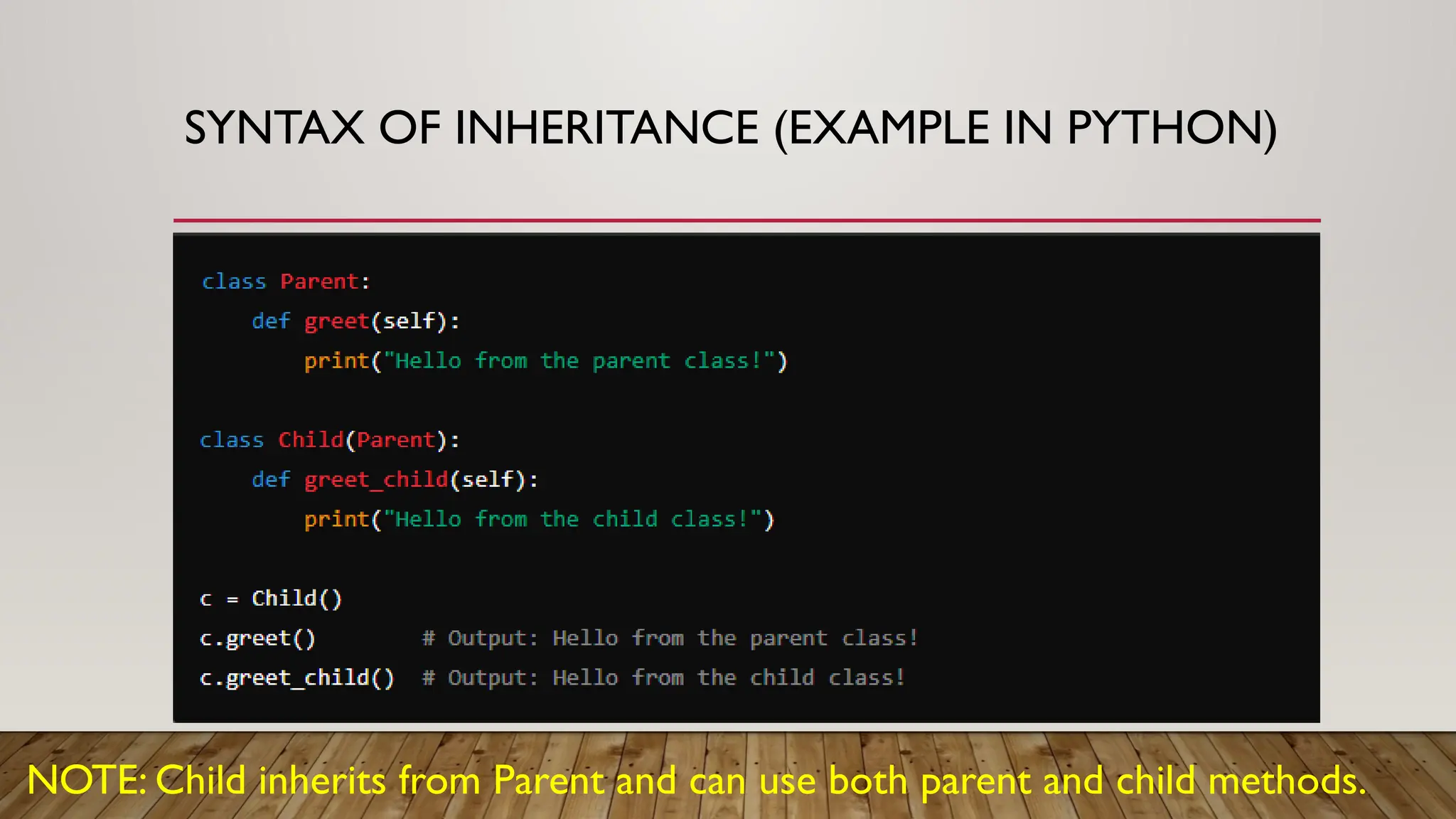
SYNTAX OF INHERITANCE (EXAMPLE IN PYTHON)
NOTE: Child inherits from Parent and can use both parent and child methods.
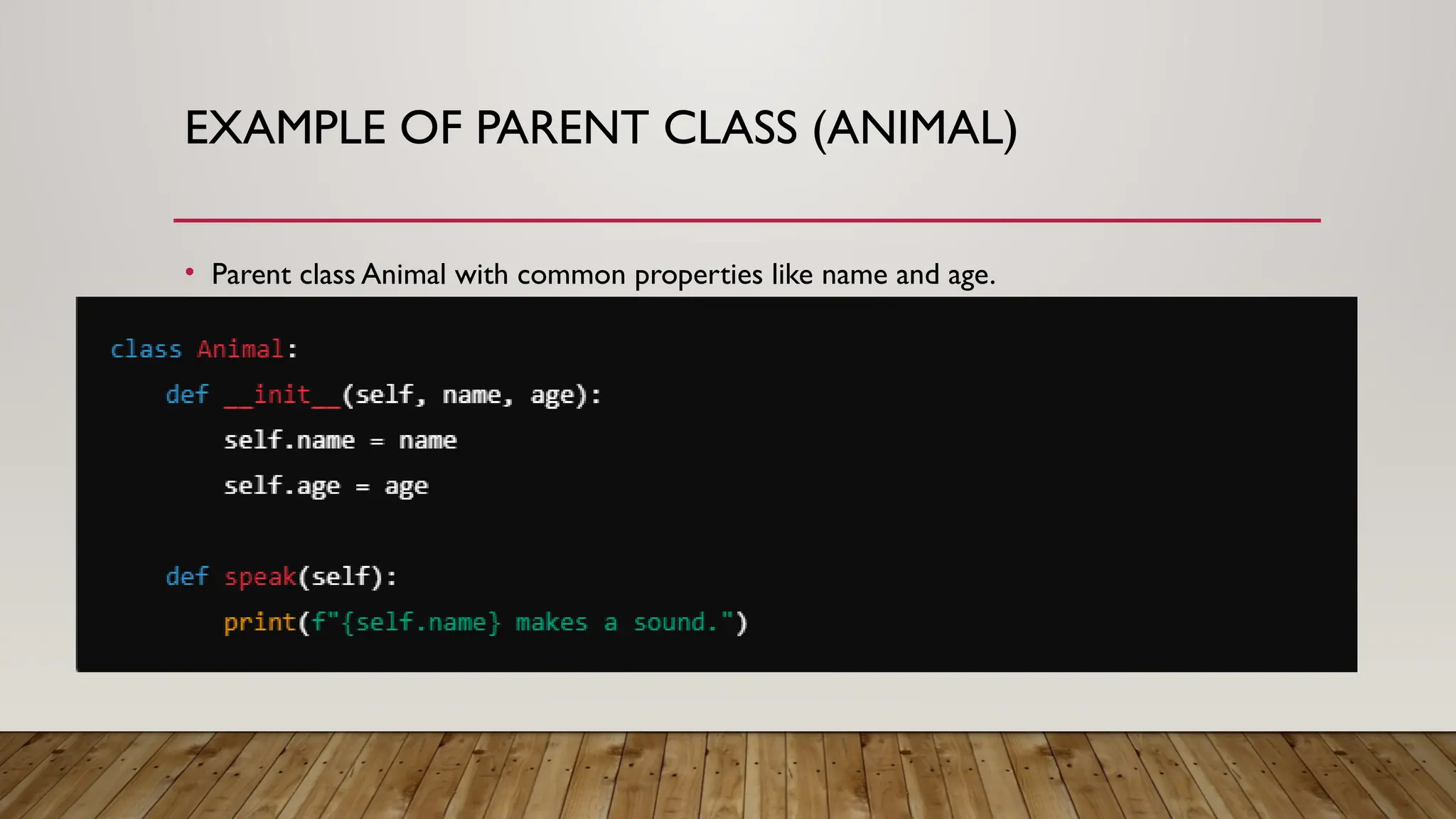
EXAMPLE OF PARENT CLASS (ANIMAL)
• Parent class Animal with common properties like name and age.
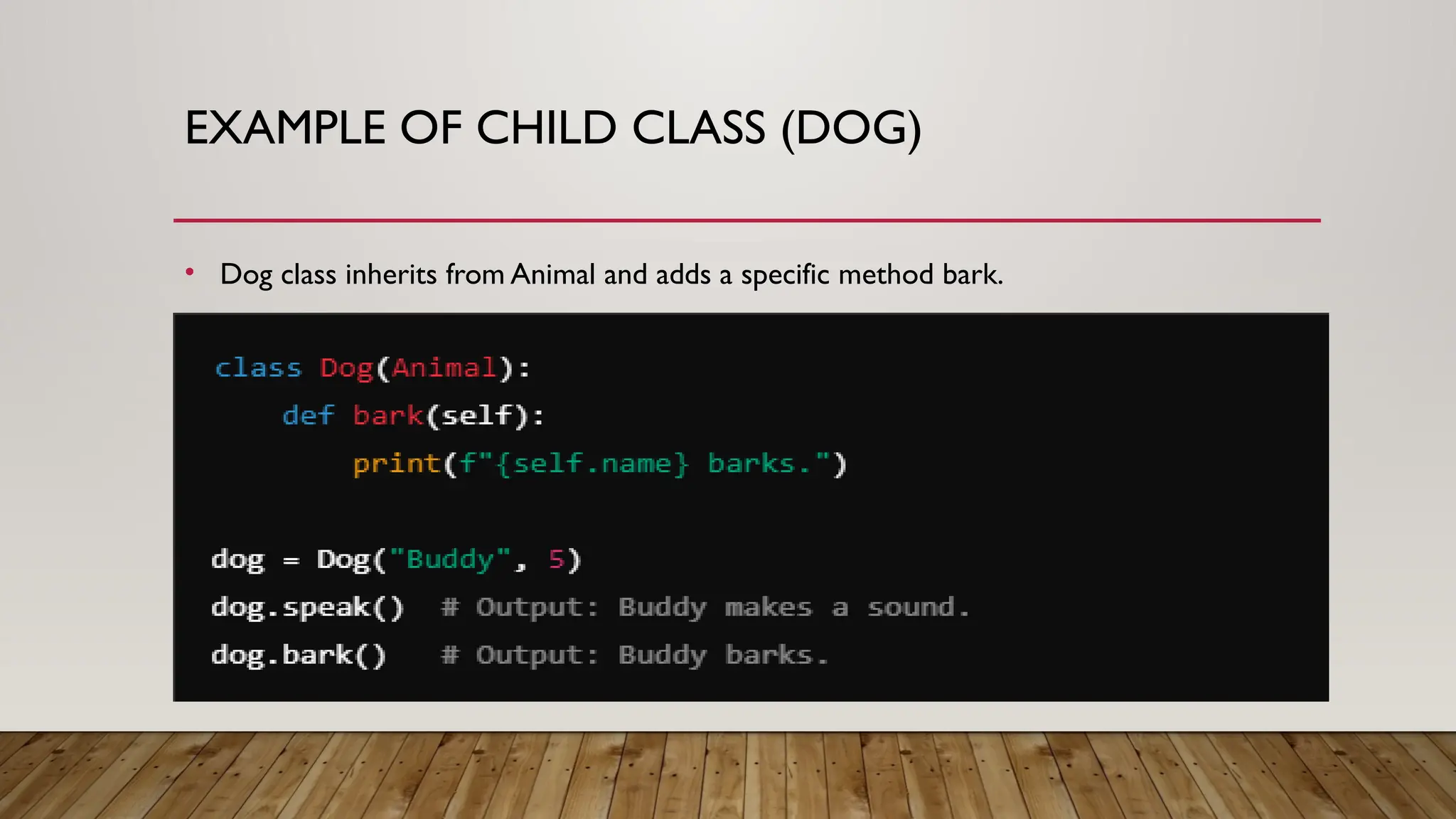
EXAMPLE OF CHILD CLASS (DOG)
• Dog class inherits from Animal and adds a specific method bark.
KEY FEATURES OF PARENT AND CHILD CLASSES
• Method Overriding: Child class can override methods
from the parent class.
• Multiple Inheritance: A child class can inherit from
multiple parents in some languages (e.g., Python).
• Extensibility: Child classes can extend the functionality
of the parent class.
ADVANTAGES OF USING PARENT-CHILD CLASSES
• Code Reusability: Common functionality is written
once in the parent class.
• Maintainability: Centralized updates in the parent
class reflect in all child classes.
• Flexibility: Child classes can extend or specialize the
behavior of the parent class.
CONCLUSION
• Parent-child classes (inheritance) are fundamental to
OOP.
• Inheritance allows for creating hierarchical
relationships between classes.
• Promotes cleaner, more organized, and maintainable
code.
END

Parent and Child Classes in Object Oriented Programming.pptx

  • 1.
    PARENT AND CHILD CLASSESIN OOP UNDERSTANDING INHERITANCE IN OBJECT-ORIENTED PROGRAMMING
  • 2.
    INTRODUCTIONTO OOP • Object-OrientedProgramming (OOP) is a paradigm based on the concept of "objects.“ • It helps in organizing code in reusable and modular components. • Key concepts: Encapsulation, Abstraction, Inheritance, and Polymorphism.
  • 3.
    WHAT ARE PARENTAND CHILD CLASSES? • Parent Class (Base/Superclass): A general class that contains common attributes and methods. • Child Class (Derived/Subclass):A class that inherits the properties and methods of the parent class and can have additional specific attributes or methods.
  • 4.
    INHERITANCE IN OOP •Inheritance allows a child class to reuse the methods and properties of a parent class. • Promotes code reuse and reduces redundancy. • Child classes can extend or modify the behavior of the parent class.
  • 5.
    SYNTAX OF INHERITANCE(EXAMPLE IN PYTHON) NOTE: Child inherits from Parent and can use both parent and child methods.
  • 6.
    EXAMPLE OF PARENTCLASS (ANIMAL) • Parent class Animal with common properties like name and age.
  • 7.
    EXAMPLE OF CHILDCLASS (DOG) • Dog class inherits from Animal and adds a specific method bark.
  • 8.
    KEY FEATURES OFPARENT AND CHILD CLASSES • Method Overriding: Child class can override methods from the parent class. • Multiple Inheritance: A child class can inherit from multiple parents in some languages (e.g., Python). • Extensibility: Child classes can extend the functionality of the parent class.
  • 9.
    ADVANTAGES OF USINGPARENT-CHILD CLASSES • Code Reusability: Common functionality is written once in the parent class. • Maintainability: Centralized updates in the parent class reflect in all child classes. • Flexibility: Child classes can extend or specialize the behavior of the parent class.
  • 10.
    CONCLUSION • Parent-child classes(inheritance) are fundamental to OOP. • Inheritance allows for creating hierarchical relationships between classes. • Promotes cleaner, more organized, and maintainable code.
  • 11.