Python Inheritance
Inheritance
• Inheritance is an important aspect of the object-
oriented paradigm. Inheritance provides code
reusability to the program because we can use an
existing class to create a new class instead of
creating it from scratch.
• In inheritance, the child class acquires the
properties and can access all the data members
and functions defined in the parent class. A child
class can also provide its specific implementation
to the functions of the parent class
Syntax
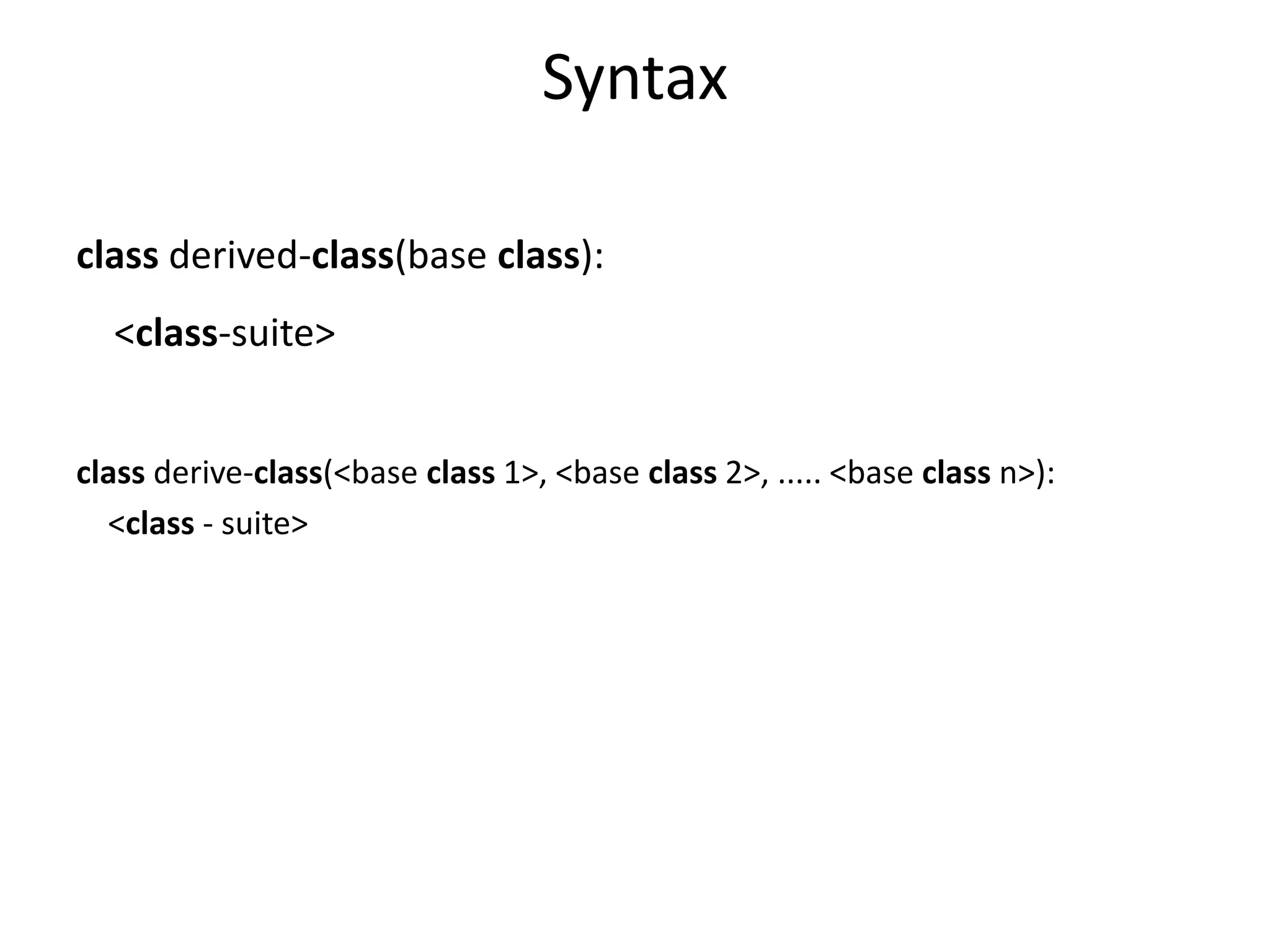
class derived-class(base class):
<class-suite>
class derive-class(<base class 1>, <base class 2>, ..... <base class n>):
<class - suite>
Example 1
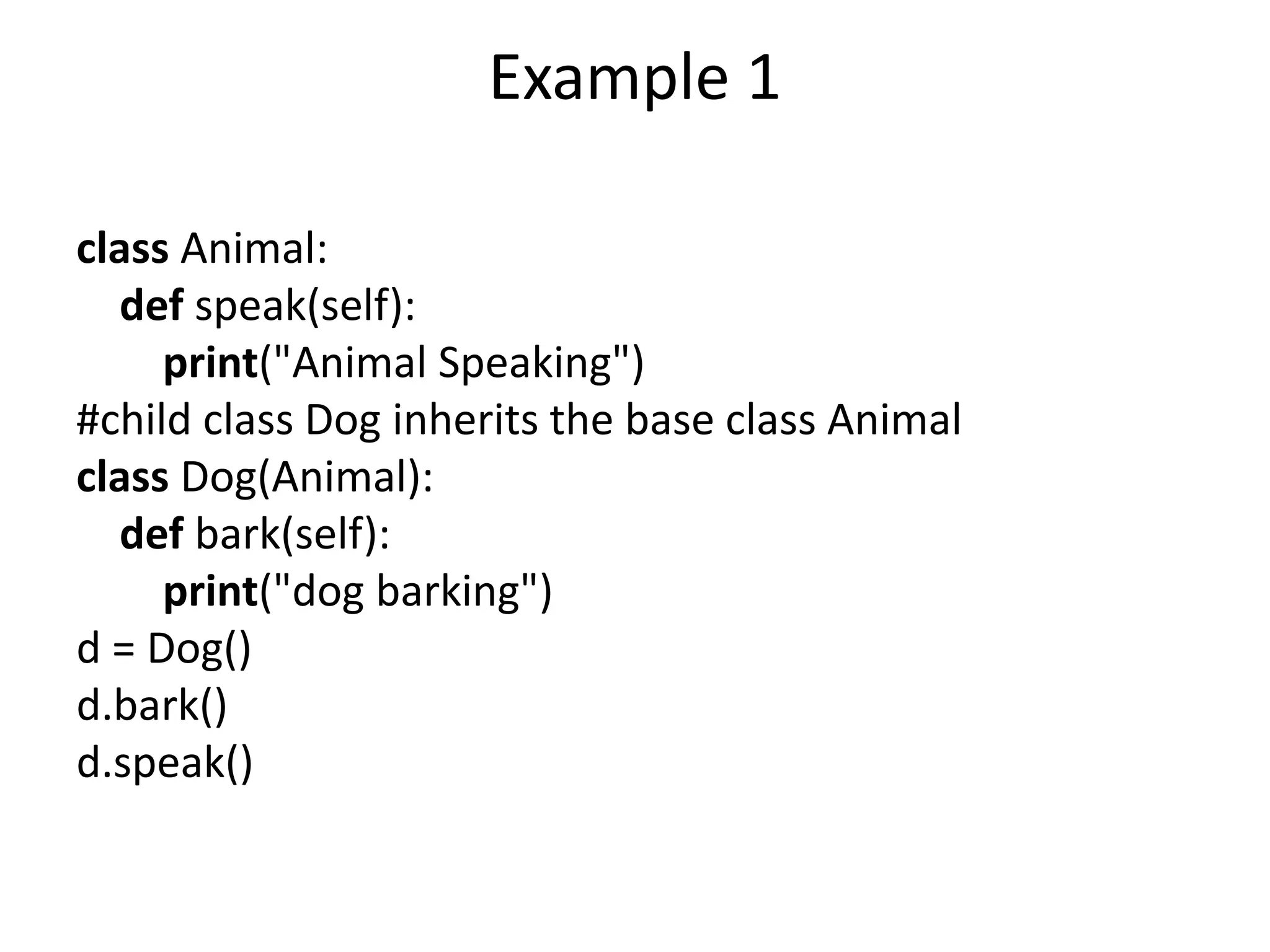
class Animal:
def speak(self):
print("Animal Speaking")
#child class Dog inherits the base class Animal
class Dog(Animal):
def bark(self):
print("dog barking")
d = Dog()
d.bark()
d.speak()
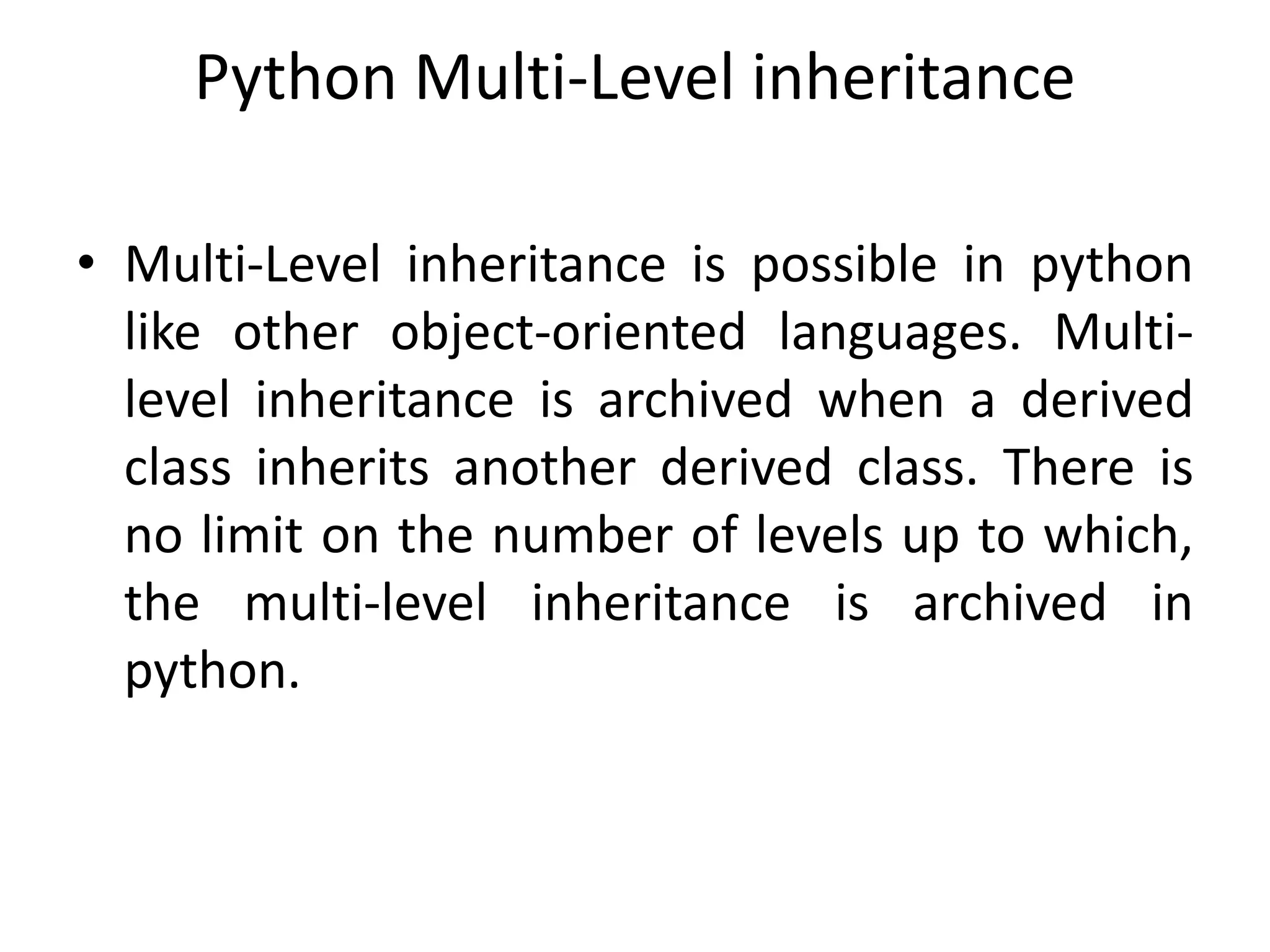
Python Multi-Level inheritance
• Multi-Level inheritance is possible in python
like other object-oriented languages. Multi-
level inheritance is archived when a derived
class inherits another derived class. There is
no limit on the number of levels up to which,
the multi-level inheritance is archived in
python.
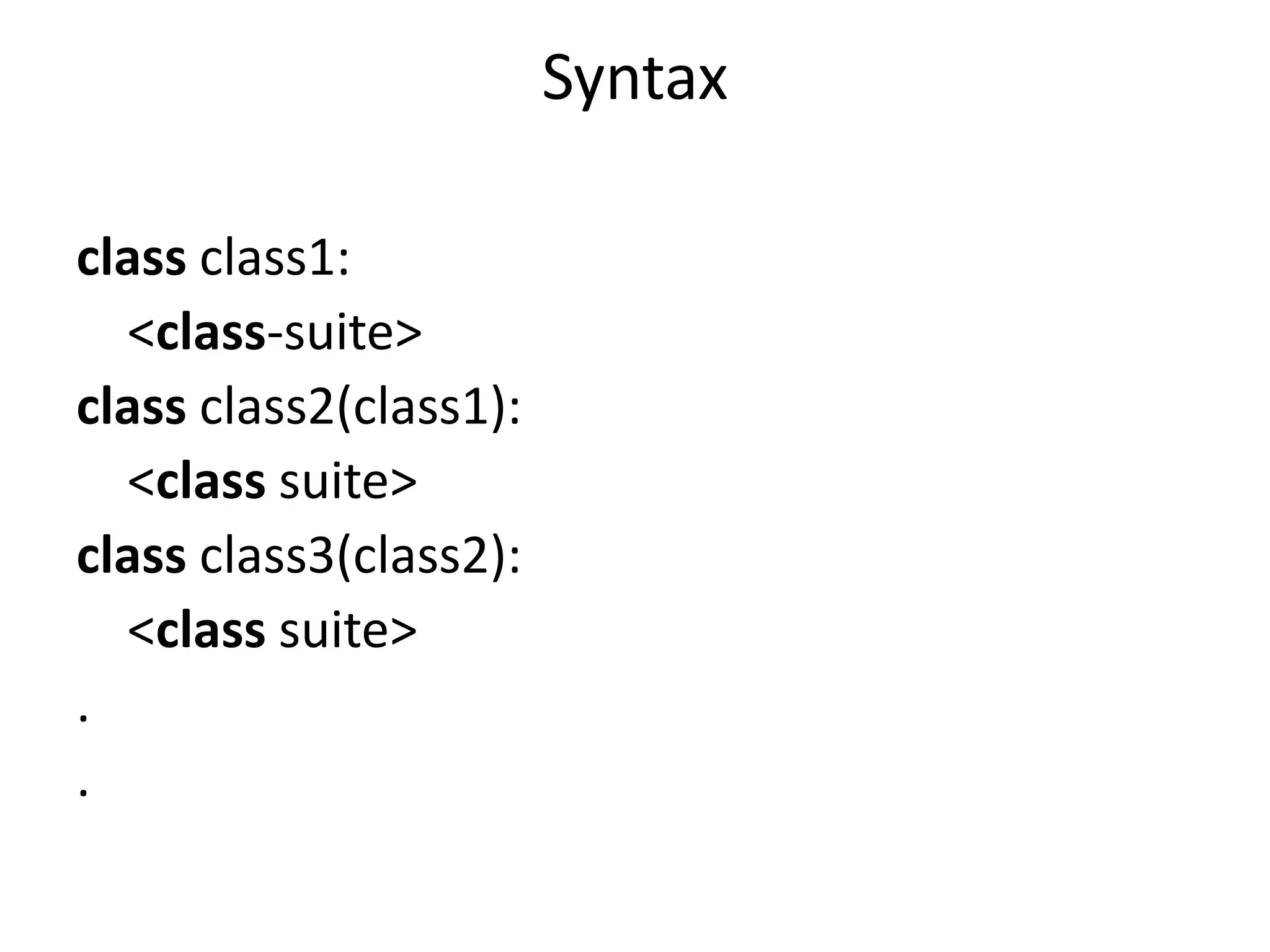
Syntax
class class1:
<class-suite>
class class2(class1):
<class suite>
class class3(class2):
<class suite>
.
.
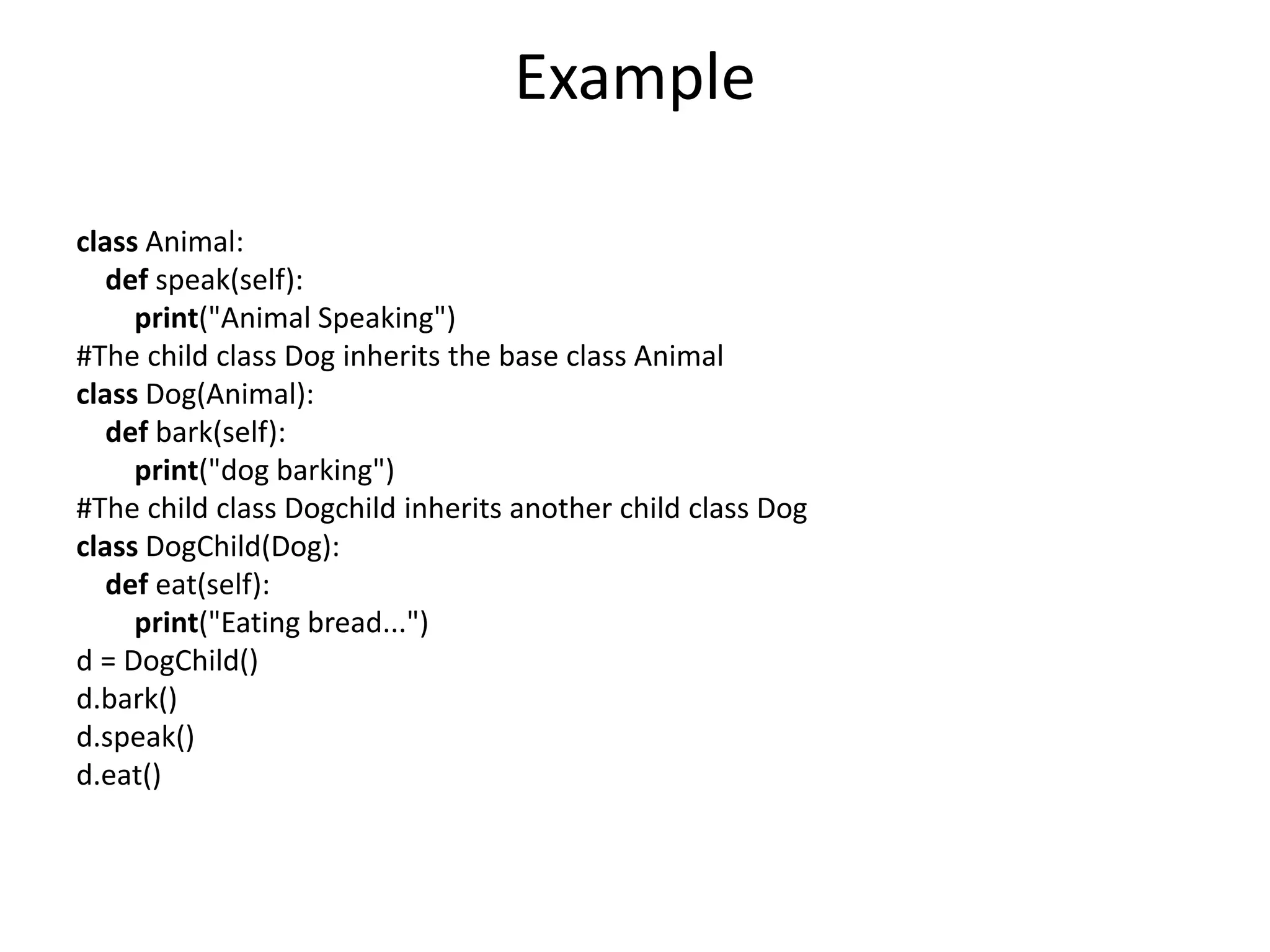
Example
class Animal:
def speak(self):
print("Animal Speaking")
#The child class Dog inherits the base class Animal
class Dog(Animal):
def bark(self):
print("dog barking")
#The child class Dogchild inherits another child class Dog
class DogChild(Dog):
def eat(self):
print("Eating bread...")
d = DogChild()
d.bark()
d.speak()
d.eat()
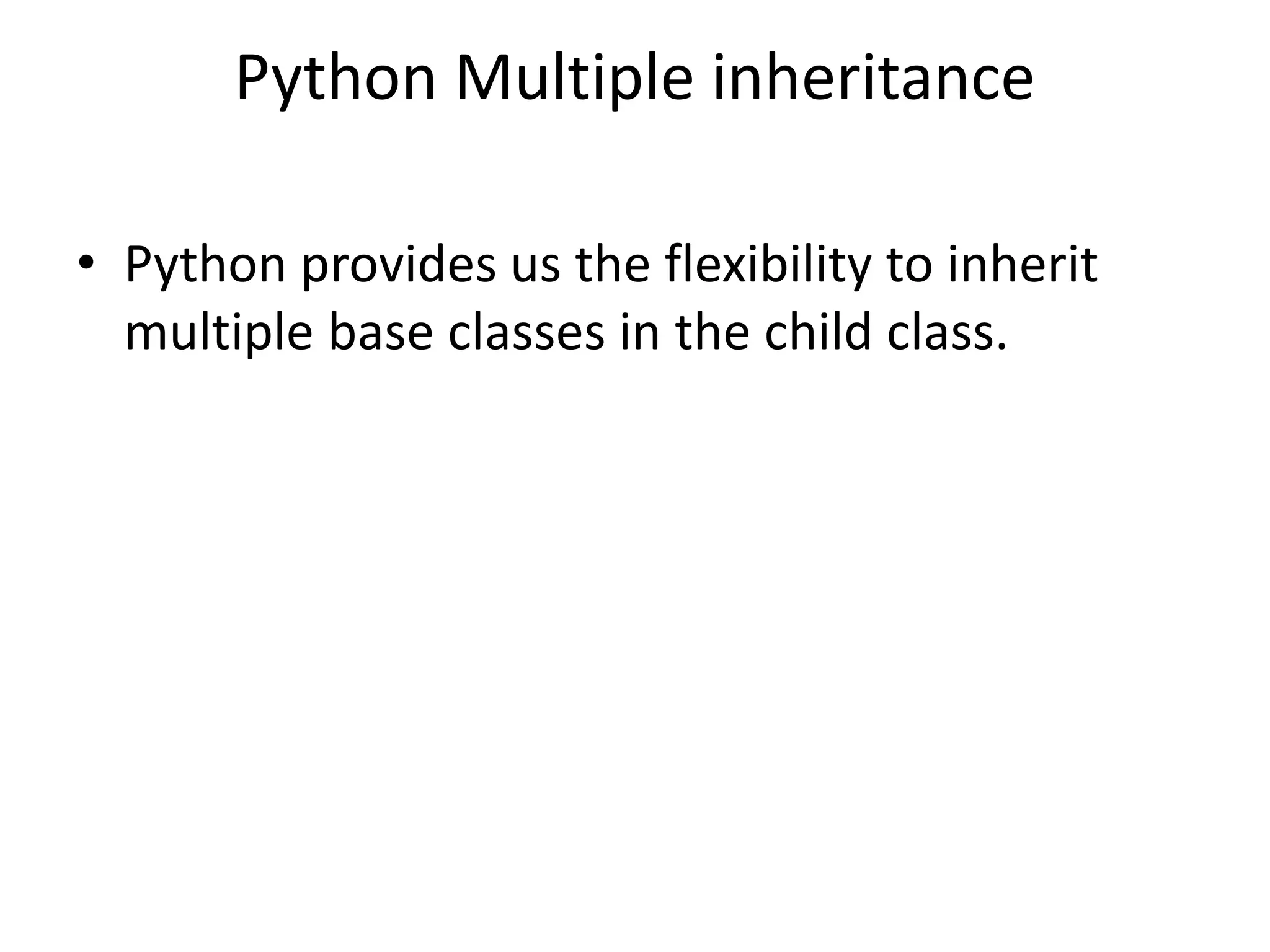
Python Multiple inheritance
• Python provides us the flexibility to inherit
multiple base classes in the child class.
Syntax
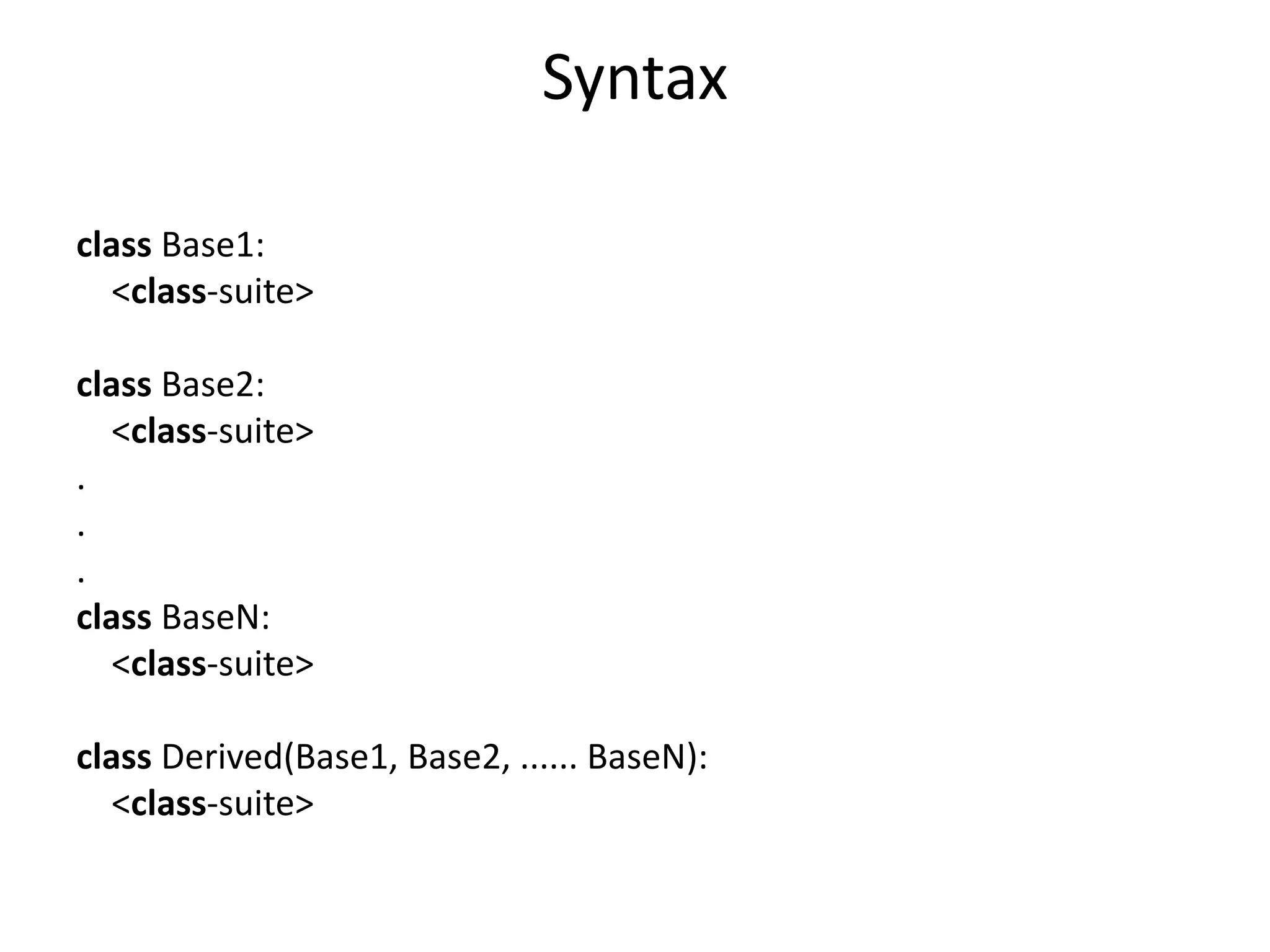
class Base1:
<class-suite>
class Base2:
<class-suite>
.
.
.
class BaseN:
<class-suite>
class Derived(Base1, Base2, ...... BaseN):
<class-suite>
Example
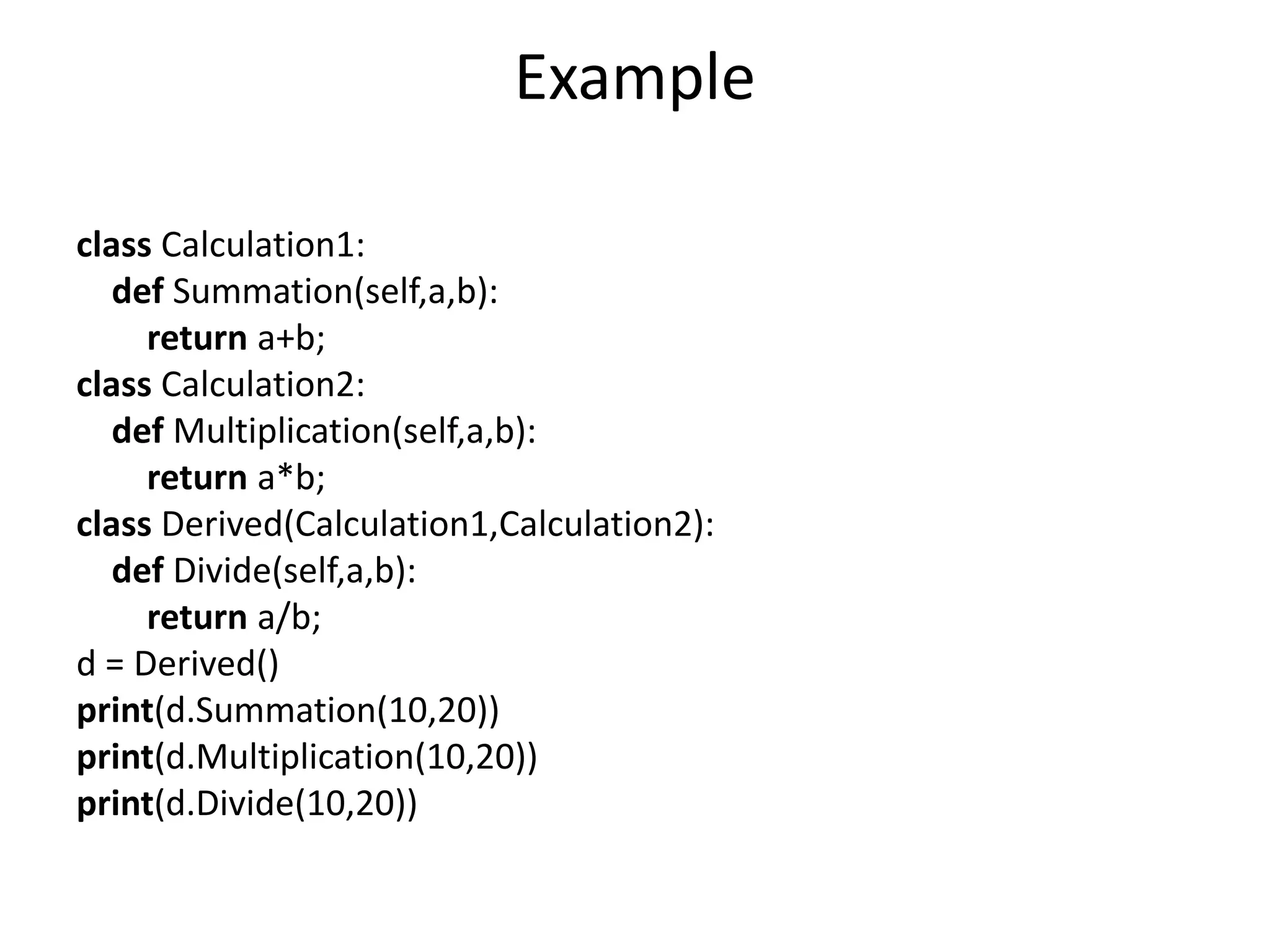
class Calculation1:
def Summation(self,a,b):
return a+b;
class Calculation2:
def Multiplication(self,a,b):
return a*b;
class Derived(Calculation1,Calculation2):
def Divide(self,a,b):
return a/b;
d = Derived()
print(d.Summation(10,20))
print(d.Multiplication(10,20))
print(d.Divide(10,20))
The issubclass(sub,sup) method
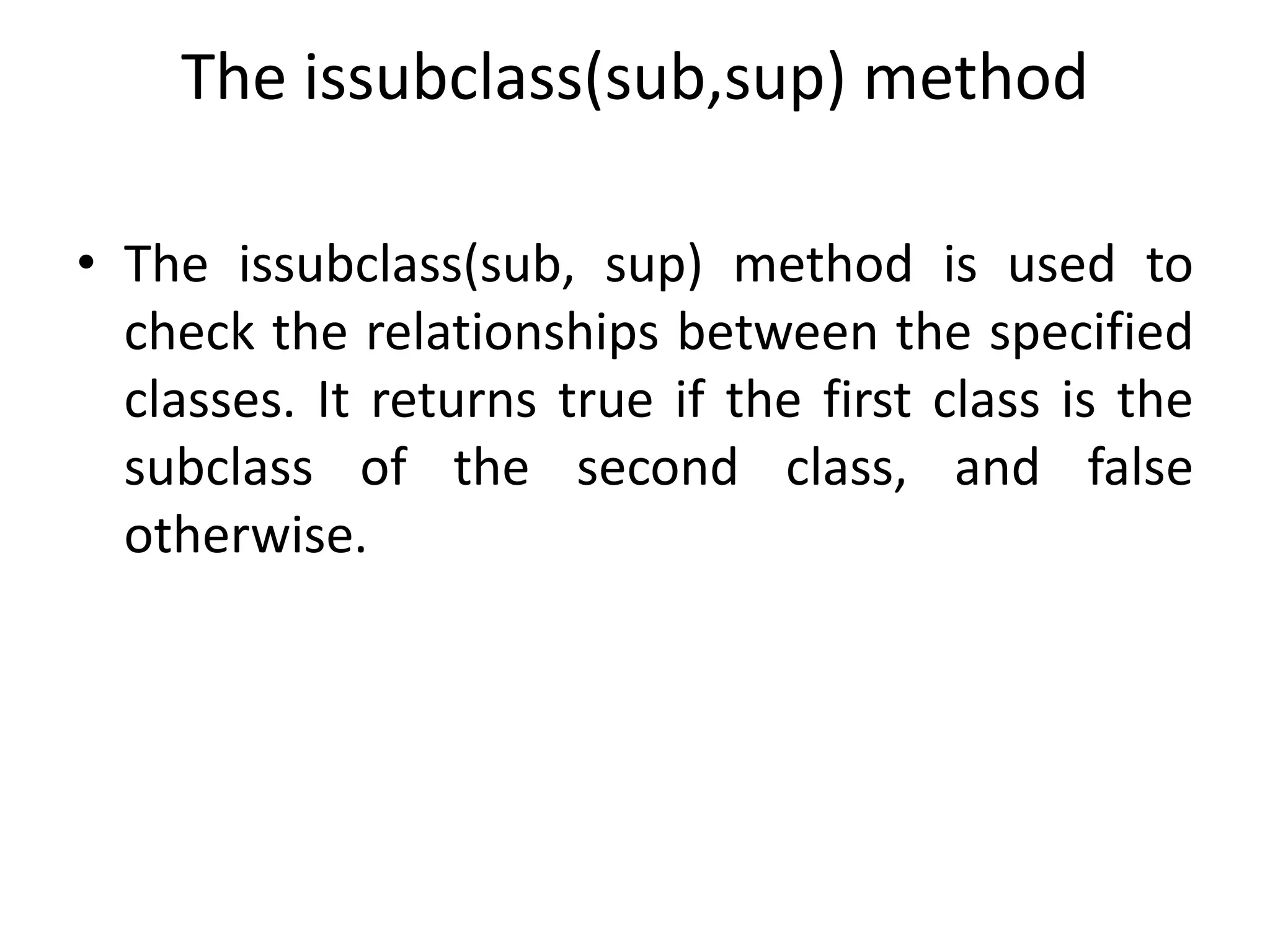
• The issubclass(sub, sup) method is used to
check the relationships between the specified
classes. It returns true if the first class is the
subclass of the second class, and false
otherwise.
Example
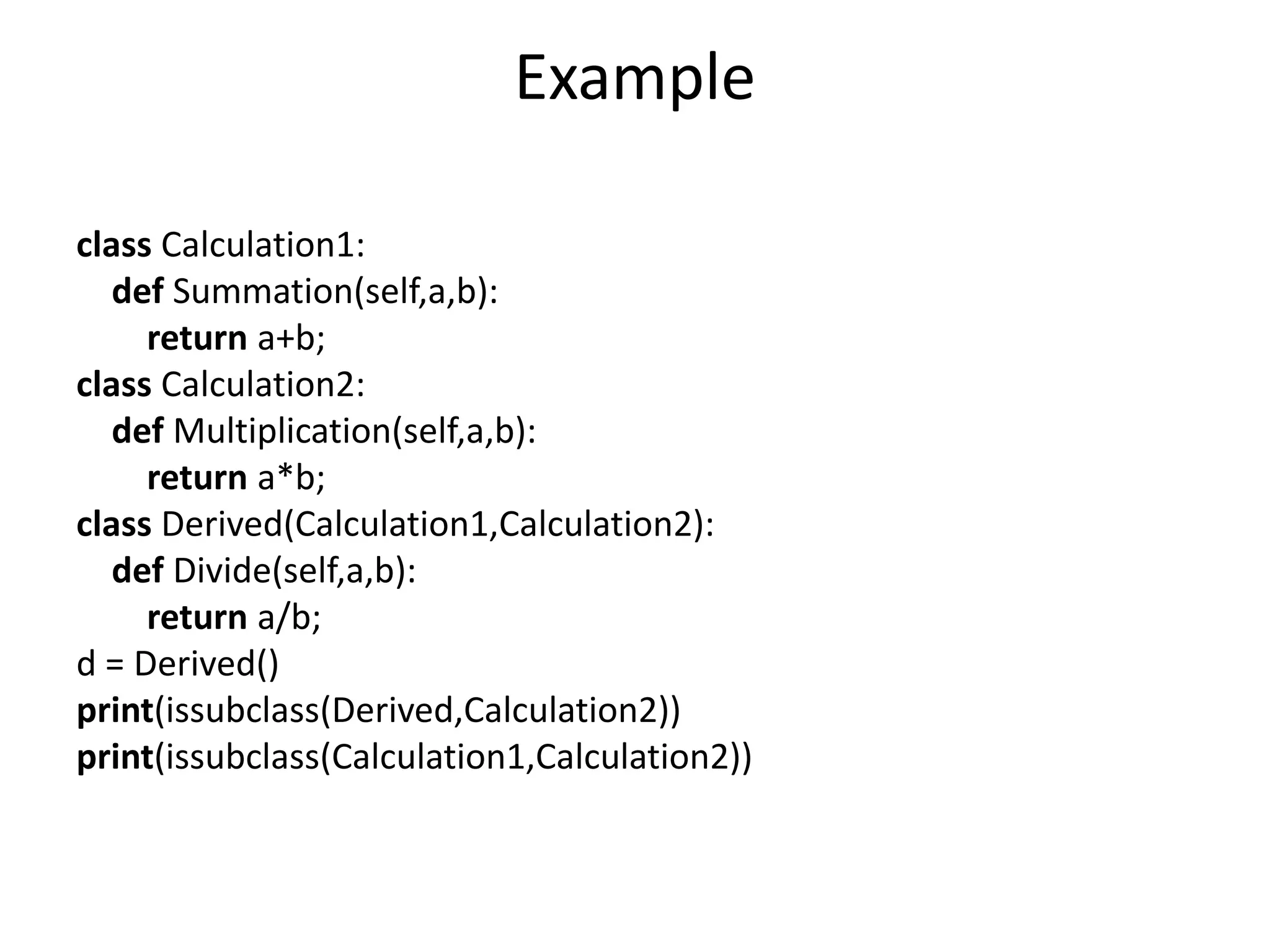
class Calculation1:
def Summation(self,a,b):
return a+b;
class Calculation2:
def Multiplication(self,a,b):
return a*b;
class Derived(Calculation1,Calculation2):
def Divide(self,a,b):
return a/b;
d = Derived()
print(issubclass(Derived,Calculation2))
print(issubclass(Calculation1,Calculation2))
The isinstance (obj, class) method
• The isinstance() method is used to check the
relationship between the objects and classes.
It returns true if the first parameter, i.e., obj is
the instance of the second parameter, i.e.,
class.
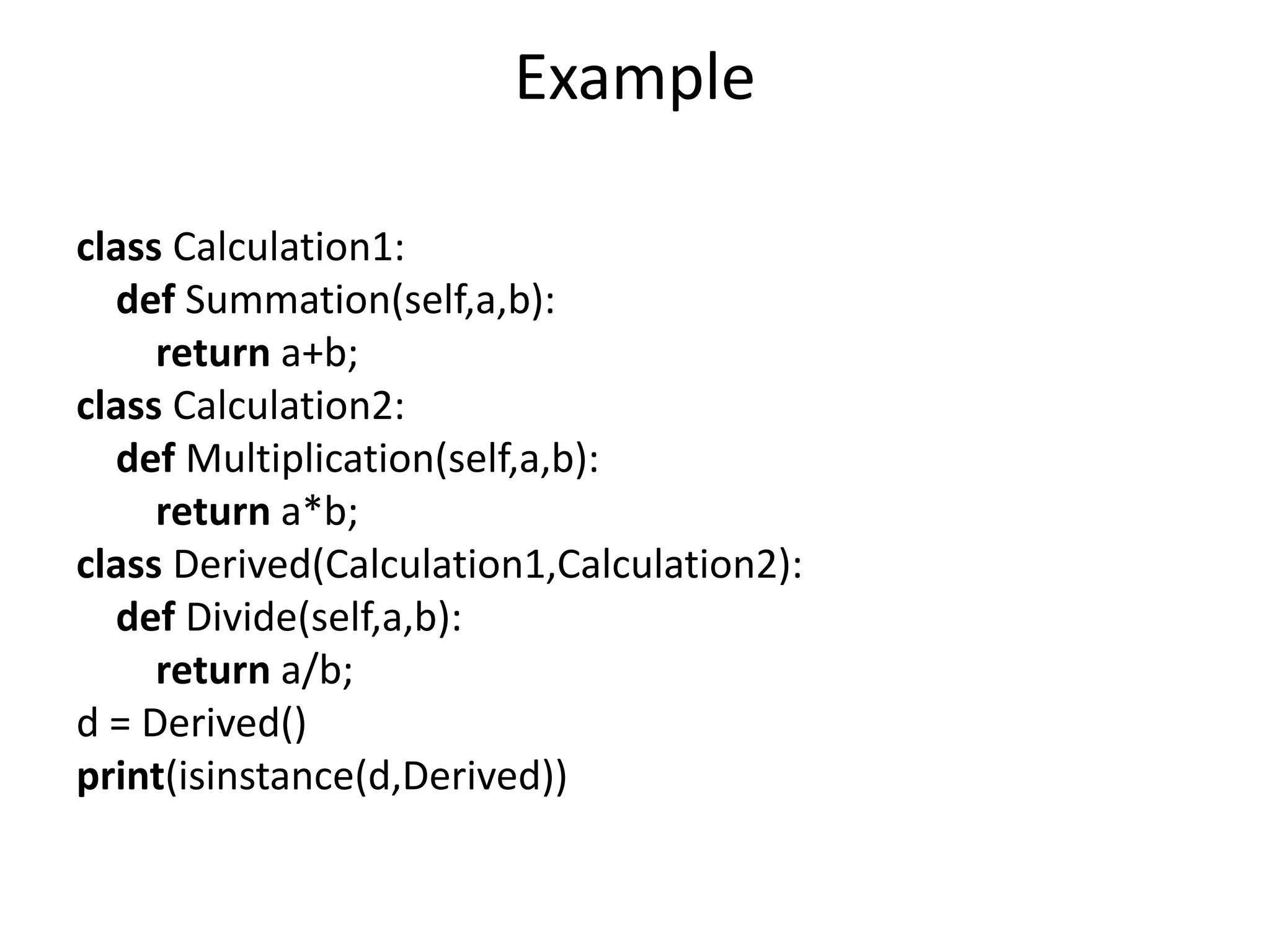
Example
class Calculation1:
def Summation(self,a,b):
return a+b;
class Calculation2:
def Multiplication(self,a,b):
return a*b;
class Derived(Calculation1,Calculation2):
def Divide(self,a,b):
return a/b;
d = Derived()
print(isinstance(d,Derived))
Method Overriding
• We can provide some specific implementation
of the parent class method in our child class.
When the parent class method is defined in
the child class with some specific
implementation, then the concept is called
method overriding. We may need to perform
method overriding in the scenario where the
different definition of a parent class method is
needed in the child class.
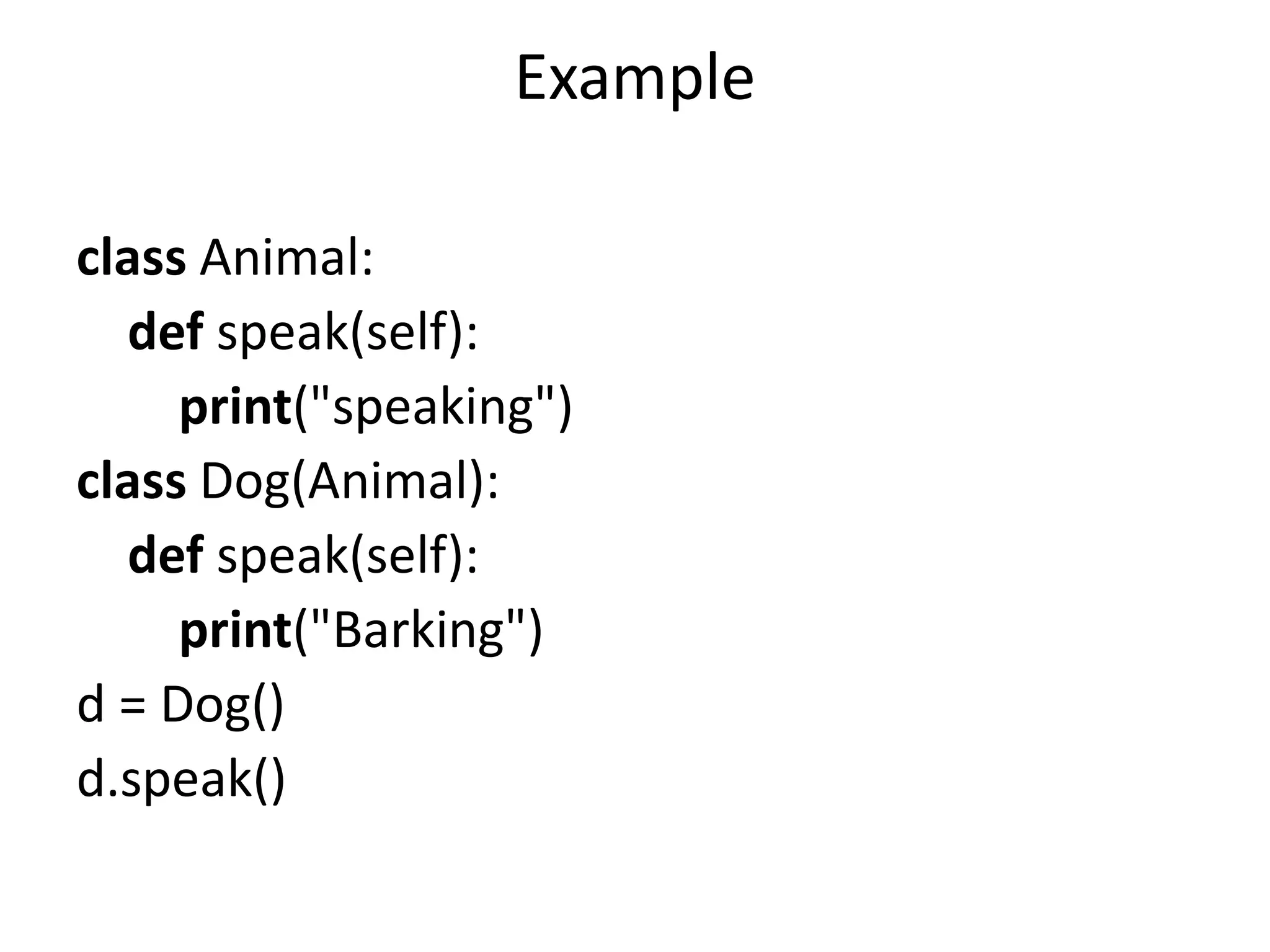
Example
class Animal:
def speak(self):
print("speaking")
class Dog(Animal):
def speak(self):
print("Barking")
d = Dog()
d.speak()
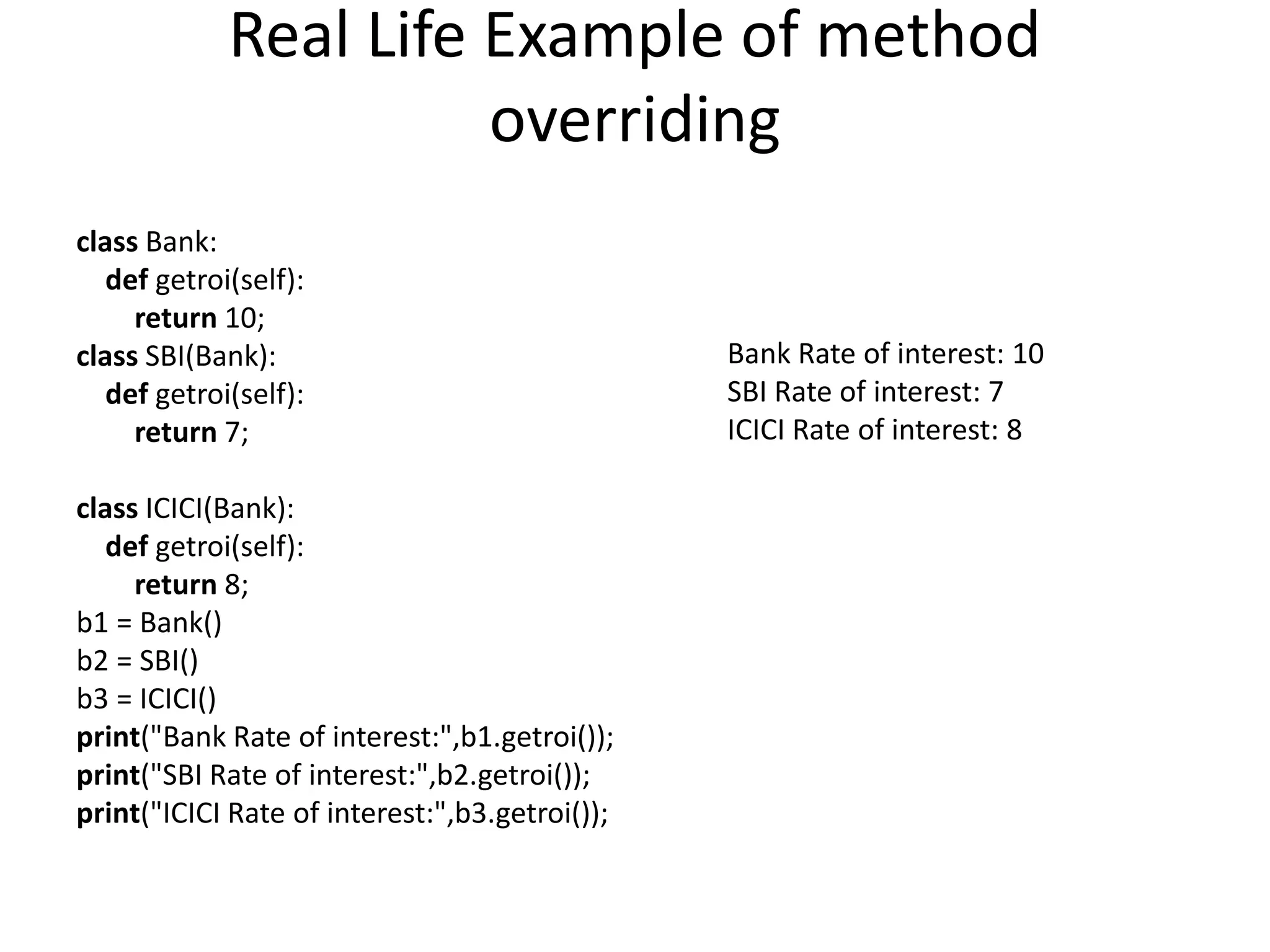
Real Life Example of method
overriding
class Bank:
def getroi(self):
return 10;
class SBI(Bank):
def getroi(self):
return 7;
class ICICI(Bank):
def getroi(self):
return 8;
b1 = Bank()
b2 = SBI()
b3 = ICICI()
print("Bank Rate of interest:",b1.getroi());
print("SBI Rate of interest:",b2.getroi());
print("ICICI Rate of interest:",b3.getroi());
Bank Rate of interest: 10
SBI Rate of interest: 7
ICICI Rate of interest: 8
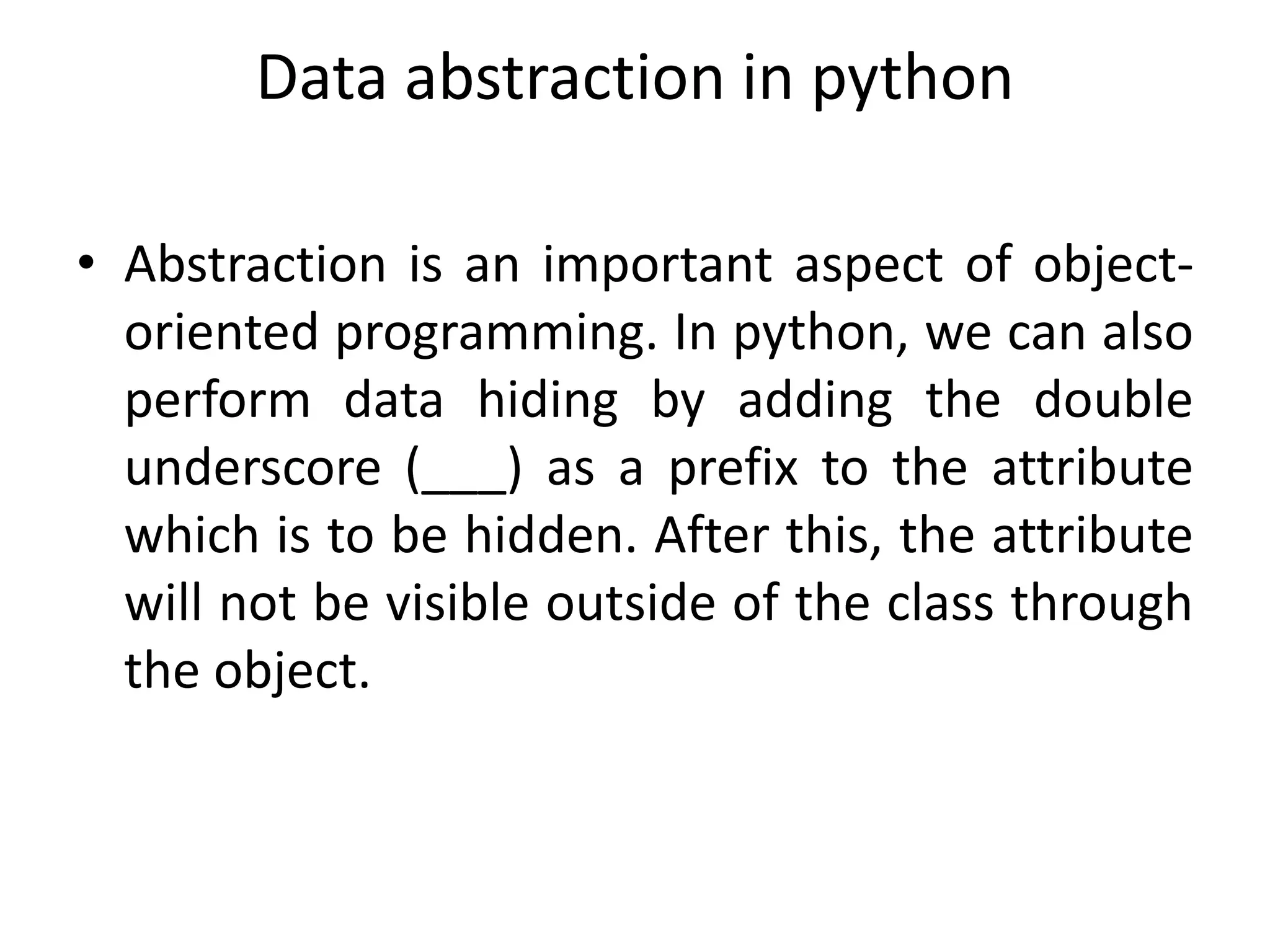
Data abstraction in python
• Abstraction is an important aspect of object-
oriented programming. In python, we can also
perform data hiding by adding the double
underscore (___) as a prefix to the attribute
which is to be hidden. After this, the attribute
will not be visible outside of the class through
the object.
Example
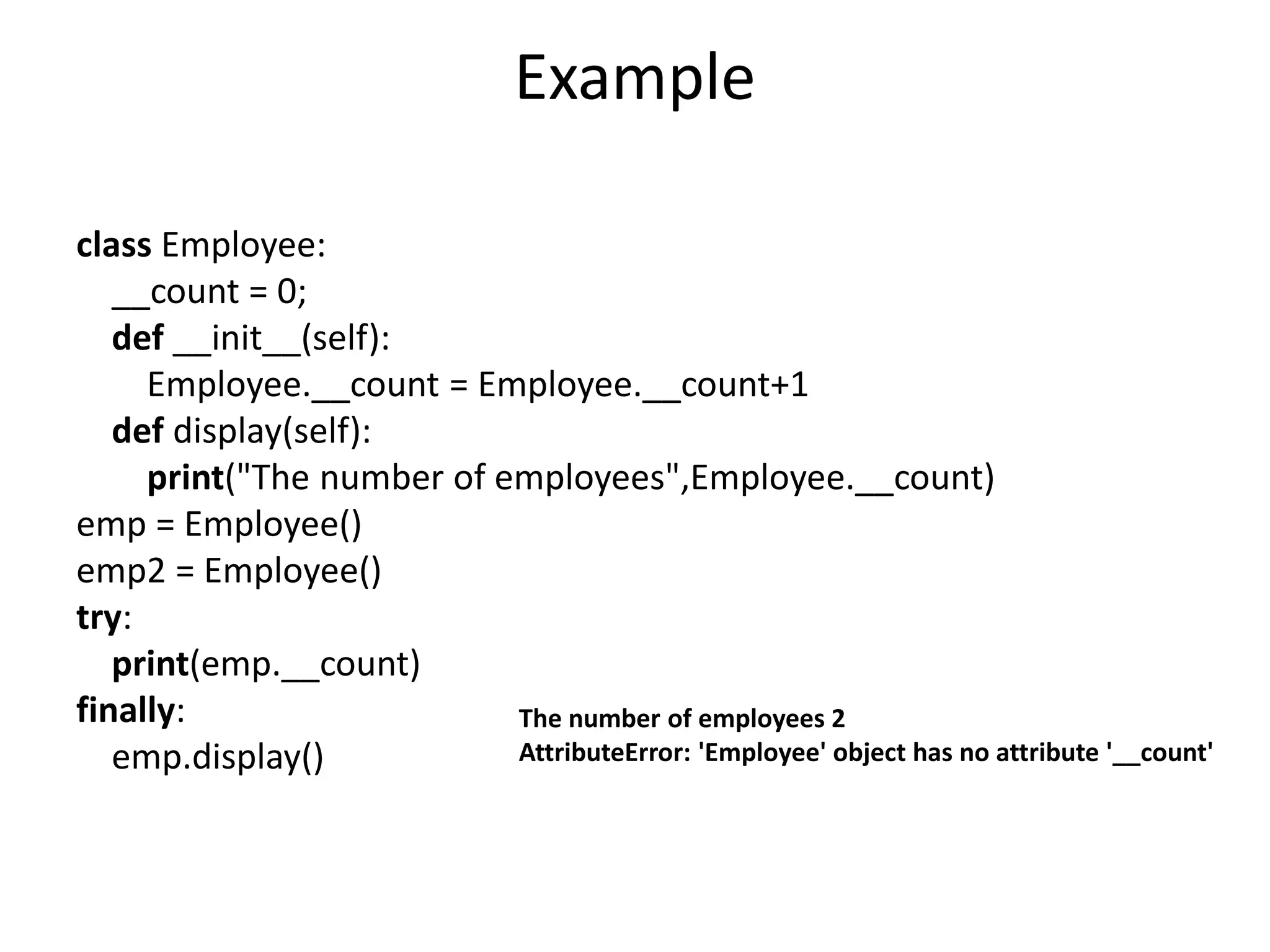
class Employee:
__count = 0;
def __init__(self):
Employee.__count = Employee.__count+1
def display(self):
print("The number of employees",Employee.__count)
emp = Employee()
emp2 = Employee()
try:
print(emp.__count)
finally:
emp.display()
The number of employees 2
AttributeError: 'Employee' object has no attribute '__count'
Thanks

601109769-Pythondyttcjycvuv-Inheritance .pptx

  • 1.
  • 2.
    Inheritance • Inheritance isan important aspect of the object- oriented paradigm. Inheritance provides code reusability to the program because we can use an existing class to create a new class instead of creating it from scratch. • In inheritance, the child class acquires the properties and can access all the data members and functions defined in the parent class. A child class can also provide its specific implementation to the functions of the parent class
  • 3.
    Syntax class derived-class(base class): <class-suite> classderive-class(<base class 1>, <base class 2>, ..... <base class n>): <class - suite>
  • 4.
    Example 1 class Animal: defspeak(self): print("Animal Speaking") #child class Dog inherits the base class Animal class Dog(Animal): def bark(self): print("dog barking") d = Dog() d.bark() d.speak()
  • 5.
    Python Multi-Level inheritance •Multi-Level inheritance is possible in python like other object-oriented languages. Multi- level inheritance is archived when a derived class inherits another derived class. There is no limit on the number of levels up to which, the multi-level inheritance is archived in python.
  • 6.
    Syntax class class1: <class-suite> class class2(class1): <classsuite> class class3(class2): <class suite> . .
  • 7.
    Example class Animal: def speak(self): print("AnimalSpeaking") #The child class Dog inherits the base class Animal class Dog(Animal): def bark(self): print("dog barking") #The child class Dogchild inherits another child class Dog class DogChild(Dog): def eat(self): print("Eating bread...") d = DogChild() d.bark() d.speak() d.eat()
  • 8.
    Python Multiple inheritance •Python provides us the flexibility to inherit multiple base classes in the child class.
  • 9.
    Syntax class Base1: <class-suite> class Base2: <class-suite> . . . classBaseN: <class-suite> class Derived(Base1, Base2, ...... BaseN): <class-suite>
  • 10.
    Example class Calculation1: def Summation(self,a,b): returna+b; class Calculation2: def Multiplication(self,a,b): return a*b; class Derived(Calculation1,Calculation2): def Divide(self,a,b): return a/b; d = Derived() print(d.Summation(10,20)) print(d.Multiplication(10,20)) print(d.Divide(10,20))
  • 11.
    The issubclass(sub,sup) method •The issubclass(sub, sup) method is used to check the relationships between the specified classes. It returns true if the first class is the subclass of the second class, and false otherwise.
  • 12.
    Example class Calculation1: def Summation(self,a,b): returna+b; class Calculation2: def Multiplication(self,a,b): return a*b; class Derived(Calculation1,Calculation2): def Divide(self,a,b): return a/b; d = Derived() print(issubclass(Derived,Calculation2)) print(issubclass(Calculation1,Calculation2))
  • 13.
    The isinstance (obj,class) method • The isinstance() method is used to check the relationship between the objects and classes. It returns true if the first parameter, i.e., obj is the instance of the second parameter, i.e., class.
  • 14.
    Example class Calculation1: def Summation(self,a,b): returna+b; class Calculation2: def Multiplication(self,a,b): return a*b; class Derived(Calculation1,Calculation2): def Divide(self,a,b): return a/b; d = Derived() print(isinstance(d,Derived))
  • 15.
    Method Overriding • Wecan provide some specific implementation of the parent class method in our child class. When the parent class method is defined in the child class with some specific implementation, then the concept is called method overriding. We may need to perform method overriding in the scenario where the different definition of a parent class method is needed in the child class.
  • 16.
    Example class Animal: def speak(self): print("speaking") classDog(Animal): def speak(self): print("Barking") d = Dog() d.speak()
  • 17.
    Real Life Exampleof method overriding class Bank: def getroi(self): return 10; class SBI(Bank): def getroi(self): return 7; class ICICI(Bank): def getroi(self): return 8; b1 = Bank() b2 = SBI() b3 = ICICI() print("Bank Rate of interest:",b1.getroi()); print("SBI Rate of interest:",b2.getroi()); print("ICICI Rate of interest:",b3.getroi()); Bank Rate of interest: 10 SBI Rate of interest: 7 ICICI Rate of interest: 8
  • 18.
    Data abstraction inpython • Abstraction is an important aspect of object- oriented programming. In python, we can also perform data hiding by adding the double underscore (___) as a prefix to the attribute which is to be hidden. After this, the attribute will not be visible outside of the class through the object.
  • 19.
    Example class Employee: __count =0; def __init__(self): Employee.__count = Employee.__count+1 def display(self): print("The number of employees",Employee.__count) emp = Employee() emp2 = Employee() try: print(emp.__count) finally: emp.display() The number of employees 2 AttributeError: 'Employee' object has no attribute '__count'
  • 20.