Communication
Signal
Processing
CSPLab
CSPLab
HTTP:/ / AMCS.SSU.AC.KR
Chapter 4. Parametric Methods
for Line Spectra
Soongsil University
School of Electronic Engineering
통신신호처리
서광남, 황주연, 서만중, 홍윤기
CSPLab
CSPLab
HTTP:/ / AMCS.SSU.AC.KR
contents
 PISARENKO AND MUSIC (MUltiple SIgnal Classification) METHODS
 Min-Norm Method
 ESPRIT (Estimation of Signal Parameters by Rotational Invariance Techniques)
Method
- 2 -
CSPLab
CSPLab
HTTP:/ / AMCS.SSU.AC.KR
 The Multiple Signal Classification (or Multiple Signal Characterization) [MUSIC] method and
Pisarenko’s method are derived from the covariance model (4.2.7) with m>n
 Let
: eigenvalues of R
: orthonormal eigenvectors associated with
PISARENKO AND MUSIC METHODS
* 2
( )
R APA I m n
σ
= + >
1 2 m
λ λ λ
≥ ≥ ≥

1
{ , , }
n
s s
 1
{ , , }
n
λ λ

1
{ , , }
m n
g g −
 1
{ , , }
n m
λ λ
+ 
1 1
[ , , ] ( ), [ , , ] ( ( ))
n m n
S s s m n G g g m m n
−
× = × −
  (4.5.4)
- 3 -
(4.2.7)
CSPLab
CSPLab
HTTP:/ / AMCS.SSU.AC.KR
1
2 * 2
0
0
n
m
RG G G APA G G
λ
σ σ
λ
+
 
 
= = = +
 
 
 

PISARENKO AND MUSIC METHODS
(4.5.5)
- 4 -
 Since *
( )
rank APA n
=
2
2
1, ,
1, ,
k
k
for k n
for k n m
λ σ
λ σ
 > =


= = +




2
1
2
0
0 n
λ σ
λ σ
 
−
 
Λ = 
 
−
 

 (4.5.10)
(4.5.3)
= nonsingular
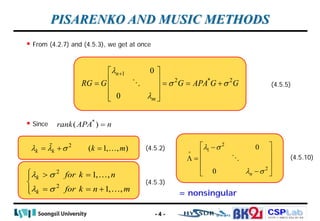
 From (4.2.7) and (4.5.3), we get at once
2
( 1, , )
k k k m
λ λ σ
=
+ =
  (4.5.2)
CSPLab
CSPLab
HTTP:/ / AMCS.SSU.AC.KR
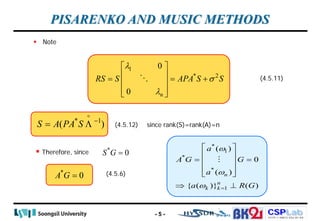
 Note
PISARENKO AND MUSIC METHODS
1
* 2
0
0 n
RS S APA S S
λ
σ
λ
 
 
= = +
 
 
 

* 1
( )
S A PA S −
= Λ

since rank(S)=rank(A)=n
 Therefore, since
(4.5.11)
(4.5.12)
*
0
S G =
*
0
A G =
*
1
*
*
1
( )
0
( )
{ ( )} ( )
n
n
k k
a
A G G
a
a R G
ω
ω
ω =
 
 
= =
 
 
 
⇒ ⊥

- 5 -
(4.5.6)
CSPLab
CSPLab
HTTP:/ / AMCS.SSU.AC.KR
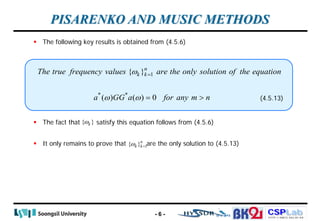
 The following key results is obtained from (4.5.6)
 The fact that satisfy this equation follows from (4.5.6)
 It only remains to prove that are the only solution to (4.5.13)
PISARENKO AND MUSIC METHODS
1
* *
{ }
( ) ( ) 0
n
k k
The true frequency values are the only solution of the equation
a GG a for any m n
ω
ω ω
=
= >
{ }
k
ω
(4.5.13)
1
{ }n
k k
ω =
- 6 -
CSPLab
CSPLab
HTTP:/ / AMCS.SSU.AC.KR
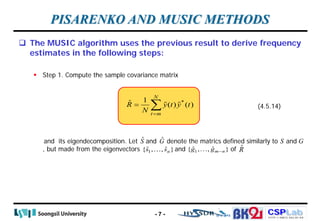
 The MUSIC algorithm uses the previous result to derive frequency
estimates in the following steps:
 Step 1. Compute the sample covariance matrix
and its eigendecomposition. Let and denote the matrics defined similarly to and
, but made from the eigenvectors and of
PISARENKO AND MUSIC METHODS
*
1
ˆ ( ) ( )
N
t m
R y t y t
N =
= ∑   (4.5.14)
Ŝ Ĝ S G
1
ˆ ˆ
{ , , }
n
s s
 1
ˆ ˆ
{ , , }
m n
g g −

- 7 -
R̂
CSPLab
CSPLab
HTTP:/ / AMCS.SSU.AC.KR
PISARENKO AND MUSIC METHODS
 Spectral MUSIC:
 Step 2a. Determine frequency estimates as the locations of the n highest peaks of the
function
* *
1
, [ , ]
ˆ ˆ
( ) ( )
a GG a
ω π π
ω ω
∈ − (4.5.15)
 Root MUSIC:
 Step 2b. Determine frequency estimates as the angular positions of the n (pairs of
reciprocal) roots of the equation
which are located nearest the unit circle
(4.5.16)
1 *
ˆ ˆ
( ) ( ) 0
T
a z GG a z
−
=
- 8 -
CSPLab
CSPLab
HTTP:/ / AMCS.SSU.AC.KR
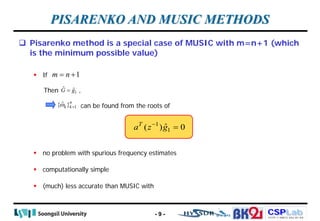
 Pisarenko method is a special case of MUSIC with m=n+1 (which
is the minimum possible value)
 If
Then ,
can be found from the roots of
 no problem with spurious frequency estimates
 computationally simple
 (much) less accurate than MUSIC with
PISARENKO AND MUSIC METHODS
1
m n
= +
1
ˆ ˆ
G g
=
1
ˆ
{ }n
k k
ω =
1
1
ˆ
( ) 0
T
a z g
−
=
- 9 -
CSPLab
CSPLab
HTTP:/ / AMCS.SSU.AC.KR
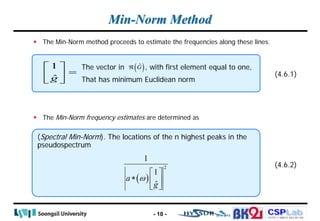
Min-Norm Method
 The Min-Norm method proceeds to estimate the frequencies along these lines.
 The Min-Norm frequency estimates are determined as
- 10 -
1
ĝ
 
=
 
 
The vector in , with first element equal to one,
That has minimum Euclidean norm
( )
Ĝ
ℜ
(4.6.1)
(Spectral Min-Norm). The locations of the n highest peaks in the
pseudospectrum
(4.6.2)
( )
2
1
1
ˆ
a
g
ω
 
∗  
 
CSPLab
CSPLab
HTTP:/ / AMCS.SSU.AC.KR
Min-Norm Method
 To find the vector in (4.6.1) and, to show that its first element can always be normalized
to 1
 The Euclidean norm of a vector is denoted by
 Partition the matrix
 As ,
- 11 -
(Root Min-Norm). The angular positions of the n roots of the polynomial
That are located nearest to the unit circle.
(4.6.3)
( )
1 1
ˆ
T
a z
g
−  
 
 
⋅
Ŝ
Ŝ
S
α∗
 
=  
 
( )
1 ˆ
ˆ
G
g
 
∈ℜ
 
 
1
ˆ 0
ˆ
S
g
∗  
=
 
 
(4.6.4)
(4.6.5)
CSPLab
CSPLab
HTTP:/ / AMCS.SSU.AC.KR
Min-Norm Method
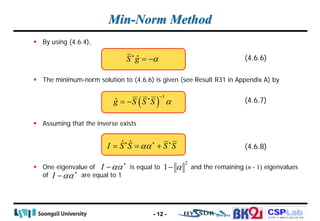
 By using (4.6.4),
 The minimum-norm solution to (4.6.6) is given (see Result R31 in Appendix A) by
 Assuming that the inverse exists
 One eigenvalue of is equal to and the remaining (n - 1) eigenvalues
of are equal to 1
- 12 -
ˆ
S g α
∗
= − (4.6.6)
( )
1
ĝ S S S α
−
∗
= − (4.6.7)
ˆ ˆ
I S S S S
αα
∗ ∗ ∗
= = + (4.6.8)
I αα∗
−
2
1 α
−
I αα∗
−
CSPLab
CSPLab
HTTP:/ / AMCS.SSU.AC.KR
Min-Norm Method
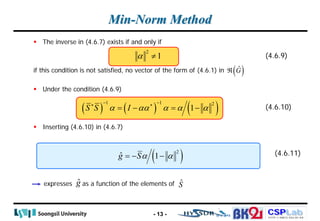
 The inverse in (4.6.7) exists if and only if
if this condition is not satisfied, no vector of the form of (4.6.1) in
 Under the condition (4.6.9)
 Inserting (4.6.10) in (4.6.7)
expresses as a function of the elements of
- 13 -
( ) ( ) ( )
1 1 2
1
S S I
α αα α α α
− −
∗ ∗
=
− =
− (4.6.10)
(4.6.11)
( )
2
ˆ 1
g Sα α
=
− −
ĝ Ŝ
2
1
α ≠ (4.6.9)
( )
Ĝ
ℜ
CSPLab
CSPLab
HTTP:/ / AMCS.SSU.AC.KR
Min-Norm Method
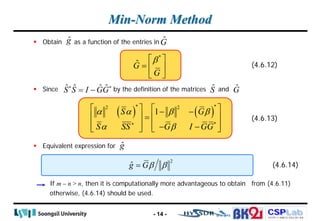
 Obtain as a function of the entries in
 Since by the definition of the matrices and
 Equivalent expression for
If m – n > n, then it is computationally more advantageous to obtain from (4.6.11)
otherwise, (4.6.14) should be used.
- 14 -
ĝ Ĝ
*
Ĝ
G
β
 
=  
 
(4.6.12)
ˆ ˆ ˆ ˆ
S S I GG
∗ ∗
= − Ŝ Ĝ
ĝ
( ) ( )
* *
2 2
*
1
S G
S SS G I GG
α α β β
α β
∗
   
− −
   
=
   
− −
   
(4.6.13)
2
ĝ Gβ β
= (4.6.14)
CSPLab
CSPLab
HTTP:/ / AMCS.SSU.AC.KR
ESPRIT Method
 Let
and
 Where Im-1 is the identity matrix of dimension and
and are
 It is verified that
 where
D is unitary matrix
- 15 -
[ ] ( )
1 m 1
I 0 1
A A m n
−
= − × (4.7.1)
[ ] ( )
2 m 1
0 I 1
A A m n
−
= − × (4.7.2)
( ) ( )
1 1
m m
− × −
[ ]
m 1
I 0
− [ ]
m 1
0 I − ( )
1
m m
− ×
2 1
A A D
= (4.7.3)
1
0
0 n
i
i
e
D
e
ω
ω
−
−
 
 
=  
 
 
 (4.7.4)
CSPLab
CSPLab
HTTP:/ / AMCS.SSU.AC.KR
ESPRIT Method
 Similarly to (4.7.1) and (4.7.2), define
 From (4.5.12), we have that
where C is the nonsingular matrix given by
 By using (4.7.1)-(4.7.3) and (4.7.7)
where
- 16 -
[ ]
1 m 1
I 0
S S
−
=
[ ]
2 m 1
0 I
S S
−
=
(4.7.5)
(4.7.6)
S AC
= (4.7.7)
n n
×
* 1
C PA S −
= Λ

1
2 2 1 1 1
S A C A DC S C DC S φ
−
= = = = (4.7.9)
1
C DC
φ −
 (4.7.10)
(4.7.8)
CSPLab
CSPLab
HTTP:/ / AMCS.SSU.AC.KR
ESPRIT Method
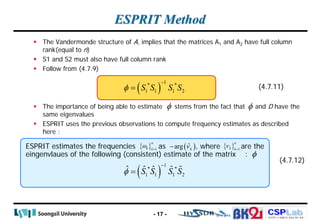
 The Vandermonde structure of A, implies that the matrices A1 and A2 have full column
rank(equal to n)
 S1 and S2 must also have full column rank
 Follow from (4.7.9)
 The importance of being able to estimate stems from the fact that and D have the
same eigenvalues
 ESPRIT uses the previous observations to compute frequency estimates as described
here :
- 17 -
( )
1
* *
1 1 1 2
S S S S
φ
−
= (4.7.11)
ESPRIT estimates the frequencies as , where are the
eingenvlaues of the following (consistent) estimate of the matrix :
(4.7.12)
φ φ
{ } 1
n
k k
ω = ( )
ˆ
arg k
ν
− { } 1
n
k k
ν =
φ
( )
1
* *
1 1 1 2
ˆ ˆ ˆ ˆ ˆ
S S S S
φ
−
=
CSPLab
CSPLab
HTTP:/ / AMCS.SSU.AC.KR
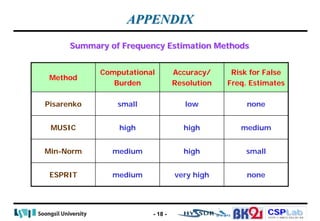
APPENDIX
Method
Computational
Burden
Accuracy/
Resolution
Risk for False
Freq. Estimates
Pisarenko small low none
MUSIC high high medium
Min-Norm medium high small
ESPRIT medium very high none
Summary of Frequency Estimation Methods
- 18 -

Parametric_ Methods for line_spectra in pdf

  • 1.
    Communication Signal Processing CSPLab CSPLab HTTP:/ / AMCS.SSU.AC.KR Chapter4. Parametric Methods for Line Spectra Soongsil University School of Electronic Engineering 통신신호처리 서광남, 황주연, 서만중, 홍윤기
  • 2.
    CSPLab CSPLab HTTP:/ / AMCS.SSU.AC.KR contents PISARENKO AND MUSIC (MUltiple SIgnal Classification) METHODS  Min-Norm Method  ESPRIT (Estimation of Signal Parameters by Rotational Invariance Techniques) Method - 2 -
  • 3.
    CSPLab CSPLab HTTP:/ / AMCS.SSU.AC.KR The Multiple Signal Classification (or Multiple Signal Characterization) [MUSIC] method and Pisarenko’s method are derived from the covariance model (4.2.7) with m>n  Let : eigenvalues of R : orthonormal eigenvectors associated with : orthonormal eigenvectors associated with PISARENKO AND MUSIC METHODS * 2 ( ) R APA I m n σ = + > 1 2 m λ λ λ ≥ ≥ ≥  1 { , , } n s s  1 { , , } n λ λ  1 { , , } m n g g −  1 { , , } n m λ λ +  1 1 [ , , ] ( ), [ , , ] ( ( )) n m n S s s m n G g g m m n − × = × −   (4.5.4) - 3 - (4.2.7)
  • 4.
    CSPLab CSPLab HTTP:/ / AMCS.SSU.AC.KR 1 2* 2 0 0 n m RG G G APA G G λ σ σ λ +     = = = +        PISARENKO AND MUSIC METHODS (4.5.5) - 4 -  Since * ( ) rank APA n = 2 2 1, , 1, , k k for k n for k n m λ σ λ σ  > =   = = +     2 1 2 0 0 n λ σ λ σ   −   Λ =    −     (4.5.10) (4.5.3) = nonsingular  From (4.2.7) and (4.5.3), we get at once 2 ( 1, , ) k k k m λ λ σ = + =   (4.5.2)
  • 5.
    CSPLab CSPLab HTTP:/ / AMCS.SSU.AC.KR Note PISARENKO AND MUSIC METHODS 1 * 2 0 0 n RS S APA S S λ σ λ     = = +        * 1 ( ) S A PA S − = Λ  since rank(S)=rank(A)=n  Therefore, since (4.5.11) (4.5.12) * 0 S G = * 0 A G = * 1 * * 1 ( ) 0 ( ) { ( )} ( ) n n k k a A G G a a R G ω ω ω =     = =       ⇒ ⊥  - 5 - (4.5.6)
  • 6.
    CSPLab CSPLab HTTP:/ / AMCS.SSU.AC.KR The following key results is obtained from (4.5.6)  The fact that satisfy this equation follows from (4.5.6)  It only remains to prove that are the only solution to (4.5.13) PISARENKO AND MUSIC METHODS 1 * * { } ( ) ( ) 0 n k k The true frequency values are the only solution of the equation a GG a for any m n ω ω ω = = > { } k ω (4.5.13) 1 { }n k k ω = - 6 -
  • 7.
    CSPLab CSPLab HTTP:/ / AMCS.SSU.AC.KR The MUSIC algorithm uses the previous result to derive frequency estimates in the following steps:  Step 1. Compute the sample covariance matrix and its eigendecomposition. Let and denote the matrics defined similarly to and , but made from the eigenvectors and of PISARENKO AND MUSIC METHODS * 1 ˆ ( ) ( ) N t m R y t y t N = = ∑   (4.5.14) Ŝ Ĝ S G 1 ˆ ˆ { , , } n s s  1 ˆ ˆ { , , } m n g g −  - 7 - R̂
  • 8.
    CSPLab CSPLab HTTP:/ / AMCS.SSU.AC.KR PISARENKOAND MUSIC METHODS  Spectral MUSIC:  Step 2a. Determine frequency estimates as the locations of the n highest peaks of the function * * 1 , [ , ] ˆ ˆ ( ) ( ) a GG a ω π π ω ω ∈ − (4.5.15)  Root MUSIC:  Step 2b. Determine frequency estimates as the angular positions of the n (pairs of reciprocal) roots of the equation which are located nearest the unit circle (4.5.16) 1 * ˆ ˆ ( ) ( ) 0 T a z GG a z − = - 8 -
  • 9.
    CSPLab CSPLab HTTP:/ / AMCS.SSU.AC.KR Pisarenko method is a special case of MUSIC with m=n+1 (which is the minimum possible value)  If Then , can be found from the roots of  no problem with spurious frequency estimates  computationally simple  (much) less accurate than MUSIC with PISARENKO AND MUSIC METHODS 1 m n = + 1 ˆ ˆ G g = 1 ˆ { }n k k ω = 1 1 ˆ ( ) 0 T a z g − = - 9 -
  • 10.
    CSPLab CSPLab HTTP:/ / AMCS.SSU.AC.KR Min-NormMethod  The Min-Norm method proceeds to estimate the frequencies along these lines.  The Min-Norm frequency estimates are determined as - 10 - 1 ĝ   =     The vector in , with first element equal to one, That has minimum Euclidean norm ( ) Ĝ ℜ (4.6.1) (Spectral Min-Norm). The locations of the n highest peaks in the pseudospectrum (4.6.2) ( ) 2 1 1 ˆ a g ω   ∗    
  • 11.
    CSPLab CSPLab HTTP:/ / AMCS.SSU.AC.KR Min-NormMethod  To find the vector in (4.6.1) and, to show that its first element can always be normalized to 1  The Euclidean norm of a vector is denoted by  Partition the matrix  As , - 11 - (Root Min-Norm). The angular positions of the n roots of the polynomial That are located nearest to the unit circle. (4.6.3) ( ) 1 1 ˆ T a z g −       ⋅ Ŝ Ŝ S α∗   =     ( ) 1 ˆ ˆ G g   ∈ℜ     1 ˆ 0 ˆ S g ∗   =     (4.6.4) (4.6.5)
  • 12.
    CSPLab CSPLab HTTP:/ / AMCS.SSU.AC.KR Min-NormMethod  By using (4.6.4),  The minimum-norm solution to (4.6.6) is given (see Result R31 in Appendix A) by  Assuming that the inverse exists  One eigenvalue of is equal to and the remaining (n - 1) eigenvalues of are equal to 1 - 12 - ˆ S g α ∗ = − (4.6.6) ( ) 1 ĝ S S S α − ∗ = − (4.6.7) ˆ ˆ I S S S S αα ∗ ∗ ∗ = = + (4.6.8) I αα∗ − 2 1 α − I αα∗ −
  • 13.
    CSPLab CSPLab HTTP:/ / AMCS.SSU.AC.KR Min-NormMethod  The inverse in (4.6.7) exists if and only if if this condition is not satisfied, no vector of the form of (4.6.1) in  Under the condition (4.6.9)  Inserting (4.6.10) in (4.6.7) expresses as a function of the elements of - 13 - ( ) ( ) ( ) 1 1 2 1 S S I α αα α α α − − ∗ ∗ = − = − (4.6.10) (4.6.11) ( ) 2 ˆ 1 g Sα α = − − ĝ Ŝ 2 1 α ≠ (4.6.9) ( ) Ĝ ℜ
  • 14.
    CSPLab CSPLab HTTP:/ / AMCS.SSU.AC.KR Min-NormMethod  Obtain as a function of the entries in  Since by the definition of the matrices and  Equivalent expression for If m – n > n, then it is computationally more advantageous to obtain from (4.6.11) otherwise, (4.6.14) should be used. - 14 - ĝ Ĝ * Ĝ G β   =     (4.6.12) ˆ ˆ ˆ ˆ S S I GG ∗ ∗ = − Ŝ Ĝ ĝ ( ) ( ) * * 2 2 * 1 S G S SS G I GG α α β β α β ∗     − −     =     − −     (4.6.13) 2 ĝ Gβ β = (4.6.14)
  • 15.
    CSPLab CSPLab HTTP:/ / AMCS.SSU.AC.KR ESPRITMethod  Let and  Where Im-1 is the identity matrix of dimension and and are  It is verified that  where D is unitary matrix - 15 - [ ] ( ) 1 m 1 I 0 1 A A m n − = − × (4.7.1) [ ] ( ) 2 m 1 0 I 1 A A m n − = − × (4.7.2) ( ) ( ) 1 1 m m − × − [ ] m 1 I 0 − [ ] m 1 0 I − ( ) 1 m m − × 2 1 A A D = (4.7.3) 1 0 0 n i i e D e ω ω − −     =        (4.7.4)
  • 16.
    CSPLab CSPLab HTTP:/ / AMCS.SSU.AC.KR ESPRITMethod  Similarly to (4.7.1) and (4.7.2), define  From (4.5.12), we have that where C is the nonsingular matrix given by  By using (4.7.1)-(4.7.3) and (4.7.7) where - 16 - [ ] 1 m 1 I 0 S S − = [ ] 2 m 1 0 I S S − = (4.7.5) (4.7.6) S AC = (4.7.7) n n × * 1 C PA S − = Λ  1 2 2 1 1 1 S A C A DC S C DC S φ − = = = = (4.7.9) 1 C DC φ −  (4.7.10) (4.7.8)
  • 17.
    CSPLab CSPLab HTTP:/ / AMCS.SSU.AC.KR ESPRITMethod  The Vandermonde structure of A, implies that the matrices A1 and A2 have full column rank(equal to n)  S1 and S2 must also have full column rank  Follow from (4.7.9)  The importance of being able to estimate stems from the fact that and D have the same eigenvalues  ESPRIT uses the previous observations to compute frequency estimates as described here : - 17 - ( ) 1 * * 1 1 1 2 S S S S φ − = (4.7.11) ESPRIT estimates the frequencies as , where are the eingenvlaues of the following (consistent) estimate of the matrix : (4.7.12) φ φ { } 1 n k k ω = ( ) ˆ arg k ν − { } 1 n k k ν = φ ( ) 1 * * 1 1 1 2 ˆ ˆ ˆ ˆ ˆ S S S S φ − =
  • 18.
    CSPLab CSPLab HTTP:/ / AMCS.SSU.AC.KR APPENDIX Method Computational Burden Accuracy/ Resolution Riskfor False Freq. Estimates Pisarenko small low none MUSIC high high medium Min-Norm medium high small ESPRIT medium very high none Summary of Frequency Estimation Methods - 18 -