PARAGRAHP WRITING
Jasbleidy Oviedo
Diana Gómez
Marisol Goyeneche
Paragraph Writing
A paragraph is a group of sentences
related to one topic or that develops
one point
A paragraph may stand independently,
that is, it may be a short composition
complete in itself or it may be apart of a
longer work like an essay
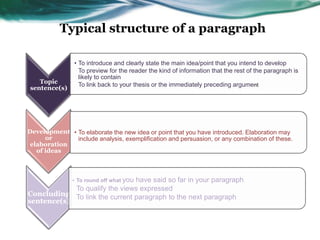
Typical structure of a paragraph
Topic
sentence(s)
• To introduce and clearly state the main idea/point that you intend to develop
To preview for the reader the kind of information that the rest of the paragraph is
likely to contain
To link back to your thesis or the immediately preceding argument
Development
or
elaboration
of ideas
• To elaborate the new idea or point that you have introduced. Elaboration may
include analysis, exemplification and persuasion, or any combination of these.
Concluding
sentence(s)
• To round off what you have said so far in your paragraph
To qualify the views expressed
To link the current paragraph to the next paragraph
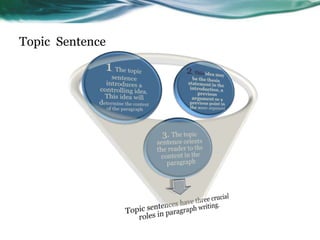
Topic Sentence
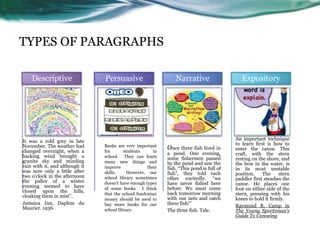
TYPES OF PARAGRAPHS
It was a cold grey in late
November. The weather had
changed overnight, when a
backing wind brought a
granite sky and mizzling
rain with it, and although it
was now only a little after
two o’clock in the afternoon
the pallor of a winter
evening seemed to have
closed upon the hills,
cloaking them in mist”.
Jamaica Inn, Daphne du
Maurier. 1936.
Descriptive Persuasive
Once three fish lived in
a pond. One evening,
some fishermen passed
by the pond and saw the
fish. “This pond is full of
fish”, they told each
other excitedly. “we
have never fished here
before. We must come
back tomorrow morning
with our nets and catch
these fish!”
The three fish. Tale.
Narrative
An important technique
to learn first is how to
enter the canoe. This
craft, with the stern
resting on the shore, and
the bow in the water, is
in its most unstable
position. The stern
paddler first steadies the
canoe. He places one
foot on either side of the
stern, pressing with his
knees to hold it firmly.
Raymond R. Camp in
The Young Sportsman's
Guide To Canoeing
Expository
Books are very important
for students in
school. They can learn
many new things and
improve their
skills. However, our
school library sometimes
doesn't have enough types
of some books. I think
that the school fundraiser
money should be used to
buy more books for our
school library.
REFERENCES
 University of Sidney. The write site Module 3: Structure . Retrieved
from:
http://writesite.elearn.usyd.edu.au/m3/m3u2/m3u2s2/m3u2s2_2.htm
 TestDEN: Education software. Vancouver, Canada. 1997.
Retrieved from:
http://www.testden.com/toefl/writing-tutorial/parts-of-an-essay.htm
 Your dictionary. Retreived
from://examples.yourdictionary.com/examples/descriptive-text-
examples.html
 Writing corner. Retrieved from:
http://wwcsd.net/~widrigr/PersuasiveWriting.htm
 Raymond R. Camp in The Young Sportsman's Guide To Canoeing
Retrieved from:
http://www.oocities.org/whoelseisgreat/Examples_of_Expository_
and_Narrative_Texts.doc

PARAGRAPH WRITING

  • 1.
  • 2.
    Paragraph Writing A paragraphis a group of sentences related to one topic or that develops one point A paragraph may stand independently, that is, it may be a short composition complete in itself or it may be apart of a longer work like an essay
  • 3.
    Typical structure ofa paragraph Topic sentence(s) • To introduce and clearly state the main idea/point that you intend to develop To preview for the reader the kind of information that the rest of the paragraph is likely to contain To link back to your thesis or the immediately preceding argument Development or elaboration of ideas • To elaborate the new idea or point that you have introduced. Elaboration may include analysis, exemplification and persuasion, or any combination of these. Concluding sentence(s) • To round off what you have said so far in your paragraph To qualify the views expressed To link the current paragraph to the next paragraph
  • 4.
  • 5.
    TYPES OF PARAGRAPHS Itwas a cold grey in late November. The weather had changed overnight, when a backing wind brought a granite sky and mizzling rain with it, and although it was now only a little after two o’clock in the afternoon the pallor of a winter evening seemed to have closed upon the hills, cloaking them in mist”. Jamaica Inn, Daphne du Maurier. 1936. Descriptive Persuasive Once three fish lived in a pond. One evening, some fishermen passed by the pond and saw the fish. “This pond is full of fish”, they told each other excitedly. “we have never fished here before. We must come back tomorrow morning with our nets and catch these fish!” The three fish. Tale. Narrative An important technique to learn first is how to enter the canoe. This craft, with the stern resting on the shore, and the bow in the water, is in its most unstable position. The stern paddler first steadies the canoe. He places one foot on either side of the stern, pressing with his knees to hold it firmly. Raymond R. Camp in The Young Sportsman's Guide To Canoeing Expository Books are very important for students in school. They can learn many new things and improve their skills. However, our school library sometimes doesn't have enough types of some books. I think that the school fundraiser money should be used to buy more books for our school library.
  • 6.
    REFERENCES  University ofSidney. The write site Module 3: Structure . Retrieved from: http://writesite.elearn.usyd.edu.au/m3/m3u2/m3u2s2/m3u2s2_2.htm  TestDEN: Education software. Vancouver, Canada. 1997. Retrieved from: http://www.testden.com/toefl/writing-tutorial/parts-of-an-essay.htm  Your dictionary. Retreived from://examples.yourdictionary.com/examples/descriptive-text- examples.html  Writing corner. Retrieved from: http://wwcsd.net/~widrigr/PersuasiveWriting.htm  Raymond R. Camp in The Young Sportsman's Guide To Canoeing Retrieved from: http://www.oocities.org/whoelseisgreat/Examples_of_Expository_ and_Narrative_Texts.doc

Editor's Notes

  • #2 Esta plantilla se puede usar como archivo de inicio para proporcionar actualizaciones de los hitos del proyecto.SeccionesLas secciones pueden ayudarle a organizar las diapositivas o a facilitar la colaboración entre varios autores. En la ficha Inicio, en Diapositivas, haga clic en Sección y, a continuación, en Agregar sección.NotasUse el panel Notas para las notas de entrega o para proporcionar detalles adicionales al público. Puede ver estas notas en la vista Moderador durante la presentación. Tenga en cuenta el tamaño de la fuente (es importante para la accesibilidad, visibilidad, grabación en vídeo y producción en línea)Colores coordinados Preste especial atención a los gráficos, diagramas y cuadros de texto.Tenga en cuenta que los asistentes imprimirán en blanco y negro o escala de grises. Ejecute una prueba de impresión para asegurarse de que los colores son los correctos cuando se imprime en blanco y negro puros y escala de grises.Gráficos y tablasEn breve: si es posible, use colores y estilos uniformes y que no distraigan.Etiquete todos los gráficos y tablas.
  • #3 ¿Sobre qué es el proyecto ?Defina el objetivo del proyecto¿Es similar a otros proyectos anteriores o es nuevo?Defina el ámbito del proyecto¿Es un proyecto independiente o está relacionado con otros proyectos?* Tenga en cuenta que no se necesita esta diapositiva para las reuniones semanales
  • #4 * Si alguno de estos problema causaron una demora en el programa o se deben analizar en profundidad, coloque los detalles en la siguiente diapositiva.
  • #5 Si hay más de un problema, duplique esta diapositiva tantas veces como sea necesario.Ésta y las diapositivas relacionadas se pueden colocar en el apéndice u ocultarlas si fuera necesario.