Paper: “Few-shot Graph
Classification with Contrastive
Loss and Meta-classifier” by
Chao Wei, Zhidong Deng
Review by Akanksha Rawat
Few-Shot Learning
FFew-shot learning (FSL) uses just a few samples and past information to
acquire representations that generalize effectively to novel classes.
Existing FSL models can generally be divided into three categories:
(1) methods based on optimization
(2) Using memory-based techniques
(3) Approaches based on metrics
Few shot classification
Few-shot classification seeks to train a classifier to identify previously
unidentified classes using a small number of labeled instances.
Recent works suggest incorporating few-shot learning frameworks for
quick adaptations to graph classes with few labeled graphs to address the
label scarcity barrier.
Contrastive Representation Learning
Contrastive learning uses the idea of comparing samples against one another to
identify characteristics that are shared by different data classes and
characteristics that distinguish one data class from another, improving
performance on visual tasks.
The fundamental foundation for contrastive learning involves choosing a "anchor"
data sample, a "positive" sample of data from the same distribution as the anchor,
and a "negative" sample of data from a different distribution.
Introduction
This paper investigates the problem of few-shot graph classification.
They presented a novel graph contrastive relation network (GCRNet) by
introducing a practical yet straightforward graph meta-baseline with
contrastive loss and meta-classifier, which achieved comparable
performance for graph few-shot learning.
Paper’s main contributions
● It recommends a contrastive loss to obtain a strong contrastive
representation by pushing away samples from various classes and
grouping graph features belonging to the same class.
● It also suggests a meta-classifier, which starts with the mean feature
of the support sets and extracts the global feature using GNode to
learn more appropriate similarity metrics.
● Even with relatively small support sets, such as 1-shot or 5-shot,
SOTA results are obtained in the experiment on all four datasets.
● Comparatively speaking, the proposed method outperforms the
current SOTA method by 10%.
Problem Definition
In an N-way K-shot few-shot task, the support set contains N classes with
K samples in each category. the query set contains the same N classes
with Q samples in each class. The goal is to classify the N × Q unlabeled
samples in the query set into N classes.
Architecture
Graph Neural Network
A specific node called the global node (GNode) was added to the
graph and made a directed connection from each graph node to
GNode individually.
In the AGGREGATEUPDATE step, the representation of GNode has
been updated as normal nodes in the graph, and GNode has no
impact on GNNs to learn the node properties.
Finally, a linear projection was applied, followed by a softmax to make
the prediction.
Architecture
Meta-learning Algorithm-
Existing GNNs and novel GNode were chosen as graph feature extractor to
learn contrastive representation and choose a linear parameter with softmax
function as meta-classifier.
Few-shot classification method is considered as meta-learning because it
makes the training procedure explicitly learn to learn from a given small
support set.
Architecture
Meta-learning framework-
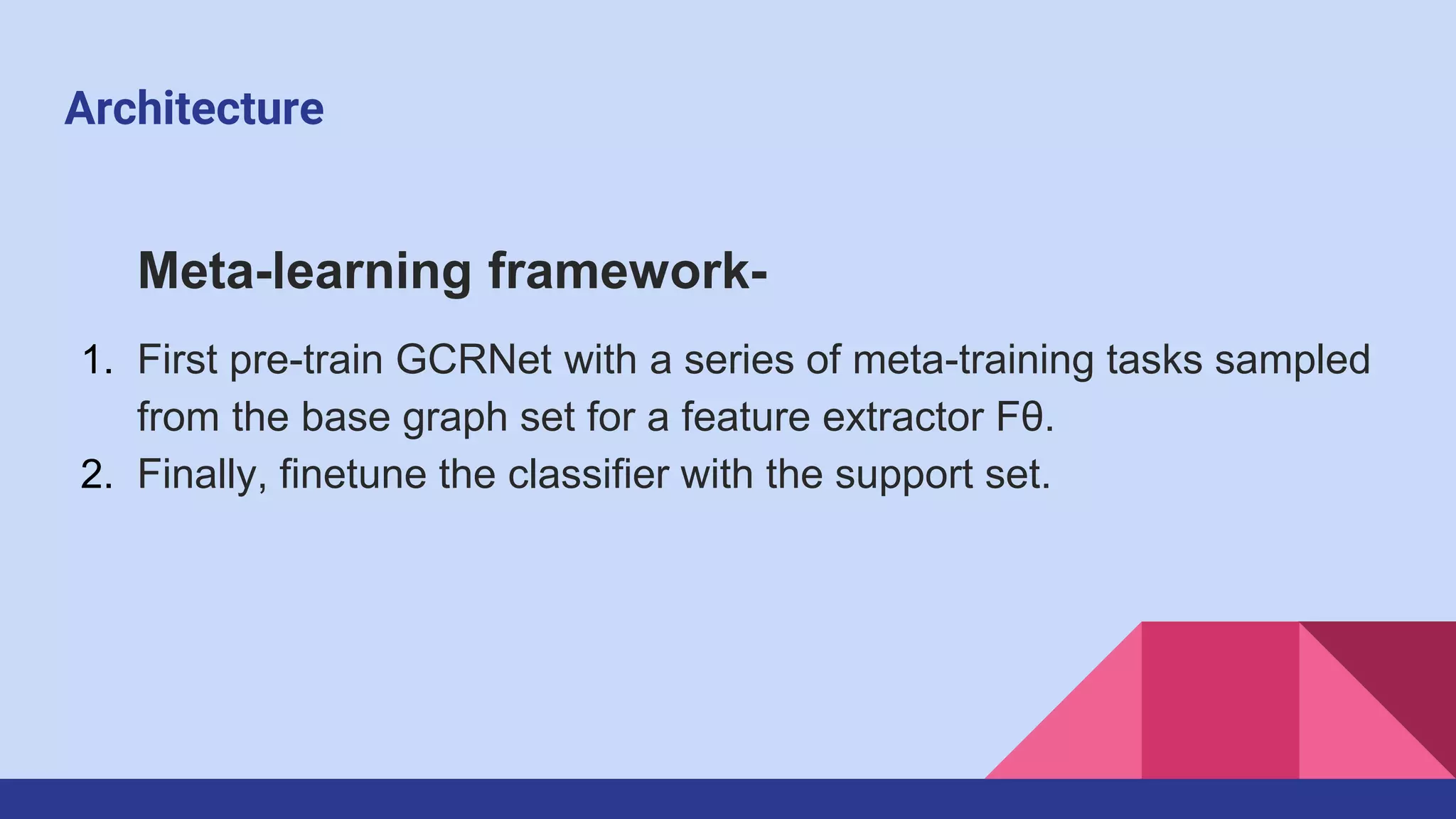
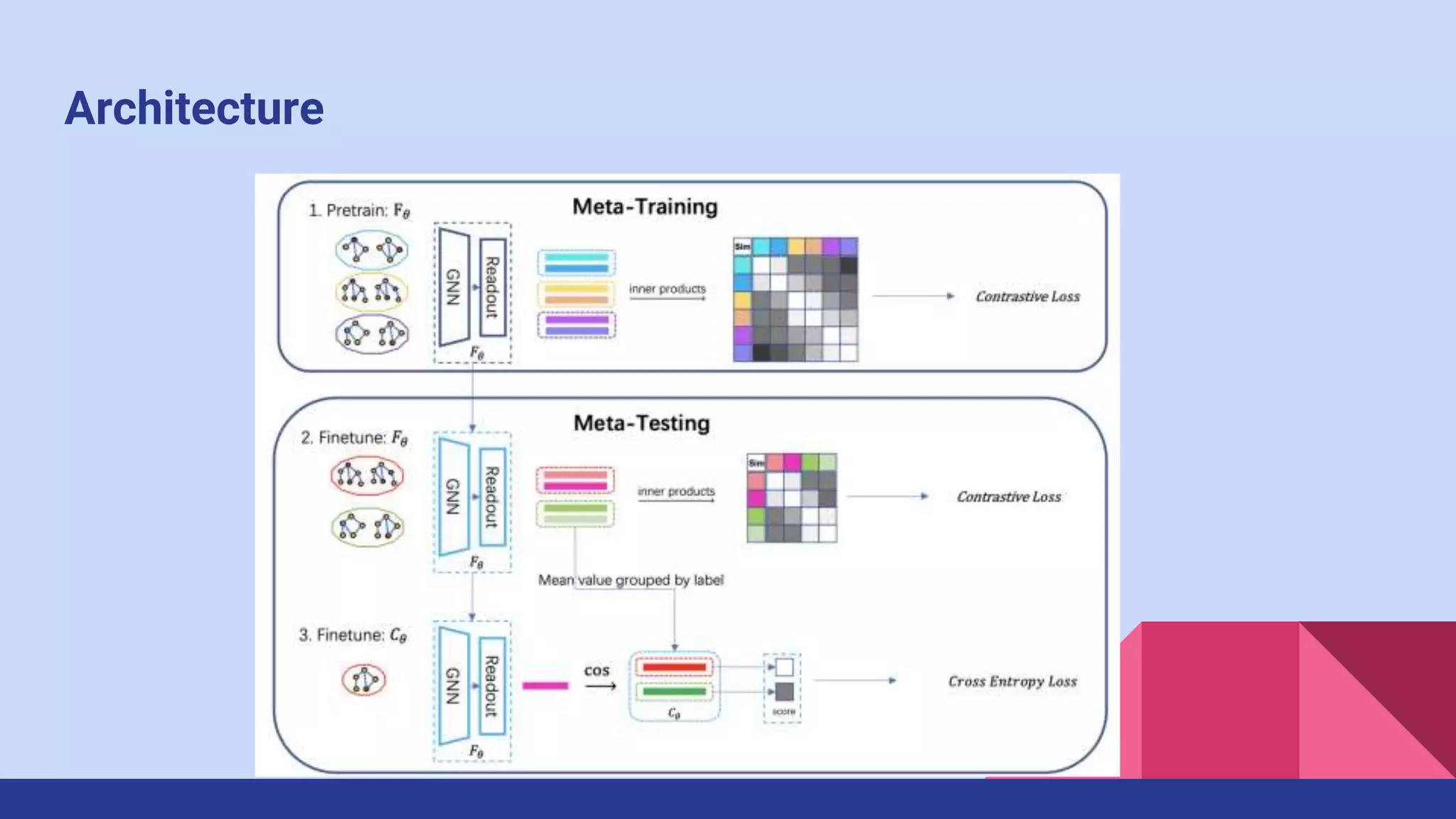
1. First pre-train GCRNet with a series of meta-training tasks sampled
from the base graph set for a feature extractor Fθ.
2. Finally, finetune the classifier with the support set.
Architecture
Experiment and Results
Datasets and Backbone-
Reddit-12K
ENZYMES dataset
The Letter-High dataset
TRIANGLES dataset
Baseline and implementation details: They adopted a five-layer graph isomorphism network (GIN) with
64- dimensional hidden units for performance comparison. They ran the model by partitioning it into the
feature extractor, i.e., GIN (backbone) + GNode, and the classifier to fairly compare our method with other
baselines.
Experiment and Results
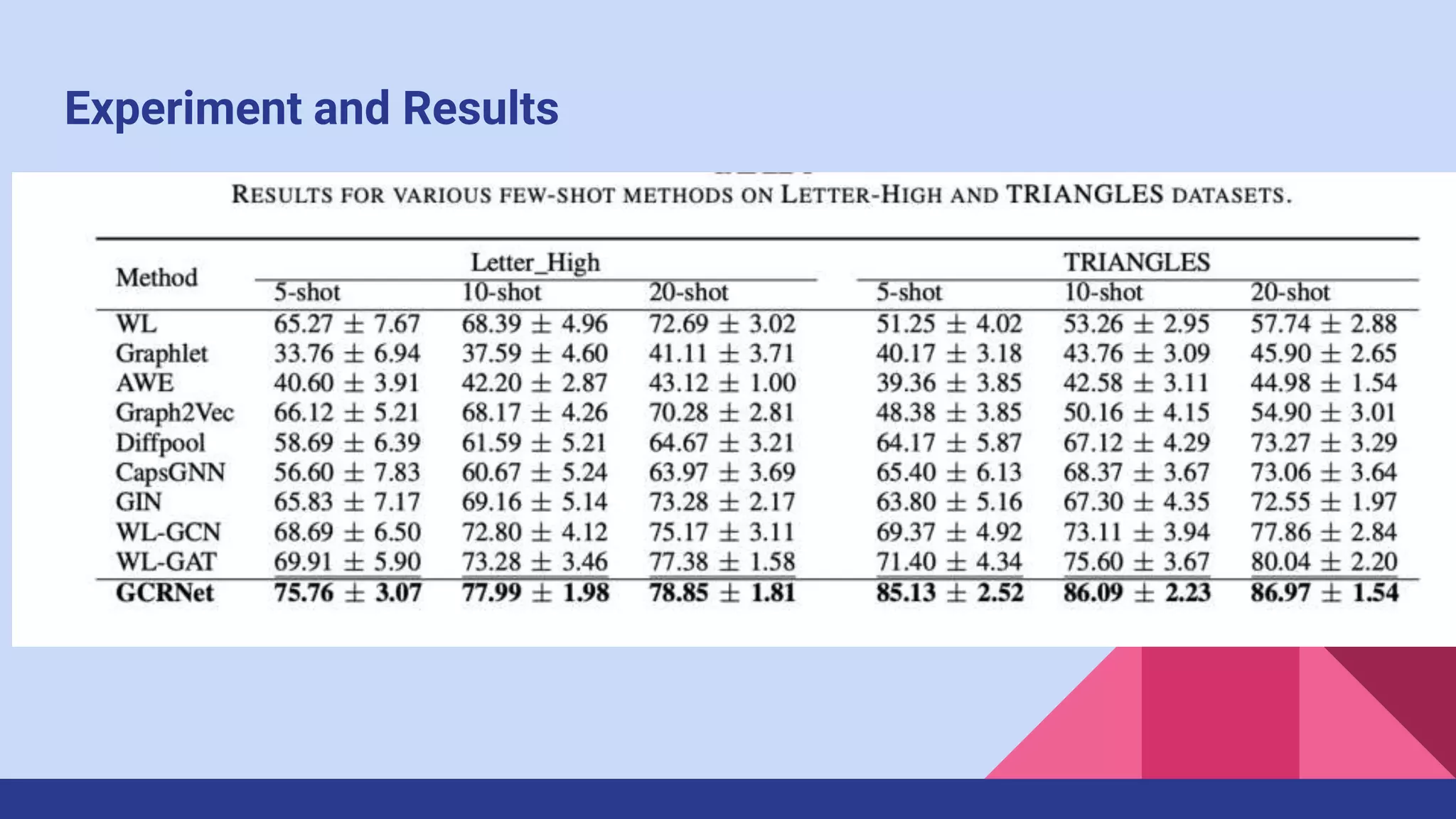
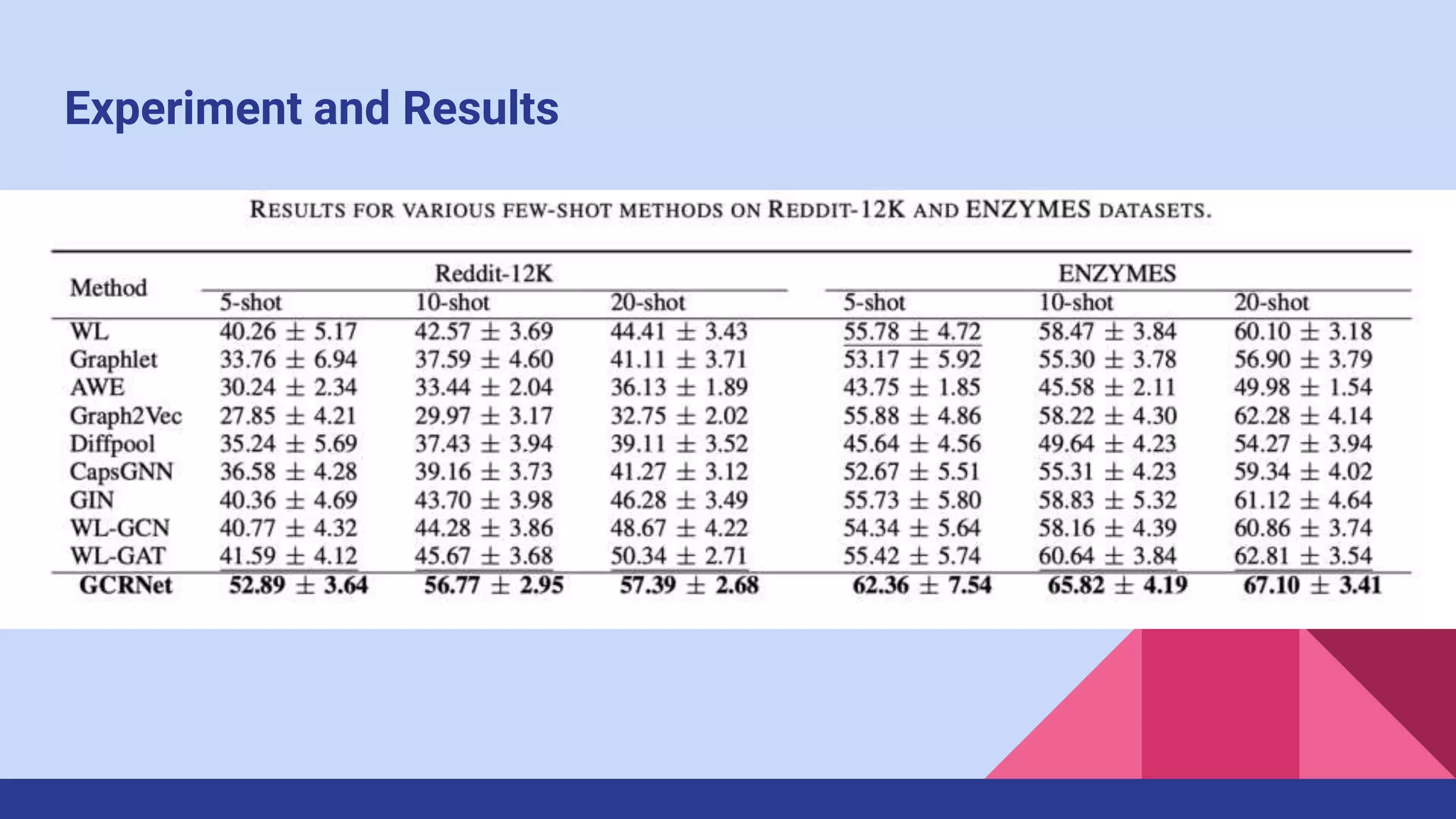
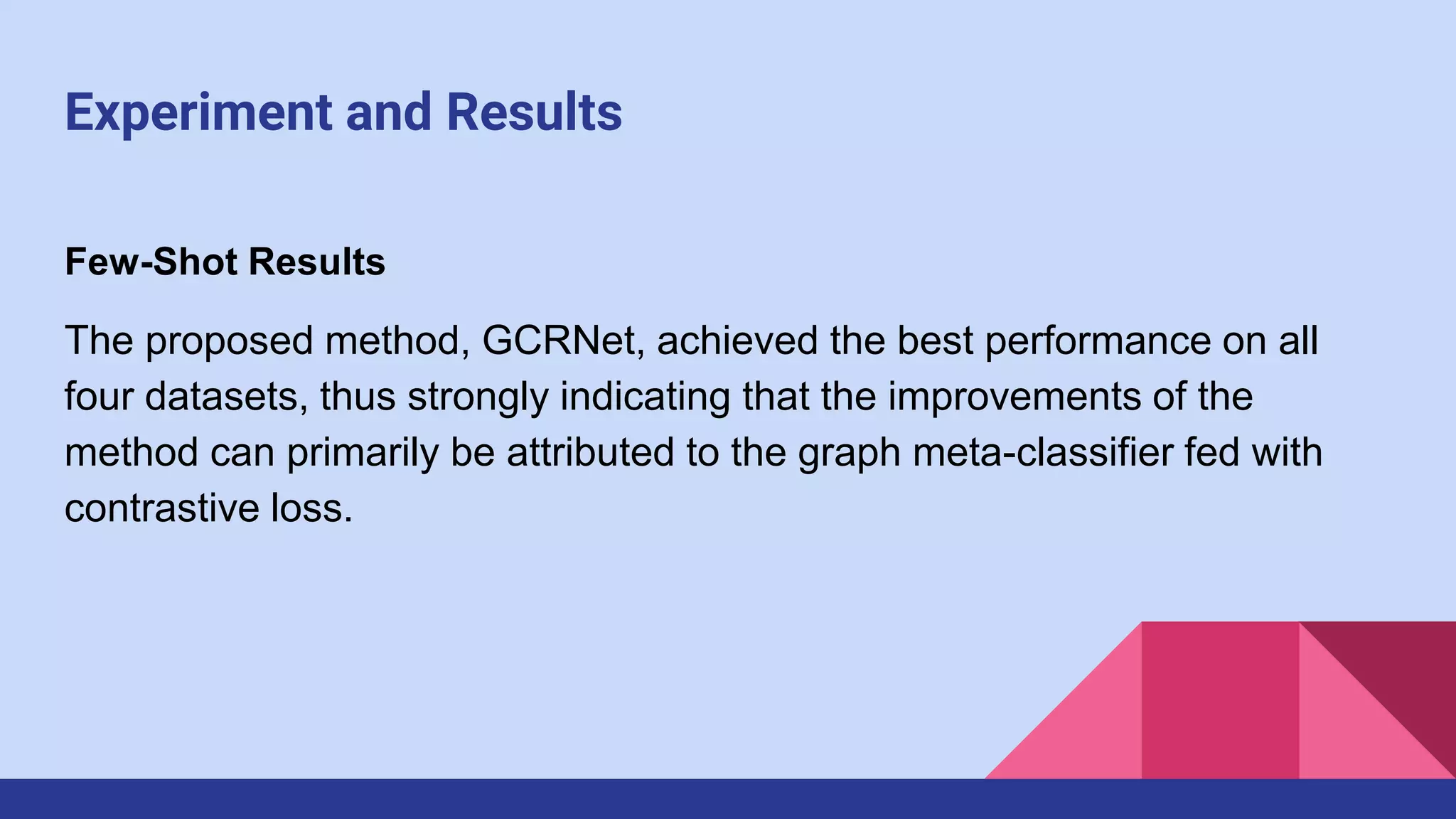
Few-Shot Results
The proposed method, GCRNet, achieved the best performance on all
four datasets, thus strongly indicating that the improvements of the
method can primarily be attributed to the graph meta-classifier fed with
contrastive loss.
Experiment and Results
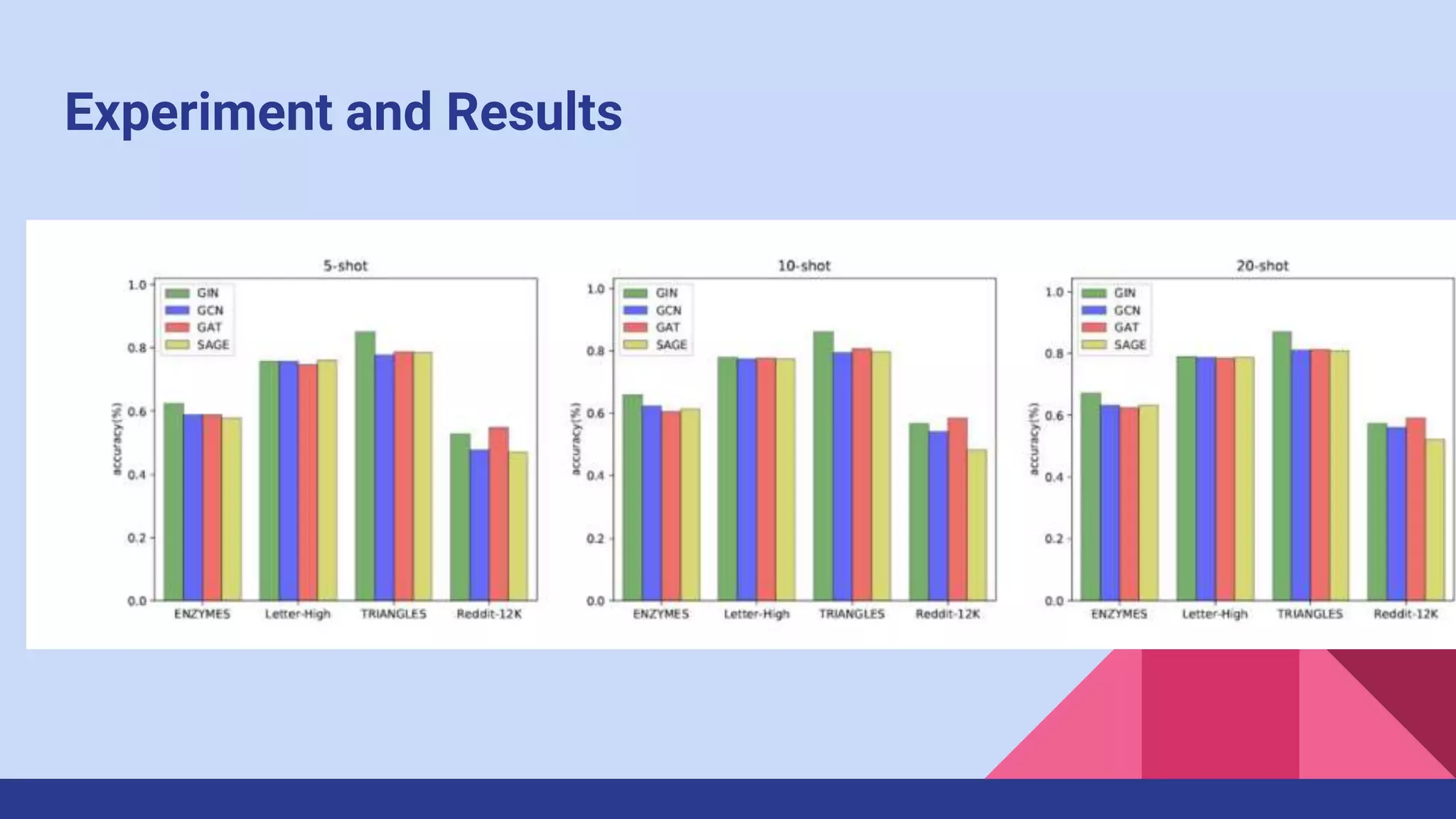
Results on different GNNs
It compared the effect of four competitive GNN models, i.e., GCN,
GraphSAGE, GAT, and GIN, as the backbone of the proposed GCRNet.
model almost achieve the best results with GIN in all four datasets, which
indicates that GIN is more powerful for learning the graph-level
representation.
Experiment and Results
References
1. Few-shot Graph Classification with Contrastive Loss and Meta-classifier- https://ieeexplore-ieee-
org.libaccess.sjlibrary.org/stamp/stamp.jsp?tp=&arnumber=9892886&tag=1
Thank you!

PaperReview_ “Few-shot Graph Classification with Contrastive Loss and Meta-classifier” by Chao Wei, Zhidong Deng (2).pptx

  • 1.
    Paper: “Few-shot Graph Classificationwith Contrastive Loss and Meta-classifier” by Chao Wei, Zhidong Deng Review by Akanksha Rawat
  • 2.
    Few-Shot Learning FFew-shot learning(FSL) uses just a few samples and past information to acquire representations that generalize effectively to novel classes. Existing FSL models can generally be divided into three categories: (1) methods based on optimization (2) Using memory-based techniques (3) Approaches based on metrics
  • 3.
    Few shot classification Few-shotclassification seeks to train a classifier to identify previously unidentified classes using a small number of labeled instances. Recent works suggest incorporating few-shot learning frameworks for quick adaptations to graph classes with few labeled graphs to address the label scarcity barrier.
  • 4.
    Contrastive Representation Learning Contrastivelearning uses the idea of comparing samples against one another to identify characteristics that are shared by different data classes and characteristics that distinguish one data class from another, improving performance on visual tasks. The fundamental foundation for contrastive learning involves choosing a "anchor" data sample, a "positive" sample of data from the same distribution as the anchor, and a "negative" sample of data from a different distribution.
  • 5.
    Introduction This paper investigatesthe problem of few-shot graph classification. They presented a novel graph contrastive relation network (GCRNet) by introducing a practical yet straightforward graph meta-baseline with contrastive loss and meta-classifier, which achieved comparable performance for graph few-shot learning.
  • 6.
    Paper’s main contributions ●It recommends a contrastive loss to obtain a strong contrastive representation by pushing away samples from various classes and grouping graph features belonging to the same class. ● It also suggests a meta-classifier, which starts with the mean feature of the support sets and extracts the global feature using GNode to learn more appropriate similarity metrics. ● Even with relatively small support sets, such as 1-shot or 5-shot, SOTA results are obtained in the experiment on all four datasets. ● Comparatively speaking, the proposed method outperforms the current SOTA method by 10%.
  • 7.
    Problem Definition In anN-way K-shot few-shot task, the support set contains N classes with K samples in each category. the query set contains the same N classes with Q samples in each class. The goal is to classify the N × Q unlabeled samples in the query set into N classes.
  • 8.
    Architecture Graph Neural Network Aspecific node called the global node (GNode) was added to the graph and made a directed connection from each graph node to GNode individually. In the AGGREGATEUPDATE step, the representation of GNode has been updated as normal nodes in the graph, and GNode has no impact on GNNs to learn the node properties. Finally, a linear projection was applied, followed by a softmax to make the prediction.
  • 9.
    Architecture Meta-learning Algorithm- Existing GNNsand novel GNode were chosen as graph feature extractor to learn contrastive representation and choose a linear parameter with softmax function as meta-classifier. Few-shot classification method is considered as meta-learning because it makes the training procedure explicitly learn to learn from a given small support set.
  • 10.
    Architecture Meta-learning framework- 1. Firstpre-train GCRNet with a series of meta-training tasks sampled from the base graph set for a feature extractor Fθ. 2. Finally, finetune the classifier with the support set.
  • 11.
  • 12.
    Experiment and Results Datasetsand Backbone- Reddit-12K ENZYMES dataset The Letter-High dataset TRIANGLES dataset Baseline and implementation details: They adopted a five-layer graph isomorphism network (GIN) with 64- dimensional hidden units for performance comparison. They ran the model by partitioning it into the feature extractor, i.e., GIN (backbone) + GNode, and the classifier to fairly compare our method with other baselines.
  • 13.
  • 14.
  • 15.
    Experiment and Results Few-ShotResults The proposed method, GCRNet, achieved the best performance on all four datasets, thus strongly indicating that the improvements of the method can primarily be attributed to the graph meta-classifier fed with contrastive loss.
  • 16.
    Experiment and Results Resultson different GNNs It compared the effect of four competitive GNN models, i.e., GCN, GraphSAGE, GAT, and GIN, as the backbone of the proposed GCRNet. model almost achieve the best results with GIN in all four datasets, which indicates that GIN is more powerful for learning the graph-level representation.
  • 17.
  • 18.
    References 1. Few-shot GraphClassification with Contrastive Loss and Meta-classifier- https://ieeexplore-ieee- org.libaccess.sjlibrary.org/stamp/stamp.jsp?tp=&arnumber=9892886&tag=1
  • 19.