Demand-Driven Computation of
Inter-procedural Data Flow
Evelyn Duesterwald et al. POPL 1995
Presenter: Min-Yih Hsu
Outline
• Overview
• Illustrating Exhaustive Data-Flow Analysis with Copy Constant
Propagation (CCP)
• Demand-Driven Data-Flow Analysis
• Related Works
• Comments
Overview
The over-analysis problem
• Users of a data-flow analysis might only need part of the results.
• Generating superfluous analysis results are called over-analysis.
The over-analysis problem
• Users of a data-flow analysis might only need part of the results.
• Generating superfluous analysis results are called over-analysis.
• Example: In constant propagation, user only asked the constant
value (or non-constant) of variable x at line n.
The over-analysis problem
• Users of a data-flow analysis might only need part of the results.
• Generating superfluous analysis results are called over-analysis.
• Example: In constant propagation, user only asked the constant
value (or non-constant) of variable x at line n.
• Traditional data-flow analysis will give you results of every
variables in each line.
The over-analysis problem
• Users of a data-flow analysis might only need part of the results.
• Generating superfluous analysis results are called over-analysis.
• Example: In constant propagation, user only asked the constant
value (or non-constant) of variable x at line n.
• Traditional data-flow analysis will give you results of every
variables in each line.
• A real-world application: Interactive code editor
CFG
Untouched
Analyzed
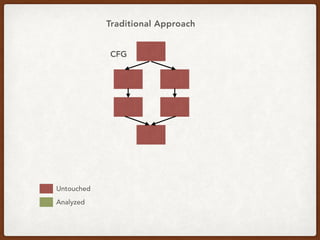
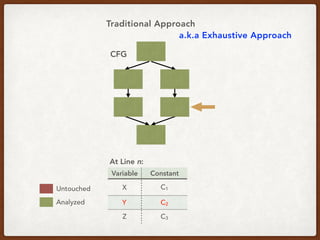
Traditional Approach
CFG
Untouched
Analyzed
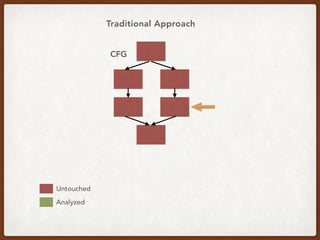
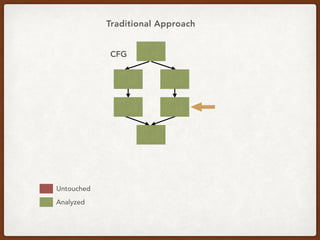
Traditional Approach
CFG
Untouched
Analyzed
Traditional Approach
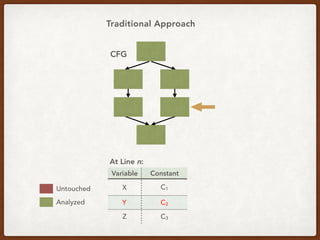
CFG
Variable Constant
X C1
Y C2
Z C3
At Line n:
Untouched
Analyzed
Traditional Approach
CFG
Variable Constant
X C1
Y C2
Z C3
At Line n:
Untouched
Analyzed
Traditional Approach
a.k.a Exhaustive Approach
CFG
Untouched
Analyzed
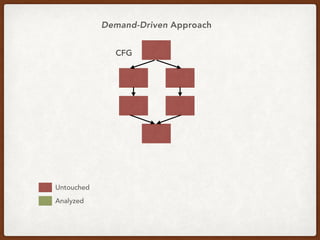
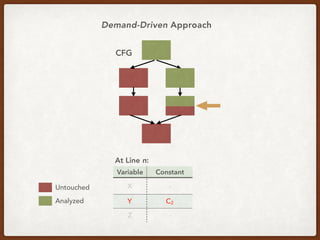
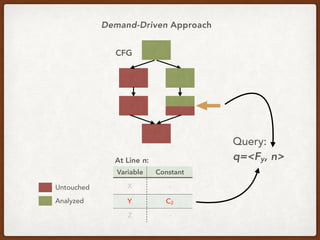
Demand-Driven Approach
CFG
Untouched
Analyzed
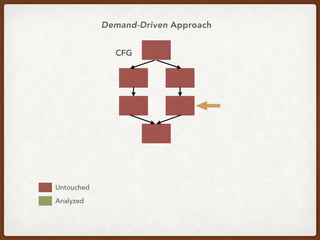
Demand-Driven Approach
CFG
Untouched
Analyzed
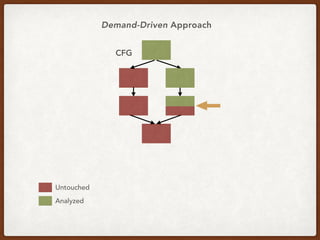
Demand-Driven Approach
CFG
Variable Constant
X -
Y C2
Z -
At Line n:
Untouched
Analyzed
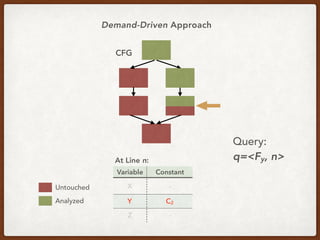
Demand-Driven Approach
CFG
Variable Constant
X -
Y C2
Z -
At Line n:
Untouched
Analyzed
Demand-Driven Approach
Query:
q=<Fy, n>
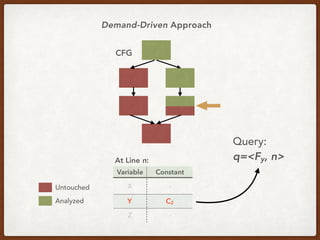
CFG
Variable Constant
X -
Y C2
Z -
At Line n:
Untouched
Analyzed
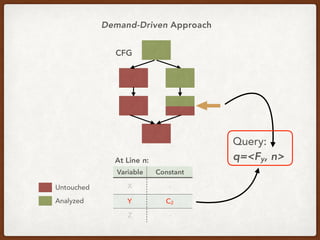
Demand-Driven Approach
Query:
q=<Fy, n>
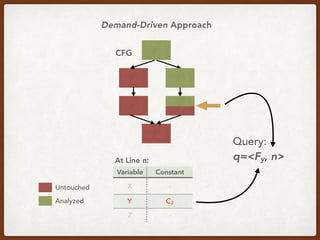
CFG
Variable Constant
X -
Y C2
Z -
At Line n:
Untouched
Analyzed
Demand-Driven Approach
Query:
q=<Fy, n>
Illustrating Exhaustive Data-Flow Analysis
w/ Copy Constant Propagation (CCP)
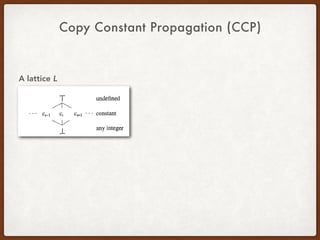
Copy Constant Propagation (CCP)
A lattice L
Copy Constant Propagation (CCP)
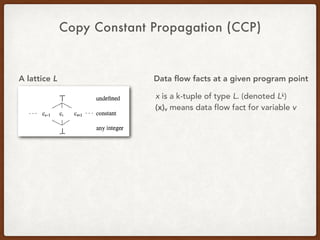
A lattice L Data flow facts at a given program point
x is a k-tuple of type L. (denoted Lk)
(x)v means data flow fact for variable v
Copy Constant Propagation (CCP)
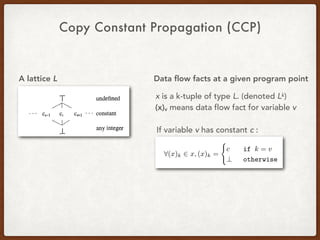
A lattice L Data flow facts at a given program point
x is a k-tuple of type L. (denoted Lk)
(x)v means data flow fact for variable v
If variable v has constant c :
Copy Constant Propagation (CCP)
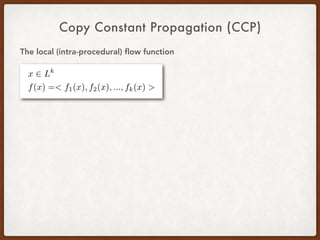
The local (intra-procedural) flow function
Copy Constant Propagation (CCP)
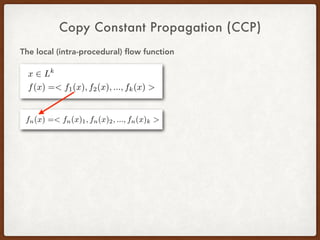
The local (intra-procedural) flow function
Copy Constant Propagation (CCP)
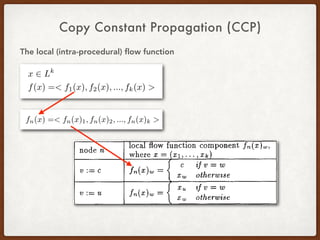
The local (intra-procedural) flow function
Copy Constant Propagation (CCP)
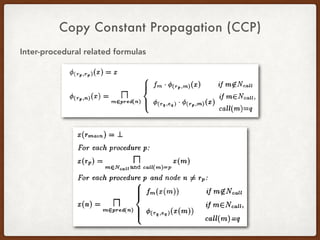
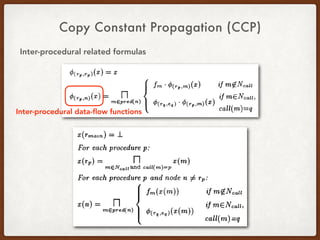
Inter-procedural related formulas
Copy Constant Propagation (CCP)
Inter-procedural related formulas
Inter-procedural data-flow functions
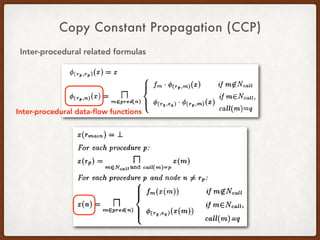
Copy Constant Propagation (CCP)
Inter-procedural related formulas
Inter-procedural data-flow functions
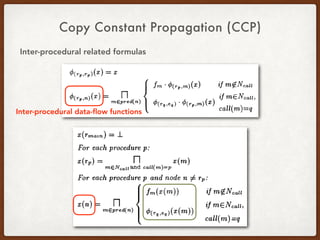
Copy Constant Propagation (CCP)
Inter-procedural related formulas
Inter-procedural data-flow functions
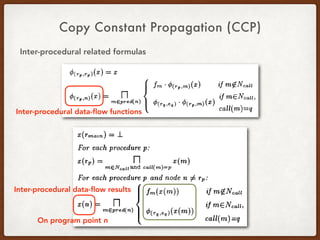
Copy Constant Propagation (CCP)
Inter-procedural related formulas
Inter-procedural data-flow functions
Inter-procedural data-flow results
On program point n
Demand-Driven Data-Flow Analysis
CFG
Variable Constant
X -
Y C2
Z -
At Line n:
Untouched
Analyzed
Demand-Driven Approach
Query:
q=<Fy, n>
CFG
Variable Constant
X -
Y C2
Z -
At Line n:
Untouched
Analyzed
Demand-Driven Approach
Query:
q=<Fy, n>
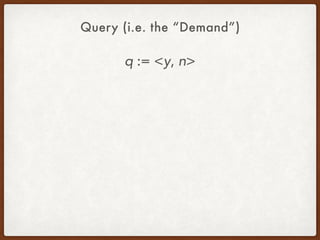
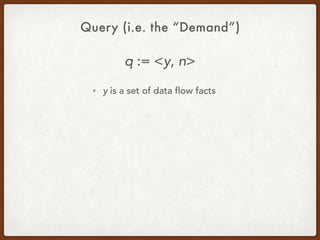
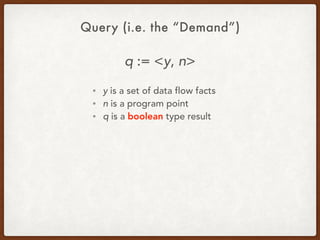
Query (i.e. the “Demand”)
q := <y, n>
Query (i.e. the “Demand”)
q := <y, n>
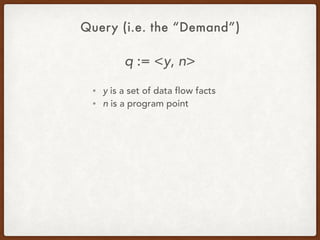
• y is a set of data flow facts
Query (i.e. the “Demand”)
q := <y, n>
• y is a set of data flow facts
• n is a program point
Query (i.e. the “Demand”)
q := <y, n>
• y is a set of data flow facts
• n is a program point
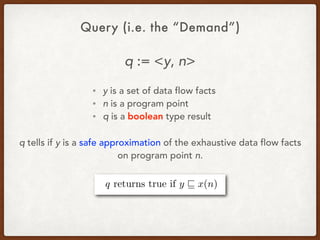
• q is a boolean type result
Query (i.e. the “Demand”)
q := <y, n>
• y is a set of data flow facts
• n is a program point
• q is a boolean type result
q tells if y is a safe approximation of the exhaustive data flow facts
on program point n.
An Example Query in CCP*
q := <[a=c], 10>
“Tell me if variable a is equal to constant c at line 10”
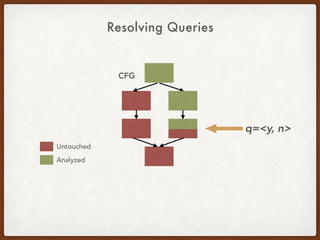
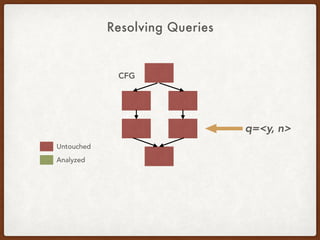
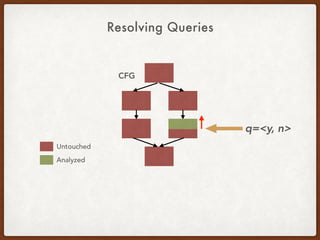
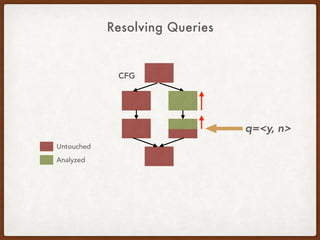
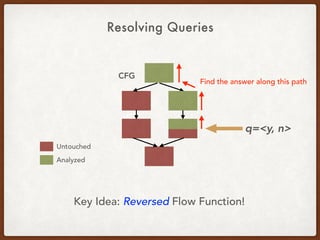
Resolving Queries
CFG
Untouched
Analyzed
q=<y, n>
Resolving Queries
CFG
Untouched
Analyzed
q=<y, n>
Resolving Queries
CFG
Untouched
Analyzed
q=<y, n>
Resolving Queries
CFG
Untouched
Analyzed
q=<y, n>
Resolving Queries
CFG
Untouched
Analyzed
q=<y, n>
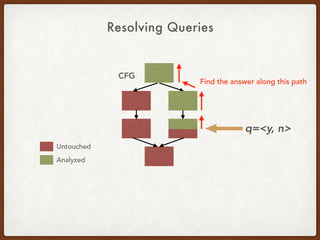
Find the answer along this path
Resolving Queries
CFG
Untouched
Analyzed
q=<y, n>
Key Idea: Reversed Flow Function!
Find the answer along this path
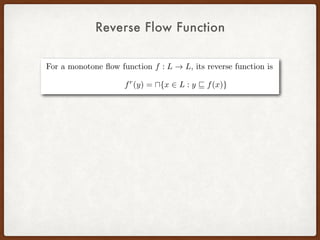
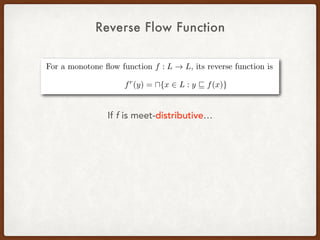
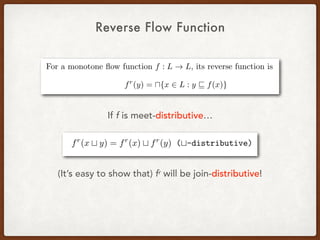
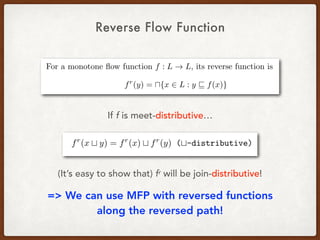
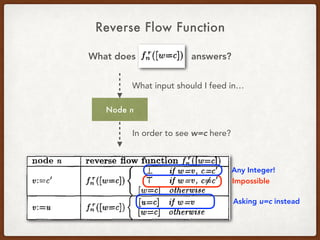
Reverse Flow Function
If f is meet-distributive…
Reverse Flow Function
If f is meet-distributive…
(It’s easy to show that) fr will be join-distributive!
Reverse Flow Function
If f is meet-distributive…
(It’s easy to show that) fr will be join-distributive!
=> We can use MFP with reversed functions
along the reversed path!
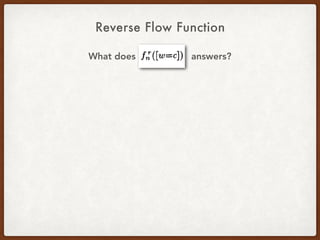
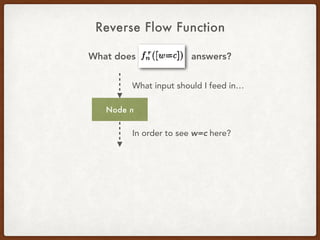
Reverse Flow Function
What does answers?
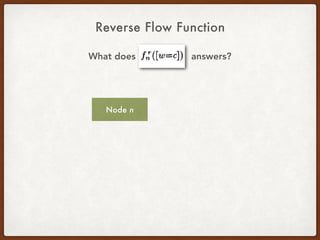
Reverse Flow Function
What does answers?
Node n
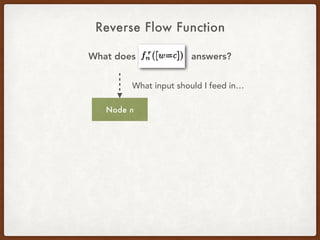
Reverse Flow Function
What does answers?
Node n
What input should I feed in…
Reverse Flow Function
What does answers?
Node n
What input should I feed in…
In order to see w=c here?
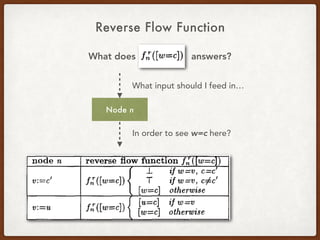
Reverse Flow Function
What does answers?
Node n
What input should I feed in…
In order to see w=c here?
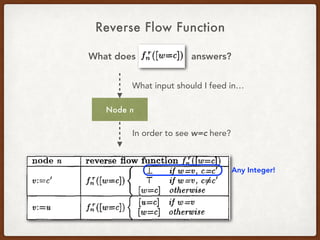
Reverse Flow Function
What does answers?
Node n
What input should I feed in…
In order to see w=c here?
Any Integer!
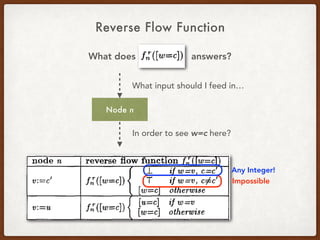
Reverse Flow Function
What does answers?
Node n
What input should I feed in…
In order to see w=c here?
Impossible
Any Integer!
Reverse Flow Function
What does answers?
Node n
What input should I feed in…
In order to see w=c here?
Impossible
Any Integer!
Asking u=c instead
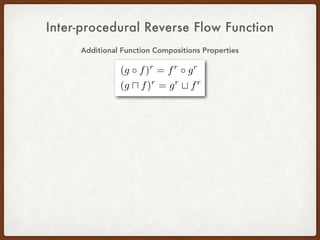
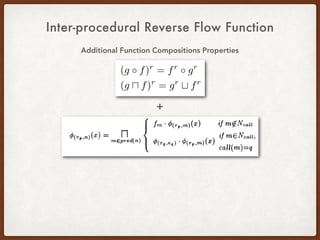
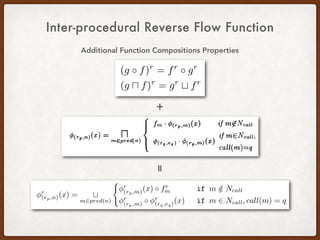
Inter-procedural Reverse Flow Function
Additional Function Compositions Properties
Inter-procedural Reverse Flow Function
Additional Function Compositions Properties
+
Inter-procedural Reverse Flow Function
Additional Function Compositions Properties
+
=
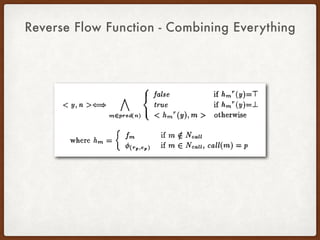
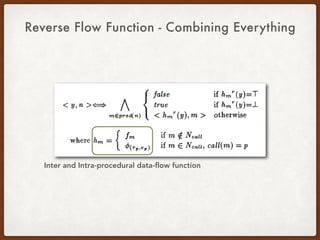
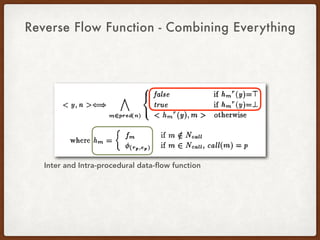
Reverse Flow Function - Combining Everything
Inter and Intra-procedural data-flow function
Reverse Flow Function - Combining Everything
Inter and Intra-procedural data-flow function
Generalizing the CCP Query
q := <[a=c], 10>
“Tell me if variable a is equal to constant c at line 10”
Generalizing the CCP Query
q := <[a=c], 10>
“Tell me if variable a is equal to constant c at line 10”
What c should we ask?
Generalizing the CCP Query
q := <[a=c], 10>
“Tell me if variable a is equal to constant c at line 10”
What c should we ask?
A more useful query:
“Tell me the constant value (if it is) of variable a at line 10.”
q’ := <[a], 10>
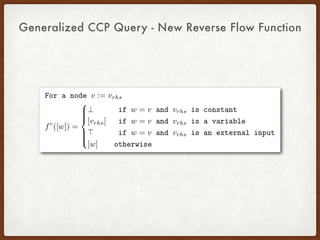
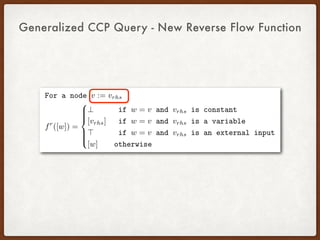
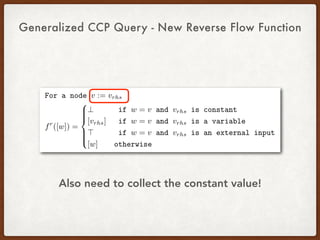
Generalized CCP Query - New Reverse Flow Function
Also need to collect the constant value!
Generalized CCP Query - A Simple Example
x = 3
y = 4
a = x
r = a + 1 <[a], n>
Generalized CCP Query - A Simple Example
x = 3
y = 4
a = x
r = a + 1 <[a], n>
Generalized CCP Query - A Simple Example
x = 3
y = 4
a = x
r = a + 1 <[a], n>
Final answer for this query
Generalized CCP Query - A Simple Example
x = 3
y = 4
a = x
r = a + 1 <[a], n>
Final answer for this query
Generalized CCP Query - A Simple Example
x = 3
y = 4
a = x
r = a + 1 <[a], n>
Final answer for this query
Takeaways
Takeaways
• Reverse flow function is the core of this algorithm.
• It’s join-distributive property allow us to use MFP with it.
Takeaways
• Reverse flow function is the core of this algorithm.
• It’s join-distributive property allow us to use MFP with it.
• In the generalized query (for CCP):
Takeaways
• Reverse flow function is the core of this algorithm.
• It’s join-distributive property allow us to use MFP with it.
• In the generalized query (for CCP):
• Instead of taking its returned value from reverse functions as
the query result, we used it to guide the query propagation
process.
Time and Space Complexity
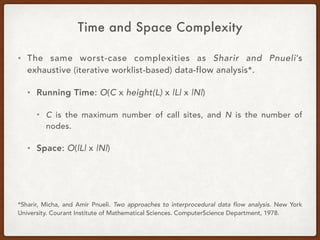
• The same worst-case complexities as Sharir and Pnueli’s
exhaustive (iterative worklist-based) data-flow analysis*.
• Running Time: O(C x height(L) x |L| x |N|)
• C is the maximum number of call sites, and N is the number of
nodes.
• Space: O(|L| x |N|)
*Sharir, Micha, and Amir Pnueli. Two approaches to interprocedural data flow analysis. New York
University. Courant Institute of Mathematical Sciences. ComputerScience Department, 1978.
Related Works
• Ryder, Barbara G., and Marvin C. Paull. "Incremental data-flow
analysis algorithms." ACM Transactions on Programming Languages
and Systems (TOPLAS) 10.1 (1988): 1-50.
• Ryder, Barbara G., and Marvin C. Paull. "Incremental data-flow
analysis algorithms." ACM Transactions on Programming Languages
and Systems (TOPLAS) 10.1 (1988): 1-50.
• Incremental data-flow analysis need to perform full data-flow
analysis on first run. Where over-analysis problem might still
happen.
• Ryder, Barbara G., and Marvin C. Paull. "Incremental data-flow
analysis algorithms." ACM Transactions on Programming Languages
and Systems (TOPLAS) 10.1 (1988): 1-50.
• Incremental data-flow analysis need to perform full data-flow
analysis on first run. Where over-analysis problem might still
happen.
• IFDS / IDE
• Ryder, Barbara G., and Marvin C. Paull. "Incremental data-flow
analysis algorithms." ACM Transactions on Programming Languages
and Systems (TOPLAS) 10.1 (1988): 1-50.
• Incremental data-flow analysis need to perform full data-flow
analysis on first run. Where over-analysis problem might still
happen.
• IFDS / IDE
• The authors of this paper argued that their work has “less
restrictions on structure of lattice and flow functions”.
• Ryder, Barbara G., and Marvin C. Paull. "Incremental data-flow
analysis algorithms." ACM Transactions on Programming Languages
and Systems (TOPLAS) 10.1 (1988): 1-50.
• Incremental data-flow analysis need to perform full data-flow
analysis on first run. Where over-analysis problem might still
happen.
• IFDS / IDE
• The authors of this paper argued that their work has “less
restrictions on structure of lattice and flow functions”.
• e.g. This work can give an approximation even with non-
distributive flow function.
• (IFDS / IDE cont’d)
• IFDS and IDE can not (fully) avoid over-analysis problem.
• (IFDS / IDE cont’d)
• IFDS and IDE can not (fully) avoid over-analysis problem.
• e.g. For CCP problem, IFDS / IDE would tell the constant value
(if any) for every variables.
• (IFDS / IDE cont’d)
• IFDS and IDE can not (fully) avoid over-analysis problem.
• e.g. For CCP problem, IFDS / IDE would tell the constant value
(if any) for every variables.
• Strom, Robert E., and Daniel M. Yellin. "Extending typestate
checking using conditional liveness analysis." IEEE Transactions on
Software Engineering 19.5 (1993): 478-485.
• (IFDS / IDE cont’d)
• IFDS and IDE can not (fully) avoid over-analysis problem.
• e.g. For CCP problem, IFDS / IDE would tell the constant value
(if any) for every variables.
• Strom, Robert E., and Daniel M. Yellin. "Extending typestate
checking using conditional liveness analysis." IEEE Transactions on
Software Engineering 19.5 (1993): 478-485.
• Also used the idea of backward and demand-driven program
analysis.
Comments
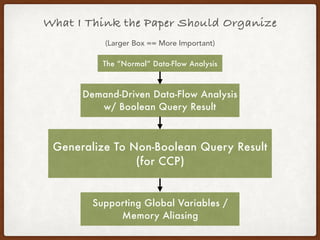
What I Think the Paper Should Organize
(Larger Box == More Important)
The “Normal” Data-Flow Analysis
Demand-Driven Data-Flow Analysis
w/ Boolean Query Result
Generalize To Non-Boolean Query Result
(for CCP)
Supporting Global Variables /
Memory Aliasing
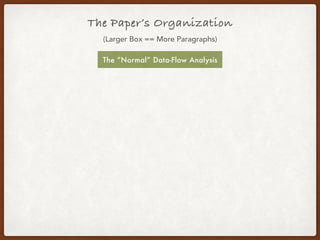
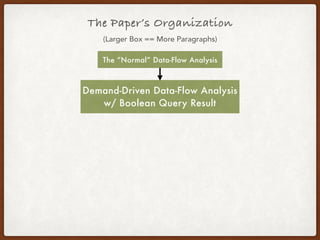
The Paper’s Organization
(Larger Box == More Paragraphs)
The “Normal” Data-Flow Analysis
The Paper’s Organization
(Larger Box == More Paragraphs)
The “Normal” Data-Flow Analysis
Demand-Driven Data-Flow Analysis
w/ Boolean Query Result
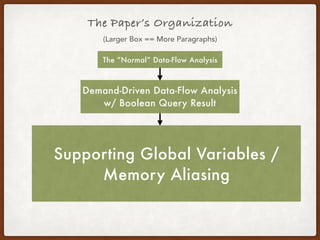
The Paper’s Organization
(Larger Box == More Paragraphs)
The “Normal” Data-Flow Analysis
Supporting Global Variables /
Memory Aliasing
Demand-Driven Data-Flow Analysis
w/ Boolean Query Result
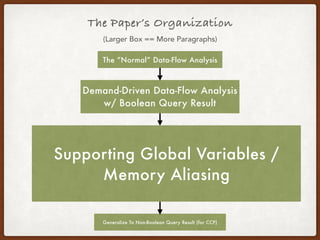
The Paper’s Organization
(Larger Box == More Paragraphs)
The “Normal” Data-Flow Analysis
Generalize To Non-Boolean Query Result (for CCP)
Supporting Global Variables /
Memory Aliasing
Demand-Driven Data-Flow Analysis
w/ Boolean Query Result
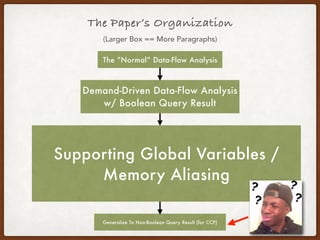
The Paper’s Organization
(Larger Box == More Paragraphs)
The “Normal” Data-Flow Analysis
Generalize To Non-Boolean Query Result (for CCP)
Supporting Global Variables /
Memory Aliasing
Demand-Driven Data-Flow Analysis
w/ Boolean Query Result
Other Comments
Other Comments
• The querying mechanism fit really well in Language Server
Protocol (LSP), which is getting more attention now.
Other Comments
• The querying mechanism fit really well in Language Server
Protocol (LSP), which is getting more attention now.
• This paper did a pretty nice survey on related works.
Other Comments
• The querying mechanism fit really well in Language Server
Protocol (LSP), which is getting more attention now.
• This paper did a pretty nice survey on related works.
• Some notations are inconsistent across paragraphs.
Other Comments
• The querying mechanism fit really well in Language Server
Protocol (LSP), which is getting more attention now.
• This paper did a pretty nice survey on related works.
• Some notations are inconsistent across paragraphs.
• Amortized Time Complexity Analysis Please!!!
Summary
Summary
• This work used queries to drive the data-flow analysis process to avoid
generating redundant results that would never be used.
Summary
• This work used queries to drive the data-flow analysis process to avoid
generating redundant results that would never be used.
• The algorithm performed a revered data-flow analysis from the point
where users are inquiring.
• The reverse data-flow function played an important role.
Summary
• This work used queries to drive the data-flow analysis process to avoid
generating redundant results that would never be used.
• The algorithm performed a revered data-flow analysis from the point
where users are inquiring.
• The reverse data-flow function played an important role.
• The query algorithm was augmented to support arbitrary result types.
In addition to the basic boolean type.
Summary
• This work used queries to drive the data-flow analysis process to avoid
generating redundant results that would never be used.
• The algorithm performed a revered data-flow analysis from the point
where users are inquiring.
• The reverse data-flow function played an important role.
• The query algorithm was augmented to support arbitrary result types.
In addition to the basic boolean type.
• Regarding the time complexity, this algorithm is no worse than the
exhaustive data-flow analysis.
• Just as the incremental data-flow analysis, we hope to see the
amortized time complexity.

Paper Study - Demand-Driven Computation of Interprocedural Data Flow

  • 1.
    Demand-Driven Computation of Inter-proceduralData Flow Evelyn Duesterwald et al. POPL 1995 Presenter: Min-Yih Hsu
  • 2.
    Outline • Overview • IllustratingExhaustive Data-Flow Analysis with Copy Constant Propagation (CCP) • Demand-Driven Data-Flow Analysis • Related Works • Comments
  • 3.
  • 4.
  • 5.
    The over-analysis problem •Users of a data-flow analysis might only need part of the results. • Generating superfluous analysis results are called over-analysis.
  • 6.
    The over-analysis problem •Users of a data-flow analysis might only need part of the results. • Generating superfluous analysis results are called over-analysis. • Example: In constant propagation, user only asked the constant value (or non-constant) of variable x at line n.
  • 7.
    The over-analysis problem •Users of a data-flow analysis might only need part of the results. • Generating superfluous analysis results are called over-analysis. • Example: In constant propagation, user only asked the constant value (or non-constant) of variable x at line n. • Traditional data-flow analysis will give you results of every variables in each line.
  • 8.
    The over-analysis problem •Users of a data-flow analysis might only need part of the results. • Generating superfluous analysis results are called over-analysis. • Example: In constant propagation, user only asked the constant value (or non-constant) of variable x at line n. • Traditional data-flow analysis will give you results of every variables in each line. • A real-world application: Interactive code editor
  • 9.
  • 10.
  • 11.
  • 12.
    CFG Variable Constant X C1 YC2 Z C3 At Line n: Untouched Analyzed Traditional Approach
  • 13.
    CFG Variable Constant X C1 YC2 Z C3 At Line n: Untouched Analyzed Traditional Approach a.k.a Exhaustive Approach
  • 14.
  • 15.
  • 16.
  • 17.
    CFG Variable Constant X - YC2 Z - At Line n: Untouched Analyzed Demand-Driven Approach
  • 18.
    CFG Variable Constant X - YC2 Z - At Line n: Untouched Analyzed Demand-Driven Approach Query: q=<Fy, n>
  • 19.
    CFG Variable Constant X - YC2 Z - At Line n: Untouched Analyzed Demand-Driven Approach Query: q=<Fy, n>
  • 20.
    CFG Variable Constant X - YC2 Z - At Line n: Untouched Analyzed Demand-Driven Approach Query: q=<Fy, n>
  • 21.
    Illustrating Exhaustive Data-FlowAnalysis w/ Copy Constant Propagation (CCP)
  • 22.
    Copy Constant Propagation(CCP) A lattice L
  • 23.
    Copy Constant Propagation(CCP) A lattice L Data flow facts at a given program point x is a k-tuple of type L. (denoted Lk) (x)v means data flow fact for variable v
  • 24.
    Copy Constant Propagation(CCP) A lattice L Data flow facts at a given program point x is a k-tuple of type L. (denoted Lk) (x)v means data flow fact for variable v If variable v has constant c :
  • 25.
    Copy Constant Propagation(CCP) The local (intra-procedural) flow function
  • 26.
    Copy Constant Propagation(CCP) The local (intra-procedural) flow function
  • 27.
    Copy Constant Propagation(CCP) The local (intra-procedural) flow function
  • 28.
    Copy Constant Propagation(CCP) Inter-procedural related formulas
  • 29.
    Copy Constant Propagation(CCP) Inter-procedural related formulas Inter-procedural data-flow functions
  • 30.
    Copy Constant Propagation(CCP) Inter-procedural related formulas Inter-procedural data-flow functions
  • 31.
    Copy Constant Propagation(CCP) Inter-procedural related formulas Inter-procedural data-flow functions
  • 32.
    Copy Constant Propagation(CCP) Inter-procedural related formulas Inter-procedural data-flow functions Inter-procedural data-flow results On program point n
  • 33.
  • 34.
    CFG Variable Constant X - YC2 Z - At Line n: Untouched Analyzed Demand-Driven Approach Query: q=<Fy, n>
  • 35.
    CFG Variable Constant X - YC2 Z - At Line n: Untouched Analyzed Demand-Driven Approach Query: q=<Fy, n>
  • 36.
    Query (i.e. the“Demand”) q := <y, n>
  • 37.
    Query (i.e. the“Demand”) q := <y, n> • y is a set of data flow facts
  • 38.
    Query (i.e. the“Demand”) q := <y, n> • y is a set of data flow facts • n is a program point
  • 39.
    Query (i.e. the“Demand”) q := <y, n> • y is a set of data flow facts • n is a program point • q is a boolean type result
  • 40.
    Query (i.e. the“Demand”) q := <y, n> • y is a set of data flow facts • n is a program point • q is a boolean type result q tells if y is a safe approximation of the exhaustive data flow facts on program point n.
  • 41.
    An Example Queryin CCP* q := <[a=c], 10> “Tell me if variable a is equal to constant c at line 10”
  • 42.
  • 43.
  • 44.
  • 45.
  • 46.
  • 47.
    Resolving Queries CFG Untouched Analyzed q=<y, n> KeyIdea: Reversed Flow Function! Find the answer along this path
  • 48.
  • 49.
    Reverse Flow Function Iff is meet-distributive…
  • 50.
    Reverse Flow Function Iff is meet-distributive… (It’s easy to show that) fr will be join-distributive!
  • 51.
    Reverse Flow Function Iff is meet-distributive… (It’s easy to show that) fr will be join-distributive! => We can use MFP with reversed functions along the reversed path!
  • 52.
  • 53.
    Reverse Flow Function Whatdoes answers? Node n
  • 54.
    Reverse Flow Function Whatdoes answers? Node n What input should I feed in…
  • 55.
    Reverse Flow Function Whatdoes answers? Node n What input should I feed in… In order to see w=c here?
  • 56.
    Reverse Flow Function Whatdoes answers? Node n What input should I feed in… In order to see w=c here?
  • 57.
    Reverse Flow Function Whatdoes answers? Node n What input should I feed in… In order to see w=c here? Any Integer!
  • 58.
    Reverse Flow Function Whatdoes answers? Node n What input should I feed in… In order to see w=c here? Impossible Any Integer!
  • 59.
    Reverse Flow Function Whatdoes answers? Node n What input should I feed in… In order to see w=c here? Impossible Any Integer! Asking u=c instead
  • 60.
    Inter-procedural Reverse FlowFunction Additional Function Compositions Properties
  • 61.
    Inter-procedural Reverse FlowFunction Additional Function Compositions Properties +
  • 62.
    Inter-procedural Reverse FlowFunction Additional Function Compositions Properties + =
  • 63.
    Reverse Flow Function- Combining Everything
  • 64.
    Reverse Flow Function- Combining Everything Inter and Intra-procedural data-flow function
  • 65.
    Reverse Flow Function- Combining Everything Inter and Intra-procedural data-flow function
  • 66.
    Generalizing the CCPQuery q := <[a=c], 10> “Tell me if variable a is equal to constant c at line 10”
  • 67.
    Generalizing the CCPQuery q := <[a=c], 10> “Tell me if variable a is equal to constant c at line 10” What c should we ask?
  • 68.
    Generalizing the CCPQuery q := <[a=c], 10> “Tell me if variable a is equal to constant c at line 10” What c should we ask? A more useful query: “Tell me the constant value (if it is) of variable a at line 10.” q’ := <[a], 10>
  • 69.
    Generalized CCP Query- New Reverse Flow Function
  • 70.
    Generalized CCP Query- New Reverse Flow Function
  • 71.
    Generalized CCP Query- New Reverse Flow Function Also need to collect the constant value!
  • 72.
    Generalized CCP Query- A Simple Example x = 3 y = 4 a = x r = a + 1 <[a], n>
  • 73.
    Generalized CCP Query- A Simple Example x = 3 y = 4 a = x r = a + 1 <[a], n>
  • 74.
    Generalized CCP Query- A Simple Example x = 3 y = 4 a = x r = a + 1 <[a], n> Final answer for this query
  • 75.
    Generalized CCP Query- A Simple Example x = 3 y = 4 a = x r = a + 1 <[a], n> Final answer for this query
  • 76.
    Generalized CCP Query- A Simple Example x = 3 y = 4 a = x r = a + 1 <[a], n> Final answer for this query
  • 77.
  • 78.
    Takeaways • Reverse flowfunction is the core of this algorithm. • It’s join-distributive property allow us to use MFP with it.
  • 79.
    Takeaways • Reverse flowfunction is the core of this algorithm. • It’s join-distributive property allow us to use MFP with it. • In the generalized query (for CCP):
  • 80.
    Takeaways • Reverse flowfunction is the core of this algorithm. • It’s join-distributive property allow us to use MFP with it. • In the generalized query (for CCP): • Instead of taking its returned value from reverse functions as the query result, we used it to guide the query propagation process.
  • 81.
    Time and SpaceComplexity • The same worst-case complexities as Sharir and Pnueli’s exhaustive (iterative worklist-based) data-flow analysis*. • Running Time: O(C x height(L) x |L| x |N|) • C is the maximum number of call sites, and N is the number of nodes. • Space: O(|L| x |N|) *Sharir, Micha, and Amir Pnueli. Two approaches to interprocedural data flow analysis. New York University. Courant Institute of Mathematical Sciences. ComputerScience Department, 1978.
  • 82.
  • 84.
    • Ryder, BarbaraG., and Marvin C. Paull. "Incremental data-flow analysis algorithms." ACM Transactions on Programming Languages and Systems (TOPLAS) 10.1 (1988): 1-50.
  • 85.
    • Ryder, BarbaraG., and Marvin C. Paull. "Incremental data-flow analysis algorithms." ACM Transactions on Programming Languages and Systems (TOPLAS) 10.1 (1988): 1-50. • Incremental data-flow analysis need to perform full data-flow analysis on first run. Where over-analysis problem might still happen.
  • 86.
    • Ryder, BarbaraG., and Marvin C. Paull. "Incremental data-flow analysis algorithms." ACM Transactions on Programming Languages and Systems (TOPLAS) 10.1 (1988): 1-50. • Incremental data-flow analysis need to perform full data-flow analysis on first run. Where over-analysis problem might still happen. • IFDS / IDE
  • 87.
    • Ryder, BarbaraG., and Marvin C. Paull. "Incremental data-flow analysis algorithms." ACM Transactions on Programming Languages and Systems (TOPLAS) 10.1 (1988): 1-50. • Incremental data-flow analysis need to perform full data-flow analysis on first run. Where over-analysis problem might still happen. • IFDS / IDE • The authors of this paper argued that their work has “less restrictions on structure of lattice and flow functions”.
  • 88.
    • Ryder, BarbaraG., and Marvin C. Paull. "Incremental data-flow analysis algorithms." ACM Transactions on Programming Languages and Systems (TOPLAS) 10.1 (1988): 1-50. • Incremental data-flow analysis need to perform full data-flow analysis on first run. Where over-analysis problem might still happen. • IFDS / IDE • The authors of this paper argued that their work has “less restrictions on structure of lattice and flow functions”. • e.g. This work can give an approximation even with non- distributive flow function.
  • 90.
    • (IFDS /IDE cont’d)
  • 91.
    • (IFDS /IDE cont’d) • IFDS and IDE can not (fully) avoid over-analysis problem.
  • 92.
    • (IFDS /IDE cont’d) • IFDS and IDE can not (fully) avoid over-analysis problem. • e.g. For CCP problem, IFDS / IDE would tell the constant value (if any) for every variables.
  • 93.
    • (IFDS /IDE cont’d) • IFDS and IDE can not (fully) avoid over-analysis problem. • e.g. For CCP problem, IFDS / IDE would tell the constant value (if any) for every variables. • Strom, Robert E., and Daniel M. Yellin. "Extending typestate checking using conditional liveness analysis." IEEE Transactions on Software Engineering 19.5 (1993): 478-485.
  • 94.
    • (IFDS /IDE cont’d) • IFDS and IDE can not (fully) avoid over-analysis problem. • e.g. For CCP problem, IFDS / IDE would tell the constant value (if any) for every variables. • Strom, Robert E., and Daniel M. Yellin. "Extending typestate checking using conditional liveness analysis." IEEE Transactions on Software Engineering 19.5 (1993): 478-485. • Also used the idea of backward and demand-driven program analysis.
  • 95.
  • 96.
    What I Thinkthe Paper Should Organize (Larger Box == More Important) The “Normal” Data-Flow Analysis Demand-Driven Data-Flow Analysis w/ Boolean Query Result Generalize To Non-Boolean Query Result (for CCP) Supporting Global Variables / Memory Aliasing
  • 97.
    The Paper’s Organization (LargerBox == More Paragraphs) The “Normal” Data-Flow Analysis
  • 98.
    The Paper’s Organization (LargerBox == More Paragraphs) The “Normal” Data-Flow Analysis Demand-Driven Data-Flow Analysis w/ Boolean Query Result
  • 99.
    The Paper’s Organization (LargerBox == More Paragraphs) The “Normal” Data-Flow Analysis Supporting Global Variables / Memory Aliasing Demand-Driven Data-Flow Analysis w/ Boolean Query Result
  • 100.
    The Paper’s Organization (LargerBox == More Paragraphs) The “Normal” Data-Flow Analysis Generalize To Non-Boolean Query Result (for CCP) Supporting Global Variables / Memory Aliasing Demand-Driven Data-Flow Analysis w/ Boolean Query Result
  • 101.
    The Paper’s Organization (LargerBox == More Paragraphs) The “Normal” Data-Flow Analysis Generalize To Non-Boolean Query Result (for CCP) Supporting Global Variables / Memory Aliasing Demand-Driven Data-Flow Analysis w/ Boolean Query Result
  • 102.
  • 103.
    Other Comments • Thequerying mechanism fit really well in Language Server Protocol (LSP), which is getting more attention now.
  • 104.
    Other Comments • Thequerying mechanism fit really well in Language Server Protocol (LSP), which is getting more attention now. • This paper did a pretty nice survey on related works.
  • 105.
    Other Comments • Thequerying mechanism fit really well in Language Server Protocol (LSP), which is getting more attention now. • This paper did a pretty nice survey on related works. • Some notations are inconsistent across paragraphs.
  • 106.
    Other Comments • Thequerying mechanism fit really well in Language Server Protocol (LSP), which is getting more attention now. • This paper did a pretty nice survey on related works. • Some notations are inconsistent across paragraphs. • Amortized Time Complexity Analysis Please!!!
  • 107.
  • 108.
    Summary • This workused queries to drive the data-flow analysis process to avoid generating redundant results that would never be used.
  • 109.
    Summary • This workused queries to drive the data-flow analysis process to avoid generating redundant results that would never be used. • The algorithm performed a revered data-flow analysis from the point where users are inquiring. • The reverse data-flow function played an important role.
  • 110.
    Summary • This workused queries to drive the data-flow analysis process to avoid generating redundant results that would never be used. • The algorithm performed a revered data-flow analysis from the point where users are inquiring. • The reverse data-flow function played an important role. • The query algorithm was augmented to support arbitrary result types. In addition to the basic boolean type.
  • 111.
    Summary • This workused queries to drive the data-flow analysis process to avoid generating redundant results that would never be used. • The algorithm performed a revered data-flow analysis from the point where users are inquiring. • The reverse data-flow function played an important role. • The query algorithm was augmented to support arbitrary result types. In addition to the basic boolean type. • Regarding the time complexity, this algorithm is no worse than the exhaustive data-flow analysis. • Just as the incremental data-flow analysis, we hope to see the amortized time complexity.