Recipe for a Paper
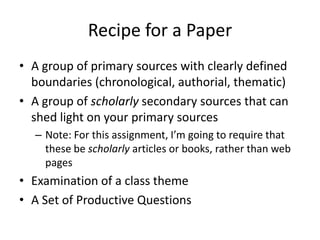
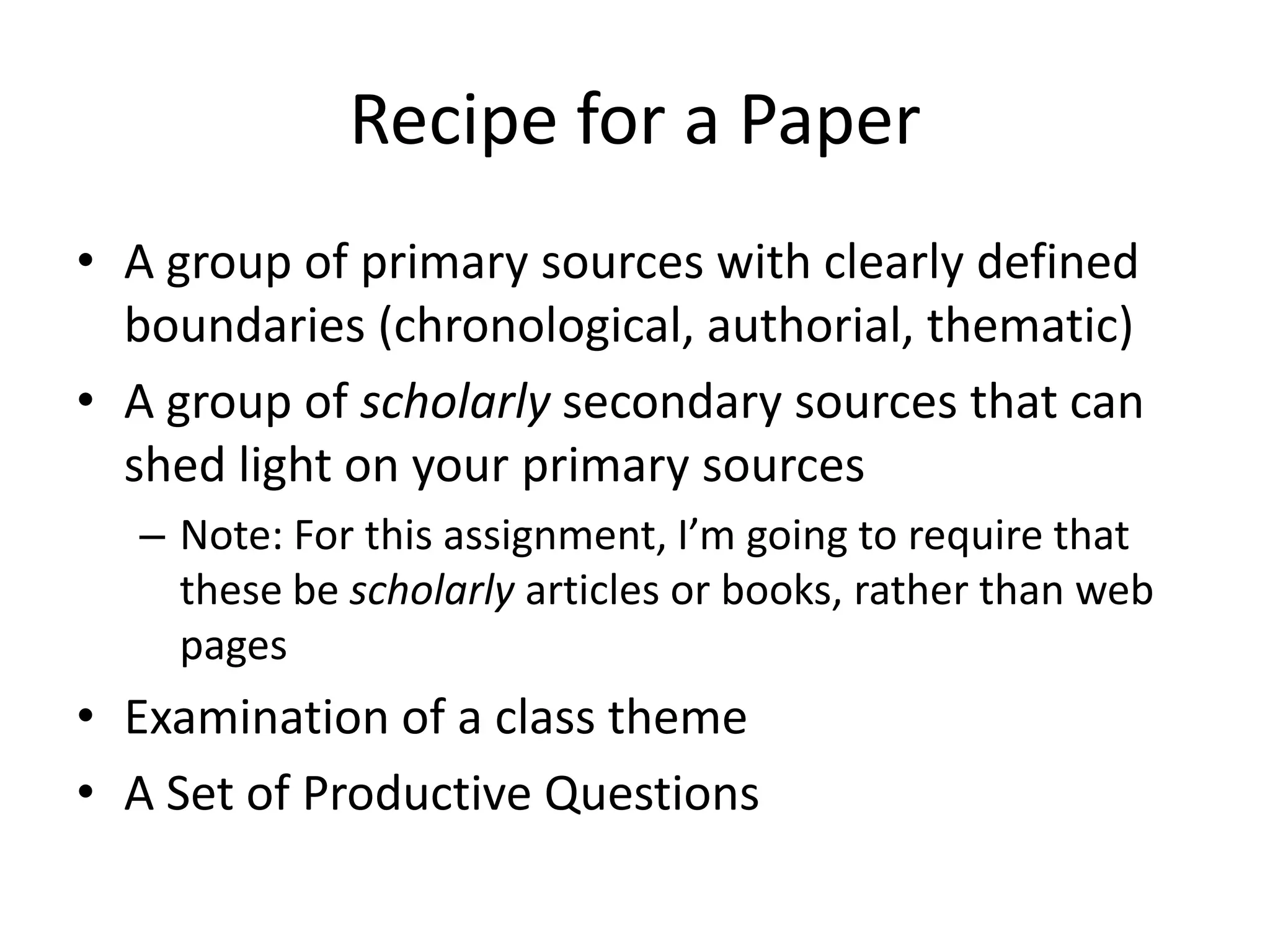
• A group of primary sources with clearly defined
  boundaries (chronological, authorial, thematic)
• A group of scholarly secondary sources that can
  shed light on your primary sources
  – Note: For this assignment, I’m going to require that
    these be scholarly articles or books, rather than web
    pages
• Examination of a class theme
• A Set of Productive Questions
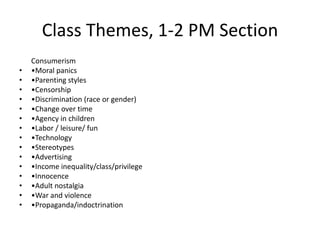
Class Themes, 1-2 PM Section
    Consumerism
•   •Moral panics
•   •Parenting styles
•   •Censorship
•   •Discrimination (race or gender)
•   •Change over time
•   •Agency in children
•   •Labor / leisure/ fun
•   •Technology
•   •Stereotypes
•   •Advertising
•   •Income inequality/class/privilege
•   •Innocence
•   •Adult nostalgia
•   •War and violence
•   •Propaganda/indoctrination
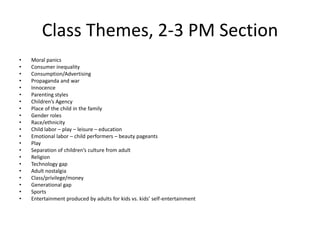
Class Themes, 2-3 PM Section
•   Moral panics
•   Consumer inequality
•   Consumption/Advertising
•   Propaganda and war
•   Innocence
•   Parenting styles
•   Children’s Agency
•   Place of the child in the family
•   Gender roles
•   Race/ethnicity
•   Child labor – play – leisure – education
•   Emotional labor – child performers – beauty pageants
•   Play
•   Separation of children’s culture from adult
•   Religion
•   Technology gap
•   Adult nostalgia
•   Class/privilege/money
•   Generational gap
•   Sports
•   Entertainment produced by adults for kids vs. kids’ self-entertainment
Initial Research Phase: The Wider Web
• Find out basic facts about your starting point: Who?
  What? When? Where?
• Is the source that is your starting point part of a bigger
  group of similar sources? Could any of these form a
  good basis for a comparative examination?
• Note sources of information (ex: books listed in
  Wikipedia “citations” section) that are more credible;
  keep track of these, and try to find them later in the
  library
• Use “snowball method”: as you find out more, use your
  new knowledge to fuel your search
Starting Points
•   Group 1: “Wall-E”
•   Group 2: Pokemon
•   Group 3: “The Cosby Show”
•   Group 4: Dr. James Dobson, Dare to Discipline
•   Group 5: Baby Einstein
•   Group 6: The Case of Trayvon Martin
Keeping a Research Log
• Web searches:
  – Bookmark pages
  – Keep lists of leads
  – PDF or print key articles, in case they disappear
• Library Databases:
  – Write down search terms you’ve exhausted
  – Copy and paste names and call numbers of books
    you might want
Discuss with Your Research Pod
• At this point in your research, how do you
  think you could turn the primary source you
  were given into an 8-pp paper, to be executed
  with a month’s lead time?
  – What boundaries would you impose?
  – What themes would you investigate?
  – What other primary sources would you use for the
    sake of comparison or contextualization?
Research Phase 2: Finding Context in
           Verified Places
• Secondary sources give you verified
  history, tell you what other people think about
  your primaries or your themes
• Look for secondaries that are directly about
  your primaries, but also ones that might give
  you historical context or address the themes
  you’re investigating
How to Search for Secondary Sources
• When looking for secondary sources, what
  search terms might you use?
  – What larger movements or phenomena relate to
    your primary sources?
  – What themes might you be addressing?
  – What bigger histories might you need to
    investigate in order to contextualize your
    primaries?
Why am I making you pick “scholarly”
       secondary sources?
• If you’re using them for informational
  purposes, you know the history in them is
  verified (peer-reviewed)
• If you’re using them for purposes of argument
  or theory, you know the argument is carefully
  considered and probably
  (though, admittedly, not always) interesting
Approaching UTNetCat
• Search for the obvious things: names of your
  primary sources, names of people or
  companies involved with their production
• Search by subject heading
  – If you’re unclear as to which subject headings
    might be appropriate, go to a source you’ve
    already identified, and click through its own
    subject headings
  – Cannibalize bibliographies of books you’ve already
    got
What’s “Scholarly”?
• If the book’s publication info contains the words
  “university press”
• If the book contains citations (footnotes or
  parentheticals) and a bibliography
• If you investigate the book’s author(s) and find
  that they’re professors of some kind (or other
  acceptable authorities)
• Gray areas: journalism, cultural criticism
  sometimes won’t have footnotes; you’ll have to
  make the call based on author’s credibility
Finding Books in the Library (Nerd
               Protocol)
• Keep a list of interesting call numbers
• Use the stack guide to identify their locations:
  http://www.lib.utexas.edu/about/librarymap/pcl.html
• Write down the locations of books next to their call
  numbers
• Consolidate books into sections using copy and paste
• Print your list
• Bring an extra tote bag
• Work the stacks top to bottom
• Look at the books around your target book to see if any
  of them might work too
Databases
• Go to library homepage->research tools->find
  articles using databases (or this link:
  http://www.lib.utexas.edu/indexes/index.php)
• Pick JStor or Project Muse for scholarly articles
• Use the same keywords you’ve seen work in your
  UTNetCat search
• Download articles in PDF form to avoid repeating
  your search
• Google Scholar may get you some of the same
  places, but will also flood you with information;
  buyer beware
Writing Opinion vs. Writing Argument: How to
           Phrase Your Research Questions
•   “Are beauty pageants oversexualizing    •   “How does the show ‘Toddlers and
    young girls?”                               Tiaras’ handle the depiction of its
•   “Are we too dependent on                    contestants in terms of innocence
    technology?”                                and sexuality?”
•   “Are first-person shooter video games   •   “How does ‘Wall-E’ try to warn kids
    too violent for kids to play?”              of the dangers of overdependence on
                                                technology? How are these warnings
                                                the same/different from those
                                                contained in anti-obesity campaigns?
                                                What kinds of assumptions do the
                                                producers of the movie/the
                                                campaigns make about the nature of
                                                contemporary childhood?”
                                            •   “In an analysis of web sites
                                                frequented by young users of FPS
                                                games, how will these users talk
                                                about the experience of virtual
                                                ‘killing’?”
Citations
• Use Chicago Style (here is a guide to putting
  together citations the old-fashioned
  way:http://www.chicagomanualofstyle.org/to
  ols_citationguide.html)
• Use NoodleBib
  (http://www.lib.utexas.edu/citations/noodlebi
  b.html) to get citations done automatically

Paper planning

  • 1.
    Recipe for aPaper • A group of primary sources with clearly defined boundaries (chronological, authorial, thematic) • A group of scholarly secondary sources that can shed light on your primary sources – Note: For this assignment, I’m going to require that these be scholarly articles or books, rather than web pages • Examination of a class theme • A Set of Productive Questions
  • 2.
    Class Themes, 1-2PM Section Consumerism • •Moral panics • •Parenting styles • •Censorship • •Discrimination (race or gender) • •Change over time • •Agency in children • •Labor / leisure/ fun • •Technology • •Stereotypes • •Advertising • •Income inequality/class/privilege • •Innocence • •Adult nostalgia • •War and violence • •Propaganda/indoctrination
  • 3.
    Class Themes, 2-3PM Section • Moral panics • Consumer inequality • Consumption/Advertising • Propaganda and war • Innocence • Parenting styles • Children’s Agency • Place of the child in the family • Gender roles • Race/ethnicity • Child labor – play – leisure – education • Emotional labor – child performers – beauty pageants • Play • Separation of children’s culture from adult • Religion • Technology gap • Adult nostalgia • Class/privilege/money • Generational gap • Sports • Entertainment produced by adults for kids vs. kids’ self-entertainment
  • 4.
    Initial Research Phase:The Wider Web • Find out basic facts about your starting point: Who? What? When? Where? • Is the source that is your starting point part of a bigger group of similar sources? Could any of these form a good basis for a comparative examination? • Note sources of information (ex: books listed in Wikipedia “citations” section) that are more credible; keep track of these, and try to find them later in the library • Use “snowball method”: as you find out more, use your new knowledge to fuel your search
  • 5.
    Starting Points • Group 1: “Wall-E” • Group 2: Pokemon • Group 3: “The Cosby Show” • Group 4: Dr. James Dobson, Dare to Discipline • Group 5: Baby Einstein • Group 6: The Case of Trayvon Martin
  • 6.
    Keeping a ResearchLog • Web searches: – Bookmark pages – Keep lists of leads – PDF or print key articles, in case they disappear • Library Databases: – Write down search terms you’ve exhausted – Copy and paste names and call numbers of books you might want
  • 7.
    Discuss with YourResearch Pod • At this point in your research, how do you think you could turn the primary source you were given into an 8-pp paper, to be executed with a month’s lead time? – What boundaries would you impose? – What themes would you investigate? – What other primary sources would you use for the sake of comparison or contextualization?
  • 8.
    Research Phase 2:Finding Context in Verified Places • Secondary sources give you verified history, tell you what other people think about your primaries or your themes • Look for secondaries that are directly about your primaries, but also ones that might give you historical context or address the themes you’re investigating
  • 9.
    How to Searchfor Secondary Sources • When looking for secondary sources, what search terms might you use? – What larger movements or phenomena relate to your primary sources? – What themes might you be addressing? – What bigger histories might you need to investigate in order to contextualize your primaries?
  • 10.
    Why am Imaking you pick “scholarly” secondary sources? • If you’re using them for informational purposes, you know the history in them is verified (peer-reviewed) • If you’re using them for purposes of argument or theory, you know the argument is carefully considered and probably (though, admittedly, not always) interesting
  • 11.
    Approaching UTNetCat • Searchfor the obvious things: names of your primary sources, names of people or companies involved with their production • Search by subject heading – If you’re unclear as to which subject headings might be appropriate, go to a source you’ve already identified, and click through its own subject headings – Cannibalize bibliographies of books you’ve already got
  • 12.
    What’s “Scholarly”? • Ifthe book’s publication info contains the words “university press” • If the book contains citations (footnotes or parentheticals) and a bibliography • If you investigate the book’s author(s) and find that they’re professors of some kind (or other acceptable authorities) • Gray areas: journalism, cultural criticism sometimes won’t have footnotes; you’ll have to make the call based on author’s credibility
  • 13.
    Finding Books inthe Library (Nerd Protocol) • Keep a list of interesting call numbers • Use the stack guide to identify their locations: http://www.lib.utexas.edu/about/librarymap/pcl.html • Write down the locations of books next to their call numbers • Consolidate books into sections using copy and paste • Print your list • Bring an extra tote bag • Work the stacks top to bottom • Look at the books around your target book to see if any of them might work too
  • 14.
    Databases • Go tolibrary homepage->research tools->find articles using databases (or this link: http://www.lib.utexas.edu/indexes/index.php) • Pick JStor or Project Muse for scholarly articles • Use the same keywords you’ve seen work in your UTNetCat search • Download articles in PDF form to avoid repeating your search • Google Scholar may get you some of the same places, but will also flood you with information; buyer beware
  • 15.
    Writing Opinion vs.Writing Argument: How to Phrase Your Research Questions • “Are beauty pageants oversexualizing • “How does the show ‘Toddlers and young girls?” Tiaras’ handle the depiction of its • “Are we too dependent on contestants in terms of innocence technology?” and sexuality?” • “Are first-person shooter video games • “How does ‘Wall-E’ try to warn kids too violent for kids to play?” of the dangers of overdependence on technology? How are these warnings the same/different from those contained in anti-obesity campaigns? What kinds of assumptions do the producers of the movie/the campaigns make about the nature of contemporary childhood?” • “In an analysis of web sites frequented by young users of FPS games, how will these users talk about the experience of virtual ‘killing’?”
  • 16.
    Citations • Use ChicagoStyle (here is a guide to putting together citations the old-fashioned way:http://www.chicagomanualofstyle.org/to ols_citationguide.html) • Use NoodleBib (http://www.lib.utexas.edu/citations/noodlebi b.html) to get citations done automatically