The Big
Fish
The Big Fish
This presentation is a short introduction to:
• Map, sort and prioritize the key opportunities
and obstacles facing a client or brand.
• Help to rapidly identify the primary role of
communication within a marketing problem.
• Systematically probe and brainstorm around
the primary opportunity or obstacle and
potential routes to a solution.
The Big Fish
Steps:
1. Determine business objective (e.g. increase sales
by 10% within the next 3 years).
2. Create up to 5 categories where threats or
barriers could exist.
Example categories:
• The competition
• A trend
• A technological breakthrough
• A consumer perception/mindset
• An internal client issue
The Big Fish
Steps continued:
3. Begin listing significant marketing obstacles or
threats to achieving the business objective within
each of the categories.
Tips:
• In particular, think about what you are
really competing against – not necessarily
competitor brands or products but rather
consumer beliefs, prejudices that underlie
their behavior, knowledge gaps in
consumer’s minds, unmade
connections/links/associations.
• Be as specific as you can.
• Be honest.
• Don’t edit (yet).
The Big Fish
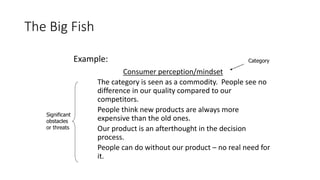
Example:
Consumer perception/mindset
 The category is seen as a commodity. People see no
difference in our quality compared to our
competitors.
 People think new products are always more
expensive than the old ones.
 Our product is an afterthought in the decision
process.
 People can do without our product – no real need for
it.
Category
Significant
obstacles
or threats
The Big Fish
Steps continued:
4. After exhausting all possible barriers in each
category, give each person a marker and allow
them to place five checkmarks next to the ideas
he or she finds to be most critical to success. (One
checkmark per idea.)
5. Tally the votes. Circle the barriers that received
the most votes. For example, you may decide to
circle all of the barriers that received four or more
votes.
6. Rewrite the list of barriers that you circled on a
separate sheet of paper and number them.
4. Note: It is not necessary to keep the barriers
5. classified by category.
The Big Fish
Steps continued:
7. Create a grid to plot the barriers. Label the axes “Addressability”
and “Importance.”
Addressability
The Big Fish
Steps continued:
8. Plot the numbered barriers on the grid.
 The more addressable (through communications)
the issue, the farther to the right.
 The more important the issue is to overcome, the
higher it is placed.
9. The barrier which is plotted the furthest to the top
right is the most important and most addressable
barrier to achieving the business goal.
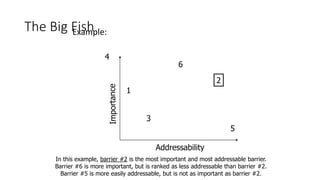
The Big FishExample:
Addressability
4
3
6
1
5
2
In this example, barrier #2 is the most important and most addressable barrier.
Barrier #6 is more important, but is ranked as less addressable than barrier #2.
Barrier #5 is more easily addressable, but is not as important as barrier #2.
The Big Fish
Steps continued:
10. After identifying the key barrier to
address, create a marketing
communications objective that will
address this barrier and therefore, help
best achieve the business objective.
Client example
where MARC used
this method.
• Xxxxxxxxx
• Xxxxxxxxxx
• Xxxxxxxxxx
• xxxxxxxxxx
A few other tools…..
SWOT/SLOT Analysis
Goal Mapping Matrix
EXERCISE
• Either as a whole group, or, several groups
depending on who your clients are, use the
“Addressibility and Importance” Graph to define
barriers and then define the marketing objective.
• At the same time, do SLOT Analysis.
• Choose one spokesperson to describe your work.
Creative Briefs
11/19/2018 14
11/19/2018 15
11/19/2018 16
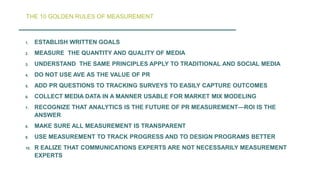
1. ESTABLISH WRITTEN GOALS
2. MEASURE THE QUANTITY AND QUALITY OF MEDIA
3. UNDERSTAND THE SAME PRINCIPLES APPLY TO TRADITIONAL AND SOCIAL MEDIA
4. DO NOT USE AVE AS THE VALUE OF PR
5. ADD PR QUESTIONS TO TRACKING SURVEYS TO EASILY CAPTURE OUTCOMES
6. COLLECT MEDIA DATA IN A MANNER USABLE FOR MARKET MIX MODELING
7. RECOGNIZE THAT ANALYTICS IS THE FUTURE OF PR MEASUREMENT—ROI IS THE
ANSWER
8. MAKE SURE ALL MEASUREMENT IS TRANSPARENT
9. USE MEASUREMENT TO TRACK PROGRESS AND TO DESIGN PROGRAMS BETTER
10. R EALIZE THAT COMMUNICATIONS EXPERTS ARE NOT NECESSARILY MEASUREMENT
EXPERTS
THE 10 GOLDEN RULES OF MEASUREMENT
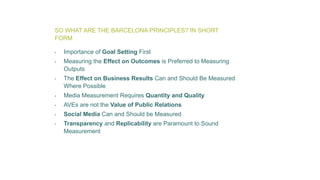
SO WHAT ARE THE BARCELONA PRINCIPLES? IN SHORT
FORM
• Importance of Goal Setting First
• Measuring the Effect on Outcomes is Preferred to Measuring
Outputs
• The Effect on Business Results Can and Should Be Measured
Where Possible
• Media Measurement Requires Quantity and Quality
• AVEs are not the Value of Public Relations
• Social Media Can and Should be Measured
• Transparency and Replicability are Paramount to Sound
Measurement
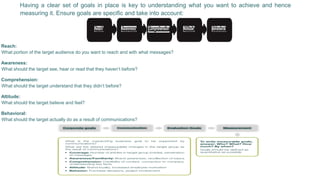
Having a clear set of goals in place is key to understanding what you want to achieve and hence
measuring it. Ensure goals are specific and take into account:
Reach:
What portion of the target audience do you want to reach and with what messages?
Awareness:
What should the target see, hear or read that they haven’t before?
Comprehension:
What should the target understand that they didn’t before?
Attitude:
What should the target believe and feel?
Behavioral:
What should the target actually do as a result of communications?
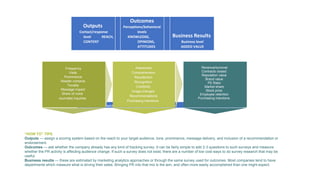
Outputs
Contact/response
level REACH,
CONTENT
Outcomes
Perceptions/behavioral
levels
KNOWLEDGE,
OPINIONS,
ATTITUDES
Business Results
Business level
ADDED VALUE
Impact on media/channels Impact on target groups Impact on organizations
Frequency
Visits
Prominence
Reader contacts
Tonality
Message impact
Share of voice
Journalist inquiries
Awareness
Comprehension
Recollection
Recognition
Credibility
Image changes
Recommendations
Purchasing intentions
Revenue/turnover
Contracts closed
Reputation value
Brand value
PE Ratio
Market share
Stock price
Employee retention
Purchasing intentions
“HOW TO” TIPS
Outputs — assign a scoring system based on the reach to your target audience, tone, prominence, message delivery, and inclusion of a recommendation or
endorsement.
Outcomes — ask whether the company already has any kind of tracking survey. It can be fairly simple to add 2-3 questions to such surveys and measure
whether the PR activity is affecting audience change. If such a survey does not exist, there are a number of low cost ways to do survey research that may be
useful.
Business results — these are estimated by marketing analytics approaches or through the same survey used for outcomes. Most companies tend to have
departments which measure what is driving their sales. Bringing PR into that mix is the aim, and often more easily accomplished than one might expect.
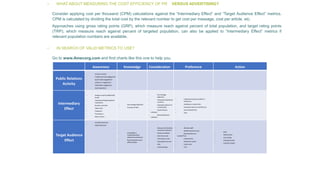
Awareness Knowledge Consideration Preference Action
Public Relations
Activity
 Content creation
 Traditional media engagement
 Social media engagement
 Influencer engagement
 Stakeholder engagement
 Events/speeches
Intermediary
Effect
 Audience reach (traditional &
social)
 Impressions/Targetaudience
impressions
 Number of articles
 Video news
 Frequence
 Prominence
 Share of voice
 Key message alignment
 Accuracy of facts
 Key message
alignment
 Frequency of (positive)
mentions
 Expressed opinions of
consideration
 Social network
Followers
 Retweets/Shares/
Linkbacks
 Endorsements by journalists or
influencers
 Rankings on industry lists
 Expressed opinions of preference
 Social network fans
 Likes
Target Audience
Effect
 Unaided awareness
 Aided awareness
 Knowledge of
company/product
attributes and features
 Brand association and
differentiation
 Relevance of brand (to
consumer/customer)
 Visitors to website
 Click-thruto site
 Time spent on site
 Downloads from site
 Calls
 Event/meeting
 Attitude uplift
 Stated intentionto buy
 Brand preference/
Loyalty/Trust
 Endorsement
 Request for quote
 Links to site
 Trial
 Sales
 Market share
 Cost savings
 Leads generated
 Customer loyalty
• WHAT ABOUT MEASURING THE COST EFFICIENCY OF PR VERSUS ADVERTISING?
Consider applying cost per thousand (CPM) calculations against the “Intermediary Effect” and “Target Audience Effect” metrics.
CPM is calculated by dividing the total cost by the relevant number to get cost per message, cost per article, etc.
Approaches using gross rating points (GRP), which measure reach against percent of total population, and target rating points
(TRP), which measure reach against percent of targeted population, can also be applied to “Intermediary Effect” metrics if
relevant population numbers are available.
• IN SEARCH OF VALID METRICS TO USE?
Go to www.Amecorg.com and find charts like this one to help you.
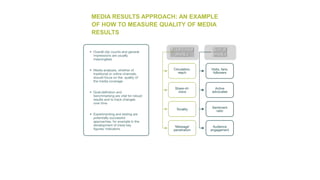
MEDIA RESULTS APPROACH: AN EXAMPLE
OF HOW TO MEASURE QUALITY OF MEDIA
RESULTS

Panther pr marc 11.10.18

  • 1.
  • 2.
    The Big Fish Thispresentation is a short introduction to: • Map, sort and prioritize the key opportunities and obstacles facing a client or brand. • Help to rapidly identify the primary role of communication within a marketing problem. • Systematically probe and brainstorm around the primary opportunity or obstacle and potential routes to a solution.
  • 3.
    The Big Fish Steps: 1.Determine business objective (e.g. increase sales by 10% within the next 3 years). 2. Create up to 5 categories where threats or barriers could exist. Example categories: • The competition • A trend • A technological breakthrough • A consumer perception/mindset • An internal client issue
  • 4.
    The Big Fish Stepscontinued: 3. Begin listing significant marketing obstacles or threats to achieving the business objective within each of the categories. Tips: • In particular, think about what you are really competing against – not necessarily competitor brands or products but rather consumer beliefs, prejudices that underlie their behavior, knowledge gaps in consumer’s minds, unmade connections/links/associations. • Be as specific as you can. • Be honest. • Don’t edit (yet).
  • 5.
    The Big Fish Example: Consumerperception/mindset  The category is seen as a commodity. People see no difference in our quality compared to our competitors.  People think new products are always more expensive than the old ones.  Our product is an afterthought in the decision process.  People can do without our product – no real need for it. Category Significant obstacles or threats
  • 6.
    The Big Fish Stepscontinued: 4. After exhausting all possible barriers in each category, give each person a marker and allow them to place five checkmarks next to the ideas he or she finds to be most critical to success. (One checkmark per idea.) 5. Tally the votes. Circle the barriers that received the most votes. For example, you may decide to circle all of the barriers that received four or more votes. 6. Rewrite the list of barriers that you circled on a separate sheet of paper and number them. 4. Note: It is not necessary to keep the barriers 5. classified by category.
  • 7.
    The Big Fish Stepscontinued: 7. Create a grid to plot the barriers. Label the axes “Addressability” and “Importance.” Addressability
  • 8.
    The Big Fish Stepscontinued: 8. Plot the numbered barriers on the grid.  The more addressable (through communications) the issue, the farther to the right.  The more important the issue is to overcome, the higher it is placed. 9. The barrier which is plotted the furthest to the top right is the most important and most addressable barrier to achieving the business goal.
  • 9.
    The Big FishExample: Addressability 4 3 6 1 5 2 Inthis example, barrier #2 is the most important and most addressable barrier. Barrier #6 is more important, but is ranked as less addressable than barrier #2. Barrier #5 is more easily addressable, but is not as important as barrier #2.
  • 10.
    The Big Fish Stepscontinued: 10. After identifying the key barrier to address, create a marketing communications objective that will address this barrier and therefore, help best achieve the business objective.
  • 11.
    Client example where MARCused this method. • Xxxxxxxxx • Xxxxxxxxxx • Xxxxxxxxxx • xxxxxxxxxx
  • 12.
    A few othertools….. SWOT/SLOT Analysis Goal Mapping Matrix
  • 13.
    EXERCISE • Either asa whole group, or, several groups depending on who your clients are, use the “Addressibility and Importance” Graph to define barriers and then define the marketing objective. • At the same time, do SLOT Analysis. • Choose one spokesperson to describe your work.
  • 14.
  • 15.
  • 16.
  • 17.
    1. ESTABLISH WRITTENGOALS 2. MEASURE THE QUANTITY AND QUALITY OF MEDIA 3. UNDERSTAND THE SAME PRINCIPLES APPLY TO TRADITIONAL AND SOCIAL MEDIA 4. DO NOT USE AVE AS THE VALUE OF PR 5. ADD PR QUESTIONS TO TRACKING SURVEYS TO EASILY CAPTURE OUTCOMES 6. COLLECT MEDIA DATA IN A MANNER USABLE FOR MARKET MIX MODELING 7. RECOGNIZE THAT ANALYTICS IS THE FUTURE OF PR MEASUREMENT—ROI IS THE ANSWER 8. MAKE SURE ALL MEASUREMENT IS TRANSPARENT 9. USE MEASUREMENT TO TRACK PROGRESS AND TO DESIGN PROGRAMS BETTER 10. R EALIZE THAT COMMUNICATIONS EXPERTS ARE NOT NECESSARILY MEASUREMENT EXPERTS THE 10 GOLDEN RULES OF MEASUREMENT
  • 18.
    SO WHAT ARETHE BARCELONA PRINCIPLES? IN SHORT FORM • Importance of Goal Setting First • Measuring the Effect on Outcomes is Preferred to Measuring Outputs • The Effect on Business Results Can and Should Be Measured Where Possible • Media Measurement Requires Quantity and Quality • AVEs are not the Value of Public Relations • Social Media Can and Should be Measured • Transparency and Replicability are Paramount to Sound Measurement
  • 19.
    Having a clearset of goals in place is key to understanding what you want to achieve and hence measuring it. Ensure goals are specific and take into account: Reach: What portion of the target audience do you want to reach and with what messages? Awareness: What should the target see, hear or read that they haven’t before? Comprehension: What should the target understand that they didn’t before? Attitude: What should the target believe and feel? Behavioral: What should the target actually do as a result of communications?
  • 20.
    Outputs Contact/response level REACH, CONTENT Outcomes Perceptions/behavioral levels KNOWLEDGE, OPINIONS, ATTITUDES Business Results Businesslevel ADDED VALUE Impact on media/channels Impact on target groups Impact on organizations Frequency Visits Prominence Reader contacts Tonality Message impact Share of voice Journalist inquiries Awareness Comprehension Recollection Recognition Credibility Image changes Recommendations Purchasing intentions Revenue/turnover Contracts closed Reputation value Brand value PE Ratio Market share Stock price Employee retention Purchasing intentions “HOW TO” TIPS Outputs — assign a scoring system based on the reach to your target audience, tone, prominence, message delivery, and inclusion of a recommendation or endorsement. Outcomes — ask whether the company already has any kind of tracking survey. It can be fairly simple to add 2-3 questions to such surveys and measure whether the PR activity is affecting audience change. If such a survey does not exist, there are a number of low cost ways to do survey research that may be useful. Business results — these are estimated by marketing analytics approaches or through the same survey used for outcomes. Most companies tend to have departments which measure what is driving their sales. Bringing PR into that mix is the aim, and often more easily accomplished than one might expect.
  • 21.
    Awareness Knowledge ConsiderationPreference Action Public Relations Activity  Content creation  Traditional media engagement  Social media engagement  Influencer engagement  Stakeholder engagement  Events/speeches Intermediary Effect  Audience reach (traditional & social)  Impressions/Targetaudience impressions  Number of articles  Video news  Frequence  Prominence  Share of voice  Key message alignment  Accuracy of facts  Key message alignment  Frequency of (positive) mentions  Expressed opinions of consideration  Social network Followers  Retweets/Shares/ Linkbacks  Endorsements by journalists or influencers  Rankings on industry lists  Expressed opinions of preference  Social network fans  Likes Target Audience Effect  Unaided awareness  Aided awareness  Knowledge of company/product attributes and features  Brand association and differentiation  Relevance of brand (to consumer/customer)  Visitors to website  Click-thruto site  Time spent on site  Downloads from site  Calls  Event/meeting  Attitude uplift  Stated intentionto buy  Brand preference/ Loyalty/Trust  Endorsement  Request for quote  Links to site  Trial  Sales  Market share  Cost savings  Leads generated  Customer loyalty • WHAT ABOUT MEASURING THE COST EFFICIENCY OF PR VERSUS ADVERTISING? Consider applying cost per thousand (CPM) calculations against the “Intermediary Effect” and “Target Audience Effect” metrics. CPM is calculated by dividing the total cost by the relevant number to get cost per message, cost per article, etc. Approaches using gross rating points (GRP), which measure reach against percent of total population, and target rating points (TRP), which measure reach against percent of targeted population, can also be applied to “Intermediary Effect” metrics if relevant population numbers are available. • IN SEARCH OF VALID METRICS TO USE? Go to www.Amecorg.com and find charts like this one to help you.
  • 22.
    MEDIA RESULTS APPROACH:AN EXAMPLE OF HOW TO MEASURE QUALITY OF MEDIA RESULTS

Editor's Notes

  • #2 PAULA INTRO
  • #3 PAULA INTRO
  • #4 MARC/PAULA
  • #5 MARC/PAULA
  • #6 MARC/PAULA
  • #7 MARC /PAULA
  • #8 MARC/PAULA
  • #9 MARC/PAULA
  • #10 MARC /PAULA
  • #11 MARC to talk about everything.
  • #12 MARC
  • #13 PAULA This is another way of looking at what preceded. Do a SLOT analysis, which is normally called a SWOT Analysis. This one begins by noting two internal issues, then we can look at two external issues. For example, an opportunity might be that a new product is being introduced. A threat might be that two competitors have a very similar product. This is another very simple chart to help you get to your goals. List a business goal on the left, and an appropriate, matching PR goal on the right. An example would be that you need to increase sales by 10%. A comparable PR goal would be to raise awareness of the product or service. Another business goal might be improved thought leadership vs a competitor. The comparable PR goal would be heightened conversion for your brand v. competitor. Another business goal could be to lower cost of customer acquisition. The PR goal would be increased engagement with customer service social channels. Getting more likes is not a goal unless you can show how support business objectives. Then fill out strategy, tactics and metrics. Talk a little bit about strategies and matrix map.
  • #14 PAULA
  • #15 PAULA – instruct to look at creative brief
  • #16 PAULA
  • #17 PAULA
  • #18 MARC/PAULA
  • #19 MARC/PAULA
  • #20 MARC/PAULA
  • #21 MARC, then Paula PAULA add points. Outputs: Actions taken to get things done. What actually is put out there. News release, blog post, tweets, FB, whitepaper. Outtakes: What the audience “takes away.” Messages. Understanding. Awareness, comments, clicks, downloads, retweets, shares. Outcome: Tangible behaviors and actions. Time on website. Attend, call, vote. Change behavior. Cost savings. More qualified leads. Sales. Donations. MARC add points.
  • #22 MARC explain.
  • #23 MARC/PAULA