Managing Transfer Pricing Risks
Panel Discussion
Date: October 17, 2015
1
Panel Details
• Ms. Marlies de Ruiter (Head of Tax Treaty & Transfer Pricing Division,
OECD)
• Mr. Kamlesh Varshney ( APA Commissioner, India )
• Mr. Deepak Dhanak (Head of Tax, Star TV India)
• Mr. Nageshwar Rao (Advocate, PDS Legal)
• Mr. Vijay Iyer (Moderator)
2
BEPS final reports
announcements
By Ms. Marlies de Ruiter (OECD)
3
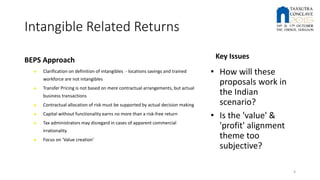
Intangible Related Returns
BEPS Approach
► Clarification on definition of intangibles - locations savings and trained
workforce are not intangibles
► Transfer Pricing is not based on mere contractual arrangements, but actual
business transactions
► Contractual allocation of risk must be supported by actual decision making
► Capital without functionality earns no more than a risk-free return
► Tax administrators may disregard in cases of apparent commercial
irrationality
► Focus on ‘Value creation’
Key Issues
• How will these
proposals work in
the Indian
scenario?
• Is the 'value' &
'profit' alignment
theme too
subjective?
4
Returns for Risk
BEPS Approach
► Risks follow Risk Assuming Functions
► Assuming Risk includes Risk Management and Risk of
Financial Loss
► Risk Management implies taking critical decisions for risk
mitigation
► Attribution of Returns for Assuming Financial Risks
► Relevant for determining returns of a risk insulated service
provider
► Departure from India’s view stated in the UN TP Manual ?
Key Issues
• How will these
proposals work in
the Indian
scenario?
5
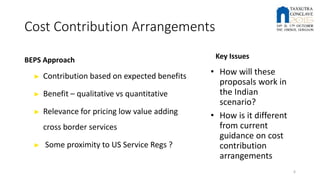
Cost Contribution Arrangements
BEPS Approach
► Contribution based on expected benefits
► Benefit – qualitative vs quantitative
► Relevance for pricing low value adding
cross border services
► Some proximity to US Service Regs ?
Key Issues
• How will these
proposals work in
the Indian
scenario?
• How is it different
from current
guidance on cost
contribution
arrangements
6
CbC documentation
BEPS Action Plan 13
► € 750 million revenue threshold
► CbC reporting subject to local enabling
enactment
► Master file and local file
► Sharing through automatic exchange of
information
► CbC Report to be used for assessing high-level
TP risk
Key Issues
• Compliance burden for industry ?
• What if a country does not legislate ?
• How will Revenue ensure
‘confidentiality’ and carry out a ‘risk
assessment’ for TP audit?
7
CbC – How Countries have reacted
8
Sr
No
Country
Name
Threshold limit Effective date / expected effective
date
1 Australia MNEs with global revenue of $1 billion or more Income years commencing on or
after January 1, 2016
2 Spain MNE’s with net revenues equal to or exceeding 750 million Euros Fiscal years beginning on or after
January 1, 2016
3 Poland MNE’s with
consolidated income exceeding EUR 750 million
Not specified
4 Germany MNE’s with
consolidated income exceeding EUR 750 million
Not specified
5 UK Not specified Financial years beginning on or
after January 1, 2016
6 Korea Details expected to be released by Korean authorities in the near future January 1, 2016
7 USA Not specified (Only intention to implement announced) Not specified
8 Netherlands MNE’s with consolidated income exceeding EUR 750 million, & Dutch
tax resident entities of MNE group with consolidated group turnover
exceeding EUR 50 million
Fiscal years beginning on or after
January 1, 2016
9 Mexico MNE’s with consolidated income equal to or exceeding approximately $
720 million (This threshold is subject to revision)
Terms yet to be established
Indian APA Update
By Mr. Kamlesh Varshney ( APA Commissioner, India )
9
APA Statistics
APA India Statistics
Total of 20 APAs signed till date (19 unilateral and 1
bilateral)
CBDT signed the first batch of 5 Unilateral APAs on
31st March 2014. These agreements were signed
within one year as against the international norm of
two years.
India signed its first bilateral APA with Japan on 19th
December 2014.
The first APA with a “Rollback” provision was signed
on 3rd August, 2015.
(Source: CBDT Press Release dated 6th August, 2015)
Country Time Taken for bilateral
APAs
Germany * 38 months
Spain * Not available
France * 25 months
Netherlands * 24 months
Austria * 59 months
Poland * 33.5 months
Sweden * 40 months
UK * 31 months
USA 40 months
Canada 47.8 months
10
* 2013 Statistics with non-EU countries
Indian TP Controversy Landscape
11
Marketing Intangibles – Sony Mobile Delhi HC
• AMP is a transaction
• Brightline is not a method
• For Distributors - Aggregation of AMP transaction with distribution
transaction
• Segregation if possible, by TPO
• Even if Segregation, set off of excess TNMM profits against AMP
adjustment
• Use if good quality comparables with similar AMP function (mis-read by
ITAT ??)
• TNMM option may not work for manufacturers – as per the High Court
12
Management Fees
• ITAT’s views on Management Fees
• How to get finality ?
• Some experiences
• Use of brightline for Management Fees
• Use of local comparables for inbound services
13
92B(2)
• Impact of recent amendment in Indian TP law on "Deemed
International transactions"
• Has the net been cast too wide ?
• Are the consequences of the amendment too onerous?
• How does Indian law provisions fare against international practices?
14
Thank You
15

Panel 10 : Managing Transfer Pricing Risks

  • 1.
    Managing Transfer PricingRisks Panel Discussion Date: October 17, 2015 1
  • 2.
    Panel Details • Ms.Marlies de Ruiter (Head of Tax Treaty & Transfer Pricing Division, OECD) • Mr. Kamlesh Varshney ( APA Commissioner, India ) • Mr. Deepak Dhanak (Head of Tax, Star TV India) • Mr. Nageshwar Rao (Advocate, PDS Legal) • Mr. Vijay Iyer (Moderator) 2
  • 3.
    BEPS final reports announcements ByMs. Marlies de Ruiter (OECD) 3
  • 4.
    Intangible Related Returns BEPSApproach ► Clarification on definition of intangibles - locations savings and trained workforce are not intangibles ► Transfer Pricing is not based on mere contractual arrangements, but actual business transactions ► Contractual allocation of risk must be supported by actual decision making ► Capital without functionality earns no more than a risk-free return ► Tax administrators may disregard in cases of apparent commercial irrationality ► Focus on ‘Value creation’ Key Issues • How will these proposals work in the Indian scenario? • Is the 'value' & 'profit' alignment theme too subjective? 4
  • 5.
    Returns for Risk BEPSApproach ► Risks follow Risk Assuming Functions ► Assuming Risk includes Risk Management and Risk of Financial Loss ► Risk Management implies taking critical decisions for risk mitigation ► Attribution of Returns for Assuming Financial Risks ► Relevant for determining returns of a risk insulated service provider ► Departure from India’s view stated in the UN TP Manual ? Key Issues • How will these proposals work in the Indian scenario? 5
  • 6.
    Cost Contribution Arrangements BEPSApproach ► Contribution based on expected benefits ► Benefit – qualitative vs quantitative ► Relevance for pricing low value adding cross border services ► Some proximity to US Service Regs ? Key Issues • How will these proposals work in the Indian scenario? • How is it different from current guidance on cost contribution arrangements 6
  • 7.
    CbC documentation BEPS ActionPlan 13 ► € 750 million revenue threshold ► CbC reporting subject to local enabling enactment ► Master file and local file ► Sharing through automatic exchange of information ► CbC Report to be used for assessing high-level TP risk Key Issues • Compliance burden for industry ? • What if a country does not legislate ? • How will Revenue ensure ‘confidentiality’ and carry out a ‘risk assessment’ for TP audit? 7
  • 8.
    CbC – HowCountries have reacted 8 Sr No Country Name Threshold limit Effective date / expected effective date 1 Australia MNEs with global revenue of $1 billion or more Income years commencing on or after January 1, 2016 2 Spain MNE’s with net revenues equal to or exceeding 750 million Euros Fiscal years beginning on or after January 1, 2016 3 Poland MNE’s with consolidated income exceeding EUR 750 million Not specified 4 Germany MNE’s with consolidated income exceeding EUR 750 million Not specified 5 UK Not specified Financial years beginning on or after January 1, 2016 6 Korea Details expected to be released by Korean authorities in the near future January 1, 2016 7 USA Not specified (Only intention to implement announced) Not specified 8 Netherlands MNE’s with consolidated income exceeding EUR 750 million, & Dutch tax resident entities of MNE group with consolidated group turnover exceeding EUR 50 million Fiscal years beginning on or after January 1, 2016 9 Mexico MNE’s with consolidated income equal to or exceeding approximately $ 720 million (This threshold is subject to revision) Terms yet to be established
  • 9.
    Indian APA Update ByMr. Kamlesh Varshney ( APA Commissioner, India ) 9
  • 10.
    APA Statistics APA IndiaStatistics Total of 20 APAs signed till date (19 unilateral and 1 bilateral) CBDT signed the first batch of 5 Unilateral APAs on 31st March 2014. These agreements were signed within one year as against the international norm of two years. India signed its first bilateral APA with Japan on 19th December 2014. The first APA with a “Rollback” provision was signed on 3rd August, 2015. (Source: CBDT Press Release dated 6th August, 2015) Country Time Taken for bilateral APAs Germany * 38 months Spain * Not available France * 25 months Netherlands * 24 months Austria * 59 months Poland * 33.5 months Sweden * 40 months UK * 31 months USA 40 months Canada 47.8 months 10 * 2013 Statistics with non-EU countries
  • 11.
  • 12.
    Marketing Intangibles –Sony Mobile Delhi HC • AMP is a transaction • Brightline is not a method • For Distributors - Aggregation of AMP transaction with distribution transaction • Segregation if possible, by TPO • Even if Segregation, set off of excess TNMM profits against AMP adjustment • Use if good quality comparables with similar AMP function (mis-read by ITAT ??) • TNMM option may not work for manufacturers – as per the High Court 12
  • 13.
    Management Fees • ITAT’sviews on Management Fees • How to get finality ? • Some experiences • Use of brightline for Management Fees • Use of local comparables for inbound services 13
  • 14.
    92B(2) • Impact ofrecent amendment in Indian TP law on "Deemed International transactions" • Has the net been cast too wide ? • Are the consequences of the amendment too onerous? • How does Indian law provisions fare against international practices? 14
  • 15.