PAINLESS JAVASCRIPT UNIT TESTING
The Presenters
@traviskaufman @benmidi
Setup
Introduction Structure Patterns Resources
Setup
Introduction Structure Patterns Resources
Setup
Introduction Patterns ResourcesStructure
Setup
Introduction Structure Patterns Resources
Introduction
Team Bicycle
● A Director of Product and Two developers
● Behavior Driven Development and Pairing
● Launched the new mobile web experience in 5 months
● 1000 Unit Tests and 200 Acceptance Tests
Introduction
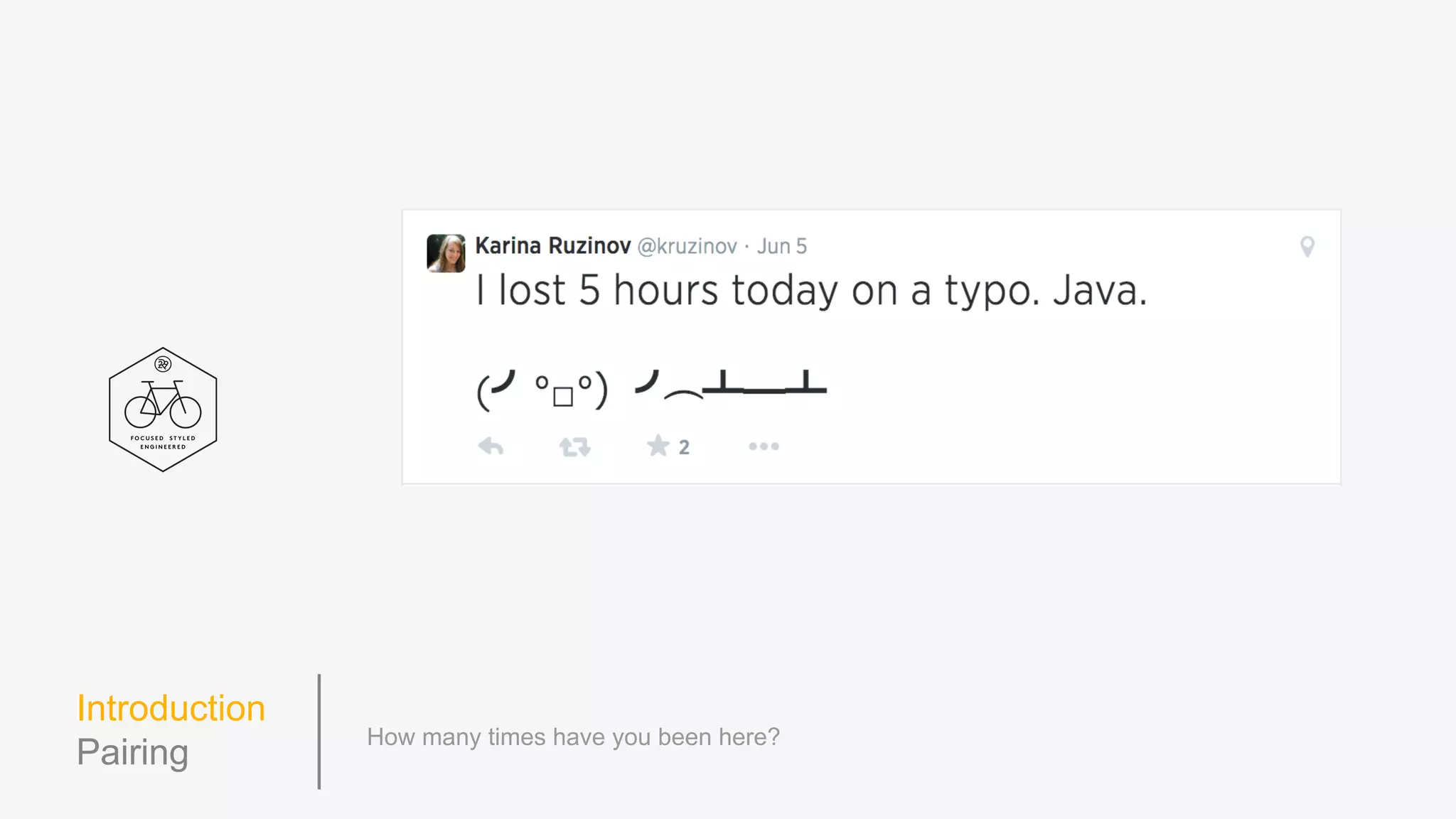
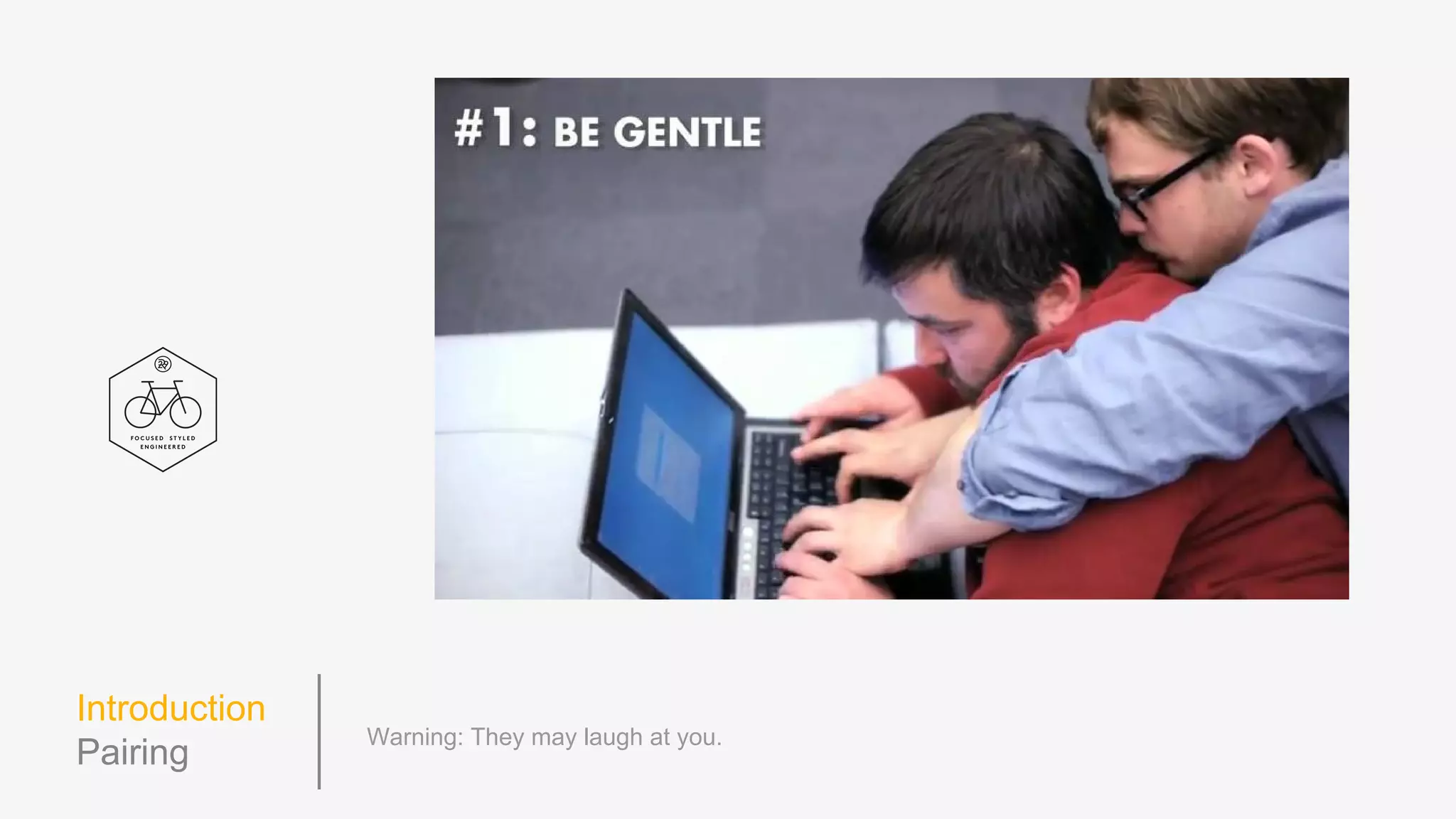
Pairing
How many times have you been here?
Introduction
Pairing
Warning: They may laugh at you.
Introduction
Team Bicycle
● A Director of Product and Two developers
● Behavior Driven Development and Pairing
● Launched the new mobile web experience in 5 months
● 1000 Unit Tests and 200 Acceptance Tests
A team built for speed.
Introduction
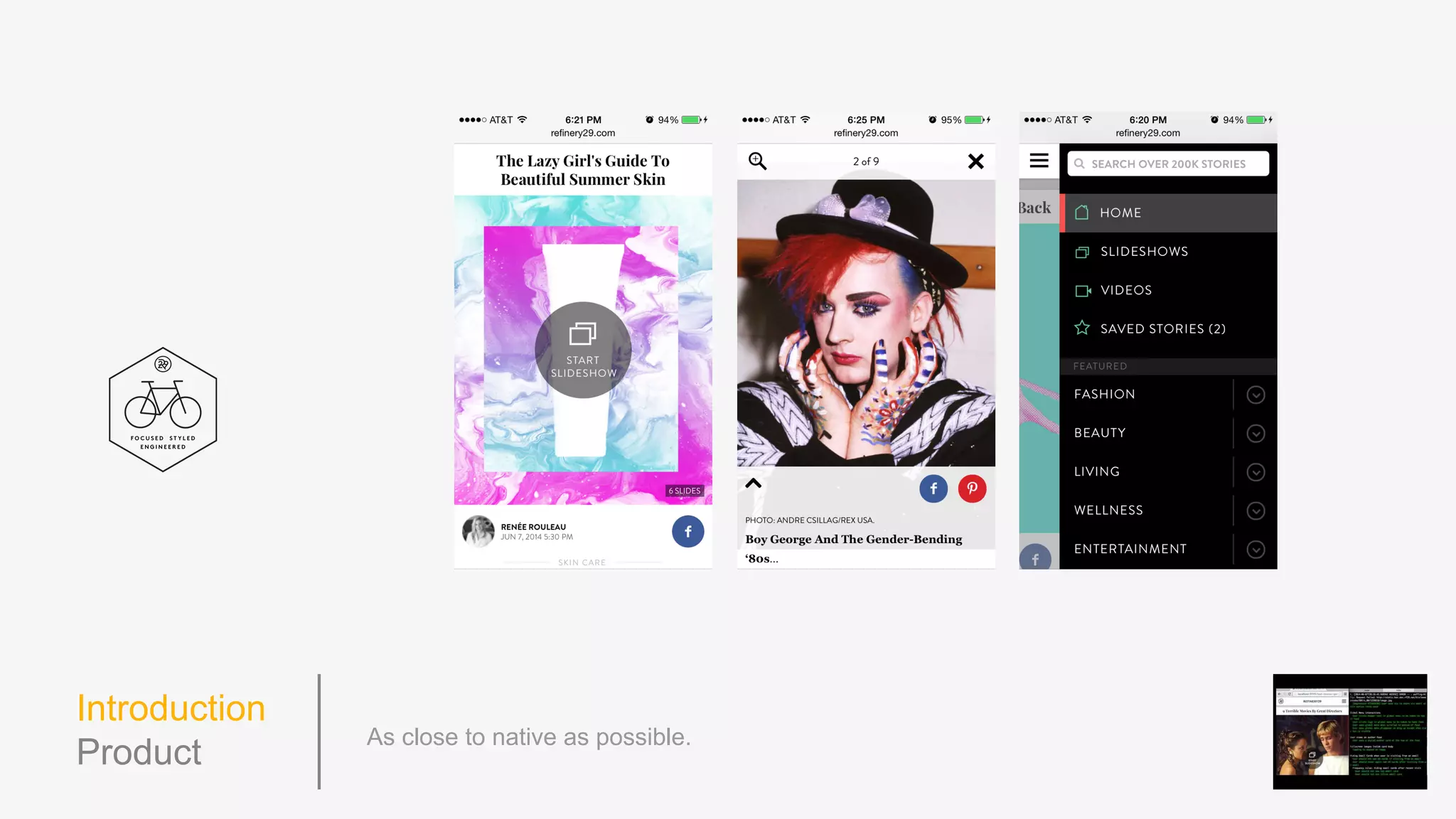
Product
As close to native as possible. http://www.refinery29.com
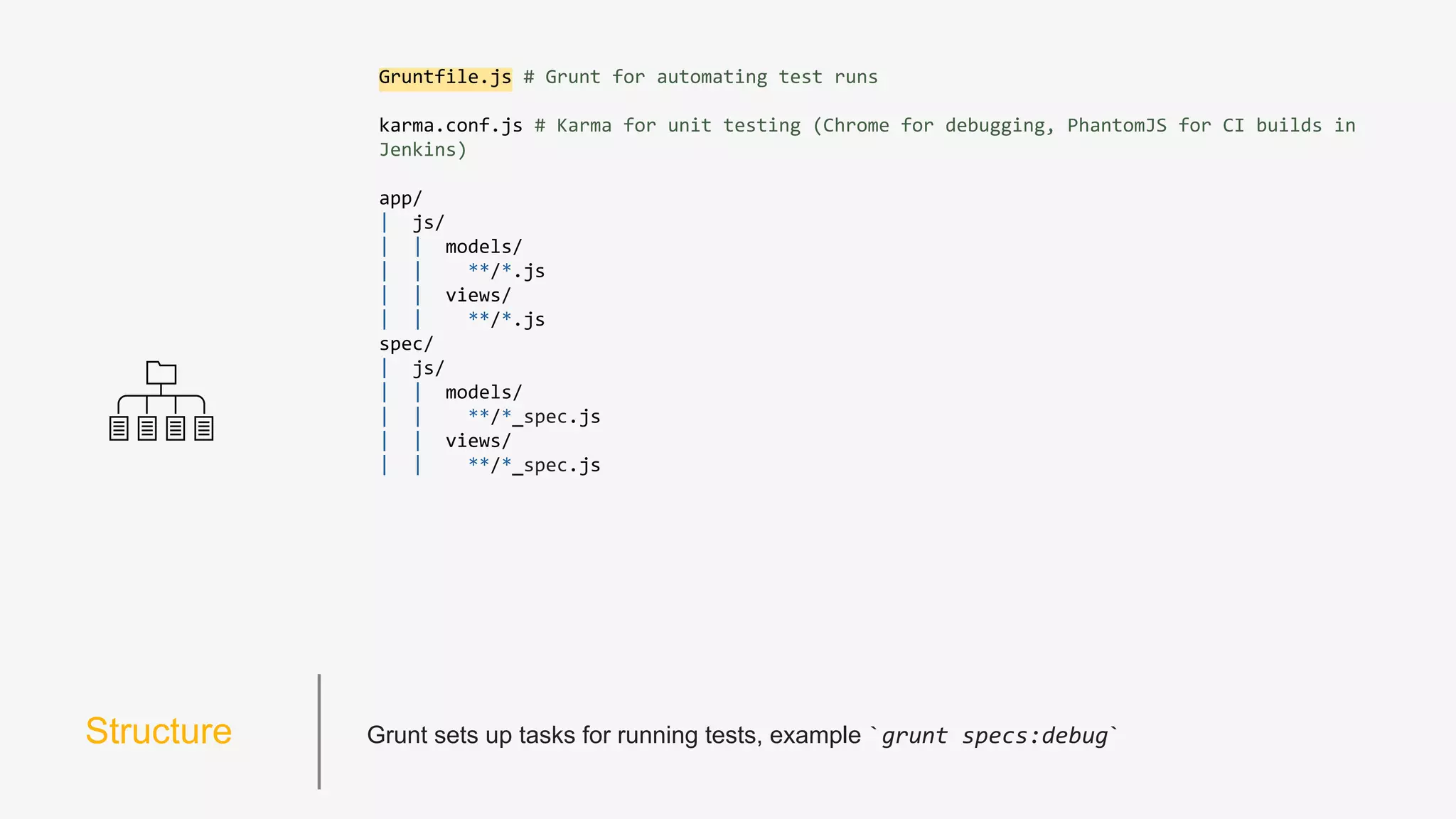
Structure Grunt sets up tasks for running tests, example: grunt specs:debug
Gruntfile.js # Grunt for automating test runs
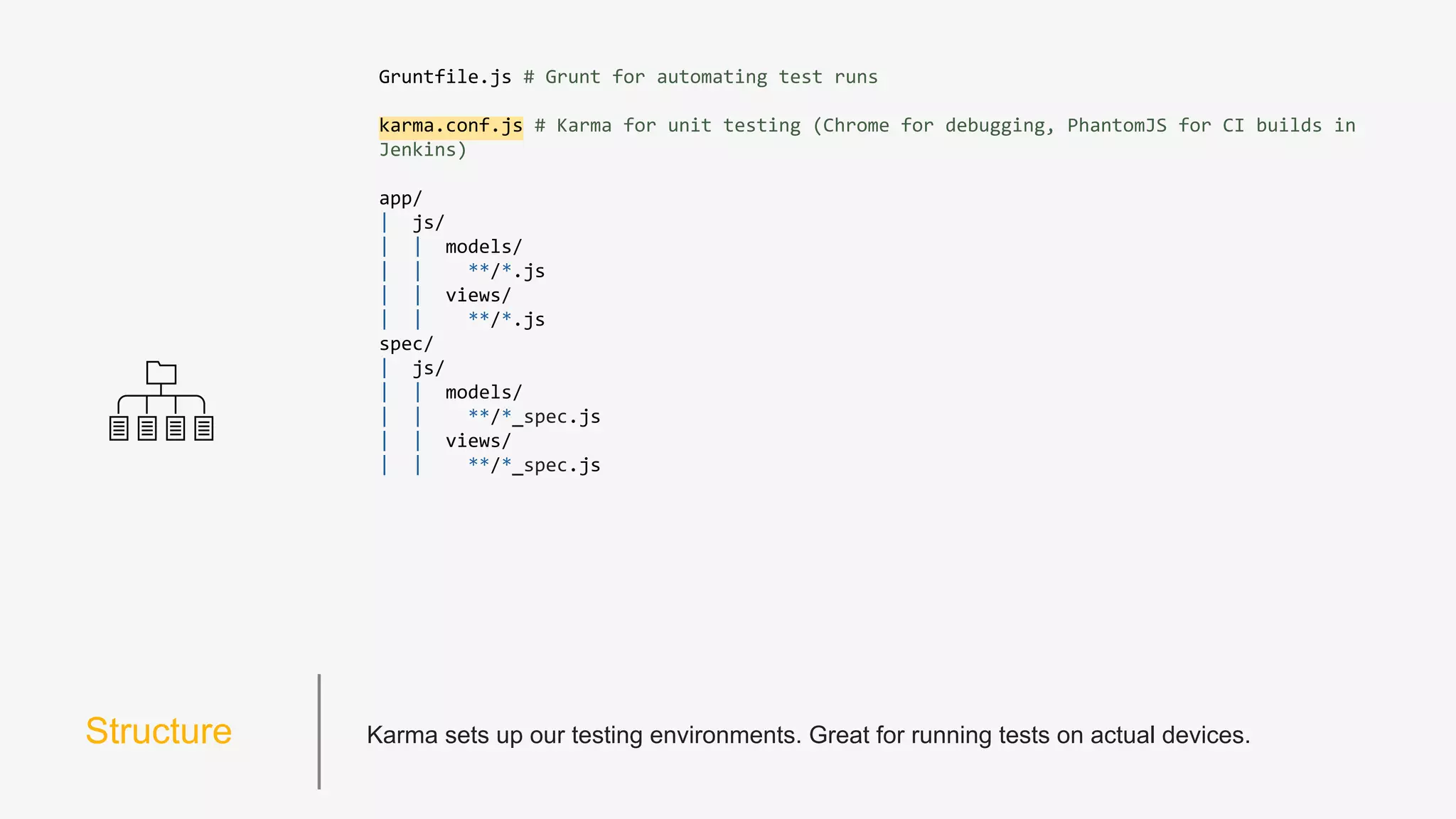
karma.conf.js # Karma for unit testing (Chrome for debugging, PhantomJS for CI builds in
Jenkins)
app/
| js/
| | models/
| | **/*.js
| | views/
| | **/*.js
spec/
| js/
| | models/
| | **/*_spec.js
| | views/
| | **/*_spec.js
Structure Karma sets up our testing environments. Great for running tests on actual devices.
Gruntfile.js # Grunt for automating test runs
karma.conf.js # Karma for unit testing (Chrome for debugging, PhantomJS for CI builds in
Jenkins)
app/
| js/
| | models/
| | **/*.js
| | views/
| | **/*.js
spec/
| js/
| | models/
| | **/*_spec.js
| | views/
| | **/*_spec.js
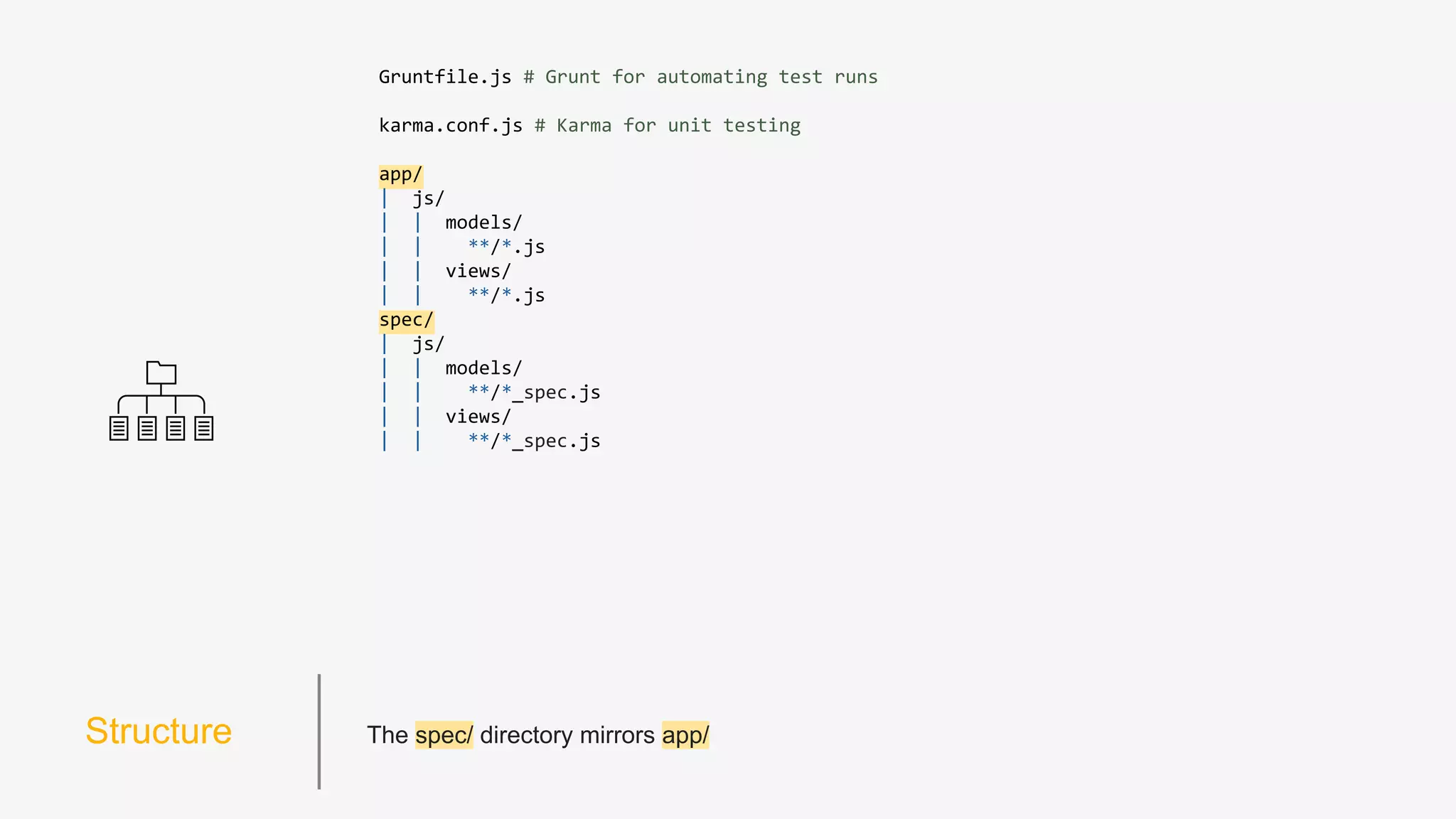
Structure The spec/ directory mirrors app/
Gruntfile.js # Grunt for automating test runs
karma.conf.js # Karma for unit testing
app/
| js/
| | models/
| | **/*.js
| | views/
| | **/*.js
spec/
| js/
| | models/
| | **/*_spec.js
| | views/
| | **/*_spec.js
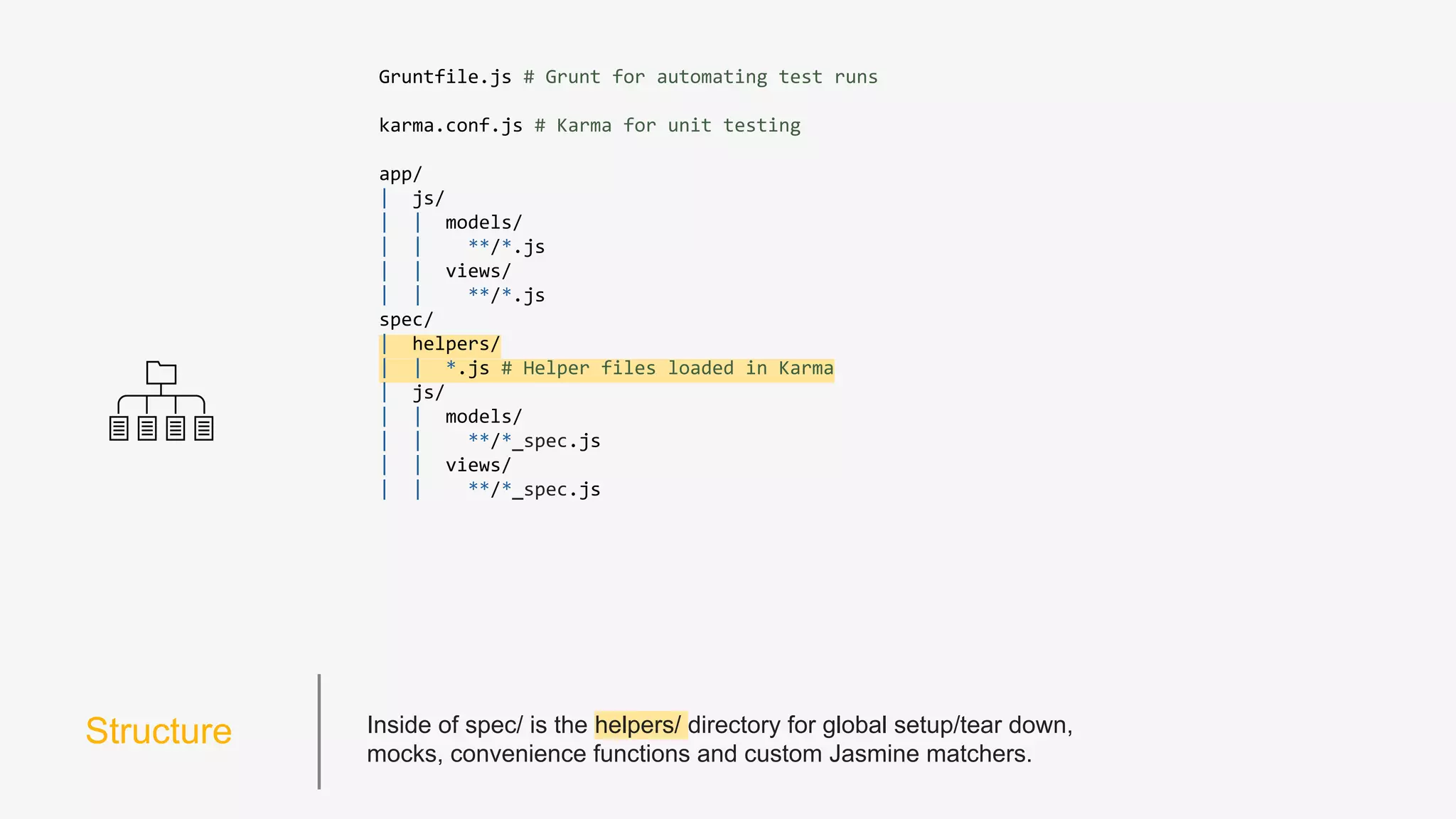
Structure Inside of spec/ is the helpers/ directory for global setup/tear down,
mocks, convenience functions and custom Jasmine matchers.
Gruntfile.js # Grunt for automating test runs
karma.conf.js # Karma for unit testing
app/
| js/
| | models/
| | **/*.js
| | views/
| | **/*.js
spec/
| helpers/
| | *.js # Helper files loaded in Karma
| js/
| | models/
| | **/*_spec.js
| | views/
| | **/*_spec.js
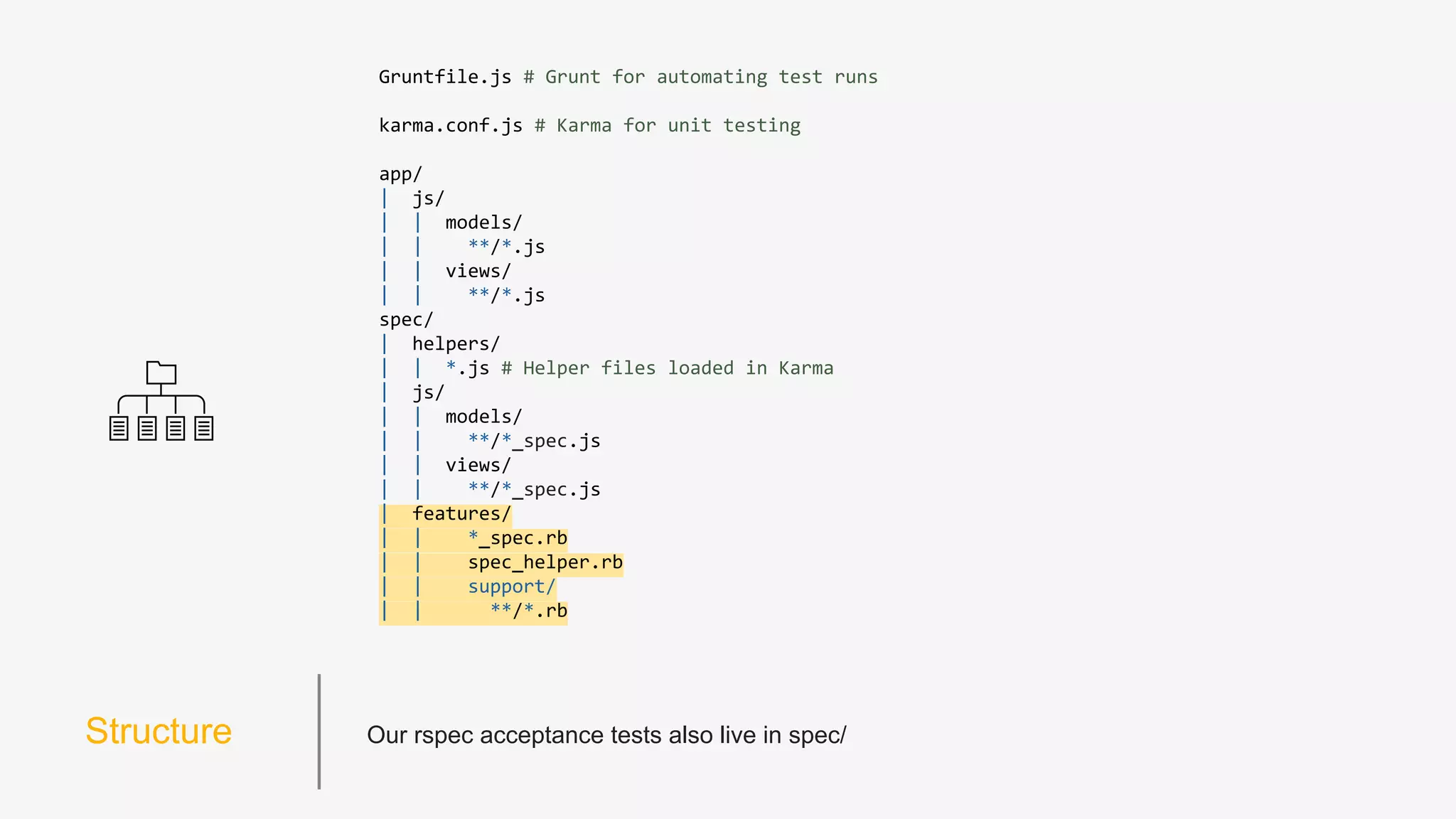
Structure Our rspec acceptance tests also live in spec/
Gruntfile.js # Grunt for automating test runs
karma.conf.js # Karma for unit testing
app/
| js/
| | models/
| | **/*.js
| | views/
| | **/*.js
spec/
| helpers/
| | *.js # Helper files loaded in Karma
| js/
| | models/
| | **/*_spec.js
| | views/
| | **/*_spec.js
| features/
| | *_spec.rb
| | spec_helper.rb
| | support/
| | **/*.rb
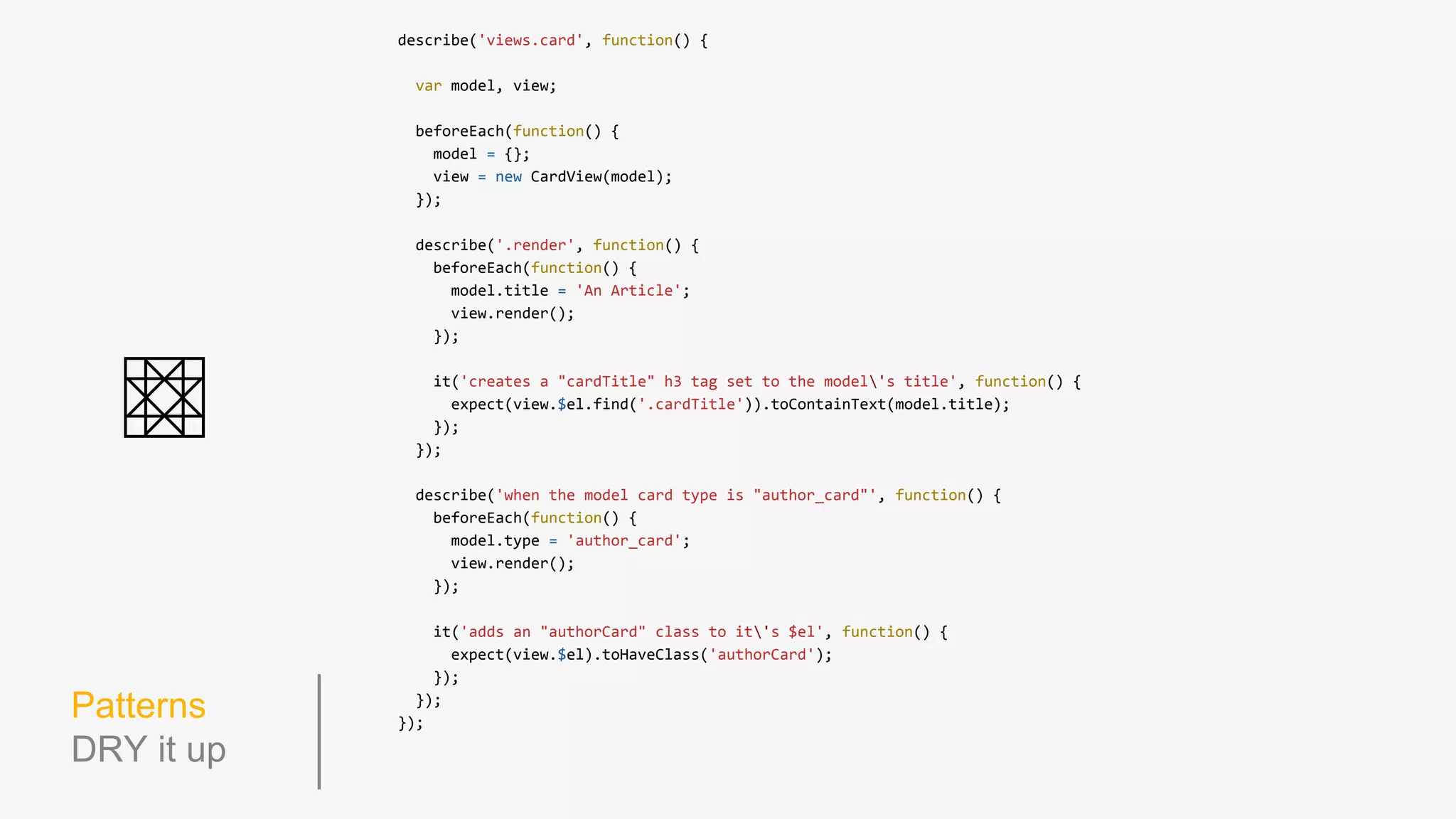
Patterns
DRY it up
describe('views.card', function() {
var model, view;
beforeEach(function() {
model = {};
view = new CardView(model);
});
describe('.render', function() {
beforeEach(function() {
model.title = 'An Article';
view.render();
});
it('creates a "cardTitle" h3 tag set to the model's title', function() {
expect(view.$el.find('.cardTitle')).toContainText(model.title);
});
});
describe('when the model card type is "author_card"', function() {
beforeEach(function() {
model.type = 'author_card';
view.render();
});
it('adds an "authorCard" class to it's $el', function() {
expect(view.$el).toHaveClass('authorCard');
});
});
});
Patterns
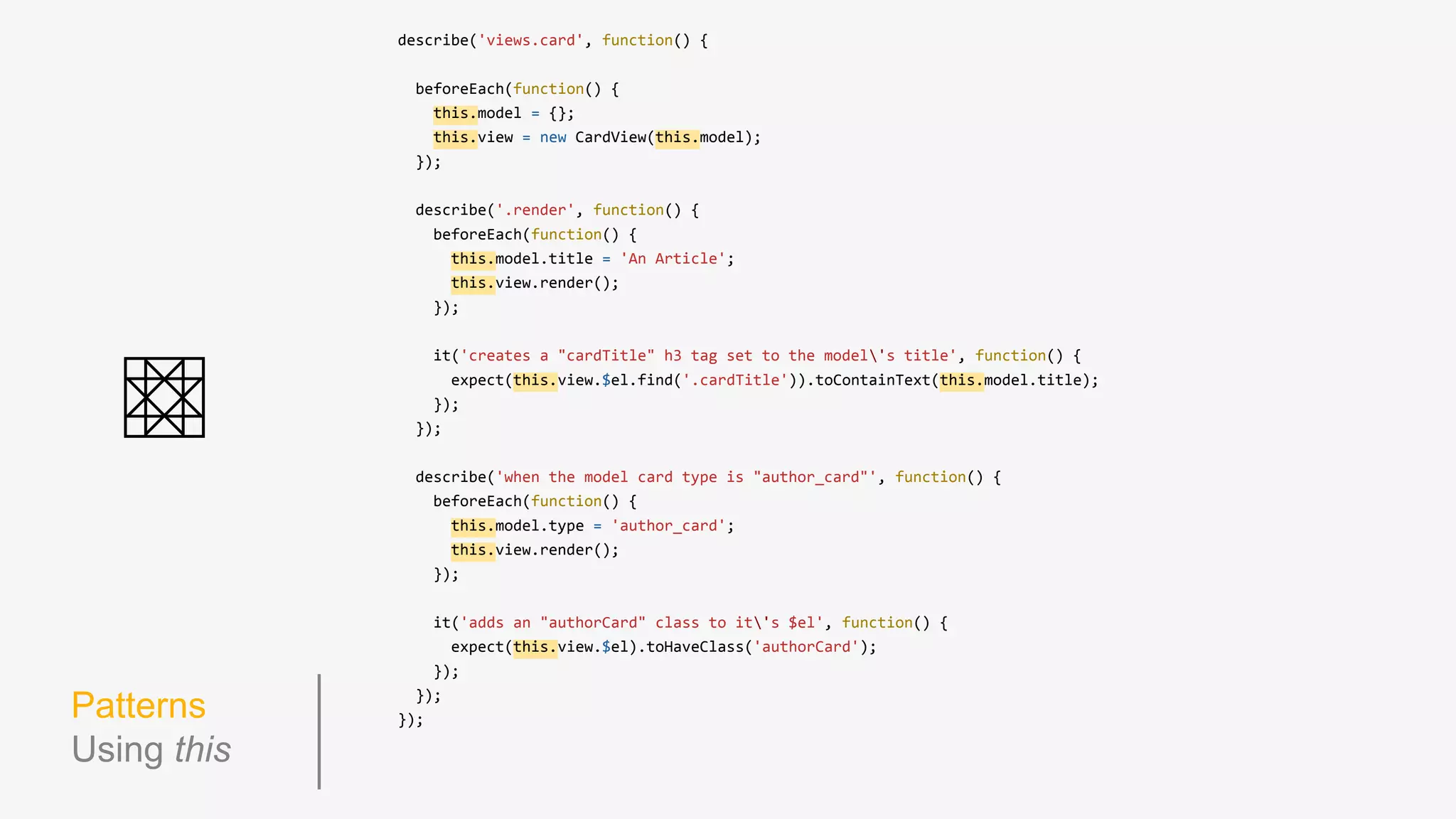
Using this
describe('views.card', function() {
beforeEach(function() {
this.model = {};
this.view = new CardView(this.model);
});
describe('.render', function() {
beforeEach(function() {
this.model.title = 'An Article';
this.view.render();
});
it('creates a "cardTitle" h3 tag set to the model's title', function() {
expect(this.view.$el.find('.cardTitle')).toContainText(this.model.title);
});
});
describe('when the model card type is "author_card"', function() {
beforeEach(function() {
this.model.type = 'author_card';
this.view.render();
});
it('adds an "authorCard" class to it's $el', function() {
expect(this.view.$el).toHaveClass('authorCard');
});
});
});
Patterns
Using this
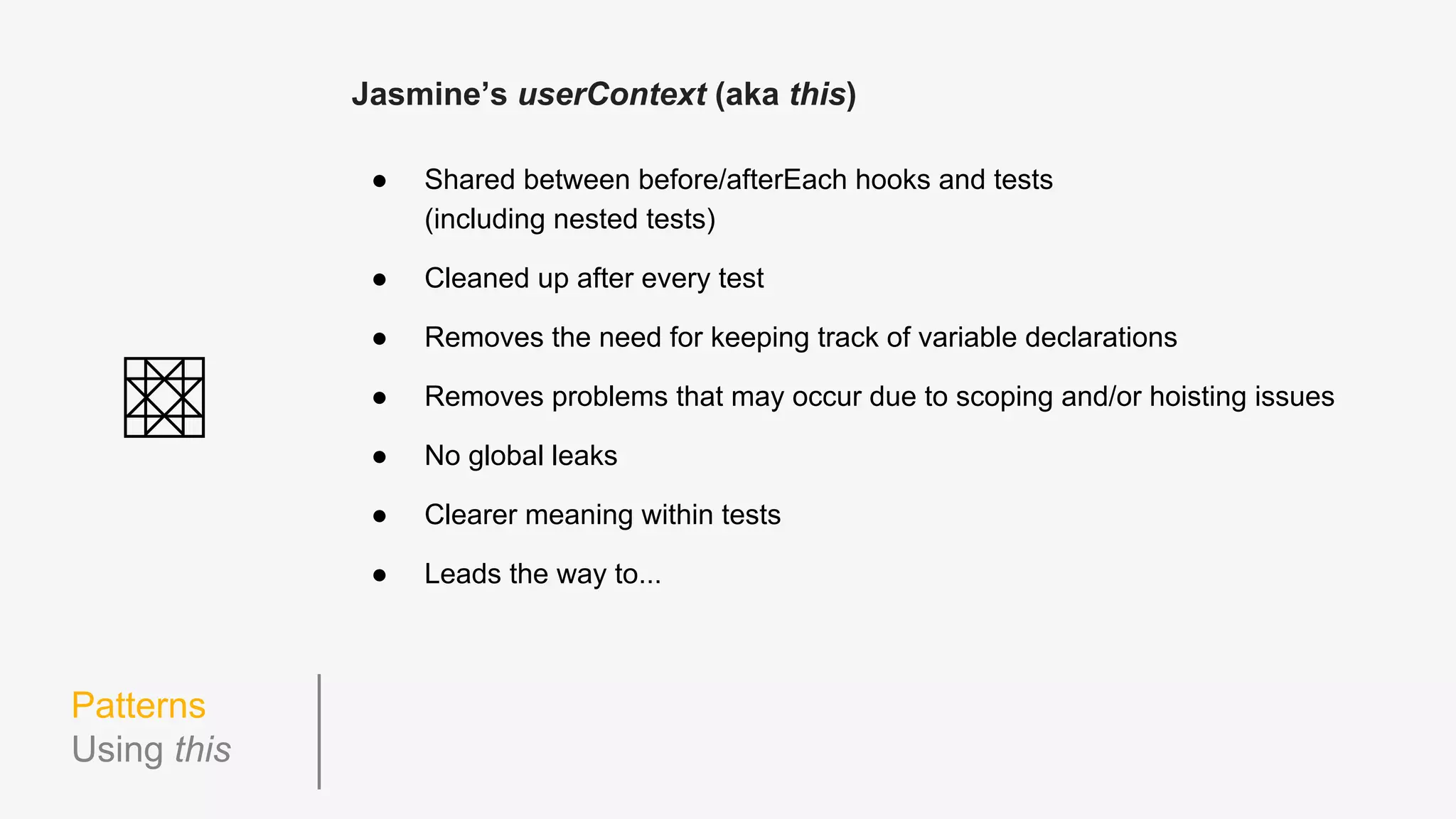
Jasmine’s userContext (aka this)
● Shared between before/afterEach hooks and tests
(including nested tests)
● Cleaned up after every test
● Removes the need for keeping track of variable declarations
● Removes problems that may occur due to scoping and/or hoisting issues
● No global leaks
● Clearer meaning within tests
● Leads the way to...
Patterns
Lazy Eval
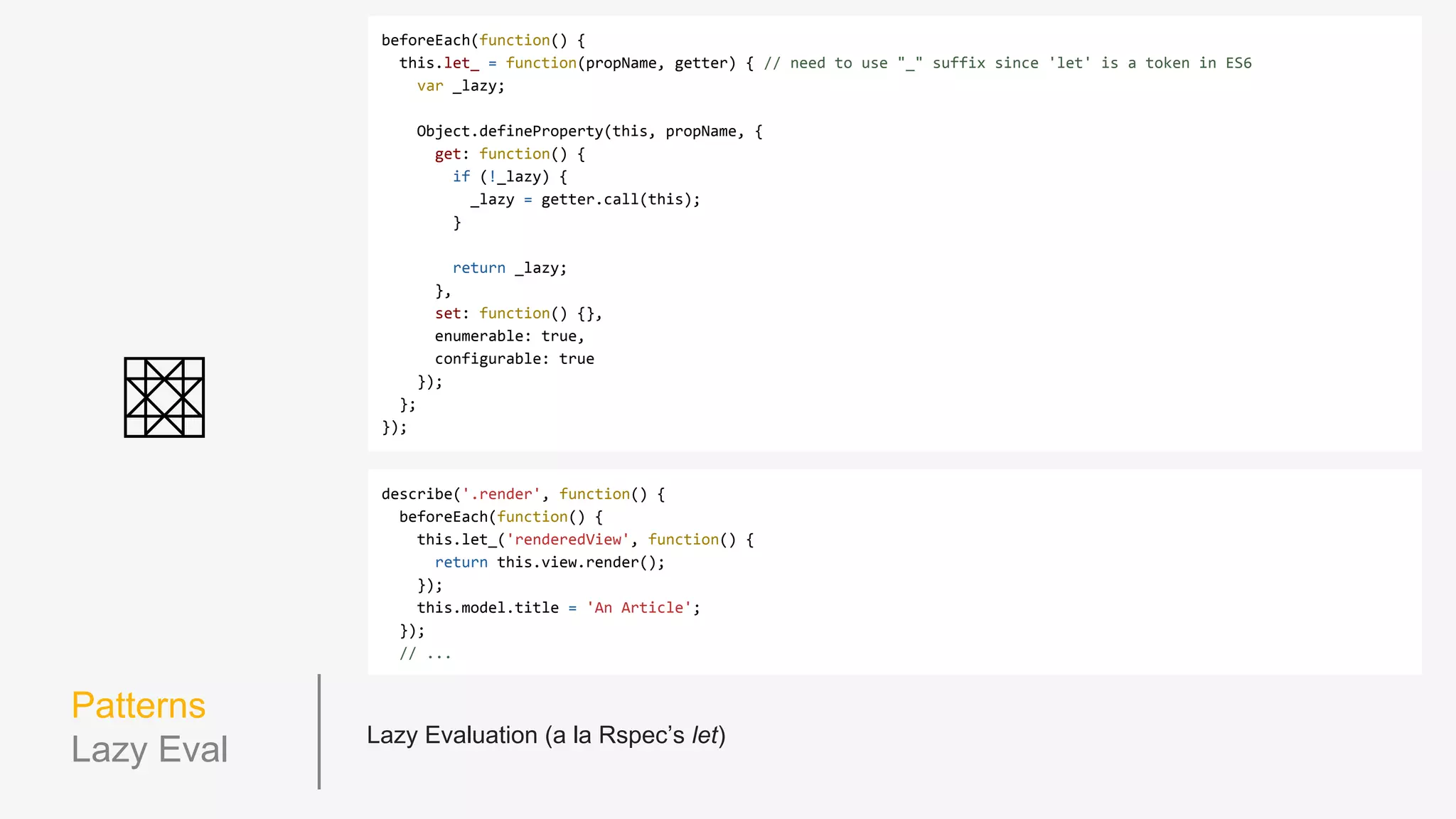
beforeEach(function() {
this.let_ = function(propName, getter) { // need to use "_" suffix since 'let' is a token in ES6
var _lazy;
Object.defineProperty(this, propName, {
get: function() {
if (!_lazy) {
_lazy = getter.call(this);
}
return _lazy;
},
set: function() {},
enumerable: true,
configurable: true
});
};
});
Lazy Evaluation (a la Rspec’s let)
describe('.render', function() {
beforeEach(function() {
this.let_('renderedView', function() {
return this.view.render();
});
this.model.title = 'An Article';
});
// ...
Patterns
Lazy Eval
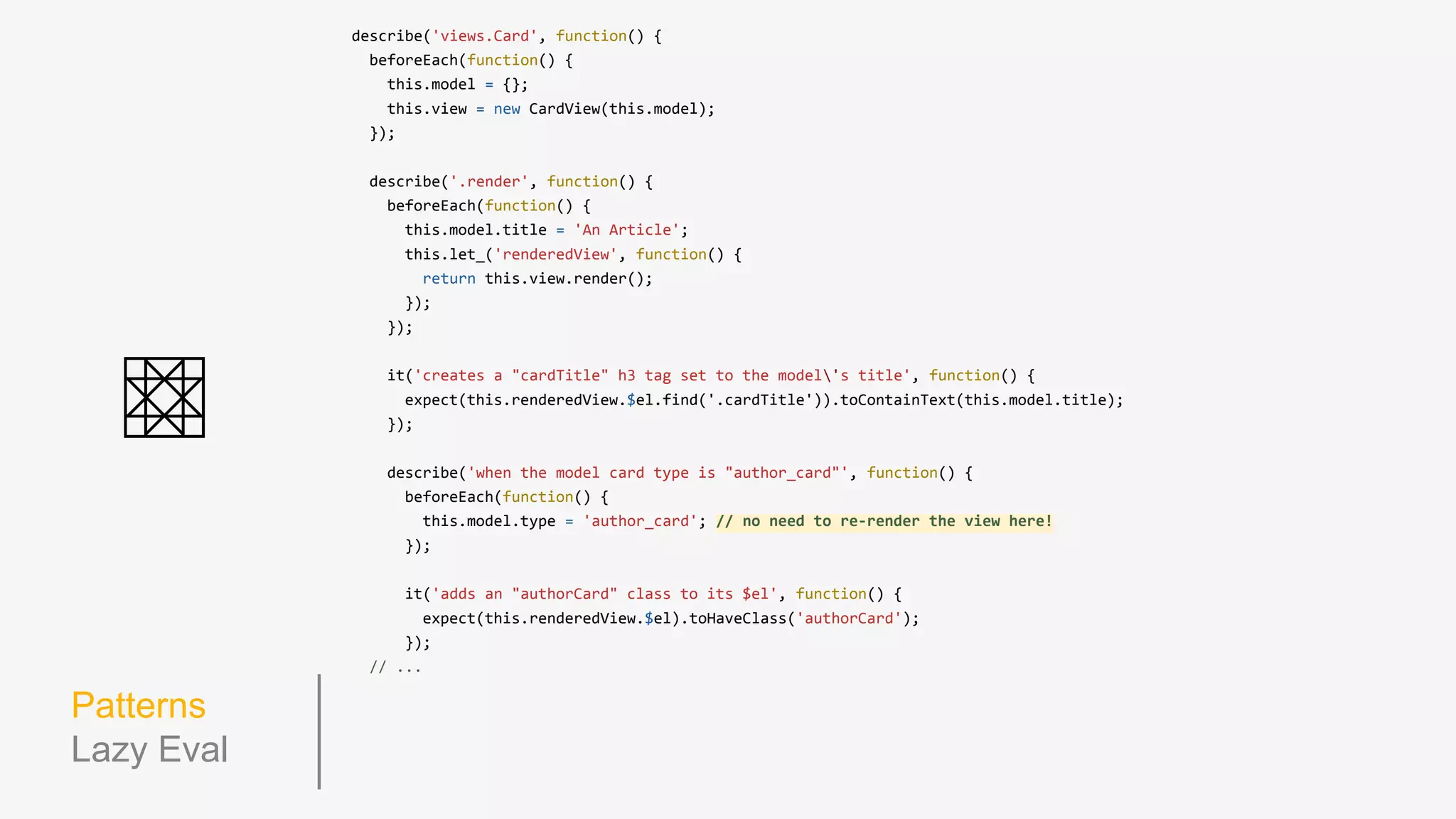
describe('views.Card', function() {
beforeEach(function() {
this.model = {};
this.view = new CardView(this.model);
});
describe('.render', function() {
beforeEach(function() {
this.model.title = 'An Article';
this.let_('renderedView', function() {
return this.view.render();
});
});
it('creates a "cardTitle" h3 tag set to the model's title', function() {
expect(this.renderedView.$el.find('.cardTitle')).toContainText(this.model.title);
});
describe('when the model card type is "author_card"', function() {
beforeEach(function() {
this.model.type = 'author_card'; // no need to re-render the view here!
});
it('adds an "authorCard" class to its $el', function() {
expect(this.renderedView.$el).toHaveClass('authorCard');
});
// ...
Patterns
Lazy Eval
Lazy Evaluation
● Our render spec, now uses let_
● We only have to call render once, in the getter function, even if we change
the model in nested beforeEach blocks
● Reduced code duplication
● Reduced chance of pollution due to side effects
● Smaller file sizes!
● Note: everything here can be used for Mocha as well!
Patterns
Behaves Like
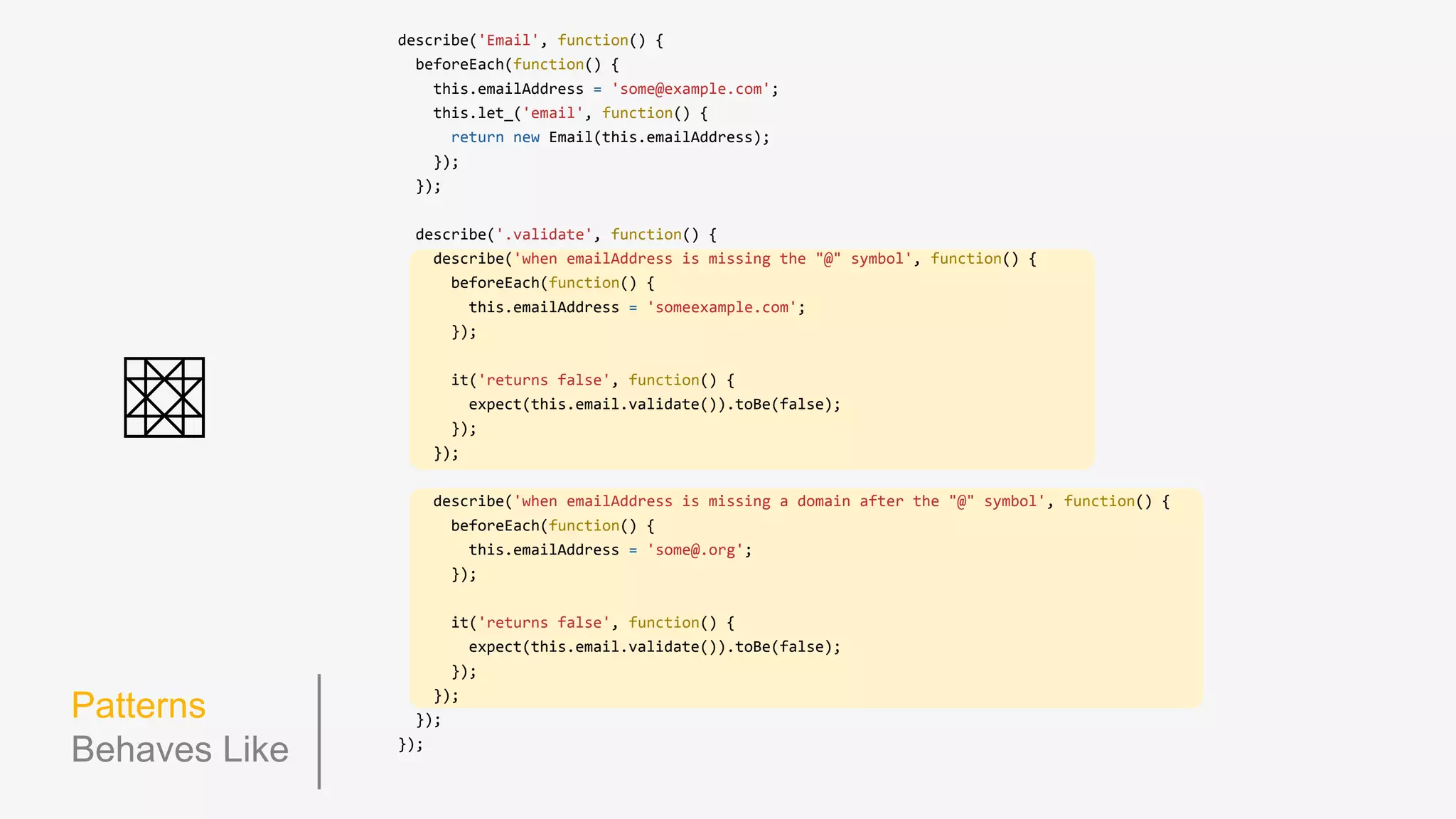
describe('Email', function() {
beforeEach(function() {
this.emailAddress = 'some@example.com';
this.let_('email', function() {
return new Email(this.emailAddress);
});
});
describe('.validate', function() {
describe('when emailAddress is missing the "@" symbol', function() {
beforeEach(function() {
this.emailAddress = 'someexample.com';
});
it('returns false', function() {
expect(this.email.validate()).toBe(false);
});
});
describe('when emailAddress is missing a domain after the "@" symbol', function() {
beforeEach(function() {
this.emailAddress = 'some@.org';
});
it('returns false', function() {
expect(this.email.validate()).toBe(false);
});
});
});
});
Patterns
Behaves Like
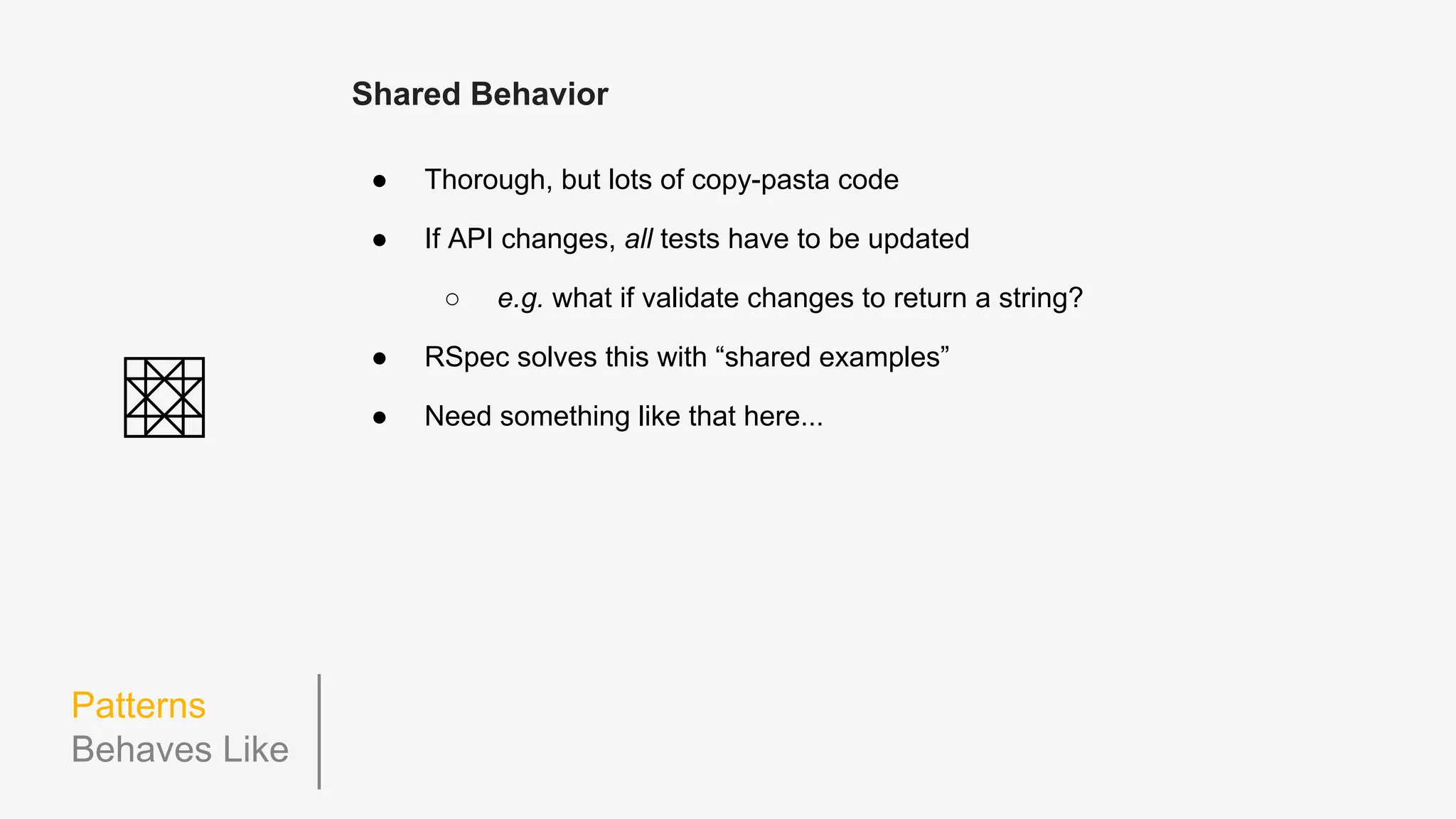
Shared Behavior
● Thorough, but lots of copy-pasta code
● If API changes, all tests have to be updated
○ e.g. what if validate changes to return a string?
● RSpec solves this with “shared examples”
● Need something like that here...
Patterns
Behaves Like
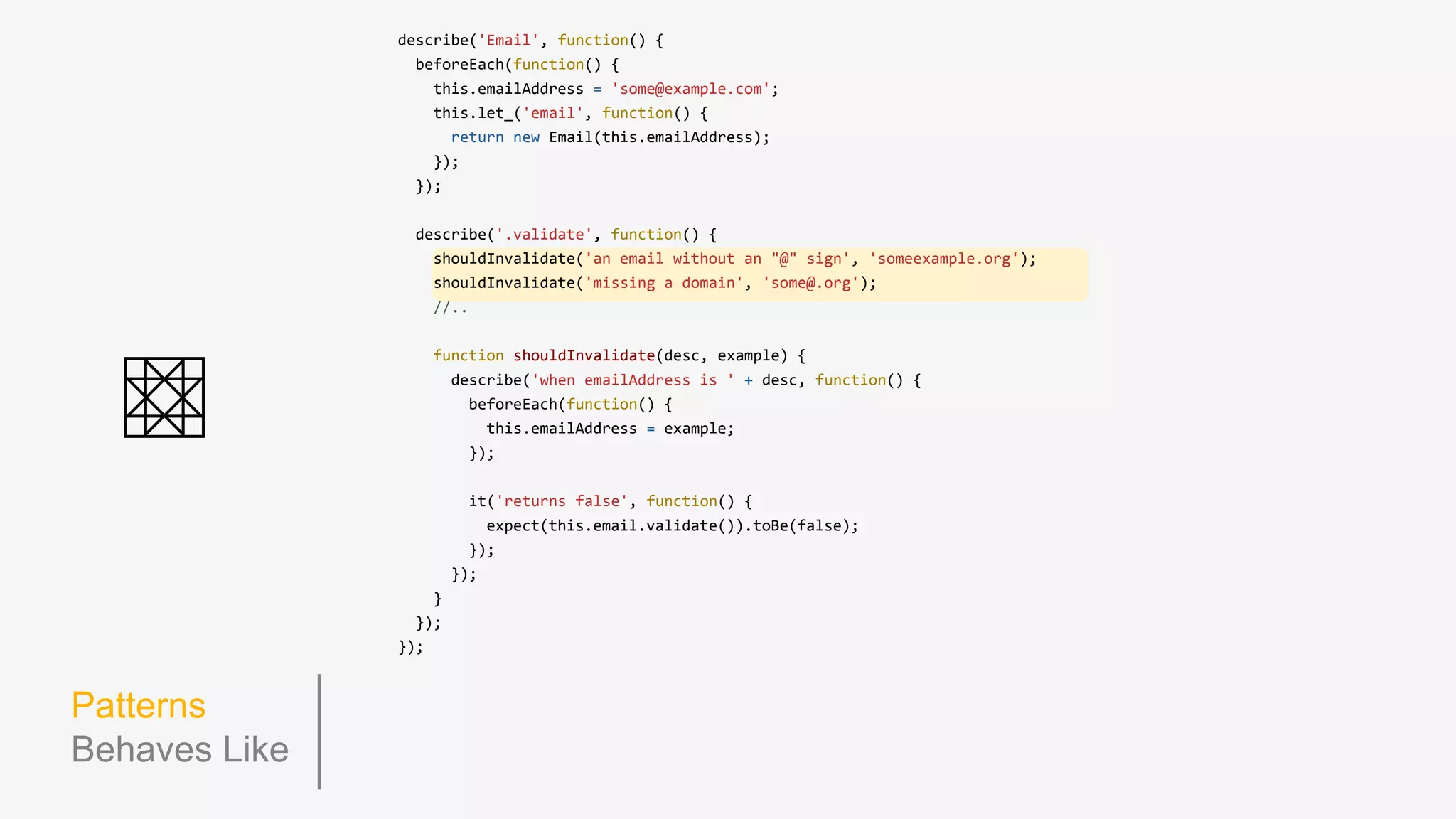
describe('Email', function() {
beforeEach(function() {
this.emailAddress = 'some@example.com';
this.let_('email', function() {
return new Email(this.emailAddress);
});
});
describe('.validate', function() {
shouldInvalidate('an email without an "@" sign', 'someexample.org');
shouldInvalidate('missing a domain', 'some@.org');
//..
function shouldInvalidate(desc, example) {
describe('when emailAddress is ' + desc, function() {
beforeEach(function() {
this.emailAddress = example;
});
it('returns false', function() {
expect(this.email.validate()).toBe(false);
});
});
}
});
});
Patterns
Behaves Like
Shared Behavior
● No more duplication of testing logic
● Extremely readable
● Leverage this along with javascripts metaprogramming techniques to create
dynamically built suites
● Looks great in the console
● Completely DRY
● Huge win for something like email validation, where there are tons of cases
to test
● Prevents having one test with a large amount of assertions
Resources
We’re Hiring
Front-End Engineer | Full Time
QA Engineer | Full Time
Developer Tools & Automation Engineer | Full Time
Junior DevOps Engineer | Full Time
Desktop Support Engineer | Full Time
Back-End Engineer | Full Time
Resources
Links
● Our Blog:
http://j.mp/R29MobileBlog
● Travis’ Gist on userContext:
http://bit.ly/BetterJasmine
● Slides:
http://bit.ly/JSStackUp
Thanks!

Painless Javascript Unit Testing

  • 1.
  • 2.
  • 3.
  • 4.
  • 5.
  • 6.
  • 7.
    Introduction Team Bicycle ● ADirector of Product and Two developers ● Behavior Driven Development and Pairing ● Launched the new mobile web experience in 5 months ● 1000 Unit Tests and 200 Acceptance Tests
  • 8.
  • 9.
  • 10.
    Introduction Team Bicycle ● ADirector of Product and Two developers ● Behavior Driven Development and Pairing ● Launched the new mobile web experience in 5 months ● 1000 Unit Tests and 200 Acceptance Tests A team built for speed.
  • 11.
    Introduction Product As close tonative as possible. http://www.refinery29.com
  • 12.
    Structure Grunt setsup tasks for running tests, example: grunt specs:debug Gruntfile.js # Grunt for automating test runs karma.conf.js # Karma for unit testing (Chrome for debugging, PhantomJS for CI builds in Jenkins) app/ | js/ | | models/ | | **/*.js | | views/ | | **/*.js spec/ | js/ | | models/ | | **/*_spec.js | | views/ | | **/*_spec.js
  • 13.
    Structure Karma setsup our testing environments. Great for running tests on actual devices. Gruntfile.js # Grunt for automating test runs karma.conf.js # Karma for unit testing (Chrome for debugging, PhantomJS for CI builds in Jenkins) app/ | js/ | | models/ | | **/*.js | | views/ | | **/*.js spec/ | js/ | | models/ | | **/*_spec.js | | views/ | | **/*_spec.js
  • 14.
    Structure The spec/directory mirrors app/ Gruntfile.js # Grunt for automating test runs karma.conf.js # Karma for unit testing app/ | js/ | | models/ | | **/*.js | | views/ | | **/*.js spec/ | js/ | | models/ | | **/*_spec.js | | views/ | | **/*_spec.js
  • 15.
    Structure Inside ofspec/ is the helpers/ directory for global setup/tear down, mocks, convenience functions and custom Jasmine matchers. Gruntfile.js # Grunt for automating test runs karma.conf.js # Karma for unit testing app/ | js/ | | models/ | | **/*.js | | views/ | | **/*.js spec/ | helpers/ | | *.js # Helper files loaded in Karma | js/ | | models/ | | **/*_spec.js | | views/ | | **/*_spec.js
  • 16.
    Structure Our rspecacceptance tests also live in spec/ Gruntfile.js # Grunt for automating test runs karma.conf.js # Karma for unit testing app/ | js/ | | models/ | | **/*.js | | views/ | | **/*.js spec/ | helpers/ | | *.js # Helper files loaded in Karma | js/ | | models/ | | **/*_spec.js | | views/ | | **/*_spec.js | features/ | | *_spec.rb | | spec_helper.rb | | support/ | | **/*.rb
  • 17.
    Patterns DRY it up describe('views.card',function() { var model, view; beforeEach(function() { model = {}; view = new CardView(model); }); describe('.render', function() { beforeEach(function() { model.title = 'An Article'; view.render(); }); it('creates a "cardTitle" h3 tag set to the model's title', function() { expect(view.$el.find('.cardTitle')).toContainText(model.title); }); }); describe('when the model card type is "author_card"', function() { beforeEach(function() { model.type = 'author_card'; view.render(); }); it('adds an "authorCard" class to it's $el', function() { expect(view.$el).toHaveClass('authorCard'); }); }); });
  • 18.
    Patterns Using this describe('views.card', function(){ beforeEach(function() { this.model = {}; this.view = new CardView(this.model); }); describe('.render', function() { beforeEach(function() { this.model.title = 'An Article'; this.view.render(); }); it('creates a "cardTitle" h3 tag set to the model's title', function() { expect(this.view.$el.find('.cardTitle')).toContainText(this.model.title); }); }); describe('when the model card type is "author_card"', function() { beforeEach(function() { this.model.type = 'author_card'; this.view.render(); }); it('adds an "authorCard" class to it's $el', function() { expect(this.view.$el).toHaveClass('authorCard'); }); }); });
  • 19.
    Patterns Using this Jasmine’s userContext(aka this) ● Shared between before/afterEach hooks and tests (including nested tests) ● Cleaned up after every test ● Removes the need for keeping track of variable declarations ● Removes problems that may occur due to scoping and/or hoisting issues ● No global leaks ● Clearer meaning within tests ● Leads the way to...
  • 20.
    Patterns Lazy Eval beforeEach(function() { this.let_= function(propName, getter) { // need to use "_" suffix since 'let' is a token in ES6 var _lazy; Object.defineProperty(this, propName, { get: function() { if (!_lazy) { _lazy = getter.call(this); } return _lazy; }, set: function() {}, enumerable: true, configurable: true }); }; }); Lazy Evaluation (a la Rspec’s let) describe('.render', function() { beforeEach(function() { this.let_('renderedView', function() { return this.view.render(); }); this.model.title = 'An Article'; }); // ...
  • 21.
    Patterns Lazy Eval describe('views.Card', function(){ beforeEach(function() { this.model = {}; this.view = new CardView(this.model); }); describe('.render', function() { beforeEach(function() { this.model.title = 'An Article'; this.let_('renderedView', function() { return this.view.render(); }); }); it('creates a "cardTitle" h3 tag set to the model's title', function() { expect(this.renderedView.$el.find('.cardTitle')).toContainText(this.model.title); }); describe('when the model card type is "author_card"', function() { beforeEach(function() { this.model.type = 'author_card'; // no need to re-render the view here! }); it('adds an "authorCard" class to its $el', function() { expect(this.renderedView.$el).toHaveClass('authorCard'); }); // ...
  • 22.
    Patterns Lazy Eval Lazy Evaluation ●Our render spec, now uses let_ ● We only have to call render once, in the getter function, even if we change the model in nested beforeEach blocks ● Reduced code duplication ● Reduced chance of pollution due to side effects ● Smaller file sizes! ● Note: everything here can be used for Mocha as well!
  • 23.
    Patterns Behaves Like describe('Email', function(){ beforeEach(function() { this.emailAddress = 'some@example.com'; this.let_('email', function() { return new Email(this.emailAddress); }); }); describe('.validate', function() { describe('when emailAddress is missing the "@" symbol', function() { beforeEach(function() { this.emailAddress = 'someexample.com'; }); it('returns false', function() { expect(this.email.validate()).toBe(false); }); }); describe('when emailAddress is missing a domain after the "@" symbol', function() { beforeEach(function() { this.emailAddress = 'some@.org'; }); it('returns false', function() { expect(this.email.validate()).toBe(false); }); }); }); });
  • 24.
    Patterns Behaves Like Shared Behavior ●Thorough, but lots of copy-pasta code ● If API changes, all tests have to be updated ○ e.g. what if validate changes to return a string? ● RSpec solves this with “shared examples” ● Need something like that here...
  • 25.
    Patterns Behaves Like describe('Email', function(){ beforeEach(function() { this.emailAddress = 'some@example.com'; this.let_('email', function() { return new Email(this.emailAddress); }); }); describe('.validate', function() { shouldInvalidate('an email without an "@" sign', 'someexample.org'); shouldInvalidate('missing a domain', 'some@.org'); //.. function shouldInvalidate(desc, example) { describe('when emailAddress is ' + desc, function() { beforeEach(function() { this.emailAddress = example; }); it('returns false', function() { expect(this.email.validate()).toBe(false); }); }); } }); });
  • 26.
    Patterns Behaves Like Shared Behavior ●No more duplication of testing logic ● Extremely readable ● Leverage this along with javascripts metaprogramming techniques to create dynamically built suites ● Looks great in the console ● Completely DRY ● Huge win for something like email validation, where there are tons of cases to test ● Prevents having one test with a large amount of assertions
  • 27.
    Resources We’re Hiring Front-End Engineer| Full Time QA Engineer | Full Time Developer Tools & Automation Engineer | Full Time Junior DevOps Engineer | Full Time Desktop Support Engineer | Full Time Back-End Engineer | Full Time
  • 28.
    Resources Links ● Our Blog: http://j.mp/R29MobileBlog ●Travis’ Gist on userContext: http://bit.ly/BetterJasmine ● Slides: http://bit.ly/JSStackUp Thanks!