By/Mohamed Gamal Abdo FadelBy/Mohamed Gamal Abdo Fadel
faculty of medicine Tanta universityfaculty of medicine Tanta university
PainPain
sensationsensationUnpleasant sensation that helps toUnpleasant sensation that helps to
protect bodyprotect body
 Types of pain receptorsTypes of pain receptors
11--MechanicalMechanical
22--ThermalThermal
33--ChemicalChemical
 They do not obey muller's lawThey do not obey muller's law
 Adapt very little and sometimes not at allAdapt very little and sometimes not at all
To remove damaging stimuliTo remove damaging stimuli
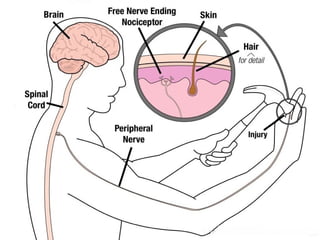
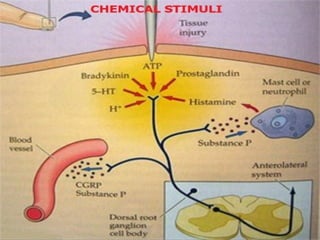
Mechanism of stimulation of pain receptorsMechanism of stimulation of pain receptors::
Noxious mechanical , chemical & thermalNoxious mechanical , chemical & thermal
stimuli cause tissue damage , leading to releasestimuli cause tissue damage , leading to release
pain producing substance as histamine ,pain producing substance as histamine ,
bradykinin and substance pbradykinin and substance p
N.BN.B::
Prostaglandins released from tissue damage ,Prostaglandins released from tissue damage ,
facilitate pain receptors but not stimulate itfacilitate pain receptors but not stimulate it
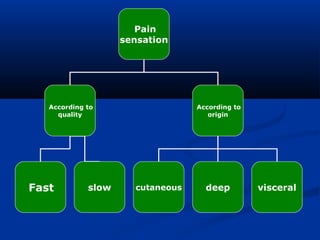
Pain
sensation
According to
quality
According to
origin
cutaneous deep visceralFast slow
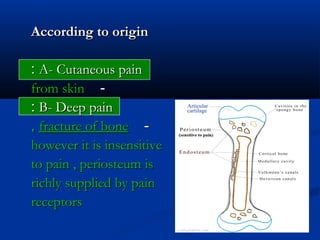
According to originAccording to origin
A- Cutaneous painA- Cutaneous pain::
--from skinfrom skin
B- Deep painB- Deep pain::
--fracture of bonefracture of bone,,
however it is insensitivehowever it is insensitive
to pain , periosteum isto pain , periosteum is
richly supplied by painrichly supplied by pain
receptorsreceptors
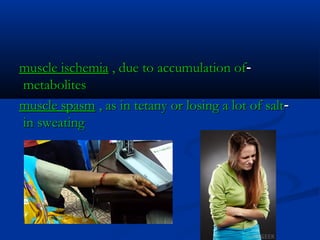
--muscle ischemiamuscle ischemia , due to accumulation of, due to accumulation of
metabolitesmetabolites
--muscle spasmmuscle spasm , as in tetany or losing a lot of salt, as in tetany or losing a lot of salt
in sweatingin sweating
C- Visceral painC- Visceral pain::
--severe distention of urinary bladdersevere distention of urinary bladder
--compression on viscera by tumorscompression on viscera by tumors
--chemical irritation as in perforated peptic ulcerchemical irritation as in perforated peptic ulcer
--ischemia to cardiac muscleischemia to cardiac muscle
N.BN.B::
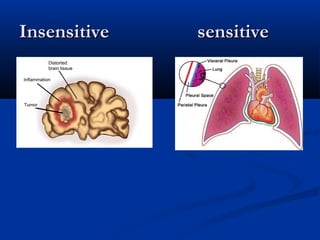
Brain , liver & alveoli of lung are insensitive to painBrain , liver & alveoli of lung are insensitive to pain
but liver capsule and pleura are sensitive to painbut liver capsule and pleura are sensitive to pain
Insensitive sensitiveInsensitive sensitive
According to quality of painAccording to quality of pain
11--Fast painFast pain
 From skin onlyFrom skin only
 Acute , sharp and immediate painAcute , sharp and immediate pain
 Felt within .1 sFelt within .1 s
 Well localizedWell localized
 Carried by a delta myelinated afferent fibers which canCarried by a delta myelinated afferent fibers which can
be blocked by compression or hypoxiabe blocked by compression or hypoxia
 Transmitted in neo-spinothalamic tractTransmitted in neo-spinothalamic tract
 Pass directly to PLVNTPass directly to PLVNT
 Pass to somatic sensory area of cerebral cortexPass to somatic sensory area of cerebral cortex
22--Slow painSlow pain::
 From skin , deep tissue & visceraFrom skin , deep tissue & viscera
 Chronic , dull aching or throbbing painChronic , dull aching or throbbing pain
 Felt after 1s or moreFelt after 1s or more
 Poorly localized carried by unmyelinated c fibersPoorly localized carried by unmyelinated c fibers
 Transmitted in paleo-spinothalamic tractTransmitted in paleo-spinothalamic tract
 Pass first to reticular formation , then to non-Pass first to reticular formation , then to non-
specific nuclei of thalamusspecific nuclei of thalamus
 Pass to whole cerebral cortexPass to whole cerebral cortex
Reaction to painReaction to pain
11--Reactions to cutaneous painReactions to cutaneous pain::
a-a- somatic reactionsomatic reaction::
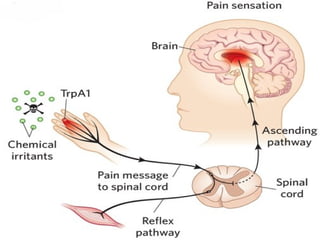
 Withdrawal reflex (injurious stimuli to limb ,Withdrawal reflex (injurious stimuli to limb ,
leads to withdrawal of this limb away fromleads to withdrawal of this limb away from
injuryinjury
b-b- autonomic reactionautonomic reaction::
 Moderate pain causes sympathetic stimulationModerate pain causes sympathetic stimulation
( increase heart rate and ABP )( increase heart rate and ABP )
 Severe pain causes parasympathetic stimulation (Severe pain causes parasympathetic stimulation (
decreased heart rate and ABP )decreased heart rate and ABP )
C-C- emotional reactionemotional reaction : crying and anxiety: crying and anxiety
D-D- not referred to other areasnot referred to other areas
22--Reactions to deep & visceral painReactions to deep & visceral pain::
A-A- somatic reacrionsomatic reacrion : muscle rigidity over painful: muscle rigidity over painful
areaarea
B-B- autonomic reactionautonomic reaction : parasympathetic: parasympathetic
stimulation ( decreased heart rate , ABP ,stimulation ( decreased heart rate , ABP ,
sweating & lacrimationsweating & lacrimation
C-C- emotional reactionemotional reaction : crying & anxiety: crying & anxiety
D-D- may be referred to other areamay be referred to other area
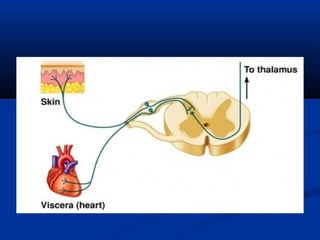
Referred painReferred pain
-- Pain is felt away its original sitePain is felt away its original site
 Structure in which pain originate and structureStructure in which pain originate and structure
to which pain referred are developed from sameto which pain referred are developed from same
embryonic segment and migration occurredembryonic segment and migration occurred
Mechanism of referred painMechanism of referred pain::
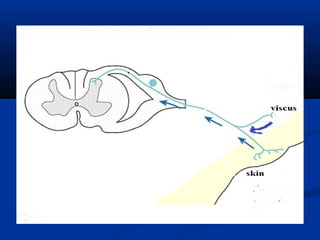
11--dorsal root branching mechanismdorsal root branching mechanism::
Single afferent divides into branches , one come fromSingle afferent divides into branches , one come from
skin and other from viscusskin and other from viscus
 So , pain impulses arising from skin or diseased viscusSo , pain impulses arising from skin or diseased viscus
will be transmitted by same afferent to spinal cord ,will be transmitted by same afferent to spinal cord ,
activating same thalamic and cortical neuronsactivating same thalamic and cortical neurons
 So , whatever source of pain , cortical neurons refers itSo , whatever source of pain , cortical neurons refers it
to skin because brain accustomed to receive painto skin because brain accustomed to receive pain
stimuli from skinstimuli from skin
22--convergence projection mechanismconvergence projection mechanism::
--Separate afferent nerves ( one comes fromSeparate afferent nerves ( one comes from
skin and other from viscusskin and other from viscus((
 They converge on same SGRThey converge on same SGR
 If there is pain from disease viscus , brain willIf there is pain from disease viscus , brain will
referred it to skin , not viscus as it accustomedreferred it to skin , not viscus as it accustomed
to receive pain pain stimuli from skinto receive pain pain stimuli from skin
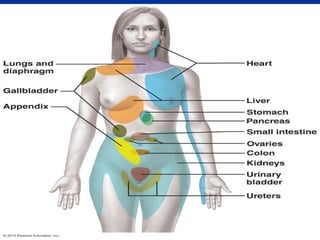
Ex. Of referred painEx. Of referred pain
11--cardiac paincardiac pain : felt in base of neck , over left shoulder &: felt in base of neck , over left shoulder &
down to armdown to arm
22--esophageal painesophageal pain : felt in lower neck or midline chest: felt in lower neck or midline chest
regionregion
33--biliary and gall bladder painbiliary and gall bladder pain : felt in right shoulder , due: felt in right shoulder , due
to irritation of diaphragm , transmitted by phrenicto irritation of diaphragm , transmitted by phrenic
nervenerve
44--uterine painuterine pain : felt in suprapubic , perineum or lower: felt in suprapubic , perineum or lower
region of backregion of back
55--appendicular painappendicular pain : felt in right iliac fossa and around: felt in right iliac fossa and around
umbilicusumbilicus
66--renal painrenal pain : felt in testicular region: felt in testicular region
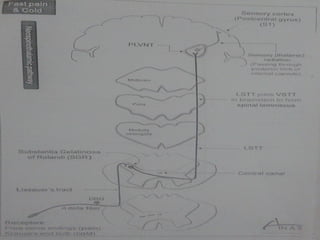
Pathway of fast pain and cold sensationPathway of fast pain and cold sensation
(neospinothalamic tract(neospinothalamic tract((
11stst
order neuronsorder neurons
ReceptorsReceptors::
 Free nerve ending for fast painFree nerve ending for fast pain
 krause end bulb for cold sensationkrause end bulb for cold sensation
AfferentAfferent::
A delta fibers pass to DRG , then enters spinalA delta fibers pass to DRG , then enters spinal
cord , ascending few segments forming leissaur tract ,cord , ascending few segments forming leissaur tract ,
ending in neurons in lamina 1&5 in dorsal hornending in neurons in lamina 1&5 in dorsal horn
22ndnd
order neuronorder neuron
From lamina 1&5 in dorsal horn ,From lamina 1&5 in dorsal horn ,
crossing opposite side in front of central canal ,crossing opposite side in front of central canal ,
then ascend forming lateral spinothalamic tract .then ascend forming lateral spinothalamic tract .
It joins ventral spinothalamic tract formingIt joins ventral spinothalamic tract forming
spinal lemniscus , ending in posterolateralspinal lemniscus , ending in posterolateral
ventral nucleus of thalalmus (PLVNTventral nucleus of thalalmus (PLVNT((
33rdrd
order neuronsorder neurons
From PLVNT to posterior limb ofFrom PLVNT to posterior limb of
internal capsule , forming sensory radiation ,internal capsule , forming sensory radiation ,
ends in postcentral gyrus ( somatic sensory areaends in postcentral gyrus ( somatic sensory area
1 ) of cerebral cortex1 ) of cerebral cortex
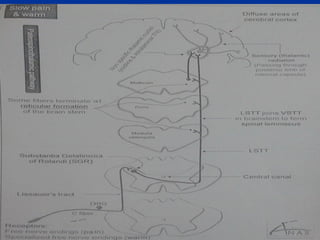
Pathway of slow pain & warm sensationPathway of slow pain & warm sensation
(paleospinothalalmic tract(paleospinothalalmic tract((
11stst
order neuronorder neuron
ReceptorsReceptors
 Free nerve ending for slow painFree nerve ending for slow pain
 Specialized free nerve ending for warmSpecialized free nerve ending for warm
AfferentAfferent
C unmyelinated , to DRG , then enterC unmyelinated , to DRG , then enter
spinal cord to end in SGRspinal cord to end in SGR
22ndnd
order neuronorder neuron
From SGR , passing opposite side inFrom SGR , passing opposite side in
front of central canal , then ascend as lateralfront of central canal , then ascend as lateral
spinothalamic tract fibers of this tract end inspinothalamic tract fibers of this tract end in
reticular formation in brain stem , ascending toreticular formation in brain stem , ascending to
enf in non-specific thalamic nuclei (intralaminarenf in non-specific thalamic nuclei (intralaminar
and midline nuclei of thalamusand midline nuclei of thalamus((
33rdrd
order neuronorder neuron
From non specific thalamic nuclei ,From non specific thalamic nuclei ,
fibers ascend in posterior limb of internalfibers ascend in posterior limb of internal
capsule , forming sensory radiation , ends incapsule , forming sensory radiation , ends in
diffuse areas of cerebral cortexdiffuse areas of cerebral cortex..
‫تم‬‫تم‬‫بحمد‬‫بحمد‬‫ا‬‫ا‬

Pain sensation

  • 1.
    By/Mohamed Gamal AbdoFadelBy/Mohamed Gamal Abdo Fadel faculty of medicine Tanta universityfaculty of medicine Tanta university
  • 2.
    PainPain sensationsensationUnpleasant sensation thathelps toUnpleasant sensation that helps to protect bodyprotect body
  • 3.
     Types ofpain receptorsTypes of pain receptors 11--MechanicalMechanical 22--ThermalThermal 33--ChemicalChemical  They do not obey muller's lawThey do not obey muller's law  Adapt very little and sometimes not at allAdapt very little and sometimes not at all To remove damaging stimuliTo remove damaging stimuli
  • 7.
    Mechanism of stimulationof pain receptorsMechanism of stimulation of pain receptors:: Noxious mechanical , chemical & thermalNoxious mechanical , chemical & thermal stimuli cause tissue damage , leading to releasestimuli cause tissue damage , leading to release pain producing substance as histamine ,pain producing substance as histamine , bradykinin and substance pbradykinin and substance p N.BN.B:: Prostaglandins released from tissue damage ,Prostaglandins released from tissue damage , facilitate pain receptors but not stimulate itfacilitate pain receptors but not stimulate it
  • 9.
  • 10.
    According to originAccordingto origin A- Cutaneous painA- Cutaneous pain:: --from skinfrom skin B- Deep painB- Deep pain:: --fracture of bonefracture of bone,, however it is insensitivehowever it is insensitive to pain , periosteum isto pain , periosteum is richly supplied by painrichly supplied by pain receptorsreceptors
  • 11.
    --muscle ischemiamuscle ischemia, due to accumulation of, due to accumulation of metabolitesmetabolites --muscle spasmmuscle spasm , as in tetany or losing a lot of salt, as in tetany or losing a lot of salt in sweatingin sweating
  • 12.
    C- Visceral painC-Visceral pain:: --severe distention of urinary bladdersevere distention of urinary bladder --compression on viscera by tumorscompression on viscera by tumors --chemical irritation as in perforated peptic ulcerchemical irritation as in perforated peptic ulcer --ischemia to cardiac muscleischemia to cardiac muscle N.BN.B:: Brain , liver & alveoli of lung are insensitive to painBrain , liver & alveoli of lung are insensitive to pain but liver capsule and pleura are sensitive to painbut liver capsule and pleura are sensitive to pain
  • 13.
  • 14.
    According to qualityof painAccording to quality of pain 11--Fast painFast pain  From skin onlyFrom skin only  Acute , sharp and immediate painAcute , sharp and immediate pain  Felt within .1 sFelt within .1 s  Well localizedWell localized  Carried by a delta myelinated afferent fibers which canCarried by a delta myelinated afferent fibers which can be blocked by compression or hypoxiabe blocked by compression or hypoxia  Transmitted in neo-spinothalamic tractTransmitted in neo-spinothalamic tract  Pass directly to PLVNTPass directly to PLVNT  Pass to somatic sensory area of cerebral cortexPass to somatic sensory area of cerebral cortex
  • 15.
    22--Slow painSlow pain:: From skin , deep tissue & visceraFrom skin , deep tissue & viscera  Chronic , dull aching or throbbing painChronic , dull aching or throbbing pain  Felt after 1s or moreFelt after 1s or more  Poorly localized carried by unmyelinated c fibersPoorly localized carried by unmyelinated c fibers  Transmitted in paleo-spinothalamic tractTransmitted in paleo-spinothalamic tract  Pass first to reticular formation , then to non-Pass first to reticular formation , then to non- specific nuclei of thalamusspecific nuclei of thalamus  Pass to whole cerebral cortexPass to whole cerebral cortex
  • 16.
    Reaction to painReactionto pain 11--Reactions to cutaneous painReactions to cutaneous pain:: a-a- somatic reactionsomatic reaction::  Withdrawal reflex (injurious stimuli to limb ,Withdrawal reflex (injurious stimuli to limb , leads to withdrawal of this limb away fromleads to withdrawal of this limb away from injuryinjury b-b- autonomic reactionautonomic reaction::  Moderate pain causes sympathetic stimulationModerate pain causes sympathetic stimulation ( increase heart rate and ABP )( increase heart rate and ABP )
  • 17.
     Severe paincauses parasympathetic stimulation (Severe pain causes parasympathetic stimulation ( decreased heart rate and ABP )decreased heart rate and ABP ) C-C- emotional reactionemotional reaction : crying and anxiety: crying and anxiety D-D- not referred to other areasnot referred to other areas
  • 18.
    22--Reactions to deep& visceral painReactions to deep & visceral pain:: A-A- somatic reacrionsomatic reacrion : muscle rigidity over painful: muscle rigidity over painful areaarea B-B- autonomic reactionautonomic reaction : parasympathetic: parasympathetic stimulation ( decreased heart rate , ABP ,stimulation ( decreased heart rate , ABP , sweating & lacrimationsweating & lacrimation C-C- emotional reactionemotional reaction : crying & anxiety: crying & anxiety D-D- may be referred to other areamay be referred to other area
  • 19.
    Referred painReferred pain --Pain is felt away its original sitePain is felt away its original site  Structure in which pain originate and structureStructure in which pain originate and structure to which pain referred are developed from sameto which pain referred are developed from same embryonic segment and migration occurredembryonic segment and migration occurred
  • 20.
    Mechanism of referredpainMechanism of referred pain:: 11--dorsal root branching mechanismdorsal root branching mechanism:: Single afferent divides into branches , one come fromSingle afferent divides into branches , one come from skin and other from viscusskin and other from viscus  So , pain impulses arising from skin or diseased viscusSo , pain impulses arising from skin or diseased viscus will be transmitted by same afferent to spinal cord ,will be transmitted by same afferent to spinal cord , activating same thalamic and cortical neuronsactivating same thalamic and cortical neurons  So , whatever source of pain , cortical neurons refers itSo , whatever source of pain , cortical neurons refers it to skin because brain accustomed to receive painto skin because brain accustomed to receive pain stimuli from skinstimuli from skin
  • 22.
    22--convergence projection mechanismconvergenceprojection mechanism:: --Separate afferent nerves ( one comes fromSeparate afferent nerves ( one comes from skin and other from viscusskin and other from viscus((  They converge on same SGRThey converge on same SGR  If there is pain from disease viscus , brain willIf there is pain from disease viscus , brain will referred it to skin , not viscus as it accustomedreferred it to skin , not viscus as it accustomed to receive pain pain stimuli from skinto receive pain pain stimuli from skin
  • 24.
    Ex. Of referredpainEx. Of referred pain 11--cardiac paincardiac pain : felt in base of neck , over left shoulder &: felt in base of neck , over left shoulder & down to armdown to arm 22--esophageal painesophageal pain : felt in lower neck or midline chest: felt in lower neck or midline chest regionregion 33--biliary and gall bladder painbiliary and gall bladder pain : felt in right shoulder , due: felt in right shoulder , due to irritation of diaphragm , transmitted by phrenicto irritation of diaphragm , transmitted by phrenic nervenerve 44--uterine painuterine pain : felt in suprapubic , perineum or lower: felt in suprapubic , perineum or lower region of backregion of back 55--appendicular painappendicular pain : felt in right iliac fossa and around: felt in right iliac fossa and around umbilicusumbilicus 66--renal painrenal pain : felt in testicular region: felt in testicular region
  • 26.
    Pathway of fastpain and cold sensationPathway of fast pain and cold sensation (neospinothalamic tract(neospinothalamic tract(( 11stst order neuronsorder neurons ReceptorsReceptors::  Free nerve ending for fast painFree nerve ending for fast pain  krause end bulb for cold sensationkrause end bulb for cold sensation AfferentAfferent:: A delta fibers pass to DRG , then enters spinalA delta fibers pass to DRG , then enters spinal cord , ascending few segments forming leissaur tract ,cord , ascending few segments forming leissaur tract , ending in neurons in lamina 1&5 in dorsal hornending in neurons in lamina 1&5 in dorsal horn
  • 27.
    22ndnd order neuronorder neuron Fromlamina 1&5 in dorsal horn ,From lamina 1&5 in dorsal horn , crossing opposite side in front of central canal ,crossing opposite side in front of central canal , then ascend forming lateral spinothalamic tract .then ascend forming lateral spinothalamic tract . It joins ventral spinothalamic tract formingIt joins ventral spinothalamic tract forming spinal lemniscus , ending in posterolateralspinal lemniscus , ending in posterolateral ventral nucleus of thalalmus (PLVNTventral nucleus of thalalmus (PLVNT((
  • 28.
    33rdrd order neuronsorder neurons FromPLVNT to posterior limb ofFrom PLVNT to posterior limb of internal capsule , forming sensory radiation ,internal capsule , forming sensory radiation , ends in postcentral gyrus ( somatic sensory areaends in postcentral gyrus ( somatic sensory area 1 ) of cerebral cortex1 ) of cerebral cortex
  • 30.
    Pathway of slowpain & warm sensationPathway of slow pain & warm sensation (paleospinothalalmic tract(paleospinothalalmic tract(( 11stst order neuronorder neuron ReceptorsReceptors  Free nerve ending for slow painFree nerve ending for slow pain  Specialized free nerve ending for warmSpecialized free nerve ending for warm AfferentAfferent C unmyelinated , to DRG , then enterC unmyelinated , to DRG , then enter spinal cord to end in SGRspinal cord to end in SGR
  • 31.
    22ndnd order neuronorder neuron FromSGR , passing opposite side inFrom SGR , passing opposite side in front of central canal , then ascend as lateralfront of central canal , then ascend as lateral spinothalamic tract fibers of this tract end inspinothalamic tract fibers of this tract end in reticular formation in brain stem , ascending toreticular formation in brain stem , ascending to enf in non-specific thalamic nuclei (intralaminarenf in non-specific thalamic nuclei (intralaminar and midline nuclei of thalamusand midline nuclei of thalamus((
  • 32.
    33rdrd order neuronorder neuron Fromnon specific thalamic nuclei ,From non specific thalamic nuclei , fibers ascend in posterior limb of internalfibers ascend in posterior limb of internal capsule , forming sensory radiation , ends incapsule , forming sensory radiation , ends in diffuse areas of cerebral cortexdiffuse areas of cerebral cortex..
  • 34.