Hydromorphone
(dilaudid)
By: Erica S. Harris
MSNE 5356: Advanced Pharmacology
Fall 2016
Pain
• Pain among cancer patients
• The presence of pain is predictive of increased morbidity and
mortality among cancer patients.
• Cancer pain is pain associated with malignancy and can result from
the disease itself or damage to secondary tissue.
• Cancer pain symptoms can be associated with treatment
interventions or just the cancer in general.
Intended Drug Response
• Opioids such as hydromorphone bind to mu, kappa or delta opioid receptors
which then causes an analgesic effect.
• Hydromorphone works on the brain (crosses the blood brain barrier) to
increase the ability to tolerate pain
• Hydromorphone begins to work within thirty minutes if given in oral form,
or within five minutes if given intravenously
Potential Interactions
• The associated use of other central nervous system depressants such as
sedatives or hypnotics, general anesthetics, phenothiazines, tranquilizers and
alcohol may produce depressant effects.
• Opioid analgesics may enhance the action of neuromuscular blocking agents
and produce an excessive degree of respiratory depression.
• Dilaudid should not be taken with alcohol.
• Respiratory depression, hypotension, sedation or coma may occur.
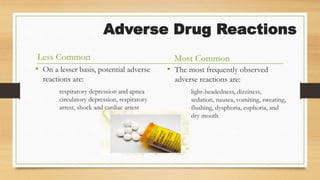
Adverse Drug Reactions
Less Common
• On a lesser basis, potential adverse
reactions are:
respiratory depression and apnea
circulatory depression, respiratory
arrest, shock and cardiac arrest
Most Common
• The most frequently observed
adverse reactions are:
light-headedness, dizziness,
sedation, nausea, vomiting, sweating,
flushing, dysphoria, euphoria, and
dry mouth
Side Effects
Common Side Effects of
Dilaudid
• Nausea or vomiting
• Constipation
• Dizziness or lightheadedness
• Drowsiness
• Anxiety
• Restlessness
• Nervousness
• Insomnia
Serious Side Effects of
Dilaudid
• Rash or hives
• Difficulty swallowing
• Swelling of the eyes, face, lips, tongue,
mouth, or throat
• Seizures
• Fainting
• Hypotension
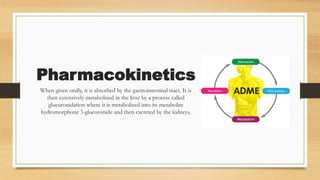
Pharmacokinetics
When given orally, it is absorbed by the gastrointestinal tract. It is
then extensively metabolized in the liver by a process called
glucuronidation where it is metabolized into its metabolite
hydromorphone 3-glucoronide and then excreted by the kidneys.
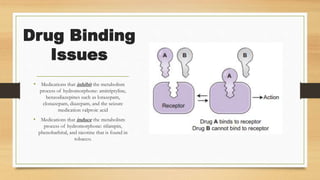
Drug Binding
Issues
• Medications that inhibit the metabolism
process of hydromorphone: amitriptyline,
benzodiazepines such as lorazepam,
clonazepam, diazepam, and the seizure
medication valproic acid
• Medications that induce the metabolism
process of hydromorphone: rifampin,
phenobarbital, and nicotine that is found in
tobacco.
Improving
Communication
• Implement
interdisciplinary team
rounds
• Understand the
perspectives of others
• Discover common goals
and collaborate in care
while keeping the patient
as the central focus
Application to Practice Setting
• Important actions to prevent complications and adverse reactions
• Identify high risk patients
• Monitor patients who have multiple prescriptions (ie. Benzos or antihistamines)
• Obtain routine vital signs
• Assess patients for over sedation (ie. Respirations, oxygen saturation, and arousal level)
• Stay alert for acute changes
• Monitor patients with liver or renal impairment and report any critical laboratory
values
• Think critically!
References
• Arcangelo, V. P., & Peterson, A. M. (2013). Pharmacotherapeutics for Advanced Practice: A Practical Approach (3rd ed.).
Philadelphia, PA Lippincott William, & Wilkins
• Fda.gov. (2009). Dilaudid and Dilaudid-HP injection. Retrieved from
http://www.accessdata.fda.gov/drugsatfda_docs/label/2009/019034s018lbl.pdf
• Jarzyna, D., Jungquist, C. R., Pasero, C., Willens, J. S., Nisbet, A., Oakes, L., … Polomano R. C. (2011). American
society for pain management nursing guidelines on monitoring for opioid induced sedation and respiratory
depression. Pain Management Nursing, 12 (3), 118-145. doi:10.1016/j.pmn.2011.06.008
• Johnson, S. J. (2007). Opioid safety in patients with renal or hepatic dysfunction. Retrieved from
http://paincommunity.org/blog/wp-content/uploads/Opioids-Renal-Hepatic-Dysfunction.pdf
• Lindeke, L., & Sieckert, A. (2005). Nurse-Physician workplace collaboration. OJIN: The Online Journal of Issues in
Nursing, 10 (1). doi: 10.3912/OJIN.Vol10No01Man04
• PG Medical. (2016). Pharmacogenomics and Pain. Retrieved from http://www.pgxmed.com/pharmacogenomics-
and-pain-2/
• Timmons, T. R. (2016). Managing pain with opioids and sedation monitoring. Oncology Nurse Advisor, 7(4), 21-22.
References Cont.
• https://www.bing.com/images/search?q=pain+&view=detailv2&&id=95CDB8166C4AD2D2AB611E7EA7746D6FD8AA37AE&selectedIndex=0&
ccid=%2bGm9lB1K&simid=608049318884018702&thid=OIP.Mf869bd941d4a49a7837bc9e6ce283caao0&ajaxhist=0
• https://www.bing.com/images/search?q=adverse+drug+reaction&view=detailv2&&id=FD5C8B82EDA79DFD46399BFA62F122A4D1385EBA&sel
ectedIndex=22&ccid=dUkLHeBp&simid=608048197890869201&thid=OIP.M75490b1de069f2ea881dea86777e8510o0&ajaxhist=0
• https://www.bing.com/images/search?q=adverse+drug+reaction&view=detailv2&&id=C71088AD825FDA1CD2B2FEFB5CED3FB173846BC3&sel
ectedIndex=27&ccid=xyvJ1FaT&simid=608011742211410835&thid=OIP.Mc72bc9d4569399c2a999b81354d5c9d5o0&ajaxhist=0
• https://www.bing.com/images/search?q=grapefruit&view=detailv2&&id=E3D597353F5D4541FC7E95B7519F6AF8438BD280&selectedIndex=0&c
cid=ZUaxsA0v&simid=608009156637167249&thid=OIP.M6546b1b00d2fec15c44a8fe03fefff9dH0&ajaxhist=0
• https://www.bing.com/images/search?q=antibiotics&view=detailv2&&id=461E4C51934CE109ACA338AB73BBA86423CBF3C7&selectedIndex=19
&ccid=aD52vzVk&simid=608016337828711335&thid=OIP.M683e76bf35646c1ca3dd3d99447c44ddo0&ajaxhist=0
• https://www.bing.com/images/search?q=drug+interactions&view=detailv2&&id=1DC6D2FB959EE5A8AB402C1627B717AC979F92F3&selectedIn
dex=19&ccid=jiusPvuL&simid=607995575959684941&thid=OIP.M8e2bac3efb8b83e42885f991bf3f515do0&ajaxhist=0
• https://www.bing.com/images/search?q=interdisciplinary+teams&view=detailv2&&id=71C23DFA256B8535E7A9A3BD848E2EE2F02B7134&selec
tedIndex=5&ccid=Pc0JT0GW&simid=607993183660281837&thid=OIP.M3dcd094f4196b648a82bed3fd2419bc8o0&ajaxhist=0
• https://www.bing.com/images/search?q=adme&view=detailv2&&id=50A987B37CF374E4B90ACC388324A8977C97F281&selectedIndex=1&ccid=
X8p7WmNG&simid=607997774983137681&thid=OIP.M5fca7b5a634668f8a2b4a68d03212a57o0&ajaxhist=0
• https://www.bing.com/images/search?q=adme&view=detailv2&&id=50A987B37CF374E4B90ACC388324A8977C97F281&selectedIndex=1&ccid=
X8p7WmNG&simid=607997774983137681&thid=OIP.M5fca7b5a634668f8a2b4a68d03212a57o0&ajaxhist=0

Pain presentation by Erica Harris

  • 1.
    Hydromorphone (dilaudid) By: Erica S.Harris MSNE 5356: Advanced Pharmacology Fall 2016
  • 2.
    Pain • Pain amongcancer patients • The presence of pain is predictive of increased morbidity and mortality among cancer patients. • Cancer pain is pain associated with malignancy and can result from the disease itself or damage to secondary tissue. • Cancer pain symptoms can be associated with treatment interventions or just the cancer in general.
  • 3.
    Intended Drug Response •Opioids such as hydromorphone bind to mu, kappa or delta opioid receptors which then causes an analgesic effect. • Hydromorphone works on the brain (crosses the blood brain barrier) to increase the ability to tolerate pain • Hydromorphone begins to work within thirty minutes if given in oral form, or within five minutes if given intravenously
  • 4.
    Potential Interactions • Theassociated use of other central nervous system depressants such as sedatives or hypnotics, general anesthetics, phenothiazines, tranquilizers and alcohol may produce depressant effects. • Opioid analgesics may enhance the action of neuromuscular blocking agents and produce an excessive degree of respiratory depression. • Dilaudid should not be taken with alcohol. • Respiratory depression, hypotension, sedation or coma may occur.
  • 5.
    Adverse Drug Reactions LessCommon • On a lesser basis, potential adverse reactions are: respiratory depression and apnea circulatory depression, respiratory arrest, shock and cardiac arrest Most Common • The most frequently observed adverse reactions are: light-headedness, dizziness, sedation, nausea, vomiting, sweating, flushing, dysphoria, euphoria, and dry mouth
  • 6.
    Side Effects Common SideEffects of Dilaudid • Nausea or vomiting • Constipation • Dizziness or lightheadedness • Drowsiness • Anxiety • Restlessness • Nervousness • Insomnia Serious Side Effects of Dilaudid • Rash or hives • Difficulty swallowing • Swelling of the eyes, face, lips, tongue, mouth, or throat • Seizures • Fainting • Hypotension
  • 7.
    Pharmacokinetics When given orally,it is absorbed by the gastrointestinal tract. It is then extensively metabolized in the liver by a process called glucuronidation where it is metabolized into its metabolite hydromorphone 3-glucoronide and then excreted by the kidneys.
  • 8.
    Drug Binding Issues • Medicationsthat inhibit the metabolism process of hydromorphone: amitriptyline, benzodiazepines such as lorazepam, clonazepam, diazepam, and the seizure medication valproic acid • Medications that induce the metabolism process of hydromorphone: rifampin, phenobarbital, and nicotine that is found in tobacco.
  • 9.
    Improving Communication • Implement interdisciplinary team rounds •Understand the perspectives of others • Discover common goals and collaborate in care while keeping the patient as the central focus
  • 10.
    Application to PracticeSetting • Important actions to prevent complications and adverse reactions • Identify high risk patients • Monitor patients who have multiple prescriptions (ie. Benzos or antihistamines) • Obtain routine vital signs • Assess patients for over sedation (ie. Respirations, oxygen saturation, and arousal level) • Stay alert for acute changes • Monitor patients with liver or renal impairment and report any critical laboratory values • Think critically!
  • 11.
    References • Arcangelo, V.P., & Peterson, A. M. (2013). Pharmacotherapeutics for Advanced Practice: A Practical Approach (3rd ed.). Philadelphia, PA Lippincott William, & Wilkins • Fda.gov. (2009). Dilaudid and Dilaudid-HP injection. Retrieved from http://www.accessdata.fda.gov/drugsatfda_docs/label/2009/019034s018lbl.pdf • Jarzyna, D., Jungquist, C. R., Pasero, C., Willens, J. S., Nisbet, A., Oakes, L., … Polomano R. C. (2011). American society for pain management nursing guidelines on monitoring for opioid induced sedation and respiratory depression. Pain Management Nursing, 12 (3), 118-145. doi:10.1016/j.pmn.2011.06.008 • Johnson, S. J. (2007). Opioid safety in patients with renal or hepatic dysfunction. Retrieved from http://paincommunity.org/blog/wp-content/uploads/Opioids-Renal-Hepatic-Dysfunction.pdf • Lindeke, L., & Sieckert, A. (2005). Nurse-Physician workplace collaboration. OJIN: The Online Journal of Issues in Nursing, 10 (1). doi: 10.3912/OJIN.Vol10No01Man04 • PG Medical. (2016). Pharmacogenomics and Pain. Retrieved from http://www.pgxmed.com/pharmacogenomics- and-pain-2/ • Timmons, T. R. (2016). Managing pain with opioids and sedation monitoring. Oncology Nurse Advisor, 7(4), 21-22.
  • 12.
    References Cont. • https://www.bing.com/images/search?q=pain+&view=detailv2&&id=95CDB8166C4AD2D2AB611E7EA7746D6FD8AA37AE&selectedIndex=0& ccid=%2bGm9lB1K&simid=608049318884018702&thid=OIP.Mf869bd941d4a49a7837bc9e6ce283caao0&ajaxhist=0 •https://www.bing.com/images/search?q=adverse+drug+reaction&view=detailv2&&id=FD5C8B82EDA79DFD46399BFA62F122A4D1385EBA&sel ectedIndex=22&ccid=dUkLHeBp&simid=608048197890869201&thid=OIP.M75490b1de069f2ea881dea86777e8510o0&ajaxhist=0 • https://www.bing.com/images/search?q=adverse+drug+reaction&view=detailv2&&id=C71088AD825FDA1CD2B2FEFB5CED3FB173846BC3&sel ectedIndex=27&ccid=xyvJ1FaT&simid=608011742211410835&thid=OIP.Mc72bc9d4569399c2a999b81354d5c9d5o0&ajaxhist=0 • https://www.bing.com/images/search?q=grapefruit&view=detailv2&&id=E3D597353F5D4541FC7E95B7519F6AF8438BD280&selectedIndex=0&c cid=ZUaxsA0v&simid=608009156637167249&thid=OIP.M6546b1b00d2fec15c44a8fe03fefff9dH0&ajaxhist=0 • https://www.bing.com/images/search?q=antibiotics&view=detailv2&&id=461E4C51934CE109ACA338AB73BBA86423CBF3C7&selectedIndex=19 &ccid=aD52vzVk&simid=608016337828711335&thid=OIP.M683e76bf35646c1ca3dd3d99447c44ddo0&ajaxhist=0 • https://www.bing.com/images/search?q=drug+interactions&view=detailv2&&id=1DC6D2FB959EE5A8AB402C1627B717AC979F92F3&selectedIn dex=19&ccid=jiusPvuL&simid=607995575959684941&thid=OIP.M8e2bac3efb8b83e42885f991bf3f515do0&ajaxhist=0 • https://www.bing.com/images/search?q=interdisciplinary+teams&view=detailv2&&id=71C23DFA256B8535E7A9A3BD848E2EE2F02B7134&selec tedIndex=5&ccid=Pc0JT0GW&simid=607993183660281837&thid=OIP.M3dcd094f4196b648a82bed3fd2419bc8o0&ajaxhist=0 • https://www.bing.com/images/search?q=adme&view=detailv2&&id=50A987B37CF374E4B90ACC388324A8977C97F281&selectedIndex=1&ccid= X8p7WmNG&simid=607997774983137681&thid=OIP.M5fca7b5a634668f8a2b4a68d03212a57o0&ajaxhist=0 • https://www.bing.com/images/search?q=adme&view=detailv2&&id=50A987B37CF374E4B90ACC388324A8977C97F281&selectedIndex=1&ccid= X8p7WmNG&simid=607997774983137681&thid=OIP.M5fca7b5a634668f8a2b4a68d03212a57o0&ajaxhist=0