Version 1.2013, 02/05/13 © National Comprehensive Cancer Network, Inc. 2013, All rights reserved. The NCCN Guidelines and this illustration may not be reproduced in any form without the express written permission of NCCN .®®
NCCN Guidelines Index
Adult Cancer Pain TOC
Discussion
NCCN.org
Continue
NCCN Clinical Practice Guidelines in Oncology (NCCN Guidelines )
Adult Cancer Pain
®
Version 1.2013
Version 1.2013, 02/05/13 © National Comprehensive Cancer Network, Inc. 2013, All rights reserved. The NCCN Guidelines and this illustration may not be reproduced in any form without the express written permission of NCCN .®®
NCCN Guidelines Index
Adult Cancer Pain TOC
Discussion
NCCN
Mary Dwyer, MS
Rashmi Kumar, PhD
Continue
NCCN Guidelines Panel Disclosures
NCCN Guidelines Version 1.2013 Panel Members
Adult Cancer Pain
Robert A. Swarm, MD/Chair
Siteman Cancer Center at Barnes-
Jewish Hospital and Washington
University School of Medicine
Amy Pickar Abernethy, MD
Duke Cancer Institute
Doralina L. Anghelescu, MD
St. Jude Children’s Research Hospital/
The University of Tennessee Health
Science Center
The Ohio State University Comprehensive
Cancer Center - James Cancer Hospital
and Solove Research Institute
Sorin Buga, MD
Moffitt Cancer Center
Charles Cleeland, PhD
The University of Texas
MD Anderson Cancer Center
Oscar A. deLeon-Casasola, MD
Roswell Park Cancer Institute
June G. Eilers, PhD, APRN
UNMC Eppley Cancer Center at
The Nebraska Medical Center
j
j
j
q
j
£
† £
£
£
£
#
Costantino Benedetti, MD
Suzanne Nesbit, PharmD, BCPS
The Sidney Kimmel Comprehensive
Cancer Center at Johns Hopkins
Judith Paice, PhD, RN
Robert H. Lurie Comprehensive Cancer
Center of Northwestern University
Michael W. Rabow, MD
UCSF Helen Diller Family
Comprehensive Cancer Center
Karen L. Syrjala, PhD
Fred Hutchinson Cancer Research Center/
Seattle Cancer Care Alliance
Susan G. Urba, MD
University of Michigan
Comprehensive Cancer Center
Sharon M. Weinstein, MD
Huntsman Cancer Institute at the
University of Utah
å
q
Y
£ #
Þ £
£ †
£
*
* Writing committee member
Betty Ferrell, RN, PhD
City of Hope Comprehensive Cancer Center
Mark Green, MEd
Nora A. Janjan, MD, MPSA, MBA
The University of Texas
MD Anderson Cancer Center
Mihir M. Kamdar, MD
Massachusetts General
Hospital Cancer Center
Michael H. Levy, MD, PhD
Fox Chase Cancer Center
Maureen Lynch, MS, APRN
Dana-Farber/Brigham and
Women’s Cancer Center
Rachel M. McDowell, ACNP
Vanderbilt-Ingram Cancer Center
Natalie Moryl, MD
Memorial Sloan-Kettering Cancer Center
£ #
¥
§
Þ £
£ †
£ #
Þ £
Patient Advocate
#
j
Y
Anesthesiology
£ Supportive care including palliative, pain
management, pastoral care, and oncology social work
† Medical oncology
Neurology/neuro-oncology
Þ Internal medicine
Psychiatry, psychology, including health behavior
# Nursing
§ Radiotherapy/Radiation oncology
Pharmacology
q
å
¥ Patient advocacy
Printed by Patricio Matovelle on 5/15/2013 7:47:16 AM. For personal use only. Not approved for distribution. Copyright © 2013 National Comprehensive Cancer Network, Inc., All Rights Reserved.
Version 1.2013, 02/05/13 © National Comprehensive Cancer Network, Inc. 2013, All rights reserved. The NCCN Guidelines and this illustration may not be reproduced in any form without the express written permission of NCCN .®®
NCCN Guidelines Index
Adult Cancer Pain TOC
Discussion
NCCN Adult Cancer Pain Panel Members
Summary of the Guidelines Updates
Clinical Trials:
Categories of Evidence and
Consensus:
NCCN
believes that
the best management for any cancer
patient is in a clinical trial.
Participation in clinical trials is
especially encouraged.
NCCN
To find clinical trials online at NCCN
Member Institutions, click here:
nccn.org/clinical_trials/physician.html.
All recommendations
are category 2A unless otherwise
specified.
.
See NCCN Categories of Evidence
and Consensus
The NCCN Guidelines are a statement of evidence and consensus of the authors regarding their views of currently accepted approaches to treatment.
Any clinician seeking to apply or consult the NCCN Guidelines is expected to use independent medical judgment in the context of individual clinical
circumstances to determine any patient’s care or treatment. The National Comprehensive Cancer Network (NCCN ) makes no representations or
warranties of any kind regarding their content, use or application and disclaims any responsibility for their application or use in any way. The NCCN
Guidelines are copyrighted by National Comprehensive Cancer Network . All rights reserved. The NCCN Guidelines and the illustrations herein may not
be reproduced in any form without the express written permission of NCCN. ©2013.
®
®
® ®
NCCN Guidelines Version 1.2013 Table of Contents
Adult Cancer Pain
Pain Definition and Principles of Cancer Pain Management (PAIN-1
Universal Screening and Assessment (PAIN-2
Management of Pain in Opioid-Naïve Patients (PAIN-3
Initiating Short-Acting Opioids in Opioid-Naïve Patients (PAIN-4
Management of Pain in Opioid-Tolerant Patients (PAIN-5
Subsequent Pain Management and Treatment in Opioid-Tolerant Patients (PAIN-6
Ongoing Care (PAIN-7
Pain Intensity Rating (PAIN-A
Procedure-Related Pain and Anxiety (PAIN-B
Comprehensive Pain Assessment (PAIN-C
Additional Interventions for Cancer Pain Syndromes (PAIN-D
Opioid Principles, Prescribing, Titration, Maintenance, and Safety (PAIN-E
Management of Opioid Adverse Effects (PAIN-F
Adjuvant Analgesics for Neuropathic Pain (PAIN-G
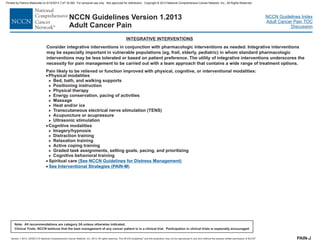
Psychosocial Support (PAIN-H)
Patient and Family/Caregiver Education (PAIN-I
Integrative Interventions (PAIN-J
)
)
)
)
)
)
)
)
)
)
)
)
)
)
)
)
Non-Opioid Analgesic (Nonsteroidal Anti-inflammatory Drugs
[NSAID ] and Acetaminophen) Prescribing (PAIN-K
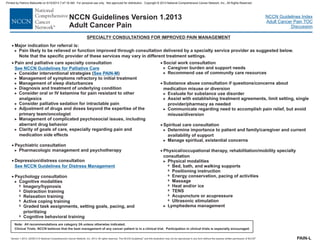
Specialty Consultations for Improved Pain Management (PAIN-L
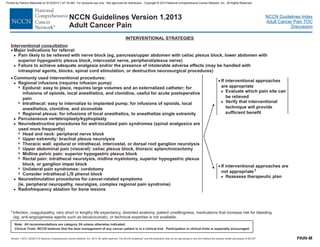
Interventional Strategies (PAIN-M
)
)
)
s
Printed by Patricio Matovelle on 5/15/2013 7:47:16 AM. For personal use only. Not approved for distribution. Copyright © 2013 National Comprehensive Cancer Network, Inc., All Rights Reserved.
Version 1.2013, 02/05/13 © National Comprehensive Cancer Network, Inc. 2013, All rights reserved. The NCCN Guidelines and this illustration may not be reproduced in any form without the express written permission of NCCN .®®
NCCN Guidelines Index
Adult Cancer Pain TOC
Discussion
UPDATES
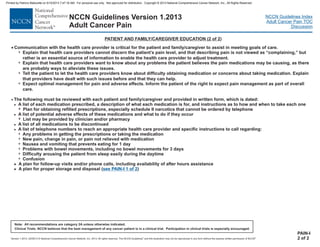
NCCN Guidelines Version 1.2013 Updates
Adult Cancer Pain
Continued on next page
PAIN-1
PAIN-2
PAIN-3
PAIN-6
PAIN-7
PAIN-C 1 of 3
PAIN-C 2 of 3
·
·
·
·
·
·
·
·
Principles of Cancer Pain Management
1st bullet was modified as: “There is increasing evidence in oncology
that survival is linked to control
. To maximize
patient outcomes, pain is an essential part of oncologic
management.”
4th bullet was modified as: “Comprehensive pain assessment must be
performed .”
7th bullet was modified as: “Pain intensity must be quantified
by the patient...”
Three new bullets were added:
Goals of pain management are improved comfort and function.
Persistent cancer pain often requires treatment with regularly
scheduled analgesics, and supplemental doses of analgesics are
often required to manage breakthrough pain.
Optimize integrative interventions (See PAIN-J).
Assessment, the following bullets were clarified as:
Comprehensive pain assessment (See PAIN-C) in order to identify
etiology
pathophysiology
Specific cancer pain syndrome (See PAIN-D)
Patient goals for comfort and function
Pain related to an oncologic emergency
“Brain metastases” was removed.
odone daily, or at least 8 mg of oral hydromorphone daily or an
equianalgesic dose of another opioid for a week or longer.”
For all pain levels
7th bullet was added: “Consider nonsteroidal anti-inflammatory drugs
(NSAIDs) or acetaminophen (See PAIN-K).” This bullet was removed
from “Mild Pain (1-3).”
Footnote “f” was added: “Not including transmucosal fentanyl dose.”
For all pain levels
5th bullet was added: “Optimize integrative interventions (See PAIN-J).”
Ongoing care
1st bullet was modified: ...including extended-release
t with rescue doses...”
6th bullet, a sub-bullet was added: “Clarify which clinician will be
prescribing patient’s ongoing analgesics.”
8th bullet, a link to PAIN-I for patient and family/caregiver education was
added.
Pain experience
Special issues relating to pain, the 3rd sub-bullet was modified as:
“Cultural beliefs toward pain, pain expression, .”
>
>
>
>
7
7
7
>
7
7
7
7
>
>
>
>
>
symptom and that pain
management contributes to quality-of-life improvement
management
if pain is present
and
quality must be characterized
Pain
Pain
or long-acting
agen
and treatment
pain
pain
Determine
· Footnotes
.
>
>
Footnote “c” was modified by adding: “...and therefore have not
developed significant tolerance. The FDA identifies tolerance as
receiving at least 60 mg of morphine daily, at least 30 mg of oral
oxycodone daily, or at least 8 mg of oral hydromorphone daily or an
equianalgesic dose of another opioid for a week or longer.” (Also for
PAIN-3 and PAIN-4)
Footnote “d” was modified by adding: “The FDA identifies tolerance as
receiving at least 60 mg of morphine daily, at least 30 mg of oral
oxyc
(Also for
PAIN-5 and PAIN-6)
Breakthrough pain is episodic pain not
controlled with existing pain regimen; see breakthrough pain on PAIN-E
3 of 9
>
>
>
New bullet was added: “
”
PAIN-5
· Pyschosocial
Sub-bullet was modified: “Patient, environmental, and social factors
.” Three supporting references were added.
> as
identified by a detailed patient evaluation and/or screening tools (eg,
SOAPP-R or ORT)
Updates in Version 1.2013 of the NCCN for Adult Cancer Pain from Version 2.2012 include:Guidelines
Printed by Patricio Matovelle on 5/15/2013 7:47:16 AM. For personal use only. Not approved for distribution. Copyright © 2013 National Comprehensive Cancer Network, Inc., All Rights Reserved.
Version 1.2013, 02/05/13 © National Comprehensive Cancer Network, Inc. 2013, All rights reserved. The NCCN Guidelines and this illustration may not be reproduced in any form without the express written permission of NCCN .®®
NCCN Guidelines Index
Adult Cancer Pain TOC
Discussion
UPDATES
NCCN Guidelines Version 1.2013 Updates
Adult Cancer Pain
PAIN-D
·
·
·
·
·
Bone pain without oncologic emergency
Consider trial of bone-modifying agents (eg, bisphosphonates)
Opioids and Risk Evaluation and Mitigation Strategy (REMS)
Last sub-bullet was revised as: “REMS programs are currently in place
for all transmucosal fentanyl products, ,
transdermal buprenorphine (See Approved Risk Evaluation and
Mitigation Strategies [REMS]),
. See FDA
Questions and Answers for REMS for Extended-Release and Long-
Acting Opioid Analgesics.”
Principles of Maintenance Opioid Therapy
4th bullet was clarified as: “Breakthrough pain (pain that fails to be
controlled or “breaks through” a regimen of regularly scheduled
opioid)
.
Miscellaneous analgesics page is new to this section.
Convert or Rotate From One Opioid to Another Opioid
A 6th point was added: “Data do not support a specific transmucosal
fentanyl dose equianalgesic to other opioids or between different
transmucosal formulations. Always initiate transmucosal fentanyl with
lowest dose in chosen formulation and titrate to effect. (See specific
transmucosal prescribing information for appropriate dosing
intervals.)”
>
7
7
>
>
>
2nd and 3rd sub-bullets were separated and clarified as:
Consider hormonal or chemotherapy,
corticosteroids, and/or systemic administration of radioisotopes
4th sub-bullet was modified: “...nerve block (eg, rib pain),
”
6th sub-bullet was added: “Consider orthopedic consultation for
stabilization, if feasible.”
7th sub-bullet was modified: Consider referral to a
pain specialist interventional
.
may be further
Diffuse bone pain:
or
vertebroplasty
for
consultation
evaluated into the
following categories, which have direct impact on treatment:”
>
>
> “For resistant pain:
and/or the use of strategies
categorized as
transdermal fentanyl products
all extended-release opioids, and long-acting
opioids (methadone)
may require additional doses of opioid for pain not relieved by
regular schedule of long-acting (eg, extended release) opioid
Breakthrough pain
and in 2013 the FDA will introduce
REMS starting with continuing education for morphine-naltrexone
combination product,
extended-release hydromorphone, extended-
release tapentadol, extended-release oxymorphone
PAIN-E 1 of 10
PAIN-E 4 of 10
PAIN-E 5 of 10
PAIN-E 6 of 10
PAIN-E 9 of 10
·
·
·
·
·
General Principles
2nd bullet was modified as: “...decreased renal/hepatic function,
, and upper airway compromise...”
3rd bullet was modified by removing: “...(ie, IV, subcutaneous, rectal,
transdermal, transmucosal )...”
8th bullet was modified by adding: “If/when pain improves...
...”
Last bullet was modified by adding: “May include patient survey tool
(eg, COMM)” with a reference.
A new bullet was added: “For breakthrough pain, see PAIN-E 3 of 10.”
Footnote “7” was modified as: “Hydrocodone is only available
commercially combined with acetaminophen (325 to 750 mg/tablet)
).
.”
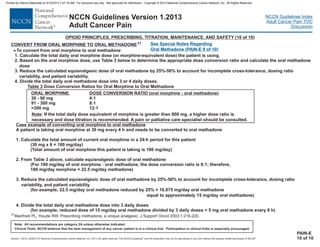
Table 2
Transdermal fentanyl dose of “12 mcg/h” and the morphine
equivalents were added.
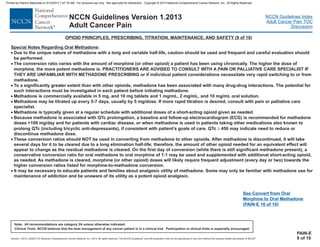
4th bullet was modified as: “Methadone is commercially available in 5
mg and 10 mg tablets and 1 mg/mL, oral
solution.”
5th bullet was modified by adding: “If more rapid titration is desired,
consult with pain or palliative care specialist.”
>
>
>
>
>
>
COPD,
, buccal
chronic lung disease
and
optimize use of nonopioid analgesics
or
ibuprofen (200 mg/tablet The FDA will be limiting the amount of
acetaminophen in all prescription drug products to no more than 325 mg
per dosage unit
2 mg/mL, and 10 mg/mL
PAIN-E 2 of 10
PAIN-E 3 of 10
PAIN-E 7 of 10
Continued on next page
Updates in Version 1.2013 of the NCCN for Adult Cancer Pain from Version 2.2012 include:Guidelines
Printed by Patricio Matovelle on 5/15/2013 7:47:16 AM. For personal use only. Not approved for distribution. Copyright © 2013 National Comprehensive Cancer Network, Inc., All Rights Reserved.
Version 1.2013, 02/05/13 © National Comprehensive Cancer Network, Inc. 2013, All rights reserved. The NCCN Guidelines and this illustration may not be reproduced in any form without the express written permission of NCCN .®®
NCCN Guidelines Index
Adult Cancer Pain TOC
Discussion
UPDATES
NCCN Guidelines Version 1.2013 Updates
Adult Cancer Pain
PAIN-F 1 of 3
·
·
Constipation, Preventative Measures
If constipation develops
“Treat other causes” was removed.
...(eg, metoclopramide, 10- mg PO 4
times a day; chronic use due to
concern for neurologic complications
).”
7th sub-bullet was modified: “
consider opioid rotation to fentanyl or methadone.”
>
>
>
>
A new sub-bullet was added: “Stool softener (docusate) alone may not
provide benefit in well-hydrated patients.”
If constipation persists
5th sub-bullet was modified: “
·
2015
consider limiting to maximum 3 mo,
[tardive dyskinesia], especially
in frail, elderly patients
For intractable chronic constipation,
PAIN-F of 3
PAIN-G 2 of 2
2
·
·
·
·
·
·
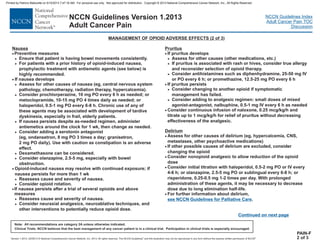
Nausea
2nd sub-bullet was modified: “
A new sub-bullet was added: “Consider olanzapine, 2.5-5 mg,
especially with bowel obstruction.”
3rd bullet was modified: “
if nausea persists for more than 1 wk.”
Delirium
4th bullet was modified: “
Respiratory Depression
Sedation
Antidepressants
Other examples, “Bupropion- Starting dose 100-150 mg daily, increase
to 150-450 mg daily” was deleted.
>
7
7
>
>
>
>
>
2nd bullet was modified by removing: “If nausea develops
.”
...or metoclopramide, 10-15 mg PO
as needed; or haloperidol, 0.5-1 mg PO
every 6-8 h.
.”
Consider haloperidol, 0.5-
2 mg PO or IV every 4-6 h; or olanzapine, 2.5-5 mg PO or sublingual
every 6-8 h; or risperidone, 0.25-0.5 mg 1-2 times per day.
”
3rd bullet was modified: “If respiratory problems
consider
naloxone administration .”
4th bullet was modified: “If reversing an opioid with a long half-life such
as methadone consider
naloxone infusion.”
5th bullet was added: “Closely monitor for the recurrence of pain as
opioid is metabolized during reversal, which may require a cautious
administration of an additional opioid.”
1st bullet was modified: “If sedation develops
and persists for more than after initiating
opioid.”
Last bullet was added: “If the patient has had marked sleep deprivation
related to poor pain control, adjustments of analgesics to improve pain
control may result in "catch up" sleep lasting 2-3 days. Therefore,
extreme fatigue can result in somnolence that may be difficult to
differentiate from opioid-induced sedation. If related to fatigue, patients
generally can be fully aroused, although this may require some effort.”
The note regarding tamoxifen was modified as: “Note: Some SSRI, SNRI
antidepressants
thereby of tamoxifen
- see Discussion.”
(Drugs
listed in alphabetical order)
20
every 6 hr
acute changes in mental status occur
1 wk
duloxetine, bupropion, may
enhance metabolism of tamoxifen
4 times daily
Chronic use of any of these agents may be associated
with development of tardive dyskinesia, especially in frail, elderly
patients
initial titration with
With
prolonged administration of these agents, it may be necessary to
decrease dose due to long elimination half-life.
or opioid-induced
sedation occurs,
but use reversing agents cautiously
or for persistent opioid-induced sedation,
significant or unexpected
2-3 d or a significant
upward titration of an
may inhibit the conversion of tamoxifen
to its active metabolite, decreasing the effectiveness
Opioid-induced nausea may resolve with
continued exposure;
>
>
>
such as and especially
PAIN-F 3 of 3
Updates in Version 1.2013 of the NCCN for Adult Cancer Pain from Version 2.2012 include:Guidelines
Continued on next page
Printed by Patricio Matovelle on 5/15/2013 7:47:16 AM. For personal use only. Not approved for distribution. Copyright © 2013 National Comprehensive Cancer Network, Inc., All Rights Reserved.
Version 1.2013, 02/05/13 © National Comprehensive Cancer Network, Inc. 2013, All rights reserved. The NCCN Guidelines and this illustration may not be reproduced in any form without the express written permission of NCCN .®®
NCCN Guidelines Index
Adult Cancer Pain TOC
Discussion
UPDATES
NCCN Guidelines Version 1.2013 Updates
Adult Cancer Pain
PAIN-I 1 of 2
·
·
Patient and Family/Caregiver Education
This page was reorganized by separating the messages to be
conveyed into: “Messages to be conveyed to patient and
family/caregiver regarding management of pain” and “Messages to be
conveyed to patient and family/caregiver regarding opioid analgesics.”
Messages to be conveyed to patient and family/caregiver regarding
opioid analgesics
2nd sub-bullet was clarified as: “When these medications are used to
treat cancer pain, addiction is rarely a problem
.
3rd sub-bullet, all bullets related to “safe use” of medications were
moved to this sub-bullet titled, “These medications are controlled
substances and must be used with caution:...”
>
>
>
unless addiction issues
existed before the cancer pain
·
·
The following must be reviewed:
1st sub-bullet, a new bullet was added: “Plan for obtaining refilled
prescriptions, especially schedule II narcotics that cannot be ordered
by telephone.”
2nd sub-bullet, a new bullet was added: “List may be provided by
clinician and/or pharmacy.”
Acetaminophen
1st bullet was clarified by adding: “Acetaminophen, 650 mg every 4 h
or 1 g every 6 h (daily maximum 4 g/d)
.”
>
>
>
in adult patients with normal
liver function
PAIN-I 2 of 2
PAIN-K
PAIN-L
· Pain and palliative care specialty consultation
The following sub-bullets were added:
Consider oral or IV ketamine for pain resistant to other analgesics
Adjustment of drugs and doses beyond the expertise of the primary
team/ oncologist
Management of complicated psychosocial issues, including aberrant
drug behavior
>
7
7
7
7 Clarity of goals of care, especially regarding pain and medication side
effects
A new bullet was added: “Psychiatric consultation.”·
Updates in Version 1.2013 of the NCCN for Adult Cancer Pain from Version 2.2012 include:Guidelines
Printed by Patricio Matovelle on 5/15/2013 7:47:16 AM. For personal use only. Not approved for distribution. Copyright © 2013 National Comprehensive Cancer Network, Inc., All Rights Reserved.
Version 1.2013, 02/05/13 © National Comprehensive Cancer Network, Inc. 2013, All rights reserved. The NCCN Guidelines and this illustration may not be reproduced in any form without the express written permission of NCCN .®®
NCCN Guidelines Index
Adult Cancer Pain TOC
Discussion
Note: All recommendations are category 2A unless otherwise indicated.
Clinical Trials: NCCN believes that the best management of any cancer patient is in a clinical trial. Participation in clinical trials is especially encouraged.
NCCN Guidelines Version 1.2013
Adult Cancer Pain
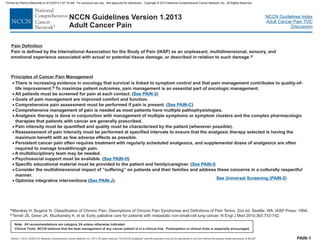
PAIN-1
Pain Definition
Principles of Cancer Pain Management
Pain is defined by the International Association for the Study of Pain (IASP) as an unpleasant, multidimensional, sensory, and
emotional experience associated with actual or potential tissue damage, or described in relation to such damage.a
aMerskey H, Bugduk N. Classification of Chronic Pain. Descriptions of Chronic Pain Syndromes and Definitions of Pain Terms. 2nd ed. Seattle, WA: IASP Press; 1994.
bTemel JS, Greer JA, Muzikansky A, et al. Early palliative care for patients with metastatic non-small-cell lung cancer. N Engl J Med 2010;363:733-742.
·
·
·
·
·
·
·
·
·
·
·
·
·
There is increasing evidence in oncology that survival is linked to symptom control and that pain management contributes to quality-of-
life improvement. To maximize patient outcomes, pain management is an essential part of oncologic management.
All patients must be screened for pain at each contact. ( )
Goals of pain management are improved comfort and function.
analgesic
Persistent cancer pain often requires tre
( )
b
Comprehensive pain assessment must be performed if pain is present. ( )
Comprehensive management of pain is needed as most patients have multiple pathophysiologies.
Analgesic therapy is done in conjunction with management of multiple symptoms or symptom clusters and the complex pharmacologic
therapies that patients with cancer are generally prescribed.
Pain intensity must be quantified and quality must be characterized by the patient (whenever possible).
Reassessment of pain intensity must be performed at specified intervals to ensure that the therapy selected is having the
maximum benefit with as few adverse effects as possible.
Psychosocial support must be available. ( )
Specific educational material must be provided to the patient and family/caregiver.
Consider the multidimensional impact of “suffering” on patients and their families and address these concerns in a culturally respectful
manner.
atment with regularly scheduled analgesics, and supplemental doses of analgesics are often
required to manage breakthrough pain.
Optimize integrative interventions ( ).
· A multidisciplinary team may be needed.
See PAIN-2
See PAIN-I
See PAIN-C
See PAIN-H
See PAIN-J
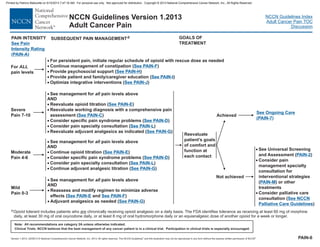
See Universal Screening (PAIN-2)
Printed by Patricio Matovelle on 5/15/2013 7:47:16 AM. For personal use only. Not approved for distribution. Copyright © 2013 National Comprehensive Cancer Network, Inc., All Rights Reserved.
Version 1.2013, 02/05/13 © National Comprehensive Cancer Network, Inc. 2013, All rights reserved. The NCCN Guidelines and this illustration may not be reproduced in any form without the express written permission of NCCN .®®
NCCN Guidelines Index
Adult Cancer Pain TOC
Discussion
Note: All recommendations are category 2A unless otherwise indicated.
Clinical Trials: NCCN believes that the best management of any cancer patient is in a clinical trial. Participation in clinical trials is especially encouraged.
NCCN Guidelines Version 1.2013
Adult Cancer Pain
Opioid-
na ve
patients
ï
c
Opioid-
tolerant
patientsd
See
of Pain in Opioid-
Na ve Patients
PAIN-3
Management
ï
( )
See Management
of Pain in Opioid-
Tolerant Patients
Pain Rating 4
(PAIN-5
Pain Rating 0-3
See PAIN-6
³
)
( )
or
Analgesics as
specified by above
pathway in addition to
specific treatment for
oncologic emergency
(eg, surgery, steroids,
radiation therapy [RT],
antibiotics)
If no pain
If pain
present
Pain not related
to an oncologic
emergency
Pain related to an
oncologic emergency:
Bone fracture or
impending fracture of
weight-bearing bone
Epidural metastases
Leptomeningeal
metastases
Infection
Obstructed or perforated
viscus (acute abdomen)
·
·
·
·
·
UNIVERSAL SCREENING
·
·
Quantify pain
intensity and
characterize quality
Severe uncontrolled
pain is a medical
emergency and
should be responded
to promptly
> See Pain Intensity
Rating (PAIN-A)
· Comprehensive pain
assessment ( )
in order to identify
athophysiology
Specific cancer pain
syndrome ( )
Patient goals for
comfort and function
>
>
See PAIN-C
See PAIN-D
>
>
Pain etiology
Pain p
PAIN-2
Screen
for pain
Rescreen at each
subsequent visit
ASSESSMENT MANAGEMENT OF PAIN
Anticipated
painful events
and procedures
Painful
events and
procedures
See Procedure-Related
Pain and Anxiety (PAIN-B)
See Procedure-
Related Pain and
Anxiety (PAIN-B)
cOpioid naïve includes patients who chronically receiving opioid
analgesic on a daily basis and therefore have not developed significant
tolerance. The FDA identifies tolerance as receiving at least 60 mg of
morphine daily, at least 30 mg of oral oxycodone daily, or at least 8 mg of oral
hydromorphone daily or an equianalgesic dose of another opioid for a week
or longer.
are not
dOpioid tolerant includes patients who chronically receiving opioid analgesic on a
daily basis.
are
The FDA identifies tolerance as receiving at least 60 mg of morphine daily,
at least 30 mg of oral oxycodone daily, or at least 8 mg of oral hydromorphone daily or
an equianalgesic dose of another opioid for a week or longer.
Printed by Patricio Matovelle on 5/15/2013 7:47:16 AM. For personal use only. Not approved for distribution. Copyright © 2013 National Comprehensive Cancer Network, Inc., All Rights Reserved.
Version 1.2013, 02/05/13 © National Comprehensive Cancer Network, Inc. 2013, All rights reserved. The NCCN Guidelines and this illustration may not be reproduced in any form without the express written permission of NCCN .®®
NCCN Guidelines Index
Adult Cancer Pain TOC
Discussion
Note: All recommendations are category 2A unless otherwise indicated.
Clinical Trials: NCCN believes that the best management of any cancer patient is in a clinical trial. Participation in clinical trials is especially encouraged.
NCCN Guidelines Version 1.2013
Adult Cancer Pain
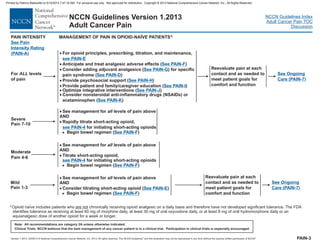
MANAGEMENT OF PAIN IN OPIOID-NAÏVE PATIENTSc
Moderate
Pain 4-6
Mild
Pain 1-3
Severe
Pain 7-10
·
·
See management for levels of pain above
AND
Rapidly titrate short-acting opioid,
for initiating short-acting opioids
Begin bowel regimen ( )
all
>
see PAIN-4
See PAIN-F
·
·
See management for levels of pain above
AND
for initiating short-acting opioids
Begin bowel regimen ( )
all
Titrate short-acting opioid,
>
see PAIN-4
See PAIN-F
· See management for levels of pain above
AND
Begin bowel regimen ( )
all
Consider titrating short-acting opioid ( )
>
· See PAIN-E
See PAIN-F
Reevaluate pain at each
contact and as needed to
meet patient goals for
comfort and function
PAIN-3
See Ongoing
Care (PAIN-7)
For levels
of pain
ALL
·
·
For opioid principles, prescribing, titration, and maintenance,
Anticipate a
see PAIN-E
nd treat analgesic effects ( )
Consider adding adjuvant analgesics ( ) for specific
pain syndrome ( )
adverse
Provide psychosocial support ( )
Provide patient and family education ( )
Optimize integrative interventions ( )
·
·
·
·
See PAIN-F
See PAIN-G
See PAIN-D
See PAIN-H
See PAIN-I
See PAIN-J
/caregiver
· Consider nonsteroidal anti-inflammatory drugs (NSAIDs) or
acetaminophen ( )See PAIN-K
PAIN INTENSITY
See Pain
Intensity Rating
PAIN-A( )
cOpioid naïve includes patients who chronically receiving opioid analgesic on a daily basis and therefore have not developed significant tolerance. The FDA
identifies tolerance as receiving at least 60 mg of morphine daily, at least 30 mg of oral oxycodone daily, or at least 8 mg of oral hydromorphone daily or an
equianalgesic dose of another opioid for a week or longer.
are not
Reevaluate pain at each
contact and as needed to
meet patient goals for
comfort and function
See Ongoing
Care (PAIN-7)
Printed by Patricio Matovelle on 5/15/2013 7:47:16 AM. For personal use only. Not approved for distribution. Copyright © 2013 National Comprehensive Cancer Network, Inc., All Rights Reserved.
Version 1.2013, 02/05/13 © National Comprehensive Cancer Network, Inc. 2013, All rights reserved. The NCCN Guidelines and this illustration may not be reproduced in any form without the express written permission of NCCN .®®
NCCN Guidelines Index
Adult Cancer Pain TOC
Discussion
Note: All recommendations are category 2A unless otherwise indicated.
Clinical Trials: NCCN believes that the best management of any cancer patient is in a clinical trial. Participation in clinical trials is especially encouraged.
NCCN Guidelines Version 1.2013
Adult Cancer Pain
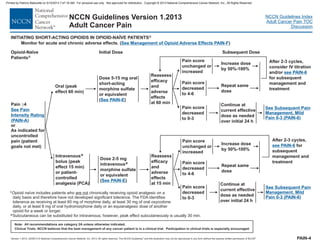
INITIATING SHORT-ACTING OPIOIDS IN OPIOID-NA VE PATIENTScÏ
Oral (peak
effect 60 min)
Pain 4
or
³
As indicated for
uncontrolled
pain (patient
goals not met)
See Pain
Intensity Rating
PAIN-A( )
Intravenous
bolus (peak
effect 15 min)
or patient-
controlled
analgesia (PCA)
e
Dose 5-15 mg oral
short-acting
morphine sulfate
or equivalent
( )See PAIN-E
Dose 2-5 mg
intravenous
morphine sulfate
or equivalent
( )
e
See PAIN-E
eSubcutaneous can be substituted for intravenous; however, peak subcutaneously is usually 30 min.effect
Pain score
unchanged or
increased
Pain score
decreased
to 4-6
Pain score
decreased
to 0-3
Reassess
efficacy
and
effects
at 60 min
adverse
Increase dose
by 50%-100%
Repeat same
dose
Pain score
unchanged or
increased
Pain score
decreased
to 4-6
Pain score
decreased
to 0-3
Reassess
at 15 min
efficacy
and
adverse
effects
Repeat same
dose
Initial Dose Subsequent Dose
PAIN-4
Continue at
current effective
dose as needed
over initial 24 h
Monitor for acute and chronic adverse effects. ( )See Management of O cts PAIN-Fpioid EffeAdverse
Increase dose
by 50%-100%
Opioid-Na ve
Patients
ï
c
cOpioid na ve includes patients who chronically receiving opioid analgesic on a
daily basis and therefore have not developed significant tolerance.
are notï
The FDA identifies
tolerance as receiving at least 60 mg of morphine daily, at least 30 mg of oral oxycodone
daily, or at least 8 mg of oral hydromorphone daily or an equianalgesic dose of another
opioid for a week or longer.
After 2-3 cycles,
consider IV titration
and/or
for subsequent
management and
treatment
see PAIN-6
After 2-3 cycles,
for
subsequent
management and
treatment
see PAIN-6
See Subsequent Pain
Management, Mild
Pain 0-3 (PAIN-6)
)
See Subsequent Pain
Management, Mild
Pain 0-3 (PAIN-6
Continue at
current effective
dose as needed
over initial 24 h
Printed by Patricio Matovelle on 5/15/2013 7:47:16 AM. For personal use only. Not approved for distribution. Copyright © 2013 National Comprehensive Cancer Network, Inc., All Rights Reserved.
Version 1.2013, 02/05/13 © National Comprehensive Cancer Network, Inc. 2013, All rights reserved. The NCCN Guidelines and this illustration may not be reproduced in any form without the express written permission of NCCN .®®
NCCN Guidelines Index
Adult Cancer Pain TOC
Discussion
Note: All recommendations are category 2A unless otherwise indicated.
Clinical Trials: NCCN believes that the best management of any cancer patient is in a clinical trial. Participation in clinical trials is especially encouraged.
NCCN Guidelines Version 1.2013
Adult Cancer Pain
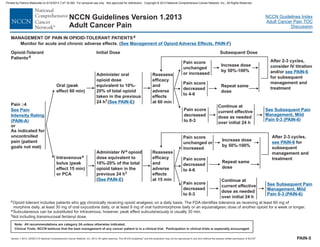
MANAGEMENT OF PAIN IN OPIOID-TOLERANT PATIENTSd
Oral (peak
effect 60 min)
Pain 4
or
³
As indicated for
uncontrolled
pain (patient
goals not met)
See Pain
Intensity Rating
PAIN-A( )
Intravenous
bolus (peak
effect 15 min)
or PCA
e
Pain score
unchanged
or increased
Pain score
decreased
to 4-6
Pain score
decreased
to 0-3
Reassess
efficacy
and
effects
at 60 min
adverse
Increase dose
by 50%-100%
Repeat same
dose
Pain score
unchanged or
increased
Pain score
decreased
to 4-6
Pain score
decreased
to 0-3
Reassess
at 15 min
efficacy
and
adverse
effects
Repeat same
dose
Initial Dose Subsequent Dose
PAIN-5
Monitor for acute and chronic adverse effects. ( )See Management of Opioid ffects, PAIN-FAdverse E
Increase dose
by 50%-100%
Opioid-Tolerant
Patientsd
Administer IV opioid
dose equivalent to
10%-20% of the total
opioid taken in the
previous 24 h
( )
e
f
See PAIN-E
Administer oral
opioid dose
equivalent to 10%-
20% of total opioid
taken in the previous
24 h ( )f See PAIN-E
)
See Subsequent Pain
Management, Mild
Pain 0-3 (PAIN-6
dOpioid tolerant includes patients who chronically receiving opioid analgesic on a daily basis. The FDA identifies tolerance asare receiving at least 60 mg of
morphine daily, at least 30 mg of oral oxycodone daily, or at least 8 mg of oral hydromorphone daily or an equianalgesic dose of another opioid for a week or longer.
See Subsequent Pain
Management, Mild
Pain 0-3 (PAIN-6)
After 2-3 cycles,
consider IV titration
and/or
for subsequent
management and
treatment
see PAIN-6
After 2-3 cycles,
for
subsequent
management and
treatment
see PAIN-6
Continue at
current effective
dose as needed
over initial 24 h
Continue at
current effective
dose as needed
over initial 24 h
eSubcutaneous can be substituted for intravenous; however, peak subcutaneously is usually 30 min.effect
Not including transmucosal fentanyl dose.f
Printed by Patricio Matovelle on 5/15/2013 7:47:16 AM. For personal use only. Not approved for distribution. Copyright © 2013 National Comprehensive Cancer Network, Inc., All Rights Reserved.
Version 1.2013, 02/05/13 © National Comprehensive Cancer Network, Inc. 2013, All rights reserved. The NCCN Guidelines and this illustration may not be reproduced in any form without the express written permission of NCCN .®®
NCCN Guidelines Index
Adult Cancer Pain TOC
Discussion
Note: All recommendations are category 2A unless otherwise indicated.
Clinical Trials: NCCN believes that the best management of any cancer patient is in a clinical trial. Participation in clinical trials is especially encouraged.
NCCN Guidelines Version 1.2013
Adult Cancer Pain
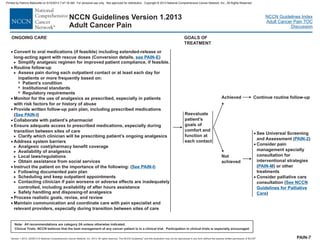
Severe
Pain 7-10
Moderate
Pain 4-6
Mild
Pain 0-3
·
·
·
·
·
·
See management for pain levels above
AND
Reevaluate opioid titration ( )
Reevaluate working diagnosis with a comprehensive pain
assessment ( )
Consider specific pain syndrome problems ( )
Consider pain specialty consultation ( )
Reevaluate adjuvant analgesics as indicated ( )
all
See PAIN-E
See PAIN-C
See PAIN-D
See PAIN-L
See PAIN-G
·
·
·
·
·
See management for pain levels above
AND
all
Consider specific pain syndrome problems ( )
Consider pain specialty consultation ( )
Continue adjuvant analgesic titration ( )
Continue opioid titration ( )See PAIN-E
See PAIN-D
See PAIN-L
See PAIN-G
·
·
·
See management for pain levels above
AND
Reassess and modify regimen to minimize
effects ( and )
Adjuvant analgesics as needed ( )
all
adverse
See PAIN-E See PAIN-F
See PAIN-G
SUBSEQUENT PAIN MANAGEMENTd
PAIN-6
For
pain levels
ALL
·
·
For persistent pain, initiate regular schedule of opioid with rescue dose as needed
Continue management of constipation ( )See PAIN-F
·
·
Provide psychosocial support ( )
Provide patient and family ducation ( )
See PAIN-H
See PAIN-I/caregiver e
Optimize integrative interventions ( )· See PAIN-J
Not achieved
Achieved
GOALS OF
TREATMENT
PAIN INTENSITY
See Pain
Intensity Rating
PAIN-A( )
dOpioid tolerant includes patients who chronically receiving opioid analgesic on a daily basis. The FDA identifies tolerance as receiving at least 60 mg of morphine
daily, at least 30 mg of oral oxycodone daily, or at least 8 mg of oral hydromorphone daily or an equianalgesic dose of another opioid for a week or longer.
are
Reevaluate
patient’s goals
of comfort and
function at
each contact
See Ongoing Care
(PAIN-7)
·
·
See Universal Screening
and Assessment ( )
Consider pain
management specialty
consultation for
interventional strategies
( ) or other
treatments
Consider palliative care
consultation (
)
·
PAIN-2
PAIN-M
See NCCN
Palliative Care Guidelines
Printed by Patricio Matovelle on 5/15/2013 7:47:16 AM. For personal use only. Not approved for distribution. Copyright © 2013 National Comprehensive Cancer Network, Inc., All Rights Reserved.
Version 1.2013, 02/05/13 © National Comprehensive Cancer Network, Inc. 2013, All rights reserved. The NCCN Guidelines and this illustration may not be reproduced in any form without the express written permission of NCCN .®®
NCCN Guidelines Index
Adult Cancer Pain TOC
Discussion
Note: All recommendations are category 2A unless otherwise indicated.
Clinical Trials: NCCN believes that the best management of any cancer patient is in a clinical trial. Participation in clinical trials is especially encouraged.
NCCN Guidelines Version 1.2013
Adult Cancer Pain
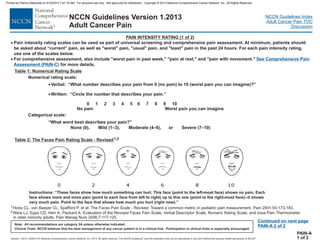
Continue routine follow-up
ONGOING CARE
·
·
·
·
tient contact or at least each day for
inpatients or more frequently based on:
Institutional standards
Regulatory requirements
( )
Collaborate with patient’s pharmacist
Ens
7 Patient’s condition
ding prescribed medications
eview
Maintain communication and coordinate care with pain specialist and
relevant providers, especially during transition between sites of care
7
7
Convert to or
with rescue doses (Conversion details, )
Simplify analgesic regimen for improved patient compliance, if feasible.
Routine follow-up
Monitor for the use of analgesics as prescribed, especially in patients
with risk factors for or history of abuse
Provide written follow-up pain plan, inclu
>
·
·
·
> Assess pain during each outpa
al medications (if feasible) including extended-release or
long-acting agent see PAIN-E
See PAIN-I
ure adequate access to prescribed medications, especially during
transition between sites of care
prescribing patient’s
Analgesic cost/pharmacy benefit coverage
Availability of analgesics
Local laws/regulations
Obtain assistance from social services
(
Following documented pain plan
Contacting clinician if pain worsens or effects are inadequately
controlled, including availability of after hours assistance
Safely handling and disposing of analgesics
>
>
>
>
Clarify which clinician will be ongoing analgesics
Address system barriers
Instruct the patient on the importance of the following:
Scheduling and keep outpatient appointments
Process realistic goals, revise, and r
·
·
·
>
>
>
>
>
adverse
See PAIN-I)
Reevaluate
patient’s
goals of
comfort and
function at
each contact
Not
achieved
·
·
·
Consider pain
management specialty
consultation for
interventional strategies
( ) or other
treatments
Consider palliative care
consultation (
See Universal Screening
and Assessment ( )
)
PAIN-2
See NCCN
Guidelines for Palliative
Care
PAIN-M
PAIN-7
Achieved
GOALS OF
TREATMENT
Printed by Patricio Matovelle on 5/15/2013 7:47:16 AM. For personal use only. Not approved for distribution. Copyright © 2013 National Comprehensive Cancer Network, Inc., All Rights Reserved.
Version 1.2013, 02/05/13 © National Comprehensive Cancer Network, Inc. 2013, All rights reserved. The NCCN Guidelines and this illustration may not be reproduced in any form without the express written permission of NCCN .®®
NCCN Guidelines Index
Adult Cancer Pain TOC
Discussion
Note: All recommendations are category 2A unless otherwise indicated.
Clinical Trials: NCCN believes that the best management of any cancer patient is in a clinical trial. Participation in clinical trials is especially encouraged.
NCCN Guidelines Version 1.2013
Adult Cancer Pain
1Hicks CL, von Baeyer CL, Spafford P, et al. The Faces Pain Scale - Revised: Toward a common metric in pediatric pain measurement. Pain 2001;93:173-183.
2Ware LJ, Epps CD, Herr K, Packard A. Evaluation of the Revised Faces Pain Scale, Verbal Descriptor Scale, Numeric Rating Scale, and Iowa Pain Thermometer
in older minority adults. Pain Manag Nurs 2006;7:117-125.
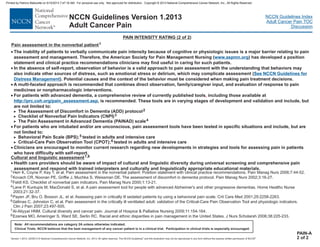
PAIN INTENSITY RATING (1 of 2)
·
·
Verbal: “ from 0 (no pain) to 10 (worst pain you can imagine)?”
Written: “Circle the number that describes ”
0 1 2 3 4 5 6 7 8 9 10
No pain Worst pain you can imagine
What number describes your pain
your pain.
“What word best describes your pain?”
None (0), Mild (1–3), Moderate (4–6), or Severe (7–10)
Table 1: Numerical Rating Scale
Continued on next page
PAIN-A 2 of 2
Numerical rating scale:
Categorical scale:
PAIN-A
1 of 2
Table 2: The Faces Pain Rating Scale - Revised1,2
Instructions: “These faces show how much something can hurt. This face (point to the left-most face) shows no pain. Each
face shows more and more pain (point to each face from left to right) up to this one (point to the right-most face)--it shows
very much pain. Point to the face that shows how much you hurt (right now).”
· Pain intensity rating scales can be used as part of universal screening and comprehensive pain assessment. At minimum, patients should
be asked about “current” pain, . For each pain intensity rating,
use one of the scales below.
For comprehensive assessment, also include "worst pain in past week," "pain at rest," and "pain with movement."
for more details.
as well as "worst" pain, "usual" pain, and "least" pain in the past 24 hours
· See Comprehensive Pain
Assessment (PAIN-C)
Printed by Patricio Matovelle on 5/15/2013 7:47:16 AM. For personal use only. Not approved for distribution. Copyright © 2013 National Comprehensive Cancer Network, Inc., All Rights Reserved.
Version 1.2013, 02/05/13 © National Comprehensive Cancer Network, Inc. 2013, All rights reserved. The NCCN Guidelines and this illustration may not be reproduced in any form without the express written permission of NCCN .®®
NCCN Guidelines Index
Adult Cancer Pain TOC
Discussion
Note: All recommendations are category 2A unless otherwise indicated.
Clinical Trials: NCCN believes that the best management of any cancer patient is in a clinical trial. Participation in clinical trials is especially encouraged.
NCCN Guidelines Version 1.2013
Adult Cancer Pain
PAIN INTENSITY RATING (2 of 2)
PAIN-A
2 of 2
·
·
·
·
·
·
The inability of patients to verbally communicate pain intensity because of cognitive or physiologic issues is a major barrier relating to pain
assessment and management. Therefore, the American Society for Pain Management Nursing ( ) has developed a position
statement and clinical practice recommendations clinicians may find useful in caring for such patients.
In the absence of self-report, observation of behavior is a valid approach to pain assessment with the understanding that behaviors may
also indicate other sources of distress, such as emotional stress or delirium, which (
). Potential causes and the context of the behavior must be considered when making pain treatment decisions.
A multi-faceted approach is recommended that combines direct observation, family/caregiver input, and evaluation of response to pain
medicines or nonpharmacologic interventions.
For patients with advanced dementia, a comprehensive review of currently published tools including those available at
se tools are in varying stages of development and validation and include, but
are not limited to:
The Assessment of Discomfort in Dementia (ADD) protocol
Checklist of Nonverbal Pain Indicators (CNPI)
The Pain Assessment in Advanced Dementia (PAINAD) scale
For patients who are intubated and/or are unconscious, pain assessment tools have been tested in specific situations and include, but are
not limited to:
Behavioral Pain Scale (BPS) tested in adults and intensive care
Critical-Care Pain Observation Tool (CPOT) tested in adults and intensive care
Clinicians are encouraged to monitor current research regarding new developments in strategies and tools for assessing pain in patients
who have difficulty with self-report.
may complicate assessment
;
;
>
>
>
>
>
2
3
4
5
6
www.aspmn.org
http://prc.coh.org/pain_assessment.asp
See NCCN Guidelines for
Distress Management
,
, is recommended. The
1
2
4
5
6
Herr K, Coyne P, Key T, et al. Pain assessment in the nonverbal patient: Position statement with clinical practice recommendations. Pain Manag Nurs 2006;7:44-52.
Kovach CR, Noonan PE, Griffie J, Muchka S, Weissman DE. The assessment of discomfort in dementia protocol. Pain Manag Nurs 2002;3:16-27.
Lane P, Kuntupis M, MacDonald S, et al. A pain assessment tool for people with advanced Alzheimer's and other progressive dementias. Home Healthc Nurse
2003;21:32-37.
Payen JF, Bru O, Bosson JL, et al. Assessing pain in critically ill sedated patients by using a behavioral pain scale. Crit Care Med 2001;29:2258-2263.
Gélinas C, Johnston C, et al. Pain assessment in the critically ill ventilated adult: validation of the Critical-Care Pain Observation Tool and physiologic indicators.
Clin J Pain 2007;23:497-505.
3
7
8
Feldt KS. Checklist of nonverbal pain indicators. Pain Manag Nurs 2000;1:13-21.
Al-Atiyyat HNM. Cultural diversity and cancer pain. Journal of Hospice & Palliative Nursing 2009;11:154-164.
Ezenwa MO, Ameringer S, Ward SE, Serlin RC. Racial and ethnic disparities in pain management in the United States. J Nurs Scholarsh 2006;38:225-233.
Pain assessment in the nonverbal patient1
Cultural and linguistic assessment7,8
· Health care providers should be aware of impact of cultural and linguistic diversity during universal screening and comprehensive pain
assessment and respond with trained interpreters and culturally and linguistically appropriate educational materials.
Printed by Patricio Matovelle on 5/15/2013 7:47:16 AM. For personal use only. Not approved for distribution. Copyright © 2013 National Comprehensive Cancer Network, Inc., All Rights Reserved.
Version 1.2013, 02/05/13 © National Comprehensive Cancer Network, Inc. 2013, All rights reserved. The NCCN Guidelines and this illustration may not be reproduced in any form without the express written permission of NCCN .®®
NCCN Guidelines Index
Adult Cancer Pain TOC
Discussion
Note: All recommendations are category 2A unless otherwise indicated.
Clinical Trials: NCCN believes that the best management of any cancer patient is in a clinical trial. Participation in clinical trials is especially encouraged.
NCCN Guidelines Version 1.2013
Adult Cancer Pain
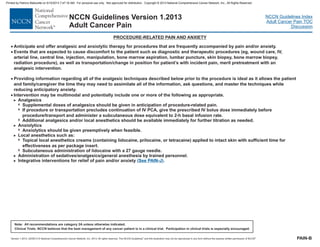
PROCEDURE-RELATED PAIN AND ANXIETY
· Intervention may be multimodal and potentially include one or more of the following as appropriate.
Analgesics
If procedure or transportation precludes continuation of IV PCA, give the prescribed IV bolus dose immediately before
procedure/transport and administer a subcutaneous dose equivalent to 2-h basal infusion rate.
Anxiolytics
hould be given preemptively when feasible.
Local anesthetics such as:
Topical local anesthetics creams (containing lidocaine, prilocaine tracaine) applied to intact skin with sufficient time for
effectiveness as per package insert.
Subcutaneous administration of lidocaine with a 27 gauge needle.
Administration of sedatives/analgesics/general anesthesia by trained personnel.
Integrative interventions for relief of pain and/or anxiety
>
7
7
7
>
7
>
7
7
>
>
Supplemental doses of analgesics should be given in anticipation of procedure-related pain.
Additional analgesics and/or local anesthetics should be available immediately for further titration as needed.
Anxiolytics s
, or te
( ).See PAIN-J
·
·
·
Anticipate and offer analgesic and anxiolytic therapy for procedures that are frequently accompanied by pain and/or anxiety.
Events that are expected to cause discomfort to the patient such as diagnostic and therapeutic procedures (eg, wound care, IV,
arterial line, central line, injection, manipulation, bone marrow aspiration, lumbar puncture, skin biopsy, bone marrow biopsy,
radiation procedure), as well as transportation/change in position for patient’s with incident pain, merit pretreatment with an
analgesic intervention.
Providing information regarding all of the analgesic techniques described below prior to the procedure is ideal as it allows the patient
and family/caregiver the time they may need to assimilate all of the information, ask questions, and master the techniques while
reducing anticipatory anxiety.
PAIN-B
Printed by Patricio Matovelle on 5/15/2013 7:47:16 AM. For personal use only. Not approved for distribution. Copyright © 2013 National Comprehensive Cancer Network, Inc., All Rights Reserved.
Version 1.2013, 02/05/13 © National Comprehensive Cancer Network, Inc. 2013, All rights reserved. The NCCN Guidelines and this illustration may not be reproduced in any form without the express written permission of NCCN .®®
NCCN Guidelines Index
Adult Cancer Pain TOC
Discussion
Note: All recommendations are category 2A unless otherwise indicated.
Clinical Trials: NCCN believes that the best management of any cancer patient is in a clinical trial. Participation in clinical trials is especially encouraged.
NCCN Guidelines Version 1.2013
Adult Cancer Pain
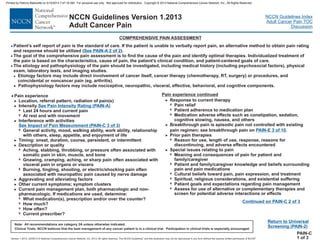
COMPREHENSIVE PAIN ASSESSMENT
·
>
>
7
7
>
7
Location, referral pattern, radiation of pain(s)
Intensity
sleep,
c and non-
pharmacologic. If medications are used, determine
What medication(s), prescription and/or over the counter?
How much?
How often?
Current prescriber?
Last 24 hours and current pain
At rest and with movement
Interference with activities
General activity, mood, walking ability, work ability, relationship
with others, appetite,
7
7
7
7
Pain experience
See Pain Intensity Rating (PAIN-A)
See Impact of Pain Measurement (PAIN-C 3 of 3)
and enjoyment of life
Timing: onset, duration, course, persistent, or intermittent
Description or quality
Aching, stabbing, throbbing, or pressure often associated with
somatic pain in skin, muscle, and bone
Gnawing, cramping, aching, or sharp pain often associated with
visceral pain in organs or viscera
ingling, shooting, or electric/shocking pain often
associated with neuropathic pain caused by nerve damage
Aggravating and alleviating factors
>
>
7
7
7
>
Burning, t
Other current symptoms; symptom clusters
Current pain management plan, both pharmacologi
:
>
>
Return to Universal
Screening (PAIN-2)
>
7
7
7
>
7
7
7
Pain relief
Patient adherence to medication plan
Medication
Prior pain therapies
Spiritual, religious considerations, and existential suffering
Patient goals and expectations regarding pain management
Assess for use of alternative or complementary therapies and
screen for potential adverse interactions or effects
adv
Response to current therapy
erse effects such as constipation, sedation,
cognitive slowing, nausea, and others
Breakthrough pain is episodic pain not controlled with existing
pain regimen; see breakthrough pain on .
Reason for use, length of use, response, reasons for
discontinuing, and adverse effects encountered
Meaning and consequences of pain for patient and
family/caregiver
Patient and family/caregiver knowledge and beliefs surrounding
pain and pain medications
Cultural beliefs toward pain, pain expression, and treatment
>
>
7
7
7
7
Special issues relating to pain
PAIN-E 3 of 10
·
·
·
The goal of the comprehensive pain assessment is to find the cause of the pain and identify optimal therapies. Individualized treatment of
the pain is based on the characteristics, cause of pain, the patient's clinical condition, and patient-centered goals of care.
The etiology and pathophysiology of the pain should be investigated, including medical history (including psychosocial factors), physical
exam, laboratory tests, and imaging studies.
Etiology factors may include direct involvement of cancer itself, cancer therapy (chemotherapy, surgery) or procedures, and
coincidental or noncancer pain (eg, arthritis).
>
> Pathophysiology factors may include nociceptive, neuropathic, visceral, effective, behavioral, and cognitive components.
Patient’s self report of pain is the standard of care. If the patient is unable to verbally report pain, an alternative method to obtain pain rating
and response should be utilized ( ).See PAIN-A 2 of 2
RT,
PAIN-C
1 of 3
Pain experience continued
Continued on PAIN-C 2 of 3
Printed by Patricio Matovelle on 5/15/2013 7:47:16 AM. For personal use only. Not approved for distribution. Copyright © 2013 National Comprehensive Cancer Network, Inc., All Rights Reserved.
Version 1.2013, 02/05/13 © National Comprehensive Cancer Network, Inc. 2013, All rights reserved. The NCCN Guidelines and this illustration may not be reproduced in any form without the express written permission of NCCN .®®
NCCN Guidelines Index
Adult Cancer Pain TOC
Discussion
Note: All recommendations are category 2A unless otherwise indicated.
Clinical Trials: NCCN believes that the best management of any cancer patient is in a clinical trial. Participation in clinical trials is especially encouraged.
NCCN Guidelines Version 1.2013
Adult Cancer Pain
COMPREHENSIVE PAIN ASSESSMENT
Return to Universal
Screening (PAIN-2)
·
·
·
>
>
>
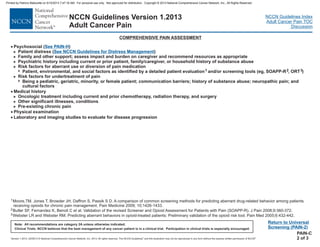
Patient distress
Family and other support; assess impact and burden on caregiver and recommend resources as appropriate
Psychiatric history including current or prior patien
Physical examination
Laboratory and imaging studies to evaluate for disease progression
nd surgery
Other significant illnesses, conditions
Pre-existing chronic pain
>
>
Psychosocial ( )See PAIN-H
( )
t, family/caregiver, or household history of substance abuse
Risk factors for aberrant use or diversion of pain medication
Risk factors for undertreatment of pain
minority, or female patient
>
7
>
7
>
Patient, environmental, and social factors as identified by a detailed patient evaluation and/or screening tools (eg, SOAPP-R , ORT )
Being a pediatric, geriatric, ; communication barriers; history of substance abuse; neuropathic pain; and
cultural factors
Medical history
Oncologic treatment including current and prior chemotherapy, radiation therapy, a
1 2 3
·
See NCCN Guidelines for Distress Management
PAIN-C
2 of 3
1
2
3
Moore,TM, Jones T, Browder JH, Daffron S, Passik S D. A comparison of common screening methods for predicting aberrant drug-related behavior among patients
receiving opioids for chronic pain management. Pain Medicine 2009; 10;1426-1433.
Butler SF, Fernandez K, Benoit C et al. J Pain 2008;9:360-372.
Webster LR and Webster RM. Predicting aberrant behaviors in opioid-treated patients: Preliminary validation of the opioid risk tool. Pain Med 2005;6:432-442.
Validation of the revised Screener and Opioid Assessment for Patients with Pain (SOAPP-R).
Printed by Patricio Matovelle on 5/15/2013 7:47:16 AM. For personal use only. Not approved for distribution. Copyright © 2013 National Comprehensive Cancer Network, Inc., All Rights Reserved.
Version 1.2013, 02/05/13 © National Comprehensive Cancer Network, Inc. 2013, All rights reserved. The NCCN Guidelines and this illustration may not be reproduced in any form without the express written permission of NCCN .®®
NCCN Guidelines Index
Adult Cancer Pain TOC
Discussion
Note: All recommendations are category 2A unless otherwise indicated.
Clinical Trials: NCCN believes that the best management of any cancer patient is in a clinical trial. Participation in clinical trials is especially encouraged.
NCCN Guidelines Version 1.2013
Adult Cancer Pain
4
5
Cleeland CS, Nakamura Y, Mendoza et al. Dimensions of the impact of cancer pain in a four country sample: New information from multidimensional scaling. Pain
1996;67:267-273.
Serlin RC, Mendoza TR, Nakamura Y, et al. When is cancer pain mild, moderate or severe? Grading pain severity by its interference with function. Pain 1995;61:277-284.
6For the complete Brief Pain Inventory assessment tool, see mdanderson.org/bpi.
Mark the number that describes how much, in the past [week/24 hours], pain has interfered with your:
4. Normal Work (includes both work outside the home and housework)
0 1 2 3 4 5 6 7 8 9 10
Does not Completely
Interfere Interferes
IMPACT OF PAIN MEASUREMENT4,5,6
7. Enjoyment of life
0 1 2 3 4 5 6 7 8 9 10
Does not Completely
Interfere Interferes
PAIN-C
3 of 3
1. General Activity
0 1 2 3 4 5 6 7 8 9 10
Does not Completely
Interfere Interferes
2. Mood
0 1 2 3 4 5 6 7 8 9 10
Does not Completely
Interfere Interferes
3. Walking Ability
0 1 2 3 4 5 6 7 8 9 10
Does not Completely
Interfere Interferes
5. Relations with other people
0 1 2 3 4 5 6 7 8 9 10
Does not Completely
Interfere Interferes
6. Sleep
0 1 2 3 4 5 6 7 8 9 10
Does not Completely
Interfere Interferes
Printed by Patricio Matovelle on 5/15/2013 7:47:16 AM. For personal use only. Not approved for distribution. Copyright © 2013 National Comprehensive Cancer Network, Inc., All Rights Reserved.
Version 1.2013, 02/05/13 © National Comprehensive Cancer Network, Inc. 2013, All rights reserved. The NCCN Guidelines and this illustration may not be reproduced in any form without the express written permission of NCCN .®®
NCCN Guidelines Index
Adult Cancer Pain TOC
Discussion
Note: All recommendations are category 2A unless otherwise indicated.
Clinical Trials: NCCN believes that the best management of any cancer patient is in a clinical trial. Participation in clinical trials is especially encouraged.
NCCN Guidelines Version 1.2013
Adult Cancer Pain
ADDITIONAL INTERVENTIONS FOR CANCER PAIN SYNDROMES
·
·
·
Pain associated with inflammation:
Trial of NSAIDs or corticosteroids
Bone pain without oncologic emergency:
NSAIDs and titrate analgesic to effect
Consider physical medicine evaluation
.
Bowel obstruction
Evaluate etiology of bowel obstruction. If resulting from
cancer, consider palliative surgery, radiation, and/or
chemotherapy for symptomatic bowel obstruction.
Palliative management of bowel obstruction could include
bowel rest, nasogastric suction (or percutaneous gastrostomy
drainage), corticosteroids, and/or octreotide.
>
>
>
>
>
See
(PAIN-K
See Pain Specialty Consultation (PAIN-L
See Interventional Strategies (PAIN-M
)
)
)
Non-Opioid Analgesic (Nonsteroidal Anti-Inflammatory
Drugs [NSAI and Acetaminophen) PrescribingDs]
>
>
>
Consider trial of bone-modifying agents (eg, bisphosphonates)
Diffuse bone pain: Consider hormonal therapy or
chemotherapy, corticosteroids, and/or systemic administration
of radioisotopes
Local bone pain: Consider local radiation therapy, nerve block
(eg, rib pain), or vertebroplasty
Consider orthopedic consultation for stabilization, if feasible
Consider referral to a pain specialist for interventional
consultation
>
>
PAIN-D
In general, cancer pain is treated with opioids as indicated on these interventions are meant to complement management.PAIN-3;
· Nerve pain
>
7
7
7
7
7
Nerve compression or inflammation:
Trial of corticosteroids
Neuropathic pain:
Trial of antidepressant,
Trial of anticonvulsant,
Consider trial of topical agent,
For refractory pain,
l to a pain specialist and/or the use of
interventional strategies.
>
and/or
and/or
Painful lesions that are likely to respond to antineoplastic therapies:
Consider trial of radiation, hormones, or chemotherapy
For severe refractory pain in the imminently dying,
.
- Trial of opioid
- Consider referra
·
·
>
see PAIN-G
see PAIN-G
see PAIN-G
See Interventional Strategies (PAIN-M)
see NCCN Guidelines for Palliative Care
Printed by Patricio Matovelle on 5/15/2013 7:47:16 AM. For personal use only. Not approved for distribution. Copyright © 2013 National Comprehensive Cancer Network, Inc., All Rights Reserved.
Version 1.2013, 02/05/13 © National Comprehensive Cancer Network, Inc. 2013, All rights reserved. The NCCN Guidelines and this illustration may not be reproduced in any form without the express written permission of NCCN .®®
NCCN Guidelines Index
Adult Cancer Pain TOC
Discussion
Note: All recommendations are category 2A unless otherwise indicated.
Clinical Trials: NCCN believes that the best management of any cancer patient is in a clinical trial. Participation in clinical trials is especially encouraged.
NCCN Guidelines Version 1.2013
Adult Cancer Pain
OPIOID PRINCIPLES, PRESCRIBING, TITRATION, MAINTENANCE, AND SAFETY (1 of 10)
GENERAL PRINCIPLES
·
·
·
·
The appropriate dose is the dose that relieves the patient’s pain throughout the dosing interval without causing unmanageable adverse
effects.
V, subcutaneous, rectal, transdermal, transmucosal) can be considered
as indicated to maximize patient comfort. For intrathecal route administration, .
Calculate dosage increase based upon total opioid dose (around the clock/scheduled and as needed) taken in the previous 24 h.
Increase both around-the-clock and as-needed doses. The rapidity of dose escalation should be related to the severity of the symptoms.
.
According to FDA guidelines, when higher doses of analgesic are needed, switch from preparations of opioid combined with other
medications [such as aspirin or acetaminophen] to a pure opioid preparation to provide adequate analgesic to relieve pain while avoiding
the toxicities of the non-opioid component of the combination ( ).
Steady state is achieved in about 5 half lives.
Titrate with caution in patients with risk factors such as decr
·
·
· If/when pain improves, it is important to look for opportunities to reduce opioid dose
eased renal/hepatic function, chronic lung disease, upper airway compromise,
sleep apnea, and poor performance status.
·
·
·
·
Generally, oral route is most common; however, other routes (ie, I
If patient is experiencing unmanageable adverse effects and pain is <4, consider downward dose titration by approximately 25% and
reevaluate. Close follow-up is required to make sure that the pain does not escalate, and that the patient does not develop symptoms of
withdrawal.
Consider opioid rotation if pain is inadequately controlled or there are persistent adverse effects from current therapy. Other indications
for switching to a different opioid include: out-of-pocket costs, limitations based upon insurance formularies, etc.
For breakthrough pain, .
Monitor for aberrant drug-taking behaviors. May include patient survey tool (eg, COMM ).
and optimize use of nonopioid analgesics as possible
without compromising pain control. Where appropriate, opioid dose could be reduced by 10%-25% with subsequent reevaluation and
further dose adjustment.
·
1
see PAIN-M
See Management of Pain in Opioid-Tolerant Patients (PAIN-5
See PAIN-K
)
see PAIN-E 3 of 10
Continued on next page
PAIN-E
1 of 10
1Butler SF, Budman SH, Fernandez KC, Houle B, et al. Development and validation of the Current Opioid Misuse Measure. Pain 2007;142:144-156.
Printed by Patricio Matovelle on 5/15/2013 7:47:16 AM. For personal use only. Not approved for distribution. Copyright © 2013 National Comprehensive Cancer Network, Inc., All Rights Reserved.
Version 1.2013, 02/05/13 © National Comprehensive Cancer Network, Inc. 2013, All rights reserved. The NCCN Guidelines and this illustration may not be reproduced in any form without the express written permission of NCCN .®®
NCCN Guidelines Index
Adult Cancer Pain TOC
Discussion
Note: All recommendations are category 2A unless otherwise indicated.
Clinical Trials: NCCN believes that the best management of any cancer patient is in a clinical trial. Participation in clinical trials is especially encouraged.
NCCN Guidelines Version 1.2013
Adult Cancer Pain
OPIOID PRINCIPLES, PRESCRIBING, TITRATION, MAINTENANCE, AND SAFETY (2 of 10)
Continued on next page
PAIN-E
2 of 10
· Opioids are the principle analgesics for moderate to severe pain, yet opioids pose risks to patients and society. I
oisoning is now the leading cause of death from injuries and 89% of poisonings are related to drugs. I f the 36,500 drug
poisoning deaths, 14,800 (40%) involved opioid analgesics, compared to 5,100 cocaine-related deaths and 3,000 heroin-related deaths.
.
Responding to the “public health crisis of addiction, misuse, abuse, overdose, and death” the FDA is in the process of establishing
REMS programs for all potent opioid products. . Provider and
patient education are the principle recommendations of proposed opioid REMS programs. Highlights include:
Prescriber should evaluate each patient for risk factors associated with opioid misuse or abuse
Prescriber should educate each patient on safe use, storage, and disposal of opioid
Prescriber should routinely monitor patients for opioid misuse or abuse.
REMS programs are currently in place for
n the United States,
p n 2008, o
>
7
7
>
7
7
Prescriber should establish opioid analgesic goals of therapy for each patient and regularly evaluate therapeutic opioid response to
guide further therapy.
See
National Center for Health Statistics Data Brief, Drug Poisoning Deaths in the United States, 1980–2008
See Opioid Drugs and Risk Evaluation and Mitigation Strategies (REMS)
( )See PAIN-I
all transmucosal fentanyl products sdermal
buprenorphine ,
, transdermal fentanyl products, and tran
( ) and in 2013 the FDA will introduce REMS starting with
continuing education for morphine-naltrexone combination product, all extended-release opioids, and long-acting opioids (methadone).
.
See Approved Risk Evaluation and Mitigation Strategies [REMS]
See FDA questions and answers for REMS for extended-release and long-acting opioid analgesics
OPIOIDS AND REMS)RISK EVALUATION AND MITIGATION STRATEGY (
Printed by Patricio Matovelle on 5/15/2013 7:47:16 AM. For personal use only. Not approved for distribution. Copyright © 2013 National Comprehensive Cancer Network, Inc., All Rights Reserved.
Version 1.2013, 02/05/13 © National Comprehensive Cancer Network, Inc. 2013, All rights reserved. The NCCN Guidelines and this illustration may not be reproduced in any form without the express written permission of NCCN .®®
NCCN Guidelines Index
Adult Cancer Pain TOC
Discussion
Note: All recommendations are category 2A unless otherwise indicated.
Clinical Trials: NCCN believes that the best management of any cancer patient is in a clinical trial. Participation in clinical trials is especially encouraged.
NCCN Guidelines Version 1.2013
Adult Cancer Pain
OPIOID PRINCIPLES, PRESCRIBING, TITRATION, MAINTENANCE, AND SAFETY (3 of 10)
Continued on next page
PAIN-E
3 of 10
PRINCIPLES OF MAINTENANCE OPIOID THERAPY
·
·
·
·
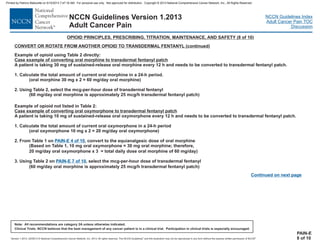
·
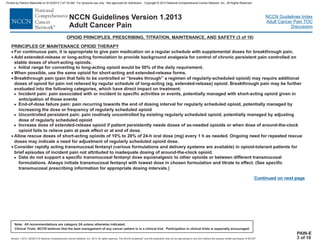
For continuous pain, it is appropriate to give pain medication on a regular schedule with supplemental doses for breakthrough pain.
Add extended-release or long-acting formulation to provide background analgesia for control of chronic persistent pain controlled on
stable doses of short-acting opioids.
Breakthrough pain (pain that fails to be controlled or “breaks through” a regimen of regularly-scheduled opioid) may require additional
doses of opioid for pain not relieved by regular schedule of long-acting (eg, extended-release) opioid. Breakthrough pain may be further
evaluated into the following categories, which have direct impact on treatment:
Incident pain: pain associated with or incident to specific activities or events, potentially managed with short-acting opioid given in
anticipation of those events
End-of-dose failure pain: pain recurring towards the end of dosing interval for regularly scheduled opioid, potentially managed by
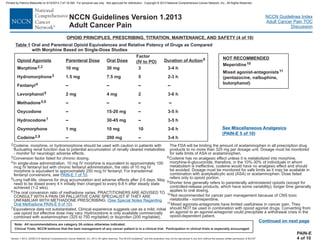
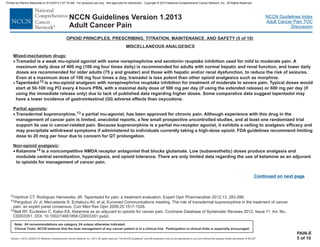
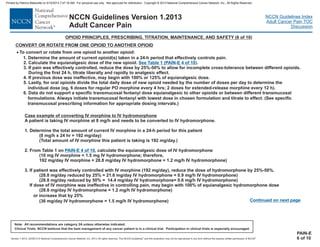
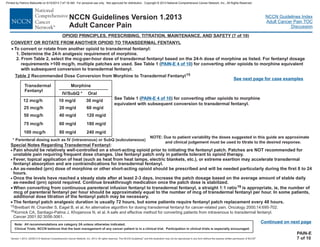
increasing the dose or frequency of regularly scheduled opioid
Increase dose of extended-release opioid if patient persistently needs doses of as-needed opioids or when dose of around-the-clock
opioid fails to relieve pain at peak effect or at end of dose.
Consider rapidly acting transmucosal fentanyl (various formulations and delivery systems are available) in opioid-tolerant patients for
brief episodes of incident pain not attributed to inadequate dosing of around-the-clock opioid.
>
>
>
>
Initial range for converting to long-acting opioid would be 50% of the daily requirement.
When possible, use the same opioid for short-acting and extended-release forms.
Uncontrolled persistent pain: pain routinely uncontrolled by existing regularly scheduled opioid, potentially managed by adjusting
dose of regularly scheduled opioid
Allow rescue doses of short-acting opioids of 10% to 20% of 24-h oral dose (mg) every 1 h as needed. Ongoing need for repeated rescue
doses may indicate a need for adjustment of regularly scheduled opioid dose.
Data do not support a specific transmucosal fentanyl dose equianalgesic to other opioids or between different transmucosal
formulations. Always initiate transmucosal fentanyl with lowest dose in chosen formulation and titrate to effect. (See specific
transmucosal prescribing information for appropriate dosing intervals.)
·
>
>
Printed by Patricio Matovelle on 5/15/2013 7:47:16 AM. For personal use only. Not approved for distribution. Copyright © 2013 National Comprehensive Cancer Network, Inc., All Rights Reserved.
Version 1.2013, 02/05/13 © National Comprehensive Cancer Network, Inc. 2013, All rights reserved. The NCCN Guidelines and this illustration may not be reproduced in any form without the express written permission of NCCN .®®
NCCN Guidelines Index
Adult Cancer Pain TOC
Discussion
Note: All recommendations are category 2A unless otherwise indicated.
Clinical Trials: NCCN believes that the best management of any cancer patient is in a clinical trial. Participation in clinical trials is especially encouraged.
NCCN Guidelines Version 1.2013
Adult Cancer Pain
Table 1 Oral and Parenteral Opioid Equivalences and Relative Potency of Drugs as Compared
with Morphine Based on Single-Dose Studies
Meperidine
Mixed agonist-antagonists
(pentazocine, nalbuphine,
butorphanol)
10
11
NOT RECOMMENDED
2
3
7
8
9
11
Codeine, morphine, or hydromorphone should be used with caution in patients with
fluctuating renal function due to potential accumulation of renally cleared metabolites
- monitor for neurologic adverse effects.
Conversion factor listed for chronic dosing.
In single-dose administration, 10 mg IV morphine is equivalent to approximately 100
mcg IV fentanyl but with chronic fentanyl administration, the ratio of 10 mg IV
morphine is equivalent to approximately 250 mcg IV fentanyl.
Equivalence data not substantiated. Clinical experience suggests use as a mild, initial
use opioid but effective dose may vary. Hydrocodone
osage must be monitored
for safe limits of ASA or acetaminophen.
Codeine has no analgesic effect unless it is metabolized into morphine,
morphine-6-glucuronide; therefore, in the 10%-30% of individuals in whom
metabolism is ineffective, codeine would have no analgesic effect and should
be avoided. Dosage must be monitored for safe limits as it may be available in
combination with acetylsalicylic acid (ASA) or acetaminophen. Dose listed
refers only to opioid portion.
Shorter time generally refers to parenterally administered opioids (except for
controlled-release products, which have some variability); longer time generally
applies to oral dosing.
Mixed agonists-antagonists have limited usefulness in cancer pain. They
should NOT be used in combination with opioid agonist drugs. Converting from
an agonist to an agonist-antagonist could precipitate a withdrawal crisis in the
opioid-dependent patient.
4
6
10
For transdermal
fentanyl conversions, see .
Long half-life, observe for drug accumulation and adverse effects after 2-5 days. May
need to be dosed every 4 h initially then changed to every 6-8 h after steady state
achieved (1-2 wks).
The oral conversion ratio of methadone varies. PRACTITIONERS ARE ADVISED TO
CONSULT WITH A PAIN OR PALLIATIVE CARE SPECIALIST IF THEY ARE
UNFAMILIAR WITH METHADONE PRESCRIBING. (
).
Not recommended for cancer pain management because of CNS toxic
metabolite - normeperidine.
5
PAIN-E 7 of 10
See Special Notes Regarding
Oral Methadone PAIN-E 9 of 10
is only available commercially
combined with acetaminophen (325 to 750 mg/tablet) or ibuprofen (200 mg/tablet).
The FDA will be limiting the amount of acetaminophen in all prescription drug
products to no more than 325 mg per dosage unit. D
PAIN-E
4 of 10
OPIOID PRINCIPLES, PRESCRIBING, TITRATION, MAINTENANCE, AND SAFETY (4 of 10)
Continued on next page
Codeine2,8
Fentanyl4
Hydrocodone7
Hydromorphone2
Levorphanol5
Methadone5,6
Morphine2,3
Oxycodone
Oxymorphone
Oral DoseParenteral Dose
200 mg
–
30-45 mg
7.5 mg
4 mg
–
30 mg
15-20 mg
10 mg
3-4 h
–
3-5 h
2-3 h
3-6 h
–
3-4 h
3-5 h
3-6 h
Duration of Action9
Factor
(IV to PO)
–
–
–
5
2
–
3
–
10
Opioid Agonists
–
–
–
1.5 mg
2 mg
–
10 mg
–
1 mg See Miscellaneous Analgesics
(PAIN-E 5 of 10)
Printed by Patricio Matovelle on 5/15/2013 7:47:16 AM. For personal use only. Not approved for distribution. Copyright © 2013 National Comprehensive Cancer Network, Inc., All Rights Reserved.
Version 1.2013, 02/05/13 © National Comprehensive Cancer Network, Inc. 2013, All rights reserved. The NCCN Guidelines and this illustration may not be reproduced in any form without the express written permission of NCCN .®®
NCCN Guidelines Index
Adult Cancer Pain TOC
Discussion
Note: All recommendations are category 2A unless otherwise indicated.
Clinical Trials: NCCN believes that the best management of any cancer patient is in a clinical trial. Participation in clinical trials is especially encouraged.
NCCN Guidelines Version 1.2013
Adult Cancer Pain
PAIN-E
5 of 10
Continued on next page
Mixed-mechanism drugs
Partial agonists
Non-opioid analgesic
:
A
maximum daily dose of 400 mg (100 mg four times daily) is recommended for adults with normal hepatic and renal function, and lower daily
doses are recommended for older adults (75 y and greater) and those with hepatic and/or renal dysfunction, to reduce the risk of seizures.
Tapentadol is a mu-opioid analgesic with norepinephrine reuptake inhibition for treatment of moderate to severe pain. Typical doses would
start at 50-100 mg PO every 4 hours PRN, with a maximal daily dose of 500 mg per day (if using the extended release) or 600 mg per day (if
using the immediate release only) due to lack of published data regarding higher doses. Some comparative data suggest tapentadol may
have a lower incidence of gastrointestinal (GI) adverse effects than oxycodone.
:
a partial mu-agonist, has been approved for chronic pain. Although experience with this drug in the
management of cancer pain is limited, anecdotal reports, a few small prospective uncontrolled studies, and at least one randomized trial
support its use in cancer-related pain Because buprenorphine is a partial mu-receptor agonist, it exhibits a ceiling to analgesic efficacy and
may precipitate withdrawal symptoms if administered to individuals currently taking a high-dose opioid. FDA guidelines recommend limiting
dose to 20 mcg per hour due to concern for QT prolongation.
:
noncompetitive NMDA receptor antagonist that blocks glutamate. Low (subanesthetic) doses produce analgesia and
modulate central sensitization, hyperalgesia, and opioid tolerance. There are only limited data regarding the use of ketamine as an adjuvant
to opioids for management of cancer pain.
·
·
·
Tramadol is a weak mu-opioid agonist with some norepinephrine and serotonin reuptake inhibition used for mild to moderate pain.
Even at a maximum dose of 100 mg four times a day, tramadol is less potent than other opioid analgesics such as morphine.
· 12
13
14
Transdermal buprenorphine,
.
Ketamine is a
MISCELLANEOUS ANALGESICS
OPIOID PRINCIPLES, PRESCRIBING, TITRATION, MAINTENANCE, AND SAFETY (5 of 10)
12
13
14
Hartrick CT, Rodriguez Hernandez JR: Tapentadol for pain: a treatment evaluation. Expert Opin Pharmacother 2012;13: 283-286.
Pergolizzi JV Jr, Mercadante S, Echaburu AV, et al, Euromed Communications meeting. The role of transdermal buprenorphine in the treatment of cancer
pain: an expert panel consensus. Curr Med Res Opin 2009;25:1517-1528.
Bell RF, Eccleston C, Kalso EA. Ketamine as an adjuvant to opioids for cancer pain. Cochrane Database of Systematic Reviews 2012, Issue 11. Art. No.:
CD003351. DOI: 10.1002/14651858.CD003351.pub2.
Printed by Patricio Matovelle on 5/15/2013 7:47:16 AM. For personal use only. Not approved for distribution. Copyright © 2013 National Comprehensive Cancer Network, Inc., All Rights Reserved.
Version 1.2013, 02/05/13 © National Comprehensive Cancer Network, Inc. 2013, All rights reserved. The NCCN Guidelines and this illustration may not be reproduced in any form without the express written permission of NCCN .®®
NCCN Guidelines Index
Adult Cancer Pain TOC
Discussion
Note: All recommendations are category 2A unless otherwise indicated.
Clinical Trials: NCCN believes that the best management of any cancer patient is in a clinical trial. Participation in clinical trials is especially encouraged.
NCCN Guidelines Version 1.2013
Adult Cancer Pain
OPIOID PRINCIPLES, PRESCRIBING, TITRATION, MAINTENANCE, AND SAFETY (6 of 10)
Continued on next page
PAIN-E
6 of 10
1. Determine the amount of current opioid(s) taken in a 24-h period that effectively controls pain.
2. Calculate the equianalgesic dose of the new opioid. .
3. If pain was effectively controlled, reduce the dose by 25%-50% to allow for incomplete cross-tolerance between different opioids.
During the first 24 h, titrate liberally and rapidly to analgesic effect.
See (PAIN-E 4 of 10Table 1 )
4. If previous dose was ineffective, may begin with 100% or 125% of equianalgesic dose.
5. Lastly, for oral opioids divide the total daily dose of new opioid needed by the number of doses per day to determine the
individual dose (eg, 6 doses for regular PO morphine every 4 hrs; 2 doses for extended-release morphine every 12 h).
6. Data do not support a specific transmucosal fentanyl dose equianalgesic to other opioids or between different transmucosal
formulations. Always initiate transmucosal fentanyl with lowest dose in chosen formulation and titrate to effect. (See specific
transmucosal prescribing information for appropriate dosing intervals.)
Case example of converting IV morphine to IV hydromorphone
A patient is taking IV morphine at 8 mg/h and needs to be converted to IV hydromorphone.
1. Determine the total amount of current IV morphine in a 24-h period for this patient
(8 mg/h x 24 hr = 192 mg/day)
(Total amount of IV morphine this patient is taking is 192 mg/day.)
2. From Table 1 on , calculate the equianalgesic dose of IV hydromorphone
(10 mg IV morphine = 1.5 mg IV hydromorphone; therefore,
192 mg/day IV morphine = 28.8 mg/day IV hydromorphone = 1.2 mg/h IV hydromorphone)
3. If patient was effectively controlled with IV morphine (192 mg/day), reduce the dose of hydromorphone by 25%-50%.
(28.8 mg/day reduced by 25% = 21.6 mg/day IV hydromorphone = 0.9 mg/h IV hydromorphone)
(28.8 mg/day reduced by 50% = 14.4 mg/day IV hydromorphone= 0.6 mg/h IV hydromorphone)
If dose of IV morphine was ineffective in controlling pain, may begin with 100% of equianalgesic hydromorphone dose
(28.8 mg/day IV hydromorphone = 1.2 mg/h IV hydromorphone)
or increase that by 25%
(36 mg/day IV hydromorphone = 1.5 mg/h IV hydromorphone)
PAIN-E 4 of 10
· To convert or rotate from one opioid to another opioid:
CONVERT OR ROTATE FROM ONE OPIOID TO ANOTHER OPIOID
Printed by Patricio Matovelle on 5/15/2013 7:47:16 AM. For personal use only. Not approved for distribution. Copyright © 2013 National Comprehensive Cancer Network, Inc., All Rights Reserved.
Version 1.2013, 02/05/13 © National Comprehensive Cancer Network, Inc. 2013, All rights reserved. The NCCN Guidelines and this illustration may not be reproduced in any form without the express written permission of NCCN .®®
NCCN Guidelines Index
Adult Cancer Pain TOC
Discussion
Note: All recommendations are category 2A unless otherwise indicated.
Clinical Trials: NCCN believes that the best management of any cancer patient is in a clinical trial. Participation in clinical trials is especially encouraged.
NCCN Guidelines Version 1.2013
Adult Cancer Pain
· To convert or rotate from another opioid to transdermal fentanyl:
1. Determine the 24-h analgesic requirement of morphine.
2. From Table 2, select the mcg-per-hour dose of transdermal fentanyl based on the 24-h dose of morphine as listed. For fentanyl dosage
requirements >100 mcg/h, multiple patches are used. See Table 1 ( ) for converting other opioids to morphine equivalent
with subsequent conversion to transdermal fentanyl.
PAIN-E 4 of 10
PAIN-E
7 of 10
OPIOID PRINCIPLES, PRESCRIBING, TITRATION, MAINTENANCE, AND SAFETY (7 of 10)
NOTE: Due to patient variability the doses suggested in this guide are approximate
and clinical judgement must be used to titrate to the desired response.
CONVERT OR ROTATE FROM ANOTHER OPIOID TO TRANSDERMAL FENTANYL
Table 2 Recommended Dose Conversion from Morphine to Transdermal Fentanyl15
Transdermal
Fentanyl
Morphine
IV/SubQ * Oral
25 mcg/h
50 mcg/h
75 mcg/h
100 mcg/h
20 mg/d
40 mg/d
60 mg/d
80 mg/d
60 mg/d
120 mg/d
180 mg/d
240 mg/d
15Breitbart W, Chandler S, Eagel B, et al. An alternative algorithm for dosing transdermal fentanyl for cancer-related pain. Oncology 2000;14:695-702.
16Kornick CA, Santiago-Palma J, Khojainova N, et al. A safe and effective method for converting patients from intravenous to transdermal fentanyl.
Cancer 2001;92:3056-3061.
* Parenteral dosing such as IV (intravenous) or SubQ (subcutaneous)
Special Notes Regarding Transdermal Fentanyl:
Pain should be relatively well-controlled on a short-acting opioid prior to initiating the fentanyl patch. Patches are NOT recommended for
unstable pain requiring frequent dose changes. Use fentanyl patch only in patients tolerant to opioid therapy.
Fever, topical application of heat (such as heat from heat lamps, electric blankets, etc.), or extreme exertion may accelerate transdermal
fentanyl absorption and are contraindications for transdermal fentanyl.
An as-needed (prn) dose of morphine or other short-acting opioid should be prescribed and will be needed particularly during the first 8 to 24
hours.
Once the levels have reached a steady state after at least 2-3 days, increase the patch dosage based on the average amount of stable daily
as-needed (prn) opioid required. Continue breakthrough medication once the patch dose is stabilized.
When converting from continuous parenteral infusion fentanyl to transdermal fentanyl, a straight 1:1 ratio is appropriate, ie, the number of
mcg of parenteral fentanyl per hour should be approximately equal to the number of mcg of transdermal fentanyl per hour. In some patients,
additional dose titration of the fentanyl patch may be necessary.
The fentanyl patch analgesic duration is usually 72 hours, but some patients require fentanyl patch replacement every 48 hours.
·
·
·
·
·
·
16
See next page for case examples
Continued on next page
See Table 1 ( ) for converting other opioids to morphine
equivalent with subsequent conversion to transdermal fentanyl.
PAIN-E 4 of 10
12 mcg/h 10 mg/d 30 mg/d
Printed by Patricio Matovelle on 5/15/2013 7:47:16 AM. For personal use only. Not approved for distribution. Copyright © 2013 National Comprehensive Cancer Network, Inc., All Rights Reserved.
Version 1.2013, 02/05/13 © National Comprehensive Cancer Network, Inc. 2013, All rights reserved. The NCCN Guidelines and this illustration may not be reproduced in any form without the express written permission of NCCN .®®
NCCN Guidelines Index
Adult Cancer Pain TOC
Discussion
Note: All recommendations are category 2A unless otherwise indicated.
Clinical Trials: NCCN believes that the best management of any cancer patient is in a clinical trial. Participation in clinical trials is especially encouraged.
NCCN Guidelines Version 1.2013
Adult Cancer Pain
PAIN-E
8 of 10
OPIOID PRINCIPLES, PRESCRIBING, TITRATION, MAINTENANCE, AND SAFETY (8 of 10)
CONVERT OR ROTATE FROM ANOTHER OPIOID TO TRANSDERMAL FENTANYL (continued)
Example of opioid not listed in Table 2:
A patient is taking 10 mg of sustained-release oral oxymorphone every 12 h and needs to be converted to transdermal fentanyl patch.
1. Calculate the total amount of current oral oxymorphone in a 24-h period
xymorphone oral oxymorphone
From Table 1 on , equianalgesic dose of oral morphine
oxymorphone
mg/day oral
transdermal fentanyl
60 mg/day oral morphine is approximately 25 mcg/h transdermal fentanyl patch)
Case example of converting oral oxymorphone to transdermal fentanyl patch
(oral o 10 mg x 2 = 20 mg/day )
2. convert
(Based on Table 1, 10 mg oral = 30 mg oral morphine; therefore,
20 oxymorphone x 3 = total daily dose oral morphine of 60 mg/day)
3. Using Table 2 on , select the mcg-per-hour dose of
(
PAIN-E 4 of 10
PAIN-E 7 of 10
to the
Example of opioid using Table 2 directly:
Case example of converting oral morphine to transdermal fentanyl patch
A patient is taking 30 mg of sustained-release oral morphine every 12 h and needs to be converted to transdermal fentanyl patch.
1. Calculate the total amount of current oral morphine in a 24-h period.
(oral morphine 30 mg x 2 = 60 mg/day oral morphine)
2. Using Table 2, select the mcg-per-hour dose of transdermal fentanyl
(60 mg/day oral morphine is approximately 25 mcg/h transdermal fentanyl patch)
Continued on next page
Printed by Patricio Matovelle on 5/15/2013 7:47:16 AM. For personal use only. Not approved for distribution. Copyright © 2013 National Comprehensive Cancer Network, Inc., All Rights Reserved.
Version 1.2013, 02/05/13 © National Comprehensive Cancer Network, Inc. 2013, All rights reserved. The NCCN Guidelines and this illustration may not be reproduced in any form without the express written permission of NCCN .®®
NCCN Guidelines Index
Adult Cancer Pain TOC
Discussion
Note: All recommendations are category 2A unless otherwise indicated.
Clinical Trials: NCCN believes that the best management of any cancer patient is in a clinical trial. Participation in clinical trials is especially encouraged.
NCCN Guidelines Version 1.2013
Adult Cancer Pain
Special Notes Regarding Oral Methadone:
PRACTITIONERS ARE ADVISED TO CONSULT WITH A PAIN OR PALLIATIVE CARE SPECIALIST IF
THEY ARE UNFAMILIAR WITH METHADONE PRESCRIBING or if individual patient considerations necessitate very rapid switching to or from
methadone.
To a significantly greater extent than with other opioids, methadone has been associated with many drug-drug interactions. The potential for
such interactions must be investigated in each patient before initiating methadone.
Methadone is commercially available in 5 mg, and 10 mg tablets and 1 mg/mL, 2 mg/mL, and 10 mg/mL oral solution.
Methadone is typically given at a regular schedule with additional doses of a short-acting opioid given as needed.
Because methadone is associated with QTc prolongation, a baseline and follow-up electrocardiogram (ECG) is recommended for methadone
doses >100 mg/day and for patients with cardiac disease, or when methadone is used in patients taking other medications also known to
prolong QTc (including tricyclic anti-depressants), if consistent with patient’s goals of care. QTc 450 may indicate need to reduce or
discontinue methadone dose.
These conversion ratios should NOT be used in converting from methadone to other opioids. After methadone is discontinued, it will take
several days for it to be cleared due to a long elimination half-life; therefore, the amount of other opioid needed for an equivalent effect will
appear to change as the residual methadone is cleared. On the first day of conversion (while there is still significant methadone present), a
conservative conversion ratio for oral methadone to oral morphine of 1:1 may be used and supplemented with additional short-acting opioid,
as needed. As methadone is cleared, morphine (or other opioid) doses will likely require frequent adjustment (every day or two) towards the
higher conversion ratios listed for morphine-to-methadone conversion.
It may be necessary to educate patients and families about analgesic utility of methadone. Some may only be familiar with methadone use for
maintenance of addiction and be unaware of its utility as a potent opioid analgesic.
·
·
·
·
·
·
Due to the unique nature of methadone with a long and variable half-life, caution should be used and frequent and careful evaluation should
be performed.
The conversion ratio varies with the amount of morphine (or other opioid) a patient has been using chronically. The higher the dose of
morphine, the more potent methadone is.
Methadone may be titrated up every 5-7 days, usually by 5 mg/dose. If more rapid titration is desired, consult with pain or palliative care
specialist.
·
·
·
³
OPIOID PRINCIPLES, PRESCRIBING, TITRATION, MAINTENANCE, AND SAFETY (9 of 10)
PAIN-E
9 of 10
See Convert from Oral
Morphine to Oral Methadone
(PAIN-E 10 of 10)
Printed by Patricio Matovelle on 5/15/2013 7:47:16 AM. For personal use only. Not approved for distribution. Copyright © 2013 National Comprehensive Cancer Network, Inc., All Rights Reserved.
Version 1.2013, 02/05/13 © National Comprehensive Cancer Network, Inc. 2013, All rights reserved. The NCCN Guidelines and this illustration may not be reproduced in any form without the express written permission of NCCN .®®
NCCN Guidelines Index
Adult Cancer Pain TOC
Discussion
Note: All recommendations are category 2A unless otherwise indicated.
Clinical Trials: NCCN believes that the best management of any cancer patient is in a clinical trial. Participation in clinical trials is especially encouraged.
NCCN Guidelines Version 1.2013
Adult Cancer Pain
Case example of converting oral morphine to oral methadone
A patient is taking oral morphine at 30 mg every 4 h and needs to be converted to oral methadone
otal amount of current oral morphine in a 24-h period for this patient
(30 mg x 6 = 180 mg/day)
(Total amount of oral morphine this patient is taking is 180 mg/day)
, calculate equianalgesic dose of oral methadone
or 180 mg/day of
180
Reduce the calculated equianalgesic dose of oral methadone by 25%-50% to account for incomplete cross-tolerance, dosing ratio
variability, and patient variability
(for example, 22.5 mg/day oral methadone reduced by 25% = 16.875 mg/day oral methadone
equal to approximately 15 mg/day oral methadone)
Divide the total daily oral methadone dose into 3 daily doses
oral methadone
1. Calculate the t
2. From Table 3 above
(F oral morphine : oral methadone, the dose conversion ratio is 8:1; therefore,
mg/day morphine = 22.5 mg/day methadone)
3.
4.
(for example, reduced dose of 15 mg/day divided by 3 daily doses = 5 mg oral methadone every 8 h)
PAIN-E
10 of 10
OPIOID PRINCIPLES, PRESCRIBING, TITRATION, MAINTENANCE, AND SAFETY (10 of 10)
1. Calculate the total daily oral morphine dose (or morphine-equivalent dose) the patient is using.
2. Based on the oral morphine dose, appropriate dose conversion ratio and calculate the oral methadone
dose
use Table 3 below to determine the
3. Reduce the calculated equianalgesic dose of oral methadone by 25%-50% to account for incomplete cross-tolerance, dosing ratio
variability, and patient variability.
4. Divide the total daily oral methadone dose into 3 or 4 daily doses.
ORAL MORPHINE DOSE CONVERSION RATIO (oral morphine : oral methadone)
30 - 90 mg 4:1
91 - 300 mg 8:1
>300 mg 12:1
Note: If the total daily dose equivalent of morphine is greater than 800 mg, a higher dose ratio is
necessary and dose titration is recommended. A pain or palliative care specialist should be consulted.
CONVERT FROM ORAL MORPHINE TO ORAL METHADONE17
· To convert from oral morphine to oral methadone
Table 3 Dose Conversion Ratios for Oral Morphine to Oral Methadone
See
(PAIN-E 9 of 10
Special Notes Regarding
Oral Methadone )
17Manfredi PL, Houde RW. Prescribing methadone, a unique analgesic. J Support Oncol 2003;1:216-220.
Printed by Patricio Matovelle on 5/15/2013 7:47:16 AM. For personal use only. Not approved for distribution. Copyright © 2013 National Comprehensive Cancer Network, Inc., All Rights Reserved.
Version 1.2013, 02/05/13 © National Comprehensive Cancer Network, Inc. 2013, All rights reserved. The NCCN Guidelines and this illustration may not be reproduced in any form without the express written permission of NCCN .®®
NCCN Guidelines Index
Adult Cancer Pain TOC
Discussion
Note: All recommendations are category 2A unless otherwise indicated.
Clinical Trials: NCCN believes that the best management of any cancer patient is in a clinical trial. Participation in clinical trials is especially encouraged.
NCCN Guidelines Version 1.2013
Adult Cancer Pain
MANAGEMENT OF OPIOID ADVERSE EFFECTS (1 of 3)
Principles of Management of Opioid Adverse Effects
·
·
·
Adverse effects to opioids are common, should be anticipated, and should be managed aggressively.
Patient and family/caregiver education is essential for successful anticipation and management of pain and opioid adverse effects.
Recognize that pain is rarely treated in isolation in cancer and adverse effects may be from other treatments or cancer itself.
Opioid adverse effects generally improve over time, except with constipation. Maximize non-opioid and nonpharmacologic interventions to
limit opioid dose and treat adverse effects. If adverse effects persist, consider opioid rotation.
Multisystem assessment is necessary.
Information from patient and family/caregiver about adverse effects is essential for appropriate opioid dose adjustment and treatment of
adverse effects.
·
·
·
PAIN-F
1 of 3
Constipation
·
·
·
Preventive measures
Prophylactic medications
Stimulant laxative ± stool softener (eg, senna ± docusate, 2
tablets every morning; maximum 8-12 tablets per day).
Polyethylene glycol (1 capful/8 oz water PO two times a day)
Increase dose of laxative when increasing dose of opioids
Maintain adequate fluid intake
While maintaining adequate dietary fiber intake is
recommended, supplemental medicinal fiber such as psyllium
(eg, Metamucil) is unlikely to control opioid-induced
constipation and is not recommended.
Stool softener (docusate) alone may not provide benefit in well-
hydrated patients
Exercise, if feasible
If constipation develops
Assess for cause and severity of constipation
Rule out obstruction
Titrate stool softener/laxatives as needed with goal of one non-
forced bowel movement every 1-2 d
Consider adjuvant analgesic to allow reduction of the opioid
dose
If constipation persists
Reassess for the cause and severity of constipation, rule out
bowel obstruction
Check for impaction
Consider adding another agent, such as magnesium hydroxide,
30-60 mL daily; bisacodyl, 2-3 tablets PO daily; 1 rectal
suppository daily; lactulose, 30-60 mL daily; sorbitol, 30 mL
every 2 h x 3, then as needed;
magnesium citrate, 8 oz PO daily; or polyethelene glycol (1
capful/8 oz water PO two times a day)
Fleet, saline, or tap water enema
Consider use of a prokinetic agent (eg, metoclopramide,
10-15 mg PO 4 times a day; consider limiting chronic use to
maximum 3 mo, due to concern for neurologic complications
[tardive dyskinesia], especially in frail, elderly patients)
When response to laxative therapy has not been sufficient for
opioid-induced constipation in patients with advanced illness,
consider methylnaltrexone, 0.15 mg/kg subcutaneously,
maximum one dose per day
For intractable chronic constipation, consider opioid rotation to
fentanyl or methadone
Consider neuraxial analgesics, neuroablative techniques, or
other interventions to decrease pain, alleviate constipation,
and/or reduce opioid dose
>
7
7
7
>
>
>
>
>
>
>
>
>
>
>
>
>
>
>
>
Continued on next page
Printed by Patricio Matovelle on 5/15/2013 7:47:16 AM. For personal use only. Not approved for distribution. Copyright © 2013 National Comprehensive Cancer Network, Inc., All Rights Reserved.
Version 1.2013, 02/05/13 © National Comprehensive Cancer Network, Inc. 2013, All rights reserved. The NCCN Guidelines and this illustration may not be reproduced in any form without the express written permission of NCCN .®®
NCCN Guidelines Index
Adult Cancer Pain TOC
Discussion
Note: All recommendations are category 2A unless otherwise indicated.
Clinical Trials: NCCN believes that the best management of any cancer patient is in a clinical trial. Participation in clinical trials is especially encouraged.
NCCN Guidelines Version 1.2013
Adult Cancer Pain
Nausea
· For further information about delirium,
·
·
·
·
·
·
·
·
·
·
Preventive measures
Ensure that patient is having bowel movements consistently.
For patients with a prior history of opioid-induced nausea,
prophylactic treatment with antiemetic agents (see below) is
highly recommended.
If nausea develops
Assess for other causes of nausea (eg, central nervous system
pathology, chemotherapy, radiation therapy, hypercalcemia).
Consider prochlorperazine, 10 mg PO every 6 h as needed; or
metoclopramide, 10-15 mg PO 4 times daily as needed; or
haloperidol, 0.5-1 mg PO every 6-8 h. Chronic use of any of
these agents may be associated with development of tardive
dyskinesia, especially in frail, elderly patients.
If nausea persists despite as-needed regimen, administer
antiemetics around the clock for 1 wk, then change as needed.
Consider adding a serotonin antagonist
(eg, ondansetron, 8 mg PO 3 times a day; granisetron,
2 mg PO daily). Use with caution as constipation is an adverse
effect.
Dexamethasone can be considered.
Consider olanzapine, 2.5-5 mg, especially with bowel
obstruction.
Opioid-induced nausea may resolve with continued exposure; if
nausea persists for more than 1 wk
Reassess cause and severity of nausea.
Consider opioid rotation.
If nausea persists after a trial of several opioids and above
measures
Reassess cause and severity of nausea.
Consider neuraxial analgesics, neuroablative techniques, and
other interventions to potentially reduce opioid dose.
If pruritus develops
Assess for other causes (other medications, etc.)
Consider antihistamines such as diphenhydramine, 25-50 mg IV
or PO every 6 h; or promethazine, 12.5-25 mg PO every 6 h
If pruritus persists
Consider changing to another opioid if symptomatic
management has failed.
Consider adding to analgesic regimen: small doses of mixed
agonist-antagonist, nalbuphine, 0.5-1 mg IV every 6 h as needed
Consider continuous infusion of naloxone, 0.25 mcg/kg/h and
titrate up to 1 mcg/kg/h for relief of pruritus without decreasing
effectiveness of the analgesic.
Assess for other causes of delirium (eg, hypercalcemia, CNS,
metastases, other psychoactive medications)
If other possible causes of delirium are excluded, consider
changing the opioid
Consider nonopioid analgesic to allow reduction of the opioid
dose
Consider initial titration with haloperidol, 0.5-2 mg PO or IV every
4-6 h; or olanzapine, 2.5-5 mg PO or sublingual every 6-8 h; or
risperidone, 0.25-0.5 mg 1-2 times per day. With prolonged
administration of these agents, it may be necessary to decrease
dose due to long elimination half-life.
.
>
>
>
>
>
>
>
>
>
>
>
>
Pruritus
Delirium
·
>
>
>
>
>
If pruritus is associated with rash or hives, consider true allergy
and reconsider selection of opioid therapy.
see NCCN Guidelines for Palliative Care
PAIN-F
2 of 3
MANAGEMENT OF OPIOID ADVERSE EFFECTS (2 of 3)
Continued on next page
Printed by Patricio Matovelle on 5/15/2013 7:47:16 AM. For personal use only. Not approved for distribution. Copyright © 2013 National Comprehensive Cancer Network, Inc., All Rights Reserved.
Version 1.2013, 02/05/13 © National Comprehensive Cancer Network, Inc. 2013, All rights reserved. The NCCN Guidelines and this illustration may not be reproduced in any form without the express written permission of NCCN .®®
NCCN Guidelines Index
Adult Cancer Pain TOC
Discussion
Note: All recommendations are category 2A unless otherwise indicated.
Clinical Trials: NCCN believes that the best management of any cancer patient is in a clinical trial. Participation in clinical trials is especially encouraged.
NCCN Guidelines Version 1.2013
Adult Cancer Pain
Motor and Cognitive Impairment
Respiratory Depression
·
·
·
·
·
·
Studies have shown that stable doses of opioids (>2 wk) are not
likely to interfere with psychomotor and cognitive function, but these
functions should be monitored during analgesic administration and
titration.
Patients with limited cardiopulmonary reserve are more susceptible.
Hypercarbia occurs before hypoxia.
Dilute one ampule of naloxone (0.4 mg/1 mL) into 9 mL of normal
saline for a total volume of 10 mL. Give 1-2 mL (0.04-0.08 mg) every
30-60 seconds until improvement in symptoms is noted.
Be prepared to repeat this process (the half-life of opioids is
generally longer than that of the naloxone [plasma half-life is 30-80
minutes]).
If the patient is not responsive within 10 minutes and total
naloxone dose of 1 mg, consider another reason for the change in
neurologic status.
If reversing an opioid with a long half-life such as methadone or for
persistent opioid-induced sedation, consider naloxone infusion.
Closely monitor for the recurrence of pain
during reversal, which may require a cautious administration of an
opioid.
If respiratory problems or opioid-induced sedation occurs, consider
naloxone administration but use reversing agents cautiously.
as opioid is metabolized
additional
>
>
>
PAIN-F
3 of 3
MANAGEMENT OF OPIOID ADVERSE EFFECTS (3 of 3)
Sedation
·
·
If significant or unexpected sedation develops and persists for
more than 2-3 d after initiating or a significant upward titration of
an opioid
Assess for other causes of sedation (eg, CNS pathology, other
sedating medications, hypercalcemia, dehydration, sepsis,
hypoxia)
Consider a lower dose of opioid given more frequently to
decrease peak concentrations
Decrease the dose of opioid if pain control can be maintained at
a lower dose
Consider opioid rotation
Consider nonopioid analgesic to allow reduction of the opioid
dose
Consider the addition of caffeine, 100-200 mg PO every 6 h; or
methylphenidate, 5-10 mg 1-3 times per day; or
dextroamphetamine, 5-10 mg PO 1-3 times per day; or
modafinil, 100-200 mg per day.
If sedation persists despite several changes of opioids and the
above measures
Reassess cause and severity of sedation
Consider neuraxial analgesics, neuroablative techniques, and
other interventions to potentially reduce opioid dose
>
>
>
>
>
>
>
>
7 When using CNS stimulants for sedation, limit dosing to
morning and early afternoon to avoid insomnia at night.
· If the patient has had marked sleep deprivation related to poor
pain control, adjustments of analgesics to improve pain control
may result in "catch up" sleep lasting 2-3 days. Therefore,
extreme fatigue can result in somnolence that may be difficult to
differentiate from opioid-induced sedation. If related to fatigue,
patients generally can be fully aroused, although this may require
some effort.
Printed by Patricio Matovelle on 5/15/2013 7:47:16 AM. For personal use only. Not approved for distribution. Copyright © 2013 National Comprehensive Cancer Network, Inc., All Rights Reserved.
Version 1.2013, 02/05/13 © National Comprehensive Cancer Network, Inc. 2013, All rights reserved. The NCCN Guidelines and this illustration may not be reproduced in any form without the express written permission of NCCN .®®
NCCN Guidelines Index
Adult Cancer Pain TOC
Discussion
Note: All recommendations are category 2A unless otherwise indicated.
Clinical Trials: NCCN believes that the best management of any cancer patient is in a clinical trial. Participation in clinical trials is especially encouraged.
NCCN Guidelines Version 1.2013
Adult Cancer Pain
PAIN-G
1 of 2
ADJUVANT ANALGESICS FOR NEUROPATHIC PAIN (1 of 2
ANTIDEPRESSANTS, ANTICONVULSANTS, AND TOPICAL AGENTS
)
( )
·
·
·
·
·
·
·
·
Antidepressants and anticonvulsants are first-line adjuvant analgesics for the treatment of cancer-related neuropathic pain.
These drugs can be helpful for patients whose pain is only partially responsive to opioids.
The use of adjuvant analgesics in the cancer population is often based on guidelines or experience derived from data for the
treatment of pain not caused by cancer (non-malignant pain).
Effective use is predicated on an assessment that clarifies the nature of the pain as most adjuvant analgesics are more likely to be
effective in management of neuropathic pain.
As with opioids, response to adjuvant analgesics may vary according to the type/cause of neuropathic pain and the individual patient.
Drug selection may be influenced by other symptoms and comorbidities. For example, a sedating drug may be useful in a patient in
whom insomnia is a problem.
Patient education should emphasize the trial and error nature of the treatment so patients do not get discouraged.
Doses should be increased until the analgesic effect is achieved, adverse effects become unmanageable, or the conventional maximal
dose is reached.
Principles of Adjuvant Analgesic Use
See Examples of Adjuvant Analgesics
Use for Neuropathic Pain (PAIN-G 2 of 2)
Printed by Patricio Matovelle on 5/15/2013 7:47:16 AM. For personal use only. Not approved for distribution. Copyright © 2013 National Comprehensive Cancer Network, Inc., All Rights Reserved.
Version 1.2013, 02/05/13 © National Comprehensive Cancer Network, Inc. 2013, All rights reserved. The NCCN Guidelines and this illustration may not be reproduced in any form without the express written permission of NCCN .®®
NCCN Guidelines Index
Adult Cancer Pain TOC
Discussion
Note: All recommendations are category 2A unless otherwise indicated.
Clinical Trials: NCCN believes that the best management of any cancer patient is in a clinical trial. Participation in clinical trials is especially encouraged.
NCCN Guidelines Version 1.2013
Adult Cancer Pain
PAIN-G
2 of 2
Examples of UseAdjuvant Analgesics
·
·
Extrapolated from non-cancer neuropathic pain management
Both antidepressants and anticonvulsants are frequently used as an adjuvant analgesic in combination with an opioid to treat
neuropathic components of pain.
ADJUVANT ANALGESICS FOR NEUROPATHIC PAIN (2 of 2
ANTIDEPRESSANTS, ANTICONVULSANTS, TOPICAL AGENTS, AND CORTICOSTEROIDS
)
( )
Note:
- see Discussion.
Some SSRI, SNRI antidepressants may inhibit the
conversion of tamoxifen to its active metabolite, thereby
decreasing the effectiveness of tamoxifen
·
·
·
·
·
Antidepressants Anticonvulsants
Topical agents
Corticosteroids
: Analgesic effectiveness is not dependent on
its antidepressant activity.
Frequently used as an analgesic in combination with
an opioid for the neuropathic component of the pain.
Tricyclic antidepressants (eg, amitriptyline, imipramine,
, )
Start with low dose and increase every 3-5 days if tolerated.
(eg, nortriptyline and desipramine starting dose 10-25 mg
nightly increase to 50-150 mg nightly).
Anticholinergic adverse effects such as sedation,
dryness of mouth, and urinary hesitancy are more likely to
occur with and imipramine.
Other examples:
Venlafaxine- Starting dose 50-75 mg daily, increase to
75-225 mg daily
: Frequently used as an adjuvant analgesic in
combination with an opioid for the neuropathic component of the pain.
Gabapentin- Starting dose 100-300 mg nightly, increase to 900-3600
mg daily in divided doses 2 to 3 times a day. Dose increments of
50%-100% every 3 days. Slower titration for the elderly or medically
frail. Dose adjustment required for those with renal insufficiency.
Pregabalin- Starting dose 50 mg three times a day, increase to 100
mg 3 times a day.
Pregabalin more efficiently absorbed through the GI tract than
gabapentin. May increase further to a maximum dose of 600 mg in
divided doses 2 to 3 times a day.
Consider other anticonvulsant agents, many of which have been
shown to have efficacy in non-cancer neuropathic pain.
: Act locally and may be used as an analgesic in
combination with an opioid, antidepressant, and/or an anticonvulsant.
Topical agent examples:
Consider NSAID- diclofenac gel 1%, four times daily; or diclofenac
patch 180 mg, one patch daily or one patch twice daily
: Long half-life of these drugs allows for once daily
dosing. Useful in the acute management of a pain crisis when neural
structures or bones are involved. Long-term adverse effects significant.
Effective analgesic dose 1)
ower than that required to treat depression, and 2) the onset of
analgesic relief may occur earlier than anti-depressive effects.
may be
l
Lidocaine patch- 5% - Apply daily to the painful site. Minimal
systemic absorption.
adjuvant
nortriptyline desipramine
The tertiary amines
(amitriptyline, imipramine) may be more efficacious but
secondary amines (nortriptyline, desipramine) are better
tolerated.
amitriptyline
Duloxetine- Starting dose 30-60 mg daily, increase to
60-120 mg daily
Anticonvulsants examples:
Slower titration for the elderly or medically frail.
Dose adjustment required for those with renal insufficiency.
adjuvant
>
7
>
>
7
7
7
>
7
7
7
7
Printed by Patricio Matovelle on 5/15/2013 7:47:16 AM. For personal use only. Not approved for distribution. Copyright © 2013 National Comprehensive Cancer Network, Inc., All Rights Reserved.
Version 1.2013, 02/05/13 © National Comprehensive Cancer Network, Inc. 2013, All rights reserved. The NCCN Guidelines and this illustration may not be reproduced in any form without the express written permission of NCCN .®®
NCCN Guidelines Index
Adult Cancer Pain TOC
Discussion
Note: All recommendations are category 2A unless otherwise indicated.
Clinical Trials: NCCN believes that the best management of any cancer patient is in a clinical trial. Participation in clinical trials is especially encouraged.
NCCN Guidelines Version 1.2013
Adult Cancer Pain
PSYCHOSOCIAL SUPPORT
·
·
·
Due to the complexity of cancer-related pain and associated symptoms, health care providers should anticipate patients’ and families’ need
for support and education in management strategies.
Assessing each patients’ need for psychosocial support is an essential component of a comprehensive pain assessment ( ).
Support
Inform pati
ncologist, nurse, pain specialist, palliative care clinician, physiatrist, neurologist, psychologist,
soci
See PAIN-C
ent and family/caregiver that emotional reactions to pain are normal and are evaluated and treated as part of pain treatment.
Provide emotional support to patient and family/caregiver that acknowledges that the pain is a problem to be addressed.
Assist in accessing treatment as needed.
State that you will work together with the patient and family/caregiver as part of the team to address the pain problem.
Describe the plan of action to be taken and when results can be expected.
Express your commitment to being available to help with pain management
Inform patient and family/caregiver that there is ALWAYS something else that can be done to try to adequately manage pain and other
noxious symptoms.
Assess impact upon family and significant others; provide education and support as indicated.
Verbally repeat your concern and the plan of action to be taken.
Teach coping skills (to be used in conjunction with and not in lieu of appropriate analgesia) to provide pain relief, enhance a sense of
personal control, and refocus energy on optimizing quality of life.
Training to encourage assertiveness to maximize comfort
Educate patient and family/caregiver that in pain management a team effort is necessary to comprehensively assess and treat the impact of
pain. Members of the team may include: o
·
·
·
·
·
·
·
·
·
·
.
Skills training
>
>
>
Coping skills for acute pain include Lamaze-type breathing exercises, distraction techniques
Coping skills for chronic pain (not pain emergency) include all of the above plus relaxation techniques, guided imagery, graded task
assignments, and hypnosis to maximize function
al worker, psychiatrist, physical therapist, and spiritual counselor.
See Patient and Family/Caregiver Education (PAIN-I)
PAIN-H
Printed by Patricio Matovelle on 5/15/2013 7:47:16 AM. For personal use only. Not approved for distribution. Copyright © 2013 National Comprehensive Cancer Network, Inc., All Rights Reserved.
Version 1.2013, 02/05/13 © National Comprehensive Cancer Network, Inc. 2013, All rights reserved. The NCCN Guidelines and this illustration may not be reproduced in any form without the express written permission of NCCN .®®
NCCN Guidelines Index
Adult Cancer Pain TOC
Discussion
Note: All recommendations are category 2A unless otherwise indicated.
Clinical Trials: NCCN believes that the best management of any cancer patient is in a clinical trial. Participation in clinical trials is especially encouraged.
NCCN Guidelines Version 1.2013
Adult Cancer Pain
· To assess for patient and family/caregiver educational needs regarding pain treatment, the health care team should:
/caregiver
/caregiver
Messages to be conveyed to patient and family/caregiver regarding management of pain
Pain can usually be well-controlled with pain medications. For persistent pain, taking an analgesic on a regular schedule will improve pain
control.
Patients with pain often have other symptoms (eg, constipation, nausea, fatigue, insomnia, depression) that need to be controlled;
management of these other symptoms may facilitate control of pain.
Messages to be conveyed to patient and family/caregiver regarding opioid analgesics
If these medications do not work, many other options are available.
>
>
>
>
>
>
>
7
>
Assess for meaning and consequences of pain for patient and family .
Assess for literacy to ensure understanding of education.
Assess existing knowledge of pain and pain treatment to aid in developing appropriate patient and family education plan.
Relief of pain is medically important and there is no medical benefit to suffering with pain.
Morphine and morphine-like medications are principle medications used to relieve severe pain.
If you take these medications now, they will still work later.
When these medications are used to treat cancer pain, addiction is rarely a problem unless addiction issues existed before the cancer pain.
1,2
·
·
7
7
7
Patients with a history of prescription, illicit drug, or alcohol dependence/substance abuse may be at increased risk for prescribed
misuse/abuse .
Patients with history of opioid use/abuse may also have increased tolerance, which may require higher doses for optimal pain control
.
medication (
(
see PAIN-L)
see PAIN-L)
>
7
7
7
7
7
These medications are controlled substances
These medications should not be mixed with alcohol or illicit substances.
U properly disposal of:
Provide information pertaining to local regulations regarding the operation of machinery or motor vehicles while taking potentially sedating
medication and advise patient and family/caregiver accordingly and provide appropriate medical counseling.
and must be used with caution:
Potent analgesics should be taken only as prescribed and by the person for whom the medication is prescribed; advise patients not to self-
adjust dosage or frequency unless discussed with health care provider; and advise patients to contact healthcare provider if the pain
management regimen is not controlling their pain.
Analgesics must be in a secured location, preferably a locked box and not in a medicine cabinet.
nused or unneeded medications (especially opioid analgesics) must be
- In general, advise not to flush down sink or toilet.
- Check with local pharmacy or law enforcement about proper medication disposal.
- Read the product-specific disposal information included with the extended release/long-acting opioid product.
PATIENT AND FAMILY/CAREGIVER EDUCATION (1 of 2)
PAIN-I
1 of 2
1
2
Stewart M, Brown JB, Donner A, McWhinney I, et al. The impact of patient centered care on outcomes. The Journal of Family Practice 2000;49:797-804.
Syrjala KL, Abrams JR, Polissar NL, et al. Patient training in cancer pain management using integrated print and video materials: a multisite randomized controlled
trial. Pain 2008,135:175-186.
Continued on next page
Printed by Patricio Matovelle on 5/15/2013 7:47:16 AM. For personal use only. Not approved for distribution. Copyright © 2013 National Comprehensive Cancer Network, Inc., All Rights Reserved.
Version 1.2013, 02/05/13 © National Comprehensive Cancer Network, Inc. 2013, All rights reserved. The NCCN Guidelines and this illustration may not be reproduced in any form without the express written permission of NCCN .®®
NCCN Guidelines Index
Adult Cancer Pain TOC
Discussion
Note: All recommendations are category 2A unless otherwise indicated.
Clinical Trials: NCCN believes that the best management of any cancer patient is in a clinical trial. Participation in clinical trials is especially encouraged.
NCCN Guidelines Version 1.2013
Adult Cancer Pain
· The following must be reviewed with each patient and family and provided in written form, which is dated:
Plan for obtaining refilled prescriptions, especially schedule II narcotics that cannot be ordered by telephone
List may be provided by clinician and/or pharmacy
Any problems in getting the prescriptions or taking the medication
New pain, change in pain, or pain not relieved with medication
Nausea and vomiting that prevents eating for 1 day
Problems with bowel movements, including no bowel movements for 3 days
Difficulty arousing the patient from sleep easily during the daytime
Confusion
A plan for follow-up visits and/or phone calls, including availability of after hours assistance
A plan for proper storage and disposal ( )
/caregiver
A list of each medication prescribed, a description of what each medication is for, and instructions as to how and when to take each one
A list of potential adverse effects of these medications and what to do if they occur
A list of all medications to be discontinued
A list of telephone numbers to reach an appropriate health care provider and specific instructions to call regarding:
>
>
>
>
7
7
7
7
7
7
7
7
>
> see PAIN-I 1 of 2
PATIENT AND FAMILY/CAREGIVER EDUCATION (2 of 2)
PAIN-I
2 of 2
· Communication with the health care provider is critical for the patient and family/caregiver to assist in meeting goals of care.
7
7
7
7
Explain that health care providers cannot discern the patient’s pain level, and that describing pain is not viewed as “complaining,” but
rather is an essential source of information to enable the health care provider to adjust treatment.
Explain that health care providers want to know about any problems the patient believes the pain medications may be causing, as there
are probably ways to alleviate these issues.
Tell the patient to let the health care providers know about difficulty obtaining medication or concerns about taking medication. Explain
that providers have dealt with such issues before and that they can help.
Expect optimal management for pain and adverse effects. Inform the patient of the right to expect pain management as part of overall
care.
Printed by Patricio Matovelle on 5/15/2013 7:47:16 AM. For personal use only. Not approved for distribution. Copyright © 2013 National Comprehensive Cancer Network, Inc., All Rights Reserved.
Version 1.2013, 02/05/13 © National Comprehensive Cancer Network, Inc. 2013, All rights reserved. The NCCN Guidelines and this illustration may not be reproduced in any form without the express written permission of NCCN .®®
NCCN Guidelines Index
Adult Cancer Pain TOC
Discussion
Note: All recommendations are category 2A unless otherwise indicated.
Clinical Trials: NCCN believes that the best management of any cancer patient is in a clinical trial. Participation in clinical trials is especially encouraged.
NCCN Guidelines Version 1.2013
Adult Cancer Pain
INTEGRATIVE INTERVENTIONS
Consider integrative interventions in conjunction with pharmacologic interventions as needed. interventions
may be especially important in vulnerable populations (eg, frail, elderly, pediatric) in whom standard pharmacologic
interventions may be less tolerated or based on patient preference. The utility of interventions underscores the
necessity for pain management to be carried out with a team approach that contains a wide range of treatment options.
Integrative
integrative
PAIN-J
Pain likely to be relieved or function improved with physical, cognitive, or interventional modalities:
Bed, bath, and walking supports
Positioning instruction
Physical therapy
Energy conservation, pacing of activities
Massage
Heat and/or ice
Transcutaneous electrical nerve stimulation (TENS)
Acupuncture or acupressure
Ultrasonic stimulation
Imagery/hypnosis
Distraction training
Relaxation training
Active coping training
Graded task assignments, setting goals, pacing, and prioritizing
Cognitive behavioral training
·
·
·
Physical modalities
Cognitive modalities
>
>
>
>
>
>
>
>
>
>
>
>
>
>
>
· Spiritual care (See NCCN Guidelines for Distress Management)
See Interventional Strategies (PAIN-M)
Printed by Patricio Matovelle on 5/15/2013 7:47:16 AM. For personal use only. Not approved for distribution. Copyright © 2013 National Comprehensive Cancer Network, Inc., All Rights Reserved.
Version 1.2013, 02/05/13 © National Comprehensive Cancer Network, Inc. 2013, All rights reserved. The NCCN Guidelines and this illustration may not be reproduced in any form without the express written permission of NCCN .®®
NCCN Guidelines Index
Adult Cancer Pain TOC
Discussion
Note: All recommendations are category 2A unless otherwise indicated.
Clinical Trials: NCCN believes that the best management of any cancer patient is in a clinical trial. Participation in clinical trials is especially encouraged.
NCCN Guidelines Version 1.2013
Adult Cancer Pain
NON-OPIOID ANALGESIC (NONSTEROIDAL ANTI-INFLAMMATORY DRUGS [NSAIDS] AND ACETAMINOPHEN) PRESCRIBING (1 of 2)
NSAID
·
·
·
·
Use NSAIDs with caution in patients at high risk for renal, GI (upper GI surgery, RT), bleeding
disorder.
Note that the potential adverse effects of chemotherapy (especially angiogenesis inhibitors), such as hematologic (thrombocytopenia,
coagulopathy), renal, hepatic, and cardiovascular toxicities, can be increased by the concomitant prescription of NSAIDs.
For some patients opioid analgesics may be a safe and effective alternative analgesic to NSAIDs.
Use any NSAID that the patient has found to be effective and well tolerated in the past; otherwise, consider ibuprofen to the maximal dose.
Ibuprofen, 400 mg four times a day (daily maximum = 3200 mg)
If needed, consider short-term use of ketorolac, 15-30 mg IV every 6 h for a maximum of 5 days
Compounds that do not inhibit platelet aggregation:
>
>
>
7
7
7
7
Nonacetylated salicylate
Choline + magnesium salicylate combinations, 1.5-4.5 g/d in three divided doses
Salsalate, 2-3 g/d in two or three divided doses
Selective COX-2 inhibitor
s
or cardiac toxicities; thrombocytopenia; or
PAIN-K
1 of 2
Continued on next page
·
·
·
Acetaminophen, 650 mg every 4 h or 1 g every 6 h (daily maximum 4 he FDA is
currently evaluating daily maximum dosing and has considered the daily maximum dose for chronic use be limited to 3 g/d or less.
Due to concerns with liver toxicity, hould be used with caution or not used at all with combination opioid-
acetaminophen products to prevent excess acetaminophen dosing.
See the FDA website for the latest information on acetaminophen adverse effects and dosing.
acetaminophen s
( )
g/d) in adult patients with normal liver function. T
www.fda.gov
Acetaminophen
Printed by Patricio Matovelle on 5/15/2013 7:47:16 AM. For personal use only. Not approved for distribution. Copyright © 2013 National Comprehensive Cancer Network, Inc., All Rights Reserved.
Version 1.2013, 02/05/13 © National Comprehensive Cancer Network, Inc. 2013, All rights reserved. The NCCN Guidelines and this illustration may not be reproduced in any form without the express written permission of NCCN .®®
NCCN Guidelines Index
Adult Cancer Pain TOC
Discussion
Note: All recommendations are category 2A unless otherwise indicated.
Clinical Trials: NCCN believes that the best management of any cancer patient is in a clinical trial. Participation in clinical trials is especially encouraged.
NCCN Guidelines Version 1.2013
Adult Cancer Pain
PAIN-K
2 of 2
· Further NSAID considerations:
If two NSAIDs are tried in succession without efficacy, use another approach to analgesia.
If NSAIDs are effective but treatment is limited by toxicities that are not deemed serious, consider trial of another NSAID.
When systemic administration is not feasible, consider topical NSAID preparations in place of oral NSAIDs.
Toxicity of anti-cancer treatment may increase the risk profile of anti-inflammatory treatment.
>
>
>
>
NON-OPIOID ANALGESIC (NONSTEROIDAL ANTI-INFLAMMATORY DRUGS [NSAIDS] AND ACETAMINOPHEN) PRESCRIBING (2 of 2)
· NSA nd toxicities
Patients at high risk for : age >60 y, compromised fluid status, multiple myeloma, diabetes, interstitial nephritis, papillary
necrosis, and concomitant administration of other nephrotoxic drugs (including cyclosporin, cisplatin) and renally excreted chemotherapy
Treatment of : reevaluate NSAID use if renal function deteriorates or if hypertension develops or worsens
Patients at high risk for : age >60 y, history of peptic ulcer disease or significant alcohol use (3 or more alcoholic
beverages/day), major organ dysfunction including hepatic dysfunction, high-dose NSAIDs given for long periods, concomitant steroid use
Treatment of : if patient develops gastric upset or nausea, consider discontinuing NSAID or changing to selective COX-2
inhibitor. COX-2 inhibitors are associated with lower incidence of GI adverse effects and do not inhibit platelet aggregation; however,
they have not been demonstrated to have reduced renal adverse effects.
Consider adding antacids, H2 receptor antagonists, misop eprazole. If patient develops GI peptic ulcer or GI hemorrhage,
discontinue NSAID.
Discontinue NSAID if liver function studies increase 1.5 times the upper limit of normal.
Patients at high risk for history of cardiovascular disease or at risk for cardiovascular disease or complications.
NSAIDs taken with prescribed anticoagulants, such as warfarin or heparin, may significantly increase the risk of bleeding complications.
Treatment of : discontinue NSAID if congestive heart failure or hypertension develops or worsens. Naproxen and
ibuprofen are preferred NSAIDs for individuals at high risk for cardiac toxicities.
Monitoring for NSAID toxicities:
Baseline blood pressure, BUN, creatinine, liver function studies [alkaline phosphatase, LDH, SGOT, SGPT], CBC, and fecal occult blood
Repeat every 3 mo to ensure lack of toxicity
>
7
>
7
7
7
>
7
>
7
7
renal toxicities
renal toxicities
GI toxicities
GI toxicities
cardiac toxicities:
cardiac toxicities
1
IDs a
rostol, or om
1Antman EM, Bennett JS, Daugherty A, et al. Use of nonsteroidal antiinflammatory drugs: an update for clinicians. A scientific statement from
the American Heart Association. Circulation 2007;115:1634-1642.
Printed by Patricio Matovelle on 5/15/2013 7:47:16 AM. For personal use only. Not approved for distribution. Copyright © 2013 National Comprehensive Cancer Network, Inc., All Rights Reserved.
Version 1.2013, 02/05/13 © National Comprehensive Cancer Network, Inc. 2013, All rights reserved. The NCCN Guidelines and this illustration may not be reproduced in any form without the express written permission of NCCN .®®
NCCN Guidelines Index
Adult Cancer Pain TOC
Discussion
Note: All recommendations are category 2A unless otherwise indicated.
Clinical Trials: NCCN believes that the best management of any cancer patient is in a clinical trial. Participation in clinical trials is especially encouraged.
NCCN Guidelines Version 1.2013
Adult Cancer Pain
SPECIALTY CONSULTATIONS FOR IMPROVED PAIN MANAGEMENT
PAIN-L
· Major indication for referral is:
Pain likely to be relieved or function improved through consultation delivered by a specialty service provider as suggested below.
Note that the specific provider of these services may vary in different treatment settings.
>
·
·
Pain and palliative care specialty consultation
Consider interventional strategies ( )
Management of symptoms refractory to initial treatment
Management of sleep disturbances
Depression/distress consultation
Cognitive modalities
Imagery/hypnosis
Distraction training
Relaxation training
Active coping training
Graded task assignments, setting goals, pacing, and
prioritizing
Cognitive behavioral training
>
>
>
>
7
7
7
7
7
7
·
See NCCN Guidelines for Palliative Care
See PAIN-M
See NCCN Guidelines for Distress Management
>
>
Diagnosis and treatment of underlying condition
Consider palliative sedation for intractable pain
Psychiatric consultation
>
>
>
>
>
Consider oral or IV ketamine for pain resistant to other
analgesics
Adjustment of drugs and doses beyond the expertise of the
primary team/oncologist
Management of complicated psychosocial issues, including
aberrant drug behavior
Clarity of goals of care, especially regarding pain and
medication side effects
Pharmacologic management and psychotherapy
·
Psychology consultation
·
>
>
>
>
7
7
7
7
7
7
7
7
>
Caregiver burden and support needs
Recommend use of community care resources
Substance abuse consultation if questions/concerns about
nd current
availability of support
Manage spiritual, existential concerns
Physical/occupational therapy, rehabilitation/mobility specialty
consultation
Physical modalities
Bed, bath, and walking supports
Positioning instruction
Energy conservation, pacing of activities
Massage
Heat and/or ice
TENS
Acupuncture or acupressure
Ultrasonic stimulation
Lymphedema management
·
·
Social work consultation
medication misuse or diversion
Evaluate for substance use disorder
Assist with establishing treatment agreements, limit setting, single
provider/pharmacy as needed
Communicate regarding need to accomplish pain relief, but avoid
misuse/diversion
Spiritual care consultation
Determine importance to patient and family/caregiver a
>
>
>
>
·
Printed by Patricio Matovelle on 5/15/2013 7:47:16 AM. For personal use only. Not approved for distribution. Copyright © 2013 National Comprehensive Cancer Network, Inc., All Rights Reserved.
Version 1.2013, 02/05/13 © National Comprehensive Cancer Network, Inc. 2013, All rights reserved. The NCCN Guidelines and this illustration may not be reproduced in any form without the express written permission of NCCN .®®
NCCN Guidelines Index
Adult Cancer Pain TOC
Discussion
Note: All recommendations are category 2A unless otherwise indicated.
Clinical Trials: NCCN believes that the best management of any cancer patient is in a clinical trial. Participation in clinical trials is especially encouraged.
NCCN Guidelines Version 1.2013
Adult Cancer Pain
· Commonly used interventional procedures:
Regional infusions (requires infusion pump)
Percutaneous vertebroplasty/kyphoplasty
Neurodestructive procedures for well-localized pain syndromes (spinal analgesics are
used more frequently)
Neurostimulation procedures for cancer-related symptoms
(ie, peripheral neuropathy, neuralgias, complex regional pain syndrome)
Radiofrequency ablation for bone lesions
>
>
>
>
>
7
7
7
7
7
7
7
7
7
7
7
Epidural: easy to place, requires large
onidine, useful for acute postoperative
pain
Intrathecal: easy to internalize to implanted pump; for infusions of opioids, local
anesthetics, clonidine, and ziconotide
Regional plexus: for infusions of local anesthetics, to anesthetize single extremity
Head and neck: peripheral nerve block
Upper extremity: brachial plexus neurolysis
Thoracic wall: epidural or intrathecal, intercostal, or dorsal root ganglion neurolysis
Upper abdominal pain (visceral): celiac plexus block, thoracic splanchnicectomy
Midline pelvic pain: superior hypogastric plexus block
Rectal pain: intrathecal neurolysis, midline myelotomy, superior hypogastric plexus
block, or ganglion impar block
Unilateral pain syndromes: cordotomy
Consider intrathecal L/S phenol block
volumes and an externalized catheter; for
infusions of opioids, local anesthetics, and cl
· If interventional approaches are
not appropriate
Reassess therapeutic plan
1
>
1Infection, coagulopathy, very short or lengthy life expectancy, distorted anatomy, patient unwillingness, medications that increase risk for bleeding
(eg, anti-angiogenesis agents such as bevacizumab), or technical expertise is not available.
INTERVENTIONAL STRATEGIES
PAIN-M
· If interventional approaches
are appropriate
Evaluate which pain site can
be relieved
Verify that interventional
technique will provide
sufficient benefit
>
>
Interventional consultation
· Major indications for referral:
>
>
Pain likely to be relieved with nerve block (eg, pancreas/upper abdomen with celiac plexus block, lower abdomen with
superior hypogastric plexus block, intercostal nerve, peripheral/plexus nerve)
Failure to achieve adequate analgesia and/or the presence of intolerable adverse effects (may be handled with
intraspinal agents, blocks, spinal cord stimulation, or destructive neurosurgical procedures)
Printed by Patricio Matovelle on 5/15/2013 7:47:16 AM. For personal use only. Not approved for distribution. Copyright © 2013 National Comprehensive Cancer Network, Inc., All Rights Reserved.
Version 1.2013, 02/05/13 © National Comprehensive Cancer Network, Inc. 2013, All rights reserved. The NCCN Guidelines® and this illustration may not be reproduced in any form without the express written permission of NCCN®. MS-1
NCCN Guidelines Index
Adult Cancer Pain TOC
Discussion
NCCN Guidelines Version 1.2013
Adult Cancer Pain
Discussion
NCCN Categories of Evidence and Consensus
Category 1: Based upon high-level evidence, there is uniform NCCN
consensus that the intervention is appropriate.
Category 2A: Based upon lower-level evidence, there is uniform
NCCN consensus that the intervention is appropriate.
Category 2B: Based upon lower-level evidence, there is NCCN
consensus that the intervention is appropriate.
Category 3: Based upon any level of evidence, there is major NCCN
disagreement that the intervention is appropriate.
All recommendations are category 2A unless otherwise noted.
Overview
Pain is one of the most common symptoms associated with cancer.
Pain is defined by the International Association for the Study of Pain
(IASP) as an unpleasant multidimensional, sensory and emotional
experience associated with actual or potential tissue damage, or
described in relation to such damage.1
Cancer pain or cancer related
pain distinguishes pain experienced by cancer patients from that
experienced by patients without malignancies. Pain occurs in
approximately one quarter of patients with newly diagnosed
malignancies, one third of patients undergoing treatment, and three
quarters of patients with advanced disease.2-4
In addition, this is one of
the symptoms patients fear most. Unrelieved pain denies them comfort
and greatly affects their activities, motivation, interactions with family
and friends, and overall quality of life. There is mounting evidence in
oncology that survival is linked to pain control.5
The importance of relieving pain and the availability of effective
therapies make it imperative that physicians and nurses caring for
these patients be adept at the assessment and treatment of cancer
pain.6-8
This requires familiarity with the pathogenesis of cancer pain;
pain assessment techniques; common barriers to the delivery of
appropriate analgesia; and pertinent pharmacologic, anesthetic,
neurosurgical, and behavioral approaches to the treatment of cancer
pain.
The most widely accepted algorithm for the treatment of cancer pain
was developed by the World Health Organization (WHO).9, 10
It
suggests that patients with pain be started on acetaminophen or a
nonsteroidal anti-inflammatory drug (NSAID). If this is not sufficient, the
patient should be escalated to a “weak opioid,” such as codeine, and
subsequently to a “strong opioid,” such as morphine. Although this
algorithm has served as an excellent teaching tool, the management of
cancer pain is considerably more complex than this three-tiered “cancer
pain ladder” suggests.
This NCCN Clinical Practice Guidelines in Oncology (NCCN
Guidelines) for Adult Cancer Pain is unique in several important ways.
First, it lists the principles of pain management:
 All patients must be screened for pain at each contact and a
comprehensive pain assessment must be performed.
 Comprehensive management of pain is needed as most patients
have multiple pathophysiologies.
 Analgesic therapy must be administered in conjunction with the
management of multiple symptoms or symptom clusters and the
complex pharmacologic therapies that patients with cancer are
generally prescribed.
This discussion is being updated to correspond with the
newly updated algorithm. Last updated 09/26/12
Printed by Patricio Matovelle on 5/15/2013 7:47:16 AM. For personal use only. Not approved for distribution. Copyright © 2013 National Comprehensive Cancer Network, Inc., All Rights Reserved.
Version 1.2013, 02/05/13 © National Comprehensive Cancer Network, Inc. 2013, All rights reserved. The NCCN Guidelines® and this illustration may not be reproduced in any form without the express written permission of NCCN®. MS-2
NCCN Guidelines Index
Adult Cancer Pain TOC
Discussion
NCCN Guidelines Version 1.2013
Adult Cancer Pain
 Pain intensity must be quantified by the patient (whenever possible),
the NCCN Guidelines bases therapeutic decisions on a numerical
value assigned to the severity of the pain.
 Reassessment of pain intensity must be performed at specified
intervals to ensure that the therapy selected is having the maximum
benefit with as few adverse effects as possible.
 A multidisciplinary team may be needed for comprehensive pain
management.
 Psychosocial support must be made available.
 Specific educational material must be provided to the patient and
family.
 The experience of pain has been associated with suffering. The multi-
dimensional impact of “suffering” on patients and their families must
be considered and these concerns must be addressed in a culturally
respectful manner.
Second, the NCCN Guidelines acknowledge the range of complex
decisions faced in the management of these patients. As a result, they
provide dosing guidelines for opioids, non-opioid analgesics, and
adjuvant analgesics. They also provide specific suggestions for titrating
and rotating opioids, escalation of opioid dosage, management of
opioid adverse effects, and when and how to proceed to other
techniques/interventions for the management of cancer pain.
Pathophysiologic Classification
Different types of pain occur in cancer patients. A number of attempts
have been made to classify pain according to different criteria. Pain
classification includes differentiating between pain associated with
tumor, pain associated with treatment, and pain unrelated to either.
Acute and chronic pain should also be distinguished from each other
when deciding what therapy to use. Therapeutic strategy depends on
the pain pathophysiology, which is determined by patient examination
and evaluation. There are two predominant mechanisms of pain
pathophysiology: nociceptive and neuropathic.11, 12
Nociceptive pain is the result of injury to somatic and visceral structures
and the resulting activation of nociceptors. Nociceptors are present in
skin, viscera, muscles, and connective tissues. Nociceptive pain can
further be divided into somatic pain and visceral pain.13
Pain described
as sharp, well localized, throbbing, and pressure-like is likely to be
somatic nociceptive pain. It occurs often after surgical procedures or
from bone metastasis. Visceral nociceptive pain is often described as
more diffuse, aching, and cramping. It is secondary to compression,
infiltration, or distension of abdominal thoracic viscera.
Neuropathic pain results from injury to the peripheral or central nervous
system (CNS). This type of pain might be described as burning, sharp,
or shooting. Examples of neuropathic pain include pain due to spinal
stenosis or diabetic neuropathy, or as an adverse effect of
chemotherapy (eg, vincristine) or radiation therapy.
Comprehensive Pain Assessment
A comprehensive evaluation is essential to ensure proper pain
management. Failure to adequately assess pain frequently leads to
poor pain control. It is therefore important to find the cause of the pain
and identify optimal therapies. This algorithm begins with the premise
that all patients with cancer should be screened for pain during the
initial evaluation, at regular follow-up intervals, and whenever new
therapy is initiated.
If pain is present on a screening evaluation, the pain intensity must be
quantified by the patient (whenever possible). Since pain is inherently
subjective, patient’s self-report to pain is the current standard of care
Printed by Patricio Matovelle on 5/15/2013 7:47:16 AM. For personal use only. Not approved for distribution. Copyright © 2013 National Comprehensive Cancer Network, Inc., All Rights Reserved.
Version 1.2013, 02/05/13 © National Comprehensive Cancer Network, Inc. 2013, All rights reserved. The NCCN Guidelines® and this illustration may not be reproduced in any form without the express written permission of NCCN®. MS-3
NCCN Guidelines Index
Adult Cancer Pain TOC
Discussion
NCCN Guidelines Version 1.2013
Adult Cancer Pain
for assessment. Intensity of pain should be quantified using a 0-10
numerical rating scale, a categorical scale, or a pictorial scale (e.g., The
Faces Pain Rating Scale).14-17
The Faces Pain Rating Scale may be
successful with patients who have difficulty with other scales, for
example, children, the elderly, and patients with language or cultural
differences or other communication barriers. If the patient is unable to
verbally report pain, an alternative method to obtain pain rating and
pain assessment must be utilized. In addition to pain intensity, the
patient should be asked to describe the characteristics of their pain
(i.e., aching, burning, etc.). If the patient has no pain, re-screening
should be performed at each subsequent visit or as requested.
Identifying the presence of pain through repeated screening is essential
to allow implementation of effective pain management.
If the Pain Rating Scale score is above 0, a comprehensive pain
assessment is initiated. The comprehensive pain assessment should
focus on the type and quality of pain, pain history (such as onset,
duration, course, etc.), pain intensity (i.e., pain experienced at rest; with
movement; interference with activities); location, referral pattern,
radiation of pain; the associated factors that exacerbate or relieve the
pain, current pain management plan; patient’s response to current
therapy; prior pain therapies; important psychosocial factors (such as
patient distress, family and other support, psychiatric history, risk
factors for aberrant use of pain medication, risk factors for
undertreatment of pain, etc); other special issues relating to pain (such
as meaning of pain for patient and family, cultural beliefs toward pain
and pain expression, spiritual or religious considerations and existential
suffering).18, 19
Finally, the patient’s goals and expectations of pain
management should be discussed, including level of comfort and
function.
In addition, a thorough physical examination and review of appropriate
laboratory and imaging studies are essential for a comprehensive pain
assessment. This evaluation should enable caregivers to determine if
the pain is related to an underlying cause that requires specific therapy.
For example, it is inappropriate to provide only opioids to a patient
suffering pain from impending spinal cord compression. Without
glucocorticoids and local radiation therapy, the pain is unlikely to be
well-controlled, and the patient will remain at high risk for spinal cord
injury.
The endpoint of comprehensive pain assessment is to diagnose the
etiology and pathophysiology (somatic, visceral, or neuropathic) of the
pain. Treatment must be individualized based on clinical circumstances
and patient wishes, with the goal of maximizing function and quality of
life.
Management of Adult Cancer Pain
For management of cancer related pain in adults, the algorithm
distinguishes three levels of pain intensity, based on a 0-10 numerical
value obtained using numerical or the pictorial rating scale (with 0 being
no pain to 10 being the worst pain). The three levels of pain intensity
listed in the algorithm are mild pain (1-3); moderate pain (4-6); and
severe pain (7-10).
It is important to separate pain related to an oncologic emergency from
pain not related to an oncologic emergency (such as pain due bone
fracture or impending fracture of weight bearing bone; brain, epidural,
or leptomeningeal metastases; pain related to infection; obstructed or
perforated viscus). Pain associated with oncologic emergency should
be directly treated while proceeding with treatment of the underlying
condition.
Printed by Patricio Matovelle on 5/15/2013 7:47:16 AM. For personal use only. Not approved for distribution. Copyright © 2013 National Comprehensive Cancer Network, Inc., All Rights Reserved.
Version 1.2013, 02/05/13 © National Comprehensive Cancer Network, Inc. 2013, All rights reserved. The NCCN Guidelines® and this illustration may not be reproduced in any form without the express written permission of NCCN®. MS-4
NCCN Guidelines Index
Adult Cancer Pain TOC
Discussion
NCCN Guidelines Version 1.2013
Adult Cancer Pain
In addition, the algorithm distinguishes pain not related to oncologic
emergencies in patients not chronically taking opioids (opioid naïve)
from patients who have previously or are chronically taking opioids for
cancer pain (opioid tolerant), and also anticipated procedure-related
pain and anxiety.
According to the U.S Food and Drug Administration (FDA), “patients
considered opioid tolerant are those who are taking at least: 60 mg oral
morphine/day, 25 mcg transdermal fentanyl/hour, 30 mg oral
oxycodone/day, 8 mg oral hydromorphone/day, 25 mg oral
oxymorphone/day, or an equianalgesic dose of another opioid for one
week or longer.” Therefore, patients who do not meet the above
definition of opioid tolerant, and who have not had opioid doses at least
as much as those listed above for a week or more, are considered to be
opioid naïve.
Management of pain not related to an oncologic emergency in
opioid naïve patients
For all patients experiencing pain, care providers should provide
psychosocial support and begin educational activities. Psychosocial
support is needed to ensure that patients encountering common
barriers to appropriate pain control (e.g., fear of addiction or side
effects, inability to purchase opioids) or needing assistance in
managing additional problems (e.g., depression, rapidly declining
functional status) receive appropriate aid. The patient and the family
must be educated regarding pain management and related issues.20, 21
Patients should be reevaluated at each contact and as needed to meet
their goals for comfort and function.
Although pharmacologic analgesics, including non-opioids, opioids, and
adjuvant analgesics are the cornerstone of cancer pain management,
they are not always adequate and are associated with many adverse
effects thus often necessitating the implementation of additional
therapies or treatments. Optimal use of nonpharmacological integrative
interventions (physical, cognitive modalities and spiritual) may serve as
valuable additions to pharmacologic interventions.
Opioid naïve patients (those who are not chronically receiving opioids
on a daily basis) experiencing severe pain (i.e. pain intensity rating
7-10) should receive rapid titration of short-acting opioids (see section
below on Opioid Principles, Prescribing, Titration, and Maintenance).
Short-acting formulations have the advantage of rapid onset of
analgesic effect. The route of administration of opioid is decided (oral
versus intravenous) based on what is best suited to the patient’s
ongoing analgesic needs.
A number of adverse effects are potentially associated with the use of
opioid analgesics. The management of these common opioid induced
adverse effects should be started simultaneously with initiation of opioid
therapy. Opioid-induced bowel dysfunction should be anticipated and
treated prophylactically with a stimulating laxative to increase bowel
motility, with or without stool softeners as indicated.22
Addition of
adjuvant analgesic for specific pain syndromes should be considered
for all groups of patients. Adjuvant analgesics are drugs used to
enhance the effects of opioids or NSAIDs.23
For opioid naïve patients, whose pain intensity is moderate with rating
between 4-6 at presentation, the pathways are quite similar to those for
pain intensity 7-10 (above). The main differences include treatment
beginning with slower titration of short-acting opioids.
Opioid naïve patients experiencing mild pain intensity (rating between
1-3) should receive treatment with nonopioid analgesics such as
Printed by Patricio Matovelle on 5/15/2013 7:47:16 AM. For personal use only. Not approved for distribution. Copyright © 2013 National Comprehensive Cancer Network, Inc., All Rights Reserved.
Version 1.2013, 02/05/13 © National Comprehensive Cancer Network, Inc. 2013, All rights reserved. The NCCN Guidelines® and this illustration may not be reproduced in any form without the express written permission of NCCN®. MS-5
NCCN Guidelines Index
Adult Cancer Pain TOC
Discussion
NCCN Guidelines Version 1.2013
Adult Cancer Pain
NSAIDs or acetaminophen or treatment with consideration of slower
titration of short-acting opioids.
Patients with chronic persistent pain controlled by stable doses of short-
acting opioids should be provided with round-the-clock extended
release or long-acting formulation opioids with provision of a ‘rescue
dose’ to manage break-through or transient exacerbations of pain. The
rescue dose is usually equivalent to 10%–20% of the total daily dose
given every hour as needed. Opioids with a rapid onset and short
duration are preferred as rescue doses. The repeated need for rescue
doses per day may indicate the necessity to adjust the baseline
treatment.
Opioid Principles, Prescribing, Titration, and Maintenance
Selecting an Appropriate Opioid
While starting therapy, attempts should be made to determine the
underlying pain mechanism and diagnose the pain syndrome. Optimal
analgesic selection will depend on the patient’s pain intensity, any
current analgesic therapy, and concomitant medical illness(es). An
individual approach should be used to determine opioid starting dose,
frequency, and titration in order to achieve a balance between pain
relief and medication adverse effects.
In a patient who has not been exposed to opioids in the past, morphine
is generally considered the standard starting drug of choice.24, 25
Oral
administration is the preferred route. An initial oral dose of 5-15 mg of
oral short-acting morphine sulfate or equivalent is recommended for
opioid naïve patients. Patients presenting with severe pain needing
urgent relief should be treated with parenteral opioids, usually
administered by the intravenous (IV) route or the subcutaneous (SC)
route. If given parenterally, the equivalent dose is one-third of the oral
dose.26
An initial dose of or 2-5 mg of IV morphine sulfate or equivalent
is recommended for opioid naïve patients.
Pure agonists (such as codeine, oxycodone, oxymorphone and
fentanyl) are the most commonly used medications in the management
of cancer pain. The short half-life opioid agonists (morphine,
hydromorphone, fentanyl, and oxycodone) are preferred, because they
can be more easily titrated than the long half-life analgesics
(methadone and levorphanol).27
Fentanyl is a highly lipid soluble opioid that can be administered by the
parenteral, spinal, transdermal, transmucosal, buccal, and intranasal
routes. Transdermal fentanyl is not indicated for rapid opioid titration
and only should be recommended after pain is controlled by other
opioids in opioid tolerant patients.28
It is usually the treatment of choice
for patients who are unable to swallow, patients with poor tolerance to
morphine and patients with poor compliance. Conversion from
intravenous fentanyl to transdermal fentanyl can be accomplished
effectively using a 1:1 conversion ratio.29
Transmucosal fentanyl may
be considered in opioid tolerant patients for brief episodes of incident
pain not attributed to inadequate dosing of around the clock opioid.
Data do not support a specific transmucosal fentanyl dose
equianalgesic to other opioids or between different transmucosal
formulations. There is increasing data showing that buccal fentanyl is
effective in treatment of breakthrough pain in patients with cancer. 30-32
Hydrocodone is approximately equipotent with oral morphine however
its equivalence data is not substantiated. Clinical experience suggests
use as a mild, initial use opioid but effective dose may vary. It is
available only in combination with oral agents such as acetaminophen.
or ibuprofen.
Printed by Patricio Matovelle on 5/15/2013 7:47:16 AM. For personal use only. Not approved for distribution. Copyright © 2013 National Comprehensive Cancer Network, Inc., All Rights Reserved.
Version 1.2013, 02/05/13 © National Comprehensive Cancer Network, Inc. 2013, All rights reserved. The NCCN Guidelines® and this illustration may not be reproduced in any form without the express written permission of NCCN®. MS-6
NCCN Guidelines Index
Adult Cancer Pain TOC
Discussion
NCCN Guidelines Version 1.2013
Adult Cancer Pain
Codeine is a prodrug that is metabolized to codeine-6-glucuronide,
norcodeine, morphine, morphine-3-glucuronide, morphine-6-
glucuronide, and normorphine.33
This process is largely through the
action of the cytochrome P450 enzyme, CYP2D6. It is important to note
that CYP2D6 exhibits polymorphism between various ethnic groups,
and between individuals. A significant portion individuals who are poor
metabolizers would obtain reduced or no analgesic effects.34
Hydromorphone has properties similar to morphine and is available in
oral tablets, liquids, suppositories, and parenteral formulations.35
There
is some evidence suggesting that the metabolite of hydromorphone
may lead to opioid neurotoxicity, including myoclonus, hyperalgesia,
and seizures.36
This metabolite may be more neurotoxic than the
morphine metabolite.37
Morphine is available in a wide range of formulations and routes,
including oral, parenteral, and rectal delivery.38
Morphine-6-glucoronide,
an active metabolite of morphine, contributes to analgesia and may
worsen adverse effects as it accumulates in patients with renal
insufficiency.39, 40
Morphine, hydromorphone, or codeine should be used with caution in
patients with fluctuating renal function due to potential accumulation of
renally cleared metabolites that may cause neurologic toxicity.
Oxycodone and oxymorphone are available as immediate- and
extended- release formulations.41-45
Oxycodone is also available in
combination with acetaminophen; therefore the dosage must be
monitored for safe limits.
Methadone is commercially available in multiple strength oral tablets or
oral solution. Individual variations in methadone pharmacokinetics (long
half-life ranging from 8 to more than 120 hours) make its usage very
difficult in cancer patients.46
Due of its long half-life, high potency, and
inter-individual variations in pharmacokinetics, methadone should be
started at doses lower than anticipated and slowly titrated upwards with
provision of adequate short-acting breakthrough pain medications
during the titration period. The dosing ratio between methadone and
morphine or other opioids, as well as conversion from another opioid to
methadone, is not known.47, 48
Studies show that outpatient initiation
and rotation to methadone can be successfully done in cancer patients
without serious adverse effects,49
The NCCN Panel caution and advise
the practitioners to consult pain management specialist if they are
unfamiliar with methadone prescribing or if individual patient
considerations necessitate very rapid switching to or from methadone.
There is evidence suggesting that high doses of methadone (300 mg
and above) may lead to QTc prolongation and torsades de pointes
which if uncorrected, may lead to sudden cardiac death.50-52
Oral
methadone is commonly used for the treatment of cancer pain, and the
average dosing appears to be much lower than is used to treat opioid
dependency and chronic nonmalignant pain. A recent study conducted
in cancer patients suggests that QT interval changes exist commonly at
baseline and are not changed with the addition of methadone.53
However, physicians initiating methadone to be aware of the drug
interactions. The NCCN panel recommends a baseline and follow-up
ECG for patients treated with methadone doses > 100 mg/day and for
patients with cardiac disease, or when methadone is used in patients
taking other medications also known to prolong QTc (including tricyclic
anti-depressants). QTc ≥ 450 may indicate need to reduce or
discontinue methadone dose.
Methadone use should be initiated by physicians with experience and
expertise in its use. Patients and their families may need to be
educated about analgesic utility of methadone. Some may only be
Printed by Patricio Matovelle on 5/15/2013 7:47:16 AM. For personal use only. Not approved for distribution. Copyright © 2013 National Comprehensive Cancer Network, Inc., All Rights Reserved.
Version 1.2013, 02/05/13 © National Comprehensive Cancer Network, Inc. 2013, All rights reserved. The NCCN Guidelines® and this illustration may not be reproduced in any form without the express written permission of NCCN®. MS-7
NCCN Guidelines Index
Adult Cancer Pain TOC
Discussion
NCCN Guidelines Version 1.2013
Adult Cancer Pain
familiar with methadone use for maintenance of addiction and be
unaware of its utility as a potent opioid analgesic.
Tramadol is a weak opioid receptor agonist with some norepinephrine
and serotonin reuptake inhibition used for mild to moderate pain.
Tramadol should be avoided in patients receiving selective serotonin
reuptake inhibitors (SSRI) or tricyclic antidepressants. Tramadol is
thought to be approximately one tenth as potent as morphine in cancer
patients.54
In a double-blind study of cancer patients, tramadol
produced more adverse effects, including vomiting, dizziness, and
weakness, when compared with hydrocodone and codeine.55
The
NCCN Panel recommends a dose of 50-100 mg four times a day
(maximum daily dose 400 mg) to avoid CNS toxicity.
Tapentadol is a new opioid that binds to the mu opioid receptor
activation and inhibits norepinephrine reuptake.56
To date, no studies
have been published for its role in managing cancer pain.
The following agents are not recommended for cancer patients: 1)
mixed agonist-antagonists (e.g. butorphanol, pentazocine), 2)
meperidine, and 3) placebos.. Mixed agonist-antagonist should not be
used in combination with opioid agonist drugs for cancer pain
mamangement. Converting from an agonist to an agonist-antagonist
could precipitate the abstinence syndrome (a withdrawal crisis) if given
to a patient who is physically dependent on a pure opioid agonist.
Meperidine is contraindicated for chronic pain especially in patients with
impaired renal function or dehydration, because accumulation of
metabolites that are cleared renally may result in neurotoxicity
(seizures) or cardiac arrhythmias.57
Use of placebo in the treatment of
pain is unethical.
Selecting a Route of Administration
The least invasive, easiest, and safest route of opioid administration
should be provided to ensure adequate analgesia.
Oral is the preferred route of administration for chronic opioid
therapy.57-59
The oral route should be considered first in patients who
can take oral medications unless a rapid onset of analgesia is required
or the patient experiences adverse effects associated with the oral
administration. Continuous parenteral infusion, IV or SC, is
recommended for patients who cannot swallow or absorb opioids
enterally. Opioids, given parenterally, may produce fast and effective
plasma concentrations in comparison with oral or transdermal opioids.
Intravenous route is considered for faster analgesia because of the
short lag-time between injection and effect (peak 15 minutes) in
comparison with oral dosing (peak 60 minutes).60
The SC route has a
slower onset and lower peak (30 minutes) effect when compared with
IV route.
Principles of opioid prescription, titration, and maintenance
The appropriate dose of opioid is based on the patient’s pain intensity
and their goals without causing undesirable and unmanageable
adverse drug effects.
The physicians should be aware of potential drug-drug and drug-
disease interactions while determining the treatment plan. The patient’s
goals and quality of life should also be considered when modifying the
treatment plan.
The following methods of ongoing analgesic administration are widely
used in clinical practice: “around the clock”, “as needed”, and
“patient-controlled analgesia”. For most patients, dosing should be used
for continuous pain relief. Additional doses of opioid may be required
for pain not relieved by regular schedule of long-acting (eg, extended
release) opioid.
Printed by Patricio Matovelle on 5/15/2013 7:47:16 AM. For personal use only. Not approved for distribution. Copyright © 2013 National Comprehensive Cancer Network, Inc., All Rights Reserved.
Version 1.2013, 02/05/13 © National Comprehensive Cancer Network, Inc. 2013, All rights reserved. The NCCN Guidelines® and this illustration may not be reproduced in any form without the express written permission of NCCN®. MS-8
NCCN Guidelines Index
Adult Cancer Pain TOC
Discussion
NCCN Guidelines Version 1.2013
Adult Cancer Pain
The NCCN panel recommends considering opioid rotation if pain
inadequately controlled or persistent adverse effects from current
therapy. Other indications for switching to a different opioid include: out-
of-pocket costs, limitations based upon insurance formularies, etc.
For patients who have intermittent pain with pain-free intervals, opioids
are administered on an “as needed” basis. The “as needed” method is
also used when rapid dose titration is required. The patient-controlled
analgesia technique allows a patient to control a device that delivers a
bolus of analgesic “on demand” (according to, and limited by,
parameters set by a physician).
Breakthrough pain is defined as pain that fails to be controlled or
“breaks through” a regimen of regularly-scheduled opioid and may be
further categorized as: incident pain that is associated with specific
activities or events, potentially managed with “rescue doses” of short-
acting opioid given in anticipation of those events; end-of-dose failure
pain that recurs towards the end of dosing interval for regularly
scheduled opioid, potentially managed by increasing the dose or
frequency of regularly scheduled opioid; and uncontrolled persistent
pain that is routinely uncontrolled by existing regularly-scheduled
opioid, potentially managed by adjusting dose of regularly-scheduled
opioid.
The NCCN Guidelines for adult cancer pain management provide
guidance for initiating short-acting opioids in opioid-naïve and opioid-
tolerant patients.
Initiating short-acting opioids in opioid naïve patients
The route of administration of opioid (oral or intravenous) must be
selected based on the needs of the patient.
For opioid naïve patients, experiencing pain intensity of greater than or
equal to 4 or a pain intensity less than 4 but whose goals of pain control
and function are not met, an initial dose of 5-15 mg of oral morphine
sulfate or 2-5 mg of intravenous morphine sulfate or equivalent is
recommended. Assessment of efficacy and adverse effects should be
performed every 60 minutes for orally administered opioids and every
15 minutes for intravenous opioids to determine a subsequent dose.
Upon assessment, if the pain score remains unchanged or is increased,
to achieve adequate analgesia, it is recommended that the dose be
increased by 50%-100% of the previous dose of opioid. If the pain
score decreases to 4-6, the same dose of opioid is repeated and
reassessment is performed at 60 minutes for orally administered
opioids and every 15 minutes for intravenously administered opioids. If
inadequate response is seen in patients with moderate to severe pain,
upon reassessment after 2-3 cycles of the opioid, changing the route of
administration from oral to intravenous or subsequent management
strategies can be considered. If the pain score decreases to 0-3, the
current effective dose of opioid is administered “as needed” over initial
24 hours before proceeding to subsequent management strategies.
Opioid Adverse Effects
A number of adverse effects are associated with the use of opioid
analgesics. Constipation, nausea and vomiting, pruritus, delirium,
respiratory depression, motor and cognitive impairment, and sedation
are fairly common, especially when multiple agents are used.61-66
Each
adverse effect requires a careful assessment and treatment strategy.
Management of opioid-induced adverse effects is integral to opioid pain
management.61, 67-75
Constipation can almost always be anticipated with opioid treatment
and patients do not develop tolerance to constipation, therefore
administration of prophylactic bowel regimen is recommended.
Printed by Patricio Matovelle on 5/15/2013 7:47:16 AM. For personal use only. Not approved for distribution. Copyright © 2013 National Comprehensive Cancer Network, Inc., All Rights Reserved.
Version 1.2013, 02/05/13 © National Comprehensive Cancer Network, Inc. 2013, All rights reserved. The NCCN Guidelines® and this illustration may not be reproduced in any form without the express written permission of NCCN®. MS-9
NCCN Guidelines Index
Adult Cancer Pain TOC
Discussion
NCCN Guidelines Version 1.2013
Adult Cancer Pain
However, there is not much evidence on which to base the selection of
the most appropriate prophylactic bowel regimen. There is one study
showing that addition of a stool softener, such as docusate to the
laxative, sennosides was less effective than administering laxative,
sennosides alone.76
Therefore for prophylaxis, the NCCN Adult Cancer
Pain Guidelines Panel members recommend a stimulant laxative with
or without a stool softener or a capful of polyethylene glycol (PEG) with
8 oz of water two times a day along with maintaining adequate fluid
intake. While maintaining adequate dietary fiber intake is
recommended, supplemental medicinal fiber, such as psyllium, are
ineffective and unlikely to reduce opioid induced constipation.
Once constipation develops, the cause and severity of constipation
must be assessed to rule out obstruction. Stool softeners or laxatives
may be titrated as needed with goal of achieving one non-forced bowel
movement every 1-2 days. Adjuvant analgesic may be considered to
allow reduction of the opioid dose.
If constipation persists, the cause and severity of constipation must be
assessed again to rule out bowel obstruction or impaction. Adding
stimulant laxatives, such as magnesium-based products, bisacodyl
(available in tablets or suppositories), or osmotic laxatives (such as
sorbitol, lactulose, and PEG) may be helpful. Opioid rotation to fentanyl
or methadone may be considered. Prokinetic agents such as
metoclopramide enhance gastric antral contractility and may be useful
in managing persistent constipation. However chronic use of
metoclopramide may be limited due to concern for neurologic
complications, including tardive dyskinesia. Enema with fleet, saline, or
tap water may be helpful as it dilates the bowel, stimulates peristalsis,
and lubricates the stool to encourage a bowel movement. When
response to laxative therapy has not been sufficient in patients with
advanced illness, methylnaltrexone, an opioid antagonist that works on
receptors in the gastrointestinal system and is given subcutaneously,
can be used as a rescue when constipation is clearly related to opioid
therapy.77-81
Neuraxial analgesics, neuroablative techniques or other
interventions to decrease pain, alleviate constipation, and/or reduction
opioid dose may also be considered to reduce its adverse effects.
For patients with a prior history of opioid induced nausea, prophylactic
treatment with antiemetic agents is highly recommended. If nausea
develops, other causes of nausea (eg, constipation, central nervous
system pathology, chemotherapy, radiation therapy, hypercalcemia)
must be assessed for. Effective agents that may be considered
include benzodiazepines such as prochlorperazine or thiethylperazine
or dopamine receptor antagonists such as metoclopramide or
haloperidol. If nausea persists despite an as needed regimen,
administer antiemetics around the clock for 1 week, then change dosing
as needed. When managing opioid-induced persistent nausea, instead
of replacing one antiemetic with another, adding therapies that target
different mechanisms of action, resulting in a synergistic effect may be
helpful. Adding serotonin receptor antagonists such as granisetron or
ondansetron, may be helpful. Corticosteroids can also be quite
beneficial for reducing opioid-induced nausea and vomiting, and in
particular have been found to be effective in combination with
metoclopramide and ondansetron.82
If nausea persists for longer than a
week. The cause of nausea needs to be reassessed and opioid rotation
must be considered.
Pruritus or itchiness is a particularly common and distressing complaint.
Pruritus occurs in 10-50% of patients receiving opioids. Even in the
presence of attentive skin care, opioids can produce recalcitrant
pruritus. If pruritus develops, other causes of pruritus such as use of
any other medication must be first assessed. Pruritus is more likely to
occur early in the course of treatment. Antihistamines such as
Printed by Patricio Matovelle on 5/15/2013 7:47:16 AM. For personal use only. Not approved for distribution. Copyright © 2013 National Comprehensive Cancer Network, Inc., All Rights Reserved.
Version 1.2013, 02/05/13 © National Comprehensive Cancer Network, Inc. 2013, All rights reserved. The NCCN Guidelines® and this illustration may not be reproduced in any form without the express written permission of NCCN®. MS-10
NCCN Guidelines Index
Adult Cancer Pain TOC
Discussion
NCCN Guidelines Version 1.2013
Adult Cancer Pain
diphenhydramine or promethazine may be beneficial. If pruritus
persists, consider changing to another opioid if symptomatic
management has failed. Opioid antagonists have also proven useful in
the management of patients whose pruritus is not relieved by
antihistamines.83
Mixed agonist/antagonists (eg. nalbuphine) can be
used to treat opioid-induced pruritus. Mu-receptor antagonists,
naloxone is also used to reverse the effects of opioid-induced adverse
effects84
and careful dose titration can produce relief without reversing
analgesic efficacy.
Sedation may hinder the achievement of dose titration of opioids to
levels that provide adequate analgesia.22
If opioid-induced sedation
develops and persists for over a week, it may be managed by
administration of a psychostimulants such as or methylphenidate,
dextroamphetamine, or modafinil or by adding caffeine. When using
CNS stimulants for sedation, the dosing should be limited to morning
and early afternoon to avoid insomnia at night.
Delirium is a pathophysiological condition characterized by altered
consciousness and inattention, cognitive dysfunction, and disturbed
psychomotor behavior. Delirium may be treated with various
interventions, for example adding a neuroleptic drug such as
haloperidol, olanzapine, or risperidone or switching to another opioid.85
Studies have shown that stable doses of opioids (> 2 weeks) are not
likely to interfere with psychomotor and cognitive function but these
functions should be monitored during analgesic administration and
titration.86
Respiratory depression is another adverse effect that is feared both by
physicians and patients. The physicians should be aware patients with
limited cardiopulmonary reserve are more susceptible and hypercarbia
occurs before hypoxia. Naloxone remains a useful antidote for the
reversal of opioid-induced respiratory and central nervous system
depression.
The details of prophylactic regimens and other measures to prevent
opioid-induced adverse effects are provided in the algorithms on the
page titled “Management of Opioid Adverse Effects”
Opioid Rotation
No single opioid is optimal for all patients.87
If opioid adverse effects are
significant, an improved balance between analgesia and adverse
effects might be achieved by changing to an equivalent dose of an
alternative opioid. This approach is known as opioid rotation.61, 88
It is
important to consider relative effectiveness when switching between
oral and parenteral routes to avoid subsequent overdosing or
under-dosing. Equianalgesic dose ratios, opioid titration and
maintenance and clinical examples of converting from one opioid to
another are listed in the algorithms on the page titled “Opioid principles,
prescribing, titration, and maintenance”.
Opioids and Risk Evaluation and Mitigation Strategy (REMS)
While opioids are the principle analgesics for management of moderate
to severe pain, they pose risks to patients and society. The abuse of
opioids is also an increasing concern. In the US, poisoning is now the
leading cause of death from injuries and 89% of poisonings are related
to drugs. In the year 2008, of the 36,500 drug poisoning deaths, 14,800
(40%) involved opioid analgesics, compared to 5,100 cocaine-related
deaths and 3,000 heroin-related deaths.89
While it is important to
ensure that opioids continue to be prescribed for patients for whom it is
appropriate, it is also essential to ensure that these drugs are
prescribed carefully. To reduce addiction, misuse, abuse, overdose,
and death the FDA is establishing REMS programs for all potent opioid
Printed by Patricio Matovelle on 5/15/2013 7:47:16 AM. For personal use only. Not approved for distribution. Copyright © 2013 National Comprehensive Cancer Network, Inc., All Rights Reserved.
Version 1.2013, 02/05/13 © National Comprehensive Cancer Network, Inc. 2013, All rights reserved. The NCCN Guidelines® and this illustration may not be reproduced in any form without the express written permission of NCCN®. MS-11
NCCN Guidelines Index
Adult Cancer Pain TOC
Discussion
NCCN Guidelines Version 1.2013
Adult Cancer Pain
products.90
The principle recommendations of opioid REMS programs
are educating the provider and patient/family. The highlights of provider
responsibilities included in the REMS are:
 Establishing goals of opioid analgesic therapy for each patient and
regularly evaluating therapeutic opioid response to guide further
therapy.
 Evaluating each patient for risk factors associated with opioid misuse
or abuse.
 Educating each patient on safe use, storage, and disposal of opioid.
 Routinely monitoring patients for opioid misuse or abuse.
The REMS programs are currently in place for all transmucosal fentanyl
products; all extended release opioids; transdermal buprenorphine; and
morphine-naltrexone combination product.91, 92
The complete list of
currently approved REMS is available on the FDA website.91
Management of pain that is not related to an oncologic emergency in
opioid tolerant patients
Opioid tolerant patients are those chronically taking opioids for pain
relief. According to the FDA, opioid tolerant patients “are those who are
taking at least: 60 mg oral morphine/day, 25 mcg transdermal
fentanyl/hour, 30 mg oral oxycodone/day, 8 mg oral
hydromorphone/day, 25 mg oral oxymorphone/day, or an equianalgesic
dose of another opioid for one week or longer.”
In opioid tolerant patients who are experiencing breakthrough pain of
intensity greater than or equal to 4, a pain intensity less than 4 but
whose goals of pain control and function are not met, in order to
achieve adequate analgesia, the previous 24 hour total oral or IV opioid
requirement must be calculated and the new “rescue” dose must be
increased by an opioid dose equivalent to 10-20% of total opioid taken
in the previous 24 hours.58, 93
Efficacy and adverse effects should be assessed every 60 minutes for
orally administered opioids and every 15 minutes for intravenous
opioids to determine a subsequent dose. Upon assessment, if the pain
score remains unchanged or is increased, administration of 50%-100%
of the previous rescue dose of opioid is recommended. If the pain score
decreases to 4-6, the same dose of opioid is repeated and
reassessment is performed at 60 minutes for orally administered
opioids and every 15 minutes for intravenously administered opioids. If
pain score remains unchanged upon reassessment after 2-3 cycles of
the opioid, in patients with moderate to severe pain, changing the route
of administration from oral to intravenous or alternate management
strategies can be considered. If the pain score decreases to 0-3, the
current effective dose of either oral or intravenous opioid is
administered “as needed” over initial 24 hours before proceeding to
subsequent management strategies.
Subsequent Management of Pain
The subsequent treatment is based upon the patient’s continued pain
rating score. All approaches for all pain intensity levels must be
administering regular doses of opioids with rescue doses as needed,
management of constipation coupled with psychosocial support and
education for patients and their families.
If the pain at this time is severe, unchanged or increased, the working
diagnosis must be re-evaluated and comprehensive pain assessment
must be carried out. For patients unable to tolerate dose escalation of
their current opioid due to adverse effects, an alternate opioid must be
considered. Addition of adjuvant analgesics should be re-evaluated to
either enhance the analgesic effect of the opioids or in some cases to
Printed by Patricio Matovelle on 5/15/2013 7:47:16 AM. For personal use only. Not approved for distribution. Copyright © 2013 National Comprehensive Cancer Network, Inc., All Rights Reserved.
Version 1.2013, 02/05/13 © National Comprehensive Cancer Network, Inc. 2013, All rights reserved. The NCCN Guidelines® and this illustration may not be reproduced in any form without the express written permission of NCCN®. MS-12
NCCN Guidelines Index
Adult Cancer Pain TOC
Discussion
NCCN Guidelines Version 1.2013
Adult Cancer Pain
counter the adverse effects associated with the opioids.22
Given the
multifaceted nature of cancer pain, additional interventions for specific
cancer pain syndromes and specialty consultation must be considered
to provide adequate analgesia.
If the patient is experiencing moderate pain of intensity 4-6 and if they
have adequate analgesic relief on their current opioid, the current
titration of the opioid may be continued or increased. In addition, as
with patients experiencing severe pain, addition of adjuvant analgesics;
additional interventions for specific cancer pain syndromes; and
specialty consultation must be considered.
For patients experiencing mild pain, if they have adequate analgesia
but intolerable or unmanageable adverse effects, the analgesic dose
may be reduced by 25% of the current opioid dose. Addition of adjuvant
analgesics may be considered.
Ongoing Care
Although pain intensity ratings will be obtained frequently to evaluate
opioid dose increases, a formal re-evaluation to assess patient’s goals
of comfort and function is mandated at each contact.
If an acceptable level of comfort and function has been achieved for the
patients, and 24 hour opioid requirement is stable, the NCCN Panel
recommends converting to an extended-release oral medication (if
feasible) or other extended-release formulation (i.e. transdermal
fentanyl), or other long-acting agent (e.g. methadone). The subsequent
treatment is based upon the patient’s continued pain rating score.
Rescue doses of the short-acting formulation of the same long-acting
drug may be provided during maintenance therapy for the management
of pain in cancer patients not relieved by extended-release opioids.
Routine follow-up should be done during each outpatient contact or at
least each day for inpatients depending on patient conditions and
institutional standards.
System-related barriers exist that include cost of analgesics and a lack
of access to/availability of analgesics, particularly in minority
neighborhoods or for those who are poor. Studies have documented
the inequalities that persist since those with financial burdens or
minorities have less access to pain treatment.19, 94
The NCCN panel
recommends addressing such system barriers.95-98
The patients must be provided written follow-up pain plan, including
prescribed medications. It is important to ensure that the patient has
adequate access to prescribed medications, maintain communication
and coordination of care with pain specialist and relevant providers
especially during transition between sites of care. Equally important is
monitoring for the use of analgesics as prescribed, especially in
patients with risk factors for or history of abuse.
If an acceptable level of comfort and function has not been achieved for
the patients, universal screening and assessment must be carried out
and additional strategies for pain relief considered.
Specialty Consultations
Continued pain ratings should be obtained and documented in the
medical record to ensure that the patient’s pain remains under good
control and goals of treatment are achieved. Specialty consultations
can be helpful in providing interventions to assist with difficult cancer
pain problems. The major indication for referral to a specialty service
provider is if the pain is likely to be relieved or will help patients become
functional in their daily activities. These modalities are delivered by a
specialty service provider and pain management is accomplished by
Printed by Patricio Matovelle on 5/15/2013 7:47:16 AM. For personal use only. Not approved for distribution. Copyright © 2013 National Comprehensive Cancer Network, Inc., All Rights Reserved.
Version 1.2013, 02/05/13 © National Comprehensive Cancer Network, Inc. 2013, All rights reserved. The NCCN Guidelines® and this illustration may not be reproduced in any form without the express written permission of NCCN®. MS-13
NCCN Guidelines Index
Adult Cancer Pain TOC
Discussion
NCCN Guidelines Version 1.2013
Adult Cancer Pain
establishing individualized goals, then providing specific treatment and
education for patients. The specialties include physical/occupational
therapy, psychosocial supportive services, pain and palliative care
services, substance abuse consultation if there are questions/concerns
about medication misuse or diversion, depression/distress consultation,
spiritual care consultation, or social work services.
Management of Procedure-Related Pain and Anxiety
Procedure-related pain represents an acute short-lived experience
which may be accompanied by a great deal of anxiety. Procedures
reported as painful include bone marrow aspirations; wound care;
lumbar puncture; skin and bone marrow biopsies; intravenous line,
arterial line, central line; injections and manipulations. Much of the data
available on procedure-related pain come from studies on pediatric
patients with cancer which are then extrapolated to adults.
Interventions to manage procedure-related pain should take into
account the type of procedure, the anticipated level of pain, other
individual characteristics of the patients such as age, and physical
condition. The interventions may be multi-modal and may include
pharmacological and/or nonpharmacological approaches.
Supplemental doses of analgesics should be given in anticipation of
procedure-related pain. Anxiolytics are drugs used for the treatment of
anxiety, and its related psychological and physical symptoms.
Anxiolytics should be given preemptively for control of procedure-
related anxiety when feasible.
Local anesthetics can be used to manage procedure-related pain with
sufficient time for effectiveness as per package insert. Examples of
local anesthetics include lidocaine, prilocaine, and tetracaine. Physical
approaches such as cutaneous warming, laser or jet injection, and
ultrasound may accelerate the onset of cutaneous anesthesia.
Sedatives may also be used. However, deep sedation and general
anesthesia must be carried out only by trained professionals. In
addition, use of nonpharmacological interventions may be valuable in
managing procedure-related pain and anxiety. The major goal of
nonpharmacological interventions that include physical and cognitive
modalities is to promote a sense of control increasing hope and
reducing helplessness that many patients with pain from cancer
experience.
Patients usually tolerate procedures better when they know what to
expect. Therefore, patients and family members should receive written
instructions for managing the pain. Pre-procedure patient education,
regarding procedure details and pain management strategies is
essential. Patients and family members should receive written
information regarding pain management options.
Additional therapies
Opioids alone may not provide the optimal therapy, but when used in
conjunction with nonopioid analgesics (such as an NSAID) or adjuvant
analgesics (antidepressants, anticonvulsants, topical agents, and
corticosteroids) along with psychologic and physical approaches, they
can help to improve patient outcomes.22
Adjuvant Analgesics for Neuropathic Pain
The term adjuvant refers to medications that are coadministered to
manage an adverse effect of an opioid or to adjuvant analgesics that
are added to enhance analgesia. These drugs can be helpful for
patients whose pain is only partially responsive to opioids.
Clinically, adjuvant analgesics consist of a diverse range of drug
classes, including anticonvulsants99
(e.g., gabapentin, pregabalin),
Printed by Patricio Matovelle on 5/15/2013 7:47:16 AM. For personal use only. Not approved for distribution. Copyright © 2013 National Comprehensive Cancer Network, Inc., All Rights Reserved.
Version 1.2013, 02/05/13 © National Comprehensive Cancer Network, Inc. 2013, All rights reserved. The NCCN Guidelines® and this illustration may not be reproduced in any form without the express written permission of NCCN®. MS-14
NCCN Guidelines Index
Adult Cancer Pain TOC
Discussion
NCCN Guidelines Version 1.2013
Adult Cancer Pain
antidepressants (e.g., tricyclic antidepressants), corticosteroids, and
local anesthetics/topical agents (e.g., topical lidocaine patch).
Adjuvant analgesics are commonly used to help manage bone pain,
neuropathic pain, visceral pain and to reduce systemic opioid
requirement and are particularly important in treating neuropathic pain
that is resistant to opioids.100
Extrapolating from studies conducted in neuropathic pain conditions, in
noncancer conditions, tricyclic antidepressants are believed to provide
relief from neuropathic pain.101-103
Several antidepressants are known
inhibitors of hepatic drug metabolism via inhibition of cytochrome P450
enzymes, especially CYP2D6. Tamoxifen is an estrogen receptor
blocker commonly used in patients with hormone receptor positive
breast cancer. Tamoxifen undergoes extensive hepatic metabolism,
and inhibition of CYP2D6 decreases production of tamoxifen active
metabolites, potentially limiting tamoxifen efficacy. Clinical studies
indicate increased risk of breast cancer recurrence in tamoxifen treated
breast cancer patients also treated with SSRI antidepressants versus
those receiving tamoxifen alone.104, 105
If concomitant use of SSRI is
required in patient receiving tamoxifen, use of a mild CYP2D6 inhibitor
(sertraline, citalopram, venlafaxine, escitalopram) may be preferred
over a moderate-to-potent inhibitor (paroxetine, fluoxetine, fluvoxamine,
bupropion, duloxetine).106
The most commonly employed anticonvulsant drugs for the treatment
of cancer pain are gabapentin and pregabalin.107
They have been
studied primarily in noncancer neuropathy syndromes.108
Gabapentin
has been reported to reduce mucositis pain in patients receiving
concomitant radiotherapy and chemotherapy.109
A review of cancer trials found that adjuvant analgesics
(antidepressants and antiepileptics) added to opioids provide additional
neuropathic pain relief.110
Local anesthetics/topical agents are useful in preventing procedural
pain and in relieving neuropathic pain. They act locally and may be
used as an analgesic in combination with an opioid, antidepressant,
and/or an anticonvulsant. Topical agents include lidocaine or diclofenac
patch. Both the gel and patch forms of lidocaine have been shown to
reduce the pain of postherpetic neuropathy and cancer-related
pain.111,112
Corticosteroids have long been used to relieve neuropathic pain
syndromes. Corticosteroids have also been effective for treating bone
pain due to their anti-inflammatory effects as well as relieving malignant
intestinal obstruction.23, 113
Nonopioid Analgesics
The non-opioid analgesics include NSAIDs and acetaminophen.
Acetaminophen is analgesic and antipyretic but not anti-
inflammatory.114
Recently, attention has been drawn towards the
relative limited efficacy and significant adverse effects of
acetaminophen, particularly hepatic and renal toxicity.115, 116
This
concern is compounded by the inclusion of acetaminophen in a variety
of prescription opioid preparations (eg, hydrocodone or codeine) as well
as in a wide selection of over-the-counter products. Due to concerns
with liver toxicity, the NCCN Panel members advise that
acetaminophen should be used with caution or not used at all with
combination opioid-acetaminophen products to prevent excess
acetaminophen dosing.
Printed by Patricio Matovelle on 5/15/2013 7:47:16 AM. For personal use only. Not approved for distribution. Copyright © 2013 National Comprehensive Cancer Network, Inc., All Rights Reserved.
Version 1.2013, 02/05/13 © National Comprehensive Cancer Network, Inc. 2013, All rights reserved. The NCCN Guidelines® and this illustration may not be reproduced in any form without the express written permission of NCCN®. MS-15
NCCN Guidelines Index
Adult Cancer Pain TOC
Discussion
NCCN Guidelines Version 1.2013
Adult Cancer Pain
The FDA believes that limiting the amount of acetaminophen per tablet,
capsule, or other dosage unit in prescription products will reduce the
risk of severe liver injury from acetaminophen overdosing, an adverse
event that can lead to liver failure, liver transplant, and death. In order
to reduce the risk of severe liver injury from acetaminophen overdosing,
the FDA recently announced that it is asking “manufacturers of
prescription acetaminophen combination products to limit the maximum
amount of acetaminophen in these products to 325 mg per tablet,
capsule, or other dosage unit.” The drug companies will have three
years from the date of publication of the Federal Register Notice
(January 14, 2011) to limit the amount of acetaminophen in their
prescription drug products to 325 mg per dosage unit. The FDA is
requiring a new boxed warning to communicate the risk of severe liver
injury associated with acetaminophen to healthcare professionals. In
addition, the companies are required to add a new warning about the
risk of allergic reactions, including anaphylaxis, to the label of all
prescription acetaminophen-containing products.
NSAIDs produce analgesia by blocking the biosynthesis of
prostaglandins, inflammatory mediators that initiate, cause, intensify, or
maintain pain. History of peptic ulcer disease, advanced age (>60 years
old), male gender, and concurrent corticosteroid therapy should be
considered before NSAIDs administration to prevent upper
gastrointestinal tract bleeding and perforation. Well-tolerated proton
pump inhibitors are recommended to reduce gastrointestinal adverse
effects induced by NSAIDs.
NSAIDs should be prescribed with caution in patients older than 60
years of age or in those having compromised fluid status, renal
insufficiency, concomitant administration of other nephrotoxic drugs,
and renally excreted chemotherapy in order to prevent renal toxicities.
The addition of NSAIDs to opioids has the potential benefit of reducing
the opioid dose when sedation, cognitive function, or other central
nervous system effects of opioid analgesic therapy become
burdensome.
In patients at high risk for cardiac toxicities such as those with history of
cardiovascular disease or at risk for cardiovascular disease or
complications, NSAIDs taken with prescribed anticoagulants, such as
warfarin or heparin, may significantly increase the risk of bleeding
complications. NSAIDs should be discontinued if congestive heart
failure or hypertension develops or worsens. Naproxen and ibuprofen
are preferred NSAIDS for individuals at high risk for cardiac toxicities.
The NSAID and acetaminophen prescribing guidelines are listed in the
algorithms on page “Non-Opioid Analgesic (NSAID and
Acetaminophen) Prescribing”.
Integrative Interventions
Since pain encompasses physical, psychosocial, and spiritual
dimensions, the treatment of cancer pain inherently requires integration
of therapies inclusive of cognitive-behavioral interventions.
Use of nonpharmacological integrative interventions (physical, cognitive
and spiritual) may serve as valuable additions to pharmacologic
interventions. Physical measures include massage, use of heat or cold,
acupuncture, acupressure etc. Cognitive interventions are aimed at
enhancing a sense of control over the pain or underlying disease.
Breathing exercises, relaxation, imagery/hypnosis, and other behavioral
therapies can be very useful.117-123
Attention should also be focused on
psychosocial support and providing education to patients and
families.124
All of these can greatly enhance patients’ sense of control
as well as greatly reduce the family caregivers’ feeling of
helplessness.122
Printed by Patricio Matovelle on 5/15/2013 7:47:16 AM. For personal use only. Not approved for distribution. Copyright © 2013 National Comprehensive Cancer Network, Inc., All Rights Reserved.
Version 1.2013, 02/05/13 © National Comprehensive Cancer Network, Inc. 2013, All rights reserved. The NCCN Guidelines® and this illustration may not be reproduced in any form without the express written permission of NCCN®. MS-16
NCCN Guidelines Index
Adult Cancer Pain TOC
Discussion
NCCN Guidelines Version 1.2013
Adult Cancer Pain
The integration of physical, psychosocial, and spiritual modalities
should also be based on assessment of cultural considerations. In
cancer care, there is growing interest in attention to spiritual needs and
the existential concerns often associated with pain. Many patients hold
cultural beliefs about such treatments, and home remedies, rituals,
prayer, and other spiritual practices may be most helpful in relieving or
coping with pain. Involvement of chaplains and other spiritual care
providers is essential.125
Spiritual needs should be routinely assessed
and spiritual care should be incorporated as a component of
comprehensive pain management.
Interventional Strategies
Some patients experience inadequate pain control despite
pharmacological therapy or may not tolerate an opioid titration program
because of side effects. Some patients may prefer interventional
therapies instead of a chronic medication regimen. Interventional
techniques have been demonstrated in some cases, to eliminate or
significantly reduce the level of pain, and/or may allow a significant
decrease in systemic analgesics.
Interventional therapies, including nerve blocks, vertebroplasty,
kyphoplasty, and other techniques, can be useful in the relief of cancer
pain.22, 126-130
The major indications for referral for interventional
therapies include a patient suffering from pain that is likely to be
relieved with nerve block (eg, pancreas/ upper abdomen with celiac
plexus block, lower abdomen with superior hypogastric plexus block,
intercostal nerve, or peripheral/plexus nerve, etc) and/or in patients
failing to achieve adequate analgesia and/or the presence of intolerable
side effects. For example, a patient with pancreatic cancer who was not
tolerating opioids or not receiving adequate analgesia could be offered
a neurolytic celiac plexus block. Neurolytic celiac plexus block may
offer some improvement in pain control over systemic analgesics, but is
generally associated with reduction in adverse effects. 131, 132
Several interventional strategies are available if a patient does not
achieve adequate analgesia. Regional infusion of analgesics (epidural,
intrathecal, and regional plexus) is one of the approaches. This
approach minimizes the distribution of drugs to receptors in the brain,
potentially avoiding adverse effects of systemic administration. The
intrathecal route of opioid administration should be considered in
patients with intolerable sedation, confusion, and/or inadequate pain
control with systemic opioid administration. This approach is a valuable
tool to improve analgesia for patients who have pain from a variety of
anatomical locations (e.g., head and neck, upper and lower extremities,
trunk).133
Percutaneous kyphoplasty and vertebroplasty might be useful for the
treatment of lytic osteoclastic spinal metastases or in cases of vertebral
compression fractures or spinal instability for which surgery is not
feasible or indicated. Vertebroplasty/kyphoplasty helps restore
mechanical stability while reducing pain and neurological symptoms.134-
139
Neurodestructive procedures may be used for well localized pain
syndromes (e.g., back pain due to facet or sacro-iliac joint arthropathy;
visceral pain due to abdominal or pelvic malignancy).
Neurostimulation procedures has been suggested to be useful for
painful chemotherapy-induced peripheral neuropathies neuralgias,
complex regional pain syndrome, etc.140
Radiofrequency ablation for bone lesions has proven successful in pain
management especially those failing to achieve adequate analgesia
without intolerable effects.141, 142
Printed by Patricio Matovelle on 5/15/2013 7:47:16 AM. For personal use only. Not approved for distribution. Copyright © 2013 National Comprehensive Cancer Network, Inc., All Rights Reserved.
Version 1.2013, 02/05/13 © National Comprehensive Cancer Network, Inc. 2013, All rights reserved. The NCCN Guidelines® and this illustration may not be reproduced in any form without the express written permission of NCCN®. MS-17
NCCN Guidelines Index
Adult Cancer Pain TOC
Discussion
NCCN Guidelines Version 1.2013
Adult Cancer Pain
Interventional strategies listed above are not appropriate if patients are
unwilling or in patients with infections, coagulopathy, or very short life
expectancy. Also, the experts performing the interventions must be
made aware of any medications that the patient are taking that might
increase risk for bleeding (i.e. anticoagulants (warfarin, heparin),
antiplatelet agents (clopidogrel, dipyridamole), or anti-angiogenesis
agents (bevacizumab). In such case, the patient may have to be off the
medication for an appropriate amount of time prior to the pain
intervention and may need to continue to stay off the medication for a
specified amount of time after the procedure. Interventions are not
appropriate if technical expertise is not available.
Summary
In most patients, cancer pain can be successfully controlled with
appropriate techniques and safe drugs. The overall approach to pain
management encompassed in these guidelines is multimodal and
comprehensive. It is based on routine pain assessments, utilizes both
pharmacologic and nonpharmacologic interventions, and requires
ongoing reevaluation of the patient. The NCCN Adult Cancer Pain
Guidelines Panel advises that cancer pain can be well controlled in the
vast majority of patients if the algorithms presented are systematically
applied, carefully monitored, and tailored to the needs of the individual
patient.
Recommended readings:
Levy MH, Chwistek M, Mehta RS. Management of chronic pain in
cancer survivors. Cancer J. 2008;14:401-409.
Levy MH, Samuel TA. Management of cancer pain. Semin Oncol.
2005;32:179-193.
Kochhar R, Legrand SB, Walsh D, Davis MP, Lagman R, Rivera NI.
Opioids in cancer pain: common dosing errors. Oncology (Williston
Park). 2003;17:571-575; discussion 575-576, 579.
Ripamonti C, Zecca E, Bruera E. An update on the clinical use of
methadone for cancer pain. Pain. 1997;70:109-115.
Printed by Patricio Matovelle on 5/15/2013 7:47:16 AM. For personal use only. Not approved for distribution. Copyright © 2013 National Comprehensive Cancer Network, Inc., All Rights Reserved.
Version 1.2013, 02/05/13 © National Comprehensive Cancer Network, Inc. 2013, All rights reserved. The NCCN Guidelines® and this illustration may not be reproduced in any form without the express written permission of NCCN®. REF-1
NCCN Guidelines Index
Adult Cancer Pain TOC
Discussion
NCCN Guidelines Version 1.2013
Adult Cancer Pain
References
1. Merskey H and Bugduk N. Classification of Chronic Pain.
Descriptions of Chronic Pain Syndromes and Definitions of Pain Terms
2nd ed. Seattle, WA: IASP Press; 1994.
2. Cohen MZ, Easley MK, Ellis C, et al. Cancer pain management and
the JCAHO's pain standards: an institutional challenge. J Pain
Symptom Manage 2003;25:519-527. Available at
http://www.ncbi.nlm.nih.gov/pubmed/12782432
3. Goudas LC, Bloch R, Gialeli-Goudas M, et al. The epidemiology of
cancer pain. Cancer Invest 2005;23:182-190. Available at
http://www.ncbi.nlm.nih.gov/pubmed/15813511
4. Svendsen KB, Andersen S, Arnason S, et al. Breakthrough pain in
malignant and non-malignant diseases: a review of prevalence,
characteristics and mechanisms. Eur J Pain 2005;9:195-206. Available
at http://www.ncbi.nlm.nih.gov/pubmed/15737812
5. Temel JS, Greer JA, Muzikansky A, et al. Early palliative care for
patients with metastatic non-small-cell lung cancer. N Engl J Med
2010;363:733-742. Available at
http://www.ncbi.nlm.nih.gov/pubmed/20818875
6. Cleeland CS, Gonin R, Hatfield AK, et al. Pain and its treatment in
outpatients with metastatic cancer. N Engl J Med 1994;330:592-596.
Available at http://www.ncbi.nlm.nih.gov/pubmed/7508092
7. Martin LA and Hagen NA. Neuropathic pain in cancer patients:
mechanisms, syndromes, and clinical controversies. J Pain Symptom
Manage 1997;14:99-9117. Available at
http://www.ncbi.nlm.nih.gov/pubmed/9262040
8. Mercadante S. Malignant bone pain: pathophysiology and treatment.
Pain 1997;69:1-18. Available at
http://www.ncbi.nlm.nih.gov/pubmed/9060007
9. Stjernsward J. WHO cancer pain relief programme. Cancer Surv
1988;7:195-208. Available at
http://www.ncbi.nlm.nih.gov/pubmed/2454740
10. Stjernsward J, Colleau SM and Ventafridda V. The World Health
Organization Cancer Pain and Palliative Care Program. Past, present,
and future. J Pain Symptom Manage 1996;12:65-72. Available at
http://www.ncbi.nlm.nih.gov/pubmed/8754982
11. Caraceni A and Weinstein SM. Classification of cancer pain
syndromes. Oncology (Williston Park) 2001;15:1627-1640. Available at
http://www.ncbi.nlm.nih.gov/pubmed/11780704
12. Hewitt DJ. The management of pain in the oncology patient. Obstet
Gynecol Clin North Am 2001;28:819-846. Available at
http://www.ncbi.nlm.nih.gov/pubmed/11766154
13. Portenoy RK. Cancer pain. Epidemiology and syndromes. Cancer
1989;63:2298-2307. Available at
http://www.ncbi.nlm.nih.gov/pubmed/2655867
14. Hicks CL, von Baeyer CL, Spafford PA, et al. The Faces Pain
Scale-Revised: toward a common metric in pediatric pain
measurement. Pain 2001;93:173-183. Available at
http://www.ncbi.nlm.nih.gov/pubmed/11427329
15. Serlin RC, Mendoza TR, Nakamura Y, et al. When is cancer pain
mild, moderate or severe? Grading pain severity by its interference with
function. Pain 1995;61:277-284. Available at
http://www.ncbi.nlm.nih.gov/pubmed/7659438
16. Soetenga D, Frank J and Pellino TA. Assessment of the validity and
reliability of the University of Wisconsin Children's Hospital Pain scale
for Preverbal and Nonverbal Children. Pediatr Nurs 1999;25:670-676.
Available at http://www.ncbi.nlm.nih.gov/pubmed/12024390
17. Ware LJ, Epps CD, Herr K and Packard A. Evaluation of the
Revised Faces Pain Scale, Verbal Descriptor Scale, Numeric Rating
Printed by Patricio Matovelle on 5/15/2013 7:47:16 AM. For personal use only. Not approved for distribution. Copyright © 2013 National Comprehensive Cancer Network, Inc., All Rights Reserved.
Version 1.2013, 02/05/13 © National Comprehensive Cancer Network, Inc. 2013, All rights reserved. The NCCN Guidelines® and this illustration may not be reproduced in any form without the express written permission of NCCN®. REF-2
NCCN Guidelines Index
Adult Cancer Pain TOC
Discussion
NCCN Guidelines Version 1.2013
Adult Cancer Pain
Scale, and Iowa Pain Thermometer in older minority adults. Pain
Manag Nurs 2006;7:117-125. Available at
http://www.ncbi.nlm.nih.gov/pubmed/16931417
18. Al-Atiyyat HNM. Cultural diversity and cancer pain. Journal of
Hospice & Palliative Nursing 2009;11:154-164. Available at
19. Ezenwa MO, Ameringer S, Ward SE and Serlin RC. Racial and
ethnic disparities in pain management in the United States. J Nurs
Scholarsh 2006;38:225-233. Available at
http://www.ncbi.nlm.nih.gov/pubmed/17044339
20. Stewart M, Brown JB, Donner A, et al. The impact of patient-
centered care on outcomes. J Fam Pract 2000;49:796-804. Available at
http://www.ncbi.nlm.nih.gov/pubmed/11032203
21. Syrjala KL, Abrams JR, Polissar NL, et al. Patient training in cancer
pain management using integrated print and video materials: a multisite
randomized controlled trial. Pain 2008;135:175-186. Available at
http://www.ncbi.nlm.nih.gov/pubmed/18093738
22. American Pain Society. Principles of Analgesic use in the treatment
of acute pain and cancer pain. (ed 5th). Glenview, IL: American Pain
Society.
23. Mercadante SL, Berchovich M, Casuccio A, et al. A prospective
randomized study of corticosteroids as adjuvant drugs to opioids in
advanced cancer patients. Am J Hosp Palliat Care 2007;24:13-19.
Available at http://www.ncbi.nlm.nih.gov/pubmed/17347500
24. Klepstad P, Kaasa S and Borchgrevink PC. Start of oral morphine
to cancer patients: effective serum morphine concentrations and
contribution from morphine-6-glucuronide to the analgesia produced by
morphine. Eur J Clin Pharmacol 2000;55:713-719. Available at
http://www.ncbi.nlm.nih.gov/pubmed/10663448
25. Klepstad P, Kaasa S, Skauge M and Borchgrevink PC. Pain
intensity and side effects during titration of morphine to cancer patients
using a fixed schedule dose escalation. Acta Anaesthesiol Scand
2000;44:656-664. Available at
http://www.ncbi.nlm.nih.gov/pubmed/10903012
26. Foley KM. The treatment of pain in the patient with cancer. CA
Cancer J Clin 1986;36:194-215. Available at
http://www.ncbi.nlm.nih.gov/pubmed/2425909
27. Cherny NI. The pharmacologic management of cancer pain.
Oncology (Williston Park) 2004;18:1499-1515. Available at
http://www.ncbi.nlm.nih.gov/pubmed/15609474
28. Hanks GW, Conno F, Cherny N, et al. Morphine and alternative
opioids in cancer pain: the EAPC recommendations. Br J Cancer
2001;84:587-593. Available at
http://www.ncbi.nlm.nih.gov/pubmed/11237376
29. Kornick CA, Santiago-Palma J, Khojainova N, et al. A safe and
effective method for converting cancer patients from intravenous to
transdermal fentanyl. Cancer 2001;92:3056-3061. Available at
http://www.ncbi.nlm.nih.gov/pubmed/11753984
30. Portenoy RK, Taylor D, Messina J and Tremmel L. A randomized,
placebo-controlled study of fentanyl buccal tablet for breakthrough pain
in opioid-treated patients with cancer. Clin J Pain 2006;22:805-811.
Available at http://www.ncbi.nlm.nih.gov/pubmed/17057563
31. Weinstein SM, Messina J and Xie F. Fentanyl buccal tablet for the
treatment of breakthrough pain in opioid-tolerant patients with chronic
cancer pain: A long-term, open-label safety study. Cancer
2009;115:2571-2579. Available at
http://www.ncbi.nlm.nih.gov/pubmed/19373888
32. Kleeberg UR, Filbet M and Zeppetella G. Fentanyl buccal tablet for
breakthrough cancer pain: why titrate? Pain Pract 2011;11:185-190.
Available at http://www.ncbi.nlm.nih.gov/pubmed/20807349
Printed by Patricio Matovelle on 5/15/2013 7:47:16 AM. For personal use only. Not approved for distribution. Copyright © 2013 National Comprehensive Cancer Network, Inc., All Rights Reserved.
Version 1.2013, 02/05/13 © National Comprehensive Cancer Network, Inc. 2013, All rights reserved. The NCCN Guidelines® and this illustration may not be reproduced in any form without the express written permission of NCCN®. REF-3
NCCN Guidelines Index
Adult Cancer Pain TOC
Discussion
NCCN Guidelines Version 1.2013
Adult Cancer Pain
33. Srinivasan V, Wielbo D and Tebbett IR. Analgesic effects of
codeine-6-glucuronide after intravenous administration. Eur J Pain
1997;1:185-190. Available at
http://www.ncbi.nlm.nih.gov/pubmed/15102399
34. Kirchheiner J, Schmidt H, Tzvetkov M, et al. Pharmacokinetics of
codeine and its metabolite morphine in ultra-rapid metabolizers due to
CYP2D6 duplication. Pharmacogenomics J 2007;7:257-265. Available
at http://www.ncbi.nlm.nih.gov/pubmed/16819548
35. Murray A and Hagen NA. Hydromorphone. J Pain Symptom
Manage 2005;29:S57-66. Available at
http://www.ncbi.nlm.nih.gov/pubmed/15907647
36. Thwaites D, McCann S and Broderick P. Hydromorphone
neuroexcitation. J Palliat Med 2004;7:545-550. Available at
http://www.ncbi.nlm.nih.gov/pubmed/15353098
37. Wright AW, Mather LE and Smith MT. Hydromorphone-3-
glucuronide: a more potent neuro-excitant than its structural analogue,
morphine-3-glucuronide. Life Sci 2001;69:409-420. Available at
http://www.ncbi.nlm.nih.gov/pubmed/11459432
38. Mercadante S. Intravenous morphine for management of cancer
pain. Lancet Oncol 2010;11:484-489. Available at
http://www.ncbi.nlm.nih.gov/pubmed/20434717
39. Tiseo PJ, Thaler HT, Lapin J, et al. Morphine-6-glucuronide
concentrations and opioid-related side effects: a survey in cancer
patients. Pain 1995;61:47-54. Available at
http://www.ncbi.nlm.nih.gov/pubmed/7644248
40. Portenoy RK, Foley KM, Stulman J, et al. Plasma morphine and
morphine-6-glucuronide during chronic morphine therapy for cancer
pain: plasma profiles, steady-state concentrations and the
consequences of renal failure. Pain 1991;47:13-19. Available at
http://www.ncbi.nlm.nih.gov/pubmed/1771088
41. Davis MP, Varga J, Dickerson D, et al. Normal-release and
controlled-release oxycodone: pharmacokinetics, pharmacodynamics,
and controversy. Support Care Cancer 2003;11:84-92. Available at
http://www.ncbi.nlm.nih.gov/pubmed/12560936
42. Ordonez Gallego A, Gonzalez Baron M and Espinosa Arranz E.
Oxycodone: a pharmacological and clinical review. Clin Transl Oncol
2007;9:298-307. Available at
http://www.ncbi.nlm.nih.gov/pubmed/17525040
43. Adam Z, Pour L, Krejci M, et al. Treatment of AL-amyloidosis--
results from one clinic and review of published experience with new
agents (bortezomib, thalidomide and lenalidomide) in AL-amyloidosis.
Vnitr Lek 2010;56:190-209. Available at
http://www.ncbi.nlm.nih.gov/sites/pubmed/20394205
44. Gabrail NY, Dvergsten C and Ahdieh H. Establishing the dosage
equivalency of oxymorphone extended release and oxycodone
controlled release in patients with cancer pain: a randomized controlled
study. Curr Med Res Opin 2004;20:911-918. Available at
http://www.ncbi.nlm.nih.gov/pubmed/15200750
45. Sloan P. Review of oral oxymorphone in the management of pain.
Ther Clin Risk Manag 2008;4:777-787. Available at
http://www.ncbi.nlm.nih.gov/pubmed/19209260
46. Davis MP and Homsi J. The importance of cytochrome P450
monooxygenase CYP2D6 in palliative medicine. Support Care Cancer
2001;9:442-451. Available at
http://www.ncbi.nlm.nih.gov/pubmed/11585271
47. Mercadante S, Casuccio A, Fulfaro F, et al. Switching from
morphine to methadone to improve analgesia and tolerability in cancer
patients: a prospective study. J Clin Oncol 2001;19:2898-2904.
Available at http://www.ncbi.nlm.nih.gov/pubmed/11387363
48. Moryl N, Santiago-Palma J, Kornick C, et al. Pitfalls of opioid
rotation: substituting another opioid for methadone in patients with
Printed by Patricio Matovelle on 5/15/2013 7:47:16 AM. For personal use only. Not approved for distribution. Copyright © 2013 National Comprehensive Cancer Network, Inc., All Rights Reserved.
Version 1.2013, 02/05/13 © National Comprehensive Cancer Network, Inc. 2013, All rights reserved. The NCCN Guidelines® and this illustration may not be reproduced in any form without the express written permission of NCCN®. REF-4
NCCN Guidelines Index
Adult Cancer Pain TOC
Discussion
NCCN Guidelines Version 1.2013
Adult Cancer Pain
cancer pain. Pain 2002;96:325-328. Available at
http://www.ncbi.nlm.nih.gov/pubmed/11973005
49. Parsons HA, de la Cruz M, El Osta B, et al. Methadone initiation
and rotation in the outpatient setting for patients with cancer pain.
Cancer 2010;116:520-528. Available at
http://www.ncbi.nlm.nih.gov/pubmed/19924788
50. Krantz MJ, Lewkowiez L, Hays H, et al. Torsade de pointes
associated with very-high-dose methadone. Ann Intern Med
2002;137:501-504. Available at
http://www.ncbi.nlm.nih.gov/pubmed/12230351
51. Krantz MJ, Kutinsky IB, Robertson AD and Mehler PS. Dose-related
effects of methadone on QT prolongation in a series of patients with
torsade de pointes. Pharmacotherapy 2003;23:802-805. Available at
http://www.ncbi.nlm.nih.gov/pubmed/12820821
52. Kornick CA, Kilborn MJ, Santiago-Palma J, et al. QTc interval
prolongation associated with intravenous methadone. Pain
2003;105:499-506. Available at
http://www.ncbi.nlm.nih.gov/pubmed/14527710
53. Reddy S, Hui D, El Osta B, et al. The effect of oral methadone on
the QTc interval in advanced cancer patients: a prospective pilot study.
J Palliat Med 2010;13:33-38. Available at
http://www.ncbi.nlm.nih.gov/pubmed/19824814
54. Grond S and Sablotzki A. Clinical pharmacology of tramadol. Clin
Pharmacokinet 2004;43:879-923. Available at
http://www.ncbi.nlm.nih.gov/pubmed/15509185
55. Rodriguez RF, Bravo LE, Castro F, et al. Incidence of weak opioids
adverse events in the management of cancer pain: a double-blind
comparative trial. J Palliat Med 2007;10:56-60. Available at
http://www.ncbi.nlm.nih.gov/pubmed/17298254
56. Wade WE and Spruill WJ. Tapentadol hydrochloride: a centrally
acting oral analgesic. Clin Ther 2009;31:2804-2818. Available at
http://www.ncbi.nlm.nih.gov/pubmed/20110020
57. Bruera E and Kim HN. Cancer pain. JAMA 2003;290:2476-2479.
Available at http://www.ncbi.nlm.nih.gov/pubmed/14612485
58. Portenoy RK and Lesage P. Management of cancer pain. Lancet
1999;353:1695-1700. Available at
http://www.ncbi.nlm.nih.gov/pubmed/10335806
59. Stevens RA and Ghazi SM. Routes of opioid analgesic therapy in
the management of cancer pain. Cancer Control 2000;7:132-141.
Available at http://www.ncbi.nlm.nih.gov/pubmed/10783817
60. Harris JT, Suresh Kumar K and Rajagopal MR. Intravenous
morphine for rapid control of severe cancer pain. Palliat Med
2003;17:248-256. Available at
http://www.ncbi.nlm.nih.gov/pubmed/12725478
61. McNicol E, Horowicz-Mehler N, Fisk RA, et al. Management of
opioid side effects in cancer-related and chronic noncancer pain: a
systematic review. J Pain 2003;4:231-256. Available at
http://www.ncbi.nlm.nih.gov/pubmed/14622694
62. Mercadante S. Comments on Wang et al., PAIN, 67 (1996) 407-
416. Pain 1998;74:106-107. Available at
http://www.ncbi.nlm.nih.gov/pubmed/9514568
63. Mercadante S. Pathophysiology and treatment of opioid-related
myoclonus in cancer patients. Pain 1998;74:5-9. Available at
http://www.ncbi.nlm.nih.gov/pubmed/9514554
64. Wilson RK and Weissman DE. Neuroexcitatory effects of opioids:
patient assessment #57. J Palliat Med 2004;7:579. Available at
http://www.ncbi.nlm.nih.gov/pubmed/15353102
Printed by Patricio Matovelle on 5/15/2013 7:47:16 AM. For personal use only. Not approved for distribution. Copyright © 2013 National Comprehensive Cancer Network, Inc., All Rights Reserved.
Version 1.2013, 02/05/13 © National Comprehensive Cancer Network, Inc. 2013, All rights reserved. The NCCN Guidelines® and this illustration may not be reproduced in any form without the express written permission of NCCN®. REF-5
NCCN Guidelines Index
Adult Cancer Pain TOC
Discussion
NCCN Guidelines Version 1.2013
Adult Cancer Pain
65. Moryl N, Carver, A, Foley, KM. ed Pain and palliation. In: Holland
JF, Frei E, eds. Cancer Medicine. Vol. I7th ed. Hamilton, ON: BC
Decker Inc; 2006:1113-1124.Available at:
66. Moryl N, Obbens EA, Ozigbo OH and Kris MG. Analgesic effect of
gefitinib in the treatment of non-small cell lung cancer. J Support Oncol
2006;4:111-111. Available at
http://www.ncbi.nlm.nih.gov/pubmed/16553135
67. Boettger S and Breitbart W. Atypical antipsychotics in the
management of delirium: a review of the empirical literature. Palliat
Support Care 2005;3:227-237. Available at
http://www.ncbi.nlm.nih.gov/pubmed/16594462?dopt=Abstract
68. Breitbart W, Marotta R, Platt MM, et al. A double-blind trial of
haloperidol, chlorpromazine, and lorazepam in the treatment of delirium
in hospitalized AIDS patients. Am J Psychiatry 1996;153:231-237.
Available at http://www.ncbi.nlm.nih.gov/pubmed/8561204
69. Bruera E, Belzile M, Neumann C, et al. A double-blind, crossover
study of controlled-release metoclopramide and placebo for the chronic
nausea and dyspepsia of advanced cancer. J Pain Symptom Manage
2000;19:427-435. Available at
http://www.ncbi.nlm.nih.gov/pubmed/10908823
70. Challoner KR, McCarron MM and Newton EJ. Pentazocine (Talwin)
intoxication: report of 57 cases. J Emerg Med 1990;8:67-74. Available
at http://www.ncbi.nlm.nih.gov/pubmed/2351801
71. Katcher J and Walsh D. Opioid-induced itching: morphine sulfate
and hydromorphone hydrochloride. J Pain Symptom Manage
1999;17:70-72. Available at
http://www.ncbi.nlm.nih.gov/pubmed/9919868
72. Marinella MA. Acute colonic pseudo-obstruction complicated by
cecal perforation in a patient with Parkinson's disease. South Med J
1997;90:1023-1026. Available at
http://www.ncbi.nlm.nih.gov/pubmed/9347813
73. Reissig JE and Rybarczyk AM. Pharmacologic treatment of opioid-
induced sedation in chronic pain. Ann Pharmacother 2005;39:727-731.
Available at http://www.ncbi.nlm.nih.gov/pubmed/15755795
74. Tarcatu D, Tamasdan C, Moryl N and Obbens E. Are we still
scratching the surface? A case of intractable pruritus following systemic
opioid analgesia. J Opioid Manag 2007;3:167-170. Available at
http://www.ncbi.nlm.nih.gov/pubmed/18027543
75. Prommer E. Modafinil: is it ready for prime time? J Opioid Manag
2006;2:130-136. Available at
http://www.ncbi.nlm.nih.gov/pubmed/17319446
76. Hawley PH and Byeon JJ. A comparison of sennosides-based
bowel protocols with and without docusate in hospitalized patients with
cancer. J Palliat Med 2008;11:575-581. Available at
http://www.ncbi.nlm.nih.gov/pubmed/18454610
77. Michna E, Blonsky ER, Schulman S, et al. Subcutaneous
methylnaltrexone for treatment of opioid-induced constipation in
patients with chronic, nonmalignant pain: a randomized controlled
study. J Pain 2011;12:554-562. Available at
http://www.ncbi.nlm.nih.gov/pubmed/21429809
78. Portenoy RK, Thomas J, Moehl Boatwright ML, et al. Subcutaneous
methylnaltrexone for the treatment of opioid-induced constipation in
patients with advanced illness: a double-blind, randomized, parallel
group, dose-ranging study. J Pain Symptom Manage 2008;35:458-468.
Available at http://www.ncbi.nlm.nih.gov/pubmed/18440447
79. Chappell D, Rehm M and Conzen P. Methylnaltrexone for opioid-
induced constipation in advanced illness. N Engl J Med 2008;359:1071;
author reply 1071. Available at
http://www.ncbi.nlm.nih.gov/pubmed/18777614
80. Sanz Rubiales A and del Valle Rivero ML. Methylnaltrexone for
opioid-induced constipation in advanced illness. N Engl J Med
Printed by Patricio Matovelle on 5/15/2013 7:47:16 AM. For personal use only. Not approved for distribution. Copyright © 2013 National Comprehensive Cancer Network, Inc., All Rights Reserved.
Version 1.2013, 02/05/13 © National Comprehensive Cancer Network, Inc. 2013, All rights reserved. The NCCN Guidelines® and this illustration may not be reproduced in any form without the express written permission of NCCN®. REF-6
NCCN Guidelines Index
Adult Cancer Pain TOC
Discussion
NCCN Guidelines Version 1.2013
Adult Cancer Pain
2008;359:1070-1071; author reply 1071. Available at
http://www.ncbi.nlm.nih.gov/pubmed/18768955
81. Thomas J, Karver S, Cooney GA, et al. Methylnaltrexone for opioid-
induced constipation in advanced illness. N Engl J Med 2008;358:2332-
2343. Available at http://www.ncbi.nlm.nih.gov/pubmed/18509120
82. Bruera E, Seifert L, Watanabe S, et al. Chronic nausea in advanced
cancer patients: a retrospective assessment of a metoclopramide-
based antiemetic regimen. J Pain Symptom Manage 1996;11:147-153.
Available at http://www.ncbi.nlm.nih.gov/pubmed/8851371
83. Friedman JD and Dello Buono FA. Opioid antagonists in the
treatment of opioid-induced constipation and pruritus. Ann
Pharmacother 2001;35:85-91. Available at
http://www.ncbi.nlm.nih.gov/pubmed/11197589
84. Chamberlain JM and Klein BL. A comprehensive review of
naloxone for the emergency physician. Am J Emerg Med 1994;12:650-
660. Available at http://www.ncbi.nlm.nih.gov/pubmed/7945608
85. Gagnon P, Allard P, Masse B and DeSerres M. Delirium in terminal
cancer: a prospective study using daily screening, early diagnosis, and
continuous monitoring. J Pain Symptom Manage 2000;19:412-426.
Available at http://www.ncbi.nlm.nih.gov/pubmed/10908822
86. Bruera E, Macmillan K, Hanson J and MacDonald RN. The
cognitive effects of the administration of narcotic analgesics in patients
with cancer pain. Pain 1989;39:13-16. Available at
http://www.ncbi.nlm.nih.gov/pubmed/2812850
87. Slatkin NE. Opioid switching and rotation in primary care:
implementation and clinical utility. Curr Med Res Opin 2009;25:2133-
2150. Available at http://www.ncbi.nlm.nih.gov/pubmed/19601703
88. Vissers KC, Besse K, Hans G, et al. Opioid rotation in the
management of chronic pain: where is the evidence? Pain Pract
2010;10:85-93. Available at
http://www.ncbi.nlm.nih.gov/pubmed/20070552
89. http://www.cdc.gov/nchs/data/databriefs/db81.htm. Available
90.
http://www.fda.gov/drugs/drugsafety/informationbydrugclass/ucm16364
7.htm.
91.
http://www.fda.gov/Drugs/DrugSafety/PostmarketDrugSafetyInformatio
nforPatientsandProviders/ucm111350.htm.
92. http://www.nccn.org/rems/default.asp.
93. Mercadante S, Arcuri E, Ferrera P, et al. Alternative treatments of
breakthrough pain in patients receiving spinal analgesics for cancer
pain. J Pain Symptom Manage 2005;30:485-491. Available at
http://www.ncbi.nlm.nih.gov/pubmed/16310622
94. Green CR, Anderson KO, Baker TA, et al. The unequal burden of
pain: confronting racial and ethnic disparities in pain. Pain Med
2003;4:277-294. Available at
http://www.ncbi.nlm.nih.gov/pubmed/12974827
95. Gordon DB, Pellino TA, Miaskowski C, et al. A 10-year review of
quality improvement monitoring in pain management: recommendations
for standardized outcome measures. Pain Manag Nurs 2002;3:116-
130. Available at http://www.ncbi.nlm.nih.gov/pubmed/12454804
96. Sun VC, Borneman T, Ferrell B, et al. Overcoming barriers to
cancer pain management: an institutional change model. J Pain
Symptom Manage 2007;34:359-369. Available at
http://www.ncbi.nlm.nih.gov/pubmed/17616336
97. Lin CC, Chou PL, Wu SL, et al. Long-term effectiveness of a patient
and family pain education program on overcoming barriers to
management of cancer pain. Pain 2006;122:271-281. Available at
http://www.ncbi.nlm.nih.gov/pubmed/16545909
Printed by Patricio Matovelle on 5/15/2013 7:47:16 AM. For personal use only. Not approved for distribution. Copyright © 2013 National Comprehensive Cancer Network, Inc., All Rights Reserved.
Version 1.2013, 02/05/13 © National Comprehensive Cancer Network, Inc. 2013, All rights reserved. The NCCN Guidelines® and this illustration may not be reproduced in any form without the express written permission of NCCN®. REF-7
NCCN Guidelines Index
Adult Cancer Pain TOC
Discussion
NCCN Guidelines Version 1.2013
Adult Cancer Pain
98. Chang MC, Chang YC, Chiou JF, et al. Overcoming patient-related
barriers to cancer pain management for home care patients. A pilot
study. Cancer Nurs 2002;25:470-476. Available at
http://www.ncbi.nlm.nih.gov/pubmed/12464839
99. Lussier D, Huskey AG and Portenoy RK. Adjuvant analgesics in
cancer pain management. Oncologist 2004;9:571-591. Available at
http://www.ncbi.nlm.nih.gov/pubmed/15477643
100. Manfredi PL, Gonzales GR, Sady R, et al. Neuropathic pain in
patients with cancer. J Palliat Care 2003;19:115-118. Available at
http://www.ncbi.nlm.nih.gov/pubmed/12955928
101. Finnerup NB, Sindrup SH and Jensen TS. The evidence for
pharmacological treatment of neuropathic pain. Pain 2010;150:573-
581. Available at http://www.ncbi.nlm.nih.gov/pubmed/20705215
102. Saarto T and Wiffen PJ. Antidepressants for neuropathic pain.
Cochrane Database Syst Rev 2007:CD005454. Available at
http://www.ncbi.nlm.nih.gov/pubmed/17943857
103. Saarto T and Wiffen PJ. Antidepressants for neuropathic pain: a
Cochrane review. J Neurol Neurosurg Psychiatry 2010;81:1372-1373.
Available at http://www.ncbi.nlm.nih.gov/pubmed/20543189
104. Aubert R, Stanek, EJ, Yao, J, Teagarden, JR, Subar, M,Epstein,
RS, Skaar, TC, Desta, Z, Flockhart, DA. Risk of breast cancer
recurrence in women initiating tamoxifen with CYP2D6 inhibitors
[abstract]. J Clin Oncol 2009;27:(Suppl 18 ):Abstract CRA508 Available
at
http://www.asco.org/ASCOv2/Meetings/Abstracts?&vmview=abst_detail
_view&confID=65&abstractID=31983
105. Dezentje V, Van Blijderveen NJ, Gelderblom H, et al. Concomitant
CYP2D6 inhibitor use and tamoxifen adherence in early-stage breast
cancer: A pharmacoepidemiologic study [abstract]. J Clin Oncol
2009;27:Abstract CRA509. Available at
http://meeting.ascopubs.org/cgi/content/abstract/27/18S/CRA509
106. Jin Y, Desta Z, Stearns V, et al. CYP2D6 genotype,
antidepressant use, and tamoxifen metabolism during adjuvant breast
cancer treatment. J Natl Cancer Inst 2005;97:30-39.
107. Johannessen Landmark C. Antiepileptic drugs in non-epilepsy
disorders: relations between mechanisms of action and clinical efficacy.
CNS Drugs 2008;22:27-47. Available at
http://www.ncbi.nlm.nih.gov/pubmed/18072813
108. Baron R, Brunnmuller U, Brasser M, et al. Efficacy and safety of
pregabalin in patients with diabetic peripheral neuropathy or
postherpetic neuralgia: Open-label, non-comparative, flexible-dose
study. Eur J Pain 2008;12:850-858. Available at
http://www.ncbi.nlm.nih.gov/pubmed/18242109
109. Bar Ad V, Weinstein G, Dutta PR, et al. Gabapentin for the
treatment of pain syndrome related to radiation-induced mucositis in
patients with head and neck cancer treated with concurrent
chemoradiotherapy. Cancer 2010;116:4206-4213. Available at
http://www.ncbi.nlm.nih.gov/pubmed/20564146
110. Bennett MI. Effectiveness of antiepileptic or antidepressant drugs
when added to opioids for cancer pain: systematic review. Palliat Med
2010. Available at http://www.ncbi.nlm.nih.gov/pubmed/20671006
111. Fleming JA and O'Connor BD. Use of lidocaine patches for
neuropathic pain in a comprehensive cancer centre. Pain Res Manag
2009;14:381-388. Available at
http://www.ncbi.nlm.nih.gov/pubmed/19862373
112. Gammaitoni AR, Alvarez NA and Galer BS. Safety and tolerability
of the lidocaine patch 5%, a targeted peripheral analgesic: a review of
the literature. J Clin Pharmacol 2003;43:111-117. Available at
http://www.ncbi.nlm.nih.gov/pubmed/12616661
113. Wooldridge JE, Anderson CM and Perry MC. Corticosteroids in
advanced cancer. Oncology (Williston Park) 2001;15:225-234;
Printed by Patricio Matovelle on 5/15/2013 7:47:16 AM. For personal use only. Not approved for distribution. Copyright © 2013 National Comprehensive Cancer Network, Inc., All Rights Reserved.
Version 1.2013, 02/05/13 © National Comprehensive Cancer Network, Inc. 2013, All rights reserved. The NCCN Guidelines® and this illustration may not be reproduced in any form without the express written permission of NCCN®. REF-8
NCCN Guidelines Index
Adult Cancer Pain TOC
Discussion
NCCN Guidelines Version 1.2013
Adult Cancer Pain
discussion 234-226. Available at
http://www.ncbi.nlm.nih.gov/pubmed/11252935
114. Stockler M, Vardy J, Pillai A and Warr D. Acetaminophen
(paracetamol) improves pain and well-being in people with advanced
cancer already receiving a strong opioid regimen: a randomized,
double-blind, placebo-controlled cross-over trial. J Clin Oncol
2004;22:3389-3394. Available at
http://www.ncbi.nlm.nih.gov/pubmed/15310785
115. Pharmacological management of persistent pain in older persons.
J Am Geriatr Soc 2009;57:1331-1346. Available at
http://www.ncbi.nlm.nih.gov/pubmed/19573219
116. Israel FJ, Parker G, Charles M and Reymond L. Lack of benefit
from paracetamol (acetaminophen) for palliative cancer patients
requiring high-dose strong opioids: a randomized, double-blind,
placebo-controlled, crossover trial. J Pain Symptom Manage
2010;39:548-554. Available at
http://www.ncbi.nlm.nih.gov/pubmed/20083373
117. Raphael J, Hester J, Ahmedzai S, et al. Cancer pain: part 2:
physical, interventional and complimentary therapies; management in
the community; acute, treatment-related and complex cancer pain: a
perspective from the British Pain Society endorsed by the UK
Association of Palliative Medicine and the Royal College of General
Practitioners. Pain Med 2010;11:872-896. Available at
http://www.ncbi.nlm.nih.gov/pubmed/20456069
118. Pfister DG, Cassileth BR, Deng GE, et al. Acupuncture for pain
and dysfunction after neck dissection: results of a randomized
controlled trial. J Clin Oncol 2010;28:2565-2570. Available at
http://www.ncbi.nlm.nih.gov/pubmed/20406930
119. Stoelb BL, Molton IR, Jensen MP and Patterson DR. The Efficacy
of Hypnotic Analgesia in Adults: A Review of the Literature. Contemp
Hypn 2009;26:24-39. Available at
http://www.ncbi.nlm.nih.gov/pubmed/20161034
120. Huang ST, Good M and Zauszniewski JA. The effectiveness of
music in relieving pain in cancer patients: a randomized controlled trial.
Int J Nurs Stud 2010;47:1354-1362. Available at
http://www.ncbi.nlm.nih.gov/pubmed/20403600
121. Kwekkeboom KL, Cherwin CH, Lee JW and Wanta B. Mind-body
treatments for the pain-fatigue-sleep disturbance symptom cluster in
persons with cancer. J Pain Symptom Manage 2010;39:126-138.
Available at http://www.ncbi.nlm.nih.gov/pubmed/19900778
122. Cassileth BR and Keefe FJ. Integrative and behavioral
approaches to the treatment of cancer-related neuropathic pain.
Oncologist 2010;15 Suppl 2:19-23. Available at
http://www.ncbi.nlm.nih.gov/pubmed/20489193
123. Montgomery GH, Weltz CR, Seltz M and Bovbjerg DH. Brief
presurgery hypnosis reduces distress and pain in excisional breast
biopsy patients. Int J Clin Exp Hypn 2002;50:17-32. Available at
http://www.ncbi.nlm.nih.gov/pubmed/11778705
124. Keefe FJ, Abernethy AP and L CC. Psychological approaches to
understanding and treating disease-related pain. Annu Rev Psychol
2005;56:601-630. Available at
http://www.ncbi.nlm.nih.gov/pubmed/15709948
125. Puchalski C, Ferrell B, Virani R, et al. Improving the quality of
spiritual care as a dimension of palliative care: the report of the
Consensus Conference. J Palliat Med 2009;12:885-904. Available at
http://www.ncbi.nlm.nih.gov/pubmed/19807235
126. Brogan S and Junkins S. Interventional therapies for the
management of cancer pain. J Support Oncol 2010;8:52-59. Available
at http://www.ncbi.nlm.nih.gov/pubmed/20464881
127. Eidelman A, White T and Swarm RA. Interventional therapies for
cancer pain management: important adjuvants to systemic analgesics.
J Natl Compr Canc Netw 2007;5:753-760. Available at
http://www.ncbi.nlm.nih.gov/pubmed/17927931
Printed by Patricio Matovelle on 5/15/2013 7:47:16 AM. For personal use only. Not approved for distribution. Copyright © 2013 National Comprehensive Cancer Network, Inc., All Rights Reserved.
Version 1.2013, 02/05/13 © National Comprehensive Cancer Network, Inc. 2013, All rights reserved. The NCCN Guidelines® and this illustration may not be reproduced in any form without the express written permission of NCCN®. REF-9
NCCN Guidelines Index
Adult Cancer Pain TOC
Discussion
NCCN Guidelines Version 1.2013
Adult Cancer Pain
128. Tay W and Ho KY. The role of interventional therapies in cancer
pain management. Ann Acad Med Singapore 2009;38:989-997.
Available at http://www.ncbi.nlm.nih.gov/pubmed/19956822
129. Wong GY, Schroeder DR, Carns PE, et al. Effect of neurolytic
celiac plexus block on pain relief, quality of life, and survival in patients
with unresectable pancreatic cancer: a randomized controlled trial.
JAMA 2004;291:1092-1099. Available at
http://www.ncbi.nlm.nih.gov/pubmed/14996778
130. Goetz MP, Callstrom MR, Charboneau JW, et al. Percutaneous
image-guided radiofrequency ablation of painful metastases involving
bone: a multicenter study. J Clin Oncol 2004;22:300-306. Available at
http://www.ncbi.nlm.nih.gov/pubmed/14722039
131. Arcidiacono PG, Calori G, Carrara S, et al. Celiac plexus block for
pancreatic cancer pain in adults. Cochrane Database Syst Rev
2011:CD007519. Available at
http://www.ncbi.nlm.nih.gov/pubmed/21412903
132. Zhang CL, Zhang TJ, Guo YN, et al. Effect of neurolytic celiac
plexus block guided by computerized tomography on pancreatic cancer
pain. Dig Dis Sci 2008;53:856-860. Available at
http://www.ncbi.nlm.nih.gov/pubmed/17676392
133. Greenberg HS, Taren J, Ensminger WD and Doan K. Benefit from
and tolerance to continuous intrathecal infusion of morphine for
intractable cancer pain. J Neurosurg 1982;57:360-364. Available at
http://www.ncbi.nlm.nih.gov/pubmed/7097332
134. Rastogi R, Patel T and Swarm RA. Vertebral augmentation for
compression fractures caused by malignant disease. J Natl Compr
Canc Netw 2010;8:1095-1102. Available at
http://www.ncbi.nlm.nih.gov/pubmed/20876546
135. Tancioni F, Lorenzetti MA, Navarria P, et al. Percutaneous
vertebral augmentation in metastatic disease: state of the art. J Support
Oncol 2011;9:4-10. Available at
http://www.ncbi.nlm.nih.gov/pubmed/21465731
136. Gofeld M, Bhatia A and Burton AW. Vertebroplasty in the
management of painful bony metastases. Curr Pain Headache Rep
2009;13:288-294. Available at
http://www.ncbi.nlm.nih.gov/pubmed/19586592
137. Berenson J, Pflugmacher R, Jarzem P, et al. Balloon kyphoplasty
versus non-surgical fracture management for treatment of painful
vertebral body compression fractures in patients with cancer: a
multicentre, randomised controlled trial. Lancet Oncol 2011;12:225-235.
Available at http://www.ncbi.nlm.nih.gov/pubmed/21333599
138. Eleraky M, Papanastassiou I, Setzer M, et al. Balloon kyphoplasty
in the treatment of metastatic tumors of the upper thoracic spine. J
Neurosurg Spine 2011;14:372-376. Available at
http://www.ncbi.nlm.nih.gov/pubmed/21250808
139. Zou J, Mei X, Gan M and Yang H. Kyphoplasty for spinal fractures
from multiple myeloma. J Surg Oncol 2010;102:43-47. Available at
http://www.ncbi.nlm.nih.gov/pubmed/20578077
140. Cata JP, Cordella JV, Burton AW, et al. Spinal cord stimulation
relieves chemotherapy-induced pain: a clinical case report. J Pain
Symptom Manage 2004;27:72-78. Available at
http://www.ncbi.nlm.nih.gov/pubmed/14711471
141. Dupuy DE, Liu D, Hartfeil D, et al. Percutaneous radiofrequency
ablation of painful osseous metastases: a multicenter American College
of Radiology Imaging Network trial. Cancer 2010;116:989-997.
Available at http://www.ncbi.nlm.nih.gov/pubmed/20041484
142. Lutz S, Berk L, Chang E, et al. Palliative radiotherapy for bone
metastases: an ASTRO evidence-based guideline. Int J Radiat Oncol
Biol Phys 2011;79:965-976. Available at
http://www.ncbi.nlm.nih.gov/pubmed/21277118
Printed by Patricio Matovelle on 5/15/2013 7:47:16 AM. For personal use only. Not approved for distribution. Copyright © 2013 National Comprehensive Cancer Network, Inc., All Rights Reserved.

Pain

  • 1.
    Version 1.2013, 02/05/13© National Comprehensive Cancer Network, Inc. 2013, All rights reserved. The NCCN Guidelines and this illustration may not be reproduced in any form without the express written permission of NCCN .®® NCCN Guidelines Index Adult Cancer Pain TOC Discussion NCCN.org Continue NCCN Clinical Practice Guidelines in Oncology (NCCN Guidelines ) Adult Cancer Pain ® Version 1.2013
  • 2.
    Version 1.2013, 02/05/13© National Comprehensive Cancer Network, Inc. 2013, All rights reserved. The NCCN Guidelines and this illustration may not be reproduced in any form without the express written permission of NCCN .®® NCCN Guidelines Index Adult Cancer Pain TOC Discussion NCCN Mary Dwyer, MS Rashmi Kumar, PhD Continue NCCN Guidelines Panel Disclosures NCCN Guidelines Version 1.2013 Panel Members Adult Cancer Pain Robert A. Swarm, MD/Chair Siteman Cancer Center at Barnes- Jewish Hospital and Washington University School of Medicine Amy Pickar Abernethy, MD Duke Cancer Institute Doralina L. Anghelescu, MD St. Jude Children’s Research Hospital/ The University of Tennessee Health Science Center The Ohio State University Comprehensive Cancer Center - James Cancer Hospital and Solove Research Institute Sorin Buga, MD Moffitt Cancer Center Charles Cleeland, PhD The University of Texas MD Anderson Cancer Center Oscar A. deLeon-Casasola, MD Roswell Park Cancer Institute June G. Eilers, PhD, APRN UNMC Eppley Cancer Center at The Nebraska Medical Center j j j q j £ † £ £ £ £ # Costantino Benedetti, MD Suzanne Nesbit, PharmD, BCPS The Sidney Kimmel Comprehensive Cancer Center at Johns Hopkins Judith Paice, PhD, RN Robert H. Lurie Comprehensive Cancer Center of Northwestern University Michael W. Rabow, MD UCSF Helen Diller Family Comprehensive Cancer Center Karen L. Syrjala, PhD Fred Hutchinson Cancer Research Center/ Seattle Cancer Care Alliance Susan G. Urba, MD University of Michigan Comprehensive Cancer Center Sharon M. Weinstein, MD Huntsman Cancer Institute at the University of Utah å q Y £ # Þ £ £ † £ * * Writing committee member Betty Ferrell, RN, PhD City of Hope Comprehensive Cancer Center Mark Green, MEd Nora A. Janjan, MD, MPSA, MBA The University of Texas MD Anderson Cancer Center Mihir M. Kamdar, MD Massachusetts General Hospital Cancer Center Michael H. Levy, MD, PhD Fox Chase Cancer Center Maureen Lynch, MS, APRN Dana-Farber/Brigham and Women’s Cancer Center Rachel M. McDowell, ACNP Vanderbilt-Ingram Cancer Center Natalie Moryl, MD Memorial Sloan-Kettering Cancer Center £ # ¥ § Þ £ £ † £ # Þ £ Patient Advocate # j Y Anesthesiology £ Supportive care including palliative, pain management, pastoral care, and oncology social work † Medical oncology Neurology/neuro-oncology Þ Internal medicine Psychiatry, psychology, including health behavior # Nursing § Radiotherapy/Radiation oncology Pharmacology q å ¥ Patient advocacy Printed by Patricio Matovelle on 5/15/2013 7:47:16 AM. For personal use only. Not approved for distribution. Copyright © 2013 National Comprehensive Cancer Network, Inc., All Rights Reserved.
  • 3.
    Version 1.2013, 02/05/13© National Comprehensive Cancer Network, Inc. 2013, All rights reserved. The NCCN Guidelines and this illustration may not be reproduced in any form without the express written permission of NCCN .®® NCCN Guidelines Index Adult Cancer Pain TOC Discussion NCCN Adult Cancer Pain Panel Members Summary of the Guidelines Updates Clinical Trials: Categories of Evidence and Consensus: NCCN believes that the best management for any cancer patient is in a clinical trial. Participation in clinical trials is especially encouraged. NCCN To find clinical trials online at NCCN Member Institutions, click here: nccn.org/clinical_trials/physician.html. All recommendations are category 2A unless otherwise specified. . See NCCN Categories of Evidence and Consensus The NCCN Guidelines are a statement of evidence and consensus of the authors regarding their views of currently accepted approaches to treatment. Any clinician seeking to apply or consult the NCCN Guidelines is expected to use independent medical judgment in the context of individual clinical circumstances to determine any patient’s care or treatment. The National Comprehensive Cancer Network (NCCN ) makes no representations or warranties of any kind regarding their content, use or application and disclaims any responsibility for their application or use in any way. The NCCN Guidelines are copyrighted by National Comprehensive Cancer Network . All rights reserved. The NCCN Guidelines and the illustrations herein may not be reproduced in any form without the express written permission of NCCN. ©2013. ® ® ® ® NCCN Guidelines Version 1.2013 Table of Contents Adult Cancer Pain Pain Definition and Principles of Cancer Pain Management (PAIN-1 Universal Screening and Assessment (PAIN-2 Management of Pain in Opioid-Naïve Patients (PAIN-3 Initiating Short-Acting Opioids in Opioid-Naïve Patients (PAIN-4 Management of Pain in Opioid-Tolerant Patients (PAIN-5 Subsequent Pain Management and Treatment in Opioid-Tolerant Patients (PAIN-6 Ongoing Care (PAIN-7 Pain Intensity Rating (PAIN-A Procedure-Related Pain and Anxiety (PAIN-B Comprehensive Pain Assessment (PAIN-C Additional Interventions for Cancer Pain Syndromes (PAIN-D Opioid Principles, Prescribing, Titration, Maintenance, and Safety (PAIN-E Management of Opioid Adverse Effects (PAIN-F Adjuvant Analgesics for Neuropathic Pain (PAIN-G Psychosocial Support (PAIN-H) Patient and Family/Caregiver Education (PAIN-I Integrative Interventions (PAIN-J ) ) ) ) ) ) ) ) ) ) ) ) ) ) ) ) Non-Opioid Analgesic (Nonsteroidal Anti-inflammatory Drugs [NSAID ] and Acetaminophen) Prescribing (PAIN-K Specialty Consultations for Improved Pain Management (PAIN-L Interventional Strategies (PAIN-M ) ) ) s Printed by Patricio Matovelle on 5/15/2013 7:47:16 AM. For personal use only. Not approved for distribution. Copyright © 2013 National Comprehensive Cancer Network, Inc., All Rights Reserved.
  • 4.
    Version 1.2013, 02/05/13© National Comprehensive Cancer Network, Inc. 2013, All rights reserved. The NCCN Guidelines and this illustration may not be reproduced in any form without the express written permission of NCCN .®® NCCN Guidelines Index Adult Cancer Pain TOC Discussion UPDATES NCCN Guidelines Version 1.2013 Updates Adult Cancer Pain Continued on next page PAIN-1 PAIN-2 PAIN-3 PAIN-6 PAIN-7 PAIN-C 1 of 3 PAIN-C 2 of 3 · · · · · · · · Principles of Cancer Pain Management 1st bullet was modified as: “There is increasing evidence in oncology that survival is linked to control . To maximize patient outcomes, pain is an essential part of oncologic management.” 4th bullet was modified as: “Comprehensive pain assessment must be performed .” 7th bullet was modified as: “Pain intensity must be quantified by the patient...” Three new bullets were added: Goals of pain management are improved comfort and function. Persistent cancer pain often requires treatment with regularly scheduled analgesics, and supplemental doses of analgesics are often required to manage breakthrough pain. Optimize integrative interventions (See PAIN-J). Assessment, the following bullets were clarified as: Comprehensive pain assessment (See PAIN-C) in order to identify etiology pathophysiology Specific cancer pain syndrome (See PAIN-D) Patient goals for comfort and function Pain related to an oncologic emergency “Brain metastases” was removed. odone daily, or at least 8 mg of oral hydromorphone daily or an equianalgesic dose of another opioid for a week or longer.” For all pain levels 7th bullet was added: “Consider nonsteroidal anti-inflammatory drugs (NSAIDs) or acetaminophen (See PAIN-K).” This bullet was removed from “Mild Pain (1-3).” Footnote “f” was added: “Not including transmucosal fentanyl dose.” For all pain levels 5th bullet was added: “Optimize integrative interventions (See PAIN-J).” Ongoing care 1st bullet was modified: ...including extended-release t with rescue doses...” 6th bullet, a sub-bullet was added: “Clarify which clinician will be prescribing patient’s ongoing analgesics.” 8th bullet, a link to PAIN-I for patient and family/caregiver education was added. Pain experience Special issues relating to pain, the 3rd sub-bullet was modified as: “Cultural beliefs toward pain, pain expression, .” > > > > 7 7 7 > 7 7 7 7 > > > > > symptom and that pain management contributes to quality-of-life improvement management if pain is present and quality must be characterized Pain Pain or long-acting agen and treatment pain pain Determine · Footnotes . > > Footnote “c” was modified by adding: “...and therefore have not developed significant tolerance. The FDA identifies tolerance as receiving at least 60 mg of morphine daily, at least 30 mg of oral oxycodone daily, or at least 8 mg of oral hydromorphone daily or an equianalgesic dose of another opioid for a week or longer.” (Also for PAIN-3 and PAIN-4) Footnote “d” was modified by adding: “The FDA identifies tolerance as receiving at least 60 mg of morphine daily, at least 30 mg of oral oxyc (Also for PAIN-5 and PAIN-6) Breakthrough pain is episodic pain not controlled with existing pain regimen; see breakthrough pain on PAIN-E 3 of 9 > > > New bullet was added: “ ” PAIN-5 · Pyschosocial Sub-bullet was modified: “Patient, environmental, and social factors .” Three supporting references were added. > as identified by a detailed patient evaluation and/or screening tools (eg, SOAPP-R or ORT) Updates in Version 1.2013 of the NCCN for Adult Cancer Pain from Version 2.2012 include:Guidelines Printed by Patricio Matovelle on 5/15/2013 7:47:16 AM. For personal use only. Not approved for distribution. Copyright © 2013 National Comprehensive Cancer Network, Inc., All Rights Reserved.
  • 5.
    Version 1.2013, 02/05/13© National Comprehensive Cancer Network, Inc. 2013, All rights reserved. The NCCN Guidelines and this illustration may not be reproduced in any form without the express written permission of NCCN .®® NCCN Guidelines Index Adult Cancer Pain TOC Discussion UPDATES NCCN Guidelines Version 1.2013 Updates Adult Cancer Pain PAIN-D · · · · · Bone pain without oncologic emergency Consider trial of bone-modifying agents (eg, bisphosphonates) Opioids and Risk Evaluation and Mitigation Strategy (REMS) Last sub-bullet was revised as: “REMS programs are currently in place for all transmucosal fentanyl products, , transdermal buprenorphine (See Approved Risk Evaluation and Mitigation Strategies [REMS]), . See FDA Questions and Answers for REMS for Extended-Release and Long- Acting Opioid Analgesics.” Principles of Maintenance Opioid Therapy 4th bullet was clarified as: “Breakthrough pain (pain that fails to be controlled or “breaks through” a regimen of regularly scheduled opioid) . Miscellaneous analgesics page is new to this section. Convert or Rotate From One Opioid to Another Opioid A 6th point was added: “Data do not support a specific transmucosal fentanyl dose equianalgesic to other opioids or between different transmucosal formulations. Always initiate transmucosal fentanyl with lowest dose in chosen formulation and titrate to effect. (See specific transmucosal prescribing information for appropriate dosing intervals.)” > 7 7 > > > 2nd and 3rd sub-bullets were separated and clarified as: Consider hormonal or chemotherapy, corticosteroids, and/or systemic administration of radioisotopes 4th sub-bullet was modified: “...nerve block (eg, rib pain), ” 6th sub-bullet was added: “Consider orthopedic consultation for stabilization, if feasible.” 7th sub-bullet was modified: Consider referral to a pain specialist interventional . may be further Diffuse bone pain: or vertebroplasty for consultation evaluated into the following categories, which have direct impact on treatment:” > > > “For resistant pain: and/or the use of strategies categorized as transdermal fentanyl products all extended-release opioids, and long-acting opioids (methadone) may require additional doses of opioid for pain not relieved by regular schedule of long-acting (eg, extended release) opioid Breakthrough pain and in 2013 the FDA will introduce REMS starting with continuing education for morphine-naltrexone combination product, extended-release hydromorphone, extended- release tapentadol, extended-release oxymorphone PAIN-E 1 of 10 PAIN-E 4 of 10 PAIN-E 5 of 10 PAIN-E 6 of 10 PAIN-E 9 of 10 · · · · · General Principles 2nd bullet was modified as: “...decreased renal/hepatic function, , and upper airway compromise...” 3rd bullet was modified by removing: “...(ie, IV, subcutaneous, rectal, transdermal, transmucosal )...” 8th bullet was modified by adding: “If/when pain improves... ...” Last bullet was modified by adding: “May include patient survey tool (eg, COMM)” with a reference. A new bullet was added: “For breakthrough pain, see PAIN-E 3 of 10.” Footnote “7” was modified as: “Hydrocodone is only available commercially combined with acetaminophen (325 to 750 mg/tablet) ). .” Table 2 Transdermal fentanyl dose of “12 mcg/h” and the morphine equivalents were added. 4th bullet was modified as: “Methadone is commercially available in 5 mg and 10 mg tablets and 1 mg/mL, oral solution.” 5th bullet was modified by adding: “If more rapid titration is desired, consult with pain or palliative care specialist.” > > > > > > COPD, , buccal chronic lung disease and optimize use of nonopioid analgesics or ibuprofen (200 mg/tablet The FDA will be limiting the amount of acetaminophen in all prescription drug products to no more than 325 mg per dosage unit 2 mg/mL, and 10 mg/mL PAIN-E 2 of 10 PAIN-E 3 of 10 PAIN-E 7 of 10 Continued on next page Updates in Version 1.2013 of the NCCN for Adult Cancer Pain from Version 2.2012 include:Guidelines Printed by Patricio Matovelle on 5/15/2013 7:47:16 AM. For personal use only. Not approved for distribution. Copyright © 2013 National Comprehensive Cancer Network, Inc., All Rights Reserved.
  • 6.
    Version 1.2013, 02/05/13© National Comprehensive Cancer Network, Inc. 2013, All rights reserved. The NCCN Guidelines and this illustration may not be reproduced in any form without the express written permission of NCCN .®® NCCN Guidelines Index Adult Cancer Pain TOC Discussion UPDATES NCCN Guidelines Version 1.2013 Updates Adult Cancer Pain PAIN-F 1 of 3 · · Constipation, Preventative Measures If constipation develops “Treat other causes” was removed. ...(eg, metoclopramide, 10- mg PO 4 times a day; chronic use due to concern for neurologic complications ).” 7th sub-bullet was modified: “ consider opioid rotation to fentanyl or methadone.” > > > > A new sub-bullet was added: “Stool softener (docusate) alone may not provide benefit in well-hydrated patients.” If constipation persists 5th sub-bullet was modified: “ · 2015 consider limiting to maximum 3 mo, [tardive dyskinesia], especially in frail, elderly patients For intractable chronic constipation, PAIN-F of 3 PAIN-G 2 of 2 2 · · · · · · Nausea 2nd sub-bullet was modified: “ A new sub-bullet was added: “Consider olanzapine, 2.5-5 mg, especially with bowel obstruction.” 3rd bullet was modified: “ if nausea persists for more than 1 wk.” Delirium 4th bullet was modified: “ Respiratory Depression Sedation Antidepressants Other examples, “Bupropion- Starting dose 100-150 mg daily, increase to 150-450 mg daily” was deleted. > 7 7 > > > > > 2nd bullet was modified by removing: “If nausea develops .” ...or metoclopramide, 10-15 mg PO as needed; or haloperidol, 0.5-1 mg PO every 6-8 h. .” Consider haloperidol, 0.5- 2 mg PO or IV every 4-6 h; or olanzapine, 2.5-5 mg PO or sublingual every 6-8 h; or risperidone, 0.25-0.5 mg 1-2 times per day. ” 3rd bullet was modified: “If respiratory problems consider naloxone administration .” 4th bullet was modified: “If reversing an opioid with a long half-life such as methadone consider naloxone infusion.” 5th bullet was added: “Closely monitor for the recurrence of pain as opioid is metabolized during reversal, which may require a cautious administration of an additional opioid.” 1st bullet was modified: “If sedation develops and persists for more than after initiating opioid.” Last bullet was added: “If the patient has had marked sleep deprivation related to poor pain control, adjustments of analgesics to improve pain control may result in "catch up" sleep lasting 2-3 days. Therefore, extreme fatigue can result in somnolence that may be difficult to differentiate from opioid-induced sedation. If related to fatigue, patients generally can be fully aroused, although this may require some effort.” The note regarding tamoxifen was modified as: “Note: Some SSRI, SNRI antidepressants thereby of tamoxifen - see Discussion.” (Drugs listed in alphabetical order) 20 every 6 hr acute changes in mental status occur 1 wk duloxetine, bupropion, may enhance metabolism of tamoxifen 4 times daily Chronic use of any of these agents may be associated with development of tardive dyskinesia, especially in frail, elderly patients initial titration with With prolonged administration of these agents, it may be necessary to decrease dose due to long elimination half-life. or opioid-induced sedation occurs, but use reversing agents cautiously or for persistent opioid-induced sedation, significant or unexpected 2-3 d or a significant upward titration of an may inhibit the conversion of tamoxifen to its active metabolite, decreasing the effectiveness Opioid-induced nausea may resolve with continued exposure; > > > such as and especially PAIN-F 3 of 3 Updates in Version 1.2013 of the NCCN for Adult Cancer Pain from Version 2.2012 include:Guidelines Continued on next page Printed by Patricio Matovelle on 5/15/2013 7:47:16 AM. For personal use only. Not approved for distribution. Copyright © 2013 National Comprehensive Cancer Network, Inc., All Rights Reserved.
  • 7.
    Version 1.2013, 02/05/13© National Comprehensive Cancer Network, Inc. 2013, All rights reserved. The NCCN Guidelines and this illustration may not be reproduced in any form without the express written permission of NCCN .®® NCCN Guidelines Index Adult Cancer Pain TOC Discussion UPDATES NCCN Guidelines Version 1.2013 Updates Adult Cancer Pain PAIN-I 1 of 2 · · Patient and Family/Caregiver Education This page was reorganized by separating the messages to be conveyed into: “Messages to be conveyed to patient and family/caregiver regarding management of pain” and “Messages to be conveyed to patient and family/caregiver regarding opioid analgesics.” Messages to be conveyed to patient and family/caregiver regarding opioid analgesics 2nd sub-bullet was clarified as: “When these medications are used to treat cancer pain, addiction is rarely a problem . 3rd sub-bullet, all bullets related to “safe use” of medications were moved to this sub-bullet titled, “These medications are controlled substances and must be used with caution:...” > > > unless addiction issues existed before the cancer pain · · The following must be reviewed: 1st sub-bullet, a new bullet was added: “Plan for obtaining refilled prescriptions, especially schedule II narcotics that cannot be ordered by telephone.” 2nd sub-bullet, a new bullet was added: “List may be provided by clinician and/or pharmacy.” Acetaminophen 1st bullet was clarified by adding: “Acetaminophen, 650 mg every 4 h or 1 g every 6 h (daily maximum 4 g/d) .” > > > in adult patients with normal liver function PAIN-I 2 of 2 PAIN-K PAIN-L · Pain and palliative care specialty consultation The following sub-bullets were added: Consider oral or IV ketamine for pain resistant to other analgesics Adjustment of drugs and doses beyond the expertise of the primary team/ oncologist Management of complicated psychosocial issues, including aberrant drug behavior > 7 7 7 7 Clarity of goals of care, especially regarding pain and medication side effects A new bullet was added: “Psychiatric consultation.”· Updates in Version 1.2013 of the NCCN for Adult Cancer Pain from Version 2.2012 include:Guidelines Printed by Patricio Matovelle on 5/15/2013 7:47:16 AM. For personal use only. Not approved for distribution. Copyright © 2013 National Comprehensive Cancer Network, Inc., All Rights Reserved.
  • 8.
    Version 1.2013, 02/05/13© National Comprehensive Cancer Network, Inc. 2013, All rights reserved. The NCCN Guidelines and this illustration may not be reproduced in any form without the express written permission of NCCN .®® NCCN Guidelines Index Adult Cancer Pain TOC Discussion Note: All recommendations are category 2A unless otherwise indicated. Clinical Trials: NCCN believes that the best management of any cancer patient is in a clinical trial. Participation in clinical trials is especially encouraged. NCCN Guidelines Version 1.2013 Adult Cancer Pain PAIN-1 Pain Definition Principles of Cancer Pain Management Pain is defined by the International Association for the Study of Pain (IASP) as an unpleasant, multidimensional, sensory, and emotional experience associated with actual or potential tissue damage, or described in relation to such damage.a aMerskey H, Bugduk N. Classification of Chronic Pain. Descriptions of Chronic Pain Syndromes and Definitions of Pain Terms. 2nd ed. Seattle, WA: IASP Press; 1994. bTemel JS, Greer JA, Muzikansky A, et al. Early palliative care for patients with metastatic non-small-cell lung cancer. N Engl J Med 2010;363:733-742. · · · · · · · · · · · · · There is increasing evidence in oncology that survival is linked to symptom control and that pain management contributes to quality-of- life improvement. To maximize patient outcomes, pain management is an essential part of oncologic management. All patients must be screened for pain at each contact. ( ) Goals of pain management are improved comfort and function. analgesic Persistent cancer pain often requires tre ( ) b Comprehensive pain assessment must be performed if pain is present. ( ) Comprehensive management of pain is needed as most patients have multiple pathophysiologies. Analgesic therapy is done in conjunction with management of multiple symptoms or symptom clusters and the complex pharmacologic therapies that patients with cancer are generally prescribed. Pain intensity must be quantified and quality must be characterized by the patient (whenever possible). Reassessment of pain intensity must be performed at specified intervals to ensure that the therapy selected is having the maximum benefit with as few adverse effects as possible. Psychosocial support must be available. ( ) Specific educational material must be provided to the patient and family/caregiver. Consider the multidimensional impact of “suffering” on patients and their families and address these concerns in a culturally respectful manner. atment with regularly scheduled analgesics, and supplemental doses of analgesics are often required to manage breakthrough pain. Optimize integrative interventions ( ). · A multidisciplinary team may be needed. See PAIN-2 See PAIN-I See PAIN-C See PAIN-H See PAIN-J See Universal Screening (PAIN-2) Printed by Patricio Matovelle on 5/15/2013 7:47:16 AM. For personal use only. Not approved for distribution. Copyright © 2013 National Comprehensive Cancer Network, Inc., All Rights Reserved.
  • 9.
    Version 1.2013, 02/05/13© National Comprehensive Cancer Network, Inc. 2013, All rights reserved. The NCCN Guidelines and this illustration may not be reproduced in any form without the express written permission of NCCN .®® NCCN Guidelines Index Adult Cancer Pain TOC Discussion Note: All recommendations are category 2A unless otherwise indicated. Clinical Trials: NCCN believes that the best management of any cancer patient is in a clinical trial. Participation in clinical trials is especially encouraged. NCCN Guidelines Version 1.2013 Adult Cancer Pain Opioid- na ve patients ï c Opioid- tolerant patientsd See of Pain in Opioid- Na ve Patients PAIN-3 Management ï ( ) See Management of Pain in Opioid- Tolerant Patients Pain Rating 4 (PAIN-5 Pain Rating 0-3 See PAIN-6 ³ ) ( ) or Analgesics as specified by above pathway in addition to specific treatment for oncologic emergency (eg, surgery, steroids, radiation therapy [RT], antibiotics) If no pain If pain present Pain not related to an oncologic emergency Pain related to an oncologic emergency: Bone fracture or impending fracture of weight-bearing bone Epidural metastases Leptomeningeal metastases Infection Obstructed or perforated viscus (acute abdomen) · · · · · UNIVERSAL SCREENING · · Quantify pain intensity and characterize quality Severe uncontrolled pain is a medical emergency and should be responded to promptly > See Pain Intensity Rating (PAIN-A) · Comprehensive pain assessment ( ) in order to identify athophysiology Specific cancer pain syndrome ( ) Patient goals for comfort and function > > See PAIN-C See PAIN-D > > Pain etiology Pain p PAIN-2 Screen for pain Rescreen at each subsequent visit ASSESSMENT MANAGEMENT OF PAIN Anticipated painful events and procedures Painful events and procedures See Procedure-Related Pain and Anxiety (PAIN-B) See Procedure- Related Pain and Anxiety (PAIN-B) cOpioid naïve includes patients who chronically receiving opioid analgesic on a daily basis and therefore have not developed significant tolerance. The FDA identifies tolerance as receiving at least 60 mg of morphine daily, at least 30 mg of oral oxycodone daily, or at least 8 mg of oral hydromorphone daily or an equianalgesic dose of another opioid for a week or longer. are not dOpioid tolerant includes patients who chronically receiving opioid analgesic on a daily basis. are The FDA identifies tolerance as receiving at least 60 mg of morphine daily, at least 30 mg of oral oxycodone daily, or at least 8 mg of oral hydromorphone daily or an equianalgesic dose of another opioid for a week or longer. Printed by Patricio Matovelle on 5/15/2013 7:47:16 AM. For personal use only. Not approved for distribution. Copyright © 2013 National Comprehensive Cancer Network, Inc., All Rights Reserved.
  • 10.
    Version 1.2013, 02/05/13© National Comprehensive Cancer Network, Inc. 2013, All rights reserved. The NCCN Guidelines and this illustration may not be reproduced in any form without the express written permission of NCCN .®® NCCN Guidelines Index Adult Cancer Pain TOC Discussion Note: All recommendations are category 2A unless otherwise indicated. Clinical Trials: NCCN believes that the best management of any cancer patient is in a clinical trial. Participation in clinical trials is especially encouraged. NCCN Guidelines Version 1.2013 Adult Cancer Pain MANAGEMENT OF PAIN IN OPIOID-NAÏVE PATIENTSc Moderate Pain 4-6 Mild Pain 1-3 Severe Pain 7-10 · · See management for levels of pain above AND Rapidly titrate short-acting opioid, for initiating short-acting opioids Begin bowel regimen ( ) all > see PAIN-4 See PAIN-F · · See management for levels of pain above AND for initiating short-acting opioids Begin bowel regimen ( ) all Titrate short-acting opioid, > see PAIN-4 See PAIN-F · See management for levels of pain above AND Begin bowel regimen ( ) all Consider titrating short-acting opioid ( ) > · See PAIN-E See PAIN-F Reevaluate pain at each contact and as needed to meet patient goals for comfort and function PAIN-3 See Ongoing Care (PAIN-7) For levels of pain ALL · · For opioid principles, prescribing, titration, and maintenance, Anticipate a see PAIN-E nd treat analgesic effects ( ) Consider adding adjuvant analgesics ( ) for specific pain syndrome ( ) adverse Provide psychosocial support ( ) Provide patient and family education ( ) Optimize integrative interventions ( ) · · · · See PAIN-F See PAIN-G See PAIN-D See PAIN-H See PAIN-I See PAIN-J /caregiver · Consider nonsteroidal anti-inflammatory drugs (NSAIDs) or acetaminophen ( )See PAIN-K PAIN INTENSITY See Pain Intensity Rating PAIN-A( ) cOpioid naïve includes patients who chronically receiving opioid analgesic on a daily basis and therefore have not developed significant tolerance. The FDA identifies tolerance as receiving at least 60 mg of morphine daily, at least 30 mg of oral oxycodone daily, or at least 8 mg of oral hydromorphone daily or an equianalgesic dose of another opioid for a week or longer. are not Reevaluate pain at each contact and as needed to meet patient goals for comfort and function See Ongoing Care (PAIN-7) Printed by Patricio Matovelle on 5/15/2013 7:47:16 AM. For personal use only. Not approved for distribution. Copyright © 2013 National Comprehensive Cancer Network, Inc., All Rights Reserved.
  • 11.
    Version 1.2013, 02/05/13© National Comprehensive Cancer Network, Inc. 2013, All rights reserved. The NCCN Guidelines and this illustration may not be reproduced in any form without the express written permission of NCCN .®® NCCN Guidelines Index Adult Cancer Pain TOC Discussion Note: All recommendations are category 2A unless otherwise indicated. Clinical Trials: NCCN believes that the best management of any cancer patient is in a clinical trial. Participation in clinical trials is especially encouraged. NCCN Guidelines Version 1.2013 Adult Cancer Pain INITIATING SHORT-ACTING OPIOIDS IN OPIOID-NA VE PATIENTScÏ Oral (peak effect 60 min) Pain 4 or ³ As indicated for uncontrolled pain (patient goals not met) See Pain Intensity Rating PAIN-A( ) Intravenous bolus (peak effect 15 min) or patient- controlled analgesia (PCA) e Dose 5-15 mg oral short-acting morphine sulfate or equivalent ( )See PAIN-E Dose 2-5 mg intravenous morphine sulfate or equivalent ( ) e See PAIN-E eSubcutaneous can be substituted for intravenous; however, peak subcutaneously is usually 30 min.effect Pain score unchanged or increased Pain score decreased to 4-6 Pain score decreased to 0-3 Reassess efficacy and effects at 60 min adverse Increase dose by 50%-100% Repeat same dose Pain score unchanged or increased Pain score decreased to 4-6 Pain score decreased to 0-3 Reassess at 15 min efficacy and adverse effects Repeat same dose Initial Dose Subsequent Dose PAIN-4 Continue at current effective dose as needed over initial 24 h Monitor for acute and chronic adverse effects. ( )See Management of O cts PAIN-Fpioid EffeAdverse Increase dose by 50%-100% Opioid-Na ve Patients ï c cOpioid na ve includes patients who chronically receiving opioid analgesic on a daily basis and therefore have not developed significant tolerance. are notï The FDA identifies tolerance as receiving at least 60 mg of morphine daily, at least 30 mg of oral oxycodone daily, or at least 8 mg of oral hydromorphone daily or an equianalgesic dose of another opioid for a week or longer. After 2-3 cycles, consider IV titration and/or for subsequent management and treatment see PAIN-6 After 2-3 cycles, for subsequent management and treatment see PAIN-6 See Subsequent Pain Management, Mild Pain 0-3 (PAIN-6) ) See Subsequent Pain Management, Mild Pain 0-3 (PAIN-6 Continue at current effective dose as needed over initial 24 h Printed by Patricio Matovelle on 5/15/2013 7:47:16 AM. For personal use only. Not approved for distribution. Copyright © 2013 National Comprehensive Cancer Network, Inc., All Rights Reserved.
  • 12.
    Version 1.2013, 02/05/13© National Comprehensive Cancer Network, Inc. 2013, All rights reserved. The NCCN Guidelines and this illustration may not be reproduced in any form without the express written permission of NCCN .®® NCCN Guidelines Index Adult Cancer Pain TOC Discussion Note: All recommendations are category 2A unless otherwise indicated. Clinical Trials: NCCN believes that the best management of any cancer patient is in a clinical trial. Participation in clinical trials is especially encouraged. NCCN Guidelines Version 1.2013 Adult Cancer Pain MANAGEMENT OF PAIN IN OPIOID-TOLERANT PATIENTSd Oral (peak effect 60 min) Pain 4 or ³ As indicated for uncontrolled pain (patient goals not met) See Pain Intensity Rating PAIN-A( ) Intravenous bolus (peak effect 15 min) or PCA e Pain score unchanged or increased Pain score decreased to 4-6 Pain score decreased to 0-3 Reassess efficacy and effects at 60 min adverse Increase dose by 50%-100% Repeat same dose Pain score unchanged or increased Pain score decreased to 4-6 Pain score decreased to 0-3 Reassess at 15 min efficacy and adverse effects Repeat same dose Initial Dose Subsequent Dose PAIN-5 Monitor for acute and chronic adverse effects. ( )See Management of Opioid ffects, PAIN-FAdverse E Increase dose by 50%-100% Opioid-Tolerant Patientsd Administer IV opioid dose equivalent to 10%-20% of the total opioid taken in the previous 24 h ( ) e f See PAIN-E Administer oral opioid dose equivalent to 10%- 20% of total opioid taken in the previous 24 h ( )f See PAIN-E ) See Subsequent Pain Management, Mild Pain 0-3 (PAIN-6 dOpioid tolerant includes patients who chronically receiving opioid analgesic on a daily basis. The FDA identifies tolerance asare receiving at least 60 mg of morphine daily, at least 30 mg of oral oxycodone daily, or at least 8 mg of oral hydromorphone daily or an equianalgesic dose of another opioid for a week or longer. See Subsequent Pain Management, Mild Pain 0-3 (PAIN-6) After 2-3 cycles, consider IV titration and/or for subsequent management and treatment see PAIN-6 After 2-3 cycles, for subsequent management and treatment see PAIN-6 Continue at current effective dose as needed over initial 24 h Continue at current effective dose as needed over initial 24 h eSubcutaneous can be substituted for intravenous; however, peak subcutaneously is usually 30 min.effect Not including transmucosal fentanyl dose.f Printed by Patricio Matovelle on 5/15/2013 7:47:16 AM. For personal use only. Not approved for distribution. Copyright © 2013 National Comprehensive Cancer Network, Inc., All Rights Reserved.
  • 13.
    Version 1.2013, 02/05/13© National Comprehensive Cancer Network, Inc. 2013, All rights reserved. The NCCN Guidelines and this illustration may not be reproduced in any form without the express written permission of NCCN .®® NCCN Guidelines Index Adult Cancer Pain TOC Discussion Note: All recommendations are category 2A unless otherwise indicated. Clinical Trials: NCCN believes that the best management of any cancer patient is in a clinical trial. Participation in clinical trials is especially encouraged. NCCN Guidelines Version 1.2013 Adult Cancer Pain Severe Pain 7-10 Moderate Pain 4-6 Mild Pain 0-3 · · · · · · See management for pain levels above AND Reevaluate opioid titration ( ) Reevaluate working diagnosis with a comprehensive pain assessment ( ) Consider specific pain syndrome problems ( ) Consider pain specialty consultation ( ) Reevaluate adjuvant analgesics as indicated ( ) all See PAIN-E See PAIN-C See PAIN-D See PAIN-L See PAIN-G · · · · · See management for pain levels above AND all Consider specific pain syndrome problems ( ) Consider pain specialty consultation ( ) Continue adjuvant analgesic titration ( ) Continue opioid titration ( )See PAIN-E See PAIN-D See PAIN-L See PAIN-G · · · See management for pain levels above AND Reassess and modify regimen to minimize effects ( and ) Adjuvant analgesics as needed ( ) all adverse See PAIN-E See PAIN-F See PAIN-G SUBSEQUENT PAIN MANAGEMENTd PAIN-6 For pain levels ALL · · For persistent pain, initiate regular schedule of opioid with rescue dose as needed Continue management of constipation ( )See PAIN-F · · Provide psychosocial support ( ) Provide patient and family ducation ( ) See PAIN-H See PAIN-I/caregiver e Optimize integrative interventions ( )· See PAIN-J Not achieved Achieved GOALS OF TREATMENT PAIN INTENSITY See Pain Intensity Rating PAIN-A( ) dOpioid tolerant includes patients who chronically receiving opioid analgesic on a daily basis. The FDA identifies tolerance as receiving at least 60 mg of morphine daily, at least 30 mg of oral oxycodone daily, or at least 8 mg of oral hydromorphone daily or an equianalgesic dose of another opioid for a week or longer. are Reevaluate patient’s goals of comfort and function at each contact See Ongoing Care (PAIN-7) · · See Universal Screening and Assessment ( ) Consider pain management specialty consultation for interventional strategies ( ) or other treatments Consider palliative care consultation ( ) · PAIN-2 PAIN-M See NCCN Palliative Care Guidelines Printed by Patricio Matovelle on 5/15/2013 7:47:16 AM. For personal use only. Not approved for distribution. Copyright © 2013 National Comprehensive Cancer Network, Inc., All Rights Reserved.
  • 14.
    Version 1.2013, 02/05/13© National Comprehensive Cancer Network, Inc. 2013, All rights reserved. The NCCN Guidelines and this illustration may not be reproduced in any form without the express written permission of NCCN .®® NCCN Guidelines Index Adult Cancer Pain TOC Discussion Note: All recommendations are category 2A unless otherwise indicated. Clinical Trials: NCCN believes that the best management of any cancer patient is in a clinical trial. Participation in clinical trials is especially encouraged. NCCN Guidelines Version 1.2013 Adult Cancer Pain Continue routine follow-up ONGOING CARE · · · · tient contact or at least each day for inpatients or more frequently based on: Institutional standards Regulatory requirements ( ) Collaborate with patient’s pharmacist Ens 7 Patient’s condition ding prescribed medications eview Maintain communication and coordinate care with pain specialist and relevant providers, especially during transition between sites of care 7 7 Convert to or with rescue doses (Conversion details, ) Simplify analgesic regimen for improved patient compliance, if feasible. Routine follow-up Monitor for the use of analgesics as prescribed, especially in patients with risk factors for or history of abuse Provide written follow-up pain plan, inclu > · · · > Assess pain during each outpa al medications (if feasible) including extended-release or long-acting agent see PAIN-E See PAIN-I ure adequate access to prescribed medications, especially during transition between sites of care prescribing patient’s Analgesic cost/pharmacy benefit coverage Availability of analgesics Local laws/regulations Obtain assistance from social services ( Following documented pain plan Contacting clinician if pain worsens or effects are inadequately controlled, including availability of after hours assistance Safely handling and disposing of analgesics > > > > Clarify which clinician will be ongoing analgesics Address system barriers Instruct the patient on the importance of the following: Scheduling and keep outpatient appointments Process realistic goals, revise, and r · · · > > > > > adverse See PAIN-I) Reevaluate patient’s goals of comfort and function at each contact Not achieved · · · Consider pain management specialty consultation for interventional strategies ( ) or other treatments Consider palliative care consultation ( See Universal Screening and Assessment ( ) ) PAIN-2 See NCCN Guidelines for Palliative Care PAIN-M PAIN-7 Achieved GOALS OF TREATMENT Printed by Patricio Matovelle on 5/15/2013 7:47:16 AM. For personal use only. Not approved for distribution. Copyright © 2013 National Comprehensive Cancer Network, Inc., All Rights Reserved.
  • 15.
    Version 1.2013, 02/05/13© National Comprehensive Cancer Network, Inc. 2013, All rights reserved. The NCCN Guidelines and this illustration may not be reproduced in any form without the express written permission of NCCN .®® NCCN Guidelines Index Adult Cancer Pain TOC Discussion Note: All recommendations are category 2A unless otherwise indicated. Clinical Trials: NCCN believes that the best management of any cancer patient is in a clinical trial. Participation in clinical trials is especially encouraged. NCCN Guidelines Version 1.2013 Adult Cancer Pain 1Hicks CL, von Baeyer CL, Spafford P, et al. The Faces Pain Scale - Revised: Toward a common metric in pediatric pain measurement. Pain 2001;93:173-183. 2Ware LJ, Epps CD, Herr K, Packard A. Evaluation of the Revised Faces Pain Scale, Verbal Descriptor Scale, Numeric Rating Scale, and Iowa Pain Thermometer in older minority adults. Pain Manag Nurs 2006;7:117-125. PAIN INTENSITY RATING (1 of 2) · · Verbal: “ from 0 (no pain) to 10 (worst pain you can imagine)?” Written: “Circle the number that describes ” 0 1 2 3 4 5 6 7 8 9 10 No pain Worst pain you can imagine What number describes your pain your pain. “What word best describes your pain?” None (0), Mild (1–3), Moderate (4–6), or Severe (7–10) Table 1: Numerical Rating Scale Continued on next page PAIN-A 2 of 2 Numerical rating scale: Categorical scale: PAIN-A 1 of 2 Table 2: The Faces Pain Rating Scale - Revised1,2 Instructions: “These faces show how much something can hurt. This face (point to the left-most face) shows no pain. Each face shows more and more pain (point to each face from left to right) up to this one (point to the right-most face)--it shows very much pain. Point to the face that shows how much you hurt (right now).” · Pain intensity rating scales can be used as part of universal screening and comprehensive pain assessment. At minimum, patients should be asked about “current” pain, . For each pain intensity rating, use one of the scales below. For comprehensive assessment, also include "worst pain in past week," "pain at rest," and "pain with movement." for more details. as well as "worst" pain, "usual" pain, and "least" pain in the past 24 hours · See Comprehensive Pain Assessment (PAIN-C) Printed by Patricio Matovelle on 5/15/2013 7:47:16 AM. For personal use only. Not approved for distribution. Copyright © 2013 National Comprehensive Cancer Network, Inc., All Rights Reserved.
  • 16.
    Version 1.2013, 02/05/13© National Comprehensive Cancer Network, Inc. 2013, All rights reserved. The NCCN Guidelines and this illustration may not be reproduced in any form without the express written permission of NCCN .®® NCCN Guidelines Index Adult Cancer Pain TOC Discussion Note: All recommendations are category 2A unless otherwise indicated. Clinical Trials: NCCN believes that the best management of any cancer patient is in a clinical trial. Participation in clinical trials is especially encouraged. NCCN Guidelines Version 1.2013 Adult Cancer Pain PAIN INTENSITY RATING (2 of 2) PAIN-A 2 of 2 · · · · · · The inability of patients to verbally communicate pain intensity because of cognitive or physiologic issues is a major barrier relating to pain assessment and management. Therefore, the American Society for Pain Management Nursing ( ) has developed a position statement and clinical practice recommendations clinicians may find useful in caring for such patients. In the absence of self-report, observation of behavior is a valid approach to pain assessment with the understanding that behaviors may also indicate other sources of distress, such as emotional stress or delirium, which ( ). Potential causes and the context of the behavior must be considered when making pain treatment decisions. A multi-faceted approach is recommended that combines direct observation, family/caregiver input, and evaluation of response to pain medicines or nonpharmacologic interventions. For patients with advanced dementia, a comprehensive review of currently published tools including those available at se tools are in varying stages of development and validation and include, but are not limited to: The Assessment of Discomfort in Dementia (ADD) protocol Checklist of Nonverbal Pain Indicators (CNPI) The Pain Assessment in Advanced Dementia (PAINAD) scale For patients who are intubated and/or are unconscious, pain assessment tools have been tested in specific situations and include, but are not limited to: Behavioral Pain Scale (BPS) tested in adults and intensive care Critical-Care Pain Observation Tool (CPOT) tested in adults and intensive care Clinicians are encouraged to monitor current research regarding new developments in strategies and tools for assessing pain in patients who have difficulty with self-report. may complicate assessment ; ; > > > > > 2 3 4 5 6 www.aspmn.org http://prc.coh.org/pain_assessment.asp See NCCN Guidelines for Distress Management , , is recommended. The 1 2 4 5 6 Herr K, Coyne P, Key T, et al. Pain assessment in the nonverbal patient: Position statement with clinical practice recommendations. Pain Manag Nurs 2006;7:44-52. Kovach CR, Noonan PE, Griffie J, Muchka S, Weissman DE. The assessment of discomfort in dementia protocol. Pain Manag Nurs 2002;3:16-27. Lane P, Kuntupis M, MacDonald S, et al. A pain assessment tool for people with advanced Alzheimer's and other progressive dementias. Home Healthc Nurse 2003;21:32-37. Payen JF, Bru O, Bosson JL, et al. Assessing pain in critically ill sedated patients by using a behavioral pain scale. Crit Care Med 2001;29:2258-2263. Gélinas C, Johnston C, et al. Pain assessment in the critically ill ventilated adult: validation of the Critical-Care Pain Observation Tool and physiologic indicators. Clin J Pain 2007;23:497-505. 3 7 8 Feldt KS. Checklist of nonverbal pain indicators. Pain Manag Nurs 2000;1:13-21. Al-Atiyyat HNM. Cultural diversity and cancer pain. Journal of Hospice & Palliative Nursing 2009;11:154-164. Ezenwa MO, Ameringer S, Ward SE, Serlin RC. Racial and ethnic disparities in pain management in the United States. J Nurs Scholarsh 2006;38:225-233. Pain assessment in the nonverbal patient1 Cultural and linguistic assessment7,8 · Health care providers should be aware of impact of cultural and linguistic diversity during universal screening and comprehensive pain assessment and respond with trained interpreters and culturally and linguistically appropriate educational materials. Printed by Patricio Matovelle on 5/15/2013 7:47:16 AM. For personal use only. Not approved for distribution. Copyright © 2013 National Comprehensive Cancer Network, Inc., All Rights Reserved.
  • 17.
    Version 1.2013, 02/05/13© National Comprehensive Cancer Network, Inc. 2013, All rights reserved. The NCCN Guidelines and this illustration may not be reproduced in any form without the express written permission of NCCN .®® NCCN Guidelines Index Adult Cancer Pain TOC Discussion Note: All recommendations are category 2A unless otherwise indicated. Clinical Trials: NCCN believes that the best management of any cancer patient is in a clinical trial. Participation in clinical trials is especially encouraged. NCCN Guidelines Version 1.2013 Adult Cancer Pain PROCEDURE-RELATED PAIN AND ANXIETY · Intervention may be multimodal and potentially include one or more of the following as appropriate. Analgesics If procedure or transportation precludes continuation of IV PCA, give the prescribed IV bolus dose immediately before procedure/transport and administer a subcutaneous dose equivalent to 2-h basal infusion rate. Anxiolytics hould be given preemptively when feasible. Local anesthetics such as: Topical local anesthetics creams (containing lidocaine, prilocaine tracaine) applied to intact skin with sufficient time for effectiveness as per package insert. Subcutaneous administration of lidocaine with a 27 gauge needle. Administration of sedatives/analgesics/general anesthesia by trained personnel. Integrative interventions for relief of pain and/or anxiety > 7 7 7 > 7 > 7 7 > > Supplemental doses of analgesics should be given in anticipation of procedure-related pain. Additional analgesics and/or local anesthetics should be available immediately for further titration as needed. Anxiolytics s , or te ( ).See PAIN-J · · · Anticipate and offer analgesic and anxiolytic therapy for procedures that are frequently accompanied by pain and/or anxiety. Events that are expected to cause discomfort to the patient such as diagnostic and therapeutic procedures (eg, wound care, IV, arterial line, central line, injection, manipulation, bone marrow aspiration, lumbar puncture, skin biopsy, bone marrow biopsy, radiation procedure), as well as transportation/change in position for patient’s with incident pain, merit pretreatment with an analgesic intervention. Providing information regarding all of the analgesic techniques described below prior to the procedure is ideal as it allows the patient and family/caregiver the time they may need to assimilate all of the information, ask questions, and master the techniques while reducing anticipatory anxiety. PAIN-B Printed by Patricio Matovelle on 5/15/2013 7:47:16 AM. For personal use only. Not approved for distribution. Copyright © 2013 National Comprehensive Cancer Network, Inc., All Rights Reserved.
  • 18.
    Version 1.2013, 02/05/13© National Comprehensive Cancer Network, Inc. 2013, All rights reserved. The NCCN Guidelines and this illustration may not be reproduced in any form without the express written permission of NCCN .®® NCCN Guidelines Index Adult Cancer Pain TOC Discussion Note: All recommendations are category 2A unless otherwise indicated. Clinical Trials: NCCN believes that the best management of any cancer patient is in a clinical trial. Participation in clinical trials is especially encouraged. NCCN Guidelines Version 1.2013 Adult Cancer Pain COMPREHENSIVE PAIN ASSESSMENT · > > 7 7 > 7 Location, referral pattern, radiation of pain(s) Intensity sleep, c and non- pharmacologic. If medications are used, determine What medication(s), prescription and/or over the counter? How much? How often? Current prescriber? Last 24 hours and current pain At rest and with movement Interference with activities General activity, mood, walking ability, work ability, relationship with others, appetite, 7 7 7 7 Pain experience See Pain Intensity Rating (PAIN-A) See Impact of Pain Measurement (PAIN-C 3 of 3) and enjoyment of life Timing: onset, duration, course, persistent, or intermittent Description or quality Aching, stabbing, throbbing, or pressure often associated with somatic pain in skin, muscle, and bone Gnawing, cramping, aching, or sharp pain often associated with visceral pain in organs or viscera ingling, shooting, or electric/shocking pain often associated with neuropathic pain caused by nerve damage Aggravating and alleviating factors > > 7 7 7 > Burning, t Other current symptoms; symptom clusters Current pain management plan, both pharmacologi : > > Return to Universal Screening (PAIN-2) > 7 7 7 > 7 7 7 Pain relief Patient adherence to medication plan Medication Prior pain therapies Spiritual, religious considerations, and existential suffering Patient goals and expectations regarding pain management Assess for use of alternative or complementary therapies and screen for potential adverse interactions or effects adv Response to current therapy erse effects such as constipation, sedation, cognitive slowing, nausea, and others Breakthrough pain is episodic pain not controlled with existing pain regimen; see breakthrough pain on . Reason for use, length of use, response, reasons for discontinuing, and adverse effects encountered Meaning and consequences of pain for patient and family/caregiver Patient and family/caregiver knowledge and beliefs surrounding pain and pain medications Cultural beliefs toward pain, pain expression, and treatment > > 7 7 7 7 Special issues relating to pain PAIN-E 3 of 10 · · · The goal of the comprehensive pain assessment is to find the cause of the pain and identify optimal therapies. Individualized treatment of the pain is based on the characteristics, cause of pain, the patient's clinical condition, and patient-centered goals of care. The etiology and pathophysiology of the pain should be investigated, including medical history (including psychosocial factors), physical exam, laboratory tests, and imaging studies. Etiology factors may include direct involvement of cancer itself, cancer therapy (chemotherapy, surgery) or procedures, and coincidental or noncancer pain (eg, arthritis). > > Pathophysiology factors may include nociceptive, neuropathic, visceral, effective, behavioral, and cognitive components. Patient’s self report of pain is the standard of care. If the patient is unable to verbally report pain, an alternative method to obtain pain rating and response should be utilized ( ).See PAIN-A 2 of 2 RT, PAIN-C 1 of 3 Pain experience continued Continued on PAIN-C 2 of 3 Printed by Patricio Matovelle on 5/15/2013 7:47:16 AM. For personal use only. Not approved for distribution. Copyright © 2013 National Comprehensive Cancer Network, Inc., All Rights Reserved.
  • 19.
    Version 1.2013, 02/05/13© National Comprehensive Cancer Network, Inc. 2013, All rights reserved. The NCCN Guidelines and this illustration may not be reproduced in any form without the express written permission of NCCN .®® NCCN Guidelines Index Adult Cancer Pain TOC Discussion Note: All recommendations are category 2A unless otherwise indicated. Clinical Trials: NCCN believes that the best management of any cancer patient is in a clinical trial. Participation in clinical trials is especially encouraged. NCCN Guidelines Version 1.2013 Adult Cancer Pain COMPREHENSIVE PAIN ASSESSMENT Return to Universal Screening (PAIN-2) · · · > > > Patient distress Family and other support; assess impact and burden on caregiver and recommend resources as appropriate Psychiatric history including current or prior patien Physical examination Laboratory and imaging studies to evaluate for disease progression nd surgery Other significant illnesses, conditions Pre-existing chronic pain > > Psychosocial ( )See PAIN-H ( ) t, family/caregiver, or household history of substance abuse Risk factors for aberrant use or diversion of pain medication Risk factors for undertreatment of pain minority, or female patient > 7 > 7 > Patient, environmental, and social factors as identified by a detailed patient evaluation and/or screening tools (eg, SOAPP-R , ORT ) Being a pediatric, geriatric, ; communication barriers; history of substance abuse; neuropathic pain; and cultural factors Medical history Oncologic treatment including current and prior chemotherapy, radiation therapy, a 1 2 3 · See NCCN Guidelines for Distress Management PAIN-C 2 of 3 1 2 3 Moore,TM, Jones T, Browder JH, Daffron S, Passik S D. A comparison of common screening methods for predicting aberrant drug-related behavior among patients receiving opioids for chronic pain management. Pain Medicine 2009; 10;1426-1433. Butler SF, Fernandez K, Benoit C et al. J Pain 2008;9:360-372. Webster LR and Webster RM. Predicting aberrant behaviors in opioid-treated patients: Preliminary validation of the opioid risk tool. Pain Med 2005;6:432-442. Validation of the revised Screener and Opioid Assessment for Patients with Pain (SOAPP-R). Printed by Patricio Matovelle on 5/15/2013 7:47:16 AM. For personal use only. Not approved for distribution. Copyright © 2013 National Comprehensive Cancer Network, Inc., All Rights Reserved.
  • 20.
    Version 1.2013, 02/05/13© National Comprehensive Cancer Network, Inc. 2013, All rights reserved. The NCCN Guidelines and this illustration may not be reproduced in any form without the express written permission of NCCN .®® NCCN Guidelines Index Adult Cancer Pain TOC Discussion Note: All recommendations are category 2A unless otherwise indicated. Clinical Trials: NCCN believes that the best management of any cancer patient is in a clinical trial. Participation in clinical trials is especially encouraged. NCCN Guidelines Version 1.2013 Adult Cancer Pain 4 5 Cleeland CS, Nakamura Y, Mendoza et al. Dimensions of the impact of cancer pain in a four country sample: New information from multidimensional scaling. Pain 1996;67:267-273. Serlin RC, Mendoza TR, Nakamura Y, et al. When is cancer pain mild, moderate or severe? Grading pain severity by its interference with function. Pain 1995;61:277-284. 6For the complete Brief Pain Inventory assessment tool, see mdanderson.org/bpi. Mark the number that describes how much, in the past [week/24 hours], pain has interfered with your: 4. Normal Work (includes both work outside the home and housework) 0 1 2 3 4 5 6 7 8 9 10 Does not Completely Interfere Interferes IMPACT OF PAIN MEASUREMENT4,5,6 7. Enjoyment of life 0 1 2 3 4 5 6 7 8 9 10 Does not Completely Interfere Interferes PAIN-C 3 of 3 1. General Activity 0 1 2 3 4 5 6 7 8 9 10 Does not Completely Interfere Interferes 2. Mood 0 1 2 3 4 5 6 7 8 9 10 Does not Completely Interfere Interferes 3. Walking Ability 0 1 2 3 4 5 6 7 8 9 10 Does not Completely Interfere Interferes 5. Relations with other people 0 1 2 3 4 5 6 7 8 9 10 Does not Completely Interfere Interferes 6. Sleep 0 1 2 3 4 5 6 7 8 9 10 Does not Completely Interfere Interferes Printed by Patricio Matovelle on 5/15/2013 7:47:16 AM. For personal use only. Not approved for distribution. Copyright © 2013 National Comprehensive Cancer Network, Inc., All Rights Reserved.
  • 21.
    Version 1.2013, 02/05/13© National Comprehensive Cancer Network, Inc. 2013, All rights reserved. The NCCN Guidelines and this illustration may not be reproduced in any form without the express written permission of NCCN .®® NCCN Guidelines Index Adult Cancer Pain TOC Discussion Note: All recommendations are category 2A unless otherwise indicated. Clinical Trials: NCCN believes that the best management of any cancer patient is in a clinical trial. Participation in clinical trials is especially encouraged. NCCN Guidelines Version 1.2013 Adult Cancer Pain ADDITIONAL INTERVENTIONS FOR CANCER PAIN SYNDROMES · · · Pain associated with inflammation: Trial of NSAIDs or corticosteroids Bone pain without oncologic emergency: NSAIDs and titrate analgesic to effect Consider physical medicine evaluation . Bowel obstruction Evaluate etiology of bowel obstruction. If resulting from cancer, consider palliative surgery, radiation, and/or chemotherapy for symptomatic bowel obstruction. Palliative management of bowel obstruction could include bowel rest, nasogastric suction (or percutaneous gastrostomy drainage), corticosteroids, and/or octreotide. > > > > > See (PAIN-K See Pain Specialty Consultation (PAIN-L See Interventional Strategies (PAIN-M ) ) ) Non-Opioid Analgesic (Nonsteroidal Anti-Inflammatory Drugs [NSAI and Acetaminophen) PrescribingDs] > > > Consider trial of bone-modifying agents (eg, bisphosphonates) Diffuse bone pain: Consider hormonal therapy or chemotherapy, corticosteroids, and/or systemic administration of radioisotopes Local bone pain: Consider local radiation therapy, nerve block (eg, rib pain), or vertebroplasty Consider orthopedic consultation for stabilization, if feasible Consider referral to a pain specialist for interventional consultation > > PAIN-D In general, cancer pain is treated with opioids as indicated on these interventions are meant to complement management.PAIN-3; · Nerve pain > 7 7 7 7 7 Nerve compression or inflammation: Trial of corticosteroids Neuropathic pain: Trial of antidepressant, Trial of anticonvulsant, Consider trial of topical agent, For refractory pain, l to a pain specialist and/or the use of interventional strategies. > and/or and/or Painful lesions that are likely to respond to antineoplastic therapies: Consider trial of radiation, hormones, or chemotherapy For severe refractory pain in the imminently dying, . - Trial of opioid - Consider referra · · > see PAIN-G see PAIN-G see PAIN-G See Interventional Strategies (PAIN-M) see NCCN Guidelines for Palliative Care Printed by Patricio Matovelle on 5/15/2013 7:47:16 AM. For personal use only. Not approved for distribution. Copyright © 2013 National Comprehensive Cancer Network, Inc., All Rights Reserved.
  • 22.
    Version 1.2013, 02/05/13© National Comprehensive Cancer Network, Inc. 2013, All rights reserved. The NCCN Guidelines and this illustration may not be reproduced in any form without the express written permission of NCCN .®® NCCN Guidelines Index Adult Cancer Pain TOC Discussion Note: All recommendations are category 2A unless otherwise indicated. Clinical Trials: NCCN believes that the best management of any cancer patient is in a clinical trial. Participation in clinical trials is especially encouraged. NCCN Guidelines Version 1.2013 Adult Cancer Pain OPIOID PRINCIPLES, PRESCRIBING, TITRATION, MAINTENANCE, AND SAFETY (1 of 10) GENERAL PRINCIPLES · · · · The appropriate dose is the dose that relieves the patient’s pain throughout the dosing interval without causing unmanageable adverse effects. V, subcutaneous, rectal, transdermal, transmucosal) can be considered as indicated to maximize patient comfort. For intrathecal route administration, . Calculate dosage increase based upon total opioid dose (around the clock/scheduled and as needed) taken in the previous 24 h. Increase both around-the-clock and as-needed doses. The rapidity of dose escalation should be related to the severity of the symptoms. . According to FDA guidelines, when higher doses of analgesic are needed, switch from preparations of opioid combined with other medications [such as aspirin or acetaminophen] to a pure opioid preparation to provide adequate analgesic to relieve pain while avoiding the toxicities of the non-opioid component of the combination ( ). Steady state is achieved in about 5 half lives. Titrate with caution in patients with risk factors such as decr · · · If/when pain improves, it is important to look for opportunities to reduce opioid dose eased renal/hepatic function, chronic lung disease, upper airway compromise, sleep apnea, and poor performance status. · · · · Generally, oral route is most common; however, other routes (ie, I If patient is experiencing unmanageable adverse effects and pain is <4, consider downward dose titration by approximately 25% and reevaluate. Close follow-up is required to make sure that the pain does not escalate, and that the patient does not develop symptoms of withdrawal. Consider opioid rotation if pain is inadequately controlled or there are persistent adverse effects from current therapy. Other indications for switching to a different opioid include: out-of-pocket costs, limitations based upon insurance formularies, etc. For breakthrough pain, . Monitor for aberrant drug-taking behaviors. May include patient survey tool (eg, COMM ). and optimize use of nonopioid analgesics as possible without compromising pain control. Where appropriate, opioid dose could be reduced by 10%-25% with subsequent reevaluation and further dose adjustment. · 1 see PAIN-M See Management of Pain in Opioid-Tolerant Patients (PAIN-5 See PAIN-K ) see PAIN-E 3 of 10 Continued on next page PAIN-E 1 of 10 1Butler SF, Budman SH, Fernandez KC, Houle B, et al. Development and validation of the Current Opioid Misuse Measure. Pain 2007;142:144-156. Printed by Patricio Matovelle on 5/15/2013 7:47:16 AM. For personal use only. Not approved for distribution. Copyright © 2013 National Comprehensive Cancer Network, Inc., All Rights Reserved.
  • 23.
    Version 1.2013, 02/05/13© National Comprehensive Cancer Network, Inc. 2013, All rights reserved. The NCCN Guidelines and this illustration may not be reproduced in any form without the express written permission of NCCN .®® NCCN Guidelines Index Adult Cancer Pain TOC Discussion Note: All recommendations are category 2A unless otherwise indicated. Clinical Trials: NCCN believes that the best management of any cancer patient is in a clinical trial. Participation in clinical trials is especially encouraged. NCCN Guidelines Version 1.2013 Adult Cancer Pain OPIOID PRINCIPLES, PRESCRIBING, TITRATION, MAINTENANCE, AND SAFETY (2 of 10) Continued on next page PAIN-E 2 of 10 · Opioids are the principle analgesics for moderate to severe pain, yet opioids pose risks to patients and society. I oisoning is now the leading cause of death from injuries and 89% of poisonings are related to drugs. I f the 36,500 drug poisoning deaths, 14,800 (40%) involved opioid analgesics, compared to 5,100 cocaine-related deaths and 3,000 heroin-related deaths. . Responding to the “public health crisis of addiction, misuse, abuse, overdose, and death” the FDA is in the process of establishing REMS programs for all potent opioid products. . Provider and patient education are the principle recommendations of proposed opioid REMS programs. Highlights include: Prescriber should evaluate each patient for risk factors associated with opioid misuse or abuse Prescriber should educate each patient on safe use, storage, and disposal of opioid Prescriber should routinely monitor patients for opioid misuse or abuse. REMS programs are currently in place for n the United States, p n 2008, o > 7 7 > 7 7 Prescriber should establish opioid analgesic goals of therapy for each patient and regularly evaluate therapeutic opioid response to guide further therapy. See National Center for Health Statistics Data Brief, Drug Poisoning Deaths in the United States, 1980–2008 See Opioid Drugs and Risk Evaluation and Mitigation Strategies (REMS) ( )See PAIN-I all transmucosal fentanyl products sdermal buprenorphine , , transdermal fentanyl products, and tran ( ) and in 2013 the FDA will introduce REMS starting with continuing education for morphine-naltrexone combination product, all extended-release opioids, and long-acting opioids (methadone). . See Approved Risk Evaluation and Mitigation Strategies [REMS] See FDA questions and answers for REMS for extended-release and long-acting opioid analgesics OPIOIDS AND REMS)RISK EVALUATION AND MITIGATION STRATEGY ( Printed by Patricio Matovelle on 5/15/2013 7:47:16 AM. For personal use only. Not approved for distribution. Copyright © 2013 National Comprehensive Cancer Network, Inc., All Rights Reserved.
  • 24.
    Version 1.2013, 02/05/13© National Comprehensive Cancer Network, Inc. 2013, All rights reserved. The NCCN Guidelines and this illustration may not be reproduced in any form without the express written permission of NCCN .®® NCCN Guidelines Index Adult Cancer Pain TOC Discussion Note: All recommendations are category 2A unless otherwise indicated. Clinical Trials: NCCN believes that the best management of any cancer patient is in a clinical trial. Participation in clinical trials is especially encouraged. NCCN Guidelines Version 1.2013 Adult Cancer Pain OPIOID PRINCIPLES, PRESCRIBING, TITRATION, MAINTENANCE, AND SAFETY (3 of 10) Continued on next page PAIN-E 3 of 10 PRINCIPLES OF MAINTENANCE OPIOID THERAPY · · · · · For continuous pain, it is appropriate to give pain medication on a regular schedule with supplemental doses for breakthrough pain. Add extended-release or long-acting formulation to provide background analgesia for control of chronic persistent pain controlled on stable doses of short-acting opioids. Breakthrough pain (pain that fails to be controlled or “breaks through” a regimen of regularly-scheduled opioid) may require additional doses of opioid for pain not relieved by regular schedule of long-acting (eg, extended-release) opioid. Breakthrough pain may be further evaluated into the following categories, which have direct impact on treatment: Incident pain: pain associated with or incident to specific activities or events, potentially managed with short-acting opioid given in anticipation of those events End-of-dose failure pain: pain recurring towards the end of dosing interval for regularly scheduled opioid, potentially managed by increasing the dose or frequency of regularly scheduled opioid Increase dose of extended-release opioid if patient persistently needs doses of as-needed opioids or when dose of around-the-clock opioid fails to relieve pain at peak effect or at end of dose. Consider rapidly acting transmucosal fentanyl (various formulations and delivery systems are available) in opioid-tolerant patients for brief episodes of incident pain not attributed to inadequate dosing of around-the-clock opioid. > > > > Initial range for converting to long-acting opioid would be 50% of the daily requirement. When possible, use the same opioid for short-acting and extended-release forms. Uncontrolled persistent pain: pain routinely uncontrolled by existing regularly scheduled opioid, potentially managed by adjusting dose of regularly scheduled opioid Allow rescue doses of short-acting opioids of 10% to 20% of 24-h oral dose (mg) every 1 h as needed. Ongoing need for repeated rescue doses may indicate a need for adjustment of regularly scheduled opioid dose. Data do not support a specific transmucosal fentanyl dose equianalgesic to other opioids or between different transmucosal formulations. Always initiate transmucosal fentanyl with lowest dose in chosen formulation and titrate to effect. (See specific transmucosal prescribing information for appropriate dosing intervals.) · > > Printed by Patricio Matovelle on 5/15/2013 7:47:16 AM. For personal use only. Not approved for distribution. Copyright © 2013 National Comprehensive Cancer Network, Inc., All Rights Reserved.
  • 25.
    Version 1.2013, 02/05/13© National Comprehensive Cancer Network, Inc. 2013, All rights reserved. The NCCN Guidelines and this illustration may not be reproduced in any form without the express written permission of NCCN .®® NCCN Guidelines Index Adult Cancer Pain TOC Discussion Note: All recommendations are category 2A unless otherwise indicated. Clinical Trials: NCCN believes that the best management of any cancer patient is in a clinical trial. Participation in clinical trials is especially encouraged. NCCN Guidelines Version 1.2013 Adult Cancer Pain Table 1 Oral and Parenteral Opioid Equivalences and Relative Potency of Drugs as Compared with Morphine Based on Single-Dose Studies Meperidine Mixed agonist-antagonists (pentazocine, nalbuphine, butorphanol) 10 11 NOT RECOMMENDED 2 3 7 8 9 11 Codeine, morphine, or hydromorphone should be used with caution in patients with fluctuating renal function due to potential accumulation of renally cleared metabolites - monitor for neurologic adverse effects. Conversion factor listed for chronic dosing. In single-dose administration, 10 mg IV morphine is equivalent to approximately 100 mcg IV fentanyl but with chronic fentanyl administration, the ratio of 10 mg IV morphine is equivalent to approximately 250 mcg IV fentanyl. Equivalence data not substantiated. Clinical experience suggests use as a mild, initial use opioid but effective dose may vary. Hydrocodone osage must be monitored for safe limits of ASA or acetaminophen. Codeine has no analgesic effect unless it is metabolized into morphine, morphine-6-glucuronide; therefore, in the 10%-30% of individuals in whom metabolism is ineffective, codeine would have no analgesic effect and should be avoided. Dosage must be monitored for safe limits as it may be available in combination with acetylsalicylic acid (ASA) or acetaminophen. Dose listed refers only to opioid portion. Shorter time generally refers to parenterally administered opioids (except for controlled-release products, which have some variability); longer time generally applies to oral dosing. Mixed agonists-antagonists have limited usefulness in cancer pain. They should NOT be used in combination with opioid agonist drugs. Converting from an agonist to an agonist-antagonist could precipitate a withdrawal crisis in the opioid-dependent patient. 4 6 10 For transdermal fentanyl conversions, see . Long half-life, observe for drug accumulation and adverse effects after 2-5 days. May need to be dosed every 4 h initially then changed to every 6-8 h after steady state achieved (1-2 wks). The oral conversion ratio of methadone varies. PRACTITIONERS ARE ADVISED TO CONSULT WITH A PAIN OR PALLIATIVE CARE SPECIALIST IF THEY ARE UNFAMILIAR WITH METHADONE PRESCRIBING. ( ). Not recommended for cancer pain management because of CNS toxic metabolite - normeperidine. 5 PAIN-E 7 of 10 See Special Notes Regarding Oral Methadone PAIN-E 9 of 10 is only available commercially combined with acetaminophen (325 to 750 mg/tablet) or ibuprofen (200 mg/tablet). The FDA will be limiting the amount of acetaminophen in all prescription drug products to no more than 325 mg per dosage unit. D PAIN-E 4 of 10 OPIOID PRINCIPLES, PRESCRIBING, TITRATION, MAINTENANCE, AND SAFETY (4 of 10) Continued on next page Codeine2,8 Fentanyl4 Hydrocodone7 Hydromorphone2 Levorphanol5 Methadone5,6 Morphine2,3 Oxycodone Oxymorphone Oral DoseParenteral Dose 200 mg – 30-45 mg 7.5 mg 4 mg – 30 mg 15-20 mg 10 mg 3-4 h – 3-5 h 2-3 h 3-6 h – 3-4 h 3-5 h 3-6 h Duration of Action9 Factor (IV to PO) – – – 5 2 – 3 – 10 Opioid Agonists – – – 1.5 mg 2 mg – 10 mg – 1 mg See Miscellaneous Analgesics (PAIN-E 5 of 10) Printed by Patricio Matovelle on 5/15/2013 7:47:16 AM. For personal use only. Not approved for distribution. Copyright © 2013 National Comprehensive Cancer Network, Inc., All Rights Reserved.
  • 26.
    Version 1.2013, 02/05/13© National Comprehensive Cancer Network, Inc. 2013, All rights reserved. The NCCN Guidelines and this illustration may not be reproduced in any form without the express written permission of NCCN .®® NCCN Guidelines Index Adult Cancer Pain TOC Discussion Note: All recommendations are category 2A unless otherwise indicated. Clinical Trials: NCCN believes that the best management of any cancer patient is in a clinical trial. Participation in clinical trials is especially encouraged. NCCN Guidelines Version 1.2013 Adult Cancer Pain PAIN-E 5 of 10 Continued on next page Mixed-mechanism drugs Partial agonists Non-opioid analgesic : A maximum daily dose of 400 mg (100 mg four times daily) is recommended for adults with normal hepatic and renal function, and lower daily doses are recommended for older adults (75 y and greater) and those with hepatic and/or renal dysfunction, to reduce the risk of seizures. Tapentadol is a mu-opioid analgesic with norepinephrine reuptake inhibition for treatment of moderate to severe pain. Typical doses would start at 50-100 mg PO every 4 hours PRN, with a maximal daily dose of 500 mg per day (if using the extended release) or 600 mg per day (if using the immediate release only) due to lack of published data regarding higher doses. Some comparative data suggest tapentadol may have a lower incidence of gastrointestinal (GI) adverse effects than oxycodone. : a partial mu-agonist, has been approved for chronic pain. Although experience with this drug in the management of cancer pain is limited, anecdotal reports, a few small prospective uncontrolled studies, and at least one randomized trial support its use in cancer-related pain Because buprenorphine is a partial mu-receptor agonist, it exhibits a ceiling to analgesic efficacy and may precipitate withdrawal symptoms if administered to individuals currently taking a high-dose opioid. FDA guidelines recommend limiting dose to 20 mcg per hour due to concern for QT prolongation. : noncompetitive NMDA receptor antagonist that blocks glutamate. Low (subanesthetic) doses produce analgesia and modulate central sensitization, hyperalgesia, and opioid tolerance. There are only limited data regarding the use of ketamine as an adjuvant to opioids for management of cancer pain. · · · Tramadol is a weak mu-opioid agonist with some norepinephrine and serotonin reuptake inhibition used for mild to moderate pain. Even at a maximum dose of 100 mg four times a day, tramadol is less potent than other opioid analgesics such as morphine. · 12 13 14 Transdermal buprenorphine, . Ketamine is a MISCELLANEOUS ANALGESICS OPIOID PRINCIPLES, PRESCRIBING, TITRATION, MAINTENANCE, AND SAFETY (5 of 10) 12 13 14 Hartrick CT, Rodriguez Hernandez JR: Tapentadol for pain: a treatment evaluation. Expert Opin Pharmacother 2012;13: 283-286. Pergolizzi JV Jr, Mercadante S, Echaburu AV, et al, Euromed Communications meeting. The role of transdermal buprenorphine in the treatment of cancer pain: an expert panel consensus. Curr Med Res Opin 2009;25:1517-1528. Bell RF, Eccleston C, Kalso EA. Ketamine as an adjuvant to opioids for cancer pain. Cochrane Database of Systematic Reviews 2012, Issue 11. Art. No.: CD003351. DOI: 10.1002/14651858.CD003351.pub2. Printed by Patricio Matovelle on 5/15/2013 7:47:16 AM. For personal use only. Not approved for distribution. Copyright © 2013 National Comprehensive Cancer Network, Inc., All Rights Reserved.
  • 27.
    Version 1.2013, 02/05/13© National Comprehensive Cancer Network, Inc. 2013, All rights reserved. The NCCN Guidelines and this illustration may not be reproduced in any form without the express written permission of NCCN .®® NCCN Guidelines Index Adult Cancer Pain TOC Discussion Note: All recommendations are category 2A unless otherwise indicated. Clinical Trials: NCCN believes that the best management of any cancer patient is in a clinical trial. Participation in clinical trials is especially encouraged. NCCN Guidelines Version 1.2013 Adult Cancer Pain OPIOID PRINCIPLES, PRESCRIBING, TITRATION, MAINTENANCE, AND SAFETY (6 of 10) Continued on next page PAIN-E 6 of 10 1. Determine the amount of current opioid(s) taken in a 24-h period that effectively controls pain. 2. Calculate the equianalgesic dose of the new opioid. . 3. If pain was effectively controlled, reduce the dose by 25%-50% to allow for incomplete cross-tolerance between different opioids. During the first 24 h, titrate liberally and rapidly to analgesic effect. See (PAIN-E 4 of 10Table 1 ) 4. If previous dose was ineffective, may begin with 100% or 125% of equianalgesic dose. 5. Lastly, for oral opioids divide the total daily dose of new opioid needed by the number of doses per day to determine the individual dose (eg, 6 doses for regular PO morphine every 4 hrs; 2 doses for extended-release morphine every 12 h). 6. Data do not support a specific transmucosal fentanyl dose equianalgesic to other opioids or between different transmucosal formulations. Always initiate transmucosal fentanyl with lowest dose in chosen formulation and titrate to effect. (See specific transmucosal prescribing information for appropriate dosing intervals.) Case example of converting IV morphine to IV hydromorphone A patient is taking IV morphine at 8 mg/h and needs to be converted to IV hydromorphone. 1. Determine the total amount of current IV morphine in a 24-h period for this patient (8 mg/h x 24 hr = 192 mg/day) (Total amount of IV morphine this patient is taking is 192 mg/day.) 2. From Table 1 on , calculate the equianalgesic dose of IV hydromorphone (10 mg IV morphine = 1.5 mg IV hydromorphone; therefore, 192 mg/day IV morphine = 28.8 mg/day IV hydromorphone = 1.2 mg/h IV hydromorphone) 3. If patient was effectively controlled with IV morphine (192 mg/day), reduce the dose of hydromorphone by 25%-50%. (28.8 mg/day reduced by 25% = 21.6 mg/day IV hydromorphone = 0.9 mg/h IV hydromorphone) (28.8 mg/day reduced by 50% = 14.4 mg/day IV hydromorphone= 0.6 mg/h IV hydromorphone) If dose of IV morphine was ineffective in controlling pain, may begin with 100% of equianalgesic hydromorphone dose (28.8 mg/day IV hydromorphone = 1.2 mg/h IV hydromorphone) or increase that by 25% (36 mg/day IV hydromorphone = 1.5 mg/h IV hydromorphone) PAIN-E 4 of 10 · To convert or rotate from one opioid to another opioid: CONVERT OR ROTATE FROM ONE OPIOID TO ANOTHER OPIOID Printed by Patricio Matovelle on 5/15/2013 7:47:16 AM. For personal use only. Not approved for distribution. Copyright © 2013 National Comprehensive Cancer Network, Inc., All Rights Reserved.
  • 28.
    Version 1.2013, 02/05/13© National Comprehensive Cancer Network, Inc. 2013, All rights reserved. The NCCN Guidelines and this illustration may not be reproduced in any form without the express written permission of NCCN .®® NCCN Guidelines Index Adult Cancer Pain TOC Discussion Note: All recommendations are category 2A unless otherwise indicated. Clinical Trials: NCCN believes that the best management of any cancer patient is in a clinical trial. Participation in clinical trials is especially encouraged. NCCN Guidelines Version 1.2013 Adult Cancer Pain · To convert or rotate from another opioid to transdermal fentanyl: 1. Determine the 24-h analgesic requirement of morphine. 2. From Table 2, select the mcg-per-hour dose of transdermal fentanyl based on the 24-h dose of morphine as listed. For fentanyl dosage requirements >100 mcg/h, multiple patches are used. See Table 1 ( ) for converting other opioids to morphine equivalent with subsequent conversion to transdermal fentanyl. PAIN-E 4 of 10 PAIN-E 7 of 10 OPIOID PRINCIPLES, PRESCRIBING, TITRATION, MAINTENANCE, AND SAFETY (7 of 10) NOTE: Due to patient variability the doses suggested in this guide are approximate and clinical judgement must be used to titrate to the desired response. CONVERT OR ROTATE FROM ANOTHER OPIOID TO TRANSDERMAL FENTANYL Table 2 Recommended Dose Conversion from Morphine to Transdermal Fentanyl15 Transdermal Fentanyl Morphine IV/SubQ * Oral 25 mcg/h 50 mcg/h 75 mcg/h 100 mcg/h 20 mg/d 40 mg/d 60 mg/d 80 mg/d 60 mg/d 120 mg/d 180 mg/d 240 mg/d 15Breitbart W, Chandler S, Eagel B, et al. An alternative algorithm for dosing transdermal fentanyl for cancer-related pain. Oncology 2000;14:695-702. 16Kornick CA, Santiago-Palma J, Khojainova N, et al. A safe and effective method for converting patients from intravenous to transdermal fentanyl. Cancer 2001;92:3056-3061. * Parenteral dosing such as IV (intravenous) or SubQ (subcutaneous) Special Notes Regarding Transdermal Fentanyl: Pain should be relatively well-controlled on a short-acting opioid prior to initiating the fentanyl patch. Patches are NOT recommended for unstable pain requiring frequent dose changes. Use fentanyl patch only in patients tolerant to opioid therapy. Fever, topical application of heat (such as heat from heat lamps, electric blankets, etc.), or extreme exertion may accelerate transdermal fentanyl absorption and are contraindications for transdermal fentanyl. An as-needed (prn) dose of morphine or other short-acting opioid should be prescribed and will be needed particularly during the first 8 to 24 hours. Once the levels have reached a steady state after at least 2-3 days, increase the patch dosage based on the average amount of stable daily as-needed (prn) opioid required. Continue breakthrough medication once the patch dose is stabilized. When converting from continuous parenteral infusion fentanyl to transdermal fentanyl, a straight 1:1 ratio is appropriate, ie, the number of mcg of parenteral fentanyl per hour should be approximately equal to the number of mcg of transdermal fentanyl per hour. In some patients, additional dose titration of the fentanyl patch may be necessary. The fentanyl patch analgesic duration is usually 72 hours, but some patients require fentanyl patch replacement every 48 hours. · · · · · · 16 See next page for case examples Continued on next page See Table 1 ( ) for converting other opioids to morphine equivalent with subsequent conversion to transdermal fentanyl. PAIN-E 4 of 10 12 mcg/h 10 mg/d 30 mg/d Printed by Patricio Matovelle on 5/15/2013 7:47:16 AM. For personal use only. Not approved for distribution. Copyright © 2013 National Comprehensive Cancer Network, Inc., All Rights Reserved.
  • 29.
    Version 1.2013, 02/05/13© National Comprehensive Cancer Network, Inc. 2013, All rights reserved. The NCCN Guidelines and this illustration may not be reproduced in any form without the express written permission of NCCN .®® NCCN Guidelines Index Adult Cancer Pain TOC Discussion Note: All recommendations are category 2A unless otherwise indicated. Clinical Trials: NCCN believes that the best management of any cancer patient is in a clinical trial. Participation in clinical trials is especially encouraged. NCCN Guidelines Version 1.2013 Adult Cancer Pain PAIN-E 8 of 10 OPIOID PRINCIPLES, PRESCRIBING, TITRATION, MAINTENANCE, AND SAFETY (8 of 10) CONVERT OR ROTATE FROM ANOTHER OPIOID TO TRANSDERMAL FENTANYL (continued) Example of opioid not listed in Table 2: A patient is taking 10 mg of sustained-release oral oxymorphone every 12 h and needs to be converted to transdermal fentanyl patch. 1. Calculate the total amount of current oral oxymorphone in a 24-h period xymorphone oral oxymorphone From Table 1 on , equianalgesic dose of oral morphine oxymorphone mg/day oral transdermal fentanyl 60 mg/day oral morphine is approximately 25 mcg/h transdermal fentanyl patch) Case example of converting oral oxymorphone to transdermal fentanyl patch (oral o 10 mg x 2 = 20 mg/day ) 2. convert (Based on Table 1, 10 mg oral = 30 mg oral morphine; therefore, 20 oxymorphone x 3 = total daily dose oral morphine of 60 mg/day) 3. Using Table 2 on , select the mcg-per-hour dose of ( PAIN-E 4 of 10 PAIN-E 7 of 10 to the Example of opioid using Table 2 directly: Case example of converting oral morphine to transdermal fentanyl patch A patient is taking 30 mg of sustained-release oral morphine every 12 h and needs to be converted to transdermal fentanyl patch. 1. Calculate the total amount of current oral morphine in a 24-h period. (oral morphine 30 mg x 2 = 60 mg/day oral morphine) 2. Using Table 2, select the mcg-per-hour dose of transdermal fentanyl (60 mg/day oral morphine is approximately 25 mcg/h transdermal fentanyl patch) Continued on next page Printed by Patricio Matovelle on 5/15/2013 7:47:16 AM. For personal use only. Not approved for distribution. Copyright © 2013 National Comprehensive Cancer Network, Inc., All Rights Reserved.
  • 30.
    Version 1.2013, 02/05/13© National Comprehensive Cancer Network, Inc. 2013, All rights reserved. The NCCN Guidelines and this illustration may not be reproduced in any form without the express written permission of NCCN .®® NCCN Guidelines Index Adult Cancer Pain TOC Discussion Note: All recommendations are category 2A unless otherwise indicated. Clinical Trials: NCCN believes that the best management of any cancer patient is in a clinical trial. Participation in clinical trials is especially encouraged. NCCN Guidelines Version 1.2013 Adult Cancer Pain Special Notes Regarding Oral Methadone: PRACTITIONERS ARE ADVISED TO CONSULT WITH A PAIN OR PALLIATIVE CARE SPECIALIST IF THEY ARE UNFAMILIAR WITH METHADONE PRESCRIBING or if individual patient considerations necessitate very rapid switching to or from methadone. To a significantly greater extent than with other opioids, methadone has been associated with many drug-drug interactions. The potential for such interactions must be investigated in each patient before initiating methadone. Methadone is commercially available in 5 mg, and 10 mg tablets and 1 mg/mL, 2 mg/mL, and 10 mg/mL oral solution. Methadone is typically given at a regular schedule with additional doses of a short-acting opioid given as needed. Because methadone is associated with QTc prolongation, a baseline and follow-up electrocardiogram (ECG) is recommended for methadone doses >100 mg/day and for patients with cardiac disease, or when methadone is used in patients taking other medications also known to prolong QTc (including tricyclic anti-depressants), if consistent with patient’s goals of care. QTc 450 may indicate need to reduce or discontinue methadone dose. These conversion ratios should NOT be used in converting from methadone to other opioids. After methadone is discontinued, it will take several days for it to be cleared due to a long elimination half-life; therefore, the amount of other opioid needed for an equivalent effect will appear to change as the residual methadone is cleared. On the first day of conversion (while there is still significant methadone present), a conservative conversion ratio for oral methadone to oral morphine of 1:1 may be used and supplemented with additional short-acting opioid, as needed. As methadone is cleared, morphine (or other opioid) doses will likely require frequent adjustment (every day or two) towards the higher conversion ratios listed for morphine-to-methadone conversion. It may be necessary to educate patients and families about analgesic utility of methadone. Some may only be familiar with methadone use for maintenance of addiction and be unaware of its utility as a potent opioid analgesic. · · · · · · Due to the unique nature of methadone with a long and variable half-life, caution should be used and frequent and careful evaluation should be performed. The conversion ratio varies with the amount of morphine (or other opioid) a patient has been using chronically. The higher the dose of morphine, the more potent methadone is. Methadone may be titrated up every 5-7 days, usually by 5 mg/dose. If more rapid titration is desired, consult with pain or palliative care specialist. · · · ³ OPIOID PRINCIPLES, PRESCRIBING, TITRATION, MAINTENANCE, AND SAFETY (9 of 10) PAIN-E 9 of 10 See Convert from Oral Morphine to Oral Methadone (PAIN-E 10 of 10) Printed by Patricio Matovelle on 5/15/2013 7:47:16 AM. For personal use only. Not approved for distribution. Copyright © 2013 National Comprehensive Cancer Network, Inc., All Rights Reserved.
  • 31.
    Version 1.2013, 02/05/13© National Comprehensive Cancer Network, Inc. 2013, All rights reserved. The NCCN Guidelines and this illustration may not be reproduced in any form without the express written permission of NCCN .®® NCCN Guidelines Index Adult Cancer Pain TOC Discussion Note: All recommendations are category 2A unless otherwise indicated. Clinical Trials: NCCN believes that the best management of any cancer patient is in a clinical trial. Participation in clinical trials is especially encouraged. NCCN Guidelines Version 1.2013 Adult Cancer Pain Case example of converting oral morphine to oral methadone A patient is taking oral morphine at 30 mg every 4 h and needs to be converted to oral methadone otal amount of current oral morphine in a 24-h period for this patient (30 mg x 6 = 180 mg/day) (Total amount of oral morphine this patient is taking is 180 mg/day) , calculate equianalgesic dose of oral methadone or 180 mg/day of 180 Reduce the calculated equianalgesic dose of oral methadone by 25%-50% to account for incomplete cross-tolerance, dosing ratio variability, and patient variability (for example, 22.5 mg/day oral methadone reduced by 25% = 16.875 mg/day oral methadone equal to approximately 15 mg/day oral methadone) Divide the total daily oral methadone dose into 3 daily doses oral methadone 1. Calculate the t 2. From Table 3 above (F oral morphine : oral methadone, the dose conversion ratio is 8:1; therefore, mg/day morphine = 22.5 mg/day methadone) 3. 4. (for example, reduced dose of 15 mg/day divided by 3 daily doses = 5 mg oral methadone every 8 h) PAIN-E 10 of 10 OPIOID PRINCIPLES, PRESCRIBING, TITRATION, MAINTENANCE, AND SAFETY (10 of 10) 1. Calculate the total daily oral morphine dose (or morphine-equivalent dose) the patient is using. 2. Based on the oral morphine dose, appropriate dose conversion ratio and calculate the oral methadone dose use Table 3 below to determine the 3. Reduce the calculated equianalgesic dose of oral methadone by 25%-50% to account for incomplete cross-tolerance, dosing ratio variability, and patient variability. 4. Divide the total daily oral methadone dose into 3 or 4 daily doses. ORAL MORPHINE DOSE CONVERSION RATIO (oral morphine : oral methadone) 30 - 90 mg 4:1 91 - 300 mg 8:1 >300 mg 12:1 Note: If the total daily dose equivalent of morphine is greater than 800 mg, a higher dose ratio is necessary and dose titration is recommended. A pain or palliative care specialist should be consulted. CONVERT FROM ORAL MORPHINE TO ORAL METHADONE17 · To convert from oral morphine to oral methadone Table 3 Dose Conversion Ratios for Oral Morphine to Oral Methadone See (PAIN-E 9 of 10 Special Notes Regarding Oral Methadone ) 17Manfredi PL, Houde RW. Prescribing methadone, a unique analgesic. J Support Oncol 2003;1:216-220. Printed by Patricio Matovelle on 5/15/2013 7:47:16 AM. For personal use only. Not approved for distribution. Copyright © 2013 National Comprehensive Cancer Network, Inc., All Rights Reserved.
  • 32.
    Version 1.2013, 02/05/13© National Comprehensive Cancer Network, Inc. 2013, All rights reserved. The NCCN Guidelines and this illustration may not be reproduced in any form without the express written permission of NCCN .®® NCCN Guidelines Index Adult Cancer Pain TOC Discussion Note: All recommendations are category 2A unless otherwise indicated. Clinical Trials: NCCN believes that the best management of any cancer patient is in a clinical trial. Participation in clinical trials is especially encouraged. NCCN Guidelines Version 1.2013 Adult Cancer Pain MANAGEMENT OF OPIOID ADVERSE EFFECTS (1 of 3) Principles of Management of Opioid Adverse Effects · · · Adverse effects to opioids are common, should be anticipated, and should be managed aggressively. Patient and family/caregiver education is essential for successful anticipation and management of pain and opioid adverse effects. Recognize that pain is rarely treated in isolation in cancer and adverse effects may be from other treatments or cancer itself. Opioid adverse effects generally improve over time, except with constipation. Maximize non-opioid and nonpharmacologic interventions to limit opioid dose and treat adverse effects. If adverse effects persist, consider opioid rotation. Multisystem assessment is necessary. Information from patient and family/caregiver about adverse effects is essential for appropriate opioid dose adjustment and treatment of adverse effects. · · · PAIN-F 1 of 3 Constipation · · · Preventive measures Prophylactic medications Stimulant laxative ± stool softener (eg, senna ± docusate, 2 tablets every morning; maximum 8-12 tablets per day). Polyethylene glycol (1 capful/8 oz water PO two times a day) Increase dose of laxative when increasing dose of opioids Maintain adequate fluid intake While maintaining adequate dietary fiber intake is recommended, supplemental medicinal fiber such as psyllium (eg, Metamucil) is unlikely to control opioid-induced constipation and is not recommended. Stool softener (docusate) alone may not provide benefit in well- hydrated patients Exercise, if feasible If constipation develops Assess for cause and severity of constipation Rule out obstruction Titrate stool softener/laxatives as needed with goal of one non- forced bowel movement every 1-2 d Consider adjuvant analgesic to allow reduction of the opioid dose If constipation persists Reassess for the cause and severity of constipation, rule out bowel obstruction Check for impaction Consider adding another agent, such as magnesium hydroxide, 30-60 mL daily; bisacodyl, 2-3 tablets PO daily; 1 rectal suppository daily; lactulose, 30-60 mL daily; sorbitol, 30 mL every 2 h x 3, then as needed; magnesium citrate, 8 oz PO daily; or polyethelene glycol (1 capful/8 oz water PO two times a day) Fleet, saline, or tap water enema Consider use of a prokinetic agent (eg, metoclopramide, 10-15 mg PO 4 times a day; consider limiting chronic use to maximum 3 mo, due to concern for neurologic complications [tardive dyskinesia], especially in frail, elderly patients) When response to laxative therapy has not been sufficient for opioid-induced constipation in patients with advanced illness, consider methylnaltrexone, 0.15 mg/kg subcutaneously, maximum one dose per day For intractable chronic constipation, consider opioid rotation to fentanyl or methadone Consider neuraxial analgesics, neuroablative techniques, or other interventions to decrease pain, alleviate constipation, and/or reduce opioid dose > 7 7 7 > > > > > > > > > > > > > > > > Continued on next page Printed by Patricio Matovelle on 5/15/2013 7:47:16 AM. For personal use only. Not approved for distribution. Copyright © 2013 National Comprehensive Cancer Network, Inc., All Rights Reserved.
  • 33.
    Version 1.2013, 02/05/13© National Comprehensive Cancer Network, Inc. 2013, All rights reserved. The NCCN Guidelines and this illustration may not be reproduced in any form without the express written permission of NCCN .®® NCCN Guidelines Index Adult Cancer Pain TOC Discussion Note: All recommendations are category 2A unless otherwise indicated. Clinical Trials: NCCN believes that the best management of any cancer patient is in a clinical trial. Participation in clinical trials is especially encouraged. NCCN Guidelines Version 1.2013 Adult Cancer Pain Nausea · For further information about delirium, · · · · · · · · · · Preventive measures Ensure that patient is having bowel movements consistently. For patients with a prior history of opioid-induced nausea, prophylactic treatment with antiemetic agents (see below) is highly recommended. If nausea develops Assess for other causes of nausea (eg, central nervous system pathology, chemotherapy, radiation therapy, hypercalcemia). Consider prochlorperazine, 10 mg PO every 6 h as needed; or metoclopramide, 10-15 mg PO 4 times daily as needed; or haloperidol, 0.5-1 mg PO every 6-8 h. Chronic use of any of these agents may be associated with development of tardive dyskinesia, especially in frail, elderly patients. If nausea persists despite as-needed regimen, administer antiemetics around the clock for 1 wk, then change as needed. Consider adding a serotonin antagonist (eg, ondansetron, 8 mg PO 3 times a day; granisetron, 2 mg PO daily). Use with caution as constipation is an adverse effect. Dexamethasone can be considered. Consider olanzapine, 2.5-5 mg, especially with bowel obstruction. Opioid-induced nausea may resolve with continued exposure; if nausea persists for more than 1 wk Reassess cause and severity of nausea. Consider opioid rotation. If nausea persists after a trial of several opioids and above measures Reassess cause and severity of nausea. Consider neuraxial analgesics, neuroablative techniques, and other interventions to potentially reduce opioid dose. If pruritus develops Assess for other causes (other medications, etc.) Consider antihistamines such as diphenhydramine, 25-50 mg IV or PO every 6 h; or promethazine, 12.5-25 mg PO every 6 h If pruritus persists Consider changing to another opioid if symptomatic management has failed. Consider adding to analgesic regimen: small doses of mixed agonist-antagonist, nalbuphine, 0.5-1 mg IV every 6 h as needed Consider continuous infusion of naloxone, 0.25 mcg/kg/h and titrate up to 1 mcg/kg/h for relief of pruritus without decreasing effectiveness of the analgesic. Assess for other causes of delirium (eg, hypercalcemia, CNS, metastases, other psychoactive medications) If other possible causes of delirium are excluded, consider changing the opioid Consider nonopioid analgesic to allow reduction of the opioid dose Consider initial titration with haloperidol, 0.5-2 mg PO or IV every 4-6 h; or olanzapine, 2.5-5 mg PO or sublingual every 6-8 h; or risperidone, 0.25-0.5 mg 1-2 times per day. With prolonged administration of these agents, it may be necessary to decrease dose due to long elimination half-life. . > > > > > > > > > > > > Pruritus Delirium · > > > > > If pruritus is associated with rash or hives, consider true allergy and reconsider selection of opioid therapy. see NCCN Guidelines for Palliative Care PAIN-F 2 of 3 MANAGEMENT OF OPIOID ADVERSE EFFECTS (2 of 3) Continued on next page Printed by Patricio Matovelle on 5/15/2013 7:47:16 AM. For personal use only. Not approved for distribution. Copyright © 2013 National Comprehensive Cancer Network, Inc., All Rights Reserved.
  • 34.
    Version 1.2013, 02/05/13© National Comprehensive Cancer Network, Inc. 2013, All rights reserved. The NCCN Guidelines and this illustration may not be reproduced in any form without the express written permission of NCCN .®® NCCN Guidelines Index Adult Cancer Pain TOC Discussion Note: All recommendations are category 2A unless otherwise indicated. Clinical Trials: NCCN believes that the best management of any cancer patient is in a clinical trial. Participation in clinical trials is especially encouraged. NCCN Guidelines Version 1.2013 Adult Cancer Pain Motor and Cognitive Impairment Respiratory Depression · · · · · · Studies have shown that stable doses of opioids (>2 wk) are not likely to interfere with psychomotor and cognitive function, but these functions should be monitored during analgesic administration and titration. Patients with limited cardiopulmonary reserve are more susceptible. Hypercarbia occurs before hypoxia. Dilute one ampule of naloxone (0.4 mg/1 mL) into 9 mL of normal saline for a total volume of 10 mL. Give 1-2 mL (0.04-0.08 mg) every 30-60 seconds until improvement in symptoms is noted. Be prepared to repeat this process (the half-life of opioids is generally longer than that of the naloxone [plasma half-life is 30-80 minutes]). If the patient is not responsive within 10 minutes and total naloxone dose of 1 mg, consider another reason for the change in neurologic status. If reversing an opioid with a long half-life such as methadone or for persistent opioid-induced sedation, consider naloxone infusion. Closely monitor for the recurrence of pain during reversal, which may require a cautious administration of an opioid. If respiratory problems or opioid-induced sedation occurs, consider naloxone administration but use reversing agents cautiously. as opioid is metabolized additional > > > PAIN-F 3 of 3 MANAGEMENT OF OPIOID ADVERSE EFFECTS (3 of 3) Sedation · · If significant or unexpected sedation develops and persists for more than 2-3 d after initiating or a significant upward titration of an opioid Assess for other causes of sedation (eg, CNS pathology, other sedating medications, hypercalcemia, dehydration, sepsis, hypoxia) Consider a lower dose of opioid given more frequently to decrease peak concentrations Decrease the dose of opioid if pain control can be maintained at a lower dose Consider opioid rotation Consider nonopioid analgesic to allow reduction of the opioid dose Consider the addition of caffeine, 100-200 mg PO every 6 h; or methylphenidate, 5-10 mg 1-3 times per day; or dextroamphetamine, 5-10 mg PO 1-3 times per day; or modafinil, 100-200 mg per day. If sedation persists despite several changes of opioids and the above measures Reassess cause and severity of sedation Consider neuraxial analgesics, neuroablative techniques, and other interventions to potentially reduce opioid dose > > > > > > > > 7 When using CNS stimulants for sedation, limit dosing to morning and early afternoon to avoid insomnia at night. · If the patient has had marked sleep deprivation related to poor pain control, adjustments of analgesics to improve pain control may result in "catch up" sleep lasting 2-3 days. Therefore, extreme fatigue can result in somnolence that may be difficult to differentiate from opioid-induced sedation. If related to fatigue, patients generally can be fully aroused, although this may require some effort. Printed by Patricio Matovelle on 5/15/2013 7:47:16 AM. For personal use only. Not approved for distribution. Copyright © 2013 National Comprehensive Cancer Network, Inc., All Rights Reserved.
  • 35.
    Version 1.2013, 02/05/13© National Comprehensive Cancer Network, Inc. 2013, All rights reserved. The NCCN Guidelines and this illustration may not be reproduced in any form without the express written permission of NCCN .®® NCCN Guidelines Index Adult Cancer Pain TOC Discussion Note: All recommendations are category 2A unless otherwise indicated. Clinical Trials: NCCN believes that the best management of any cancer patient is in a clinical trial. Participation in clinical trials is especially encouraged. NCCN Guidelines Version 1.2013 Adult Cancer Pain PAIN-G 1 of 2 ADJUVANT ANALGESICS FOR NEUROPATHIC PAIN (1 of 2 ANTIDEPRESSANTS, ANTICONVULSANTS, AND TOPICAL AGENTS ) ( ) · · · · · · · · Antidepressants and anticonvulsants are first-line adjuvant analgesics for the treatment of cancer-related neuropathic pain. These drugs can be helpful for patients whose pain is only partially responsive to opioids. The use of adjuvant analgesics in the cancer population is often based on guidelines or experience derived from data for the treatment of pain not caused by cancer (non-malignant pain). Effective use is predicated on an assessment that clarifies the nature of the pain as most adjuvant analgesics are more likely to be effective in management of neuropathic pain. As with opioids, response to adjuvant analgesics may vary according to the type/cause of neuropathic pain and the individual patient. Drug selection may be influenced by other symptoms and comorbidities. For example, a sedating drug may be useful in a patient in whom insomnia is a problem. Patient education should emphasize the trial and error nature of the treatment so patients do not get discouraged. Doses should be increased until the analgesic effect is achieved, adverse effects become unmanageable, or the conventional maximal dose is reached. Principles of Adjuvant Analgesic Use See Examples of Adjuvant Analgesics Use for Neuropathic Pain (PAIN-G 2 of 2) Printed by Patricio Matovelle on 5/15/2013 7:47:16 AM. For personal use only. Not approved for distribution. Copyright © 2013 National Comprehensive Cancer Network, Inc., All Rights Reserved.
  • 36.
    Version 1.2013, 02/05/13© National Comprehensive Cancer Network, Inc. 2013, All rights reserved. The NCCN Guidelines and this illustration may not be reproduced in any form without the express written permission of NCCN .®® NCCN Guidelines Index Adult Cancer Pain TOC Discussion Note: All recommendations are category 2A unless otherwise indicated. Clinical Trials: NCCN believes that the best management of any cancer patient is in a clinical trial. Participation in clinical trials is especially encouraged. NCCN Guidelines Version 1.2013 Adult Cancer Pain PAIN-G 2 of 2 Examples of UseAdjuvant Analgesics · · Extrapolated from non-cancer neuropathic pain management Both antidepressants and anticonvulsants are frequently used as an adjuvant analgesic in combination with an opioid to treat neuropathic components of pain. ADJUVANT ANALGESICS FOR NEUROPATHIC PAIN (2 of 2 ANTIDEPRESSANTS, ANTICONVULSANTS, TOPICAL AGENTS, AND CORTICOSTEROIDS ) ( ) Note: - see Discussion. Some SSRI, SNRI antidepressants may inhibit the conversion of tamoxifen to its active metabolite, thereby decreasing the effectiveness of tamoxifen · · · · · Antidepressants Anticonvulsants Topical agents Corticosteroids : Analgesic effectiveness is not dependent on its antidepressant activity. Frequently used as an analgesic in combination with an opioid for the neuropathic component of the pain. Tricyclic antidepressants (eg, amitriptyline, imipramine, , ) Start with low dose and increase every 3-5 days if tolerated. (eg, nortriptyline and desipramine starting dose 10-25 mg nightly increase to 50-150 mg nightly). Anticholinergic adverse effects such as sedation, dryness of mouth, and urinary hesitancy are more likely to occur with and imipramine. Other examples: Venlafaxine- Starting dose 50-75 mg daily, increase to 75-225 mg daily : Frequently used as an adjuvant analgesic in combination with an opioid for the neuropathic component of the pain. Gabapentin- Starting dose 100-300 mg nightly, increase to 900-3600 mg daily in divided doses 2 to 3 times a day. Dose increments of 50%-100% every 3 days. Slower titration for the elderly or medically frail. Dose adjustment required for those with renal insufficiency. Pregabalin- Starting dose 50 mg three times a day, increase to 100 mg 3 times a day. Pregabalin more efficiently absorbed through the GI tract than gabapentin. May increase further to a maximum dose of 600 mg in divided doses 2 to 3 times a day. Consider other anticonvulsant agents, many of which have been shown to have efficacy in non-cancer neuropathic pain. : Act locally and may be used as an analgesic in combination with an opioid, antidepressant, and/or an anticonvulsant. Topical agent examples: Consider NSAID- diclofenac gel 1%, four times daily; or diclofenac patch 180 mg, one patch daily or one patch twice daily : Long half-life of these drugs allows for once daily dosing. Useful in the acute management of a pain crisis when neural structures or bones are involved. Long-term adverse effects significant. Effective analgesic dose 1) ower than that required to treat depression, and 2) the onset of analgesic relief may occur earlier than anti-depressive effects. may be l Lidocaine patch- 5% - Apply daily to the painful site. Minimal systemic absorption. adjuvant nortriptyline desipramine The tertiary amines (amitriptyline, imipramine) may be more efficacious but secondary amines (nortriptyline, desipramine) are better tolerated. amitriptyline Duloxetine- Starting dose 30-60 mg daily, increase to 60-120 mg daily Anticonvulsants examples: Slower titration for the elderly or medically frail. Dose adjustment required for those with renal insufficiency. adjuvant > 7 > > 7 7 7 > 7 7 7 7 Printed by Patricio Matovelle on 5/15/2013 7:47:16 AM. For personal use only. Not approved for distribution. Copyright © 2013 National Comprehensive Cancer Network, Inc., All Rights Reserved.
  • 37.
    Version 1.2013, 02/05/13© National Comprehensive Cancer Network, Inc. 2013, All rights reserved. The NCCN Guidelines and this illustration may not be reproduced in any form without the express written permission of NCCN .®® NCCN Guidelines Index Adult Cancer Pain TOC Discussion Note: All recommendations are category 2A unless otherwise indicated. Clinical Trials: NCCN believes that the best management of any cancer patient is in a clinical trial. Participation in clinical trials is especially encouraged. NCCN Guidelines Version 1.2013 Adult Cancer Pain PSYCHOSOCIAL SUPPORT · · · Due to the complexity of cancer-related pain and associated symptoms, health care providers should anticipate patients’ and families’ need for support and education in management strategies. Assessing each patients’ need for psychosocial support is an essential component of a comprehensive pain assessment ( ). Support Inform pati ncologist, nurse, pain specialist, palliative care clinician, physiatrist, neurologist, psychologist, soci See PAIN-C ent and family/caregiver that emotional reactions to pain are normal and are evaluated and treated as part of pain treatment. Provide emotional support to patient and family/caregiver that acknowledges that the pain is a problem to be addressed. Assist in accessing treatment as needed. State that you will work together with the patient and family/caregiver as part of the team to address the pain problem. Describe the plan of action to be taken and when results can be expected. Express your commitment to being available to help with pain management Inform patient and family/caregiver that there is ALWAYS something else that can be done to try to adequately manage pain and other noxious symptoms. Assess impact upon family and significant others; provide education and support as indicated. Verbally repeat your concern and the plan of action to be taken. Teach coping skills (to be used in conjunction with and not in lieu of appropriate analgesia) to provide pain relief, enhance a sense of personal control, and refocus energy on optimizing quality of life. Training to encourage assertiveness to maximize comfort Educate patient and family/caregiver that in pain management a team effort is necessary to comprehensively assess and treat the impact of pain. Members of the team may include: o · · · · · · · · · · . Skills training > > > Coping skills for acute pain include Lamaze-type breathing exercises, distraction techniques Coping skills for chronic pain (not pain emergency) include all of the above plus relaxation techniques, guided imagery, graded task assignments, and hypnosis to maximize function al worker, psychiatrist, physical therapist, and spiritual counselor. See Patient and Family/Caregiver Education (PAIN-I) PAIN-H Printed by Patricio Matovelle on 5/15/2013 7:47:16 AM. For personal use only. Not approved for distribution. Copyright © 2013 National Comprehensive Cancer Network, Inc., All Rights Reserved.
  • 38.
    Version 1.2013, 02/05/13© National Comprehensive Cancer Network, Inc. 2013, All rights reserved. The NCCN Guidelines and this illustration may not be reproduced in any form without the express written permission of NCCN .®® NCCN Guidelines Index Adult Cancer Pain TOC Discussion Note: All recommendations are category 2A unless otherwise indicated. Clinical Trials: NCCN believes that the best management of any cancer patient is in a clinical trial. Participation in clinical trials is especially encouraged. NCCN Guidelines Version 1.2013 Adult Cancer Pain · To assess for patient and family/caregiver educational needs regarding pain treatment, the health care team should: /caregiver /caregiver Messages to be conveyed to patient and family/caregiver regarding management of pain Pain can usually be well-controlled with pain medications. For persistent pain, taking an analgesic on a regular schedule will improve pain control. Patients with pain often have other symptoms (eg, constipation, nausea, fatigue, insomnia, depression) that need to be controlled; management of these other symptoms may facilitate control of pain. Messages to be conveyed to patient and family/caregiver regarding opioid analgesics If these medications do not work, many other options are available. > > > > > > > 7 > Assess for meaning and consequences of pain for patient and family . Assess for literacy to ensure understanding of education. Assess existing knowledge of pain and pain treatment to aid in developing appropriate patient and family education plan. Relief of pain is medically important and there is no medical benefit to suffering with pain. Morphine and morphine-like medications are principle medications used to relieve severe pain. If you take these medications now, they will still work later. When these medications are used to treat cancer pain, addiction is rarely a problem unless addiction issues existed before the cancer pain. 1,2 · · 7 7 7 Patients with a history of prescription, illicit drug, or alcohol dependence/substance abuse may be at increased risk for prescribed misuse/abuse . Patients with history of opioid use/abuse may also have increased tolerance, which may require higher doses for optimal pain control . medication ( ( see PAIN-L) see PAIN-L) > 7 7 7 7 7 These medications are controlled substances These medications should not be mixed with alcohol or illicit substances. U properly disposal of: Provide information pertaining to local regulations regarding the operation of machinery or motor vehicles while taking potentially sedating medication and advise patient and family/caregiver accordingly and provide appropriate medical counseling. and must be used with caution: Potent analgesics should be taken only as prescribed and by the person for whom the medication is prescribed; advise patients not to self- adjust dosage or frequency unless discussed with health care provider; and advise patients to contact healthcare provider if the pain management regimen is not controlling their pain. Analgesics must be in a secured location, preferably a locked box and not in a medicine cabinet. nused or unneeded medications (especially opioid analgesics) must be - In general, advise not to flush down sink or toilet. - Check with local pharmacy or law enforcement about proper medication disposal. - Read the product-specific disposal information included with the extended release/long-acting opioid product. PATIENT AND FAMILY/CAREGIVER EDUCATION (1 of 2) PAIN-I 1 of 2 1 2 Stewart M, Brown JB, Donner A, McWhinney I, et al. The impact of patient centered care on outcomes. The Journal of Family Practice 2000;49:797-804. Syrjala KL, Abrams JR, Polissar NL, et al. Patient training in cancer pain management using integrated print and video materials: a multisite randomized controlled trial. Pain 2008,135:175-186. Continued on next page Printed by Patricio Matovelle on 5/15/2013 7:47:16 AM. For personal use only. Not approved for distribution. Copyright © 2013 National Comprehensive Cancer Network, Inc., All Rights Reserved.
  • 39.
    Version 1.2013, 02/05/13© National Comprehensive Cancer Network, Inc. 2013, All rights reserved. The NCCN Guidelines and this illustration may not be reproduced in any form without the express written permission of NCCN .®® NCCN Guidelines Index Adult Cancer Pain TOC Discussion Note: All recommendations are category 2A unless otherwise indicated. Clinical Trials: NCCN believes that the best management of any cancer patient is in a clinical trial. Participation in clinical trials is especially encouraged. NCCN Guidelines Version 1.2013 Adult Cancer Pain · The following must be reviewed with each patient and family and provided in written form, which is dated: Plan for obtaining refilled prescriptions, especially schedule II narcotics that cannot be ordered by telephone List may be provided by clinician and/or pharmacy Any problems in getting the prescriptions or taking the medication New pain, change in pain, or pain not relieved with medication Nausea and vomiting that prevents eating for 1 day Problems with bowel movements, including no bowel movements for 3 days Difficulty arousing the patient from sleep easily during the daytime Confusion A plan for follow-up visits and/or phone calls, including availability of after hours assistance A plan for proper storage and disposal ( ) /caregiver A list of each medication prescribed, a description of what each medication is for, and instructions as to how and when to take each one A list of potential adverse effects of these medications and what to do if they occur A list of all medications to be discontinued A list of telephone numbers to reach an appropriate health care provider and specific instructions to call regarding: > > > > 7 7 7 7 7 7 7 7 > > see PAIN-I 1 of 2 PATIENT AND FAMILY/CAREGIVER EDUCATION (2 of 2) PAIN-I 2 of 2 · Communication with the health care provider is critical for the patient and family/caregiver to assist in meeting goals of care. 7 7 7 7 Explain that health care providers cannot discern the patient’s pain level, and that describing pain is not viewed as “complaining,” but rather is an essential source of information to enable the health care provider to adjust treatment. Explain that health care providers want to know about any problems the patient believes the pain medications may be causing, as there are probably ways to alleviate these issues. Tell the patient to let the health care providers know about difficulty obtaining medication or concerns about taking medication. Explain that providers have dealt with such issues before and that they can help. Expect optimal management for pain and adverse effects. Inform the patient of the right to expect pain management as part of overall care. Printed by Patricio Matovelle on 5/15/2013 7:47:16 AM. For personal use only. Not approved for distribution. Copyright © 2013 National Comprehensive Cancer Network, Inc., All Rights Reserved.
  • 40.
    Version 1.2013, 02/05/13© National Comprehensive Cancer Network, Inc. 2013, All rights reserved. The NCCN Guidelines and this illustration may not be reproduced in any form without the express written permission of NCCN .®® NCCN Guidelines Index Adult Cancer Pain TOC Discussion Note: All recommendations are category 2A unless otherwise indicated. Clinical Trials: NCCN believes that the best management of any cancer patient is in a clinical trial. Participation in clinical trials is especially encouraged. NCCN Guidelines Version 1.2013 Adult Cancer Pain INTEGRATIVE INTERVENTIONS Consider integrative interventions in conjunction with pharmacologic interventions as needed. interventions may be especially important in vulnerable populations (eg, frail, elderly, pediatric) in whom standard pharmacologic interventions may be less tolerated or based on patient preference. The utility of interventions underscores the necessity for pain management to be carried out with a team approach that contains a wide range of treatment options. Integrative integrative PAIN-J Pain likely to be relieved or function improved with physical, cognitive, or interventional modalities: Bed, bath, and walking supports Positioning instruction Physical therapy Energy conservation, pacing of activities Massage Heat and/or ice Transcutaneous electrical nerve stimulation (TENS) Acupuncture or acupressure Ultrasonic stimulation Imagery/hypnosis Distraction training Relaxation training Active coping training Graded task assignments, setting goals, pacing, and prioritizing Cognitive behavioral training · · · Physical modalities Cognitive modalities > > > > > > > > > > > > > > > · Spiritual care (See NCCN Guidelines for Distress Management) See Interventional Strategies (PAIN-M) Printed by Patricio Matovelle on 5/15/2013 7:47:16 AM. For personal use only. Not approved for distribution. Copyright © 2013 National Comprehensive Cancer Network, Inc., All Rights Reserved.
  • 41.
    Version 1.2013, 02/05/13© National Comprehensive Cancer Network, Inc. 2013, All rights reserved. The NCCN Guidelines and this illustration may not be reproduced in any form without the express written permission of NCCN .®® NCCN Guidelines Index Adult Cancer Pain TOC Discussion Note: All recommendations are category 2A unless otherwise indicated. Clinical Trials: NCCN believes that the best management of any cancer patient is in a clinical trial. Participation in clinical trials is especially encouraged. NCCN Guidelines Version 1.2013 Adult Cancer Pain NON-OPIOID ANALGESIC (NONSTEROIDAL ANTI-INFLAMMATORY DRUGS [NSAIDS] AND ACETAMINOPHEN) PRESCRIBING (1 of 2) NSAID · · · · Use NSAIDs with caution in patients at high risk for renal, GI (upper GI surgery, RT), bleeding disorder. Note that the potential adverse effects of chemotherapy (especially angiogenesis inhibitors), such as hematologic (thrombocytopenia, coagulopathy), renal, hepatic, and cardiovascular toxicities, can be increased by the concomitant prescription of NSAIDs. For some patients opioid analgesics may be a safe and effective alternative analgesic to NSAIDs. Use any NSAID that the patient has found to be effective and well tolerated in the past; otherwise, consider ibuprofen to the maximal dose. Ibuprofen, 400 mg four times a day (daily maximum = 3200 mg) If needed, consider short-term use of ketorolac, 15-30 mg IV every 6 h for a maximum of 5 days Compounds that do not inhibit platelet aggregation: > > > 7 7 7 7 Nonacetylated salicylate Choline + magnesium salicylate combinations, 1.5-4.5 g/d in three divided doses Salsalate, 2-3 g/d in two or three divided doses Selective COX-2 inhibitor s or cardiac toxicities; thrombocytopenia; or PAIN-K 1 of 2 Continued on next page · · · Acetaminophen, 650 mg every 4 h or 1 g every 6 h (daily maximum 4 he FDA is currently evaluating daily maximum dosing and has considered the daily maximum dose for chronic use be limited to 3 g/d or less. Due to concerns with liver toxicity, hould be used with caution or not used at all with combination opioid- acetaminophen products to prevent excess acetaminophen dosing. See the FDA website for the latest information on acetaminophen adverse effects and dosing. acetaminophen s ( ) g/d) in adult patients with normal liver function. T www.fda.gov Acetaminophen Printed by Patricio Matovelle on 5/15/2013 7:47:16 AM. For personal use only. Not approved for distribution. Copyright © 2013 National Comprehensive Cancer Network, Inc., All Rights Reserved.
  • 42.
    Version 1.2013, 02/05/13© National Comprehensive Cancer Network, Inc. 2013, All rights reserved. The NCCN Guidelines and this illustration may not be reproduced in any form without the express written permission of NCCN .®® NCCN Guidelines Index Adult Cancer Pain TOC Discussion Note: All recommendations are category 2A unless otherwise indicated. Clinical Trials: NCCN believes that the best management of any cancer patient is in a clinical trial. Participation in clinical trials is especially encouraged. NCCN Guidelines Version 1.2013 Adult Cancer Pain PAIN-K 2 of 2 · Further NSAID considerations: If two NSAIDs are tried in succession without efficacy, use another approach to analgesia. If NSAIDs are effective but treatment is limited by toxicities that are not deemed serious, consider trial of another NSAID. When systemic administration is not feasible, consider topical NSAID preparations in place of oral NSAIDs. Toxicity of anti-cancer treatment may increase the risk profile of anti-inflammatory treatment. > > > > NON-OPIOID ANALGESIC (NONSTEROIDAL ANTI-INFLAMMATORY DRUGS [NSAIDS] AND ACETAMINOPHEN) PRESCRIBING (2 of 2) · NSA nd toxicities Patients at high risk for : age >60 y, compromised fluid status, multiple myeloma, diabetes, interstitial nephritis, papillary necrosis, and concomitant administration of other nephrotoxic drugs (including cyclosporin, cisplatin) and renally excreted chemotherapy Treatment of : reevaluate NSAID use if renal function deteriorates or if hypertension develops or worsens Patients at high risk for : age >60 y, history of peptic ulcer disease or significant alcohol use (3 or more alcoholic beverages/day), major organ dysfunction including hepatic dysfunction, high-dose NSAIDs given for long periods, concomitant steroid use Treatment of : if patient develops gastric upset or nausea, consider discontinuing NSAID or changing to selective COX-2 inhibitor. COX-2 inhibitors are associated with lower incidence of GI adverse effects and do not inhibit platelet aggregation; however, they have not been demonstrated to have reduced renal adverse effects. Consider adding antacids, H2 receptor antagonists, misop eprazole. If patient develops GI peptic ulcer or GI hemorrhage, discontinue NSAID. Discontinue NSAID if liver function studies increase 1.5 times the upper limit of normal. Patients at high risk for history of cardiovascular disease or at risk for cardiovascular disease or complications. NSAIDs taken with prescribed anticoagulants, such as warfarin or heparin, may significantly increase the risk of bleeding complications. Treatment of : discontinue NSAID if congestive heart failure or hypertension develops or worsens. Naproxen and ibuprofen are preferred NSAIDs for individuals at high risk for cardiac toxicities. Monitoring for NSAID toxicities: Baseline blood pressure, BUN, creatinine, liver function studies [alkaline phosphatase, LDH, SGOT, SGPT], CBC, and fecal occult blood Repeat every 3 mo to ensure lack of toxicity > 7 > 7 7 7 > 7 > 7 7 renal toxicities renal toxicities GI toxicities GI toxicities cardiac toxicities: cardiac toxicities 1 IDs a rostol, or om 1Antman EM, Bennett JS, Daugherty A, et al. Use of nonsteroidal antiinflammatory drugs: an update for clinicians. A scientific statement from the American Heart Association. Circulation 2007;115:1634-1642. Printed by Patricio Matovelle on 5/15/2013 7:47:16 AM. For personal use only. Not approved for distribution. Copyright © 2013 National Comprehensive Cancer Network, Inc., All Rights Reserved.
  • 43.
    Version 1.2013, 02/05/13© National Comprehensive Cancer Network, Inc. 2013, All rights reserved. The NCCN Guidelines and this illustration may not be reproduced in any form without the express written permission of NCCN .®® NCCN Guidelines Index Adult Cancer Pain TOC Discussion Note: All recommendations are category 2A unless otherwise indicated. Clinical Trials: NCCN believes that the best management of any cancer patient is in a clinical trial. Participation in clinical trials is especially encouraged. NCCN Guidelines Version 1.2013 Adult Cancer Pain SPECIALTY CONSULTATIONS FOR IMPROVED PAIN MANAGEMENT PAIN-L · Major indication for referral is: Pain likely to be relieved or function improved through consultation delivered by a specialty service provider as suggested below. Note that the specific provider of these services may vary in different treatment settings. > · · Pain and palliative care specialty consultation Consider interventional strategies ( ) Management of symptoms refractory to initial treatment Management of sleep disturbances Depression/distress consultation Cognitive modalities Imagery/hypnosis Distraction training Relaxation training Active coping training Graded task assignments, setting goals, pacing, and prioritizing Cognitive behavioral training > > > > 7 7 7 7 7 7 · See NCCN Guidelines for Palliative Care See PAIN-M See NCCN Guidelines for Distress Management > > Diagnosis and treatment of underlying condition Consider palliative sedation for intractable pain Psychiatric consultation > > > > > Consider oral or IV ketamine for pain resistant to other analgesics Adjustment of drugs and doses beyond the expertise of the primary team/oncologist Management of complicated psychosocial issues, including aberrant drug behavior Clarity of goals of care, especially regarding pain and medication side effects Pharmacologic management and psychotherapy · Psychology consultation · > > > > 7 7 7 7 7 7 7 7 > Caregiver burden and support needs Recommend use of community care resources Substance abuse consultation if questions/concerns about nd current availability of support Manage spiritual, existential concerns Physical/occupational therapy, rehabilitation/mobility specialty consultation Physical modalities Bed, bath, and walking supports Positioning instruction Energy conservation, pacing of activities Massage Heat and/or ice TENS Acupuncture or acupressure Ultrasonic stimulation Lymphedema management · · Social work consultation medication misuse or diversion Evaluate for substance use disorder Assist with establishing treatment agreements, limit setting, single provider/pharmacy as needed Communicate regarding need to accomplish pain relief, but avoid misuse/diversion Spiritual care consultation Determine importance to patient and family/caregiver a > > > > · Printed by Patricio Matovelle on 5/15/2013 7:47:16 AM. For personal use only. Not approved for distribution. Copyright © 2013 National Comprehensive Cancer Network, Inc., All Rights Reserved.
  • 44.
    Version 1.2013, 02/05/13© National Comprehensive Cancer Network, Inc. 2013, All rights reserved. The NCCN Guidelines and this illustration may not be reproduced in any form without the express written permission of NCCN .®® NCCN Guidelines Index Adult Cancer Pain TOC Discussion Note: All recommendations are category 2A unless otherwise indicated. Clinical Trials: NCCN believes that the best management of any cancer patient is in a clinical trial. Participation in clinical trials is especially encouraged. NCCN Guidelines Version 1.2013 Adult Cancer Pain · Commonly used interventional procedures: Regional infusions (requires infusion pump) Percutaneous vertebroplasty/kyphoplasty Neurodestructive procedures for well-localized pain syndromes (spinal analgesics are used more frequently) Neurostimulation procedures for cancer-related symptoms (ie, peripheral neuropathy, neuralgias, complex regional pain syndrome) Radiofrequency ablation for bone lesions > > > > > 7 7 7 7 7 7 7 7 7 7 7 Epidural: easy to place, requires large onidine, useful for acute postoperative pain Intrathecal: easy to internalize to implanted pump; for infusions of opioids, local anesthetics, clonidine, and ziconotide Regional plexus: for infusions of local anesthetics, to anesthetize single extremity Head and neck: peripheral nerve block Upper extremity: brachial plexus neurolysis Thoracic wall: epidural or intrathecal, intercostal, or dorsal root ganglion neurolysis Upper abdominal pain (visceral): celiac plexus block, thoracic splanchnicectomy Midline pelvic pain: superior hypogastric plexus block Rectal pain: intrathecal neurolysis, midline myelotomy, superior hypogastric plexus block, or ganglion impar block Unilateral pain syndromes: cordotomy Consider intrathecal L/S phenol block volumes and an externalized catheter; for infusions of opioids, local anesthetics, and cl · If interventional approaches are not appropriate Reassess therapeutic plan 1 > 1Infection, coagulopathy, very short or lengthy life expectancy, distorted anatomy, patient unwillingness, medications that increase risk for bleeding (eg, anti-angiogenesis agents such as bevacizumab), or technical expertise is not available. INTERVENTIONAL STRATEGIES PAIN-M · If interventional approaches are appropriate Evaluate which pain site can be relieved Verify that interventional technique will provide sufficient benefit > > Interventional consultation · Major indications for referral: > > Pain likely to be relieved with nerve block (eg, pancreas/upper abdomen with celiac plexus block, lower abdomen with superior hypogastric plexus block, intercostal nerve, peripheral/plexus nerve) Failure to achieve adequate analgesia and/or the presence of intolerable adverse effects (may be handled with intraspinal agents, blocks, spinal cord stimulation, or destructive neurosurgical procedures) Printed by Patricio Matovelle on 5/15/2013 7:47:16 AM. For personal use only. Not approved for distribution. Copyright © 2013 National Comprehensive Cancer Network, Inc., All Rights Reserved.
  • 45.
    Version 1.2013, 02/05/13© National Comprehensive Cancer Network, Inc. 2013, All rights reserved. The NCCN Guidelines® and this illustration may not be reproduced in any form without the express written permission of NCCN®. MS-1 NCCN Guidelines Index Adult Cancer Pain TOC Discussion NCCN Guidelines Version 1.2013 Adult Cancer Pain Discussion NCCN Categories of Evidence and Consensus Category 1: Based upon high-level evidence, there is uniform NCCN consensus that the intervention is appropriate. Category 2A: Based upon lower-level evidence, there is uniform NCCN consensus that the intervention is appropriate. Category 2B: Based upon lower-level evidence, there is NCCN consensus that the intervention is appropriate. Category 3: Based upon any level of evidence, there is major NCCN disagreement that the intervention is appropriate. All recommendations are category 2A unless otherwise noted. Overview Pain is one of the most common symptoms associated with cancer. Pain is defined by the International Association for the Study of Pain (IASP) as an unpleasant multidimensional, sensory and emotional experience associated with actual or potential tissue damage, or described in relation to such damage.1 Cancer pain or cancer related pain distinguishes pain experienced by cancer patients from that experienced by patients without malignancies. Pain occurs in approximately one quarter of patients with newly diagnosed malignancies, one third of patients undergoing treatment, and three quarters of patients with advanced disease.2-4 In addition, this is one of the symptoms patients fear most. Unrelieved pain denies them comfort and greatly affects their activities, motivation, interactions with family and friends, and overall quality of life. There is mounting evidence in oncology that survival is linked to pain control.5 The importance of relieving pain and the availability of effective therapies make it imperative that physicians and nurses caring for these patients be adept at the assessment and treatment of cancer pain.6-8 This requires familiarity with the pathogenesis of cancer pain; pain assessment techniques; common barriers to the delivery of appropriate analgesia; and pertinent pharmacologic, anesthetic, neurosurgical, and behavioral approaches to the treatment of cancer pain. The most widely accepted algorithm for the treatment of cancer pain was developed by the World Health Organization (WHO).9, 10 It suggests that patients with pain be started on acetaminophen or a nonsteroidal anti-inflammatory drug (NSAID). If this is not sufficient, the patient should be escalated to a “weak opioid,” such as codeine, and subsequently to a “strong opioid,” such as morphine. Although this algorithm has served as an excellent teaching tool, the management of cancer pain is considerably more complex than this three-tiered “cancer pain ladder” suggests. This NCCN Clinical Practice Guidelines in Oncology (NCCN Guidelines) for Adult Cancer Pain is unique in several important ways. First, it lists the principles of pain management:  All patients must be screened for pain at each contact and a comprehensive pain assessment must be performed.  Comprehensive management of pain is needed as most patients have multiple pathophysiologies.  Analgesic therapy must be administered in conjunction with the management of multiple symptoms or symptom clusters and the complex pharmacologic therapies that patients with cancer are generally prescribed. This discussion is being updated to correspond with the newly updated algorithm. Last updated 09/26/12 Printed by Patricio Matovelle on 5/15/2013 7:47:16 AM. For personal use only. Not approved for distribution. Copyright © 2013 National Comprehensive Cancer Network, Inc., All Rights Reserved.
  • 46.
    Version 1.2013, 02/05/13© National Comprehensive Cancer Network, Inc. 2013, All rights reserved. The NCCN Guidelines® and this illustration may not be reproduced in any form without the express written permission of NCCN®. MS-2 NCCN Guidelines Index Adult Cancer Pain TOC Discussion NCCN Guidelines Version 1.2013 Adult Cancer Pain  Pain intensity must be quantified by the patient (whenever possible), the NCCN Guidelines bases therapeutic decisions on a numerical value assigned to the severity of the pain.  Reassessment of pain intensity must be performed at specified intervals to ensure that the therapy selected is having the maximum benefit with as few adverse effects as possible.  A multidisciplinary team may be needed for comprehensive pain management.  Psychosocial support must be made available.  Specific educational material must be provided to the patient and family.  The experience of pain has been associated with suffering. The multi- dimensional impact of “suffering” on patients and their families must be considered and these concerns must be addressed in a culturally respectful manner. Second, the NCCN Guidelines acknowledge the range of complex decisions faced in the management of these patients. As a result, they provide dosing guidelines for opioids, non-opioid analgesics, and adjuvant analgesics. They also provide specific suggestions for titrating and rotating opioids, escalation of opioid dosage, management of opioid adverse effects, and when and how to proceed to other techniques/interventions for the management of cancer pain. Pathophysiologic Classification Different types of pain occur in cancer patients. A number of attempts have been made to classify pain according to different criteria. Pain classification includes differentiating between pain associated with tumor, pain associated with treatment, and pain unrelated to either. Acute and chronic pain should also be distinguished from each other when deciding what therapy to use. Therapeutic strategy depends on the pain pathophysiology, which is determined by patient examination and evaluation. There are two predominant mechanisms of pain pathophysiology: nociceptive and neuropathic.11, 12 Nociceptive pain is the result of injury to somatic and visceral structures and the resulting activation of nociceptors. Nociceptors are present in skin, viscera, muscles, and connective tissues. Nociceptive pain can further be divided into somatic pain and visceral pain.13 Pain described as sharp, well localized, throbbing, and pressure-like is likely to be somatic nociceptive pain. It occurs often after surgical procedures or from bone metastasis. Visceral nociceptive pain is often described as more diffuse, aching, and cramping. It is secondary to compression, infiltration, or distension of abdominal thoracic viscera. Neuropathic pain results from injury to the peripheral or central nervous system (CNS). This type of pain might be described as burning, sharp, or shooting. Examples of neuropathic pain include pain due to spinal stenosis or diabetic neuropathy, or as an adverse effect of chemotherapy (eg, vincristine) or radiation therapy. Comprehensive Pain Assessment A comprehensive evaluation is essential to ensure proper pain management. Failure to adequately assess pain frequently leads to poor pain control. It is therefore important to find the cause of the pain and identify optimal therapies. This algorithm begins with the premise that all patients with cancer should be screened for pain during the initial evaluation, at regular follow-up intervals, and whenever new therapy is initiated. If pain is present on a screening evaluation, the pain intensity must be quantified by the patient (whenever possible). Since pain is inherently subjective, patient’s self-report to pain is the current standard of care Printed by Patricio Matovelle on 5/15/2013 7:47:16 AM. For personal use only. Not approved for distribution. Copyright © 2013 National Comprehensive Cancer Network, Inc., All Rights Reserved.
  • 47.
    Version 1.2013, 02/05/13© National Comprehensive Cancer Network, Inc. 2013, All rights reserved. The NCCN Guidelines® and this illustration may not be reproduced in any form without the express written permission of NCCN®. MS-3 NCCN Guidelines Index Adult Cancer Pain TOC Discussion NCCN Guidelines Version 1.2013 Adult Cancer Pain for assessment. Intensity of pain should be quantified using a 0-10 numerical rating scale, a categorical scale, or a pictorial scale (e.g., The Faces Pain Rating Scale).14-17 The Faces Pain Rating Scale may be successful with patients who have difficulty with other scales, for example, children, the elderly, and patients with language or cultural differences or other communication barriers. If the patient is unable to verbally report pain, an alternative method to obtain pain rating and pain assessment must be utilized. In addition to pain intensity, the patient should be asked to describe the characteristics of their pain (i.e., aching, burning, etc.). If the patient has no pain, re-screening should be performed at each subsequent visit or as requested. Identifying the presence of pain through repeated screening is essential to allow implementation of effective pain management. If the Pain Rating Scale score is above 0, a comprehensive pain assessment is initiated. The comprehensive pain assessment should focus on the type and quality of pain, pain history (such as onset, duration, course, etc.), pain intensity (i.e., pain experienced at rest; with movement; interference with activities); location, referral pattern, radiation of pain; the associated factors that exacerbate or relieve the pain, current pain management plan; patient’s response to current therapy; prior pain therapies; important psychosocial factors (such as patient distress, family and other support, psychiatric history, risk factors for aberrant use of pain medication, risk factors for undertreatment of pain, etc); other special issues relating to pain (such as meaning of pain for patient and family, cultural beliefs toward pain and pain expression, spiritual or religious considerations and existential suffering).18, 19 Finally, the patient’s goals and expectations of pain management should be discussed, including level of comfort and function. In addition, a thorough physical examination and review of appropriate laboratory and imaging studies are essential for a comprehensive pain assessment. This evaluation should enable caregivers to determine if the pain is related to an underlying cause that requires specific therapy. For example, it is inappropriate to provide only opioids to a patient suffering pain from impending spinal cord compression. Without glucocorticoids and local radiation therapy, the pain is unlikely to be well-controlled, and the patient will remain at high risk for spinal cord injury. The endpoint of comprehensive pain assessment is to diagnose the etiology and pathophysiology (somatic, visceral, or neuropathic) of the pain. Treatment must be individualized based on clinical circumstances and patient wishes, with the goal of maximizing function and quality of life. Management of Adult Cancer Pain For management of cancer related pain in adults, the algorithm distinguishes three levels of pain intensity, based on a 0-10 numerical value obtained using numerical or the pictorial rating scale (with 0 being no pain to 10 being the worst pain). The three levels of pain intensity listed in the algorithm are mild pain (1-3); moderate pain (4-6); and severe pain (7-10). It is important to separate pain related to an oncologic emergency from pain not related to an oncologic emergency (such as pain due bone fracture or impending fracture of weight bearing bone; brain, epidural, or leptomeningeal metastases; pain related to infection; obstructed or perforated viscus). Pain associated with oncologic emergency should be directly treated while proceeding with treatment of the underlying condition. Printed by Patricio Matovelle on 5/15/2013 7:47:16 AM. For personal use only. Not approved for distribution. Copyright © 2013 National Comprehensive Cancer Network, Inc., All Rights Reserved.
  • 48.
    Version 1.2013, 02/05/13© National Comprehensive Cancer Network, Inc. 2013, All rights reserved. The NCCN Guidelines® and this illustration may not be reproduced in any form without the express written permission of NCCN®. MS-4 NCCN Guidelines Index Adult Cancer Pain TOC Discussion NCCN Guidelines Version 1.2013 Adult Cancer Pain In addition, the algorithm distinguishes pain not related to oncologic emergencies in patients not chronically taking opioids (opioid naïve) from patients who have previously or are chronically taking opioids for cancer pain (opioid tolerant), and also anticipated procedure-related pain and anxiety. According to the U.S Food and Drug Administration (FDA), “patients considered opioid tolerant are those who are taking at least: 60 mg oral morphine/day, 25 mcg transdermal fentanyl/hour, 30 mg oral oxycodone/day, 8 mg oral hydromorphone/day, 25 mg oral oxymorphone/day, or an equianalgesic dose of another opioid for one week or longer.” Therefore, patients who do not meet the above definition of opioid tolerant, and who have not had opioid doses at least as much as those listed above for a week or more, are considered to be opioid naïve. Management of pain not related to an oncologic emergency in opioid naïve patients For all patients experiencing pain, care providers should provide psychosocial support and begin educational activities. Psychosocial support is needed to ensure that patients encountering common barriers to appropriate pain control (e.g., fear of addiction or side effects, inability to purchase opioids) or needing assistance in managing additional problems (e.g., depression, rapidly declining functional status) receive appropriate aid. The patient and the family must be educated regarding pain management and related issues.20, 21 Patients should be reevaluated at each contact and as needed to meet their goals for comfort and function. Although pharmacologic analgesics, including non-opioids, opioids, and adjuvant analgesics are the cornerstone of cancer pain management, they are not always adequate and are associated with many adverse effects thus often necessitating the implementation of additional therapies or treatments. Optimal use of nonpharmacological integrative interventions (physical, cognitive modalities and spiritual) may serve as valuable additions to pharmacologic interventions. Opioid naïve patients (those who are not chronically receiving opioids on a daily basis) experiencing severe pain (i.e. pain intensity rating 7-10) should receive rapid titration of short-acting opioids (see section below on Opioid Principles, Prescribing, Titration, and Maintenance). Short-acting formulations have the advantage of rapid onset of analgesic effect. The route of administration of opioid is decided (oral versus intravenous) based on what is best suited to the patient’s ongoing analgesic needs. A number of adverse effects are potentially associated with the use of opioid analgesics. The management of these common opioid induced adverse effects should be started simultaneously with initiation of opioid therapy. Opioid-induced bowel dysfunction should be anticipated and treated prophylactically with a stimulating laxative to increase bowel motility, with or without stool softeners as indicated.22 Addition of adjuvant analgesic for specific pain syndromes should be considered for all groups of patients. Adjuvant analgesics are drugs used to enhance the effects of opioids or NSAIDs.23 For opioid naïve patients, whose pain intensity is moderate with rating between 4-6 at presentation, the pathways are quite similar to those for pain intensity 7-10 (above). The main differences include treatment beginning with slower titration of short-acting opioids. Opioid naïve patients experiencing mild pain intensity (rating between 1-3) should receive treatment with nonopioid analgesics such as Printed by Patricio Matovelle on 5/15/2013 7:47:16 AM. For personal use only. Not approved for distribution. Copyright © 2013 National Comprehensive Cancer Network, Inc., All Rights Reserved.
  • 49.
    Version 1.2013, 02/05/13© National Comprehensive Cancer Network, Inc. 2013, All rights reserved. The NCCN Guidelines® and this illustration may not be reproduced in any form without the express written permission of NCCN®. MS-5 NCCN Guidelines Index Adult Cancer Pain TOC Discussion NCCN Guidelines Version 1.2013 Adult Cancer Pain NSAIDs or acetaminophen or treatment with consideration of slower titration of short-acting opioids. Patients with chronic persistent pain controlled by stable doses of short- acting opioids should be provided with round-the-clock extended release or long-acting formulation opioids with provision of a ‘rescue dose’ to manage break-through or transient exacerbations of pain. The rescue dose is usually equivalent to 10%–20% of the total daily dose given every hour as needed. Opioids with a rapid onset and short duration are preferred as rescue doses. The repeated need for rescue doses per day may indicate the necessity to adjust the baseline treatment. Opioid Principles, Prescribing, Titration, and Maintenance Selecting an Appropriate Opioid While starting therapy, attempts should be made to determine the underlying pain mechanism and diagnose the pain syndrome. Optimal analgesic selection will depend on the patient’s pain intensity, any current analgesic therapy, and concomitant medical illness(es). An individual approach should be used to determine opioid starting dose, frequency, and titration in order to achieve a balance between pain relief and medication adverse effects. In a patient who has not been exposed to opioids in the past, morphine is generally considered the standard starting drug of choice.24, 25 Oral administration is the preferred route. An initial oral dose of 5-15 mg of oral short-acting morphine sulfate or equivalent is recommended for opioid naïve patients. Patients presenting with severe pain needing urgent relief should be treated with parenteral opioids, usually administered by the intravenous (IV) route or the subcutaneous (SC) route. If given parenterally, the equivalent dose is one-third of the oral dose.26 An initial dose of or 2-5 mg of IV morphine sulfate or equivalent is recommended for opioid naïve patients. Pure agonists (such as codeine, oxycodone, oxymorphone and fentanyl) are the most commonly used medications in the management of cancer pain. The short half-life opioid agonists (morphine, hydromorphone, fentanyl, and oxycodone) are preferred, because they can be more easily titrated than the long half-life analgesics (methadone and levorphanol).27 Fentanyl is a highly lipid soluble opioid that can be administered by the parenteral, spinal, transdermal, transmucosal, buccal, and intranasal routes. Transdermal fentanyl is not indicated for rapid opioid titration and only should be recommended after pain is controlled by other opioids in opioid tolerant patients.28 It is usually the treatment of choice for patients who are unable to swallow, patients with poor tolerance to morphine and patients with poor compliance. Conversion from intravenous fentanyl to transdermal fentanyl can be accomplished effectively using a 1:1 conversion ratio.29 Transmucosal fentanyl may be considered in opioid tolerant patients for brief episodes of incident pain not attributed to inadequate dosing of around the clock opioid. Data do not support a specific transmucosal fentanyl dose equianalgesic to other opioids or between different transmucosal formulations. There is increasing data showing that buccal fentanyl is effective in treatment of breakthrough pain in patients with cancer. 30-32 Hydrocodone is approximately equipotent with oral morphine however its equivalence data is not substantiated. Clinical experience suggests use as a mild, initial use opioid but effective dose may vary. It is available only in combination with oral agents such as acetaminophen. or ibuprofen. Printed by Patricio Matovelle on 5/15/2013 7:47:16 AM. For personal use only. Not approved for distribution. Copyright © 2013 National Comprehensive Cancer Network, Inc., All Rights Reserved.
  • 50.
    Version 1.2013, 02/05/13© National Comprehensive Cancer Network, Inc. 2013, All rights reserved. The NCCN Guidelines® and this illustration may not be reproduced in any form without the express written permission of NCCN®. MS-6 NCCN Guidelines Index Adult Cancer Pain TOC Discussion NCCN Guidelines Version 1.2013 Adult Cancer Pain Codeine is a prodrug that is metabolized to codeine-6-glucuronide, norcodeine, morphine, morphine-3-glucuronide, morphine-6- glucuronide, and normorphine.33 This process is largely through the action of the cytochrome P450 enzyme, CYP2D6. It is important to note that CYP2D6 exhibits polymorphism between various ethnic groups, and between individuals. A significant portion individuals who are poor metabolizers would obtain reduced or no analgesic effects.34 Hydromorphone has properties similar to morphine and is available in oral tablets, liquids, suppositories, and parenteral formulations.35 There is some evidence suggesting that the metabolite of hydromorphone may lead to opioid neurotoxicity, including myoclonus, hyperalgesia, and seizures.36 This metabolite may be more neurotoxic than the morphine metabolite.37 Morphine is available in a wide range of formulations and routes, including oral, parenteral, and rectal delivery.38 Morphine-6-glucoronide, an active metabolite of morphine, contributes to analgesia and may worsen adverse effects as it accumulates in patients with renal insufficiency.39, 40 Morphine, hydromorphone, or codeine should be used with caution in patients with fluctuating renal function due to potential accumulation of renally cleared metabolites that may cause neurologic toxicity. Oxycodone and oxymorphone are available as immediate- and extended- release formulations.41-45 Oxycodone is also available in combination with acetaminophen; therefore the dosage must be monitored for safe limits. Methadone is commercially available in multiple strength oral tablets or oral solution. Individual variations in methadone pharmacokinetics (long half-life ranging from 8 to more than 120 hours) make its usage very difficult in cancer patients.46 Due of its long half-life, high potency, and inter-individual variations in pharmacokinetics, methadone should be started at doses lower than anticipated and slowly titrated upwards with provision of adequate short-acting breakthrough pain medications during the titration period. The dosing ratio between methadone and morphine or other opioids, as well as conversion from another opioid to methadone, is not known.47, 48 Studies show that outpatient initiation and rotation to methadone can be successfully done in cancer patients without serious adverse effects,49 The NCCN Panel caution and advise the practitioners to consult pain management specialist if they are unfamiliar with methadone prescribing or if individual patient considerations necessitate very rapid switching to or from methadone. There is evidence suggesting that high doses of methadone (300 mg and above) may lead to QTc prolongation and torsades de pointes which if uncorrected, may lead to sudden cardiac death.50-52 Oral methadone is commonly used for the treatment of cancer pain, and the average dosing appears to be much lower than is used to treat opioid dependency and chronic nonmalignant pain. A recent study conducted in cancer patients suggests that QT interval changes exist commonly at baseline and are not changed with the addition of methadone.53 However, physicians initiating methadone to be aware of the drug interactions. The NCCN panel recommends a baseline and follow-up ECG for patients treated with methadone doses > 100 mg/day and for patients with cardiac disease, or when methadone is used in patients taking other medications also known to prolong QTc (including tricyclic anti-depressants). QTc ≥ 450 may indicate need to reduce or discontinue methadone dose. Methadone use should be initiated by physicians with experience and expertise in its use. Patients and their families may need to be educated about analgesic utility of methadone. Some may only be Printed by Patricio Matovelle on 5/15/2013 7:47:16 AM. For personal use only. Not approved for distribution. Copyright © 2013 National Comprehensive Cancer Network, Inc., All Rights Reserved.
  • 51.
    Version 1.2013, 02/05/13© National Comprehensive Cancer Network, Inc. 2013, All rights reserved. The NCCN Guidelines® and this illustration may not be reproduced in any form without the express written permission of NCCN®. MS-7 NCCN Guidelines Index Adult Cancer Pain TOC Discussion NCCN Guidelines Version 1.2013 Adult Cancer Pain familiar with methadone use for maintenance of addiction and be unaware of its utility as a potent opioid analgesic. Tramadol is a weak opioid receptor agonist with some norepinephrine and serotonin reuptake inhibition used for mild to moderate pain. Tramadol should be avoided in patients receiving selective serotonin reuptake inhibitors (SSRI) or tricyclic antidepressants. Tramadol is thought to be approximately one tenth as potent as morphine in cancer patients.54 In a double-blind study of cancer patients, tramadol produced more adverse effects, including vomiting, dizziness, and weakness, when compared with hydrocodone and codeine.55 The NCCN Panel recommends a dose of 50-100 mg four times a day (maximum daily dose 400 mg) to avoid CNS toxicity. Tapentadol is a new opioid that binds to the mu opioid receptor activation and inhibits norepinephrine reuptake.56 To date, no studies have been published for its role in managing cancer pain. The following agents are not recommended for cancer patients: 1) mixed agonist-antagonists (e.g. butorphanol, pentazocine), 2) meperidine, and 3) placebos.. Mixed agonist-antagonist should not be used in combination with opioid agonist drugs for cancer pain mamangement. Converting from an agonist to an agonist-antagonist could precipitate the abstinence syndrome (a withdrawal crisis) if given to a patient who is physically dependent on a pure opioid agonist. Meperidine is contraindicated for chronic pain especially in patients with impaired renal function or dehydration, because accumulation of metabolites that are cleared renally may result in neurotoxicity (seizures) or cardiac arrhythmias.57 Use of placebo in the treatment of pain is unethical. Selecting a Route of Administration The least invasive, easiest, and safest route of opioid administration should be provided to ensure adequate analgesia. Oral is the preferred route of administration for chronic opioid therapy.57-59 The oral route should be considered first in patients who can take oral medications unless a rapid onset of analgesia is required or the patient experiences adverse effects associated with the oral administration. Continuous parenteral infusion, IV or SC, is recommended for patients who cannot swallow or absorb opioids enterally. Opioids, given parenterally, may produce fast and effective plasma concentrations in comparison with oral or transdermal opioids. Intravenous route is considered for faster analgesia because of the short lag-time between injection and effect (peak 15 minutes) in comparison with oral dosing (peak 60 minutes).60 The SC route has a slower onset and lower peak (30 minutes) effect when compared with IV route. Principles of opioid prescription, titration, and maintenance The appropriate dose of opioid is based on the patient’s pain intensity and their goals without causing undesirable and unmanageable adverse drug effects. The physicians should be aware of potential drug-drug and drug- disease interactions while determining the treatment plan. The patient’s goals and quality of life should also be considered when modifying the treatment plan. The following methods of ongoing analgesic administration are widely used in clinical practice: “around the clock”, “as needed”, and “patient-controlled analgesia”. For most patients, dosing should be used for continuous pain relief. Additional doses of opioid may be required for pain not relieved by regular schedule of long-acting (eg, extended release) opioid. Printed by Patricio Matovelle on 5/15/2013 7:47:16 AM. For personal use only. Not approved for distribution. Copyright © 2013 National Comprehensive Cancer Network, Inc., All Rights Reserved.
  • 52.
    Version 1.2013, 02/05/13© National Comprehensive Cancer Network, Inc. 2013, All rights reserved. The NCCN Guidelines® and this illustration may not be reproduced in any form without the express written permission of NCCN®. MS-8 NCCN Guidelines Index Adult Cancer Pain TOC Discussion NCCN Guidelines Version 1.2013 Adult Cancer Pain The NCCN panel recommends considering opioid rotation if pain inadequately controlled or persistent adverse effects from current therapy. Other indications for switching to a different opioid include: out- of-pocket costs, limitations based upon insurance formularies, etc. For patients who have intermittent pain with pain-free intervals, opioids are administered on an “as needed” basis. The “as needed” method is also used when rapid dose titration is required. The patient-controlled analgesia technique allows a patient to control a device that delivers a bolus of analgesic “on demand” (according to, and limited by, parameters set by a physician). Breakthrough pain is defined as pain that fails to be controlled or “breaks through” a regimen of regularly-scheduled opioid and may be further categorized as: incident pain that is associated with specific activities or events, potentially managed with “rescue doses” of short- acting opioid given in anticipation of those events; end-of-dose failure pain that recurs towards the end of dosing interval for regularly scheduled opioid, potentially managed by increasing the dose or frequency of regularly scheduled opioid; and uncontrolled persistent pain that is routinely uncontrolled by existing regularly-scheduled opioid, potentially managed by adjusting dose of regularly-scheduled opioid. The NCCN Guidelines for adult cancer pain management provide guidance for initiating short-acting opioids in opioid-naïve and opioid- tolerant patients. Initiating short-acting opioids in opioid naïve patients The route of administration of opioid (oral or intravenous) must be selected based on the needs of the patient. For opioid naïve patients, experiencing pain intensity of greater than or equal to 4 or a pain intensity less than 4 but whose goals of pain control and function are not met, an initial dose of 5-15 mg of oral morphine sulfate or 2-5 mg of intravenous morphine sulfate or equivalent is recommended. Assessment of efficacy and adverse effects should be performed every 60 minutes for orally administered opioids and every 15 minutes for intravenous opioids to determine a subsequent dose. Upon assessment, if the pain score remains unchanged or is increased, to achieve adequate analgesia, it is recommended that the dose be increased by 50%-100% of the previous dose of opioid. If the pain score decreases to 4-6, the same dose of opioid is repeated and reassessment is performed at 60 minutes for orally administered opioids and every 15 minutes for intravenously administered opioids. If inadequate response is seen in patients with moderate to severe pain, upon reassessment after 2-3 cycles of the opioid, changing the route of administration from oral to intravenous or subsequent management strategies can be considered. If the pain score decreases to 0-3, the current effective dose of opioid is administered “as needed” over initial 24 hours before proceeding to subsequent management strategies. Opioid Adverse Effects A number of adverse effects are associated with the use of opioid analgesics. Constipation, nausea and vomiting, pruritus, delirium, respiratory depression, motor and cognitive impairment, and sedation are fairly common, especially when multiple agents are used.61-66 Each adverse effect requires a careful assessment and treatment strategy. Management of opioid-induced adverse effects is integral to opioid pain management.61, 67-75 Constipation can almost always be anticipated with opioid treatment and patients do not develop tolerance to constipation, therefore administration of prophylactic bowel regimen is recommended. Printed by Patricio Matovelle on 5/15/2013 7:47:16 AM. For personal use only. Not approved for distribution. Copyright © 2013 National Comprehensive Cancer Network, Inc., All Rights Reserved.
  • 53.
    Version 1.2013, 02/05/13© National Comprehensive Cancer Network, Inc. 2013, All rights reserved. The NCCN Guidelines® and this illustration may not be reproduced in any form without the express written permission of NCCN®. MS-9 NCCN Guidelines Index Adult Cancer Pain TOC Discussion NCCN Guidelines Version 1.2013 Adult Cancer Pain However, there is not much evidence on which to base the selection of the most appropriate prophylactic bowel regimen. There is one study showing that addition of a stool softener, such as docusate to the laxative, sennosides was less effective than administering laxative, sennosides alone.76 Therefore for prophylaxis, the NCCN Adult Cancer Pain Guidelines Panel members recommend a stimulant laxative with or without a stool softener or a capful of polyethylene glycol (PEG) with 8 oz of water two times a day along with maintaining adequate fluid intake. While maintaining adequate dietary fiber intake is recommended, supplemental medicinal fiber, such as psyllium, are ineffective and unlikely to reduce opioid induced constipation. Once constipation develops, the cause and severity of constipation must be assessed to rule out obstruction. Stool softeners or laxatives may be titrated as needed with goal of achieving one non-forced bowel movement every 1-2 days. Adjuvant analgesic may be considered to allow reduction of the opioid dose. If constipation persists, the cause and severity of constipation must be assessed again to rule out bowel obstruction or impaction. Adding stimulant laxatives, such as magnesium-based products, bisacodyl (available in tablets or suppositories), or osmotic laxatives (such as sorbitol, lactulose, and PEG) may be helpful. Opioid rotation to fentanyl or methadone may be considered. Prokinetic agents such as metoclopramide enhance gastric antral contractility and may be useful in managing persistent constipation. However chronic use of metoclopramide may be limited due to concern for neurologic complications, including tardive dyskinesia. Enema with fleet, saline, or tap water may be helpful as it dilates the bowel, stimulates peristalsis, and lubricates the stool to encourage a bowel movement. When response to laxative therapy has not been sufficient in patients with advanced illness, methylnaltrexone, an opioid antagonist that works on receptors in the gastrointestinal system and is given subcutaneously, can be used as a rescue when constipation is clearly related to opioid therapy.77-81 Neuraxial analgesics, neuroablative techniques or other interventions to decrease pain, alleviate constipation, and/or reduction opioid dose may also be considered to reduce its adverse effects. For patients with a prior history of opioid induced nausea, prophylactic treatment with antiemetic agents is highly recommended. If nausea develops, other causes of nausea (eg, constipation, central nervous system pathology, chemotherapy, radiation therapy, hypercalcemia) must be assessed for. Effective agents that may be considered include benzodiazepines such as prochlorperazine or thiethylperazine or dopamine receptor antagonists such as metoclopramide or haloperidol. If nausea persists despite an as needed regimen, administer antiemetics around the clock for 1 week, then change dosing as needed. When managing opioid-induced persistent nausea, instead of replacing one antiemetic with another, adding therapies that target different mechanisms of action, resulting in a synergistic effect may be helpful. Adding serotonin receptor antagonists such as granisetron or ondansetron, may be helpful. Corticosteroids can also be quite beneficial for reducing opioid-induced nausea and vomiting, and in particular have been found to be effective in combination with metoclopramide and ondansetron.82 If nausea persists for longer than a week. The cause of nausea needs to be reassessed and opioid rotation must be considered. Pruritus or itchiness is a particularly common and distressing complaint. Pruritus occurs in 10-50% of patients receiving opioids. Even in the presence of attentive skin care, opioids can produce recalcitrant pruritus. If pruritus develops, other causes of pruritus such as use of any other medication must be first assessed. Pruritus is more likely to occur early in the course of treatment. Antihistamines such as Printed by Patricio Matovelle on 5/15/2013 7:47:16 AM. For personal use only. Not approved for distribution. Copyright © 2013 National Comprehensive Cancer Network, Inc., All Rights Reserved.
  • 54.
    Version 1.2013, 02/05/13© National Comprehensive Cancer Network, Inc. 2013, All rights reserved. The NCCN Guidelines® and this illustration may not be reproduced in any form without the express written permission of NCCN®. MS-10 NCCN Guidelines Index Adult Cancer Pain TOC Discussion NCCN Guidelines Version 1.2013 Adult Cancer Pain diphenhydramine or promethazine may be beneficial. If pruritus persists, consider changing to another opioid if symptomatic management has failed. Opioid antagonists have also proven useful in the management of patients whose pruritus is not relieved by antihistamines.83 Mixed agonist/antagonists (eg. nalbuphine) can be used to treat opioid-induced pruritus. Mu-receptor antagonists, naloxone is also used to reverse the effects of opioid-induced adverse effects84 and careful dose titration can produce relief without reversing analgesic efficacy. Sedation may hinder the achievement of dose titration of opioids to levels that provide adequate analgesia.22 If opioid-induced sedation develops and persists for over a week, it may be managed by administration of a psychostimulants such as or methylphenidate, dextroamphetamine, or modafinil or by adding caffeine. When using CNS stimulants for sedation, the dosing should be limited to morning and early afternoon to avoid insomnia at night. Delirium is a pathophysiological condition characterized by altered consciousness and inattention, cognitive dysfunction, and disturbed psychomotor behavior. Delirium may be treated with various interventions, for example adding a neuroleptic drug such as haloperidol, olanzapine, or risperidone or switching to another opioid.85 Studies have shown that stable doses of opioids (> 2 weeks) are not likely to interfere with psychomotor and cognitive function but these functions should be monitored during analgesic administration and titration.86 Respiratory depression is another adverse effect that is feared both by physicians and patients. The physicians should be aware patients with limited cardiopulmonary reserve are more susceptible and hypercarbia occurs before hypoxia. Naloxone remains a useful antidote for the reversal of opioid-induced respiratory and central nervous system depression. The details of prophylactic regimens and other measures to prevent opioid-induced adverse effects are provided in the algorithms on the page titled “Management of Opioid Adverse Effects” Opioid Rotation No single opioid is optimal for all patients.87 If opioid adverse effects are significant, an improved balance between analgesia and adverse effects might be achieved by changing to an equivalent dose of an alternative opioid. This approach is known as opioid rotation.61, 88 It is important to consider relative effectiveness when switching between oral and parenteral routes to avoid subsequent overdosing or under-dosing. Equianalgesic dose ratios, opioid titration and maintenance and clinical examples of converting from one opioid to another are listed in the algorithms on the page titled “Opioid principles, prescribing, titration, and maintenance”. Opioids and Risk Evaluation and Mitigation Strategy (REMS) While opioids are the principle analgesics for management of moderate to severe pain, they pose risks to patients and society. The abuse of opioids is also an increasing concern. In the US, poisoning is now the leading cause of death from injuries and 89% of poisonings are related to drugs. In the year 2008, of the 36,500 drug poisoning deaths, 14,800 (40%) involved opioid analgesics, compared to 5,100 cocaine-related deaths and 3,000 heroin-related deaths.89 While it is important to ensure that opioids continue to be prescribed for patients for whom it is appropriate, it is also essential to ensure that these drugs are prescribed carefully. To reduce addiction, misuse, abuse, overdose, and death the FDA is establishing REMS programs for all potent opioid Printed by Patricio Matovelle on 5/15/2013 7:47:16 AM. For personal use only. Not approved for distribution. Copyright © 2013 National Comprehensive Cancer Network, Inc., All Rights Reserved.
  • 55.
    Version 1.2013, 02/05/13© National Comprehensive Cancer Network, Inc. 2013, All rights reserved. The NCCN Guidelines® and this illustration may not be reproduced in any form without the express written permission of NCCN®. MS-11 NCCN Guidelines Index Adult Cancer Pain TOC Discussion NCCN Guidelines Version 1.2013 Adult Cancer Pain products.90 The principle recommendations of opioid REMS programs are educating the provider and patient/family. The highlights of provider responsibilities included in the REMS are:  Establishing goals of opioid analgesic therapy for each patient and regularly evaluating therapeutic opioid response to guide further therapy.  Evaluating each patient for risk factors associated with opioid misuse or abuse.  Educating each patient on safe use, storage, and disposal of opioid.  Routinely monitoring patients for opioid misuse or abuse. The REMS programs are currently in place for all transmucosal fentanyl products; all extended release opioids; transdermal buprenorphine; and morphine-naltrexone combination product.91, 92 The complete list of currently approved REMS is available on the FDA website.91 Management of pain that is not related to an oncologic emergency in opioid tolerant patients Opioid tolerant patients are those chronically taking opioids for pain relief. According to the FDA, opioid tolerant patients “are those who are taking at least: 60 mg oral morphine/day, 25 mcg transdermal fentanyl/hour, 30 mg oral oxycodone/day, 8 mg oral hydromorphone/day, 25 mg oral oxymorphone/day, or an equianalgesic dose of another opioid for one week or longer.” In opioid tolerant patients who are experiencing breakthrough pain of intensity greater than or equal to 4, a pain intensity less than 4 but whose goals of pain control and function are not met, in order to achieve adequate analgesia, the previous 24 hour total oral or IV opioid requirement must be calculated and the new “rescue” dose must be increased by an opioid dose equivalent to 10-20% of total opioid taken in the previous 24 hours.58, 93 Efficacy and adverse effects should be assessed every 60 minutes for orally administered opioids and every 15 minutes for intravenous opioids to determine a subsequent dose. Upon assessment, if the pain score remains unchanged or is increased, administration of 50%-100% of the previous rescue dose of opioid is recommended. If the pain score decreases to 4-6, the same dose of opioid is repeated and reassessment is performed at 60 minutes for orally administered opioids and every 15 minutes for intravenously administered opioids. If pain score remains unchanged upon reassessment after 2-3 cycles of the opioid, in patients with moderate to severe pain, changing the route of administration from oral to intravenous or alternate management strategies can be considered. If the pain score decreases to 0-3, the current effective dose of either oral or intravenous opioid is administered “as needed” over initial 24 hours before proceeding to subsequent management strategies. Subsequent Management of Pain The subsequent treatment is based upon the patient’s continued pain rating score. All approaches for all pain intensity levels must be administering regular doses of opioids with rescue doses as needed, management of constipation coupled with psychosocial support and education for patients and their families. If the pain at this time is severe, unchanged or increased, the working diagnosis must be re-evaluated and comprehensive pain assessment must be carried out. For patients unable to tolerate dose escalation of their current opioid due to adverse effects, an alternate opioid must be considered. Addition of adjuvant analgesics should be re-evaluated to either enhance the analgesic effect of the opioids or in some cases to Printed by Patricio Matovelle on 5/15/2013 7:47:16 AM. For personal use only. Not approved for distribution. Copyright © 2013 National Comprehensive Cancer Network, Inc., All Rights Reserved.
  • 56.
    Version 1.2013, 02/05/13© National Comprehensive Cancer Network, Inc. 2013, All rights reserved. The NCCN Guidelines® and this illustration may not be reproduced in any form without the express written permission of NCCN®. MS-12 NCCN Guidelines Index Adult Cancer Pain TOC Discussion NCCN Guidelines Version 1.2013 Adult Cancer Pain counter the adverse effects associated with the opioids.22 Given the multifaceted nature of cancer pain, additional interventions for specific cancer pain syndromes and specialty consultation must be considered to provide adequate analgesia. If the patient is experiencing moderate pain of intensity 4-6 and if they have adequate analgesic relief on their current opioid, the current titration of the opioid may be continued or increased. In addition, as with patients experiencing severe pain, addition of adjuvant analgesics; additional interventions for specific cancer pain syndromes; and specialty consultation must be considered. For patients experiencing mild pain, if they have adequate analgesia but intolerable or unmanageable adverse effects, the analgesic dose may be reduced by 25% of the current opioid dose. Addition of adjuvant analgesics may be considered. Ongoing Care Although pain intensity ratings will be obtained frequently to evaluate opioid dose increases, a formal re-evaluation to assess patient’s goals of comfort and function is mandated at each contact. If an acceptable level of comfort and function has been achieved for the patients, and 24 hour opioid requirement is stable, the NCCN Panel recommends converting to an extended-release oral medication (if feasible) or other extended-release formulation (i.e. transdermal fentanyl), or other long-acting agent (e.g. methadone). The subsequent treatment is based upon the patient’s continued pain rating score. Rescue doses of the short-acting formulation of the same long-acting drug may be provided during maintenance therapy for the management of pain in cancer patients not relieved by extended-release opioids. Routine follow-up should be done during each outpatient contact or at least each day for inpatients depending on patient conditions and institutional standards. System-related barriers exist that include cost of analgesics and a lack of access to/availability of analgesics, particularly in minority neighborhoods or for those who are poor. Studies have documented the inequalities that persist since those with financial burdens or minorities have less access to pain treatment.19, 94 The NCCN panel recommends addressing such system barriers.95-98 The patients must be provided written follow-up pain plan, including prescribed medications. It is important to ensure that the patient has adequate access to prescribed medications, maintain communication and coordination of care with pain specialist and relevant providers especially during transition between sites of care. Equally important is monitoring for the use of analgesics as prescribed, especially in patients with risk factors for or history of abuse. If an acceptable level of comfort and function has not been achieved for the patients, universal screening and assessment must be carried out and additional strategies for pain relief considered. Specialty Consultations Continued pain ratings should be obtained and documented in the medical record to ensure that the patient’s pain remains under good control and goals of treatment are achieved. Specialty consultations can be helpful in providing interventions to assist with difficult cancer pain problems. The major indication for referral to a specialty service provider is if the pain is likely to be relieved or will help patients become functional in their daily activities. These modalities are delivered by a specialty service provider and pain management is accomplished by Printed by Patricio Matovelle on 5/15/2013 7:47:16 AM. For personal use only. Not approved for distribution. Copyright © 2013 National Comprehensive Cancer Network, Inc., All Rights Reserved.
  • 57.
    Version 1.2013, 02/05/13© National Comprehensive Cancer Network, Inc. 2013, All rights reserved. The NCCN Guidelines® and this illustration may not be reproduced in any form without the express written permission of NCCN®. MS-13 NCCN Guidelines Index Adult Cancer Pain TOC Discussion NCCN Guidelines Version 1.2013 Adult Cancer Pain establishing individualized goals, then providing specific treatment and education for patients. The specialties include physical/occupational therapy, psychosocial supportive services, pain and palliative care services, substance abuse consultation if there are questions/concerns about medication misuse or diversion, depression/distress consultation, spiritual care consultation, or social work services. Management of Procedure-Related Pain and Anxiety Procedure-related pain represents an acute short-lived experience which may be accompanied by a great deal of anxiety. Procedures reported as painful include bone marrow aspirations; wound care; lumbar puncture; skin and bone marrow biopsies; intravenous line, arterial line, central line; injections and manipulations. Much of the data available on procedure-related pain come from studies on pediatric patients with cancer which are then extrapolated to adults. Interventions to manage procedure-related pain should take into account the type of procedure, the anticipated level of pain, other individual characteristics of the patients such as age, and physical condition. The interventions may be multi-modal and may include pharmacological and/or nonpharmacological approaches. Supplemental doses of analgesics should be given in anticipation of procedure-related pain. Anxiolytics are drugs used for the treatment of anxiety, and its related psychological and physical symptoms. Anxiolytics should be given preemptively for control of procedure- related anxiety when feasible. Local anesthetics can be used to manage procedure-related pain with sufficient time for effectiveness as per package insert. Examples of local anesthetics include lidocaine, prilocaine, and tetracaine. Physical approaches such as cutaneous warming, laser or jet injection, and ultrasound may accelerate the onset of cutaneous anesthesia. Sedatives may also be used. However, deep sedation and general anesthesia must be carried out only by trained professionals. In addition, use of nonpharmacological interventions may be valuable in managing procedure-related pain and anxiety. The major goal of nonpharmacological interventions that include physical and cognitive modalities is to promote a sense of control increasing hope and reducing helplessness that many patients with pain from cancer experience. Patients usually tolerate procedures better when they know what to expect. Therefore, patients and family members should receive written instructions for managing the pain. Pre-procedure patient education, regarding procedure details and pain management strategies is essential. Patients and family members should receive written information regarding pain management options. Additional therapies Opioids alone may not provide the optimal therapy, but when used in conjunction with nonopioid analgesics (such as an NSAID) or adjuvant analgesics (antidepressants, anticonvulsants, topical agents, and corticosteroids) along with psychologic and physical approaches, they can help to improve patient outcomes.22 Adjuvant Analgesics for Neuropathic Pain The term adjuvant refers to medications that are coadministered to manage an adverse effect of an opioid or to adjuvant analgesics that are added to enhance analgesia. These drugs can be helpful for patients whose pain is only partially responsive to opioids. Clinically, adjuvant analgesics consist of a diverse range of drug classes, including anticonvulsants99 (e.g., gabapentin, pregabalin), Printed by Patricio Matovelle on 5/15/2013 7:47:16 AM. For personal use only. Not approved for distribution. Copyright © 2013 National Comprehensive Cancer Network, Inc., All Rights Reserved.
  • 58.
    Version 1.2013, 02/05/13© National Comprehensive Cancer Network, Inc. 2013, All rights reserved. The NCCN Guidelines® and this illustration may not be reproduced in any form without the express written permission of NCCN®. MS-14 NCCN Guidelines Index Adult Cancer Pain TOC Discussion NCCN Guidelines Version 1.2013 Adult Cancer Pain antidepressants (e.g., tricyclic antidepressants), corticosteroids, and local anesthetics/topical agents (e.g., topical lidocaine patch). Adjuvant analgesics are commonly used to help manage bone pain, neuropathic pain, visceral pain and to reduce systemic opioid requirement and are particularly important in treating neuropathic pain that is resistant to opioids.100 Extrapolating from studies conducted in neuropathic pain conditions, in noncancer conditions, tricyclic antidepressants are believed to provide relief from neuropathic pain.101-103 Several antidepressants are known inhibitors of hepatic drug metabolism via inhibition of cytochrome P450 enzymes, especially CYP2D6. Tamoxifen is an estrogen receptor blocker commonly used in patients with hormone receptor positive breast cancer. Tamoxifen undergoes extensive hepatic metabolism, and inhibition of CYP2D6 decreases production of tamoxifen active metabolites, potentially limiting tamoxifen efficacy. Clinical studies indicate increased risk of breast cancer recurrence in tamoxifen treated breast cancer patients also treated with SSRI antidepressants versus those receiving tamoxifen alone.104, 105 If concomitant use of SSRI is required in patient receiving tamoxifen, use of a mild CYP2D6 inhibitor (sertraline, citalopram, venlafaxine, escitalopram) may be preferred over a moderate-to-potent inhibitor (paroxetine, fluoxetine, fluvoxamine, bupropion, duloxetine).106 The most commonly employed anticonvulsant drugs for the treatment of cancer pain are gabapentin and pregabalin.107 They have been studied primarily in noncancer neuropathy syndromes.108 Gabapentin has been reported to reduce mucositis pain in patients receiving concomitant radiotherapy and chemotherapy.109 A review of cancer trials found that adjuvant analgesics (antidepressants and antiepileptics) added to opioids provide additional neuropathic pain relief.110 Local anesthetics/topical agents are useful in preventing procedural pain and in relieving neuropathic pain. They act locally and may be used as an analgesic in combination with an opioid, antidepressant, and/or an anticonvulsant. Topical agents include lidocaine or diclofenac patch. Both the gel and patch forms of lidocaine have been shown to reduce the pain of postherpetic neuropathy and cancer-related pain.111,112 Corticosteroids have long been used to relieve neuropathic pain syndromes. Corticosteroids have also been effective for treating bone pain due to their anti-inflammatory effects as well as relieving malignant intestinal obstruction.23, 113 Nonopioid Analgesics The non-opioid analgesics include NSAIDs and acetaminophen. Acetaminophen is analgesic and antipyretic but not anti- inflammatory.114 Recently, attention has been drawn towards the relative limited efficacy and significant adverse effects of acetaminophen, particularly hepatic and renal toxicity.115, 116 This concern is compounded by the inclusion of acetaminophen in a variety of prescription opioid preparations (eg, hydrocodone or codeine) as well as in a wide selection of over-the-counter products. Due to concerns with liver toxicity, the NCCN Panel members advise that acetaminophen should be used with caution or not used at all with combination opioid-acetaminophen products to prevent excess acetaminophen dosing. Printed by Patricio Matovelle on 5/15/2013 7:47:16 AM. For personal use only. Not approved for distribution. Copyright © 2013 National Comprehensive Cancer Network, Inc., All Rights Reserved.
  • 59.
    Version 1.2013, 02/05/13© National Comprehensive Cancer Network, Inc. 2013, All rights reserved. The NCCN Guidelines® and this illustration may not be reproduced in any form without the express written permission of NCCN®. MS-15 NCCN Guidelines Index Adult Cancer Pain TOC Discussion NCCN Guidelines Version 1.2013 Adult Cancer Pain The FDA believes that limiting the amount of acetaminophen per tablet, capsule, or other dosage unit in prescription products will reduce the risk of severe liver injury from acetaminophen overdosing, an adverse event that can lead to liver failure, liver transplant, and death. In order to reduce the risk of severe liver injury from acetaminophen overdosing, the FDA recently announced that it is asking “manufacturers of prescription acetaminophen combination products to limit the maximum amount of acetaminophen in these products to 325 mg per tablet, capsule, or other dosage unit.” The drug companies will have three years from the date of publication of the Federal Register Notice (January 14, 2011) to limit the amount of acetaminophen in their prescription drug products to 325 mg per dosage unit. The FDA is requiring a new boxed warning to communicate the risk of severe liver injury associated with acetaminophen to healthcare professionals. In addition, the companies are required to add a new warning about the risk of allergic reactions, including anaphylaxis, to the label of all prescription acetaminophen-containing products. NSAIDs produce analgesia by blocking the biosynthesis of prostaglandins, inflammatory mediators that initiate, cause, intensify, or maintain pain. History of peptic ulcer disease, advanced age (>60 years old), male gender, and concurrent corticosteroid therapy should be considered before NSAIDs administration to prevent upper gastrointestinal tract bleeding and perforation. Well-tolerated proton pump inhibitors are recommended to reduce gastrointestinal adverse effects induced by NSAIDs. NSAIDs should be prescribed with caution in patients older than 60 years of age or in those having compromised fluid status, renal insufficiency, concomitant administration of other nephrotoxic drugs, and renally excreted chemotherapy in order to prevent renal toxicities. The addition of NSAIDs to opioids has the potential benefit of reducing the opioid dose when sedation, cognitive function, or other central nervous system effects of opioid analgesic therapy become burdensome. In patients at high risk for cardiac toxicities such as those with history of cardiovascular disease or at risk for cardiovascular disease or complications, NSAIDs taken with prescribed anticoagulants, such as warfarin or heparin, may significantly increase the risk of bleeding complications. NSAIDs should be discontinued if congestive heart failure or hypertension develops or worsens. Naproxen and ibuprofen are preferred NSAIDS for individuals at high risk for cardiac toxicities. The NSAID and acetaminophen prescribing guidelines are listed in the algorithms on page “Non-Opioid Analgesic (NSAID and Acetaminophen) Prescribing”. Integrative Interventions Since pain encompasses physical, psychosocial, and spiritual dimensions, the treatment of cancer pain inherently requires integration of therapies inclusive of cognitive-behavioral interventions. Use of nonpharmacological integrative interventions (physical, cognitive and spiritual) may serve as valuable additions to pharmacologic interventions. Physical measures include massage, use of heat or cold, acupuncture, acupressure etc. Cognitive interventions are aimed at enhancing a sense of control over the pain or underlying disease. Breathing exercises, relaxation, imagery/hypnosis, and other behavioral therapies can be very useful.117-123 Attention should also be focused on psychosocial support and providing education to patients and families.124 All of these can greatly enhance patients’ sense of control as well as greatly reduce the family caregivers’ feeling of helplessness.122 Printed by Patricio Matovelle on 5/15/2013 7:47:16 AM. For personal use only. Not approved for distribution. Copyright © 2013 National Comprehensive Cancer Network, Inc., All Rights Reserved.
  • 60.
    Version 1.2013, 02/05/13© National Comprehensive Cancer Network, Inc. 2013, All rights reserved. The NCCN Guidelines® and this illustration may not be reproduced in any form without the express written permission of NCCN®. MS-16 NCCN Guidelines Index Adult Cancer Pain TOC Discussion NCCN Guidelines Version 1.2013 Adult Cancer Pain The integration of physical, psychosocial, and spiritual modalities should also be based on assessment of cultural considerations. In cancer care, there is growing interest in attention to spiritual needs and the existential concerns often associated with pain. Many patients hold cultural beliefs about such treatments, and home remedies, rituals, prayer, and other spiritual practices may be most helpful in relieving or coping with pain. Involvement of chaplains and other spiritual care providers is essential.125 Spiritual needs should be routinely assessed and spiritual care should be incorporated as a component of comprehensive pain management. Interventional Strategies Some patients experience inadequate pain control despite pharmacological therapy or may not tolerate an opioid titration program because of side effects. Some patients may prefer interventional therapies instead of a chronic medication regimen. Interventional techniques have been demonstrated in some cases, to eliminate or significantly reduce the level of pain, and/or may allow a significant decrease in systemic analgesics. Interventional therapies, including nerve blocks, vertebroplasty, kyphoplasty, and other techniques, can be useful in the relief of cancer pain.22, 126-130 The major indications for referral for interventional therapies include a patient suffering from pain that is likely to be relieved with nerve block (eg, pancreas/ upper abdomen with celiac plexus block, lower abdomen with superior hypogastric plexus block, intercostal nerve, or peripheral/plexus nerve, etc) and/or in patients failing to achieve adequate analgesia and/or the presence of intolerable side effects. For example, a patient with pancreatic cancer who was not tolerating opioids or not receiving adequate analgesia could be offered a neurolytic celiac plexus block. Neurolytic celiac plexus block may offer some improvement in pain control over systemic analgesics, but is generally associated with reduction in adverse effects. 131, 132 Several interventional strategies are available if a patient does not achieve adequate analgesia. Regional infusion of analgesics (epidural, intrathecal, and regional plexus) is one of the approaches. This approach minimizes the distribution of drugs to receptors in the brain, potentially avoiding adverse effects of systemic administration. The intrathecal route of opioid administration should be considered in patients with intolerable sedation, confusion, and/or inadequate pain control with systemic opioid administration. This approach is a valuable tool to improve analgesia for patients who have pain from a variety of anatomical locations (e.g., head and neck, upper and lower extremities, trunk).133 Percutaneous kyphoplasty and vertebroplasty might be useful for the treatment of lytic osteoclastic spinal metastases or in cases of vertebral compression fractures or spinal instability for which surgery is not feasible or indicated. Vertebroplasty/kyphoplasty helps restore mechanical stability while reducing pain and neurological symptoms.134- 139 Neurodestructive procedures may be used for well localized pain syndromes (e.g., back pain due to facet or sacro-iliac joint arthropathy; visceral pain due to abdominal or pelvic malignancy). Neurostimulation procedures has been suggested to be useful for painful chemotherapy-induced peripheral neuropathies neuralgias, complex regional pain syndrome, etc.140 Radiofrequency ablation for bone lesions has proven successful in pain management especially those failing to achieve adequate analgesia without intolerable effects.141, 142 Printed by Patricio Matovelle on 5/15/2013 7:47:16 AM. For personal use only. Not approved for distribution. Copyright © 2013 National Comprehensive Cancer Network, Inc., All Rights Reserved.
  • 61.
    Version 1.2013, 02/05/13© National Comprehensive Cancer Network, Inc. 2013, All rights reserved. The NCCN Guidelines® and this illustration may not be reproduced in any form without the express written permission of NCCN®. MS-17 NCCN Guidelines Index Adult Cancer Pain TOC Discussion NCCN Guidelines Version 1.2013 Adult Cancer Pain Interventional strategies listed above are not appropriate if patients are unwilling or in patients with infections, coagulopathy, or very short life expectancy. Also, the experts performing the interventions must be made aware of any medications that the patient are taking that might increase risk for bleeding (i.e. anticoagulants (warfarin, heparin), antiplatelet agents (clopidogrel, dipyridamole), or anti-angiogenesis agents (bevacizumab). In such case, the patient may have to be off the medication for an appropriate amount of time prior to the pain intervention and may need to continue to stay off the medication for a specified amount of time after the procedure. Interventions are not appropriate if technical expertise is not available. Summary In most patients, cancer pain can be successfully controlled with appropriate techniques and safe drugs. The overall approach to pain management encompassed in these guidelines is multimodal and comprehensive. It is based on routine pain assessments, utilizes both pharmacologic and nonpharmacologic interventions, and requires ongoing reevaluation of the patient. The NCCN Adult Cancer Pain Guidelines Panel advises that cancer pain can be well controlled in the vast majority of patients if the algorithms presented are systematically applied, carefully monitored, and tailored to the needs of the individual patient. Recommended readings: Levy MH, Chwistek M, Mehta RS. Management of chronic pain in cancer survivors. Cancer J. 2008;14:401-409. Levy MH, Samuel TA. Management of cancer pain. Semin Oncol. 2005;32:179-193. Kochhar R, Legrand SB, Walsh D, Davis MP, Lagman R, Rivera NI. Opioids in cancer pain: common dosing errors. Oncology (Williston Park). 2003;17:571-575; discussion 575-576, 579. Ripamonti C, Zecca E, Bruera E. An update on the clinical use of methadone for cancer pain. Pain. 1997;70:109-115. Printed by Patricio Matovelle on 5/15/2013 7:47:16 AM. For personal use only. Not approved for distribution. Copyright © 2013 National Comprehensive Cancer Network, Inc., All Rights Reserved.
  • 62.
    Version 1.2013, 02/05/13© National Comprehensive Cancer Network, Inc. 2013, All rights reserved. The NCCN Guidelines® and this illustration may not be reproduced in any form without the express written permission of NCCN®. REF-1 NCCN Guidelines Index Adult Cancer Pain TOC Discussion NCCN Guidelines Version 1.2013 Adult Cancer Pain References 1. Merskey H and Bugduk N. Classification of Chronic Pain. Descriptions of Chronic Pain Syndromes and Definitions of Pain Terms 2nd ed. Seattle, WA: IASP Press; 1994. 2. Cohen MZ, Easley MK, Ellis C, et al. Cancer pain management and the JCAHO's pain standards: an institutional challenge. J Pain Symptom Manage 2003;25:519-527. Available at http://www.ncbi.nlm.nih.gov/pubmed/12782432 3. Goudas LC, Bloch R, Gialeli-Goudas M, et al. The epidemiology of cancer pain. Cancer Invest 2005;23:182-190. Available at http://www.ncbi.nlm.nih.gov/pubmed/15813511 4. Svendsen KB, Andersen S, Arnason S, et al. Breakthrough pain in malignant and non-malignant diseases: a review of prevalence, characteristics and mechanisms. Eur J Pain 2005;9:195-206. Available at http://www.ncbi.nlm.nih.gov/pubmed/15737812 5. Temel JS, Greer JA, Muzikansky A, et al. Early palliative care for patients with metastatic non-small-cell lung cancer. N Engl J Med 2010;363:733-742. Available at http://www.ncbi.nlm.nih.gov/pubmed/20818875 6. Cleeland CS, Gonin R, Hatfield AK, et al. Pain and its treatment in outpatients with metastatic cancer. N Engl J Med 1994;330:592-596. Available at http://www.ncbi.nlm.nih.gov/pubmed/7508092 7. Martin LA and Hagen NA. Neuropathic pain in cancer patients: mechanisms, syndromes, and clinical controversies. J Pain Symptom Manage 1997;14:99-9117. Available at http://www.ncbi.nlm.nih.gov/pubmed/9262040 8. Mercadante S. Malignant bone pain: pathophysiology and treatment. Pain 1997;69:1-18. Available at http://www.ncbi.nlm.nih.gov/pubmed/9060007 9. Stjernsward J. WHO cancer pain relief programme. Cancer Surv 1988;7:195-208. Available at http://www.ncbi.nlm.nih.gov/pubmed/2454740 10. Stjernsward J, Colleau SM and Ventafridda V. The World Health Organization Cancer Pain and Palliative Care Program. Past, present, and future. J Pain Symptom Manage 1996;12:65-72. Available at http://www.ncbi.nlm.nih.gov/pubmed/8754982 11. Caraceni A and Weinstein SM. Classification of cancer pain syndromes. Oncology (Williston Park) 2001;15:1627-1640. Available at http://www.ncbi.nlm.nih.gov/pubmed/11780704 12. Hewitt DJ. The management of pain in the oncology patient. Obstet Gynecol Clin North Am 2001;28:819-846. Available at http://www.ncbi.nlm.nih.gov/pubmed/11766154 13. Portenoy RK. Cancer pain. Epidemiology and syndromes. Cancer 1989;63:2298-2307. Available at http://www.ncbi.nlm.nih.gov/pubmed/2655867 14. Hicks CL, von Baeyer CL, Spafford PA, et al. The Faces Pain Scale-Revised: toward a common metric in pediatric pain measurement. Pain 2001;93:173-183. Available at http://www.ncbi.nlm.nih.gov/pubmed/11427329 15. Serlin RC, Mendoza TR, Nakamura Y, et al. When is cancer pain mild, moderate or severe? Grading pain severity by its interference with function. Pain 1995;61:277-284. Available at http://www.ncbi.nlm.nih.gov/pubmed/7659438 16. Soetenga D, Frank J and Pellino TA. Assessment of the validity and reliability of the University of Wisconsin Children's Hospital Pain scale for Preverbal and Nonverbal Children. Pediatr Nurs 1999;25:670-676. Available at http://www.ncbi.nlm.nih.gov/pubmed/12024390 17. Ware LJ, Epps CD, Herr K and Packard A. Evaluation of the Revised Faces Pain Scale, Verbal Descriptor Scale, Numeric Rating Printed by Patricio Matovelle on 5/15/2013 7:47:16 AM. For personal use only. Not approved for distribution. Copyright © 2013 National Comprehensive Cancer Network, Inc., All Rights Reserved.
  • 63.
    Version 1.2013, 02/05/13© National Comprehensive Cancer Network, Inc. 2013, All rights reserved. The NCCN Guidelines® and this illustration may not be reproduced in any form without the express written permission of NCCN®. REF-2 NCCN Guidelines Index Adult Cancer Pain TOC Discussion NCCN Guidelines Version 1.2013 Adult Cancer Pain Scale, and Iowa Pain Thermometer in older minority adults. Pain Manag Nurs 2006;7:117-125. Available at http://www.ncbi.nlm.nih.gov/pubmed/16931417 18. Al-Atiyyat HNM. Cultural diversity and cancer pain. Journal of Hospice & Palliative Nursing 2009;11:154-164. Available at 19. Ezenwa MO, Ameringer S, Ward SE and Serlin RC. Racial and ethnic disparities in pain management in the United States. J Nurs Scholarsh 2006;38:225-233. Available at http://www.ncbi.nlm.nih.gov/pubmed/17044339 20. Stewart M, Brown JB, Donner A, et al. The impact of patient- centered care on outcomes. J Fam Pract 2000;49:796-804. Available at http://www.ncbi.nlm.nih.gov/pubmed/11032203 21. Syrjala KL, Abrams JR, Polissar NL, et al. Patient training in cancer pain management using integrated print and video materials: a multisite randomized controlled trial. Pain 2008;135:175-186. Available at http://www.ncbi.nlm.nih.gov/pubmed/18093738 22. American Pain Society. Principles of Analgesic use in the treatment of acute pain and cancer pain. (ed 5th). Glenview, IL: American Pain Society. 23. Mercadante SL, Berchovich M, Casuccio A, et al. A prospective randomized study of corticosteroids as adjuvant drugs to opioids in advanced cancer patients. Am J Hosp Palliat Care 2007;24:13-19. Available at http://www.ncbi.nlm.nih.gov/pubmed/17347500 24. Klepstad P, Kaasa S and Borchgrevink PC. Start of oral morphine to cancer patients: effective serum morphine concentrations and contribution from morphine-6-glucuronide to the analgesia produced by morphine. Eur J Clin Pharmacol 2000;55:713-719. Available at http://www.ncbi.nlm.nih.gov/pubmed/10663448 25. Klepstad P, Kaasa S, Skauge M and Borchgrevink PC. Pain intensity and side effects during titration of morphine to cancer patients using a fixed schedule dose escalation. Acta Anaesthesiol Scand 2000;44:656-664. Available at http://www.ncbi.nlm.nih.gov/pubmed/10903012 26. Foley KM. The treatment of pain in the patient with cancer. CA Cancer J Clin 1986;36:194-215. Available at http://www.ncbi.nlm.nih.gov/pubmed/2425909 27. Cherny NI. The pharmacologic management of cancer pain. Oncology (Williston Park) 2004;18:1499-1515. Available at http://www.ncbi.nlm.nih.gov/pubmed/15609474 28. Hanks GW, Conno F, Cherny N, et al. Morphine and alternative opioids in cancer pain: the EAPC recommendations. Br J Cancer 2001;84:587-593. Available at http://www.ncbi.nlm.nih.gov/pubmed/11237376 29. Kornick CA, Santiago-Palma J, Khojainova N, et al. A safe and effective method for converting cancer patients from intravenous to transdermal fentanyl. Cancer 2001;92:3056-3061. Available at http://www.ncbi.nlm.nih.gov/pubmed/11753984 30. Portenoy RK, Taylor D, Messina J and Tremmel L. A randomized, placebo-controlled study of fentanyl buccal tablet for breakthrough pain in opioid-treated patients with cancer. Clin J Pain 2006;22:805-811. Available at http://www.ncbi.nlm.nih.gov/pubmed/17057563 31. Weinstein SM, Messina J and Xie F. Fentanyl buccal tablet for the treatment of breakthrough pain in opioid-tolerant patients with chronic cancer pain: A long-term, open-label safety study. Cancer 2009;115:2571-2579. Available at http://www.ncbi.nlm.nih.gov/pubmed/19373888 32. Kleeberg UR, Filbet M and Zeppetella G. Fentanyl buccal tablet for breakthrough cancer pain: why titrate? Pain Pract 2011;11:185-190. Available at http://www.ncbi.nlm.nih.gov/pubmed/20807349 Printed by Patricio Matovelle on 5/15/2013 7:47:16 AM. For personal use only. Not approved for distribution. Copyright © 2013 National Comprehensive Cancer Network, Inc., All Rights Reserved.
  • 64.
    Version 1.2013, 02/05/13© National Comprehensive Cancer Network, Inc. 2013, All rights reserved. The NCCN Guidelines® and this illustration may not be reproduced in any form without the express written permission of NCCN®. REF-3 NCCN Guidelines Index Adult Cancer Pain TOC Discussion NCCN Guidelines Version 1.2013 Adult Cancer Pain 33. Srinivasan V, Wielbo D and Tebbett IR. Analgesic effects of codeine-6-glucuronide after intravenous administration. Eur J Pain 1997;1:185-190. Available at http://www.ncbi.nlm.nih.gov/pubmed/15102399 34. Kirchheiner J, Schmidt H, Tzvetkov M, et al. Pharmacokinetics of codeine and its metabolite morphine in ultra-rapid metabolizers due to CYP2D6 duplication. Pharmacogenomics J 2007;7:257-265. Available at http://www.ncbi.nlm.nih.gov/pubmed/16819548 35. Murray A and Hagen NA. Hydromorphone. J Pain Symptom Manage 2005;29:S57-66. Available at http://www.ncbi.nlm.nih.gov/pubmed/15907647 36. Thwaites D, McCann S and Broderick P. Hydromorphone neuroexcitation. J Palliat Med 2004;7:545-550. Available at http://www.ncbi.nlm.nih.gov/pubmed/15353098 37. Wright AW, Mather LE and Smith MT. Hydromorphone-3- glucuronide: a more potent neuro-excitant than its structural analogue, morphine-3-glucuronide. Life Sci 2001;69:409-420. Available at http://www.ncbi.nlm.nih.gov/pubmed/11459432 38. Mercadante S. Intravenous morphine for management of cancer pain. Lancet Oncol 2010;11:484-489. Available at http://www.ncbi.nlm.nih.gov/pubmed/20434717 39. Tiseo PJ, Thaler HT, Lapin J, et al. Morphine-6-glucuronide concentrations and opioid-related side effects: a survey in cancer patients. Pain 1995;61:47-54. Available at http://www.ncbi.nlm.nih.gov/pubmed/7644248 40. Portenoy RK, Foley KM, Stulman J, et al. Plasma morphine and morphine-6-glucuronide during chronic morphine therapy for cancer pain: plasma profiles, steady-state concentrations and the consequences of renal failure. Pain 1991;47:13-19. Available at http://www.ncbi.nlm.nih.gov/pubmed/1771088 41. Davis MP, Varga J, Dickerson D, et al. Normal-release and controlled-release oxycodone: pharmacokinetics, pharmacodynamics, and controversy. Support Care Cancer 2003;11:84-92. Available at http://www.ncbi.nlm.nih.gov/pubmed/12560936 42. Ordonez Gallego A, Gonzalez Baron M and Espinosa Arranz E. Oxycodone: a pharmacological and clinical review. Clin Transl Oncol 2007;9:298-307. Available at http://www.ncbi.nlm.nih.gov/pubmed/17525040 43. Adam Z, Pour L, Krejci M, et al. Treatment of AL-amyloidosis-- results from one clinic and review of published experience with new agents (bortezomib, thalidomide and lenalidomide) in AL-amyloidosis. Vnitr Lek 2010;56:190-209. Available at http://www.ncbi.nlm.nih.gov/sites/pubmed/20394205 44. Gabrail NY, Dvergsten C and Ahdieh H. Establishing the dosage equivalency of oxymorphone extended release and oxycodone controlled release in patients with cancer pain: a randomized controlled study. Curr Med Res Opin 2004;20:911-918. Available at http://www.ncbi.nlm.nih.gov/pubmed/15200750 45. Sloan P. Review of oral oxymorphone in the management of pain. Ther Clin Risk Manag 2008;4:777-787. Available at http://www.ncbi.nlm.nih.gov/pubmed/19209260 46. Davis MP and Homsi J. The importance of cytochrome P450 monooxygenase CYP2D6 in palliative medicine. Support Care Cancer 2001;9:442-451. Available at http://www.ncbi.nlm.nih.gov/pubmed/11585271 47. Mercadante S, Casuccio A, Fulfaro F, et al. Switching from morphine to methadone to improve analgesia and tolerability in cancer patients: a prospective study. J Clin Oncol 2001;19:2898-2904. Available at http://www.ncbi.nlm.nih.gov/pubmed/11387363 48. Moryl N, Santiago-Palma J, Kornick C, et al. Pitfalls of opioid rotation: substituting another opioid for methadone in patients with Printed by Patricio Matovelle on 5/15/2013 7:47:16 AM. For personal use only. Not approved for distribution. Copyright © 2013 National Comprehensive Cancer Network, Inc., All Rights Reserved.
  • 65.
    Version 1.2013, 02/05/13© National Comprehensive Cancer Network, Inc. 2013, All rights reserved. The NCCN Guidelines® and this illustration may not be reproduced in any form without the express written permission of NCCN®. REF-4 NCCN Guidelines Index Adult Cancer Pain TOC Discussion NCCN Guidelines Version 1.2013 Adult Cancer Pain cancer pain. Pain 2002;96:325-328. Available at http://www.ncbi.nlm.nih.gov/pubmed/11973005 49. Parsons HA, de la Cruz M, El Osta B, et al. Methadone initiation and rotation in the outpatient setting for patients with cancer pain. Cancer 2010;116:520-528. Available at http://www.ncbi.nlm.nih.gov/pubmed/19924788 50. Krantz MJ, Lewkowiez L, Hays H, et al. Torsade de pointes associated with very-high-dose methadone. Ann Intern Med 2002;137:501-504. Available at http://www.ncbi.nlm.nih.gov/pubmed/12230351 51. Krantz MJ, Kutinsky IB, Robertson AD and Mehler PS. Dose-related effects of methadone on QT prolongation in a series of patients with torsade de pointes. Pharmacotherapy 2003;23:802-805. Available at http://www.ncbi.nlm.nih.gov/pubmed/12820821 52. Kornick CA, Kilborn MJ, Santiago-Palma J, et al. QTc interval prolongation associated with intravenous methadone. Pain 2003;105:499-506. Available at http://www.ncbi.nlm.nih.gov/pubmed/14527710 53. Reddy S, Hui D, El Osta B, et al. The effect of oral methadone on the QTc interval in advanced cancer patients: a prospective pilot study. J Palliat Med 2010;13:33-38. Available at http://www.ncbi.nlm.nih.gov/pubmed/19824814 54. Grond S and Sablotzki A. Clinical pharmacology of tramadol. Clin Pharmacokinet 2004;43:879-923. Available at http://www.ncbi.nlm.nih.gov/pubmed/15509185 55. Rodriguez RF, Bravo LE, Castro F, et al. Incidence of weak opioids adverse events in the management of cancer pain: a double-blind comparative trial. J Palliat Med 2007;10:56-60. Available at http://www.ncbi.nlm.nih.gov/pubmed/17298254 56. Wade WE and Spruill WJ. Tapentadol hydrochloride: a centrally acting oral analgesic. Clin Ther 2009;31:2804-2818. Available at http://www.ncbi.nlm.nih.gov/pubmed/20110020 57. Bruera E and Kim HN. Cancer pain. JAMA 2003;290:2476-2479. Available at http://www.ncbi.nlm.nih.gov/pubmed/14612485 58. Portenoy RK and Lesage P. Management of cancer pain. Lancet 1999;353:1695-1700. Available at http://www.ncbi.nlm.nih.gov/pubmed/10335806 59. Stevens RA and Ghazi SM. Routes of opioid analgesic therapy in the management of cancer pain. Cancer Control 2000;7:132-141. Available at http://www.ncbi.nlm.nih.gov/pubmed/10783817 60. Harris JT, Suresh Kumar K and Rajagopal MR. Intravenous morphine for rapid control of severe cancer pain. Palliat Med 2003;17:248-256. Available at http://www.ncbi.nlm.nih.gov/pubmed/12725478 61. McNicol E, Horowicz-Mehler N, Fisk RA, et al. Management of opioid side effects in cancer-related and chronic noncancer pain: a systematic review. J Pain 2003;4:231-256. Available at http://www.ncbi.nlm.nih.gov/pubmed/14622694 62. Mercadante S. Comments on Wang et al., PAIN, 67 (1996) 407- 416. Pain 1998;74:106-107. Available at http://www.ncbi.nlm.nih.gov/pubmed/9514568 63. Mercadante S. Pathophysiology and treatment of opioid-related myoclonus in cancer patients. Pain 1998;74:5-9. Available at http://www.ncbi.nlm.nih.gov/pubmed/9514554 64. Wilson RK and Weissman DE. Neuroexcitatory effects of opioids: patient assessment #57. J Palliat Med 2004;7:579. Available at http://www.ncbi.nlm.nih.gov/pubmed/15353102 Printed by Patricio Matovelle on 5/15/2013 7:47:16 AM. For personal use only. Not approved for distribution. Copyright © 2013 National Comprehensive Cancer Network, Inc., All Rights Reserved.
  • 66.
    Version 1.2013, 02/05/13© National Comprehensive Cancer Network, Inc. 2013, All rights reserved. The NCCN Guidelines® and this illustration may not be reproduced in any form without the express written permission of NCCN®. REF-5 NCCN Guidelines Index Adult Cancer Pain TOC Discussion NCCN Guidelines Version 1.2013 Adult Cancer Pain 65. Moryl N, Carver, A, Foley, KM. ed Pain and palliation. In: Holland JF, Frei E, eds. Cancer Medicine. Vol. I7th ed. Hamilton, ON: BC Decker Inc; 2006:1113-1124.Available at: 66. Moryl N, Obbens EA, Ozigbo OH and Kris MG. Analgesic effect of gefitinib in the treatment of non-small cell lung cancer. J Support Oncol 2006;4:111-111. Available at http://www.ncbi.nlm.nih.gov/pubmed/16553135 67. Boettger S and Breitbart W. Atypical antipsychotics in the management of delirium: a review of the empirical literature. Palliat Support Care 2005;3:227-237. Available at http://www.ncbi.nlm.nih.gov/pubmed/16594462?dopt=Abstract 68. Breitbart W, Marotta R, Platt MM, et al. A double-blind trial of haloperidol, chlorpromazine, and lorazepam in the treatment of delirium in hospitalized AIDS patients. Am J Psychiatry 1996;153:231-237. Available at http://www.ncbi.nlm.nih.gov/pubmed/8561204 69. Bruera E, Belzile M, Neumann C, et al. A double-blind, crossover study of controlled-release metoclopramide and placebo for the chronic nausea and dyspepsia of advanced cancer. J Pain Symptom Manage 2000;19:427-435. Available at http://www.ncbi.nlm.nih.gov/pubmed/10908823 70. Challoner KR, McCarron MM and Newton EJ. Pentazocine (Talwin) intoxication: report of 57 cases. J Emerg Med 1990;8:67-74. Available at http://www.ncbi.nlm.nih.gov/pubmed/2351801 71. Katcher J and Walsh D. Opioid-induced itching: morphine sulfate and hydromorphone hydrochloride. J Pain Symptom Manage 1999;17:70-72. Available at http://www.ncbi.nlm.nih.gov/pubmed/9919868 72. Marinella MA. Acute colonic pseudo-obstruction complicated by cecal perforation in a patient with Parkinson's disease. South Med J 1997;90:1023-1026. Available at http://www.ncbi.nlm.nih.gov/pubmed/9347813 73. Reissig JE and Rybarczyk AM. Pharmacologic treatment of opioid- induced sedation in chronic pain. Ann Pharmacother 2005;39:727-731. Available at http://www.ncbi.nlm.nih.gov/pubmed/15755795 74. Tarcatu D, Tamasdan C, Moryl N and Obbens E. Are we still scratching the surface? A case of intractable pruritus following systemic opioid analgesia. J Opioid Manag 2007;3:167-170. Available at http://www.ncbi.nlm.nih.gov/pubmed/18027543 75. Prommer E. Modafinil: is it ready for prime time? J Opioid Manag 2006;2:130-136. Available at http://www.ncbi.nlm.nih.gov/pubmed/17319446 76. Hawley PH and Byeon JJ. A comparison of sennosides-based bowel protocols with and without docusate in hospitalized patients with cancer. J Palliat Med 2008;11:575-581. Available at http://www.ncbi.nlm.nih.gov/pubmed/18454610 77. Michna E, Blonsky ER, Schulman S, et al. Subcutaneous methylnaltrexone for treatment of opioid-induced constipation in patients with chronic, nonmalignant pain: a randomized controlled study. J Pain 2011;12:554-562. Available at http://www.ncbi.nlm.nih.gov/pubmed/21429809 78. Portenoy RK, Thomas J, Moehl Boatwright ML, et al. Subcutaneous methylnaltrexone for the treatment of opioid-induced constipation in patients with advanced illness: a double-blind, randomized, parallel group, dose-ranging study. J Pain Symptom Manage 2008;35:458-468. Available at http://www.ncbi.nlm.nih.gov/pubmed/18440447 79. Chappell D, Rehm M and Conzen P. Methylnaltrexone for opioid- induced constipation in advanced illness. N Engl J Med 2008;359:1071; author reply 1071. Available at http://www.ncbi.nlm.nih.gov/pubmed/18777614 80. Sanz Rubiales A and del Valle Rivero ML. Methylnaltrexone for opioid-induced constipation in advanced illness. N Engl J Med Printed by Patricio Matovelle on 5/15/2013 7:47:16 AM. For personal use only. Not approved for distribution. Copyright © 2013 National Comprehensive Cancer Network, Inc., All Rights Reserved.
  • 67.
    Version 1.2013, 02/05/13© National Comprehensive Cancer Network, Inc. 2013, All rights reserved. The NCCN Guidelines® and this illustration may not be reproduced in any form without the express written permission of NCCN®. REF-6 NCCN Guidelines Index Adult Cancer Pain TOC Discussion NCCN Guidelines Version 1.2013 Adult Cancer Pain 2008;359:1070-1071; author reply 1071. Available at http://www.ncbi.nlm.nih.gov/pubmed/18768955 81. Thomas J, Karver S, Cooney GA, et al. Methylnaltrexone for opioid- induced constipation in advanced illness. N Engl J Med 2008;358:2332- 2343. Available at http://www.ncbi.nlm.nih.gov/pubmed/18509120 82. Bruera E, Seifert L, Watanabe S, et al. Chronic nausea in advanced cancer patients: a retrospective assessment of a metoclopramide- based antiemetic regimen. J Pain Symptom Manage 1996;11:147-153. Available at http://www.ncbi.nlm.nih.gov/pubmed/8851371 83. Friedman JD and Dello Buono FA. Opioid antagonists in the treatment of opioid-induced constipation and pruritus. Ann Pharmacother 2001;35:85-91. Available at http://www.ncbi.nlm.nih.gov/pubmed/11197589 84. Chamberlain JM and Klein BL. A comprehensive review of naloxone for the emergency physician. Am J Emerg Med 1994;12:650- 660. Available at http://www.ncbi.nlm.nih.gov/pubmed/7945608 85. Gagnon P, Allard P, Masse B and DeSerres M. Delirium in terminal cancer: a prospective study using daily screening, early diagnosis, and continuous monitoring. J Pain Symptom Manage 2000;19:412-426. Available at http://www.ncbi.nlm.nih.gov/pubmed/10908822 86. Bruera E, Macmillan K, Hanson J and MacDonald RN. The cognitive effects of the administration of narcotic analgesics in patients with cancer pain. Pain 1989;39:13-16. Available at http://www.ncbi.nlm.nih.gov/pubmed/2812850 87. Slatkin NE. Opioid switching and rotation in primary care: implementation and clinical utility. Curr Med Res Opin 2009;25:2133- 2150. Available at http://www.ncbi.nlm.nih.gov/pubmed/19601703 88. Vissers KC, Besse K, Hans G, et al. Opioid rotation in the management of chronic pain: where is the evidence? Pain Pract 2010;10:85-93. Available at http://www.ncbi.nlm.nih.gov/pubmed/20070552 89. http://www.cdc.gov/nchs/data/databriefs/db81.htm. Available 90. http://www.fda.gov/drugs/drugsafety/informationbydrugclass/ucm16364 7.htm. 91. http://www.fda.gov/Drugs/DrugSafety/PostmarketDrugSafetyInformatio nforPatientsandProviders/ucm111350.htm. 92. http://www.nccn.org/rems/default.asp. 93. Mercadante S, Arcuri E, Ferrera P, et al. Alternative treatments of breakthrough pain in patients receiving spinal analgesics for cancer pain. J Pain Symptom Manage 2005;30:485-491. Available at http://www.ncbi.nlm.nih.gov/pubmed/16310622 94. Green CR, Anderson KO, Baker TA, et al. The unequal burden of pain: confronting racial and ethnic disparities in pain. Pain Med 2003;4:277-294. Available at http://www.ncbi.nlm.nih.gov/pubmed/12974827 95. Gordon DB, Pellino TA, Miaskowski C, et al. A 10-year review of quality improvement monitoring in pain management: recommendations for standardized outcome measures. Pain Manag Nurs 2002;3:116- 130. Available at http://www.ncbi.nlm.nih.gov/pubmed/12454804 96. Sun VC, Borneman T, Ferrell B, et al. Overcoming barriers to cancer pain management: an institutional change model. J Pain Symptom Manage 2007;34:359-369. Available at http://www.ncbi.nlm.nih.gov/pubmed/17616336 97. Lin CC, Chou PL, Wu SL, et al. Long-term effectiveness of a patient and family pain education program on overcoming barriers to management of cancer pain. Pain 2006;122:271-281. Available at http://www.ncbi.nlm.nih.gov/pubmed/16545909 Printed by Patricio Matovelle on 5/15/2013 7:47:16 AM. For personal use only. Not approved for distribution. Copyright © 2013 National Comprehensive Cancer Network, Inc., All Rights Reserved.
  • 68.
    Version 1.2013, 02/05/13© National Comprehensive Cancer Network, Inc. 2013, All rights reserved. The NCCN Guidelines® and this illustration may not be reproduced in any form without the express written permission of NCCN®. REF-7 NCCN Guidelines Index Adult Cancer Pain TOC Discussion NCCN Guidelines Version 1.2013 Adult Cancer Pain 98. Chang MC, Chang YC, Chiou JF, et al. Overcoming patient-related barriers to cancer pain management for home care patients. A pilot study. Cancer Nurs 2002;25:470-476. Available at http://www.ncbi.nlm.nih.gov/pubmed/12464839 99. Lussier D, Huskey AG and Portenoy RK. Adjuvant analgesics in cancer pain management. Oncologist 2004;9:571-591. Available at http://www.ncbi.nlm.nih.gov/pubmed/15477643 100. Manfredi PL, Gonzales GR, Sady R, et al. Neuropathic pain in patients with cancer. J Palliat Care 2003;19:115-118. Available at http://www.ncbi.nlm.nih.gov/pubmed/12955928 101. Finnerup NB, Sindrup SH and Jensen TS. The evidence for pharmacological treatment of neuropathic pain. Pain 2010;150:573- 581. Available at http://www.ncbi.nlm.nih.gov/pubmed/20705215 102. Saarto T and Wiffen PJ. Antidepressants for neuropathic pain. Cochrane Database Syst Rev 2007:CD005454. Available at http://www.ncbi.nlm.nih.gov/pubmed/17943857 103. Saarto T and Wiffen PJ. Antidepressants for neuropathic pain: a Cochrane review. J Neurol Neurosurg Psychiatry 2010;81:1372-1373. Available at http://www.ncbi.nlm.nih.gov/pubmed/20543189 104. Aubert R, Stanek, EJ, Yao, J, Teagarden, JR, Subar, M,Epstein, RS, Skaar, TC, Desta, Z, Flockhart, DA. Risk of breast cancer recurrence in women initiating tamoxifen with CYP2D6 inhibitors [abstract]. J Clin Oncol 2009;27:(Suppl 18 ):Abstract CRA508 Available at http://www.asco.org/ASCOv2/Meetings/Abstracts?&vmview=abst_detail _view&confID=65&abstractID=31983 105. Dezentje V, Van Blijderveen NJ, Gelderblom H, et al. Concomitant CYP2D6 inhibitor use and tamoxifen adherence in early-stage breast cancer: A pharmacoepidemiologic study [abstract]. J Clin Oncol 2009;27:Abstract CRA509. Available at http://meeting.ascopubs.org/cgi/content/abstract/27/18S/CRA509 106. Jin Y, Desta Z, Stearns V, et al. CYP2D6 genotype, antidepressant use, and tamoxifen metabolism during adjuvant breast cancer treatment. J Natl Cancer Inst 2005;97:30-39. 107. Johannessen Landmark C. Antiepileptic drugs in non-epilepsy disorders: relations between mechanisms of action and clinical efficacy. CNS Drugs 2008;22:27-47. Available at http://www.ncbi.nlm.nih.gov/pubmed/18072813 108. Baron R, Brunnmuller U, Brasser M, et al. Efficacy and safety of pregabalin in patients with diabetic peripheral neuropathy or postherpetic neuralgia: Open-label, non-comparative, flexible-dose study. Eur J Pain 2008;12:850-858. Available at http://www.ncbi.nlm.nih.gov/pubmed/18242109 109. Bar Ad V, Weinstein G, Dutta PR, et al. Gabapentin for the treatment of pain syndrome related to radiation-induced mucositis in patients with head and neck cancer treated with concurrent chemoradiotherapy. Cancer 2010;116:4206-4213. Available at http://www.ncbi.nlm.nih.gov/pubmed/20564146 110. Bennett MI. Effectiveness of antiepileptic or antidepressant drugs when added to opioids for cancer pain: systematic review. Palliat Med 2010. Available at http://www.ncbi.nlm.nih.gov/pubmed/20671006 111. Fleming JA and O'Connor BD. Use of lidocaine patches for neuropathic pain in a comprehensive cancer centre. Pain Res Manag 2009;14:381-388. Available at http://www.ncbi.nlm.nih.gov/pubmed/19862373 112. Gammaitoni AR, Alvarez NA and Galer BS. Safety and tolerability of the lidocaine patch 5%, a targeted peripheral analgesic: a review of the literature. J Clin Pharmacol 2003;43:111-117. Available at http://www.ncbi.nlm.nih.gov/pubmed/12616661 113. Wooldridge JE, Anderson CM and Perry MC. Corticosteroids in advanced cancer. Oncology (Williston Park) 2001;15:225-234; Printed by Patricio Matovelle on 5/15/2013 7:47:16 AM. For personal use only. Not approved for distribution. Copyright © 2013 National Comprehensive Cancer Network, Inc., All Rights Reserved.
  • 69.
    Version 1.2013, 02/05/13© National Comprehensive Cancer Network, Inc. 2013, All rights reserved. The NCCN Guidelines® and this illustration may not be reproduced in any form without the express written permission of NCCN®. REF-8 NCCN Guidelines Index Adult Cancer Pain TOC Discussion NCCN Guidelines Version 1.2013 Adult Cancer Pain discussion 234-226. Available at http://www.ncbi.nlm.nih.gov/pubmed/11252935 114. Stockler M, Vardy J, Pillai A and Warr D. Acetaminophen (paracetamol) improves pain and well-being in people with advanced cancer already receiving a strong opioid regimen: a randomized, double-blind, placebo-controlled cross-over trial. J Clin Oncol 2004;22:3389-3394. Available at http://www.ncbi.nlm.nih.gov/pubmed/15310785 115. Pharmacological management of persistent pain in older persons. J Am Geriatr Soc 2009;57:1331-1346. Available at http://www.ncbi.nlm.nih.gov/pubmed/19573219 116. Israel FJ, Parker G, Charles M and Reymond L. Lack of benefit from paracetamol (acetaminophen) for palliative cancer patients requiring high-dose strong opioids: a randomized, double-blind, placebo-controlled, crossover trial. J Pain Symptom Manage 2010;39:548-554. Available at http://www.ncbi.nlm.nih.gov/pubmed/20083373 117. Raphael J, Hester J, Ahmedzai S, et al. Cancer pain: part 2: physical, interventional and complimentary therapies; management in the community; acute, treatment-related and complex cancer pain: a perspective from the British Pain Society endorsed by the UK Association of Palliative Medicine and the Royal College of General Practitioners. Pain Med 2010;11:872-896. Available at http://www.ncbi.nlm.nih.gov/pubmed/20456069 118. Pfister DG, Cassileth BR, Deng GE, et al. Acupuncture for pain and dysfunction after neck dissection: results of a randomized controlled trial. J Clin Oncol 2010;28:2565-2570. Available at http://www.ncbi.nlm.nih.gov/pubmed/20406930 119. Stoelb BL, Molton IR, Jensen MP and Patterson DR. The Efficacy of Hypnotic Analgesia in Adults: A Review of the Literature. Contemp Hypn 2009;26:24-39. Available at http://www.ncbi.nlm.nih.gov/pubmed/20161034 120. Huang ST, Good M and Zauszniewski JA. The effectiveness of music in relieving pain in cancer patients: a randomized controlled trial. Int J Nurs Stud 2010;47:1354-1362. Available at http://www.ncbi.nlm.nih.gov/pubmed/20403600 121. Kwekkeboom KL, Cherwin CH, Lee JW and Wanta B. Mind-body treatments for the pain-fatigue-sleep disturbance symptom cluster in persons with cancer. J Pain Symptom Manage 2010;39:126-138. Available at http://www.ncbi.nlm.nih.gov/pubmed/19900778 122. Cassileth BR and Keefe FJ. Integrative and behavioral approaches to the treatment of cancer-related neuropathic pain. Oncologist 2010;15 Suppl 2:19-23. Available at http://www.ncbi.nlm.nih.gov/pubmed/20489193 123. Montgomery GH, Weltz CR, Seltz M and Bovbjerg DH. Brief presurgery hypnosis reduces distress and pain in excisional breast biopsy patients. Int J Clin Exp Hypn 2002;50:17-32. Available at http://www.ncbi.nlm.nih.gov/pubmed/11778705 124. Keefe FJ, Abernethy AP and L CC. Psychological approaches to understanding and treating disease-related pain. Annu Rev Psychol 2005;56:601-630. Available at http://www.ncbi.nlm.nih.gov/pubmed/15709948 125. Puchalski C, Ferrell B, Virani R, et al. Improving the quality of spiritual care as a dimension of palliative care: the report of the Consensus Conference. J Palliat Med 2009;12:885-904. Available at http://www.ncbi.nlm.nih.gov/pubmed/19807235 126. Brogan S and Junkins S. Interventional therapies for the management of cancer pain. J Support Oncol 2010;8:52-59. Available at http://www.ncbi.nlm.nih.gov/pubmed/20464881 127. Eidelman A, White T and Swarm RA. Interventional therapies for cancer pain management: important adjuvants to systemic analgesics. J Natl Compr Canc Netw 2007;5:753-760. Available at http://www.ncbi.nlm.nih.gov/pubmed/17927931 Printed by Patricio Matovelle on 5/15/2013 7:47:16 AM. For personal use only. Not approved for distribution. Copyright © 2013 National Comprehensive Cancer Network, Inc., All Rights Reserved.
  • 70.
    Version 1.2013, 02/05/13© National Comprehensive Cancer Network, Inc. 2013, All rights reserved. The NCCN Guidelines® and this illustration may not be reproduced in any form without the express written permission of NCCN®. REF-9 NCCN Guidelines Index Adult Cancer Pain TOC Discussion NCCN Guidelines Version 1.2013 Adult Cancer Pain 128. Tay W and Ho KY. The role of interventional therapies in cancer pain management. Ann Acad Med Singapore 2009;38:989-997. Available at http://www.ncbi.nlm.nih.gov/pubmed/19956822 129. Wong GY, Schroeder DR, Carns PE, et al. Effect of neurolytic celiac plexus block on pain relief, quality of life, and survival in patients with unresectable pancreatic cancer: a randomized controlled trial. JAMA 2004;291:1092-1099. Available at http://www.ncbi.nlm.nih.gov/pubmed/14996778 130. Goetz MP, Callstrom MR, Charboneau JW, et al. Percutaneous image-guided radiofrequency ablation of painful metastases involving bone: a multicenter study. J Clin Oncol 2004;22:300-306. Available at http://www.ncbi.nlm.nih.gov/pubmed/14722039 131. Arcidiacono PG, Calori G, Carrara S, et al. Celiac plexus block for pancreatic cancer pain in adults. Cochrane Database Syst Rev 2011:CD007519. Available at http://www.ncbi.nlm.nih.gov/pubmed/21412903 132. Zhang CL, Zhang TJ, Guo YN, et al. Effect of neurolytic celiac plexus block guided by computerized tomography on pancreatic cancer pain. Dig Dis Sci 2008;53:856-860. Available at http://www.ncbi.nlm.nih.gov/pubmed/17676392 133. Greenberg HS, Taren J, Ensminger WD and Doan K. Benefit from and tolerance to continuous intrathecal infusion of morphine for intractable cancer pain. J Neurosurg 1982;57:360-364. Available at http://www.ncbi.nlm.nih.gov/pubmed/7097332 134. Rastogi R, Patel T and Swarm RA. Vertebral augmentation for compression fractures caused by malignant disease. J Natl Compr Canc Netw 2010;8:1095-1102. Available at http://www.ncbi.nlm.nih.gov/pubmed/20876546 135. Tancioni F, Lorenzetti MA, Navarria P, et al. Percutaneous vertebral augmentation in metastatic disease: state of the art. J Support Oncol 2011;9:4-10. Available at http://www.ncbi.nlm.nih.gov/pubmed/21465731 136. Gofeld M, Bhatia A and Burton AW. Vertebroplasty in the management of painful bony metastases. Curr Pain Headache Rep 2009;13:288-294. Available at http://www.ncbi.nlm.nih.gov/pubmed/19586592 137. Berenson J, Pflugmacher R, Jarzem P, et al. Balloon kyphoplasty versus non-surgical fracture management for treatment of painful vertebral body compression fractures in patients with cancer: a multicentre, randomised controlled trial. Lancet Oncol 2011;12:225-235. Available at http://www.ncbi.nlm.nih.gov/pubmed/21333599 138. Eleraky M, Papanastassiou I, Setzer M, et al. Balloon kyphoplasty in the treatment of metastatic tumors of the upper thoracic spine. J Neurosurg Spine 2011;14:372-376. Available at http://www.ncbi.nlm.nih.gov/pubmed/21250808 139. Zou J, Mei X, Gan M and Yang H. Kyphoplasty for spinal fractures from multiple myeloma. J Surg Oncol 2010;102:43-47. Available at http://www.ncbi.nlm.nih.gov/pubmed/20578077 140. Cata JP, Cordella JV, Burton AW, et al. Spinal cord stimulation relieves chemotherapy-induced pain: a clinical case report. J Pain Symptom Manage 2004;27:72-78. Available at http://www.ncbi.nlm.nih.gov/pubmed/14711471 141. Dupuy DE, Liu D, Hartfeil D, et al. Percutaneous radiofrequency ablation of painful osseous metastases: a multicenter American College of Radiology Imaging Network trial. Cancer 2010;116:989-997. Available at http://www.ncbi.nlm.nih.gov/pubmed/20041484 142. Lutz S, Berk L, Chang E, et al. Palliative radiotherapy for bone metastases: an ASTRO evidence-based guideline. Int J Radiat Oncol Biol Phys 2011;79:965-976. Available at http://www.ncbi.nlm.nih.gov/pubmed/21277118 Printed by Patricio Matovelle on 5/15/2013 7:47:16 AM. For personal use only. Not approved for distribution. Copyright © 2013 National Comprehensive Cancer Network, Inc., All Rights Reserved.