By : Dr.Mohammad Abu Ashour
Radiation Oncology Resident /RMS
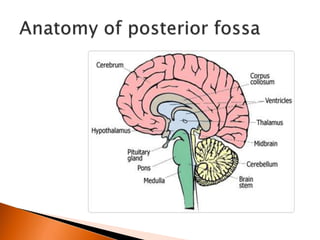
 Posterior fossa contains hindbrain which
consists of cerebellum, pons and medulla.
 The cavity of hindbrain is fourth ventricle.
This is bounded in front by pons and medulla
and behind by cerebellum.
 The vermis separates two lateral lobes or
cerebellar hemspheres.
 Medulloblastoma ( 40 % )
 Ependymoma
 Astrocytoma
 Brainstem Glioma
 Metastasis
The name was given by Baily and Cushing 1925
 Medulloblastoma name is from:
 Medulla (Greek for marrow)
 Blast (Greek word for germ)
 Oma (Greek for tumor)
 means “tumor of primitive undeveloped cells
located inside the cerebellum”.
 20 % percent of pediatric CNS tumors, 40% of
all PF tumors.
 The second most common pediatric CNS
tumor after low-grade glioma
medulloblastoma.
 M:F = 2:1.
 Median age 5–6 year in children and 25 year
in adults.
 MB patients present with symptoms and signs
of:
 1. Increased intra cranial tension.
 2. Cerebellar dysfunction.
 Headache
 vomiting
 altered mental status
 Confusion
 Unsteady walking , ataxia
 Dizzness
 cranial nerve involvement
 Bony pains (bone metastsis)
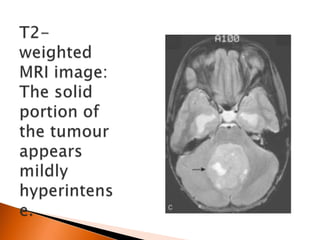
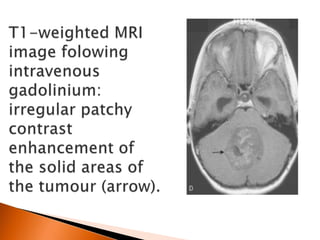
 Medulloblastoma is WHO IV tumor of small
blue cell origin which arise from medullblast
?! cells mostly arise from vermis .
 WHO classification
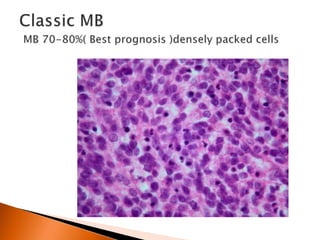
 Classic 70%
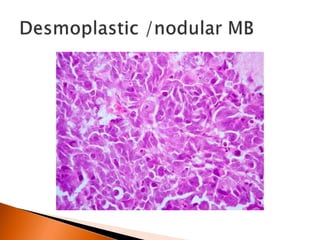
 Desmoplastic /nodular MB 7%
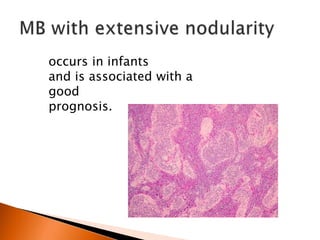
 MB with extensive nodularity (MBEN) 3%
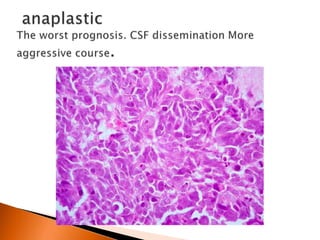
 Large cell /anaplastic variant 10-20%
 Gross picture soft , friable , extensive
necrosis
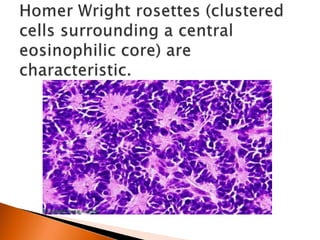
 Microscopic picture : highly cellular , dark
staining , round / .oval nuclei
occurs in infants
and is associated with a
good
prognosis.
 Direct invasion .
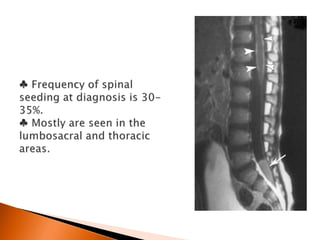
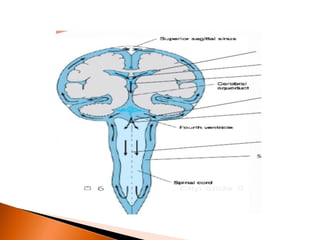
 CSF(30%).
 Extraneural (5%) Most common CNS tumor to
spread outside CNS
Hematogenous
MC sites are Long Bones and Ribs(10-15%) ,
LN(4-6%)
 H&P
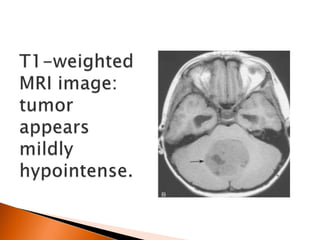
 MRI of the brain (pre-op and post-op within
24–48 h after surgery)
 MRI of the spine to rule-out spread(MRI
within 14-21 days post surgery if not done
pre op )
 CSF cytology ( 14 – 21 days post op )
 Bilateral bone marrow biopsy
 Consider bone scan and CXR
 Baseline audiometry , IQ, TSH, CBC, and
growth measurements
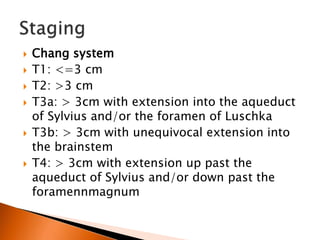
 Chang system
 T1: <=3 cm
 T2: >3 cm
 T3a: > 3cm with extension into the aqueduct
of Sylvius and/or the foramen of Luschka
 T3b: > 3cm with unequivocal extension into
the brainstem
 T4: > 3cm with extension up past the
aqueduct of Sylvius and/or down past the
foramennmagnum
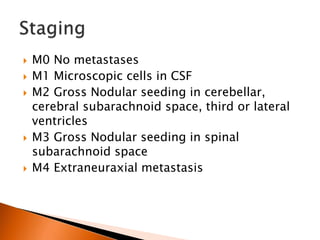
 M0 No metastases
 M1 Microscopic cells in CSF
 M2 Gross Nodular seeding in cerebellar,
cerebral subarachnoid space, third or lateral
ventricles
 M3 Gross Nodular seeding in spinal
subarachnoid space
 M4 Extraneuraxial metastasis
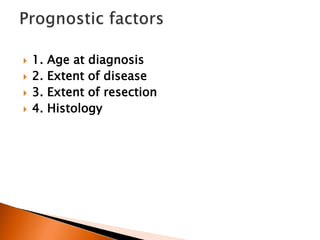
 1. Age at diagnosis
 2. Extent of disease
 3. Extent of resection
 4. Histology
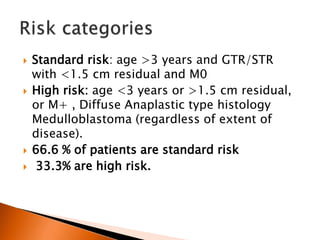
 Standard risk: age >3 years and GTR/STR
with <1.5 cm residual and M0
 High risk: age <3 years or >1.5 cm residual,
or M+ , Diffuse Anaplastic type histology
Medulloblastoma (regardless of extent of
disease).
 66.6 % of patients are standard risk
 33.3% are high risk.
 Survival
 Standard-risk DFS 60–90%
 High-risk DFS 20–40%, increased to 50–85%
with adjuvant chemo
 “Surgery is usually the first step and mainstay
of treatment.” BUT Surgery alone is not
curative and the addition of radiotherapy has
significantly improved survival.
 Objective:
 Remove or Reduce as much of the tumor's
bulk as possible.
 Relieve ICT & local pressure effect ,i.e. V-P
Shunting.
 Tissue Diagnosis and staging – Biopsy
 Surgery is classified as:
 No evidence of residual tumor at surgery and
negative postoperativeimaging : Gross total
resection
 > 90% : Total or near total
 51 - 90% : Subtotal resection
 11 - 50% : Partial resection
 < 10% : Biopsy
 Edema in the brain
 Hematoma
 Aseptic meningitis
 Posterior fossa syndrome/ cerebellar mutism
syndrome:
15% of children
Difficulty in swallowing, truncal ataxia, mutism,
and, less often,respiratory failure.
noted after a 12 to 24 hour
often improve dramatically, sometimes over many
months after
surgery.
 Highly radio-sensitive.
 RT plays a central role.
Objective:
 To treat microscopic cancer cells / residual
tumor with the goal of reducing its size or
stopping its progression.
 Prevent or treat spread through CSF. Covering
the entire subarachnoid space is an essential
component in the management of
medulloblastoma.
 So We do Craniospinal irradiation (CSI).
 Nausea, vomiting
 neutropenia,thrombocytopenia
 Fatigue, headache,drowsiness
 Alopecia, mild dermitis
 Serous otitis media
 mucositis
 Spinal cord : radiation induced myelitis
 Brain :Radiation necrosis, Intellectual deficit
 Lens of eye :Cataract formation
 Retina :Radiation retinopathy
 Optic nerve: Optic neuritis
 Inner ear: Sensorineural hearing loss
 Hypothalamicpituitary Axis: Endocrinopathies
( hypothyroidism and decreased growth
hormone secretion)
 Secondary Malignancy.
 chemo-sensitive ( vincristine , PCV )
 Indication for CT :
 1. As Adjuvant with Surgery in child <3 yrs
to delay/avoid RT.
 2. In Recurrent /Progressive disease .
 3. In patients with Extra cranial mets .
 4. High risk Pt. to improve cure rates
 5. In avg. risk group to allow reduced RT
dose.
 TREATMENT RECOMMENDATIONS
 General management
 Hydrocephalus and increased ICP: steroids and
VP shunt before attempting resection
 Standard risk
 Surgical resection then CSI 23.4 Gy at 1.8-Gy/ fx
with PF boost to 54 Gy with concurrently with
vincristine then PCV chemo.
 High risk
 Surgical resection then post-op CSI 36–39 Gy at
1.8-Gy/fx, with entire PF and mets >1 cm
boosted to 54 Gy concurrently with vincristine
then PCV chemo.
 Infants
 <3-year old
 Surgery + intensive chemo. Reserve RT for
salvage
 –Patient Position: For CSI all patients are treated
in supine position .( historically prone position )
 –Immobilization devices: Head mask.
 –Anesthesia may required .
 – scan the brain and spine ( 3 mm and 5mm ),
which includes the entire head to the inferior
limit of the S4 vertebral body.
 Primary Gross Tumor Volume (GTV) The GTV
includes all gross residual tumor and/or the
tumor bed at the primary site based on the
initial pre-operative imaging examination
that defines the tissues initially involved with
disease anatomically and the post-operative
and pre-irradiation neuroimaging
examinations that identify residual disease
and/or the tumor bed. The GTV in most cases
will be a contracted or collapsed tumor bed.
 Metastatic Target Volume (MTV) : Overt
metastatic disease > 5mm in maximal
diameter will define a volume or volumes for
potential boost irradiation. The MTV will
include the contoured lesion(s) with a margin
of 0.5cm.
 •cranial CTV
 –Anteriorly : include the entire frontal lobe ,cribriform plate region and the
superior orbital tissue (but not the posterior globe ).
 –Inferiorly: at least 0.5 cm below the base of the skull at the foramen magnum.
 •Spine (CTV_SpI): the entire thecal sac.
 –Laterally : extend laterally on both sides to cover the recesses of the entire
vertebral bodies, with at least a 1 cm margin on either side
 –Superiorly : will be the junction with the whole brain field.
 –Inferiorly :should be placed after review of the spinal MRI. The border will be 2
cm below the termination of the subdural space. This will extend at least to the
inferior border of S2-S3 interspace, but may be as low as the inferior border of
S4.
 P.F BOOST : tumor bed with 1 cm margins .
PTV : CTV + 0.3-0.5 cm
 Brain : 2 lateral opposed fields .
 Spine : 1 posterior field if possible if not 2 .
 Gap : 0.5 cm
 In standard risk :
 Brain MRI - every 3 months, for the first 2
years Spinal MRI - every 6 months, for the
first 2 years;
 then Brain MRI every 6 months up to 3 years
and
MRI every year for 3 yrs.
 In high-risk :
 brain and spinal MRI - every 3 months for the
first 2 years then every 6 months.
 Relapses occur in nearly 75% of paediatric cases within 2
years.
 Sites•
Post. Fossa ( most common siteof relapse) , spinal cord .
 Diagnosed by neuroimaging;
 occasionally, clinical progression precedes neuroimaging
findings.
 Treatment at relapse:
 Localized brain recurrence: Surgery , radiation therapy
combined with various chemotherapy schedules.”
 Disseminated disease: Chemotherapy or best supportive
care
 including radiation.
 Evans et al. (1990) CCSG/RTOG – phase III:
233 patients with medulloblastoma
underwent surgery then randomized to
post-op RT vs. post-op chemo-RT followed
by chemo × 1 year. RT was CSI 35–40 Gy with
PF boost to 50–55 Gy + spinal mets to 50 Gy.
 Chemo was concurrent vincristine, adjuvant
vincristine, CCNU, and prednisone ×1 year.
Five-year OS 65% in both arms. Chemo
improved EFS in T3–4, M1–3 (46% for chemo-
RT vs. 0% for RT alone)
 Medulloblastoma is pediatric age group tumor.
 Raised ICT is the most common presentation.
 CT, MRI have important role in diagnosis and
treatment.
 Surgery is the primary modality of treatment .
 RT has central role in treatment.
 Infants pt treated with intent to avoid or delay
the RT.
 Long term neurological sequalae seen in CSI.

Medulloblastoma

  • 2.
    By : Dr.MohammadAbu Ashour Radiation Oncology Resident /RMS
  • 3.
     Posterior fossacontains hindbrain which consists of cerebellum, pons and medulla.  The cavity of hindbrain is fourth ventricle. This is bounded in front by pons and medulla and behind by cerebellum.  The vermis separates two lateral lobes or cerebellar hemspheres.
  • 5.
     Medulloblastoma (40 % )  Ependymoma  Astrocytoma  Brainstem Glioma  Metastasis
  • 6.
    The name wasgiven by Baily and Cushing 1925  Medulloblastoma name is from:  Medulla (Greek for marrow)  Blast (Greek word for germ)  Oma (Greek for tumor)  means “tumor of primitive undeveloped cells located inside the cerebellum”.
  • 7.
     20 %percent of pediatric CNS tumors, 40% of all PF tumors.  The second most common pediatric CNS tumor after low-grade glioma medulloblastoma.  M:F = 2:1.  Median age 5–6 year in children and 25 year in adults.
  • 8.
     MB patientspresent with symptoms and signs of:  1. Increased intra cranial tension.  2. Cerebellar dysfunction.
  • 9.
     Headache  vomiting altered mental status  Confusion  Unsteady walking , ataxia  Dizzness  cranial nerve involvement  Bony pains (bone metastsis)
  • 10.
     Medulloblastoma isWHO IV tumor of small blue cell origin which arise from medullblast ?! cells mostly arise from vermis .  WHO classification  Classic 70%  Desmoplastic /nodular MB 7%  MB with extensive nodularity (MBEN) 3%  Large cell /anaplastic variant 10-20%
  • 11.
     Gross picturesoft , friable , extensive necrosis  Microscopic picture : highly cellular , dark staining , round / .oval nuclei
  • 13.
    occurs in infants andis associated with a good prognosis.
  • 17.
     Direct invasion.  CSF(30%).  Extraneural (5%) Most common CNS tumor to spread outside CNS Hematogenous MC sites are Long Bones and Ribs(10-15%) , LN(4-6%)
  • 18.
     H&P  MRIof the brain (pre-op and post-op within 24–48 h after surgery)  MRI of the spine to rule-out spread(MRI within 14-21 days post surgery if not done pre op )  CSF cytology ( 14 – 21 days post op )  Bilateral bone marrow biopsy  Consider bone scan and CXR  Baseline audiometry , IQ, TSH, CBC, and growth measurements
  • 23.
     Chang system T1: <=3 cm  T2: >3 cm  T3a: > 3cm with extension into the aqueduct of Sylvius and/or the foramen of Luschka  T3b: > 3cm with unequivocal extension into the brainstem  T4: > 3cm with extension up past the aqueduct of Sylvius and/or down past the foramennmagnum
  • 24.
     M0 Nometastases  M1 Microscopic cells in CSF  M2 Gross Nodular seeding in cerebellar, cerebral subarachnoid space, third or lateral ventricles  M3 Gross Nodular seeding in spinal subarachnoid space  M4 Extraneuraxial metastasis
  • 26.
     1. Ageat diagnosis  2. Extent of disease  3. Extent of resection  4. Histology
  • 27.
     Standard risk:age >3 years and GTR/STR with <1.5 cm residual and M0  High risk: age <3 years or >1.5 cm residual, or M+ , Diffuse Anaplastic type histology Medulloblastoma (regardless of extent of disease).  66.6 % of patients are standard risk  33.3% are high risk.
  • 28.
     Survival  Standard-riskDFS 60–90%  High-risk DFS 20–40%, increased to 50–85% with adjuvant chemo
  • 30.
     “Surgery isusually the first step and mainstay of treatment.” BUT Surgery alone is not curative and the addition of radiotherapy has significantly improved survival.  Objective:  Remove or Reduce as much of the tumor's bulk as possible.  Relieve ICT & local pressure effect ,i.e. V-P Shunting.  Tissue Diagnosis and staging – Biopsy
  • 31.
     Surgery isclassified as:  No evidence of residual tumor at surgery and negative postoperativeimaging : Gross total resection  > 90% : Total or near total  51 - 90% : Subtotal resection  11 - 50% : Partial resection  < 10% : Biopsy
  • 32.
     Edema inthe brain  Hematoma  Aseptic meningitis  Posterior fossa syndrome/ cerebellar mutism syndrome: 15% of children Difficulty in swallowing, truncal ataxia, mutism, and, less often,respiratory failure. noted after a 12 to 24 hour often improve dramatically, sometimes over many months after surgery.
  • 33.
     Highly radio-sensitive. RT plays a central role. Objective:  To treat microscopic cancer cells / residual tumor with the goal of reducing its size or stopping its progression.  Prevent or treat spread through CSF. Covering the entire subarachnoid space is an essential component in the management of medulloblastoma.  So We do Craniospinal irradiation (CSI).
  • 34.
     Nausea, vomiting neutropenia,thrombocytopenia  Fatigue, headache,drowsiness  Alopecia, mild dermitis  Serous otitis media  mucositis
  • 35.
     Spinal cord: radiation induced myelitis  Brain :Radiation necrosis, Intellectual deficit  Lens of eye :Cataract formation  Retina :Radiation retinopathy  Optic nerve: Optic neuritis  Inner ear: Sensorineural hearing loss  Hypothalamicpituitary Axis: Endocrinopathies ( hypothyroidism and decreased growth hormone secretion)  Secondary Malignancy.
  • 36.
     chemo-sensitive (vincristine , PCV )  Indication for CT :  1. As Adjuvant with Surgery in child <3 yrs to delay/avoid RT.  2. In Recurrent /Progressive disease .  3. In patients with Extra cranial mets .  4. High risk Pt. to improve cure rates  5. In avg. risk group to allow reduced RT dose.
  • 37.
     TREATMENT RECOMMENDATIONS General management  Hydrocephalus and increased ICP: steroids and VP shunt before attempting resection  Standard risk  Surgical resection then CSI 23.4 Gy at 1.8-Gy/ fx with PF boost to 54 Gy with concurrently with vincristine then PCV chemo.  High risk  Surgical resection then post-op CSI 36–39 Gy at 1.8-Gy/fx, with entire PF and mets >1 cm boosted to 54 Gy concurrently with vincristine then PCV chemo.  Infants  <3-year old  Surgery + intensive chemo. Reserve RT for salvage
  • 38.
     –Patient Position:For CSI all patients are treated in supine position .( historically prone position )  –Immobilization devices: Head mask.  –Anesthesia may required .  – scan the brain and spine ( 3 mm and 5mm ), which includes the entire head to the inferior limit of the S4 vertebral body.
  • 39.
     Primary GrossTumor Volume (GTV) The GTV includes all gross residual tumor and/or the tumor bed at the primary site based on the initial pre-operative imaging examination that defines the tissues initially involved with disease anatomically and the post-operative and pre-irradiation neuroimaging examinations that identify residual disease and/or the tumor bed. The GTV in most cases will be a contracted or collapsed tumor bed.
  • 40.
     Metastatic TargetVolume (MTV) : Overt metastatic disease > 5mm in maximal diameter will define a volume or volumes for potential boost irradiation. The MTV will include the contoured lesion(s) with a margin of 0.5cm.
  • 41.
     •cranial CTV –Anteriorly : include the entire frontal lobe ,cribriform plate region and the superior orbital tissue (but not the posterior globe ).  –Inferiorly: at least 0.5 cm below the base of the skull at the foramen magnum.  •Spine (CTV_SpI): the entire thecal sac.  –Laterally : extend laterally on both sides to cover the recesses of the entire vertebral bodies, with at least a 1 cm margin on either side  –Superiorly : will be the junction with the whole brain field.  –Inferiorly :should be placed after review of the spinal MRI. The border will be 2 cm below the termination of the subdural space. This will extend at least to the inferior border of S2-S3 interspace, but may be as low as the inferior border of S4.
  • 42.
     P.F BOOST: tumor bed with 1 cm margins . PTV : CTV + 0.3-0.5 cm
  • 43.
     Brain :2 lateral opposed fields .  Spine : 1 posterior field if possible if not 2 .  Gap : 0.5 cm
  • 44.
     In standardrisk :  Brain MRI - every 3 months, for the first 2 years Spinal MRI - every 6 months, for the first 2 years;  then Brain MRI every 6 months up to 3 years and MRI every year for 3 yrs.  In high-risk :  brain and spinal MRI - every 3 months for the first 2 years then every 6 months.
  • 45.
     Relapses occurin nearly 75% of paediatric cases within 2 years.  Sites• Post. Fossa ( most common siteof relapse) , spinal cord .  Diagnosed by neuroimaging;  occasionally, clinical progression precedes neuroimaging findings.  Treatment at relapse:  Localized brain recurrence: Surgery , radiation therapy combined with various chemotherapy schedules.”  Disseminated disease: Chemotherapy or best supportive care  including radiation.
  • 46.
     Evans etal. (1990) CCSG/RTOG – phase III: 233 patients with medulloblastoma underwent surgery then randomized to post-op RT vs. post-op chemo-RT followed by chemo × 1 year. RT was CSI 35–40 Gy with PF boost to 50–55 Gy + spinal mets to 50 Gy.  Chemo was concurrent vincristine, adjuvant vincristine, CCNU, and prednisone ×1 year. Five-year OS 65% in both arms. Chemo improved EFS in T3–4, M1–3 (46% for chemo- RT vs. 0% for RT alone)
  • 47.
     Medulloblastoma ispediatric age group tumor.  Raised ICT is the most common presentation.  CT, MRI have important role in diagnosis and treatment.  Surgery is the primary modality of treatment .  RT has central role in treatment.  Infants pt treated with intent to avoid or delay the RT.  Long term neurological sequalae seen in CSI.