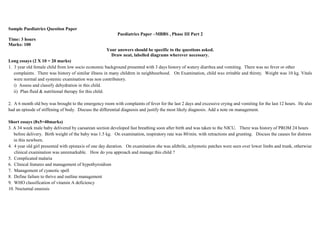
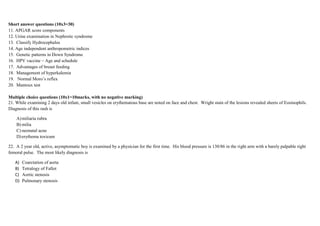
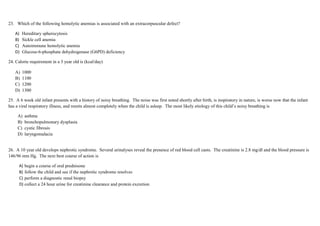
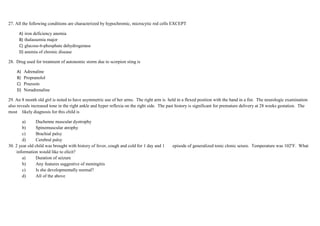
Rajiv Gandhi University of Health Sciences
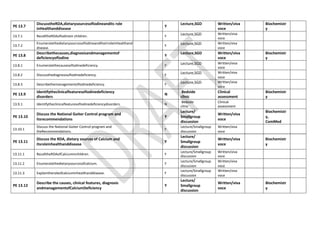
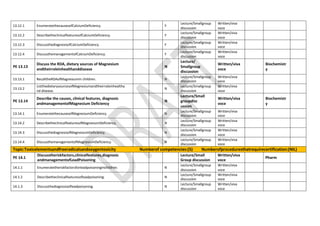
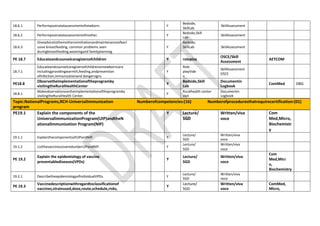
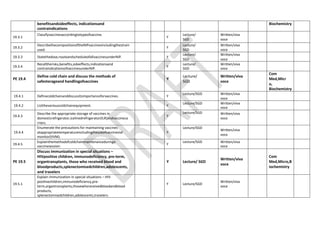
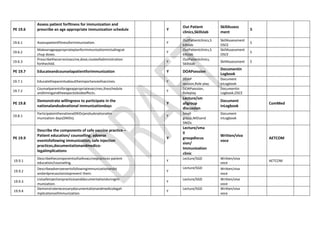
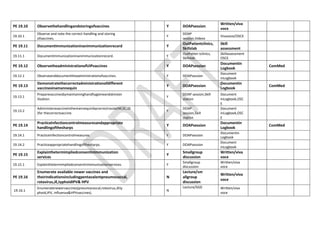
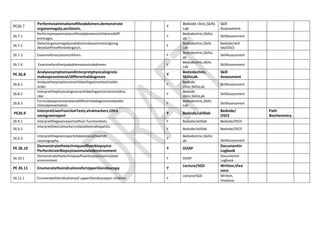
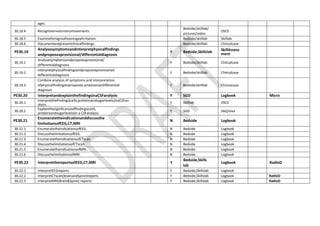
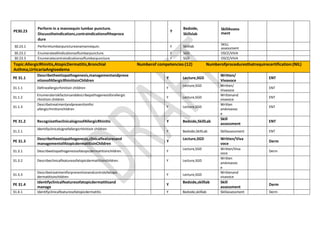
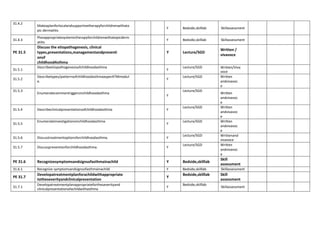
Bangalore, Karnataka
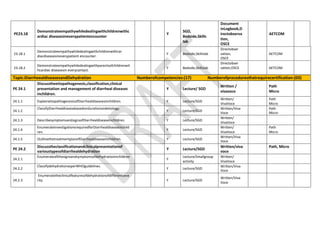
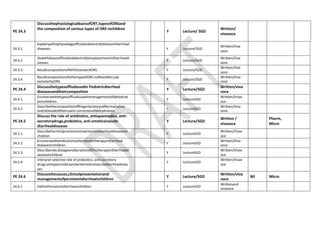
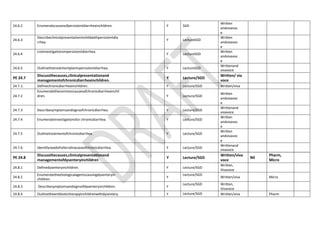
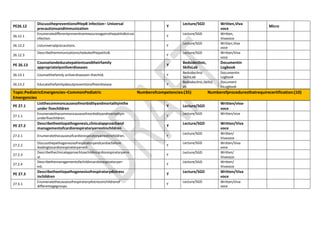
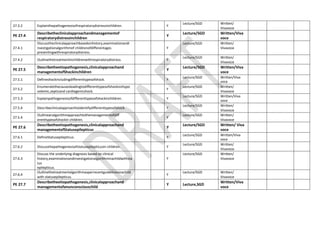
Paediatrics Curriculum
as per
Competency-Based Medical Education Curriculum
Abbreviations
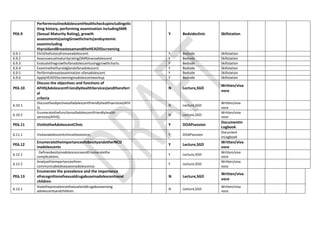
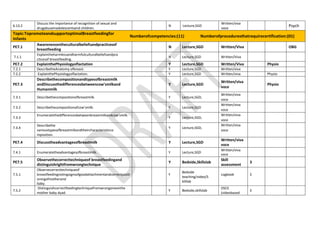
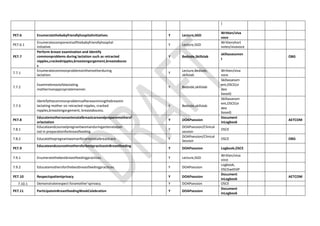
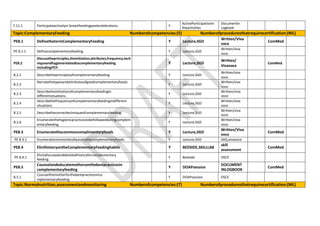
NMC - National Medical Council
IMG - Indian Medical Graduate
CBME - Competency Based Medical Education
SLO - Specific Learning Objectives
TL - Teaching Learning
P - performed
Y/N - yes / no
SGD - Small group discussion
OSCE - Objective structured clinical examination
AETCOM - Attitude, Ethics and communication
SAQ - short answer question
MCQ - multiple choice question
RGUHS Paediatrics Curriculum as per the new Competency Based Medical Education
Preamble
The NMC envisages that the Indian Medical Graduate, should function as the Physician of first contact in the community, to provide holistic health care to the
evolving needs of the nation and the world. To fulfil this the IMG should be able to perform the following roles: a clinician, a communicator, a lifelong learner, a
professional and a team leader.
Competency-based medical education (CBME) is an outcomes-based training model that has become the new standard of medical education internationally. This new
curriculum is being implemented across the country and the first batch has been enrolled since the academic year 2019. The regulatory and accrediting body NMC
had started the process by training faculty across the country in the key principles of CBME and developing key competencies for each speciality with the input from
expert groups under each speciality.
Paediatrics is an interesting branch of medicine dealing with health and medical care of children. It encompasses a broad spectrum of services ranging from
preventive health care to the diagnosis and treatment of acute and chronic childhood illnesses. It is an ever-evolving branch requiring compassion, dedication and
precision of care. The Paediatrics undergraduate curriculum provides the IMG the requisite knowledge, essential skills and appropriate attitudes to be able to diagnose
and treat common paediatric disorders and also to be able to recognise serious conditions and refer appropriately.
The NMC, in the Graduate medical regulations 2019, has provided the list of paediatric competencies required for an IMG and these have been included in this
curriculum document. The Specific learning objectives (SLO’s) to achieve each competency has been listed along with the suggested Teaching-Learning methods and
preferred assessment methods.
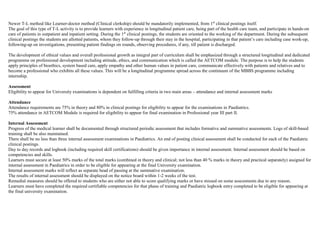
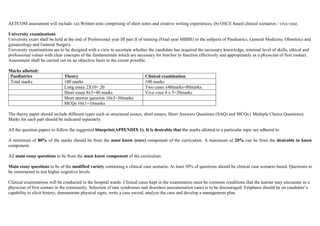
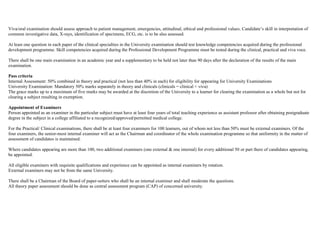
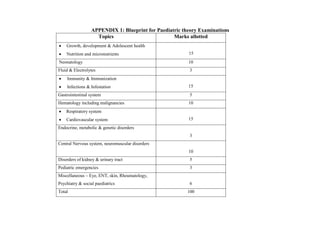
Following this is a detailed blueprint showing the weightage and the assessment tool for a particular chapter. This blueprint will ensure that there is an alignment
between the SLOs’, TL methods and the assessment. A question paper layout has also been added to ensure that there is consistency among different paper setters.
Finally, the list of practical skills along with the most appropriate TL and assessment methods has been laid out.
Goals and Objectives of the RGUHS Paediatrics Curriculum
Goals:
The course includes systematic instructions in management of common diseases of infancy and childhood, evaluation of growth and development, nutritional needs,
and immunization schedule in children, social pediatrics and counseling is also dealt in the course. The aim of teaching undergraduate medical students is to impart
appropriate knowledge and skills to optimally deal with major health problems and also to ensure optimal growth and development of children.
Objectives:
(A) Knowledge
At the end of the course, the student shall be able to:
1. Describe normal growth and development during fetal, neonatal, child and adolescence period.
2. Describe the common pediatric disorders and emergencies in terms of epidemiology, etiopathogenesis, clinical manifestations, diagnosis, rational therapy and
rehabilitation.
3. State age related requirements of calories, nutrients, fluids, drugs etc. in health and disease.
4. Describe preventive strategies for common infectious disorders, poisonings, accidents and child abuse.
5. Outline national programmes relating to child health including immunization programmes.
(B) Skills
At the end of the course, the student shall be able to:
1. Take a detailed pediatric history, conduct an appropriate physical examination of children including neonates, make clinical diagnosis, conduct common bedside
investigative procedures, interpret common laboratory investigation results and plan and institute therapy.
2. Distinguish between normal newborn babies and those requiring special care and institute early care to all newborn babies including care of preterm and low birth
weight babies.
3. Take anthropometric measurements, resuscitate newborn infants at birth, prepare oral rehydration solution, perform tuberculin test, administer vaccines available
under current national programmes, perform venesection, start an intravenous line and provide nasogastric feeding.
4. Would have observed procedures such as lumbar puncture, liver and kidney biopsy, bone marrow aspiration, pleural tap and ascitic tap.
5. Provide appropriate guidance and counseling in breast feeding.
6. Provide ambulatory care to all sick children, identify indications for specialized/inpatient care and ensure timely referral of those who require hospitalization.
7. Be aware and analyse ethical problems that arise during practice and deal with them in an acceptable manner following the code of ethics.
(C) Attitude and communication skills
At the end of the course, the student shall be able to:
1.Communicate effectively with patients, their families and the public at large.
2. Communicate effectively with peers and teachers and demonstrate the ability to work effectively with peers in a team.
3. Demonstrate professional attributes of punctuality, accountability and respect for teachers and peers.
4. Appreciate the issues of equity and social accountability while undergoing early clinical exposure
(D) Integration
The training in pediatrics should prepare the student to deliver preventive, promotive, curative and rehabilitative services for care of children both in the community
and at hospital as part of a team in an integrated form with other disciplines.
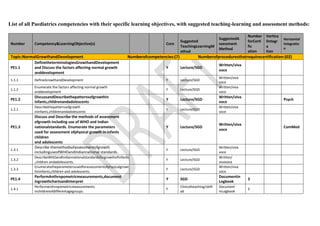
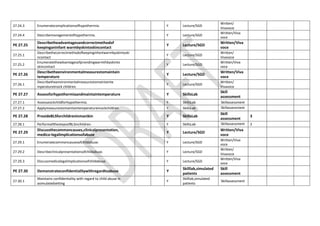
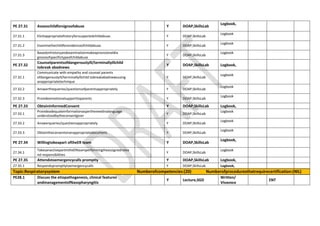
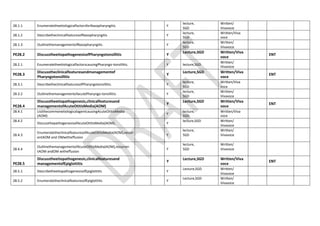
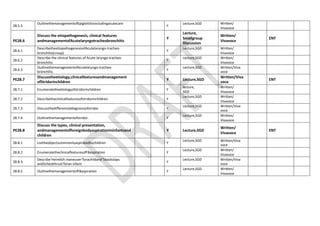
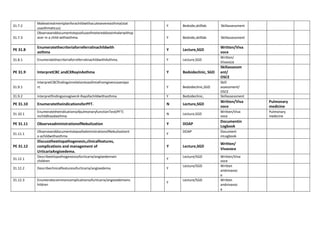
List of all Paediatrics competencies with their specific learning objectives, with suggested teaching-learning and assessment methods:
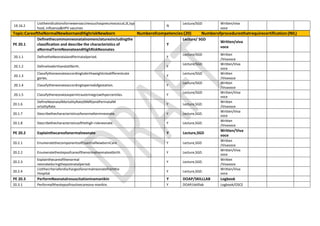
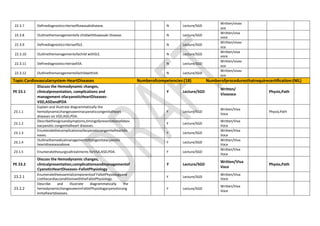
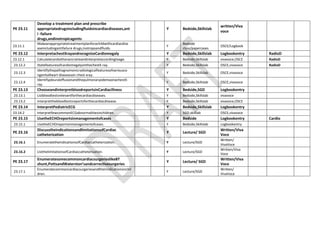
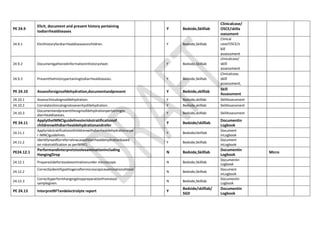
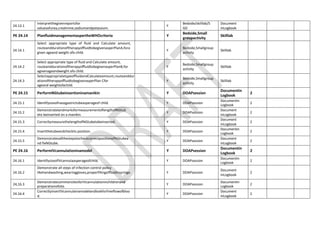
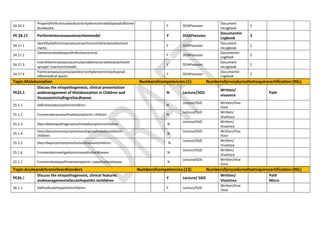
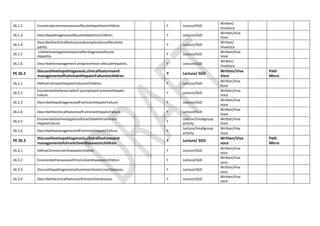
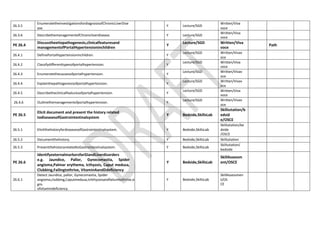
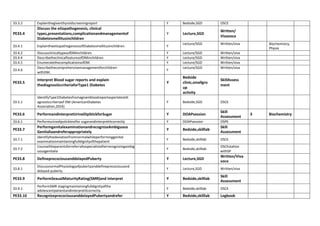
Number Competency&LearningObjective(s) Core
Suggested
TeachingLearningM
ethod
SuggestedA
ssessment
Method
Number
forCerti
fic
ation
Vertica
lIntegr
a
tion
Horizontal
Integratio
n
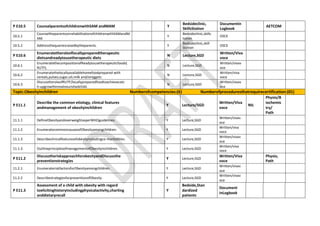
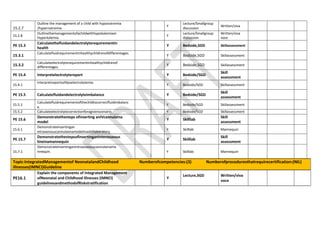
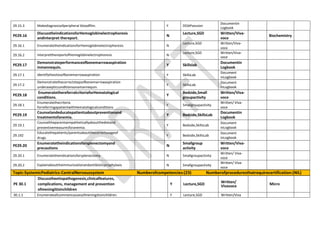
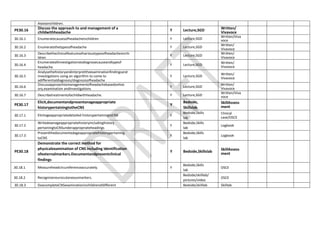
Topic:NormalGrowthandDevelopment Numberofcompetencies:(7) Numberofproceduresthatrequirecertification:(02)
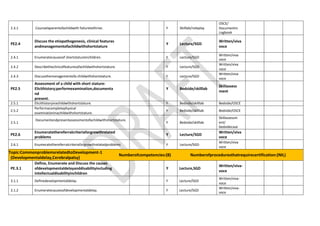
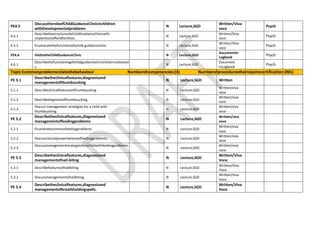
PE1.1
DefinetheterminologiesGrowthandDevelopment
and Discuss the factors affecting normal growth
anddevelopment
Y Lecture/SGD
Written/viva
voce
1.1.1 DefineGrowthandDevelopment Y Lecture/SGD
Written/viva
voce
1.1.2
Enumerate the factors affecting normal growth
anddevelopment
Y Lecture/SGD
Written/viva
voce
PE1.2
DiscussandDescribethepatternsofgrowthin
infants,childrenandadolescents
Y Lecture/SGD
Written/viva
voce
Psych
1.2.1
Describethepatternsofgrowth
ininfants,childrenandadolescents
Y Lecture/SGD
Written/viva
voce
PE1.3
Discuss and Describe the methods of assessment
ofgrowth including use of WHO and Indian
nationalstandards. Enumerate the parameters
used for assessment ofphysical growth in infants
children
and adolescents
Y Lecture/SGD
Written/viva
voce
ComMed
1.3.1
Describe themethodsofassessmentofgrowth
includinguseofWHOandIndiannational standards.
Y Lecture/SGD
Written/viva
voce
1.3.2
DescribeWHOandIndiannationalstandardsforgrowthofinfants
,children andadolescents.
Y Lecture/SGD
Written/
vivavoce
1.3.3
Enumeratetheparametersusedforassessmentofphysicalgrowt
hininfants,children and adolescents.
Y Lecture/SGD
Written/viva
voce
PE1.4
PerformAnthropometricmeasurements,document
ingrowthchartsandinterpret
Y SGD
Documentin
Logbook
3
1.4.1
Performanthropometricmeasurements
inchildrenofdifferentagegroups.
Y
Clinicalteaching/skilll
ab
Document
inLogbook
3
1.4.2
Documentthemeasuredparametersingrowthchartsandinte
rpretthefindingson growthcharts.
Y
Clinicalteaching/skilll
ab
Document
inLogbook
3
PE1.5
Define development and Discuss the
normaldevelopmentalmilestoneswithrespecttomotor,
behavior,social,adaptiveandlanguage
Y Lecture/SGD
Written/viva
voce
Psych
1.5.1 Definedevelopment. Y Lecture/SGD
Written/viva
voce
1.5.2
Describe the normal developmental milestones
withrespect to motor, behavior, social, adaptive and
languagedomains.
Y Lecture/SGD
Written/viva
voce
Psych
PE1.6 Discussthemethodsofassessmentofdevelopment. Y Lecture/SGD
Written/viva
voce
1.6.1 Discussthemethodsofassessmentofdevelopment Y Lecture/SGD
Written/viva
voce
PE1.7 PerformDevelopmentalassessmentandinterpret N Bedside/skillslab
Documentin
Logbook
3
1.7.1
PerformDevelopmentalassessmentininfantsandchildrenan
dinterpret thefindings.
N Bedside/skillslab
Document
inLogbook/sk
illlab
3
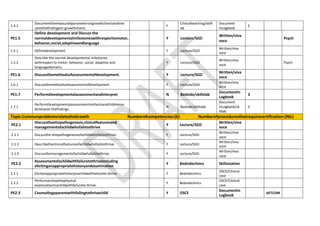
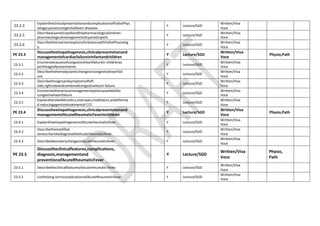
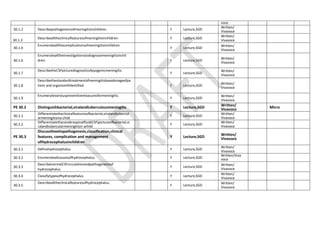
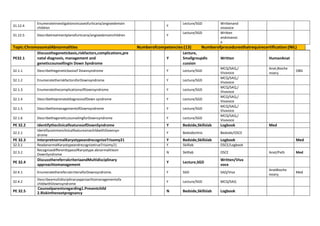
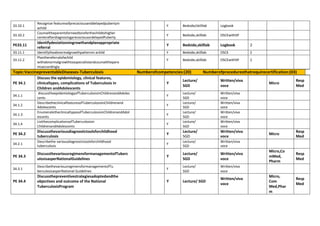
Topic:CommonproblemsrelatedtoGrowth Numberofcompetencies:(6) Numberofproceduresthatrequirecertification:(NIL)
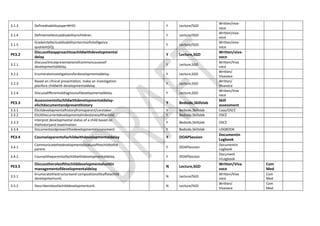
PE2.1
Discusstheetiopathogenesis,clinicalfeaturesand
managementofachildwhofailstothrive
Y Lecture/SGD
Written/viva
voce
2.1.1 Discussthe etiopathogenesisofachildwhofailstothrive. Y Lecture/SGD
Written/viva
voce
2.1.2 Describetheclinicalfeaturesofachildwhofailstothrive. Y Lecture/SGD
Written/viva
voce
2.1.3 Discussthemanagementofachildwhofailstothrive. Y Lecture/SGD
Written/viva
voce
PE2.2
Assessmentofachildwithfailuretothriveincluding
elicitinganappropriatehistoryandexamination
Y Bedsideclinics Skillsstation
2.2.1 Elicitanappropriatehistoryinachildwithfailureto thrive. Y Bedsideclinics
OSCE/Clinical
case
2.2.2
Performacompletephysical
examinationinachildwithfailureto thrive.
Y Bedsideclinics
OSCE/Clinical
case
PE2.3 Counselingaparentwithfailingtothrivechild Y OSCE
Documentin
Logbook
AETCOM
2.3.1 Counselaparentofachildwith failuretothrive. Y Skilllab/roleplay
OSCE/
Documentin
Logbook
PE2.4
Discuss the etiopathogenesis, clinical features
andmanagementofachildwithshortstature
Y Lecture/SGD
Written/viva
voce
2.4.1 Enumeratecausesof shortstatureinchildren. Y Lecture/SGD
Written/viva
voce
2.4.2 Describetheclinicalfeaturesofachildwithshortstature. Y Lecture/SGD
Written/viva
voce
2.4.3 Discussthemanagementofa childwithshortstature. Y Lecture/SGD
Written/viva
voce
PE2.5
Assessment of a child with short stature:
Elicithistory;performexamination,documenta
nd
present.
Y Bedside/skilllab
Skillassess
ment
2.5.1 Elicithistoryinachildwithshortstature. Y Bedside/skilllab Bedside/OSCE
2.5.2
Performacompletephysical
examinationinachildwithshortstature.
Y Bedside/skilllab Bedside/OSCE
2.5.1
Documentandpresentassessmentofachildwithshortstature.
Y Bedside/skilllab
Skillassessm
ent/
bedsidecase
PE2.6
Enumeratethereferralcriteriaforgrowthrelated
problems
Y Lecture/SGD
Written/viva
voce
2.6.1 Enumeratethereferralcriteriaforgrowthrelatedproblems Y Lecture/SGD
Written/viva
voce
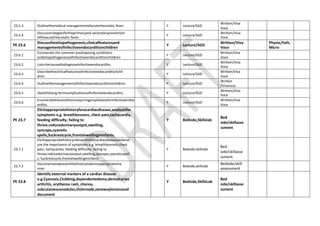
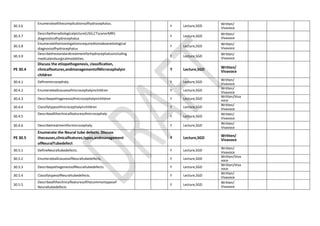
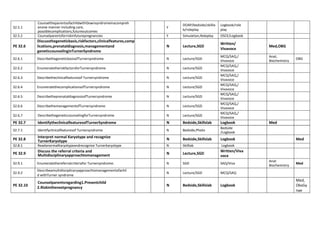
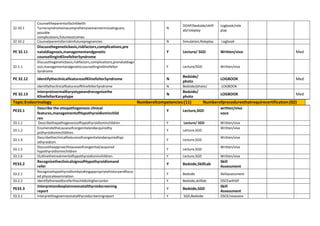
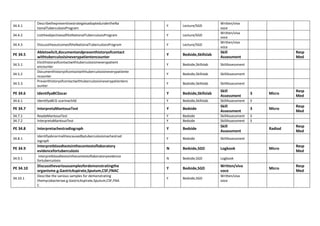
Topic:CommonproblemsrelatedtoDevelopment-1
(Developmentaldelay,Cerebralpalsy)
Numberofcompetencies:(8) Numberofproceduresthatrequirecertification:(NIL)
PE.3.1
Define, Enumerate and Discuss the causes
ofdevelopmentaldelayanddisabilityincluding
intellectualdisabilityinchildren
Y Lecture,SGD
Written/viva-
voce
3.1.1 Definedevelopmentaldelay. Y Lecture/SGD
Written/viva-
voce
3.1.2 Enumeratecausesofdevelopmentaldelay. Y Lecture/SGD
Written/viva-
voce
3.1.3 DefinedisabilityasperWHO. Y Lecture/SGD
Written/viva-
voce
3.1.4 DefineIntellectualdisabilityinchildren. Y Lecture/SGD
Written/viva-
voce
3.1.5
Gradeintellectualdisabilityintermsofintelligence
quotient(IQ).
Y Lecture/SGD
Written/viva-
voce
PE3.2
Discusstheapproachtoachildwithdevelopmental
delay
Y Lecture,SGD
Written/viva-
voce
3.2.1
Discussclinicalpresentationofcommoncausesof
developmentaldelay.
Y Lecture,SGD
Written/Viva
voce
3.2.2 Enumerateinvestigationsfordevelopmentaldelay. Y Lecture,SGD
Written/
Vivavoce
3.2.3
Based on clinical presentation, make an investigation
planfora childwith developmentaldelay.
Y Lecture,SGD
Written/
Vivavoce
3.2.4 Discussdifferentialdiagnosisofdevelopmentaldelay. Y Lecture,SGD
Written/Viva
voce
PE3.3
Assessmentofachildwithdevelopmentaldelay-
elicitdocumentandpresenthistory
Y Bedside,Skillslab
Skill
assessment
3.3.1 Elicitdevelopmentalhistoryfromaparent/caretaker. Y Bedside,Skillslab Case/OSCE
3.3.2 Elicitthecurrentdevelopmentalmilestonesofthechild. Y Bedside,Skillslab OSCE
3.3.3
Interpret developmental status of a child based on
thehistoryand examination.
Y Bedside,Skillslab OSCE
3.3.4 Documentandpresentthedevelopmentalassessment. Y Bedside,Skillslab LOGBOOK
PE3.4 Counselaparentofachildwithdevelopmentaldelay Y DOAPSession
Documentin
Logbook
3.4.1
Communicatethedevelopmentalstatusofthechildtothe
parent.
Y DOAPSession
Documentin
Logbook
3.4.2 Counseltheparentsofachildwithdevelopmentaldelay. Y DOAPSession
Document
inLogbook
PE3.5
Discusstheroleofthechilddevelopmentalunitin
managementofdevelopmentaldelay
N Lecture,SGD
Written/Viva
voce
Com
Med
3.5.1
Enumeratethestructureand compositionofstaffatachild
developmentunit.
N Lecture/SGD
Written/Viva
voce
Com
Med
3.5.2 Describerolesofachilddevelopmentunit. N Lecture/SGD
Written/
Vivavoce
Com
Med
PE3.6
Discussthereferralcriteriaforchildrenwith
developmentaldelay
Y Lecture,SGD
Written/viva
voce
3.6.1
Enumerateclinicalcriteriafor
referralofachildwithdevelopmentaldelay.
Y Lecture/SGD
Written/viva
voce
PE3.7
VisitaChildDevelopmentalUnitandObserveits
functioning
Y Lecture,SGD
Logbook
entry
Com
Med
3.7.1
Observeandlisttheactivitiesinthechilddevelopmental
unit.
Y Lecture,SGD Logbookentry
Com
Med
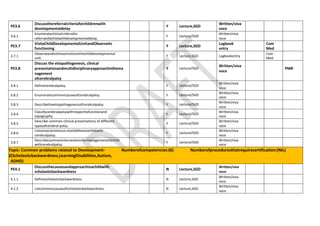
PE3.8
Discuss the etiopathogenesis, clinical
presentationandmultidisciplinaryapproachinthema
nagement
ofcerebralpalsy
Y Lecture/SGD
Written/viva
voce
PMR
3.8.1 Definecerebralpalsy. Y Lecture/SGD
Written/viva
voce
3.8.2 Enumeratecommoncausesofcerebralpalsy. Y Lecture/SGD
Written/viva
voce
3.8.3 Describetheetiopathogenesisofcerebralpalsy. Y Lecture/SGD
Written/viva
voce
3.8.4
Classifycerebralpalsywithrespecttofunctionand
topography.
Y Lecture/SGD
Written/viva
voce
3.8.5
Describe common clinical presentations of different
typesofcerebral palsy.
Y Lecture/SGD
Written/viva
voce
3.8.6
Listsomecommonco-morbiditiesinachildwith
cerebralpalsy.
Y Lecture/SGD
Written/viva
voce
3.8.7
Describecommoninterventionsformanagementofachild
withcerebralpalsy.
Y Lecture/SGD
Written/viva
voce
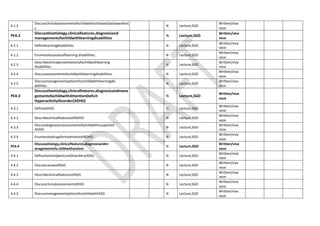
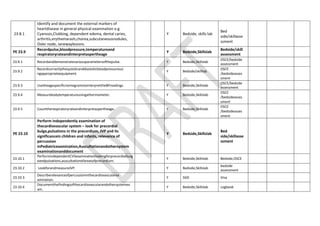
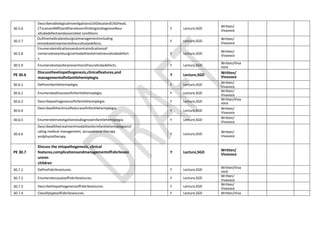
Topic: Common problems related to Development-
2(Scholasticbackwardness,LearningDisabilities,Autism,
ADHD)
Numberofcompetencies:(6) Numberofproceduresthatrequirecertification:(NIL)
PE4.1
Discussthecausesandapproachtoachildwith
scholasticbackwardness
N Lecture,SGD
Written/viva
voce
4.1.1 Definescholasticbackwardness. N Lecture,SGD
Written/viva
voce
4.1.2 Listcommoncausesofscholasticbackwardness. N Lecture,SGD
Written/viva
voce
4.1.3
Discussclinicalassessmentofachildwithscholasticbackwardnes
s.
N Lecture,SGD
Written/viva
voce
PE4.2
Discusstheetiology,clinicalfeatures,diagnosisand
managementofachildwithlearningdisabilities
N Lecture,SGD
Written/viva
voce
4.2.1 Definelearningdisabilities. N Lecture,SGD
Written/viva
voce
4.2.2 Enumeratecausesoflearning disabilities. N Lecture,SGD
Written/viva
voce
4.2.3
Describeclinicalpresentationofachildwithlearning
disabilities.
N Lecture,SGD
Written/viva
voce
4.2.4 Discussassessmentofachildwithlearningdisabilities. N Lecture,SGD
Written/viva
voce
4.2.5
Discussmanagementoptionsforachildwithlearningdis
abilities.
N Lecture,SGD
Written/viva
voce
PE4.3
Discusstheetiology,clinicalfeatures,diagnosisandmana
gementofachildwithAttentionDeficit
HyperactivityDisorder(ADHD)
N Lecture,SGD
Written/viva
voce
4.3.1 DefineADHD. N Lecture,SGD
Written/viva
voce
4.3.2 DescribeclinicalfeaturesofADHD. N Lecture,SGD
Written/viva
voce
4.3.3
Discussdiagnosticassessmentofachildwithsuspected
ADHD.
N Lecture,SGD
Written/viva
voce
4.3.4 EnumeratedrugsfortreatmentofADHD. N Lecture,SGD
Written/viva
voce
PE4.4
Discussetiology,clinicalfeatures,diagnosisandm
anagementofa childwithautism
N Lecture,SGD
Written/viva
voce
4.4.1 DefineAutismSpectrumDisorders(ASD). N Lecture,SGD
Written/viva
voce
4.4.2 DiscusscausesofASD. N Lecture,SGD
Written/viva
voce
4.4.3 DescribeclinicalfeaturesofASD. N Lecture,SGD
Written/viva
voce
4.4.4 DiscussclinicalassessmentofASD. N Lecture,SGD
Written/viva
voce
4.4.5 DiscussmanagementoptionsforachildwithASD. N Lecture,SGD
Written/viva
voce
PE4.5
DiscusstheroleofChildGuidanceClinicinchildren
withDevelopmentalproblems
N Lecture,SGD
Written/Viva
voce
Psych
4.5.1
DescribethestructureofaChildGuidanceClinicwith
respecttostaffandfacilities.
N Lecture,SGD
Written/Viva
voce
Psych
4.5.2 Enumeratethefunctionsofachild guidanceclinic. N Lecture,SGD
Written/Viva
voce
Psych
PE4.6 VisittotheChildGuidanceClinic N Lecture,SGD
Documentin
Logbook
Psych
4.6.1
Describethefunctioningofchildguidanceclinicintheirinstitution
s.
N Lecture,SGD
Document
inLogbook
Psych
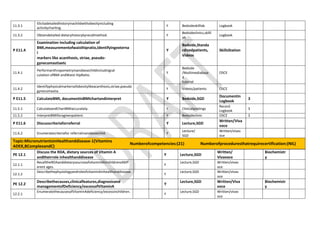
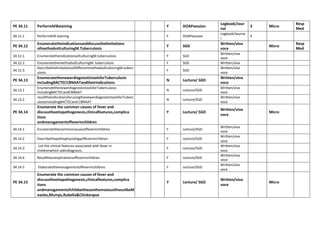
Topic:Commonproblemsrelatedtobehaviour Numberofcompetencies:(3) Numberofproceduresthatrequirecertification:(NIL)
PE 5.1
Describetheclinicalfeatures,diagnosisand
managementofthumbsucking
N Lecture,SGD Written
5.1.1 Describeclinicalfeaturesofthumbsucking. N Lecture,SGD
Written/viva
voce
5.1.2 Describediagnosisofthumbsucking. N Lecture,SGD
Written/viva
voce
5.1.3
Discuss management strategies for a child with
thumbsucking.
N Lecture,SGD
Written/viva
voce
PE 5.2
Describetheclinicalfeatures,diagnosisand
managementoffeedingproblems
N Lecture,SGD
Written/viva
voce
5.2.1 Enumeratecommonfeedingproblems. N Lecture,SGD
Written/viva
voce
5.2.2 Discussclinicalpresentationsoffeedingproblems. N Lecture,SGD
Written/viva
voce
5.2.3
Discussmanagementstrategiesforachildwithfeedingproblems.
N Lecture,SGD
Written/viva
voce
PE 5.3
Describetheclinicalfeatures,diagnosisand
managementofnail-biting
N Lecture,SGD
Written/Viva
Voce
5.3.1 Describefeaturesofnailbiting. N Lecture,SGD
Written/Viva
Voce
5.3.2 Discussmanagementofnailbiting. N Lecture,SGD
Written/Viva
Voce
PE 5.4
Describetheclinicalfeatures,diagnosisand
managementofbreathholdingspells.
N Lecture,SGD
Written/Viva
Voce
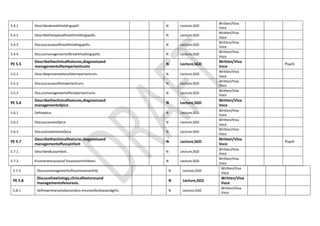
5.7.3 Discussmanagementoffussinessinachild. N Lecture,SGD
Written/Viva
Voce
PE 5.8
Discusstheetiology,clinicalfeaturesand
managementofenuresis.
N Lecture,SGD
Written/Viva
Voce
5.8.1 Defineprimaryandsecondary enuresisforboysandgirls. N Lecture,SGD
Written/Viva
Voce
5.4.1 Describeabreathholdingspell. N Lecture,SGD
Written/Viva
Voce
5.4.2 Describethetypesofbreathholdingspells. N Lecture,SGD
Written/Viva
Voce
5.4.3 Discusscausesofbreathholdingspells. N Lecture,SGD
Written/Viva
Voce
5.4.4 Discussmanagementofbreathholdingspells. N Lecture,SGD
Written/Viva
Voce
PE 5.5
Describetheclinicalfeatures,diagnosisand
managementoftempertantrums
N Lecture,SGD
Written/Viva
Voce
Psych
5.5.1 Describepresentationofatempertantrum. N Lecture,SGD
Written/Viva
Voce
5.5.2 Discusscausesoftempertantrum. N Lecture,SGD
Written/Viva
Voce
5.5.3 Discussmanagementoftempertantrums. N Lecture,SGD
Written/Viva
Voce
PE 5.6
Describetheclinicalfeatures,diagnosisand
managementofpica
N Lecture,SGD
Written/Viva
Voce
5.6.1 Definepica. N Lecture,SGD
Written/Viva
Voce
5.6.2 Discusscausesofpica. N Lecture,SGD
Written/Viva
Voce
5.6.3 Discusstreatmentofpica. N Lecture,SGD
Written/Viva
Voce
PE 5.7
Describetheclinicalfeatures,diagnosisand
managementoffussyinfant
N Lecture,SGD
Written/Viva
Voce
Psych
5.7.1 Describeafussyinfant. N Lecture,SGD
Written/Viva
Voce
5.7.2 Enumeratecausesof fussinessinchildren. N Lecture,SGD
Written/Viva
Voce
5.8.2 Discussetiologyofprimaryandsecondaryenuresis. N Lecture,SGD
Written/Viva
Voce
5.8.3
Discusspharmacologicalandnon-pharmacological
managementstrategiesforenuresis.
N Lecture,SGD
Written/Viva
Voce
PE 5.9
Discusstheetiology,clinicalfeaturesand
managementofEncopresis.
N Lecture,SGD
Written/Viva
Voce
5.9.1 DescribeEncopresis. N Lecture,SGD
Written/Viva
Voce
5.9.2 DiscusscausesofEncopresis. N Lecture,SGD
Written/Viva
Voce
5.9.3 DescribemanagementofEncopresis. N Lecture,SGD
Written/Viva
Voce
PE 5.10
Discusstheroleofchildguidanceclinicinchildren
withbehaviouralproblemsandthereferralcriteria
N Lecture,SGD
Written/Viva
Voce
Psych
5.10.1
Describetheroleofachildguidanceclinicinchildrenwithbeha
viouralproblems.
N Lecture,SGD
Written/Viva
Voce
5.10.2
Enumeratereferralcriteriaforbehaviouralproblemsin
children.
N Lecture,SGD
Written/Viva
Voce
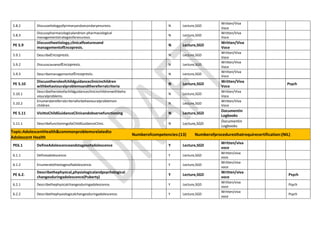
PE 5.11 VisittoChildGuidanceClinicandobservefunctioning N Lecture,SGD
Documentin
Logbooks
5.11.1 DescribefunctioningofaChildGuidanceClinic. N Lecture,SGD
Documentin
Logbooks
Topic:AdolescentHealth&commonproblemsrelatedto
Adolescent Health
Numberofcompetencies:(13) Numberofproceduresthatrequirecertification:(NIL)
PE6.1 DefineAdolescenceandstagesofadolescence Y Lecture,SGD
Written/viva
voce
6.1.1 Defineadolescence. Y Lecture,SGD
Written/viva
voce
6.1.2 Enumeratethestagesofadolescence. Y Lecture,SGD
Written/viva
voce
PE 6.2.
Describethephysical,physiologicalandpsychological
changesduringadolescence(Puberty)
Y Lecture,SGD
Written/viva
voce
Psych
6.2.1 Describethephysicalchangesduringadolescence. Y Lecture,SGD
Written/viva
voce
Psych
6.2.2 Describethephysiologicalchangesduringadolescence. Y Lecture,SGD
Written/viva
voce
Psych
6.2.3 Describethepsychologicalchangesduringadolescence. Y Lecture,SGD
Written/viva
voce
Psych
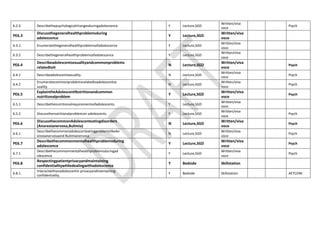
PE6.3
Discussthegeneralhealthproblemsduring
adolescence
Y Lecture,SGD
Written/viva
voce
6.3.1 Enumeratethegeneralhealthproblemsofadolescence Y Lecture,SGD
Written/viva
voce
6.3.2 Describethegeneralhealthproblemsofadolescence Y Lecture,SGD
Written/viva
voce
PE6.4
Describeadolescentsexualityandcommonproblems
relatedtoit
N Lecture,SGD
Written/viva
voce
Psych
6.4.1 Describeadolescentsexuality. N Lecture,SGD
Written/viva
voce
Psych
6.4.2
Enumeratecommonproblemsrelatedtoadolescentse
xuality.
N Lecture,SGD
Written/viva
voce
Psych
PE6.5
ExplaintheAdolescentNutritionandcommon
nutritionalproblem
Y Lecture,SGD
Written/viva
voce
Psych
6.5.1 Describethenutritionalrequirementsofadolescents. Y Lecture,SGD
Written/viva
voce
6.5.2 Discussthenutritionalproblemsin adolescents. Y Lecture,SGD
Written/viva
voce
Psych
PE6.6
DiscussthecommonAdolescenteatingdisorders
(Anorexianervosa,Bulimia)
N Lecture,SGD
Written/viva
voce
Psych
6.6.1
DescribethecommonadolescenteatingproblemslikeAn
orexianervosaand Bulimianervosa.
N Lecture,SGD
Written/viva
voce
Psych
PE6.7
Describethecommonmentalhealthproblemsduring
adolescence
Y Lecture,SGD
Written/viva
voce
Psych
6.7.1
Describethecommonmentalhealthproblemsduringad
olescence.
Y Lecture,SGD
Written/viva
voce
Psych
PE6.8
Respectingpatientprivacyandmaintaining
confidentialitywhiledealingwithadolescence
Y Bedside Skillstation
6.8.1
Interactwithanadolescentin privacyandmaintaining
confidentiality.
Y Bedside Skillstation AETCOM
PE6.9
PerformroutineAdolescentHealthcheckupincludingelic
iting history, performing examination includingSMR
(Sexual Maturity Rating), growth
assessments(usingGrowthcharts)andsystemic
examincluding
thyroidandBreastexamandtheHEADSSscreening
Y Bedsideclinic Skillstation
6.9.1 Elicitthehistoryfromanadolescent. Y Bedside Skillstation
6.9.2 Assesssexualmaturityrating(SMR)inanadolescent. Y Bedside Skillstation
6.9.3 Evaluatethegrowthofanadolescentusinggrowthcharts. Y Bedside Skillstation
6.9.4 Examinethethyroidglandofanadolescent. Y Bedside Skillstation
6.9.5 Performabreastexamination ofanadolescent. Y Bedside Skillstation
6.9.6 ApplyHEADSSscreeninginadolescentworkup. Y Bedside Skillstation
PE6.10
Discuss the objectives and functions of
AFHS(AdolescentFriendlyHealthServices)andthereferr
al
criteria
N Lecture,SGD
Written/viva
voce
6.10.1
Discusstheobjectivesofadolescentfriendlyhealthservices(AFH
S).
N Lecture,SGD
Written/viva
voce
6.10.2
Enumeratethefunctionsofadolescentfriendlyhealth
services(AFHS).
N Lecture,SGD
Written/viva
voce
PE6.11 VisittotheAdolescentClinic Y DOAPsession
Documentin
Logbook
6.11.1 Visitanadolescentclinicatleastonce. Y DOAPsession
Document
inLogbook
PE6.12
EnumeratetheimportanceofobesityandotherNCD
inadolescents
Y Lecture,SGD
Written/viva
voce
6.12.1
DefineobesityinadolescenceandEnumeratethe
complications.
Y Lecture,SGD
Written/viva
voce
6.12.2
Analyzetheimportanceofnon-
communicablediseasesinadolescence.
Y Lecture,SGD
Written/viva
voce
PE6.13
Enumerate the prevalence and the importance
ofrecognitionofsexualdrugabuseinadolescentsand
children
N Lecture,SGD
Written/viva
voce
6.13.1
Statetheprevalenceofsexualanddrugabuseamong
adolescentsandchildren.
N Lecture,SGD
Written/viva
voce
6.13.2
Discuss the importance of recognition of sexual and
drugabuseinadolescentsand children.
N Lecture,SGD
Written/viva
voce
Psych
Topic:TopromoteandsupportoptimalBreastfeedingfor
Infants
Numberofcompetencies:(11) Numberofproceduresthatrequirecertification:(01)
PE7.1
Awarenessontheculturalbeliefsandpracticesof
breastfeeding
N Lecture,SGD Written/Viva OBG
7.1.1
Explaintheharmlessandharmfulculturalbeliefsandpra
cticesof breastfeeding.
N Lecture,SGD Written/Viva
PE7.2 ExplainthePhysiologyoflactation Y Lecture,SGD Written/Viva Physio
7.2.1 DescribetheAnatomy ofbreast. Y Lecture,SGD Written/viva
7.2.2 ExplainthePhysiologyoflactation. Y Lecture,SGD Written/viva Physio
PE7.3
Describethecompositionandtypesofbreastmilk
andDiscussthedifferencesbetweencow’smilkand
Humanmilk
Y Lecture,SGD
Written/viva
voce
Physio
7.3.1 Describethecompositionofbreastmilk. Y Lecture,SGD,
Written/viva
voce
7.3.2 Describethecompositionofcow'smilk. Y Lecture,SGD
Written/viva
voce
7.3.3
Enumeratethedifferencesbetweenbreastmilkandcow'smilk.
Y Lecture,SGD,
Written/viva
voce
7.3.4
Describethe
varioustypesofbreastmilkandtheircharacteristicco
mposition.
Y Lecture,SGD,
Written/viva
voce
PE7.4 Discusstheadvantagesofbreastmilk Y Lecture,SGD
Written/viva
voce
7.4.1 Enumeratetheadvantagesofbreastmilk. Y Lecture,SGD
Written/viva
voce
PE7.5
Observethecorrecttechniqueof breastfeedingand
distinguishrightfromwrongtechnique
Y Bedside,Skillslab
Skill
assessment
3
7.5.1
Observecorrecttechniqueof
breastfeedingnotingsignsofgoodattachmentandcorrectpositi
oningofmotherand
baby.
Y
Bedside
teaching/video/S
killlab
Logbook 3
7.5.2
Distinguishcorrectfeedingtechniquefromwrongoneonthe
mother baby dyad.
Y Bedside,skillslab
OSCE
(videobased
3
)
PE7.6 Enumeratethebabyfriendlyhospitalinitiatives Y Lecture,SGD
Written/viva
voce
PE7.6.1
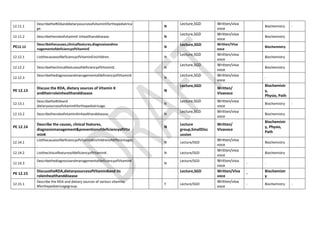
Enumeratecomponentsofthebabyfriendlyhospital
initiative.
Y Lecture,SGD
Writtenshort
notes/vivavoce
PE7.7
Perform breast examination and Identify
commonproblems during lactation such as retracted
nipples,crackednipples,breastengorgement,breastabsces
s
Y Bedside,Skillslab
skillassessmen
t
OBG
7.7.1
Enumeratecommonproblemsinthemotherduring
lactation.
Y
Lecture,Bedside,
skillslab
Written/viva
voce
7.7.2
Examinebreastofalactating
motherinanappropriatemanner.
Y Bedside,skillslab
Skillassessm
ent,OSCE(vi
deo
based)
7.7.3
Identifythecommonproblemsafterexaminingthebreastin
lactating mother viz retracted nipples, cracked
nipples,breastengorgement, breastabscess.
Y Bedside,skillslab
Skillassessm
ent,OSCE(vi
deo
based)
PE7.8
Educatemothersonantenatalbreastcareandpreparemothersf
orlactation
Y DOAPsession
Document
inLogbook
AETCOM
7.8.1
Educateandcounselpregnantwomanduringantenatalper
iod in preparationforbreastfeeding.
Y
DOAPsession/Clinical
session
OSCE
7.8.2 Educatethepregnantwomanforantenatalbreastcare. Y
DOAPsession/Clinical
Session
OSCE OBG
PE7.9
EducateandcounselmothersforbestpracticesinBreastfeeding
Y DOAPsession Logbook,OSCE
7.9.1 Enumeratethebestbreastfeedingpractices. Y Lecture,SGD
Written/viva
voce
7.9.2 Educatemothersforthebestbreastfeedingpractices. Y DOAPsession
Logbook,
OSCEwithSP
PE7.10 Respectspatientprivacy Y DOAPsession
Document
inLogbook
AETCOM
7.10.1 Demonstraterespect foramother'sprivacy. Y DOAPsession OSCE
PE7.11 ParticipateinBreastfeedingWeekCelebration Y DOAPsession
Document
inLogbook
7.11.1 Participateactivelyin breastfeedingweekcelebrations. Y
ActiveParticipationin
theactivities
Documentin
Logbook
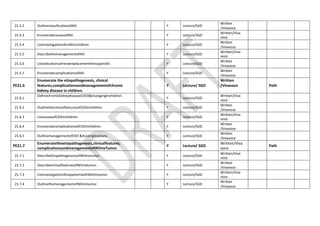
Topic:ComplementaryFeeding Numberofcompetencies:(5) Numberofproceduresthatrequirecertification:(NIL)
PE8.1 DefinethetermComplementaryFeeding Y Lecture,SGD
Written/Viva
voce
ComMed
PE 8.1.1 Definecomplementaryfeeding. Y Lecture,SGD
Written/viva
voce
PE8.2
Discusstheprinciples,theinitiation,attributes,frequency,tech
niqueandhygienerelatedtocomplementaryfeeding
includingIYCF
Y Lecture,SGD
Written/
Vivavoce
ComMed
8.2.1 Describetheprinciplesofcomplementaryfeeding. Y Lecture,SGD
Written/viva
voce
8.2.2
Narratethetypesandattributesofgoodcomplementaryfoods.
Y Lecture,SGD
Written/viva
voce
8.2.3
Describetheinitiationofcomplementaryfeedingin
differentsituations.
Y Lecture,SGD
Written/viva
voce
8.2.4
Describethefrequencyofcomplementaryfeedingindifferent
situations.
Y Lecture,SGD
Written/viva
voce
8.2.5 Describethecorrecttechniqueofcomplementaryfeeding. Y Lecture,SGD
Written/viva
voce
8.2.6
Enumeratethehygienicpracticestobefollowedduringcomplem
entaryfeeding.
Y Lecture,SGD
Written/viva
voce
PE8.3 Enumeratethecommoncomplimentaryfoods Y Lecture,SGD
Written/Viva
voce
ComMed
PE 8.3.1 Enumeratecommonlocallyavailablecomplementaryfoods. Y Lecture,SGD SAQ,vivavoce
PE8.4 ElicithistoryontheComplementaryFeedinghabits Y BEDSIDE,SKILLLAB
skill
assessment
ComMed
PE 8.4.1
Elicitafocusedanddetailedhistoryforcomplementary
feeding.
Y Bedside OSCE
PE8.5
Counselandeducatemothersonthebestpracticesin
complementaryfeeding
Y DOAPsession
DOCUMENT
INLOGBOOK
ComMed
8.5.1
Counselthemotherforthebestpracticesinco
mplementaryfeeding.
Y DOAPsession OSCE
Topic:Normalnutrition,assessmentandmonitoring Numberofcompetencies:(7) Numberofproceduresthatrequirecertification:(NIL)
PE9.1
Describe the age-related nutritional needs of
infants,children and adolescents including
micronutrientsandvitamins
Y Lecture,SGD
Written/
Vivavoce
ComMed
,Biochem
i
stry
9.1.1
Listthemacronutrientsandmicronutrientsrequiredforgro
wth.
Y Lecture,SGD
Written/Viva
voce
9.1.2
Describe the nutritional needs (calorie,
protein,micronutrientsmineralsandvitamins)ofanin
fant.
Y Lecture,SGD
Written/Viva
voce
9.1.3
Describe the nutritional needs (calorie,
protein,micronutrientsmineralsandvitamins)forchild
renof
differentages.
Y Lecture,SGD
Written/
Vivavoce
9.1.4
Describe the nutritional needs (calorie,
protein,micronutrientsmineralsandvitamins)ofadolesce
ntsofboth genders.
Y Lecture,SGD
Written/
Vivavoce
PE9.2
Describe the tools and methods for assessment
andclassificationofnutritionalstatusofinfants,children
andadolescents
Y Lecture,SGD
Written/
Vivavoce
ComMed
9.2.1
Listthetoolsrequiredforanthropometricmeasurements
viz.weight,length/height,headcircumference,midarmcir
cumference.
Y Lecture,SGD
Written/
Vivavoce
9.2.2
Describethemethodofassessmentindetailfordifferentanthrop
ometricmeasurementsforallagegroups.
Y Lecture,SGD
Written/Viva
voce
9.2.3
ClassifythenutritionalstatusasperWHOclassification
basedonanthropometricmeasurementdataforallagegro
ups.
Y Lecture,SGD
Written/
Vivavoce
PE9.3 ExplainsthecalorificvalueofcommonIndianfoods Y Lecture,SGD
Written/Viva
voce
Biochemi
stry
9.3.1
Explainthecalorieandproteincontentofcommonlyuseduncook
edand cooked cereals.
Y Lecture,SGD
Written/Viva
voce
9.3.2
Explain the calorie and protein content of
commonuncookedfooditemslikedairyproducts,eggs,f
ruits,
vegetablesetc.
Y Lecture,SGD
Written/
Vivavoce
9.3.3
ExplainthecalorieandproteincontentofcommonIndiancooked
food items e.g. dalia, roti, chapati, khichdi, dal,rice,idli. Y Lecture,SGD
Written/
Vivavoce
PE9.4
Elicit,documentandpresentanappropriate
nutritionalhistoryandperformadietaryrecall
Y Bedside,skilllab
Skill
Assessment
ComMed
9.4.1
Takefocusseddietaryhistorybasedonrecallmethodfrom
thecaregiver.
Y Bedside,skilllab OSCE
9.4.2
Documentthedietaryhistory
andcalculatecalorieandproteincontent.
Y Bedside,skilllab
OSCE,
VIVAVOCE
9.4.3 Presentthedietaryhistory. Y Bedside,skilllab
LONGCASE,
VIVAVOCE
PE9.5
Calculate the age appropriate calorie requirement
inhealthanddiseaseandIdentifygaps
Y Bedsideclinic, SGD
OSCE,CLI
NICAL
CASE
ComMed
9.5.1
Calculatetherecommendedcalorieandproteinrequirementf
orchildrenofallagegroups.
Y Bedsideclinic,SGD
LONGCASE,
VIVA
VOCE,OSCE
9.5.2
Calculatethecalorieandproteincontentof24hourdietary
intakeby achild.
Y Bedsideclinic,SGD
LONGCASE,
VIVAVOCE
9.5.3
Calculatethegap(deficit)betweenrecommendedintakeofcalori
eand protein and actual intake.
Y Bedsideclinic,SGD
LONG
CASE,VIVAV
OCE
PE9.6
Assessandclassifythenutritionstatusofinfants,
childrenandadolescentsandrecognizedeviations
Y Bedsideclinic, SGD
Skill
Assessment
ComMed
9.6.1
Assessnutritionalstatusfromanthropometricparametersfo
rchildren ofall agegroups.
Y Bedsideclinic,SGD OSCE,Bedside
9.6.2
Interprettheanthropometricmeasurementdataby
plottinginappropriateWHOgrowthchartsforchildrenofalla
ge groupsand gender.
Y Bedsideclinic,SGD OSCE
9.6.3
Classifythetypeanddegreeofundernutritionusingthe
WHOcharts.
Y Bedsideclinic,SGD OSCE
9.6.4
Identifyovernutrition(overweightandobesity)byusingW
HOcharts.
Y Bedsideclinic,SGD OSCE
PE9.7 Plananappropriatedietinhealthanddisease N Bedsideclinic, SGD
Documentin
Logbook
ComMed
9.7.1 Planadietforahealthychildofallagegroups. N Bedsideclinic,SGD
Document
inLogbook
9.7.2
Plananageappropriatedietforchild ofdifferentage
groupswithundernutrition/overnutrition.
N Bedsideclinic,SGD
Documentin
Logbook
9.7.3
Plan an age appropriate diet for child of different
agegroupswithfewcommondiseasesviz.Lactoseintolerance,
Celiacdisease,ChronicKidney disease
N SGD
Document
inLogbook
Topic:Providenutritionalsupport,assessmentand
monitoringforcommonnutritionalproblems
Numberofcompetencies:(6) Numberofproceduresthatrequirecertification:(NIL)
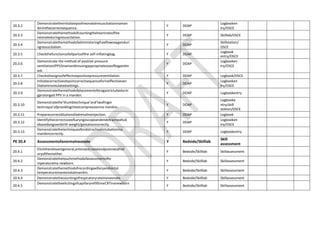
P E10.1
Define and Describe the etiopathogenesis,
classifyincluding WHO classification, clinical
features,complication and management of severe
acutemalnourishment(SAM)andmoderateacute
Malnutrition(MAM)
Y Lecture,SGD
Written/
Vivavoce
Physio,Bio
chemistry,
10.1.1 Definemalnutrition asperWHO. Y Lecture,SGD
Written/Viva
voce
10.1.2 Describetheaetiologyofmalnutrition. Y Lecture,SGD
Written/Viva
voce
10.1.3 Discussthepathophysiologyofmalnutrition. Y Lecture,SGD
Written/Viva
voce
10.1.4 ClassifythemalnutritionasperWHO. Y Lecture,SGD
Written/Viva
voce
10.1.5
Describethecriteriaforsevereacutemalnutrition(SAM)and
moderateacutemalnutrition(MAM)asperWHO.
Y Lecture,SGD
Written/Viva
voce
10.1.6
DescribetheclinicalfeaturesofMAMandSAMincludingmar
asmusand kwashiorkor.
Y Lecture,SGD
Written/Viva
voce
10.1.7 DescribethecomplicationsofSAM. Y Lecture,SGD
Written/Viva
voce
10.1.8
DescribethestepsofmanagementofSAMinvolvingstabilization
and rehabilitationphase.
Y Lecture,SGD
Written/Viva
voce
10.1.9
Describethedomiciliarymanagementofmoderateacutema
lnutrition (MAM).
Y Lecture,SGD
Written/Viva
voce
P E10.2
Outline the clinical approach to a child with SAM
andMAM
Y Lecture,SGD
Written/
Vivavoce
Physio,
Biochemis
try
10.2.1
Describe the clinical approach (algorithmic
approachincludingclinicalhistory,examinationandinvestigati
ons)to
achild withSAMandMAM.
Y Lecture,SGD
Written/
Vivavoce
P E10.3
Assessment of a patient with SAM and
MAM,diagnosis, classification and planning
managementincludinghospitalandcommunity-
based
intervention,rehabilitationandprevention
Y
Bedside,
SkillsLab
Skillassess
ment
Physio,Bio
chemistry
10.3.1
Takeclinicalhistoryincludingfocusseddietary
historyfromthecaregiver.
Y Bedside
OSCE,
Longcase
10.3.2
Examinethechildincludinganthropometryandsignsof
vitamindeficiency.
Y Bedside
OSCE,Long
case
10.3.3
Diagnose and classify the patient as having SAM or
MAMbasedonclinicalhistory,examinationandanthropomet
ry.
Y Bedside
OSCE,
Longcase
10.3.4
Plantheindividualised home-basedmanagementinachild
withMAMoruncomplicatedSAM.
Y Bedside
OSCE,Long
case
10.3.5
Planthehospital-basedmanagementofcomplicatedSAMina
child.
Y Bedside
OSCE,
Longcase
10.3.6
Planthehospital-
basedrehabilitationphasemanagementofcomplicated
SAM in a child.
Y Bedside
OSCE,
Longcase
10.3.7 Planpreventionofmalnutritionatalllevels. Y Bedside
OSCE,Long
case
P E10.4
Identifychildrenwithundernutritionasper IMNCI
criteriaandplanreferral
Y DOAPsession
Documentin
Logbook
ComMed
10.4.1 IdentifyundernutritionasperIMNCIcriteria. Y DOAPsession
Document
inLogbook
10.4.2 Describepre-referraltreatmentasperIMNCI. Y DOAPsession
Documentin
Logbook
10.4.3
Planreferralforchildrenwith
undernutritionasperIMNCIguidelines.
Y DOAPsession
Document
inLogbook
P E10.5 CounselparentsofchildrenwithSAM andMAM Y
Bedsideclinic,
SkillsStation
Documentin
Logbook
AETCOM
10.5.1
CounseltheparentsonrehabilitationofchildrenwithSAMandM
AM.
Y
Bedsideclinic,skills
tation
OSCE
10.5.2 Addressthequeriesraisedbytheparents. Y
Bedsideclinic,skill
Station
OSCE
P E10.6
Enumeratetheroleoflocallypreparedtherapeutic
dietsandreadytousetherapeutic diets
N Lecture,SGD
Written/Viva
voce
10.6.1
EnumeratethecompositionofReadytousetherapeuticfoods(
RUTF).
N Lecture,SGD
Written/vivav
oce
10.6.2
Enumeratethelocallyavailablehomefoodprepared with
cereals,pulses,sugar,oil,milk and/oreggetc.
N Lecture,SGD
Written/viva
voce
10.6.3
DiscusstheroleofRUTF/locallypreparedfoodtoachievecatc
h-upgrowthinmalnourishedchild.
N Lecture,SGD
Written/vivav
oce
Topic:Obesityinchildren Numberofcompetencies:(6) Numberofproceduresthatrequirecertification:(01)
P E11.1
Describe the common etiology, clinical features
andmanagement of obesityinchildren
Y Lecture/SGD
Written/Viva
voce
NIL
Physio/B
iochemis
try/
Path
11.1.1 DefineObesityandoverweightasperWHOguidelines. Y Lecture,SGD
Written/vivav
oce
11.1.2 EnumeratecommoncausesofObesityamongchildren. Y Lecture,SGD
Written/viva
voce
11.1.3 Describeclinicalfeaturesofobesityincludingco-morbidities. Y Lecture,SGD
Written/vivav
oce
11.1.3 OutlineprinciplesofmanagementofObesityinchildren. Y Lecture,SGD
Written/viva
voce
P E11.2
DiscusstheriskapproachforobesityandDiscussthe
preventionstrategies
Y Lecture,SGD
Written/Viva
voce
Physio,
Path
11.2.1 EnumerateriskfactorsforObesityamongchildren. Y Lecture,SGD
Written/vivav
oce
11.2.2 DescribestrategiesforpreventionofObesity. Y Lecture,SGD
Written/vivav
oce
P E11.3
Assessment of a child with obesity with regard
toelicitinghistoryincludingphysicalactivity,charting
anddietaryrecall
Y
Bedside,Stan
dardized
patients
Document
inLogbook
11.3.1
Elicitadetailedhistoryinachildwithobesityincluding
activitycharting.
Y Bedsideskilllab Logbook
11.3.2 Obtaindetailed dietaryhistorybyrecallmethod. Y
Bedsideclinics,skilll
ab
Logbook
P E11.4
Examination including calculation of
BMI,measurementofwaisthipratio,Identifyingexterna
l
markers like acanthosis, striae, pseudo-
gynecomastiaetc
Y
Bedside,Standa
rdizedpatients,
Videos
SkillsStation
11.4.1
Performanthropometryinanobesechildincludingcal
culation ofBMI andWaist HipRatio.
Y
Bedside
/Multimediabase
d
tutorial
OSCE
11.4.2
Identifyphysicalmarkersofobesitylikeacanthosis,striae,pseudo
gynecomastia.
Y Videos/patients OSCE
P E11.5 CalculateBMI, documentinBMIchartandinterpret Y Bedside,SGD
Documentin
Logbook
3
11.5.1 CalculateandChartBMIaccurately. Y Clinicalpostings
Record
Logbook
3
11.5.2 InterpretBMIforagivenpatient. Y Bedsideclinic OSCE 3
P E11.6 Discusscriteriaforreferral Y Lecture,SGD
Written/Viva
voce
11.6.2 Enumeratecriteriafor referralinanobesechild. Y
Lecture/
SGD
Written/vivav
oce
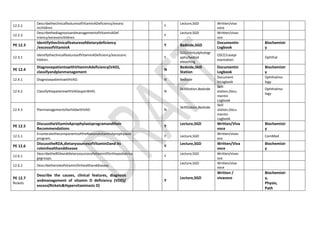
Topic:MicronutrientsinHealthanddisease-1(Vitamins
ADEK,BComplexandC)
Numberofcompetencies:(21) Numberofproceduresthatrequirecertification:(NIL)
PE 12.1
Discuss the RDA, dietary sources of Vitamin A
andtheirrole inhealthanddisease
Y Lecture,SGD
Written/
Vivavoce
Biochemistr
y
12.1.1
RecalltheRDAanddietarysourcesofvitaminAforchildrenofdiff
erent ages.
Y
Lecture,SGD Written/vivav
oce
12.1.2
DescribethephysiologyandroleofvitaminAinhealthanddisease.
Y
Lecture,SGD Written/vivav
oce
PE 12.2
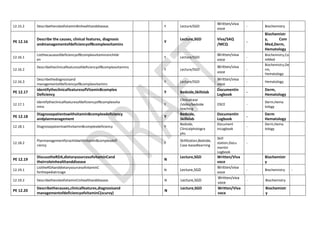
Describethecauses,clinicalfeatures,diagnosisand
managementofDeficiency/excessofVitaminA
Y
Lecture,SGD Written/Viva
voce
Biochemistr
y
12.2.1
EnumeratethecausesofVitaminAdeficiency/excessinchildren.
Y
Lecture,SGD Written/vivav
oce
12.2.2
DescribetheclinicalfeaturesofVitaminADeficiency/excess
inchildren.
Y
Lecture,SGD Written/viva
voce
12.2.3
DescribethediagnosisandmanagementofVitaminADef
iciency/excessinchildren.
Y
Lecture,SGD Written/vivav
oce
PE 12.3
Identifytheclinicalfeaturesofdietarydeficiency
/excessofVitaminA
Y Bedside,SGD
Documentin
Logbook
Biochemistr
y
12.3.1
IdentifytheclinicalfeaturesofVitaminADeficiency/excessinc
hildren.
Y
SGD/clinicalphotogr
aphs/bedsid
eteaching
OSCE/casepr
esentation
Ophthal
PE 12.4
DiagnosepatientswithVitaminAdeficiency(VAD),
classifyandplanmanagement
N
Bedside,Skill
Station
Documentin
Logbook
Biochemistr
y
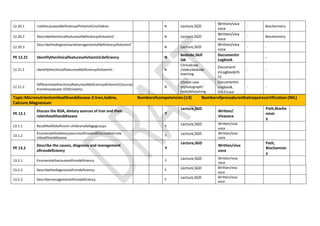
12.4.1 DiagnosepatientswithVAD. N Bedside
Document
inLogbook
Ophthalmo-
logy
12.4.2 ClassifythepatientwithVADasperWHO. N
SkillStation,Bedside
Skill
station,Docu
mentin
Logbook
Ophthalmo-
logy
12.4.3 PlanmanagementofachildwithVAD. N
SkillStation,Bedside
Skill
station,Docu
mentin
Logbook
PE 12.5
DiscusstheVitaminAprophylaxisprogramandtheir
Recommendations
Y
Lecture,SGD Written/Viva
voce
Biochemistr
y
12.5.1
EnumeratethecomponentsoftheNationalvitaminAprophylaxis
program.
Y Lecture,SGD
Written/vivav
oce
ComMed
PE 12.6
DiscusstheRDA,dietarysourcesofVitaminDand its
roleinhealthanddisease
Y
Lecture,SGD Written/Viva
voce
Biochemistr
y
12.6.1
DescribetheRDAanddietarysourcesofvitaminDforthepediatrica
gegroups.
Y
Lecture,SGD Written/vivav
oce
12.6.2 DescribetheroleofvitaminDinhealthanddisease.
Lecture,SGD Written/viva
voce
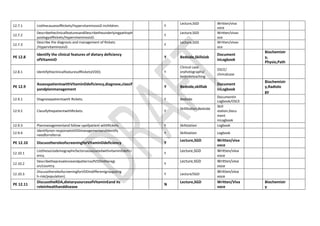
PE 12.7
Rickets
Describe the causes, clinical features, diagnosis
andmanagement of vitamin D deficiency (VDD)/
excess(Rickets&Hypervitaminosis D)
Y
Lecture,SGD
Written /
vivavoce
Biochemistr
y,
Physio,
Path
12.7.1 ListthecausesofRickets/HypervitaminosisD inchildren. Y
Lecture,SGD Written/viva
voce
12.7.2
DescribetheclinicalfeaturesandDescribetheunderlyingpathoph
ysiologyofRickets/HypervitaminosisD.
Y
Lecture,SGD Written/vivav
oce
12.7.3
Describe the diagnosis and management of Rickets
/HypervitaminosisD.
Y
Lecture,SGD Written/vivav
oce
PE 12.8
Identify the clinical features of dietary deficiency
ofVitaminD
Y Bedside,Skillslab
Document
inLogbook
Biochemistr
y,
Physio,Path
12.8.1 IdentifytheclinicalfeaturesofRickets(VDD). Y
Clinical case
orphotographs/
bedsideteaching
OSCE/
clinicalcase
PE 12.9
AssesspatientswithVitaminDdeficiency,diagnose,classif
yandplanmanagement
Y Bedside,skilllab
Document
inLogbook
Biochemistr
y,Radiolo
gy
12.9.1 Diagnosepatientswith Rickets. Y Bedside
Documentin
Logbook/OSCE
12.9.2 ClassifythepatientwithRickets. Y
SkillStation,Bedside
Skill
station,Docu
ment
inLogbook
12.9.3 Planmanagementand follow-upofpatient withRickets. Y Skillstation Logbook
12.9.4
Identifynon-responsetoVDDmanagementandIdentify
needforreferral.
Y Skillstation Logbook
PE 12.10 DiscusstheroleofscreeningforVitaminDdeficiency Y
Lecture,SGD Written/viva
voce
12.10.1
ListthesociodemographicfactorsassociatedwithvitaminDdefici
ency.
Y
Lecture,SGD Written/viva
voce
12.10.2
DescribetheprevalenceandpatternsofVDDintheregi
on/country.
Y
Lecture,SGD Written/viva
voce
12.10.3
DiscusstheroleofscreeningforVDDindifferentgroups(hig
h-risk/population).
Y Lecture/SGD
Written/viva
voce
PE 12.11
DiscusstheRDA,dietarysourcesofVitaminEand its
roleinhealthanddisease
N
Lecture,SGD Written/Viva
voce
Biochemistr
y
12.11.1
DescribetheRDAanddietarysourcesofvitaminEforthepediatrica
ge.
N
Lecture,SGD Written/viva
voce
Biochemistry -
12.11.2 DescribetheroleofvitaminE inhealthanddisease. N
Lecture,SGD Written/viva
voce
Biochemistry
PE12.12
Describethecauses,clinicalfeatures,diagnosisandma
nagementofdeficiencyofVitaminE
N
Lecture,SGD Written/Viva
voce
Biochemistry
12.12.1 ListthecausesofdeficiencyofVitaminEinchildren. N
Lecture,SGD Written/viva
voce
Biochemistry
12.12.2 DescribetheclinicalfeaturesofdeficiencyofVitaminE. N
Lecture,SGD Written/viva
voce
Biochemistry
12.12.3
DescribethediagnosisandmanagementofdeficiencyofVitaminE
.
N
Lecture,SGD Written/viva
voce
-
PE 12.13
Discuss the RDA, dietary sources of Vitamin K
andtheirroleinhealthanddisease
N
Lecture,SGD
Written/
Vivavoce
Biochemistr
y,
Physio, Path
12.13.1
DescribetheRDAand
dietarysourcesofvitaminKforthepediatricage.
N
Lecture,SGD Written/viva
voce
Biochemistry -
12.13.2 DescribetheroleofvitaminKinhealthanddisease. N
Lecture,SGD Written/viva
voce
Biochemistry
PE 12.14
Describe the causes, clinical features,
diagnosismanagement&preventionofdeficiencyofVita
minK
N
Lecture
group,SmallDisc
ussion
Written/
Vivavoce
Biochemistr
y, Physio,
Path
12.14.1
ListthecausesofdeficiencyofVitaminKinchildrenofdifferentages
.
N Lecture/SGD
Written/viva
voce
Biochemistry
12.14.2 ListtheclinicalfeaturesofdeficiencyofVitaminK. N Lecture/SGD
Written/viva
voce
Biochemistry
12.14.3
DescribethediagnosisandmanagementofdeficiencyofVitaminK
.
N
Lecture/SGD Written/viva
voce
- -
PE 12.15
DiscusstheRDA,dietarysourcesofVitaminBand its
roleinhealthanddisease
Lecture,SGD Written/Viva
voce
-
Biochemistr
y
12.15.1
Describe the RDA and dietary sources of various vitamins
Bforthepediatricagegroup.
Y Lecture/SGD
Written/viva
voce
- Biochemistry -
12.15.2 DescribetheroleofvitaminBinhealthanddisease. Y Lecture/SGD
Written/viva
voce
- Biochemistry
PE 12.16
Describe the causes, clinical features, diagnosis
andmanagementofdeficiencyofBcomplexvitamins
Y
Lecture,SGD Viva/SAQ
/MCQ
-
Biochemistr
y, Com
Med,Derm,
Hematology
12.16.1
ListthecausesofdeficiencyofBcomplexvitaminsinchildr
en
Y Lecture/SGD
Written/viva
voce
-
Biochemistry,Co
mMed
12.16.2
DescribetheclinicalfeaturesofdeficiencyofBcomplexvitamins
Y Lecture/SGD
Written/viva
voce
-
Biochemistry,De
rm,
Hematology
12.16.3
Describethediagnosisand
managementofdeficiencyofBcomplexvitamins
Y Lecture/SGD
Written/viva
voce
- Hematology
PE 12.17
IdentifytheclinicalfeaturesofVitaminBcomplex
Deficiency
Y Bedside,Skillslab
Documentin
Logbook
-
Derm,
Hematology
12.17.1
IdentifytheclinicalfeaturesofdeficiencyofBcomplexvita
mins
Y
Clinicalcase
/slides/bedside
teaching
OSCE -
Derm,Hema
tology
PE 12.18
DiagnosepatientswithvitaminBcomplexdeficiency
andplanmanagement
Y
Bedside,
Skillslab
Documentin
Logbook
-
Derm
Hematology
12.18.1 DiagnosepatientswithvitaminBcomplexdeficiency Y
Bedside,
Clinicalphotogra
phs
Document
inLogbook
-
Derm,Hema
tology
12.18.2
PlanmanagementforachildwithvitaminBcomplexdefi
ciency
Y
SkillStation,Bedside,
Case-basedlearning
Skill
station,Docu
mentin
Logbook
-
PE 12.19
DiscusstheRDA,dietarysourcesofvitaminCand
theirroleinhealthanddisease
N
Lecture,SGD Written/Viva
voce
Biochemistr
y
12.19.1
ListtheRDAanddietarysourcesofvitaminC
forthepediatricage
N Lecture,SGD
Written/viva
voce
- Biochemistry -
12.19.2 DescribetheroleofvitaminCinhealthanddisease N Lecture,SGD
Written/viva
voce
- Biochemistry
PE 12.20
Describethecauses,clinicalfeatures,diagnosisand
managementofdeficiencyofvitaminC(scurvy)
N
Lecture,SGD Written/Viva
voce
Biochemistr
y
12.20.1 ListthecausesofdeficiencyofVitaminCinchildren N Lecture,SGD
Written/viva
voce
- Biochemistry
12.20.2 DescribetheclinicalfeaturesofdeficiencyofvitaminC N Lecture,SGD
Written/viva
voce
- Biochemistry
12.20.3
DescribethediagnosisandmanagementofdeficiencyofvitaminC
N Lecture,SGD
Written/viva
voce
- -
PE 12.21 IdentifytheclinicalfeaturesofvitaminCdeficiency N
Bedside,Skill
lab
Documentin
Logbook
-
12.21.1 IdentifytheclinicalfeaturesofdeficiencyofvitaminC. N
Clinicalcase
/slides/bedside
teaching
Document
inLogbookOS
CE
- -
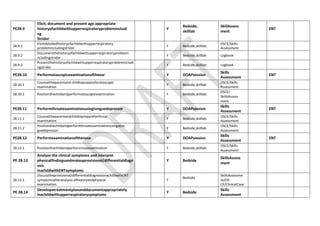
12.21.2
DifferentiatetheclinicalfeaturesofdeficiencyofvitaminC(scurvy)
fromthosedueto VDD(rickets).
N
Clinical case
orphotograph/
bedsideteaching
Documentin
Logbook,
OSCE/case
- -
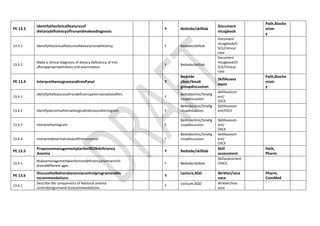
Topic:MicronutrientsinHealthanddisease-2:Iron,Iodine,
Calcium,Magnesium
Numberofcompetencies:(14) Numberofproceduresthatrequirecertification:(NIL)
PE 13.1
Discuss the RDA, dietary sources of Iron and their
roleinhealthanddisease
Y
Lecture,SGD
Written/
Vivavoce
Path,Bioche
mistr
y
13.1.1 RecalltheRDAofIronin childrenofallagegroups. Y Lecture,SGD Written/viva
voce
13.1.2
EnumeratethedietarysourcesofIronandDiscusstheirrole
inhealthanddisease.
Y Lecture,SGD Written/viva
voce
PE 13.2
Describe the causes, diagnosis and management
ofIrondeficiency
Y
Lecture,SGD
Written/viva
voce
Path,
Biochemistr
y
13.2.1 Enumeratethecausesofirondeficiency. Y
Lecture,SGD Written/viva
voce
13.2.2 Describethediagnosisofirondeficiency. Y Lecture,SGD Written/viva
voce
13.2.3 Describemanagementofirondeficiency. Y Lecture,SGD Written/viva
voce
PE 13.3
Identifytheclinicalfeaturesof
dietarydeficiencyofIronandmakeadiagnosis
Y Bedside/skilllab
Document
inLogbook
Path,Bioche
mistr
y
13.3.1 Identifytheclinicalfeaturesofdietaryirondeficiency. Y Bedside/skilllab
Document
inLogbook/O
SCE/Clinical
case
13.3.2
Make a clinical diagnosis of dietary deficiency of Iron
afterappropriatehistory and examination.
Y Bedside/skilllab
Document
inLogbook/O
SCE/Clinical
case
PE 13.4 InterprethemogramandIronPanel Y
Bedside
clinic/Small
groupdiscussion
SkillAssess
ment
Path,Bioche
mistr
y
13.4.1
Identifythefeaturesofirondeficiencyanemiainabloodfilm.
Y
Bedsideclinic/Smallg
roupdiscussion
SkillAssessm
ent/
OSCE
13.4.2 Identifyabnormalhematologicalindicesonahemogram. Y
Bedsideclinic/Smallg
roupdiscussion
SkillAssessm
ent/OSCE
13.4.3 Interprethemogram. Y
Bedsideclinic/Smallg
roupdiscussion
SkillAssessm
ent/
OSCE
13.4.4 Interpretabnormalvaluesoftheironpanel. Y
Bedsideclinic/Smallg
roupdiscussion
SkillAssessm
ent/
OSCE
PE 13.5
ProposeamanagementplanforIRONdeficiency
Anemia
Y Bedside/skilllab
Skill
assessment
Path,
Pharm
13.5.1
MakeamanagementplanforIrondeficiencyanemiainchil
drenofdifferent ages.
Y Bedside/skilllab
Skillassessment
/OSCE
PE 13.6
DiscusstheNationalanemiacontrolprogramandits
recommendations
Y
Lecture,SGD Written/viva
voce
Pharm,
ComMed
13.6.1
Describe the components of National anemia
controlprogramand itsrecommendations.
Y Lecture,SGD Written/viva
voce
PE 13.7
DiscusstheRDA,dietarysourcesofIodineandits role
inHealthanddisease
Y
Lecture,SGD Written/viva
voce
Biochemistr
y
13.7.1 RecalltheRDAofIodinein children. Y Lecture,SGD Written/viva
voce
13.7.2
EnumeratethedietarysourcesofIodineandtheirroleinHealthand
disease.
Y Lecture,SGD Written/viva
voce
PE 13.8
Describethecauses,diagnosisandmanagementof
deficiencyofIodine
Y
Lecture,SGD Written/viva
voce
Biochemistr
y
13.8.1 EnumeratethecausesofIodinedeficiency. Y Lecture,SGD Written/viva
voce
13.8.2 DiscussthediagnosisofIodinedeficiency. Y
Lecture,SGD Written/viva
voce
13.8.3 DescribethemanagementofIodinedeficiency. Y Lecture,SGD Written/viva
voce
PE 13.9
IdentifytheclinicalfeaturesofIodinedeficiency
disorders
N
Bedside
clinic
Clinical
assessment
Biochemistr
y
13.9.1 IdentifytheclinicalfeaturesofIodinedeficiencydisorders. N
Bedside
clinic
Clinical
assessment
PE 13.10
Discuss the National Goiter Control program and
itsrecommendations
Y
Lecture/
Smallgroup
discussion
Written/viva
voce
Biochemistr
y,
ComMed
13.10.1
Discuss the National Goiter Control program and
theRecommendations.
Y
Lecture/Smallgroup
discussion
Written/viva
voce
PE 13.11
Discuss the RDA, dietary sources of Calcium and
itsroleinhealthanddisease
Y
Lecture/
Smallgroup
discussion
Written/viva
voce
Biochemistr
y
13.11.1 RecalltheRDAofCalciuminchildren. Y
Lecture/Smallgroup
discussion
Written/viva
voce
13.11.2 Enumeratethedietarysourcesofcalcium. Y
Lecture/Smallgroup
discussion
Written/viva
voce
13.11.3 Explaintheroleofcalciuminhealthanddisease. Y
Lecture/Smallgroup
discussion
Written/viva
voce
PE 13.12
Describe the causes, clinical features, diagnosis
andmanagementofCalciumDeficiency
Y
Lecture/
Smallgroup
discussion
Written/viva
voce
Biochemistr
y
13.12.1 EnumeratethecausesofCalciumDeficiency. Y
Lecture/Smallgroup
discussion
Written/viva
voce
13.12.2 DescribetheclinicalfeaturesofCalciumDeficiency. Y
Lecture/Smallgroup
discussion
Written/viva
voce
13.12.3 DiscussthediagnosisofCalciumDeficiency. Y
Lecture/Smallgroup
discussion
Written/viva
voce
13.12.4 DiscussthemanagementofCalciumDeficiency. Y
Lecture/Smallgroup
discussion
Written/viva
voce
PE 13.13
Discuss the RDA, dietary sources of Magnesium
andtheirroleinhealthanddisease
N
Lecture/
Smallgroup
discussion
Written/viva
voce
Biochemistr
y
13.13.1 RecalltheRDAofMagnesiumin children. N
Lecture/Smallgroup
discussion
Written/viva
voce
13.13.2
ListthedietarysourcesofMagnesiumandtheirroleinhealtha
nd disease.
N
Lecture/Smallgroup
discussion
Written/viva
voce
PE 13.14
Describe the causes, clinical features, diagnosis
andmanagementofMagnesium Deficiency
N
Lecture/Small
groupdisc
ussion
Written/viva
voce
Biochemistr
y
13.14.1 EnumeratethecausesofMagnesiumDeficiency. N
Lecture/Smallgroup
discussion
Written/viva
voce
13.14.2 DescribetheclinicalfeaturesofMagnesiumDeficiency. N
Lecture/Smallgroup
discussion
Written/viva
voce
13.14.3 DiscussthediagnosisofMagnesiumDeficiency. N
Lecture/Smallgroup
discussion
Written/viva
voce
13.14.4 DiscussthemanagementofMagnesiumDeficiency. N
Lecture/Smallgroup
discussion
Written/viva
voce
Topic:Toxicelementsandfreeradicalsandoxygentoxicity Numberof competencies:(5) Numberofproceduresthatrequirecertification:(NIL)
PE 14.1
Discusstheriskfactors,clinicalfeatures,diagnosis
andmanagementofLeadPoisoning
Lecture/Small
Group discussion
Written/viva
voce
Pharm
14.1.1 Enumeratetheriskfactorsforleadpoisoninginchildren. N
Lecture/Smallgroup
discussion
Written/viva
voce
14.1.2 Describetheclinicalfeaturesofleadpoisoning. N
Lecture/Smallgroup
discussion
Written/viva
voce
14.1.3 Discussthediagnosisofleadpoisoning. N
Lecture/Smallgroup
discussion
Written/viva
voce
14.1.4
Describethemanagementofachildwithleadpoisoningincl
udingprevention.
N
Lecture/Smallgroup
discussion
Written/viva
voce
PE 14.2
Discusstheriskfactors,clinicalfeatures,diagnosis
andmanagementofKeroseneaspiration
N
Lecture/Smallgroup
discussion
Written/viva
voce
ENT
14.2.1 Enumeratetheriskfactorsfor keroseneaspiration. N
Lecture/Smallgroup
discussion
Written/viva
voce
14.2.2 Describetheclinicalfeatures ofkeroseneaspiration. N
Lecture/Smallgroup
discussion
Written/viva
voce
14.2.3 Discussthediagnosisofkeroseneaspiration. N
Lecture/Smallgroup
discussion
Written/viva
voce
14.2.4
Describe the management of a child with
keroseneaspiration.
N
Lecture/Smallgroup
discussion
Written/viva
voce
PE 14.3
Discuss the risk factors, clinical features,
diagnosisandmanagementofOrganophosphoruspo
isoning
N
Lecture/
Smallgroup
discussion
Written/viva
voce
Pharm
14.3.1 Enumeratetheriskfactorsfororganophosphoruspoisoning. N
Lecture/Smallgroup
discussion
Written/viva
voce
14.3.2
Describe the clinical features of
organophosphoruspoisoning.
N
Lecture/Smallgroup
discussion
Written/viva
voce
14.3.4 Discussthediagnosisoforganophosphoruspoisoning. N
Lecture/Smallgroup
discussion
Written/viva
voce
14.3.5
Describethemanagementofachildwithorganophosphorus
poisoning.
N
Lecture/Smallgroup
discussion
Written/viva
voce
PE 14.4
Discusstheriskfactors,clinicalfeatures,diagnosisan
dmanagementofparacetamolpoisoning
N
Lecture/
Smallgroup
discussion
Written/viva
voce
Pharm
14.4.1 Enumeratetheriskfactorsforparacetamolpoisoning. N
Lecture/Smallgroup
discussion
Written/viva
voce
14.4.2 Describetheclinicalfeaturesofparacetamolpoisoning. N
Lecture/Smallgroup
discussion
Written/viva
voce
14.4.3 Discussthediagnosisofparacetamolpoisoning. N
Lecture/Smallgroup
discussion
Written/viva
voce
14.4.4
Discussthemanagementofa
childwithparacetamolpoisoning includingprevention.
N
Lecture/Smallgroup
discussion
Written/viva
voce
PE 14.5
Discusstheriskfactors,clinicalfeatures,diagnosisandm
anagement ofOxygentoxicity
N
Lecture/
Smallgroup
discussion
Written/viva
voce
14.5.1 Enumeratetheriskfactorsforoxygentoxicity. N
Lecture/Smallgroup
discussion
Written/viva
voce
14.5.2 Describetheclinicalfeaturesofoxygentoxicity. N
Lecture/Smallgroup
discussion
Written/viva
voce
14.5.3 Discussthediagnosisofoxygentoxicity. N
Lecture/Smallgroup
discussion
Written/viva
voce
14.5.4 Discussthemanagementofa childwithoxygentoxicity. N
Lecture/Smallgroup
discussion
Written/viva
voce
Topic:Fluidandelectrolytebalance Numberofcompetencies:(7) Numberofproceduresthatrequirecertification:(NIL)
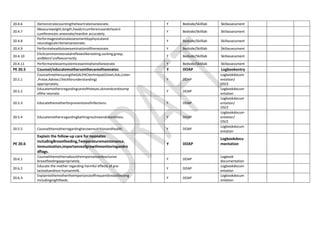
PE 15.1
Discussthefluidandelectrolyterequirementinhealthandd
isease
Y
Lecture/
Smallgroup
discussion
Written/viva
voce
15.1.1 Statethefluidrequirementofahealthyneonate. Y
Lecture/Smallgroup
discussion
Written/viva
voce
15.1.2
Describethefluidandelectrolyterequirementsofhealthychildren
ofdifferent ages.
Y
Lecture/Smallgroup
discussion
Written/viva
voce
15.1.3
Describethefluidrequirementsincommondiseasesof
children.
Y
Lecture/Smallgroup
discussion
PE 15.2
Discusstheclinicalfeaturesandcomplicationsoffluid
and electrolyte imbalance and outline
themanagement
Lecture/Small
groupdisc
ussion
15.2.1 Definehyponatremiaandhypernatremia. Y
Lecture/Smallgroup
discussion
Written/viva
voce
15.2.2 Definehypokalemiaandhyperkalemia. Y
Lecture/Smallgroup
discussion
Written/viva
voce
15.2.3
Describetheclinicalfeaturesofachildwhohasdehydrationorflu
id overload.
Y
Lecture/Smallgroup
discussion
Written/viva
voce
15.2.4
Outlinethemanagementofachildwhohasdehydrationorfluid
overload.
Y
Lecture/Smallgroup
discussion
Written/viva
voce
15.2.5
EnumeratethesymptomsandsignsofhyponatremiaandHyper
natremia.
Y
Lecture/Smallgroup
discussion
Written/viva
voce
15.2.6
Enumeratethesymptomsandsignsofhypokalemiaandhyperka
lemia.
Y
Lecture/Smallgroup
discussion
Written/viva
voce
15.2.7
Outline the management of a child with hyponatremia
/hypernatremia.
Y
Lecture/Smallgroup
discussion
Written/viva
15.2.8
Outlinethemanagementofachildwithhypokalemiaor
Hyperkalemia.
Y
Lecture/Smallgroup
discussion
Written/viva
voce
PE 15.3
Calculatethefluidandelectrolyterequirementin
health
Y Bedside,SGD Skillassessment
15.3.1
Calculatefluidrequirementinhealthychildrenofdifferentages.
Y Bedside,SGD Skillassessment
15.3.2
Calculateelectrolyterequirementinhealthychildrenof
differentages.
Y Bedside,SGD Skillassessment
PE 15.4 Interpretelectrolytereport Y Bedside/SGD
Skill
assessment
15.4.1
Interpretreportsofdyselectrolytemia.
Y Bedside/SGD Skillassessment
PE 15.5 Calculatefluidandelectrolyteimbalance Y Bedside/SGD
Skill
assessment
15.5.1
Calculatefluidrequirementofthechildtocorrectfluidimbalanc
e.
Y Bedside/SGD Skillassessment
15.5.2 Calculateelectrolytecorrectionforagivenscenario. Y Bedside/SGD Skillassessment
PE 15.6
Demonstratethesteps ofinserting anIVcannulaina
model
Y Skilllab
Skill
assessment
15.6.1
Demonstrateinsertingan
intravenouscannulaonamodelinaskilllaboratory.
Y Skilllab Mannequin
PE 15.7
Demonstratethestepsofinsertinganinterosseous
lineinamannequin
Y Skilllab
Skill
assessment
15.7.1
Demonstrateinsertinganintraosseouscannulainama
nnequin. Y Skilllab Mannequin
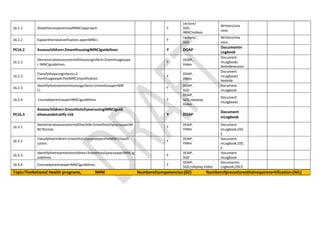
Topic:IntegratedManagementof NeonatalandChildhood
Illnesses(IMNCI)Guideline
Numberofcompetencies:(3) Numberofproceduresthatrequirecertification:(NIL)
PE16.1
Explain the components of Integrated Management
ofNeonatal and Childhood Illnesses (IMNCI)
guidelinesandmethodofRiskstratification
Y
Lecture,SGD Written/viva
voce
16.1.1 StatethecomponentsofIMNCIapproach. Y
Lecture/
SGD,
IMNCIvideos
Written/viva
voce
16.1.2 Explaintheriskstratification asperIMNCI. Y
Lecture/
SGD
Written/viva
voce
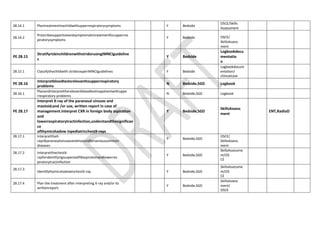
PE16.2 Assesschildren<2monthsusingIMNCIguidelines Y DOAP
Documentin
Logbook
16.2.1
Demonstrateassessmentoftheyounginfant<2monthsageaspe
r IMNCIguidelines.
Y
DOAP,
Video
Document
inLogbook/
bedsidesession
16.2.2
Classifytheyounginfants<2
monthsageaspertheIMNCIclassification.
Y
DOAP,
Video
Document
inLogbook/
bedside
16.2.3
Identifythetreatmentinyounginfants<2monthsasperIMN
CI.
Y
DOAP,
SGD
Document
inLogbook
16.2.4 CounselparentsasperIMNCIguidelines. Y
DOAP,
SGD,roleplay,
Video
Document
inLogbook/
PE16.3
Assesschildren>2monthsto5yearsusingIMNCIguid
elinesandstratify risk Y DOAP
Document
inLogbook
16.3.1
Demonstrateassessmentofthechild>2monthsto5yearsasperIM
NCIformat.
Y
DOAP,
Video
Document
inLogbook,OSC
E
16.3.2
Classifythechildren>2monthsto5yearsaspertheIMNCIclassifi
cation.
Y
DOAP,
Video
Document
inLogbook,OSC
E
16.3.3
Identifythetreatmentinchildren>2monthsto5yearsasperIMNCIg
uidelines.
Y
DOAP,
SGD
Document
inLogbook
16.3.4 CounselparentsasperIMNCIguidelines. Y
DOAP,
SGD,roleplay,Video
Documentin
Logbook,OSCE
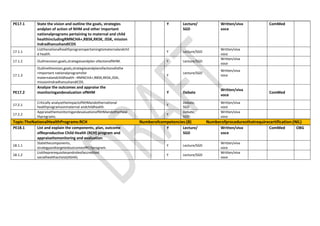
Topic:TheNational Health programs, NHM Numberofcompetencies:(02) Numberofproceduresthatrequirecertification:(NIL)
PE17.1 State the vision and outline the goals, strategies
andplan of action of NHM and other important
nationalprograms pertaining to maternal and child
healthincludingRMNCHA+,RBSK,RKSK, JSSK, mission
IndradhanushandICDS
Y Lecture/
SGD
Written/viva
voce
ComMed
17.1.1
Listthenationalhealthprogramspertainingtomaternalandchil
d health.
Y Lecture/SGD
Written/viva
voce
17.1.2 Outlinevision,goals,strategiesandplan ofactionofNHM. Y Lecture/SGD
Written/viva
voce
17.1.3
Outlinethevision,goals,strategiesandplanofactionofothe
rimportant nationalprogramsfor
maternalandchildhealth –RMNCHA+,RBSK,RKSK,JSSK,
missionIndradhanushandICDS.
Y
Lecture/SGD
Written/viva
voce
PE17.2
Analyze the outcomes and appraise the
monitoringandevaluation ofNHM Y Debate
Written/viva
voce
ComMed
17.2.1
Critically analyzetheimpactofNHMandothernational
healthprogramsonmaternal andchildhealth.
Y
Debate,
SGD
Written/viva
voce
17.2.2
AppraisethemonitoringandevaluationofNHMandotherheal
thprograms.
Y
Debate,
SGD
Written/viva
voce
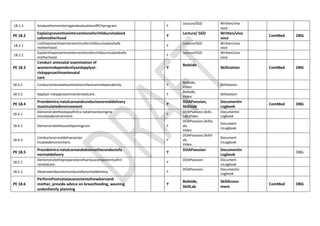
Topic:TheNationalHealthPrograms:RCH Numberofcompetencies:(8) Numberofproceduresthatrequirecertification:(NIL)
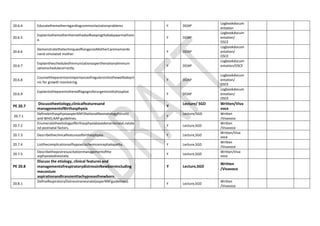
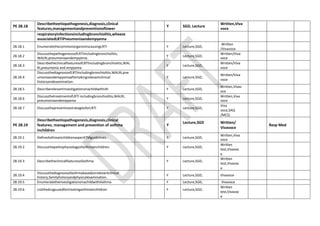
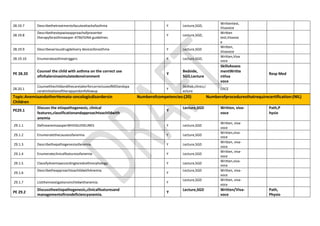
PE18.1 List and explain the components, plan, outcome
ofReproductive Child Health (RCH) program and
appraiseitsmonitoring and evaluation
Y Lecture/
SGD
Written/viva
voce
ComMed OBG
18.1.1
Statethecomponents,
strategyandtargetedoutcomeofRCHprogram.
Y Lecture/SGD
Written/viva
voce
18.1.2
Listtheprerequisitesandroleofaccredited
socialhealthactivist(ASHA).
Y Lecture/SGD
Written/viva
voce
18.1.3 AnalyzethemonitoringandevaluationofRCHprogram. Y
Lecture/SGD Written/viva
voce
PE 18.2
Explainpreventiveinterventionsforchildsurvivaland
safemotherhood
Y
Lecture/ SGD Written/viva
voce
ComMed OBG
18.2.1
Listthepreventiveinterventionsforchildsurvivalandsafe
motherhood.
Y
Lecture/SGD Written/viva
voce
18.2.2
Explainthepreventiveinterventionsforchildsurvivalandsafe
motherhood.
Y
Lecture/SGD Written/viva
voce
PE 18.3
Conduct antenatal examination of
womenindependentlyandapplyat-
riskapproachinantenatal
care
Y
Bedside
Skillstation ComMed OBG
18.3.1 Conductantenatalexaminationofwomenindependently. Y
Bedside,
Video
Skillstation
18.3.2 Applyat-riskapproachinantenatalcare. Y
Bedside,
Video
Skillstation
PE 18.4
Provideintra-natalcareandconductanormaldelivery
inasimulatedenvironment
Y
DOAPsession,
Skillslab
Documentin
Logbook
ComMed OBG
18.4.1
Demonstratethestepsofintra-natalmonitoringina
simulatedenvironment.
Y
DOAPsession,Skills
Lab,Video
Documentin
Logbook
18.4.2 Demonstratetheuseofaportogram. Y
DOAPsession,SkillsL
ab,
Video
Document
inLogbook
18.4.3
Conductanormaldeliveryinasi
mulatedenvironment.
Y
DOAPsession,Skillsl
ab,
Video
Document
inLogbook
PE 18.5
Provideintra-natalcareandobservetheconductofa
normaldelivery
Y
DOAPsession Documentin
Logbook
OBG
18.5.1
Demonstratethepreparationofvariouscomponentsofint
ranatalcare.
Y
DOAPsession Document
inLogbook
18.5.2 Observeandassistinconductofanormaldelivery. Y
DOAPsession Documentin
Logbook
PE 18.6
PerformPostnatalassessmentofnewbornand
mother, provide advice on breastfeeding, weaning
andonfamily planning
Y
Bedside,
SkillLab
SkillAssess
ment
ComMed OBG
18.6.1 Performpostnatalassessmentofnewborn. Y
Bedside,
SkillLab
SkillAssessment
18.6.2 Performpostnatalassessmentofmother. Y
Bedside,Skill
Lab
SkillAssessment
18.6.3
Giveadvicetothemotheroninitiationandmaintenanceofexcl
usive breastfeeding, common problems seen
duringbreastfeeding,weaningand familyplanning.
Y
Bedside,
SkillLab SkillAssessment
PE 18.7 Educateandcounselcaregiversofchildren Y roleplay
OSCE/Skill
Assessment
AETCOM
18.7.1
Educateandcounselcaregiversofchildrenonnewborncare
includingprovidingwarmth,feeding,andprevention
ofinfection,immunizationand dangersigns.
Y
Role
playVide
o
SkillAssessment
OSCE
PE18.8
Observetheimplementationoftheprogramby
visitingtheRuralHealthCenter
Y
Bedside,Skill
Lab
Documentin
Logbook
ComMed OBG
18.8.1
Makeobservationsontheimplementationoftheprogramby
visitingtheRuralHealth Center.
Y
Ruralhealth center
visit
Documentin
Logbook
Topic:NationalPrograms,RCH-UniversalImmunization
program
Numberofcompetencies:(16) Numberofproceduresthatrequirecertification:(01)
PE19.1 Explain the components of the
UniversalImmunizationProgram(UIP)andtheN
ationalImmunization Program(NIP)
Y Lecture/
SGD
Written/viva
voce
Com
Med,Micro,
Biochemistr
y
19.1.1 ExplainthecomponentsofUIPandNIP. Y
Lecture/
SGD
Written/viva
voce
19.1.2 ListthevaccinescoveredunderUIPandNIP. Y
Lecture/
SGD
Written/viva
voce
PE 19.2
Explain the epidemiology of vaccine
preventablediseases(VPDs)
Y
Lecture/
SGD
Written/viva
voce
Com
Med,Micr
o,
Biochemistry
19.2.1 DescribetheepidemiologyofindividualVPDs. Y
Lecture/
SGD
Written/viva
voce
PE 19.3
Vaccinedescriptionwithregardtoclassificationof
vaccines,strainused,dose,route,schedule,risks,
Y
Lecture/
SGD
Written/viva
voce
ComMed,
Micro,
benefitsandsideeffects, indicationsand
contraindications
Biochemistry
19.3.1
Classifyvaccinesaccordingtotypeofvaccine.
Y
Lecture/
SGD
Written/viva
voce
19.3.2
DescribethecompositionoftheNIPvaccinesincludingthestrain
used.
Y
Lecture/
SGD
Written/viva
voce
19.3.3 Statethedose,routeandscheduleofallvaccinesunderNIP. Y
Lecture/
SGD
Written/viva
voce
19.3.4
Recalltherisks,benefits,sideeffects,indicationsand
contraindicationsofvaccinesunderNIP.
Y
Lecture/
SGD
Written/viva
voce
PE 19.4
Define cold chain and discuss the methods of
safestorageand handlingofvaccines
Y
Lecture/
SGD
Written/viva
voce
Com
Med,Micr
o,
Biochemistry
19.4.1 Definecoldchainanddiscussitsimportanceforvaccines. Y
Lecture/SGD Written/viva
voce
19.4.2 Listthevariouscoldchainequipment. Y
Lecture/SGD Written/viva
voce
19.4.3
Describe the appropriate storage of vaccines in
domesticrefrigerator,icelinedrefrigerator(ILR)andvaccineca
rriers.
Y
Lecture/SGD Written/viva
voce
19.4.4
Enumerate the precautions for maintaining vaccines
atappropriatetemperatureincludingtheuseofvaccinevial
monitor(VVM).
Y
Lecture/SGD
Written/viva
voce
19.4.5
Explainthemethodofcoldchainmaintenanceduringa
vaccinesession.
Y
Lecture/SGD Written/viva
voce
PE 19.5
Discuss immunization in special situations –
HIVpositive children, immunodeficiency, pre-term,
organtransplants, those who received blood and
bloodproducts,splenectomisedchildren,adolescents,
and travelers
Y Lecture/ SGD
Written/viva
voce
Com
Med,Micro,B
iochemistry
19.5.1
Explain immunization in special situations – HIV
positivechildren,immunodeficiency,pre-
term,organtransplants,thosewhoreceivedbloodandblood
products,
splenectomisedchildren,adolescents,travelers.
Y Lecture/SGD
Written/viva
voce
PE 19.6
Assess patient forfitness for immunization and
prescribe an age appropriate immunization schedule Y
Out Patient
clinics,Skillslab
SkillAssess
ment
5
19.6.1 Assesspatientfitnessforimmunization. Y
OutPatientclinics,S
killslab
SkillAssessment
OSCE
5
19.6.2
Makeanageappropriateplanforimmunizationincludingcat
chup doses.
Y
OutPatientclinics,S
killslab
SkillAssessment
OSCE
5
19.6.3
Prescribethecorrectvaccine,dose,routeofadministration
forthechild.
Y
OutPatientclinics,
Skillslab
SkillAssessment 5
PE 19.7 Educateandcounselapatientforimmunization Y DOAPsession
Documentin
Logbook
19.7.1 Educatetheparentsabouttheimportanceofvaccines. Y
DOAP
session,Role play
Document
inLogbook
19.7.2
Counselparentsforageappropriatevaccines,theschedule
andtimingandtheexpectedsideeffects.
Y
DOAPsession,
Roleplay
Documentin
Logbook,OSCE
PE 19.8
Demonstrate willingness to participate in the
nationalandsubnational immunizationdays
Y
Lecture/sm
allgroup
discussion
Document
inLogbook
ComMed
19.8.1
Participateinthenational(NIDs)andsubnationalim
munization days(SNIDs).
Y
Small
group,NIDsand
SNIDs
Document
inLogbook
PE 19.9
Describe the components of safe vaccine practice –
Patient education/ counselling; adverse
eventsfollowing immunization, safe injection
practices,documentationandmedico-
legalimplications
Y
Lecture/sma
ll
groupdiscus
sion/
Immunization
clinic
Written/viva
voce
AETCOM
19.9.1
Describethecomponentsofsafevaccinepractices-patient
education/counseling.
Y
Lecture/SGD Written/viva
voce
AETCOM
19.9.2
Describeadverseeventsfollowingimmunizationandst
andardprecautionstoprevent them.
Y
Lecture/SGD Written/viva
voce
19.9.3
Listsafeinjectionpracticesanddocumentationduringim
munization.
Y
Lecture/SGD Written/viva
voce
19.9.4
Demonstratenecessarydocumentationandmedicolegali
mplicationsofimmunization.
Y
Lecture/SGD Written/viva
voce
PE 19.10 Observethehandlingandstoringofvaccines Y DOAPsession
Written/viva
voce
19.10.1
Observe and note the correct handling and storing
ofvaccines.
Y
DOAP
session,Videos
Vivavoce/OSCE
PE 19.11 DocumentImmunizationinanimmunizationrecord Y
OutPatientclinics,
Skillslab
Skill
assessment
19.11.1 DocumentImmunizationinanimmunizationrecord. Y
OutPatien tclinics,
Skillslab
Skillassessment
OSCE
PE 19.12 ObservetheadministrationofUIPvaccines Y DOAPsession
Documentin
Logbook
ComMed
19.12.1 Observeanddocumenttheadministrationofvaccines. Y DOAPsession
Document
inLogbook
PE 19.13
Demonstratethecorrectadministrationofdifferent
vaccinesinamannequin
Y DOAPsession
Documentin
Logbook
ComMed
19.13.1
Preparevaccinesbymaintaininghandhygieneandskinster
ilization.
Y
DOAP session,Skill
station
Document
inLogbook,OSC
E
19.13.2
Administeravaccineinthemannequinbycorrectroute(IM,SC,ID
)for thecorrectvaccine.
Y
DOAP
session,Skill
station
Document
inLogbook,OSC
E
PE 19.14
PracticeInfectioncontrolmeasuresandappropriate
handlingofthesharps
Y DOAPsession
Documentin
Logbook
ComMed
19.14.1 PracticeInfectioncontrolmeasures. Y DOAPsession
Documentin
Logbook
19.14.2 Practiceappropriatehandlingofthesharps. Y DOAPsession
Document
inLogbook
PE 19.15
ExplainthetermimpliedconsentinImmunization
services
Y
Smallgroup
discussion
Written/viva
voce
19.15.1 ExplainthetermimpliedconsentinImmunizationservices. Y
Smallgroup
discussion
Written/viva
voce
PE 19.16
Enumerate available newer vaccines and
theirindicationsincludingpentavalentpneumococcal,
rotavirus,JE,typhoidIPV& HPV
N
Lecture/sm
allgroup
discussion
Written/viva
voce
19.16.1
Enumeratenewervaccines(pneumococcal,rotavirus,JEty
phoid,IPV, influenza&HPVvaccines).
N
Lecture/SGD Written/viva
voce
19.16.2
Listtheindicationsfornewervaccinessuchaspneumococcal,JE,typ
hoid, influenza&HPV vaccines
N
Lecture/SGD Written/viva
voce
Topic:CareoftheNormalNewbornandHighriskNewborn Numberofcompetencies:(20) Numberofproceduresthatrequirecertification:(NIL)
PE 20.1
Definethecommonneonatalnomenclaturesincludingthe
classification and describe the characteristics of
aNormalTermNeonateandHighRiskNeonates
Y
Lecture/ SGD
Written/viva
voce
20.1.1 DefinetheNeonatalandPerinatalperiod. Y
Lecture/SGD Written
/Vivavoce
20.1.2 Definelivebirthandstillbirth. Y
Lecture/SGD Written/Viva
voce
20.1.3
Classifytheneonateaccordingtobirthweightintodifferentcate
gories.
Y
Lecture/SGD Written
/Vivavoce
20.1.4 Classifytheneonateaccordingtoperiodofgestation. Y
Lecture/SGD Written
/Vivavoce
20.1.5 Classifytheneonateasperintrauterinegrowthpercentiles. Y
Lecture/SGD Written/Viva
voce
20.1.6
DefineNeonatalMortalityRate(NMR)andPerinatalM
ortalityRate.
Y Lecture,SGD.
Written
/Vivavoce
20.1.7 Describethecharacteristicsofanormaltermneonate. Y Lecture,SGD.
Written/Viva
voce
20.1.8 Describethecharacteristicsofthehigh-riskneonate. Y Lecture,SGD.
Written
/Vivavoce
PE 20.2 Explainthecareofanormalneonate Y Lecture,SGD
Written/Viva
voce
20.2.1 EnumeratethecomponentsofEssentialNewbornCare Y Lecture,SGD
Written
/Vivavoce
20.2.2 Enumeratethestepsofcareofthenormalneonateatbirth. Y Lecture,SGD.
Written/Viva
voce
20.2.3
Explainthecareofthenormal
neonateduringthepostnatalperiod.
Y Lecture,SGD.
Written
/Vivavoce
20.2.4
Listthecriteriafordischargeofanormalneonatefromthe
Hospital
Y Lecture,SGD.
Written/Viva
voce
PE 20.3 PerformNeonatalresuscitationinamanikin Y DOAP/SKILLLAB Logbook
20.3.1 Performallthestepsofroutinecareona manikin. Y DOAP/skilllab Logbook/OSCE
20.3.2
Demonstratetheinitialstepsofneonatalresuscitationinaman
ikininthecorrectsequence.
Y DOAP
Logbooken
try/OSCE
20.3.3
Demonstratethemethodofcountingtheheartrateofthe
neonateduringresuscitation.
Y DOAP Skilllab/OSCE
20.3.4
Demonstratethemethodofadministeringfreeflowoxygenduri
ngresuscitation.
Y DOAP
Skillstation/
OSCE
20.3.5 Checkthefunctionsofallpartsofthe self-inflatingbag. Y DOAP
Logbook
entry/OSCE
20.3.6
Demonstrate the method of positive pressure
ventilation(PPV)inamanikinusingappropriatesizeofbagandm
ask.
Y DOAP
Logbooken
try/OSCE
20.3.7 Checksthesignsofeffectivepositivepressureventilation. Y DOAP Logbook/OSCE
20.3.8
Initiatecorrectivestepsincorrectsequenceforineffectiveven
tilationinsimulatedsettings.
Y DOAP
Logbooken
try/OSCE
20.3.9
Demonstratethemethodofplacementoforogastrictubedurin
gprolonged PPV in a manikin.
Y DOAP Logbookentry
20.3.10
Demonstratethe‘thumbtechnique’and‘twofinger
technique’ofprovidingchestcompressionina manikin.
Y DOAP
Logbooke
ntry/skill
station/OSCE
20.3.11 Preparecorrectdilutionofadrenalineinjection. Y DOAP Logbook
20.3.12
IdentifythecorrectsizeofLaryngoscopeandendotrachealtub
ebasedongivenbirth weight/gestationcorrectly.
Y DOAP
Logbooken
try/OSCE
20.3.13
Demonstratethetechniqueofendotrachealintubationina
manikincorrectly.
Y DOAP Logbookentry
PE 20.4 Assessmentofanormalneonate Y Bedside/Skilllab
Skill
assessment
20.4.1
Elicittherelevantgeneral,antenatal,natalandpostnatalhist
oryofthemother.
Y Bedside/Skilllab Skillassessment
20.4.2
Demonstratethetouchmethodofassessmentofte
mperatureina newborn.
Y Bedside/Skilllab Skillassessment
20.4.3
Demonstratethemethodofrecordingaxillaryandrectal
temperatureinaneonatalmanikin.
Y Bedside/Skilllab Skillassessment
20.4.4 Demonstratethecountingofrespiratoryrateinaneonate. Y Bedside/Skilllab Skillassessment
20.4.5
DemonstratetheelicitingofcapillaryrefilltimeCRTinanewborn
.
Y Bedside/Skilllab Skillassessment
20.4.6 Demonstratecountingtheheartrateinaneonate. Y Bedside/Skilllab Skillassessment
20.4.7
Measureweight,length,headcircumferenceandchestcir
cumferencein aneonate/manikin accurately.
Y Bedside/Skilllab Skillassessment
20.4.8
Performagestationalassessmentbyphysicaland
neurologicalcriteriainaneonate.
Y Bedside/Skilllab Skillassessment
20.4.9 Performaheadtotoeexaminationoftheneonate. Y Bedside/Skilllab Skillassessment
20.4.10
Elicitcommonneonatalreflexeslikerooting,sucking,grasp,
andMoro’sreflexcorrectly.
Y Bedside/Skilllab Skillassessment
20.4.11 Performarelevantsystemicexaminationofaneonate Y Bedside/Skilllab Skillassessment
PE 20.5 Counsel/educatemothersonthecareofneonates Y DOAP Logbookentry
20.5.1
CounselmothersusingtheGALPACtechnique(Greet,Ask,Listen
,Praise,Advise,Checkforunderstanding)
appropriately.
Y DOAP
Logbookdocum
entation/
OSCE
20.5.2
Educatemothersregardingcareoftheeyes,skinandcordstump
ofthe neonate.
Y DOAP
Logbookdocum
entation
20.5.3 Educatethemotherforpreventionofinfections. Y DOAP
Logbookdocum
entation/
OSCE
20.5.4 Educatemothersregardingbathingroutineandcleanliness. Y DOAP
Logbookdocum
entation/
OSCE
20.5.5 Counselthemotherregardingherownnutritionandhealth. Y DOAP
Logbookdocum
entation
PE 20.6
Explain the follow-up care for neonates
includingBreastfeeding,Temperaturemaintenance,
immunization,importanceofgrowthmonitoringandre
dflags.
Y DOAP
Logbookdocu
mentation
20.6.1
Counselthemothersabouttheimportanceofexclusive
breastfeedingappropriately.
Y DOAP
Logbook
documentation
20.6.2
Educate the mother regarding harmful effects of pre-
lactealsandnon-humanmilk.
Y DOAP
Logbookdocum
entation
20.6.3
Explaintothemothertheimportanceoffrequentbreastfeeding
includingnightfeeds.
Y DOAP
Logbookdocum
entation
20.6.4 Educatethemotherregardingcommonlactationproblems Y DOAP
Logbookdocum
entation
20.6.5
Explaintothemotherthemethodsofkeepingthebabywarmathom
e.
Y DOAP
Logbookdocum
entation/
OSCE
20.6.6
DemonstratethetechniqueofKangarooMotherCareinamaniki
nand simulated mother.
Y DOAP
Logbookdocum
entation/
OSCE
20.6.7
Explainthescheduleofimmunizationasperthenationalimmuni
zationschedulecorrectly.
Y DOAP
Logbookdocum
entation/OSCE
20.6.8
Counseltheparentsonimportanceofregularvisittothewellbabycli
nic for growth monitoring.
Y DOAP
Logbookdocum
entation/
OSCE
20.6.9
Explaintotheparentstheredflagsignsforurgentvisittohospital.
Y DOAP
Logbookdocum
entation/
OSCE
PE 20.7
Discusstheetiology,clinicalfeaturesand
managementofBirthasphyxia
Y
Lecture/ SGD Written/Viva
voce
20.7.1
DefinebirthasphyxiaasperNNF(NationalNeonatologyForum)
and WHO,AAP guidelines.
Y
Lecture/SGD Written
/Vivavoce
20.7.2
Enumeratetheetiologyofbirthasphyxiabasedonantenatal,natala
nd postnatal factors.
Y Lecture,SGD
Written
/Vivavoce
20.7.3 Describetheclinicalfeaturesofbirthasphyxia. Y Lecture,SGD
Written/Viva
voce
20.7.4 Listthecomplicationsofhypoxicischemicencephalopathy. Y Lecture,SGD
Written
/Vivavoce
20.7.5
Describethepostresuscitationmanagementofthe
asphyxiatedneonate.
Y Lecture,SGD
Written/Viva
voce
PE 20.8
Discuss the etiology, clinical features and
managementofrespiratorydistressinNewbornincluding
meconium
aspirationandtransienttachypneaofnewborn.
Y Lecture,SGD
Written
/Vivavoce
20.8.1
DefineRespiratoryDistressinaneonate(asperNNFguidelines).
Y Lecture,SGD
Written
/Vivavoce
20.8.2
Enumeratethecommonetiologiesofrespiratorydistressbased
on timeofonset andgestation.
Y Lecture,SGD
Written
/Vivavoce
20.8.3
EnumeratetheparametersoftheDownesscorefor
assessmentofseverityofrespiratorydistress.
Y Lecture,SGD
Written/Viva
voce
20.8.4
DescribetheclinicalfeaturesandcomplicationsofMeconiumAspir
ation Syndrome (MAS).
Y Lecture,SGD
Written
/Vivavoce
20.8.5 DiscussthemanagementofMAS. Y Lecture,SGD
Written/Viva
voce
20.8.6
DiscusstheclinicalfeaturesandmanagementofTransientTachy
pneaofNewborn.
Y Lecture,SGD
Written
/Vivavoce
20.8.7
DescribetheetiologyandclinicalfeaturesofHyalineMe
mbraneDisease.
Y Lecture,SGD
Written
/Vivavoce
20.8.8 DiscussthemanagementincludingpreventionofHMD. Y Lecture,SGD
Written/Viva
voce
PE 20.9
Discusstheetiology,clinicalfeaturesandmanagement
ofbirthinjuries.
Y Lecture,SGD
Written/Viva
voce
20.9.1 Definebirthinjury(asperNationalVitalStatisticsReport). Y Lecture,SGD
Written
/Vivavoce
20.9.2 Enumeratethecommonbirthinjuriesinneonates Y Lecture,SGD
Written
/Vivavoce
20.9.3 Discusstheetiologyandriskfactorsofbirthinjuries Y Lecture,SGD
Written/Viva
voce
20.9.4
Discuss the clinical features of common birth injuries
like,cephalhematoma,subgalealhemorrhage,brachialplexusa
ndfacialnerveinjury, boneandsoft tissueinjuriesand intra-
abdominalinjuries,fractures.
Y Lecture,SGD
Written
/Vivavoce
20.9.5
Discussthemanagementincludingpreventionofcommonbirth
injuries
Y Lecture,SGD
Written
/Vivavoce
PE 20.10
Discusstheetiology,clinicalfeaturesandmanagement
ofhemorrhagicdiseaseofnewborn
Y Lecture,SGD
Written/Viva
voce
20.10.1
Enumeratethecausesofhemorrhagicdiseaseofnewborn
accordingtotimeofonset.
Y Lecture,SGD
Written/Viva
voce
20.10.2
DiscusstheroleofvitaminKdeficiencyinhemorrhagicdise
aseofnewborn.
Y Lecture,SGD
Written
/Vivavoce
20.10.3
Describetheclinicalfeaturesofearly,classicalandlateonsethemor
rhagicdiseaseofnewborn.
Y Lecture,SGD
Written
/Vivavoce
20.10.4
Outlinethestepsofmanagementandpreventionof
hemorrhagicdiseaseofnewborn.
Y Lecture,SGD
Written/Viva
voce
PE 20.11
Discusstheclinicalcharacteristics,complicationsandma
nagementoflowbirthweight(pretermandsmall
forgestation).
Y Lecture,SGD
Written
/Vivavoce
20.11.1
Describetheclinicalcharacteristicsofpreterm,smallforges
tationand lowbirthweightnewborns.
Y Lecture,SGD
Written
/Vivavoce
20.11.2
Enumeratethecomplicationsinthepreterm,smallfor
gestationandlowbirthweightnewborns
Y Lecture,SGD
Written/Viva
voce
20.11.3
Describethemanagementofthepreterm,small
fordateandlowbirthweight newborns.
Y Lecture,SGD
Written
/Vivavoce
20.11.4
Enumeratethecriteriafordischargeoflowbirthweightbabi
esfrom hospital-basedcare.
Y Lecture,SGD
Written
/Vivavoce
20.11.5 Listthefollowupadvicefor lowbirthweightnewborns. Y Lecture,SGD
Written/Viva
voce
PE 20.12
Discussthetemperatureregulationinneonates,
clinicalfeaturesandmanagementofNeonatalHypother
mia.
Y Lecture,SGD
Written
/Vivavoce
20.12.1 Enumeratethemodesofheatlossinanewborn. Y Lecture,SGD
Written/Viva
voce
20.12.2
Describethemechanismofthermoregulationinthe
newborn.
Y Lecture,SGD
Written/Viva
voce
20.12.3 ClassifyhypothermiainnewbornsasperNNFcriteria. Y Lecture,SGD
Written
/Vivavoce
20.12.4
Describetheclinicalfeaturesofanewbornwithcoldstress,mod
eratehypothermiaandseverehypothermia.
Y Lecture,SGD
Written
/Vivavoce
20.12.5
Discussthemanagementofcoldstress,moderate
hypothermiaandseverehypothermia.
Y Lecture,SGD
Written/Viva
voce
20.12.6
Outlinethepreventionofhypothermiainnewbornby‘tenstep
softhewarmchain’.
Y Lecture,SGD
Written
/Vivavoce
20.12.7
ExplaintheKangarooMotherCareforpreventionof
hypothermiainnewborns.
Y Lecture,SGD
Written/Viva
voce
PE 20.13
Discusstheetiology,clinicalfeaturesandmanagement
ofNeonatalhypoglycemia.
Y Lecture,SGD
Written/Viva
voce
20.13.1 Definehypoglycemiainnewborn. Y Lecture,SGD
Written
/Vivavoce
20.13.2 Enumeratetheetiologyofhypoglycemiainthenewborn. Y Lecture,SGD
Written/Viva
voce
20.13.3
Enumeratethe“atrisknewborns”needingroutineblood
sugarmonitoringforhypoglycemia.
Y Lecture,SGD
Written
/Vivavoce
20.13.4
Describetheclinicalfeaturesofhypoglycemiainthe
newborn.
Y Lecture,SGD
Written/Viva
voce
20.13.5
Discussthemanagementofa
newbornwithasymptomaticandsymptomatic hypoglycemia.
Y Lecture,SGD
Written
/Vivavoce
20.13.6
Enumeratethemeasuresfor
preventionofhypoglycemiainnewborn.
Y Lecture,SGD
Written
/Vivavoce
PE 20.14
Discusstheetiology,clinicalfeaturesandmanagement
ofNeonatalhypocalcemia.
Y Lecture,SGD
Written/Viva
voce
20.14.1 Defineneonatalhypocalcemia. Y Lecture,SGD
Written/Viva
voce
20.14.2
Enumeratetheriskfactorsfor earlyandlateonset
hypocalcemia.
Y Lecture,SGD
Written/Viva
voce
20.14.3 Describetheclinicalfeaturesofneonatalhypocalcemia. Y Lecture,SGD
Written/Viva
voce
20.14.4 Outlinethemanagementofneonatalhypocalcemia. Y Lecture,SGD
Written
/Vivavoce
PE 20.15
Discusstheetiology,clinicalfeaturesandmanagement
ofneonatalseizures.
Y Lecture,SGD
Written/Viva
voce
20.15.1 Enumeratetheclinicaltypesofseizuresinthenewborn. Y Lecture,SGD
Written
/Vivavoce
20.15.2
Enumeratethekeydifferentiatingfeaturesbetweenseizures
andjitteriness.
Y Lecture,SGD
Written/Viva
voce
20.15.3
Describethecommoncausesofneonatalseizuresaccordingtoti
meofonset ofseizure.
Y Lecture,SGD
Written
/Vivavoce
20.15.4
Discusstheclinicalfeaturesofthecommoncausesofneonatalse
izures.
Y Lecture,SGD
Written
/Vivavoce
20.15.5
Listtheprimarydiagnostictestsindicatedinneonatalseiz
ures.
Y Lecture,SGD
Written
/Vivavoce
20.15.6
Elaboratethestepwisealgorithmicapproachforthe
managementofneonatalseizures.
Y Lecture,SGD
Written/Viva
voce
PE 20.16
Discusstheetiology,clinicalfeaturesandmanagement
ofneonatalsepsis.
Y Lecture,SGD
Written/Viva
voce
20.16.1
Defineneonatalsepsis,probablesepsis,severesepsis,septicshock
Y Lecture,SGD
Written
/Vivavoce
20.16.2 ClassifyEarlyandlateneonatalsepsis. Y Lecture,SGD
Written/Viva
voce
20.16.3
Enumeratetheorganismsresponsibleforcausingearlyandlate
onset sepsis.
Y
20.16.4
Enumeratetheriskfactorsofearlyandlateonsetneonatalsepsis
correctly.
Y Lecture,SGD
Written
/Vivavoce
20.16.5
Describetheclinicalfeaturesofearlyonsetandlateonset
neonatalsepsis
Y Lecture,SGD
Written/Viva
voce
20.16.6
Enumeratethecommonlyusedlaboratorytestsfordiagnosisofn
eonatal sepsis.
Y Lecture,SGD
Written
/Vivavoce
20.16.7 Recalltheinterpretationofapositive sepsisscreen. Y Lecture/SGD
Written
/Vivavoce
20.16.8
Describetheapproachtoanewbornwithsuspectedearly
onsetsepsis.
Y Lecture,SGD
Written/Viva
voce
20.16.9
Describetheapproachtoanewbornwithsuspectedlateons
et sepsis.
Y Lecture,SGD
Written
/Vivavoce
20.16.8
Listthecommonlyusedantibiotics(withdosageandduration
oftherapy)inthemanagementofneonatalsepsis.
Y Lecture,SGD
Written/Viva
voce
20.16.9
Describethesupportiveand
adjunctivetherapyinmanagementofneonatalsepsi
s.
N Lecture/SGD
Written/viva
voce
20.16.9
Discussthemeasuresforpreventionofearlyonsetandlateonset
sepsis.
Y Lecture,SGD
Written
/Vivavoce
PE 20.17
Discusstheetiology,clinicalfeaturesandmanagement
ofPerinatalinfections.
Y Lecture,SGD
Written/Viva
voce
20.17.1 DefinePerinatalinfection. Y Lecture,SGD
Written/Viva
voce
20.17.2
Discuss the etiology and risk factors for acquisition
ofcommon Perinatal infections like Herpes,
Cytomegalovirus,Toxoplasmosis,Rubella,HIV,Varicella,Hepat
itisBvirusand
syphilis.
Y Lecture,SGD
Written
/Vivavoce
20.17.3
DescribetheclinicalfeaturesofthecommonPerinatalinfe
ctions.
Y Lecture,SGD
Written
/Vivavoce
20.17.4 OutlinethemanagementofthecommonPerinatalinfections. Y Lecture,SGD
Written/Viva
voce
20.17.5
Enumeratethemeasuresfor
preventionofcommonPerinatalinfections.
Y Lecture,SGD
Written
/Vivavoce
PE 20.18
IdentifyandstratifyriskinasickneonateusingIMNCI
guidelines
Y DOAP
Documentin
Logbook
20.18.1
Identifypossibleseriousbacterialinfection/jaundiceand
stratifythesickneonateasperIMNCI.
Y DOAP
Documentin
Logbook
20.18.2
Identifyandstratifydehydrationinasickneonatewithdiar
rheaasper IMNCI.
Y DOAP
Document
inLogbook
20.18.3
Classifydiarrheaintoseverepersistentdiarrheaandseveredyse
nteryasper IMNCIguidelines.
Y DOAP
Document
inLogbook
20.18.4 Checkforfeedingproblemandmalnutritionandstratify. Y DOAP
Documentin
Logbook
20.18.5
Assessbreastfeedingandcheckforsignsofgoodattachmenttoth
ebreastina neonate.
Y DOAP
Document
inLogbook
20.18.6
Interpretandclassifytheneonateonthebasisofweightforagez
scoresweightcategoriesaccurately.
Y DOAP
Document
inLogbook
PE 20.19
Discusstheetiology,clinicalfeaturesandmanagement
ofNeonatalhyperbilirubinemia.
Y Lecture/SGD
Written/Viva
voce
20.19.1 Describetheetiologyofneonatalhyperbilirubinemia Y Lecture/SGD
Written/Viva
voce
20.19.2
Differentiatethecausesofneonataljaundicebasedonageofonset
and duration ofjaundice.
Y LectureSGD
Written
/Vivavoce
20.19.3
Enumeratethecommoncausesofunconjugatedand
conjugatedhyperbilirubinemiainthenewborn.
Y Lecture/SGD
Written/Viva
voce
20.19.4
Differentiatebetweenphysiologicalandpathologicaljaundiceinth
enewborn.
Y Lecture/SGD
Written
/Vivavoce
20.19.5
Discusstheclinicalfeaturesofcommoncausesofneonataljaund
ice
Y Lecture/SGD
Written
/Vivavoce
20.19.6
Describetheimportantclinicalfeaturesofacutebilirubin
encephalopathy.
Y LectureSGD
Written/Viva
voce
20.19.7
Listtheinvestigationstobeperformedintheevaluationofneo
natalhyperbilirubinemia.
Y Lecture/SGD
Written
/Vivavoce
20.19.8
Categorizetheriskinneonatalhyperbilirubinemiabasedon
theAmericanAcademyofPediatricsBilirubinNomogram.
Y Lecture/SGD
Written/Viva
voce
20.19.9
Identify a neonate requiring phototherapy as per
theAmericanAcademyofPediatricsBilirubinNomogram
.
Y Lecture/SGD
Written
/Vivavoce
20.19.10
IdentifyaneonaterequiringexchangetransfusionaspertheAmeric
an AcademyofPediatricsBilirubinNomogram
correctly.
Y Lecture/SGD
Written
/Vivavoce
20.19.11 Describethecareofthebabyreceivingphototherapy. Y Lecture/SGD
Written
/Vivavoce
20.19.12
Explainthemechanismofphototherapy.
Y Lecture/SGD
Written
/Vivavoce
20.19.13 Detailthemethodofadministeringphototherapy. Y Lecture/SGD
Written/Viva
voce
PE 20.20
Identify clinical presentations of common
surgicalconditions in the newborn including TEF,
esophagealatresia,analatresia,cleftlipandpalate,con
genital
diaphragmaticherniaandcausesofacuteabdomen.
Y Lecture/ SGD
Written/
vivavoce
20.20.1
Describeclinicalpresentationsofcommonsurgicalconditionsin
the newborn like Tracheo-esophageal fistula
(TEF),esophagealatresia,analatresia,cleftlip andpalateand
congenitaldiaphragmaticherniacorrectly.
Y Lecture/SGD
Written
/Vivavoce
20.20.2 Enumeratethecausesofacuteabdomeninthenewborn Y Lecture/SGD
Written
/Vivavoce
20.20.3
Recallthecausesofacuteabdomeninthenewbornbasedon
thepresentingclinicalfeatures.
Y Lecture/SGD
Written/Viva
voce
Topic:Genito-Urinarysystem Numberofcompetencies:(17) Numberofproceduresthatrequirecertification:(NIL)
PE21.1
Enumeratetheetiopathogenesis,clinicalfeatures,com
plicationsandmanagementofUrinaryTract
infection(UTI)inchildren
Y
Small
groupdiscus
sion
Written/
Vivavoce Micro
21.1.1 DefineUTIasperstandardcriteria. Y Lecture/SGD
Written/Viva
voce
21.1.2
EnumeratetheorganismscausingUTIinchildrenofdifferentages.
Y
Lecture/SGD Written
/Vivavoce
21.1.3 Describetheclinicalfeaturesofsimple&complicatedUTI. Y
Lecture/SGD Written/Viva
voce
21.1.4
OutlinediagnosticworkupforchildrenwithUTIatdifferentage
s.
Y
Lecture/SGD Written
/Vivavoce
21.1.5
Describe the treatment including the choice of antibiotics
anddurationofantibiotic therapyfor treatingsimple&
complicatedUTI.
Y
Lecture/SGD
Written
/Vivavoce
21.1.6 EnumeratethecomplicationsofUTIchildren. Y
Lecture/SGD Written
/Vivavoce
PE21.2
Enumeratetheetiopathogenesis,clinicalfeatures,
complications and management of acute post-
streptococcalGlomerularNephritisinchildren
Y Lecture/ SGD
Written
/Vivavoce Path
21.2.1 Defineacuteglomerulonephritis. Y Lecture/SGD
Written/Viva
voce
21.2.2
Elaboratepathogenesisofimmunemediatednephriticsy
ndrome
Y Lecture/SGD
Written
/Vivavoce
21.2.3
DescribetheclinicalfeaturesofPost-
StreptococcalGlomerulonephritis(PSGN)
Y Lecture/SGD
Written
/Vivavoce
21.2.4 EnumeratethecomplicationsofPSGN. Y Lecture/SGD
Written/Viva
voce
21.2.5 EnumeratetheinvestigationsforPSGN. Y Lecture/SGD
Written
/Vivavoce
21.2.6 EnumerateindicationsofkidneybiopsyinPSGN. Y Lecture/SGD
Written/Viva
voce
21.2.7 OutlinemanagementofPSGN. Y Lecture/SGD
Written
/Vivavoce
PE21.3
Discusstheapproachandreferralcriteriatoachild
withProteinuria
Y Lecture/ SGD
Written/Viva
voce
Path
21.3.1 Listcausesofglomerular&nonglomerularProteinuria. Y Lecture/SGD
Written
/Vivavoce
21.3.2 Definenephroticsyndrome. Y Lecture/SGD
Written/Viva
voce
21.3.3 Enumeratecausesofnephroticsyndrome. Y Lecture/SGD
Written
/Vivavoce
21.3.4
Outlinetheapproachtoachildwithfirstepisodeofnephrotic
syndrome.
Y Lecture/SGD
Written/Viva
voce
21.3.5 Listthecomplicationsofnephroticsyndrome. Y Lecture/SGD
Written
/Vivavoce
21.3.6 Listindicationsofkidneybiopsyinnephroticsyndrome. Y Lecture/SGD
Written
/Vivavoce
21.3.7
Outlinethemanagementofinitialepisode nephrotic
syndromeandsubsequentrelapse.
Y Lecture/SGD
Written/Viva
voce
21.3.8 ListtheCriteriaforreferralofachildwithproteinuria. Y Lecture/SGD
Written
/Vivavoce
PE21.4
Discusstheapproachandreferralcriteriatoachild
withhematuria
Y Lecture/ SGD
Written/Viva
voce
Anat
21.4.1 Enumeratecausesofhematuriainchildrenofdifferentages Y Lecture/SGD
Written/Viva
voce
21.4.2
Outlinedifferencesbetweenglomerular&nonglomerularhe
maturia
Y Lecture/SGD
Written
/Vivavoce
21.4.3 Listinvestigationsforachildwithhematuria Y Lecture/SGD
Written
/Vivavoce
21.4.4 Listindicationsofkidneybiopsyin hematuria Y Lecture/SGD
Written/Viva
voce
21.4.5 Listcriteria forreferralforachildwithhematuria Y Lecture/SGD
Written
/Vivavoce
PE21.5
Enumerate the etiopathogenesis, clinical
features,complicationsandmanagementofAcuteRenalFa
ilure
inchildren
Y Lecture/ SGD
Written
/Vivavoce Path
21.5.1 Defineacutekidneyinjury(AKI)asperKDIGO. Y Lecture/SGD
Written/Viva
voce
21.5.2 OutlineclassificationofAKI. Y Lecture/SGD
Written
/Vivavoce
21.5.3 EnumeratecausesofAKI. Y Lecture/SGD
Written/Viva
voce
21.5.4 ListinvestigationsforAKIinchildren. Y Lecture/SGD
Written
/Vivavoce
21.5.5 DescribethemanagementofAKI. Y Lecture/SGD
Written/Viva
voce
21.5.6 ListindicationsofrenalreplacementtherapyinAKI. Y Lecture/SGD
Written
/Vivavoce
21.5.7 EnumeratecomplicationsofAKI. Y Lecture/SGD
Written
/Vivavoce
PE21.6
Enumerate the etiopathogenesis, clinical
features,complicationsandmanagementofchronic
kidney disease in children.
Y Lecture/ SGD
Written
/Vivavoce Path
21.6.1
Definechronickidneydisease(CKD)&itsstaginginchildren.
Y Lecture/SGD
Written/Viva
voce
21.6.2 OutlinetheclinicalfeaturesofCKDinchildren. Y Lecture/SGD
Written
/Vivavoce
21.6.3 ListcausesofCKDinchildren. Y Lecture/SGD
Written/Viva
voce
21.6.4 EnumeratecomplicationsofCKDinchildren. Y Lecture/SGD
Written
/Vivavoce
21.6.5 OutlinemanagementofCKD &itscomplications. Y Lecture/SGD
Written
/Vivavoce
PE21.7
Enumeratetheetiopathogenesis,clinicalfeatures,
complicationsandmanagementofWilmsTumor.
Y Lecture/ SGD
Written/Viva
voce
Path
21.7.1 DescribeEtiopathogenesisofWilmstumor. Y Lecture/SGD
Written/Viva
voce
21.7.2 DescribeclinicalfeaturesofWilmstumor. Y Lecture/SGD
Written
/Vivavoce
21.7.3 ListinvestigationsforapatientwithWilmstumor. Y Lecture/SGD
Written/Viva
voce
21.7.4 OutlinethemanagementofWilmstumor. Y Lecture/SGD
Written
/Vivavoce
PE21.8
Elicit, documentandpresentahistorypertainingto
diseasesoftheGenitourinarytract
Y Bedside,Skillslab
Skill
Assessment
21.8.1
Elicitclinicalhistorypertainingtogenitourinarydiseasesinchil
dren.
Y Bedside,Skillslab SkillAssessment
21.8.2
Performacompletephysicalexaminationforachildwith
genitourinarydiseases.
Y Bedside,Skillslab SkillAssessment
21.8.4 Documentthecompletehistoryinthe Logbook. Y Bedside,Skillslab SkillAssessment
PE21.9
IdentifyexternalmarkersforKidneydisease,like
Failingtothrive,hypertension,pallor,Icthyosis,anasarc
a
Y Bedside,Skillslab
Document
inLogbook
21.9.1
IdentifyexternalmarkersforKidneydisease,likeFailingto
thrive,hypertension,pallor,Icthyosis,anasarca.
Y Bedside,Skillslab
Documentin
Logbook
PE21.10
Analyzesymptomandinterpretthephysicalfindingsand
arriveatanappropriateprovisionaldifferential
diagnosis
Y Bedside,Skillslab Logbook
21.10.1
Analyzesymptomsandinterpretthephysicalfindingsand
arriveatanappropriateprovisionaldifferentialdiagnosis.
Y Bedside,Skillslab Logbook
PE21.11
PerformandinterpretthecommonanalytesinaUrine
examination
Y Bedside,Skillslab
Skill
assessment
Biochemistr,
Path
21.11.1 PerformatleastonetesttoelicitProteinuria. Y Bedside,Skillslab Skillassessment
21.11.2 Interpretthetestsforproteinuriaandtheirsignificance. Y Bedside,Skillslab Skillassessment
21.11.3 Performtest forevaluatingUrinePH. Y Bedside,Skillslab Skillassessment
21.11.4 Performurinemicroscopy. Y Bedside,Skillslab Skillassessment
21.11.5
IdentifytheabnormaldepositsandInterprettheurinemic
roscopyfindings.
Y Bedside,Skillslab Skillassessment
21.11.6 Testtheurineforglucosuria. Y Bedside,Skillslab Skillassessment
21.11,7 Interprettheurinesugarresults. Y Bedside,Skillslab Skillassessment
PE21.12 InterpretreportofPlainXRayofKUB Y Bedside,Skillslab Logbook
Radio
D
21.12.1 Identifyany abnormalitiesonX-Ray KUB. Y Bedside,Skillslab Logbook
PE21.13
Enumeratetheindicationsfor andInterpretthe
writtenreportofUltrasonogramofKUB
Y Bedside,Skillslab Logbook
Radio
D
21.13.1 EnumerateindicationsforUltrasoundKUB. Y Bedside,Skillslab Logbook
21.13.2 InterpretthewrittenreportofultrasonogramofKUB. Y Bedside,Skillslab Logbook
PE21.14
Recognize common surgical conditions of
theabdomen and genitourinary system and
enumeratethe indications for referral including
acute andsubacute intestinal obstruction,
appendicitis,pancreatitis, perforation
intussusception, Phimosis,
undescendedtestis,Chordee,hypospadias,Torsion
testis,herniaHydrocele,VulvalSynechiae
Y Bedside,Skillslab
Bedside,
Skillslab
Surg
21.14.1
Recognize common surgical conditions of the abdomen
andgenitourinary system and enumerate the indications
forreferral including acute and subacute intestinal
obstruction,appendicitis, pancreatitis, perforation
intussusception,Phimosis,undescendedtestis,Chordee,hypospa
dias,Torsion testis,herniaHydrocele,VulvalSynechiae.
Y Bedside,Skillslab
Bedside,
Skillslab
PE21.15
Discussandenumeratethereferralcriteriaforchildren
withgenitourinarydisorder
Y Lecture/ SGD
Written/viva
voce
21.15.1
EnumeratereferralcriteriainachildwithGenitourinarydis
order.
Y Lecture/SGD
Written/vivav
oce
PE21.16 Counsel/educateapatientforreferralappropriately Y DOAP Logbook AETCOM
21.16.1 Counsel/educateapatientforreferralappropriately. Y DOAP Logbook
PE21.17
Describetheetiopathogenesis,grading,clinical
featuresandmanagementofhypertensioninchildren
Y
Lecture/
SGD
Written/viva
voce
21.17.1
DefineHypertension(HTN)&itsstagingasperAAP2017guidelin
es. Y Lecture/SGD
Written/
vivavoce
21.17.2 Enumeratecausesofhypertensioninchildren. Y Lecture/SGD
Written/viva
voce
21.17.3 DescribetheclinicalpresentationofachildwithHT. Y Lecture/SGD
Written/
vivavoce
21.17.4 ListcomplicationsofHTin children. Y Lecture/SGD
Written/
vivavoce
21.17.5 Enumerateinvestigationsforhypertensioninchildren. Y Lecture/SGD
Written/viva
voce
21.17.6
Outlinetreatmentofhypertension(asperguidelines)inchildren
.
Y Lecture/SGD
Written/
vivavoce
Topic:Approachtoandrecognitionofachildwithpossible
Rheumatologicproblem
Numberofcompetencies:(3) Numberofproceduresthatrequirecertification:(NIL)
PE 22.1
EnumeratethecommonRheumatologicalproblemsinchi
ldren.Discuss the clinical approach to
recognitionandreferralofachildwithRheumatologicalpr
oblem
Y
Lecture/SGD
Written /
vivavoce
22.1.1
EnumeratethecommonRheumatologicalproblemsinch
ildren. Y
Lecture/SGD
Written/vivav
oce
22.1.2
Describetheclinicalapproachtoachild
withRheumatologicalproblem.
Y
Lecture/SGD Written/vivav
oce
22.1.3
Enumeratetheindicationsfor
referralofachildwithRheumatologicalproblem.
Y
Lecture/SGD Written/vivav
oce
PE 22.2 CounselapatientwithChronicillness N
Bedsideclinic/skill
lab
Logbook
22.2.1 Counselachild /parentsofachildwithachronicillness. N
Bedsideclinic/skill
lab
Logbook
PE 22.3
Describethediagnosisandmanagementofcommon
vasculitic disorders including Henoch
SchonleinPurpura, KawasakiDisease, SLE, JIA
N Lecture/SGD
Written /
vivavoce
22.3.1 Listthecommoncausesofvasculitisinchildren. Y Lecture/SGD
Written/Viva
voce
22.3.2 EnumerateClinical featuressuggestiveofvasculitisinachild N Lecture/SGD
Written/viva
voce
22.3.3. ListtheclinicalfeaturesofHenochSchonleinPurpura(HSP). N Lecture/SGD
Written/vivav
oce
22.3.4
ListthediagnosticcriteriaofHSP.
N Lecture/SGD
Written/vivav
oce
22.3.5 OutlinethemanagementofachildwithHSP. N Lecture/SGD
Written/viva
voce
22.3.6 Enumeratetheclinical featuresofKawasakidisease(KD). N Lecture/SGD
Written/vivav
oce
22.3.7 DefinediagnosticcriteriaofKawasakidisease. N Lecture/SGD
Written/vivav
oce
22.3.8 Outlinethemanagementofa childwithKawasaki Disease. N Lecture/SGD
Written/viva
voce
22.3.9 DefinediagnosticcriteriaofSLE. N Lecture/SGD
Written/vivav
oce
22.3.10 Outlinethemanagementofachild withSLE. N Lecture/SGD
Written/viva
voce
22.3.11 DefinediagnosticcriteriaofJIA. N Lecture/SGD
Written/vivav
oce
22.3.12 OutlinethemanagementofachildwithJIA. N Lecture/SGD
Written/vivav
oce
Topic:Cardiovascularsystem-HeartDiseases Numberofcompetencies:(18) Numberofproceduresthatrequirecertification:(NIL)
PE 23.1
Discuss the Hemodynamic changes,
clinicalpresentation, complications and
management ofacyanoticHeartDiseases-
VSD,ASDandPDA
Y Lecture/SGD
Written/
Vivavoce
Physio,Path
23.1.1
Explain and illustrate diagrammatically the
hemodynamicchangesseeninacyanoticcongenitalheart
diseases viz VSD,ASD,PDA.
Y Lecture/SGD
Written/Viva
Voce
Physio,Path
23.1.2
Describethesignsandsymptoms,timingofpresentationofabov
eacyanotic congenitalheart diseases.
Y Lecture/SGD
Written/Viva
Voce
23.1.3
Enumeratethecomplicationsofacyanoticcongenitalheartdis
eases.
Y Lecture/SGD
Written/Viva
Voce
23.1.4
Outlinethemedicalmanagementofcongenitalacyanotic
heartdiseaseasabove.
Y Lecture/SGD
Written/Viva
Voce
23.1.5 Enumeratethesurgicaltreatments forVSA,ASD,PDA. Y Lecture/SGD
Written/Viva
Voce
PE 23.2
Discuss the Hemodynamic changes,
clinicalpresentation,complicationsandmanagementof
CyanoticHeartDiseases–FallotPhysiology
Y Lecture/SGD
Written/Viva
Voce
Physio,Path
23.2.1
Enumeratetheessentialcomponentsof FallotPhysiologyand
ListthecardiacconditionswiththeFallotPhysiology.
Y Lecture/SGD
Written/Viva
Voce
23.2.2
Describe and illustrate diagrammatically the
hemodynamicchangesseeninFallotPhysiologycyanoticcong
enitalheartdiseases.
Y Lecture/SGD
Written/Viva
Voce
23.2.3
ExplaintheclinicalpresentationandcomplicationsofFallotPhys
iologycyanoticcongenitalheart diseases.
Y Lecture/SGD
Written/Viva
Voce
23.2.5
Describeacyanoticspellandthepharmacologicalandnon-
pharmacologicalmanagementofcyanoticspells.
Y Lecture/SGD
Written/Viva
Voce
23.2.6
DescribethetreatmentoptionsforlesionswithFallotPhysiolog
y.
Y Lecture/SGD
Written/Viva
Voce
PE 23.3
Discusstheetiopathogenesis,clinicalpresentationand
managementofcardiacfailureininfantandchildren
Y Lecture/SGD
Written/Viva
Voce
Physio,Path
23.3.1
Enumeratecausesofcongestiveheartfailurein childrenas
pertheageofpresentation.
Y Lecture/SGD
Written/Viva
Voce
23.3.2
Describethehemodynamicchangesincongestiveheartfail
ure.
Y Lecture/SGD
Written/Viva
Voce
23.3.3
Describethesignsandsymptomsofleft
side,rightsideandcombinedcongestiveheart failure.
Y Lecture/SGD
Written/Viva
Voce
23.3.4
Enumeratethevariousmanagementoptionsavailablefor
congestiveheartfailure.
Y Lecture/SGD
Written/Viva
Voce
23.3.5
Explaintheroleofdiuretics,inotropes,inodilators,andafterloa
d reducingagentsintreatmentof CCF.
Y Lecture/SGD
Written/Viva
Voce
PE 23.4
Discusstheetiopathogenesis,clinicalpresentationand
managementofAcuteRheumaticFeverinchildren
Y Lecture/SGD
Written/Viva
Voce
Physio,Path
23.4.1 ExplaintheetiopathogenesisofAcuterheumaticfever. Y Lecture/SGD
Written/Viva
Voce
23.4.2
Describethemodified
JonescriteriatodiagnosetheAcuterheumaticfever.
Y Lecture/SGD
Written/Viva
Voce
23.4.3 DescribelaboratorychangesinAcuterheumaticfever. Y Lecture/SGD
Written/Viva
Voce
PE 23.5
Discusstheclinicalfeatures,complications,
diagnosis,managementand
preventionofAcuteRheumaticFever
Y Lecture/SGD
Written/Viva
Voce
Physio,
Path
23.5.1 Describetheclinicalfeaturesofacuterheumatic fever. Y Lecture/SGD
Written/Viva
Voce
23.5.2 Listthelong-termcomplicationsofAcuteRheumaticfever. Y Lecture/SGD
Written/Viva
Voce
23.5.3 Outlinethemedical managementofacuterheumatic fever. Y Lecture/SGD
Written/Viva
Voce
23.5.4
Discussstrategiesfortheprimaryand secondaryprevention
oftheacuterheumatic fever.
Y Lecture/SGD
Written/Viva
Voce
PE 23.6
Discusstheetiopathogenesis,clinicalfeaturesand
managementofInfectiveendocarditisinchildren
Y Lecture/SGD
Written/Viva
Voce
Physio,Path,
Micro
23.6.1
Enumerate the common predisposing conditions
andetiopathogenesisofInfectiveendocarditisinchildren
Y Lecture/SGD
Written/Viva
Voce
23.6.2 ListcriteriausedtodiagnoseInfectiveendocarditis. Y Lecture/SGD
Written/Viva
Voce
23.6.3
Describetheclinicalfeaturesofinfectiveendocarditisinchil
dren.
Y Lecture/SGD
Written/Viva
Voce
23.6.4 Outlinethemanagementofinfectiveendocarditisinchildren. Y Lecture/SGD
Written
/Vivavoce
23.6.5 Statethelong-termcomplicationsofInfectiveendocarditis. Y Lecture/SGD
Written/Viva
Voce
23.6.6
Enumeratetheconditionsrequiringprophylaxisforinfectiveendoc
arditis.
Y Lecture/SGD
Written/Viva
Voce
PE 23.7
Elicitappropriatehistoryforacardiacdisease,analyzethe
symptoms e.g. breathlessness, chest pain,tachycardia,
feeding difficulty, failing to
thrive,reducedurinaryoutput,swelling,
syncope,cyanotic
spells,Suckrestcycle,frontalswellingininfants.
Y Bedside,Skillslab
Bed
side/skillasse
ssment
23.7.1
Elicitappropriatehistoryrelevanttothecardiacdiseaseandanal
yze the importance of symptoms e.g. breathlessness,chest
pain, tachycardia, feeding difficulty, failing to
thrive,reducedurinaryoutput,swelling,syncope,cyanoticspell
s, Suckrestcycle,frontalswellingininfants.
Y Bedside,skillslab
Bed
side/skillasse
ssment
23.7.2
Documentandpresentthehistorytakeninappropriatema
nner.
Y Bedside,skillslab
Bedside/skill
assessment
PE 23.8
Identify external markers of a cardiac disease
e.g.Cyanosis,Clubbing,dependentedema,dentalcaries
arthritis, erythema rash, chorea,
subcutaneousnodules,Oslernode,Janewaylesionsand
document
Y Bedside,SkillsLab
Bed
side/skillasse
ssment
23.8.1
Identify and document the external markers of
heartdisease in general physical examination e.g.
Cyanosis,Clubbing, dependent edema, dental caries,
arthritis,erythemarash,chorea,subcutaneousnodules,
Osler node, Janewaylesions.
Y Bedside, skills lab
Bed
side/skillasse
ssment
PE 23.9
Recordpulse,bloodpressure,temperatureand
respiratoryrateandinterpretaspertheage
Y Bedside,Skillslab
Bedside/skill
assessment
23.9.1 Recordanddemonstratevariousparametersofthepulse. Y Bedside,Skillslab
OSCE/bedside
assessment
23.9.2
Recordcorrectlythesystolicanddiastolicbloodpressureusi
ngappropriateequipment.
Y Bedside/skilllab
OSCE
/bedsideasses
sment
23.9.3 UsetheagespecificnomogramstointerprettheBPreadings. Y Bedside,Skillslab
OSCE/bedside
assessment
23.9.4 Measurebodytemperatureusingathermometer. Y Bedside,Skillslab
OSCE
/bedsideasses
sment
23.9.5 Counttherespiratoryrateandinterpretaspertheage. Y Bedside,Skillslab
OSCE
/bedsideasses
sment
PE 23.10
Perform independently examination of
thecardiovascular system – look for precordial
bulge,pulsations in the precordium, JVP and its
significancein children and infants, relevance of
percussion
inPediatricexamination,Auscultationandothersystem
examinationanddocument
Y Bedside,Skillslab
Bed
side/skillasse
ssment
23.10.1
PerformindependentCVSexaminationlookingforprecordialbulg
eandpulsations,auscultationofareasofprecordium.
Y Bedside,Skillslab Bedside,OSCE
23.10.2 LookforandmeasureJVP. Y Bedside,Skillslab
bedside
assessment
23.10.3
Describerelevanceofpercussioninthecardiovascularex
amination.
Y SGD Viva
23.10.4
Documentthefindingsofthecardiovascularandothersystemex
am.
Y Bedside,Skillslab Logbook
PE 23.11
Develop a treatment plan and prescribe
appropriatedrugsincludingfluidsincardiacdiseases,ant
i -failure
drugs,andinotropicagents
Y Bedside,Skillslab
written/Viva
voce
23.11.1
Makeanappropriatetreatmentplanforachildwithcardiacdise
aseincludingantifailure drugs,inotropsandfluids.
Y
Bedside
class/papercases
OSCE/Logbook
PE 23.12 InterpretachestXrayandrecognizeCardiomegaly Y Bedside,Skillslab Logbookentry RadioD
23.12.1 Calculatecardiothoracicratioandinterpretaccordingtoage. Y Bedside,Skillslab vivavoce,OSCE RadioD
23.12.2 StatefeaturesofcardiomegalyonthechestX-ray. Y Bedside,Skillslab OSCE,vivavoce RadioD
23.12.3
Identifythepathognomonicradiologicalfeaturesofvariousco
ngenitalheart diseaseson chest xray.
Y Bedside,Skillslab OSCE,vivavoce
23.12.4
IdentifypleuraleffusionandthepulmonaryedemaonachestX-
ray.
Y Bedside,Skillslab OSCE,vivavoce
PE 23.13 ChooseandInterpretbloodreportsinCardiacillness Y Bedside,SGD Logbookentry
23.13.1 Listbloodtestsrelevantforthecardiacdiseases. Y Bedside,Skillslab vivavoce
23.13.2 Interpretthebloodtestsreportsforthecardiacdisease. Y Bedside,Skillslab vivavoce,OSCE
PE 23.14 InterpretPediatricECG Y Bedside,Skillslab Logbookentry
23.14.2 InterpretfewcommonECGabnormalitiesinchildren. Y SGD,skilllab OSCE,vivavoce
PE 23.15 UsetheECHOreportsinmanagementofcases Y Bedside Logbookentry Cardio
23.15.1 UsetheECHOreportsinmanagementofcases. Y Bedside,Skillslab Logbookentry
PE 23.16
DiscusstheindicationsandlimitationsofCardiac
catheterization
Y Lecture/ SGD
Written/Viva
Voce
23.16.1 EnumeratetheindicationsofCardiaccatheterization. Y Lecture/SGD
Written/
VivaVoce
23.16.2 ListthelimitationsofCardiaccatheterization. Y Lecture/SGD
Written/Viva
Voce
PE 23.17
EnumeratesomecommoncardiacsurgerieslikeBT
shunt,PottsandWaterston’sandcorrectivesurgeries
Y Lecture/ SGD
Written/Viva
Voce
23.17.1
Enumeratecommoncardiacsurgeriesandtheirindicationsinchil
dren.
Y Lecture/SGD
Written/
VivaVoce
PE23.18
Demonstrateempathywhiledealingwithchildrenwithc
ardiac diseasesineverypatientencounter
Y
SGD,
Bedside,Skills
lab
Document
inLogbook,D
irectobserva
tion,
OSCE
AETCOM
23.18.1
Demonstrateempathywhiledealingwithchildrenwithcar
diacdiseasesineverypatient encounter.
Y Bedside,Skillslab
Directobser
vation,
OSCE
AETCOM
23.18.2
Demonstrateempathywhiledealingwithparentsofchildrenwit
hcardiac diseasesin everycontact.
Y Bedside,Skillslab
Directobser
vation,OSCE AETCOM
Topic:DiarrhoealdiseasesandDehydration Numberofcompetencies:(17) Numberofproceduresthatrequirecertification:(03)
PE 24.1
Discusstheetiopathogenesis,classification,clinical
presentation and management of diarrheal diseases
inchildren.
Y Lecture/ SGD
Written /
vivavoce
Path
Micro
24.1.1 ExplainetiopathogenesisofDiarrhealdiseasesinchildren. Y Lecture/SGD
Written/
VivaVoce
Path
Micro
24.1.2
ClassifyDiarrhealdiseasebasedondurationandetiology.
Y Lecture/SGD
Written/Viva
Voce
Path
Micro
24.1.3 DescribesymptomsandsignsofDiarrhealdiseaseinchildren. Y Lecture/SGD
Written/
VivaVoce
24.1.4
EnumerateinvestigationsrequiredforDiarrhealdiseaseinchild
ren.
Y Lecture/SGD
Written/
VivaVoce
Path
Micro
24.1.5 OutlinethetreatmentplanofDiarrhealdiseaseinchildren. Y Lecture/SGD
Written/Viva
Voce
PE 24.2
Discusstheclassificationandclinicalpresentationof
varioustypesofdiarrhealdehydration
Y Lecture/SGD
Written/viva
voce
Path, Micro
24.2.1
Enumerateallthesignsandsymptomsofdehydrationinchildren
.
Y
Lecture/Smallgroup
activity
Written/
VivaVoce
24.2.2
ClassifydehydrationasperWHOguidelines.
Y Lecture/SGD
Written/Viva
Voce
24.2.3
Enumeratetheclinicalfeaturesofdehydrationofdifferentseve
rity. Y Lecture/SGD
Written/Viva
Voce
PE 24.3
DiscussthephysiologicalbasisofORT,typesofORSand
the composition of various types of ORS inchildren
Y Lecture/ SGD
Written/
vivavoce
24.3.1
ExplainpathophysiologyoffluidandelectrolytelossinDiarrheal
diseases. Y Lecture/SGD
Written/Viva
voce
24.3.2
StatethebasisoffluidandelectrolytereplacementinDiarrheald
iseases.
Y Lecture/SGD
Written/Viva
voce
24.3.3 RecallcompositionofWHOstandardORS. Y Lecture/SGD
Written/Viva
voce
24.3.4
RecallcompositionofothertypeofORS vizResoMal,Low
osmolarityORS.
Y Lecture/SGD
Written/Viva
voce
PE 24.4
Discussthetypesoffluidusedin Pediatricdiarrheal
diseasesandtheircomposition
Y Lecture/SGD
Written/viva
voce
24.4.1
Enumeratethetypesoffluidsusedinmanagementofdehydrati
oninchildren.
Y LectureSGD
Written/Vivav
oce
24.4.2
DescribethecompositionofRingerlactateandNormalsaline
andrationaleoftheirusein correctionofdehydration.
Y LectureSGD
Written/Viva
voce
PE 24.5
Discuss the role of antibiotics, antispasmodics, anti-
secretorydrugs,probiotics, anti-emeticsinacute
diarrhealdiseases
Y Lecture/SGD
Written /
vivavoce
Pharm,
Micro
24.5.1
Describeharmfulpracticesintreatmentofdiarrhealdiseasesin
children
Y LectureSGD
Written/Vivav
oce
24.5.2
Enumeratetheindicationsofantibiotictherapyindiarrheal
diseasesinchildren
Y LectureSGD
Written/Viva
voce
24.5.3
Describerole,dosageanddurationofZinctherapyinDiarrhealdi
seasesinchildren
Y LectureSGD
Written/Vivav
oce
24.5.4
Interpret selective role of probiotics, anti-secretory
drugs,antispasmodicsandantiemeticsinacutediarrhealdisea
ses.
Y LectureSGD
Written/Vivav
oce
PE 24.6
Discussthecauses,clinicalpresentationand
managementofpersistentdiarrheainchildren
Y Lecture/SGD
Written/viva
voce
Nil Micro
24.6.1 DefinePersistentdiarrheainchildren. Y LectureSGD
Writtenand
vivavoce
24.6.2 Enumeratecausesofpersistentdiarrheainchildren. Y SGD
Written
andvivavoc
e
24.6.3
Describeclinicalpresentationinchildwithpersistentdia
rrhea.
Y LectureSGD
Written
andvivavoc
e
24.6.4
Listinvestigationsinpersistentdiarrhea.
Y LectureSGD
Written
andvivavoc
e
24.6.5 Outlinethetreatmentplaninpersistentdiarrhea. Y LectureSGD
Writtenand
vivavoce
PE 24.7
Discussthecauses,clinicalpresentationand
managementofchronicdiarrheainchildren.
Y Lecture/SGD
Written/ via
voce
24.7.1. Definechronicdiarrheainchildren. Y Lecture/SGD Written/viva
24.7.2
Enumeratethecommoncausesofchronicdiarrheainchil
dren. Y Lecture/SGD
Written
andvivavoc
e
24.7.3 Describesymptomsandsignsofchronicdiarrhea. Y Lecture/SGD
Writtenand
vivavoce
24.7.4 Enumerateinvestigationsfor chronicdiarrhea. Y Lecture/SGD
Written
andvivavoc
e
24.7.5 Outlinetreatmentofchronicdiarrhea. Y Lecture/SGD
Written
andvivavoc
e
24.7.6 Identifyneedofreferralinacaseofchronicdiarrhea. Y Lecture/SGD
Writtenand
vivavoce
PE 24.8
Discussthecauses,clinicalpresentationand
managementofdysenteryinchildren
Y Lecture/SGD
Written/viva
voce
Nil
Pharm,
Micro
24.8.1 Definedysenteryinchildren. Y Lecture/SGD
Written,
Vivavoce
24.8.2
Enumeratetheetiologicalagentscausingdysenteryin
children.
Y
Lecture/SGD
Written/viva Micro
24.8.3 Describesymptomsandsignsofdysenteryinchildren. Y
Lecture/SGD Written,
Vivavoce
24.8.4 Outlinetheantibiotictherapyinchildrenwithdysentery. Y Lecture/SGD Written/viva Pharm
PE 24.9
Elicit, document and present history pertaining
todiarrhealdiseases
Y Bedside,Skilllab
Clinicalcase/
OSCE/skilla
ssessment
24.9.1 Elicithistoryfordiarrhealdiseasesinchildren. Y Bedside,Skilllab
Clinical
case/OSCE/s
kill
assessment
24.9.2 Documentgatheredinformationinhistorysheet. Y Bedside,Skilllab
clinicalcase/
skill
assessment
24.9.3 Presentthehistorypertainingtodiarrhealdiseases. Y Bedside,Skilllab
Clinicalcase,
skill
assessment,
PE 24.10 Assessforsignsofdehydration,documentandpresent Y Bedside,skilllab
Skill
Assessment
24.10.1 Assessclinicalsignsofdehydration. Y Bedside,skilllab SkillAssessment
24.10.2 Correlateclinicalsignstoseverityofdehydration. Y Bedside,skilllab SkillAssessment
24.10.3
Documentandpresentthesignsofdehydrationpertainingto
diarrhealdiseases.
Y Bedside,skilllab SkillAssessment
PE 24.11
ApplytheIMNCIguidelinesinriskstratificationof
childrenwithdiarrhealdehydrationandrefer
Y Bedside/skilllab
Documentin
Logbook
24.11.1
Applyriskstratificationofchildrenwithdiarrhealdehydrationaspe
r IMNCIguidelines.
Y Bedside/skilllab
Document
inLogbook
24.11.2
Identifyneedforreferralinacaseofdiarrhealdehydrationbased
on riskstratification as perIMNCI.
Y Bedside,Skilllab
Document
inLogbook
PE24.12.1
Performandinterpretstoolexaminationincluding
HangingDrop
N Bedside,Skilllab
Documentin
Logbook
Micro
24.12.1 Prepareslideforstoolexaminationunder microscope. N Bedside,Skilllab
Documentin
Logbook
24.12.2
Correctlyidentifypathogenaftermicroscopicexaminationofstool
.
N Bedside,Skilllab
Document
inLogbook
24.12.3
Correctlyperformhangingdroppreparationfromstool
samplegiven.
N Bedside,Skilllab
Documentin
Logbook
PE 24.13 InterpretRFTandelectrolyte report Y
Bedside/skilllab/
SGD
Documentin
Logbook
24.13.1
Interpretthegivenreportsfor
valuesofurea,creatinine,sodiumandpotassium.
Y
Bedside/skilllab/S
GD
Document
inLogbook
PE 24.14 PlanfluidmanagementaspertheWHOcriteria Y
Bedside,Small
groupactivity
Skilllab
24.14.1
Select appropriate type of fluid and Calculate amount,
routeanddurationoftherapyoffluidtobegivenasperPlanA,fora
given ageand weight ofa child.
Y
Bedside,Smallgroup
activity
Skilllab
24.14.2
Select appropriate type of fluid and Calculate amount,
routeanddurationoftherapyoffluidtobegivenasperPlanB,for
agivenageandweight ofa child.
Y
Bedside,Smallgroup
activity
Skilllab
24.14.3
SelectappropriatetypeoffluidandCalculateamount,routeanddur
ationoftherapyoffluidtobegivenasperPlan Cfor
ageand weightofachild.
Y
Bedside,Smallgroup
activity
Skilllab
PE 24.15 PerformNGtubeinsertioninamanikin Y DOAPsession
Documentin
Logbook
2
24.15.1 Identifysizeofnasogastrictubeasperageof child. Y DOAPsession
Documentin
Logbook
2
24.15.2
DemonstratelandmarksformeasurementoflengthofNGtub
eto beinserted on a manikin.
Y DOAPsession
Document
inLogbook
2
24.15.3 CorrectlymeasurethelengthofNGtubetobeinserted. Y DOAPsession
Document
inLogbook
2
24.15.4 Insertthetubeandcheckits position. Y DOAPsession
Documentin
Logbook
2
24.15.5
DemonstratesallthestepstocheckcorrectpositionofNGtubea
nd fixNGtube.
Y DOAPsession
Document
inLogbook
2
PE 24.16 PerformIVcannulationinamodel Y DOAPsession
Documentin
Logbook
2
24.16.1 IdentifysizeofIVcannulaasperageofchild. Y DOAPsession
Documentin
Logbook
2
24.16.2
Demonstrate all steps of infection control policy
likehandwashing,wearinggloves,properfillingoffluidinsyringe. Y DOAPsession
Document
inLogbook
2
24,16.3
DemonstratecommonsitesforIVcannulationinchildrenand
preparationofsite.
Y DOAPsession
Documentin
Logbook
2
24.16.4
CorrectlyinsertIVcannulainamodelandlookforfreeflowofbloo
d.
Y DOAPsession
Document
inLogbook
2
24.16.5
ProperlyfixIVcannulaandcorrectlydemonstratedisposalofbiome
dicalwaste.
Y DOAPsession
Document
inLogbook
2
PE 24.17 PerformInterosseousinsertionmodel Y DOAPsession
Documentin
Logbook
2
24.17.1
Identifysiteforintraosseousinsertioninchildrenbasedonland
marks.
Y DOAPsession
Document
inLogbook
2
24.17.2
Demonstrateallstepsofinfectioncontrol.
Y DOAPsession
Documentin
Logbook
2
24.17.3
InserttheIntraosseouscannulaanddemonstratehowtocheckit
sproper insertioninmodel.
Y DOAPsession
Document
inLogbook
2
24.17.4
FixIntraosseouscannulaandcorrectlydemonstratedisposal
ofbiomedical waste.
Y DOAPsession
Documentin
Logbook
2
Topic:Malabsorption Numberofcompetencies:(1) Numberofproceduresthatrequirecertification:(NIL)
PE25.1
Discuss the etiopathogenesis, clinical presentation
andmanagement of Malabsorption in Children and
itscausesincludingceliacdisease.
N Lecture/SGD
Written/
vivavoce
Path
25.1.1 Definemalabsorptioninchildren. N
Lecture/SGD Written/Viva
Voce
25.1.2 Enumeratecausesofmalabsorptionin children. N
Lecture/SGD Written/
VivaVoce
25.1.3 Describeetiopathogenesisofmalabsorptioninchildren. N
Lecture/SGD Written/
VivaVoce
25.1.4
Describecommonsymptomsandsignsofmalabsorptionin
children.
N
Lecture/SGD Written/Viva
Voce
25.1.5 Describepresentationsofceliacdiseaseinchildren. N
Lecture/SGD Written/
VivaVoce
25.1.6 Enumerateinvestigationsincaseofceliacdisease. N
Lecture/SGD Written/
VivaVoce
25.1.7 Enumeratestepsoftreatmentplanin caseofceliacdisease. N
Lecture/SGD Written/Viva
Voce
Topic:Acuteandchronicliverdisorders Numberofcompetencies:(13) Numberofproceduresthatrequirecertification:(NIL)
PE26.1
Discuss the etiopathogenesis, clinical features
andmanagementofacutehepatitis inchildren
Y Lecture/ SGD
Written/
VivaVoce
Path
Micro
26.1.1 DefineAcuteHepatitisinchildren. Y Lecture/SGD
Written/Viva
Voce
26.1.2 EnumeratecommoncausesofAcuteHepatitisinchildren. Y Lecture/SGD
Written/
VivaVoce
26.1.3 DescribepathogenesisofAcuteHepatitisinchildren. Y Lecture/SGD
Written/Viva
Voce
26.1.4
DescribetheclinicalfeaturesandcomplicationsofAcuteHe
patitis.
Y Lecture/SGD
Written/
VivaVoce
26.1.5
ListtheinvestigationsrequiredfordiagnosisofAcute
Hepatitis.
Y Lecture/SGD
Written/Viva
Voce
26.1.6 Describethemanagement andprevention ofAcuteHepatitis. Y Lecture/SGD
Written/
VivaVoce
PE 26.2
Discusstheetiopathogenesis,clinicalfeaturesand
managementofFulminantHepaticFailureinchildren
Y Lecture/ SGD
Written/Viva
Voce
Path
Micro
26.2.1 DefineFulminantHepaticFailureinChildren. Y Lecture/SGD
Written/Viva
Voce
26.2.2
Enumeratethefactorswhich precipitateFulminantHepatic
Failure.
Y Lecture/SGD
Written/Viva
Voce
26.2.3 DescribethepathogenesisofFulminantHepaticFailure. Y Lecture/SGD
Written/Viva
Voce
26.2.4 DescribetheclinicalfeaturesofFulminantHepaticFailure. Y Lecture/SGD
Written/Viva
Voce
26.2.5
EnumeratetheinvestigationsforachildwithFulminant
HepaticFailure.
Y
Lecture/Smallgroup
activity
Written/Viva
Voce
26.2.6 DescribethemanagementofFulminantHepaticFailure. Y
Lecture/Smallgroup
activity
Written/Viva
Voce
PE 26.3
Discusstheetiopathogenesis,clinicalfeaturesand
managementofchronicliverdiseasesinchildren.
Y Lecture/ SGD
Written/Viva
voce
Path
Micro
26.3.1 DefineChronicLiverDiseaseinchildren. Y Lecture/SGD
Written/Viva
voce
26.3.2 Enumeratethecausesofchronicliverdiseasesinchildren. Y Lecture/SGD
Written/Viva
voce
26.3.3 DiscussthepathogenesisofcommonchronicLiverDiseases. Y Lecture/SGD
Written/Viva
voce
26.3.4 Describetheclinicalfeaturesofchronicliverdisease. Y Lecture/SGD
Written/Viva
voce
26.3.5
EnumeratetheinvestigationsfordiagnosisofChronicLiverDise
ase.
Y Lecture/SGD
Written/Viva
voce
26.3.6 DescribethemanagementofChronicliverdisease. Y Lecture/SGD
Written/Viva
voce
PE 26.4
Discusstheetiopathogenesis,clinicalfeaturesand
managementofPortalHypertensioninchildren
Y
Lecture/SGD Written/Viva
voce
Path
26.4.1 DefinePortalHypertensioninchildren. Y
Lecture/SGD Written/Vivav
oce
26.4.2 Classifydifferenttypesofportalhypertension. Y
Lecture/SGD Written/Viva
voce
26.4.3 Enumeratethecausesofportalhypertension. Y
Lecture/SGD Written/Vivav
oce
26.4.4 Explainthepathogenesisofportalhypertension. Y
Lecture/SGD Written/Vivav
oce
26.4.5 Describetheclinicalfeaturesofportalhypertension. Y
Lecture/SGD Written/Viva
voce
26.4.6 Outlinethemanagementofportalhypertension. Y
Lecture/SGD Written/Vivav
oce
PE 26.5
Elicit document and present the history related
todiseasesofGastrointestinalsystem
Y Bedside,SkillsLab
Skillsstation/b
edsid
e/OSCE
26.5.1 ElicitthehistoryfordiseasesofGastrointestinalsystem. Y Bedside,SkillsLab
Skillsstation/be
dside
/OSCE
26.5.2 Documentthehistory. Y Bedside,SkillsLab Skillsstation
26.5.3 PresentthehistoryrelatedtoGastrointestinalsystem. Y Bedside,SkillsLab
Skillsstation/
bedside
PE 26.6
IdentifyexternalmarkersforGIandLiverdisorders
e.g. Jaundice, Pallor, Gynecomastia, Spider
angioma,Palmar erythema, Icthyosis, Caput medusa,
Clubbing,Failingtothrive, VitaminAandDdeficiency
Y Bedside,SkillsLab
SkillAssessm
ent/OSCE
26.6.1
Detect Jaundice, pallor, Gynecomastia, Spider
angioma,clubbing,Caputmedusa,Ichthyosisandfailuretothrive,si
gns
ofvitamindeficiency.
Y Bedside,SkillsLab
SkillAssessmen
t/OS
CE
PE26.7
Performexaminationoftheabdomen,demonstrate
organomegaly,ascitesetc.
Y
Bedside clinic,Skills
Lab
Skill
Assessment
26.7.1
Performanexaminationoftheabdomeninchildrenofdiff
erentages.
Y
Bedsideclinic,SkillsL
ab
SkillAssessment
26.7.2
Detectorganomegalyonabdominalexaminationgiving
detailsoftheaffectedorgan/s.
Y
Bedsideclinic,Skills
Lab
Bedside/skill
lab/OSCE
26.7.3 Examineforascitesinchildren. Y
Bedsideclinic,SkillsL
ab
SkillAssessment
26.7.4 Examineforotherpalpablemassesinabdomen. Y
Bedsideclinic,Skills
Lab
SkillAssessment
PE 26.8
Analyzesymptomsandinterpretphysicalsignsto
makeaprovisional/differentialdiagnosis
Y
Bedsideclinic,
SkillsLab
Skill
Assessment
26.8.1
Analyzethesymptomsinachildwithgastrointestinaldis
order.
Y
Bedside
clinic,SkillsLab
SkillAssessment
26.8.2
Interpretthephysicalsignsinachildwithgastrointestinaldiso
rder.
Y
Bedside
clinic,SkillsLab
SkillAssessment
26.8.3
Formulateaprovisionalanddifferentialdiagnosisrelatedto
clinicalpresentation.
Y
Bedsideclinic,Skills
Lab
SkillAssessment
PE26.9
InterpretLiverFunctionTests,viralmarkers,Ultra
sonogramreport
Y Bedside/skilllab
Bedside/
OSCE
Path
Biochemistry
26.9.1 Interpretthegivenreportsofliver functiontests. Y Bedside/skilllab Bedside/OSCE
26.9.2
Interprettheviralmarkersrelatedtoviralhepatitis.
Y Bedside/skilllab Bedside/OSCE
26.9.3
Interpretthegivenreportofabdominal/liverUlt
rasonography.
Y
Bedsideclinic,SkillsL
ab SkillAssessment
PE 26.10
Demonstratethetechniqueofliverbiopsyina
PerformLiverBiopsyinasimulatedenvironment
Y DOAP
Documentin
Logbook
26.10.1
Demonstratethetechniqueofliverbiopsyinasimulated
environment.
Y DOAP
Documentin
Logbook
PE 26.11 EnumeratetheindicationsforUpperGIendoscopy Y
Lecture/SGD Written,Viva
voce
26.11.1 Enumeratetheindicationsof upperGIendoscopyin children. Y
Lecture/SGD Written,
Vivavoce
PE26.12
DiscussthepreventionofHepB infection– Universal
precautionsandImmunization
Y
Lecture/SGD Written,Viva
voce
Micro
26.12.1
EnumeratedifferentpreventivemeasuresagainsthepatitisBvirusi
nfection.
Y
Lecture/SGD Written,
Vivavoce
26.12.2 Listuniversalprecautions. Y
Lecture/SGD Written,Viva
voce
26.12.3
DescribetheimmunizationscheduleofHepatitisB.
Y
Lecture/SGD Written/Viva
voce
PE 26.13
Counselandeducatepatientsandtheirfamily
appropriatelyonliverdiseases
Y
Bedsideclinic,
SkillsLab
Documentin
Logbook
26.13.1 Counselthefamily onliverdiseasein thechild. Y
Bedsideclinic
SkillsLab
Documentin
Logbook
26.13.2 Educatethefamilyaboutpreventionofliverdisease. Y
Bedsideclinic,SkillsL
ab
Document
inLogbook
Topic:PediatricEmergencies–CommonPediatric
Emergencies
Numberofcompetencies:(35) Numberofproceduresthatrequirecertification:(10)
PE 27.1
Listthecommoncausesofmorbidityandmortalityinthe
under fivechildren
Y Lecture/SGD
Written/viva-
voce
27.1.1
Enumeratethecommoncausesofmorbidityandmortalityin
underfivechildren.
Y
Lecture/SGD Written/viva
PE 27.2
Describetheetiopathogenesis,clinicalapproachand
managementofcardiorespiratoryarrestinchildren
Y
Lecture/SGD Written/Viva
voce
27.2.1 Enumeratethecausesofcardiorespiratoryarrestinchildren. Y
Lecture/SGD Written/
Vivavoce
27.2.2
Discussthepathogenesisofrespiratoryandcardiacfailure
leadingtocardiorespiratoryarrest.
Y
Lecture/SGD Written/Viva
voce
27.2.3
Describetheclinicalapproachtoachildincardiorespiratoryarre
st.
Y
Lecture/SGD Written/
Vivavoce
27.2.4
Describethemanagementofachildincardiorespiratoryarr
est.
Y
Lecture/SGD Written/
Vivavoce
PE 27.3
Describetheetiopathogenesisofrespiratorydistress
inchildren
Y
Lecture/SGD Written/Viva
voce
27.3.1
Enumeratethecausesofrespiratorydistressinchildrenof
differentagegroups.
Y
Lecture/SGD Written/Viva
voce
27.3.2 Explainthepathogenesisofrespiratorydistressinchildren. Y
Lecture/SGD Written/
Vivavoce
PE 27.4
Describetheclinicalapproachandmanagementof
respiratorydistressinchildren
Y
Lecture/SGD Written/Viva
voce
27.4.1
Discusstheclinicalapproachbasedonhistory,examinationandi
nvestigationalgorithmof childrenofdifferentages
presentingwithrespiratorydistress.
Y
Lecture/SGD Written/
Vivavoce
27.4.2 Outlinethetreatmentinchildrenwithrespiratorydistress. Y
Lecture/SGD Written/
Vivavoce
PE 27.5
Describetheetiopathogenesis,clinicalapproachand
managementofShockinchildren
Y
Lecture/SGD Written/Viva
voce
27.5.1 Defineshockincludingdifferenttypesofshock. Y
Lecture/SGD Written/Viva
voce
27.5.2
Enumeratethecausesleadingtodifferenttypesofshockvizhypo
volemic,septicand cardiogenicshock.
Y
Lecture/SGD Written/
Vivavoce
27.5.3 Explainpathogenesisofdifferenttypesofshockinchildren. Y
Lecture/SGD Written/Viva
voce
27.5.4 Describeclinicalapproachtoidentifydifferenttypesofshock. Y
Lecture/SGD Written/
Vivavoce
27.5.4
Outlineanalgorithmapproachtothemanagementofdiff
erenttypesofshockin children.
Y
Lecture/SGD Written/
Vivavoce
PE 27.6
Describetheetiopathogenesis,clinicalapproachand
managementofStatusepilepticus
Y
Lecture/SGD Written/ Viva
voce
27.6.1 DefineStatusepilepticus. Y
Lecture/SGD Written/Viva
voce
27.6.2 Discussthepathogenesisofstatusepilepticusin children. Y
Lecture/SGD Written/
Vivavoce
27.6.3
Discuss the underlying diagnosis based on clinical
history,examinationandinvestigationalgorithminachildwithsta
tus
epilepticus.
Y
Lecture/SGD Written/
Vivavoce
27.6.4
Outlinethetreatmentalgorithmasperrecentguidelinesinachild
with statusepilepticus.
Y
Lecture/SGD Written/
Vivavoce
PE 27.7
Describetheetiopathogenesis,clinicalapproachand
managementofanunconsciouschild
Y Lecture,SGD
Written/Viva
voce
PE27.7.1 Define differentlevelsofconsciousnessinchildren. Y
Lecture/SGD Written/Viva
voce
27.7.2
Enumeratethe causesofalteredsensorium/comain
children.
Y
Lecture/SGD Written/Viva
voce
27.7.3 Explainpathogenesisofalteredsensorium/coma. Y
Lecture/SGD Written/Viva
voce
27.7.4
Describetheclinicalapproachbasedonclinicalhistory,
examinationina childwithaltered sensorium/coma.
Y
Lecture/SGD Written/Viva
voce
27.7.5
Listtheinvestigationsasguided bytheclinical
assessmentofthepatient.
Y
Lecture/SGD Written/Viva
voce
27.7.4 Outline thetreatmentplanfor acomatose child. Y
Lecture/SGD Written/Viva
voce
PE 27.8
Discussthecommontypes,clinicalpresentationsand
managementofpoisoninginchildren
Y
Lecture,Small
groupdiscussion
Written/Viva
voce
27.8.1 Enumeratethecommonpoisoninginchildren. Y
Lecture/SGD Written/Viva
voce
27.8.1
Elaborateontheclinicalsignandsymptomsofcommon
poisoninginchildren(kerosene,organophosphorus,p
aracetamoland corrosive).
Y
Lecture/SGD Written/
Vivavoce
27.8.1
Discussthemanagementofcommonpoisoninginchildren
(kerosene,organophosphorus,paracetamolandcorrosive).
Y
Lecture/SGD Written/Viva
voce
PE 27.9
Discussoxygentherapy,inPediatricemergenciesand
modesofadministration
Y
Lecture/SGD Written/Viva
voce
27.9.1
Enumeratetheindicationsofoxygentherapyinpediatricemerg
encies.
Y
Lecture/SGD Written/
Vivavoce
27.9.2 Describedifferentmodalitiesforoxygendelivery. Y
Lecture/SGD Written/
Vivavoce
PE 27.10 ObservethevariousmethodsofadministeringOxygen Y Demonstration
Documentin
Logbook
27.10.1 Observedandnotedvariousmethodsofoxygendelivery. Y
Demonstration
Bedside
Document
inLogbook
27.10.2 Monitoroxygen deliveryinapatient. Y
Demonstration
Bedside
Document
inLogbook
PE 27.11
Explaintheneedandprocessoftriageofsickchildren
broughttohealthfacility
Y Lecture,SGD
Written/Viva
voce
27.11.1
Discusstheneedoftriageofsickchildespeciallyinresourcelimite
dsetting.
Y Lecture,SGD
Written/
Vivavoce
27.11.2 Explaintheprocessoftriageofsickchildren. Y Lecture,SGD
Written/Viva
voce
PE 27.12 Enumerateemergencysignsandprioritysigns Y Lecture,SGD
Written/Viva
voce
27.12.1
Enumeratevariousemergencyandprioritysignsinasickchil
d.
Y Lecture,SGD,
Written/
Vivavoce
PE 27.13
Listthesequentialapproachof assessmentof
emergencyandprioritysigns
Y Lecture,SGD
Written/Viva
voce
27.13.1
Discuss the systematic approach for assessing a sick
childbasedon emergencyandprioritysignsasperWHO–ETAT
guidelines.
Y Lecture,SGD
Written/
Vivavoce
PE 27.14 Assessemergencysignsandprioritize Y
DOAPsession,
Skills lab
Skills
Assessment
27.14.1
Assessandrecognize emergencysignsinasickchild
andprioritizetreatment.
Y Bedside,skilllab
Skillassessment
PE 27.15
Assessairwayandbreathing:recognizesignsofsevere
respiratorydistress.Checkforcyanosis,severechestindr
awing,grunting
Y
DOAPsession,
Skills
lab
SkillsAssess
ment
27.15.1
Recognizesignsofsevererespiratorydistressbyassessing
cyanosis,severechestindrawingandgrunting.
Y
Bedside,DOAP
session
skillassessment,
OSCEwithvideo 3
PE 27.16
Assessairwayandbreathing.Demonstratethemethod
of positioning of an infant & child to open airway in
asimulatedenvironment
Y
DOAP
session,Skills
Lab
SkillsAssess
ment
3
27.16.1
Demonstrate the methods of opening the airway in
infantsandchildrenbyhead tilt–
chinliftandjawthrustmethodson
mannequin.
Y
BLStrainingsession
usingmannequin
OSCE
usingmann
equin
3
PE 27.17
Assessairwayandbreathing:administeroxygenusing
correcttechniqueandappropriateflowrate
Y
DOAPsession,
Skills Lab
Skills
Assessment
3
27.17.1
Demonstratetheappropriateuseofvariousoxygendeliverysyst
ems in different clinical scenarios along
withrecommendedflow rateofoxygen
Y
DOAPsession,SkillsL
ab
Skillassessm
ent,OSCEusi
ng
mannequin
3
PE 27.18
Assess airway and breathing: perform
assistedventilation by Bag and mask in a
simulatedenvironment
y
DOAP
session,Skills
Lab
Skillassessm
ent,OSCEusi
ng
mannequin
3
27.18.1
Demonstrateassistedventilationusingbagandmaskinasim
ulatedenvironment
y
DOAPsession,SkillsL
ab
Skillassessm
ent,OSCEusi
ng
mannequin
3
PE 27.19 Checkforsignsofshocki.e.pulse,Bloodpressure,CRT y
DOAP
session,SkillsL
ab
Skillassessm
ent, 3
27.19.1 Checkpulseasasignofshock. Y
DOAPsession,SkillsL
ab
Skillassessm
ent, 3
27.19.2 Measurebloodpressuretocheckforshock. Y
DOAPsession,SkillsL
ab
Skillassessm
ent,
3
27.19.3 AssessCRTforcheckingfor shock. Y
DOAPsession,Skills
Lab
Skillassessment 3
PE 27.20 SecureanIVaccessinasimulatedenvironment Y
DOAP
session,SkillsL
ab
Skillassessm
ent, 3
27.20.1 CollectallthenecessaryitemsforIVaccess. Y
DOAPsession,SkillsL
ab
Skillassessment
3
27.20.2 Identifyanappropriatesiteandvein. Y
DOAPsession,Skills
Lab
Skillassessment
3
27.20.3 ObtainIVaccessinthemanikin. Y
DOAPsession,SkillsL
ab
Skillassessment
3
27.20.4 SecuretheIVlineappropriately. Y
DOAPsession,SkillsL
ab
Skillassessment
3
27.20.5 Maintainasepsisthroughouttheprocedure. Y
DOAPsession,Skills
Lab
Skillassessment
3
PE 27.21
Choosethetypeoffluidandcalculatethefluid
requirementinshock
Y
DOAPsession,
SkillsLab
Skill
assessment
3
27.21.1
Chooseappropriatefluidaccordingtodifferenttypesofshock.
Y
DOAPsession,SkillsL
ab
Skillassessment
3
27.21.2
Calculatethefluidfor managingdifferenttypesofshockat
differentage/sizeofthechild.
Y
DOAPsession,Skills
Lab
Skillassessment
3
PE 27.22
Assess level of consciousness & provide
emergencytreatment to a child with convulsions/
coma - Positionanunconsciouschild
- Positionachildwithsuspectedtrauma
- AdministerIV/perrectalDiazepamforaconvulsingchi
ldinasimulatedenvironment
Y
DOAP
session,SkillsL
ab
Skillassess
ment 3
27.22.1 Assesslevelofconsciousness Y
DOAPsession,Skills
Lab
Skillassessment
3
27.22.2
Provideemergencytreatmenttoachildwithconvulsions/comai
ncludingABCDE
Y
DOAPsession,SkillsL
ab
Skillassessment
3
27.22.3
AdministerIV/perrectalDiazepamforaconvulsingchildinasimulat
edenvironment
Y
DOAPsession,SkillsL
ab
Skillassessment
3
27.22.4 Positionanunconsciouschildappropriately. Y
DOAPsession,Skills
Lab
Skillassessment
3
27.22.5
Positionachildwithsuspectedtraumakeepingthenecessarypreca
utions.
Y
DOAPsession,SkillsL
ab
Skillassessment
3
PE 27.23 Assesssignsofseveredehydration Y
DOAPsession,
SkillsLab
Skill
assessment
3
27.23.1 Identifysignsofseveredehydration Y
DOAPsession,Skills
Lab
Skillassessment 3
PE 27.24
Monitoringandmaintainingtemperature:define
hypothermia. Describe the clinical
features,complicationsandmanagementofHypotherm
ia
Y Lecture/SGD
Written/
Vivavoce
27.24.1 DefineHypothermia. Y Lecture/SGD
Written/Viva
voce
27.24.2 DescribeclinicalfeaturesofHypothermia. Y Lecture/SGD
Written/
Vivavoce
27.24.3 Enumeratecomplicationsofhypothermia. Y Lecture/SGD
Written/
Vivavoce
27.24.4 DescribemanagementofHypothermia. Y Lecture/SGD
Written/Viva
voce
PE 27.25
Describetheadvantagesandcorrectmethodof
keepinganinfant warmbyskintoskincontact
Y Lecture/SGD
Written/Viva
voce
27.25.1
Describethecorrectmethodofkeepinginfantwarmbyskintoski
ncontact
Y Lecture/SGD
Written/
Vivavoce
27.25.2
Enumeratetheadvantagesofprovidingwarmthbyskinto
skincontact
Y Lecture/SGD
Written/Viva
voce
PE 27.26
Describetheenvironmentalmeasurestomaintain
temperature
Y Lecture/SGD
Written/Viva
voce
27.26.1
Describetheenvironmentalmeasurestomaintainte
mperatureinsick children.
Y Lecture/SGD
Written/
Vivavoce
PE 27.27 Assessforhypothermiaandmaintaintemperature Y SkillsLab
Skill
assessment
27.27.1 Assessasickchildforhypothermia. Y SkillsLab Skillassessment
27.27.2 Applymeasurestomaintaintemperatureinsickchildren. Y SkillsLab Skillassessment
PE 27.28 ProvideBLSforchildreninmanikin Y SkillsLab
Skill
assessment
3
27.28.1 PerformallthestepsofBLSinchildren. Y SkillsLab Skillassessment 3
PE 27.29
Discussthecommoncauses,clinicalpresentation,
medico-legalimplicationsofabuse
Y Lecture/SGD
Written/Viva
voce
27.29.1 Enumeratecommoncausesofchildabuse. Y Lecture/SGD
Written/Viva
voce
27.29.2 Describeclinicalpresentationsofchildabuse. Y Lecture/SGD
Written/
Vivavoce
27.29.3 Discussmedicolegalimplicationsofchildabuse. Y Lecture/SGD
Written/Viva
voce
PE 27.30 Demonstrateconfidentialitywithregardtoabuse Y
Skilllab,simulated
patients
Skill
assessment
27.30.1
Maintains confidentiality with regard to child abuse in
asimulatedsetting
Y
Skilllab,simulated
patients
Skillassessment
PE 27.31 Assesschildforsignsofabuse Y DOAP,SkillsLab
Logbook,
27.31.1 Elicitappropriatehistoryforsuspectedchildabuse. Y DOAP,SkillsLab
Logbook
27.31.2 Examinethechildforevidenceofchildabuse. Y DOAP,SkillsLab
Logbook
27.31.3
Basedonhistoryandexaminationmakeaprovisionaldia
gnosisofspecifictypeofchildabuse
Y DOAP,SkillsLab
Logbook
PE 27.32
Counselparentsofdangerouslyill/terminallyillchild
tobreak abadnews
Y DOAP,SkillsLab Logbook,
27.32.1
Communicate with empathy and counsel parents
ofdangerouslyill/terminallyillchild tobreakabadnewsusing
anappropriatetechnique
Y DOAP,SkillsLab
Logbook
27.32.2 Answerthequeries/questionsofparentsappropriately Y DOAP,SkillsLab
Logbook
27.32.3 Provideemotionalsupporttoparents Y DOAP,SkillsLab
Logbook
PE 27.33 ObtainInformedConsent Y DOAP,SkillsLab Logbook,
27.33.1
Provideadequateinformationaspertheneedinalanguage
understoodbytheconsentgiver
Y DOAP,SkillsLab
Logbook
27.33.2 Answerqueries/questionsappropriately Y DOAP,SkillsLab
Logbook
27.33.3 Obtaintheconsentonanappropriatedocument. Y DOAP,SkillsLab
Logbook
PE 27.34 Willingtobeapart oftheER team Y DOAP,SkillsLab
Logbook,
27.34.1
TakesanactivepartintheERteamperformingtheassignedrolea
nd responsibilities
Y DOAP,SkillsLab
Logbook
PE 27.35 Attendstoemergencycalls promptly Y DOAP,SkillsLab Logbook,
27.35.1 Respondspromptlytoemergencycalls Y DOAP,SkillsLab Logbook,
Topic:Respiratorysystem Numberofcompetencies:(20) Numberofproceduresthatrequirecertification:(NIL)
PE28.1 Discuss the etiopathogenesis, clinical features
andmanagementofNasopharyngitis
Y Lecture,SGD
Written/
Vivavoce
ENT
28.1.1 EnumeratetheetiologicalfactorsforNasopharyngitis. Y
lecture,
SGD
Written/
Vivavoce
28.1.2 DescribetheclinicalfeaturesofNasopharyngitis Y
lecture,
SGD
Written/Viva
voce
28.1.3 OutlinethemanagementofNasopharyngitis Y
lecture,
SGD
Written/
Vivavoce
PE28.2 DiscusstheetiopathogenesisofPharyngotonsillitis Y
Lecture,SGD Written/Viva
voce
ENT
28.2.1 EnumeratetheetiologicalfactorscausingPharyngo-tonsillitis. Y lecture,SGD
Written/
Vivavoce
PE28.3
Discusstheclinicalfeaturesandmanagementof
Pharyngotonsillitis
Y
Lecture,SGD Written/Viva
voce
ENT
28.3.1 DescribetheclinicalfeaturesofPharyngotonsillitis. Y
lecture,
SGD
Written/Viva
voce
28.3.2 OutlinethemanagementofacutePharyngo-tonsillitis. Y
lecture,
SGD
Written/
Vivavoce
PE28.4
Discusstheetiopathogenesis,clinicalfeaturesand
managementofAcuteOtitisMedia(AOM)
Y
Lecture,SGD Written/Viva
voce
ENT
28.4.1 ListthecommonetiologicalagentcausingAcuteOtitisMedia
(AOM)
Y
lecture,
SGD
Written/Viva
voce
28.4.2
DiscussthepathogenesisofAcuteOtitisMedia(AOM), Y
lecture,SGD Written/
Vivavoce
28.4.3
EnumeratetheclinicalfeaturesofAcuteOtitisMedia(AOM),recurr
entAOM and OMwitheffusion
Y
lecture,
SGD
Written/
Vivavoce
28.4.4
OutlinethemanagementofAcuteOtitisMedia(AOM),recurren
tAOM andOM witheffusion
Y
lecture,
SGD
Written/
Vivavoce
PE28.5
Discusstheetiopathogenesis,clinicalfeaturesand
managementofEpiglottitis
Y
Lecture,SGD Written/Viva
voce
ENT
28.5.1 DescribetheetiopathogenesisofEpiglottitis Y
Lecture,SGD Written/
Vivavoce
28.5.2 EnumeratetheclinicalfeaturesofEpiglottitis Y
Lecture,SGD Written/
Vivavoce
28.5.3
OutlinethemanagementofEpiglottitisincludingacutecare
Y
Lecture,SGD Written/
Vivavoce
PE28.6
Discuss the etiopathogenesis, clinical features
andmanagementofAcutelaryngotracheobronchitis
Y
Lecture,
Smallgroup
Discussion
Written/
Vivavoce
ENT
28.6.1
DescribetheetiopathogenesisofAcutelaryngo-tracheo-
bronchitis(croup)
Y
Lecture,SGD Written/
Vivavoce
28.6.2
Describe the clinical features of Acute laryngo-tracheo-
bronchitis
Y
Lecture,SGD Written/
Vivavoce
28.6.3
OutlinethemanagementofAcutelaryngo-tracheo-
bronchitis.
Y
Lecture,SGD Written/Viva
voce
PE28.7
Discusstheetiology,clinicalfeaturesandmanagement
ofStridorinchildren
Y Lecture,SGD
Written/Viva
voce
ENT
28.7.1 Enumeratetheetiologyofstridorinchildren Y
lecture,
SGD
Written/
Vivavoce
28.7.2 Describetheclinicalfeaturesofstridorinchildren Y
Lecture,SGD Written/
Vivavoce
28.7.3 Discussthedifferentialdiagnosisofstridor Y
Lecture,SGD Written/Viva
voce
28.7.4 Outlinethemanagementofstridor. Y
Lecture,SGD Written/
Vivavoce
PE28.8
Discuss the types, clinical presentation,
andmanagementofforeignbodyaspirationininfantsand
children
Y Lecture,SGD
Written/
Vivavoce
ENT
28.8.1 Listtheobjectscommonlyaspiratedbychildren Y
Lecture,SGD Written/Viva
voce
28.8.2 EnumeratetheclinicalfeaturesofFBaspiration Y
Lecture,SGD Written/
Vivavoce
28.8.3
Describe‘Heimlich maneuver’forachildand‘5backslaps
and5chestthrust’foran infant
Y
Lecture,SGD Written/Viva
voce
28.8.5 OutlinethemanagementofFBaspiration Y
Lecture,SGD Written/
Vivavoce
PE28.9
Elicit, document and present age appropriate
historyofachildwithupperrespiratoryproblemincludi
ng
Stridor
Y
Bedside,
skilllab
SkillAssess
ment
ENT
28.9.1
Elicitdetailedhistoryofachildwithupperrespiratory
problemincludingstridor
Y Bedside,skilllab
OSCE/Skills
Assessment
28.9.2
Documentthehistoryofachildwithupperrespiratoryproblemi
ncludingstridor
Y Bedside,skilllab Logbook
28.9.3
Presentthehistoryofachildwithupperrespiratoryproblemincludi
ngstridor
Y Bedside,skilllab Logbook
PE28.10 Performotoscopicexaminationoftheear Y DOAPsession
Skills
Assessment
ENT
28.10.1
Counseltheparentand childtoprepareforotoscopic
examination
Y Bedside,skilllab
OSCE/Skills
Assessment
28.10.2 Positionthechildandperformotoscopicexamination Y Bedside,skilllab
OSCE/
SkillsAssess
ment
PE28.11 Performthroatexaminationusingtonguedepressor Y DOAPsession
Skills
Assessment
ENT
28.11.1
Counseltheparentandchildtoprepareforthroat
examination
Y Bedside,skilllab
OSCE/Skills
Assessment
28.11.2
Positionthechildandperformthroatexaminationusingaton
guedepressor
Y Bedside,skilllab
OSCE/Skills
Assessment
PE28.12 Performexaminationofthenose Y DOAPsession
Skills
Assessment
ENT
28.12.1 Positionthechildandperformnoseexamination Y Bedside,skilllab
OSCE/Skills
Assessment
PE 28.13
Analyze the clinical symptoms and interpret
physicalfindingsandmakeaprovisional/differentialdiagn
osis
inachildwithENTsymptoms
Y Bedside
SkillsAssess
ment
28.13.1
Discusstheprovisional/differentialdiagnosisinachildwithENT
symptomsafteranalysis ofhistoryandphysical
examination.
Y
Bedside
SkillsAssessme
nt/OS
CE/ClinicalCase
PE 28.14
Developatreatmentplananddocumentappropriately
inachildwithupperrespiratorysymptoms
Y Bedside
Skills
Assessment
28.14.1 Plantreatmentinachildwithupperrespiratorysymptoms Y Bedside
OSCE/Skills
Assessment
28.14.2
Prescribesupportiveandsymptomatictreatmentforupperres
piratorysymptoms
Y Bedside OSCE/
SkillsAssess
ment
PE 28.15
StratifyriskinchildrenwithstridorusingIMNCIguideline
s
Y Bedside
Logbookdocu
mentatio
n
28.15.1 Classifythechildwith stridorasperIMNCIguidelines Y Bedside
Logbookdocum
entation/
clinicalcase
PE 28.16
Interpretbloodtestsrelevanttoupperrespiratory
problems
N Bedside,SGD Logbook
28.16.1
Planandinterprettherelevantbloodtestinapatientwithuppe
rrespiratory problems
N Bedside,SGD Logbook
PE 28.17
Interpret X-ray of the paranasal sinuses and
mastoid;and /or use, written report in case of
management.Interpret CXR in foreign body aspiration
and
lowerrespiratorytractinfection,understandthesignifican
ce
ofthymicshadow inpediatricchestX-rays
Y Bedside,SGD
SkillsAssess
ment
ENT,RadioD
28.17.1 InterprettheX-
rayofparanasalsinusesandmastoidforvariouscommon
diseases
Y Bedside,SGD
OSCE/
SkillsAssess
ment
28.17.2 InterpretthechestX-
rayforidentifyingsuspectedFBaspirationandlowerres
piratorytractinfection
Y Bedside,SGD
SkillsAssessme
nt/OS
CE
28.17.3
IdentifythymicshadowinchestX-ray. Y Bedside,SGD
SkillsAssessme
nt/OS
CE
28.17.4 Plan the treatment after interpreting X-ray and/or its
writtenreport.
Y Bedside,SGD
SkillsAssess
ment/
OSCE
PE 28.18
Describetheetiopathogenesis,diagnosis,clinical
features,managementandpreventionoflower
Y SGD, Lecture
Written,Viva
voce
respiratoryinfectionsincludingbronchiolitis,wheeze
associatedLRTIPneumoniaandempyema
28.18.1 EnumeratethecommonorganismscausingLRTI Y Lecture,SGD,
Written
/Vivavoce
28.18.2
DiscussthepathogenesisofLRTIincludingbronchiolitis,
WALRI,pneumoniaandempyema.
Y Lecture,SGD,
Written/Viva
voce
28.18.3
DescribetheclinicalfeaturesofLRTIincludingbronchiolitis,WAL
RI,pneumonia and empyema
Y Lecture,SGD,
Written/Viva
voce
28.18.4
DiscussthediagnosisofLRTIincludingbronchiolitis,WALRI,pne
umoniaandempyemaaftertakingrelevantclinical
historyandexamination.
Y Lecture,SGD,
Written/Viva
voce
28.18.5 DescriberelevantinvestigationsinachildwithLRI Y Lecture,SGD,
Written,Vivav
oce
28.18.6
DiscussthetreatmentofLRTI includingbronchiolitis,WALRI,
pneumoniaandempyema
Y Lecture,SGD,
Written,Viva
voce
28.18.7 DiscussthepreventivestrategiesforLRTI Y Lecture,SGD,
Viva
voce,SAQ
/MCQ
PE 28.19
Describetheetiopathogenesis,diagnosis,clinical
features, management and prevention of asthma
inchildren
Y
Lecture,SGD Written/
Vivavoce
Resp Med
28.19.1 DefineAsthmainchildrenasperATMguidelines. Y Lecture,SGD,
Written,Viva
voce
28.19.2 Discussthepathophysiologyofasthmainchildren. Y Lecture,SGD,
Written
test,Vivavoc
e
28.19.3 Describetheclinicalfeaturesofasthma Y Lecture,SGD,
Written
test,Vivavoc
e
28.19.4
Discussthediagnosisofasthmabasedonrelevantclinical
history,familyhistoryandphysicalexamination.
Y Lecture,SGD, Vivavoce
28.19.5 EnumeratetheinvestigationsinachildwithAsthma Y Lecture,SGD, Vivavoce
28.19.6 Listthedrugsusedfortreatingasthmainchildren Y Lecture,SGD,
Written
test,Vivavoc
e
28.19.7 Describethetreatmentofacuteattackofasthma Y Lecture,SGD,
Writtentest,
Vivavoce
28.19.8
Describethestepwiseapproachofpreventer
therapyforasthmaasper ATM/GINA guidelines
Y Lecture,SGD,
Written
test,Vivavoc
e
28.19.9 Describevariousdrugdelivery devicesforasthma Y Lecture,SGD
Written,
Vivavoce
28.19.10 Enumerateasthmatriggers Y Lecture,SGD,
Written,Viva
voce
PE 28.20
Counsel the child with asthma on the correct use
ofinhalersinasimulatedenvironment
Y
Bedside,
SGD,Lecture
SkillsAssess
mentWritte
nViva
voce
Resp Med
28.20.1
CounselthechildandthecaretakerforcorrectuseofMDIandspa
ceratinitiationoftherapyandonfollowup
Y
Skilllab,clinics,l
ecture
OSCE
Topic:AnemiaandotherHemato-oncologicdisordersin
Children
Numberofcompetencies:(20) Numberofproceduresthatrequirecertification:(NIL)
PE29.1
Discuss the etiopathogenesis, clinical
features,classificationandapproachtoachildwith
anemia
Y
Lecture,SGD Written, viva-
voce
Path,P
hysio
29.1.1 DefineanemiaasperWHOGUIDELINES Y Lecture,SGD
Written, viva-
voce
29.1.2 Enumeratethecausesofanemia. Y Lecture,SGD
Written,viva-
voce
29.1.3 Describethepathogenesisofanemia. Y Lecture,SGD
Written, viva-
voce
29.1.4 Enumerateclinicalfeaturesofanemia Y Lecture,SGD
Written, viva-
voce
29.1.5 ClassifyAnemiaaccordingtoredcellmorphology Y Lecture,SGD
Written,viva-
voce
29.1.6
DescribetheapproachtoachildwithAnemia.
Y
Lecture,SGD Written, viva-
voce
29.1.7 Listtheinvestigationsinchildwithanemia. Y
Lecture,SGD Written, viva-
voce
PE 29.2
Discusstheetiopathogenesis,clinicalfeaturesand
managementofirondeficiencyanemia.
Y
Lecture,SGD Written/Viva-
voce
Path,
Physio
29.2.1 Enumeratethecausesofirondeficiencyanemiainchildren Y
Lecture,SGD Written, viva-
voce
29.2.2 Describethepathogenesisofirondeficiencyanemia. Y
Lecture,SGD Written, viva-
voce
29.2.3
Describeclinicalfeaturesofirondeficiencyanemiainchil
dren.
Y
Lecture,SGD Written, viva-
voce
29.2.4 Listtheinvestigationsinachildwithirondeficiency. Y
Lecture,SGD Written,viva-
voce
29.2.5 Describethetreatmentofirondeficiencyanemiainchildren. Y
Lecture,SGD Written, viva-
voce
PE 29.3
Discusstheetiopathogenesis,clinicalfeaturesandmana
gementofVitaminB-12,Folatedeficiency
anemia.
Y
Lecture,SGD
Written/Viva-
voce
Path,Physio
29.3.1
EnumeratethecausesofvitaminB-12andfolicacid
deficiency.
Y
Lecture,SGD Written,viva-
voce
29.3.2 DescribethepathogenesisofVitaminB-12deficiency. Y
Lecture,SGD Written, viva-
voce
29.3.3 Describethepathogenesisoffolatedeficiency. Y
Lecture,SGD Written, viva-
voce
29.3.4
DescribetheclinicalfeaturesofvitaminB-12andFolate
deficiency.
Y
Lecture,SGD Written,viva-
voce
29.3.5
Enumerate the investigations for a child of Vitamin B-12
andFolatedeficiency.
Y
Lecture,SGD Written, viva-
voce
29.3.6
Describethetreatmentforachildsufferingfrom VitaminB-
12andFolicaciddeficiency.
Y
Lecture,SGD Written,viva-
voce
PE29.4
Discuss the etiopathogenesis, clinical features
andmanagement of Hemolytic anemia,
ThalassemiaMajor, Sickle cell anemia, Hereditary
spherocytosis,Auto-
immunehemolyticanemiaandhemolyticuremic
syndrome.
Y
Lecture,SGD
Written, viva-
voce
Path,Physio
29.4.1 DefineHemolyticAnemia. Y
Lecture,SGD Written, viva-
voce
29.4.2 Enumeratethecausesofhemolyticanemiainchildren. Y
Lecture,SGD Written,viva-
voce
29.4.3
Describethepathogenesisofdifferenttypesofhemolyticanemi
a.
Y
Lecture,SGD Written, viva-
voce
29.4.4
Describetheclinicalfeaturesofhemolyticanemia,Th
alassemiaMajor,Sicklecellanemia,Hereditary
Y
Lecture,SGD Written, viva-
voce
spherocytosis,Auto-
immunehemolyticanemiaandhemolyticuremic
syndrome
29.4.5 Listtheinvestigationsfordiagnosisofhemolyticanemia. Y
Lecture,SGD Written,viva-
voce
29.4.6
Differentiatevarioustypesofhemolyticanemiabasedonclinica
lfeaturesandinvestigations. Y
Lecture,SGD
Written, viva-
voce
29.4.7
DescribetreatmentofhemolyticanemiaThalassemiaMajor,
Sicklecellanemia,Hereditaryspherocytosis,Auto-
immunehemolyticanemiaandhemolyticuremic syndrome.
Y
Lecture,SGD
Written, viva-
voce
29.4.8
Describetheroleofchelationtherapyandrecallthedrugs,dosa
gesand side-effectsofthedrugs.
Y
Lecture,SGD Written, viva-
voce
PE29.5 DiscusstheNationalAnemiaControlProgram. Y
Lecture,SGD Written,viva-
voce
ComMed
29.5.1 DescribeNationalAnemiaControlProgram. Y
Lecture,SGD Written, viva-
voce
PE29.6
Discussthecauseofthrombocytopeniainchildren:de
scribetheclinicalfeaturesandmanagementof
idiopathicThrombocytopenicPurpura.
Y
Lecture,SGD
Written, viva-
voce
Path
29.6.1 Definethrombocytopenia Y
Lecture,SGD Written, viva-
voce
29.6.2 Enumeratethecausesofthrombocytopeniainchildren. Y
Lecture,SGD Written,viva-
voce
29.6.3 DescribethepathogenesisofITP. Y
Lecture,SGD Written, viva-
voce
29.6.4 DescribetheclinicalfeaturesofITP. Y
Lecture,SGD Written,viva-
voce
29.6.5 OutlinetheinvestigationsofITP Y
Lecture,SGD Written, viva-
voce
29.6.6 OutlinethemanagementofITP. Y
Lecture,SGD Written, viva-
voce
PE29.7
Discusstheetiology,classification,pathogenesisand
clinicalfeaturesofHemophiliainchildren.
Y
Lecture,SGD Written,viva-
voce
Path
29.7.1 Describetheetiologyofhemophilia. Y
Lecture,SGD Written,viva-
voce
29.7.2 Classifyhemophilia. Y
Lecture,SGD Written, viva-
voce
29.7.3 Describethepathogenesisofhemophilia. Y
Lecture,SGD Written,viva-
voce
29.7.4 Enumeratetheclinicalfeaturesofhemophilia. Y
Lecture,SGD Written, viva-
voce
PE29.8
Discuss the etiology, clinical presentation
andmanagementofAcuteLymphoblasticLeukemiain
Children.
N
Lecture,SGD
Written, Viva-
voce
Path
29.8.1 StatetheetiologiesofAcuteLymphoblasticLeukemia(ALL). N
Lecture,SGD Written,viva-
voce
29.8.2 Enumerateriskfactorsforchildhoodleukemia. N
Lecture,SGD Written, viva-
voce
29.8.3 DescribetheclinicalpresentationofALL. N
Lecture,SGD Written, viva-
voce
29.8.4 Outlinetheinvestigationsfor diagnosisofALL. N
Lecture,SGD Written,viva-
voce
29.8.5 OutlinethetreatmentforALL. N
Lecture,SGD Written, viva-
voce
PE29.9
Discusstheetiology,clinicalpresentationand
managementofLymphomainchildren.
N
Lecture,SGD Written,Viva-
Voce
Path
29.9.1 Definelymphoma. N
Lecture,SGD Written,viva-
voce
29.9.2 StatetheetiologyofLymphomaanditstypes. N
Lecture,SGD Written, viva-
voce
29.9.3 Describethepathologyoflymphomas. N
Lecture,SGD Written, viva-
voce
29.9.4 RecalltheclinicalfeaturesofLymphomas. N
Lecture,SGD Written,viva-
voce
29.9.5
Outlinetheinvestigations(diagnosticworkup)forLy
mphomas.
N
Lecture,SGD Written, viva-
voce
29.9.6 EnumeratethetreatmentmodalitiesforLymphomas. N
Lecture,SGD Written,viva-
voce
PE29.10
Elicit,documentandpresentthehistoryrelatedto
Hematology.
Y Bedside,Skillslab SkillStation
29.10.1 Elicitthehistoryrelatedtoahematologicaldisorder. Y Bedside,Skillslab SkillStation
29.10.2 Documentthehistory. Y Bedside,Skillslab SkillStation
29.10.3 Presentthehistory Y Bedside,Skillslab SkillStation
PE29.11
Identifyexternalmarkersforhematologicaldisorders
e.g.Jaundice,Pallor,Petechiae,Purpura,Ecchymosis,Ly
mphadenopathy,bonetenderness,lossofweight,
Mucosalandlargejointbleed.
Y Bedside,SkillsLab
Skillassess
ment
29.11.1
Identifyjaundice,pallor,petechialspots,purpura,
ecchymosis, lymphadenopathy, bone tenderness,
Mucosalandlargejointbleedinapatientofhematologicaldisor
der.
Y Bedside,SkillsLab Skillassessment
PE29.12
Performexaminationoftheabdomen,demonstrate
Organomegaly.
Y Bedside,SkillsLab.
Skill
assessment
29.12.1 Performperabdomenexamination. Y Bedside,SkillsLab Skillassessment
29.12.2
Demonstrateorganomegalyinachildafterabdominal
examination.
Y Bedside,SkillsLab Skillassessment
PE29.13
Analyzesymptomsandinterpretphysicalsignsto
makeaprovisional/differentialdiagnosis.
Y Bedside,SkillsLab
Skill
assessment
29.13.1 Analyzesymptomsrelatedtohemato-oncologicalconditions. Y Bedside,SkillsLab Skillassessment
29.13.2 interpretphysicalsignstomakeaprovisionaldiagnosis Y Bedside,SkillsLab Skillassessment
29.13.3
Producedifferentialdiagnosiskeepinginmindthesymptoms
andsignsrelatedtohaemato-oncologicalconditions.
Y Bedside,SkillsLab Skillassessment
PE29.14 InterpretCBC, LFT Y Bedside,SkillsLab
Skill
assessment
29.14.1 interpretCompleteBloodCountReport Y Bedside,SkillsLab Skillassessment
29.14.2 InterpretLiverFunctionTestsReport. Y Bedside,SkillsLab Skillassessment
PE29.15 PerformandInterpretperipheralsmear. Y DOAPsession
Documentin
Logbook
29.15.1 Prepareaperipheralbloodfilm. Y DOAPsession
Documentin
Logbook
29.15.2 Interprettheperipheralbloodfilm. Y DOAPsession
Document
inLogbook
29.15.3 Makediagnosisofperipheral bloodfilm. Y DOAPsession
Documentin
Logbook
PE29.16
DiscusstheindicationsforHemoglobinelectrophoresis
andinterpret thereport.
N
Lecture,SGD Written/Viva-
voce
Biochemistry
29.16.1 EnumeratetheindicationsforHemoglobinelectrophoresis N
Lecture,SGD Written/Viva-
voce
29.16.2 interpretthereportofHemoglobinelectrophoresis N
Lecture,SGD Written/Viva-
voce
PE29.17
Demonstrateperformanceofbonemarrowaspiration
inmannequin.
Y Skillslab
Documentin
Logbook
29.17.1 identifythesitesofbonemarrowaspiration Y SkillsLab
Document
inLogbook
29.17.2
Demonstratethecorrectstepsofbonemarrowaspiration
underasepticconditionsonamannequin.
Y SkillsLab
Document
inLogbook
PE29.18
EnumeratethereferralcriteriaforHematological
conditions.
Y
Bedside,Small
groupactivity
Written/Viva-
voce
29.18.1
Enumeratethecriteria
forreferringapatientwithHematologicalconditions
Y Smallgroupactivity
Written/ Viva-
voce
PE29.19
Counselandeducatepatientsaboutpreventionand
treatmentofanemia.
Y Bedside,SkillsLab
Documentin
Logbook
29.19.1
Counseltheparentsempatheticallyaboutthedietand
preventivemeasuresforanemia.
Y Bedside,SkillsLab
Document
inLogbook
29.192
Educatethepatients/parentsaboutthecorrectusageof
drugs.
Y Bedside,SkillsLab
Document
inLogbook
PE29.20
Enumeratetheindicationsforsplenectomyand
precautions
N
Smallgroup
activity
Written/Viva-
voce
29.20.1 Enumeratetheindicationsforsplenectomy N Smallgroupactivity
Written/ Viva-
voce
29.20.2 Explainabouttheimmunizationandantibioticprophylaxis N Smallgroupactivity
Written/ Viva-
voce
Topic:SystemicPediatrics-CentralNervoussystem Numberofcompetencies:(23) Numberofproceduresthatrequirecertification:(NIL)
PE 30.1
Discusstheetiopathogenesis,clinicalfeatures,
complications, management and prevention
ofmeningitisinchildren
Y Lecture,SGD Written/
Vivavoce Micro
30.1.1 Enumerateallcommoncausesofmeningitisinchildren. Y Lecture,SGD Written/Viva
voce
30.1.2 Describepathogenesisofmeningitisinchildren. Y Lecture,SGD
Written/
Vivavoce
30.1.3
Describealltheclinicalfeaturesofmeningitisinchildren. Y Lecture,SGD
Written/
Vivavoce
30.1.4
Enumerateallthecomplicationsofmeningitisinchildren.
Y Lecture,SGD
Written/
Vivavoce
30.1.6
Enumeratealltheinvestigationstodiagnosemeningitisinchil
dren. Y Lecture,SGD
Written/
Vivavoce
30.1.7
DescribetheCSFpicturediagnosticofpyogenicmeningitis.
Y Lecture,SGD
Written/
Vivavoce
30.1.8
Describethestandardtreatmentofmeningitisbasedonageofpa
tient and organismifidentified. Y Lecture,SGD
Written/
Vivavoce
30.1.9
Enumeratevariouspreventivemeasuresformeningitis.
Y Lecture,SGD
Written/
Vivavoce
PE 30.2 Distinguishbacterial,viralandtuberculousmeningitis Y Lecture,SGD
Written/
Vivavoce Micro
30.2.1
Differentiatetheclinicalfeaturesofbacterial,viralandtubercul
armeningitisina child
Y Lecture,SGD
Written/
Vivavoce
30.2.2
Differentiatethecerebrospinalfluid(CSF)pictureofbacterial,vi
ralandtubercularmeningitisin achild
Y Lecture,SGD
Written/
Vivavoce
PE 30.3
Discusstheetiopathogenesis,classification,clinical
features, complication and management
ofHydrocephalusinchildren
Y Lecture,SGD Written/
Vivavoce
30.3.1 Definehydrocephalus. Y Lecture,SGD
Written/
Vivavoce
30.3.2 Enumerateallcausesofhydrocephalus. Y Lecture,SGD
Written/Viva
voce
30.3.3
DescribenormalCSFcirculationandpathogenesisof
hydrocephalus
Y Lecture,SGD
Written/
Vivavoce
30.3.4 Classifytypesofhydrocephalus Y Lecture,SGD
Written/
Vivavoce
30.3.5
Describealltheclinicalfeaturesofhydrocephalus.
Y Lecture,SGD
Written/
Vivavoce
30.3.6
Enumerateallthecomplicationsofhydrocephalus.
Y Lecture,SGD
Written/
Vivavoce
30.3.7
Describetheradiologicalpicture(USG,CTscanorMRI)
diagnosticofhydrocephalus
Y Lecture,SGD
Written/
Vivavoce
30.3.8
Enumeratetheinvestigationsrequiredtomakeanetiological
diagnosisofhydrocephalus
Y Lecture,SGD
Written/
Vivavoce
30.3.9
Describethestandardtreatmentforhydrocephalusincluding
medicalandsurgicalmodalities.
Y Lecture,SGD
Written/
Vivavoce
PE 30.4
Discuss the etiopathogenesis, classification,
clinicalfeatures,andmanagementofMicrocephalyin
children
Y Lecture,SGD Written/
Vivavoce
30.4.1 Definemicrocephaly. Y Lecture,SGD
Written/
Vivavoce
30.4.2 Enumerateallcausesofmicrocephalyinchildren Y Lecture,SGD
Written/
Vivavoce
30.4.3 Describepathogenesisofmicrocephalyinchildren Y Lecture,SGD
Written/Viva
voce
30.4.4 Classifytypesofmicrocephalyinchildren Y Lecture,SGD
Written/
Vivavoce
30.4.5
Describealltheclinicalfeaturesofmicrocephaly
Y Lecture,SGD
Written/
Vivavoce
30.4.6 Describetreatmentformicrocephaly. Y Lecture,SGD
Written/
Vivavoce
PE 30.5
Enumerate the Neural tube defects. Discuss
thecauses,clinicalfeatures,types,andmanagement
ofNeuralTubedefect
Y Lecture,SGD Written/
Vivavoce
30.5.1 DefineNeuraltubedefects. Y Lecture,SGD
Written/
Vivavoce
30.5.2 EnumerateallcausesofNeuraltubedefects. Y Lecture,SGD
Written/Viva
voce
30.5.3 DescribepathogenesisofNeuraltubedefects. Y Lecture,SGD
Written/Viva
voce
30.5.4 ClassifytypesofNeuraltubedefects. Y Lecture,SGD
Written/
Vivavoce
30.5.5
Describealltheclinicalfeaturesofthecommontypesof
Neuraltubedefects
Y Lecture,SGD
Written/
Vivavoce
30.5.6
Describeradiologicalinvestigations(USGlocalandUSGHead,
CTscanandMRI)andtherelevantfindingstodiagnoseNeur
altubedefectsandassociated conditions
Y Lecture,SGD
Written/
Vivavoce
30.5.7
Outlinemedicalandsurgicalmanagementincluding
immediatetreatmentofneuraltubedefects.
Y Lecture,SGD
Written/
Vivavoce
30.5.8
Enumerateindicationsandcontraindicationsof
conservativeandsurgicalmodalitiestotreatneuraltubedefect
s.
Y Lecture,SGD
Written/
Vivavoce
30.5.9 Enumeratestepsforpreventionofneuraltubedefects. Y Lecture,SGD
Written/Viva
voce
PE 30.6
Discusstheetiopathogenesis,clinicalfeatures,and
managementofInfantilehemiplegia
Y Lecture,SGD Written/
Vivavoce
30.6.1 Defineinfantilehemiplegia. Y Lecture,SGD
Written/
Vivavoce
30.6.2 Enumerateallcausesofinfantilehemiplegia. Y Lecture,SGD
Written/
Vivavoce
30.6.3 Describepathogenesisofinfantilehemiplegia. Y Lecture,SGD
Written/Viva
voce
30.6.4
Describealltheclinicalfeaturesofinfantilehemiplegia.
Y Lecture,SGD
Written/
Vivavoce
30.6.5 Enumerateinvestigationstodiagnoseinfantilehemiplegia. Y Lecture,SGD
Written/
Vivavoce
30.6.6
Describeallthetreatmentmodalitiesforinfantilehemiplegiaincl
uding medical management, occupational therapy
andphysiotherapy.
Y Lecture,SGD
Written/
Vivavoce
PE 30.7
Discuss the etiopathogenesis, clinical
features,complicationsandmanagementofFebrileseiz
uresin
children
Y Lecture,SGD Written/
Vivavoce
30.7.1 DefineFebrileseizures. Y Lecture,SGD
Written/Viva
voce
30.7.2 EnumeratecausesofFebrileseizures. Y Lecture,SGD
Written/
Vivavoce
30.7.3 DescribethepathogenesisofFebrileseizures. Y Lecture,SGD
Written/
Vivavoce
30.7.4 ClassifytypesofFebrileseizures. Y Lecture,SGD Written/Viva
voce
30.7.5
DescribetheclinicalfeaturesofdifferenttypesofFebrile
seizures.
Y Lecture,SGD
Written/
Vivavoce
30.7.6 EnumeratecomplicationsofFebrileseizures. Y Lecture,SGD
Written/
Vivavoce
30.7.7
EnumeratetheinvestigationsfordiagnosisofFebrileseizures
andthecauseoftheunderlyingfever.
Y Lecture,SGD
Written/
Vivavoce
30.7.8
Describe the standard treatment for Febrile seizures
inchildrenincludingintermittentprophylaxisandtreatmentof
causeoffever.
K
K
KH
Lecture,SGD
Written/
Vivavoce
PE 30.8
Defineepilepsy.Discussthepathogenesis,clinical
types, presentation and management of Epilepsy
inchildren
K
K K
Lecture,SGD Written/
Vivavoce
30.8.1 DefineEpilepsy. KH Lecture,SGD
Written/
Vivavoce
30.8.2 DescribethepathogenesisofEpilepsy. Y Lecture,SGD
Written/Viva
voce
30.8.3 ClassifyclinicaltypesofEpilepsy. Y Lecture,SGD
Written/
Vivavoce
30.8.4 DescribethevariouspresentationsofEpilepsy. Y Lecture,SGD
Written/
Vivavoce
30.8.5
EnumerateandDescribetheinvestigationsrequiredto
diagnoseEpilepsy.
Y Lecture,SGD
Written/
Vivavoce
30.8.6 OutlinethemedicalandsurgicalmanagementofEpilepsy Y Lecture,SGD
Written/
Vivavoce
30.8.7
EnumeratecommonAntiepilepticdrugsandthetypesof
Epilepsyinwhichtheyareindicated.
Y Lecture,SGD
Written/
Vivavoce
30.8.8
EnumeratethesideeffectsofcommonlyusedAntiepileptic
drugs.
Y Lecture,SGD
Written/
Vivavoce
PE 30.9
DefineStatusEpilepticus.Discusstheclinical
presentationandmanagement
Y Lecture,SGD Written/
Vivavoce
30.9.1 DefineStatusepilepticus. Y Lecture,SGD
Written/
Vivavoce
30.9.2 Describetheclinicalpresentationofstatusepilepticus Y Lecture,SGD
Written/
Vivavoce
30.9.4 Enumerateinvestigationsrequiredfordiagnosisofstatus Y Lecture,SGD Written/Viva
epilepticus voce
30.9.5
Describe management of status epilepticus in a step
wisemannerbasedonthestandardalgorithmofmanagementof
statusepilepticusofthePICU
Y Lecture,SGD
Written/
Vivavoce
PE 30.10
Discusstheetiopathogenesis,clinicalfeaturesand
managementofMentalretardationinchildren
Y Lecture,SGD Written/
Vivavoce
30.10.1 DefineMentalRetardation(Intellectualdisability) Y Lecture,SGD
Written/Viva
voce
30.10.2
EnumeratethecausesofMentalRetardation(Intellectual
disability)
Y Lecture,SGD
Written/
Vivavoce
30.10.3
DescribethepathogenesisofMentalRetardation
(Intellectualdisability)
Y Lecture,SGD
Written/
Vivavoce
30.10.4 ClassifyMentalRetardation(Intellectualdisability). Y Lecture,SGD
Written/
Vivavoce
30.10.5
EnumerateandDescribeclinicalfeaturesofMental
Retardation(Intellectualdisability)includingdysmorphicfe
atures.
Y Lecture,SGD
Written/
Vivavoce
30.10.6
DescribetheinvestigationsfordiagnosisofMental
Retardation(Intellectualdisability).
Y Lecture,SGD
Written/
Vivavoce
30.10.7
Describetheinvestigations(includinggenetictests)required
foridentifyingtheetiologyofMentalRetardation(In
tellectualdisability).
Y Lecture,SGD
Written/
Vivavoce
30.10.8
Describethemultidisciplinary approachtomanagementof
MentalRetardation(Intellectualdisability).
Y Lecture,SGD
Written/
Vivavoce
30.10.9
Describethetreatmentofpreventableandtreatablecauses
ofMentalRetardation(Intellectualdisability).
Y Lecture,SGD
Written/
Vivavoce
PE 30.11
Discusstheetiopathogenesis,clinicalfeaturesand
managementofchildrenwithcerebralpalsy
Y Lecture,SGD Written/
Vivavoce
30.11.1 DefineCerebralPalsy Y Lecture,SGD
Written/
Vivavoce
30.11.2 EnumeratethecausesofCerebralPalsy Y Lecture,SGD
Written/Viva
voce
30.11.3 DescribethepathogenesisofCerebralPalsy Y Lecture,SGD
Written/Viva
voce
30.11.4 ClassifyCerebralPalsy. Y Lecture,SGD Written/Viva
voce
30.11.5
EnumerateandDescribeclinicalfeaturesofdifferenttypes
ofCerebralPalsy
Y Lecture,SGD
Written/
Vivavoce
30.11.6
Describetheinvestigationsrequiredforidentifyingthe
etiologyofCerebralPalsy.
Y Lecture,SGD
Written/
Vivavoce
30.11.7
Describethemultidisciplinary approachtomanagementof
CerebralPalsy.
Y Lecture,SGD
Written/
Vivavoce
30.11.8
Describethetreatmentofpreventableandtreatablecauses
ofCerebralPalsy.
Y Lecture,SGD
Written/
Vivavoce
PE30.12
Enumerate the causes of floppiness in an infant
anddiscusstheclinicalfeatures,differentialdiagnosisand
management
Y Lecture,SGD Written/
Vivavoce
30.12.1 Definefloppinessinaninfant. Y Lecture,SGD
Written/Viva
voce
30.12.2 Enumeratethecausesoffloppinessinaninfant. Y Lecture,SGD
Written/
Vivavoce
30.12.3 Describethepathogenesisoffloppinessinaninfant Y Lecture,SGD
Written/
Vivavoce
30.12.4 Describetheclinicalfeaturesoffloppinessinaninfant Y Lecture,SGD
Written/Viva
voce
30.12.5 Describethedifferentialdiagnosisof floppinessinaninfant Y Lecture,SGD
Written/
Vivavoce
30.12.6 Enumeratetheinvestigationsforfloppinessinaninfant Y Lecture,SGD
Written/
Vivavoce
30.12.7
Describetreatmentapproachtoafloppyinfant,including
occupationaltherapyandphysiotherapy.
Y Lecture,SGD
Written/
Vivavoce
PE30.13
Discuss the etiopathogenesis, clinical
features,managementandpreventionofPoliomyelitisi
n
children
Y Lecture,SGD Written/
Vivavoce Micro
30.13.1 Defineacuteflaccidparalysis(AFP). Y Lecture,SGD
Written/
Vivavoce
30.13.2 ListcausesofAcuteFlaccidParalysis. Y Lecture,SGD
Written/
Vivavoce
30.13.3 EnumeratethevirusescausingPoliomyelitis. Y Lecture,SGD
Written/
Vivavoce
Micro
30.13.4 DescribethepathogenesisofPoliomyelitis Y Lecture,SGD Written/Viva
voce
30.13.5 DescribealltheclinicalfeaturesofPoliomyelitis. Y Lecture,SGD
Written/
Vivavoce
30.13.6 DiscussthedifferentialdiagnosisofAFP. Y Lecture,SGD
Written/
Vivavoce
30.13.7
DescribeallthetreatmentmodalitiesforPoliomyelitis/AFPincl
udingmedicalmanagement,occupationaltherapyand
physiotherapy.
Y Lecture,SGD
Written/
Vivavoce
30.13.8
DescribethevariousavailablePoliovaccinesandtheirrole
inpreventionofpoliomyelitis.
Y Lecture,SGD
Written/
Vivavoce
PE30.14
Discusstheetiopathogenesis,clinicalfeaturesand
managementofDuchenemusculardystrophy
Y Lecture,SGD Written/
Vivavoce
30.14.1 DefineDuchenemusculardystrophy. Y Lecture,SGD
Written/
Vivavoce
30.14.2
DescribetheetiopathogenesisofDuchenemuscular
dystrophy
Y Lecture,SGD
Written/
Vivavoce
30.14.3
DescribetheclinicalfeaturesofDuchenemuscular
dystrophy.
Y Lecture,SGD
Written/
Vivavoce
30.14.4
Enumerateinvestigationsrequiredincludinggenetic
testingtodiagnoseDuchenemusculardystrophy.
Y Lecture,SGD
Written/
Vivavoce
30.14.5
DescribethetreatmentmodalitiesforDuchenemuscular
dystrophyincludingoccupationaltherapyandphysiotherapy.
Y Lecture,SGD
Written/
Vivavoce
PE30.15
Discusstheetiopathogenesis,clinicalfeaturesand
managementofAtaxiainchildren
Y Lecture,SGD Written/
Vivavoce
30.15.1 DefineAtaxiainchildren. Y Lecture,SGD
Written/
Vivavoce
30.15.2 EnumerateallcausesofAtaxiainchildren. Y Lecture,SGD
Written/
Vivavoce
30.15.3 DescribethepathogenesisofAtaxiainchildren. Y Lecture,SGD
Written/
Vivavoce
30.15.4 DescribealltheclinicalfeaturesofAtaxiainchildren. Y Lecture,SGD
Written/
Vivavoce
30.15.5
EnumeratetheinvestigationsinevaluationofAtaxiain
children.
Y Lecture,SGD
Written/
Vivavoce
30.15.7 Describethetreatmentavailableforthevariouscausesof Y Lecture,SGD
Written/Viva
voce
Ataxiainchildren.
PE30.16 Discuss the approach to and management of a
childwithheadache
Y Lecture,SGD Written/
Vivavoce
30.16.1 Enumeratecausesofheadacheinchildren Y Lecture,SGD
Written/Viva
voce
30.16.2 Enumeratethetypesofheadache Y Lecture,SGD
Written/
Vivavoce
30.16.3
Describetheclinicalfeaturesofvarioustypesofheadachesinchi
ldren
Y Lecture,SGD
Written/
Vivavoce
30.16.4
Enumerateallinvestigationstodiagnosecauseandtypeof
headache.
Y Lecture,SGD
Written/
Vivavoce
30.16.5
Analysethehistoryandinterprettheexaminationfindingsand
investigations using an algorithm to come to
adifferentialdiagnosis/diagnosisofheadache
Y Lecture,SGD
Written/
Vivavoce
30.16.6
Discussapproachtomanagementofheadachebasedonhist
ory,examination andinvestigations
Y Lecture,SGD
Written/
Vivavoce
30.16.7 Describetreatmentofachildwithheadache. Y Lecture,SGD
Written/Viva
voce
PE30.17
Elicit,documentandpresentanageappropriate
historypertainingtotheCNS
Y
Bedside,
Skillslab
SkillAssess
ment
30.17.1 Elicitageappropriatedetailed historypertainingtoCNS Y
Bedside,Skills
lab
Clinical
case/OSCE
30.17.2
Writedownageappropriatehistoryincludinghistory
pertainingtoCNSunderappropriateheadings
Y
Bedside,Skills
lab
Logbook
30.17.3
Presentthedocumentedageappropriatehistorypertaining
toCNS
Y
Bedside,Skills
lab
Logbook
PE30.18
Demonstrate the correct method for
physicalexamination of CNS including identification
ofexternalmarkers.Documentandpresentclinical
findings
Y Bedside,Skillslab SkillAssess
ment
30.18.1 Measureheadcircumferenceaccurately. Y
Bedside,Skills
lab
OSCE
30.18.2 Recognizeneurocutaneousmarkers.
Bedside/skilllab/
pictures/video
OSCE
30.18.3 DoacompleteCNSexaminationinchildrenofdifferent Bedside/skilllab Skilllab
ages.
30.18.4 Recognizeinvoluntarymovements.
Bedside/skilllab/
pictures/video
OSCE
30.18.5 Examineforsignsofmeningealirritation. Bedside/skilllab Skilllab
30.18.6 Documentandpresentclinicalfindings. Bedside/skilllab Clinicalcase
PE30.19
Analysesymptomsandinterpretphysicalfindings
andproposeaprovisional/differentialdiagnosis
Y Bedside,Skillslab SkillAssess
ment
30.19.1
Analysesymptomsandproposeaprovisional/
differentialdiagnosis
Y Bedside/skilllab Clinicalcase
30.19.2
Interpretphysicalfindingsandproposeaprovisional/
differentialdiagnosis
Y Bedside/skilllab Clinicalcase
30.19.3
Combine analysis of symptoms and interpretation
ofphysicalfindingstoproposea provisional/differential
diagnosis
Y Bedside/skilllab Clinicalcase
PE30.20 InterpretandexplainthefindingsinaCSFanalysis Y SGD Logbook Micro
30.20.1
Interpretthefindings(cells,proteinsandsugarlevels)inaCSFan
alysis. .
Y Skilllab OSCE
30.20.2
Explainthesignificanceoffindings(cells,
proteinsandsugarlevels)in a CSFanalysis
Y SGD SAQ/viva
PE30.21
Enumeratetheindicationanddiscussthe
limitationsofEEG,CT,MRI
N Bedside Logbook
30.21.1 EnumeratetheindicationsofEEG. N Bedside Logbook
30.21.2 DiscussthelimitationsofEEG. N Bedside Logbook
30.21.3 EnumeratetheindicationsofCTscan N Bedside Logbook
30.21.4 DiscussthelimitationsofCTscan. N Bedside Logbook
30.21.5 EnumeratetheindicationsofMRI. N Bedside Logbook
30.21.6 DiscussthelimitationsofMRI. N Bedside Logbook
PE30.22 InterpretthereportsofEEG,CT,MRI Y
Bedside,Skills
lab
Logbook RadioD
30.22.1 InterpretEEGreports Y Bedside,Skillslab Logbook
30.22.2 InterpretCTscan(BrainandSpine)reports Y Bedside,Skillslab Logbook RadioD
30.22.3 InterpretMRI(Brain&Spine) reports Y Bedside,Skillslab Logbook RadioD
PE30.23
Perform in a mannequin lumbar puncture.
Discusstheindications,contraindicationoftheproce
dure
Y
Bedside,
Skillslab
SkillAssess
ment
30.23.1 Performlumbarpunctureonamannequin. Y Skilllab
SKILL
assessment
30.23.2 Enumerateallindicationsoflumbarpuncture. Y SGD OSCE/VIVA
30.23.3 Enumeratecontraindicationsoflumbarpuncture Y SGD OSCE/VIVA
Topic:AllergicRhinitis,AtopicDermatitis,Bronchial
Asthma,UrticariaAngioedema
Numberof competencies:(12) Numberofproceduresthatrequirecertification:(NIL)
PE 31.1
Describetheetiopathogenesis,managementandpreve
ntionofAllergicRhinitisinChildren
Y Lecture,SGD
Written/
Vivavoce
ENT
31.1.1 Defineallergicrhinitisin children Y
Lecture,SGD Written/
Vivavoce
ENT
31.1.2
Enumerateriskfactorsanddescribepathogenesisforallergic
rhinitisin children
Y Lecture,SGD
Writtenand
vivavoce
ENT
31.1.3
Describetreatmentandpreventionfor
allergicrhinitisinchildren
Y Lecture,SGD
Written
andvivavoc
e
ENT
PE 31.2 RecognizetheclinicalsignsofAllergicRhinitis Y Bedside,SkillLab
Skill
assessment
ENT
31.2.1
identifyclinicalsignofallergicrhinitisin children
Y Bedside,SkillLab Skillassessment ENT
PE 31.3
Describetheetiopathogenesis,clinicalfeaturesand
managementofAtopicdermatitisinChildren
Y
Lecture,SGD Written/Viva
voce
Derm
31.3.1 Describeetiopathogenesisofatopicdermatitisinchildren. Y
Lecture,SGD Written/Viva
voce
Derm
31.3.2 Describeclinicalfeaturesofatopicdermatitisinchildren. Y Lecture,SGD
Written
andvivavoc
e
31.3.3
Describetreatmentforpreventionandcontrolofatopic
dermatitisinchildren
Y Lecture,SGD
Writtenand
vivavoce
PE 31.4
Identifyclinicalfeaturesofatopicdermatitisand
manage
Y
Bedside,skilllab Skill
assessment
Derm
31.4.1 Identifyclinicalfeaturesofatopicdermatitis Y Bedside,skilllab Skillassessment Derm
31.4.2
Makeaplanforlocalandsupportivetherapyforchildrenwithato
pic dermatitis
Y Bedside,skilllab Skillassessment
31.4.3
Planappropriatesystemictherapyforchildrenwithatopicderm
atitis
Y Bedside,skilllab Skillassessment
PE 31.5
Discuss the etiopathogenesis, clinical
types,presentations,managementandpreventi
onof
childhoodAsthma
Y Lecture/SGD
Written /
vivavoce
31.5.1
Describeetiopathogenesisofchildhoodasthma
Y
Lecture/SGD Written/Viva
voce
31.5.2
Describetypes/patternsofchildhoodasthmaasperATMmodul
e.
Y
Lecture/SGD Written
andvivavoc
e
31.5.3
Enumeratecommontriggersinchildhoodasthma
Y
Lecture/SGD
Written
andvivavoc
e
31.5.4 Describeclinicalpresentationsofchildhoodasthma Y
Lecture/SGD Written
andvivavoc
e
31.5.5
Enumerateinvestigationsinchildhoodasthma
Y
Lecture/SGD Written
andvivavoc
e
31.5.6 Discusstreatmentoptionsforchildhoodasthma. Y
Lecture/SGD Writtenand
vivavoce
31.5.7 Discusspreventionforchildhoodasthma. Y
Lecture/SGD Written
andvivavoc
e
PE 31.6 Recognizesymptomsandsignsofasthmainachild Y Bedside,skilllab
Skill
assessment
31.6.1 Recognize symptomsandsignsofasthmainachild Y Bedside,skilllab Skillassessment
PE 31.7
Developatreatmentplanforachildwithappropriate
totheseverityandclinicalpresentation
Y
Bedside,skilllab Skill
assessment
31.7.1
Developatreatmentplanappropriatefortheseverityand
clinicalpresentationofachildwithasthma
Y
Bedside,skilllab
Skillassessment
31.7.2
Makeatreatmentplanforachildwithacutesevereasthma(stat
usasthmaticus)
Y Bedside,skilllab Skillassessment
31.7.3
Observeanddocumentstepsofuseofmetereddoseinhalerwithsp
acer in a child withasthma. Y Bedside,skilllab Skillassessment
PE 31.8
Enumeratethecriteriaforreferralinachildwith
asthma
Y Lecture,SGD
Written/Viva
voce
31.8.1 EnumeratethecriteriaforreferralinachildwithAsthma. Y Lecture,SGD
Written/
Vivavoce
PE 31.9 InterpretCBC andCXRayinAsthma Y Bedsideclinic, SGD
Skillassessm
ent/
OSCE
31.9.1
InterpretCBCfindingsinrelationtoasthmafromgivencaserepo
rt. Y Bedsideclinic,SGD
Skill
assessment/
OSCE
31.9.2 InterpretfindingsonagivenX-Rayofachildwithasthma Y Bedsideclinic, Skillassessment
PE 31.10 EnumeratetheindicationsforPFT. N Lecture,SGD
Written/Viva
voce
Pulmonary
medicine
31.10.1
EnumeratetheindicationsofpulmonaryfunctionTest(PFT)
inchildhoodasthma
N Lecture,SGD
Written/Viva
voce
Pulmonary
medicine
PE 31.11 ObserveadministrationofNebulization Y DOAP
Documentin
Logbook
31.11.1
ObserveanddocumentstepsofadministrationofNebulizationt
o achildwithasthma
Y
DOAP Document
inLogbook
PE 31.12
Discusstheetiopathogenesis,clinicalfeatures,
complications and management of
UrticariaAngioedema.
Y Lecture,SGD
Written/
Vivavoce
31.12.1
Describeetiopathogenesisofurticaria/angioedemain
children
Y
Lecture/SGD Written/Viva
voce
31.12.2 Describeclinicalfeaturesofurticaria/angioedema Y
Lecture/SGD Written
andvivavoc
e
31.12.3 Enumeratecommoncomplicationsofurticaria/angioedemainc
hildren
Y
Lecture/SGD Written
andvivavoc
e
31.12.4
Enumerateinvestigationsincaseofurticaria/angioedemain
children
Y
Lecture/SGD Writtenand
vivavoce
31.12.5 Describetreatmentplanofurticaria/angioedemainchildren Y
Lecture/SGD Written
andvivavoc
e
Topic:ChromosomalAbnormalities Numberofcompetencies:(13) Numberofproceduresthatrequirecertification:(NIL)
PE32.1
Discussthegeneticbasis,riskfactors,complications,pre
natal diagnosis, management and
geneticcounsellingin Down Syndrome
Y
Lecture,
Smallgroupdis
cussion
Written HumanAnat
32.1.1 Describethegeneticbasisof Downsyndrome Y Lecture/SGD
MCQ/SAQ,/
Vivavoce
Anat,Bioche
mistry
OBG
32.1.2 EnumeratetheriskfactorsforDownsyndrome Y Lecture/SGD
MCQ/SAQ,/
Vivavoce
32.1.3 EnumeratethecomplicationsofDownsyndrome Y Lecture/SGD
MCQ/SAQ,/
Vivavoce
32.1.4 DescribetheprenataldiagnosisofDown syndrome Y Lecture/SGD
MCQ/SAQ,/
Vivavoce
32.1.5 DescribethemanagementofDownsyndrome Y Lecture/SGD
MCQ/SAQ,/
Vivavoce
32.1.6 DescribethegeneticcounselingforDownsyndrome Y Lecture/SGD
MCQ/SAQ,/
Vivavoce
PE 32.2 IdentifytheclinicalfeaturesofDownSyndrome Y Bedside,Skillslab Logbook Med
32.2.1
IdentifycommonclinicalfeaturesinachildwithDownsyn
drome
Y Bedsideclinic Bedside/OSCE
PE 32.3 InterpretnormalKaryotypeandrecognizeTrisomy21 Y Bedside,Skillslab Logbook Med
32.3.1 ReadanormalKaryotypeandrecognizetrueTrisomy21 Y Skilllab OSCE/Logbook
32.3.2
RecognizedifferenttypesofKaryotype abnormalitiesin
DownSyndrome
N Skilllab OSCE Anat/Path Med
PE 32.4
DiscussthereferralcriteriaandMultidisciplinary
approachtomanagement
Y Lecture,SGD
Written/Viva
voce
32.4.1 EnumeratethereferralcriteriaforDownsyndrome. Y SGD SAQ/Viva
AnatBioche
mistry
Med
32.4.2
Describeamultidisciplinaryapproachtomanagementofa
childwithDownsyndrome
Y Lecture/SGD MCQ/SAQ
PE 32.5
Counselparentsregarding1.Presentchild
2.Riskinthenextpregnancy N Bedside,Skillslab Logbook
32.5.1
CounseltheparentsofachildwithDownsyndromeinacompreh
ensive manner including care,
possiblecomplications,futureoutcomes
Y
DOAP/bedside/skillla
b/roleplay
Logbook/role
play
32.5.2 Counselparentsforriskinfuturepregnancies Y Simulation,Roleplay OSCE/Logbook
PE 32.6
Discussthegeneticbasis,riskfactors,clinicalfeatures,comp
lications,prenataldiagnosis,managementand
geneticcounselinginTurnerSyndrome
N Lecture,SGD
Written/
Vivavoce
Med,OBG
32.6.1 DescribethegeneticbasisofTurnersyndrome N Lecture/SGD
MCQ/SAQ,/
Vivavoce
Anat,
Biochemistry
OBG
32.6.2 EnumeratetheriskfactorsforTurnersyndrome N Lecture/SGD
MCQ/SAQ,/
Vivavoce
32.6.3 Describetheclinicalfeaturesof Turnersyndrome N Lecture/SGD
MCQ/SAQ,/
Vivavoce
32.6.4 EnumeratethecomplicationsofTurnersyndrome N Lecture/SGD
MCQ/SAQ,/
Vivavoce
32.6.5 DescribetheprenataldiagnosisofTurnersyndrome N Lecture/SGD
MCQ/SAQ,/
Vivavoce
32.6.6 DescribethemanagementofTurnersyndrome N Lecture/SGD
MCQ/SAQ,/
Vivavoce
32.6.7 DescribethegeneticcounselingforTurnersyndrome N Lecture/SGD
MCQ/SAQ,/
Vivavoce
PE 32.7 IdentifytheclinicalfeaturesofTurnerSyndrome N Bedside,Skillslab Logbook Med
32.7.1 Identifyclinicalfeaturesof Turnersyndrome N Bedside,Photo
Bedside
/Logbook
PE 32.8
Interpret normal Karyotype and recognize
TurnerKaryotype N Bedside,Skillslab Logbook Med
32.8.1 ReadanormalKaryotypeandrecognize Turnerkaryotype N Skilllab Logbook
PE 32.9
Discuss the referral criteria and
Multidisciplinaryapproachtomanagement N Lecture,SGD
Written/Viva
voce
32.9.1 Enumeratethereferralcriteriafor Turnersyndrome. N SGD SAQ/Viva
Anat
Biochemistry
Med
32.9.2
Describeamultidisciplinaryapproachtomanagementofachil
d withTurner syndrome
N Lecture/SGD MCQ/SAQ
PE 32.10
Counselparentsregarding1.Presentchild
2.Riskinthenextpregnancy
N Bedside,Skillslab Logbook
Med,
ObsGy
nae
32.10.1
Counseltheparentsofachildwith
Turnersyndromeinacomprehensivemannerincludingcare,
possible
complications,futureoutcomes
N
DOAP/bedside/skilll
ab/roleplay
Logbook/role
play
32.10.2 Counselparentsforriskinfuturepregnancies N Simulation,Roleplay Logbook
PE 32.11
Discussthegeneticbasis,riskfactors,complications,pre
nataldiagnosis,managementandgenetic
counsellinginKlinefelterSyndrome
Y Lecture/ SGD Written/viva Med
32.1.1
Discussthegeneticbasis,riskfactors,complications,prenataldiagn
osis,managementandgeneticcounsellinginKlinefelter
Syndrome
Y Lecture/SGD Written/viva
PE 32.12 IdentifytheclinicalfeaturesofKlinefelterSyndrome N
Bedside/
photo
LOGBOOK Med
IdentifytheclinicalfeaturesofKlinefelterSyndrome N Bedside/photo/ LOGBOOK
PE 32.13
InterpretnormalKaryotypeandrecognizethe
KlinefelterKaryotype
N
Bedside/
photo
LOGBOOK Med
Topic:Endocrinology Numberofcompetencies:(11) Numberofproceduresthatrequirecertification:(02)
PE33.1
Describe the etiopathogenesis clinical
features,managementofHypothyroidisminchild
ren
Y Lecture,SGD
written/viva
voce
33.1.1 Describethepathogenesisofhypothyroidisminchildren Y Lecture/ SGD Written/viva
33.1.2
Enumeratethecausesofcongenitalandacquiredhy
pothyroidisminchildren.
Y Lecture,SGD
Written/viva
33.1.4
Describetheclinicalfeaturesofcongenitalandacquiredhyp
othyroidism
Y Lecture,SGD
Written/viva
33.1.5
Discusstheapproachtoacaseofcongenital/acquired
hypothyroidisminchildren
Y Lecture,SGD
Written/viva
33.1.6 Outlinethetreatmentofhypothyroidisminchildren. Y Lecture,SGD Written/viva
PE33.2
RecognizetheclinicalsignsofHypothyroidismand
refer
Y Bedside,SkillLab
Skill
Assessment
33.2.1
Recognizehypothyroidismbytakingappropriatehistoryandfocus
ed physicalexamination
Y Bedside Skillassessment
33.2.2 Identifytheneedtoreferthechildtohighercenter Y Bedside,skilllab OSCEwithSP
PE33.3
Interpretandexplainneonatalthyroidscreening
report
Y Bedside,SGD
Skill
Assessment
33.3.1 Interpretthegivenneonatalthyroidscreeningreport Y SGD,Bedside OSCE/vivavoce
33.3.2 Explainthegiventhyroidscreeningreport Y Bedside,SGD OSCE
PE33.4
Discuss the etiopathogenesis, clinical
types,presentations,complicationandmanagementof
Diabetesmellitusinchildren
Y Lecture,SGD
Written/
Vivavoce
33.4.1 ExplaintheetiopathogenesisofDiabetesmellitusinchildren. Y
Lecture/SGD Written/viva Biochemistry,
Physio
33.4.2 DiscussclinicaltypesofDMinchildren. Y Lecture/SGD Written/viva
33.4.4 DescribetheclinicalfeaturesofDMinchildren. Y Lecture/SGD Written/viva
33.4.5 EnumeratethecomplicationsofDM. Y Lecture/SGD Written/viva
33.4.6
Describethecomprehensivemanagementforchildren
withDM.
Y
Lecture/SGD Written/viva
PE33.5
Interpret Blood sugar reports and explain
thediagnosticcriteriaforType1 Diabetes
Y
Bedside
clinic,smallgro
up
activity
SkillAssess
ment
33.5.1
IdentifyType1Diabetesfromagivenbloodreportasperlatestdi
agnosticcriteriaof DM (AmericanDiabetes
Association,2016)
Y Bedside,SGD OSCE
PE33.6 PerformandinterpretUrineDipStickforSugar Y DOAPsession
Skill
Assessment
3 Biochemistry
33.6.1 Performurinedipsticktestfor sugarandinterpretitcorrectly Y DOAPsession OSPE
PE33.7
PerformgenitalexaminationandrecognizeAmbiguous
Genitaliaandreferappropriately
Y Bedside,skilllab
Skill
Assessment
33.7.1
Identifythedeviationfromnormalwhileperforminggenital
examinationmaintainingfulldignityofthepatient
Y Bedside,skilllab OSCE
33.7.2
Counseltheparentsforreferraltospecialistafterrecognizingambig
uousgenitalia
Y Bedside,skilllab
OSCEstation
withSP
PE33.8 DefineprecociousanddelayedPuberty Y Lecture,SGD
Written/Viva
voce
33.8.1
DiscussnormalPhysiologyofpubertyanddefineprecociousand
delayed puberty
Y Lecture,SGD Written/viva
PE33.9 PerformSexualMaturityRating(SMR)and interpret Y Bedside,skilllab
Skill
Assessment
33.9.1
PerformSMR stagingmaintainingfulldignityofthe
adolescentpatientandinterpretitcorrectly
Y Bedside,skilllab OSCE
PE33.10 RecognizeprecociousanddelayedPubertyandrefer Y Bedside,skilllab Logbook
33.10.1
Recognize featuresofprecociousanddelayedpubertyin
achild
Y Bedside/skilllab Logbook
33.10.2
Counseltheparentsforneedtoreferthechildtohigher
centerafterdiagnosingprecociousordelayedPuberty
Y Bedside,skilllab OSCEwithSP
PE33.11
Identifydeviationsingrowthandplanappropriate
referral
Y Bedside,skilllab Logbook 2
33.11.1 Identifytheabnormalgrowthpatternin achild Y Bedside,skilllab OSCE 2
33.11.2
Planthereferralofachild
withabnormalgrowthtoaspecialistandcounselthepare
ntsaccordingly
Y Bedside,skilllab OSCEwithSP 2
Topic:VaccinepreventableDiseases-Tuberculosis Numberofcompetencies:(20) Numberofproceduresthatrequirecertification:(03)
PE 34.1
Discuss the epidemiology, clinical features,
clinicaltypes, complications of Tuberculosis in
Children andAdolescents
Y
Lecture/
SGD
Written/viva
voce
Micro
Resp
Med
34.1.1
discusstheepidemiologyofTuberculosisinChildrenandAdoles
cents
Y
Lecture/
SGD
Written/viva
voce
34.1.2
DescribetheclinicalfeaturesofTuberculosisinChildrenand
Adolescents
Y
Lecture/
SGD
Written/viva
voce
34.1.3
EnumeratetheclinicaltypesofTuberculosisinChildrenandAdol
escents
Y
Lecture/
SGD
Written/viva
voce
34.1.4
ListthecomplicationsofTuberculosisin
ChildrenandAdolescents
Y
Lecture/
SGD
Written/viva
voce
PE 34.2
Discussthevariousdiagnostictoolsforchildhood
tuberculosis
Y
Lecture/
SGD
Written/viva
voce
Micro
Resp
Med
34.2.1
Describethe variousdiagnostictoolsforchildhood
tuberculosis
Y
Lecture/
SGD
Written/viva
voce
PE 34.3
DiscussthevariousregimensformanagementofTuberc
ulosisasperNationalGuidelines
Y
Lecture/
SGD
Written/viva
voce
Micro,Co
mMed,
Pharm
Resp
Med
34.3.1
DescribethevariousregimensformanagementofTu
berculosisasperNational Guidelines
Y
Lecture/
SGD
Written/viva
voce
PE 34.4
Discussthepreventivestrategiesadoptedandthe
objectives and outcome of the National
TuberculosisProgram
Y Lecture/ SGD
Written/viva
voce
Micro,
Com
Med,Phar
m
Resp
Med
34.4.1
DescribethepreventivestrategiesadoptedundertheNa
tionalTuberculosisProgram
Y Lecture/SGD
Written/viva
voce
34.4.2 ListtheobjectivesoftheNationalTuberculosisProgram Y Lecture/SGD
Written/viva
voce
34.4.3 DiscusstheoutcomeoftheNationalTuberculosisProgram Y Lecture/SGD
Written/viva
voce
PE 34.5
Abletoelicit,documentandpresenthistoryofcontact
withtuberculosisineverypatientencounter
Y Bedside,Skillslab
Skill
Assessment
Resp
Med
34.5.1
Elicithistoryofcontactwithtuberculosisineverypatient
encounter
Y Bedside,Skillslab SkillAssessment
34.5.2
Documenthistoryofcontactwithtuberculosisineverypatiente
ncounter
Y Bedside,Skillslab SkillAssessment
34.5.3
Presenthistoryofcontactwithtuberculosisineverypatientenc
ounter
Y Bedside,Skillslab SkillAssessment
PE 34.6 IdentifyaBCGscar Y Bedside,Skillslab
Skill
Assessment
3 Micro
Resp
Med
34.6.1 IdentifyaBCG scarinachild Y Bedside,Skillslab SkillAssessment 3
PE 34.7 InterpretaMantouxTest Y Bedside
Skill
Assessment
3 Micro
Resp
Med
34.7.1 ReadaMantouxTest Y Bedside SkillAssessment 3
34.7.2 InterpretaMantouxTest Y Bedside SkillAssessment 3
PE 34.8 Interpretachestradiograph Y Bedside
Skill
Assessment
Radiod
Resp
Med
34.8.1
Identifyabnormalitiescausedbytuberculosisinachestrad
iograph
Y Bedside SkillAssessment
PE 34.9
Interpretbloodtestsinthecontextoflaboratory
evidencefortuberculosis
N Bedside,SGD Logbook Micro
Resp
Med
34.9.1
interpretbloodtestsinthecontextoflaboratoryevidence
fortuberculosis
N Bedside,SGD Logbook
PE 34.10
Discussthevarioussamplesfordemonstratingthe
organisme.g.GastricAspirate,Sputum,CSF,FNAC
Y Bedside,SGD
Written/viva
voce
Micro
Resp
Med
34.10.1
Describe the various samples for demonstrating
themycobacteriae.g.GastricAspirate,Sputum,CSF,FNA
C
Y Bedside,SGD
Written/viva
voce
PE 34.11 PerformAFBstaining Y DOAPsession
Logbook/Jour
nal
3 Micro
Resp
Med
34.11.1 PerformAFB staining Y DOAPsession
Logbook/Journa
l
3
PE 34.12
Enumeratetheindicationsanddiscussthelimitations
ofmethodsofculturingM.Tuberculosis
Y SGD
Written/viva
voce
Micro
Resp
Med
34.12.1 EnumeratetheindicationsofculturingM.tuberculosis Y SGD
Written/viva
voce
34.12.2 EnumeratethemethodsofculturingM. tuberculosis Y SGD Written/viva
34.12.3
DescribethelimitationsofdifferentmethodsofculturingM.tuberc
ulosis
Y SGD
Written/viva
voce
PE 34.13
EnumeratethenewerdiagnostictoolsforTuberculosis
includingBACTECCBNAATandtheirindications
N Lecture/ SGD
Written/viva
voce
34.13.1
EnumeratethenewerdiagnostictoolsforTuberculosis
includingBACTECandCBNAAT
N Lecture/SGD
Written/viva
voce
34.13.2
recalltheindicationsforusingthenewerdiagnostictoolsforTuberc
ulosisincludingBACTECand CBNAAT
N Lecture/SGD
Written/viva
voce
PE 34.14
Enumerate the common causes of fever and
discusstheetiopathogenesis,clinicalfeatures,complica
tions
andmanagementoffeverinchildren
Y Lecture/ SGD
Written/viva
voce
Micro
34.14.1 Enumeratethecommoncausesoffeverinchildren. Y Lecture/SGD
Written/viva
voce
34.14.2 Describethepathophysiologyoffeverinchildren. Y Lecture/SGD
Written/viva
voce
34.14.3
List the clinical features associated with fever in
childrenwhich aidindiagnosis.
Y Lecture/SGD
Written/viva
voce
34.14.4 Recallthecomplicationsoffeverinchildren. Y Lecture/SGD
Written/viva
voce
34.14.5 Elaboratethemanagementoffeverinchildren. Y Lecture/SGD
Written/viva
voce
PE 34.15
Enumerate the common causes of fever and
discusstheetiopathogenesis,clinicalfeatures,complica
tions
andmanagementofchildwithexanthematousillnesslikeM
easles,Mumps,Rubella&Chickenpox
Y Lecture/ SGD
Written/viva
voce
Micro
34.15.1
Enumeratethecommoncausesofexanthematousillness(fever
with rash) in children
Y Lecture/SGD
Written/viva
voce
34.15.2
discussthepathogenesisofMeasles,Mumps,Rubella&
Chickenpox
Y Lecture/SGD
Written/viva
voce
34.15.3
DescribetheclinicalfeaturesofMeasles,Mumps,Rubella&Chic
kenpox inchildren andadolescents
Y Lecture/SGD
Written/viva
voce
34.15.4
EnumeratethecomplicationsofMeasles,Mumps,Rubella &
Chickenpoxinchildrenand adolescents
Y Lecture/SGD
Written/viva
voce
34.15.5
outlinethemanagementofMeasles,Mumps,Rubella&Chi
ckenpoxin childrenand adolescents
Y Lecture/SGD
Written/viva
voce
PE 34.16
Enumerate the common causes of fever and
discusstheetiopathogenesis,clinicalfeatures,complica
tionsandmanagementofchildwithDiphtheria,Pertussi
s,
Tetanus
Y Lecture/ SGD
Written/viva
voce
Micro
34.16.1 discussthepathogenesisofDiphtheria,PertussisandTetanus Y Lecture/SGD
Written/viva
voce
34.16.2
DescribetheclinicalfeaturesofDiphtheria,PertussisandTetanu
sinchildrenand adolescents.
Y Lecture/SGD
Written/viva
voce
34.16.3
EnumeratethecomplicationsofDiphtheria,PertussisandTetan
usinchildren andadolescents
Y Lecture/SGD
Written/viva
voce
34.16.4
outlinethemanagementofDiphtheria,PertussisandTetanus
inchildrenandadolescents
Y Lecture/SGD
Written/viva
voce
PE 34.17
Enumerate the common causes of fever and
discusstheetiopathogenesis,clinicalfeatures,complica
tions
andmanagementofchildwithTyphoid
Y Lecture/ SGD
Written/viva
voce
Micro -
34.17.1 discussthepathophysiologyofTyphoidfever Y Lecture/SGD
Written/viva
voce
34.17.2 DescribetheclinicalfeaturesofTyphoidfeverinchildren Y Lecture/SGD
Written/viva
voce
34.17.3 EnumeratethecomplicationsofTyphoidfeverinchildren Y Lecture/SGD
Written/viva
voce
34.17.4 outlinethemanagementofTyphoidfeverinchildren Y Lecture/SGD
Written/viva
voce
PE 34.18 Enumerate the common causes of fever and
discusstheetiopathogenesis,clinicalfeatures,complica
tionsandmanagementofchildwithDengue,Chikunguny
a
andothervectorbornediseases
Y Lecture/ SGD Written/viva
voce
Micro -
34.18.1
Enumeratecommoncausesoffeverresultingfromvectorborne
diseasesinchildren(EgDengue,Chikungunyaand
others)
Y Lecture/SGD
Written/viva
voce
34.18.2
discussthepathophysiologyofvectorbornediseasesinchildren
(EgDengue,Chikungunya,andothers)
Y Lecture/SGD
Written/viva
voce
34.18.3
listtheclinicalfeaturesofvectorbornediseasesinchildren
(EgDengue,Chikungunya,andothers)
Y Lecture/SGD
Written/viva
voce
34.18.4
recallthecomplicationsofvectorbornediseasesinchildren(EgD
engue, Chikungunya,and others)
Y Lecture/SGD
Written/viva
voce
34.18.5
elaboratethemanagementofvectorbornediseasesinchil
dren(EgDengue,Chikungunya,andothers)
Y Lecture/SGD
Written/viva
voce
PE 34.19
Enumerate the common causes of fever and
discussthe etiopathogenesis, clinical features,
complicationsand management of children with
Common
ParasiticInfections,malaria,leishmaniasis,filariasis,hel
minthic
infestations,amebiasis,giardiasis
Y
Lecture/
SGD
Written/viva
voce
Micro -
34.19.1
Enumerate the common causes of fever resulting
fromparasiticinfectionslikemalaria,leishmaniasis,filarias
is,helminthicinfestations,amebiasisandgiardiasis
Y
Lecture/
SGD
Written/viva
voce
34.19.2
DiscussthepathophysiologyofCommonParasiticInfectionslikem
alaria,leishmaniasis,filariasis,helminthicinfestations,
amebiasisandgiardiasis
Y
Lecture/
SGD
Written/viva
voce
34.19.3
ListtheclinicalfeaturesofCommonParasiticInfectionslikemal
aria,leishmaniasis,filariasis,helminthicinfestations,
amebiasisandgiardiasis
Y
Lecture/
SGD
Written/viva
voce
34.19.4
RecallthecomplicationsofCommonParasiticInfectionslikemal
aria, leishmaniasis, filariasis, helminthic
infestations,amebiasisand giardiasis
Y
Lecture/
SGD
Written/viva
voce
34.19.5
Elaborate the management of Common Parasitic
Infectionslikemalaria,leishmaniasis,filariasis,helminthicinfes
tations,
amebiasisandgiardiasis
Y
Lecture/
SGD
Written/viva
voce
PE 34.20
Enumerate the common causes of fever and
discusstheetiopathogenesis,clinicalfeatures,complica
tions
andmanagementofchildwithRickettsialdiseases
Y
Lecture/
SGD
Written/viva
voce
Micro -
34.20.1
Enumeratethecommoncausesoffeverresultingfrom
Rickettsialdiseases
Y
Lecture/
SGD
Written/viva
voce
34.20.2 DiscussthepathophysiologyofRickettsialdiseases Y
Lecture/
SGD
Written/viva
voce
34.20.3 ListtheclinicalfeaturesofRickettsialdiseasesinchildren Y
Lecture/
SGD
Written/viva
voce
34.20.4 RecallthecomplicationsofRickettsialdiseasesin children Y
Lecture/
SGD
Written/viva
voce
34.20.5 ElaboratethemanagementofRickettsialdiseasesinchildren Y
Lecture/
SGD
Written/viva
voce
Topic:Theroleofthephysicianin thecommunity Numberofcompetencies:(1) Numberofproceduresthatrequirecertification:(NIL)
PE 35.1
Identify, discuss and defend medicolegal, socio-
cultural and ethical issues as they pertain to
healthcareinchildren(includingparentalrightsandright
to
refusetreatment)
Y
Small
groupdiscus
sion
Written/
Vivavoce
35.1.1
Listcommonmedicolegalissuesrelatedtohealthcareinchil
dren
Y Interactivelecture
Written/viva
- Forensic
35.1.2
Listcommonsocio-
culturalissuesrelatedtohealthcareinchildren
Y
Interactive
lecture/community
visit
Written/viva
- ComMed
35.1.3
Identify the important socio-cultural and ethical
issuesrelatedtohealthcareinchildreninaclinicalcasedurin
gbedsideteaching
Y Bedsideteaching
Long
caseOSCE
Reflective
writing
35.1.4
Discuss the common medico-legal, socio-cultural and
ethicalissuesrelated to healthcareinchildren
Y
Case-based
learning/SGD
OSCE
Reflective
writing
Summary of course content, teaching and learning methods and student assessment for the undergraduate (MBBS) Curriculum in
Paediatrics
Course content
The course content has been given in detail in the above Table, which includes competencies, specific learning objectives for each competencies and the suggested
Teaching-Learning methods and assessment methods. The competencies have been developed by an expert group nominated by NMC, while the SLOs, T-L methods
and assessments methods have been written by the expert committee constituted by Rajiv Gandhi University of Health Sciences, with inputs taken from IAP
Taskforce.
Teaching-Learning methods and Time allotted
Clinics Lectures Small group
discussion
Self-directed learning No. of
hours
Total hours
Professional year II 2 weeks (3
hours per
day, 6 days a
week)
- - -
36 hours
300 hours
Professional year III Part I 4 weeks (3
hours per
day, 6 days a
week)
20 30 5
127 hours
Professional year III Part II 4 weeks (3
hours per
day, 6 days a
week)
20 35 10
137 hours
Teaching-learning methods shall be learner centric and shall predominantly include small group learning, interactive teaching methods and case-based learning.
Didactic lectures not to exceed one-third of the total teaching time. The teaching learning activity focus should be on application of knowledge rather than acquisition
of knowledge.
The curricular contents shall be vertically and horizontally aligned and integrated to the maximum extent possible to enhance learner’s interest and eliminate
redundancy and overlap. Integration allows the student to understand the structural basis of paediatric problems, their management and correlation with function,
rehabilitation and quality of life.
Acquisition and certification of skills shall be through experiences in patient care, diagnostic and skill laboratories. Use of skill lab to train undergraduates is
desirable.
Newer T-L method like Learner-doctor method (Clinical clerkship) should be mandatorily implemented, from 1st
clinical postings itself.
The goal of this type of T-L activity is to provide learners with experience in longitudinal patient care, being part of the health care team, and participate in hands-on
care of patients in outpatient and inpatient setting. During the 1st
clinical postings, the students are oriented to the working of the department. During the subsequent
clinical postings the students are allotted patients, whom they follow-up through their stay in the hospital, participating in that patient’s care including case work-up,
following-up on investigations, presenting patient findings on rounds, observing procedures, if any, till patient is discharged.
The development of ethical values and overall professional growth as integral part of curriculum shall be emphasized through a structured longitudinal and dedicated
programme on professional development including attitude, ethics, and communication which is called the AETCOM module. The purpose is to help the students
apply principles of bioethics, system based care, apply empathy and other human values in patient care, communicate effectively with patients and relatives and to
become a professional who exhibits all these values. This will be a longitudinal programme spread across the continuum of the MBBS programme including
internship.
Assessment
Eligibility to appear for University examinations is dependent on fulfilling criteria in two main areas – attendance and internal assessment marks
Attendance
Attendance requirements are 75% in theory and 80% in clinical postings for eligibility to appear for the examinations in Paediatrics.
75% attendance in AETCOM Module is required for eligibility to appear for final examination in Professional year III part II.
Internal Assessment
Progress of the medical learner shall be documented through structured periodic assessment that includes formative and summative assessments. Logs of skill-based
training shall be also maintained.
There shall be no less than three internal assessment examinations in Paediatrics. An end of posting clinical assessment shall be conducted for each of the Paediatric
clinical postings.
Day to day records and logbook (including required skill certifications) should be given importance in internal assessment. Internal assessment should be based on
competencies and skills.
Learners must secure at least 50% marks of the total marks (combined in theory and clinical; not less than 40 % marks in theory and practical separately) assigned for
internal assessment in Paediatrics in order to be eligible for appearing at the final University examination.
Internal assessment marks will reflect as separate head of passing at the summative examination.
The results of internal assessment should be displayed on the notice board within 1-2 weeks of the test.
Remedial measures should be offered to students who are either not able to score qualifying marks or have missed on some assessments due to any reason.
Learners must have completed the required certifiable competencies for that phase of training and Paediatric logbook entry completed to be eligible for appearing at
the final university examination.
AETCOM assessment will include: (a) Written tests comprising of short notes and creative writing experiences, (b) OSCE based clinical scenarios / viva voce.
University examinations
University exam shall be held at the end of Professional year III part II of training (Final year MBBS) in the subjects of Paediatrics, General Medicine, Obstetrics and
gynaecology and General Surgery.
University examinations are to be designed with a view to ascertain whether the candidate has acquired the necessary knowledge, minimal level of skills, ethical and
professional values with clear concepts of the fundamentals which are necessary for him/her to function effectively and appropriately as a physician of first contact.
Assessment shall be carried out on an objective basis to the extent possible.
Marks allotted:
Paediatrics Theory Clinical examination
Total marks 100 marks 100 marks
Long essay 2X10= 20 Two cases x40marks=80marks
Short essay 8x5=40 marks Viva voce 4 x 5=20marks
Short answer question 10x3=30marks
MCQs 10x1=10marks
The theory paper should include different types such as structured essays, short essays, Short Answers Questions (SAQ) and MCQs ( Multiple Choice Questions).
Marks for each part should be indicated separately.
All the question papers to follow the suggested blueprint(APPENDIX 1). It is desirable that the marks allotted to a particular topic are adhered to.
A minimum of 80% of the marks should be from the must know (core) component of the curriculum. A maximum of 20% can be from the desirable to know
component.
All main essay questions to be from the must know component of the curriculum.
Main essay questions to be of the modified variety containing a clinical case scenario. At least 30% of questions should be clinical case scenario based. Questions to
be constructed to test higher cognitive levels.
Clinical examinations will be conducted in the hospital wards. Clinical cases kept in the examination must be common conditions that the learner may encounter as a
physician of first contact in the community. Selection of rare syndromes and disorders asexamination cases is to be discouraged. Emphasis should be on candidate’s
capability to elicit history, demonstrate physical signs, write a case record, analyze the case and develop a management plan.
Viva/oral examination should assess approach to patient management, emergencies, attitudinal, ethical and professional values. Candidate’s skill in interpretation of
common investigative data, X-rays, identification of specimens, ECG, etc. is to be also assessed.
At least one question in each paper of the clinical specialties in the University examination should test knowledge competencies acquired during the professional
development programme. Skill competencies acquired during the Professional Development Programme must be tested during the clinical, practical and viva voce.
There shall be one main examination in an academic year and a supplementary to be held not later than 90 days after the declaration of the results of the main
examination.
Pass criteria
Internal Assessment: 50% combined in theory and practical (not less than 40% in each) for eligibility for appearing for University Examinations
University Examination: Mandatory 50% marks separately in theory and clinicals (clinicals = clinical + viva)
The grace marks up to a maximum of five marks may be awarded at the discretion of the University to a learner for clearing the examination as a whole but not for
clearing a subject resulting in exemption.
Appointment of Examiners
Person appointed as an examiner in the particular subject must have at least four years of total teaching experience as assistant professor after obtaining postgraduate
degree in the subject in a college affiliated to a recognized/approved/permitted medical college.
For the Practical/ Clinical examinations, there shall be at least four examiners for 100 learners, out of whom not less than 50% must be external examiners. Of the
four examiners, the senior-most internal examiner will act as the Chairman and coordinator of the whole examination programme so that uniformity in the matter of
assessment of candidates is maintained.
Where candidates appearing are more than 100, two additional examiners (one external & one internal) for every additional 50 or part there of candidates appearing,
be appointed.
All eligible examiners with requisite qualifications and experience can be appointed as internal examiners by rotation.
External examiners may not be from the same University.
There shall be a Chairman of the Board of paper-setters who shall be an internal examiner and shall moderate the questions.
All theory paper assessment should be done as central assessment program (CAP) of concerned university.
APPENDIX 1: Blueprint for Paediatric theory Examinations
Topics Marks allotted
• Growth, development & Adolescent health
• Nutrition and micronutrients 15
Neonatology 10
Fluid & Electrolytes 3
• Immunity & Immunization
• Infections & Infestation 15
Gastrointestinal system 5
Hematology including malignancies 10
• Respiratory system
• Cardiovascular system 15
Endocrine, metabolic & genetic disorders
3
Central Nervous system, neuromuscular disorders
10
Disorders of kidney & urinary tract 5
Pediatric emergencies 3
Miscellaneous – Eye, ENT, skin, Rheumatology,
Psychiatry & social paediatrics 6
Total 100
Sample Paediatrics Question Paper
Paediatrics Paper –MBBS , Phase III Part 2
Time: 3 hours
Marks: 100
Your answers should be specific to the questions asked.
Draw neat, labelled diagrams wherever necessary.
Long essays (2 X 10 = 20 marks)
1. 3 year old female child from low socio economic background presented with 3 days history of watery diarrhea and vomiting. There was no fever or other
complaints. There was history of similar illness in many children in neighbourhood. On Examination, child was irritable and thirsty. Weight was 10 kg. Vitals
were normal and systemic examination was non contributory.
i) Assess and classify dehydration in this child.
ii) Plan fluid & nutritional therapy for this child.
2. A 6 month old boy was brought to the emergency room with complaints of fever for the last 2 days and excessive crying and vomiting for the last 12 hours. He also
had an episode of stiffening of body. Discuss the differential diagnosis and justify the most likely diagnosis. Add a note on management.
Short essays (8x5=40marks)
3. A 34 week male baby delivered by caesarean section developed fast breathing soon after birth and was taken to the NICU. There was history of PROM 24 hours
before delivery. Birth weight of the baby was 1.5 kg. On examination, respiratory rate was 80/min. with retractions and grunting. Discuss the causes for distress
in this newborn.
4. 4 year old girl presented with epistaxis of one day duration. On examination she was afebrile, echymotic patches were seen over lower limbs and trunk, otherwise
clinical examination was unremarkable. How do you approach and manage this child ?
5. Complicated malaria
6. Clinical features and management of hypothyroidism
7. Management of cyanotic spell
8. Define failure to thrive and outline management
9. WHO classification of vitamin A deficiency
10. Nocturnal enuresis
Short answer questions (10x3=30)
11. APGAR score components
12. Urine examination in Nephrotic syndrome
13. Classify Hydrocephalus
14. Age independent anthropometric indices
15. Genetic patterns in Down Syndrome
16. HPV vaccine – Age and schedule
17. Advantages of breast feeding
18. Management of hyperkalemia
19. Normal Moro’s reflex
20. Mantoux test
Multiple choice questions (10x1=10marks, with no negative marking)
21. While examining 2 days old infant, small vesicles on erythematous base are noted on face and chest. Wright stain of the lesions revealed sheets of Eosinophils.
Diagnosis of this rash is
A)miliaria rubra
B) milia
C) neonatal acne
D)erythema toxicum
22. A 2 year old, active, asymptomatic boy is examined by a physician for the first time. His blood pressure is 130/86 in the right arm with a barely palpable right
femoral pulse. The most likely diagnosis is
A) Coarctation of aorta
B) Tetralogy of Fallot
C) Aortic stenosis
D) Pulmonary stenosis
23. Which of the following hemolytic anemias is associated with an extracorpuscular defect?
A) Hereditary spherocytosis
B) Sickle cell anemia
C) Autoimmune hemolytic anemia
D) Glucose-6-phosphate dehydrogenase (G6PD) deficiency
24. Calorie requirement in a 3 year old is (kcal/day)
A) 1000
B) 1100
C) 1200
D) 1300
25. A 6 week old infant presents with a history of noisy breathing. The noise was first noted shortly after birth, is inspiratory in nature, is worse now that the infant
has a viral respiratory illness, and remits almost completely when the child is asleep. The most likely etiology of this child’s noisy breathing is
A) asthma
B) bronchopulmonary dysplasia
C) cystic fibrosis
D) laryngomalacia
26. A 10 year old develops nephrotic syndrome. Several urinalyses reveal the presence of red blood cell casts. The creatinine is 2.8 mg/dl and the blood pressure is
146/96 mm Hg. The next best course of action is
A) begin a course of oral prednisone
B) follow the child and see if the nephrotic syndrome resolves
C) perform a diagnostic renal biopsy
D) collect a 24 hour urine for creatinine clearance and protein excretion
27. All the following conditions are characterized by hypochromic, microcytic red cells EXCEPT
A) iron deficiency anemia
B) thalassemia major
C) glucose-6-phosphate dehydrogenase
D) anemia of chronic disease
28. Drug used for treatment of autonomic storm due to scorpion sting is
A) Adrenaline
B) Propranolol
C) Prazosin
D) Noradrenaline
29. An 8 month old girl is noted to have asymmetric use of her arms. The right arm is held in a flexed position with the hand in a fist. The neurologic examination
also reveals increased tone in the right ankle and hyper reflexia on the right side. The past history is significant for premature delivery at 28 weeks gestation. The
most likely diagnosis for this child is
a) Duchenne muscular dystrophy
b) Spinomuscular atrophy
c) Brachial palsy
d) Cerebral palsy
30. 2 year old child was brought with history of fever, cough and cold for 1 day and 1 episode of generalized tonic clonic seiure. Temperature was 102o
F. What
information would like to elicit?
a) Duration of seizure
b) Any features suggestive of meningitis
c) Is she developmentally normal?
d) All of the above
Acknowledgement of contributors
IAP task force CBME curriculum for Paediatrics
Ophthalmology curriculum prepared by faculty from St Johns
RGUHS CBME curriculum for RS 4 Batch
NMC Document - Regulations on Graduate Medical Education
Dr. K. Shreedhara Avabratha, Professor & HOD, Dept. of Paediatrics, Father Muller Medical College Hospital, Mangalore
Dr. Sweta Shanbhag, Senior Resident, Dept. of Paediatrics, Father Muller Medical College Hospital, Mangalore

Paediatric curriculum for rguhs cbme pattern

  • 1.
    Rajiv Gandhi Universityof Health Sciences Bangalore, Karnataka Paediatrics Curriculum as per Competency-Based Medical Education Curriculum
  • 2.
    Abbreviations NMC - NationalMedical Council IMG - Indian Medical Graduate CBME - Competency Based Medical Education SLO - Specific Learning Objectives TL - Teaching Learning P - performed Y/N - yes / no SGD - Small group discussion OSCE - Objective structured clinical examination AETCOM - Attitude, Ethics and communication SAQ - short answer question MCQ - multiple choice question
  • 3.
    RGUHS Paediatrics Curriculumas per the new Competency Based Medical Education Preamble The NMC envisages that the Indian Medical Graduate, should function as the Physician of first contact in the community, to provide holistic health care to the evolving needs of the nation and the world. To fulfil this the IMG should be able to perform the following roles: a clinician, a communicator, a lifelong learner, a professional and a team leader. Competency-based medical education (CBME) is an outcomes-based training model that has become the new standard of medical education internationally. This new curriculum is being implemented across the country and the first batch has been enrolled since the academic year 2019. The regulatory and accrediting body NMC had started the process by training faculty across the country in the key principles of CBME and developing key competencies for each speciality with the input from expert groups under each speciality. Paediatrics is an interesting branch of medicine dealing with health and medical care of children. It encompasses a broad spectrum of services ranging from preventive health care to the diagnosis and treatment of acute and chronic childhood illnesses. It is an ever-evolving branch requiring compassion, dedication and precision of care. The Paediatrics undergraduate curriculum provides the IMG the requisite knowledge, essential skills and appropriate attitudes to be able to diagnose and treat common paediatric disorders and also to be able to recognise serious conditions and refer appropriately. The NMC, in the Graduate medical regulations 2019, has provided the list of paediatric competencies required for an IMG and these have been included in this curriculum document. The Specific learning objectives (SLO’s) to achieve each competency has been listed along with the suggested Teaching-Learning methods and preferred assessment methods. Following this is a detailed blueprint showing the weightage and the assessment tool for a particular chapter. This blueprint will ensure that there is an alignment between the SLOs’, TL methods and the assessment. A question paper layout has also been added to ensure that there is consistency among different paper setters. Finally, the list of practical skills along with the most appropriate TL and assessment methods has been laid out.
  • 4.
    Goals and Objectivesof the RGUHS Paediatrics Curriculum Goals: The course includes systematic instructions in management of common diseases of infancy and childhood, evaluation of growth and development, nutritional needs, and immunization schedule in children, social pediatrics and counseling is also dealt in the course. The aim of teaching undergraduate medical students is to impart appropriate knowledge and skills to optimally deal with major health problems and also to ensure optimal growth and development of children. Objectives: (A) Knowledge At the end of the course, the student shall be able to: 1. Describe normal growth and development during fetal, neonatal, child and adolescence period. 2. Describe the common pediatric disorders and emergencies in terms of epidemiology, etiopathogenesis, clinical manifestations, diagnosis, rational therapy and rehabilitation. 3. State age related requirements of calories, nutrients, fluids, drugs etc. in health and disease. 4. Describe preventive strategies for common infectious disorders, poisonings, accidents and child abuse. 5. Outline national programmes relating to child health including immunization programmes. (B) Skills At the end of the course, the student shall be able to: 1. Take a detailed pediatric history, conduct an appropriate physical examination of children including neonates, make clinical diagnosis, conduct common bedside investigative procedures, interpret common laboratory investigation results and plan and institute therapy.
  • 5.
    2. Distinguish betweennormal newborn babies and those requiring special care and institute early care to all newborn babies including care of preterm and low birth weight babies. 3. Take anthropometric measurements, resuscitate newborn infants at birth, prepare oral rehydration solution, perform tuberculin test, administer vaccines available under current national programmes, perform venesection, start an intravenous line and provide nasogastric feeding. 4. Would have observed procedures such as lumbar puncture, liver and kidney biopsy, bone marrow aspiration, pleural tap and ascitic tap. 5. Provide appropriate guidance and counseling in breast feeding. 6. Provide ambulatory care to all sick children, identify indications for specialized/inpatient care and ensure timely referral of those who require hospitalization. 7. Be aware and analyse ethical problems that arise during practice and deal with them in an acceptable manner following the code of ethics. (C) Attitude and communication skills At the end of the course, the student shall be able to: 1.Communicate effectively with patients, their families and the public at large. 2. Communicate effectively with peers and teachers and demonstrate the ability to work effectively with peers in a team. 3. Demonstrate professional attributes of punctuality, accountability and respect for teachers and peers. 4. Appreciate the issues of equity and social accountability while undergoing early clinical exposure (D) Integration The training in pediatrics should prepare the student to deliver preventive, promotive, curative and rehabilitative services for care of children both in the community and at hospital as part of a team in an integrated form with other disciplines.
  • 6.
    List of allPaediatrics competencies with their specific learning objectives, with suggested teaching-learning and assessment methods: Number Competency&LearningObjective(s) Core Suggested TeachingLearningM ethod SuggestedA ssessment Method Number forCerti fic ation Vertica lIntegr a tion Horizontal Integratio n Topic:NormalGrowthandDevelopment Numberofcompetencies:(7) Numberofproceduresthatrequirecertification:(02) PE1.1 DefinetheterminologiesGrowthandDevelopment and Discuss the factors affecting normal growth anddevelopment Y Lecture/SGD Written/viva voce 1.1.1 DefineGrowthandDevelopment Y Lecture/SGD Written/viva voce 1.1.2 Enumerate the factors affecting normal growth anddevelopment Y Lecture/SGD Written/viva voce PE1.2 DiscussandDescribethepatternsofgrowthin infants,childrenandadolescents Y Lecture/SGD Written/viva voce Psych 1.2.1 Describethepatternsofgrowth ininfants,childrenandadolescents Y Lecture/SGD Written/viva voce PE1.3 Discuss and Describe the methods of assessment ofgrowth including use of WHO and Indian nationalstandards. Enumerate the parameters used for assessment ofphysical growth in infants children and adolescents Y Lecture/SGD Written/viva voce ComMed 1.3.1 Describe themethodsofassessmentofgrowth includinguseofWHOandIndiannational standards. Y Lecture/SGD Written/viva voce 1.3.2 DescribeWHOandIndiannationalstandardsforgrowthofinfants ,children andadolescents. Y Lecture/SGD Written/ vivavoce 1.3.3 Enumeratetheparametersusedforassessmentofphysicalgrowt hininfants,children and adolescents. Y Lecture/SGD Written/viva voce PE1.4 PerformAnthropometricmeasurements,document ingrowthchartsandinterpret Y SGD Documentin Logbook 3 1.4.1 Performanthropometricmeasurements inchildrenofdifferentagegroups. Y Clinicalteaching/skilll ab Document inLogbook 3
  • 7.
    1.4.2 Documentthemeasuredparametersingrowthchartsandinte rpretthefindingson growthcharts. Y Clinicalteaching/skilll ab Document inLogbook 3 PE1.5 Define developmentand Discuss the normaldevelopmentalmilestoneswithrespecttomotor, behavior,social,adaptiveandlanguage Y Lecture/SGD Written/viva voce Psych 1.5.1 Definedevelopment. Y Lecture/SGD Written/viva voce 1.5.2 Describe the normal developmental milestones withrespect to motor, behavior, social, adaptive and languagedomains. Y Lecture/SGD Written/viva voce Psych PE1.6 Discussthemethodsofassessmentofdevelopment. Y Lecture/SGD Written/viva voce 1.6.1 Discussthemethodsofassessmentofdevelopment Y Lecture/SGD Written/viva voce PE1.7 PerformDevelopmentalassessmentandinterpret N Bedside/skillslab Documentin Logbook 3 1.7.1 PerformDevelopmentalassessmentininfantsandchildrenan dinterpret thefindings. N Bedside/skillslab Document inLogbook/sk illlab 3 Topic:CommonproblemsrelatedtoGrowth Numberofcompetencies:(6) Numberofproceduresthatrequirecertification:(NIL) PE2.1 Discusstheetiopathogenesis,clinicalfeaturesand managementofachildwhofailstothrive Y Lecture/SGD Written/viva voce 2.1.1 Discussthe etiopathogenesisofachildwhofailstothrive. Y Lecture/SGD Written/viva voce 2.1.2 Describetheclinicalfeaturesofachildwhofailstothrive. Y Lecture/SGD Written/viva voce 2.1.3 Discussthemanagementofachildwhofailstothrive. Y Lecture/SGD Written/viva voce PE2.2 Assessmentofachildwithfailuretothriveincluding elicitinganappropriatehistoryandexamination Y Bedsideclinics Skillsstation 2.2.1 Elicitanappropriatehistoryinachildwithfailureto thrive. Y Bedsideclinics OSCE/Clinical case 2.2.2 Performacompletephysical examinationinachildwithfailureto thrive. Y Bedsideclinics OSCE/Clinical case PE2.3 Counselingaparentwithfailingtothrivechild Y OSCE Documentin Logbook AETCOM
  • 8.
    2.3.1 Counselaparentofachildwith failuretothrive.Y Skilllab/roleplay OSCE/ Documentin Logbook PE2.4 Discuss the etiopathogenesis, clinical features andmanagementofachildwithshortstature Y Lecture/SGD Written/viva voce 2.4.1 Enumeratecausesof shortstatureinchildren. Y Lecture/SGD Written/viva voce 2.4.2 Describetheclinicalfeaturesofachildwithshortstature. Y Lecture/SGD Written/viva voce 2.4.3 Discussthemanagementofa childwithshortstature. Y Lecture/SGD Written/viva voce PE2.5 Assessment of a child with short stature: Elicithistory;performexamination,documenta nd present. Y Bedside/skilllab Skillassess ment 2.5.1 Elicithistoryinachildwithshortstature. Y Bedside/skilllab Bedside/OSCE 2.5.2 Performacompletephysical examinationinachildwithshortstature. Y Bedside/skilllab Bedside/OSCE 2.5.1 Documentandpresentassessmentofachildwithshortstature. Y Bedside/skilllab Skillassessm ent/ bedsidecase PE2.6 Enumeratethereferralcriteriaforgrowthrelated problems Y Lecture/SGD Written/viva voce 2.6.1 Enumeratethereferralcriteriaforgrowthrelatedproblems Y Lecture/SGD Written/viva voce Topic:CommonproblemsrelatedtoDevelopment-1 (Developmentaldelay,Cerebralpalsy) Numberofcompetencies:(8) Numberofproceduresthatrequirecertification:(NIL) PE.3.1 Define, Enumerate and Discuss the causes ofdevelopmentaldelayanddisabilityincluding intellectualdisabilityinchildren Y Lecture,SGD Written/viva- voce 3.1.1 Definedevelopmentaldelay. Y Lecture/SGD Written/viva- voce 3.1.2 Enumeratecausesofdevelopmentaldelay. Y Lecture/SGD Written/viva- voce
  • 9.
    3.1.3 DefinedisabilityasperWHO. YLecture/SGD Written/viva- voce 3.1.4 DefineIntellectualdisabilityinchildren. Y Lecture/SGD Written/viva- voce 3.1.5 Gradeintellectualdisabilityintermsofintelligence quotient(IQ). Y Lecture/SGD Written/viva- voce PE3.2 Discusstheapproachtoachildwithdevelopmental delay Y Lecture,SGD Written/viva- voce 3.2.1 Discussclinicalpresentationofcommoncausesof developmentaldelay. Y Lecture,SGD Written/Viva voce 3.2.2 Enumerateinvestigationsfordevelopmentaldelay. Y Lecture,SGD Written/ Vivavoce 3.2.3 Based on clinical presentation, make an investigation planfora childwith developmentaldelay. Y Lecture,SGD Written/ Vivavoce 3.2.4 Discussdifferentialdiagnosisofdevelopmentaldelay. Y Lecture,SGD Written/Viva voce PE3.3 Assessmentofachildwithdevelopmentaldelay- elicitdocumentandpresenthistory Y Bedside,Skillslab Skill assessment 3.3.1 Elicitdevelopmentalhistoryfromaparent/caretaker. Y Bedside,Skillslab Case/OSCE 3.3.2 Elicitthecurrentdevelopmentalmilestonesofthechild. Y Bedside,Skillslab OSCE 3.3.3 Interpret developmental status of a child based on thehistoryand examination. Y Bedside,Skillslab OSCE 3.3.4 Documentandpresentthedevelopmentalassessment. Y Bedside,Skillslab LOGBOOK PE3.4 Counselaparentofachildwithdevelopmentaldelay Y DOAPSession Documentin Logbook 3.4.1 Communicatethedevelopmentalstatusofthechildtothe parent. Y DOAPSession Documentin Logbook 3.4.2 Counseltheparentsofachildwithdevelopmentaldelay. Y DOAPSession Document inLogbook PE3.5 Discusstheroleofthechilddevelopmentalunitin managementofdevelopmentaldelay N Lecture,SGD Written/Viva voce Com Med 3.5.1 Enumeratethestructureand compositionofstaffatachild developmentunit. N Lecture/SGD Written/Viva voce Com Med 3.5.2 Describerolesofachilddevelopmentunit. N Lecture/SGD Written/ Vivavoce Com Med
  • 10.
    PE3.6 Discussthereferralcriteriaforchildrenwith developmentaldelay Y Lecture,SGD Written/viva voce 3.6.1 Enumerateclinicalcriteriafor referralofachildwithdevelopmentaldelay. Y Lecture/SGD Written/viva voce PE3.7 VisitaChildDevelopmentalUnitandObserveits functioning YLecture,SGD Logbook entry Com Med 3.7.1 Observeandlisttheactivitiesinthechilddevelopmental unit. Y Lecture,SGD Logbookentry Com Med PE3.8 Discuss the etiopathogenesis, clinical presentationandmultidisciplinaryapproachinthema nagement ofcerebralpalsy Y Lecture/SGD Written/viva voce PMR 3.8.1 Definecerebralpalsy. Y Lecture/SGD Written/viva voce 3.8.2 Enumeratecommoncausesofcerebralpalsy. Y Lecture/SGD Written/viva voce 3.8.3 Describetheetiopathogenesisofcerebralpalsy. Y Lecture/SGD Written/viva voce 3.8.4 Classifycerebralpalsywithrespecttofunctionand topography. Y Lecture/SGD Written/viva voce 3.8.5 Describe common clinical presentations of different typesofcerebral palsy. Y Lecture/SGD Written/viva voce 3.8.6 Listsomecommonco-morbiditiesinachildwith cerebralpalsy. Y Lecture/SGD Written/viva voce 3.8.7 Describecommoninterventionsformanagementofachild withcerebralpalsy. Y Lecture/SGD Written/viva voce Topic: Common problems related to Development- 2(Scholasticbackwardness,LearningDisabilities,Autism, ADHD) Numberofcompetencies:(6) Numberofproceduresthatrequirecertification:(NIL) PE4.1 Discussthecausesandapproachtoachildwith scholasticbackwardness N Lecture,SGD Written/viva voce 4.1.1 Definescholasticbackwardness. N Lecture,SGD Written/viva voce 4.1.2 Listcommoncausesofscholasticbackwardness. N Lecture,SGD Written/viva voce
  • 11.
    4.1.3 Discussclinicalassessmentofachildwithscholasticbackwardnes s. N Lecture,SGD Written/viva voce PE4.2 Discusstheetiology,clinicalfeatures,diagnosisand managementofachildwithlearningdisabilities N Lecture,SGD Written/viva voce 4.2.1Definelearningdisabilities. N Lecture,SGD Written/viva voce 4.2.2 Enumeratecausesoflearning disabilities. N Lecture,SGD Written/viva voce 4.2.3 Describeclinicalpresentationofachildwithlearning disabilities. N Lecture,SGD Written/viva voce 4.2.4 Discussassessmentofachildwithlearningdisabilities. N Lecture,SGD Written/viva voce 4.2.5 Discussmanagementoptionsforachildwithlearningdis abilities. N Lecture,SGD Written/viva voce PE4.3 Discusstheetiology,clinicalfeatures,diagnosisandmana gementofachildwithAttentionDeficit HyperactivityDisorder(ADHD) N Lecture,SGD Written/viva voce 4.3.1 DefineADHD. N Lecture,SGD Written/viva voce 4.3.2 DescribeclinicalfeaturesofADHD. N Lecture,SGD Written/viva voce 4.3.3 Discussdiagnosticassessmentofachildwithsuspected ADHD. N Lecture,SGD Written/viva voce 4.3.4 EnumeratedrugsfortreatmentofADHD. N Lecture,SGD Written/viva voce PE4.4 Discussetiology,clinicalfeatures,diagnosisandm anagementofa childwithautism N Lecture,SGD Written/viva voce 4.4.1 DefineAutismSpectrumDisorders(ASD). N Lecture,SGD Written/viva voce 4.4.2 DiscusscausesofASD. N Lecture,SGD Written/viva voce 4.4.3 DescribeclinicalfeaturesofASD. N Lecture,SGD Written/viva voce 4.4.4 DiscussclinicalassessmentofASD. N Lecture,SGD Written/viva voce 4.4.5 DiscussmanagementoptionsforachildwithASD. N Lecture,SGD Written/viva voce
  • 12.
    PE4.5 DiscusstheroleofChildGuidanceClinicinchildren withDevelopmentalproblems N Lecture,SGD Written/Viva voce Psych 4.5.1 DescribethestructureofaChildGuidanceClinicwith respecttostaffandfacilities. N Lecture,SGD Written/Viva voce Psych 4.5.2Enumeratethefunctionsofachild guidanceclinic. N Lecture,SGD Written/Viva voce Psych PE4.6 VisittotheChildGuidanceClinic N Lecture,SGD Documentin Logbook Psych 4.6.1 Describethefunctioningofchildguidanceclinicintheirinstitution s. N Lecture,SGD Document inLogbook Psych Topic:Commonproblemsrelatedtobehaviour Numberofcompetencies:(3) Numberofproceduresthatrequirecertification:(NIL) PE 5.1 Describetheclinicalfeatures,diagnosisand managementofthumbsucking N Lecture,SGD Written 5.1.1 Describeclinicalfeaturesofthumbsucking. N Lecture,SGD Written/viva voce 5.1.2 Describediagnosisofthumbsucking. N Lecture,SGD Written/viva voce 5.1.3 Discuss management strategies for a child with thumbsucking. N Lecture,SGD Written/viva voce PE 5.2 Describetheclinicalfeatures,diagnosisand managementoffeedingproblems N Lecture,SGD Written/viva voce 5.2.1 Enumeratecommonfeedingproblems. N Lecture,SGD Written/viva voce 5.2.2 Discussclinicalpresentationsoffeedingproblems. N Lecture,SGD Written/viva voce 5.2.3 Discussmanagementstrategiesforachildwithfeedingproblems. N Lecture,SGD Written/viva voce PE 5.3 Describetheclinicalfeatures,diagnosisand managementofnail-biting N Lecture,SGD Written/Viva Voce 5.3.1 Describefeaturesofnailbiting. N Lecture,SGD Written/Viva Voce 5.3.2 Discussmanagementofnailbiting. N Lecture,SGD Written/Viva Voce PE 5.4 Describetheclinicalfeatures,diagnosisand managementofbreathholdingspells. N Lecture,SGD Written/Viva Voce
  • 13.
    5.7.3 Discussmanagementoffussinessinachild. NLecture,SGD Written/Viva Voce PE 5.8 Discusstheetiology,clinicalfeaturesand managementofenuresis. N Lecture,SGD Written/Viva Voce 5.8.1 Defineprimaryandsecondary enuresisforboysandgirls. N Lecture,SGD Written/Viva Voce 5.4.1 Describeabreathholdingspell. N Lecture,SGD Written/Viva Voce 5.4.2 Describethetypesofbreathholdingspells. N Lecture,SGD Written/Viva Voce 5.4.3 Discusscausesofbreathholdingspells. N Lecture,SGD Written/Viva Voce 5.4.4 Discussmanagementofbreathholdingspells. N Lecture,SGD Written/Viva Voce PE 5.5 Describetheclinicalfeatures,diagnosisand managementoftempertantrums N Lecture,SGD Written/Viva Voce Psych 5.5.1 Describepresentationofatempertantrum. N Lecture,SGD Written/Viva Voce 5.5.2 Discusscausesoftempertantrum. N Lecture,SGD Written/Viva Voce 5.5.3 Discussmanagementoftempertantrums. N Lecture,SGD Written/Viva Voce PE 5.6 Describetheclinicalfeatures,diagnosisand managementofpica N Lecture,SGD Written/Viva Voce 5.6.1 Definepica. N Lecture,SGD Written/Viva Voce 5.6.2 Discusscausesofpica. N Lecture,SGD Written/Viva Voce 5.6.3 Discusstreatmentofpica. N Lecture,SGD Written/Viva Voce PE 5.7 Describetheclinicalfeatures,diagnosisand managementoffussyinfant N Lecture,SGD Written/Viva Voce Psych 5.7.1 Describeafussyinfant. N Lecture,SGD Written/Viva Voce 5.7.2 Enumeratecausesof fussinessinchildren. N Lecture,SGD Written/Viva Voce
  • 14.
    5.8.2 Discussetiologyofprimaryandsecondaryenuresis. NLecture,SGD Written/Viva Voce 5.8.3 Discusspharmacologicalandnon-pharmacological managementstrategiesforenuresis. N Lecture,SGD Written/Viva Voce PE 5.9 Discusstheetiology,clinicalfeaturesand managementofEncopresis. N Lecture,SGD Written/Viva Voce 5.9.1 DescribeEncopresis. N Lecture,SGD Written/Viva Voce 5.9.2 DiscusscausesofEncopresis. N Lecture,SGD Written/Viva Voce 5.9.3 DescribemanagementofEncopresis. N Lecture,SGD Written/Viva Voce PE 5.10 Discusstheroleofchildguidanceclinicinchildren withbehaviouralproblemsandthereferralcriteria N Lecture,SGD Written/Viva Voce Psych 5.10.1 Describetheroleofachildguidanceclinicinchildrenwithbeha viouralproblems. N Lecture,SGD Written/Viva Voce 5.10.2 Enumeratereferralcriteriaforbehaviouralproblemsin children. N Lecture,SGD Written/Viva Voce PE 5.11 VisittoChildGuidanceClinicandobservefunctioning N Lecture,SGD Documentin Logbooks 5.11.1 DescribefunctioningofaChildGuidanceClinic. N Lecture,SGD Documentin Logbooks Topic:AdolescentHealth&commonproblemsrelatedto Adolescent Health Numberofcompetencies:(13) Numberofproceduresthatrequirecertification:(NIL) PE6.1 DefineAdolescenceandstagesofadolescence Y Lecture,SGD Written/viva voce 6.1.1 Defineadolescence. Y Lecture,SGD Written/viva voce 6.1.2 Enumeratethestagesofadolescence. Y Lecture,SGD Written/viva voce PE 6.2. Describethephysical,physiologicalandpsychological changesduringadolescence(Puberty) Y Lecture,SGD Written/viva voce Psych 6.2.1 Describethephysicalchangesduringadolescence. Y Lecture,SGD Written/viva voce Psych 6.2.2 Describethephysiologicalchangesduringadolescence. Y Lecture,SGD Written/viva voce Psych
  • 15.
    6.2.3 Describethepsychologicalchangesduringadolescence. YLecture,SGD Written/viva voce Psych PE6.3 Discussthegeneralhealthproblemsduring adolescence Y Lecture,SGD Written/viva voce 6.3.1 Enumeratethegeneralhealthproblemsofadolescence Y Lecture,SGD Written/viva voce 6.3.2 Describethegeneralhealthproblemsofadolescence Y Lecture,SGD Written/viva voce PE6.4 Describeadolescentsexualityandcommonproblems relatedtoit N Lecture,SGD Written/viva voce Psych 6.4.1 Describeadolescentsexuality. N Lecture,SGD Written/viva voce Psych 6.4.2 Enumeratecommonproblemsrelatedtoadolescentse xuality. N Lecture,SGD Written/viva voce Psych PE6.5 ExplaintheAdolescentNutritionandcommon nutritionalproblem Y Lecture,SGD Written/viva voce Psych 6.5.1 Describethenutritionalrequirementsofadolescents. Y Lecture,SGD Written/viva voce 6.5.2 Discussthenutritionalproblemsin adolescents. Y Lecture,SGD Written/viva voce Psych PE6.6 DiscussthecommonAdolescenteatingdisorders (Anorexianervosa,Bulimia) N Lecture,SGD Written/viva voce Psych 6.6.1 DescribethecommonadolescenteatingproblemslikeAn orexianervosaand Bulimianervosa. N Lecture,SGD Written/viva voce Psych PE6.7 Describethecommonmentalhealthproblemsduring adolescence Y Lecture,SGD Written/viva voce Psych 6.7.1 Describethecommonmentalhealthproblemsduringad olescence. Y Lecture,SGD Written/viva voce Psych PE6.8 Respectingpatientprivacyandmaintaining confidentialitywhiledealingwithadolescence Y Bedside Skillstation 6.8.1 Interactwithanadolescentin privacyandmaintaining confidentiality. Y Bedside Skillstation AETCOM
  • 16.
    PE6.9 PerformroutineAdolescentHealthcheckupincludingelic iting history, performingexamination includingSMR (Sexual Maturity Rating), growth assessments(usingGrowthcharts)andsystemic examincluding thyroidandBreastexamandtheHEADSSscreening Y Bedsideclinic Skillstation 6.9.1 Elicitthehistoryfromanadolescent. Y Bedside Skillstation 6.9.2 Assesssexualmaturityrating(SMR)inanadolescent. Y Bedside Skillstation 6.9.3 Evaluatethegrowthofanadolescentusinggrowthcharts. Y Bedside Skillstation 6.9.4 Examinethethyroidglandofanadolescent. Y Bedside Skillstation 6.9.5 Performabreastexamination ofanadolescent. Y Bedside Skillstation 6.9.6 ApplyHEADSSscreeninginadolescentworkup. Y Bedside Skillstation PE6.10 Discuss the objectives and functions of AFHS(AdolescentFriendlyHealthServices)andthereferr al criteria N Lecture,SGD Written/viva voce 6.10.1 Discusstheobjectivesofadolescentfriendlyhealthservices(AFH S). N Lecture,SGD Written/viva voce 6.10.2 Enumeratethefunctionsofadolescentfriendlyhealth services(AFHS). N Lecture,SGD Written/viva voce PE6.11 VisittotheAdolescentClinic Y DOAPsession Documentin Logbook 6.11.1 Visitanadolescentclinicatleastonce. Y DOAPsession Document inLogbook PE6.12 EnumeratetheimportanceofobesityandotherNCD inadolescents Y Lecture,SGD Written/viva voce 6.12.1 DefineobesityinadolescenceandEnumeratethe complications. Y Lecture,SGD Written/viva voce 6.12.2 Analyzetheimportanceofnon- communicablediseasesinadolescence. Y Lecture,SGD Written/viva voce PE6.13 Enumerate the prevalence and the importance ofrecognitionofsexualdrugabuseinadolescentsand children N Lecture,SGD Written/viva voce 6.13.1 Statetheprevalenceofsexualanddrugabuseamong adolescentsandchildren. N Lecture,SGD Written/viva voce
  • 17.
    6.13.2 Discuss the importanceof recognition of sexual and drugabuseinadolescentsand children. N Lecture,SGD Written/viva voce Psych Topic:TopromoteandsupportoptimalBreastfeedingfor Infants Numberofcompetencies:(11) Numberofproceduresthatrequirecertification:(01) PE7.1 Awarenessontheculturalbeliefsandpracticesof breastfeeding N Lecture,SGD Written/Viva OBG 7.1.1 Explaintheharmlessandharmfulculturalbeliefsandpra cticesof breastfeeding. N Lecture,SGD Written/Viva PE7.2 ExplainthePhysiologyoflactation Y Lecture,SGD Written/Viva Physio 7.2.1 DescribetheAnatomy ofbreast. Y Lecture,SGD Written/viva 7.2.2 ExplainthePhysiologyoflactation. Y Lecture,SGD Written/viva Physio PE7.3 Describethecompositionandtypesofbreastmilk andDiscussthedifferencesbetweencow’smilkand Humanmilk Y Lecture,SGD Written/viva voce Physio 7.3.1 Describethecompositionofbreastmilk. Y Lecture,SGD, Written/viva voce 7.3.2 Describethecompositionofcow'smilk. Y Lecture,SGD Written/viva voce 7.3.3 Enumeratethedifferencesbetweenbreastmilkandcow'smilk. Y Lecture,SGD, Written/viva voce 7.3.4 Describethe varioustypesofbreastmilkandtheircharacteristicco mposition. Y Lecture,SGD, Written/viva voce PE7.4 Discusstheadvantagesofbreastmilk Y Lecture,SGD Written/viva voce 7.4.1 Enumeratetheadvantagesofbreastmilk. Y Lecture,SGD Written/viva voce PE7.5 Observethecorrecttechniqueof breastfeedingand distinguishrightfromwrongtechnique Y Bedside,Skillslab Skill assessment 3 7.5.1 Observecorrecttechniqueof breastfeedingnotingsignsofgoodattachmentandcorrectpositi oningofmotherand baby. Y Bedside teaching/video/S killlab Logbook 3 7.5.2 Distinguishcorrectfeedingtechniquefromwrongoneonthe mother baby dyad. Y Bedside,skillslab OSCE (videobased 3
  • 18.
    ) PE7.6 Enumeratethebabyfriendlyhospitalinitiatives YLecture,SGD Written/viva voce PE7.6.1 Enumeratecomponentsofthebabyfriendlyhospital initiative. Y Lecture,SGD Writtenshort notes/vivavoce PE7.7 Perform breast examination and Identify commonproblems during lactation such as retracted nipples,crackednipples,breastengorgement,breastabsces s Y Bedside,Skillslab skillassessmen t OBG 7.7.1 Enumeratecommonproblemsinthemotherduring lactation. Y Lecture,Bedside, skillslab Written/viva voce 7.7.2 Examinebreastofalactating motherinanappropriatemanner. Y Bedside,skillslab Skillassessm ent,OSCE(vi deo based) 7.7.3 Identifythecommonproblemsafterexaminingthebreastin lactating mother viz retracted nipples, cracked nipples,breastengorgement, breastabscess. Y Bedside,skillslab Skillassessm ent,OSCE(vi deo based) PE7.8 Educatemothersonantenatalbreastcareandpreparemothersf orlactation Y DOAPsession Document inLogbook AETCOM 7.8.1 Educateandcounselpregnantwomanduringantenatalper iod in preparationforbreastfeeding. Y DOAPsession/Clinical session OSCE 7.8.2 Educatethepregnantwomanforantenatalbreastcare. Y DOAPsession/Clinical Session OSCE OBG PE7.9 EducateandcounselmothersforbestpracticesinBreastfeeding Y DOAPsession Logbook,OSCE 7.9.1 Enumeratethebestbreastfeedingpractices. Y Lecture,SGD Written/viva voce 7.9.2 Educatemothersforthebestbreastfeedingpractices. Y DOAPsession Logbook, OSCEwithSP PE7.10 Respectspatientprivacy Y DOAPsession Document inLogbook AETCOM 7.10.1 Demonstraterespect foramother'sprivacy. Y DOAPsession OSCE PE7.11 ParticipateinBreastfeedingWeekCelebration Y DOAPsession Document inLogbook
  • 19.
    7.11.1 Participateactivelyin breastfeedingweekcelebrations.Y ActiveParticipationin theactivities Documentin Logbook Topic:ComplementaryFeeding Numberofcompetencies:(5) Numberofproceduresthatrequirecertification:(NIL) PE8.1 DefinethetermComplementaryFeeding Y Lecture,SGD Written/Viva voce ComMed PE 8.1.1 Definecomplementaryfeeding. Y Lecture,SGD Written/viva voce PE8.2 Discusstheprinciples,theinitiation,attributes,frequency,tech niqueandhygienerelatedtocomplementaryfeeding includingIYCF Y Lecture,SGD Written/ Vivavoce ComMed 8.2.1 Describetheprinciplesofcomplementaryfeeding. Y Lecture,SGD Written/viva voce 8.2.2 Narratethetypesandattributesofgoodcomplementaryfoods. Y Lecture,SGD Written/viva voce 8.2.3 Describetheinitiationofcomplementaryfeedingin differentsituations. Y Lecture,SGD Written/viva voce 8.2.4 Describethefrequencyofcomplementaryfeedingindifferent situations. Y Lecture,SGD Written/viva voce 8.2.5 Describethecorrecttechniqueofcomplementaryfeeding. Y Lecture,SGD Written/viva voce 8.2.6 Enumeratethehygienicpracticestobefollowedduringcomplem entaryfeeding. Y Lecture,SGD Written/viva voce PE8.3 Enumeratethecommoncomplimentaryfoods Y Lecture,SGD Written/Viva voce ComMed PE 8.3.1 Enumeratecommonlocallyavailablecomplementaryfoods. Y Lecture,SGD SAQ,vivavoce PE8.4 ElicithistoryontheComplementaryFeedinghabits Y BEDSIDE,SKILLLAB skill assessment ComMed PE 8.4.1 Elicitafocusedanddetailedhistoryforcomplementary feeding. Y Bedside OSCE PE8.5 Counselandeducatemothersonthebestpracticesin complementaryfeeding Y DOAPsession DOCUMENT INLOGBOOK ComMed 8.5.1 Counselthemotherforthebestpracticesinco mplementaryfeeding. Y DOAPsession OSCE Topic:Normalnutrition,assessmentandmonitoring Numberofcompetencies:(7) Numberofproceduresthatrequirecertification:(NIL)
  • 20.
    PE9.1 Describe the age-relatednutritional needs of infants,children and adolescents including micronutrientsandvitamins Y Lecture,SGD Written/ Vivavoce ComMed ,Biochem i stry 9.1.1 Listthemacronutrientsandmicronutrientsrequiredforgro wth. Y Lecture,SGD Written/Viva voce 9.1.2 Describe the nutritional needs (calorie, protein,micronutrientsmineralsandvitamins)ofanin fant. Y Lecture,SGD Written/Viva voce 9.1.3 Describe the nutritional needs (calorie, protein,micronutrientsmineralsandvitamins)forchild renof differentages. Y Lecture,SGD Written/ Vivavoce 9.1.4 Describe the nutritional needs (calorie, protein,micronutrientsmineralsandvitamins)ofadolesce ntsofboth genders. Y Lecture,SGD Written/ Vivavoce PE9.2 Describe the tools and methods for assessment andclassificationofnutritionalstatusofinfants,children andadolescents Y Lecture,SGD Written/ Vivavoce ComMed 9.2.1 Listthetoolsrequiredforanthropometricmeasurements viz.weight,length/height,headcircumference,midarmcir cumference. Y Lecture,SGD Written/ Vivavoce 9.2.2 Describethemethodofassessmentindetailfordifferentanthrop ometricmeasurementsforallagegroups. Y Lecture,SGD Written/Viva voce 9.2.3 ClassifythenutritionalstatusasperWHOclassification basedonanthropometricmeasurementdataforallagegro ups. Y Lecture,SGD Written/ Vivavoce PE9.3 ExplainsthecalorificvalueofcommonIndianfoods Y Lecture,SGD Written/Viva voce Biochemi stry 9.3.1 Explainthecalorieandproteincontentofcommonlyuseduncook edand cooked cereals. Y Lecture,SGD Written/Viva voce 9.3.2 Explain the calorie and protein content of commonuncookedfooditemslikedairyproducts,eggs,f ruits, vegetablesetc. Y Lecture,SGD Written/ Vivavoce
  • 21.
    9.3.3 ExplainthecalorieandproteincontentofcommonIndiancooked food items e.g.dalia, roti, chapati, khichdi, dal,rice,idli. Y Lecture,SGD Written/ Vivavoce PE9.4 Elicit,documentandpresentanappropriate nutritionalhistoryandperformadietaryrecall Y Bedside,skilllab Skill Assessment ComMed 9.4.1 Takefocusseddietaryhistorybasedonrecallmethodfrom thecaregiver. Y Bedside,skilllab OSCE 9.4.2 Documentthedietaryhistory andcalculatecalorieandproteincontent. Y Bedside,skilllab OSCE, VIVAVOCE 9.4.3 Presentthedietaryhistory. Y Bedside,skilllab LONGCASE, VIVAVOCE PE9.5 Calculate the age appropriate calorie requirement inhealthanddiseaseandIdentifygaps Y Bedsideclinic, SGD OSCE,CLI NICAL CASE ComMed 9.5.1 Calculatetherecommendedcalorieandproteinrequirementf orchildrenofallagegroups. Y Bedsideclinic,SGD LONGCASE, VIVA VOCE,OSCE 9.5.2 Calculatethecalorieandproteincontentof24hourdietary intakeby achild. Y Bedsideclinic,SGD LONGCASE, VIVAVOCE 9.5.3 Calculatethegap(deficit)betweenrecommendedintakeofcalori eand protein and actual intake. Y Bedsideclinic,SGD LONG CASE,VIVAV OCE PE9.6 Assessandclassifythenutritionstatusofinfants, childrenandadolescentsandrecognizedeviations Y Bedsideclinic, SGD Skill Assessment ComMed 9.6.1 Assessnutritionalstatusfromanthropometricparametersfo rchildren ofall agegroups. Y Bedsideclinic,SGD OSCE,Bedside 9.6.2 Interprettheanthropometricmeasurementdataby plottinginappropriateWHOgrowthchartsforchildrenofalla ge groupsand gender. Y Bedsideclinic,SGD OSCE 9.6.3 Classifythetypeanddegreeofundernutritionusingthe WHOcharts. Y Bedsideclinic,SGD OSCE 9.6.4 Identifyovernutrition(overweightandobesity)byusingW HOcharts. Y Bedsideclinic,SGD OSCE PE9.7 Plananappropriatedietinhealthanddisease N Bedsideclinic, SGD Documentin Logbook ComMed
  • 22.
    9.7.1 Planadietforahealthychildofallagegroups. NBedsideclinic,SGD Document inLogbook 9.7.2 Plananageappropriatedietforchild ofdifferentage groupswithundernutrition/overnutrition. N Bedsideclinic,SGD Documentin Logbook 9.7.3 Plan an age appropriate diet for child of different agegroupswithfewcommondiseasesviz.Lactoseintolerance, Celiacdisease,ChronicKidney disease N SGD Document inLogbook Topic:Providenutritionalsupport,assessmentand monitoringforcommonnutritionalproblems Numberofcompetencies:(6) Numberofproceduresthatrequirecertification:(NIL) P E10.1 Define and Describe the etiopathogenesis, classifyincluding WHO classification, clinical features,complication and management of severe acutemalnourishment(SAM)andmoderateacute Malnutrition(MAM) Y Lecture,SGD Written/ Vivavoce Physio,Bio chemistry, 10.1.1 Definemalnutrition asperWHO. Y Lecture,SGD Written/Viva voce 10.1.2 Describetheaetiologyofmalnutrition. Y Lecture,SGD Written/Viva voce 10.1.3 Discussthepathophysiologyofmalnutrition. Y Lecture,SGD Written/Viva voce 10.1.4 ClassifythemalnutritionasperWHO. Y Lecture,SGD Written/Viva voce 10.1.5 Describethecriteriaforsevereacutemalnutrition(SAM)and moderateacutemalnutrition(MAM)asperWHO. Y Lecture,SGD Written/Viva voce 10.1.6 DescribetheclinicalfeaturesofMAMandSAMincludingmar asmusand kwashiorkor. Y Lecture,SGD Written/Viva voce 10.1.7 DescribethecomplicationsofSAM. Y Lecture,SGD Written/Viva voce 10.1.8 DescribethestepsofmanagementofSAMinvolvingstabilization and rehabilitationphase. Y Lecture,SGD Written/Viva voce 10.1.9 Describethedomiciliarymanagementofmoderateacutema lnutrition (MAM). Y Lecture,SGD Written/Viva voce
  • 23.
    P E10.2 Outline theclinical approach to a child with SAM andMAM Y Lecture,SGD Written/ Vivavoce Physio, Biochemis try 10.2.1 Describe the clinical approach (algorithmic approachincludingclinicalhistory,examinationandinvestigati ons)to achild withSAMandMAM. Y Lecture,SGD Written/ Vivavoce P E10.3 Assessment of a patient with SAM and MAM,diagnosis, classification and planning managementincludinghospitalandcommunity- based intervention,rehabilitationandprevention Y Bedside, SkillsLab Skillassess ment Physio,Bio chemistry 10.3.1 Takeclinicalhistoryincludingfocusseddietary historyfromthecaregiver. Y Bedside OSCE, Longcase 10.3.2 Examinethechildincludinganthropometryandsignsof vitamindeficiency. Y Bedside OSCE,Long case 10.3.3 Diagnose and classify the patient as having SAM or MAMbasedonclinicalhistory,examinationandanthropomet ry. Y Bedside OSCE, Longcase 10.3.4 Plantheindividualised home-basedmanagementinachild withMAMoruncomplicatedSAM. Y Bedside OSCE,Long case 10.3.5 Planthehospital-basedmanagementofcomplicatedSAMina child. Y Bedside OSCE, Longcase 10.3.6 Planthehospital- basedrehabilitationphasemanagementofcomplicated SAM in a child. Y Bedside OSCE, Longcase 10.3.7 Planpreventionofmalnutritionatalllevels. Y Bedside OSCE,Long case P E10.4 Identifychildrenwithundernutritionasper IMNCI criteriaandplanreferral Y DOAPsession Documentin Logbook ComMed 10.4.1 IdentifyundernutritionasperIMNCIcriteria. Y DOAPsession Document inLogbook 10.4.2 Describepre-referraltreatmentasperIMNCI. Y DOAPsession Documentin Logbook 10.4.3 Planreferralforchildrenwith undernutritionasperIMNCIguidelines. Y DOAPsession Document inLogbook
  • 24.
    P E10.5 CounselparentsofchildrenwithSAMandMAM Y Bedsideclinic, SkillsStation Documentin Logbook AETCOM 10.5.1 CounseltheparentsonrehabilitationofchildrenwithSAMandM AM. Y Bedsideclinic,skills tation OSCE 10.5.2 Addressthequeriesraisedbytheparents. Y Bedsideclinic,skill Station OSCE P E10.6 Enumeratetheroleoflocallypreparedtherapeutic dietsandreadytousetherapeutic diets N Lecture,SGD Written/Viva voce 10.6.1 EnumeratethecompositionofReadytousetherapeuticfoods( RUTF). N Lecture,SGD Written/vivav oce 10.6.2 Enumeratethelocallyavailablehomefoodprepared with cereals,pulses,sugar,oil,milk and/oreggetc. N Lecture,SGD Written/viva voce 10.6.3 DiscusstheroleofRUTF/locallypreparedfoodtoachievecatc h-upgrowthinmalnourishedchild. N Lecture,SGD Written/vivav oce Topic:Obesityinchildren Numberofcompetencies:(6) Numberofproceduresthatrequirecertification:(01) P E11.1 Describe the common etiology, clinical features andmanagement of obesityinchildren Y Lecture/SGD Written/Viva voce NIL Physio/B iochemis try/ Path 11.1.1 DefineObesityandoverweightasperWHOguidelines. Y Lecture,SGD Written/vivav oce 11.1.2 EnumeratecommoncausesofObesityamongchildren. Y Lecture,SGD Written/viva voce 11.1.3 Describeclinicalfeaturesofobesityincludingco-morbidities. Y Lecture,SGD Written/vivav oce 11.1.3 OutlineprinciplesofmanagementofObesityinchildren. Y Lecture,SGD Written/viva voce P E11.2 DiscusstheriskapproachforobesityandDiscussthe preventionstrategies Y Lecture,SGD Written/Viva voce Physio, Path 11.2.1 EnumerateriskfactorsforObesityamongchildren. Y Lecture,SGD Written/vivav oce 11.2.2 DescribestrategiesforpreventionofObesity. Y Lecture,SGD Written/vivav oce P E11.3 Assessment of a child with obesity with regard toelicitinghistoryincludingphysicalactivity,charting anddietaryrecall Y Bedside,Stan dardized patients Document inLogbook
  • 25.
    11.3.1 Elicitadetailedhistoryinachildwithobesityincluding activitycharting. Y Bedsideskilllab Logbook 11.3.2Obtaindetailed dietaryhistorybyrecallmethod. Y Bedsideclinics,skilll ab Logbook P E11.4 Examination including calculation of BMI,measurementofwaisthipratio,Identifyingexterna l markers like acanthosis, striae, pseudo- gynecomastiaetc Y Bedside,Standa rdizedpatients, Videos SkillsStation 11.4.1 Performanthropometryinanobesechildincludingcal culation ofBMI andWaist HipRatio. Y Bedside /Multimediabase d tutorial OSCE 11.4.2 Identifyphysicalmarkersofobesitylikeacanthosis,striae,pseudo gynecomastia. Y Videos/patients OSCE P E11.5 CalculateBMI, documentinBMIchartandinterpret Y Bedside,SGD Documentin Logbook 3 11.5.1 CalculateandChartBMIaccurately. Y Clinicalpostings Record Logbook 3 11.5.2 InterpretBMIforagivenpatient. Y Bedsideclinic OSCE 3 P E11.6 Discusscriteriaforreferral Y Lecture,SGD Written/Viva voce 11.6.2 Enumeratecriteriafor referralinanobesechild. Y Lecture/ SGD Written/vivav oce Topic:MicronutrientsinHealthanddisease-1(Vitamins ADEK,BComplexandC) Numberofcompetencies:(21) Numberofproceduresthatrequirecertification:(NIL) PE 12.1 Discuss the RDA, dietary sources of Vitamin A andtheirrole inhealthanddisease Y Lecture,SGD Written/ Vivavoce Biochemistr y 12.1.1 RecalltheRDAanddietarysourcesofvitaminAforchildrenofdiff erent ages. Y Lecture,SGD Written/vivav oce 12.1.2 DescribethephysiologyandroleofvitaminAinhealthanddisease. Y Lecture,SGD Written/vivav oce PE 12.2 Describethecauses,clinicalfeatures,diagnosisand managementofDeficiency/excessofVitaminA Y Lecture,SGD Written/Viva voce Biochemistr y 12.2.1 EnumeratethecausesofVitaminAdeficiency/excessinchildren. Y Lecture,SGD Written/vivav oce
  • 26.
    12.2.2 DescribetheclinicalfeaturesofVitaminADeficiency/excess inchildren. Y Lecture,SGD Written/viva voce 12.2.3 DescribethediagnosisandmanagementofVitaminADef iciency/excessinchildren. Y Lecture,SGD Written/vivav oce PE12.3 Identifytheclinicalfeaturesofdietarydeficiency /excessofVitaminA Y Bedside,SGD Documentin Logbook Biochemistr y 12.3.1 IdentifytheclinicalfeaturesofVitaminADeficiency/excessinc hildren. Y SGD/clinicalphotogr aphs/bedsid eteaching OSCE/casepr esentation Ophthal PE 12.4 DiagnosepatientswithVitaminAdeficiency(VAD), classifyandplanmanagement N Bedside,Skill Station Documentin Logbook Biochemistr y 12.4.1 DiagnosepatientswithVAD. N Bedside Document inLogbook Ophthalmo- logy 12.4.2 ClassifythepatientwithVADasperWHO. N SkillStation,Bedside Skill station,Docu mentin Logbook Ophthalmo- logy 12.4.3 PlanmanagementofachildwithVAD. N SkillStation,Bedside Skill station,Docu mentin Logbook PE 12.5 DiscusstheVitaminAprophylaxisprogramandtheir Recommendations Y Lecture,SGD Written/Viva voce Biochemistr y 12.5.1 EnumeratethecomponentsoftheNationalvitaminAprophylaxis program. Y Lecture,SGD Written/vivav oce ComMed PE 12.6 DiscusstheRDA,dietarysourcesofVitaminDand its roleinhealthanddisease Y Lecture,SGD Written/Viva voce Biochemistr y 12.6.1 DescribetheRDAanddietarysourcesofvitaminDforthepediatrica gegroups. Y Lecture,SGD Written/vivav oce 12.6.2 DescribetheroleofvitaminDinhealthanddisease. Lecture,SGD Written/viva voce PE 12.7 Rickets Describe the causes, clinical features, diagnosis andmanagement of vitamin D deficiency (VDD)/ excess(Rickets&Hypervitaminosis D) Y Lecture,SGD Written / vivavoce Biochemistr y, Physio, Path
  • 27.
    12.7.1 ListthecausesofRickets/HypervitaminosisD inchildren.Y Lecture,SGD Written/viva voce 12.7.2 DescribetheclinicalfeaturesandDescribetheunderlyingpathoph ysiologyofRickets/HypervitaminosisD. Y Lecture,SGD Written/vivav oce 12.7.3 Describe the diagnosis and management of Rickets /HypervitaminosisD. Y Lecture,SGD Written/vivav oce PE 12.8 Identify the clinical features of dietary deficiency ofVitaminD Y Bedside,Skillslab Document inLogbook Biochemistr y, Physio,Path 12.8.1 IdentifytheclinicalfeaturesofRickets(VDD). Y Clinical case orphotographs/ bedsideteaching OSCE/ clinicalcase PE 12.9 AssesspatientswithVitaminDdeficiency,diagnose,classif yandplanmanagement Y Bedside,skilllab Document inLogbook Biochemistr y,Radiolo gy 12.9.1 Diagnosepatientswith Rickets. Y Bedside Documentin Logbook/OSCE 12.9.2 ClassifythepatientwithRickets. Y SkillStation,Bedside Skill station,Docu ment inLogbook 12.9.3 Planmanagementand follow-upofpatient withRickets. Y Skillstation Logbook 12.9.4 Identifynon-responsetoVDDmanagementandIdentify needforreferral. Y Skillstation Logbook PE 12.10 DiscusstheroleofscreeningforVitaminDdeficiency Y Lecture,SGD Written/viva voce 12.10.1 ListthesociodemographicfactorsassociatedwithvitaminDdefici ency. Y Lecture,SGD Written/viva voce 12.10.2 DescribetheprevalenceandpatternsofVDDintheregi on/country. Y Lecture,SGD Written/viva voce 12.10.3 DiscusstheroleofscreeningforVDDindifferentgroups(hig h-risk/population). Y Lecture/SGD Written/viva voce PE 12.11 DiscusstheRDA,dietarysourcesofVitaminEand its roleinhealthanddisease N Lecture,SGD Written/Viva voce Biochemistr y
  • 28.
    12.11.1 DescribetheRDAanddietarysourcesofvitaminEforthepediatrica ge. N Lecture,SGD Written/viva voce Biochemistry - 12.11.2DescribetheroleofvitaminE inhealthanddisease. N Lecture,SGD Written/viva voce Biochemistry PE12.12 Describethecauses,clinicalfeatures,diagnosisandma nagementofdeficiencyofVitaminE N Lecture,SGD Written/Viva voce Biochemistry 12.12.1 ListthecausesofdeficiencyofVitaminEinchildren. N Lecture,SGD Written/viva voce Biochemistry 12.12.2 DescribetheclinicalfeaturesofdeficiencyofVitaminE. N Lecture,SGD Written/viva voce Biochemistry 12.12.3 DescribethediagnosisandmanagementofdeficiencyofVitaminE . N Lecture,SGD Written/viva voce - PE 12.13 Discuss the RDA, dietary sources of Vitamin K andtheirroleinhealthanddisease N Lecture,SGD Written/ Vivavoce Biochemistr y, Physio, Path 12.13.1 DescribetheRDAand dietarysourcesofvitaminKforthepediatricage. N Lecture,SGD Written/viva voce Biochemistry - 12.13.2 DescribetheroleofvitaminKinhealthanddisease. N Lecture,SGD Written/viva voce Biochemistry PE 12.14 Describe the causes, clinical features, diagnosismanagement&preventionofdeficiencyofVita minK N Lecture group,SmallDisc ussion Written/ Vivavoce Biochemistr y, Physio, Path 12.14.1 ListthecausesofdeficiencyofVitaminKinchildrenofdifferentages . N Lecture/SGD Written/viva voce Biochemistry 12.14.2 ListtheclinicalfeaturesofdeficiencyofVitaminK. N Lecture/SGD Written/viva voce Biochemistry 12.14.3 DescribethediagnosisandmanagementofdeficiencyofVitaminK . N Lecture/SGD Written/viva voce - - PE 12.15 DiscusstheRDA,dietarysourcesofVitaminBand its roleinhealthanddisease Lecture,SGD Written/Viva voce - Biochemistr y 12.15.1 Describe the RDA and dietary sources of various vitamins Bforthepediatricagegroup. Y Lecture/SGD Written/viva voce - Biochemistry -
  • 29.
    12.15.2 DescribetheroleofvitaminBinhealthanddisease. YLecture/SGD Written/viva voce - Biochemistry PE 12.16 Describe the causes, clinical features, diagnosis andmanagementofdeficiencyofBcomplexvitamins Y Lecture,SGD Viva/SAQ /MCQ - Biochemistr y, Com Med,Derm, Hematology 12.16.1 ListthecausesofdeficiencyofBcomplexvitaminsinchildr en Y Lecture/SGD Written/viva voce - Biochemistry,Co mMed 12.16.2 DescribetheclinicalfeaturesofdeficiencyofBcomplexvitamins Y Lecture/SGD Written/viva voce - Biochemistry,De rm, Hematology 12.16.3 Describethediagnosisand managementofdeficiencyofBcomplexvitamins Y Lecture/SGD Written/viva voce - Hematology PE 12.17 IdentifytheclinicalfeaturesofVitaminBcomplex Deficiency Y Bedside,Skillslab Documentin Logbook - Derm, Hematology 12.17.1 IdentifytheclinicalfeaturesofdeficiencyofBcomplexvita mins Y Clinicalcase /slides/bedside teaching OSCE - Derm,Hema tology PE 12.18 DiagnosepatientswithvitaminBcomplexdeficiency andplanmanagement Y Bedside, Skillslab Documentin Logbook - Derm Hematology 12.18.1 DiagnosepatientswithvitaminBcomplexdeficiency Y Bedside, Clinicalphotogra phs Document inLogbook - Derm,Hema tology 12.18.2 PlanmanagementforachildwithvitaminBcomplexdefi ciency Y SkillStation,Bedside, Case-basedlearning Skill station,Docu mentin Logbook - PE 12.19 DiscusstheRDA,dietarysourcesofvitaminCand theirroleinhealthanddisease N Lecture,SGD Written/Viva voce Biochemistr y 12.19.1 ListtheRDAanddietarysourcesofvitaminC forthepediatricage N Lecture,SGD Written/viva voce - Biochemistry - 12.19.2 DescribetheroleofvitaminCinhealthanddisease N Lecture,SGD Written/viva voce - Biochemistry PE 12.20 Describethecauses,clinicalfeatures,diagnosisand managementofdeficiencyofvitaminC(scurvy) N Lecture,SGD Written/Viva voce Biochemistr y
  • 30.
    12.20.1 ListthecausesofdeficiencyofVitaminCinchildren NLecture,SGD Written/viva voce - Biochemistry 12.20.2 DescribetheclinicalfeaturesofdeficiencyofvitaminC N Lecture,SGD Written/viva voce - Biochemistry 12.20.3 DescribethediagnosisandmanagementofdeficiencyofvitaminC N Lecture,SGD Written/viva voce - - PE 12.21 IdentifytheclinicalfeaturesofvitaminCdeficiency N Bedside,Skill lab Documentin Logbook - 12.21.1 IdentifytheclinicalfeaturesofdeficiencyofvitaminC. N Clinicalcase /slides/bedside teaching Document inLogbookOS CE - - 12.21.2 DifferentiatetheclinicalfeaturesofdeficiencyofvitaminC(scurvy) fromthosedueto VDD(rickets). N Clinical case orphotograph/ bedsideteaching Documentin Logbook, OSCE/case - - Topic:MicronutrientsinHealthanddisease-2:Iron,Iodine, Calcium,Magnesium Numberofcompetencies:(14) Numberofproceduresthatrequirecertification:(NIL) PE 13.1 Discuss the RDA, dietary sources of Iron and their roleinhealthanddisease Y Lecture,SGD Written/ Vivavoce Path,Bioche mistr y 13.1.1 RecalltheRDAofIronin childrenofallagegroups. Y Lecture,SGD Written/viva voce 13.1.2 EnumeratethedietarysourcesofIronandDiscusstheirrole inhealthanddisease. Y Lecture,SGD Written/viva voce PE 13.2 Describe the causes, diagnosis and management ofIrondeficiency Y Lecture,SGD Written/viva voce Path, Biochemistr y 13.2.1 Enumeratethecausesofirondeficiency. Y Lecture,SGD Written/viva voce 13.2.2 Describethediagnosisofirondeficiency. Y Lecture,SGD Written/viva voce 13.2.3 Describemanagementofirondeficiency. Y Lecture,SGD Written/viva voce
  • 31.
    PE 13.3 Identifytheclinicalfeaturesof dietarydeficiencyofIronandmakeadiagnosis Y Bedside/skilllab Document inLogbook Path,Bioche mistr y 13.3.1Identifytheclinicalfeaturesofdietaryirondeficiency. Y Bedside/skilllab Document inLogbook/O SCE/Clinical case 13.3.2 Make a clinical diagnosis of dietary deficiency of Iron afterappropriatehistory and examination. Y Bedside/skilllab Document inLogbook/O SCE/Clinical case PE 13.4 InterprethemogramandIronPanel Y Bedside clinic/Small groupdiscussion SkillAssess ment Path,Bioche mistr y 13.4.1 Identifythefeaturesofirondeficiencyanemiainabloodfilm. Y Bedsideclinic/Smallg roupdiscussion SkillAssessm ent/ OSCE 13.4.2 Identifyabnormalhematologicalindicesonahemogram. Y Bedsideclinic/Smallg roupdiscussion SkillAssessm ent/OSCE 13.4.3 Interprethemogram. Y Bedsideclinic/Smallg roupdiscussion SkillAssessm ent/ OSCE 13.4.4 Interpretabnormalvaluesoftheironpanel. Y Bedsideclinic/Smallg roupdiscussion SkillAssessm ent/ OSCE PE 13.5 ProposeamanagementplanforIRONdeficiency Anemia Y Bedside/skilllab Skill assessment Path, Pharm 13.5.1 MakeamanagementplanforIrondeficiencyanemiainchil drenofdifferent ages. Y Bedside/skilllab Skillassessment /OSCE PE 13.6 DiscusstheNationalanemiacontrolprogramandits recommendations Y Lecture,SGD Written/viva voce Pharm, ComMed 13.6.1 Describe the components of National anemia controlprogramand itsrecommendations. Y Lecture,SGD Written/viva voce
  • 32.
    PE 13.7 DiscusstheRDA,dietarysourcesofIodineandits role inHealthanddisease Y Lecture,SGDWritten/viva voce Biochemistr y 13.7.1 RecalltheRDAofIodinein children. Y Lecture,SGD Written/viva voce 13.7.2 EnumeratethedietarysourcesofIodineandtheirroleinHealthand disease. Y Lecture,SGD Written/viva voce PE 13.8 Describethecauses,diagnosisandmanagementof deficiencyofIodine Y Lecture,SGD Written/viva voce Biochemistr y 13.8.1 EnumeratethecausesofIodinedeficiency. Y Lecture,SGD Written/viva voce 13.8.2 DiscussthediagnosisofIodinedeficiency. Y Lecture,SGD Written/viva voce 13.8.3 DescribethemanagementofIodinedeficiency. Y Lecture,SGD Written/viva voce PE 13.9 IdentifytheclinicalfeaturesofIodinedeficiency disorders N Bedside clinic Clinical assessment Biochemistr y 13.9.1 IdentifytheclinicalfeaturesofIodinedeficiencydisorders. N Bedside clinic Clinical assessment PE 13.10 Discuss the National Goiter Control program and itsrecommendations Y Lecture/ Smallgroup discussion Written/viva voce Biochemistr y, ComMed 13.10.1 Discuss the National Goiter Control program and theRecommendations. Y Lecture/Smallgroup discussion Written/viva voce PE 13.11 Discuss the RDA, dietary sources of Calcium and itsroleinhealthanddisease Y Lecture/ Smallgroup discussion Written/viva voce Biochemistr y 13.11.1 RecalltheRDAofCalciuminchildren. Y Lecture/Smallgroup discussion Written/viva voce 13.11.2 Enumeratethedietarysourcesofcalcium. Y Lecture/Smallgroup discussion Written/viva voce 13.11.3 Explaintheroleofcalciuminhealthanddisease. Y Lecture/Smallgroup discussion Written/viva voce PE 13.12 Describe the causes, clinical features, diagnosis andmanagementofCalciumDeficiency Y Lecture/ Smallgroup discussion Written/viva voce Biochemistr y
  • 33.
    13.12.1 EnumeratethecausesofCalciumDeficiency. Y Lecture/Smallgroup discussion Written/viva voce 13.12.2DescribetheclinicalfeaturesofCalciumDeficiency. Y Lecture/Smallgroup discussion Written/viva voce 13.12.3 DiscussthediagnosisofCalciumDeficiency. Y Lecture/Smallgroup discussion Written/viva voce 13.12.4 DiscussthemanagementofCalciumDeficiency. Y Lecture/Smallgroup discussion Written/viva voce PE 13.13 Discuss the RDA, dietary sources of Magnesium andtheirroleinhealthanddisease N Lecture/ Smallgroup discussion Written/viva voce Biochemistr y 13.13.1 RecalltheRDAofMagnesiumin children. N Lecture/Smallgroup discussion Written/viva voce 13.13.2 ListthedietarysourcesofMagnesiumandtheirroleinhealtha nd disease. N Lecture/Smallgroup discussion Written/viva voce PE 13.14 Describe the causes, clinical features, diagnosis andmanagementofMagnesium Deficiency N Lecture/Small groupdisc ussion Written/viva voce Biochemistr y 13.14.1 EnumeratethecausesofMagnesiumDeficiency. N Lecture/Smallgroup discussion Written/viva voce 13.14.2 DescribetheclinicalfeaturesofMagnesiumDeficiency. N Lecture/Smallgroup discussion Written/viva voce 13.14.3 DiscussthediagnosisofMagnesiumDeficiency. N Lecture/Smallgroup discussion Written/viva voce 13.14.4 DiscussthemanagementofMagnesiumDeficiency. N Lecture/Smallgroup discussion Written/viva voce Topic:Toxicelementsandfreeradicalsandoxygentoxicity Numberof competencies:(5) Numberofproceduresthatrequirecertification:(NIL) PE 14.1 Discusstheriskfactors,clinicalfeatures,diagnosis andmanagementofLeadPoisoning Lecture/Small Group discussion Written/viva voce Pharm 14.1.1 Enumeratetheriskfactorsforleadpoisoninginchildren. N Lecture/Smallgroup discussion Written/viva voce 14.1.2 Describetheclinicalfeaturesofleadpoisoning. N Lecture/Smallgroup discussion Written/viva voce 14.1.3 Discussthediagnosisofleadpoisoning. N Lecture/Smallgroup discussion Written/viva voce
  • 34.
    14.1.4 Describethemanagementofachildwithleadpoisoningincl udingprevention. N Lecture/Smallgroup discussion Written/viva voce PE 14.2 Discusstheriskfactors,clinicalfeatures,diagnosis andmanagementofKeroseneaspiration N Lecture/Smallgroup discussion Written/viva voce ENT 14.2.1 Enumeratetheriskfactorsforkeroseneaspiration. N Lecture/Smallgroup discussion Written/viva voce 14.2.2 Describetheclinicalfeatures ofkeroseneaspiration. N Lecture/Smallgroup discussion Written/viva voce 14.2.3 Discussthediagnosisofkeroseneaspiration. N Lecture/Smallgroup discussion Written/viva voce 14.2.4 Describe the management of a child with keroseneaspiration. N Lecture/Smallgroup discussion Written/viva voce PE 14.3 Discuss the risk factors, clinical features, diagnosisandmanagementofOrganophosphoruspo isoning N Lecture/ Smallgroup discussion Written/viva voce Pharm 14.3.1 Enumeratetheriskfactorsfororganophosphoruspoisoning. N Lecture/Smallgroup discussion Written/viva voce 14.3.2 Describe the clinical features of organophosphoruspoisoning. N Lecture/Smallgroup discussion Written/viva voce 14.3.4 Discussthediagnosisoforganophosphoruspoisoning. N Lecture/Smallgroup discussion Written/viva voce 14.3.5 Describethemanagementofachildwithorganophosphorus poisoning. N Lecture/Smallgroup discussion Written/viva voce PE 14.4 Discusstheriskfactors,clinicalfeatures,diagnosisan dmanagementofparacetamolpoisoning N Lecture/ Smallgroup discussion Written/viva voce Pharm 14.4.1 Enumeratetheriskfactorsforparacetamolpoisoning. N Lecture/Smallgroup discussion Written/viva voce 14.4.2 Describetheclinicalfeaturesofparacetamolpoisoning. N Lecture/Smallgroup discussion Written/viva voce 14.4.3 Discussthediagnosisofparacetamolpoisoning. N Lecture/Smallgroup discussion Written/viva voce 14.4.4 Discussthemanagementofa childwithparacetamolpoisoning includingprevention. N Lecture/Smallgroup discussion Written/viva voce
  • 35.
    PE 14.5 Discusstheriskfactors,clinicalfeatures,diagnosisandm anagement ofOxygentoxicity N Lecture/ Smallgroup discussion Written/viva voce 14.5.1Enumeratetheriskfactorsforoxygentoxicity. N Lecture/Smallgroup discussion Written/viva voce 14.5.2 Describetheclinicalfeaturesofoxygentoxicity. N Lecture/Smallgroup discussion Written/viva voce 14.5.3 Discussthediagnosisofoxygentoxicity. N Lecture/Smallgroup discussion Written/viva voce 14.5.4 Discussthemanagementofa childwithoxygentoxicity. N Lecture/Smallgroup discussion Written/viva voce Topic:Fluidandelectrolytebalance Numberofcompetencies:(7) Numberofproceduresthatrequirecertification:(NIL) PE 15.1 Discussthefluidandelectrolyterequirementinhealthandd isease Y Lecture/ Smallgroup discussion Written/viva voce 15.1.1 Statethefluidrequirementofahealthyneonate. Y Lecture/Smallgroup discussion Written/viva voce 15.1.2 Describethefluidandelectrolyterequirementsofhealthychildren ofdifferent ages. Y Lecture/Smallgroup discussion Written/viva voce 15.1.3 Describethefluidrequirementsincommondiseasesof children. Y Lecture/Smallgroup discussion PE 15.2 Discusstheclinicalfeaturesandcomplicationsoffluid and electrolyte imbalance and outline themanagement Lecture/Small groupdisc ussion 15.2.1 Definehyponatremiaandhypernatremia. Y Lecture/Smallgroup discussion Written/viva voce 15.2.2 Definehypokalemiaandhyperkalemia. Y Lecture/Smallgroup discussion Written/viva voce 15.2.3 Describetheclinicalfeaturesofachildwhohasdehydrationorflu id overload. Y Lecture/Smallgroup discussion Written/viva voce 15.2.4 Outlinethemanagementofachildwhohasdehydrationorfluid overload. Y Lecture/Smallgroup discussion Written/viva voce 15.2.5 EnumeratethesymptomsandsignsofhyponatremiaandHyper natremia. Y Lecture/Smallgroup discussion Written/viva voce 15.2.6 Enumeratethesymptomsandsignsofhypokalemiaandhyperka lemia. Y Lecture/Smallgroup discussion Written/viva voce
  • 36.
    15.2.7 Outline the managementof a child with hyponatremia /hypernatremia. Y Lecture/Smallgroup discussion Written/viva 15.2.8 Outlinethemanagementofachildwithhypokalemiaor Hyperkalemia. Y Lecture/Smallgroup discussion Written/viva voce PE 15.3 Calculatethefluidandelectrolyterequirementin health Y Bedside,SGD Skillassessment 15.3.1 Calculatefluidrequirementinhealthychildrenofdifferentages. Y Bedside,SGD Skillassessment 15.3.2 Calculateelectrolyterequirementinhealthychildrenof differentages. Y Bedside,SGD Skillassessment PE 15.4 Interpretelectrolytereport Y Bedside/SGD Skill assessment 15.4.1 Interpretreportsofdyselectrolytemia. Y Bedside/SGD Skillassessment PE 15.5 Calculatefluidandelectrolyteimbalance Y Bedside/SGD Skill assessment 15.5.1 Calculatefluidrequirementofthechildtocorrectfluidimbalanc e. Y Bedside/SGD Skillassessment 15.5.2 Calculateelectrolytecorrectionforagivenscenario. Y Bedside/SGD Skillassessment PE 15.6 Demonstratethesteps ofinserting anIVcannulaina model Y Skilllab Skill assessment 15.6.1 Demonstrateinsertingan intravenouscannulaonamodelinaskilllaboratory. Y Skilllab Mannequin PE 15.7 Demonstratethestepsofinsertinganinterosseous lineinamannequin Y Skilllab Skill assessment 15.7.1 Demonstrateinsertinganintraosseouscannulainama nnequin. Y Skilllab Mannequin Topic:IntegratedManagementof NeonatalandChildhood Illnesses(IMNCI)Guideline Numberofcompetencies:(3) Numberofproceduresthatrequirecertification:(NIL) PE16.1 Explain the components of Integrated Management ofNeonatal and Childhood Illnesses (IMNCI) guidelinesandmethodofRiskstratification Y Lecture,SGD Written/viva voce
  • 37.
    16.1.1 StatethecomponentsofIMNCIapproach. Y Lecture/ SGD, IMNCIvideos Written/viva voce 16.1.2Explaintheriskstratification asperIMNCI. Y Lecture/ SGD Written/viva voce PE16.2 Assesschildren<2monthsusingIMNCIguidelines Y DOAP Documentin Logbook 16.2.1 Demonstrateassessmentoftheyounginfant<2monthsageaspe r IMNCIguidelines. Y DOAP, Video Document inLogbook/ bedsidesession 16.2.2 Classifytheyounginfants<2 monthsageaspertheIMNCIclassification. Y DOAP, Video Document inLogbook/ bedside 16.2.3 Identifythetreatmentinyounginfants<2monthsasperIMN CI. Y DOAP, SGD Document inLogbook 16.2.4 CounselparentsasperIMNCIguidelines. Y DOAP, SGD,roleplay, Video Document inLogbook/ PE16.3 Assesschildren>2monthsto5yearsusingIMNCIguid elinesandstratify risk Y DOAP Document inLogbook 16.3.1 Demonstrateassessmentofthechild>2monthsto5yearsasperIM NCIformat. Y DOAP, Video Document inLogbook,OSC E 16.3.2 Classifythechildren>2monthsto5yearsaspertheIMNCIclassifi cation. Y DOAP, Video Document inLogbook,OSC E 16.3.3 Identifythetreatmentinchildren>2monthsto5yearsasperIMNCIg uidelines. Y DOAP, SGD Document inLogbook 16.3.4 CounselparentsasperIMNCIguidelines. Y DOAP, SGD,roleplay,Video Documentin Logbook,OSCE Topic:TheNational Health programs, NHM Numberofcompetencies:(02) Numberofproceduresthatrequirecertification:(NIL)
  • 38.
    PE17.1 State thevision and outline the goals, strategies andplan of action of NHM and other important nationalprograms pertaining to maternal and child healthincludingRMNCHA+,RBSK,RKSK, JSSK, mission IndradhanushandICDS Y Lecture/ SGD Written/viva voce ComMed 17.1.1 Listthenationalhealthprogramspertainingtomaternalandchil d health. Y Lecture/SGD Written/viva voce 17.1.2 Outlinevision,goals,strategiesandplan ofactionofNHM. Y Lecture/SGD Written/viva voce 17.1.3 Outlinethevision,goals,strategiesandplanofactionofothe rimportant nationalprogramsfor maternalandchildhealth –RMNCHA+,RBSK,RKSK,JSSK, missionIndradhanushandICDS. Y Lecture/SGD Written/viva voce PE17.2 Analyze the outcomes and appraise the monitoringandevaluation ofNHM Y Debate Written/viva voce ComMed 17.2.1 Critically analyzetheimpactofNHMandothernational healthprogramsonmaternal andchildhealth. Y Debate, SGD Written/viva voce 17.2.2 AppraisethemonitoringandevaluationofNHMandotherheal thprograms. Y Debate, SGD Written/viva voce Topic:TheNationalHealthPrograms:RCH Numberofcompetencies:(8) Numberofproceduresthatrequirecertification:(NIL) PE18.1 List and explain the components, plan, outcome ofReproductive Child Health (RCH) program and appraiseitsmonitoring and evaluation Y Lecture/ SGD Written/viva voce ComMed OBG 18.1.1 Statethecomponents, strategyandtargetedoutcomeofRCHprogram. Y Lecture/SGD Written/viva voce 18.1.2 Listtheprerequisitesandroleofaccredited socialhealthactivist(ASHA). Y Lecture/SGD Written/viva voce
  • 39.
    18.1.3 AnalyzethemonitoringandevaluationofRCHprogram. Y Lecture/SGDWritten/viva voce PE 18.2 Explainpreventiveinterventionsforchildsurvivaland safemotherhood Y Lecture/ SGD Written/viva voce ComMed OBG 18.2.1 Listthepreventiveinterventionsforchildsurvivalandsafe motherhood. Y Lecture/SGD Written/viva voce 18.2.2 Explainthepreventiveinterventionsforchildsurvivalandsafe motherhood. Y Lecture/SGD Written/viva voce PE 18.3 Conduct antenatal examination of womenindependentlyandapplyat- riskapproachinantenatal care Y Bedside Skillstation ComMed OBG 18.3.1 Conductantenatalexaminationofwomenindependently. Y Bedside, Video Skillstation 18.3.2 Applyat-riskapproachinantenatalcare. Y Bedside, Video Skillstation PE 18.4 Provideintra-natalcareandconductanormaldelivery inasimulatedenvironment Y DOAPsession, Skillslab Documentin Logbook ComMed OBG 18.4.1 Demonstratethestepsofintra-natalmonitoringina simulatedenvironment. Y DOAPsession,Skills Lab,Video Documentin Logbook 18.4.2 Demonstratetheuseofaportogram. Y DOAPsession,SkillsL ab, Video Document inLogbook 18.4.3 Conductanormaldeliveryinasi mulatedenvironment. Y DOAPsession,Skillsl ab, Video Document inLogbook PE 18.5 Provideintra-natalcareandobservetheconductofa normaldelivery Y DOAPsession Documentin Logbook OBG 18.5.1 Demonstratethepreparationofvariouscomponentsofint ranatalcare. Y DOAPsession Document inLogbook 18.5.2 Observeandassistinconductofanormaldelivery. Y DOAPsession Documentin Logbook PE 18.6 PerformPostnatalassessmentofnewbornand mother, provide advice on breastfeeding, weaning andonfamily planning Y Bedside, SkillLab SkillAssess ment ComMed OBG
  • 40.
    18.6.1 Performpostnatalassessmentofnewborn. Y Bedside, SkillLab SkillAssessment 18.6.2Performpostnatalassessmentofmother. Y Bedside,Skill Lab SkillAssessment 18.6.3 Giveadvicetothemotheroninitiationandmaintenanceofexcl usive breastfeeding, common problems seen duringbreastfeeding,weaningand familyplanning. Y Bedside, SkillLab SkillAssessment PE 18.7 Educateandcounselcaregiversofchildren Y roleplay OSCE/Skill Assessment AETCOM 18.7.1 Educateandcounselcaregiversofchildrenonnewborncare includingprovidingwarmth,feeding,andprevention ofinfection,immunizationand dangersigns. Y Role playVide o SkillAssessment OSCE PE18.8 Observetheimplementationoftheprogramby visitingtheRuralHealthCenter Y Bedside,Skill Lab Documentin Logbook ComMed OBG 18.8.1 Makeobservationsontheimplementationoftheprogramby visitingtheRuralHealth Center. Y Ruralhealth center visit Documentin Logbook Topic:NationalPrograms,RCH-UniversalImmunization program Numberofcompetencies:(16) Numberofproceduresthatrequirecertification:(01) PE19.1 Explain the components of the UniversalImmunizationProgram(UIP)andtheN ationalImmunization Program(NIP) Y Lecture/ SGD Written/viva voce Com Med,Micro, Biochemistr y 19.1.1 ExplainthecomponentsofUIPandNIP. Y Lecture/ SGD Written/viva voce 19.1.2 ListthevaccinescoveredunderUIPandNIP. Y Lecture/ SGD Written/viva voce PE 19.2 Explain the epidemiology of vaccine preventablediseases(VPDs) Y Lecture/ SGD Written/viva voce Com Med,Micr o, Biochemistry 19.2.1 DescribetheepidemiologyofindividualVPDs. Y Lecture/ SGD Written/viva voce PE 19.3 Vaccinedescriptionwithregardtoclassificationof vaccines,strainused,dose,route,schedule,risks, Y Lecture/ SGD Written/viva voce ComMed, Micro,
  • 41.
    benefitsandsideeffects, indicationsand contraindications Biochemistry 19.3.1 Classifyvaccinesaccordingtotypeofvaccine. Y Lecture/ SGD Written/viva voce 19.3.2 DescribethecompositionoftheNIPvaccinesincludingthestrain used. Y Lecture/ SGD Written/viva voce 19.3.3 Statethedose,routeandscheduleofallvaccinesunderNIP.Y Lecture/ SGD Written/viva voce 19.3.4 Recalltherisks,benefits,sideeffects,indicationsand contraindicationsofvaccinesunderNIP. Y Lecture/ SGD Written/viva voce PE 19.4 Define cold chain and discuss the methods of safestorageand handlingofvaccines Y Lecture/ SGD Written/viva voce Com Med,Micr o, Biochemistry 19.4.1 Definecoldchainanddiscussitsimportanceforvaccines. Y Lecture/SGD Written/viva voce 19.4.2 Listthevariouscoldchainequipment. Y Lecture/SGD Written/viva voce 19.4.3 Describe the appropriate storage of vaccines in domesticrefrigerator,icelinedrefrigerator(ILR)andvaccineca rriers. Y Lecture/SGD Written/viva voce 19.4.4 Enumerate the precautions for maintaining vaccines atappropriatetemperatureincludingtheuseofvaccinevial monitor(VVM). Y Lecture/SGD Written/viva voce 19.4.5 Explainthemethodofcoldchainmaintenanceduringa vaccinesession. Y Lecture/SGD Written/viva voce PE 19.5 Discuss immunization in special situations – HIVpositive children, immunodeficiency, pre-term, organtransplants, those who received blood and bloodproducts,splenectomisedchildren,adolescents, and travelers Y Lecture/ SGD Written/viva voce Com Med,Micro,B iochemistry 19.5.1 Explain immunization in special situations – HIV positivechildren,immunodeficiency,pre- term,organtransplants,thosewhoreceivedbloodandblood products, splenectomisedchildren,adolescents,travelers. Y Lecture/SGD Written/viva voce
  • 42.
    PE 19.6 Assess patientforfitness for immunization and prescribe an age appropriate immunization schedule Y Out Patient clinics,Skillslab SkillAssess ment 5 19.6.1 Assesspatientfitnessforimmunization. Y OutPatientclinics,S killslab SkillAssessment OSCE 5 19.6.2 Makeanageappropriateplanforimmunizationincludingcat chup doses. Y OutPatientclinics,S killslab SkillAssessment OSCE 5 19.6.3 Prescribethecorrectvaccine,dose,routeofadministration forthechild. Y OutPatientclinics, Skillslab SkillAssessment 5 PE 19.7 Educateandcounselapatientforimmunization Y DOAPsession Documentin Logbook 19.7.1 Educatetheparentsabouttheimportanceofvaccines. Y DOAP session,Role play Document inLogbook 19.7.2 Counselparentsforageappropriatevaccines,theschedule andtimingandtheexpectedsideeffects. Y DOAPsession, Roleplay Documentin Logbook,OSCE PE 19.8 Demonstrate willingness to participate in the nationalandsubnational immunizationdays Y Lecture/sm allgroup discussion Document inLogbook ComMed 19.8.1 Participateinthenational(NIDs)andsubnationalim munization days(SNIDs). Y Small group,NIDsand SNIDs Document inLogbook PE 19.9 Describe the components of safe vaccine practice – Patient education/ counselling; adverse eventsfollowing immunization, safe injection practices,documentationandmedico- legalimplications Y Lecture/sma ll groupdiscus sion/ Immunization clinic Written/viva voce AETCOM 19.9.1 Describethecomponentsofsafevaccinepractices-patient education/counseling. Y Lecture/SGD Written/viva voce AETCOM 19.9.2 Describeadverseeventsfollowingimmunizationandst andardprecautionstoprevent them. Y Lecture/SGD Written/viva voce 19.9.3 Listsafeinjectionpracticesanddocumentationduringim munization. Y Lecture/SGD Written/viva voce 19.9.4 Demonstratenecessarydocumentationandmedicolegali mplicationsofimmunization. Y Lecture/SGD Written/viva voce
  • 43.
    PE 19.10 ObservethehandlingandstoringofvaccinesY DOAPsession Written/viva voce 19.10.1 Observe and note the correct handling and storing ofvaccines. Y DOAP session,Videos Vivavoce/OSCE PE 19.11 DocumentImmunizationinanimmunizationrecord Y OutPatientclinics, Skillslab Skill assessment 19.11.1 DocumentImmunizationinanimmunizationrecord. Y OutPatien tclinics, Skillslab Skillassessment OSCE PE 19.12 ObservetheadministrationofUIPvaccines Y DOAPsession Documentin Logbook ComMed 19.12.1 Observeanddocumenttheadministrationofvaccines. Y DOAPsession Document inLogbook PE 19.13 Demonstratethecorrectadministrationofdifferent vaccinesinamannequin Y DOAPsession Documentin Logbook ComMed 19.13.1 Preparevaccinesbymaintaininghandhygieneandskinster ilization. Y DOAP session,Skill station Document inLogbook,OSC E 19.13.2 Administeravaccineinthemannequinbycorrectroute(IM,SC,ID )for thecorrectvaccine. Y DOAP session,Skill station Document inLogbook,OSC E PE 19.14 PracticeInfectioncontrolmeasuresandappropriate handlingofthesharps Y DOAPsession Documentin Logbook ComMed 19.14.1 PracticeInfectioncontrolmeasures. Y DOAPsession Documentin Logbook 19.14.2 Practiceappropriatehandlingofthesharps. Y DOAPsession Document inLogbook PE 19.15 ExplainthetermimpliedconsentinImmunization services Y Smallgroup discussion Written/viva voce 19.15.1 ExplainthetermimpliedconsentinImmunizationservices. Y Smallgroup discussion Written/viva voce PE 19.16 Enumerate available newer vaccines and theirindicationsincludingpentavalentpneumococcal, rotavirus,JE,typhoidIPV& HPV N Lecture/sm allgroup discussion Written/viva voce 19.16.1 Enumeratenewervaccines(pneumococcal,rotavirus,JEty phoid,IPV, influenza&HPVvaccines). N Lecture/SGD Written/viva voce
  • 44.
    19.16.2 Listtheindicationsfornewervaccinessuchaspneumococcal,JE,typ hoid, influenza&HPV vaccines N Lecture/SGDWritten/viva voce Topic:CareoftheNormalNewbornandHighriskNewborn Numberofcompetencies:(20) Numberofproceduresthatrequirecertification:(NIL) PE 20.1 Definethecommonneonatalnomenclaturesincludingthe classification and describe the characteristics of aNormalTermNeonateandHighRiskNeonates Y Lecture/ SGD Written/viva voce 20.1.1 DefinetheNeonatalandPerinatalperiod. Y Lecture/SGD Written /Vivavoce 20.1.2 Definelivebirthandstillbirth. Y Lecture/SGD Written/Viva voce 20.1.3 Classifytheneonateaccordingtobirthweightintodifferentcate gories. Y Lecture/SGD Written /Vivavoce 20.1.4 Classifytheneonateaccordingtoperiodofgestation. Y Lecture/SGD Written /Vivavoce 20.1.5 Classifytheneonateasperintrauterinegrowthpercentiles. Y Lecture/SGD Written/Viva voce 20.1.6 DefineNeonatalMortalityRate(NMR)andPerinatalM ortalityRate. Y Lecture,SGD. Written /Vivavoce 20.1.7 Describethecharacteristicsofanormaltermneonate. Y Lecture,SGD. Written/Viva voce 20.1.8 Describethecharacteristicsofthehigh-riskneonate. Y Lecture,SGD. Written /Vivavoce PE 20.2 Explainthecareofanormalneonate Y Lecture,SGD Written/Viva voce 20.2.1 EnumeratethecomponentsofEssentialNewbornCare Y Lecture,SGD Written /Vivavoce 20.2.2 Enumeratethestepsofcareofthenormalneonateatbirth. Y Lecture,SGD. Written/Viva voce 20.2.3 Explainthecareofthenormal neonateduringthepostnatalperiod. Y Lecture,SGD. Written /Vivavoce 20.2.4 Listthecriteriafordischargeofanormalneonatefromthe Hospital Y Lecture,SGD. Written/Viva voce PE 20.3 PerformNeonatalresuscitationinamanikin Y DOAP/SKILLLAB Logbook 20.3.1 Performallthestepsofroutinecareona manikin. Y DOAP/skilllab Logbook/OSCE
  • 45.
    20.3.2 Demonstratetheinitialstepsofneonatalresuscitationinaman ikininthecorrectsequence. Y DOAP Logbooken try/OSCE 20.3.3 Demonstratethemethodofcountingtheheartrateofthe neonateduringresuscitation. Y DOAPSkilllab/OSCE 20.3.4 Demonstratethemethodofadministeringfreeflowoxygenduri ngresuscitation. Y DOAP Skillstation/ OSCE 20.3.5 Checkthefunctionsofallpartsofthe self-inflatingbag. Y DOAP Logbook entry/OSCE 20.3.6 Demonstrate the method of positive pressure ventilation(PPV)inamanikinusingappropriatesizeofbagandm ask. Y DOAP Logbooken try/OSCE 20.3.7 Checksthesignsofeffectivepositivepressureventilation. Y DOAP Logbook/OSCE 20.3.8 Initiatecorrectivestepsincorrectsequenceforineffectiveven tilationinsimulatedsettings. Y DOAP Logbooken try/OSCE 20.3.9 Demonstratethemethodofplacementoforogastrictubedurin gprolonged PPV in a manikin. Y DOAP Logbookentry 20.3.10 Demonstratethe‘thumbtechnique’and‘twofinger technique’ofprovidingchestcompressionina manikin. Y DOAP Logbooke ntry/skill station/OSCE 20.3.11 Preparecorrectdilutionofadrenalineinjection. Y DOAP Logbook 20.3.12 IdentifythecorrectsizeofLaryngoscopeandendotrachealtub ebasedongivenbirth weight/gestationcorrectly. Y DOAP Logbooken try/OSCE 20.3.13 Demonstratethetechniqueofendotrachealintubationina manikincorrectly. Y DOAP Logbookentry PE 20.4 Assessmentofanormalneonate Y Bedside/Skilllab Skill assessment 20.4.1 Elicittherelevantgeneral,antenatal,natalandpostnatalhist oryofthemother. Y Bedside/Skilllab Skillassessment 20.4.2 Demonstratethetouchmethodofassessmentofte mperatureina newborn. Y Bedside/Skilllab Skillassessment 20.4.3 Demonstratethemethodofrecordingaxillaryandrectal temperatureinaneonatalmanikin. Y Bedside/Skilllab Skillassessment 20.4.4 Demonstratethecountingofrespiratoryrateinaneonate. Y Bedside/Skilllab Skillassessment 20.4.5 DemonstratetheelicitingofcapillaryrefilltimeCRTinanewborn . Y Bedside/Skilllab Skillassessment
  • 46.
    20.4.6 Demonstratecountingtheheartrateinaneonate. YBedside/Skilllab Skillassessment 20.4.7 Measureweight,length,headcircumferenceandchestcir cumferencein aneonate/manikin accurately. Y Bedside/Skilllab Skillassessment 20.4.8 Performagestationalassessmentbyphysicaland neurologicalcriteriainaneonate. Y Bedside/Skilllab Skillassessment 20.4.9 Performaheadtotoeexaminationoftheneonate. Y Bedside/Skilllab Skillassessment 20.4.10 Elicitcommonneonatalreflexeslikerooting,sucking,grasp, andMoro’sreflexcorrectly. Y Bedside/Skilllab Skillassessment 20.4.11 Performarelevantsystemicexaminationofaneonate Y Bedside/Skilllab Skillassessment PE 20.5 Counsel/educatemothersonthecareofneonates Y DOAP Logbookentry 20.5.1 CounselmothersusingtheGALPACtechnique(Greet,Ask,Listen ,Praise,Advise,Checkforunderstanding) appropriately. Y DOAP Logbookdocum entation/ OSCE 20.5.2 Educatemothersregardingcareoftheeyes,skinandcordstump ofthe neonate. Y DOAP Logbookdocum entation 20.5.3 Educatethemotherforpreventionofinfections. Y DOAP Logbookdocum entation/ OSCE 20.5.4 Educatemothersregardingbathingroutineandcleanliness. Y DOAP Logbookdocum entation/ OSCE 20.5.5 Counselthemotherregardingherownnutritionandhealth. Y DOAP Logbookdocum entation PE 20.6 Explain the follow-up care for neonates includingBreastfeeding,Temperaturemaintenance, immunization,importanceofgrowthmonitoringandre dflags. Y DOAP Logbookdocu mentation 20.6.1 Counselthemothersabouttheimportanceofexclusive breastfeedingappropriately. Y DOAP Logbook documentation 20.6.2 Educate the mother regarding harmful effects of pre- lactealsandnon-humanmilk. Y DOAP Logbookdocum entation 20.6.3 Explaintothemothertheimportanceoffrequentbreastfeeding includingnightfeeds. Y DOAP Logbookdocum entation
  • 47.
    20.6.4 Educatethemotherregardingcommonlactationproblems YDOAP Logbookdocum entation 20.6.5 Explaintothemotherthemethodsofkeepingthebabywarmathom e. Y DOAP Logbookdocum entation/ OSCE 20.6.6 DemonstratethetechniqueofKangarooMotherCareinamaniki nand simulated mother. Y DOAP Logbookdocum entation/ OSCE 20.6.7 Explainthescheduleofimmunizationasperthenationalimmuni zationschedulecorrectly. Y DOAP Logbookdocum entation/OSCE 20.6.8 Counseltheparentsonimportanceofregularvisittothewellbabycli nic for growth monitoring. Y DOAP Logbookdocum entation/ OSCE 20.6.9 Explaintotheparentstheredflagsignsforurgentvisittohospital. Y DOAP Logbookdocum entation/ OSCE PE 20.7 Discusstheetiology,clinicalfeaturesand managementofBirthasphyxia Y Lecture/ SGD Written/Viva voce 20.7.1 DefinebirthasphyxiaasperNNF(NationalNeonatologyForum) and WHO,AAP guidelines. Y Lecture/SGD Written /Vivavoce 20.7.2 Enumeratetheetiologyofbirthasphyxiabasedonantenatal,natala nd postnatal factors. Y Lecture,SGD Written /Vivavoce 20.7.3 Describetheclinicalfeaturesofbirthasphyxia. Y Lecture,SGD Written/Viva voce 20.7.4 Listthecomplicationsofhypoxicischemicencephalopathy. Y Lecture,SGD Written /Vivavoce 20.7.5 Describethepostresuscitationmanagementofthe asphyxiatedneonate. Y Lecture,SGD Written/Viva voce PE 20.8 Discuss the etiology, clinical features and managementofrespiratorydistressinNewbornincluding meconium aspirationandtransienttachypneaofnewborn. Y Lecture,SGD Written /Vivavoce 20.8.1 DefineRespiratoryDistressinaneonate(asperNNFguidelines). Y Lecture,SGD Written /Vivavoce
  • 48.
    20.8.2 Enumeratethecommonetiologiesofrespiratorydistressbased on timeofonset andgestation. YLecture,SGD Written /Vivavoce 20.8.3 EnumeratetheparametersoftheDownesscorefor assessmentofseverityofrespiratorydistress. Y Lecture,SGD Written/Viva voce 20.8.4 DescribetheclinicalfeaturesandcomplicationsofMeconiumAspir ation Syndrome (MAS). Y Lecture,SGD Written /Vivavoce 20.8.5 DiscussthemanagementofMAS. Y Lecture,SGD Written/Viva voce 20.8.6 DiscusstheclinicalfeaturesandmanagementofTransientTachy pneaofNewborn. Y Lecture,SGD Written /Vivavoce 20.8.7 DescribetheetiologyandclinicalfeaturesofHyalineMe mbraneDisease. Y Lecture,SGD Written /Vivavoce 20.8.8 DiscussthemanagementincludingpreventionofHMD. Y Lecture,SGD Written/Viva voce PE 20.9 Discusstheetiology,clinicalfeaturesandmanagement ofbirthinjuries. Y Lecture,SGD Written/Viva voce 20.9.1 Definebirthinjury(asperNationalVitalStatisticsReport). Y Lecture,SGD Written /Vivavoce 20.9.2 Enumeratethecommonbirthinjuriesinneonates Y Lecture,SGD Written /Vivavoce 20.9.3 Discusstheetiologyandriskfactorsofbirthinjuries Y Lecture,SGD Written/Viva voce 20.9.4 Discuss the clinical features of common birth injuries like,cephalhematoma,subgalealhemorrhage,brachialplexusa ndfacialnerveinjury, boneandsoft tissueinjuriesand intra- abdominalinjuries,fractures. Y Lecture,SGD Written /Vivavoce 20.9.5 Discussthemanagementincludingpreventionofcommonbirth injuries Y Lecture,SGD Written /Vivavoce PE 20.10 Discusstheetiology,clinicalfeaturesandmanagement ofhemorrhagicdiseaseofnewborn Y Lecture,SGD Written/Viva voce 20.10.1 Enumeratethecausesofhemorrhagicdiseaseofnewborn accordingtotimeofonset. Y Lecture,SGD Written/Viva voce 20.10.2 DiscusstheroleofvitaminKdeficiencyinhemorrhagicdise aseofnewborn. Y Lecture,SGD Written /Vivavoce
  • 49.
    20.10.3 Describetheclinicalfeaturesofearly,classicalandlateonsethemor rhagicdiseaseofnewborn. Y Lecture,SGD Written /Vivavoce 20.10.4 Outlinethestepsofmanagementandpreventionof hemorrhagicdiseaseofnewborn. Y Lecture,SGD Written/Viva voce PE20.11 Discusstheclinicalcharacteristics,complicationsandma nagementoflowbirthweight(pretermandsmall forgestation). Y Lecture,SGD Written /Vivavoce 20.11.1 Describetheclinicalcharacteristicsofpreterm,smallforges tationand lowbirthweightnewborns. Y Lecture,SGD Written /Vivavoce 20.11.2 Enumeratethecomplicationsinthepreterm,smallfor gestationandlowbirthweightnewborns Y Lecture,SGD Written/Viva voce 20.11.3 Describethemanagementofthepreterm,small fordateandlowbirthweight newborns. Y Lecture,SGD Written /Vivavoce 20.11.4 Enumeratethecriteriafordischargeoflowbirthweightbabi esfrom hospital-basedcare. Y Lecture,SGD Written /Vivavoce 20.11.5 Listthefollowupadvicefor lowbirthweightnewborns. Y Lecture,SGD Written/Viva voce PE 20.12 Discussthetemperatureregulationinneonates, clinicalfeaturesandmanagementofNeonatalHypother mia. Y Lecture,SGD Written /Vivavoce 20.12.1 Enumeratethemodesofheatlossinanewborn. Y Lecture,SGD Written/Viva voce 20.12.2 Describethemechanismofthermoregulationinthe newborn. Y Lecture,SGD Written/Viva voce 20.12.3 ClassifyhypothermiainnewbornsasperNNFcriteria. Y Lecture,SGD Written /Vivavoce 20.12.4 Describetheclinicalfeaturesofanewbornwithcoldstress,mod eratehypothermiaandseverehypothermia. Y Lecture,SGD Written /Vivavoce 20.12.5 Discussthemanagementofcoldstress,moderate hypothermiaandseverehypothermia. Y Lecture,SGD Written/Viva voce 20.12.6 Outlinethepreventionofhypothermiainnewbornby‘tenstep softhewarmchain’. Y Lecture,SGD Written /Vivavoce 20.12.7 ExplaintheKangarooMotherCareforpreventionof hypothermiainnewborns. Y Lecture,SGD Written/Viva voce
  • 50.
    PE 20.13 Discusstheetiology,clinicalfeaturesandmanagement ofNeonatalhypoglycemia. Y Lecture,SGD Written/Viva voce 20.13.1Definehypoglycemiainnewborn. Y Lecture,SGD Written /Vivavoce 20.13.2 Enumeratetheetiologyofhypoglycemiainthenewborn. Y Lecture,SGD Written/Viva voce 20.13.3 Enumeratethe“atrisknewborns”needingroutineblood sugarmonitoringforhypoglycemia. Y Lecture,SGD Written /Vivavoce 20.13.4 Describetheclinicalfeaturesofhypoglycemiainthe newborn. Y Lecture,SGD Written/Viva voce 20.13.5 Discussthemanagementofa newbornwithasymptomaticandsymptomatic hypoglycemia. Y Lecture,SGD Written /Vivavoce 20.13.6 Enumeratethemeasuresfor preventionofhypoglycemiainnewborn. Y Lecture,SGD Written /Vivavoce PE 20.14 Discusstheetiology,clinicalfeaturesandmanagement ofNeonatalhypocalcemia. Y Lecture,SGD Written/Viva voce 20.14.1 Defineneonatalhypocalcemia. Y Lecture,SGD Written/Viva voce 20.14.2 Enumeratetheriskfactorsfor earlyandlateonset hypocalcemia. Y Lecture,SGD Written/Viva voce 20.14.3 Describetheclinicalfeaturesofneonatalhypocalcemia. Y Lecture,SGD Written/Viva voce 20.14.4 Outlinethemanagementofneonatalhypocalcemia. Y Lecture,SGD Written /Vivavoce PE 20.15 Discusstheetiology,clinicalfeaturesandmanagement ofneonatalseizures. Y Lecture,SGD Written/Viva voce 20.15.1 Enumeratetheclinicaltypesofseizuresinthenewborn. Y Lecture,SGD Written /Vivavoce 20.15.2 Enumeratethekeydifferentiatingfeaturesbetweenseizures andjitteriness. Y Lecture,SGD Written/Viva voce 20.15.3 Describethecommoncausesofneonatalseizuresaccordingtoti meofonset ofseizure. Y Lecture,SGD Written /Vivavoce 20.15.4 Discusstheclinicalfeaturesofthecommoncausesofneonatalse izures. Y Lecture,SGD Written /Vivavoce
  • 51.
    20.15.5 Listtheprimarydiagnostictestsindicatedinneonatalseiz ures. Y Lecture,SGD Written /Vivavoce 20.15.6 Elaboratethestepwisealgorithmicapproachforthe managementofneonatalseizures. Y Lecture,SGD Written/Viva voce PE20.16 Discusstheetiology,clinicalfeaturesandmanagement ofneonatalsepsis. Y Lecture,SGD Written/Viva voce 20.16.1 Defineneonatalsepsis,probablesepsis,severesepsis,septicshock Y Lecture,SGD Written /Vivavoce 20.16.2 ClassifyEarlyandlateneonatalsepsis. Y Lecture,SGD Written/Viva voce 20.16.3 Enumeratetheorganismsresponsibleforcausingearlyandlate onset sepsis. Y 20.16.4 Enumeratetheriskfactorsofearlyandlateonsetneonatalsepsis correctly. Y Lecture,SGD Written /Vivavoce 20.16.5 Describetheclinicalfeaturesofearlyonsetandlateonset neonatalsepsis Y Lecture,SGD Written/Viva voce 20.16.6 Enumeratethecommonlyusedlaboratorytestsfordiagnosisofn eonatal sepsis. Y Lecture,SGD Written /Vivavoce 20.16.7 Recalltheinterpretationofapositive sepsisscreen. Y Lecture/SGD Written /Vivavoce 20.16.8 Describetheapproachtoanewbornwithsuspectedearly onsetsepsis. Y Lecture,SGD Written/Viva voce 20.16.9 Describetheapproachtoanewbornwithsuspectedlateons et sepsis. Y Lecture,SGD Written /Vivavoce 20.16.8 Listthecommonlyusedantibiotics(withdosageandduration oftherapy)inthemanagementofneonatalsepsis. Y Lecture,SGD Written/Viva voce 20.16.9 Describethesupportiveand adjunctivetherapyinmanagementofneonatalsepsi s. N Lecture/SGD Written/viva voce 20.16.9 Discussthemeasuresforpreventionofearlyonsetandlateonset sepsis. Y Lecture,SGD Written /Vivavoce PE 20.17 Discusstheetiology,clinicalfeaturesandmanagement ofPerinatalinfections. Y Lecture,SGD Written/Viva voce 20.17.1 DefinePerinatalinfection. Y Lecture,SGD Written/Viva voce
  • 52.
    20.17.2 Discuss the etiologyand risk factors for acquisition ofcommon Perinatal infections like Herpes, Cytomegalovirus,Toxoplasmosis,Rubella,HIV,Varicella,Hepat itisBvirusand syphilis. Y Lecture,SGD Written /Vivavoce 20.17.3 DescribetheclinicalfeaturesofthecommonPerinatalinfe ctions. Y Lecture,SGD Written /Vivavoce 20.17.4 OutlinethemanagementofthecommonPerinatalinfections. Y Lecture,SGD Written/Viva voce 20.17.5 Enumeratethemeasuresfor preventionofcommonPerinatalinfections. Y Lecture,SGD Written /Vivavoce PE 20.18 IdentifyandstratifyriskinasickneonateusingIMNCI guidelines Y DOAP Documentin Logbook 20.18.1 Identifypossibleseriousbacterialinfection/jaundiceand stratifythesickneonateasperIMNCI. Y DOAP Documentin Logbook 20.18.2 Identifyandstratifydehydrationinasickneonatewithdiar rheaasper IMNCI. Y DOAP Document inLogbook 20.18.3 Classifydiarrheaintoseverepersistentdiarrheaandseveredyse nteryasper IMNCIguidelines. Y DOAP Document inLogbook 20.18.4 Checkforfeedingproblemandmalnutritionandstratify. Y DOAP Documentin Logbook 20.18.5 Assessbreastfeedingandcheckforsignsofgoodattachmenttoth ebreastina neonate. Y DOAP Document inLogbook 20.18.6 Interpretandclassifytheneonateonthebasisofweightforagez scoresweightcategoriesaccurately. Y DOAP Document inLogbook PE 20.19 Discusstheetiology,clinicalfeaturesandmanagement ofNeonatalhyperbilirubinemia. Y Lecture/SGD Written/Viva voce 20.19.1 Describetheetiologyofneonatalhyperbilirubinemia Y Lecture/SGD Written/Viva voce 20.19.2 Differentiatethecausesofneonataljaundicebasedonageofonset and duration ofjaundice. Y LectureSGD Written /Vivavoce 20.19.3 Enumeratethecommoncausesofunconjugatedand conjugatedhyperbilirubinemiainthenewborn. Y Lecture/SGD Written/Viva voce 20.19.4 Differentiatebetweenphysiologicalandpathologicaljaundiceinth enewborn. Y Lecture/SGD Written /Vivavoce
  • 53.
    20.19.5 Discusstheclinicalfeaturesofcommoncausesofneonataljaund ice Y Lecture/SGD Written /Vivavoce 20.19.6 Describetheimportantclinicalfeaturesofacutebilirubin encephalopathy. Y LectureSGD Written/Viva voce 20.19.7 Listtheinvestigationstobeperformedintheevaluationofneo natalhyperbilirubinemia. YLecture/SGD Written /Vivavoce 20.19.8 Categorizetheriskinneonatalhyperbilirubinemiabasedon theAmericanAcademyofPediatricsBilirubinNomogram. Y Lecture/SGD Written/Viva voce 20.19.9 Identify a neonate requiring phototherapy as per theAmericanAcademyofPediatricsBilirubinNomogram . Y Lecture/SGD Written /Vivavoce 20.19.10 IdentifyaneonaterequiringexchangetransfusionaspertheAmeric an AcademyofPediatricsBilirubinNomogram correctly. Y Lecture/SGD Written /Vivavoce 20.19.11 Describethecareofthebabyreceivingphototherapy. Y Lecture/SGD Written /Vivavoce 20.19.12 Explainthemechanismofphototherapy. Y Lecture/SGD Written /Vivavoce 20.19.13 Detailthemethodofadministeringphototherapy. Y Lecture/SGD Written/Viva voce PE 20.20 Identify clinical presentations of common surgicalconditions in the newborn including TEF, esophagealatresia,analatresia,cleftlipandpalate,con genital diaphragmaticherniaandcausesofacuteabdomen. Y Lecture/ SGD Written/ vivavoce 20.20.1 Describeclinicalpresentationsofcommonsurgicalconditionsin the newborn like Tracheo-esophageal fistula (TEF),esophagealatresia,analatresia,cleftlip andpalateand congenitaldiaphragmaticherniacorrectly. Y Lecture/SGD Written /Vivavoce 20.20.2 Enumeratethecausesofacuteabdomeninthenewborn Y Lecture/SGD Written /Vivavoce 20.20.3 Recallthecausesofacuteabdomeninthenewbornbasedon thepresentingclinicalfeatures. Y Lecture/SGD Written/Viva voce
  • 54.
    Topic:Genito-Urinarysystem Numberofcompetencies:(17) Numberofproceduresthatrequirecertification:(NIL) PE21.1 Enumeratetheetiopathogenesis,clinicalfeatures,com plicationsandmanagementofUrinaryTract infection(UTI)inchildren Y Small groupdiscus sion Written/ VivavoceMicro 21.1.1 DefineUTIasperstandardcriteria. Y Lecture/SGD Written/Viva voce 21.1.2 EnumeratetheorganismscausingUTIinchildrenofdifferentages. Y Lecture/SGD Written /Vivavoce 21.1.3 Describetheclinicalfeaturesofsimple&complicatedUTI. Y Lecture/SGD Written/Viva voce 21.1.4 OutlinediagnosticworkupforchildrenwithUTIatdifferentage s. Y Lecture/SGD Written /Vivavoce 21.1.5 Describe the treatment including the choice of antibiotics anddurationofantibiotic therapyfor treatingsimple& complicatedUTI. Y Lecture/SGD Written /Vivavoce 21.1.6 EnumeratethecomplicationsofUTIchildren. Y Lecture/SGD Written /Vivavoce PE21.2 Enumeratetheetiopathogenesis,clinicalfeatures, complications and management of acute post- streptococcalGlomerularNephritisinchildren Y Lecture/ SGD Written /Vivavoce Path 21.2.1 Defineacuteglomerulonephritis. Y Lecture/SGD Written/Viva voce 21.2.2 Elaboratepathogenesisofimmunemediatednephriticsy ndrome Y Lecture/SGD Written /Vivavoce 21.2.3 DescribetheclinicalfeaturesofPost- StreptococcalGlomerulonephritis(PSGN) Y Lecture/SGD Written /Vivavoce 21.2.4 EnumeratethecomplicationsofPSGN. Y Lecture/SGD Written/Viva voce 21.2.5 EnumeratetheinvestigationsforPSGN. Y Lecture/SGD Written /Vivavoce 21.2.6 EnumerateindicationsofkidneybiopsyinPSGN. Y Lecture/SGD Written/Viva voce 21.2.7 OutlinemanagementofPSGN. Y Lecture/SGD Written /Vivavoce
  • 55.
    PE21.3 Discusstheapproachandreferralcriteriatoachild withProteinuria Y Lecture/ SGD Written/Viva voce Path 21.3.1Listcausesofglomerular&nonglomerularProteinuria. Y Lecture/SGD Written /Vivavoce 21.3.2 Definenephroticsyndrome. Y Lecture/SGD Written/Viva voce 21.3.3 Enumeratecausesofnephroticsyndrome. Y Lecture/SGD Written /Vivavoce 21.3.4 Outlinetheapproachtoachildwithfirstepisodeofnephrotic syndrome. Y Lecture/SGD Written/Viva voce 21.3.5 Listthecomplicationsofnephroticsyndrome. Y Lecture/SGD Written /Vivavoce 21.3.6 Listindicationsofkidneybiopsyinnephroticsyndrome. Y Lecture/SGD Written /Vivavoce 21.3.7 Outlinethemanagementofinitialepisode nephrotic syndromeandsubsequentrelapse. Y Lecture/SGD Written/Viva voce 21.3.8 ListtheCriteriaforreferralofachildwithproteinuria. Y Lecture/SGD Written /Vivavoce PE21.4 Discusstheapproachandreferralcriteriatoachild withhematuria Y Lecture/ SGD Written/Viva voce Anat 21.4.1 Enumeratecausesofhematuriainchildrenofdifferentages Y Lecture/SGD Written/Viva voce 21.4.2 Outlinedifferencesbetweenglomerular&nonglomerularhe maturia Y Lecture/SGD Written /Vivavoce 21.4.3 Listinvestigationsforachildwithhematuria Y Lecture/SGD Written /Vivavoce 21.4.4 Listindicationsofkidneybiopsyin hematuria Y Lecture/SGD Written/Viva voce 21.4.5 Listcriteria forreferralforachildwithhematuria Y Lecture/SGD Written /Vivavoce PE21.5 Enumerate the etiopathogenesis, clinical features,complicationsandmanagementofAcuteRenalFa ilure inchildren Y Lecture/ SGD Written /Vivavoce Path 21.5.1 Defineacutekidneyinjury(AKI)asperKDIGO. Y Lecture/SGD Written/Viva voce
  • 56.
    21.5.2 OutlineclassificationofAKI. YLecture/SGD Written /Vivavoce 21.5.3 EnumeratecausesofAKI. Y Lecture/SGD Written/Viva voce 21.5.4 ListinvestigationsforAKIinchildren. Y Lecture/SGD Written /Vivavoce 21.5.5 DescribethemanagementofAKI. Y Lecture/SGD Written/Viva voce 21.5.6 ListindicationsofrenalreplacementtherapyinAKI. Y Lecture/SGD Written /Vivavoce 21.5.7 EnumeratecomplicationsofAKI. Y Lecture/SGD Written /Vivavoce PE21.6 Enumerate the etiopathogenesis, clinical features,complicationsandmanagementofchronic kidney disease in children. Y Lecture/ SGD Written /Vivavoce Path 21.6.1 Definechronickidneydisease(CKD)&itsstaginginchildren. Y Lecture/SGD Written/Viva voce 21.6.2 OutlinetheclinicalfeaturesofCKDinchildren. Y Lecture/SGD Written /Vivavoce 21.6.3 ListcausesofCKDinchildren. Y Lecture/SGD Written/Viva voce 21.6.4 EnumeratecomplicationsofCKDinchildren. Y Lecture/SGD Written /Vivavoce 21.6.5 OutlinemanagementofCKD &itscomplications. Y Lecture/SGD Written /Vivavoce PE21.7 Enumeratetheetiopathogenesis,clinicalfeatures, complicationsandmanagementofWilmsTumor. Y Lecture/ SGD Written/Viva voce Path 21.7.1 DescribeEtiopathogenesisofWilmstumor. Y Lecture/SGD Written/Viva voce 21.7.2 DescribeclinicalfeaturesofWilmstumor. Y Lecture/SGD Written /Vivavoce 21.7.3 ListinvestigationsforapatientwithWilmstumor. Y Lecture/SGD Written/Viva voce 21.7.4 OutlinethemanagementofWilmstumor. Y Lecture/SGD Written /Vivavoce
  • 57.
    PE21.8 Elicit, documentandpresentahistorypertainingto diseasesoftheGenitourinarytract Y Bedside,Skillslab Skill Assessment 21.8.1 Elicitclinicalhistorypertainingtogenitourinarydiseasesinchil dren. YBedside,Skillslab SkillAssessment 21.8.2 Performacompletephysicalexaminationforachildwith genitourinarydiseases. Y Bedside,Skillslab SkillAssessment 21.8.4 Documentthecompletehistoryinthe Logbook. Y Bedside,Skillslab SkillAssessment PE21.9 IdentifyexternalmarkersforKidneydisease,like Failingtothrive,hypertension,pallor,Icthyosis,anasarc a Y Bedside,Skillslab Document inLogbook 21.9.1 IdentifyexternalmarkersforKidneydisease,likeFailingto thrive,hypertension,pallor,Icthyosis,anasarca. Y Bedside,Skillslab Documentin Logbook PE21.10 Analyzesymptomandinterpretthephysicalfindingsand arriveatanappropriateprovisionaldifferential diagnosis Y Bedside,Skillslab Logbook 21.10.1 Analyzesymptomsandinterpretthephysicalfindingsand arriveatanappropriateprovisionaldifferentialdiagnosis. Y Bedside,Skillslab Logbook PE21.11 PerformandinterpretthecommonanalytesinaUrine examination Y Bedside,Skillslab Skill assessment Biochemistr, Path 21.11.1 PerformatleastonetesttoelicitProteinuria. Y Bedside,Skillslab Skillassessment 21.11.2 Interpretthetestsforproteinuriaandtheirsignificance. Y Bedside,Skillslab Skillassessment 21.11.3 Performtest forevaluatingUrinePH. Y Bedside,Skillslab Skillassessment 21.11.4 Performurinemicroscopy. Y Bedside,Skillslab Skillassessment 21.11.5 IdentifytheabnormaldepositsandInterprettheurinemic roscopyfindings. Y Bedside,Skillslab Skillassessment 21.11.6 Testtheurineforglucosuria. Y Bedside,Skillslab Skillassessment 21.11,7 Interprettheurinesugarresults. Y Bedside,Skillslab Skillassessment PE21.12 InterpretreportofPlainXRayofKUB Y Bedside,Skillslab Logbook Radio D 21.12.1 Identifyany abnormalitiesonX-Ray KUB. Y Bedside,Skillslab Logbook PE21.13 Enumeratetheindicationsfor andInterpretthe writtenreportofUltrasonogramofKUB Y Bedside,Skillslab Logbook Radio D
  • 58.
    21.13.1 EnumerateindicationsforUltrasoundKUB. YBedside,Skillslab Logbook 21.13.2 InterpretthewrittenreportofultrasonogramofKUB. Y Bedside,Skillslab Logbook PE21.14 Recognize common surgical conditions of theabdomen and genitourinary system and enumeratethe indications for referral including acute andsubacute intestinal obstruction, appendicitis,pancreatitis, perforation intussusception, Phimosis, undescendedtestis,Chordee,hypospadias,Torsion testis,herniaHydrocele,VulvalSynechiae Y Bedside,Skillslab Bedside, Skillslab Surg 21.14.1 Recognize common surgical conditions of the abdomen andgenitourinary system and enumerate the indications forreferral including acute and subacute intestinal obstruction,appendicitis, pancreatitis, perforation intussusception,Phimosis,undescendedtestis,Chordee,hypospa dias,Torsion testis,herniaHydrocele,VulvalSynechiae. Y Bedside,Skillslab Bedside, Skillslab PE21.15 Discussandenumeratethereferralcriteriaforchildren withgenitourinarydisorder Y Lecture/ SGD Written/viva voce 21.15.1 EnumeratereferralcriteriainachildwithGenitourinarydis order. Y Lecture/SGD Written/vivav oce PE21.16 Counsel/educateapatientforreferralappropriately Y DOAP Logbook AETCOM 21.16.1 Counsel/educateapatientforreferralappropriately. Y DOAP Logbook PE21.17 Describetheetiopathogenesis,grading,clinical featuresandmanagementofhypertensioninchildren Y Lecture/ SGD Written/viva voce 21.17.1 DefineHypertension(HTN)&itsstagingasperAAP2017guidelin es. Y Lecture/SGD Written/ vivavoce 21.17.2 Enumeratecausesofhypertensioninchildren. Y Lecture/SGD Written/viva voce 21.17.3 DescribetheclinicalpresentationofachildwithHT. Y Lecture/SGD Written/ vivavoce 21.17.4 ListcomplicationsofHTin children. Y Lecture/SGD Written/ vivavoce 21.17.5 Enumerateinvestigationsforhypertensioninchildren. Y Lecture/SGD Written/viva voce
  • 59.
    21.17.6 Outlinetreatmentofhypertension(asperguidelines)inchildren . Y Lecture/SGD Written/ vivavoce Topic:Approachtoandrecognitionofachildwithpossible Rheumatologicproblem Numberofcompetencies:(3) Numberofproceduresthatrequirecertification:(NIL) PE22.1 EnumeratethecommonRheumatologicalproblemsinchi ldren.Discuss the clinical approach to recognitionandreferralofachildwithRheumatologicalpr oblem Y Lecture/SGD Written / vivavoce 22.1.1 EnumeratethecommonRheumatologicalproblemsinch ildren. Y Lecture/SGD Written/vivav oce 22.1.2 Describetheclinicalapproachtoachild withRheumatologicalproblem. Y Lecture/SGD Written/vivav oce 22.1.3 Enumeratetheindicationsfor referralofachildwithRheumatologicalproblem. Y Lecture/SGD Written/vivav oce PE 22.2 CounselapatientwithChronicillness N Bedsideclinic/skill lab Logbook 22.2.1 Counselachild /parentsofachildwithachronicillness. N Bedsideclinic/skill lab Logbook PE 22.3 Describethediagnosisandmanagementofcommon vasculitic disorders including Henoch SchonleinPurpura, KawasakiDisease, SLE, JIA N Lecture/SGD Written / vivavoce 22.3.1 Listthecommoncausesofvasculitisinchildren. Y Lecture/SGD Written/Viva voce 22.3.2 EnumerateClinical featuressuggestiveofvasculitisinachild N Lecture/SGD Written/viva voce 22.3.3. ListtheclinicalfeaturesofHenochSchonleinPurpura(HSP). N Lecture/SGD Written/vivav oce 22.3.4 ListthediagnosticcriteriaofHSP. N Lecture/SGD Written/vivav oce 22.3.5 OutlinethemanagementofachildwithHSP. N Lecture/SGD Written/viva voce 22.3.6 Enumeratetheclinical featuresofKawasakidisease(KD). N Lecture/SGD Written/vivav oce
  • 60.
    22.3.7 DefinediagnosticcriteriaofKawasakidisease. NLecture/SGD Written/vivav oce 22.3.8 Outlinethemanagementofa childwithKawasaki Disease. N Lecture/SGD Written/viva voce 22.3.9 DefinediagnosticcriteriaofSLE. N Lecture/SGD Written/vivav oce 22.3.10 Outlinethemanagementofachild withSLE. N Lecture/SGD Written/viva voce 22.3.11 DefinediagnosticcriteriaofJIA. N Lecture/SGD Written/vivav oce 22.3.12 OutlinethemanagementofachildwithJIA. N Lecture/SGD Written/vivav oce Topic:Cardiovascularsystem-HeartDiseases Numberofcompetencies:(18) Numberofproceduresthatrequirecertification:(NIL) PE 23.1 Discuss the Hemodynamic changes, clinicalpresentation, complications and management ofacyanoticHeartDiseases- VSD,ASDandPDA Y Lecture/SGD Written/ Vivavoce Physio,Path 23.1.1 Explain and illustrate diagrammatically the hemodynamicchangesseeninacyanoticcongenitalheart diseases viz VSD,ASD,PDA. Y Lecture/SGD Written/Viva Voce Physio,Path 23.1.2 Describethesignsandsymptoms,timingofpresentationofabov eacyanotic congenitalheart diseases. Y Lecture/SGD Written/Viva Voce 23.1.3 Enumeratethecomplicationsofacyanoticcongenitalheartdis eases. Y Lecture/SGD Written/Viva Voce 23.1.4 Outlinethemedicalmanagementofcongenitalacyanotic heartdiseaseasabove. Y Lecture/SGD Written/Viva Voce 23.1.5 Enumeratethesurgicaltreatments forVSA,ASD,PDA. Y Lecture/SGD Written/Viva Voce PE 23.2 Discuss the Hemodynamic changes, clinicalpresentation,complicationsandmanagementof CyanoticHeartDiseases–FallotPhysiology Y Lecture/SGD Written/Viva Voce Physio,Path 23.2.1 Enumeratetheessentialcomponentsof FallotPhysiologyand ListthecardiacconditionswiththeFallotPhysiology. Y Lecture/SGD Written/Viva Voce 23.2.2 Describe and illustrate diagrammatically the hemodynamicchangesseeninFallotPhysiologycyanoticcong enitalheartdiseases. Y Lecture/SGD Written/Viva Voce
  • 61.
    23.2.3 ExplaintheclinicalpresentationandcomplicationsofFallotPhys iologycyanoticcongenitalheart diseases. Y Lecture/SGD Written/Viva Voce 23.2.5 Describeacyanoticspellandthepharmacologicalandnon- pharmacologicalmanagementofcyanoticspells. YLecture/SGD Written/Viva Voce 23.2.6 DescribethetreatmentoptionsforlesionswithFallotPhysiolog y. Y Lecture/SGD Written/Viva Voce PE 23.3 Discusstheetiopathogenesis,clinicalpresentationand managementofcardiacfailureininfantandchildren Y Lecture/SGD Written/Viva Voce Physio,Path 23.3.1 Enumeratecausesofcongestiveheartfailurein childrenas pertheageofpresentation. Y Lecture/SGD Written/Viva Voce 23.3.2 Describethehemodynamicchangesincongestiveheartfail ure. Y Lecture/SGD Written/Viva Voce 23.3.3 Describethesignsandsymptomsofleft side,rightsideandcombinedcongestiveheart failure. Y Lecture/SGD Written/Viva Voce 23.3.4 Enumeratethevariousmanagementoptionsavailablefor congestiveheartfailure. Y Lecture/SGD Written/Viva Voce 23.3.5 Explaintheroleofdiuretics,inotropes,inodilators,andafterloa d reducingagentsintreatmentof CCF. Y Lecture/SGD Written/Viva Voce PE 23.4 Discusstheetiopathogenesis,clinicalpresentationand managementofAcuteRheumaticFeverinchildren Y Lecture/SGD Written/Viva Voce Physio,Path 23.4.1 ExplaintheetiopathogenesisofAcuterheumaticfever. Y Lecture/SGD Written/Viva Voce 23.4.2 Describethemodified JonescriteriatodiagnosetheAcuterheumaticfever. Y Lecture/SGD Written/Viva Voce 23.4.3 DescribelaboratorychangesinAcuterheumaticfever. Y Lecture/SGD Written/Viva Voce PE 23.5 Discusstheclinicalfeatures,complications, diagnosis,managementand preventionofAcuteRheumaticFever Y Lecture/SGD Written/Viva Voce Physio, Path 23.5.1 Describetheclinicalfeaturesofacuterheumatic fever. Y Lecture/SGD Written/Viva Voce 23.5.2 Listthelong-termcomplicationsofAcuteRheumaticfever. Y Lecture/SGD Written/Viva Voce
  • 62.
    23.5.3 Outlinethemedical managementofacuterheumaticfever. Y Lecture/SGD Written/Viva Voce 23.5.4 Discussstrategiesfortheprimaryand secondaryprevention oftheacuterheumatic fever. Y Lecture/SGD Written/Viva Voce PE 23.6 Discusstheetiopathogenesis,clinicalfeaturesand managementofInfectiveendocarditisinchildren Y Lecture/SGD Written/Viva Voce Physio,Path, Micro 23.6.1 Enumerate the common predisposing conditions andetiopathogenesisofInfectiveendocarditisinchildren Y Lecture/SGD Written/Viva Voce 23.6.2 ListcriteriausedtodiagnoseInfectiveendocarditis. Y Lecture/SGD Written/Viva Voce 23.6.3 Describetheclinicalfeaturesofinfectiveendocarditisinchil dren. Y Lecture/SGD Written/Viva Voce 23.6.4 Outlinethemanagementofinfectiveendocarditisinchildren. Y Lecture/SGD Written /Vivavoce 23.6.5 Statethelong-termcomplicationsofInfectiveendocarditis. Y Lecture/SGD Written/Viva Voce 23.6.6 Enumeratetheconditionsrequiringprophylaxisforinfectiveendoc arditis. Y Lecture/SGD Written/Viva Voce PE 23.7 Elicitappropriatehistoryforacardiacdisease,analyzethe symptoms e.g. breathlessness, chest pain,tachycardia, feeding difficulty, failing to thrive,reducedurinaryoutput,swelling, syncope,cyanotic spells,Suckrestcycle,frontalswellingininfants. Y Bedside,Skillslab Bed side/skillasse ssment 23.7.1 Elicitappropriatehistoryrelevanttothecardiacdiseaseandanal yze the importance of symptoms e.g. breathlessness,chest pain, tachycardia, feeding difficulty, failing to thrive,reducedurinaryoutput,swelling,syncope,cyanoticspell s, Suckrestcycle,frontalswellingininfants. Y Bedside,skillslab Bed side/skillasse ssment 23.7.2 Documentandpresentthehistorytakeninappropriatema nner. Y Bedside,skillslab Bedside/skill assessment PE 23.8 Identify external markers of a cardiac disease e.g.Cyanosis,Clubbing,dependentedema,dentalcaries arthritis, erythema rash, chorea, subcutaneousnodules,Oslernode,Janewaylesionsand document Y Bedside,SkillsLab Bed side/skillasse ssment
  • 63.
    23.8.1 Identify and documentthe external markers of heartdisease in general physical examination e.g. Cyanosis,Clubbing, dependent edema, dental caries, arthritis,erythemarash,chorea,subcutaneousnodules, Osler node, Janewaylesions. Y Bedside, skills lab Bed side/skillasse ssment PE 23.9 Recordpulse,bloodpressure,temperatureand respiratoryrateandinterpretaspertheage Y Bedside,Skillslab Bedside/skill assessment 23.9.1 Recordanddemonstratevariousparametersofthepulse. Y Bedside,Skillslab OSCE/bedside assessment 23.9.2 Recordcorrectlythesystolicanddiastolicbloodpressureusi ngappropriateequipment. Y Bedside/skilllab OSCE /bedsideasses sment 23.9.3 UsetheagespecificnomogramstointerprettheBPreadings. Y Bedside,Skillslab OSCE/bedside assessment 23.9.4 Measurebodytemperatureusingathermometer. Y Bedside,Skillslab OSCE /bedsideasses sment 23.9.5 Counttherespiratoryrateandinterpretaspertheage. Y Bedside,Skillslab OSCE /bedsideasses sment PE 23.10 Perform independently examination of thecardiovascular system – look for precordial bulge,pulsations in the precordium, JVP and its significancein children and infants, relevance of percussion inPediatricexamination,Auscultationandothersystem examinationanddocument Y Bedside,Skillslab Bed side/skillasse ssment 23.10.1 PerformindependentCVSexaminationlookingforprecordialbulg eandpulsations,auscultationofareasofprecordium. Y Bedside,Skillslab Bedside,OSCE 23.10.2 LookforandmeasureJVP. Y Bedside,Skillslab bedside assessment 23.10.3 Describerelevanceofpercussioninthecardiovascularex amination. Y SGD Viva 23.10.4 Documentthefindingsofthecardiovascularandothersystemex am. Y Bedside,Skillslab Logbook
  • 64.
    PE 23.11 Develop atreatment plan and prescribe appropriatedrugsincludingfluidsincardiacdiseases,ant i -failure drugs,andinotropicagents Y Bedside,Skillslab written/Viva voce 23.11.1 Makeanappropriatetreatmentplanforachildwithcardiacdise aseincludingantifailure drugs,inotropsandfluids. Y Bedside class/papercases OSCE/Logbook PE 23.12 InterpretachestXrayandrecognizeCardiomegaly Y Bedside,Skillslab Logbookentry RadioD 23.12.1 Calculatecardiothoracicratioandinterpretaccordingtoage. Y Bedside,Skillslab vivavoce,OSCE RadioD 23.12.2 StatefeaturesofcardiomegalyonthechestX-ray. Y Bedside,Skillslab OSCE,vivavoce RadioD 23.12.3 Identifythepathognomonicradiologicalfeaturesofvariousco ngenitalheart diseaseson chest xray. Y Bedside,Skillslab OSCE,vivavoce 23.12.4 IdentifypleuraleffusionandthepulmonaryedemaonachestX- ray. Y Bedside,Skillslab OSCE,vivavoce PE 23.13 ChooseandInterpretbloodreportsinCardiacillness Y Bedside,SGD Logbookentry 23.13.1 Listbloodtestsrelevantforthecardiacdiseases. Y Bedside,Skillslab vivavoce 23.13.2 Interpretthebloodtestsreportsforthecardiacdisease. Y Bedside,Skillslab vivavoce,OSCE PE 23.14 InterpretPediatricECG Y Bedside,Skillslab Logbookentry 23.14.2 InterpretfewcommonECGabnormalitiesinchildren. Y SGD,skilllab OSCE,vivavoce PE 23.15 UsetheECHOreportsinmanagementofcases Y Bedside Logbookentry Cardio 23.15.1 UsetheECHOreportsinmanagementofcases. Y Bedside,Skillslab Logbookentry PE 23.16 DiscusstheindicationsandlimitationsofCardiac catheterization Y Lecture/ SGD Written/Viva Voce 23.16.1 EnumeratetheindicationsofCardiaccatheterization. Y Lecture/SGD Written/ VivaVoce 23.16.2 ListthelimitationsofCardiaccatheterization. Y Lecture/SGD Written/Viva Voce PE 23.17 EnumeratesomecommoncardiacsurgerieslikeBT shunt,PottsandWaterston’sandcorrectivesurgeries Y Lecture/ SGD Written/Viva Voce 23.17.1 Enumeratecommoncardiacsurgeriesandtheirindicationsinchil dren. Y Lecture/SGD Written/ VivaVoce
  • 65.
    PE23.18 Demonstrateempathywhiledealingwithchildrenwithc ardiac diseasesineverypatientencounter Y SGD, Bedside,Skills lab Document inLogbook,D irectobserva tion, OSCE AETCOM 23.18.1 Demonstrateempathywhiledealingwithchildrenwithcar diacdiseasesineverypatient encounter. YBedside,Skillslab Directobser vation, OSCE AETCOM 23.18.2 Demonstrateempathywhiledealingwithparentsofchildrenwit hcardiac diseasesin everycontact. Y Bedside,Skillslab Directobser vation,OSCE AETCOM Topic:DiarrhoealdiseasesandDehydration Numberofcompetencies:(17) Numberofproceduresthatrequirecertification:(03) PE 24.1 Discusstheetiopathogenesis,classification,clinical presentation and management of diarrheal diseases inchildren. Y Lecture/ SGD Written / vivavoce Path Micro 24.1.1 ExplainetiopathogenesisofDiarrhealdiseasesinchildren. Y Lecture/SGD Written/ VivaVoce Path Micro 24.1.2 ClassifyDiarrhealdiseasebasedondurationandetiology. Y Lecture/SGD Written/Viva Voce Path Micro 24.1.3 DescribesymptomsandsignsofDiarrhealdiseaseinchildren. Y Lecture/SGD Written/ VivaVoce 24.1.4 EnumerateinvestigationsrequiredforDiarrhealdiseaseinchild ren. Y Lecture/SGD Written/ VivaVoce Path Micro 24.1.5 OutlinethetreatmentplanofDiarrhealdiseaseinchildren. Y Lecture/SGD Written/Viva Voce PE 24.2 Discusstheclassificationandclinicalpresentationof varioustypesofdiarrhealdehydration Y Lecture/SGD Written/viva voce Path, Micro 24.2.1 Enumerateallthesignsandsymptomsofdehydrationinchildren . Y Lecture/Smallgroup activity Written/ VivaVoce 24.2.2 ClassifydehydrationasperWHOguidelines. Y Lecture/SGD Written/Viva Voce 24.2.3 Enumeratetheclinicalfeaturesofdehydrationofdifferentseve rity. Y Lecture/SGD Written/Viva Voce
  • 66.
    PE 24.3 DiscussthephysiologicalbasisofORT,typesofORSand the compositionof various types of ORS inchildren Y Lecture/ SGD Written/ vivavoce 24.3.1 ExplainpathophysiologyoffluidandelectrolytelossinDiarrheal diseases. Y Lecture/SGD Written/Viva voce 24.3.2 StatethebasisoffluidandelectrolytereplacementinDiarrheald iseases. Y Lecture/SGD Written/Viva voce 24.3.3 RecallcompositionofWHOstandardORS. Y Lecture/SGD Written/Viva voce 24.3.4 RecallcompositionofothertypeofORS vizResoMal,Low osmolarityORS. Y Lecture/SGD Written/Viva voce PE 24.4 Discussthetypesoffluidusedin Pediatricdiarrheal diseasesandtheircomposition Y Lecture/SGD Written/viva voce 24.4.1 Enumeratethetypesoffluidsusedinmanagementofdehydrati oninchildren. Y LectureSGD Written/Vivav oce 24.4.2 DescribethecompositionofRingerlactateandNormalsaline andrationaleoftheirusein correctionofdehydration. Y LectureSGD Written/Viva voce PE 24.5 Discuss the role of antibiotics, antispasmodics, anti- secretorydrugs,probiotics, anti-emeticsinacute diarrhealdiseases Y Lecture/SGD Written / vivavoce Pharm, Micro 24.5.1 Describeharmfulpracticesintreatmentofdiarrhealdiseasesin children Y LectureSGD Written/Vivav oce 24.5.2 Enumeratetheindicationsofantibiotictherapyindiarrheal diseasesinchildren Y LectureSGD Written/Viva voce 24.5.3 Describerole,dosageanddurationofZinctherapyinDiarrhealdi seasesinchildren Y LectureSGD Written/Vivav oce 24.5.4 Interpret selective role of probiotics, anti-secretory drugs,antispasmodicsandantiemeticsinacutediarrhealdisea ses. Y LectureSGD Written/Vivav oce PE 24.6 Discussthecauses,clinicalpresentationand managementofpersistentdiarrheainchildren Y Lecture/SGD Written/viva voce Nil Micro 24.6.1 DefinePersistentdiarrheainchildren. Y LectureSGD Writtenand vivavoce
  • 67.
    24.6.2 Enumeratecausesofpersistentdiarrheainchildren. YSGD Written andvivavoc e 24.6.3 Describeclinicalpresentationinchildwithpersistentdia rrhea. Y LectureSGD Written andvivavoc e 24.6.4 Listinvestigationsinpersistentdiarrhea. Y LectureSGD Written andvivavoc e 24.6.5 Outlinethetreatmentplaninpersistentdiarrhea. Y LectureSGD Writtenand vivavoce PE 24.7 Discussthecauses,clinicalpresentationand managementofchronicdiarrheainchildren. Y Lecture/SGD Written/ via voce 24.7.1. Definechronicdiarrheainchildren. Y Lecture/SGD Written/viva 24.7.2 Enumeratethecommoncausesofchronicdiarrheainchil dren. Y Lecture/SGD Written andvivavoc e 24.7.3 Describesymptomsandsignsofchronicdiarrhea. Y Lecture/SGD Writtenand vivavoce 24.7.4 Enumerateinvestigationsfor chronicdiarrhea. Y Lecture/SGD Written andvivavoc e 24.7.5 Outlinetreatmentofchronicdiarrhea. Y Lecture/SGD Written andvivavoc e 24.7.6 Identifyneedofreferralinacaseofchronicdiarrhea. Y Lecture/SGD Writtenand vivavoce PE 24.8 Discussthecauses,clinicalpresentationand managementofdysenteryinchildren Y Lecture/SGD Written/viva voce Nil Pharm, Micro 24.8.1 Definedysenteryinchildren. Y Lecture/SGD Written, Vivavoce 24.8.2 Enumeratetheetiologicalagentscausingdysenteryin children. Y Lecture/SGD Written/viva Micro 24.8.3 Describesymptomsandsignsofdysenteryinchildren. Y Lecture/SGD Written, Vivavoce 24.8.4 Outlinetheantibiotictherapyinchildrenwithdysentery. Y Lecture/SGD Written/viva Pharm
  • 68.
    PE 24.9 Elicit, documentand present history pertaining todiarrhealdiseases Y Bedside,Skilllab Clinicalcase/ OSCE/skilla ssessment 24.9.1 Elicithistoryfordiarrhealdiseasesinchildren. Y Bedside,Skilllab Clinical case/OSCE/s kill assessment 24.9.2 Documentgatheredinformationinhistorysheet. Y Bedside,Skilllab clinicalcase/ skill assessment 24.9.3 Presentthehistorypertainingtodiarrhealdiseases. Y Bedside,Skilllab Clinicalcase, skill assessment, PE 24.10 Assessforsignsofdehydration,documentandpresent Y Bedside,skilllab Skill Assessment 24.10.1 Assessclinicalsignsofdehydration. Y Bedside,skilllab SkillAssessment 24.10.2 Correlateclinicalsignstoseverityofdehydration. Y Bedside,skilllab SkillAssessment 24.10.3 Documentandpresentthesignsofdehydrationpertainingto diarrhealdiseases. Y Bedside,skilllab SkillAssessment PE 24.11 ApplytheIMNCIguidelinesinriskstratificationof childrenwithdiarrhealdehydrationandrefer Y Bedside/skilllab Documentin Logbook 24.11.1 Applyriskstratificationofchildrenwithdiarrhealdehydrationaspe r IMNCIguidelines. Y Bedside/skilllab Document inLogbook 24.11.2 Identifyneedforreferralinacaseofdiarrhealdehydrationbased on riskstratification as perIMNCI. Y Bedside,Skilllab Document inLogbook PE24.12.1 Performandinterpretstoolexaminationincluding HangingDrop N Bedside,Skilllab Documentin Logbook Micro 24.12.1 Prepareslideforstoolexaminationunder microscope. N Bedside,Skilllab Documentin Logbook 24.12.2 Correctlyidentifypathogenaftermicroscopicexaminationofstool . N Bedside,Skilllab Document inLogbook 24.12.3 Correctlyperformhangingdroppreparationfromstool samplegiven. N Bedside,Skilllab Documentin Logbook PE 24.13 InterpretRFTandelectrolyte report Y Bedside/skilllab/ SGD Documentin Logbook
  • 69.
    24.13.1 Interpretthegivenreportsfor valuesofurea,creatinine,sodiumandpotassium. Y Bedside/skilllab/S GD Document inLogbook PE 24.14 PlanfluidmanagementaspertheWHOcriteriaY Bedside,Small groupactivity Skilllab 24.14.1 Select appropriate type of fluid and Calculate amount, routeanddurationoftherapyoffluidtobegivenasperPlanA,fora given ageand weight ofa child. Y Bedside,Smallgroup activity Skilllab 24.14.2 Select appropriate type of fluid and Calculate amount, routeanddurationoftherapyoffluidtobegivenasperPlanB,for agivenageandweight ofa child. Y Bedside,Smallgroup activity Skilllab 24.14.3 SelectappropriatetypeoffluidandCalculateamount,routeanddur ationoftherapyoffluidtobegivenasperPlan Cfor ageand weightofachild. Y Bedside,Smallgroup activity Skilllab PE 24.15 PerformNGtubeinsertioninamanikin Y DOAPsession Documentin Logbook 2 24.15.1 Identifysizeofnasogastrictubeasperageof child. Y DOAPsession Documentin Logbook 2 24.15.2 DemonstratelandmarksformeasurementoflengthofNGtub eto beinserted on a manikin. Y DOAPsession Document inLogbook 2 24.15.3 CorrectlymeasurethelengthofNGtubetobeinserted. Y DOAPsession Document inLogbook 2 24.15.4 Insertthetubeandcheckits position. Y DOAPsession Documentin Logbook 2 24.15.5 DemonstratesallthestepstocheckcorrectpositionofNGtubea nd fixNGtube. Y DOAPsession Document inLogbook 2 PE 24.16 PerformIVcannulationinamodel Y DOAPsession Documentin Logbook 2 24.16.1 IdentifysizeofIVcannulaasperageofchild. Y DOAPsession Documentin Logbook 2 24.16.2 Demonstrate all steps of infection control policy likehandwashing,wearinggloves,properfillingoffluidinsyringe. Y DOAPsession Document inLogbook 2 24,16.3 DemonstratecommonsitesforIVcannulationinchildrenand preparationofsite. Y DOAPsession Documentin Logbook 2 24.16.4 CorrectlyinsertIVcannulainamodelandlookforfreeflowofbloo d. Y DOAPsession Document inLogbook 2
  • 70.
    24.16.5 ProperlyfixIVcannulaandcorrectlydemonstratedisposalofbiome dicalwaste. Y DOAPsession Document inLogbook 2 PE 24.17PerformInterosseousinsertionmodel Y DOAPsession Documentin Logbook 2 24.17.1 Identifysiteforintraosseousinsertioninchildrenbasedonland marks. Y DOAPsession Document inLogbook 2 24.17.2 Demonstrateallstepsofinfectioncontrol. Y DOAPsession Documentin Logbook 2 24.17.3 InserttheIntraosseouscannulaanddemonstratehowtocheckit sproper insertioninmodel. Y DOAPsession Document inLogbook 2 24.17.4 FixIntraosseouscannulaandcorrectlydemonstratedisposal ofbiomedical waste. Y DOAPsession Documentin Logbook 2 Topic:Malabsorption Numberofcompetencies:(1) Numberofproceduresthatrequirecertification:(NIL) PE25.1 Discuss the etiopathogenesis, clinical presentation andmanagement of Malabsorption in Children and itscausesincludingceliacdisease. N Lecture/SGD Written/ vivavoce Path 25.1.1 Definemalabsorptioninchildren. N Lecture/SGD Written/Viva Voce 25.1.2 Enumeratecausesofmalabsorptionin children. N Lecture/SGD Written/ VivaVoce 25.1.3 Describeetiopathogenesisofmalabsorptioninchildren. N Lecture/SGD Written/ VivaVoce 25.1.4 Describecommonsymptomsandsignsofmalabsorptionin children. N Lecture/SGD Written/Viva Voce 25.1.5 Describepresentationsofceliacdiseaseinchildren. N Lecture/SGD Written/ VivaVoce 25.1.6 Enumerateinvestigationsincaseofceliacdisease. N Lecture/SGD Written/ VivaVoce 25.1.7 Enumeratestepsoftreatmentplanin caseofceliacdisease. N Lecture/SGD Written/Viva Voce Topic:Acuteandchronicliverdisorders Numberofcompetencies:(13) Numberofproceduresthatrequirecertification:(NIL) PE26.1 Discuss the etiopathogenesis, clinical features andmanagementofacutehepatitis inchildren Y Lecture/ SGD Written/ VivaVoce Path Micro 26.1.1 DefineAcuteHepatitisinchildren. Y Lecture/SGD Written/Viva Voce
  • 71.
    26.1.2 EnumeratecommoncausesofAcuteHepatitisinchildren. YLecture/SGD Written/ VivaVoce 26.1.3 DescribepathogenesisofAcuteHepatitisinchildren. Y Lecture/SGD Written/Viva Voce 26.1.4 DescribetheclinicalfeaturesandcomplicationsofAcuteHe patitis. Y Lecture/SGD Written/ VivaVoce 26.1.5 ListtheinvestigationsrequiredfordiagnosisofAcute Hepatitis. Y Lecture/SGD Written/Viva Voce 26.1.6 Describethemanagement andprevention ofAcuteHepatitis. Y Lecture/SGD Written/ VivaVoce PE 26.2 Discusstheetiopathogenesis,clinicalfeaturesand managementofFulminantHepaticFailureinchildren Y Lecture/ SGD Written/Viva Voce Path Micro 26.2.1 DefineFulminantHepaticFailureinChildren. Y Lecture/SGD Written/Viva Voce 26.2.2 Enumeratethefactorswhich precipitateFulminantHepatic Failure. Y Lecture/SGD Written/Viva Voce 26.2.3 DescribethepathogenesisofFulminantHepaticFailure. Y Lecture/SGD Written/Viva Voce 26.2.4 DescribetheclinicalfeaturesofFulminantHepaticFailure. Y Lecture/SGD Written/Viva Voce 26.2.5 EnumeratetheinvestigationsforachildwithFulminant HepaticFailure. Y Lecture/Smallgroup activity Written/Viva Voce 26.2.6 DescribethemanagementofFulminantHepaticFailure. Y Lecture/Smallgroup activity Written/Viva Voce PE 26.3 Discusstheetiopathogenesis,clinicalfeaturesand managementofchronicliverdiseasesinchildren. Y Lecture/ SGD Written/Viva voce Path Micro 26.3.1 DefineChronicLiverDiseaseinchildren. Y Lecture/SGD Written/Viva voce 26.3.2 Enumeratethecausesofchronicliverdiseasesinchildren. Y Lecture/SGD Written/Viva voce 26.3.3 DiscussthepathogenesisofcommonchronicLiverDiseases. Y Lecture/SGD Written/Viva voce 26.3.4 Describetheclinicalfeaturesofchronicliverdisease. Y Lecture/SGD Written/Viva voce
  • 72.
    26.3.5 EnumeratetheinvestigationsfordiagnosisofChronicLiverDise ase. Y Lecture/SGD Written/Viva voce 26.3.6 DescribethemanagementofChronicliverdisease.Y Lecture/SGD Written/Viva voce PE 26.4 Discusstheetiopathogenesis,clinicalfeaturesand managementofPortalHypertensioninchildren Y Lecture/SGD Written/Viva voce Path 26.4.1 DefinePortalHypertensioninchildren. Y Lecture/SGD Written/Vivav oce 26.4.2 Classifydifferenttypesofportalhypertension. Y Lecture/SGD Written/Viva voce 26.4.3 Enumeratethecausesofportalhypertension. Y Lecture/SGD Written/Vivav oce 26.4.4 Explainthepathogenesisofportalhypertension. Y Lecture/SGD Written/Vivav oce 26.4.5 Describetheclinicalfeaturesofportalhypertension. Y Lecture/SGD Written/Viva voce 26.4.6 Outlinethemanagementofportalhypertension. Y Lecture/SGD Written/Vivav oce PE 26.5 Elicit document and present the history related todiseasesofGastrointestinalsystem Y Bedside,SkillsLab Skillsstation/b edsid e/OSCE 26.5.1 ElicitthehistoryfordiseasesofGastrointestinalsystem. Y Bedside,SkillsLab Skillsstation/be dside /OSCE 26.5.2 Documentthehistory. Y Bedside,SkillsLab Skillsstation 26.5.3 PresentthehistoryrelatedtoGastrointestinalsystem. Y Bedside,SkillsLab Skillsstation/ bedside PE 26.6 IdentifyexternalmarkersforGIandLiverdisorders e.g. Jaundice, Pallor, Gynecomastia, Spider angioma,Palmar erythema, Icthyosis, Caput medusa, Clubbing,Failingtothrive, VitaminAandDdeficiency Y Bedside,SkillsLab SkillAssessm ent/OSCE 26.6.1 Detect Jaundice, pallor, Gynecomastia, Spider angioma,clubbing,Caputmedusa,Ichthyosisandfailuretothrive,si gns ofvitamindeficiency. Y Bedside,SkillsLab SkillAssessmen t/OS CE
  • 73.
    PE26.7 Performexaminationoftheabdomen,demonstrate organomegaly,ascitesetc. Y Bedside clinic,Skills Lab Skill Assessment 26.7.1 Performanexaminationoftheabdomeninchildrenofdiff erentages. Y Bedsideclinic,SkillsL ab SkillAssessment 26.7.2 Detectorganomegalyonabdominalexaminationgiving detailsoftheaffectedorgan/s. Y Bedsideclinic,Skills Lab Bedside/skill lab/OSCE 26.7.3 Examineforascitesinchildren.Y Bedsideclinic,SkillsL ab SkillAssessment 26.7.4 Examineforotherpalpablemassesinabdomen. Y Bedsideclinic,Skills Lab SkillAssessment PE 26.8 Analyzesymptomsandinterpretphysicalsignsto makeaprovisional/differentialdiagnosis Y Bedsideclinic, SkillsLab Skill Assessment 26.8.1 Analyzethesymptomsinachildwithgastrointestinaldis order. Y Bedside clinic,SkillsLab SkillAssessment 26.8.2 Interpretthephysicalsignsinachildwithgastrointestinaldiso rder. Y Bedside clinic,SkillsLab SkillAssessment 26.8.3 Formulateaprovisionalanddifferentialdiagnosisrelatedto clinicalpresentation. Y Bedsideclinic,Skills Lab SkillAssessment PE26.9 InterpretLiverFunctionTests,viralmarkers,Ultra sonogramreport Y Bedside/skilllab Bedside/ OSCE Path Biochemistry 26.9.1 Interpretthegivenreportsofliver functiontests. Y Bedside/skilllab Bedside/OSCE 26.9.2 Interprettheviralmarkersrelatedtoviralhepatitis. Y Bedside/skilllab Bedside/OSCE 26.9.3 Interpretthegivenreportofabdominal/liverUlt rasonography. Y Bedsideclinic,SkillsL ab SkillAssessment PE 26.10 Demonstratethetechniqueofliverbiopsyina PerformLiverBiopsyinasimulatedenvironment Y DOAP Documentin Logbook 26.10.1 Demonstratethetechniqueofliverbiopsyinasimulated environment. Y DOAP Documentin Logbook PE 26.11 EnumeratetheindicationsforUpperGIendoscopy Y Lecture/SGD Written,Viva voce 26.11.1 Enumeratetheindicationsof upperGIendoscopyin children. Y Lecture/SGD Written, Vivavoce
  • 74.
    PE26.12 DiscussthepreventionofHepB infection– Universal precautionsandImmunization Y Lecture/SGDWritten,Viva voce Micro 26.12.1 EnumeratedifferentpreventivemeasuresagainsthepatitisBvirusi nfection. Y Lecture/SGD Written, Vivavoce 26.12.2 Listuniversalprecautions. Y Lecture/SGD Written,Viva voce 26.12.3 DescribetheimmunizationscheduleofHepatitisB. Y Lecture/SGD Written/Viva voce PE 26.13 Counselandeducatepatientsandtheirfamily appropriatelyonliverdiseases Y Bedsideclinic, SkillsLab Documentin Logbook 26.13.1 Counselthefamily onliverdiseasein thechild. Y Bedsideclinic SkillsLab Documentin Logbook 26.13.2 Educatethefamilyaboutpreventionofliverdisease. Y Bedsideclinic,SkillsL ab Document inLogbook Topic:PediatricEmergencies–CommonPediatric Emergencies Numberofcompetencies:(35) Numberofproceduresthatrequirecertification:(10) PE 27.1 Listthecommoncausesofmorbidityandmortalityinthe under fivechildren Y Lecture/SGD Written/viva- voce 27.1.1 Enumeratethecommoncausesofmorbidityandmortalityin underfivechildren. Y Lecture/SGD Written/viva PE 27.2 Describetheetiopathogenesis,clinicalapproachand managementofcardiorespiratoryarrestinchildren Y Lecture/SGD Written/Viva voce 27.2.1 Enumeratethecausesofcardiorespiratoryarrestinchildren. Y Lecture/SGD Written/ Vivavoce 27.2.2 Discussthepathogenesisofrespiratoryandcardiacfailure leadingtocardiorespiratoryarrest. Y Lecture/SGD Written/Viva voce 27.2.3 Describetheclinicalapproachtoachildincardiorespiratoryarre st. Y Lecture/SGD Written/ Vivavoce 27.2.4 Describethemanagementofachildincardiorespiratoryarr est. Y Lecture/SGD Written/ Vivavoce PE 27.3 Describetheetiopathogenesisofrespiratorydistress inchildren Y Lecture/SGD Written/Viva voce 27.3.1 Enumeratethecausesofrespiratorydistressinchildrenof differentagegroups. Y Lecture/SGD Written/Viva voce
  • 75.
    27.3.2 Explainthepathogenesisofrespiratorydistressinchildren. Y Lecture/SGDWritten/ Vivavoce PE 27.4 Describetheclinicalapproachandmanagementof respiratorydistressinchildren Y Lecture/SGD Written/Viva voce 27.4.1 Discusstheclinicalapproachbasedonhistory,examinationandi nvestigationalgorithmof childrenofdifferentages presentingwithrespiratorydistress. Y Lecture/SGD Written/ Vivavoce 27.4.2 Outlinethetreatmentinchildrenwithrespiratorydistress. Y Lecture/SGD Written/ Vivavoce PE 27.5 Describetheetiopathogenesis,clinicalapproachand managementofShockinchildren Y Lecture/SGD Written/Viva voce 27.5.1 Defineshockincludingdifferenttypesofshock. Y Lecture/SGD Written/Viva voce 27.5.2 Enumeratethecausesleadingtodifferenttypesofshockvizhypo volemic,septicand cardiogenicshock. Y Lecture/SGD Written/ Vivavoce 27.5.3 Explainpathogenesisofdifferenttypesofshockinchildren. Y Lecture/SGD Written/Viva voce 27.5.4 Describeclinicalapproachtoidentifydifferenttypesofshock. Y Lecture/SGD Written/ Vivavoce 27.5.4 Outlineanalgorithmapproachtothemanagementofdiff erenttypesofshockin children. Y Lecture/SGD Written/ Vivavoce PE 27.6 Describetheetiopathogenesis,clinicalapproachand managementofStatusepilepticus Y Lecture/SGD Written/ Viva voce 27.6.1 DefineStatusepilepticus. Y Lecture/SGD Written/Viva voce 27.6.2 Discussthepathogenesisofstatusepilepticusin children. Y Lecture/SGD Written/ Vivavoce 27.6.3 Discuss the underlying diagnosis based on clinical history,examinationandinvestigationalgorithminachildwithsta tus epilepticus. Y Lecture/SGD Written/ Vivavoce 27.6.4 Outlinethetreatmentalgorithmasperrecentguidelinesinachild with statusepilepticus. Y Lecture/SGD Written/ Vivavoce PE 27.7 Describetheetiopathogenesis,clinicalapproachand managementofanunconsciouschild Y Lecture,SGD Written/Viva voce
  • 76.
    PE27.7.1 Define differentlevelsofconsciousnessinchildren.Y Lecture/SGD Written/Viva voce 27.7.2 Enumeratethe causesofalteredsensorium/comain children. Y Lecture/SGD Written/Viva voce 27.7.3 Explainpathogenesisofalteredsensorium/coma. Y Lecture/SGD Written/Viva voce 27.7.4 Describetheclinicalapproachbasedonclinicalhistory, examinationina childwithaltered sensorium/coma. Y Lecture/SGD Written/Viva voce 27.7.5 Listtheinvestigationsasguided bytheclinical assessmentofthepatient. Y Lecture/SGD Written/Viva voce 27.7.4 Outline thetreatmentplanfor acomatose child. Y Lecture/SGD Written/Viva voce PE 27.8 Discussthecommontypes,clinicalpresentationsand managementofpoisoninginchildren Y Lecture,Small groupdiscussion Written/Viva voce 27.8.1 Enumeratethecommonpoisoninginchildren. Y Lecture/SGD Written/Viva voce 27.8.1 Elaborateontheclinicalsignandsymptomsofcommon poisoninginchildren(kerosene,organophosphorus,p aracetamoland corrosive). Y Lecture/SGD Written/ Vivavoce 27.8.1 Discussthemanagementofcommonpoisoninginchildren (kerosene,organophosphorus,paracetamolandcorrosive). Y Lecture/SGD Written/Viva voce PE 27.9 Discussoxygentherapy,inPediatricemergenciesand modesofadministration Y Lecture/SGD Written/Viva voce 27.9.1 Enumeratetheindicationsofoxygentherapyinpediatricemerg encies. Y Lecture/SGD Written/ Vivavoce 27.9.2 Describedifferentmodalitiesforoxygendelivery. Y Lecture/SGD Written/ Vivavoce PE 27.10 ObservethevariousmethodsofadministeringOxygen Y Demonstration Documentin Logbook 27.10.1 Observedandnotedvariousmethodsofoxygendelivery. Y Demonstration Bedside Document inLogbook 27.10.2 Monitoroxygen deliveryinapatient. Y Demonstration Bedside Document inLogbook
  • 77.
    PE 27.11 Explaintheneedandprocessoftriageofsickchildren broughttohealthfacility Y Lecture,SGD Written/Viva voce 27.11.1 Discusstheneedoftriageofsickchildespeciallyinresourcelimite dsetting. YLecture,SGD Written/ Vivavoce 27.11.2 Explaintheprocessoftriageofsickchildren. Y Lecture,SGD Written/Viva voce PE 27.12 Enumerateemergencysignsandprioritysigns Y Lecture,SGD Written/Viva voce 27.12.1 Enumeratevariousemergencyandprioritysignsinasickchil d. Y Lecture,SGD, Written/ Vivavoce PE 27.13 Listthesequentialapproachof assessmentof emergencyandprioritysigns Y Lecture,SGD Written/Viva voce 27.13.1 Discuss the systematic approach for assessing a sick childbasedon emergencyandprioritysignsasperWHO–ETAT guidelines. Y Lecture,SGD Written/ Vivavoce PE 27.14 Assessemergencysignsandprioritize Y DOAPsession, Skills lab Skills Assessment 27.14.1 Assessandrecognize emergencysignsinasickchild andprioritizetreatment. Y Bedside,skilllab Skillassessment PE 27.15 Assessairwayandbreathing:recognizesignsofsevere respiratorydistress.Checkforcyanosis,severechestindr awing,grunting Y DOAPsession, Skills lab SkillsAssess ment 27.15.1 Recognizesignsofsevererespiratorydistressbyassessing cyanosis,severechestindrawingandgrunting. Y Bedside,DOAP session skillassessment, OSCEwithvideo 3 PE 27.16 Assessairwayandbreathing.Demonstratethemethod of positioning of an infant & child to open airway in asimulatedenvironment Y DOAP session,Skills Lab SkillsAssess ment 3 27.16.1 Demonstrate the methods of opening the airway in infantsandchildrenbyhead tilt– chinliftandjawthrustmethodson mannequin. Y BLStrainingsession usingmannequin OSCE usingmann equin 3 PE 27.17 Assessairwayandbreathing:administeroxygenusing correcttechniqueandappropriateflowrate Y DOAPsession, Skills Lab Skills Assessment 3
  • 78.
    27.17.1 Demonstratetheappropriateuseofvariousoxygendeliverysyst ems in differentclinical scenarios along withrecommendedflow rateofoxygen Y DOAPsession,SkillsL ab Skillassessm ent,OSCEusi ng mannequin 3 PE 27.18 Assess airway and breathing: perform assistedventilation by Bag and mask in a simulatedenvironment y DOAP session,Skills Lab Skillassessm ent,OSCEusi ng mannequin 3 27.18.1 Demonstrateassistedventilationusingbagandmaskinasim ulatedenvironment y DOAPsession,SkillsL ab Skillassessm ent,OSCEusi ng mannequin 3 PE 27.19 Checkforsignsofshocki.e.pulse,Bloodpressure,CRT y DOAP session,SkillsL ab Skillassessm ent, 3 27.19.1 Checkpulseasasignofshock. Y DOAPsession,SkillsL ab Skillassessm ent, 3 27.19.2 Measurebloodpressuretocheckforshock. Y DOAPsession,SkillsL ab Skillassessm ent, 3 27.19.3 AssessCRTforcheckingfor shock. Y DOAPsession,Skills Lab Skillassessment 3 PE 27.20 SecureanIVaccessinasimulatedenvironment Y DOAP session,SkillsL ab Skillassessm ent, 3 27.20.1 CollectallthenecessaryitemsforIVaccess. Y DOAPsession,SkillsL ab Skillassessment 3 27.20.2 Identifyanappropriatesiteandvein. Y DOAPsession,Skills Lab Skillassessment 3 27.20.3 ObtainIVaccessinthemanikin. Y DOAPsession,SkillsL ab Skillassessment 3 27.20.4 SecuretheIVlineappropriately. Y DOAPsession,SkillsL ab Skillassessment 3 27.20.5 Maintainasepsisthroughouttheprocedure. Y DOAPsession,Skills Lab Skillassessment 3
  • 79.
    PE 27.21 Choosethetypeoffluidandcalculatethefluid requirementinshock Y DOAPsession, SkillsLab Skill assessment 3 27.21.1 Chooseappropriatefluidaccordingtodifferenttypesofshock. Y DOAPsession,SkillsL ab Skillassessment 3 27.21.2 Calculatethefluidfor managingdifferenttypesofshockat differentage/sizeofthechild. Y DOAPsession,Skills Lab Skillassessment 3 PE27.22 Assess level of consciousness & provide emergencytreatment to a child with convulsions/ coma - Positionanunconsciouschild - Positionachildwithsuspectedtrauma - AdministerIV/perrectalDiazepamforaconvulsingchi ldinasimulatedenvironment Y DOAP session,SkillsL ab Skillassess ment 3 27.22.1 Assesslevelofconsciousness Y DOAPsession,Skills Lab Skillassessment 3 27.22.2 Provideemergencytreatmenttoachildwithconvulsions/comai ncludingABCDE Y DOAPsession,SkillsL ab Skillassessment 3 27.22.3 AdministerIV/perrectalDiazepamforaconvulsingchildinasimulat edenvironment Y DOAPsession,SkillsL ab Skillassessment 3 27.22.4 Positionanunconsciouschildappropriately. Y DOAPsession,Skills Lab Skillassessment 3 27.22.5 Positionachildwithsuspectedtraumakeepingthenecessarypreca utions. Y DOAPsession,SkillsL ab Skillassessment 3 PE 27.23 Assesssignsofseveredehydration Y DOAPsession, SkillsLab Skill assessment 3 27.23.1 Identifysignsofseveredehydration Y DOAPsession,Skills Lab Skillassessment 3 PE 27.24 Monitoringandmaintainingtemperature:define hypothermia. Describe the clinical features,complicationsandmanagementofHypotherm ia Y Lecture/SGD Written/ Vivavoce 27.24.1 DefineHypothermia. Y Lecture/SGD Written/Viva voce 27.24.2 DescribeclinicalfeaturesofHypothermia. Y Lecture/SGD Written/ Vivavoce
  • 80.
    27.24.3 Enumeratecomplicationsofhypothermia. YLecture/SGD Written/ Vivavoce 27.24.4 DescribemanagementofHypothermia. Y Lecture/SGD Written/Viva voce PE 27.25 Describetheadvantagesandcorrectmethodof keepinganinfant warmbyskintoskincontact Y Lecture/SGD Written/Viva voce 27.25.1 Describethecorrectmethodofkeepinginfantwarmbyskintoski ncontact Y Lecture/SGD Written/ Vivavoce 27.25.2 Enumeratetheadvantagesofprovidingwarmthbyskinto skincontact Y Lecture/SGD Written/Viva voce PE 27.26 Describetheenvironmentalmeasurestomaintain temperature Y Lecture/SGD Written/Viva voce 27.26.1 Describetheenvironmentalmeasurestomaintainte mperatureinsick children. Y Lecture/SGD Written/ Vivavoce PE 27.27 Assessforhypothermiaandmaintaintemperature Y SkillsLab Skill assessment 27.27.1 Assessasickchildforhypothermia. Y SkillsLab Skillassessment 27.27.2 Applymeasurestomaintaintemperatureinsickchildren. Y SkillsLab Skillassessment PE 27.28 ProvideBLSforchildreninmanikin Y SkillsLab Skill assessment 3 27.28.1 PerformallthestepsofBLSinchildren. Y SkillsLab Skillassessment 3 PE 27.29 Discussthecommoncauses,clinicalpresentation, medico-legalimplicationsofabuse Y Lecture/SGD Written/Viva voce 27.29.1 Enumeratecommoncausesofchildabuse. Y Lecture/SGD Written/Viva voce 27.29.2 Describeclinicalpresentationsofchildabuse. Y Lecture/SGD Written/ Vivavoce 27.29.3 Discussmedicolegalimplicationsofchildabuse. Y Lecture/SGD Written/Viva voce PE 27.30 Demonstrateconfidentialitywithregardtoabuse Y Skilllab,simulated patients Skill assessment 27.30.1 Maintains confidentiality with regard to child abuse in asimulatedsetting Y Skilllab,simulated patients Skillassessment
  • 81.
    PE 27.31 AssesschildforsignsofabuseY DOAP,SkillsLab Logbook, 27.31.1 Elicitappropriatehistoryforsuspectedchildabuse. Y DOAP,SkillsLab Logbook 27.31.2 Examinethechildforevidenceofchildabuse. Y DOAP,SkillsLab Logbook 27.31.3 Basedonhistoryandexaminationmakeaprovisionaldia gnosisofspecifictypeofchildabuse Y DOAP,SkillsLab Logbook PE 27.32 Counselparentsofdangerouslyill/terminallyillchild tobreak abadnews Y DOAP,SkillsLab Logbook, 27.32.1 Communicate with empathy and counsel parents ofdangerouslyill/terminallyillchild tobreakabadnewsusing anappropriatetechnique Y DOAP,SkillsLab Logbook 27.32.2 Answerthequeries/questionsofparentsappropriately Y DOAP,SkillsLab Logbook 27.32.3 Provideemotionalsupporttoparents Y DOAP,SkillsLab Logbook PE 27.33 ObtainInformedConsent Y DOAP,SkillsLab Logbook, 27.33.1 Provideadequateinformationaspertheneedinalanguage understoodbytheconsentgiver Y DOAP,SkillsLab Logbook 27.33.2 Answerqueries/questionsappropriately Y DOAP,SkillsLab Logbook 27.33.3 Obtaintheconsentonanappropriatedocument. Y DOAP,SkillsLab Logbook PE 27.34 Willingtobeapart oftheER team Y DOAP,SkillsLab Logbook, 27.34.1 TakesanactivepartintheERteamperformingtheassignedrolea nd responsibilities Y DOAP,SkillsLab Logbook PE 27.35 Attendstoemergencycalls promptly Y DOAP,SkillsLab Logbook, 27.35.1 Respondspromptlytoemergencycalls Y DOAP,SkillsLab Logbook, Topic:Respiratorysystem Numberofcompetencies:(20) Numberofproceduresthatrequirecertification:(NIL) PE28.1 Discuss the etiopathogenesis, clinical features andmanagementofNasopharyngitis Y Lecture,SGD Written/ Vivavoce ENT
  • 82.
    28.1.1 EnumeratetheetiologicalfactorsforNasopharyngitis. Y lecture, SGD Written/ Vivavoce 28.1.2DescribetheclinicalfeaturesofNasopharyngitis Y lecture, SGD Written/Viva voce 28.1.3 OutlinethemanagementofNasopharyngitis Y lecture, SGD Written/ Vivavoce PE28.2 DiscusstheetiopathogenesisofPharyngotonsillitis Y Lecture,SGD Written/Viva voce ENT 28.2.1 EnumeratetheetiologicalfactorscausingPharyngo-tonsillitis. Y lecture,SGD Written/ Vivavoce PE28.3 Discusstheclinicalfeaturesandmanagementof Pharyngotonsillitis Y Lecture,SGD Written/Viva voce ENT 28.3.1 DescribetheclinicalfeaturesofPharyngotonsillitis. Y lecture, SGD Written/Viva voce 28.3.2 OutlinethemanagementofacutePharyngo-tonsillitis. Y lecture, SGD Written/ Vivavoce PE28.4 Discusstheetiopathogenesis,clinicalfeaturesand managementofAcuteOtitisMedia(AOM) Y Lecture,SGD Written/Viva voce ENT 28.4.1 ListthecommonetiologicalagentcausingAcuteOtitisMedia (AOM) Y lecture, SGD Written/Viva voce 28.4.2 DiscussthepathogenesisofAcuteOtitisMedia(AOM), Y lecture,SGD Written/ Vivavoce 28.4.3 EnumeratetheclinicalfeaturesofAcuteOtitisMedia(AOM),recurr entAOM and OMwitheffusion Y lecture, SGD Written/ Vivavoce 28.4.4 OutlinethemanagementofAcuteOtitisMedia(AOM),recurren tAOM andOM witheffusion Y lecture, SGD Written/ Vivavoce PE28.5 Discusstheetiopathogenesis,clinicalfeaturesand managementofEpiglottitis Y Lecture,SGD Written/Viva voce ENT 28.5.1 DescribetheetiopathogenesisofEpiglottitis Y Lecture,SGD Written/ Vivavoce 28.5.2 EnumeratetheclinicalfeaturesofEpiglottitis Y Lecture,SGD Written/ Vivavoce
  • 83.
    28.5.3 OutlinethemanagementofEpiglottitisincludingacutecare Y Lecture,SGD Written/ Vivavoce PE28.6 Discuss theetiopathogenesis, clinical features andmanagementofAcutelaryngotracheobronchitis Y Lecture, Smallgroup Discussion Written/ Vivavoce ENT 28.6.1 DescribetheetiopathogenesisofAcutelaryngo-tracheo- bronchitis(croup) Y Lecture,SGD Written/ Vivavoce 28.6.2 Describe the clinical features of Acute laryngo-tracheo- bronchitis Y Lecture,SGD Written/ Vivavoce 28.6.3 OutlinethemanagementofAcutelaryngo-tracheo- bronchitis. Y Lecture,SGD Written/Viva voce PE28.7 Discusstheetiology,clinicalfeaturesandmanagement ofStridorinchildren Y Lecture,SGD Written/Viva voce ENT 28.7.1 Enumeratetheetiologyofstridorinchildren Y lecture, SGD Written/ Vivavoce 28.7.2 Describetheclinicalfeaturesofstridorinchildren Y Lecture,SGD Written/ Vivavoce 28.7.3 Discussthedifferentialdiagnosisofstridor Y Lecture,SGD Written/Viva voce 28.7.4 Outlinethemanagementofstridor. Y Lecture,SGD Written/ Vivavoce PE28.8 Discuss the types, clinical presentation, andmanagementofforeignbodyaspirationininfantsand children Y Lecture,SGD Written/ Vivavoce ENT 28.8.1 Listtheobjectscommonlyaspiratedbychildren Y Lecture,SGD Written/Viva voce 28.8.2 EnumeratetheclinicalfeaturesofFBaspiration Y Lecture,SGD Written/ Vivavoce 28.8.3 Describe‘Heimlich maneuver’forachildand‘5backslaps and5chestthrust’foran infant Y Lecture,SGD Written/Viva voce 28.8.5 OutlinethemanagementofFBaspiration Y Lecture,SGD Written/ Vivavoce
  • 84.
    PE28.9 Elicit, document andpresent age appropriate historyofachildwithupperrespiratoryproblemincludi ng Stridor Y Bedside, skilllab SkillAssess ment ENT 28.9.1 Elicitdetailedhistoryofachildwithupperrespiratory problemincludingstridor Y Bedside,skilllab OSCE/Skills Assessment 28.9.2 Documentthehistoryofachildwithupperrespiratoryproblemi ncludingstridor Y Bedside,skilllab Logbook 28.9.3 Presentthehistoryofachildwithupperrespiratoryproblemincludi ngstridor Y Bedside,skilllab Logbook PE28.10 Performotoscopicexaminationoftheear Y DOAPsession Skills Assessment ENT 28.10.1 Counseltheparentand childtoprepareforotoscopic examination Y Bedside,skilllab OSCE/Skills Assessment 28.10.2 Positionthechildandperformotoscopicexamination Y Bedside,skilllab OSCE/ SkillsAssess ment PE28.11 Performthroatexaminationusingtonguedepressor Y DOAPsession Skills Assessment ENT 28.11.1 Counseltheparentandchildtoprepareforthroat examination Y Bedside,skilllab OSCE/Skills Assessment 28.11.2 Positionthechildandperformthroatexaminationusingaton guedepressor Y Bedside,skilllab OSCE/Skills Assessment PE28.12 Performexaminationofthenose Y DOAPsession Skills Assessment ENT 28.12.1 Positionthechildandperformnoseexamination Y Bedside,skilllab OSCE/Skills Assessment PE 28.13 Analyze the clinical symptoms and interpret physicalfindingsandmakeaprovisional/differentialdiagn osis inachildwithENTsymptoms Y Bedside SkillsAssess ment 28.13.1 Discusstheprovisional/differentialdiagnosisinachildwithENT symptomsafteranalysis ofhistoryandphysical examination. Y Bedside SkillsAssessme nt/OS CE/ClinicalCase PE 28.14 Developatreatmentplananddocumentappropriately inachildwithupperrespiratorysymptoms Y Bedside Skills Assessment
  • 85.
    28.14.1 Plantreatmentinachildwithupperrespiratorysymptoms YBedside OSCE/Skills Assessment 28.14.2 Prescribesupportiveandsymptomatictreatmentforupperres piratorysymptoms Y Bedside OSCE/ SkillsAssess ment PE 28.15 StratifyriskinchildrenwithstridorusingIMNCIguideline s Y Bedside Logbookdocu mentatio n 28.15.1 Classifythechildwith stridorasperIMNCIguidelines Y Bedside Logbookdocum entation/ clinicalcase PE 28.16 Interpretbloodtestsrelevanttoupperrespiratory problems N Bedside,SGD Logbook 28.16.1 Planandinterprettherelevantbloodtestinapatientwithuppe rrespiratory problems N Bedside,SGD Logbook PE 28.17 Interpret X-ray of the paranasal sinuses and mastoid;and /or use, written report in case of management.Interpret CXR in foreign body aspiration and lowerrespiratorytractinfection,understandthesignifican ce ofthymicshadow inpediatricchestX-rays Y Bedside,SGD SkillsAssess ment ENT,RadioD 28.17.1 InterprettheX- rayofparanasalsinusesandmastoidforvariouscommon diseases Y Bedside,SGD OSCE/ SkillsAssess ment 28.17.2 InterpretthechestX- rayforidentifyingsuspectedFBaspirationandlowerres piratorytractinfection Y Bedside,SGD SkillsAssessme nt/OS CE 28.17.3 IdentifythymicshadowinchestX-ray. Y Bedside,SGD SkillsAssessme nt/OS CE 28.17.4 Plan the treatment after interpreting X-ray and/or its writtenreport. Y Bedside,SGD SkillsAssess ment/ OSCE
  • 86.
    PE 28.18 Describetheetiopathogenesis,diagnosis,clinical features,managementandpreventionoflower Y SGD,Lecture Written,Viva voce respiratoryinfectionsincludingbronchiolitis,wheeze associatedLRTIPneumoniaandempyema 28.18.1 EnumeratethecommonorganismscausingLRTI Y Lecture,SGD, Written /Vivavoce 28.18.2 DiscussthepathogenesisofLRTIincludingbronchiolitis, WALRI,pneumoniaandempyema. Y Lecture,SGD, Written/Viva voce 28.18.3 DescribetheclinicalfeaturesofLRTIincludingbronchiolitis,WAL RI,pneumonia and empyema Y Lecture,SGD, Written/Viva voce 28.18.4 DiscussthediagnosisofLRTIincludingbronchiolitis,WALRI,pne umoniaandempyemaaftertakingrelevantclinical historyandexamination. Y Lecture,SGD, Written/Viva voce 28.18.5 DescriberelevantinvestigationsinachildwithLRI Y Lecture,SGD, Written,Vivav oce 28.18.6 DiscussthetreatmentofLRTI includingbronchiolitis,WALRI, pneumoniaandempyema Y Lecture,SGD, Written,Viva voce 28.18.7 DiscussthepreventivestrategiesforLRTI Y Lecture,SGD, Viva voce,SAQ /MCQ PE 28.19 Describetheetiopathogenesis,diagnosis,clinical features, management and prevention of asthma inchildren Y Lecture,SGD Written/ Vivavoce Resp Med 28.19.1 DefineAsthmainchildrenasperATMguidelines. Y Lecture,SGD, Written,Viva voce 28.19.2 Discussthepathophysiologyofasthmainchildren. Y Lecture,SGD, Written test,Vivavoc e 28.19.3 Describetheclinicalfeaturesofasthma Y Lecture,SGD, Written test,Vivavoc e 28.19.4 Discussthediagnosisofasthmabasedonrelevantclinical history,familyhistoryandphysicalexamination. Y Lecture,SGD, Vivavoce 28.19.5 EnumeratetheinvestigationsinachildwithAsthma Y Lecture,SGD, Vivavoce 28.19.6 Listthedrugsusedfortreatingasthmainchildren Y Lecture,SGD, Written test,Vivavoc e
  • 87.
    28.19.7 Describethetreatmentofacuteattackofasthma YLecture,SGD, Writtentest, Vivavoce 28.19.8 Describethestepwiseapproachofpreventer therapyforasthmaasper ATM/GINA guidelines Y Lecture,SGD, Written test,Vivavoc e 28.19.9 Describevariousdrugdelivery devicesforasthma Y Lecture,SGD Written, Vivavoce 28.19.10 Enumerateasthmatriggers Y Lecture,SGD, Written,Viva voce PE 28.20 Counsel the child with asthma on the correct use ofinhalersinasimulatedenvironment Y Bedside, SGD,Lecture SkillsAssess mentWritte nViva voce Resp Med 28.20.1 CounselthechildandthecaretakerforcorrectuseofMDIandspa ceratinitiationoftherapyandonfollowup Y Skilllab,clinics,l ecture OSCE Topic:AnemiaandotherHemato-oncologicdisordersin Children Numberofcompetencies:(20) Numberofproceduresthatrequirecertification:(NIL) PE29.1 Discuss the etiopathogenesis, clinical features,classificationandapproachtoachildwith anemia Y Lecture,SGD Written, viva- voce Path,P hysio 29.1.1 DefineanemiaasperWHOGUIDELINES Y Lecture,SGD Written, viva- voce 29.1.2 Enumeratethecausesofanemia. Y Lecture,SGD Written,viva- voce 29.1.3 Describethepathogenesisofanemia. Y Lecture,SGD Written, viva- voce 29.1.4 Enumerateclinicalfeaturesofanemia Y Lecture,SGD Written, viva- voce 29.1.5 ClassifyAnemiaaccordingtoredcellmorphology Y Lecture,SGD Written,viva- voce 29.1.6 DescribetheapproachtoachildwithAnemia. Y Lecture,SGD Written, viva- voce 29.1.7 Listtheinvestigationsinchildwithanemia. Y Lecture,SGD Written, viva- voce PE 29.2 Discusstheetiopathogenesis,clinicalfeaturesand managementofirondeficiencyanemia. Y Lecture,SGD Written/Viva- voce Path, Physio
  • 88.
    29.2.1 Enumeratethecausesofirondeficiencyanemiainchildren Y Lecture,SGDWritten, viva- voce 29.2.2 Describethepathogenesisofirondeficiencyanemia. Y Lecture,SGD Written, viva- voce 29.2.3 Describeclinicalfeaturesofirondeficiencyanemiainchil dren. Y Lecture,SGD Written, viva- voce 29.2.4 Listtheinvestigationsinachildwithirondeficiency. Y Lecture,SGD Written,viva- voce 29.2.5 Describethetreatmentofirondeficiencyanemiainchildren. Y Lecture,SGD Written, viva- voce PE 29.3 Discusstheetiopathogenesis,clinicalfeaturesandmana gementofVitaminB-12,Folatedeficiency anemia. Y Lecture,SGD Written/Viva- voce Path,Physio 29.3.1 EnumeratethecausesofvitaminB-12andfolicacid deficiency. Y Lecture,SGD Written,viva- voce 29.3.2 DescribethepathogenesisofVitaminB-12deficiency. Y Lecture,SGD Written, viva- voce 29.3.3 Describethepathogenesisoffolatedeficiency. Y Lecture,SGD Written, viva- voce 29.3.4 DescribetheclinicalfeaturesofvitaminB-12andFolate deficiency. Y Lecture,SGD Written,viva- voce 29.3.5 Enumerate the investigations for a child of Vitamin B-12 andFolatedeficiency. Y Lecture,SGD Written, viva- voce 29.3.6 Describethetreatmentforachildsufferingfrom VitaminB- 12andFolicaciddeficiency. Y Lecture,SGD Written,viva- voce PE29.4 Discuss the etiopathogenesis, clinical features andmanagement of Hemolytic anemia, ThalassemiaMajor, Sickle cell anemia, Hereditary spherocytosis,Auto- immunehemolyticanemiaandhemolyticuremic syndrome. Y Lecture,SGD Written, viva- voce Path,Physio 29.4.1 DefineHemolyticAnemia. Y Lecture,SGD Written, viva- voce 29.4.2 Enumeratethecausesofhemolyticanemiainchildren. Y Lecture,SGD Written,viva- voce
  • 89.
    29.4.3 Describethepathogenesisofdifferenttypesofhemolyticanemi a. Y Lecture,SGD Written, viva- voce 29.4.4 Describetheclinicalfeaturesofhemolyticanemia,Th alassemiaMajor,Sicklecellanemia,Hereditary Y Lecture,SGDWritten, viva- voce spherocytosis,Auto- immunehemolyticanemiaandhemolyticuremic syndrome 29.4.5 Listtheinvestigationsfordiagnosisofhemolyticanemia. Y Lecture,SGD Written,viva- voce 29.4.6 Differentiatevarioustypesofhemolyticanemiabasedonclinica lfeaturesandinvestigations. Y Lecture,SGD Written, viva- voce 29.4.7 DescribetreatmentofhemolyticanemiaThalassemiaMajor, Sicklecellanemia,Hereditaryspherocytosis,Auto- immunehemolyticanemiaandhemolyticuremic syndrome. Y Lecture,SGD Written, viva- voce 29.4.8 Describetheroleofchelationtherapyandrecallthedrugs,dosa gesand side-effectsofthedrugs. Y Lecture,SGD Written, viva- voce PE29.5 DiscusstheNationalAnemiaControlProgram. Y Lecture,SGD Written,viva- voce ComMed 29.5.1 DescribeNationalAnemiaControlProgram. Y Lecture,SGD Written, viva- voce PE29.6 Discussthecauseofthrombocytopeniainchildren:de scribetheclinicalfeaturesandmanagementof idiopathicThrombocytopenicPurpura. Y Lecture,SGD Written, viva- voce Path 29.6.1 Definethrombocytopenia Y Lecture,SGD Written, viva- voce 29.6.2 Enumeratethecausesofthrombocytopeniainchildren. Y Lecture,SGD Written,viva- voce 29.6.3 DescribethepathogenesisofITP. Y Lecture,SGD Written, viva- voce 29.6.4 DescribetheclinicalfeaturesofITP. Y Lecture,SGD Written,viva- voce 29.6.5 OutlinetheinvestigationsofITP Y Lecture,SGD Written, viva- voce 29.6.6 OutlinethemanagementofITP. Y Lecture,SGD Written, viva- voce
  • 90.
    PE29.7 Discusstheetiology,classification,pathogenesisand clinicalfeaturesofHemophiliainchildren. Y Lecture,SGD Written,viva- voce Path 29.7.1 Describetheetiologyofhemophilia.Y Lecture,SGD Written,viva- voce 29.7.2 Classifyhemophilia. Y Lecture,SGD Written, viva- voce 29.7.3 Describethepathogenesisofhemophilia. Y Lecture,SGD Written,viva- voce 29.7.4 Enumeratetheclinicalfeaturesofhemophilia. Y Lecture,SGD Written, viva- voce PE29.8 Discuss the etiology, clinical presentation andmanagementofAcuteLymphoblasticLeukemiain Children. N Lecture,SGD Written, Viva- voce Path 29.8.1 StatetheetiologiesofAcuteLymphoblasticLeukemia(ALL). N Lecture,SGD Written,viva- voce 29.8.2 Enumerateriskfactorsforchildhoodleukemia. N Lecture,SGD Written, viva- voce 29.8.3 DescribetheclinicalpresentationofALL. N Lecture,SGD Written, viva- voce 29.8.4 Outlinetheinvestigationsfor diagnosisofALL. N Lecture,SGD Written,viva- voce 29.8.5 OutlinethetreatmentforALL. N Lecture,SGD Written, viva- voce PE29.9 Discusstheetiology,clinicalpresentationand managementofLymphomainchildren. N Lecture,SGD Written,Viva- Voce Path 29.9.1 Definelymphoma. N Lecture,SGD Written,viva- voce 29.9.2 StatetheetiologyofLymphomaanditstypes. N Lecture,SGD Written, viva- voce 29.9.3 Describethepathologyoflymphomas. N Lecture,SGD Written, viva- voce 29.9.4 RecalltheclinicalfeaturesofLymphomas. N Lecture,SGD Written,viva- voce 29.9.5 Outlinetheinvestigations(diagnosticworkup)forLy mphomas. N Lecture,SGD Written, viva- voce 29.9.6 EnumeratethetreatmentmodalitiesforLymphomas. N Lecture,SGD Written,viva- voce
  • 91.
    PE29.10 Elicit,documentandpresentthehistoryrelatedto Hematology. Y Bedside,Skillslab SkillStation 29.10.1Elicitthehistoryrelatedtoahematologicaldisorder. Y Bedside,Skillslab SkillStation 29.10.2 Documentthehistory. Y Bedside,Skillslab SkillStation 29.10.3 Presentthehistory Y Bedside,Skillslab SkillStation PE29.11 Identifyexternalmarkersforhematologicaldisorders e.g.Jaundice,Pallor,Petechiae,Purpura,Ecchymosis,Ly mphadenopathy,bonetenderness,lossofweight, Mucosalandlargejointbleed. Y Bedside,SkillsLab Skillassess ment 29.11.1 Identifyjaundice,pallor,petechialspots,purpura, ecchymosis, lymphadenopathy, bone tenderness, Mucosalandlargejointbleedinapatientofhematologicaldisor der. Y Bedside,SkillsLab Skillassessment PE29.12 Performexaminationoftheabdomen,demonstrate Organomegaly. Y Bedside,SkillsLab. Skill assessment 29.12.1 Performperabdomenexamination. Y Bedside,SkillsLab Skillassessment 29.12.2 Demonstrateorganomegalyinachildafterabdominal examination. Y Bedside,SkillsLab Skillassessment PE29.13 Analyzesymptomsandinterpretphysicalsignsto makeaprovisional/differentialdiagnosis. Y Bedside,SkillsLab Skill assessment 29.13.1 Analyzesymptomsrelatedtohemato-oncologicalconditions. Y Bedside,SkillsLab Skillassessment 29.13.2 interpretphysicalsignstomakeaprovisionaldiagnosis Y Bedside,SkillsLab Skillassessment 29.13.3 Producedifferentialdiagnosiskeepinginmindthesymptoms andsignsrelatedtohaemato-oncologicalconditions. Y Bedside,SkillsLab Skillassessment PE29.14 InterpretCBC, LFT Y Bedside,SkillsLab Skill assessment 29.14.1 interpretCompleteBloodCountReport Y Bedside,SkillsLab Skillassessment 29.14.2 InterpretLiverFunctionTestsReport. Y Bedside,SkillsLab Skillassessment PE29.15 PerformandInterpretperipheralsmear. Y DOAPsession Documentin Logbook 29.15.1 Prepareaperipheralbloodfilm. Y DOAPsession Documentin Logbook 29.15.2 Interprettheperipheralbloodfilm. Y DOAPsession Document inLogbook
  • 92.
    29.15.3 Makediagnosisofperipheral bloodfilm.Y DOAPsession Documentin Logbook PE29.16 DiscusstheindicationsforHemoglobinelectrophoresis andinterpret thereport. N Lecture,SGD Written/Viva- voce Biochemistry 29.16.1 EnumeratetheindicationsforHemoglobinelectrophoresis N Lecture,SGD Written/Viva- voce 29.16.2 interpretthereportofHemoglobinelectrophoresis N Lecture,SGD Written/Viva- voce PE29.17 Demonstrateperformanceofbonemarrowaspiration inmannequin. Y Skillslab Documentin Logbook 29.17.1 identifythesitesofbonemarrowaspiration Y SkillsLab Document inLogbook 29.17.2 Demonstratethecorrectstepsofbonemarrowaspiration underasepticconditionsonamannequin. Y SkillsLab Document inLogbook PE29.18 EnumeratethereferralcriteriaforHematological conditions. Y Bedside,Small groupactivity Written/Viva- voce 29.18.1 Enumeratethecriteria forreferringapatientwithHematologicalconditions Y Smallgroupactivity Written/ Viva- voce PE29.19 Counselandeducatepatientsaboutpreventionand treatmentofanemia. Y Bedside,SkillsLab Documentin Logbook 29.19.1 Counseltheparentsempatheticallyaboutthedietand preventivemeasuresforanemia. Y Bedside,SkillsLab Document inLogbook 29.192 Educatethepatients/parentsaboutthecorrectusageof drugs. Y Bedside,SkillsLab Document inLogbook PE29.20 Enumeratetheindicationsforsplenectomyand precautions N Smallgroup activity Written/Viva- voce 29.20.1 Enumeratetheindicationsforsplenectomy N Smallgroupactivity Written/ Viva- voce 29.20.2 Explainabouttheimmunizationandantibioticprophylaxis N Smallgroupactivity Written/ Viva- voce Topic:SystemicPediatrics-CentralNervoussystem Numberofcompetencies:(23) Numberofproceduresthatrequirecertification:(NIL) PE 30.1 Discusstheetiopathogenesis,clinicalfeatures, complications, management and prevention ofmeningitisinchildren Y Lecture,SGD Written/ Vivavoce Micro 30.1.1 Enumerateallcommoncausesofmeningitisinchildren. Y Lecture,SGD Written/Viva
  • 93.
    voce 30.1.2 Describepathogenesisofmeningitisinchildren. YLecture,SGD Written/ Vivavoce 30.1.3 Describealltheclinicalfeaturesofmeningitisinchildren. Y Lecture,SGD Written/ Vivavoce 30.1.4 Enumerateallthecomplicationsofmeningitisinchildren. Y Lecture,SGD Written/ Vivavoce 30.1.6 Enumeratealltheinvestigationstodiagnosemeningitisinchil dren. Y Lecture,SGD Written/ Vivavoce 30.1.7 DescribetheCSFpicturediagnosticofpyogenicmeningitis. Y Lecture,SGD Written/ Vivavoce 30.1.8 Describethestandardtreatmentofmeningitisbasedonageofpa tient and organismifidentified. Y Lecture,SGD Written/ Vivavoce 30.1.9 Enumeratevariouspreventivemeasuresformeningitis. Y Lecture,SGD Written/ Vivavoce PE 30.2 Distinguishbacterial,viralandtuberculousmeningitis Y Lecture,SGD Written/ Vivavoce Micro 30.2.1 Differentiatetheclinicalfeaturesofbacterial,viralandtubercul armeningitisina child Y Lecture,SGD Written/ Vivavoce 30.2.2 Differentiatethecerebrospinalfluid(CSF)pictureofbacterial,vi ralandtubercularmeningitisin achild Y Lecture,SGD Written/ Vivavoce PE 30.3 Discusstheetiopathogenesis,classification,clinical features, complication and management ofHydrocephalusinchildren Y Lecture,SGD Written/ Vivavoce 30.3.1 Definehydrocephalus. Y Lecture,SGD Written/ Vivavoce 30.3.2 Enumerateallcausesofhydrocephalus. Y Lecture,SGD Written/Viva voce 30.3.3 DescribenormalCSFcirculationandpathogenesisof hydrocephalus Y Lecture,SGD Written/ Vivavoce 30.3.4 Classifytypesofhydrocephalus Y Lecture,SGD Written/ Vivavoce 30.3.5 Describealltheclinicalfeaturesofhydrocephalus. Y Lecture,SGD Written/ Vivavoce
  • 94.
    30.3.6 Enumerateallthecomplicationsofhydrocephalus. Y Lecture,SGD Written/ Vivavoce 30.3.7 Describetheradiologicalpicture(USG,CTscanorMRI) diagnosticofhydrocephalus Y Lecture,SGD Written/ Vivavoce 30.3.8 Enumeratetheinvestigationsrequiredtomakeanetiological diagnosisofhydrocephalus YLecture,SGD Written/ Vivavoce 30.3.9 Describethestandardtreatmentforhydrocephalusincluding medicalandsurgicalmodalities. Y Lecture,SGD Written/ Vivavoce PE 30.4 Discuss the etiopathogenesis, classification, clinicalfeatures,andmanagementofMicrocephalyin children Y Lecture,SGD Written/ Vivavoce 30.4.1 Definemicrocephaly. Y Lecture,SGD Written/ Vivavoce 30.4.2 Enumerateallcausesofmicrocephalyinchildren Y Lecture,SGD Written/ Vivavoce 30.4.3 Describepathogenesisofmicrocephalyinchildren Y Lecture,SGD Written/Viva voce 30.4.4 Classifytypesofmicrocephalyinchildren Y Lecture,SGD Written/ Vivavoce 30.4.5 Describealltheclinicalfeaturesofmicrocephaly Y Lecture,SGD Written/ Vivavoce 30.4.6 Describetreatmentformicrocephaly. Y Lecture,SGD Written/ Vivavoce PE 30.5 Enumerate the Neural tube defects. Discuss thecauses,clinicalfeatures,types,andmanagement ofNeuralTubedefect Y Lecture,SGD Written/ Vivavoce 30.5.1 DefineNeuraltubedefects. Y Lecture,SGD Written/ Vivavoce 30.5.2 EnumerateallcausesofNeuraltubedefects. Y Lecture,SGD Written/Viva voce 30.5.3 DescribepathogenesisofNeuraltubedefects. Y Lecture,SGD Written/Viva voce 30.5.4 ClassifytypesofNeuraltubedefects. Y Lecture,SGD Written/ Vivavoce 30.5.5 Describealltheclinicalfeaturesofthecommontypesof Neuraltubedefects Y Lecture,SGD Written/ Vivavoce
  • 95.
    30.5.6 Describeradiologicalinvestigations(USGlocalandUSGHead, CTscanandMRI)andtherelevantfindingstodiagnoseNeur altubedefectsandassociated conditions Y Lecture,SGD Written/ Vivavoce 30.5.7 Outlinemedicalandsurgicalmanagementincluding immediatetreatmentofneuraltubedefects. YLecture,SGD Written/ Vivavoce 30.5.8 Enumerateindicationsandcontraindicationsof conservativeandsurgicalmodalitiestotreatneuraltubedefect s. Y Lecture,SGD Written/ Vivavoce 30.5.9 Enumeratestepsforpreventionofneuraltubedefects. Y Lecture,SGD Written/Viva voce PE 30.6 Discusstheetiopathogenesis,clinicalfeatures,and managementofInfantilehemiplegia Y Lecture,SGD Written/ Vivavoce 30.6.1 Defineinfantilehemiplegia. Y Lecture,SGD Written/ Vivavoce 30.6.2 Enumerateallcausesofinfantilehemiplegia. Y Lecture,SGD Written/ Vivavoce 30.6.3 Describepathogenesisofinfantilehemiplegia. Y Lecture,SGD Written/Viva voce 30.6.4 Describealltheclinicalfeaturesofinfantilehemiplegia. Y Lecture,SGD Written/ Vivavoce 30.6.5 Enumerateinvestigationstodiagnoseinfantilehemiplegia. Y Lecture,SGD Written/ Vivavoce 30.6.6 Describeallthetreatmentmodalitiesforinfantilehemiplegiaincl uding medical management, occupational therapy andphysiotherapy. Y Lecture,SGD Written/ Vivavoce PE 30.7 Discuss the etiopathogenesis, clinical features,complicationsandmanagementofFebrileseiz uresin children Y Lecture,SGD Written/ Vivavoce 30.7.1 DefineFebrileseizures. Y Lecture,SGD Written/Viva voce 30.7.2 EnumeratecausesofFebrileseizures. Y Lecture,SGD Written/ Vivavoce 30.7.3 DescribethepathogenesisofFebrileseizures. Y Lecture,SGD Written/ Vivavoce 30.7.4 ClassifytypesofFebrileseizures. Y Lecture,SGD Written/Viva
  • 96.
    voce 30.7.5 DescribetheclinicalfeaturesofdifferenttypesofFebrile seizures. Y Lecture,SGD Written/ Vivavoce 30.7.6 EnumeratecomplicationsofFebrileseizures.Y Lecture,SGD Written/ Vivavoce 30.7.7 EnumeratetheinvestigationsfordiagnosisofFebrileseizures andthecauseoftheunderlyingfever. Y Lecture,SGD Written/ Vivavoce 30.7.8 Describe the standard treatment for Febrile seizures inchildrenincludingintermittentprophylaxisandtreatmentof causeoffever. K K KH Lecture,SGD Written/ Vivavoce PE 30.8 Defineepilepsy.Discussthepathogenesis,clinical types, presentation and management of Epilepsy inchildren K K K Lecture,SGD Written/ Vivavoce 30.8.1 DefineEpilepsy. KH Lecture,SGD Written/ Vivavoce 30.8.2 DescribethepathogenesisofEpilepsy. Y Lecture,SGD Written/Viva voce 30.8.3 ClassifyclinicaltypesofEpilepsy. Y Lecture,SGD Written/ Vivavoce 30.8.4 DescribethevariouspresentationsofEpilepsy. Y Lecture,SGD Written/ Vivavoce 30.8.5 EnumerateandDescribetheinvestigationsrequiredto diagnoseEpilepsy. Y Lecture,SGD Written/ Vivavoce 30.8.6 OutlinethemedicalandsurgicalmanagementofEpilepsy Y Lecture,SGD Written/ Vivavoce 30.8.7 EnumeratecommonAntiepilepticdrugsandthetypesof Epilepsyinwhichtheyareindicated. Y Lecture,SGD Written/ Vivavoce 30.8.8 EnumeratethesideeffectsofcommonlyusedAntiepileptic drugs. Y Lecture,SGD Written/ Vivavoce PE 30.9 DefineStatusEpilepticus.Discusstheclinical presentationandmanagement Y Lecture,SGD Written/ Vivavoce 30.9.1 DefineStatusepilepticus. Y Lecture,SGD Written/ Vivavoce 30.9.2 Describetheclinicalpresentationofstatusepilepticus Y Lecture,SGD Written/ Vivavoce 30.9.4 Enumerateinvestigationsrequiredfordiagnosisofstatus Y Lecture,SGD Written/Viva
  • 97.
    epilepticus voce 30.9.5 Describe managementof status epilepticus in a step wisemannerbasedonthestandardalgorithmofmanagementof statusepilepticusofthePICU Y Lecture,SGD Written/ Vivavoce PE 30.10 Discusstheetiopathogenesis,clinicalfeaturesand managementofMentalretardationinchildren Y Lecture,SGD Written/ Vivavoce 30.10.1 DefineMentalRetardation(Intellectualdisability) Y Lecture,SGD Written/Viva voce 30.10.2 EnumeratethecausesofMentalRetardation(Intellectual disability) Y Lecture,SGD Written/ Vivavoce 30.10.3 DescribethepathogenesisofMentalRetardation (Intellectualdisability) Y Lecture,SGD Written/ Vivavoce 30.10.4 ClassifyMentalRetardation(Intellectualdisability). Y Lecture,SGD Written/ Vivavoce 30.10.5 EnumerateandDescribeclinicalfeaturesofMental Retardation(Intellectualdisability)includingdysmorphicfe atures. Y Lecture,SGD Written/ Vivavoce 30.10.6 DescribetheinvestigationsfordiagnosisofMental Retardation(Intellectualdisability). Y Lecture,SGD Written/ Vivavoce 30.10.7 Describetheinvestigations(includinggenetictests)required foridentifyingtheetiologyofMentalRetardation(In tellectualdisability). Y Lecture,SGD Written/ Vivavoce 30.10.8 Describethemultidisciplinary approachtomanagementof MentalRetardation(Intellectualdisability). Y Lecture,SGD Written/ Vivavoce 30.10.9 Describethetreatmentofpreventableandtreatablecauses ofMentalRetardation(Intellectualdisability). Y Lecture,SGD Written/ Vivavoce PE 30.11 Discusstheetiopathogenesis,clinicalfeaturesand managementofchildrenwithcerebralpalsy Y Lecture,SGD Written/ Vivavoce 30.11.1 DefineCerebralPalsy Y Lecture,SGD Written/ Vivavoce 30.11.2 EnumeratethecausesofCerebralPalsy Y Lecture,SGD Written/Viva voce 30.11.3 DescribethepathogenesisofCerebralPalsy Y Lecture,SGD Written/Viva voce 30.11.4 ClassifyCerebralPalsy. Y Lecture,SGD Written/Viva
  • 98.
    voce 30.11.5 EnumerateandDescribeclinicalfeaturesofdifferenttypes ofCerebralPalsy Y Lecture,SGD Written/ Vivavoce 30.11.6 Describetheinvestigationsrequiredforidentifyingthe etiologyofCerebralPalsy. Y Lecture,SGD Written/ Vivavoce 30.11.7 Describethemultidisciplinaryapproachtomanagementof CerebralPalsy. Y Lecture,SGD Written/ Vivavoce 30.11.8 Describethetreatmentofpreventableandtreatablecauses ofCerebralPalsy. Y Lecture,SGD Written/ Vivavoce PE30.12 Enumerate the causes of floppiness in an infant anddiscusstheclinicalfeatures,differentialdiagnosisand management Y Lecture,SGD Written/ Vivavoce 30.12.1 Definefloppinessinaninfant. Y Lecture,SGD Written/Viva voce 30.12.2 Enumeratethecausesoffloppinessinaninfant. Y Lecture,SGD Written/ Vivavoce 30.12.3 Describethepathogenesisoffloppinessinaninfant Y Lecture,SGD Written/ Vivavoce 30.12.4 Describetheclinicalfeaturesoffloppinessinaninfant Y Lecture,SGD Written/Viva voce 30.12.5 Describethedifferentialdiagnosisof floppinessinaninfant Y Lecture,SGD Written/ Vivavoce 30.12.6 Enumeratetheinvestigationsforfloppinessinaninfant Y Lecture,SGD Written/ Vivavoce 30.12.7 Describetreatmentapproachtoafloppyinfant,including occupationaltherapyandphysiotherapy. Y Lecture,SGD Written/ Vivavoce PE30.13 Discuss the etiopathogenesis, clinical features,managementandpreventionofPoliomyelitisi n children Y Lecture,SGD Written/ Vivavoce Micro 30.13.1 Defineacuteflaccidparalysis(AFP). Y Lecture,SGD Written/ Vivavoce 30.13.2 ListcausesofAcuteFlaccidParalysis. Y Lecture,SGD Written/ Vivavoce 30.13.3 EnumeratethevirusescausingPoliomyelitis. Y Lecture,SGD Written/ Vivavoce Micro 30.13.4 DescribethepathogenesisofPoliomyelitis Y Lecture,SGD Written/Viva
  • 99.
    voce 30.13.5 DescribealltheclinicalfeaturesofPoliomyelitis. YLecture,SGD Written/ Vivavoce 30.13.6 DiscussthedifferentialdiagnosisofAFP. Y Lecture,SGD Written/ Vivavoce 30.13.7 DescribeallthetreatmentmodalitiesforPoliomyelitis/AFPincl udingmedicalmanagement,occupationaltherapyand physiotherapy. Y Lecture,SGD Written/ Vivavoce 30.13.8 DescribethevariousavailablePoliovaccinesandtheirrole inpreventionofpoliomyelitis. Y Lecture,SGD Written/ Vivavoce PE30.14 Discusstheetiopathogenesis,clinicalfeaturesand managementofDuchenemusculardystrophy Y Lecture,SGD Written/ Vivavoce 30.14.1 DefineDuchenemusculardystrophy. Y Lecture,SGD Written/ Vivavoce 30.14.2 DescribetheetiopathogenesisofDuchenemuscular dystrophy Y Lecture,SGD Written/ Vivavoce 30.14.3 DescribetheclinicalfeaturesofDuchenemuscular dystrophy. Y Lecture,SGD Written/ Vivavoce 30.14.4 Enumerateinvestigationsrequiredincludinggenetic testingtodiagnoseDuchenemusculardystrophy. Y Lecture,SGD Written/ Vivavoce 30.14.5 DescribethetreatmentmodalitiesforDuchenemuscular dystrophyincludingoccupationaltherapyandphysiotherapy. Y Lecture,SGD Written/ Vivavoce PE30.15 Discusstheetiopathogenesis,clinicalfeaturesand managementofAtaxiainchildren Y Lecture,SGD Written/ Vivavoce 30.15.1 DefineAtaxiainchildren. Y Lecture,SGD Written/ Vivavoce 30.15.2 EnumerateallcausesofAtaxiainchildren. Y Lecture,SGD Written/ Vivavoce 30.15.3 DescribethepathogenesisofAtaxiainchildren. Y Lecture,SGD Written/ Vivavoce 30.15.4 DescribealltheclinicalfeaturesofAtaxiainchildren. Y Lecture,SGD Written/ Vivavoce 30.15.5 EnumeratetheinvestigationsinevaluationofAtaxiain children. Y Lecture,SGD Written/ Vivavoce 30.15.7 Describethetreatmentavailableforthevariouscausesof Y Lecture,SGD Written/Viva voce
  • 100.
    Ataxiainchildren. PE30.16 Discuss theapproach to and management of a childwithheadache Y Lecture,SGD Written/ Vivavoce 30.16.1 Enumeratecausesofheadacheinchildren Y Lecture,SGD Written/Viva voce 30.16.2 Enumeratethetypesofheadache Y Lecture,SGD Written/ Vivavoce 30.16.3 Describetheclinicalfeaturesofvarioustypesofheadachesinchi ldren Y Lecture,SGD Written/ Vivavoce 30.16.4 Enumerateallinvestigationstodiagnosecauseandtypeof headache. Y Lecture,SGD Written/ Vivavoce 30.16.5 Analysethehistoryandinterprettheexaminationfindingsand investigations using an algorithm to come to adifferentialdiagnosis/diagnosisofheadache Y Lecture,SGD Written/ Vivavoce 30.16.6 Discussapproachtomanagementofheadachebasedonhist ory,examination andinvestigations Y Lecture,SGD Written/ Vivavoce 30.16.7 Describetreatmentofachildwithheadache. Y Lecture,SGD Written/Viva voce PE30.17 Elicit,documentandpresentanageappropriate historypertainingtotheCNS Y Bedside, Skillslab SkillAssess ment 30.17.1 Elicitageappropriatedetailed historypertainingtoCNS Y Bedside,Skills lab Clinical case/OSCE 30.17.2 Writedownageappropriatehistoryincludinghistory pertainingtoCNSunderappropriateheadings Y Bedside,Skills lab Logbook 30.17.3 Presentthedocumentedageappropriatehistorypertaining toCNS Y Bedside,Skills lab Logbook PE30.18 Demonstrate the correct method for physicalexamination of CNS including identification ofexternalmarkers.Documentandpresentclinical findings Y Bedside,Skillslab SkillAssess ment 30.18.1 Measureheadcircumferenceaccurately. Y Bedside,Skills lab OSCE 30.18.2 Recognizeneurocutaneousmarkers. Bedside/skilllab/ pictures/video OSCE 30.18.3 DoacompleteCNSexaminationinchildrenofdifferent Bedside/skilllab Skilllab
  • 101.
    ages. 30.18.4 Recognizeinvoluntarymovements. Bedside/skilllab/ pictures/video OSCE 30.18.5 Examineforsignsofmeningealirritation.Bedside/skilllab Skilllab 30.18.6 Documentandpresentclinicalfindings. Bedside/skilllab Clinicalcase PE30.19 Analysesymptomsandinterpretphysicalfindings andproposeaprovisional/differentialdiagnosis Y Bedside,Skillslab SkillAssess ment 30.19.1 Analysesymptomsandproposeaprovisional/ differentialdiagnosis Y Bedside/skilllab Clinicalcase 30.19.2 Interpretphysicalfindingsandproposeaprovisional/ differentialdiagnosis Y Bedside/skilllab Clinicalcase 30.19.3 Combine analysis of symptoms and interpretation ofphysicalfindingstoproposea provisional/differential diagnosis Y Bedside/skilllab Clinicalcase PE30.20 InterpretandexplainthefindingsinaCSFanalysis Y SGD Logbook Micro 30.20.1 Interpretthefindings(cells,proteinsandsugarlevels)inaCSFan alysis. . Y Skilllab OSCE 30.20.2 Explainthesignificanceoffindings(cells, proteinsandsugarlevels)in a CSFanalysis Y SGD SAQ/viva PE30.21 Enumeratetheindicationanddiscussthe limitationsofEEG,CT,MRI N Bedside Logbook 30.21.1 EnumeratetheindicationsofEEG. N Bedside Logbook 30.21.2 DiscussthelimitationsofEEG. N Bedside Logbook 30.21.3 EnumeratetheindicationsofCTscan N Bedside Logbook 30.21.4 DiscussthelimitationsofCTscan. N Bedside Logbook 30.21.5 EnumeratetheindicationsofMRI. N Bedside Logbook 30.21.6 DiscussthelimitationsofMRI. N Bedside Logbook PE30.22 InterpretthereportsofEEG,CT,MRI Y Bedside,Skills lab Logbook RadioD 30.22.1 InterpretEEGreports Y Bedside,Skillslab Logbook 30.22.2 InterpretCTscan(BrainandSpine)reports Y Bedside,Skillslab Logbook RadioD 30.22.3 InterpretMRI(Brain&Spine) reports Y Bedside,Skillslab Logbook RadioD
  • 102.
    PE30.23 Perform in amannequin lumbar puncture. Discusstheindications,contraindicationoftheproce dure Y Bedside, Skillslab SkillAssess ment 30.23.1 Performlumbarpunctureonamannequin. Y Skilllab SKILL assessment 30.23.2 Enumerateallindicationsoflumbarpuncture. Y SGD OSCE/VIVA 30.23.3 Enumeratecontraindicationsoflumbarpuncture Y SGD OSCE/VIVA Topic:AllergicRhinitis,AtopicDermatitis,Bronchial Asthma,UrticariaAngioedema Numberof competencies:(12) Numberofproceduresthatrequirecertification:(NIL) PE 31.1 Describetheetiopathogenesis,managementandpreve ntionofAllergicRhinitisinChildren Y Lecture,SGD Written/ Vivavoce ENT 31.1.1 Defineallergicrhinitisin children Y Lecture,SGD Written/ Vivavoce ENT 31.1.2 Enumerateriskfactorsanddescribepathogenesisforallergic rhinitisin children Y Lecture,SGD Writtenand vivavoce ENT 31.1.3 Describetreatmentandpreventionfor allergicrhinitisinchildren Y Lecture,SGD Written andvivavoc e ENT PE 31.2 RecognizetheclinicalsignsofAllergicRhinitis Y Bedside,SkillLab Skill assessment ENT 31.2.1 identifyclinicalsignofallergicrhinitisin children Y Bedside,SkillLab Skillassessment ENT PE 31.3 Describetheetiopathogenesis,clinicalfeaturesand managementofAtopicdermatitisinChildren Y Lecture,SGD Written/Viva voce Derm 31.3.1 Describeetiopathogenesisofatopicdermatitisinchildren. Y Lecture,SGD Written/Viva voce Derm 31.3.2 Describeclinicalfeaturesofatopicdermatitisinchildren. Y Lecture,SGD Written andvivavoc e 31.3.3 Describetreatmentforpreventionandcontrolofatopic dermatitisinchildren Y Lecture,SGD Writtenand vivavoce PE 31.4 Identifyclinicalfeaturesofatopicdermatitisand manage Y Bedside,skilllab Skill assessment Derm 31.4.1 Identifyclinicalfeaturesofatopicdermatitis Y Bedside,skilllab Skillassessment Derm
  • 103.
    31.4.2 Makeaplanforlocalandsupportivetherapyforchildrenwithato pic dermatitis Y Bedside,skilllabSkillassessment 31.4.3 Planappropriatesystemictherapyforchildrenwithatopicderm atitis Y Bedside,skilllab Skillassessment PE 31.5 Discuss the etiopathogenesis, clinical types,presentations,managementandpreventi onof childhoodAsthma Y Lecture/SGD Written / vivavoce 31.5.1 Describeetiopathogenesisofchildhoodasthma Y Lecture/SGD Written/Viva voce 31.5.2 Describetypes/patternsofchildhoodasthmaasperATMmodul e. Y Lecture/SGD Written andvivavoc e 31.5.3 Enumeratecommontriggersinchildhoodasthma Y Lecture/SGD Written andvivavoc e 31.5.4 Describeclinicalpresentationsofchildhoodasthma Y Lecture/SGD Written andvivavoc e 31.5.5 Enumerateinvestigationsinchildhoodasthma Y Lecture/SGD Written andvivavoc e 31.5.6 Discusstreatmentoptionsforchildhoodasthma. Y Lecture/SGD Writtenand vivavoce 31.5.7 Discusspreventionforchildhoodasthma. Y Lecture/SGD Written andvivavoc e PE 31.6 Recognizesymptomsandsignsofasthmainachild Y Bedside,skilllab Skill assessment 31.6.1 Recognize symptomsandsignsofasthmainachild Y Bedside,skilllab Skillassessment PE 31.7 Developatreatmentplanforachildwithappropriate totheseverityandclinicalpresentation Y Bedside,skilllab Skill assessment 31.7.1 Developatreatmentplanappropriatefortheseverityand clinicalpresentationofachildwithasthma Y Bedside,skilllab Skillassessment
  • 104.
    31.7.2 Makeatreatmentplanforachildwithacutesevereasthma(stat usasthmaticus) Y Bedside,skilllab Skillassessment 31.7.3 Observeanddocumentstepsofuseofmetereddoseinhalerwithsp acerin a child withasthma. Y Bedside,skilllab Skillassessment PE 31.8 Enumeratethecriteriaforreferralinachildwith asthma Y Lecture,SGD Written/Viva voce 31.8.1 EnumeratethecriteriaforreferralinachildwithAsthma. Y Lecture,SGD Written/ Vivavoce PE 31.9 InterpretCBC andCXRayinAsthma Y Bedsideclinic, SGD Skillassessm ent/ OSCE 31.9.1 InterpretCBCfindingsinrelationtoasthmafromgivencaserepo rt. Y Bedsideclinic,SGD Skill assessment/ OSCE 31.9.2 InterpretfindingsonagivenX-Rayofachildwithasthma Y Bedsideclinic, Skillassessment PE 31.10 EnumeratetheindicationsforPFT. N Lecture,SGD Written/Viva voce Pulmonary medicine 31.10.1 EnumeratetheindicationsofpulmonaryfunctionTest(PFT) inchildhoodasthma N Lecture,SGD Written/Viva voce Pulmonary medicine PE 31.11 ObserveadministrationofNebulization Y DOAP Documentin Logbook 31.11.1 ObserveanddocumentstepsofadministrationofNebulizationt o achildwithasthma Y DOAP Document inLogbook PE 31.12 Discusstheetiopathogenesis,clinicalfeatures, complications and management of UrticariaAngioedema. Y Lecture,SGD Written/ Vivavoce 31.12.1 Describeetiopathogenesisofurticaria/angioedemain children Y Lecture/SGD Written/Viva voce 31.12.2 Describeclinicalfeaturesofurticaria/angioedema Y Lecture/SGD Written andvivavoc e 31.12.3 Enumeratecommoncomplicationsofurticaria/angioedemainc hildren Y Lecture/SGD Written andvivavoc e
  • 105.
    31.12.4 Enumerateinvestigationsincaseofurticaria/angioedemain children Y Lecture/SGD Writtenand vivavoce 31.12.5 Describetreatmentplanofurticaria/angioedemainchildrenY Lecture/SGD Written andvivavoc e Topic:ChromosomalAbnormalities Numberofcompetencies:(13) Numberofproceduresthatrequirecertification:(NIL) PE32.1 Discussthegeneticbasis,riskfactors,complications,pre natal diagnosis, management and geneticcounsellingin Down Syndrome Y Lecture, Smallgroupdis cussion Written HumanAnat 32.1.1 Describethegeneticbasisof Downsyndrome Y Lecture/SGD MCQ/SAQ,/ Vivavoce Anat,Bioche mistry OBG 32.1.2 EnumeratetheriskfactorsforDownsyndrome Y Lecture/SGD MCQ/SAQ,/ Vivavoce 32.1.3 EnumeratethecomplicationsofDownsyndrome Y Lecture/SGD MCQ/SAQ,/ Vivavoce 32.1.4 DescribetheprenataldiagnosisofDown syndrome Y Lecture/SGD MCQ/SAQ,/ Vivavoce 32.1.5 DescribethemanagementofDownsyndrome Y Lecture/SGD MCQ/SAQ,/ Vivavoce 32.1.6 DescribethegeneticcounselingforDownsyndrome Y Lecture/SGD MCQ/SAQ,/ Vivavoce PE 32.2 IdentifytheclinicalfeaturesofDownSyndrome Y Bedside,Skillslab Logbook Med 32.2.1 IdentifycommonclinicalfeaturesinachildwithDownsyn drome Y Bedsideclinic Bedside/OSCE PE 32.3 InterpretnormalKaryotypeandrecognizeTrisomy21 Y Bedside,Skillslab Logbook Med 32.3.1 ReadanormalKaryotypeandrecognizetrueTrisomy21 Y Skilllab OSCE/Logbook 32.3.2 RecognizedifferenttypesofKaryotype abnormalitiesin DownSyndrome N Skilllab OSCE Anat/Path Med PE 32.4 DiscussthereferralcriteriaandMultidisciplinary approachtomanagement Y Lecture,SGD Written/Viva voce 32.4.1 EnumeratethereferralcriteriaforDownsyndrome. Y SGD SAQ/Viva AnatBioche mistry Med 32.4.2 Describeamultidisciplinaryapproachtomanagementofa childwithDownsyndrome Y Lecture/SGD MCQ/SAQ PE 32.5 Counselparentsregarding1.Presentchild 2.Riskinthenextpregnancy N Bedside,Skillslab Logbook
  • 106.
    32.5.1 CounseltheparentsofachildwithDownsyndromeinacompreh ensive manner includingcare, possiblecomplications,futureoutcomes Y DOAP/bedside/skillla b/roleplay Logbook/role play 32.5.2 Counselparentsforriskinfuturepregnancies Y Simulation,Roleplay OSCE/Logbook PE 32.6 Discussthegeneticbasis,riskfactors,clinicalfeatures,comp lications,prenataldiagnosis,managementand geneticcounselinginTurnerSyndrome N Lecture,SGD Written/ Vivavoce Med,OBG 32.6.1 DescribethegeneticbasisofTurnersyndrome N Lecture/SGD MCQ/SAQ,/ Vivavoce Anat, Biochemistry OBG 32.6.2 EnumeratetheriskfactorsforTurnersyndrome N Lecture/SGD MCQ/SAQ,/ Vivavoce 32.6.3 Describetheclinicalfeaturesof Turnersyndrome N Lecture/SGD MCQ/SAQ,/ Vivavoce 32.6.4 EnumeratethecomplicationsofTurnersyndrome N Lecture/SGD MCQ/SAQ,/ Vivavoce 32.6.5 DescribetheprenataldiagnosisofTurnersyndrome N Lecture/SGD MCQ/SAQ,/ Vivavoce 32.6.6 DescribethemanagementofTurnersyndrome N Lecture/SGD MCQ/SAQ,/ Vivavoce 32.6.7 DescribethegeneticcounselingforTurnersyndrome N Lecture/SGD MCQ/SAQ,/ Vivavoce PE 32.7 IdentifytheclinicalfeaturesofTurnerSyndrome N Bedside,Skillslab Logbook Med 32.7.1 Identifyclinicalfeaturesof Turnersyndrome N Bedside,Photo Bedside /Logbook PE 32.8 Interpret normal Karyotype and recognize TurnerKaryotype N Bedside,Skillslab Logbook Med 32.8.1 ReadanormalKaryotypeandrecognize Turnerkaryotype N Skilllab Logbook PE 32.9 Discuss the referral criteria and Multidisciplinaryapproachtomanagement N Lecture,SGD Written/Viva voce 32.9.1 Enumeratethereferralcriteriafor Turnersyndrome. N SGD SAQ/Viva Anat Biochemistry Med 32.9.2 Describeamultidisciplinaryapproachtomanagementofachil d withTurner syndrome N Lecture/SGD MCQ/SAQ PE 32.10 Counselparentsregarding1.Presentchild 2.Riskinthenextpregnancy N Bedside,Skillslab Logbook Med, ObsGy nae
  • 107.
    32.10.1 Counseltheparentsofachildwith Turnersyndromeinacomprehensivemannerincludingcare, possible complications,futureoutcomes N DOAP/bedside/skilll ab/roleplay Logbook/role play 32.10.2 Counselparentsforriskinfuturepregnancies NSimulation,Roleplay Logbook PE 32.11 Discussthegeneticbasis,riskfactors,complications,pre nataldiagnosis,managementandgenetic counsellinginKlinefelterSyndrome Y Lecture/ SGD Written/viva Med 32.1.1 Discussthegeneticbasis,riskfactors,complications,prenataldiagn osis,managementandgeneticcounsellinginKlinefelter Syndrome Y Lecture/SGD Written/viva PE 32.12 IdentifytheclinicalfeaturesofKlinefelterSyndrome N Bedside/ photo LOGBOOK Med IdentifytheclinicalfeaturesofKlinefelterSyndrome N Bedside/photo/ LOGBOOK PE 32.13 InterpretnormalKaryotypeandrecognizethe KlinefelterKaryotype N Bedside/ photo LOGBOOK Med Topic:Endocrinology Numberofcompetencies:(11) Numberofproceduresthatrequirecertification:(02) PE33.1 Describe the etiopathogenesis clinical features,managementofHypothyroidisminchild ren Y Lecture,SGD written/viva voce 33.1.1 Describethepathogenesisofhypothyroidisminchildren Y Lecture/ SGD Written/viva 33.1.2 Enumeratethecausesofcongenitalandacquiredhy pothyroidisminchildren. Y Lecture,SGD Written/viva 33.1.4 Describetheclinicalfeaturesofcongenitalandacquiredhyp othyroidism Y Lecture,SGD Written/viva 33.1.5 Discusstheapproachtoacaseofcongenital/acquired hypothyroidisminchildren Y Lecture,SGD Written/viva 33.1.6 Outlinethetreatmentofhypothyroidisminchildren. Y Lecture,SGD Written/viva PE33.2 RecognizetheclinicalsignsofHypothyroidismand refer Y Bedside,SkillLab Skill Assessment 33.2.1 Recognizehypothyroidismbytakingappropriatehistoryandfocus ed physicalexamination Y Bedside Skillassessment 33.2.2 Identifytheneedtoreferthechildtohighercenter Y Bedside,skilllab OSCEwithSP PE33.3 Interpretandexplainneonatalthyroidscreening report Y Bedside,SGD Skill Assessment 33.3.1 Interpretthegivenneonatalthyroidscreeningreport Y SGD,Bedside OSCE/vivavoce
  • 108.
    33.3.2 Explainthegiventhyroidscreeningreport YBedside,SGD OSCE PE33.4 Discuss the etiopathogenesis, clinical types,presentations,complicationandmanagementof Diabetesmellitusinchildren Y Lecture,SGD Written/ Vivavoce 33.4.1 ExplaintheetiopathogenesisofDiabetesmellitusinchildren. Y Lecture/SGD Written/viva Biochemistry, Physio 33.4.2 DiscussclinicaltypesofDMinchildren. Y Lecture/SGD Written/viva 33.4.4 DescribetheclinicalfeaturesofDMinchildren. Y Lecture/SGD Written/viva 33.4.5 EnumeratethecomplicationsofDM. Y Lecture/SGD Written/viva 33.4.6 Describethecomprehensivemanagementforchildren withDM. Y Lecture/SGD Written/viva PE33.5 Interpret Blood sugar reports and explain thediagnosticcriteriaforType1 Diabetes Y Bedside clinic,smallgro up activity SkillAssess ment 33.5.1 IdentifyType1Diabetesfromagivenbloodreportasperlatestdi agnosticcriteriaof DM (AmericanDiabetes Association,2016) Y Bedside,SGD OSCE PE33.6 PerformandinterpretUrineDipStickforSugar Y DOAPsession Skill Assessment 3 Biochemistry 33.6.1 Performurinedipsticktestfor sugarandinterpretitcorrectly Y DOAPsession OSPE PE33.7 PerformgenitalexaminationandrecognizeAmbiguous Genitaliaandreferappropriately Y Bedside,skilllab Skill Assessment 33.7.1 Identifythedeviationfromnormalwhileperforminggenital examinationmaintainingfulldignityofthepatient Y Bedside,skilllab OSCE 33.7.2 Counseltheparentsforreferraltospecialistafterrecognizingambig uousgenitalia Y Bedside,skilllab OSCEstation withSP PE33.8 DefineprecociousanddelayedPuberty Y Lecture,SGD Written/Viva voce 33.8.1 DiscussnormalPhysiologyofpubertyanddefineprecociousand delayed puberty Y Lecture,SGD Written/viva PE33.9 PerformSexualMaturityRating(SMR)and interpret Y Bedside,skilllab Skill Assessment 33.9.1 PerformSMR stagingmaintainingfulldignityofthe adolescentpatientandinterpretitcorrectly Y Bedside,skilllab OSCE PE33.10 RecognizeprecociousanddelayedPubertyandrefer Y Bedside,skilllab Logbook
  • 109.
    33.10.1 Recognize featuresofprecociousanddelayedpubertyin achild Y Bedside/skilllabLogbook 33.10.2 Counseltheparentsforneedtoreferthechildtohigher centerafterdiagnosingprecociousordelayedPuberty Y Bedside,skilllab OSCEwithSP PE33.11 Identifydeviationsingrowthandplanappropriate referral Y Bedside,skilllab Logbook 2 33.11.1 Identifytheabnormalgrowthpatternin achild Y Bedside,skilllab OSCE 2 33.11.2 Planthereferralofachild withabnormalgrowthtoaspecialistandcounselthepare ntsaccordingly Y Bedside,skilllab OSCEwithSP 2 Topic:VaccinepreventableDiseases-Tuberculosis Numberofcompetencies:(20) Numberofproceduresthatrequirecertification:(03) PE 34.1 Discuss the epidemiology, clinical features, clinicaltypes, complications of Tuberculosis in Children andAdolescents Y Lecture/ SGD Written/viva voce Micro Resp Med 34.1.1 discusstheepidemiologyofTuberculosisinChildrenandAdoles cents Y Lecture/ SGD Written/viva voce 34.1.2 DescribetheclinicalfeaturesofTuberculosisinChildrenand Adolescents Y Lecture/ SGD Written/viva voce 34.1.3 EnumeratetheclinicaltypesofTuberculosisinChildrenandAdol escents Y Lecture/ SGD Written/viva voce 34.1.4 ListthecomplicationsofTuberculosisin ChildrenandAdolescents Y Lecture/ SGD Written/viva voce PE 34.2 Discussthevariousdiagnostictoolsforchildhood tuberculosis Y Lecture/ SGD Written/viva voce Micro Resp Med 34.2.1 Describethe variousdiagnostictoolsforchildhood tuberculosis Y Lecture/ SGD Written/viva voce PE 34.3 DiscussthevariousregimensformanagementofTuberc ulosisasperNationalGuidelines Y Lecture/ SGD Written/viva voce Micro,Co mMed, Pharm Resp Med 34.3.1 DescribethevariousregimensformanagementofTu berculosisasperNational Guidelines Y Lecture/ SGD Written/viva voce PE 34.4 Discussthepreventivestrategiesadoptedandthe objectives and outcome of the National TuberculosisProgram Y Lecture/ SGD Written/viva voce Micro, Com Med,Phar m Resp Med
  • 110.
    34.4.1 DescribethepreventivestrategiesadoptedundertheNa tionalTuberculosisProgram Y Lecture/SGD Written/viva voce 34.4.2 ListtheobjectivesoftheNationalTuberculosisProgramY Lecture/SGD Written/viva voce 34.4.3 DiscusstheoutcomeoftheNationalTuberculosisProgram Y Lecture/SGD Written/viva voce PE 34.5 Abletoelicit,documentandpresenthistoryofcontact withtuberculosisineverypatientencounter Y Bedside,Skillslab Skill Assessment Resp Med 34.5.1 Elicithistoryofcontactwithtuberculosisineverypatient encounter Y Bedside,Skillslab SkillAssessment 34.5.2 Documenthistoryofcontactwithtuberculosisineverypatiente ncounter Y Bedside,Skillslab SkillAssessment 34.5.3 Presenthistoryofcontactwithtuberculosisineverypatientenc ounter Y Bedside,Skillslab SkillAssessment PE 34.6 IdentifyaBCGscar Y Bedside,Skillslab Skill Assessment 3 Micro Resp Med 34.6.1 IdentifyaBCG scarinachild Y Bedside,Skillslab SkillAssessment 3 PE 34.7 InterpretaMantouxTest Y Bedside Skill Assessment 3 Micro Resp Med 34.7.1 ReadaMantouxTest Y Bedside SkillAssessment 3 34.7.2 InterpretaMantouxTest Y Bedside SkillAssessment 3 PE 34.8 Interpretachestradiograph Y Bedside Skill Assessment Radiod Resp Med 34.8.1 Identifyabnormalitiescausedbytuberculosisinachestrad iograph Y Bedside SkillAssessment PE 34.9 Interpretbloodtestsinthecontextoflaboratory evidencefortuberculosis N Bedside,SGD Logbook Micro Resp Med 34.9.1 interpretbloodtestsinthecontextoflaboratoryevidence fortuberculosis N Bedside,SGD Logbook PE 34.10 Discussthevarioussamplesfordemonstratingthe organisme.g.GastricAspirate,Sputum,CSF,FNAC Y Bedside,SGD Written/viva voce Micro Resp Med 34.10.1 Describe the various samples for demonstrating themycobacteriae.g.GastricAspirate,Sputum,CSF,FNA C Y Bedside,SGD Written/viva voce
  • 111.
    PE 34.11 PerformAFBstainingY DOAPsession Logbook/Jour nal 3 Micro Resp Med 34.11.1 PerformAFB staining Y DOAPsession Logbook/Journa l 3 PE 34.12 Enumeratetheindicationsanddiscussthelimitations ofmethodsofculturingM.Tuberculosis Y SGD Written/viva voce Micro Resp Med 34.12.1 EnumeratetheindicationsofculturingM.tuberculosis Y SGD Written/viva voce 34.12.2 EnumeratethemethodsofculturingM. tuberculosis Y SGD Written/viva 34.12.3 DescribethelimitationsofdifferentmethodsofculturingM.tuberc ulosis Y SGD Written/viva voce PE 34.13 EnumeratethenewerdiagnostictoolsforTuberculosis includingBACTECCBNAATandtheirindications N Lecture/ SGD Written/viva voce 34.13.1 EnumeratethenewerdiagnostictoolsforTuberculosis includingBACTECandCBNAAT N Lecture/SGD Written/viva voce 34.13.2 recalltheindicationsforusingthenewerdiagnostictoolsforTuberc ulosisincludingBACTECand CBNAAT N Lecture/SGD Written/viva voce PE 34.14 Enumerate the common causes of fever and discusstheetiopathogenesis,clinicalfeatures,complica tions andmanagementoffeverinchildren Y Lecture/ SGD Written/viva voce Micro 34.14.1 Enumeratethecommoncausesoffeverinchildren. Y Lecture/SGD Written/viva voce 34.14.2 Describethepathophysiologyoffeverinchildren. Y Lecture/SGD Written/viva voce 34.14.3 List the clinical features associated with fever in childrenwhich aidindiagnosis. Y Lecture/SGD Written/viva voce 34.14.4 Recallthecomplicationsoffeverinchildren. Y Lecture/SGD Written/viva voce 34.14.5 Elaboratethemanagementoffeverinchildren. Y Lecture/SGD Written/viva voce PE 34.15 Enumerate the common causes of fever and discusstheetiopathogenesis,clinicalfeatures,complica tions andmanagementofchildwithexanthematousillnesslikeM easles,Mumps,Rubella&Chickenpox Y Lecture/ SGD Written/viva voce Micro
  • 112.
    34.15.1 Enumeratethecommoncausesofexanthematousillness(fever with rash) inchildren Y Lecture/SGD Written/viva voce 34.15.2 discussthepathogenesisofMeasles,Mumps,Rubella& Chickenpox Y Lecture/SGD Written/viva voce 34.15.3 DescribetheclinicalfeaturesofMeasles,Mumps,Rubella&Chic kenpox inchildren andadolescents Y Lecture/SGD Written/viva voce 34.15.4 EnumeratethecomplicationsofMeasles,Mumps,Rubella & Chickenpoxinchildrenand adolescents Y Lecture/SGD Written/viva voce 34.15.5 outlinethemanagementofMeasles,Mumps,Rubella&Chi ckenpoxin childrenand adolescents Y Lecture/SGD Written/viva voce PE 34.16 Enumerate the common causes of fever and discusstheetiopathogenesis,clinicalfeatures,complica tionsandmanagementofchildwithDiphtheria,Pertussi s, Tetanus Y Lecture/ SGD Written/viva voce Micro 34.16.1 discussthepathogenesisofDiphtheria,PertussisandTetanus Y Lecture/SGD Written/viva voce 34.16.2 DescribetheclinicalfeaturesofDiphtheria,PertussisandTetanu sinchildrenand adolescents. Y Lecture/SGD Written/viva voce 34.16.3 EnumeratethecomplicationsofDiphtheria,PertussisandTetan usinchildren andadolescents Y Lecture/SGD Written/viva voce 34.16.4 outlinethemanagementofDiphtheria,PertussisandTetanus inchildrenandadolescents Y Lecture/SGD Written/viva voce PE 34.17 Enumerate the common causes of fever and discusstheetiopathogenesis,clinicalfeatures,complica tions andmanagementofchildwithTyphoid Y Lecture/ SGD Written/viva voce Micro - 34.17.1 discussthepathophysiologyofTyphoidfever Y Lecture/SGD Written/viva voce 34.17.2 DescribetheclinicalfeaturesofTyphoidfeverinchildren Y Lecture/SGD Written/viva voce 34.17.3 EnumeratethecomplicationsofTyphoidfeverinchildren Y Lecture/SGD Written/viva voce 34.17.4 outlinethemanagementofTyphoidfeverinchildren Y Lecture/SGD Written/viva voce
  • 113.
    PE 34.18 Enumeratethe common causes of fever and discusstheetiopathogenesis,clinicalfeatures,complica tionsandmanagementofchildwithDengue,Chikunguny a andothervectorbornediseases Y Lecture/ SGD Written/viva voce Micro - 34.18.1 Enumeratecommoncausesoffeverresultingfromvectorborne diseasesinchildren(EgDengue,Chikungunyaand others) Y Lecture/SGD Written/viva voce 34.18.2 discussthepathophysiologyofvectorbornediseasesinchildren (EgDengue,Chikungunya,andothers) Y Lecture/SGD Written/viva voce 34.18.3 listtheclinicalfeaturesofvectorbornediseasesinchildren (EgDengue,Chikungunya,andothers) Y Lecture/SGD Written/viva voce 34.18.4 recallthecomplicationsofvectorbornediseasesinchildren(EgD engue, Chikungunya,and others) Y Lecture/SGD Written/viva voce 34.18.5 elaboratethemanagementofvectorbornediseasesinchil dren(EgDengue,Chikungunya,andothers) Y Lecture/SGD Written/viva voce PE 34.19 Enumerate the common causes of fever and discussthe etiopathogenesis, clinical features, complicationsand management of children with Common ParasiticInfections,malaria,leishmaniasis,filariasis,hel minthic infestations,amebiasis,giardiasis Y Lecture/ SGD Written/viva voce Micro - 34.19.1 Enumerate the common causes of fever resulting fromparasiticinfectionslikemalaria,leishmaniasis,filarias is,helminthicinfestations,amebiasisandgiardiasis Y Lecture/ SGD Written/viva voce 34.19.2 DiscussthepathophysiologyofCommonParasiticInfectionslikem alaria,leishmaniasis,filariasis,helminthicinfestations, amebiasisandgiardiasis Y Lecture/ SGD Written/viva voce 34.19.3 ListtheclinicalfeaturesofCommonParasiticInfectionslikemal aria,leishmaniasis,filariasis,helminthicinfestations, amebiasisandgiardiasis Y Lecture/ SGD Written/viva voce 34.19.4 RecallthecomplicationsofCommonParasiticInfectionslikemal aria, leishmaniasis, filariasis, helminthic infestations,amebiasisand giardiasis Y Lecture/ SGD Written/viva voce
  • 114.
    34.19.5 Elaborate the managementof Common Parasitic Infectionslikemalaria,leishmaniasis,filariasis,helminthicinfes tations, amebiasisandgiardiasis Y Lecture/ SGD Written/viva voce PE 34.20 Enumerate the common causes of fever and discusstheetiopathogenesis,clinicalfeatures,complica tions andmanagementofchildwithRickettsialdiseases Y Lecture/ SGD Written/viva voce Micro - 34.20.1 Enumeratethecommoncausesoffeverresultingfrom Rickettsialdiseases Y Lecture/ SGD Written/viva voce 34.20.2 DiscussthepathophysiologyofRickettsialdiseases Y Lecture/ SGD Written/viva voce 34.20.3 ListtheclinicalfeaturesofRickettsialdiseasesinchildren Y Lecture/ SGD Written/viva voce 34.20.4 RecallthecomplicationsofRickettsialdiseasesin children Y Lecture/ SGD Written/viva voce 34.20.5 ElaboratethemanagementofRickettsialdiseasesinchildren Y Lecture/ SGD Written/viva voce Topic:Theroleofthephysicianin thecommunity Numberofcompetencies:(1) Numberofproceduresthatrequirecertification:(NIL) PE 35.1 Identify, discuss and defend medicolegal, socio- cultural and ethical issues as they pertain to healthcareinchildren(includingparentalrightsandright to refusetreatment) Y Small groupdiscus sion Written/ Vivavoce 35.1.1 Listcommonmedicolegalissuesrelatedtohealthcareinchil dren Y Interactivelecture Written/viva - Forensic 35.1.2 Listcommonsocio- culturalissuesrelatedtohealthcareinchildren Y Interactive lecture/community visit Written/viva - ComMed 35.1.3 Identify the important socio-cultural and ethical issuesrelatedtohealthcareinchildreninaclinicalcasedurin gbedsideteaching Y Bedsideteaching Long caseOSCE Reflective writing 35.1.4 Discuss the common medico-legal, socio-cultural and ethicalissuesrelated to healthcareinchildren Y Case-based learning/SGD OSCE Reflective writing
  • 115.
    Summary of coursecontent, teaching and learning methods and student assessment for the undergraduate (MBBS) Curriculum in Paediatrics Course content The course content has been given in detail in the above Table, which includes competencies, specific learning objectives for each competencies and the suggested Teaching-Learning methods and assessment methods. The competencies have been developed by an expert group nominated by NMC, while the SLOs, T-L methods and assessments methods have been written by the expert committee constituted by Rajiv Gandhi University of Health Sciences, with inputs taken from IAP Taskforce. Teaching-Learning methods and Time allotted Clinics Lectures Small group discussion Self-directed learning No. of hours Total hours Professional year II 2 weeks (3 hours per day, 6 days a week) - - - 36 hours 300 hours Professional year III Part I 4 weeks (3 hours per day, 6 days a week) 20 30 5 127 hours Professional year III Part II 4 weeks (3 hours per day, 6 days a week) 20 35 10 137 hours Teaching-learning methods shall be learner centric and shall predominantly include small group learning, interactive teaching methods and case-based learning. Didactic lectures not to exceed one-third of the total teaching time. The teaching learning activity focus should be on application of knowledge rather than acquisition of knowledge. The curricular contents shall be vertically and horizontally aligned and integrated to the maximum extent possible to enhance learner’s interest and eliminate redundancy and overlap. Integration allows the student to understand the structural basis of paediatric problems, their management and correlation with function, rehabilitation and quality of life. Acquisition and certification of skills shall be through experiences in patient care, diagnostic and skill laboratories. Use of skill lab to train undergraduates is desirable.
  • 116.
    Newer T-L methodlike Learner-doctor method (Clinical clerkship) should be mandatorily implemented, from 1st clinical postings itself. The goal of this type of T-L activity is to provide learners with experience in longitudinal patient care, being part of the health care team, and participate in hands-on care of patients in outpatient and inpatient setting. During the 1st clinical postings, the students are oriented to the working of the department. During the subsequent clinical postings the students are allotted patients, whom they follow-up through their stay in the hospital, participating in that patient’s care including case work-up, following-up on investigations, presenting patient findings on rounds, observing procedures, if any, till patient is discharged. The development of ethical values and overall professional growth as integral part of curriculum shall be emphasized through a structured longitudinal and dedicated programme on professional development including attitude, ethics, and communication which is called the AETCOM module. The purpose is to help the students apply principles of bioethics, system based care, apply empathy and other human values in patient care, communicate effectively with patients and relatives and to become a professional who exhibits all these values. This will be a longitudinal programme spread across the continuum of the MBBS programme including internship. Assessment Eligibility to appear for University examinations is dependent on fulfilling criteria in two main areas – attendance and internal assessment marks Attendance Attendance requirements are 75% in theory and 80% in clinical postings for eligibility to appear for the examinations in Paediatrics. 75% attendance in AETCOM Module is required for eligibility to appear for final examination in Professional year III part II. Internal Assessment Progress of the medical learner shall be documented through structured periodic assessment that includes formative and summative assessments. Logs of skill-based training shall be also maintained. There shall be no less than three internal assessment examinations in Paediatrics. An end of posting clinical assessment shall be conducted for each of the Paediatric clinical postings. Day to day records and logbook (including required skill certifications) should be given importance in internal assessment. Internal assessment should be based on competencies and skills. Learners must secure at least 50% marks of the total marks (combined in theory and clinical; not less than 40 % marks in theory and practical separately) assigned for internal assessment in Paediatrics in order to be eligible for appearing at the final University examination. Internal assessment marks will reflect as separate head of passing at the summative examination. The results of internal assessment should be displayed on the notice board within 1-2 weeks of the test. Remedial measures should be offered to students who are either not able to score qualifying marks or have missed on some assessments due to any reason. Learners must have completed the required certifiable competencies for that phase of training and Paediatric logbook entry completed to be eligible for appearing at the final university examination.
  • 117.
    AETCOM assessment willinclude: (a) Written tests comprising of short notes and creative writing experiences, (b) OSCE based clinical scenarios / viva voce. University examinations University exam shall be held at the end of Professional year III part II of training (Final year MBBS) in the subjects of Paediatrics, General Medicine, Obstetrics and gynaecology and General Surgery. University examinations are to be designed with a view to ascertain whether the candidate has acquired the necessary knowledge, minimal level of skills, ethical and professional values with clear concepts of the fundamentals which are necessary for him/her to function effectively and appropriately as a physician of first contact. Assessment shall be carried out on an objective basis to the extent possible. Marks allotted: Paediatrics Theory Clinical examination Total marks 100 marks 100 marks Long essay 2X10= 20 Two cases x40marks=80marks Short essay 8x5=40 marks Viva voce 4 x 5=20marks Short answer question 10x3=30marks MCQs 10x1=10marks The theory paper should include different types such as structured essays, short essays, Short Answers Questions (SAQ) and MCQs ( Multiple Choice Questions). Marks for each part should be indicated separately. All the question papers to follow the suggested blueprint(APPENDIX 1). It is desirable that the marks allotted to a particular topic are adhered to. A minimum of 80% of the marks should be from the must know (core) component of the curriculum. A maximum of 20% can be from the desirable to know component. All main essay questions to be from the must know component of the curriculum. Main essay questions to be of the modified variety containing a clinical case scenario. At least 30% of questions should be clinical case scenario based. Questions to be constructed to test higher cognitive levels. Clinical examinations will be conducted in the hospital wards. Clinical cases kept in the examination must be common conditions that the learner may encounter as a physician of first contact in the community. Selection of rare syndromes and disorders asexamination cases is to be discouraged. Emphasis should be on candidate’s capability to elicit history, demonstrate physical signs, write a case record, analyze the case and develop a management plan.
  • 118.
    Viva/oral examination shouldassess approach to patient management, emergencies, attitudinal, ethical and professional values. Candidate’s skill in interpretation of common investigative data, X-rays, identification of specimens, ECG, etc. is to be also assessed. At least one question in each paper of the clinical specialties in the University examination should test knowledge competencies acquired during the professional development programme. Skill competencies acquired during the Professional Development Programme must be tested during the clinical, practical and viva voce. There shall be one main examination in an academic year and a supplementary to be held not later than 90 days after the declaration of the results of the main examination. Pass criteria Internal Assessment: 50% combined in theory and practical (not less than 40% in each) for eligibility for appearing for University Examinations University Examination: Mandatory 50% marks separately in theory and clinicals (clinicals = clinical + viva) The grace marks up to a maximum of five marks may be awarded at the discretion of the University to a learner for clearing the examination as a whole but not for clearing a subject resulting in exemption. Appointment of Examiners Person appointed as an examiner in the particular subject must have at least four years of total teaching experience as assistant professor after obtaining postgraduate degree in the subject in a college affiliated to a recognized/approved/permitted medical college. For the Practical/ Clinical examinations, there shall be at least four examiners for 100 learners, out of whom not less than 50% must be external examiners. Of the four examiners, the senior-most internal examiner will act as the Chairman and coordinator of the whole examination programme so that uniformity in the matter of assessment of candidates is maintained. Where candidates appearing are more than 100, two additional examiners (one external & one internal) for every additional 50 or part there of candidates appearing, be appointed. All eligible examiners with requisite qualifications and experience can be appointed as internal examiners by rotation. External examiners may not be from the same University. There shall be a Chairman of the Board of paper-setters who shall be an internal examiner and shall moderate the questions. All theory paper assessment should be done as central assessment program (CAP) of concerned university.
  • 119.
    APPENDIX 1: Blueprintfor Paediatric theory Examinations Topics Marks allotted • Growth, development & Adolescent health • Nutrition and micronutrients 15 Neonatology 10 Fluid & Electrolytes 3 • Immunity & Immunization • Infections & Infestation 15 Gastrointestinal system 5 Hematology including malignancies 10 • Respiratory system • Cardiovascular system 15 Endocrine, metabolic & genetic disorders 3 Central Nervous system, neuromuscular disorders 10 Disorders of kidney & urinary tract 5 Pediatric emergencies 3 Miscellaneous – Eye, ENT, skin, Rheumatology, Psychiatry & social paediatrics 6 Total 100
  • 120.
    Sample Paediatrics QuestionPaper Paediatrics Paper –MBBS , Phase III Part 2 Time: 3 hours Marks: 100 Your answers should be specific to the questions asked. Draw neat, labelled diagrams wherever necessary. Long essays (2 X 10 = 20 marks) 1. 3 year old female child from low socio economic background presented with 3 days history of watery diarrhea and vomiting. There was no fever or other complaints. There was history of similar illness in many children in neighbourhood. On Examination, child was irritable and thirsty. Weight was 10 kg. Vitals were normal and systemic examination was non contributory. i) Assess and classify dehydration in this child. ii) Plan fluid & nutritional therapy for this child. 2. A 6 month old boy was brought to the emergency room with complaints of fever for the last 2 days and excessive crying and vomiting for the last 12 hours. He also had an episode of stiffening of body. Discuss the differential diagnosis and justify the most likely diagnosis. Add a note on management. Short essays (8x5=40marks) 3. A 34 week male baby delivered by caesarean section developed fast breathing soon after birth and was taken to the NICU. There was history of PROM 24 hours before delivery. Birth weight of the baby was 1.5 kg. On examination, respiratory rate was 80/min. with retractions and grunting. Discuss the causes for distress in this newborn. 4. 4 year old girl presented with epistaxis of one day duration. On examination she was afebrile, echymotic patches were seen over lower limbs and trunk, otherwise clinical examination was unremarkable. How do you approach and manage this child ? 5. Complicated malaria 6. Clinical features and management of hypothyroidism 7. Management of cyanotic spell 8. Define failure to thrive and outline management 9. WHO classification of vitamin A deficiency 10. Nocturnal enuresis
  • 121.
    Short answer questions(10x3=30) 11. APGAR score components 12. Urine examination in Nephrotic syndrome 13. Classify Hydrocephalus 14. Age independent anthropometric indices 15. Genetic patterns in Down Syndrome 16. HPV vaccine – Age and schedule 17. Advantages of breast feeding 18. Management of hyperkalemia 19. Normal Moro’s reflex 20. Mantoux test Multiple choice questions (10x1=10marks, with no negative marking) 21. While examining 2 days old infant, small vesicles on erythematous base are noted on face and chest. Wright stain of the lesions revealed sheets of Eosinophils. Diagnosis of this rash is A)miliaria rubra B) milia C) neonatal acne D)erythema toxicum 22. A 2 year old, active, asymptomatic boy is examined by a physician for the first time. His blood pressure is 130/86 in the right arm with a barely palpable right femoral pulse. The most likely diagnosis is A) Coarctation of aorta B) Tetralogy of Fallot C) Aortic stenosis D) Pulmonary stenosis
  • 122.
    23. Which ofthe following hemolytic anemias is associated with an extracorpuscular defect? A) Hereditary spherocytosis B) Sickle cell anemia C) Autoimmune hemolytic anemia D) Glucose-6-phosphate dehydrogenase (G6PD) deficiency 24. Calorie requirement in a 3 year old is (kcal/day) A) 1000 B) 1100 C) 1200 D) 1300 25. A 6 week old infant presents with a history of noisy breathing. The noise was first noted shortly after birth, is inspiratory in nature, is worse now that the infant has a viral respiratory illness, and remits almost completely when the child is asleep. The most likely etiology of this child’s noisy breathing is A) asthma B) bronchopulmonary dysplasia C) cystic fibrosis D) laryngomalacia 26. A 10 year old develops nephrotic syndrome. Several urinalyses reveal the presence of red blood cell casts. The creatinine is 2.8 mg/dl and the blood pressure is 146/96 mm Hg. The next best course of action is A) begin a course of oral prednisone B) follow the child and see if the nephrotic syndrome resolves C) perform a diagnostic renal biopsy D) collect a 24 hour urine for creatinine clearance and protein excretion
  • 123.
    27. All thefollowing conditions are characterized by hypochromic, microcytic red cells EXCEPT A) iron deficiency anemia B) thalassemia major C) glucose-6-phosphate dehydrogenase D) anemia of chronic disease 28. Drug used for treatment of autonomic storm due to scorpion sting is A) Adrenaline B) Propranolol C) Prazosin D) Noradrenaline 29. An 8 month old girl is noted to have asymmetric use of her arms. The right arm is held in a flexed position with the hand in a fist. The neurologic examination also reveals increased tone in the right ankle and hyper reflexia on the right side. The past history is significant for premature delivery at 28 weeks gestation. The most likely diagnosis for this child is a) Duchenne muscular dystrophy b) Spinomuscular atrophy c) Brachial palsy d) Cerebral palsy 30. 2 year old child was brought with history of fever, cough and cold for 1 day and 1 episode of generalized tonic clonic seiure. Temperature was 102o F. What information would like to elicit? a) Duration of seizure b) Any features suggestive of meningitis c) Is she developmentally normal? d) All of the above
  • 124.
    Acknowledgement of contributors IAPtask force CBME curriculum for Paediatrics Ophthalmology curriculum prepared by faculty from St Johns RGUHS CBME curriculum for RS 4 Batch NMC Document - Regulations on Graduate Medical Education Dr. K. Shreedhara Avabratha, Professor & HOD, Dept. of Paediatrics, Father Muller Medical College Hospital, Mangalore Dr. Sweta Shanbhag, Senior Resident, Dept. of Paediatrics, Father Muller Medical College Hospital, Mangalore