LDM2
for Teachers
MODULE 5
BUILDING THE TEACHING PORTFOLIO RELATED
TO THE IMPLEMENTATION OF THE MODALITIES
Module 5
BUILDING THE
TEACHING
PORTFOLIO
RELATED TO THE
IMPLEMENTATION
OF THE
MODALITIES
Module
5BUILDING THE
TEACHING
PORTFOLIO
RELATED TO THE
IMPLEMENTATION
OF THE
MODALITIES
LESSON 1:
THE
TEACHING
PORTFOLIO
AND ITS
CONTENTS
MODULE 2: UNPACKING OF MELCS
MEMBERS
(GROUP OF 4)
SUBJECT MELC
(1ST QUARTER)
UNPACKED
LEARNING
COMPETENCY
1
Individual Unpacking of a Sample MELC
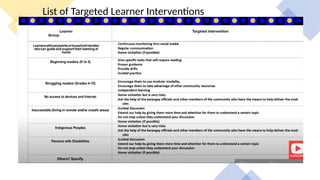
MODULE 3A LIST OF TARGETED LEARNER INTERVENTIONS
LEARNER GROUP TARGETED INTERVENTION
2
List of Targeted Learner Interventions
3
MODULE 3A LEARNING TASKS FOR DL
BEFORE THE LESSON LESSON PROPER AFTER THE LESSON
4
MODULE 3A ASSESSMENT METHODS IN DL
ASSESSMENT METHOD HOW TO ADAPT THE ASSESSMENT METHOD IN DL
1
2
3
4
5
Assessment Methods in DL
MODULE 3A WEEKLY HOME LEARNING PLAN
FOR ONE (1) SUBJECT
Weekly Home Learning Plan for Grade ___ for _________Learning
Week ___, Quarter ____, Date: ____________________
5
DAY & TIME LEARNING AREA LEARNING
COMPETENCY
LEARNING TASKS MODE OF
DELIVERY
Weekly Home Learning Plan
MODULE 3A INDIVIDUAL
MONITORING PLAN TEMPLATE
LEARNER’S NAME:
GRADE LEVEL:
LEARNING
AREA
LEARNER’S
NEEDS
INTERVENTION
STRATEGIES
PROVIDED
MONITORIN
G DATE
LEARNER’S STATUS
INSIGNIFICANT
PROGRESS
SIGNIFICANT
PROGRESS
MASTERY
6
INTERVENTION
STATUS
LEARNER IS NOT MAKING SIGNIFICANT PROGRESS IN A TIMELY MANNER. INTERVENTION STRATEGIES NEED TO BE
REVISED.
LEARNER IS MAKING SIGNIFICANT PROGRESS. CONTINUE WITH THE LEARNING PLAN.
LEARNER HAS REACHED MASTERY OF THE COMPETENCIES IN LEARNING PLAN.
MODULE 3A FORM 3: LAC SESSION REPORT
7 LAC ID: REGION: IV-A CALABARZON
LAC FACILITATOR: LAC SESSION NO.:
DATE AND TIME OF SESSION: VENUE/PLATFORM OF SESSION:
Number of members present (attach attendance document):
Materials and resources:
___ Self-Learning Module
___ Activity sheets
___ Digital resources
___ Online resources
___ Smartphone
___ PC
___ LAC session guide
___ Others. Please specify:
_______________________________________
This form should be accomplished by the LAC Facilitator at the end of every LAC session.
SD D N A SA
Comments / Remarks
(For example, if you
disagree or strongly
disagree, please indicate
why.)
MEMBER PARTICIPATION
1. All of the members came prepared for the LAC session
2. All of the members had an opportunity to share and discuss their
assignment, insights, and ideas
3. Members listened to each other’s insights and ideas.
4. The members’ assignments showed an understanding of the
lessons in the SLM.
5. The members demonstrated
engagement in and/or
enthusiasm for the learning tasks during the session (including
providing feedback
on each other’s assignment).
Part A
Please indicate the extent to which you agree with each of the following statements by
ticking the appropriate box.
(SD = Strongly Disagree; D = Disagree; N = Neutral; A = Agree; SA = Strongly agree)
MODULE 3A FORM 3: LAC SESSION REPORT
7
FACILITATION
1. I managed the sharing and
discussion during the LAC session
by keeping the discussion focused
on the lesson or topic.
1. I encouraged all the members to
actively participate in the LAC
session (i.e., for the teachers to
share their work and ideas/
insights).
1. I provided useful feedback on the
teachers’ assignments.
MODULE 3A FORM 3: LAC SESSION REPORT
7
Part B
Please provide the information requested.
1. The best part of the session (i.e. what went well):
2. Problems or challenges encountered and how they were resolved:
3. Other topics discussed apart from the recommended topics, if any:
4. Recommendations/Plans for next LAC session:
MODULE 3A FORM 3: LAC SESSION REPORT
7
MODULE 3A FORM 4: LAC ENGAGEMENT REPORT
This form should be accomplished by each LAC Member at the end of every LAC session.
NAME OF MEMBER: LAC SESSION ID.:
REGION: IV- A CALABARZON DATE OF LAC SESSION:
DIVISION: BINAN CITY NUMBER OF LAC SESSION:
Part A
Please indicate the extent to which you agree with each of the following
statements by ticking
the appropriate box. (SD = Strongly Disagree; D = Disagree; N = Neutral; A =
Agree; SA =
Strongly agree)
8
SD D N A SA
Comments / Remarks (For
example, if you disagree or
strongly disagree, please
indicate why.)
THE LAC SESSION
1. I learned a lot from my colleagues in this
LAC session.
1. The LAC session deepened my
understanding of the SLM content.
1. My perspective on the topic/s covered has
changed as a result of the LAC session.
1. I participated actively in the LAC session by
sharing my assignment and insights, asking
questions, and giving
feedback on what colleagues shared.
1. I interacted with different
people during the LAC
session.
MODULE 3A FORM 4: LAC ENGAGEMENT REPORT
8
SD D N A SA
Comments / Remarks (For
example, if you disagree or
strongly disagree, please
indicate why.)
ACTION PLAN
1. I feel motivated to apply in my
region/division/district what I have learned
in this lesson.
1. I intend to apply what I have learned from
the lesson in my region/division/district
Part B
Please provide the information requested.
1. I need further clarification and/or resources on the following topics:
2. I encountered the following problems or challenges:
3. Other comments/suggestions:
MODULE 3A FORM 4: LAC ENGAGEMENT REPORT
8
LR Rapid
Assessment
Tools with
Reflections
MODULE 4 FINALIZED LDM
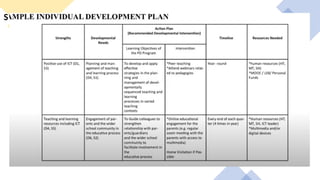
INDIVIDUAL DEVELOPMENT PLAN
Strengths Developmental
Needs
Action Plan
(Recommended Developmental
Intervention)
Timeline Resources
Needed
Learning
Objectives of
the PD Program
Intervention
10
S
WHAT IS A
PORTFOLIO?
SOURCE: The Glossary of Education Reform
https://www.edglossary.org/portfolio/
A student portfolio is a compilation of academic work
and other forms of educational evidence assembled for
the purpose of (1) evaluating coursework quality,
learning progress, and academic achievement; (2)
determining whether students have met
learning standards or other academic requirements for
courses, grade-level promotion, and graduation; (3)
helping students reflect on their academic goals and
progress as learners; and (4) creating a lasting archive
of academic work products, accomplishments, and
other documentation. Advocates of student portfolios
argue that compiling, reviewing, and evaluating student
work over time can provide a richer, deeper, and more
accurate picture of what students have learned and are
able to do than more traditional measures—such as
standardized tests, quizzes, or final exams—that only
measure what students know at a specific point in time.
• Portfolios come in many forms, from notebooks filled with documents,
notes, and graphics to online digital archives and student-created
websites, and they may be used at the elementary, middle, and high
school levels. Portfolios can be a physical collection of student work
that includes materials such as written assignments, journal entries,
completed tests, artwork, lab reports, physical projects (such as
dioramas or models), and other material evidence of learning progress
and academic accomplishment, including awards, honors,
certifications, recommendations, written evaluations by teachers or
peers, and self-reflections written by students. Portfolios may also be
digital archives, presentations, blogs, or websites that feature the
same materials as physical portfolios, but that may also include
content such as student-created videos, multimedia presentations,
spreadsheets, websites, photographs, or other digital artifacts of
learning.
• Online portfolios are often called digital portfolios or e-portfolios, among
other terms. In some cases, blogs or online journals may be maintained
by students and include ongoing reflections about learning activities,
progress, and accomplishments. Portfolios may also be presented—
publicly or privately—to parents, teachers, and community members as
part of a demonstration of learning, exhibition, or capstone project.
• It’s important to note that there are many different types of portfolios in
education, and each form has its own purpose. For example, “capstone”
portfolios would feature student work completed as part of long-term
projects or final assessments typically undertaken at the culmination of a
middle school or high school, or at the end of a long-term, possibly
multiyear project. Some portfolios are only intended to evaluate learning
progress and achievement in a specific course, while others are
maintained for the entire time a student is enrolled in a school. And some
portfolios are used to assess learning in a specific subject area, while
others evaluate the acquisition of skills that students can apply in all
subject areas.
List of Suggested Evidence Form
PADIDA_Module-5- learning modalities ppt

PADIDA_Module-5- learning modalities ppt

  • 2.
    LDM2 for Teachers MODULE 5 BUILDINGTHE TEACHING PORTFOLIO RELATED TO THE IMPLEMENTATION OF THE MODALITIES
  • 8.
    Module 5 BUILDING THE TEACHING PORTFOLIO RELATEDTO THE IMPLEMENTATION OF THE MODALITIES
  • 9.
    Module 5BUILDING THE TEACHING PORTFOLIO RELATED TOTHE IMPLEMENTATION OF THE MODALITIES
  • 11.
  • 14.
    MODULE 2: UNPACKINGOF MELCS MEMBERS (GROUP OF 4) SUBJECT MELC (1ST QUARTER) UNPACKED LEARNING COMPETENCY 1
  • 15.
  • 16.
    MODULE 3A LISTOF TARGETED LEARNER INTERVENTIONS LEARNER GROUP TARGETED INTERVENTION 2
  • 17.
    List of TargetedLearner Interventions
  • 18.
    3 MODULE 3A LEARNINGTASKS FOR DL BEFORE THE LESSON LESSON PROPER AFTER THE LESSON
  • 19.
    4 MODULE 3A ASSESSMENTMETHODS IN DL ASSESSMENT METHOD HOW TO ADAPT THE ASSESSMENT METHOD IN DL 1 2 3 4 5
  • 20.
  • 21.
    MODULE 3A WEEKLYHOME LEARNING PLAN FOR ONE (1) SUBJECT Weekly Home Learning Plan for Grade ___ for _________Learning Week ___, Quarter ____, Date: ____________________ 5 DAY & TIME LEARNING AREA LEARNING COMPETENCY LEARNING TASKS MODE OF DELIVERY
  • 22.
  • 23.
    MODULE 3A INDIVIDUAL MONITORINGPLAN TEMPLATE LEARNER’S NAME: GRADE LEVEL: LEARNING AREA LEARNER’S NEEDS INTERVENTION STRATEGIES PROVIDED MONITORIN G DATE LEARNER’S STATUS INSIGNIFICANT PROGRESS SIGNIFICANT PROGRESS MASTERY 6 INTERVENTION STATUS LEARNER IS NOT MAKING SIGNIFICANT PROGRESS IN A TIMELY MANNER. INTERVENTION STRATEGIES NEED TO BE REVISED. LEARNER IS MAKING SIGNIFICANT PROGRESS. CONTINUE WITH THE LEARNING PLAN. LEARNER HAS REACHED MASTERY OF THE COMPETENCIES IN LEARNING PLAN.
  • 25.
    MODULE 3A FORM3: LAC SESSION REPORT 7 LAC ID: REGION: IV-A CALABARZON LAC FACILITATOR: LAC SESSION NO.: DATE AND TIME OF SESSION: VENUE/PLATFORM OF SESSION: Number of members present (attach attendance document): Materials and resources: ___ Self-Learning Module ___ Activity sheets ___ Digital resources ___ Online resources ___ Smartphone ___ PC ___ LAC session guide ___ Others. Please specify: _______________________________________ This form should be accomplished by the LAC Facilitator at the end of every LAC session.
  • 26.
    SD D NA SA Comments / Remarks (For example, if you disagree or strongly disagree, please indicate why.) MEMBER PARTICIPATION 1. All of the members came prepared for the LAC session 2. All of the members had an opportunity to share and discuss their assignment, insights, and ideas 3. Members listened to each other’s insights and ideas. 4. The members’ assignments showed an understanding of the lessons in the SLM. 5. The members demonstrated engagement in and/or enthusiasm for the learning tasks during the session (including providing feedback on each other’s assignment). Part A Please indicate the extent to which you agree with each of the following statements by ticking the appropriate box. (SD = Strongly Disagree; D = Disagree; N = Neutral; A = Agree; SA = Strongly agree) MODULE 3A FORM 3: LAC SESSION REPORT 7
  • 27.
    FACILITATION 1. I managedthe sharing and discussion during the LAC session by keeping the discussion focused on the lesson or topic. 1. I encouraged all the members to actively participate in the LAC session (i.e., for the teachers to share their work and ideas/ insights). 1. I provided useful feedback on the teachers’ assignments. MODULE 3A FORM 3: LAC SESSION REPORT 7
  • 28.
    Part B Please providethe information requested. 1. The best part of the session (i.e. what went well): 2. Problems or challenges encountered and how they were resolved: 3. Other topics discussed apart from the recommended topics, if any: 4. Recommendations/Plans for next LAC session: MODULE 3A FORM 3: LAC SESSION REPORT 7
  • 29.
    MODULE 3A FORM4: LAC ENGAGEMENT REPORT This form should be accomplished by each LAC Member at the end of every LAC session. NAME OF MEMBER: LAC SESSION ID.: REGION: IV- A CALABARZON DATE OF LAC SESSION: DIVISION: BINAN CITY NUMBER OF LAC SESSION: Part A Please indicate the extent to which you agree with each of the following statements by ticking the appropriate box. (SD = Strongly Disagree; D = Disagree; N = Neutral; A = Agree; SA = Strongly agree) 8
  • 30.
    SD D NA SA Comments / Remarks (For example, if you disagree or strongly disagree, please indicate why.) THE LAC SESSION 1. I learned a lot from my colleagues in this LAC session. 1. The LAC session deepened my understanding of the SLM content. 1. My perspective on the topic/s covered has changed as a result of the LAC session. 1. I participated actively in the LAC session by sharing my assignment and insights, asking questions, and giving feedback on what colleagues shared. 1. I interacted with different people during the LAC session. MODULE 3A FORM 4: LAC ENGAGEMENT REPORT 8
  • 31.
    SD D NA SA Comments / Remarks (For example, if you disagree or strongly disagree, please indicate why.) ACTION PLAN 1. I feel motivated to apply in my region/division/district what I have learned in this lesson. 1. I intend to apply what I have learned from the lesson in my region/division/district Part B Please provide the information requested. 1. I need further clarification and/or resources on the following topics: 2. I encountered the following problems or challenges: 3. Other comments/suggestions: MODULE 3A FORM 4: LAC ENGAGEMENT REPORT 8
  • 32.
  • 33.
    MODULE 4 FINALIZEDLDM INDIVIDUAL DEVELOPMENT PLAN Strengths Developmental Needs Action Plan (Recommended Developmental Intervention) Timeline Resources Needed Learning Objectives of the PD Program Intervention 10
  • 34.
  • 37.
    WHAT IS A PORTFOLIO? SOURCE:The Glossary of Education Reform https://www.edglossary.org/portfolio/ A student portfolio is a compilation of academic work and other forms of educational evidence assembled for the purpose of (1) evaluating coursework quality, learning progress, and academic achievement; (2) determining whether students have met learning standards or other academic requirements for courses, grade-level promotion, and graduation; (3) helping students reflect on their academic goals and progress as learners; and (4) creating a lasting archive of academic work products, accomplishments, and other documentation. Advocates of student portfolios argue that compiling, reviewing, and evaluating student work over time can provide a richer, deeper, and more accurate picture of what students have learned and are able to do than more traditional measures—such as standardized tests, quizzes, or final exams—that only measure what students know at a specific point in time.
  • 38.
    • Portfolios comein many forms, from notebooks filled with documents, notes, and graphics to online digital archives and student-created websites, and they may be used at the elementary, middle, and high school levels. Portfolios can be a physical collection of student work that includes materials such as written assignments, journal entries, completed tests, artwork, lab reports, physical projects (such as dioramas or models), and other material evidence of learning progress and academic accomplishment, including awards, honors, certifications, recommendations, written evaluations by teachers or peers, and self-reflections written by students. Portfolios may also be digital archives, presentations, blogs, or websites that feature the same materials as physical portfolios, but that may also include content such as student-created videos, multimedia presentations, spreadsheets, websites, photographs, or other digital artifacts of learning.
  • 39.
    • Online portfoliosare often called digital portfolios or e-portfolios, among other terms. In some cases, blogs or online journals may be maintained by students and include ongoing reflections about learning activities, progress, and accomplishments. Portfolios may also be presented— publicly or privately—to parents, teachers, and community members as part of a demonstration of learning, exhibition, or capstone project. • It’s important to note that there are many different types of portfolios in education, and each form has its own purpose. For example, “capstone” portfolios would feature student work completed as part of long-term projects or final assessments typically undertaken at the culmination of a middle school or high school, or at the end of a long-term, possibly multiyear project. Some portfolios are only intended to evaluate learning progress and achievement in a specific course, while others are maintained for the entire time a student is enrolled in a school. And some portfolios are used to assess learning in a specific subject area, while others evaluate the acquisition of skills that students can apply in all subject areas.
  • 43.
    List of SuggestedEvidence Form