PACOM ISSUES AND
CHALLENGES
Introduction
 “In accordance with national guidance, our desired end
state is that the Asia-Pacific is secure and prosperous,
underpinned by U.S. leadership and a rules-based
international order. To this end, we will strengthen
alliances and partnerships, maintain an assured
presence in the region, and effectively communicate our
intent and resolve to safeguard U.S. national interests.”
 – Commander, U.S. Pacific Command, Admiral Samuel
J. Locklear III
Area of Responsibility
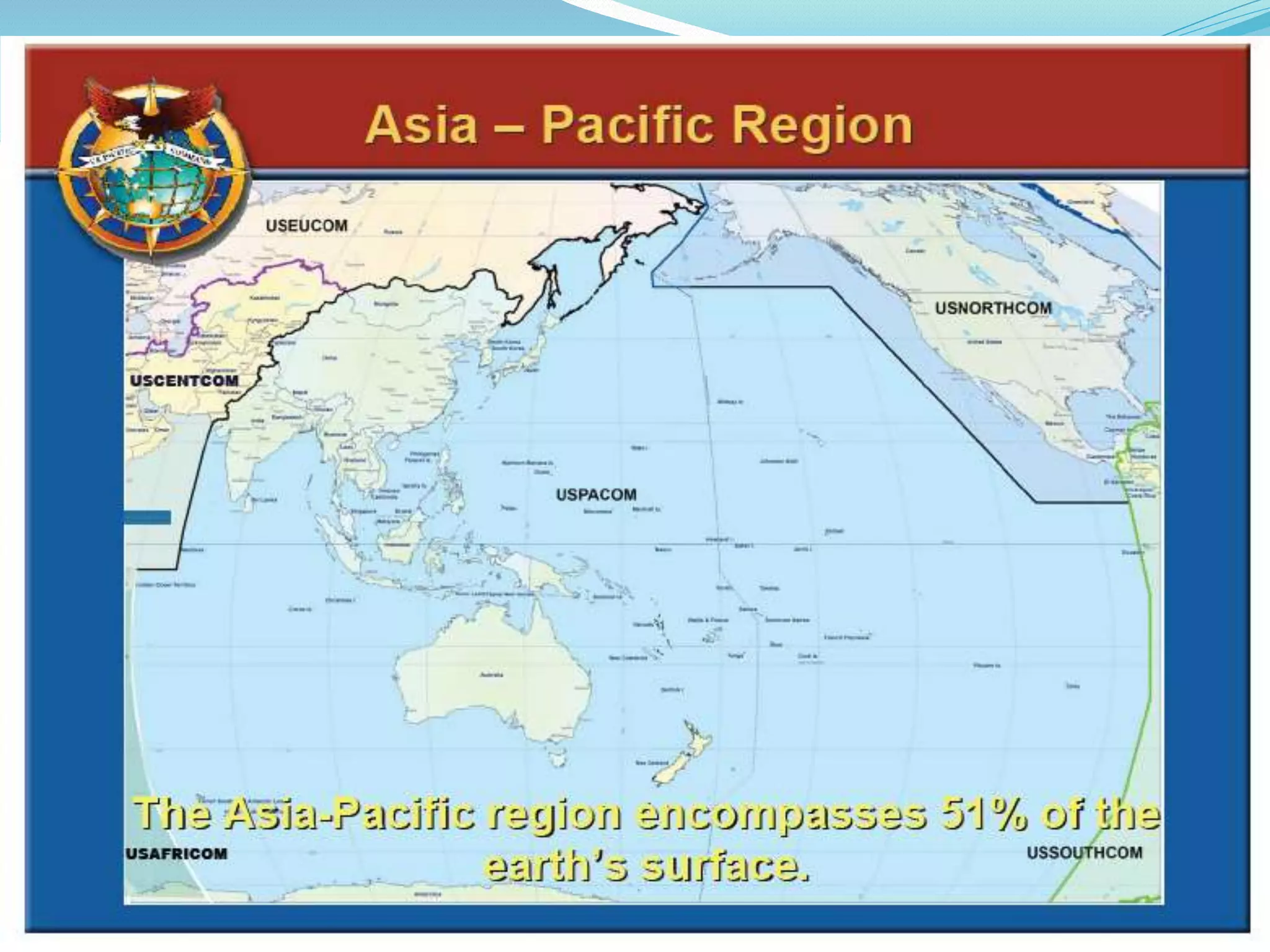
 Covers half Earth’s surface and more than half its
population – 36 nations total
 Includes the world’s busiest international sea lanes
and 9 of the 10 largest ports
 Most militarized region in the world: 7 of the 10 largest
standing militaries and 5 of the world’s declared
nuclear nations
PACOM as a Combatant Command
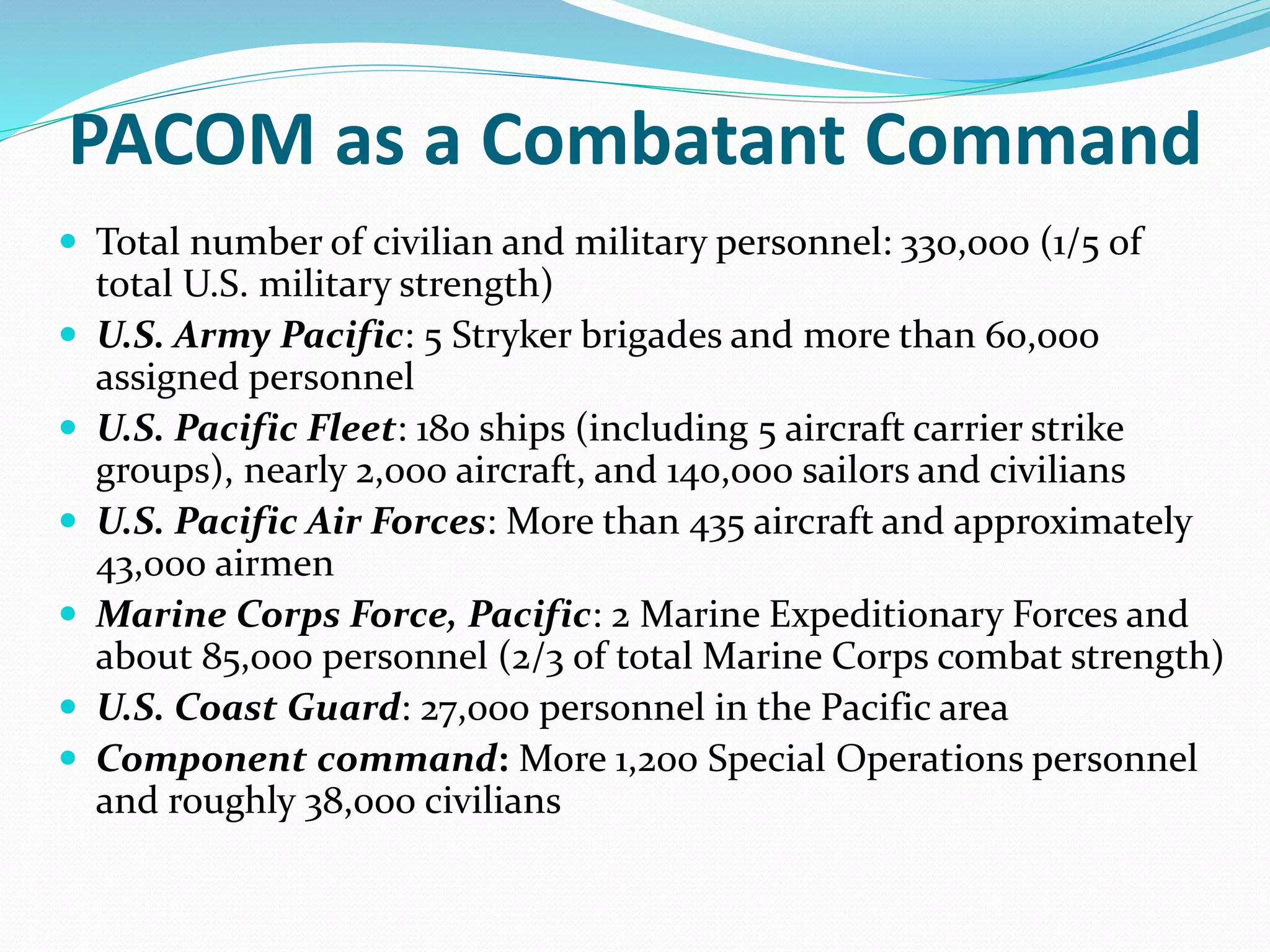
 Total number of civilian and military personnel: 330,000 (1/5 of
total U.S. military strength)
 U.S. Army Pacific: 5 Stryker brigades and more than 60,000
assigned personnel
 U.S. Pacific Fleet: 180 ships (including 5 aircraft carrier strike
groups), nearly 2,000 aircraft, and 140,000 sailors and civilians
 U.S. Pacific Air Forces: More than 435 aircraft and approximately
43,000 airmen
 Marine Corps Force, Pacific: 2 Marine Expeditionary Forces and
about 85,000 personnel (2/3 of total Marine Corps combat strength)
 U.S. Coast Guard: 27,000 personnel in the Pacific area
 Component command: More 1,200 Special Operations personnel
and roughly 38,000 civilians
Guiding Principles
 1) International Rules
 2) Partnerships
 3) Presence
 4) Force Projection
 5) Unity of Effort
 6) Strategic Communication
 7) Readiness to Fight and Win
Security Environment
Areas of Focus/Threats:
 1) Sea/Air
 2) WMD/Terrorism/ungoverned spaces
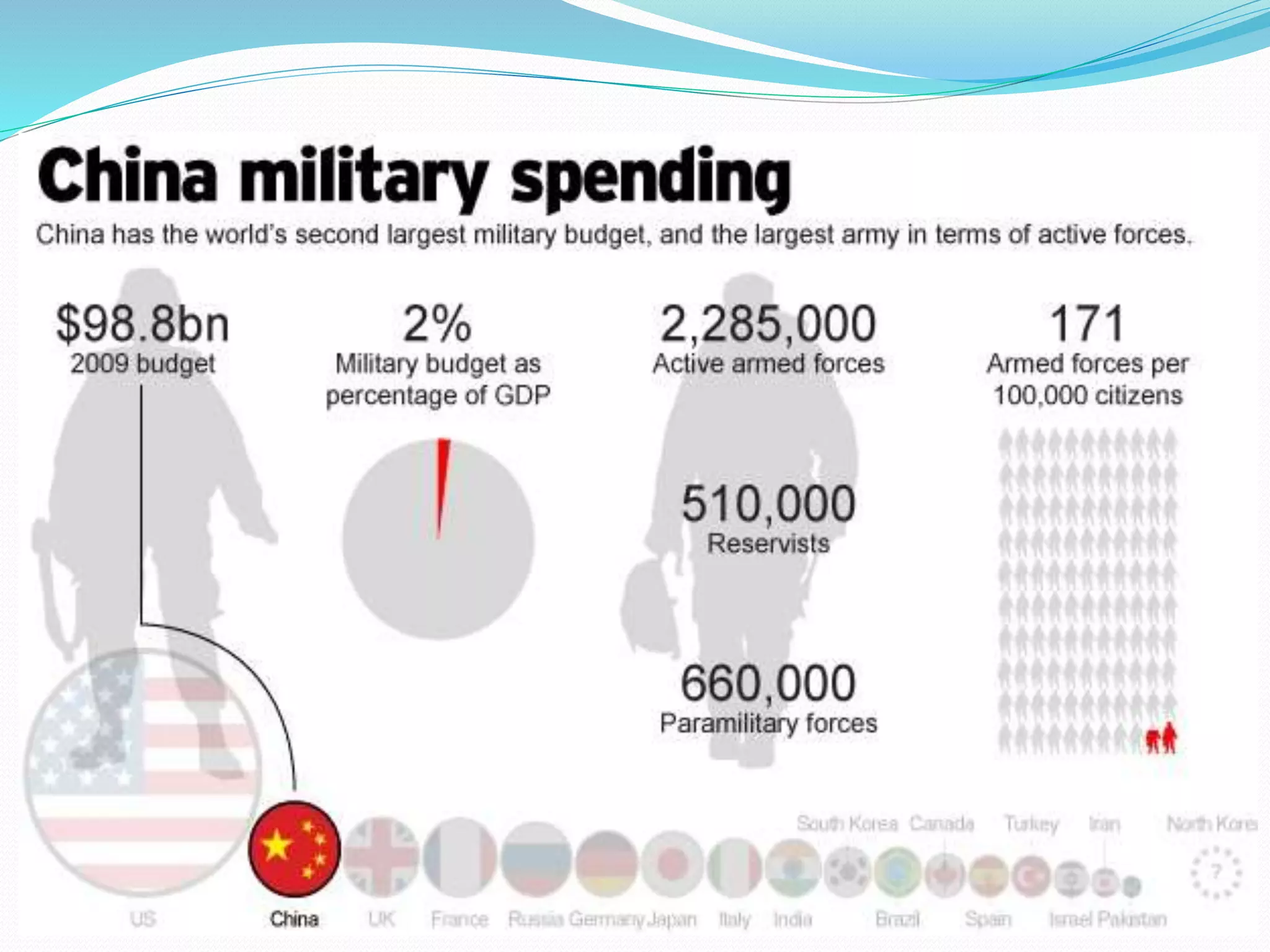
 3) China/N. Korea
Security Environment
Sea/Air
 I) Access
 II) Energy
 III) Transportation/Commerce
Security Environment - Sea/Air
 Access
 Northeast Asia (NEA)
 Southeast Asia (SEA)
 South Asia
 Oceania
Security Environment - Sea/Air
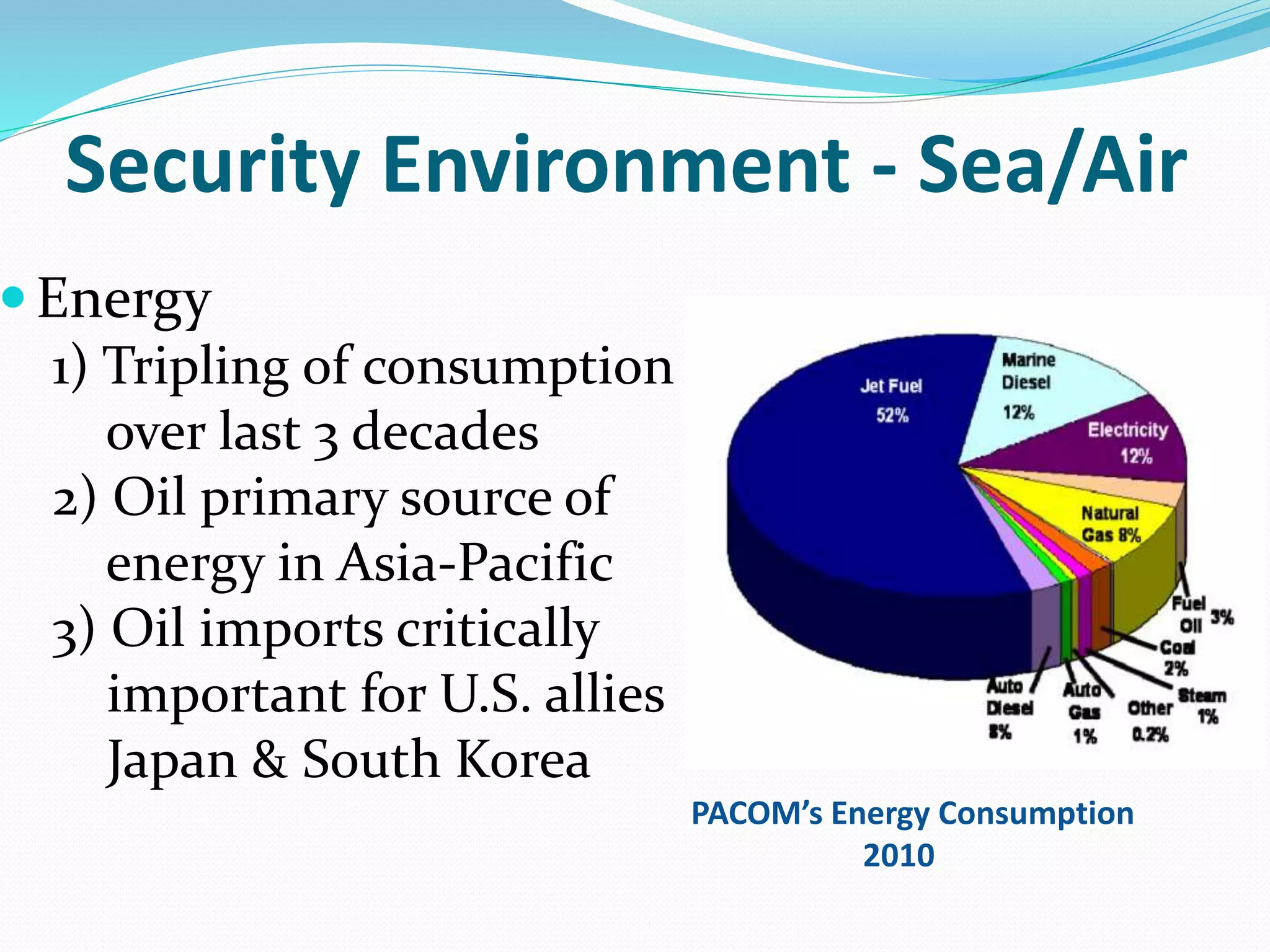
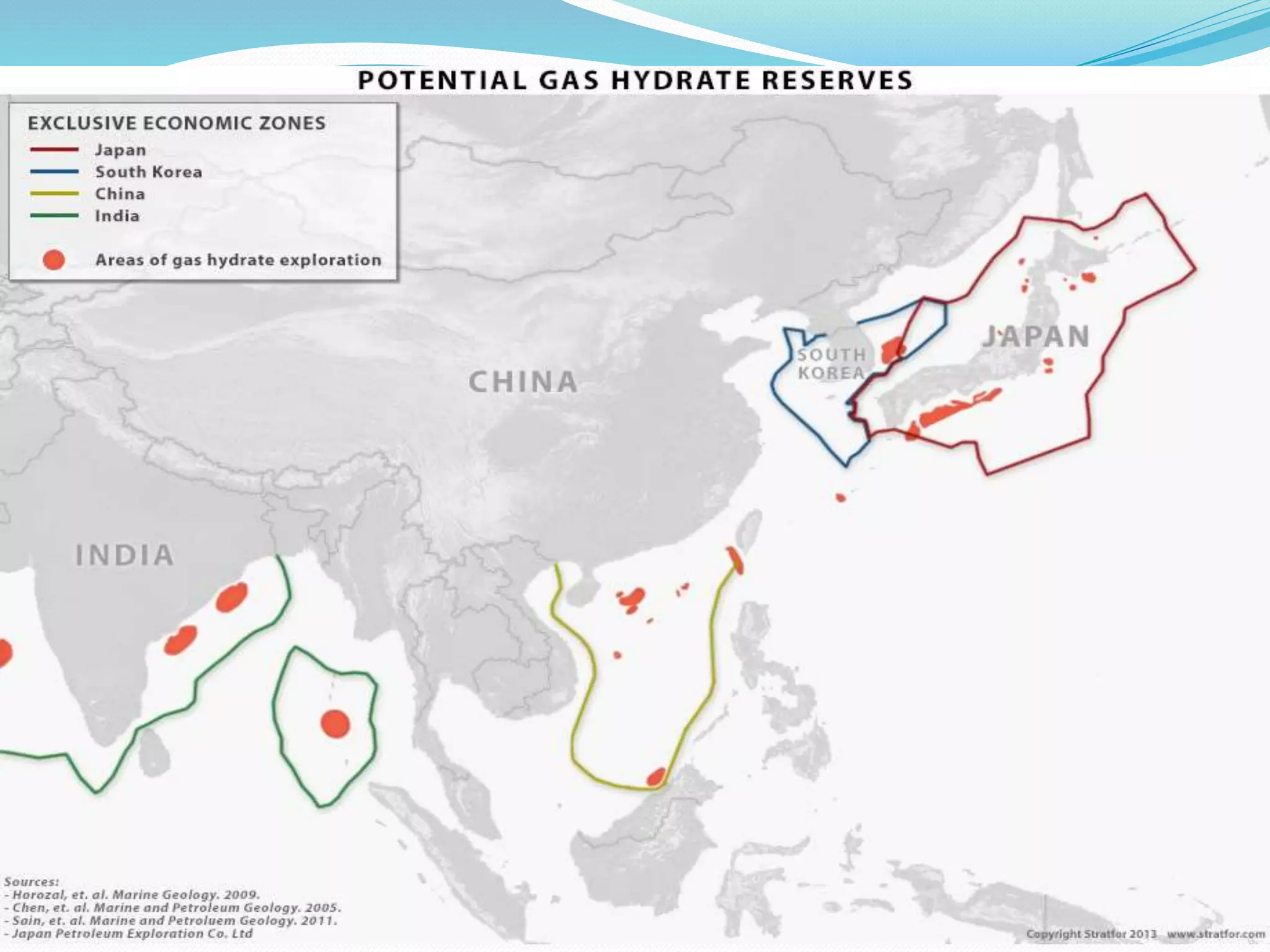
Energy
1) Tripling of consumption
over last 3 decades
2) Oil primary source of
energy in Asia-Pacific
3) Oil imports critically
important for U.S. allies
Japan & South Korea
PACOM’s Energy Consumption
2010
Security Environment - Sea/Air
 Transportation/ Commerce
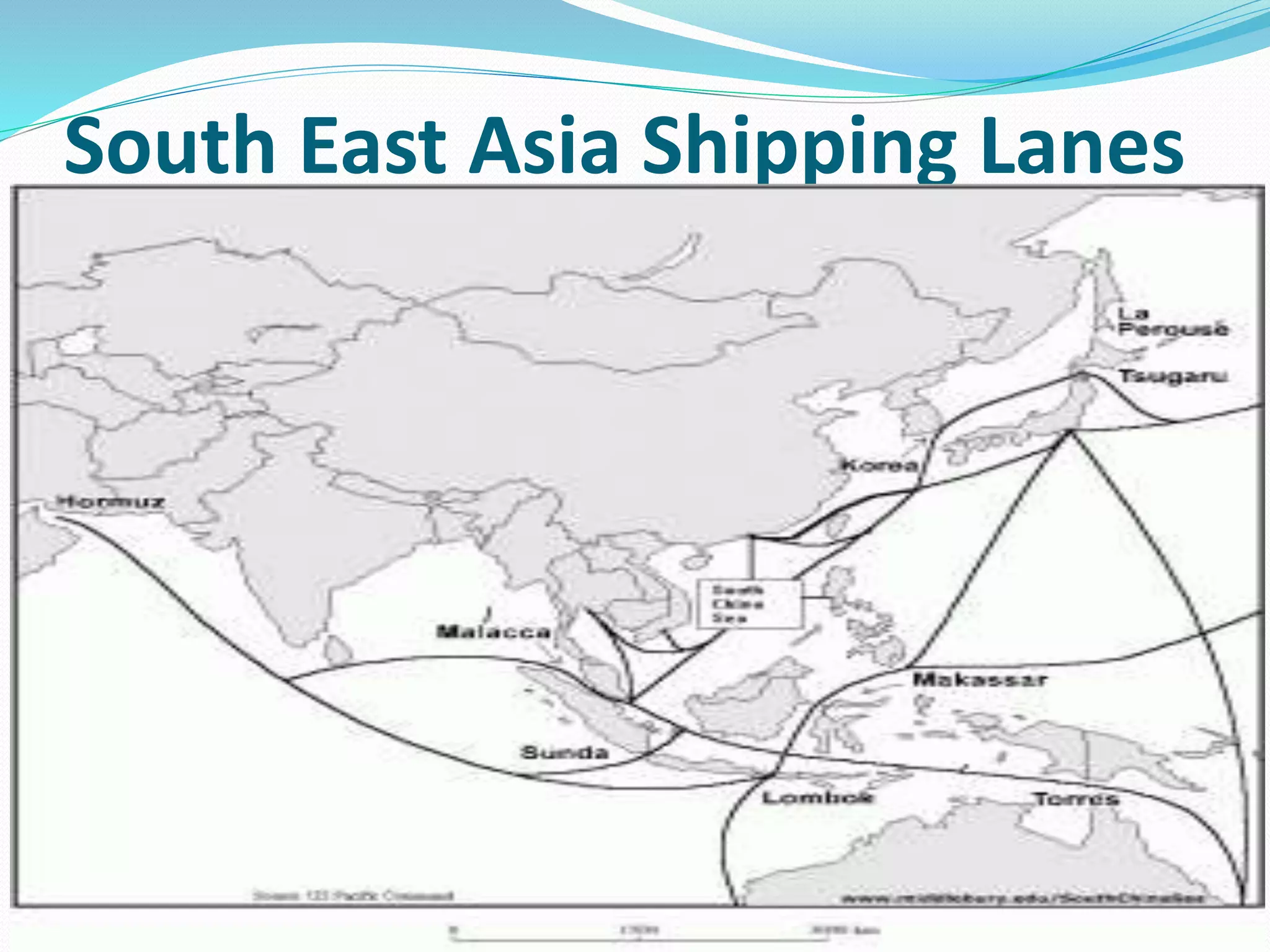
 Freedom of navigation and SLOCs
 Maritime shipping lanes
 Critical “Chokepoints”
 Malacca, Suda & Lombok Straits
 Disruption
 Accidents, terrorism & piracy
 East China Sea
Security Environment
WMD/Terrorism/ungoverned spaces
I) Terrorist Organizations in the AOR, threats and
opportunities
II) North Korea/pursuit of a nuclear deterrent other
chemical threats. Other CBRN possible threats in
the region.
III) Piracy
 Terrorism in the Asia Pacific Region originates mostly from
South East Asia.
 The Main terrorist groups are
1) Jemaah Islamiya-Indonesia
2) Abu Sayyaf/Moro Islamic Liberation Front (MILF)/New
Peoples Army-Philippines
3) Southern Insurgency groups (Runda Kumpulan Kecil )-
Thailand
4) Jemaah Ilamiya/Kampulan Mujheddin Malaysia
(KMM)-Malaysia
Security Environment– Terrorism
Security Environment – Terrorism
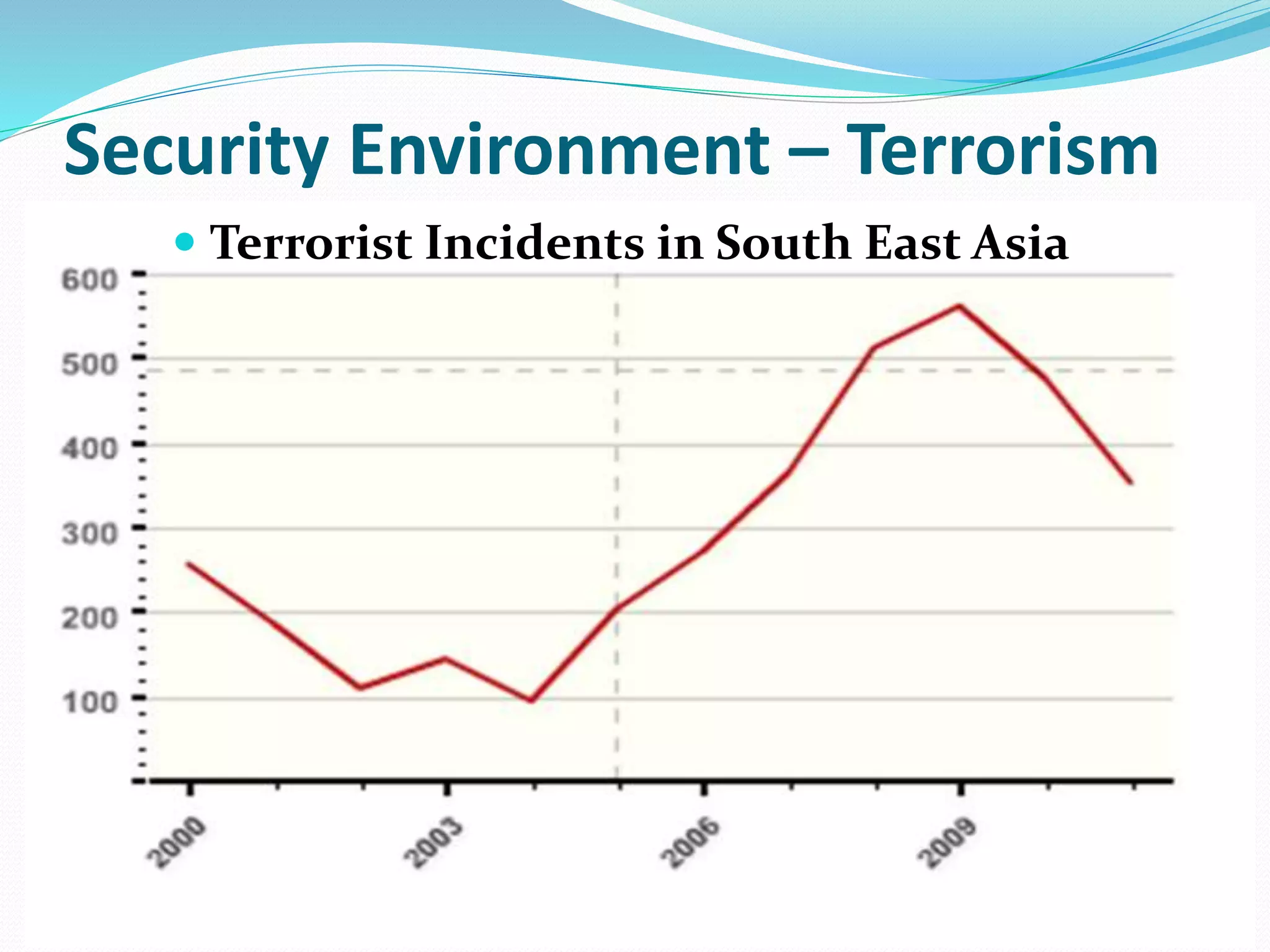
 Terrorist Incidents in South East Asia
Security Environment – WMD
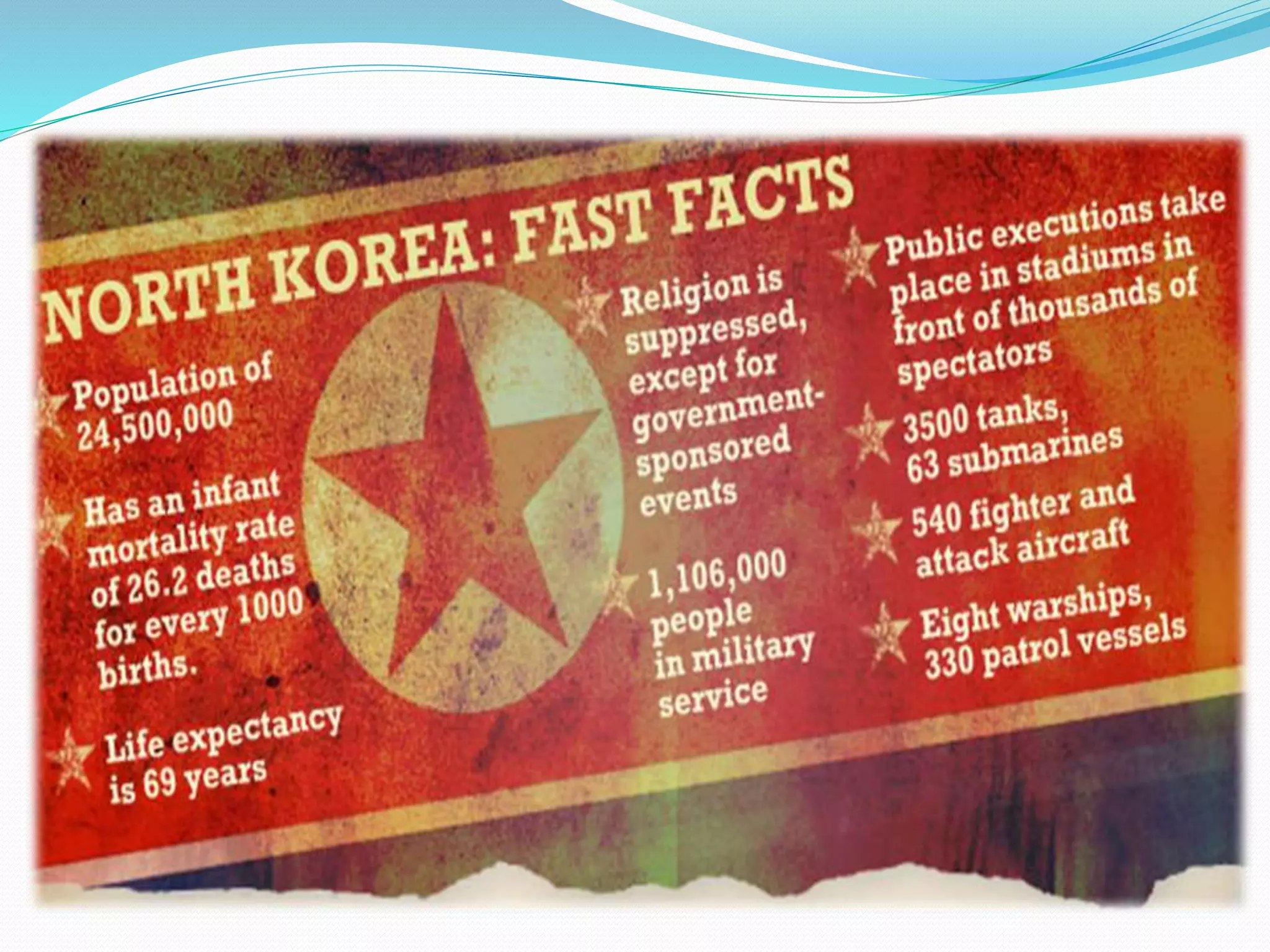
1) The Democratic People's Republic of Korea (DPRK)
has an active nuclear weapons program and tested
nuclear explosive devices in 2006, 2009, and 2013
2) Canceled the Armistice with South Korea
3) Most of North Korea’s nuclear complex lies
underground making it difficult to determine its
full capabilities
Security Environment – Piracy
 Piracy prone region due to the vast amount of trade
(energy) that passes daily ($1.2 trillion in U.S. trade pass
through the South China Sea)
 Best interest of USPACOM that countries are engaged
regarding piracy and energy
 Prone Areas:
 Bangladesh
 Indonesia
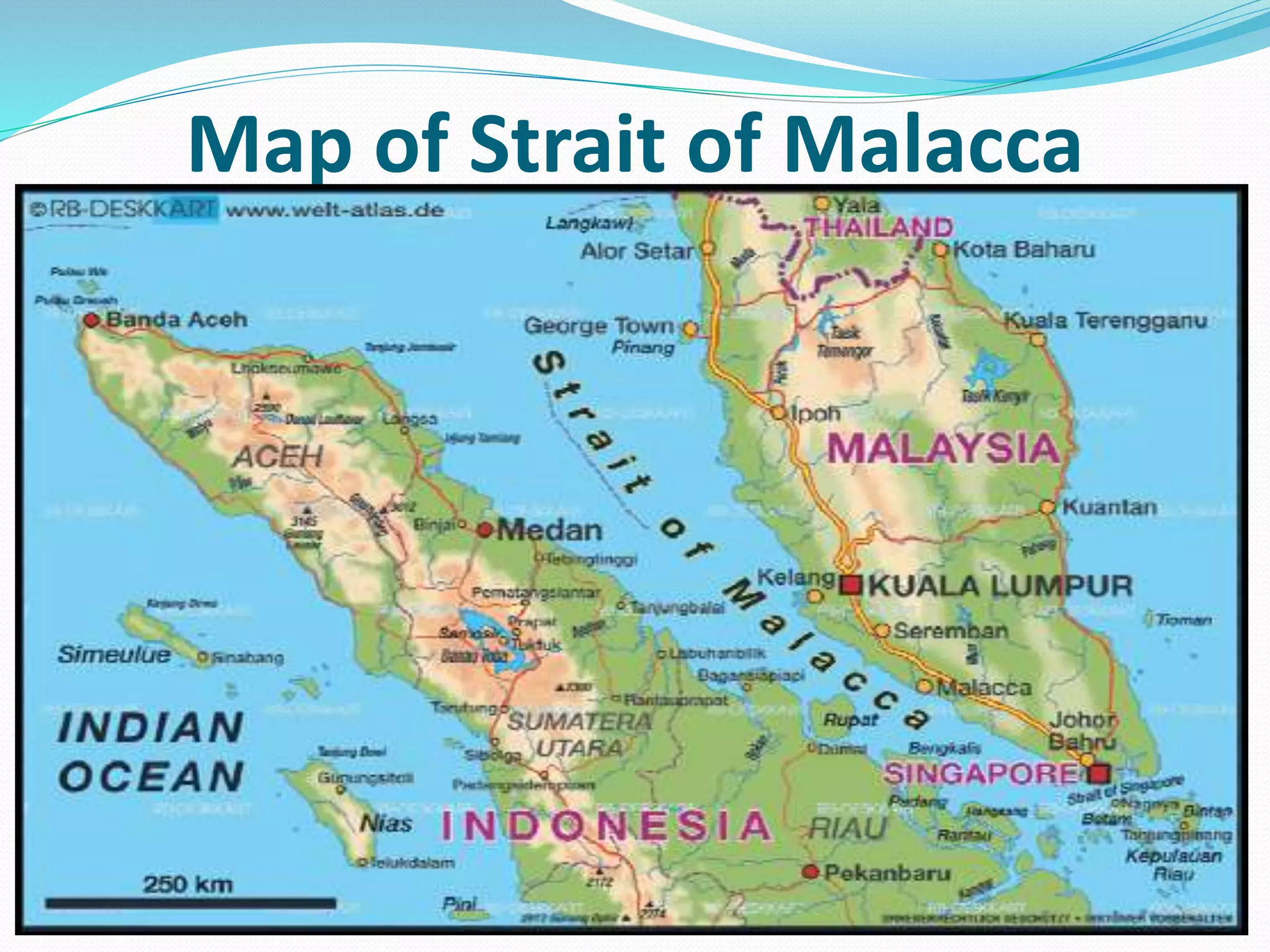
 Malacca Straits
 Singapore Straits
 South China Sea
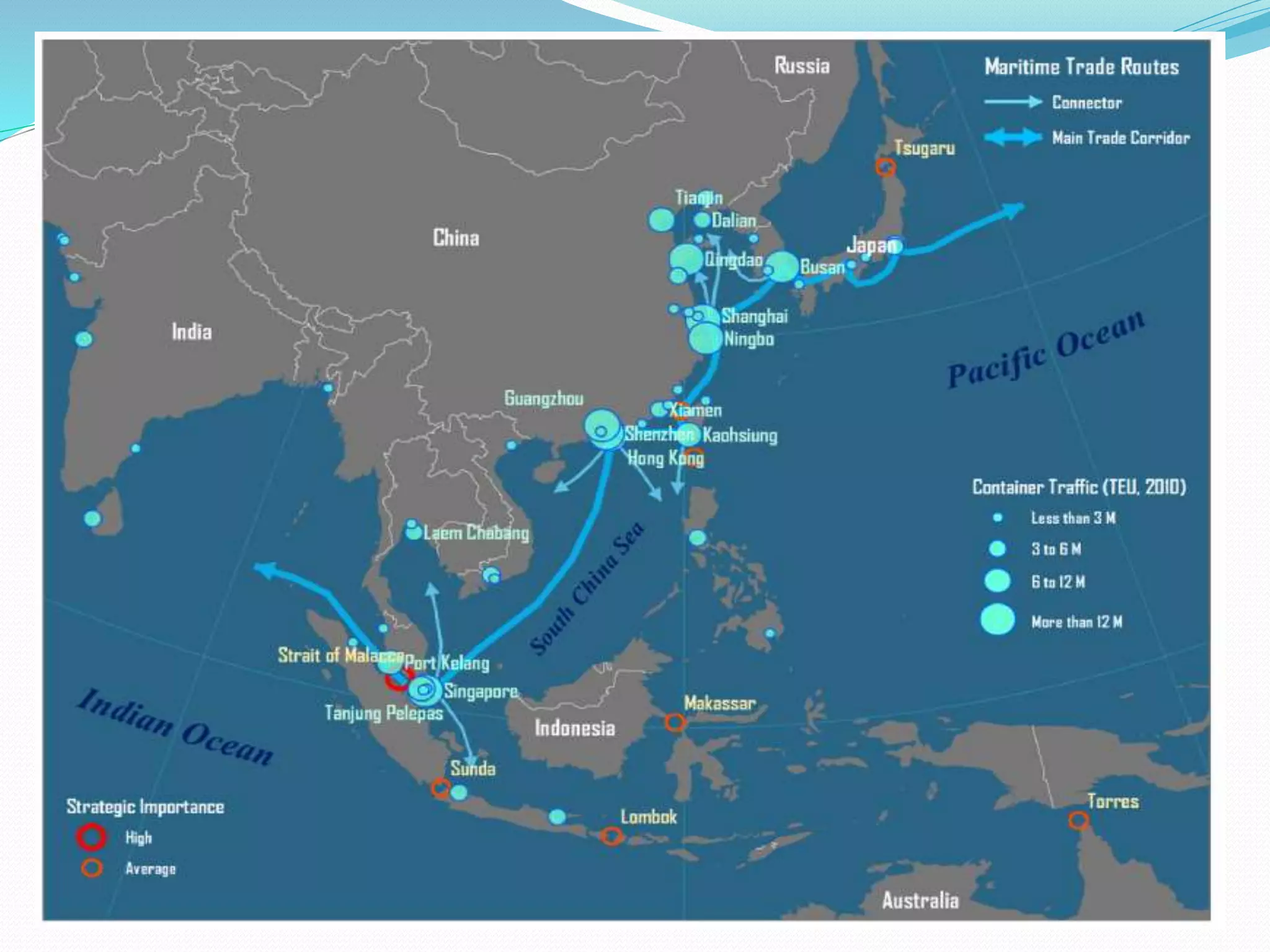
South East Asia Shipping Lanes
Map of Strait of Malacca
Security Environment
 China/N. Korea
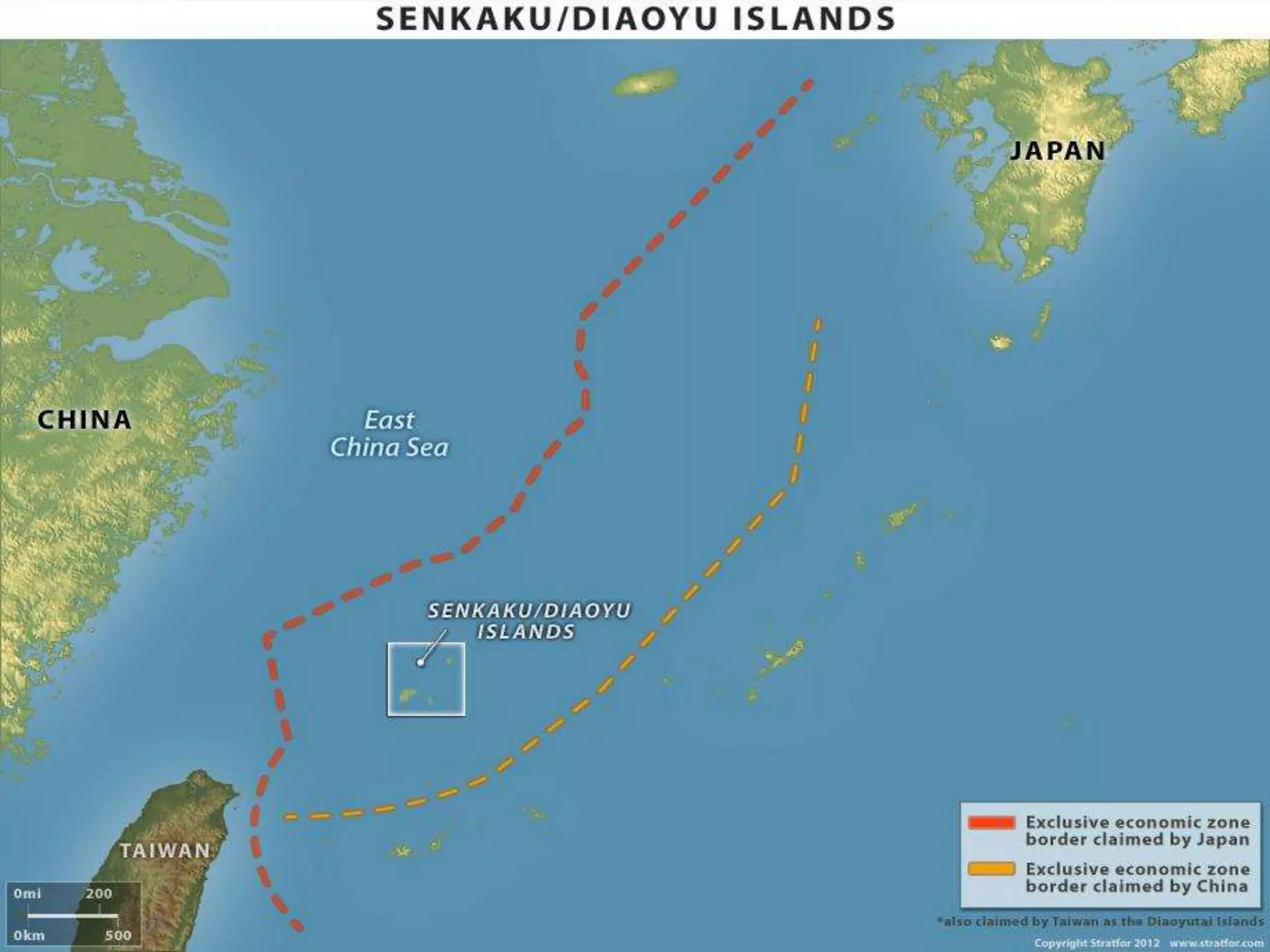
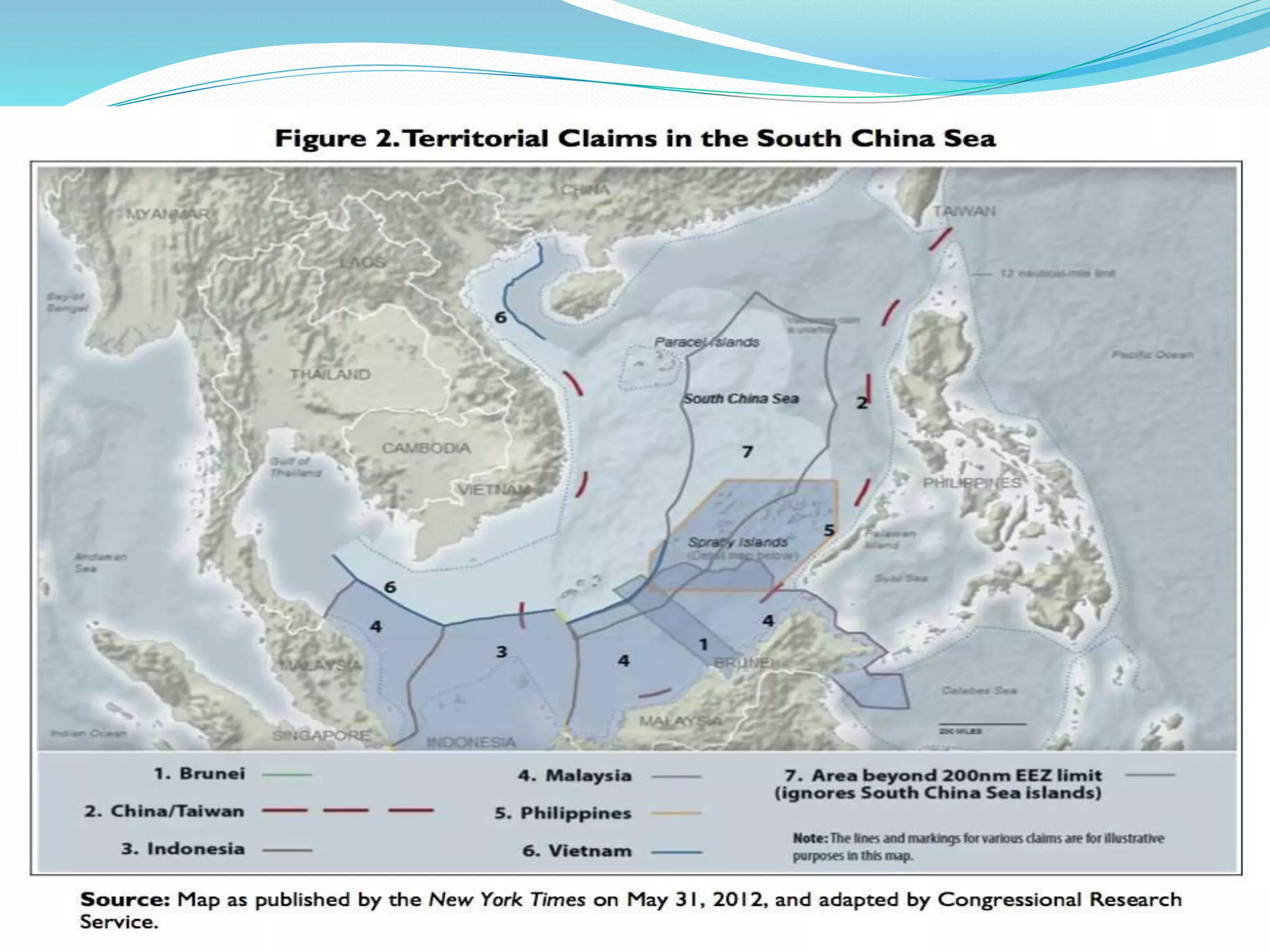
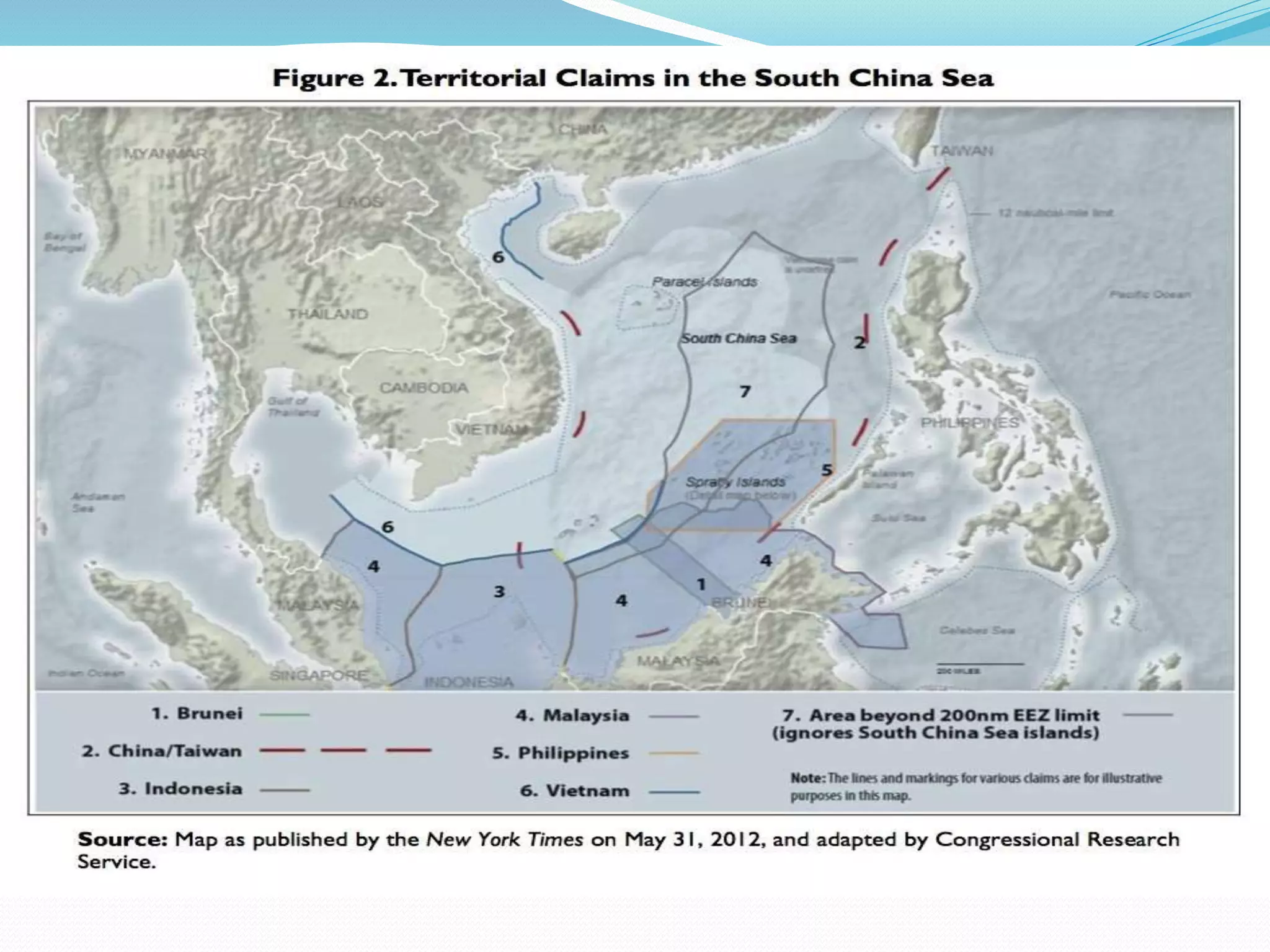
I) Territorial Claims and Disputes
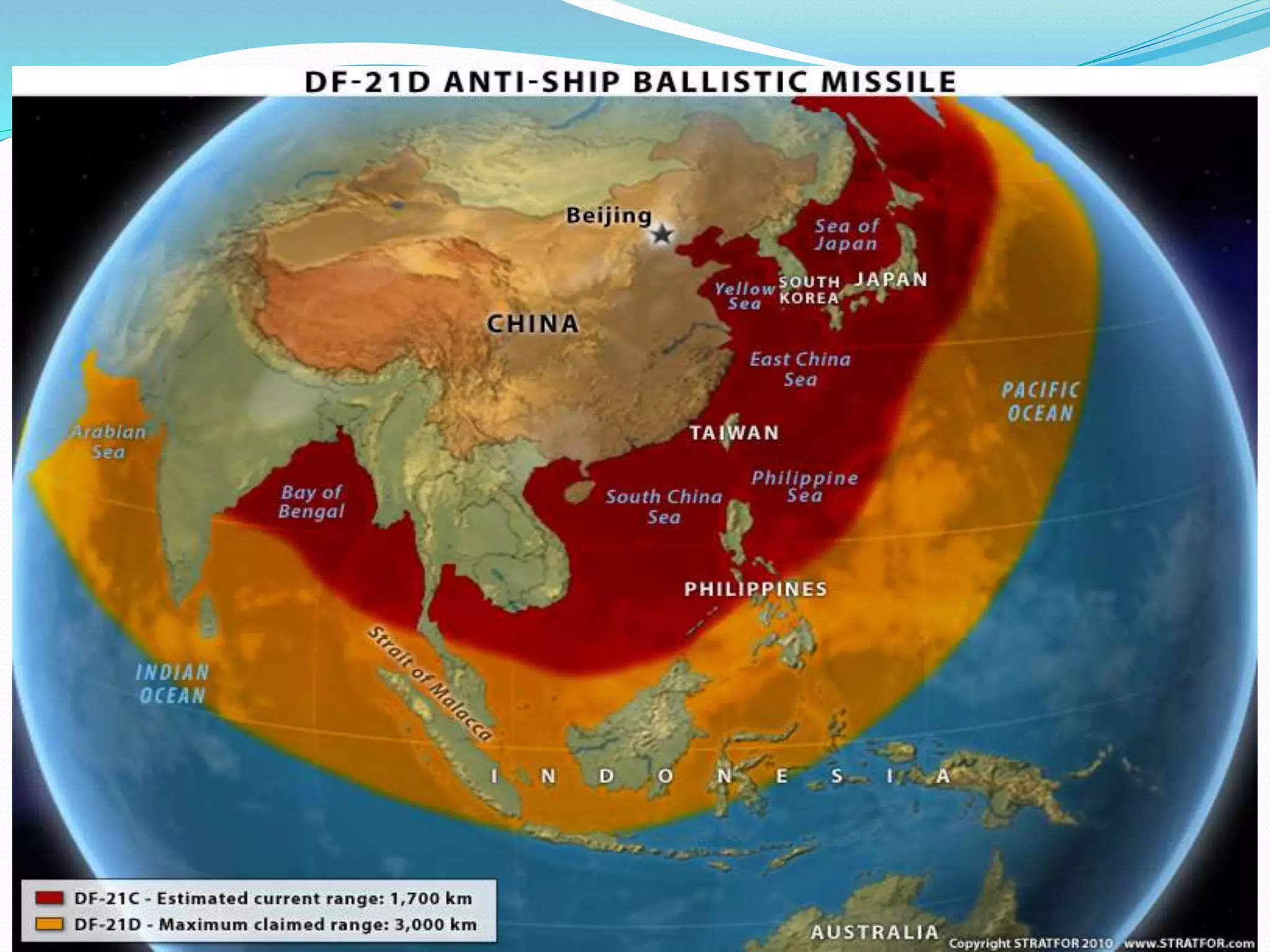
II) China: Threats and Concerns
III) North Korea: Military and Nuclear Aspirations
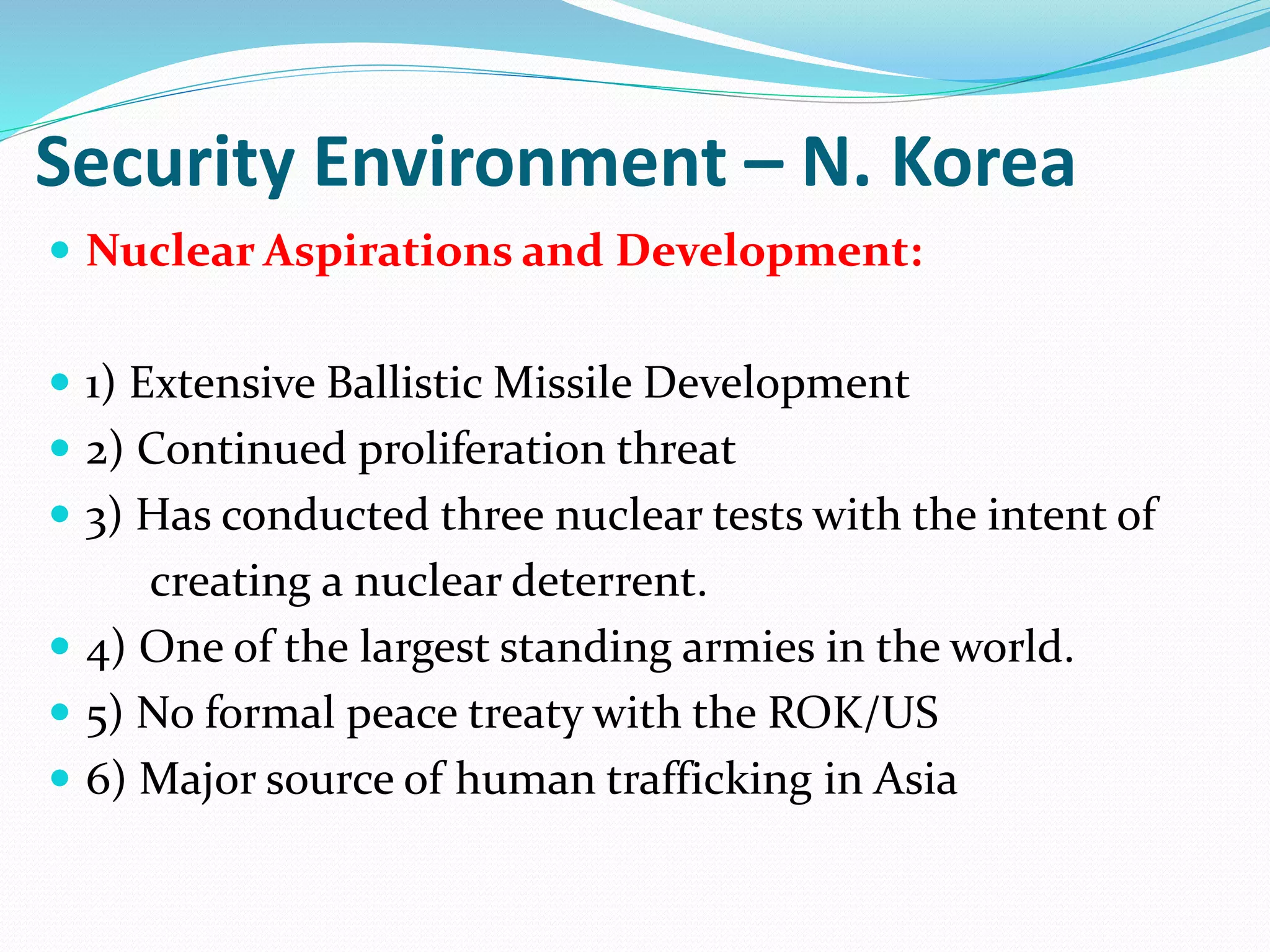
Security Environment – N. Korea
 Nuclear Aspirations and Development:
 1) Extensive Ballistic Missile Development
 2) Continued proliferation threat
 3) Has conducted three nuclear tests with the intent of
creating a nuclear deterrent.
 4) One of the largest standing armies in the world.
 5) No formal peace treaty with the ROK/US
 6) Major source of human trafficking in Asia
Presence
“Enhance and adapt our enduring presence in the region and
enable more effective engagement with partners.” -PACOM
 U.S. Military Assets
 ½ of USN assets, 2/3 of USMC Combat Strength, 1/5 of Total
Military
 Freedom of Navigation
 USN intends to increase commitment of assets from 50% to 60% by
2020.
 South China Sea has 7 countries claiming territorial waters.
 Port Visits
 The U.S. Navy makes approximately 700 port visits throughout the
Pacific region each year.
 Coast Guard
Joint Operations
 U.S. Coast Guard
 High Seas Drift Net
 Exclusive Economic Zones
 Anti-Piracy
 JIATF West
 “JIATF West partners with U.S. and foreign law
enforcement agencies through regional U.S. Embassies
and their respective country teams. JIATF West also
partners with regional law enforcement agencies who
coordinate complementary capabilities in the region.
JIATF West brings military and law enforcement
capabilities together to combat and reduce transnational
crime in the Asia-Pacific” - PACOM
Support
 Humanitarian Aide
 “USPACOM participated in more than 20 disaster relief
operations in 12 countries and one U.S. territory (Japan,
South Korea, the Philippines, Palau, Indonesia, Thailand,
Vietnam, Laos, Burma, India, Madagascar, Sri Lanka and
Guam) since 1996”. - PACOM
 Global Security Contingency Fund
 “The FY2012 National Defense Authorization Act (P.L. 112-81), Section
1207, created a new Global Security Contingency Fund (GSCF) as a
four-year pilot project to be jointly administered and funded by the
Department of Defense (DOD) and the State Department. The
purpose of the fund is to carry out security and counterterrorism
training, and rule of law programs”. - GAO
Support
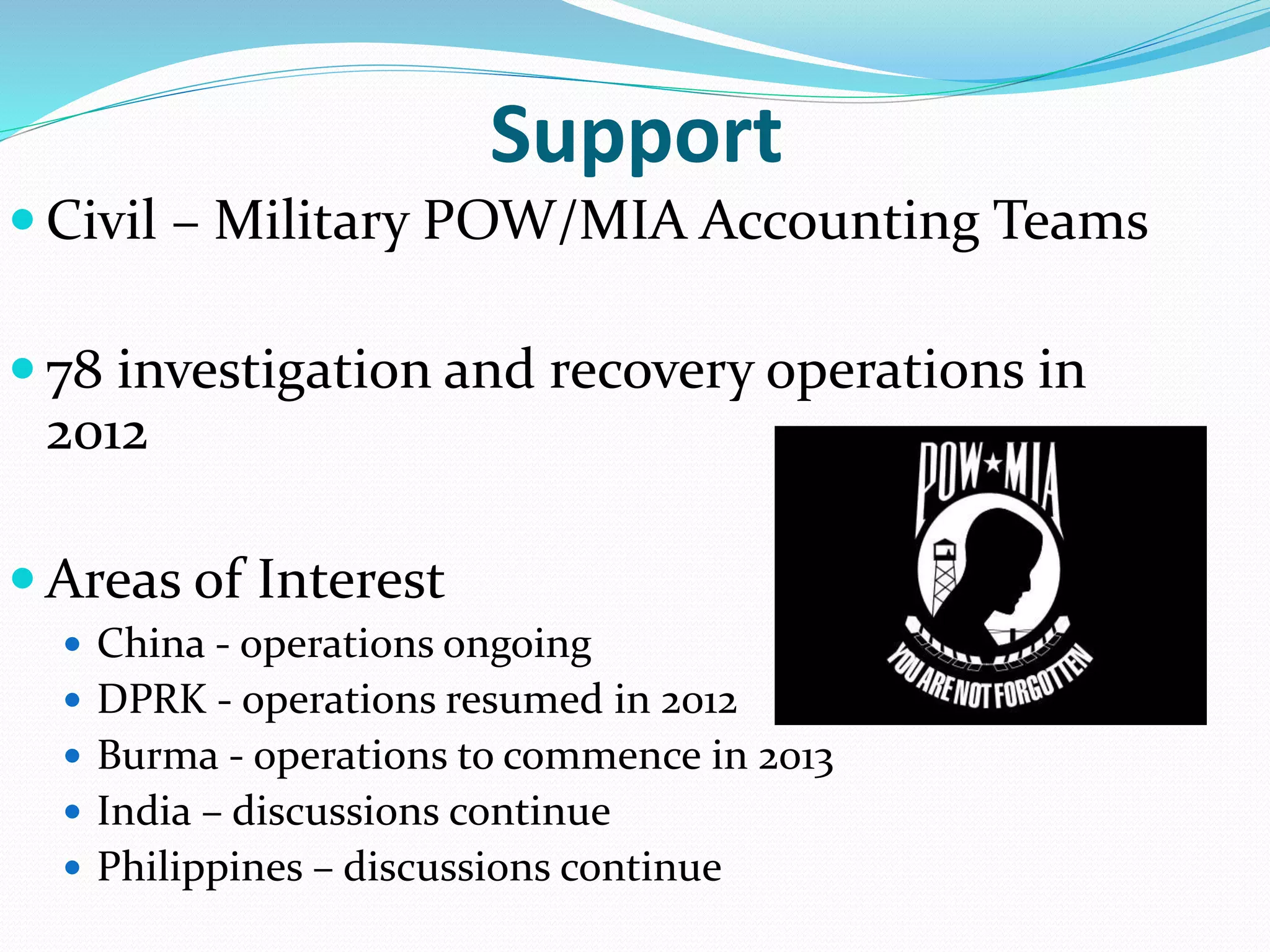
 Civil – Military POW/MIA Accounting Teams
 78 investigation and recovery operations in
2012
 Areas of Interest
 China - operations ongoing
 DPRK - operations resumed in 2012
 Burma - operations to commence in 2013
 India – discussions continue
 Philippines – discussions continue
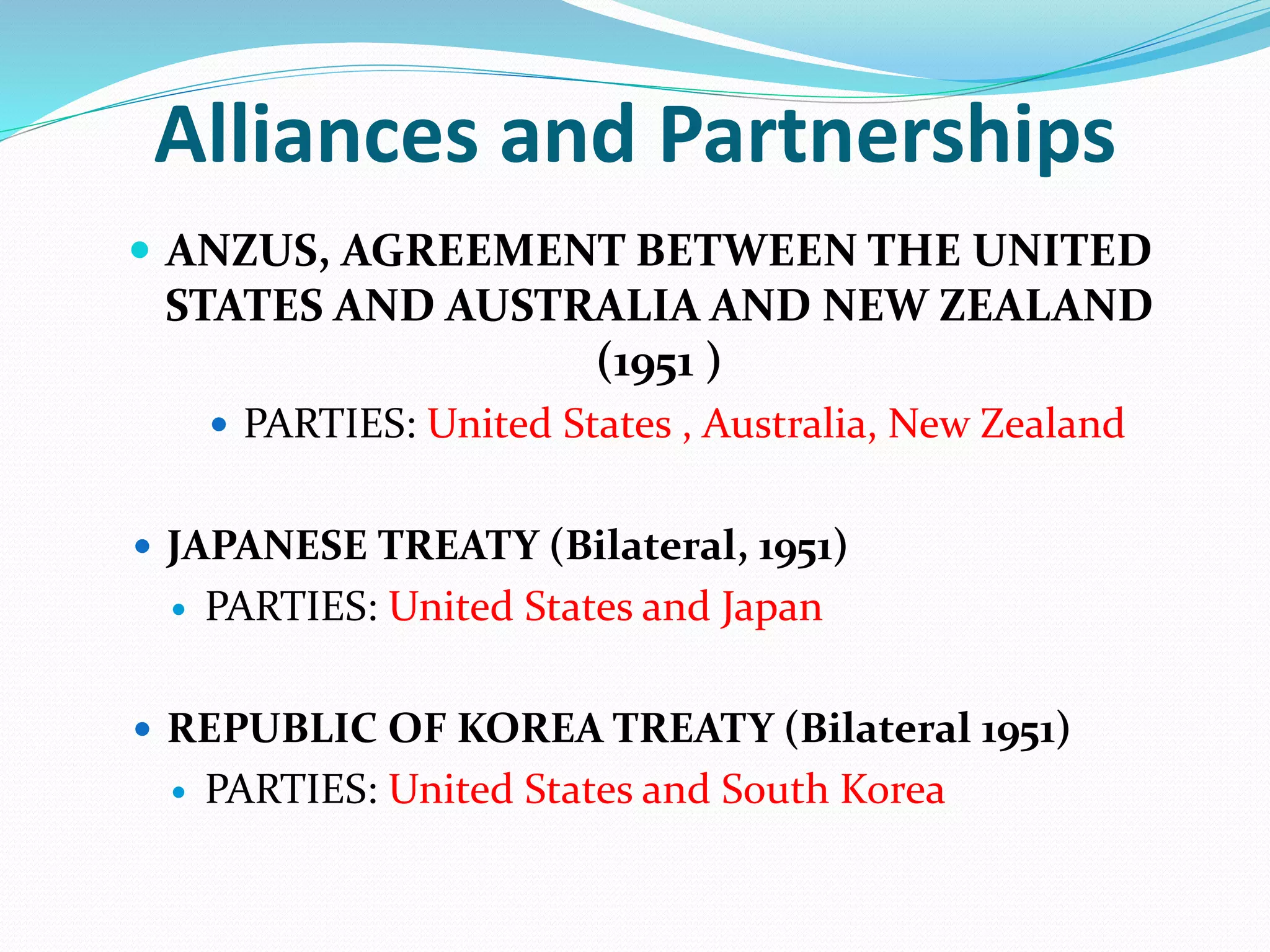
Alliances and Partnerships
 ANZUS, AGREEMENT BETWEEN THE UNITED
STATES AND AUSTRALIA AND NEW ZEALAND
(1951 )
 PARTIES: United States , Australia, New Zealand
 JAPANESE TREATY (Bilateral, 1951)
 PARTIES: United States and Japan
 REPUBLIC OF KOREA TREATY (Bilateral 1951)
 PARTIES: United States and South Korea
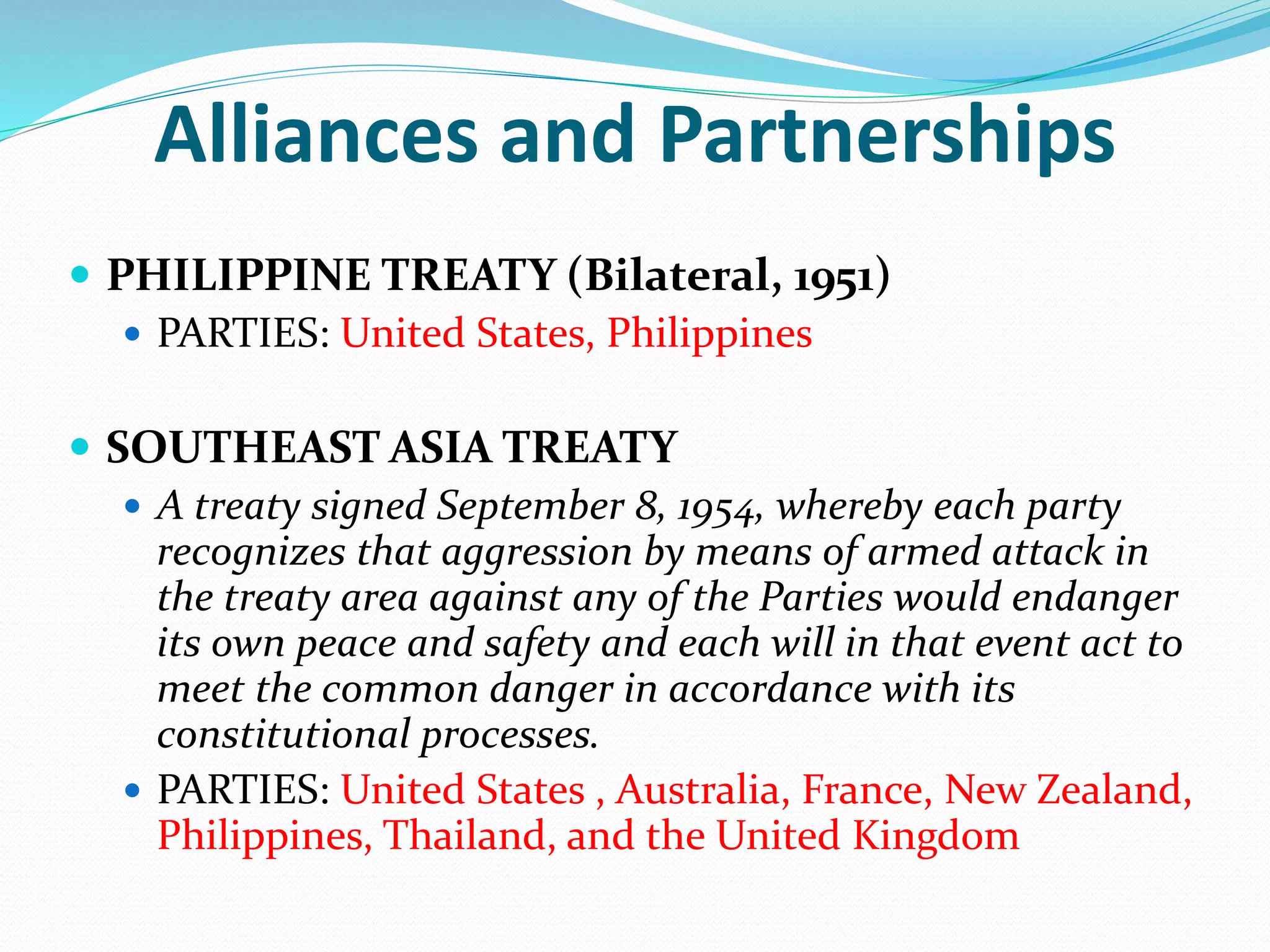
Alliances and Partnerships
 PHILIPPINE TREATY (Bilateral, 1951)
 PARTIES: United States, Philippines
 SOUTHEAST ASIA TREATY
 A treaty signed September 8, 1954, whereby each party
recognizes that aggression by means of armed attack in
the treaty area against any of the Parties would endanger
its own peace and safety and each will in that event act to
meet the common danger in accordance with its
constitutional processes.
 PARTIES: United States , Australia, France, New Zealand,
Philippines, Thailand, and the United Kingdom
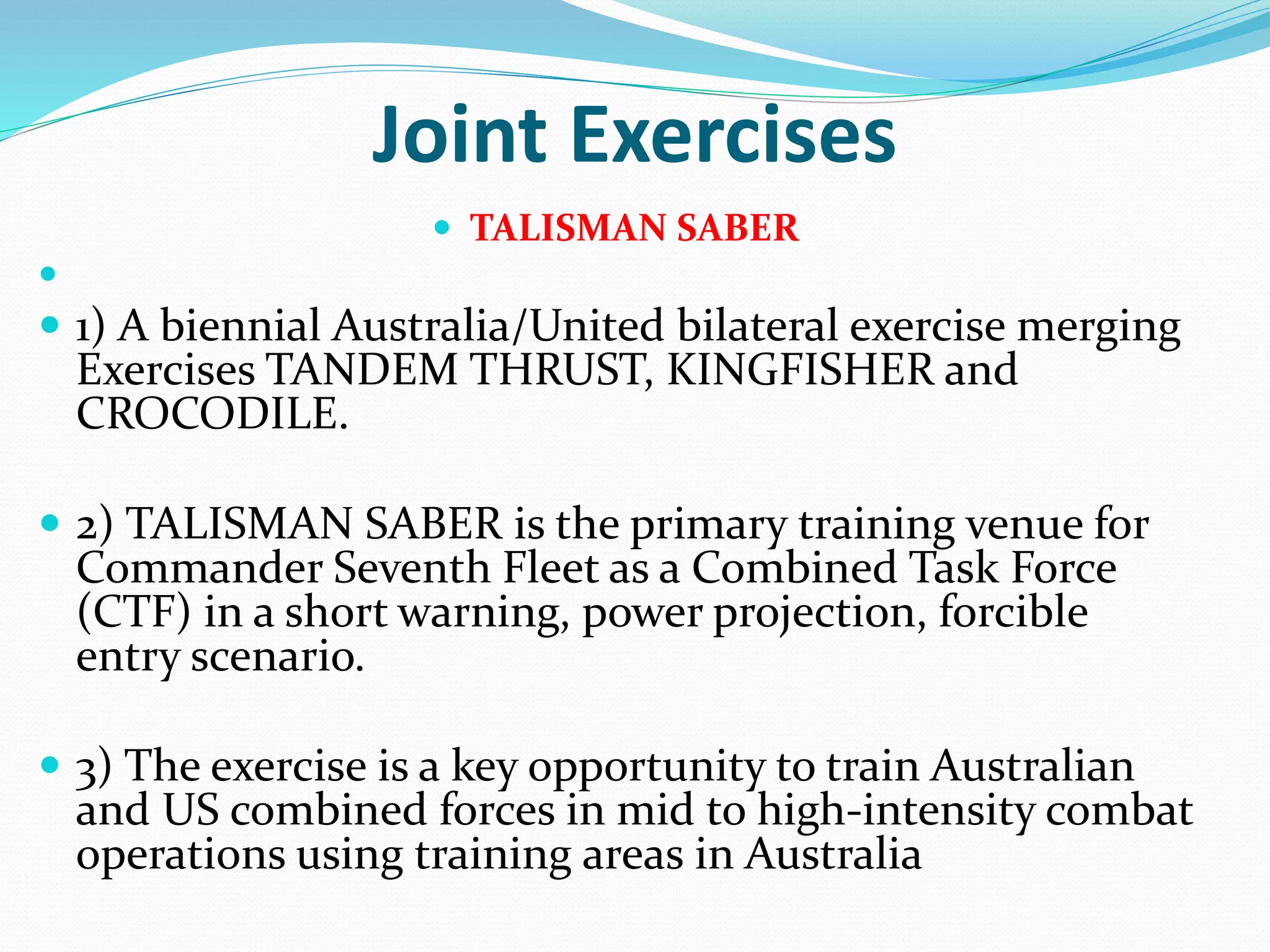
Joint Exercises
 TALISMAN SABER

 1) A biennial Australia/United bilateral exercise merging
Exercises TANDEM THRUST, KINGFISHER and
CROCODILE.
 2) TALISMAN SABER is the primary training venue for
Commander Seventh Fleet as a Combined Task Force
(CTF) in a short warning, power projection, forcible
entry scenario.
 3) The exercise is a key opportunity to train Australian
and US combined forces in mid to high-intensity combat
operations using training areas in Australia
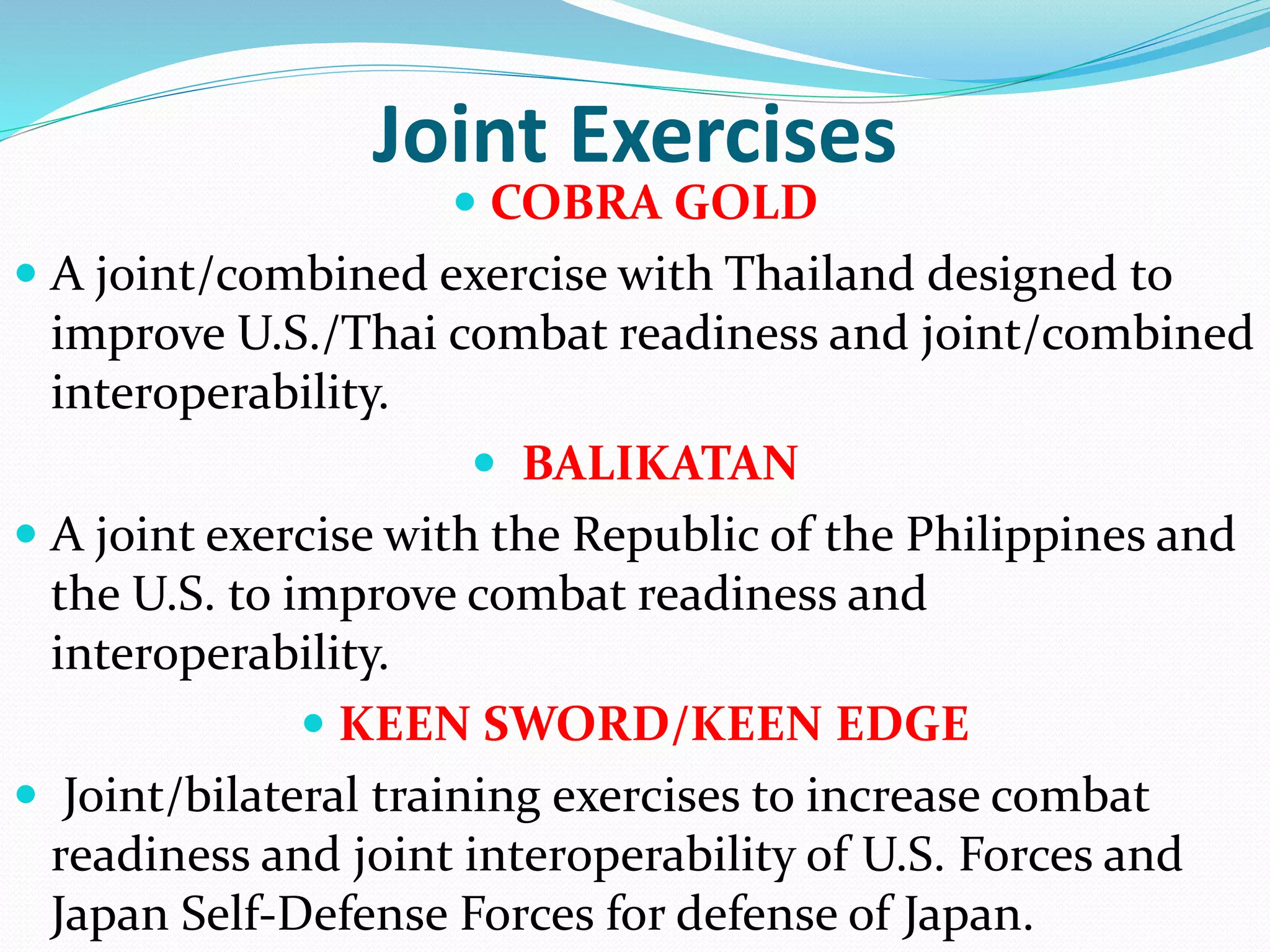
Joint Exercises
 COBRA GOLD
 A joint/combined exercise with Thailand designed to
improve U.S./Thai combat readiness and joint/combined
interoperability.
 BALIKATAN
 A joint exercise with the Republic of the Philippines and
the U.S. to improve combat readiness and
interoperability.
 KEEN SWORD/KEEN EDGE
 Joint/bilateral training exercises to increase combat
readiness and joint interoperability of U.S. Forces and
Japan Self-Defense Forces for defense of Japan.
Joint Exercises
 RIM OF THE PACIFIC
 1) A biennial large-scale multinational power
projection/sea control exercise. In 2000, participants
included the U.S., Canada, Australia, Japan, South Korea,
Chile and the United Kingdom.
 2) USPACOM participated in more than 20 disaster relief
operations in 12 countries and one U.S. territory (Japan,
South Korea, the Philippines, Palau, Indonesia, Thailand,
Vietnam, Laos, Burma, India, Madagascar, Sri Lanka and
Guam) since 1996.
Conclusions
 1) Alliances, Cooperation and Partnerships
within Nations with rebalancing Strategy.
 2) Promote Regional Security and Challenges
within Maritime and air domains, Space and
Cyberspace.
 3) Defend the United States territories and
interests.
 4) Threat Posed by the DPRK.
 5) Rise of China.
Questions?

PACOM_Assessment

  • 1.
  • 2.
    Introduction  “In accordancewith national guidance, our desired end state is that the Asia-Pacific is secure and prosperous, underpinned by U.S. leadership and a rules-based international order. To this end, we will strengthen alliances and partnerships, maintain an assured presence in the region, and effectively communicate our intent and resolve to safeguard U.S. national interests.”  – Commander, U.S. Pacific Command, Admiral Samuel J. Locklear III
  • 3.
    Area of Responsibility Covers half Earth’s surface and more than half its population – 36 nations total  Includes the world’s busiest international sea lanes and 9 of the 10 largest ports  Most militarized region in the world: 7 of the 10 largest standing militaries and 5 of the world’s declared nuclear nations
  • 5.
    PACOM as aCombatant Command  Total number of civilian and military personnel: 330,000 (1/5 of total U.S. military strength)  U.S. Army Pacific: 5 Stryker brigades and more than 60,000 assigned personnel  U.S. Pacific Fleet: 180 ships (including 5 aircraft carrier strike groups), nearly 2,000 aircraft, and 140,000 sailors and civilians  U.S. Pacific Air Forces: More than 435 aircraft and approximately 43,000 airmen  Marine Corps Force, Pacific: 2 Marine Expeditionary Forces and about 85,000 personnel (2/3 of total Marine Corps combat strength)  U.S. Coast Guard: 27,000 personnel in the Pacific area  Component command: More 1,200 Special Operations personnel and roughly 38,000 civilians
  • 6.
    Guiding Principles  1)International Rules  2) Partnerships  3) Presence  4) Force Projection  5) Unity of Effort  6) Strategic Communication  7) Readiness to Fight and Win
  • 7.
    Security Environment Areas ofFocus/Threats:  1) Sea/Air  2) WMD/Terrorism/ungoverned spaces  3) China/N. Korea
  • 8.
    Security Environment Sea/Air  I)Access  II) Energy  III) Transportation/Commerce
  • 9.
    Security Environment -Sea/Air  Access  Northeast Asia (NEA)  Southeast Asia (SEA)  South Asia  Oceania
  • 10.
    Security Environment -Sea/Air Energy 1) Tripling of consumption over last 3 decades 2) Oil primary source of energy in Asia-Pacific 3) Oil imports critically important for U.S. allies Japan & South Korea PACOM’s Energy Consumption 2010
  • 11.
    Security Environment -Sea/Air  Transportation/ Commerce  Freedom of navigation and SLOCs  Maritime shipping lanes  Critical “Chokepoints”  Malacca, Suda & Lombok Straits  Disruption  Accidents, terrorism & piracy  East China Sea
  • 13.
    Security Environment WMD/Terrorism/ungoverned spaces I)Terrorist Organizations in the AOR, threats and opportunities II) North Korea/pursuit of a nuclear deterrent other chemical threats. Other CBRN possible threats in the region. III) Piracy
  • 14.
     Terrorism inthe Asia Pacific Region originates mostly from South East Asia.  The Main terrorist groups are 1) Jemaah Islamiya-Indonesia 2) Abu Sayyaf/Moro Islamic Liberation Front (MILF)/New Peoples Army-Philippines 3) Southern Insurgency groups (Runda Kumpulan Kecil )- Thailand 4) Jemaah Ilamiya/Kampulan Mujheddin Malaysia (KMM)-Malaysia Security Environment– Terrorism
  • 15.
    Security Environment –Terrorism  Terrorist Incidents in South East Asia
  • 16.
    Security Environment –WMD 1) The Democratic People's Republic of Korea (DPRK) has an active nuclear weapons program and tested nuclear explosive devices in 2006, 2009, and 2013 2) Canceled the Armistice with South Korea 3) Most of North Korea’s nuclear complex lies underground making it difficult to determine its full capabilities
  • 17.
    Security Environment –Piracy  Piracy prone region due to the vast amount of trade (energy) that passes daily ($1.2 trillion in U.S. trade pass through the South China Sea)  Best interest of USPACOM that countries are engaged regarding piracy and energy  Prone Areas:  Bangladesh  Indonesia  Malacca Straits  Singapore Straits  South China Sea
  • 18.
    South East AsiaShipping Lanes
  • 19.
    Map of Straitof Malacca
  • 20.
    Security Environment  China/N.Korea I) Territorial Claims and Disputes II) China: Threats and Concerns III) North Korea: Military and Nuclear Aspirations
  • 26.
    Security Environment –N. Korea  Nuclear Aspirations and Development:  1) Extensive Ballistic Missile Development  2) Continued proliferation threat  3) Has conducted three nuclear tests with the intent of creating a nuclear deterrent.  4) One of the largest standing armies in the world.  5) No formal peace treaty with the ROK/US  6) Major source of human trafficking in Asia
  • 28.
    Presence “Enhance and adaptour enduring presence in the region and enable more effective engagement with partners.” -PACOM  U.S. Military Assets  ½ of USN assets, 2/3 of USMC Combat Strength, 1/5 of Total Military  Freedom of Navigation  USN intends to increase commitment of assets from 50% to 60% by 2020.  South China Sea has 7 countries claiming territorial waters.  Port Visits  The U.S. Navy makes approximately 700 port visits throughout the Pacific region each year.  Coast Guard
  • 30.
    Joint Operations  U.S.Coast Guard  High Seas Drift Net  Exclusive Economic Zones  Anti-Piracy  JIATF West  “JIATF West partners with U.S. and foreign law enforcement agencies through regional U.S. Embassies and their respective country teams. JIATF West also partners with regional law enforcement agencies who coordinate complementary capabilities in the region. JIATF West brings military and law enforcement capabilities together to combat and reduce transnational crime in the Asia-Pacific” - PACOM
  • 31.
    Support  Humanitarian Aide “USPACOM participated in more than 20 disaster relief operations in 12 countries and one U.S. territory (Japan, South Korea, the Philippines, Palau, Indonesia, Thailand, Vietnam, Laos, Burma, India, Madagascar, Sri Lanka and Guam) since 1996”. - PACOM  Global Security Contingency Fund  “The FY2012 National Defense Authorization Act (P.L. 112-81), Section 1207, created a new Global Security Contingency Fund (GSCF) as a four-year pilot project to be jointly administered and funded by the Department of Defense (DOD) and the State Department. The purpose of the fund is to carry out security and counterterrorism training, and rule of law programs”. - GAO
  • 32.
    Support  Civil –Military POW/MIA Accounting Teams  78 investigation and recovery operations in 2012  Areas of Interest  China - operations ongoing  DPRK - operations resumed in 2012  Burma - operations to commence in 2013  India – discussions continue  Philippines – discussions continue
  • 33.
    Alliances and Partnerships ANZUS, AGREEMENT BETWEEN THE UNITED STATES AND AUSTRALIA AND NEW ZEALAND (1951 )  PARTIES: United States , Australia, New Zealand  JAPANESE TREATY (Bilateral, 1951)  PARTIES: United States and Japan  REPUBLIC OF KOREA TREATY (Bilateral 1951)  PARTIES: United States and South Korea
  • 34.
    Alliances and Partnerships PHILIPPINE TREATY (Bilateral, 1951)  PARTIES: United States, Philippines  SOUTHEAST ASIA TREATY  A treaty signed September 8, 1954, whereby each party recognizes that aggression by means of armed attack in the treaty area against any of the Parties would endanger its own peace and safety and each will in that event act to meet the common danger in accordance with its constitutional processes.  PARTIES: United States , Australia, France, New Zealand, Philippines, Thailand, and the United Kingdom
  • 35.
    Joint Exercises  TALISMANSABER   1) A biennial Australia/United bilateral exercise merging Exercises TANDEM THRUST, KINGFISHER and CROCODILE.  2) TALISMAN SABER is the primary training venue for Commander Seventh Fleet as a Combined Task Force (CTF) in a short warning, power projection, forcible entry scenario.  3) The exercise is a key opportunity to train Australian and US combined forces in mid to high-intensity combat operations using training areas in Australia
  • 36.
    Joint Exercises  COBRAGOLD  A joint/combined exercise with Thailand designed to improve U.S./Thai combat readiness and joint/combined interoperability.  BALIKATAN  A joint exercise with the Republic of the Philippines and the U.S. to improve combat readiness and interoperability.  KEEN SWORD/KEEN EDGE  Joint/bilateral training exercises to increase combat readiness and joint interoperability of U.S. Forces and Japan Self-Defense Forces for defense of Japan.
  • 37.
    Joint Exercises  RIMOF THE PACIFIC  1) A biennial large-scale multinational power projection/sea control exercise. In 2000, participants included the U.S., Canada, Australia, Japan, South Korea, Chile and the United Kingdom.  2) USPACOM participated in more than 20 disaster relief operations in 12 countries and one U.S. territory (Japan, South Korea, the Philippines, Palau, Indonesia, Thailand, Vietnam, Laos, Burma, India, Madagascar, Sri Lanka and Guam) since 1996.
  • 38.
    Conclusions  1) Alliances,Cooperation and Partnerships within Nations with rebalancing Strategy.  2) Promote Regional Security and Challenges within Maritime and air domains, Space and Cyberspace.  3) Defend the United States territories and interests.  4) Threat Posed by the DPRK.  5) Rise of China.
  • 39.

Editor's Notes

  • #18 http://www.icc-ccs.org/piracy-reporting-centre/live-piracy-map