Human Reproduction
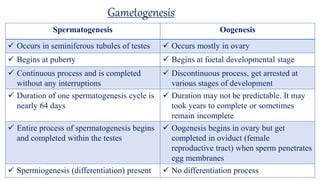
Gametogenesis
Spermatogenesis Oogenesis
 Occurs in seminiferous tubules of testes  Occurs mostly in ovary
 Begins at puberty  Begins at foetal developmental stage
 Continuous process and is completed
without any interruptions
 Discontinuous process, get arrested at
various stages of development
 Duration of one spermatogenesis cycle is
nearly 64 days
 Duration may not be predictable. It may
took years to complete or sometimes
remain incomplete
 Entire process of spermatogenesis begins
and completed within the testes
 Oogenesis begins in ovary but get
completed in oviduct (female
reproductive tract) when sperm penetrates
egg membranes
 Spermiogenesis (differentiation) present  No differentiation process
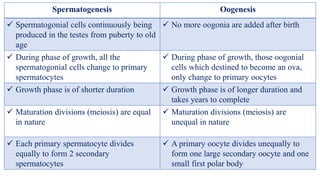
Spermatogenesis Oogenesis
 Spermatogonial cells continuously being
produced in the testes from puberty to old
age
 No more oogonia are added after birth
 During phase of growth, all the
spermatogonial cells change to primary
spermatocytes
 During phase of growth, those oogonial
cells which destined to become an ova,
only change to primary oocytes
 Growth phase is of shorter duration  Growth phase is of longer duration and
takes years to complete
 Maturation divisions (meiosis) are equal
in nature
 Maturation divisions (meiosis) are
unequal in nature
 Each primary spermatocyte divides
equally to form 2 secondary
spermatocytes
 A primary oocyte divides unequally to
form one large secondary oocyte and one
small first polar body
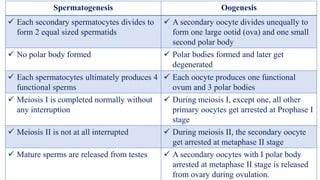
Spermatogenesis Oogenesis
 Each secondary spermatocytes divides to
form 2 equal sized spermatids
 A secondary oocyte divides unequally to
form one large ootid (ova) and one small
second polar body
 No polar body formed  Polar bodies formed and later get
degenerated
 Each spermatocytes ultimately produces 4
functional sperms
 Each oocyte produces one functional
ovum and 3 polar bodies
 Meiosis I is completed normally without
any interruption
 During meiosis I, except one, all other
primary oocytes get arrested at Prophase I
stage
 Meiosis II is not at all interrupted  During meiosis II, the secondary oocyte
get arrested at metaphase II stage
 Mature sperms are released from testes  A secondary oocytes with I polar body
arrested at metaphase II stage is released
from ovary during ovulation.
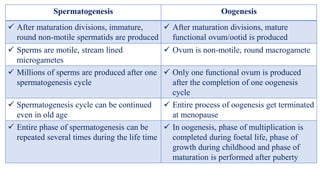
Spermatogenesis Oogenesis
 After maturation divisions, immature,
round non-motile spermatids are produced
 After maturation divisions, mature
functional ovum/ootid is produced
 Sperms are motile, stream lined
microgametes
 Ovum is non-motile, round macrogamete
 Millions of sperms are produced after one
spermatogenesis cycle
 Only one functional ovum is produced
after the completion of one oogenesis
cycle
 Spermatogenesis cycle can be continued
even in old age
 Entire process of oogenesis get terminated
at menopause
 Entire phase of spermatogenesis can be
repeated several times during the life time
 In oogenesis, phase of multiplication is
completed during foetal life, phase of
growth during childhood and phase of
maturation is performed after puberty
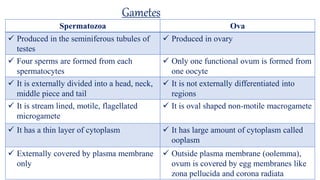
Gametes
Spermatozoa Ova
 Produced in the seminiferous tubules of
testes
 Produced in ovary
 Four sperms are formed from each
spermatocytes
 Only one functional ovum is formed from
one oocyte
 It is externally divided into a head, neck,
middle piece and tail
 It is not externally differentiated into
regions
 It is stream lined, motile, flagellated
microgamete
 It is oval shaped non-motile macrogamete
 It has a thin layer of cytoplasm  It has large amount of cytoplasm called
ooplasm
 Externally covered by plasma membrane
only
 Outside plasma membrane (oolemma),
ovum is covered by egg membranes like
zona pellucida and corona radiata
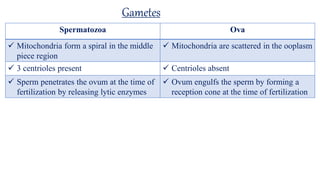
Gametes
Spermatozoa Ova
 Mitochondria form a spiral in the middle
piece region
 Mitochondria are scattered in the ooplasm
 3 centrioles present  Centrioles absent
 Sperm penetrates the ovum at the time of
fertilization by releasing lytic enzymes
 Ovum engulfs the sperm by forming a
reception cone at the time of fertilization
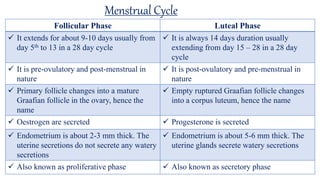
Menstrual Cycle
Follicular Phase Luteal Phase
 It extends for about 9-10 days usually from
day 5th to 13 in a 28 day cycle
 It is always 14 days duration usually
extending from day 15 – 28 in a 28 day
cycle
 It is pre-ovulatory and post-menstrual in
nature
 It is post-ovulatory and pre-menstrual in
nature
 Primary follicle changes into a mature
Graafian follicle in the ovary, hence the
name
 Empty ruptured Graafian follicle changes
into a corpus luteum, hence the name
 Oestrogen are secreted  Progesterone is secreted
 Endometrium is about 2-3 mm thick. The
uterine secretions do not secrete any watery
secretions
 Endometrium is about 5-6 mm thick. The
uterine glands secrete watery secretions
 Also known as proliferative phase  Also known as secretory phase
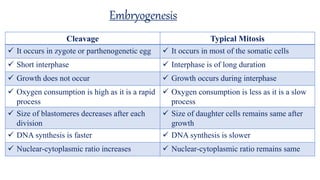
Embryogenesis
Cleavage Typical Mitosis
 It occurs in zygote or parthenogenetic egg  It occurs in most of the somatic cells
 Short interphase  Interphase is of long duration
 Growth does not occur  Growth occurs during interphase
 Oxygen consumption is high as it is a rapid
process
 Oxygen consumption is less as it is a slow
process
 Size of blastomeres decreases after each
division
 Size of daughter cells remains same after
growth
 DNA synthesis is faster  DNA synthesis is slower
 Nuclear-cytoplasmic ratio increases  Nuclear-cytoplasmic ratio remains same
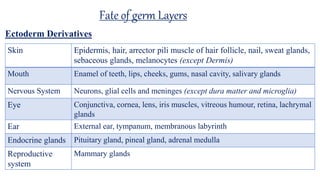
Fate of germ Layers
Skin Epidermis, hair, arrector pili muscle of hair follicle, nail, sweat glands,
sebaceous glands, melanocytes (except Dermis)
Mouth Enamel of teeth, lips, cheeks, gums, nasal cavity, salivary glands
Nervous System Neurons, glial cells and meninges (except dura matter and microglia)
Eye Conjunctiva, cornea, lens, iris muscles, vitreous humour, retina, lachrymal
glands
Ear External ear, tympanum, membranous labyrinth
Endocrine glands Pituitary gland, pineal gland, adrenal medulla
Reproductive
system
Mammary glands
Ectoderm Derivatives
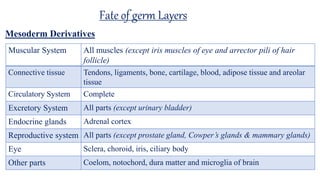
Fate of germ Layers
Muscular System All muscles (except iris muscles of eye and arrector pili of hair
follicle)
Connective tissue Tendons, ligaments, bone, cartilage, blood, adipose tissue and areolar
tissue
Circulatory System Complete
Excretory System All parts (except urinary bladder)
Endocrine glands Adrenal cortex
Reproductive system All parts (except prostate gland, Cowper’s glands & mammary glands)
Eye Sclera, choroid, iris, ciliary body
Other parts Coelom, notochord, dura matter and microglia of brain
Mesoderm Derivatives
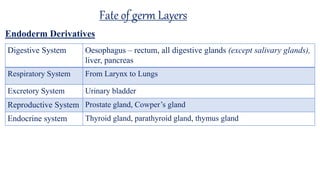
Fate of germ Layers
Digestive System Oesophagus – rectum, all digestive glands (except salivary glands),
liver, pancreas
Respiratory System From Larynx to Lungs
Excretory System Urinary bladder
Reproductive System Prostate gland, Cowper’s gland
Endocrine system Thyroid gland, parathyroid gland, thymus gland
Endoderm Derivatives
Thank You

P-32.pptx

  • 1.
  • 2.
    Gametogenesis Spermatogenesis Oogenesis  Occursin seminiferous tubules of testes  Occurs mostly in ovary  Begins at puberty  Begins at foetal developmental stage  Continuous process and is completed without any interruptions  Discontinuous process, get arrested at various stages of development  Duration of one spermatogenesis cycle is nearly 64 days  Duration may not be predictable. It may took years to complete or sometimes remain incomplete  Entire process of spermatogenesis begins and completed within the testes  Oogenesis begins in ovary but get completed in oviduct (female reproductive tract) when sperm penetrates egg membranes  Spermiogenesis (differentiation) present  No differentiation process
  • 3.
    Spermatogenesis Oogenesis  Spermatogonialcells continuously being produced in the testes from puberty to old age  No more oogonia are added after birth  During phase of growth, all the spermatogonial cells change to primary spermatocytes  During phase of growth, those oogonial cells which destined to become an ova, only change to primary oocytes  Growth phase is of shorter duration  Growth phase is of longer duration and takes years to complete  Maturation divisions (meiosis) are equal in nature  Maturation divisions (meiosis) are unequal in nature  Each primary spermatocyte divides equally to form 2 secondary spermatocytes  A primary oocyte divides unequally to form one large secondary oocyte and one small first polar body
  • 4.
    Spermatogenesis Oogenesis  Eachsecondary spermatocytes divides to form 2 equal sized spermatids  A secondary oocyte divides unequally to form one large ootid (ova) and one small second polar body  No polar body formed  Polar bodies formed and later get degenerated  Each spermatocytes ultimately produces 4 functional sperms  Each oocyte produces one functional ovum and 3 polar bodies  Meiosis I is completed normally without any interruption  During meiosis I, except one, all other primary oocytes get arrested at Prophase I stage  Meiosis II is not at all interrupted  During meiosis II, the secondary oocyte get arrested at metaphase II stage  Mature sperms are released from testes  A secondary oocytes with I polar body arrested at metaphase II stage is released from ovary during ovulation.
  • 5.
    Spermatogenesis Oogenesis  Aftermaturation divisions, immature, round non-motile spermatids are produced  After maturation divisions, mature functional ovum/ootid is produced  Sperms are motile, stream lined microgametes  Ovum is non-motile, round macrogamete  Millions of sperms are produced after one spermatogenesis cycle  Only one functional ovum is produced after the completion of one oogenesis cycle  Spermatogenesis cycle can be continued even in old age  Entire process of oogenesis get terminated at menopause  Entire phase of spermatogenesis can be repeated several times during the life time  In oogenesis, phase of multiplication is completed during foetal life, phase of growth during childhood and phase of maturation is performed after puberty
  • 6.
    Gametes Spermatozoa Ova  Producedin the seminiferous tubules of testes  Produced in ovary  Four sperms are formed from each spermatocytes  Only one functional ovum is formed from one oocyte  It is externally divided into a head, neck, middle piece and tail  It is not externally differentiated into regions  It is stream lined, motile, flagellated microgamete  It is oval shaped non-motile macrogamete  It has a thin layer of cytoplasm  It has large amount of cytoplasm called ooplasm  Externally covered by plasma membrane only  Outside plasma membrane (oolemma), ovum is covered by egg membranes like zona pellucida and corona radiata
  • 7.
    Gametes Spermatozoa Ova  Mitochondriaform a spiral in the middle piece region  Mitochondria are scattered in the ooplasm  3 centrioles present  Centrioles absent  Sperm penetrates the ovum at the time of fertilization by releasing lytic enzymes  Ovum engulfs the sperm by forming a reception cone at the time of fertilization
  • 8.
    Menstrual Cycle Follicular PhaseLuteal Phase  It extends for about 9-10 days usually from day 5th to 13 in a 28 day cycle  It is always 14 days duration usually extending from day 15 – 28 in a 28 day cycle  It is pre-ovulatory and post-menstrual in nature  It is post-ovulatory and pre-menstrual in nature  Primary follicle changes into a mature Graafian follicle in the ovary, hence the name  Empty ruptured Graafian follicle changes into a corpus luteum, hence the name  Oestrogen are secreted  Progesterone is secreted  Endometrium is about 2-3 mm thick. The uterine secretions do not secrete any watery secretions  Endometrium is about 5-6 mm thick. The uterine glands secrete watery secretions  Also known as proliferative phase  Also known as secretory phase
  • 9.
    Embryogenesis Cleavage Typical Mitosis It occurs in zygote or parthenogenetic egg  It occurs in most of the somatic cells  Short interphase  Interphase is of long duration  Growth does not occur  Growth occurs during interphase  Oxygen consumption is high as it is a rapid process  Oxygen consumption is less as it is a slow process  Size of blastomeres decreases after each division  Size of daughter cells remains same after growth  DNA synthesis is faster  DNA synthesis is slower  Nuclear-cytoplasmic ratio increases  Nuclear-cytoplasmic ratio remains same
  • 10.
    Fate of germLayers Skin Epidermis, hair, arrector pili muscle of hair follicle, nail, sweat glands, sebaceous glands, melanocytes (except Dermis) Mouth Enamel of teeth, lips, cheeks, gums, nasal cavity, salivary glands Nervous System Neurons, glial cells and meninges (except dura matter and microglia) Eye Conjunctiva, cornea, lens, iris muscles, vitreous humour, retina, lachrymal glands Ear External ear, tympanum, membranous labyrinth Endocrine glands Pituitary gland, pineal gland, adrenal medulla Reproductive system Mammary glands Ectoderm Derivatives
  • 11.
    Fate of germLayers Muscular System All muscles (except iris muscles of eye and arrector pili of hair follicle) Connective tissue Tendons, ligaments, bone, cartilage, blood, adipose tissue and areolar tissue Circulatory System Complete Excretory System All parts (except urinary bladder) Endocrine glands Adrenal cortex Reproductive system All parts (except prostate gland, Cowper’s glands & mammary glands) Eye Sclera, choroid, iris, ciliary body Other parts Coelom, notochord, dura matter and microglia of brain Mesoderm Derivatives
  • 12.
    Fate of germLayers Digestive System Oesophagus – rectum, all digestive glands (except salivary glands), liver, pancreas Respiratory System From Larynx to Lungs Excretory System Urinary bladder Reproductive System Prostate gland, Cowper’s gland Endocrine system Thyroid gland, parathyroid gland, thymus gland Endoderm Derivatives
  • 13.