by Hasnaa abdelraheem
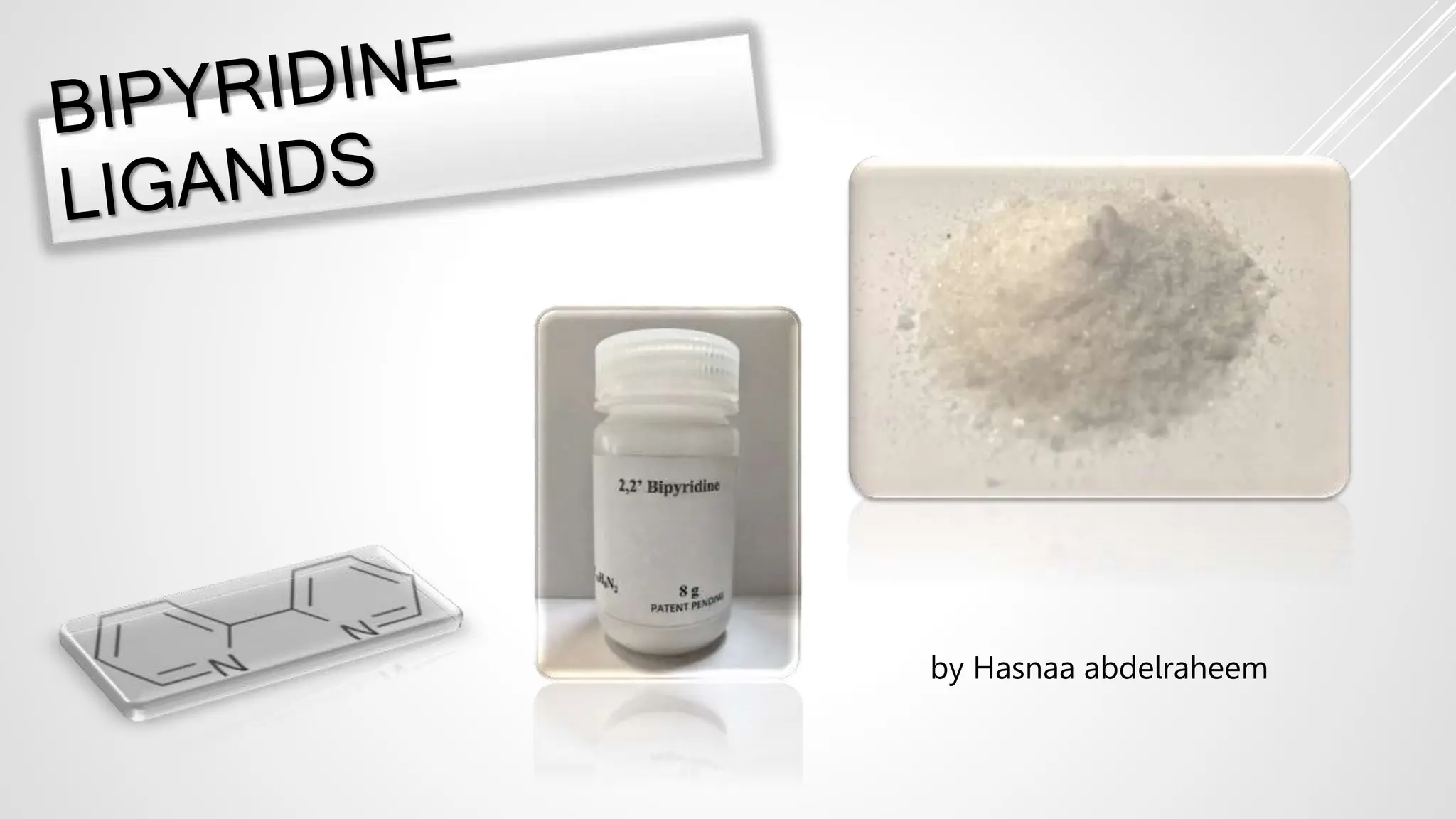
BIPYRIDINE LIGANDS
 dipyridyls, and dipyridines, are aromatic nitrogen heterocycles that
form complexes with most transition metals
 Bipyridine ligands interact with metals via both sigma-donating
nitrogen atoms and bi -accepting molecular orbitals
 Bipyridines figure prominently in studies of electron and energy
transfer, supramolecular and materials chemistry, and catalysis.
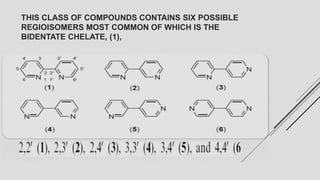
THIS CLASS OF COMPOUNDS CONTAINS SIX POSSIBLE
REGIOISOMERS MOST COMMON OF WHICH IS THE
BIDENTATE CHELATE, (1),
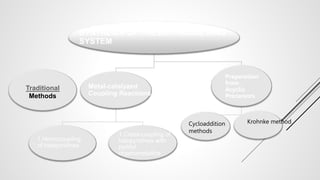
SYNTHESIS OF THE BIPYRIDINE RING
SYSTEM
Metal-catalyzed
Coupling Reactions
1.Homocoupling
of halopyridines
1.Cross-coupling of
halopyridines with
pyridyl
organometallics
Preparation
from
Acyclic
Precursors
Traditional
Methods
Krohnke method
Cycloaddition
methods
Traditional Methods
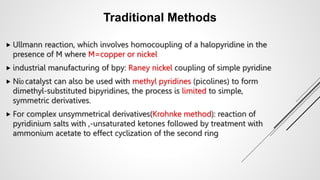
 Ullmann reaction, which involves homocoupling of a halopyridine in the
presence of M where M=copper or nickel
 industrial manufacturing of bpy: Raney nickel coupling of simple pyridine
 Ni0 catalyst can also be used with methyl pyridines (picolines) to form
dimethyl-substituted bipyridines, the process is limited to simple,
symmetric derivatives.
 For complex unsymmetrical derivatives(Krohnke method): reaction of
pyridinium salts with ,-unsaturated ketones followed by treatment with
ammonium acetate to effect cyclization of the second ring
Metal-catalyzed Coupling Reactions
HOMOCOUPLING OF HALOPYRIDINES
 most useful transition metal: Ni catalyst, most often generated in situ
through reduction of a Ni+2 complex
Advantages of this method:
 provides product in much higher yield than the classic Ullmann reaction
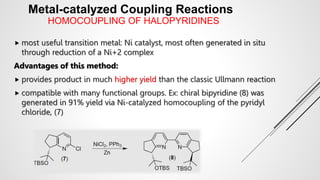
 compatible with many functional groups. Ex: chiral bipyridine (8) was
generated in 91% yield via Ni-catalyzed homocoupling of the pyridyl
chloride, (7)
 other catalyst systems for halopyridine homocouplings: Pd/C and Cu II
typically afford product in lower yields.
 This methodology has also been used to generate:
o 3,3’-bipyridine, (72%)
o Methyl substituted 3,3’-bipyridines (84%).
o 3,4,3’,4’-tetramethoxy-substituted bipyridine, which was similarly afforded
in 80% yield through homocoupling of a dimethoxy-substituted
iodopyridine
 Note:
o substituted at 3 and 3’ bipyridines positions exhibit a large steric
repulsion between substituents while in the cis configuration, they bind
metals more weakly and form strained, nonplanar structures.
o coordinated to ruthenium molecular distortions could be used to
advantage in modulating physical properties of the resulting complexes
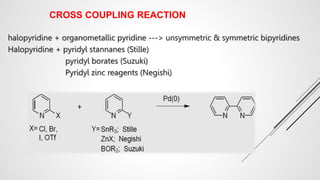
CROSS COUPLING REACTION
halopyridine + organometallic pyridine ---> unsymmetric & symmetric bipyridines
Halopyridine + pyridyl stannanes (Stille)
pyridyl borates (Suzuki)
Pyridyl zinc reagents (Negishi)
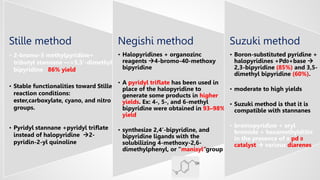
Stille method
• 2-bromo-5 methylpyridine+
tributyl stannane —>5,5’-dimethyl
bipyridine 86% yield
• Stable functionalities toward Stille
reaction conditions:
ester,carboxylate, cyano, and nitro
groups.
• Pyridyl stannane +pyridyl triflate
instead of halopyridine 2-
pyridin-2-yl quinoline
Negishi method
• Halopyridines + organozinc
reagents 4-bromo-40-methoxy
bipyridine
• A pyridyl triflate has been used in
place of the halopyridine to
generate some products in higher
yields. Ex: 4-, 5-, and 6-methyl
bipyridine were obtained in 93–98%
yield
• synthesize 2,4’-bipyridine, and
bipyridine ligands with the
solubilizing 4-methoxy-2,6-
dimethylphenyl, or ‘‘manisyl’’group
Suzuki method
• Boron-substituted pyridine +
halopyridines +Pd0+base 
2,3-bipyridine (85%) and 3,5-
dimethyl bipyridine (60%).
• moderate to high yields
• Suzuki method is that it is
compatible with stannanes
• bromopyridine + aryl
bromide + hexamethylditin
in the presence of a pd 0
catalyst  various diarenes
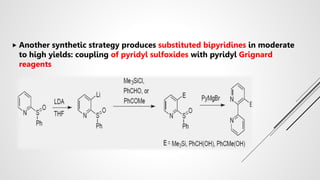
 Another synthetic strategy produces substituted bipyridines in moderate
to high yields: coupling of pyridyl sulfoxides with pyridyl Grignard
reagents
Preparation from Acyclic Precursors
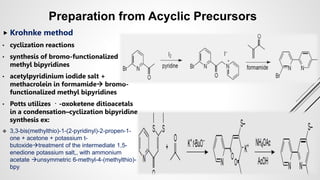
 Krohnke method
• cyclization reactions
• synthesis of bromo-functionalized
methyl bipyridines
• acetylpyridinium iodide salt +
methacrolein in formamide bromo-
functionalized methyl bipyridines
• Potts utilizes -oxoketene ditioacetals
in a condensation–cyclization bipyridine
synthesis ex:
 3,3-bis(methylthio)-1-(2-pyridinyl)-2-propen-1-
one + acetone + potassium t-
butoxidetreatment of the intermediate 1,5-
enedione potassium salt,, with ammonium
acetate unsymmetric 6-methyl-4-(methylthio)-
bpy,
Cycloaddition methods
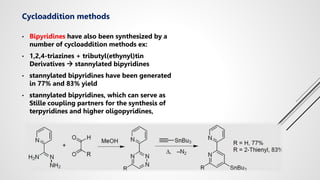
• Bipyridines have also been synthesized by a
number of cycloaddition methods ex:
• 1,2,4-triazines + tributyl(ethynyl)tin
Derivatives  stannylated bipyridines
• stannylated bipyridines have been generated
in 77% and 83% yield
• stannylated bipyridines, which can serve as
Stille coupling partners for the synthesis of
terpyridines and higher oligopyridines,
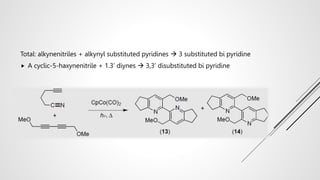
Total: alkynenitriles + alkynyl substituted pyridines  3 substituted bi pyridine
 A cyclic-5-haxynenitrile + 1.3’ diynes  3,3’ disubstituted bi pyridine
OTHER SYNTHETIC METHODS
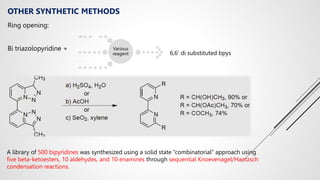
Ring opening:
Bi triazolopyridine + Various
reagent
A; sulfuric acid
B:acetic acid
C: selenium
dioxide,
6,6’ di substituted bpys
A library of 500 bipyridines was synthesized using a solid state ‘‘combinatorial’’ approach using
five beta-ketoesters, 10 aldehydes, and 10 enamines through sequential Knoevenagel/Hantzsch
condensation reactions.
p1 bipyridine. synthesis methods and its reactions

p1 bipyridine. synthesis methods and its reactions

  • 1.
  • 2.
    BIPYRIDINE LIGANDS  dipyridyls,and dipyridines, are aromatic nitrogen heterocycles that form complexes with most transition metals  Bipyridine ligands interact with metals via both sigma-donating nitrogen atoms and bi -accepting molecular orbitals  Bipyridines figure prominently in studies of electron and energy transfer, supramolecular and materials chemistry, and catalysis.
  • 3.
    THIS CLASS OFCOMPOUNDS CONTAINS SIX POSSIBLE REGIOISOMERS MOST COMMON OF WHICH IS THE BIDENTATE CHELATE, (1),
  • 4.
    SYNTHESIS OF THEBIPYRIDINE RING SYSTEM Metal-catalyzed Coupling Reactions 1.Homocoupling of halopyridines 1.Cross-coupling of halopyridines with pyridyl organometallics Preparation from Acyclic Precursors Traditional Methods Krohnke method Cycloaddition methods
  • 5.
    Traditional Methods  Ullmannreaction, which involves homocoupling of a halopyridine in the presence of M where M=copper or nickel  industrial manufacturing of bpy: Raney nickel coupling of simple pyridine  Ni0 catalyst can also be used with methyl pyridines (picolines) to form dimethyl-substituted bipyridines, the process is limited to simple, symmetric derivatives.  For complex unsymmetrical derivatives(Krohnke method): reaction of pyridinium salts with ,-unsaturated ketones followed by treatment with ammonium acetate to effect cyclization of the second ring
  • 6.
    Metal-catalyzed Coupling Reactions HOMOCOUPLINGOF HALOPYRIDINES  most useful transition metal: Ni catalyst, most often generated in situ through reduction of a Ni+2 complex Advantages of this method:  provides product in much higher yield than the classic Ullmann reaction  compatible with many functional groups. Ex: chiral bipyridine (8) was generated in 91% yield via Ni-catalyzed homocoupling of the pyridyl chloride, (7)
  • 7.
     other catalystsystems for halopyridine homocouplings: Pd/C and Cu II typically afford product in lower yields.  This methodology has also been used to generate: o 3,3’-bipyridine, (72%) o Methyl substituted 3,3’-bipyridines (84%). o 3,4,3’,4’-tetramethoxy-substituted bipyridine, which was similarly afforded in 80% yield through homocoupling of a dimethoxy-substituted iodopyridine
  • 8.
     Note: o substitutedat 3 and 3’ bipyridines positions exhibit a large steric repulsion between substituents while in the cis configuration, they bind metals more weakly and form strained, nonplanar structures. o coordinated to ruthenium molecular distortions could be used to advantage in modulating physical properties of the resulting complexes
  • 9.
    CROSS COUPLING REACTION halopyridine+ organometallic pyridine ---> unsymmetric & symmetric bipyridines Halopyridine + pyridyl stannanes (Stille) pyridyl borates (Suzuki) Pyridyl zinc reagents (Negishi)
  • 10.
    Stille method • 2-bromo-5methylpyridine+ tributyl stannane —>5,5’-dimethyl bipyridine 86% yield • Stable functionalities toward Stille reaction conditions: ester,carboxylate, cyano, and nitro groups. • Pyridyl stannane +pyridyl triflate instead of halopyridine 2- pyridin-2-yl quinoline Negishi method • Halopyridines + organozinc reagents 4-bromo-40-methoxy bipyridine • A pyridyl triflate has been used in place of the halopyridine to generate some products in higher yields. Ex: 4-, 5-, and 6-methyl bipyridine were obtained in 93–98% yield • synthesize 2,4’-bipyridine, and bipyridine ligands with the solubilizing 4-methoxy-2,6- dimethylphenyl, or ‘‘manisyl’’group Suzuki method • Boron-substituted pyridine + halopyridines +Pd0+base  2,3-bipyridine (85%) and 3,5- dimethyl bipyridine (60%). • moderate to high yields • Suzuki method is that it is compatible with stannanes • bromopyridine + aryl bromide + hexamethylditin in the presence of a pd 0 catalyst  various diarenes
  • 11.
     Another syntheticstrategy produces substituted bipyridines in moderate to high yields: coupling of pyridyl sulfoxides with pyridyl Grignard reagents
  • 12.
    Preparation from AcyclicPrecursors  Krohnke method • cyclization reactions • synthesis of bromo-functionalized methyl bipyridines • acetylpyridinium iodide salt + methacrolein in formamide bromo- functionalized methyl bipyridines • Potts utilizes -oxoketene ditioacetals in a condensation–cyclization bipyridine synthesis ex:  3,3-bis(methylthio)-1-(2-pyridinyl)-2-propen-1- one + acetone + potassium t- butoxidetreatment of the intermediate 1,5- enedione potassium salt,, with ammonium acetate unsymmetric 6-methyl-4-(methylthio)- bpy,
  • 13.
    Cycloaddition methods • Bipyridineshave also been synthesized by a number of cycloaddition methods ex: • 1,2,4-triazines + tributyl(ethynyl)tin Derivatives  stannylated bipyridines • stannylated bipyridines have been generated in 77% and 83% yield • stannylated bipyridines, which can serve as Stille coupling partners for the synthesis of terpyridines and higher oligopyridines,
  • 14.
    Total: alkynenitriles +alkynyl substituted pyridines  3 substituted bi pyridine  A cyclic-5-haxynenitrile + 1.3’ diynes  3,3’ disubstituted bi pyridine
  • 15.
    OTHER SYNTHETIC METHODS Ringopening: Bi triazolopyridine + Various reagent A; sulfuric acid B:acetic acid C: selenium dioxide, 6,6’ di substituted bpys A library of 500 bipyridines was synthesized using a solid state ‘‘combinatorial’’ approach using five beta-ketoesters, 10 aldehydes, and 10 enamines through sequential Knoevenagel/Hantzsch condensation reactions.