1. MACROCYCLES:-
1.1 Bipyridines with Pendant Macrocycles:
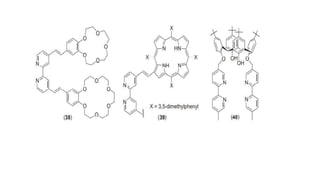
• Conjugated crown ethers analogous have been prepared by coupling
an aldehydefunctionalized crown ether with the lithium dimethyl
bipyridine dianion, followed by dehydration.
• . The porphyrin substituents were incorporated through Wittig
reaction of 4,4’ -diformyl bipyridine with a porphyrin-functionalized
phosphonium salt. Calixarenes with bpy N-oxide and methyl-
substituted bipyridine substituents have been coordinated to
lanthanide and copper metals, respectively.
• Cyclodextrin groups have been bound to bipyridine derivatives via
condensation of monohydroxypermethylated -cyclodextrin with a
bromomethyl bipyridine. These, and other modified bipyridine-CD
ligands, have been subsequently bound to various transition metals.
• A bipyridine-linked cyclodextrin dimer has also been generated by
coupling 5,5’ -dithienyl bipyridine with mono-6-iodo--cyclodextrin
and has been utilized as a template to anchor substrates in close
proximity to metal ions bound at the bipyridine site for ester
hydrolysis.
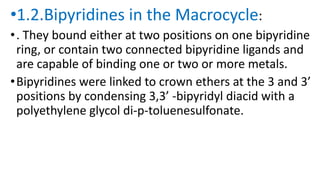
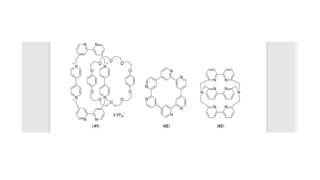
•1.2.Bipyridines in the Macrocycle:
•. They bound either at two positions on one bipyridine
ring, or contain two connected bipyridine ligands and
are capable of binding one or two or more metals.
•Bipyridines were linked to crown ethers at the 3 and 3’
positions by condensing 3,3’ -bipyridyl diacid with a
polyethylene glycol di-p-toluenesulfonate.
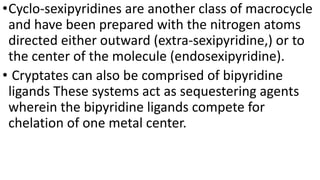
•Cyclo-sexipyridines are another class of macrocycle
and have been prepared with the nitrogen atoms
directed either outward (extra-sexipyridine,) or to
the center of the molecule (endosexipyridine).
• Cryptates can also be comprised of bipyridine
ligands These systems act as sequestering agents
wherein the bipyridine ligands compete for
chelation of one metal center.
1- MULTIDENTATE CHELATES:
•Bipyridines have been functionalized with
additional coordinating groups to form numerous
multidentate structures.
• Among these systems are bipyridines with
additional pyridyl or bipyridyl groups (namely
terpyridine and higher order oligopyridines), oxygen
chelates , groups, as well as cyclic and other higher
order amines.
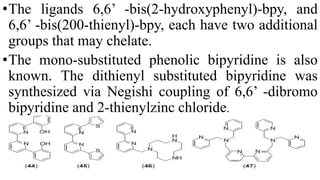
•The ligands 6,6’ -bis(2-hydroxyphenyl)-bpy, and
6,6’ -bis(200-thienyl)-bpy, each have two additional
groups that may chelate.
•The mono-substituted phenolic bipyridine is also
known. The dithienyl substituted bipyridine was
synthesized via Negishi coupling of 6,6’ -dibromo
bipyridine and 2-thienylzinc chloride.
2- POLYMERS:
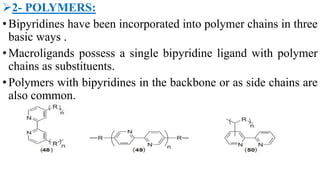
•Bipyridines have been incorporated into polymer chains in three
basic ways .
•Macroligands possess a single bipyridine ligand with polymer
chains as substituents.
•Polymers with bipyridines in the backbone or as side chains are
also common.
 2.1 Macro-ligands :
•Polymers with a single bipyridine binding site covalently bound
at the center or end of the chain have been chelated to both
discrete metal ions, and metal clusters.
• Variants of poly (oxazoline), polystyrene, poly(methyl
methacrylate), poly(ethylene glycol), poly(lactic acid), and
poly(caprolactone) are known.
•These macroligands have been synthesized by polymerizing
from bipyridine ligands with initiator functionalities or by
coupling reactive bipyridines with end groups of linear polymer
chains.
•Similar macromolecular bipyridine ligands with large dendritic
wedges in the 4 and 4’ positions have been bound to (RuII)
centers to generate dendrimers with a photoactive [Ru(bpy)3]
2+ core.
•Buckminsterfullerene units have also been incorporated into
bipyridine systems by coupling an acyl chloride-functionalized
C60 molecule with a hydroxy-functionalized bipyridine.
•Two of these ligands were reacted with [Cu(MeCN)4](PF6) to
generate a metal-centered dimer.
2.2 Bipyridines in the Main Chain:
• Various bis halo-functionalized bipyridine ligands have been
polymerized through iterative coupling steps to generate polypyridyl
structures.
• Monomers such as 5,5’ -dibromo-3,3’ -dinitro-bpy and 5,5’ -diiodo-bpy
as well as many of their alkyl-substituted derivatives are competent for
either cross-coupling with stannanes and borates or for Ni0 -catalyzed
homocouplings.
• Polycondensation of bipyridine diacid or bipyridine
dicarbonyl dichloride ligands with the hydrochlorides
of 2,5-diamino-1,4-benzenediol; 4,6-diamino-1,3-
benzenediol; 2,5-diamino1,4-benzenedithiol; and
2,3,5,6-tetraaminopyridine in poly(phosphoric acid)
have generated rigid-rod poly(benzobisoxazole)-,
poly(benzobisthiazole)-, and poly(benzobisimidazole)-
bpy copolymers, respectively.
•The dithienyl substituted ligand can be
electrothermally polymerized in MeCN to
generate stable n-doped materials with high
bandgaps. The ligand was generated by
coupling the dimethyl bipyridine dianion with
p-aminobenzaldehyde.
2.3 Polymers with Bipyridine Side Chains:
• Bipyridine may be incorporated into polymers as side
chains. These macromolecules are typically generated
by functionalizing a standard monomer with a
bipyridine ligand prior to polymerization.
• For example, a bromomethyl group substituted at the 3
position of a thiophene ring was coupled with various
bipyridine anions formed from lithiation of methyl
precursors to generate a bipyridine-functionalized
thiophene monomer.
3. BIPYRIDINES AND BIOLOGICAL MOLECULES:
 3.1 Peptides:
ligands have been incorporated into polypeptides at the chain
end, in the backbone, and as attached substituents. Synthetic
bipyridine amino acids have been used to construct polypeptides
with bipyridine in the backbone.
 3.3 Nucleic Acids:
A bipyridine nucleoside mimic has enabled the
incorporation of a copper complex inside the double
helix of DNA.
 3.2 Carbohydrates:
The established interaction between boronic acids
and saccharides has been used to selectively
generate and -[Co(bpy)3] 3þ in as high as 79% ee
with þD-glucose.
• 4. BIPYRIDINE ANALOGUES:
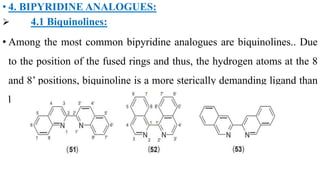
 4.1 Biquinolines:
• Among the most common bipyridine analogues are biquinolines.. Due
to the position of the fused rings and thus, the hydrogen atoms at the 8
and 8’ positions, biquinoline is a more sterically demanding ligand than
bipyridine
 4.2 Biisoquinolines:
• Biisoquinolines differ from biquinolines in the position of the
nitrogen atom relative to the adjacent fused benzene ring. Again, there
are six possible biisoquinoline isomers; however, the two symmetric
molecules, 1,1’- biquinoline and 3,30- biquinoline, are most
commonly employed as transition metal ligands.
 4.3 Other Analogues:
• In fact, palladium complexes have been isolated where one ligand
preferentially bound two palladium centers (one through each
nitrogen).
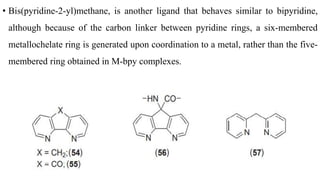
• Bis(pyridine-2-yl)methane, is another ligand that behaves similar to bipyridine,
although because of the carbon linker between pyridine rings, a six-membered
metallochelate ring is generated upon coordination to a metal, rather than the five-
membered ring obtained in M-bpy complexes.

Bipyridines with Pendant Macrocycles The

  • 1.
    1. MACROCYCLES:- 1.1 Bipyridineswith Pendant Macrocycles: • Conjugated crown ethers analogous have been prepared by coupling an aldehydefunctionalized crown ether with the lithium dimethyl bipyridine dianion, followed by dehydration. • . The porphyrin substituents were incorporated through Wittig reaction of 4,4’ -diformyl bipyridine with a porphyrin-functionalized phosphonium salt. Calixarenes with bpy N-oxide and methyl- substituted bipyridine substituents have been coordinated to lanthanide and copper metals, respectively.
  • 2.
    • Cyclodextrin groupshave been bound to bipyridine derivatives via condensation of monohydroxypermethylated -cyclodextrin with a bromomethyl bipyridine. These, and other modified bipyridine-CD ligands, have been subsequently bound to various transition metals. • A bipyridine-linked cyclodextrin dimer has also been generated by coupling 5,5’ -dithienyl bipyridine with mono-6-iodo--cyclodextrin and has been utilized as a template to anchor substrates in close proximity to metal ions bound at the bipyridine site for ester hydrolysis.
  • 4.
    •1.2.Bipyridines in theMacrocycle: •. They bound either at two positions on one bipyridine ring, or contain two connected bipyridine ligands and are capable of binding one or two or more metals. •Bipyridines were linked to crown ethers at the 3 and 3’ positions by condensing 3,3’ -bipyridyl diacid with a polyethylene glycol di-p-toluenesulfonate.
  • 6.
    •Cyclo-sexipyridines are anotherclass of macrocycle and have been prepared with the nitrogen atoms directed either outward (extra-sexipyridine,) or to the center of the molecule (endosexipyridine). • Cryptates can also be comprised of bipyridine ligands These systems act as sequestering agents wherein the bipyridine ligands compete for chelation of one metal center.
  • 7.
    1- MULTIDENTATE CHELATES: •Bipyridineshave been functionalized with additional coordinating groups to form numerous multidentate structures. • Among these systems are bipyridines with additional pyridyl or bipyridyl groups (namely terpyridine and higher order oligopyridines), oxygen chelates , groups, as well as cyclic and other higher order amines.
  • 8.
    •The ligands 6,6’-bis(2-hydroxyphenyl)-bpy, and 6,6’ -bis(200-thienyl)-bpy, each have two additional groups that may chelate. •The mono-substituted phenolic bipyridine is also known. The dithienyl substituted bipyridine was synthesized via Negishi coupling of 6,6’ -dibromo bipyridine and 2-thienylzinc chloride.
  • 9.
    2- POLYMERS: •Bipyridines havebeen incorporated into polymer chains in three basic ways . •Macroligands possess a single bipyridine ligand with polymer chains as substituents. •Polymers with bipyridines in the backbone or as side chains are also common.
  • 10.
     2.1 Macro-ligands: •Polymers with a single bipyridine binding site covalently bound at the center or end of the chain have been chelated to both discrete metal ions, and metal clusters. • Variants of poly (oxazoline), polystyrene, poly(methyl methacrylate), poly(ethylene glycol), poly(lactic acid), and poly(caprolactone) are known. •These macroligands have been synthesized by polymerizing from bipyridine ligands with initiator functionalities or by coupling reactive bipyridines with end groups of linear polymer chains.
  • 11.
    •Similar macromolecular bipyridineligands with large dendritic wedges in the 4 and 4’ positions have been bound to (RuII) centers to generate dendrimers with a photoactive [Ru(bpy)3] 2+ core. •Buckminsterfullerene units have also been incorporated into bipyridine systems by coupling an acyl chloride-functionalized C60 molecule with a hydroxy-functionalized bipyridine. •Two of these ligands were reacted with [Cu(MeCN)4](PF6) to generate a metal-centered dimer.
  • 12.
    2.2 Bipyridines inthe Main Chain: • Various bis halo-functionalized bipyridine ligands have been polymerized through iterative coupling steps to generate polypyridyl structures. • Monomers such as 5,5’ -dibromo-3,3’ -dinitro-bpy and 5,5’ -diiodo-bpy as well as many of their alkyl-substituted derivatives are competent for either cross-coupling with stannanes and borates or for Ni0 -catalyzed homocouplings.
  • 13.
    • Polycondensation ofbipyridine diacid or bipyridine dicarbonyl dichloride ligands with the hydrochlorides of 2,5-diamino-1,4-benzenediol; 4,6-diamino-1,3- benzenediol; 2,5-diamino1,4-benzenedithiol; and 2,3,5,6-tetraaminopyridine in poly(phosphoric acid) have generated rigid-rod poly(benzobisoxazole)-, poly(benzobisthiazole)-, and poly(benzobisimidazole)- bpy copolymers, respectively.
  • 14.
    •The dithienyl substitutedligand can be electrothermally polymerized in MeCN to generate stable n-doped materials with high bandgaps. The ligand was generated by coupling the dimethyl bipyridine dianion with p-aminobenzaldehyde.
  • 15.
    2.3 Polymers withBipyridine Side Chains: • Bipyridine may be incorporated into polymers as side chains. These macromolecules are typically generated by functionalizing a standard monomer with a bipyridine ligand prior to polymerization. • For example, a bromomethyl group substituted at the 3 position of a thiophene ring was coupled with various bipyridine anions formed from lithiation of methyl precursors to generate a bipyridine-functionalized thiophene monomer.
  • 16.
    3. BIPYRIDINES ANDBIOLOGICAL MOLECULES:  3.1 Peptides: ligands have been incorporated into polypeptides at the chain end, in the backbone, and as attached substituents. Synthetic bipyridine amino acids have been used to construct polypeptides with bipyridine in the backbone.
  • 17.
     3.3 NucleicAcids: A bipyridine nucleoside mimic has enabled the incorporation of a copper complex inside the double helix of DNA.
  • 18.
     3.2 Carbohydrates: Theestablished interaction between boronic acids and saccharides has been used to selectively generate and -[Co(bpy)3] 3þ in as high as 79% ee with þD-glucose.
  • 19.
    • 4. BIPYRIDINEANALOGUES:  4.1 Biquinolines: • Among the most common bipyridine analogues are biquinolines.. Due to the position of the fused rings and thus, the hydrogen atoms at the 8 and 8’ positions, biquinoline is a more sterically demanding ligand than bipyridine
  • 20.
     4.2 Biisoquinolines: •Biisoquinolines differ from biquinolines in the position of the nitrogen atom relative to the adjacent fused benzene ring. Again, there are six possible biisoquinoline isomers; however, the two symmetric molecules, 1,1’- biquinoline and 3,30- biquinoline, are most commonly employed as transition metal ligands.  4.3 Other Analogues: • In fact, palladium complexes have been isolated where one ligand preferentially bound two palladium centers (one through each nitrogen).
  • 21.
    • Bis(pyridine-2-yl)methane, isanother ligand that behaves similar to bipyridine, although because of the carbon linker between pyridine rings, a six-membered metallochelate ring is generated upon coordination to a metal, rather than the five- membered ring obtained in M-bpy complexes.