TO BE PRESENT
BY
ZAHARADDEEN KARAMI LAWAL
Department of Computer Science and Engineering,
Faculty of Engineering and
Technology,
Jodhpur National University, Jodhpur
1
Table of contents
1.1 Introduction …………………………………………………. 3
1.2 Features of Ozone …………………………………… 4_5
1.3 Difference between Ozone and JDO …………….. 6
1.4 Architecture of Ozone ..................................7 _10
1.5 Conclusion …………………………………………………… 11
1.6 References …………………………………………………….. 12
2
Introduction
The Ozone Database (www.ozone-db.org) is a fully
featured, OODMS completely implemented in Java
Server that makes it possible to execute persistence
objects in a transactional environment.
Ozone is a database management system (DBMS)
that allows developers to build pure object-oriented,
pure java database applications.
3
continue
Ozone manages large collection of java objects
through the use of java object serialization with
paging and caching as well as other advanced
database techniques. Java objects can be created and
run on in a transactional environment.
The main goal of ozone is to add persistence and
transaction to the java object model in a transparent
manner. Ozone applications look and works like
ordinary java applications. There is no division
between data model and object model. There is no
database other than ozone itself at the back end.
4
Features of Ozone
1.Besides the native API, Ozone provides an ODMG 3.0
interface. Although not fully ODMG compliant, it helps in
porting the applications to/from Ozone.
2. The DBMS is simple to install and maintain and is written
entirely in java. The database can be run in either a client server
mode, enabling multiple applications to connect to and
manipulate the data simultaneously, or as embedded server
which runs in the same JVM as the application which accesses
and manipulates the data.
3. Besides java, ozone also has an extended XML support.
5. It supports transactions, RMI (Remote Method Invocation),
Multi user access and multi-threading.
6. Ozone does not depend on any backend database or mapping
technology to actually save objects. It contain its own clustered
storage and cache system to handle persistent java object
5
continue
7. The ozone has a garbage collector (i.e Garbage
Collection) its an automatic memory management
which simplifies the development of application
systems using complex data structures.
6
 
Difference between Ozone and Java Data
Objects (JDO)
1. Ozone objects are different from JDO. JDO is only a
storage mechanism , whereas Ozone Objects act both
as data and application objects.
2. JDO only supports fields but not methods, whereas
Ozone is a method dependent and not field
dependent.
3. Ozone relies on a single-instance architecture where
there is only one instance of a database object inside
the database server control with proxy object.
7
Architecture of Ozone
8
Architecture of Ozone
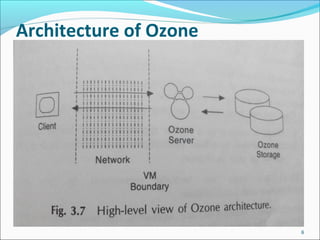
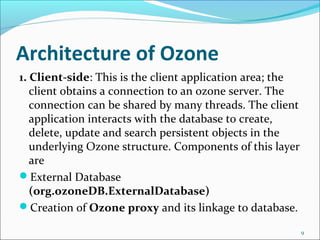
1. Client-side: This is the client application area; the
client obtains a connection to an ozone server. The
connection can be shared by many threads. The client
application interacts with the database to create,
delete, update and search persistent objects in the
underlying Ozone structure. Components of this layer
are
External Database
(org.ozoneDB.ExternalDatabase)
Creation of Ozone proxy and its linkage to database.
9
continue
2. Network layer: This is where the Ozone protocol
plays a role similar to RMI.
3. Server: the server manages client connections,
security and incoming method invocations from
clients. The server maintains a transactional safe
environment for multiple client access persistence
object through a remote proxy. This layer can be
describe by the following components:
The protocol
Server’s components
Connection management
10
continue
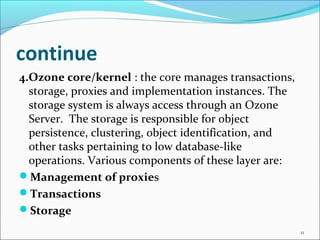
4.Ozone core/kernel : the core manages transactions,
storage, proxies and implementation instances. The
storage system is always access through an Ozone
Server. The storage is responsible for object
persistence, clustering, object identification, and
other tasks pertaining to low database-like
operations. Various components of these layer are:
Management of proxies
Transactions
Storage
11
Conclusion
We have surveyed the features of Ozone, the open
source OODBMS. We have also discussed the Ozone
architecture, Components of client-side, server-side
and Ozone core.
12
References
1. Object-oriented Database Systems, Approaches and
Architecture by C.S.R Prabhu, third edition.
2. Java Data Objects by Addison-Wesley, London 2002.
3. www.ozone.org
4. www.beginnersbook.com
13

Ozone java based

  • 1.
    TO BE PRESENT BY ZAHARADDEENKARAMI LAWAL Department of Computer Science and Engineering, Faculty of Engineering and Technology, Jodhpur National University, Jodhpur 1
  • 2.
    Table of contents 1.1Introduction …………………………………………………. 3 1.2 Features of Ozone …………………………………… 4_5 1.3 Difference between Ozone and JDO …………….. 6 1.4 Architecture of Ozone ..................................7 _10 1.5 Conclusion …………………………………………………… 11 1.6 References …………………………………………………….. 12 2
  • 3.
    Introduction The Ozone Database(www.ozone-db.org) is a fully featured, OODMS completely implemented in Java Server that makes it possible to execute persistence objects in a transactional environment. Ozone is a database management system (DBMS) that allows developers to build pure object-oriented, pure java database applications. 3
  • 4.
    continue Ozone manages largecollection of java objects through the use of java object serialization with paging and caching as well as other advanced database techniques. Java objects can be created and run on in a transactional environment. The main goal of ozone is to add persistence and transaction to the java object model in a transparent manner. Ozone applications look and works like ordinary java applications. There is no division between data model and object model. There is no database other than ozone itself at the back end. 4
  • 5.
    Features of Ozone 1.Besidesthe native API, Ozone provides an ODMG 3.0 interface. Although not fully ODMG compliant, it helps in porting the applications to/from Ozone. 2. The DBMS is simple to install and maintain and is written entirely in java. The database can be run in either a client server mode, enabling multiple applications to connect to and manipulate the data simultaneously, or as embedded server which runs in the same JVM as the application which accesses and manipulates the data. 3. Besides java, ozone also has an extended XML support. 5. It supports transactions, RMI (Remote Method Invocation), Multi user access and multi-threading. 6. Ozone does not depend on any backend database or mapping technology to actually save objects. It contain its own clustered storage and cache system to handle persistent java object 5
  • 6.
    continue 7. The ozonehas a garbage collector (i.e Garbage Collection) its an automatic memory management which simplifies the development of application systems using complex data structures. 6
  • 7.
      Difference between Ozoneand Java Data Objects (JDO) 1. Ozone objects are different from JDO. JDO is only a storage mechanism , whereas Ozone Objects act both as data and application objects. 2. JDO only supports fields but not methods, whereas Ozone is a method dependent and not field dependent. 3. Ozone relies on a single-instance architecture where there is only one instance of a database object inside the database server control with proxy object. 7
  • 8.
  • 9.
    Architecture of Ozone 1.Client-side: This is the client application area; the client obtains a connection to an ozone server. The connection can be shared by many threads. The client application interacts with the database to create, delete, update and search persistent objects in the underlying Ozone structure. Components of this layer are External Database (org.ozoneDB.ExternalDatabase) Creation of Ozone proxy and its linkage to database. 9
  • 10.
    continue 2. Network layer:This is where the Ozone protocol plays a role similar to RMI. 3. Server: the server manages client connections, security and incoming method invocations from clients. The server maintains a transactional safe environment for multiple client access persistence object through a remote proxy. This layer can be describe by the following components: The protocol Server’s components Connection management 10
  • 11.
    continue 4.Ozone core/kernel :the core manages transactions, storage, proxies and implementation instances. The storage system is always access through an Ozone Server. The storage is responsible for object persistence, clustering, object identification, and other tasks pertaining to low database-like operations. Various components of these layer are: Management of proxies Transactions Storage 11
  • 12.
    Conclusion We have surveyedthe features of Ozone, the open source OODBMS. We have also discussed the Ozone architecture, Components of client-side, server-side and Ozone core. 12
  • 13.
    References 1. Object-oriented DatabaseSystems, Approaches and Architecture by C.S.R Prabhu, third edition. 2. Java Data Objects by Addison-Wesley, London 2002. 3. www.ozone.org 4. www.beginnersbook.com 13