The 
Future 
of 
Scien2fic 
Publishing 
Marie 
Farge 
LMD-­‐CNRS, 
Ecole 
Normale 
Supérieure, 
Paris 
Paris, 
October 
30th 
2014
What is scientific publishing? 
Scien'fic 
research 
is 
a 
collabora've 
ac'vity, 
in 
both 
space 
and 
'me, 
that 
advances 
through 
discussions, 
seminars, 
conferences 
and 
peer-­‐reviewed 
ar'cles 
Publishing 
means 
making 
scien'fic 
results 
publicly 
available 
(1) 
€ 
⇒ 
This 
guarantees 
valida'on, 
reproduc'on, 
transmission 
and 
conserva'on 
of 
scien'fic 
results 
for 
the 
advancement 
of 
knowledge 
(1) 
To 
whom? 
How? 
Who 
pays?
To whom are articles available ? 
Only 
to 
scien'sts 
working 
in 
ins'tu'ons 
and 
countries 
rich 
enough 
to 
afford 
the 
very 
costly 
subscrip'ons 
and 
ar'cle 
processing 
charges 
imposed 
by 
publishers 
but 
scien'sts 
in 
developing 
countries, 
companies, 
highschool 
teachers 
and 
all 
ci'zens 
who 
finance 
public 
research 
cannot 
access 
scien'fic 
papers 
Principle 
of 
intellectual 
commons 
: 
Ideas 
are 
not 
of 
the 
same 
nature 
as 
material 
objects. 
Ideas 
are 
only 
fruiEul 
if 
they 
are 
exchanged, 
discussed, 
cri'cised, 
improved, 
reproduced 
and 
explained. 
When 
you 
share 
your 
ideas 
you 
don’t 
lose 
them. 
Ideas 
are 
not 
merchandise 
but 
intellectual 
commons 
!
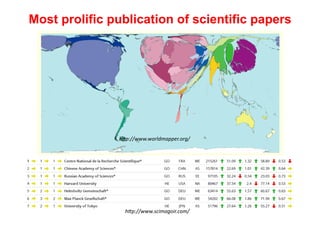
Most prolific publication of scientific papers 
hBp://www.worldmapper.org/ 
hBp://www.scimagoir.com/
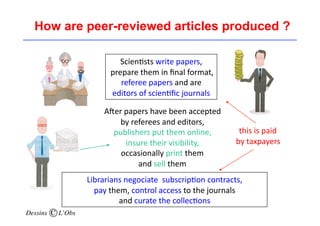
How are peer-reviewed articles produced ? 
Scien'sts 
write 
papers, 
prepare 
them 
in 
final 
format, 
referee 
papers 
and 
are 
editors 
of 
scien'fic 
journals 
this 
is 
paid 
by 
taxpayers 
ALer 
papers 
have 
been 
accepted 
by 
referees 
and 
editors, 
publishers 
put 
them 
online, 
insure 
their 
visibility, 
occasionally 
print 
them 
and 
sell 
them 
Librarians 
negociate 
subscrip'on 
contracts, 
pay 
them, 
control 
access 
to 
the 
journals 
and 
curate 
the 
collec'ons 
Dessins 
L’Obs
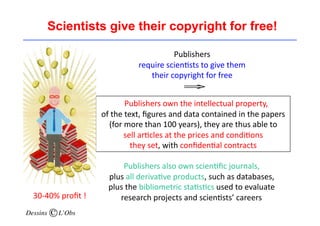
Scientists give their copyright for free! 
Publishers 
require 
scien'sts 
to 
give 
them 
their 
copyright 
for 
free 
Publishers 
own 
the 
intellectual 
property, 
of 
the 
text, 
figures 
and 
data 
contained 
in 
the 
papers 
(for 
more 
than 
100 
years), 
they 
are 
thus 
able 
to 
sell 
ar'cles 
at 
the 
prices 
and 
condi'ons 
they 
set, 
with 
confiden'al 
contracts 
€ 
⇒ 
Publishers 
also 
own 
scien'fic 
journals, 
plus 
all 
deriva've 
products, 
such 
as 
databases, 
plus 
the 
bibliometric 
sta's'cs 
used 
to 
evaluate 
research 
projects 
30-­‐40% 
profit 
! 
and 
scien'sts’ 
careers 
Dessins 
L’Obs
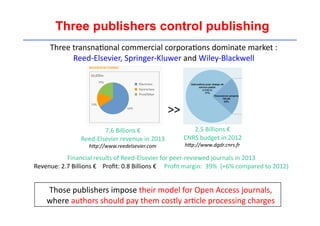
Three publishers control publishing 
Three 
transna'onal 
commercial 
corpora'ons 
dominate 
market 
: 
Reed-­‐Elsevier, 
Springer-­‐Kluwer 
and 
Wiley-­‐Blackwell 
7.6 
Billions 
€ 
Reed-­‐Elsevier 
revenue 
in 
2013 
hBp://www.reedelsevier.com 
2.5 
Billions 
€ 
CNRS 
budget 
in 
2012 
hBp://www.dgdr.cnrs.fr 
>> 
Financial 
results 
of 
Reed-­‐Elsevier 
for 
peer-­‐reviewed 
journals 
in 
2013 
Revenue: 
2.7 
Billions 
€ 
Profit: 
0.8 
Billions 
€ 
Profit 
margin: 
39% 
(+6% 
compared 
to 
2012) 
Those 
publishers 
impose 
their 
model 
for 
Open 
Access 
journals, 
where 
authors 
should 
pay 
them 
costly 
ar'cle 
processing 
charges
How could scientists take back control? 
1 
Authors 
should 
keep 
their 
copyright 
and 
make 
their 
papers 
available 
in 
open 
access 
under 
a 
Crea've 
Commons 
licenses 
CC-­‐BY 
2 
Journals 
should 
be 
owned 
by 
their 
editorial 
board 
in 
charge 
of 
the 
peer-­‐reviewing, 
while 
editors 
and 
referees 
will 
con'nue 
to 
do 
this 
for 
free 
3 
Funding 
agencies 
should 
no 
longer 
pay, 
subscrip'ons 
and 
ar'cle 
processing 
charges, 
directly 
to 
publishers 
as 
long 
as 
market 
is 
oligolis'c 
with 
confiden'ality 
clauses
Scientists need publishing platforms 
1 
Funding 
agencies 
should 
provide 
to 
the 
scien'fic 
community 
publishing 
plaEorms, 
developed 
in 
open 
source 
soLware, 
for 
edi'ng 
and 
publishing 
peer-­‐reviewed 
journals 
with 
the 
help 
of 
librarians 
and 
publishers 
as 
subcontractors 
2 
Publishing 
plaEorms 
would 
offer 
to 
anyone 
freely 
usable 
scien'fic 
papers, 
in 
open 
access 
under 
CC-­‐BY 
licenses, 
without 
authors 
having 
to 
pay 
to 
publish 
3 
Funding 
agencies 
would 
thus 
control 
the 
quality 
of 
peer-­‐reviewing, 
by 
selec'ng 
the 
journals 
having 
good 
prac'ces 
and 
reputable 
editors
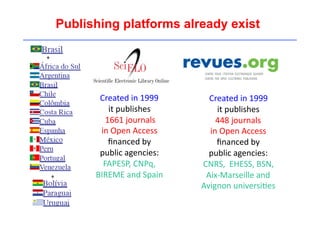
Publishing platforms already exist 
Created 
in 
1999 
it 
publishes 
448 
journals 
in 
Open 
Access 
financed 
by 
public 
agencies: 
CNRS, 
EHESS, 
BSN, 
Aix-­‐Marseille 
and 
Avignon 
universi'es 
Created 
in 
1999 
it 
publishes 
1661 
journals 
in 
Open 
Access 
financed 
by 
public 
agencies: 
FAPESP, 
CNPq, 
BIREME 
and 
Spain 
+ 
+
In conclusion 
Scien=fic 
publishing 
today 
: 
Investments 
for 
wri'ng 
and 
peer-­‐reviewing 
scien'fic 
papers 
are 
public, 
but 
ownership 
of 
scien'fic 
journals 
and 
profits 
from 
subscrip'ons 
are 
private 
Publishers 
should 
become 
compe'ng 
service 
providers 
to 
the 
publicly 
funded 
and 
publicly 
owned 
publishing 
plaEorms, 
but 
no 
longer 
intellectual 
content 
owners 
Scien=fic 
publishing 
tomorrow 
: 
Scien'fic 
papers 
will 
be 
available 
for 
free 
in 
open 
access, 
and 
their 
content 
usable, 
to 
anyone 
and 
to 
any 
ins'tu'on, 
for 
the 
sake 
of 
the 
advancement 
of 
knowledge 
€ 
⇒
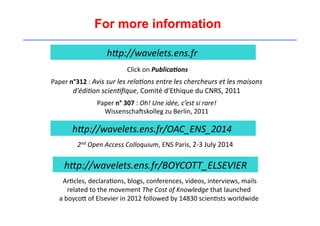
For more information 
hBp://wavelets.ens.fr 
Click 
on 
Publica=ons 
Paper 
n°312 
: 
Avis 
sur 
les 
relaSons 
entre 
les 
chercheurs 
et 
les 
maisons 
d'édiSon 
scienSfique, 
Comité 
d'Ethique 
du 
CNRS, 
2011 
Paper 
n° 
307 
: 
Oh! 
Une 
idée, 
c’est 
si 
rare! 
WissenschaLskolleg 
zu 
Berlin, 
2011 
hBp://wavelets.ens.fr/OAC_ENS_2014 
2nd 
Open 
Access 
Colloquium, 
ENS 
Paris, 
2-­‐3 
July 
2014 
hBp://wavelets.ens.fr/BOYCOTT_ELSEVIER 
Ar'cles, 
declara'ons, 
blogs, 
conferences, 
videos, 
interviews, 
mails 
related 
to 
the 
movement 
The 
Cost 
of 
Knowledge 
that 
launched 
a 
boycol 
of 
Elsevier 
in 
2012 
followed 
by 
14830 
scien'sts 
worldwide

OWF14 - Plenary Session : Marie Farge, Research director, Ecole Normale Supérieure

  • 1.
    The Future of Scien2fic Publishing Marie Farge LMD-­‐CNRS, Ecole Normale Supérieure, Paris Paris, October 30th 2014
  • 2.
    What is scientificpublishing? Scien'fic research is a collabora've ac'vity, in both space and 'me, that advances through discussions, seminars, conferences and peer-­‐reviewed ar'cles Publishing means making scien'fic results publicly available (1) € ⇒ This guarantees valida'on, reproduc'on, transmission and conserva'on of scien'fic results for the advancement of knowledge (1) To whom? How? Who pays?
  • 3.
    To whom arearticles available ? Only to scien'sts working in ins'tu'ons and countries rich enough to afford the very costly subscrip'ons and ar'cle processing charges imposed by publishers but scien'sts in developing countries, companies, highschool teachers and all ci'zens who finance public research cannot access scien'fic papers Principle of intellectual commons : Ideas are not of the same nature as material objects. Ideas are only fruiEul if they are exchanged, discussed, cri'cised, improved, reproduced and explained. When you share your ideas you don’t lose them. Ideas are not merchandise but intellectual commons !
  • 4.
    Most prolific publicationof scientific papers hBp://www.worldmapper.org/ hBp://www.scimagoir.com/
  • 5.
    How are peer-reviewedarticles produced ? Scien'sts write papers, prepare them in final format, referee papers and are editors of scien'fic journals this is paid by taxpayers ALer papers have been accepted by referees and editors, publishers put them online, insure their visibility, occasionally print them and sell them Librarians negociate subscrip'on contracts, pay them, control access to the journals and curate the collec'ons Dessins L’Obs
  • 6.
    Scientists give theircopyright for free! Publishers require scien'sts to give them their copyright for free Publishers own the intellectual property, of the text, figures and data contained in the papers (for more than 100 years), they are thus able to sell ar'cles at the prices and condi'ons they set, with confiden'al contracts € ⇒ Publishers also own scien'fic journals, plus all deriva've products, such as databases, plus the bibliometric sta's'cs used to evaluate research projects 30-­‐40% profit ! and scien'sts’ careers Dessins L’Obs
  • 7.
    Three publishers controlpublishing Three transna'onal commercial corpora'ons dominate market : Reed-­‐Elsevier, Springer-­‐Kluwer and Wiley-­‐Blackwell 7.6 Billions € Reed-­‐Elsevier revenue in 2013 hBp://www.reedelsevier.com 2.5 Billions € CNRS budget in 2012 hBp://www.dgdr.cnrs.fr >> Financial results of Reed-­‐Elsevier for peer-­‐reviewed journals in 2013 Revenue: 2.7 Billions € Profit: 0.8 Billions € Profit margin: 39% (+6% compared to 2012) Those publishers impose their model for Open Access journals, where authors should pay them costly ar'cle processing charges
  • 8.
    How could scientiststake back control? 1 Authors should keep their copyright and make their papers available in open access under a Crea've Commons licenses CC-­‐BY 2 Journals should be owned by their editorial board in charge of the peer-­‐reviewing, while editors and referees will con'nue to do this for free 3 Funding agencies should no longer pay, subscrip'ons and ar'cle processing charges, directly to publishers as long as market is oligolis'c with confiden'ality clauses
  • 9.
    Scientists need publishingplatforms 1 Funding agencies should provide to the scien'fic community publishing plaEorms, developed in open source soLware, for edi'ng and publishing peer-­‐reviewed journals with the help of librarians and publishers as subcontractors 2 Publishing plaEorms would offer to anyone freely usable scien'fic papers, in open access under CC-­‐BY licenses, without authors having to pay to publish 3 Funding agencies would thus control the quality of peer-­‐reviewing, by selec'ng the journals having good prac'ces and reputable editors
  • 10.
    Publishing platforms alreadyexist Created in 1999 it publishes 448 journals in Open Access financed by public agencies: CNRS, EHESS, BSN, Aix-­‐Marseille and Avignon universi'es Created in 1999 it publishes 1661 journals in Open Access financed by public agencies: FAPESP, CNPq, BIREME and Spain + +
  • 11.
    In conclusion Scien=fic publishing today : Investments for wri'ng and peer-­‐reviewing scien'fic papers are public, but ownership of scien'fic journals and profits from subscrip'ons are private Publishers should become compe'ng service providers to the publicly funded and publicly owned publishing plaEorms, but no longer intellectual content owners Scien=fic publishing tomorrow : Scien'fic papers will be available for free in open access, and their content usable, to anyone and to any ins'tu'on, for the sake of the advancement of knowledge € ⇒
  • 12.
    For more information hBp://wavelets.ens.fr Click on Publica=ons Paper n°312 : Avis sur les relaSons entre les chercheurs et les maisons d'édiSon scienSfique, Comité d'Ethique du CNRS, 2011 Paper n° 307 : Oh! Une idée, c’est si rare! WissenschaLskolleg zu Berlin, 2011 hBp://wavelets.ens.fr/OAC_ENS_2014 2nd Open Access Colloquium, ENS Paris, 2-­‐3 July 2014 hBp://wavelets.ens.fr/BOYCOTT_ELSEVIER Ar'cles, declara'ons, blogs, conferences, videos, interviews, mails related to the movement The Cost of Knowledge that launched a boycol of Elsevier in 2012 followed by 14830 scien'sts worldwide