Owens Illinois Inc.
Glass container producer
Vladislav Sadykov
Subjects
 Company profile
 Products
 Market coverage
 Clients
 Definition of the customer
 Performance objectives
 Operations strategy
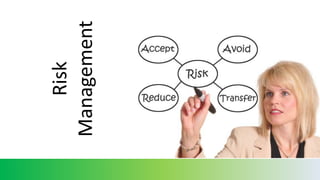
 Risk management
Company Profile
• Founded in 1903, merged in 1929
• $7 billion in net sales in 2013
• 77 plants in 21 countries
• 22,500-plus employees worldwide
• 1,900-plus worldwide patents
• 49,000-plus customers in 86 countries
• 10,000-plus product offerings
• 600-plus new product solutions launched each year
• More post-consumer glass - 4.5 million tons - used than any other glass-container
maker
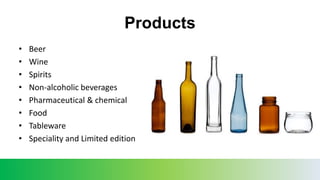
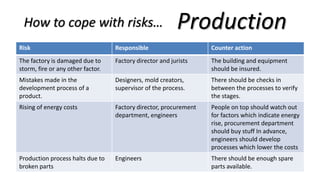
Products
• Beer
• Wine
• Spirits
• Non-alcoholic beverages
• Pharmaceutical & chemical
• Food
• Tableware
• Speciality and Limited edition
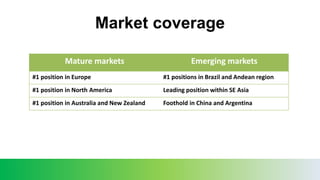
Market coverage
Mature markets Emerging markets
#1 position in Europe #1 positions in Brazil and Andean region
#1 position in North America Leading position within SE Asia
#1 position in Australia and New Zealand Foothold in China and Argentina
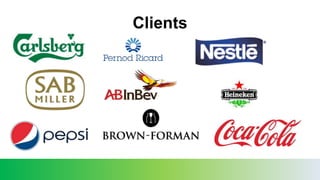
Clients
Definition of the customer
• Consumer – the person who uses the bottles to
consume liquids or other contents.
• Client – retailer or corporation e.g. holder of the brand
name who orders the company to produce containers.
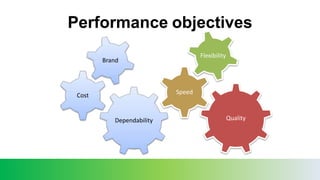
Performance objectives
Quality
Speed
Flexibility
Dependability
Cost
Brand
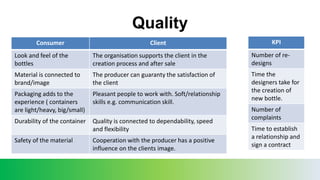
Quality
Consumer Client
Look and feel of the
bottles
The organisation supports the client in the
creation process and after sale
Material is connected to
brand/image
The producer can guaranty the satisfaction of
the client
Packaging adds to the
experience ( containers
are light/heavy, big/small)
Pleasant people to work with. Soft/relationship
skills e.g. communication skill.
Durability of the container Quality is connected to dependability, speed
and flexibility
Safety of the material Cooperation with the producer has a positive
influence on the clients image.
KPI
Number of re-
designs
Time the
designers take for
the creation of
new bottle.
Number of
complaints
Time to establish
a relationship and
sign a contract
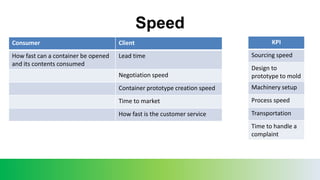
Speed
Consumer Client
How fast can a container be opened
and its contents consumed
Lead time
Negotiation speed
Container prototype creation speed
Time to market
How fast is the customer service
KPI
Sourcing speed
Design to
prototype to mold
Machinery setup
Process speed
Transportation
Time to handle a
complaint
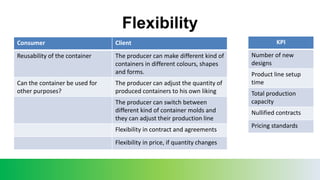
Flexibility
Consumer Client
Reusability of the container The producer can make different kind of
containers in different colours, shapes
and forms.
Can the container be used for
other purposes?
The producer can adjust the quantity of
produced containers to his own liking
The producer can switch between
different kind of container molds and
they can adjust their production line
Flexibility in contract and agreements
Flexibility in price, if quantity changes
KPI
Number of new
designs
Product line setup
time
Total production
capacity
Nullified contracts
Pricing standards
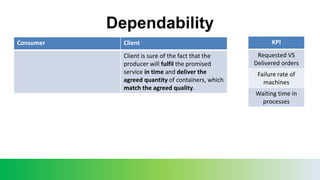
Dependability
Consumer Client
Client is sure of the fact that the
producer will fulfil the promised
service in time and deliver the
agreed quantity of containers, which
match the agreed quality.
KPI
Requested VS
Delivered orders
Failure rate of
machines
Waiting time in
processes
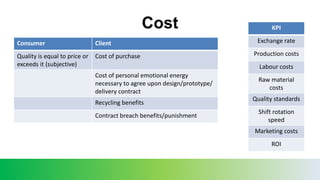
Cost
Consumer Client
Quality is equal to price or
exceeds it (subjective)
Cost of purchase
Cost of personal emotional energy
necessary to agree upon design/prototype/
delivery contract
Recycling benefits
Contract breach benefits/punishment
KPI
Exchange rate
Production costs
Labour costs
Raw material
costs
Quality standards
Shift rotation
speed
Marketing costs
ROI
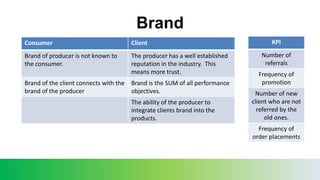
Brand
Consumer Client
Brand of producer is not known to
the consumer.
The producer has a well established
reputation in the industry. This
means more trust.
Brand of the client connects with the
brand of the producer
Brand is the SUM of all performance
objectives.
The ability of the producer to
integrate clients brand into the
products.
KPI
Number of
referrals
Frequency of
promotion
Number of new
client who are not
referred by the
old ones.
Frequency of
order placements
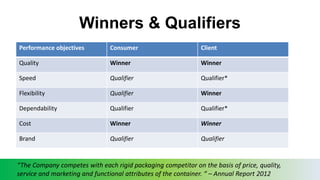
Winners & Qualifiers
Performance objectives Consumer Client
Quality Winner Winner
Speed Qualifier Qualifier*
Flexibility Qualifier Winner
Dependability Qualifier Qualifier*
Cost Winner Winner
Brand Qualifier Qualifier
“The Company competes with each rigid packaging competitor on the basis of price, quality,
service and marketing and functional attributes of the container. “ – Annual Report 2012
Operations
Management
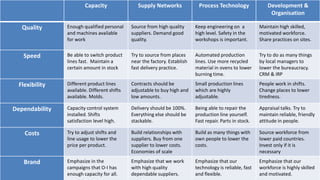
Capacity Supply Networks Process Technology Development &
Organisation
Quality Enough qualified personal
and machines available
for work
Source from high quality
suppliers. Demand good
quality.
Keep engineering on a
high level. Safety in the
workshops is important.
Maintain high skilled,
motivated workforce.
Share practices on sites.
Speed Be able to switch product
lines fast. Maintain a
certain amount in stock
Try to source from places
near the factory. Establish
fast delivery practice.
Automated production
lines. Use more recycled
material in ovens to lower
burning time.
Try to do as many things
by local managers to
lower the bureaucracy.
CRM & IRP
Flexibility Different product lines
available. Different shifts
available. Molds.
Contracts should be
adjustable to buy high and
low amounts.
Small production lines
which are highly
adjustable.
People work in shifts.
Change places to lower
tiredness.
Dependability Capacity control system
installed. Shifts
satisfaction level high.
Delivery should be 100%.
Everything else should be
stackable.
Being able to repair the
production line yourself.
Fast repair. Parts in stock.
Appraisal talks. Try to
maintain reliable, friendly
attitude in people.
Costs Try to adjust shifts and
line usage to lower the
price per product.
Build relationships with
suppliers. Buy from one
supplier to lower costs.
Economies of scale
Build as many things with
own people to lower the
costs.
Source workforce from
lower paid countries.
Invest only if it is
necessary
Brand Emphasize in the
campaigns that O-I has
enough capacity for all.
Emphasize that we work
with high quality
dependable suppliers.
Emphasize that our
technology is reliable, fast
and flexible.
Emphasize that our
workforce is highly skilled
and motivated.
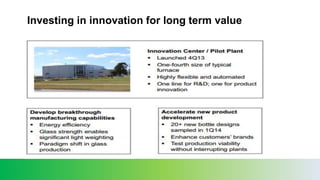
Investing in innovation for long term value
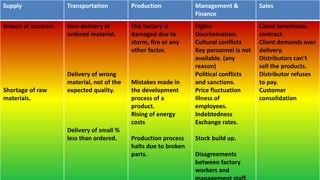
Risk
Management
Supply Transportation Production Management &
Finance
Sales
Breach of contract.
Shortage of raw
materials.
Non-delivery of
ordered material.
Delivery of wrong
material, not of the
expected quality.
Delivery of small %
less than ordered.
The factory is
damaged due to
storm, fire or any
other factor.
Mistakes made in
the development
process of a
product.
Rising of energy
costs
Production process
halts due to broken
parts.
Fights.
Discrimination.
Cultural conflicts
Key personnel is not
available. (any
reason)
Political conflicts
and sanctions.
Price fluctuation
Illness of
employees.
Indebtedness
Exchange rates.
Stock build up.
Disagreements
between factory
workers and
Client terminates
contract.
Client demands over
delivery.
Distributors can’t
sell the products.
Distributor refuses
to pay.
Customer
consolidation
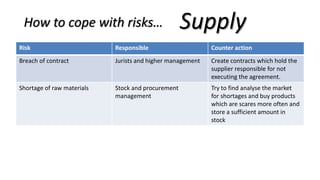
How to cope with risks…
Risk Responsible Counter action
Breach of contract Jurists and higher management Create contracts which hold the
supplier responsible for not
executing the agreement.
Shortage of raw materials Stock and procurement
management
Try to find analyse the market
for shortages and buy products
which are scares more often and
store a sufficient amount in
stock
Supply
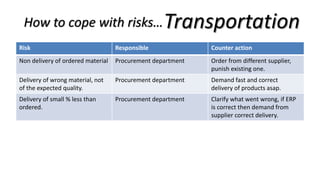
How to cope with risks…
Risk Responsible Counter action
Non delivery of ordered material Procurement department Order from different supplier,
punish existing one.
Delivery of wrong material, not
of the expected quality.
Procurement department Demand fast and correct
delivery of products asap.
Delivery of small % less than
ordered.
Procurement department Clarify what went wrong, if ERP
is correct then demand from
supplier correct delivery.
Transportation
How to cope with risks…
Risk Responsible Counter action
The factory is damaged due to
storm, fire or any other factor.
Factory director and jurists The building and equipment
should be insured.
Mistakes made in the
development process of a
product.
Designers, mold creators,
supervisor of the process.
There should be checks in
between the processes to verify
the stages.
Rising of energy costs Factory director, procurement
department, engineers
People on top should watch out
for factors which indicate energy
rise, procurement department
should buy stuff In advance,
engineers should develop
processes which lower the costs
Production process halts due to
broken parts
Engineers There should be enough spare
parts available.
Production
How to cope with risks…
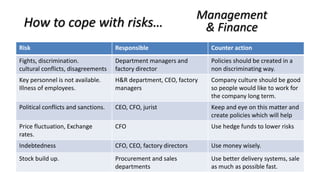
Risk Responsible Counter action
Fights, discrimination.
cultural conflicts, disagreements
Department managers and
factory director
Policies should be created in a
non discriminating way.
Key personnel is not available.
Illness of employees.
H&R department, CEO, factory
managers
Company culture should be good
so people would like to work for
the company long term.
Political conflicts and sanctions. CEO, CFO, jurist Keep and eye on this matter and
create policies which will help
Price fluctuation, Exchange
rates.
CFO Use hedge funds to lower risks
Indebtedness CFO, CEO, factory directors Use money wisely.
Stock build up. Procurement and sales
departments
Use better delivery systems, sale
as much as possible fast.
Management
& Finance
How to cope with risks…
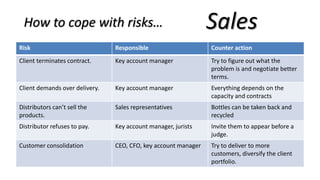
Risk Responsible Counter action
Client terminates contract. Key account manager Try to figure out what the
problem is and negotiate better
terms.
Client demands over delivery. Key account manager Everything depends on the
capacity and contracts
Distributors can’t sell the
products.
Sales representatives Bottles can be taken back and
recycled
Distributor refuses to pay. Key account manager, jurists Invite them to appear before a
judge.
Customer consolidation CEO, CFO, key account manager Try to deliver to more
customers, diversify the client
portfolio.
Sales
Thank you for your attention!
Questions?

Owens Illinois.pptx

  • 1.
    Owens Illinois Inc. Glasscontainer producer Vladislav Sadykov
  • 2.
    Subjects  Company profile Products  Market coverage  Clients  Definition of the customer  Performance objectives  Operations strategy  Risk management
  • 3.
    Company Profile • Foundedin 1903, merged in 1929 • $7 billion in net sales in 2013 • 77 plants in 21 countries • 22,500-plus employees worldwide • 1,900-plus worldwide patents • 49,000-plus customers in 86 countries • 10,000-plus product offerings • 600-plus new product solutions launched each year • More post-consumer glass - 4.5 million tons - used than any other glass-container maker
  • 4.
    Products • Beer • Wine •Spirits • Non-alcoholic beverages • Pharmaceutical & chemical • Food • Tableware • Speciality and Limited edition
  • 5.
    Market coverage Mature marketsEmerging markets #1 position in Europe #1 positions in Brazil and Andean region #1 position in North America Leading position within SE Asia #1 position in Australia and New Zealand Foothold in China and Argentina
  • 6.
  • 7.
    Definition of thecustomer • Consumer – the person who uses the bottles to consume liquids or other contents. • Client – retailer or corporation e.g. holder of the brand name who orders the company to produce containers.
  • 8.
  • 9.
    Quality Consumer Client Look andfeel of the bottles The organisation supports the client in the creation process and after sale Material is connected to brand/image The producer can guaranty the satisfaction of the client Packaging adds to the experience ( containers are light/heavy, big/small) Pleasant people to work with. Soft/relationship skills e.g. communication skill. Durability of the container Quality is connected to dependability, speed and flexibility Safety of the material Cooperation with the producer has a positive influence on the clients image. KPI Number of re- designs Time the designers take for the creation of new bottle. Number of complaints Time to establish a relationship and sign a contract
  • 10.
    Speed Consumer Client How fastcan a container be opened and its contents consumed Lead time Negotiation speed Container prototype creation speed Time to market How fast is the customer service KPI Sourcing speed Design to prototype to mold Machinery setup Process speed Transportation Time to handle a complaint
  • 11.
    Flexibility Consumer Client Reusability ofthe container The producer can make different kind of containers in different colours, shapes and forms. Can the container be used for other purposes? The producer can adjust the quantity of produced containers to his own liking The producer can switch between different kind of container molds and they can adjust their production line Flexibility in contract and agreements Flexibility in price, if quantity changes KPI Number of new designs Product line setup time Total production capacity Nullified contracts Pricing standards
  • 12.
    Dependability Consumer Client Client issure of the fact that the producer will fulfil the promised service in time and deliver the agreed quantity of containers, which match the agreed quality. KPI Requested VS Delivered orders Failure rate of machines Waiting time in processes
  • 13.
    Cost Consumer Client Quality isequal to price or exceeds it (subjective) Cost of purchase Cost of personal emotional energy necessary to agree upon design/prototype/ delivery contract Recycling benefits Contract breach benefits/punishment KPI Exchange rate Production costs Labour costs Raw material costs Quality standards Shift rotation speed Marketing costs ROI
  • 14.
    Brand Consumer Client Brand ofproducer is not known to the consumer. The producer has a well established reputation in the industry. This means more trust. Brand of the client connects with the brand of the producer Brand is the SUM of all performance objectives. The ability of the producer to integrate clients brand into the products. KPI Number of referrals Frequency of promotion Number of new client who are not referred by the old ones. Frequency of order placements
  • 15.
    Winners & Qualifiers Performanceobjectives Consumer Client Quality Winner Winner Speed Qualifier Qualifier* Flexibility Qualifier Winner Dependability Qualifier Qualifier* Cost Winner Winner Brand Qualifier Qualifier “The Company competes with each rigid packaging competitor on the basis of price, quality, service and marketing and functional attributes of the container. “ – Annual Report 2012
  • 16.
  • 17.
    Capacity Supply NetworksProcess Technology Development & Organisation Quality Enough qualified personal and machines available for work Source from high quality suppliers. Demand good quality. Keep engineering on a high level. Safety in the workshops is important. Maintain high skilled, motivated workforce. Share practices on sites. Speed Be able to switch product lines fast. Maintain a certain amount in stock Try to source from places near the factory. Establish fast delivery practice. Automated production lines. Use more recycled material in ovens to lower burning time. Try to do as many things by local managers to lower the bureaucracy. CRM & IRP Flexibility Different product lines available. Different shifts available. Molds. Contracts should be adjustable to buy high and low amounts. Small production lines which are highly adjustable. People work in shifts. Change places to lower tiredness. Dependability Capacity control system installed. Shifts satisfaction level high. Delivery should be 100%. Everything else should be stackable. Being able to repair the production line yourself. Fast repair. Parts in stock. Appraisal talks. Try to maintain reliable, friendly attitude in people. Costs Try to adjust shifts and line usage to lower the price per product. Build relationships with suppliers. Buy from one supplier to lower costs. Economies of scale Build as many things with own people to lower the costs. Source workforce from lower paid countries. Invest only if it is necessary Brand Emphasize in the campaigns that O-I has enough capacity for all. Emphasize that we work with high quality dependable suppliers. Emphasize that our technology is reliable, fast and flexible. Emphasize that our workforce is highly skilled and motivated.
  • 18.
    Investing in innovationfor long term value
  • 19.
  • 20.
    Supply Transportation ProductionManagement & Finance Sales Breach of contract. Shortage of raw materials. Non-delivery of ordered material. Delivery of wrong material, not of the expected quality. Delivery of small % less than ordered. The factory is damaged due to storm, fire or any other factor. Mistakes made in the development process of a product. Rising of energy costs Production process halts due to broken parts. Fights. Discrimination. Cultural conflicts Key personnel is not available. (any reason) Political conflicts and sanctions. Price fluctuation Illness of employees. Indebtedness Exchange rates. Stock build up. Disagreements between factory workers and Client terminates contract. Client demands over delivery. Distributors can’t sell the products. Distributor refuses to pay. Customer consolidation
  • 21.
    How to copewith risks… Risk Responsible Counter action Breach of contract Jurists and higher management Create contracts which hold the supplier responsible for not executing the agreement. Shortage of raw materials Stock and procurement management Try to find analyse the market for shortages and buy products which are scares more often and store a sufficient amount in stock Supply
  • 22.
    How to copewith risks… Risk Responsible Counter action Non delivery of ordered material Procurement department Order from different supplier, punish existing one. Delivery of wrong material, not of the expected quality. Procurement department Demand fast and correct delivery of products asap. Delivery of small % less than ordered. Procurement department Clarify what went wrong, if ERP is correct then demand from supplier correct delivery. Transportation
  • 23.
    How to copewith risks… Risk Responsible Counter action The factory is damaged due to storm, fire or any other factor. Factory director and jurists The building and equipment should be insured. Mistakes made in the development process of a product. Designers, mold creators, supervisor of the process. There should be checks in between the processes to verify the stages. Rising of energy costs Factory director, procurement department, engineers People on top should watch out for factors which indicate energy rise, procurement department should buy stuff In advance, engineers should develop processes which lower the costs Production process halts due to broken parts Engineers There should be enough spare parts available. Production
  • 24.
    How to copewith risks… Risk Responsible Counter action Fights, discrimination. cultural conflicts, disagreements Department managers and factory director Policies should be created in a non discriminating way. Key personnel is not available. Illness of employees. H&R department, CEO, factory managers Company culture should be good so people would like to work for the company long term. Political conflicts and sanctions. CEO, CFO, jurist Keep and eye on this matter and create policies which will help Price fluctuation, Exchange rates. CFO Use hedge funds to lower risks Indebtedness CFO, CEO, factory directors Use money wisely. Stock build up. Procurement and sales departments Use better delivery systems, sale as much as possible fast. Management & Finance
  • 25.
    How to copewith risks… Risk Responsible Counter action Client terminates contract. Key account manager Try to figure out what the problem is and negotiate better terms. Client demands over delivery. Key account manager Everything depends on the capacity and contracts Distributors can’t sell the products. Sales representatives Bottles can be taken back and recycled Distributor refuses to pay. Key account manager, jurists Invite them to appear before a judge. Customer consolidation CEO, CFO, key account manager Try to deliver to more customers, diversify the client portfolio. Sales
  • 26.
    Thank you foryour attention! Questions?

Editor's Notes

  • #4 as Owens Bottle Company Merged with Illinois Glass Company in 1929 to become Owens-Illinois, Inc. Raw materials: sand, soda ash, limestone and recycled glass. The Company seeks to provide products and services to customers ranging from large multinationals to small local breweries and wineries in a way that creates a competitive advantage for the Company. The Company believes that it is often the glass container partner of choice because of its innovation and branding capabilities, its global footprint and its expertise in manufacturing know-how and process technology.
  • #13 The Company operates machine shops that rebuild and repair high-productivity glass forming machines, as well as a mold shop that manufactures molds and related equipment. The Company also provides engineering support for its glass manufacturing operations through facilities located in the U.S., Australia, Poland and Peru. The Company carries a significant amount of repair parts inventories in order to provide a dependable supply of quality parts for servicing the Company’s PP&E, particularly its glass melting furnaces and forming machines. The Company evaluates the recoverability of repair parts inventories based on undiscounted projected cash flows, excluding interest and taxes, when factors indicate that impairment may exist. If impairment exists, the repair parts are written down to fair value. The Company continually monitors the carrying value of repair parts for recoverability, especially in light of 43changing business circumstances. For example, technological advances related to, and changes in, the estimated future demand for products produced on the equipment to which the repair parts relate may make the repair parts obsolete. In these circumstances, the Company writes down the repair parts to fair value.
  • #21 Glass container production is typically scheduled to maintain reasonable levels of inventory. The Company sells most of its glass container products directly to customers under annual or multi-year supply agreements. Multi-year contracts typically provide for price adjustments based on cost changes with annual limitations. The Company also sells some of its products through distributors. proprietary equipment and process technology