ComprehensiveGuideto
OWASP
(OpenWebApplication
SecurityProject)
www.travarsa.com
The Open Web Application Security Project
(OWASP) is a nonprofit organization dedicated
to improving the security of software. It
provides free and open resources for
individuals and organizations interested in
enhancing the security of web applications and
software systems.
OWASP was founded in 2001.The organization's
mission is to make software security visible so
that individuals and organizations can make
informed decisions about managing software
risks.
O
WASP
Introduction
www.travarsa.com
OWASPTop10list
Injection
www.travarsa.com
Injection flaws, such as SQL, NoSQL, OS, and
LDAP injection, occur when untrusted data is
sent to an interpreter as part of a command or
query. The attacker's malicious data can trick
the interpreter into executing unintended
commands or accessing unauthorized data.
Prevention: Use parameterized queries,
input validation, and proper encoding.
Avoid concatenating user input into
commands.
Tools: SQLMap, OWASP ZAP, Burp Suite
OWASPTop10list
BrokenAuthentication
www.travarsa.com
This includes vulnerabilities related to
authentication mechanisms such as weak
passwords, improper session management, and
failure to properly protect credentials, session
IDs, or other sensitive data.
Prevention: Enforce strong password
policies, implement multi-factor
authentication, use secure session
management, and protect credentials.
Tools: OWASP ZAP, Burp Suite, Nmap
OWASPTop10list
SensitiveDataExposure
www.travarsa.com
This risk arises when sensitive data such as
passwords, credit card numbers, or healthcare
records are not properly protected. This may
occur due to inadequate encryption, insecure
storage, or transmission of sensitive data.
Prevention: Encrypt sensitive data at rest
and in transit, avoid storing unnecessary
sensitive data, and use secure
communication protocols.
Tools: Wireshark, OpenSSL, Nmap
OWASPTop10list
XMLExternalEntities
(XXE)
www.travarsa.com
This refers to the exploitation of insecure XML
processors. Attackers can leverage XXE
vulnerabilities to disclose confidential data,
execute remote code, and perform denial-of-
service attacks.
Prevention: Disable XML external entity
and DTD processing, use whitelisting of
allowed XML entities, and employ up-to-
date XML parsers.
Tools: Burp Suite, OWASP ZAP, XXEinjector
OWASPTop10list
BrokenAccessControl
www.travarsa.com
Insecure access control mechanisms can allow
unauthorized users to access restricted
functionalities or data. This includes issues
such as missing or insufficient access controls,
direct object references, and privilege
escalation vulnerabilities.
Prevention: Implement proper access
control checks, validate user permissions at
each request, and avoid direct object
references.
Tools: OWASP ZAP, Burp Suite, Metasploit
OWASPTop10list
SecurityMisconfigurations
www.travarsa.com
Security misconfigurations occur when systems
are not securely configured or maintained. This
could include default configurations,
unnecessary services enabled, incomplete or
improper security configurations, and
unpatched systems.
Prevention: Regularly update and patch
systems, follow security best practices and
guidelines, and minimize unnecessary
services and components.
Tools: Nessus, OpenSCAP, AWS Config
OWASPTop10list
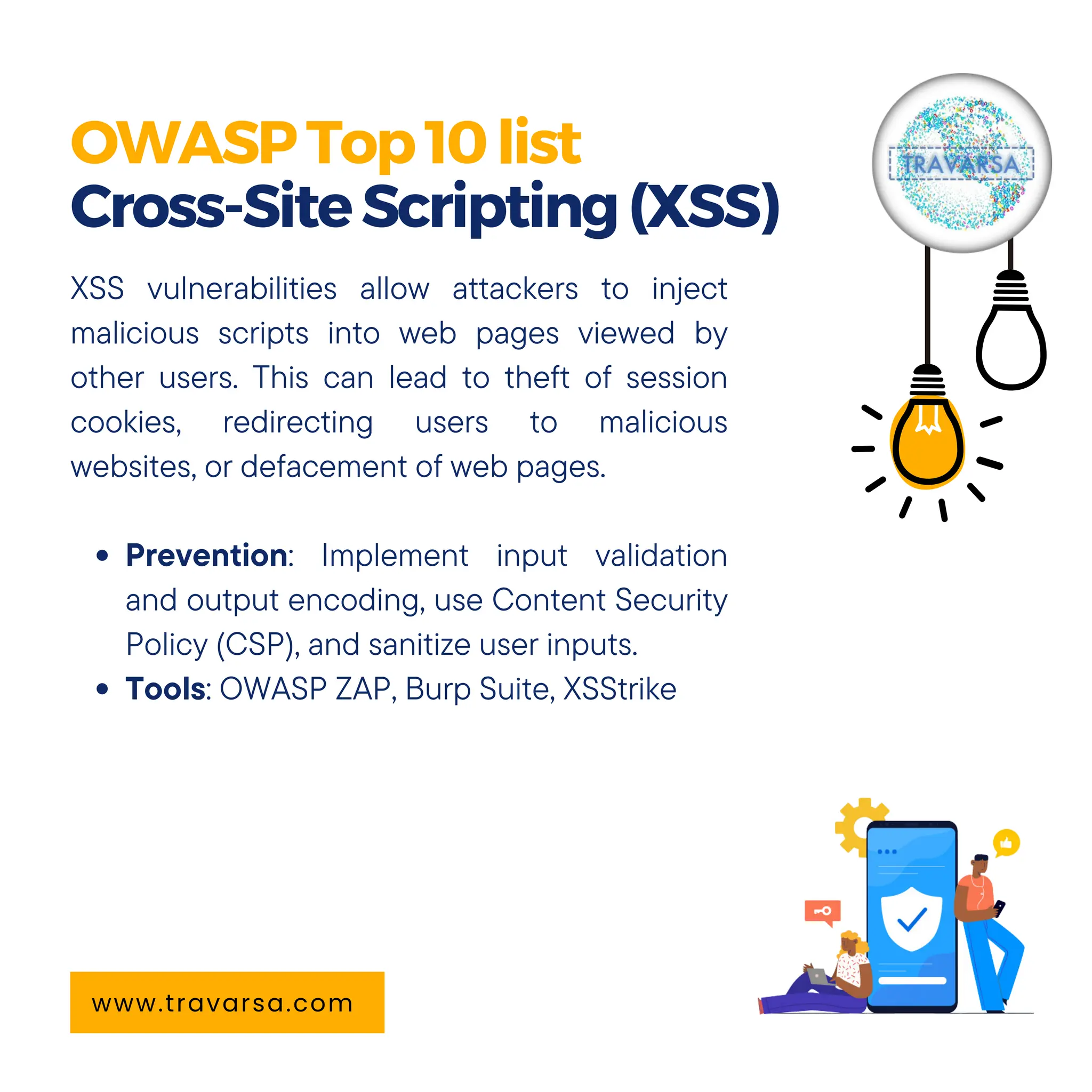
Cross-SiteScripting(XSS)
www.travarsa.com
XSS vulnerabilities allow attackers to inject
malicious scripts into web pages viewed by
other users. This can lead to theft of session
cookies, redirecting users to malicious
websites, or defacement of web pages.
Prevention: Implement input validation
and output encoding, use Content Security
Policy (CSP), and sanitize user inputs.
Tools: OWASP ZAP, Burp Suite, XSStrike
OWASPTop10list
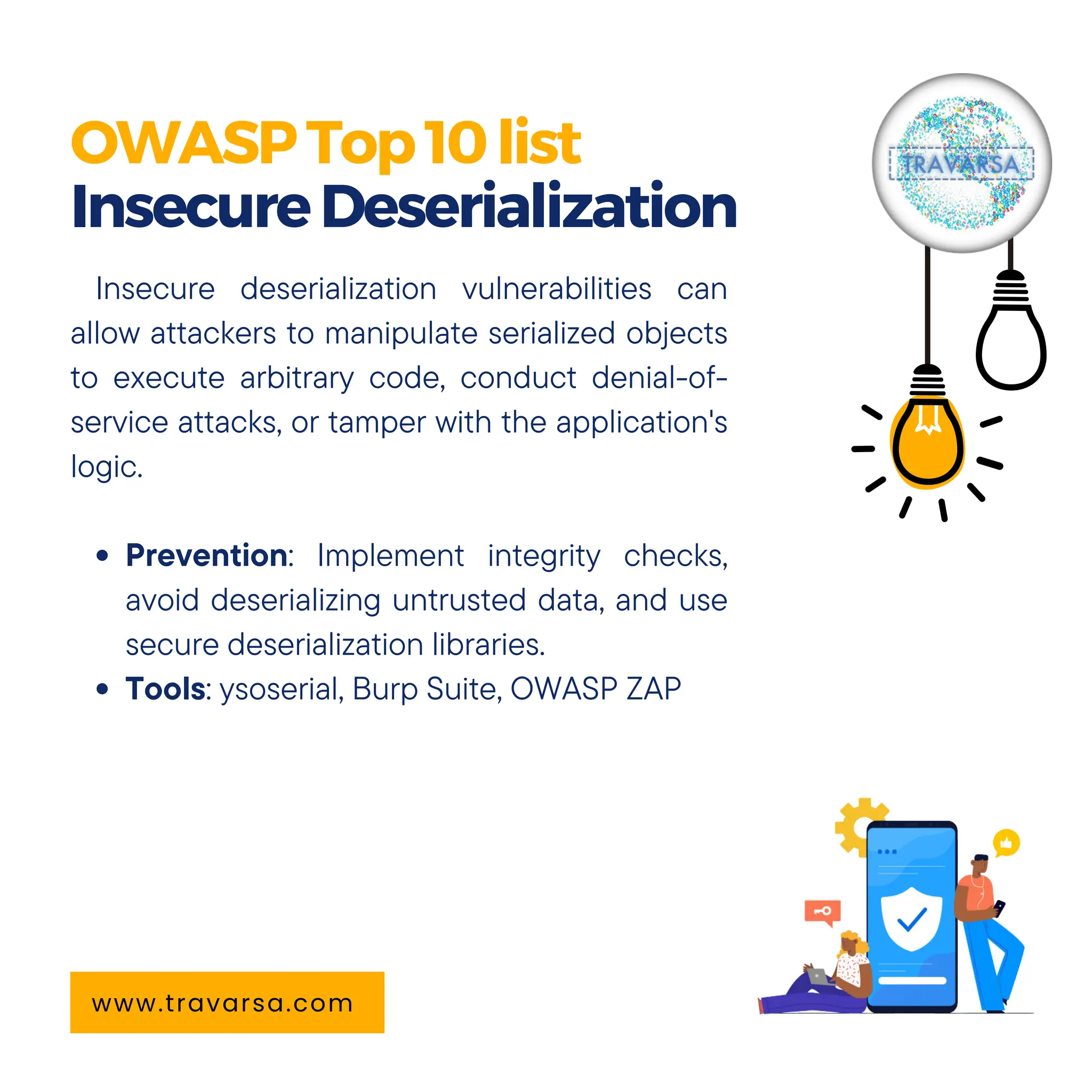
InsecureDeserialization
www.travarsa.com
Insecure deserialization vulnerabilities can
allow attackers to manipulate serialized objects
to execute arbitrary code, conduct denial-of-
service attacks, or tamper with the application's
logic.
Prevention: Implement integrity checks,
avoid deserializing untrusted data, and use
secure deserialization libraries.
Tools: ysoserial, Burp Suite, OWASP ZAP
OWASPTop10list
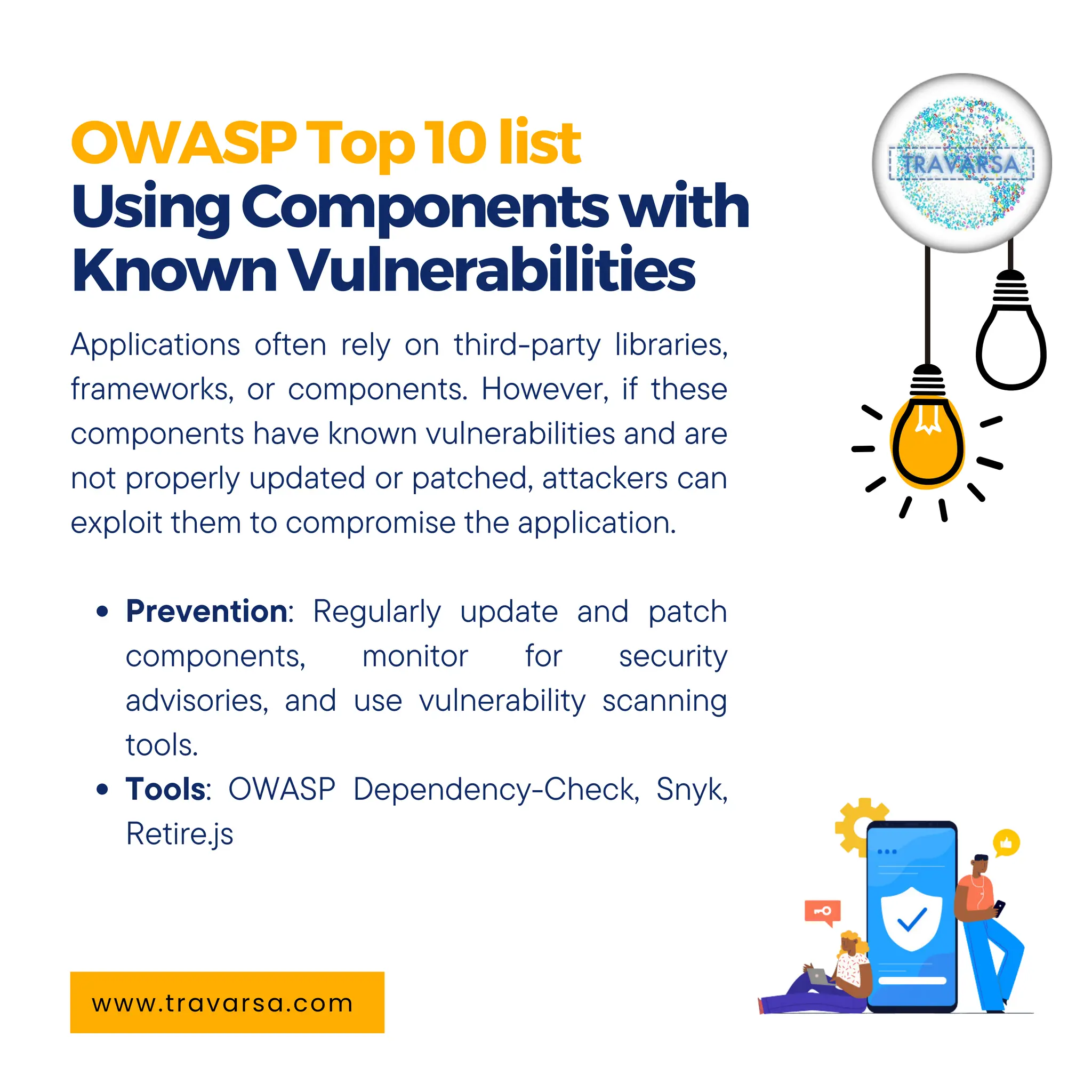
UsingComponentswith
KnownVulnerabilities
www.travarsa.com
Applications often rely on third-party libraries,
frameworks, or components. However, if these
components have known vulnerabilities and are
not properly updated or patched, attackers can
exploit them to compromise the application.
Prevention: Regularly update and patch
components, monitor for security
advisories, and use vulnerability scanning
tools.
Tools: OWASP Dependency-Check, Snyk,
Retire.js
OWASPTop10list
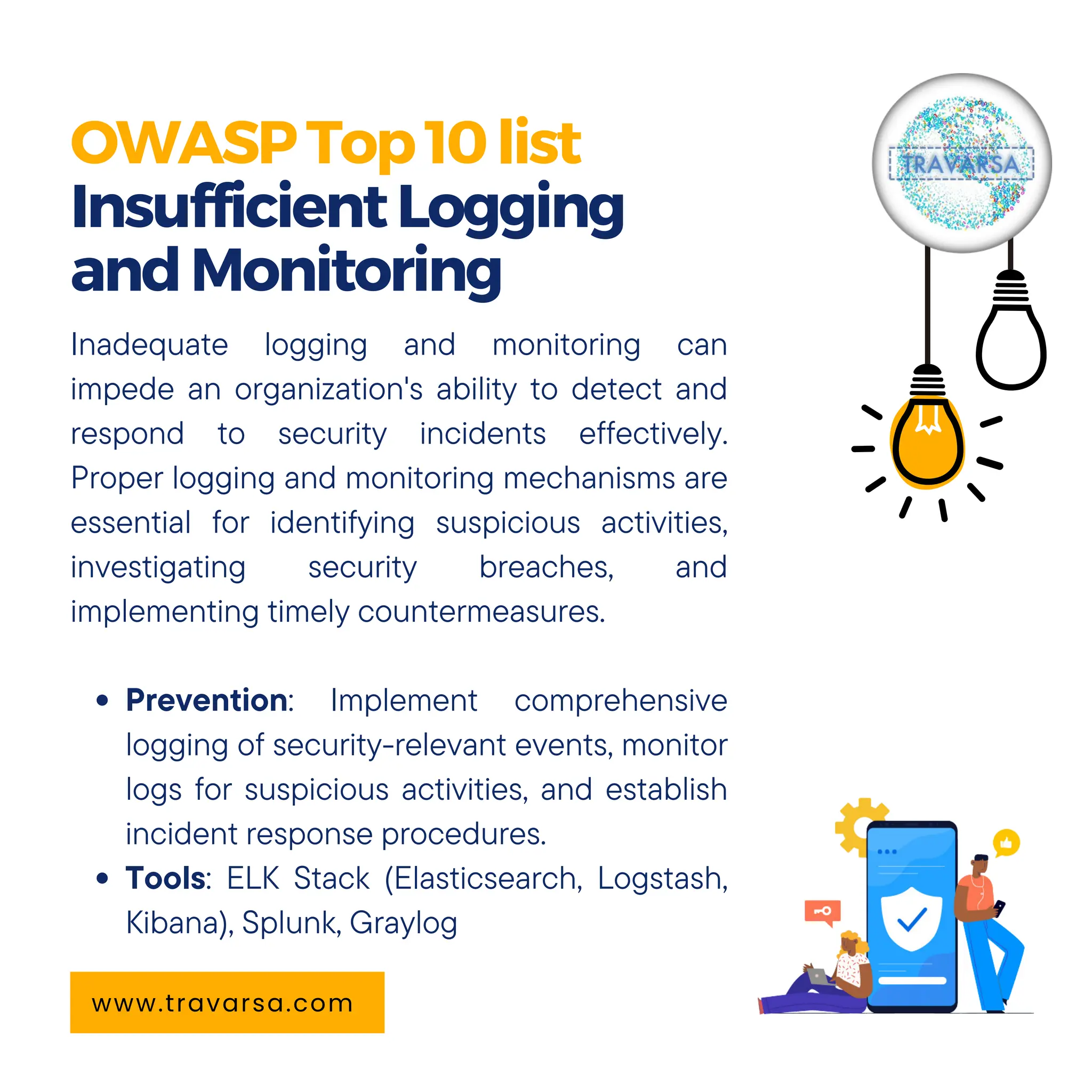
InsufficientLogging
andMonitoring
www.travarsa.com
Inadequate logging and monitoring can
impede an organization's ability to detect and
respond to security incidents effectively.
Proper logging and monitoring mechanisms are
essential for identifying suspicious activities,
investigating security breaches, and
implementing timely countermeasures.
Prevention: Implement comprehensive
logging of security-relevant events, monitor
logs for suspicious activities, and establish
incident response procedures.
Tools: ELK Stack (Elasticsearch, Logstash,
Kibana), Splunk, Graylog
Wasthis
helpfultoyou?
Be sure to save this post
for later reading
Followusformore:
Travarsa.com
SCAN NOW TO READ MORE

OWASP (Open Web Application Security Project) .pdf

  • 1.
  • 2.
    The Open WebApplication Security Project (OWASP) is a nonprofit organization dedicated to improving the security of software. It provides free and open resources for individuals and organizations interested in enhancing the security of web applications and software systems. OWASP was founded in 2001.The organization's mission is to make software security visible so that individuals and organizations can make informed decisions about managing software risks. O WASP Introduction www.travarsa.com
  • 3.
    OWASPTop10list Injection www.travarsa.com Injection flaws, suchas SQL, NoSQL, OS, and LDAP injection, occur when untrusted data is sent to an interpreter as part of a command or query. The attacker's malicious data can trick the interpreter into executing unintended commands or accessing unauthorized data. Prevention: Use parameterized queries, input validation, and proper encoding. Avoid concatenating user input into commands. Tools: SQLMap, OWASP ZAP, Burp Suite
  • 4.
    OWASPTop10list BrokenAuthentication www.travarsa.com This includes vulnerabilitiesrelated to authentication mechanisms such as weak passwords, improper session management, and failure to properly protect credentials, session IDs, or other sensitive data. Prevention: Enforce strong password policies, implement multi-factor authentication, use secure session management, and protect credentials. Tools: OWASP ZAP, Burp Suite, Nmap
  • 5.
    OWASPTop10list SensitiveDataExposure www.travarsa.com This risk ariseswhen sensitive data such as passwords, credit card numbers, or healthcare records are not properly protected. This may occur due to inadequate encryption, insecure storage, or transmission of sensitive data. Prevention: Encrypt sensitive data at rest and in transit, avoid storing unnecessary sensitive data, and use secure communication protocols. Tools: Wireshark, OpenSSL, Nmap
  • 6.
    OWASPTop10list XMLExternalEntities (XXE) www.travarsa.com This refers tothe exploitation of insecure XML processors. Attackers can leverage XXE vulnerabilities to disclose confidential data, execute remote code, and perform denial-of- service attacks. Prevention: Disable XML external entity and DTD processing, use whitelisting of allowed XML entities, and employ up-to- date XML parsers. Tools: Burp Suite, OWASP ZAP, XXEinjector
  • 7.
    OWASPTop10list BrokenAccessControl www.travarsa.com Insecure access controlmechanisms can allow unauthorized users to access restricted functionalities or data. This includes issues such as missing or insufficient access controls, direct object references, and privilege escalation vulnerabilities. Prevention: Implement proper access control checks, validate user permissions at each request, and avoid direct object references. Tools: OWASP ZAP, Burp Suite, Metasploit
  • 8.
    OWASPTop10list SecurityMisconfigurations www.travarsa.com Security misconfigurations occurwhen systems are not securely configured or maintained. This could include default configurations, unnecessary services enabled, incomplete or improper security configurations, and unpatched systems. Prevention: Regularly update and patch systems, follow security best practices and guidelines, and minimize unnecessary services and components. Tools: Nessus, OpenSCAP, AWS Config
  • 9.
    OWASPTop10list Cross-SiteScripting(XSS) www.travarsa.com XSS vulnerabilities allowattackers to inject malicious scripts into web pages viewed by other users. This can lead to theft of session cookies, redirecting users to malicious websites, or defacement of web pages. Prevention: Implement input validation and output encoding, use Content Security Policy (CSP), and sanitize user inputs. Tools: OWASP ZAP, Burp Suite, XSStrike
  • 10.
    OWASPTop10list InsecureDeserialization www.travarsa.com Insecure deserialization vulnerabilitiescan allow attackers to manipulate serialized objects to execute arbitrary code, conduct denial-of- service attacks, or tamper with the application's logic. Prevention: Implement integrity checks, avoid deserializing untrusted data, and use secure deserialization libraries. Tools: ysoserial, Burp Suite, OWASP ZAP
  • 11.
    OWASPTop10list UsingComponentswith KnownVulnerabilities www.travarsa.com Applications often relyon third-party libraries, frameworks, or components. However, if these components have known vulnerabilities and are not properly updated or patched, attackers can exploit them to compromise the application. Prevention: Regularly update and patch components, monitor for security advisories, and use vulnerability scanning tools. Tools: OWASP Dependency-Check, Snyk, Retire.js
  • 12.
    OWASPTop10list InsufficientLogging andMonitoring www.travarsa.com Inadequate logging andmonitoring can impede an organization's ability to detect and respond to security incidents effectively. Proper logging and monitoring mechanisms are essential for identifying suspicious activities, investigating security breaches, and implementing timely countermeasures. Prevention: Implement comprehensive logging of security-relevant events, monitor logs for suspicious activities, and establish incident response procedures. Tools: ELK Stack (Elasticsearch, Logstash, Kibana), Splunk, Graylog
  • 13.
    Wasthis helpfultoyou? Be sure tosave this post for later reading Followusformore: Travarsa.com SCAN NOW TO READ MORE