BİL711 Natural Language Processing 1
What is Natural Language Processing (NLP)
• The process of computer analysis of input provided in a human
language (natural language), and conversion of this input into
a useful form of representation.
• The field of NLP is primarily concerned with getting computers to
perform useful and interesting tasks with human languages.
• The field of NLP is secondarily concerned with helping us come
to a better understanding of human language.
BİL711 Natural Language Processing 2
Forms of Natural Language
• The input/output of a NLP system can be:
– written text
– speech
• We will mostly concerned with written text (not speech).
• To process written text, we need:
– lexical, syntactic, semantic knowledge about the language
– discourse information, real world knowledge
• To process spoken language, we need everything required
to process written text, plus the challenges of speech
recognition and speech synthesis.
BİL711 Natural Language Processing 3
Knowledge of Language
• Phonology – concerns how words are related to the sounds that
realize them.
• Morphology – concerns how words are constructed from more
basic meaning units called morphemes. A morpheme is the
primitive unit of meaning in a language.
• Syntax – concerns how can be put together to form correct
sentences and determines what structural role each word plays in
the sentence and what phrases are subparts of other phrases.
• Semantics – concerns what words mean and how these meaning
combine in sentences to form sentence meaning. The study of
context-independent meaning.
BİL711 Natural Language Processing 4
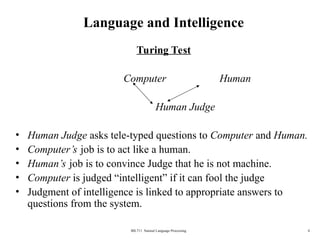
Language and Intelligence
Turing Test
Computer Human
Human Judge
• Human Judge asks tele-typed questions to Computer and Human.
• Computer’s job is to act like a human.
• Human’s job is to convince Judge that he is not machine.
• Computer is judged “intelligent” if it can fool the judge
• Judgment of intelligence is linked to appropriate answers to
questions from the system.
BİL711 Natural Language Processing 5
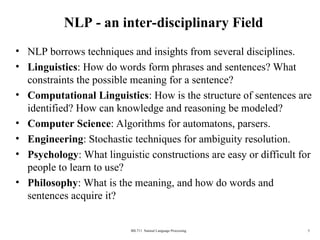
NLP - an inter-disciplinary Field
• NLP borrows techniques and insights from several disciplines.
• Linguistics: How do words form phrases and sentences? What
constraints the possible meaning for a sentence?
• Computational Linguistics: How is the structure of sentences are
identified? How can knowledge and reasoning be modeled?
• Computer Science: Algorithms for automatons, parsers.
• Engineering: Stochastic techniques for ambiguity resolution.
• Psychology: What linguistic constructions are easy or difficult for
people to learn to use?
• Philosophy: What is the meaning, and how do words and
sentences acquire it?
BİL711 Natural Language Processing 6
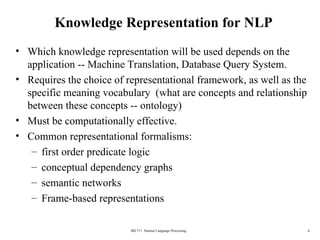
Knowledge Representation for NLP
• Which knowledge representation will be used depends on the
application -- Machine Translation, Database Query System.
• Requires the choice of representational framework, as well as the
specific meaning vocabulary (what are concepts and relationship
between these concepts -- ontology)
• Must be computationally effective.
• Common representational formalisms:
– first order predicate logic
– conceptual dependency graphs
– semantic networks
– Frame-based representations
BİL711 Natural Language Processing 7
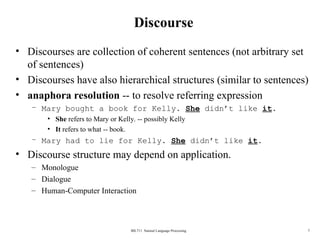
Discourse
• Discourses are collection of coherent sentences (not arbitrary set
of sentences)
• Discourses have also hierarchical structures (similar to sentences)
• anaphora resolution -- to resolve referring expression
– Mary bought a book for Kelly. She didn’t like it.
• She refers to Mary or Kelly. -- possibly Kelly
• It refers to what -- book.
– Mary had to lie for Kelly. She didn’t like it.
• Discourse structure may depend on application.
– Monologue
– Dialogue
– Human-Computer Interaction
BİL711 Natural Language Processing 8
Natural Language Generation
• NLG is the process of constructing natural language outputs from
non-linguistic inputs.
• NLG can be viewed as the reverse process of NL understanding.
• A NLG system may have two main parts:
– Discourse Planner -- what will be generated. which
sentences.
– Surface Realizer -- realizes a sentence from its internal
representation.
• Lexical Selection -- selecting the correct words describing the
concepts.
BİL711 Natural Language Processing 9
Machine Translation
• Machine Translation -- converting a text in language A into the
corresponding text in language B (or speech).
• Different Machine Translation architectures:
– interlingua based systems
– transfer based systems
• How to acquire the required knowledge resources such as
mapping rules and bi-lingual dictionary? By hand or acquire
them automatically from corpora.
• Example Based Machine Translation acquires the required
knowledge (some of it or all of it) from corpora.

Overview of Knowledge Representation for NLP

  • 1.
    BİL711 Natural LanguageProcessing 1 What is Natural Language Processing (NLP) • The process of computer analysis of input provided in a human language (natural language), and conversion of this input into a useful form of representation. • The field of NLP is primarily concerned with getting computers to perform useful and interesting tasks with human languages. • The field of NLP is secondarily concerned with helping us come to a better understanding of human language.
  • 2.
    BİL711 Natural LanguageProcessing 2 Forms of Natural Language • The input/output of a NLP system can be: – written text – speech • We will mostly concerned with written text (not speech). • To process written text, we need: – lexical, syntactic, semantic knowledge about the language – discourse information, real world knowledge • To process spoken language, we need everything required to process written text, plus the challenges of speech recognition and speech synthesis.
  • 3.
    BİL711 Natural LanguageProcessing 3 Knowledge of Language • Phonology – concerns how words are related to the sounds that realize them. • Morphology – concerns how words are constructed from more basic meaning units called morphemes. A morpheme is the primitive unit of meaning in a language. • Syntax – concerns how can be put together to form correct sentences and determines what structural role each word plays in the sentence and what phrases are subparts of other phrases. • Semantics – concerns what words mean and how these meaning combine in sentences to form sentence meaning. The study of context-independent meaning.
  • 4.
    BİL711 Natural LanguageProcessing 4 Language and Intelligence Turing Test Computer Human Human Judge • Human Judge asks tele-typed questions to Computer and Human. • Computer’s job is to act like a human. • Human’s job is to convince Judge that he is not machine. • Computer is judged “intelligent” if it can fool the judge • Judgment of intelligence is linked to appropriate answers to questions from the system.
  • 5.
    BİL711 Natural LanguageProcessing 5 NLP - an inter-disciplinary Field • NLP borrows techniques and insights from several disciplines. • Linguistics: How do words form phrases and sentences? What constraints the possible meaning for a sentence? • Computational Linguistics: How is the structure of sentences are identified? How can knowledge and reasoning be modeled? • Computer Science: Algorithms for automatons, parsers. • Engineering: Stochastic techniques for ambiguity resolution. • Psychology: What linguistic constructions are easy or difficult for people to learn to use? • Philosophy: What is the meaning, and how do words and sentences acquire it?
  • 6.
    BİL711 Natural LanguageProcessing 6 Knowledge Representation for NLP • Which knowledge representation will be used depends on the application -- Machine Translation, Database Query System. • Requires the choice of representational framework, as well as the specific meaning vocabulary (what are concepts and relationship between these concepts -- ontology) • Must be computationally effective. • Common representational formalisms: – first order predicate logic – conceptual dependency graphs – semantic networks – Frame-based representations
  • 7.
    BİL711 Natural LanguageProcessing 7 Discourse • Discourses are collection of coherent sentences (not arbitrary set of sentences) • Discourses have also hierarchical structures (similar to sentences) • anaphora resolution -- to resolve referring expression – Mary bought a book for Kelly. She didn’t like it. • She refers to Mary or Kelly. -- possibly Kelly • It refers to what -- book. – Mary had to lie for Kelly. She didn’t like it. • Discourse structure may depend on application. – Monologue – Dialogue – Human-Computer Interaction
  • 8.
    BİL711 Natural LanguageProcessing 8 Natural Language Generation • NLG is the process of constructing natural language outputs from non-linguistic inputs. • NLG can be viewed as the reverse process of NL understanding. • A NLG system may have two main parts: – Discourse Planner -- what will be generated. which sentences. – Surface Realizer -- realizes a sentence from its internal representation. • Lexical Selection -- selecting the correct words describing the concepts.
  • 9.
    BİL711 Natural LanguageProcessing 9 Machine Translation • Machine Translation -- converting a text in language A into the corresponding text in language B (or speech). • Different Machine Translation architectures: – interlingua based systems – transfer based systems • How to acquire the required knowledge resources such as mapping rules and bi-lingual dictionary? By hand or acquire them automatically from corpora. • Example Based Machine Translation acquires the required knowledge (some of it or all of it) from corpora.