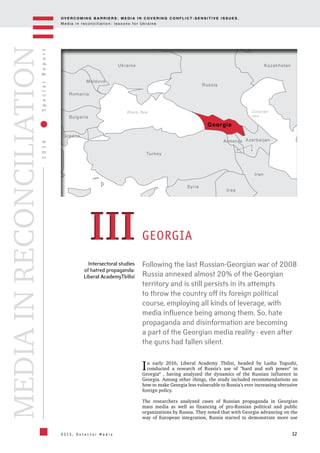
1O S C E , D e t e c t o r M e d i a
Media in Covering
Conflict-Sensitive Issues
OSCE Detector Media Kyiv 2016
S P E C I A L R E P O R T
OVERCOMING BARRIERS
2
C O N F L I C T
MEDIA
MEDIA
SETTINGS
УСТАНОВКИ
CONFLICTPRACTICE
EXPERIENCE
FOREIGN
LESSONS
M O N I T O R I N G
K y i v · 2 0 1 6
3O S C E , D e t e c t o r M e d i a
Overcoming Barriers:
Media in Covering Conflict-Sensitive Issues.
Special Report. – Detector Media, Kyiv 2016. - 48 p.
© Detector Media NGO, 2016
© Yana Dobryanska – design and layoutphoto: Pixabay
The Special Reports is prepared by within “Supporting Conflict
Sensitive Journalism in Ukraine” project under financial sup-
port of Embassy of Great Britain in Ukraine. Opinions reflected
in the Report may not correlate with those of the Government
of Great Britain or OSCE PCU.
Maryna Bezkorovaina
Daria Orlova, the Lead Researcher
Roman Shutov
Yevhen Zaslavskyi
Edited by
Diana Dutsyk
Design and layout
Yana Dobryanska
A U T H O R S
The Special Report contains the results of comprehensive work conducted by OSCE Project Co-Ordi-
nator in Ukraine and Detector Media NGO in 2015-2016 aimed to promote conflict sensitive journal-
ism in Ukraine, in particular:
the Report on the results of monitoring of TV content in November 2015 due to conflict sensitivity;
the Report on the results of research among the journalists in February-March 2016 that clarifies
the roots and causes of the detected problems;
the review of the international practices of involvement of media into reconciliation in the soci-
eties, and recommendations regarding their possible implementation (adaptation) in Ukraine.
For journalists, editors, representatives of educational establishments and technical assistance proj-
ects, media experts and other persons searching for the better solutions to increase the role of Ukrai-
nian media in reconciliation and challenge the social barriers caused by the military conflict.
4
2016SpecialReport
O S C E , D e t e c t o r M e d i a
CONTENTS C O N T E N T S
The Project
Monitoring results of the conflict-sensitive coverage of groups
involved in the conflict by central and regional TV-channels,
November 2015
Coverage of the conflict in the East by Ukrainian media: study
of journalists’ values, attitudes and practices: research findings,
February-March 2015
Media in reconciliation: lessons for Ukraine
Central and Eastern Europe.
Initiatives aimed at monitoring hatred and enmity
propaganda: EEAS East StratCom Task Force; Kremlin
Media Watch; Information War Monitor for Central
Europe
Armenia, Azerbaijan.
Promotion of media conflict sensitivity at the time
of conflict: Imagine Center
Georgia.
Intersectoral studies of hatred propaganda: Liberal
Academy Tbilisi
Moldova (Transnistria).
Training And Cooperation Among Journalists In
Conditions Of "Frozen Conflict": Center For Independent
Journalism
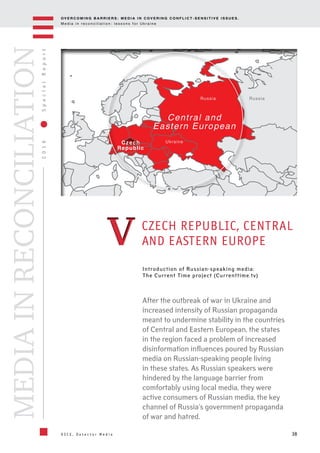
Czech Republic, Central and Eastern Europe.
Introduction Of Russian-Speaking Media: The Current
Time Project (Currenttime.Tv)
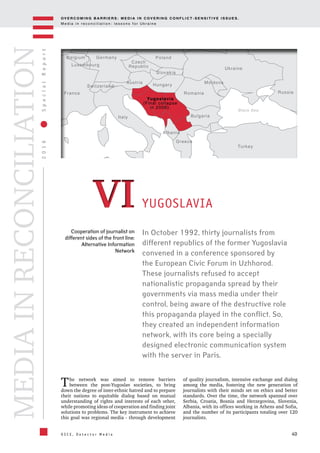
Yugoslavia.
Cooperation Of Journalist On Different Sides Of The
Front Line: Alternative Information Network
Czech Republic.
Teaching Children To Resist Propaganda: People In Need
Kyrgyzstan.
Lowering hostility of the national media discourse:
Egalite Conflict Management Agency
OV E R C O M I N G B A R R I E R S : M E D I A I N C OV E R I N G C O N F L I C T - S E N S I T I V E I S S U E S .
5
2016SpecialReport
O S C E , D e t e c t o r M e d i a
THE PROJECT
The ongoing debate around the way how Ukrainian mass media give
coverage to the conflict in Ukraine's east and its aftermath has shown:
news stories and analytical materials often tend to exploit generalization
and dehumanization of the other parties to the conflict. Moreover,
extensive appeal to emotional sentiment fuels discord and adds heat
to controversies in the society. The physical safety of journalists while
reporting in armed conflicts areas has become a primary concern
voiced time after time in statements of international officials, and the
OSCE Representative on Freedom of the Media in particular.
The "Supporting Conflict Sensitive Journalism in Ukraine" project
was developed by the OSCE ProjectCo-Ordinator in Ukraine at
request of Detector Media NGO, the Institute of Mass Information, the
Commission on Journalism Ethics, the Ministry of Defense of Ukraine
and the Ministry of Education of Ukraine. It is aimed to support the
media community's effort to develop algorithms ensuring that the
journalist applied responsible approaches when covering the conflict
and its aftermath, as well as to promote better awareness among them
about the role of mass media in the processes of restoring the society’s
trust. The first stage of the project was implemented with the financial
aid from the British Embassy to Ukraine and the International Media
Support international non-governmental organization.
The scope of the project included a number of measures:
regional round-table discussions attended by members of local
government, regional mass media, representatives of civil
society aimed at working out mechanisms for collaboration to
address the region's topical problems;
production of the guide "Journalism in Conflict: Best
Practices and Recommendations" which incorporated the best
international practices and Ukrainian experience;
trainings in pre-medical first aid and skills of working in
dangerous conditions for reporters working immediately in the
area of military action, specialized trainings on communication
with journalists — for brigade commanders of the Ukrainian
Armed Forces;
an intensive six-day training on fundamentals of media ethics in
conflict and post-conflict societies;
a comprehensive sociological study of conflict coverage
practices: monitoring of mass media adherence to conflict
sensitivity standards; focus group studies and individual in-
depth interviews with journalists in order to identify individual
and editorial practices, mindsets and attitudes they may stick to
and to evaluate how much they are actually willing to become
a part of the processes of conflict resolution and restoration of
trust across the society.
This publication presents an analytical overview of international
standards and practices of involving mass media to conflict
settlement discussed during the final conference "Involving
Media in Reconciliation: Lessons Learned for Ukraine" held
within the scope of the project on 16 May, 2016.
OV E R C O M I N G B A R R I E R S : M E D I A I N C OV E R I N G C O N F L I C T - S E N S I T I V E I S S U E S .
6
2016SpecialReport
O S C E , D e t e c t o r M e d i a
RESULTS
MONITORING RESULTS OF THE CONFLICT-SENSITIVE
COVERAGE OF GROUPS INVOLVED IN THE CONFLICT
BY CENTRAL AND REGIONAL TV-CHANNELS
From 6 November till 6 December 2015 the Detector Media NGO (that
had at that time title Telekritika NGO) expert team was monitoring
the news and talk shows of Ukrainian TV-channels (20 regional and 7
central ones) in terms of coverage of different social groups involved
in the conflict. The monitoring was to identify if the media discourse
favours the social dialogue, if it is able to destroy the conflict paradigm
in minds or contrariwise builds new barriers in the society and
escalates internal tensions caused by the conflict
The Ukrainian TV-channels glorify the ATO fighters,
demonize the insurgents of ‘LPR’, ‘DPR’ and Russia,
keep silent about the problems of displaced persons
and almost forget about the volunteers. The talk-
shows of central TV-channels are full of hate speech,
they are focused on inter-regional, ethnic and inter-
religion barriers and not on the ways to clear them.
These are the monitoring results of the conflict-
sensitive coverage of groups involved in the conflict
by Ukrainian TV-channels; the monitoring was per-
formed by Detector Media NGO within the OSCE’s
project funded by the UK Embassy to Ukraine.
The Ukrainian channels are not agents for conflict alleviation in the society. Leaning to the
BW world-view, practicing of hate speech against the other party of the conflict (against Russia’s
citizens as well), concealing of problems of conflict-affected social groups do not contribute to
the dialogue and reconciliation.
The discourse of central channels’ social talk-shows is much more aggressive than the one
of the news, and it may be a powerful trigger of hostility between different conflict-affected
groups as well as of other social and latent conflicts.
TV-channels talk a lot about ATO fighters: they are mentioned in 12% of stories on central
TV-channels (10% on the regional ones). But in 27% cases (13% for regional channels) such
mentions are not neutral. The journalists tend to glorify the fighters (‘heroes’, ‘best sons of
Ukraine’), to identify them as ‘Ukrainians’ (as opposed to the other party), recognize themselves
on the same side of the fence (‘our guys’). The fighter’s topic is actively exploited by central
channels’ talk-shows causing the audience to feel pride, respect or sympathy.
The other party of the conflict is mentioned in 11% of coverages by central channels and 3% by
regional ones, and the share of conflict-insensitive messages is the highest among the considered
groups (64% and 39% respectively). The other party is described using negative emotional
language that makes clear distinction between ‘us’ and ‘them’, ‘good’ and ‘bad’. There were
detected cases of cultivation of hatred and other negative emotions against the other party by
central channels’ talk-shows.
11
22
33
44
The monitoring discovered the following trends in the
Ukrainian TV-media:
OV E R C O M I N G B A R R I E R S : M E D I A I N C OV E R I N G C O N F L I C T - S E N S I T I V E I S S U E S .
7
2016SpecialReport
O S C E , D e t e c t o r M e d i a
RESULTS
The monitoring of conflict-sensitive coverage of problems of social groups involved in the conflict by Ukrainian
TV-channels is performed by Detector Media NGO (then - Telekritika NGO) within the project implemented by
the OSCE Project Co-ordinator in Ukraine with the financial support by the UK Embassy to Ukraine.
Subjects of monitoring:
Evening news of Ukrainian central TV-channels (1 + 1, Inter, STB, Novy, UA:Pershyi, Ukraine,
Channel 5) during 1 week (16-22 November)
Evening news of 20 TV-channels in 10 Ukrainian regions for during 1 week (16-22 November):
"Dnipropetrovskyi Derzhavnyi" (Dnipropetrovsk), "Tisa" (Uzhgorod), "Avers" (Lutsk), "Scythia"
(Kherson), "Nova Volyn" (Lutsk), "VTV Plus" (Kherson), Channel 34 (Dnipropetrovsk),
"Vintera" (Vinnytsia), Zaporizhia RSTBC, "Ltava" (Poltava), ATN (Kharkiv), Odesa RSTBC, OTB
(Kharkiv), TVA (Chernivtsi), "Vita" (Vinnytsa), TV5 (Zaporizhia), Channel 21 (Uzhgorod),
"Pervyi Gorodskoy" (Odesa), "Bukovyna" (Chernivtsi), "IRT-Poltava".
Social talk-shows of central TV-channels of Ukraine from 6 November 6 till6 December 2015:
"Wayfarers” (Podorozhni) (UA:Pershyi);“War and Peace’ (UA:Pershyi) "LifeCode» (ZiK);
"Affects Everyone" (Inter); "Govoryt Ukraina" (Ukraine); "Bravehearts" (2+2); "One for All"
(STB).
The monitoring was to define how Ukrainian media cover problems of the groups involved in the Ukrainian
conflict, these are: ATO fighters, displaced persons, the other party of conflict (both the insurgents and the RF
Government), occupied area residents, volunteers, families of Ukrainian servicemen as well as children affected
by the conflict. The monitoring was focused on the following aspects: i) representation of target groups on media
scene; ii) observance of journalism standards when covering the mentioned groups; iii) conflict sensitivity of
communications.
The displaced persons are ignored by central channels – only 1% of news pieces have
mentions about them. Talk-shows ignore them as well. Regional channels pay more attention
to the displaced persons – 3% of messages. Journalists try to focus on positive aspects of ‘new
life’ but the regional news show the cases of negative stereotypes spreading: displaced persons
as isolated and passive group having chronical problems with integration to new community
(12% of identified stories are about this social group).
The residents of occupied areas are hardly mentioned both by central (4%, and the majority
of them are about ‘grey area’) and regional (1%) channels. Real problems and needs of these
people do not get to the media discourse. The coverages are neutral mostly, it is hard to tell
clear trends given the isolated violations (‘zombified population’, 1+1). The aggressive hate
speech against this group is practiced by central channels’ talk-shows.
The topic of volunteers is ignored by central channels – both in news (2% of stories) and
talk-shows. Regional channels cover the topic correctly (it is mentioned in 4% of news stories),
there are isolated instances of negative stereotypes spreading (volunteers as an isolated group
of people of questionable quality).
Families of militaries and children are not properly covered by the media. Each of these
groups is mentioned only in 1% of central channels’ news and 2% of regional ones. Though all
of these stories are conflict sensitive; only one story had signs of negative stereotypes spreading
(being 6% of all detected mentions of militaries’ families in regional news).
The very journalists are a conflict source in the news pieces in 69%, and in 31% this are
people on camera. Given this, it is fair to say that the journalists in conflict are rather triggers
of conflict discourse than passive transmitters.
The central channels’ talk-shows are more likely to strengthen than to clear the barriers
and hatred. In addition to promotion of the mentioned ‘us’ and ‘them’ distinction (glorification
of Ukrainian soldiers and demonization of the other party), some talk-shows foster negative
attitude to the occupied area residents.
55
66
77
88
99
1010
11
22
33
Methodology
8
STANDARDS
CONFLICT
PRACTICES
COVERAGE OF THE CONFLICT
IN THE EAST BY UKRAINIAN
MEDIA: STUDY OF JOURNALISTS’
VALUES, ATTITUDES AND
PRACTICES
O S C E , D e t e c t o r M e d i a
Research findings,
February-March 2016
A T T I T U D E S
OV E R C O M I N G B A R R I E R S : M E D I A I N C OV E R I N G C O N F L I C T - S E N S I T I V E I S S U E S .
C o v e r a g e o f t h e c o n f l i c t i n t h e e a s t b y u k r a i n i a n m e d i a : s t u d y o f j o u r n a l i s t s ’ v a l u e s , a t t i t u d e s a n d p r a c t i c e s .
9
2016SpecialReport
O S C E , D e t e c t o r M e d i a
RESEARCH
S
11
22
RESEARCH OBJECTIVE
RESEARCH TOOLS
The coverage of the issues associated with the conflict in the east of
the country by the Ukrainian media has become a subject of multiple
studies, expert reviews and comments. Such an interest to the problem
is explained by its topicality and wide public resonance.
Most of the studies, however, are based on the analysis of media content.
Meanwhile, the very practices of the journalists and their understanding
of the standards of working under conflict are predominantly
understudied.
The following study is intended to fill this gap focusing the research
interest on the journalists themselves, their approaches and system of
values regarding the conflict interpretation and relevant issues as well
as editorial practices of the Ukrainian media.
The research objective is the following:
to find out how the journalists understand their role in reporting
the conflict and relevant issues;
to reveal their views and guidelines they follow while working
under conflict;
to find out what editorial practices and standards of reporting
the issues associated with the conflict are spread among the Ukrainian
media.
The following study resumes the previous project, “Monitoring the
conflict-sensitive coverage of the groups relevant to the conflict by
central and regional TV channels” conducted by NGO Telekritika. The
results of the monitoring have become a starting point for a deeper
research of the practices spread among the editorial offices; the
journalists’ understanding of their role in reporting the conflict; and
the guidelines determining the journalists’ practices.
According to the research objective and tasks, the study combines the
methods of semi-structured in-depth interviews and focus group
discussion.
Both methods are the key tools for the studies analyzing the experience
of certain social groups’ representatives as well as their ideas and
views concerning certain issues. These are the methods that help to
understand the experience of the respondents, their attitudes and
motives more deeply.
On the one hand, combining the methods of interview and focus groups
helps to understand the individual experience of the journalists, their
ideas of the problem and editorial practices. On the other hand, it
helps to monitor group dynamics, spontaneous interaction between the
colleagues, and their responses to the statements of other participants
of the discussion concerning rather controversial and sensitive issues.
The discussion participants were guaranteed anonymity in view of the
provocative character of the issues under discussion.
OV E R C O M I N G B A R R I E R S : M E D I A I N C OV E R I N G C O N F L I C T - S E N S I T I V E I S S U E S .
C o v e r a g e o f t h e c o n f l i c t i n t h e e a s t b y u k r a i n i a n m e d i a : s t u d y o f j o u r n a l i s t s ’ v a l u e s , a t t i t u d e s a n d p r a c t i c e s .
10
2016SpecialReport
O S C E , D e t e c t o r M e d i a
RESEARCH
OV E R C O M I N G B A R R I E R S : M E D I A I N C OV E R I N G C O N F L I C T - S E N S I T I V E I S S U E S .
C o v e r a g e o f t h e c o n f l i c t i n t h e e a s t b y u k r a i n i a n m e d i a : s t u d y o f j o u r n a l i s t s ’ v a l u e s , a t t i t u d e s a n d p r a c t i c e s .
11
2016SpecialReport
O S C E , D e t e c t o r M e d i a
RESEARCH
33
RESEARCH SAMPLE
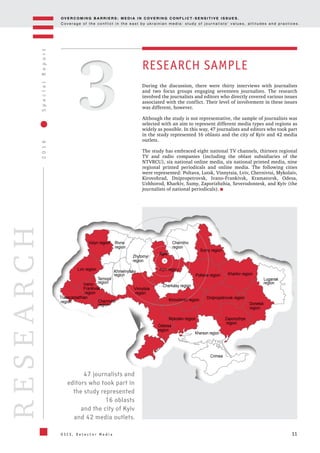
During the discussion, there were thirty interviews with journalists
and two focus groups engaging seventeen journalists. The research
involved the journalists and editors who directly covered various issues
associated with the conflict. Their level of involvement in these issues
was different, however.
Although the study is not representative, the sample of journalists was
selected with an aim to represent different media types and regions as
widely as possible. In this way, 47 journalists and editors who took part
in the study represented 16 oblasts and the city of Kyiv and 42 media
outlets.
The study has embraced eight national TV channels, thirteen regional
TV and radio companies (including the oblast subsidiaries of the
NTVRCU), six national online media, six national printed media, nine
regional printed periodicals and online media. The following cities
were represented: Poltava, Lutsk, Vinnytsia, Lviv, Chernivtsi, Mykolaiv,
Kirovohrad, Dnipropetrovsk, Ivano-Frankivsk, Kramatorsk, Odesa,
Uzhhorod, Kharkiv, Sumy, Zaporizhzhia, Severodontesk, and Kyiv (the
journalists of national periodicals).
47 journalists and
editors who took part in
the study represented
16 oblasts
and the city of Kyiv
and 42 media outlets.
Crimea
Kyiv
Sumy region
Kharkiv region
Lugansk
region
Donetsk
region
Dnipropetrovsk region
Kherson region
Odessa
region
Mykolaiv region Zaporozhye
region
Kirovohrad region
Cherkasy region
Vinnytsia
region
Ternopil
region
Lviv region
Volyn region Rivne
region
Zhytomyr
region
Transcarpathian
region Chernivtsi
region
Khmelnytsky
region Poltava region
Ivano-
Frankivsk
region
Chernihiv
region
Kyiv region
OV E R C O M I N G B A R R I E R S : M E D I A I N C OV E R I N G C O N F L I C T - S E N S I T I V E I S S U E S .
C o v e r a g e o f t h e c o n f l i c t i n t h e e a s t b y u k r a i n i a n m e d i a : s t u d y o f j o u r n a l i s t s ’ v a l u e s , a t t i t u d e s a n d p r a c t i c e s .
12
2016SpecialReport
O S C E , D e t e c t o r M e d i a
RESEARCH
44
RESEARCH RESULTS
General overview
The interviews with the journalists and focus group discussions have
shown the absence of a common approach to reporting the conflict
and relevant issues that would be prevailing among the journalists.
Instead, essential pluralism of approaches and professional guidelines
as well as a high level of ambivalence regarding a “correct” way to report
the issues associated with the conflict is noted among the journalists.
On the one hand, such pluralism and ambivalence testify to a rather
high level of the journalists’ reflexion on what a proper and professional
coverage of the conflict should be like. On the other hand, it means
that the Ukrainian journalist community has not worked out universal
rules and instructions yet; the journalist community is still in search of
professional guidelines. Apart from that, such editorial pluralism shows
that there is no state coordinated censorship of media under war. None of
the interviewed journalists mentioned any attempts of state authorities
to influence their media content concerning the conflict and relevant
issues.
The variety of approaches in different Ukrainian media can be divided
into three groups: deliberately activist / patriotic approach; expressly
professional / neutral approach; and mixed one.
The patriotic, or activist, approach includes intentional focusing on
representing the Ukrainian (“our”) side and ignoring “another” side
as illegal; a compromise with traditional professional standards of
“peaceful times” is admissible to fight against Russian propaganda.
Such an approach was the least represented in the interviews and focus
groups with the journalists, which, however, contrasts with the previous
studies of media content. It may mean that there are certain differences
between the views of particular journalists and more stable practices and
approaches of media editorial boards.
The second type, expressly professional, or neutral, includes
unconditional adherence to professional journalist standards and is
mostly typical for media claiming to work by Western standards (for
example, Ukrainian editorial offices of international media; some of the
independent Ukrainian media).
The most widely spread approach was the third one. The mixed approach
includes understanding of how standards are important and adherence
to some of them; still, there is much ambivalence and dilemmas. Such an
approach also has some varieties, different proportions of “adherence to
standards” vs. “trying to help / not to hurt the Ukrainian side.”
The prevalence of the mixed approach and a high level of ambivalence
among the journalists concerning different aspects of reporting the issues
associated with the conflict demonstrate the lack of institutionalization
of editorial practices regarding these issues. The interviewed journalists
often mentioned that there are no written rules or fixed standards of
working under conflict in their editorial offices. Oral articulation of
approaches, standards, and debatable issues is also rare and significantly
depends on the journalists’, not the editors’, initiative.
In this way, understanding of professional standards in most of the
Ukrainian media (except the media distinctly declaring the adherence to
Western standards of journalism) is left to the judgment of the journalists.
It is especially true for regional media. Therefore, the journalists are
OV E R C O M I N G B A R R I E R S : M E D I A I N C OV E R I N G C O N F L I C T - S E N S I T I V E I S S U E S .
C o v e r a g e o f t h e c o n f l i c t i n t h e e a s t b y u k r a i n i a n m e d i a : s t u d y o f j o u r n a l i s t s ’ v a l u e s , a t t i t u d e s a n d p r a c t i c e s .
13
2016SpecialReport
O S C E , D e t e c t o r M e d i a
RESEARCH
likely to follow their own views or experiences than conventional
editorial practices and standards.
The research has also revealed a great importance of a personal
factor and individual initiatives shown by the journalists. Most of the
journalists who took part in the study spoke the word themselves to
deal with the issues associated with the conflict. A great deal of the
respondents are from Donetsk and Luhansk regions; having left these
regions in different moments, they are well aware of the context;
they have accumulated a database of contacts in the region; they are
personally interested in reporting these problems and often initiate
the reports relying upon their own experience and awareness of the
situation. In this way, it seems rational to conclude that the role of
a personal factor is essential for shaping the agenda concerning
the issues associated with the conflict in the Ukrainian media. Only
some of the media selected for the research sample have a purposeful
editorial policy “to keep abreast” of the situation in Donbas both in the
liberated and occupied territories.
Reporting the issues associated
with the conflict: the journalists’
experience and editorial practices
One of the key tasks of the study was to find out how the journalists
assess the importance and topicality of the issues associated with
the conflict.
The absolute majority of the interviewed journalists consider the issues
associated with the conflict to be among the most priority for the
Ukrainian media and society. In the meantime, relying upon their own
observations, most of the interviewed journalists have noted the decrease
of interest to these issues among the audience, while political events
have advanced to the forefront. Relatively calm situation in the conflict
area as well as the tiredness of continuous tension, in the opinion of the
journalists, have led to the decrease of the interest among the audience
and, consequently, to the decrease of the coverage of these issues by
mass media. Most of the journalists’ assessments derived from their own
impressions, although some of the interviewed referred to the data from
the studies of the audience (online statistics and viewing ratings).
“Here we should note that people are already tired of war. They are tired
of all these things. Therefore, mass media response to people’s interest and
little by little begin to forget about these issues” (a journalist of a national
channel).
“We see such a tendency: about a year ago everything – I mean from
“Yandex. Metrics” and “Google Analytics” – associated with the ATO
was read excellently, but now the interest to the ATO and to the IDPs is
falling. The volunteer organizations also note that there are less donations
and it is harder for people to survive…” (a journalist of a regional online
periodical).
“Unfortunately, we have to fight for ratings. That’s why we’ve been not
touching the issues of war or IDPs for a long time. A certain period of
time has shown that people are just switch to another channel when this
subject is voiced. Unfortunately, those are the circumstances. Previously,
I often went to the ATO zone to shoot videos. We brought reportages from
there, when it was a subject number one and it was at the top. I can’t say
people were interested, this subject is hard to call interesting, but people
did watch. Now, however, there is no such an editorial task even. Until
something extraordinary happens there to stir the public, sorry… There is
no prohibition, no, nothing of that kind. It is just not the most important
subject” (a journalist of a national TV channel).
The problem of the
conflict in the
agenda structure
OV E R C O M I N G B A R R I E R S : M E D I A I N C OV E R I N G C O N F L I C T - S E N S I T I V E I S S U E S .
C o v e r a g e o f t h e c o n f l i c t i n t h e e a s t b y u k r a i n i a n m e d i a : s t u d y o f j o u r n a l i s t s ’ v a l u e s , a t t i t u d e s a n d p r a c t i c e s .
14
2016SpecialReport
O S C E , D e t e c t o r M e d i a
RESEARCH
The interviews and focus group discussions conducted under the study
testify that the journalists, especially those representing TV channels,
prefer the materials about the military men. This conclusion comes in
support of the results of the “Monitoring the conflict-sensitive coverage of
the groups relevant to the conflict by central and regional TV channels.”
Particular attention to military men is explained by several factors.
First of all, the stories about military men, according to the majority of
the interviewed journalists, make up the most interesting and significant
category for the all-Ukrainian audience, because the military men are
directly exposed to great danger and the situation in the country as
well as the security of other citizens depends on their actions. Secondly,
mobilization has affected most of the families in this or that way, which is
also a factor provoking the audience’s interest to the issues associated with
the military men.
Additionally, the members of television crews have underlined the
audience’s need for a bright picture and subject, which are easier to receive
when you shoot a story about military men.
Besides, it seems important to add that the overwhelming majority of the
journalists writing on the conflict tend to keep in touch with the military
men, which makes the latter represented more often in the media discourse.
Regional journalists have also noted that they pay much attention to the
materials about the military men who represent their regions. What is more,
an economic factor should be also taken to account: most of the regional
journalists have an opportunity to get to the ATO zone only together with
the military men and volunteers. So, their materials tend to be dedicated
to these groups as well.
Another factor is that of empathy: while the journalists communicate much
with the military men, feel distressed for their lot and grateful for their
service, it is inevitably reflected in their materials, in the amount of their
attention to the military men and positive representation of the latter.
“Military men, military men – I think, it is the most important now. In fact,
they bear the heaviest burden now, and they are responsible for that. If they
won’t be there, we can all become refugees and families of the lost etc. That
is why, everything depends on them now. […] As long as they are there, I
can be here. If they leave, I will probably have to leave, too. So as for me, I
am grateful to them, I support them, I always pay certain attention to them.
I respect them, I am ready to forgive them much and hope that a conscious
Ukrainian army will appear in this way. That is what I write about” (a
journalist of a national printed periodical).
Such logic and sense of gratitude determines the attention of media
to volunteers. Some of the journalists have explained the interest to
volunteers’ actions by their wish to tell about positive stories of the victory
and faithfulness of common people to common goal. Still, the volunteers
were much more seldom mentioned by the journalists in the interviews
than the military men. It can be probably explained by general decrease
of intensity of reporting the volunteers’ activities in comparison with the
critical phase of the conflict.
“We were so sympathetic… That is why when people (volunteers) began to
do something good, we were in action. We also tried to help our soldiers, but
it was not as globally as volunteers did. So we began to report it all. And the
more we reported, the more people began to join” (a journalist of a regional
TV channel).
The issues associated with the IDPs, the citizens of the liberated and
the occupied territories, according to the journalists, are less reported in
comparison with the military men in view of several reasons.
Firstly, the problems of the IDPs are still the same as half a year ago, while
there are almost no solutions of these problems. Therefore, many editorial
Subjects and
characters
OV E R C O M I N G B A R R I E R S : M E D I A I N C OV E R I N G C O N F L I C T - S E N S I T I V E I S S U E S .
C o v e r a g e o f t h e c o n f l i c t i n t h e e a s t b y u k r a i n i a n m e d i a : s t u d y o f j o u r n a l i s t s ’ v a l u e s , a t t i t u d e s a n d p r a c t i c e s .
15
2016SpecialReport
O S C E , D e t e c t o r M e d i a
RESEARCH
offices keep to the point that such materials would be of no interest for the
public at large.
“There are many problems. And there are no solutions. What to talk about?
I mean, to tell again that they live in destroyed hostels or have to live a
vagabond life? And we have helped them, while the state has provided
nothing for them except 400 hryvnias of relief payments?” (a journalist of a
regional online periodical).
Some of the journalists have even listed the ratings data, according to
which the interest of the audience to the IDPs is rather low.
“Not always all the topics are welcomed. The most interesting thing is– if
to speak about the audience (yes, we receive rating information) – that the
subject of IDPs was not very welcomed…” (a journalist of a regional TV
channel).
Secondly, many journalists, especially those representing regional media,
explain that there are fewer materials about these social groups because
the journalists lack resources and access and are restricted by security
issues. The overwhelming majority of regional media have no opportunity
to send their correspondents to the frontline zone, since essential funds are
needed and the editorial board has to bear responsibility for their security.
The absolute majority of the interviewed regional journalists went to the
conflict zone either with the volunteers or at their own expense; and
it also affected the focus of their materials prepared there. What is more,
regional editorial offices often discourage the journalists from going to the
east of Ukraine justifying it with the issues of security.
It is also significant to note that many journalists have a vaguer attitude
to the IDPs and the citizens of the liberated and the occupied territories
than to the military men. It is often explained by different experience
of communicating with the representatives of these social groups and
by journalists’ views. Some of the journalists note that the IDPs are less
disposed to communication. There is a widely spread idea that the citizens
of Donbas are the people “brainwashed with propaganda.” Besides, there
are suppositions that all the citizens of Donbas loyal to Ukraine have already
left the occupied territories. Nevertheless, the interviews conducted
under research suggest that the interviewed journalists are not likely to
generalize their observations and to extrapolate their own experience
of communicating with these social groups.
“We are stuck in clichés, again, we reduce everything to the topic “we are
sorry, sorry, sorry…” You know, it is like… This group is just used to create
such an image – so to speak, let us cry together with them. Their tragedy is
not studied as it is. Because it is hard to implement. It is hard to go there
[…]. Sometimes we run to extremes. At times we want to hear them, at
others we want to concrete them. The options are so simple. But there can be
no simple options in this situation. Only evolutionary options are left, and it
will take much time. I think, here is the inadequacy. It is hard to reach them,
it is hard to discover them, because they don’t want to be discovered. Because
they are like a person who feels pain and puts on a mask. And they want to
use these masks to defend themselves against the problem” (a journalist of
a national TV channel).
“The IDPs are different. Some of them are optimistic and tell about how
they were attacked, how they used to hide without worrying. Others prefer
to behave as if it was a done deal: “we have moved and that is all”; they
don’t tell anything. It is especially true for the women whose husbands are
still there. I.e. when you ask where her husband is and she just says: he is
in Donetsk. And so on. It seems strange. Why is he in Donetsk? These are
controversies between the role of a journalist and an individual. Why is the
person in the “levy”? His wife is here and receives payments from the state,
demands something from Ukraine. But I try to subdue the inner voice, to
work professionally, not to take any side of the conflict. Still, it is always
painful to communicate with them; you see that a person has lost everything
and is trying to make both ends meet from the very beginning, and not all of
them succeed to do it” (a journalist of a national TV channel).
OV E R C O M I N G B A R R I E R S : M E D I A I N C OV E R I N G C O N F L I C T - S E N S I T I V E I S S U E S .
C o v e r a g e o f t h e c o n f l i c t i n t h e e a s t b y u k r a i n i a n m e d i a : s t u d y o f j o u r n a l i s t s ’ v a l u e s , a t t i t u d e s a n d p r a c t i c e s .
16
2016SpecialReport
O S C E , D e t e c t o r M e d i a
RESEARCH
It is also representative that many interviewed journalists have not
mentioned the citizens of the occupied territories while listing the
sufferers. Still, there is a group of journalists who notice such imbalances
in the media content and would love to see more materials on the living of
the citizens of the liberated and the occupied territories.
“It seems to me that there we lack people’s stories. Because politics is nothing
but politics. There is no understanding that war is people. And there is a
widespread myth in the Ukrainian information space as if “we have marked
the line of the frontier, we have established this stone, and there is no life
behind that stone.” As if there was no life on the other side. But it is wrong.
There is life. There are certain conditions of life. There are certain processes.
And they seem interesting to me. But it is a subjective opinion of mine.
Establishing the borders, people think that they have also fenced themselves
off from the information; they think that the problems are over there. And
the main misbelief is that the problems taking place behind the border do
not affect the entire Ukraine. Although this border is still conditional, I see
that many people from this side of the frontier tend to fence themselves off”
(a journalist of a national media outlet).
Moreover, the journalists representing the media having access to the
content from the occupied territories speak about high popularity of such
materials under the deficit of information.
“Our journalists have repeatedly gone to the Crimea, and the ratings were
always high; people are always interested in it. Then, if to monitor the page
views in the Internet, there will be many reposts and views. And, of course,
Donbas. We have several streamers who do not show their faces but shoot
by mobile phones and send the reportages to us; the same with Donbas, I
mean the occupied territories. […]. They are always read; the materials
from the occupied territories are always of high popularity” (a journalist of
a national online media outlet).
In other words, it seems worthwhile to conclude that the overwhelming
majority of the Ukrainian mass media prioritize reporting the issues
associated with the Ukrainian military men; the citizens of the occupied
territories are less reported and the citizens of the liberated territories
are left beyond the focus of their attention because of several reasons
(lack of access, personal attitude, lack of articulation of this problem at
state level etc.). As long as there is no distinct editorial demand for the
materials on the citizens of the liberated and the occupied territories, a
great role is played by a personal factor, i.e. the activities of the journalists
who have substantial understanding of the context and the problems and
initiate their coverage. Apart from that, there is a small group of media
the editorial policy of which includes a stable interest to covering the
issues associated with the situation in Donbas.
OV E R C O M I N G B A R R I E R S : M E D I A I N C OV E R I N G C O N F L I C T - S E N S I T I V E I S S U E S .
C o v e r a g e o f t h e c o n f l i c t i n t h e e a s t b y u k r a i n i a n m e d i a : s t u d y o f j o u r n a l i s t s ’ v a l u e s , a t t i t u d e s a n d p r a c t i c e s .
17
2016SpecialReport
O S C E , D e t e c t o r M e d i a
RESEARCH
All the journalists who took part in the study (but several exceptions)
mention that the coverage of the conflict and relevant issues is
followed by extraordinary high tension for them. Many of the interviewed
journalists spoke of their experience in terms of “making it their own,” that
is how significant the problems of their characters have become for them
and how painful the subject on the whole has become.
Emotional tension and the sense of involvement on the one hand and the
sense of insecurity of their own country on the other hand have influenced
the journalists’ understanding of their professional role under conflict.
The overwhelming majority of the interviewed journalists admit that
they cannot be entirely “beyond the situation.” Still, different journalists
demonstrate different level of such an approach: some of them are steadfast
while identifying themselves with the “Ukrainian side,” whereas others
claim to understand the weaknesses and restrictions of such a position.
Nevertheless, all of the journalists find it difficult to abstract away from the
situation and to have an absolutely neutral perspective.
“If you want to be beyond the situation, you need to be far from the
situation. For example, if to speak about the conflict in Syria, the Ukrainian
journalists can be beyond the situation. But this conflict is taking place just
in our country; our people are dying; our state and our people are suffering.
Herein, a journalist is not able to be beyond the situation. In any case. I have
just recollected: anytime I hear a phrase “independent media” I want to ask,
independent from what? From money, from people? The same with this…
beyond what can the journalists be? If they live in this environment and
report these problems? And you need to take them personally. It is impossible
to be beyond the situation” (a journalist of a national TV channel).
“I think that maybe we would love to be beyond the situation in Ukraine, but
it is impossible. Why? Because… well, you can be beyond the situation in
Syria. Cannot you? It does not matter who will win there, who is fighting…
But when you are personally persecuted by the PRD, and you have already
been announced as a criminal there just for your materials, it is hard to
be beyond the situation. When your acquaintances have been killed or
imprisoned, it is hard to be beyond the situation. When there is a military
aggression against your country, it is also hard to be beyond the situation.
After all, what does it mean to be beyond the situation? We can end up
with an absurd, some neutral statements. Without admitting the obvious
thing. But here I even don’t know. Even neutrality is unachievable here. How
can you, for instance, describe the annexation of the Crimea neutrally?
We can write “the incorporation of the Crimea” and “referendum” without
quotation marks, but then it will be the position of Russia” (a journalist of
a national printed periodical).
Emotional tension
and identification
with «our side»
Professional standards under the conflict:
editorial practices and journalists’ views
The interviews and focus groups with the journalists have demonstrated
that the problems of professional standards in the work of a journalist
while reporting the issues associated with the conflict are not properly
articulated and thrashed over in most of the editorial offices.
Although all the interviewed journalists agree that professional standards
are important even under the armed conflict, a considerable part of
journalists could not formulate these standards distinctly. Many journalists
speak of the standards in their editorial offices as if they were “the matter
of course,” but they often failed to describe these “conventional” standards
in detail.
“No, you see, the people working here are experienced enough to understand
such things, they are professionals, that is why they were taken here. You
don’t need to explain anything to them. Only if certain problems arise, they
are discussed” (a journalist of a national printed periodical).
OV E R C O M I N G B A R R I E R S : M E D I A I N C OV E R I N G C O N F L I C T - S E N S I T I V E I S S U E S .
C o v e r a g e o f t h e c o n f l i c t i n t h e e a s t b y u k r a i n i a n m e d i a : s t u d y o f j o u r n a l i s t s ’ v a l u e s , a t t i t u d e s a n d p r a c t i c e s .
18
2016SpecialReport
O S C E , D e t e c t o r M e d i a
RESEARCH
“Of course, such things (standards) are usual not to be discussed. It is by
default. Default rules. Of course, we keep to the journalism standards. Of
course, we look for the sources. In fact, sometimes we speak about particular
facts without asking the opposite side. The opposite side is often hiding from
us. Sometimes we just speak about obvious things. And we say that it is an
obvious fact” (a journalist of a national TV channel).
“So, we have certain discussion, but that is a professional discussion.
Nobody keeps us away from using the word “a terrorist.” It is OK. Or “you
should picture all the people from the PRD and PRL as the bad.” If there are
good people, you may picture them as the good. Here we have democracy. I
don’t know, maybe, it is a problem within Ukraine that there is no common
position, no information policy as it is. But we are a free society and that is
one of the advantages. That is why we lose the information war, of course”
(a journalist of a national TV channel).
Only the journalists of several national media have distinctly formulated
the standards they should adhere to. It suggests that either these editorial
offices have written rules or unwritten rules are carefully discussed there.
The overwhelming majority of the journalists, however, focused on a few
standards only (first of all, the standard of verifying the information).
In this way, the absolute majority of the editorial offices, especially those of
the regional media, lack institutionalization of professional standards.
The interviews have shown that in many cases, the standards are
interpreted by the journalists themselves, not produced by the editorial
offices. There are no universal ethic rules: a journalist each time takes a
decision according to the circumstances and his or her own intuition.
Among different aspects of professional standards, the most developed
is that of terminology, inasmuch as a considerable part of editorial
offices (mainly national) managed to work out particular approaches to
naming the parties of the conflict, events and phenomena, although such
approaches are usually a kind of “a verbal agreement.” Still, there is no
unanimity and complete determinacy among the Ukrainian mass media
even concerning the terms. Sometimes there is no unanimity even within
the same media outlet. Most of the journalists admit trying to use neutral
vocabulary, but a considerable part of the media has decided to adopt the
official terminology of the ATO staff.
“Frankly speaking, everyone decides on his or her own how to call this or
that phenomenon. There are no strict limitations on how to write or not to
write, on to use these words or not to use those. […]. The editor does not
put any restrictions when we work with a subject. The editor can suggest
in what direction to move, where to dig or whom to ask. But there are no
rules. The main thing is to keep balance, to work substantially and without
misrepresentation” (a journalist of a national periodical).
“We treat our party as “the Ukrainian military men” or “the Ukrainian
army.” The opposite side is called “the separatists,” “the so-called,” and “the
self-proclaimed republics.” We avoid calling them “ the terrorists.” At least,
I do avoid, because I don’t think it is terrorism” (a journalist of a national
periodical).
“I decide it to myself that we don’t use the word “rebel.” This word has already
taken root as a positive characteristic of these combatants, that’s why we
don’t call them in that way. We don’t use any slang like “the Colorados”
or “vata.” We utilize classic terms from the ATO vocabulary. If they are the
locals who have taken to arms, they are “the separatists.” It does not mean
direct using of the weapon. It can be a mayor who calls to act against the
state in some way using the weapon. If it is a local person who is armed and
who shoots, it is already “a terrorist,” because he takes part in an aggressive,
violent fighting. Finally, when it is a Russian person, we just say as it is:
“Russian troops” (a journalist of a national TV channel).
Considering the professional standards, most of the journalists emphasize
that the journalists should not lie, should verify the information, be
decent and keep away from provoking the audience.
OV E R C O M I N G B A R R I E R S : M E D I A I N C OV E R I N G C O N F L I C T - S E N S I T I V E I S S U E S .
C o v e r a g e o f t h e c o n f l i c t i n t h e e a s t b y u k r a i n i a n m e d i a : s t u d y o f j o u r n a l i s t s ’ v a l u e s , a t t i t u d e s a n d p r a c t i c e s .
19
2016SpecialReport
O S C E , D e t e c t o r M e d i a
RESEARCH
The study has also shown that although there is a general understanding
of regulatory importance of the standards of objectivity and balance
within the Ukrainian journalist environment, the journalists still feel
unconfident that these standards are practicable under the conflict
without doing harm to the country. Apart from that, some of the
journalists note that they cannot be impartial and balanced because of
the emotional tension and their civic position.
“Objectivity… Well, I should say, there is a very important thing under
the “information war.” When you need to give ear to each point of view in
order to adhere to objectivity. If to use it while reporting the politics of the
war between Russia and Ukraine, it will become a game to the good of the
enemy. Because you listen to their position, but it is a patent untruth. […].
I need to say, I know that my answer will be appreciated as a negative one
by you. I consider that we should purposely change the rules, as we are the
participants of an information war. We are under the information war, a
hybrid war, while information is a weapon, so we can’t… Actually, all those
rules can become a weapon against our country. Thus, if it does harm to the
country and its future, we need to revise the rules. Although I understand
that there should be certain objectivity. But sometimes, under the hybrid
war, it can become harmful” (a journalist of a regional periodical).
“When you are at a foreign war, it is very easy to work according to the
standards of the BBC. It is very easy to be beyond the combat, it is very easy
to be objective. When you are indifferent to both sides of the conflict, you
don’t matter how the war will develop, what will happen. Of course, strong
feelings are caused by pain, deaths, children who have nowhere to live, such
human things… But they don’t shape your civic position on who is right and
who is wrong in the conflict. And you don’t spend so much time or effort
thinking about it. But when a war takes place in your own country, it is
impossible to be beyond the “combat,” I think. Like it is impossible to report
the aggression of the Nazi Germany against Russia there, it is impossible to
report the war now. Because I feel that if Ukraine is a party of the conflict of
Russian aggression, then it is a victim of this aggression. As a citizen of this
country, I am a victim, too” (a journalist of a national TV channel).
The problem of balance and representation of several points of view
has become one of the most controversial for the journalists, especially
when that entails the coverage of the opposite side position. Some of the
media (mainly those which are or used to be state-owned and several
commercial media) have a distinctly articulated position not to quote “the
terrorists,” because it contributes to their legitimization.
Most of the interviewed journalists, however, explain that they often fail
to represent the opposite party because of objective restrictions and lack
of opportunity to get access to another side. In the meantime, almost no
one has turned to the opposite party for information and made attempts
to get accredited there. The editorial policy of only a few media includes
obligatory citing of the representatives of the so-called PRD and PRL.
Some of the media regularly post the materials that contain the position
of “another party,” but it is usually the initiative of the journalists
themselves (when they are well-informed of the context and specialize in
these issues), not a fixed editorial policy.
“The editorial policy lies in objectivity. I mean, we do not try to give a word
to another party, it is rather hard to do it because they rarely say anything.
I mean, they spread certain clichés. But what we do try: for example, when
I write an investigation, let it be Donetsk oblast, I always cite the locals. Or
Oleksandr Zhuchkovskyi, or Hubarev… But not as a comment, because they
won’t give it to me. As their comments in social networks. In other words, I
find what they write in Facebook or Vkontakte, for instance. And cite this
post” (a journalist of a national periodical).
Particular attention should be paid to the fact that the journalists of
several commercial TV channels have such an editorial policy which
allows and even encourages certain level of a journalist’s subjectivity in
order to provide the stories with additional poignancy and attractiveness.
OV E R C O M I N G B A R R I E R S : M E D I A I N C OV E R I N G C O N F L I C T - S E N S I T I V E I S S U E S .
C o v e r a g e o f t h e c o n f l i c t i n t h e e a s t b y u k r a i n i a n m e d i a : s t u d y o f j o u r n a l i s t s ’ v a l u e s , a t t i t u d e s a n d p r a c t i c e s .
20
2016SpecialReport
O S C E , D e t e c t o r M e d i a
RESEARCH
Such an editorial approach is obviously incompatible with the standard
of balance.
So, the overwhelming majority of the Ukrainian media tend to more or
less deliberately exclude representation of the opposite party in their
materials on the issues associated with the conflict in the east of Ukraine.
At the same time, there are the journalists, in particular among those who
work for the media with the editorial policy of “not quoting the terrorists,”
who reveal the problem of not citing the opposite side in the media
discourse.
“There is such a standard not to represent the opinion of the terrorists. Of
course, the balance of thoughts is widely violated now, as we represent only
one side of the conflict. We represent the opinion only of those who share
the opinion of the current Ukrainian power. These are the Armed Forces of
Ukraine and the people who support the current Ukrainian power. We do
not represent another opinion at all, the opinion of the so-called separatists,
as if they didn’t exist, and we can’t even provide them with enough access to
speak on our air. I don’t know why it is so, but there is such a ban… It is not
at the level of an editorial office, I think it is a kind of inner censorship. How
would it be if I cite the opinion of a terrorist, Hirkin or anyone else? There is
some inner censorship as if it were impossible. If I do it, the editor may say
that I am out of my mind, because it will be for the first time in history. That
is it. But it is very bad that we don’t represent all the parties of the conflict”
(a journalist of a national TV channel).
Addressing the journalists’ work with the sources, it seems important to
underline that a considerable part of the interviewed journalists complain
of working with the official representatives of the military institutions and
cast doubt on the trustworthiness of the “official information.”
“The main problem from the very beginning is that the official position of
the state – the General Staff, the State Border Office, and other institutions
– is inconsistent with the reality. And it is rather hard to understand what
is really going on. In other words, if we pictured the events according to
the quotes taken from the statements of Andriy Lysenko, it would be an
absolutely distorted picture, in which everything is either absolutely calm
and nothing is going on (while in reality there are shootings and military
actions) or everything is very bad and Russia is attacking, we all need to
leave (while everything is absolutely calm there). Therefore, we have to
check and countercheck everything” (a journalist of a national online media
outlet).
In this way, the most general tendencies are simultaneously the escape
from representing the opposite party and mistrust to the official
discourse of the Ukrainian party (the statements of the officials and
military leaders). The key sources of information for the journalists are
the military men and volunteers, and civil population in a less degree.
OV E R C O M I N G B A R R I E R S : M E D I A I N C OV E R I N G C O N F L I C T - S E N S I T I V E I S S U E S .
C o v e r a g e o f t h e c o n f l i c t i n t h e e a s t b y u k r a i n i a n m e d i a : s t u d y o f j o u r n a l i s t s ’ v a l u e s , a t t i t u d e s a n d p r a c t i c e s .
21
2016SpecialReport
O S C E , D e t e c t o r M e d i a
RESEARCH
Self-censorship.
Editorial and public tension
Although the overwhelming majority of the interviewed journalists
admit feeling free in reporting the issues associated with the conflict,
a profounder research has provided the opportunity to reveal the
restrictions faced by the journalists to this or that extent.
First of all, there is a self-restriction, a self-censorship. Some of the
journalists note that they experienced some self-restrictions when the
coverage of certain issues could harm the Ukrainian military men, for
example. In most of the cases, the journalists explained the occurrence of
self-censorship by the threat of Russian propaganda.
“Then you may, for example, face the information on some crimes and
violations committed by the Ukrainian military men. And you don’t want
to write about that, because we understand how Russian propaganda will
catch it up. […]. If we were in a vacuum and we didn’t have any eastern
or western neighbours, then we could write that all. But we have Russian
propaganda, which monitors all the news and selects all the negative to
boom it further. Sometimes I personally took a decision not to write about
such things” (a journalist of a national printed periodical).
Still, some of the interviewed journalists have voiced a categorical
position that it is wrong to withhold unpleasant information.
“And this supposition that you can lie if it is for the benefit of the state
is nothing but nonsense, because nothing good is generated by lies…
A journalist is to inform. Stop saving humanity with your truths, stop
pretending you have a mission. If the information is true, you need to share
it whatever it is like” (a journalist of a regional online media).
All in all, there is a group of journalists who are absolutely against self-
censorship for the sake of a generous goal, but the overwhelming majority
of the journalists reveals ambivalence and tends to look for compromises
with the standards depending on the situation.
Furthermore, the journalists experience certain tension from their
editorial offices, admitting, however, that they have much more
freedom if to compare the subject with the coverage of political processes
and issues. The tension they experience arises both from the “adherence
to standards” and in the context of finding a compromise with the
standards.
As a rule, this is in reference not to direct tension / editors’ demands,
but rather to journalists’ understanding what is proper or improper
within this or that editorial office, to the so-called “editorial policy.” In
particular, some of the journalists tell that their position is more radical
that the editors’ one, but they accept the standards of balance. Others
refer to the “taboo” on reporting certain groups. Still others experience
“tension” regarding the necessity to report the actions of the Ukrainian
army in the most positive perspective.
“The moral dilemma is that you are restricted by very tough limits of the
standards... You cannot call them the terrorists… You say: “the leader of the
grouping of the PRD, the so-called minister.” Well, my moral problem is that
I saw how it all takes place. I’m from there myself and sometimes I want to
use swear words to call them in my items, to explain “who is who”, but I need
to be objective and neutral. We should give equal time to each of the parties
to speak, to voice every party of the conflict. And sometimes I feel a strong
unwillingness to give a word to the PRD, but I have to, because otherwise, if
it won’t be represented, the people who live there won’t have any opportunity
to hear anything at all. That’s why we have to” (a journalist of a national
online media outlet).
“We don’t know the real state of things. Even if, for example, a participant
OV E R C O M I N G B A R R I E R S : M E D I A I N C OV E R I N G C O N F L I C T - S E N S I T I V E I S S U E S .
C o v e r a g e o f t h e c o n f l i c t i n t h e e a s t b y u k r a i n i a n m e d i a : s t u d y o f j o u r n a l i s t s ’ v a l u e s , a t t i t u d e s a n d p r a c t i c e s .
22
2016SpecialReport
O S C E , D e t e c t o r M e d i a
RESEARCH
of the ATO will tell us where the firings of the peaceful territories from the
Ukrainian army took place, we can’t broadcast it: “How, it will humble our
army, it will humble our leaders!” So we just withhold it and do not pass
it to the air. Many times, the participants of the ATO told me how their
commander would mount the armoured personal carrier and leave the
battle field just upon the firing. But the informer told it himself: “I feel
ashamed to tell that, let’s do it without cameras.” And there are a lot of such
things without cameras. They seem to have a wish to share it with us, with
the journalists that there are a lot of problems there, that there is an awful
mess there. But they also have an inner censorship, just as we do not to
show it. Even if we broadcast an item on how a commander is running from
the battle field leaving the battalion under the firings, it will look rather
strange. We don’t show that. […]. There are certain details we withhold.
There is a trend, yet, to show the heroic character of our army, to wind an
aureole round it. I don’t like that” (a journalist of a national TV channel).
Self-censorship is closely related to public tension as well. Some of the
interviewed journalists note that they feel certain fear of the response to a
critical material. The journalists recollect the causes when the journalists
producing some accusing materials were accused of “betrayal,” “anti-
Ukrainian position.” It is especially true for the materials on the Ukrainian
military men.
“Here is the dilemma: sometimes you are afraid that they will say your film
is anti-Ukrainian. For example, the journalists of one of the channels were
preparing an item on how the Ukrainian military men were plundered. Is that
a subject? It is. Is that truth? It is. Is the duty of the Ukrainian journalists to
report is? It is. But on the other hand, they immediately faced the accusation
that they were anti-Ukrainian, that they were feeding Russian propaganda
and so on. Here the patriotic and professional principles go into combat
inside of you. Of course, it is rather hard. In each case you decide how to
behave. There is no strict rule to behave in this or that way, I mean” (a
journalist of a regional TV channel).
While the level of institutionalization of editorial practices in the
Ukrainian media is rather low, a great role is played by personal
factors: individual and professional experience of a journalist and his or
her own views.
As for experience, the interviewed journalists can be divided into several
groups. The groups are distinguished not by their age or professional
experience, but rather by the formation of professional identity and
disposition to reflection. The first group is made up by the journalists
who have worked in media for a long time, especially in regional outlets,
and have shaped their understanding of the profession and duties. The
second group are the experts with well-formed views, but disposed to
reflection, problematizing the role of a journalist and conflict reporting.
The third group is made up by relatively young journalists (from both
national and regional media) who are in search of their professional
guidelines and are more disposed to adopting Western principles.
The first group is more passive in their approaches and practices (there
are less reflections on the terms); the journalists usually work more in the
office and seldom go to the field. The journalists of the second group are
much more active and initiative, prepare many materials from the mission,
and actually play a role of agenda-setters regarding the issues associated
with the conflict. The journalists of the third group demonstrate a high
level of reflection and openness to new guidelines; many of them refer
to the standards of the BBC and the experience received at different
professional trainings.
Further, the journalists are extremely influenced by such factors as the
experience of working in the field and awareness of the context. The
journalists who have an opportunity to go to the conflict zone more often
The influence of
personal experi-
ence and views
on reporting the
issues associated
with the conflict
OV E R C O M I N G B A R R I E R S : M E D I A I N C OV E R I N G C O N F L I C T - S E N S I T I V E I S S U E S .
C o v e r a g e o f t h e c o n f l i c t i n t h e e a s t b y u k r a i n i a n m e d i a : s t u d y o f j o u r n a l i s t s ’ v a l u e s , a t t i t u d e s a n d p r a c t i c e s .
23
2016SpecialReport
O S C E , D e t e c t o r M e d i a
RESEARCH
demonstrate deeper understanding of the details; they are less disposed
to making generalizations and believing the stereotypes concerning
the different social groups; they know the problems of the region, the
military men and other nuances better. Meanwhile, if the journalists
had more contact with the region before the conflict and live closer to the
conflict zone, they tend to have a complex view on the situation, while
the journalists from the farther regions who have less opportunities to go
on a mission to the east have simplified understanding of the situation.
It is significant to stress on a group of active journalists originating from
Donbas and the Crimea who raise many important subjects and influence
media agenda on the whole.
The interviews have testified the existence of a wide range of views on
the conflict and situation among the journalists, which helps to make a
conclusion on a social profile. Most of the interviewees treat the conflict
as a result of Russia’s aggression, but a considerable part of the journalists
pay attention to other levels of the conflict: historical and economic
factors, the role of identity etc.
Ingeneral,mostoftheinterviewedjournalistshavecomplexunderstanding
of the reasons of the conflict. The more the interest for the subject and
better the awareness of the context, the more complex the approach of a
journalist. It is interesting to note that the overwhelming majority of the
journalists express critical attitude to the Ukrainian power on the whole
and their actions regarding the conflict in particular (for example, they
criticize the lack of state policy regarding the IDPs; insufficient attempts
to supply the army etc.).
The attitude to a dialogue
One of the essential points of the study was to find out the views of the
journalists on a potential dialogue and how they see their role in such
a dialogue.
In most of the terms, the overwhelming majority considers the dialogue to
be important and necessary, but almost all the journalists immediately
ask: “a dialogue with whom?” Many journalists note that knowing the
situation from near, they see no opportunities for a real dialogue with the
representatives of the occupation power. Some of the journalists (the few)
state that it is impossible to hold a dialogue with terrorists as a matter of
principle.
“I think that the dialogue with that side is needed. But question is, with whom
exactly? I mean, there are terrorists who have just seized the power and stand
up for their own interest, claiming to represent the public. I think they are
the people with whom no dialogue is possible. But on the other hand, there
are no representatives of all the people involved in the conflict to represent
their interests. On the one hand, it is necessary to hold negotiations; but on
the other hand, there is no one to hold them” (a journalist of a national TV
channel).
“With whom to talk from the opposite side? I like this rhetoric, it is humanly.
In fact, it is needed to talk. But tell me please, with whom to talk? List the
people with whom to talk. In my humble opinion, there is no one to talk with
in the occupied territories. And the occupied territory does not see anyone
to talk with here. How to solve it is another question. Unfortunately, I don’t
know people from the occupation power ready to the dialogue” (a journalist
of a national media outlet).
Trying to answer with whom to hold a dialogue, many journalists offer
to hold a dialogue with common people living in the occupied territories.
The same journalists note that they feel more and more dissociation of the
Ukrainian society and the state from the citizens of the occupied territories.
Herein, they see a challenge to potential reintegration.
OV E R C O M I N G B A R R I E R S : M E D I A I N C OV E R I N G C O N F L I C T - S E N S I T I V E I S S U E S .
C o v e r a g e o f t h e c o n f l i c t i n t h e e a s t b y u k r a i n i a n m e d i a : s t u d y o f j o u r n a l i s t s ’ v a l u e s , a t t i t u d e s a n d p r a c t i c e s .
24
2016SpecialReport
O S C E , D e t e c t o r M e d i a
RESEARCH
“Of course, the dialogue with the locals is needed. We forget them; they become
alien. And this process is on, unfortunately. And we become more and more
alienated from each other. Here, I think, we need to do something urgently. A
couple of years will pass, and it will be the same as in Moldova. Prydnistrovia
is already a cut-off piece” (a journalist of a national TV channel).
“The problem is that our state has ceased to treat them as our citizens” (a
journalist of a national online media outlet).
Most of the journalists have expressed the demand for an articulated state
policy regarding both the citizens of the occupied territories and the
scenarios of their potential reintegration. Until there is an articulated
state policy, most of the journalists are not ready to take responsibility for
promoting the idea of the dialogue.
“As it seems to me, the task of a journalist is to go on doing what they always
did, with more intensity, if possible. We lack information policy in Ukraine.
I won’t call it propaganda, but people need to understand that Ukraine is
interested to save these territories; they need to be called for a dialogue and
so on. It is very important, and I don’t know how to call it… there should be
a state order for certain programs, films to explain what is going on to the
people. People are already lost in this information tinsel. As one internally
displaced woman has said to me, if you turn off television on that side,
they will mix up for what they are in three days. You see? They don’t know
what they are for. And here they also don’t know what to expect; they don’t
understand what is going on. They just live. One day is gone; we’re still alive,
okay, thanks God. But what is going next?” (a journalist of a regional TV
channel).
In the meantime, there is a part of the journalists (the active minority) who
believe that the journalists can stimulate political leadership to working
out a state policy by means of their materials, systematic coverage of the
problems and everyday life of the liberated and the occupied territories.
OV E R C O M I N G B A R R I E R S : M E D I A I N C OV E R I N G C O N F L I C T - S E N S I T I V E I S S U E S .
C o v e r a g e o f t h e c o n f l i c t i n t h e e a s t b y u k r a i n i a n m e d i a : s t u d y o f j o u r n a l i s t s ’ v a l u e s , a t t i t u d e s a n d p r a c t i c e s .
25
2016SpecialReport
O S C E , D e t e c t o r M e d i a
CONCLUSIONS
The Ukrainian media are rather plural in
approaches and editorial policies concerning the
coverage of the conflict. The journalists are often
ambivalent in professional standards; it means that the
Ukrainian journalist community has not worked out
universal rules yet, while the journalists are still looking
for professional guidelines.
The Ukrainian media lack institutionalization of
editorial practices regarding the coverage of the issues
associated with the conflict. Therefore, the journalists
often tend to follow their own experiences and views
instead of the fixed editorial practices and standards.
One of the significant factors affecting the agenda
of the Ukrainian media regarding the issues associated
with the conflict is a personal factor. Notably these are
the activities of the journalists many of whom originate
from Donbas and the Crimea, understand the context
of the problems well and often visit the conflict zone
and raise important questions.
The journalists tend to have unanimous
understanding of the importance of the conflict issues,
but most of them note that the interest of the audience
to these issues is falling because of the tiredness and
relatively calm situation in the ATO zone, which is also
a reason to reduce the amount of relevant items in the
media.
The Ukrainian military men make up the most
reported group in the media, if to compare them with
the other social groups suffering from the conflict. It
is so because, according to the journalists, the stories
about the military men are the most interesting for the
audience, important for the society and bright. There
is also a factor of journalists’ empathy, as they keep in
touch with the military men and are anxious for them.
According to the journalists, the issues associated
with the IDPs, the citizens of the liberated and the
occupied territories are less reported in the media
because of lower interest of the public to these
subjects, lack of resources, and problems with access.
Besides, the journalists’ attitude to these social groups
is more ambivalent than to the military men. Yet, the
journalists on the whole are not disposed to making
excessive generalizations and are often aware of
stereotypification problem in media.
Emotional tension that follows the coverage of
the conflict and the sense of involvement provoked the
journalists to reinterpret their professional role under
conflict. Most of the journalists consider themselves
not to be able to stay entirely “beyond the situation,”
although many of them realize the challenges of this
position.
The matter of professional standards in the work
of a journalist while reporting the issues associated
with the conflict are predominantly under-articulated
in most of the editorial offices. The standards are very
often interpreted by the journalists themselves, not
determined by editorial policies.
In general, the Ukrainian journalist environment
tends to understand the regulatory importance of
the standards of objectivity and balance, but under
conflict, the journalists are not sure they have enough
opportunities to adhere to these standards without
potential harm to the state. Therefore, most of the
Ukrainian media more or less deliberately exclude
representation of the opposite party in their materials
on the conflict. In the meantime, there is a group of
journalists who reveal the problem of not citing the
opposite side in the media discourse.
In fact, the journalists feel rather free in reporting
the issues associated with the conflict (especially in
contrast with political issues), but some of the journalist
experience the tension of editorial offices, public
tension and are aware of possible self-censorship. In
particular, it entails the issues the coverage of which
could challenge the image of the Ukrainian military
men and contribute to Russian propaganda.
Significant factors influencing the coverage of the
conflict are the experience of working in the conflict
zone and awareness of the context. The journalists
who have an opportunity to visit the conflict zone
actively, who have a contact database and who had
more contacts with the region before the conflict
demonstrate a more complex idea of the situation
and deeper understanding of the details. In turn, the
journalists who seldom leave the editorial offices and
work far from the conflict zone tend to have a simplified
understanding of the situation.
Most of the journalists support the idea of a
dialogue, but they do not understand with whom
the dialogue is possible. According to the journalists,
there is no sufficient dialogue in the media because
there is no distinctly articulated state policy on the
future of the occupied territories and the citizens of
these territories. Thereafter, most of the journalists
are not ready to take responsibility for promoting the
idea of a dialogue, while they are still ready to report
such a dialogue.
The interviews with the journalists and focus
group discussions have helped to reveal a number
of tendencies associated with the coverage of the
conflict and relevant issues among the journalists.
CONCLUSIONS
26
MEDIA IN
RECONCILIATION
LESSONS
MEDIA IN
RECONCILIATION:
LESSONS FOR
UKRAINE
O S C E , D e t e c t o r M e d i a
OV E R C O M I N G B A R R I E R S : M E D I A I N C OV E R I N G C O N F L I C T - S E N S I T I V E I S S U E S .
M e d i a i n r e c o n c i l i a t i o n : l e s s o n s f o r U k r a i n e
27
2016SpecialReport
O S C E , D e t e c t o r M e d i a
MEDIAINRECONCILIATION
Ukrainian media continue on their quest for a place in the
political, and more importantly, social and psychological
processesunderwayinUkraineamidthewarinthecountry's
east. Journalistic community of a country at peace was not
prepared to the all-out external information attack, to the
defensive war with thousands killed and citizens longing
for faith and truth at the same time. Looking for answers
to complex issues as to the place of journalism under
conditions of conflict, its role in maintaining the unity of the
Ukrainian nation, Ukrainian media professionals and non-
governmental experts turn their looks to the history and
practices of the countries which went through, are amid or
struggle to face the conflict escalation in their territory.
This section presents an overview of European and Asian
practices of engaging mass media in the effort to remedy
the aftermath of the conflict, to restore dialog at the time
of active military action as well as to prevent hatred and
violence in conditions when the society is balancing on the
verge of conflict. Some of these practices were discussed
during the international conference "Involving Media in
Reconciliation: Lessons Learned for Ukraine" held in Kyiv
on 16 May 2016.
OV E R C O M I N G B A R R I E R S : M E D I A I N C OV E R I N G C O N F L I C T - S E N S I T I V E I S S U E S .
M e d i a i n r e c o n c i l i a t i o n : l e s s o n s f o r U k r a i n e
28
2016SpecialReport
O S C E , D e t e c t o r M e d i a
MEDIAINRECONCILIATION
As a response to the increased intensity of hate
propaganda in Eastern Europe, in 2014–2015, there
emerged a number of initiatives called to provide day-
to-day identification and spread of information about
propaganda among the export community and ordinary
media consumers.
The first initiative among the others to follow was the
expert network created by European External Action
Service (EEAS) in autumn 2015. In spring 2015, they
set up the East Stratcom Task Force, whose functions
included positive communication of the European
Union policies and values in Eastern Partnership
counties, support of independent media in the region
and countering misinformation. The project involved
creation of volunteer groups (over 450 persons) in
30 countries (both in Eastern Partnership and EU
members) comprised by journalists, media experts,
NGO representatives. These experts monitor the media
scene in their states for misinformation and send pieces
of it, along with a reasoned rebuttal, to the EEAS team,
who summarize it in the Disinformation Digests. The
digests are circulated via e-mail and are available on
the web resources of the European Commission; based
on it, local journalists (members of the network, in
particular) make news for their audiences thus raising
their awareness of propaganda issues1
.
For a while, the project was only concerned with
fakes, blatant misrepresentation of facts in the media.
Digests featured collections of fakes with their brief
generalization analysis. Despite positive user feedback,
it was obvious that the adopted approach did have its
limitationssincethehugebodyofpropagandainfluences,
being of discourse nature, rather than fakes, were left
out of the view of the monitors. For this reason, in March
2016, the team launched another weekly product - the
Disinformation Reviews featuring extended analyses of
propaganda discourse in general. As the digests, these
products form the bedrock for further use by journalists
in different countries, with adapted stories regularly
posted in Ukraine by the Ukrainska Pravda and Detector
Media in particular.
Czech organizations are among active participants of
the hatred and enmity propaganda monitoring program.
The European Values Think Tank has been issuing the
electronic bulletin Kremlin Watch Monitor2
since 2015.
Apart from propaganda overviews, the bulletin also
presents essential news in this field: new publications,
analytical reports of other European and US think tanks,
conferences and other events. The bulletin is available
on the organization's site and is delivered by e-mail to
over 3500 of its subscribers.
In late 2015, a coalition of think tanks from the Czech
Republic,HungaryandSlovakiastartedtheInformation
War Monitor for Central Europe3
— periodical (twice
a month) publications containing specimens of hate
and hostility propaganda, as well as disinformation and
manipulation in the mass media of the Visegrad Group
countries. The reviews are published on the web site
of Globsec Policy Institute and sent by e-mail to this
region's journalists.
Initiatives aimed at monitoring hatred and enmity propaganda: EEAS
East StratCom Task Force; Kremlin Media Watch; Information War
Monitor for Central Europe
CENTRAL AND EASTERN
EUROPE
1
EEAS digests and disinformation overviews are available on their web page at: http://eeas.europa.eu/euvsdisinfo/
2
Kremlin Watch Monitor bulletins are available at: www.europeanvalues.net/kremlinwatch/
II
OV E R C O M I N G B A R R I E R S : M E D I A I N C OV E R I N G C O N F L I C T - S E N S I T I V E I S S U E S .
M e d i a i n r e c o n c i l i a t i o n : l e s s o n s f o r U k r a i n e
29
2016SpecialReport
O S C E , D e t e c t o r M e d i a
MEDIAINRECONCILIATION
3
E.g.: Information War Monitor for Central Europe: February 2016. — March 11, 2016. — Access mode: http://www.
cepolicy.org/publications/information-war-monitor-central-europe-february-2016#_ftn6
4
Monitoring reports are available at: http://osvita.mediasapiens.ua/monitoring/ru_zmi/
5
Countering Russian Information Aggression: Joint Effort to Protect Democracy. Analytical report. — Kyiv. :
Telekritika, 2015. — 77 p.
Relevance
for Ukraine
With the above cases of foreign practices being remarkable and
interesting as they are, yet Ukraine is undoubted leader on
that score. Thus, the country's media space has been systematically
monitored for disinformation by Detector Media, a non-governmental
organization, since February 2014. The organization has been
publishing overviews of propaganda spread by the Russian media on the
MediaSapiens website in the Ukrainian and English languages. In March
2015, Detector Media NGO (then known as "Telekritika") published
their first analytical report with the results of the one-year monitoring
of the Russian mass media for propaganda, the results of sociological
survey of the influence of messages planted by Russian propaganda on
Ukrainian people, as well as recommendations for different actors (mass
media, government authorities. non-governmental organizations) on
how to counter Russian propaganda.
In addition, experts of Detector Media NGO, Internews Ukraine, the
Institute of Mass Information, Pylyp Orlyk Institute for Democracy and
other organizations have been carrying out ongoing monitoring of the
national mass media for propaganda and disinformation. The move
gained momentum in 2014, when the Ukrainian media space was yet
to build up sufficient immunity to disinformation influences. Detector
Media NGO and the OSCE consolidated the groundwork done by these
specialists into a methodology for monitoring conflict sensitivity of
the media discourse in 2015 — an innovative tool intended to expose
propaganda of hatred and enmity in the media discourse.
The StopFake project created on 02 March 2014 have gained much
acclaim, with its team becoming undisputed leader of fact catching
in Eastern Europe with their website (www.stopfake.org), a unique
database of fakes cooked by Russian propaganda to incite hatred and
enmity in Ukraine.
Both in Ukraine and abroad, the main problem of monitoring is to
convey its results to ultimate information consumers. Due to the lack
of efficient instruments for dissemination of the monitoring results,
it can have impact on the real-life practices of media consumptions
only provided close cooperation between the monitoring experts and
the media that would translate the findings of the monitoring into the
language of their audiences and contribute to their promotion. This
is exactly the reason of the current success of StopFake, a Ukrainian
project regularly supplying materials for the Ukrainian mass media, and
the EEAS project since the journalists connected to the network adapt
and spread its materials. The influence of the rest of the projects is
limited to the expert community.
Ukraine also lacks tools for rapid response to targeted information
attacks. Such campaigns may last for several days, so the situation calls
for the information to be promptly shared among experts and media
consumers. While the weekly format employed in EEAS monitoring is
up to the challenge, there are no such formats in Ukraine though.
OV E R C O M I N G B A R R I E R S : M E D I A I N C OV E R I N G C O N F L I C T - S E N S I T I V E I S S U E S .
M e d i a i n r e c o n c i l i a t i o n : l e s s o n s f o r U k r a i n e
30
2016SpecialReport
O S C E , D e t e c t o r M e d i a
MEDIAINRECONCILIATION
Promotion
of media conflict sensitivity
at the time of conflict:
Imagine Center
ARMENIA, AZERBAIJAN
***
One of the most successful organizations that see their mission in
restoration of full-fledged relations between the two states is the Imagine
Center for Conflict Transformation. The organization is a driving force of
the Armenian-Azerbaijani dialog and provides a platform for joint study,
analysis and development of ideas that address the needs of all parties
and can be used in the peace-making process.
One of the core activities of Imagine is their media project, which,
through trainings and workshops, aims at creation of a professional
network of journalists and media institutions between the conflicting
parties to facilitate emergence of new alternative mass media discourses,
to counter biased conflict coverage. Journalists try to synchronize the real
vision of the processes going on between the conflicting parties, and use
local networks to spread this vision among local communities.
The two of the most recent media and journalism projects "Ethical
Conflict Coverage in the South Caucasus" and "Fall School and Dialogue
for Journalists and Analysts" brought Abkhaz, Armenian, Azerbaijani,
Georgian, Osset, and Turkish analysts and journalists together in the
regional online publication the Caucasus Edition. The Edition creates
alternative media coverage, makes political analysis and applied research,
encourages debate in the media and involves journalists and analysts in
the dialog and regional cooperation. Among its key areas of activity are
issuance of the monthly review of local events, joint case studies and
development of policy documents.
There is a network of online radio stations in the region, acting
independently of the official governmental mainstream. They primarily
focus on human rights, democratic development, gender issues, freedom
of speech and other problems; the radio stations on the both sides of the
border employ a practice of sharing content thus facilitating the dialog of
cultures and nations and contributing to conflict settlement.
In winter - spring 2015, the Imagine center had implemented the project
"Conflict Aware Journalism in the Context of South Caucasus Conflicts".
The project was aimed to contribute to the development of ethical and
IIII
Azerbaijan
Georgia
Kazakhstan
Turkmenistan
Uzbekistan
Iran
Turkey
Russia
Armenia
Black
sea
Caspian
sea
The Armenian-Azerbaijani conflict has been smoldering since 1988 over
Nagorny Karabakh, a part of Azerbaijan's territory now under Armenian
control. The armed conflict became a perpetual stumbling block to spark
tensions between the two states.
OV E R C O M I N G B A R R I E R S : M E D I A I N C OV E R I N G C O N F L I C T - S E N S I T I V E I S S U E S .
M e d i a i n r e c o n c i l i a t i o n : l e s s o n s f o r U k r a i n e
31
2016SpecialReport
O S C E , D e t e c t o r M e d i a
MEDIAINRECONCILIATION
6
Code of Ethics for Journalists Covering Conflicts // Caucasus Edition. — June 27, 2015. — Access mode: http://
caucasusedition.net/analysis/code-of-ethics-for-journalists-covering-conflicts/
Relevance
for Ukraine
Imagine's track record highlights the importance of monitoring conflict
sensitivity of the media at the time of conflict and holding trainings,
round tables as a part of monitoring follow-up measures to work out
concerted actions to reduce hostility in the Ukrainian society and to
encourage it to overcome the crisis. A next step might involve organization
of media people and analysts into local professional networks that would
work on finding ways to abate hostility and promote conflict-sensitive
regional news coverage.
Having studied editorial guidelines and conflict reporting practices,
Detector Media found that Ukrainian mass media lack institutionalization
of editorial practices with regard to coverage of conflict-related topics.
Therefore, journalists generally tend to rely more on their own experience
and attitudes rather than editorial practices and standards. And since due
to the occupation of Crimea and the war in the East of Ukraine the level
of tension in the Ukrainian society is extremely high, Ukrainian editorial
offices, especially those with big audiences, should create a book of style
similar to the BBC's Editorial Guidelines that contain ethical principles
and proper coverage practices applicable to specific problems journalists
may face. And the practices employed by the media in the South Caucasus
prove effectiveness of such solutions.
Maria Karapetyan,
Development Director,
Imagine Center for Conflict Transformation,
Yerevan
"Journalists can not do the job for the state authorities and
get the dialog under way, however, it is media people, educa-
tors and historians that shape the narrative, which will unfold
in the society, it is the rhetorics of their stories that will con-
dition the attitudes towards past events. Changing discourse
is one of the challenges facing journalists and they must be
conscious of their responsibility".
conflict sensitive reporting and to encourage a culture of responsible,
independent, and impartial media coverage in the South Caucasus. In
March 2015, a group of journalists and practical social scientists from the
South Caucasus met in Tbilisi to develop a code of ethics6
for journalists
covering the conflict in the region. They also developed a conflict-
sensitive journalism training module. The code of ethics is in fact a
unique collection of ethical recommendations to accommodate the vast
experience accumulated in the field of conflict-sensitive journalism and
may be regarded as a universal reference that can be applied to various
conflict situations. At the same time, the ethical guidelines reflect
cultural and political specifics of the South Caucasus.
OV E R C O M I N G B A R R I E R S : M E D I A I N C OV E R I N G C O N F L I C T - S E N S I T I V E I S S U E S .
M e d i a i n r e c o n c i l i a t i o n : l e s s o n s f o r U k r a i n e
32
2016SpecialReport
O S C E , D e t e c t o r M e d i a
MEDIAINRECONCILIATION
Intersectoral studies
of hatred propaganda:
Liberal AcademyTbilisi
Following the last Russian-Georgian war of 2008
Russia annexed almost 20% of the Georgian
territory and is still persists in its attempts
to throw the country off its foreign political
course, employing all kinds of leverage, with
media influence being among them. So, hate
propaganda and disinformation are becoming
a part of the Georgian media reality - even after
the guns had fallen silent.
GEORGIA
In early 2016, Liberal Academy Tbilisi, headed by Lasha Tugushi,
conducted a research of Russia's use of "hard and soft power" in
Georgia8
, having analyzed the dynamics of the Russian influence in
Georgia. Among other things, the study included recommendations on
how to make Georgia less vulnerable to Russia's ever increasing obtrusive
foreign policy.
The researchers analyzed cases of Russian propaganda in Georgian
mass media as well as financing of pro-Russian political and public
organizations by Russia. They noted that with Georgia advancing on the
way of European integration, Russia started to demonstrate more use
IIIIII
Azerbaijan
Georgia
Kazakhstan
Iran
Iraq
Syria
Turkey
Ukraine
Moldova
Romania
Bulgaria
Greece
Russia
Armenia
Black Sea Caspian
sea
OV E R C O M I N G B A R R I E R S : M E D I A I N C OV E R I N G C O N F L I C T - S E N S I T I V E I S S U E S .
M e d i a i n r e c o n c i l i a t i o n : l e s s o n s f o r U k r a i n e
33
2016SpecialReport
O S C E , D e t e c t o r M e d i a
MEDIAINRECONCILIATION
7
Threats of Russian Hard and Soft Power in Georgia // European Initiative – Liberal Academy Tbilisi.
– http://www.ei-lat.ge/images/doc/policy%20document.pdf
8
Anti-Western Propaganda // Tamar Kintsurashvili, Media Development Foundation. – Tbilisi, 2015.
Lasha Tugushi,
Head of the European Initiative
Liberal Academy think tank.
"Georgia is a multiconfessional country, with confessions in-
cluding Muslims, Sunnis, Shiites in particular, and a home for
many ethnic minorities.For example, there are Armenian and
Azerbaijani communities living in the South of Georgia, where
they do not speak Georgian. We are trying to adapt them into
the Georgian reality, but I think we are too late here. Almost
most of them watch Russian TV. There are several parallel in-
formation spaces in Georgia and Russian propagandists break
their necks to divide Georgia as a single information space -
this is a serious inner conflict. Sometimes it seems to me that
we are sitting on a powder barrel".
of "soft power" with propaganda of its own narrative, with increased
financing of pro-Russian political figures, with more extensive use of
hate speech and anti-Western myths. In general, all Georgian European
integration activities have been symmetrically opposed with sanctions
by Russia, only to demonstrate that Russia does not treat its neighbors
as independent sovereign states. The study also showed that Russia had
been actively employing Georgian TV and printed media to spread its
narrative. Russian TV channels broadcasted in Georgia defy professional
standards both in Russian TV shows and their versions adapted for
Goergia. Influence of Russian propaganda is especially pronounced in
the periphery and areas populated with ethnic minorities, where these
channels rank high in the ratings. Russian propaganda has the ear of
Armenean and Azerbaijani ethnic minorities in Georgia living in close
communities concentrated in certain areas and often not speaking
Georgian, hence, relying on information received from the media in their
native languages or in Russian. According to expert estimates, some part
of Georgian printed media overtly supports Russian propaganda and
anti-Western and anti-US content8
. Published on a daily and weekly basis,
these newspapers had been seen not only to air Russian propaganda,
but also to actively implant stereotypes encouraging radicalism and
nationalistic sentiment. As pointed out by the experts, it is obvious that
Georgia should develop a vision and a strategy to limit the spread of
Russian propaganda in Georgia, was the reaction of the civic society to
Russian "soft power" was still inadequate to the challenge.
Russia has been planting political myths and stigma in the Georgian media
space, presenting itself as Georgia's sole ally as regards identity, religion,
history and culture, while the West has been represented by Moscow as a
threat to Georgian values. Pro-Russian non-governmental organizations,
too, are active in Georgia, with their two main types being as follows: the
ones that aim to influence the public opinion through their rhetorics and
OV E R C O M I N G B A R R I E R S : M E D I A I N C OV E R I N G C O N F L I C T - S E N S I T I V E I S S U E S .
M e d i a i n r e c o n c i l i a t i o n : l e s s o n s f o r U k r a i n e
34
2016SpecialReport
O S C E , D e t e c t o r M e d i a
MEDIAINRECONCILIATION
propaganda and those aspiring to set up a foothold for more aggressive
actions that may put the state in a serious peril. Largely funded by
Russia, these organizations live on a transparent financial income, with
their number growing at an exponential rate lately. And governed by the
Russian agenda, they span their activities all over Georgia including a
variety of events ranging from biased political surveys containing anti-
Western sentiment to influence public opinion to charity.
Apart from that the research studied the dynamics of military relations
between Georgia and Russia. To be more specific, the researchers predict
that Russia will keep on using its "soft power" to make the Georgians
to abandon the multilateral dialog regarding the country's safety for
bilateral format thus lifting the international pressure on Moscow.
The study included recommendations to reduce the above threats
in the short, medium and long term. The first thing the researches
recommended to do is to work out a single state concept of security,
which would safeguard the country against Russia's soft power. The
researches also emphasized the need to get the civic society involved
in development of strategic and security policy documents. In order to
play down the impact on domestic politics, the researches suggested
to introduce effective audit and control of partisan financing facilities
aimed at limiting backstairs political financing from the outside. State
authorities should impose regulations on cable broadcasting based on
the principle applied to digital broadcasting, which prohibits putting on
air television channels headquartered in other countries or any other
interested physical persons or entities (with regard to the content of
news or political shows) without any relevant agreement between the
countries. In order to keep the public better informed, the government
should set up a Russian-speaking channel as a part of the public
broadcaster to develop and extend its communication channels to the
areas inhabited by ethnic minorities.
Relevance
for Ukraine
Since Russia has developed and institutionalized the strategy that
involves furthering its interests both using "soft" and "hard" powers,
adopted a system of international broadcasting as well as ideological
and political support of Russia in other countries, Ukrainian media
organizations should better start systematic monitoring of promotion
of the Russian narrative: among Russian media focused on Ukrainian
consumers; among Ukrainian media that promote, wither willingly
or not, messages of Russian propaganda; should hold sociological
surveys and focus-groups to find how Russian propaganda messages are
perceived in different regions of Ukraine.
Another important achievement to the credit of the Georgian research
effort was their ability to engage experts of international standing in
the analysis, as well as carrying out the multidisciplinary expert review,
which required consolidation of think tanks specializing in different
problem domains. There are no groups that would study action of the
Russian "soft" force in Ukraine, especially its aspect focused on fueling
hatred inside the Ukrainian society. In this context, it seems to be a good
idea to promote the intersectoral dialog for comprehensive analysis
of the effects of Russian propaganda influence (and "soft" power in
general) in Ukraine and to develop strategies for minimization of its
adverse impacts.
OV E R C O M I N G B A R R I E R S : M E D I A I N C OV E R I N G C O N F L I C T - S E N S I T I V E I S S U E S .
M e d i a i n r e c o n c i l i a t i o n : l e s s o n s f o r U k r a i n e
35
2016SpecialReport
O S C E , D e t e c t o r M e d i a
MEDIAINRECONCILIATION
Training and cooperation among journalists in conditions
of "frozen conflict": Center for Independent Journalism
The Transnistria conflict in Moldova remains
unsettled following the military phase of the
conflict that raged between the Transnistria
(Transnistrian republican guards, militia
and Russian Cossack detachments backed
by the Russian 14th army) and Moldovian
forces (Moldovian army and police) till
1992, claiming about 1200 lives killed in
action. In July 1992 in Moscow, Moldovan
President Mircea Snegur and Boris Yeltsin
signed an agreement on the principles of
the Transnistria conflict settlement. For the
time being, the Transnistrian conflict stays
unresolved.
MOLDOVA
(TRANSNISTRIA)IVIV
Azerbaijan
Georgia
Kazakhstan
Turkey
Ukraine
Belarus
Poland
Moldova
Romania
Serbia
Croatia
FYROM
Hungary
Slovenia
Bulgaria
Greece
Albania
Montenegro
Bosnia and
Herzegovina
Russia
Armenia
Black Sea
Caspian
sea
OV E R C O M I N G B A R R I E R S : M E D I A I N C OV E R I N G C O N F L I C T - S E N S I T I V E I S S U E S .
M e d i a i n r e c o n c i l i a t i o n : l e s s o n s f o r U k r a i n e
36
2016SpecialReport
O S C E , D e t e c t o r M e d i a
MEDIAINRECONCILIATION
And since the political climate in Transnistria is still being shaped
by the regime that features a mix of authoritarian and crony
government styles aligned to Moscow, the civic society and independent
media has developed at an extremely slow pace. According to Freedom
House, freedom of assembly and association in Transnistria are severely
restricted by authorities. "Any action in non-governmental sector must be
approved by local authorities, while the groups failing to comply are subject
to pressure, including in the form of surveillance and visits by state security
officers "9
, and "the media environment is constrained. Practically all mass
media are owned by the state or under its control and abstain from criticism
of authorities."
The discussion about abating hostility has been underway among
Moldovian journalist community and the third sector since the beginning
of the conflict. Established non-governmental media organizations have
a long record of peacemaking initiatives. One of such projects (Building
bridges across the Dniester: Joint Media Efforts to Resolve the Conflict in
Moldova10
) was implemented by the Center for Independent Journalism in
2007. The project was aimed at starting cooperation between journalists
from Moldova and Transnistria by identifying the most effective journalist
practices that would promote well-balanced and independent coverage of
conflict-sensitive topics. In the course of its implementation the project
was joined by Gagauz broadcasters and journalist associations. The main
areas of activities under the scope of the project were:
evaluation of needs of the media in the region (identifying
gaps in skills of journalists in Transnistria, Gagauzia and the
Moldovian public broadcaster) and monitoring of national and
local mass media;
9
Freedom in the World 2014. Transnistria // Freedom House. - https://freedomhouse.org/report/freedom-world/2014/
transnistria#.VBqRt5R_veI
10
Building Bridges between NGOs, Business Associations and Media from Moldova, including Transnistrian Region, Ukraine
and Russia // East Europe Foundation. - http://eef.md/index.php?pag=page&id=972&l=en
Petru Makovei,
Executive Director of the
Association of Independent Press (АРІ) of Mol-
dova
«It is 24 years now since 1992. This time was enough not only
for a new generation of those who do not associate themselves
with the unitary state of Moldova, to grow [in Transnistria. —
Ed.] – the generation already have their own children raised
in the same way. According to latest surveys, most citizens of
Moldova have lost hope that the Transnistria region will ever be
reunited... An important thing, and I do recommend this to my
Ukrainian colleagues, is for them not to leave these regions [the
territories uncontrolled by the Ukrainian government — Ed.] to
themselves. This not about authorities, whether recognized or
not, this is about people. They ought to cover problems people
face there since they are often common ones".
OV E R C O M I N G B A R R I E R S : M E D I A I N C OV E R I N G C O N F L I C T - S E N S I T I V E I S S U E S .
M e d i a i n r e c o n c i l i a t i o n : l e s s o n s f o r U k r a i n e
37
2016SpecialReport
O S C E , D e t e c t o r M e d i a
MEDIAINRECONCILIATION
training and consulting programs for traditional and online
media provided by BBC professionals on professional
standards, balanced coverage, diversity and conflict, the role
of news media as a catalyst of social changes. The project gave
special focus to improving editors' skills of communication
with their teams and finding common ground;
development of training and consulting programs for
journalists, organization of trainings for specialist university
teachers and journalists in covering conflict-sensitive topics,
translation and publishing of the guide "Applied Conflictology
for Journalists" and a guide to professional standards of
journalism;
stories co-authored by journalists from the three traditional
regions of Modlova aimed at information exchange and
establishment of good relations among residents of the
different regions of Moldova;
monthly meetings of the Chisinau Press Club;
joint production of public TV and radio debates broadcasted by
the Moldovian public broadcasters, boradcasters in Gagauzia
and Transnistria.
support of the Dialogue portal, which mission is to facilitate
constructive dialog between different identity groups in
Moldova.
Experts, who worked on the project, noted extremely low awareness
of the population of the social and economic process on the both
sides of the Dniester, as well as lack of noticeable changes in conflict
resolution. In this way, these projects attempt to overcome the social
barriers created by the conflict. During visits, journalists learn more
about conflict-sensitive topics covering practices, received practical
training in professional standards. Participants of the project from
the three different regions of Moldova believe this experience to
be useful, however, they confirmed there were gaps in exchange of
socially important information among the regions, having pointed out
the importance of strengthening cooperation among journalists from
different parts of the Republic of Moldova.
Relevance
for Ukraine
Media in the occupied territory act solely as retranslators of messages
contrived by Russian propaganda and are not independent subjects;
they brutally violate standards and excite enmity. So, by now no equitable
dialog between journalists of Ukrainian media and representatives of
media institutions in the occupied territories is possible as it is in the
situation of the Transnistrian conflict.
Nevertheless, while there is no space for peer discussion, it is important
to analyze the discourse in the local mass media and the influence of
propaganda on the local population. Such studies may lay the basis for
further analysis to predict the aggressor's next actions against Ukraine.
The history of Moldovian conflict suggests the need in training
journalists to raise their awareness of the conflict sensitivity problem.
Despite considerable effort, this problem was still poignant and topical
for Moldova in 2007. Therefore, Ukrainian institutions, which see their
mission in spreading conflict-sensitive approaches should develop long-
term strategies aimed at implementation of such activities and have no
illusions that there is a quick solution to the problem.
OV E R C O M I N G B A R R I E R S : M E D I A I N C OV E R I N G C O N F L I C T - S E N S I T I V E I S S U E S .
M e d i a i n r e c o n c i l i a t i o n : l e s s o n s f o r U k r a i n e
38
2016SpecialReport
O S C E , D e t e c t o r M e d i a
MEDIAINRECONCILIATION
Introduction of Russian-speaking media:
The Current Time project (Currenttime.tv)
CZECH REPUBLIC, CENTRAL
AND EASTERN EUROPE
After the outbreak of war in Ukraine and
increased intensity of Russian propaganda
meant to undermine stability in the countries
of Central and Eastern European, the states
in the region faced a problem of increased
disinformation influences poured by Russian
media on Russian-speaking people living
in these states. As Russian speakers were
hindered by the language barrier from
comfortably using local media, they were
active consumers of Russian media, the key
channel of Russia's government propaganda
of war and hatred.
Czech
Republic
Ukraine
Central and
Eastern European
RussiaRussia
VV
OV E R C O M I N G B A R R I E R S : M E D I A I N C OV E R I N G C O N F L I C T - S E N S I T I V E I S S U E S .
M e d i a i n r e c o n c i l i a t i o n : l e s s o n s f o r U k r a i n e
39
2016SpecialReport
O S C E , D e t e c t o r M e d i a
MEDIAINRECONCILIATION
Relevance
for Ukraine
Unlike the Baltic States or the Czech Republic, Russian-speaking
population in Ukraine do not feel isolated from the national
information space. Russian-speaking citizens understand the Ukrainian
language, and what's more, information products in the Russian language
enjoy a significant share of the national media space. Therefore, experts
lean toward the idea that it is not so much about integration of Russian-
speaking citizens into the Ukrainian media space (say, by creating
objective Russian-speaking media) but rather about restoration of
trust in Ukrainian media among all Ukrainian viewers irrespective the
language they speak.
The Current Time project is a useful and needed one for the Ukrainian
society since it is a media organization that is free of political and business
influence aimed at objective and faithful journalism. Importantly, the
project plans to get Ukrainian journalists involved in work on its content,
a move that is bound to get the project closer to the Ukrainian consumer.
When created by Ukrainian institutions, the projects of this type will
certainly contribute to building democratic media environment in
Ukraine.
Comic cartoon clips mentioned above look promising in terms of
countering hatred and hostility propaganda. Ukraine had a record of
this type of creativity in the past, when videos of that kind became a
hallmark of the Orange Revolution in 2004. In the situation, when the
Ukrainian society feels tired of war and are more and more eager to
escape from war-related information overload, such clips might become
an effective communication tool to develop in the citizens’ resistance to
manipulation.
National media communities started to discuss
actively the prospects of creating truthful,
objective Russian-speaking media able to be an
alternative to pro-Kremlin propaganda channels for
Russian-speaking citizens allowing them to remain in
the democratic discourse. Estonian public television
introduced the practice of airing newscasts in Russian
but the effort was too small to handle the challenge.
In 2014-2015, European Endowment for Democracy
estimated the feasibility of setting up a Russian TV-
channel for the Baltic region, however, the discussion
was then shifted to alternative, less resource-
consuming, models to address the problem.
Meanwhile, Czech Republic has a similar project
up and running now. In a very short time, the
US broadcasters the Voice of America and the
Radio Liberty created the Current Time project
(Currenttime.tv) that launched the production of
information and analytical newscasts on hot topics
of the day regarding events and developments in the
region and in the world. With their office in Prague,
the project is not intended for Russian-speaking
Czech citizens only. They publish a lot of videos
and texts dedicated to problems in Russia, events in
Ukraine and occupied Crimea, international relations
in Europe and around the world, current events from
around the globe; so it will be interesting for all, who
want to have objective and quality information in the
Russian language.
The project is available at their website www.
currenttime.tv; as a TV broadcast on 25 channels in
more than ten countries, including the Baltic states,
Ukraine and Georgia. They plan to launch a full-
fledged TV-channel in Russian language in September
2016. Their plan is six hours of original product every
day including rebroadcasts. It is positioned as a news
and analytics channel; it will be available via satellite
and in cable networks, in particular in Ukraine.
The channel not only gives objective and neutral
news coverage but also contributes to raising media
literacy of its viewers, building their immunity
to manipulations and propaganda. It produces
and broadcasts videos made in an easy and clever
manner to convey their viewer the mechanisms
of manipulation and cultivation of hatred, to help
them to develop skills of identifying propaganda.
Short satirical cartoons about disinformation and
propaganda became quite popular (and much viewed
and shared in social networks).
OV E R C O M I N G B A R R I E R S : M E D I A I N C OV E R I N G C O N F L I C T - S E N S I T I V E I S S U E S .
M e d i a i n r e c o n c i l i a t i o n : l e s s o n s f o r U k r a i n e
40
2016SpecialReport
O S C E , D e t e c t o r M e d i a
MEDIAINRECONCILIATION
Cooperation of journalist on
different sides of the front line:
Alternative Information
Network
In October 1992, thirty journalists from
different republics of the former Yugoslavia
convened in a conference sponsored by
the European Civic Forum in Uzhhorod.
These journalists refused to accept
nationalistic propaganda spread by their
governments via mass media under their
control, being aware of the destructive role
this propaganda played in the conflict. So,
they created an independent information
network, with its core being a specially
designed electronic communication system
with the server in Paris.
YUGOSLAVIA
The network was aimed to remove barriers
between the post-Yugoslav societies, to bring
down the degree of inter-ethnic hatred and to prepare
their nations to equitable dialog based on mutual
understanding of rights and interests of each other,
while promoting ideas of cooperation and finding joint
solutions to problems. The key instrument to achieve
this goal was regional media - through development
of quality journalism, intensive exchange and dialog
among the media, fostering the new generation of
journalists with their minds set on ethics and better
standards. Over the time, the network spanned over
Serbia, Croatia, Bosnia and Herzegovina, Slovenia,
Albania, with its offices working in Athens and Sofia,
and the number of its participants totaling over 120
journalists.
VIVI
Turkey
Ukraine
Moldova
Romania
Bulgaria
Greece
Black Sea
Poland
Czech
RepublicLuxembourg
Germany
Yugoslavia
(Final collapse
in 2006).
Hungary
Austria
Switzerland
France
Belgium
Italy
Slovakia
Albania
Russia
OV E R C O M I N G B A R R I E R S : M E D I A I N C OV E R I N G C O N F L I C T - S E N S I T I V E I S S U E S .
M e d i a i n r e c o n c i l i a t i o n : l e s s o n s f o r U k r a i n e
41
2016SpecialReport
O S C E , D e t e c t o r M e d i a
MEDIAINRECONCILIATION
The idea was to create quality, neutral content about
the life of people in different countries of the region
available free of charge to any interested media.
Each month journalists wrote over one hundred
articles, with their priority topics being democratic
development and formation of civic society, human
rights, refugee problems, education, freedom of
speech, privatization of economies. The network
editors ensured that incoming materials were neutral
and well-balanced and, upon appropriate selection,
the texts were sent to the server, where they were
available to more than 90 mass media organizations
in the the Balkans and other countries. In this way,
independent, say, Serbian media could publish stories
written by Croatian journalists, and citizens had
access to information alternative to the governmental
propagandistic mainstream, saw the life on the other
side of the front line with the eyes of ordinary people,
they talked not about war, but about problems and
ways to solve them. In this way, since 1993, the project
circulated in total over 12 000 publications that
contributed to the dialog and mutual understanding.
The project brought yet another important outcome.
Under conditions of government pressing and
censorship it helped many local journalists as it offered
them quality, and most importantly - free, content; at
the same time many professional journalists could
stay in the trade receiving fees from the project for
their publications.
Trainings and education of young journalists was an
important part of the project, allowing them to grow
into professionals under conditions of war without
accepting nationalistic discourse. Such journalist
rallied around national editor's offices of the network
and could learn and get advice from professionals
regarding the issues of conflict sensitivity, balance
and neutrality, journalist ethics. In Croatia and
Montenegro they introduced trimonthly courses for
professional improvement of these journalists; upon
graduation they were encouraged to join respective
editor's offices.
The project kicked off with a small grant and became
possible thanks to the aid from different international
donors that came when the initiative was already
being implemented.
Relevance
for Ukraine
When analyzing the experience of the Alternative Information
Network, it is important to understand that the initiative was
incepted a) in conditions of an open war, b) in presence of a strict control
over mass media and propaganda of war by the government, c) with
existence of peer media organizations involved in the processes on the
different sides of the front lines, d) at times where there was no internet
and alternative information was not so easily accessible.
The situation in Ukraine is quite different. There is no problem of pressure
from the state on the mass media or government propaganda of war in
the territories under Ukrainian control. And there are no independent
media in the occupied part of Donbas, with only quasi-media existing
in the ruined media space, acting as a voice pipe for DNR and LNR
militant groups. Though there is some exchange of information between
journalists on the personal level, in the situation as it is, any equitable
dialog among them looks hardly possible, if practicable at all. Unlike
Yugoslavia, where the objective was to stop violence and the foundation
for the equitable cooperation between the nations that was to follow,
cease-fire in Ukraine will not imply the end of the conflict and restoration
of the country's territorial integrity. Considering the above, it is obvious
that application of such approach in Ukrainian conditions would hardly
be expedient and would hardly be adequate to address the problems and
the goals of constructive information influence.
One of the helpful aspects in the practice of this network is that it shows
the peacemaking potential of peoples' stories that covered real problems
and needs of ordinary people on the opposite sides of the dividing lines
acted as catalysts for restoration of trust, helped to dispel myths, build
common human empathy and understanding of the artificial nature of
controversies used by propaganda to incite people into a conflict against
each other. And while in Yugoslavia these barriers were front lines, in
Ukraine these are not only the administrative border and the division
line, but also thesocial and psychological barriers around the displaced,
volunteers, veterans. Publications with life stories of these people,
their perception of reality and the conflict without any comments or
interpretations, their combat —and in case of residents of the occupied
territories — occupation experiences may become a valuable contribution
to the mutual understanding in the Ukrainian society.
OV E R C O M I N G B A R R I E R S : M E D I A I N C OV E R I N G C O N F L I C T - S E N S I T I V E I S S U E S .
M e d i a i n r e c o n c i l i a t i o n : l e s s o n s f o r U k r a i n e
42
2016SpecialReport
O S C E , D e t e c t o r M e d i a
MEDIAINRECONCILIATION
Teaching children to resist propaganda: People in Need
The Czech organization "People in Need"
(Člověk v tísni) is introducing the program
under the name "One World in Schools"
(Jeden svět na školách11
), which scope
involves work with teachers and school
students in over 3300 elementary and
secondary schools in the Czech Republic.
Teachers are offered an innovative,
interesting product in the form of audio
and video lessons, documentaries,
methodical materials, with lessons
focusing on the modern world problems —
human rights, social development, media
literacy, etc.
CZECH REPUBLICVIIVII
Ukraine
Belarus
Lithuania
Latvia
Moldova
Romania
Serbia
Bulgaria
Black Sea
Baltic Sea
Poland
Luxembourg
Czech
Republic
Hungary
Austria
Slovenia
Bosnia and
Herzegovina
Switzerland
France
Belgium
Netherlands
Germany
Denmark
Sweden
Italy
Slovakia
Russia
Russia
OV E R C O M I N G B A R R I E R S : M E D I A I N C OV E R I N G C O N F L I C T - S E N S I T I V E I S S U E S .
M e d i a i n r e c o n c i l i a t i o n : l e s s o n s f o r U k r a i n e
43
2016SpecialReport
O S C E , D e t e c t o r M e d i a
MEDIAINRECONCILIATION
In recent years, following the country's exposure to
hostility and hatred propaganda mostly on the part
of Russian or Kremlin-controlled media, the experts of
this organization developed a course of five lectures
dedicated to propaganda. The program is intended
for secondary school students aged 15 to 21. The
convenientlystructuredguidefeaturesawell-balanced
combination of propaganda and manipulations theory
with practical tasks, self-instructional exercises, and
play methods. In addition to the guide, there is a web
page containing a set of video materials, exercises
that can be used by the teacher during the lesson, as
well as a huge array of additional information about
events in Ukraine and Russia, propaganda influences
and manipulation techniques. The materials help
to understand how hatred propaganda looks like
in Czechia and how one can resist manipulative
influence, identify manipulation and propaganda
when one sees it.
The course has been introduced in schools as a part
of media literacy program, and having received
very positive feedback from teachers, it promoted
the authors to extend the course and to start work
on additional lectures. There were some problems,
though. The Czech society bears the burdensome
legacy of the totalitarian past, and the fact affects
the level of media literacy of the teachers themselves
(many of them had lived big parts of their lives under
the "socialism" with its absence of critical perception
of information), as well as perception of Russian
propaganda by the older generation of parents —
both those supporting Russia and those holding the
opposite views being committed supporters of liberal
democracy (who, too, view countering propaganda
as another type of brainwashing). For this reason
the authors of the textbook paid special attention
to correctness and unambiguity of its content. By
comparing quotes by Putin before and after the
annexation of the Crimea, quoting theories regarding
the downed MH17 aircraft published in Russian mass
media and verifying them against expert evidence, the
authors gave clear proofs of lies and manipulations on
the part of the Russian sources.
Relevance
for Ukraine
The practice introduced by "People in Need” is a good example of
spreading media literacy among school students with the help of
innovative, interesting and teaching-friendly methods. By forming in the
youth the understanding of manipulative techniques, fostering critical
attitude to information presented in mass media, developing practical
media literacy skills, the experts of the organization and teachers
involved in the initiative made a contribution to formation of the new
generation of citizens, who will be less vulnerable to propaganda of
hostility and hatred.
In Ukraine, various initiatives to enhance media literacy have been
introduced at different times by such organizations as the Ukrainian
Press Academy, the Institute of Mass Information, the MyMedia project
(Danida/NIRAS), StopFake. Detector Media (Telekritika) is working on
development of the special website www.mediasapiens.ua, a source of
information on practical medial literacy for the citizens. Though truly
innovative practices were but few, here mention should be made of the
media literacy guide developed by IREX in 201612
.
Cases of successful practices of spreading media literacy among
school students are especially rare, while the need for fostering the
new generation of media consumers is obvious, and the experience of
"People in Need" shows that this could be done efficiently. However,
the presence of the media literacy course in school programs made the
task easier for the Czech experts. As of 2016, there is a pilot program
to introduce a similar course in school programs in Ukraine underway
in 250 schools, so there is neither established practice nor experienced
teachers. Nevertheless, as the pilot project will be growing in scope,
so will do the need in teaching aids and materials; this offers non-
governmental organizations the opportunity to spread media literacy
products for schoolchildren by following the model used by "People in
Need".
11
https://www.clovekvtisni.c
12
Citizen Media Literacy Project – Ukraine // IREX. - https://www.irex.org/projects/citizen-media-literacy-project-
%E2%80%93-ukraine
OV E R C O M I N G B A R R I E R S : M E D I A I N C OV E R I N G C O N F L I C T - S E N S I T I V E I S S U E S .
M e d i a i n r e c o n c i l i a t i o n : l e s s o n s f o r U k r a i n e
44
2016SpecialReport
O S C E , D e t e c t o r M e d i a
MEDIAINRECONCILIATION
Caspian
  sea
Kyrgyzstan
China
Uzbekistan
Turkmenistan
Azerbaijan
Georgia
Russia
Russia
Armenia
Tajikistan
Kazakhstan
Iran Afghanistan
Pakistan
India
Lowering hostility of the
national media discourse.
Egalite Conflict
Management Agency
In 2010, Kyrgyzstan went through two
social upheavals, with the first one being
the April revolution that claimed about one
hundred deaths and over thirty injured,
which led to the removal of Kurmanbek
Bakiyev from the post of the president of
Kyrgyzstan, and the second one to follow
as soon as in two months being the ethnic
clashes in the South between Kyrgyz
and Uzbeks, with mass media playing an
important role in the ethnic conflict
KYRGYZSTANVIIIVIII
Shortly before the outbreak of the violence they launched the website
Gezitter.org, which acted as the catalyst for hatred and enmity: the
site posted translations of most humiliating and nationalistic articles
under the slogan "For you to understand" (with almost a third of
Kutgyz population, including ethnic Kyrgyz, having no understanding
of the Kyrgyz language at that time). The analysis of the media scene
has found that about 1% of publications contained expressive negative
OV E R C O M I N G B A R R I E R S : M E D I A I N C OV E R I N G C O N F L I C T - S E N S I T I V E I S S U E S .
M e d i a i n r e c o n c i l i a t i o n : l e s s o n s f o r U k r a i n e
45
2016SpecialReport
O S C E , D e t e c t o r M e d i a
MEDIAINRECONCILIATION
ethnonyms and proclaimed the special historical role
and exceptionalism of the Kyrgyz people. It is these
articles translated by the Gezitter.org website and
other Kyrgyz media from Kyrgyz into Russian that
contributed to frustration in practically all ethnic
minorities living in the country and become a fertile
soil for rumors and overt lies.
In post-revolutionary chaos the inter-ethnic
contradictions in the country’s South reached
their peak. The mass clashes occurred that killed,
according to different sources, from five hundred to
two thousand people.
While right after the revolution the media did not take
much effort to reflect on their role in the escalation of
the conflict, after the ethnic violence was over, the
situation was subjected to thorough analysis followed
by implementation of some conflict management
tools. This case is about monitoring enmity and
creation of special glossaries to help avoiding
conflict-provoking words, in the first place. Egalite
International, Door Media Foundation, Internews,
Media Policy Institute and other organizations were
actively working in this direction. During the two
years following the clashes, even a hint to expressive
ethnonyms or a person's ethnic nationality was
considered ethnic hate speech. Introduction of these
glossaries brought a dramatic reduction in the use
of trigger words; a study in 2013 showed that hate
speech has almost completely left the media for social
networks.
Another example of good practice was projects, where
government officers and journalists were taught
fundamentals of conflictology in the same time. This
made public addresses and statements by politicians
less conflict-provoking, while the kind of statements
by officials that used to shock ethnic groups and
provoke panic have almost become a thing of the past.
At the same time similar type of statements regarding
religions groups are still there — there was no one
to draw the analogy. This means that both general
conflict management education and work on each
specific conflict topic are important. 2014 gave rise to
content creation practices aimed at uniting different
groups: ethnic, religious, political. Once available,
this content significantly reduced the occurrence of
chauvinistic speech, calls for violence towards certain
groups. However, the practice of training journalists
to skill up mediation and dialog (the Media Policy
Institute, the Social Policy Institute) proved to be less
successful. The reason of the failure was that the job
of journalists is to inform, support the dialog process,
while the program was designed to train them for
participation in conflict resolution.
Relevance
for Ukraine
The Kyrgyz experience demonstrates the importance of close
monitoring of the processes in the media scene by independent
parties (non-governmental and international organizations in the
first place) during a conflict, stimulation of reflection and discussion
about the consequences of these processes and further development
of the conflict and its resolution. The Ukrainian journalist and expert
communities largely follow the Kyrgyz tracks. They developed tools for
ongoing monitoring of hate speech and conflict sensitivity of the media
(due to the efforts by the OSCE, Director Media NGO, the Institute of
Mass Information, the School of Journalism at the Ukrainian Catholic
University and others), hold trainings on work of the media at the
time of conflict (Internews Ukraine, the Institute of Mass Information,
Ukraine Crisis Media Center). Influence of media discourse on the
further course of the conflict has already become a topic for active
discussion.
However, for the time being, these processes are mostly centered in
the media community, they lack conflictological foundation. Conflict
management experts are practically excluded from this dialog.
Therefore, one can often see Ukrainian journalists and experts
involved in lengthy discussions about the matters that are axiomatical
in conflict science; they sometimes propose and discuss solutions that
are a priori wrong from the point of view of conflictology. The Kyrgyz
practice shows how important it is for journalists to understand the
essence of the conflict and its causes, the laws of conflict development
and possible ways to end it, to have a clear vision of the object of the
conflict and its actors since it allows them to do their job competently
and maintain productive dialog regarding problems of mass media in
the conflict. Theretofore, it looks reasonable to initiate and implement
more educational and awareness-raising practices among journalists
and politicians; one should promote cooperation between journalists
and conflict management experts in order to apply joint efforts to
develop and introduce educational, awareness-raising and dialog
initiatives among media community members.

Overcoming Barriers: Media in Covering Conflict-Sensitive Issues

  • 1.
    1O S CE , D e t e c t o r M e d i a Media in Covering Conflict-Sensitive Issues OSCE Detector Media Kyiv 2016 S P E C I A L R E P O R T OVERCOMING BARRIERS
  • 2.
    2 C O NF L I C T MEDIA MEDIA SETTINGS УСТАНОВКИ CONFLICTPRACTICE EXPERIENCE FOREIGN LESSONS M O N I T O R I N G K y i v · 2 0 1 6
  • 3.
    3O S CE , D e t e c t o r M e d i a Overcoming Barriers: Media in Covering Conflict-Sensitive Issues. Special Report. – Detector Media, Kyiv 2016. - 48 p. © Detector Media NGO, 2016 © Yana Dobryanska – design and layoutphoto: Pixabay The Special Reports is prepared by within “Supporting Conflict Sensitive Journalism in Ukraine” project under financial sup- port of Embassy of Great Britain in Ukraine. Opinions reflected in the Report may not correlate with those of the Government of Great Britain or OSCE PCU. Maryna Bezkorovaina Daria Orlova, the Lead Researcher Roman Shutov Yevhen Zaslavskyi Edited by Diana Dutsyk Design and layout Yana Dobryanska A U T H O R S The Special Report contains the results of comprehensive work conducted by OSCE Project Co-Ordi- nator in Ukraine and Detector Media NGO in 2015-2016 aimed to promote conflict sensitive journal- ism in Ukraine, in particular: the Report on the results of monitoring of TV content in November 2015 due to conflict sensitivity; the Report on the results of research among the journalists in February-March 2016 that clarifies the roots and causes of the detected problems; the review of the international practices of involvement of media into reconciliation in the soci- eties, and recommendations regarding their possible implementation (adaptation) in Ukraine. For journalists, editors, representatives of educational establishments and technical assistance proj- ects, media experts and other persons searching for the better solutions to increase the role of Ukrai- nian media in reconciliation and challenge the social barriers caused by the military conflict.
  • 4.
    4 2016SpecialReport O S CE , D e t e c t o r M e d i a CONTENTS C O N T E N T S The Project Monitoring results of the conflict-sensitive coverage of groups involved in the conflict by central and regional TV-channels, November 2015 Coverage of the conflict in the East by Ukrainian media: study of journalists’ values, attitudes and practices: research findings, February-March 2015 Media in reconciliation: lessons for Ukraine Central and Eastern Europe. Initiatives aimed at monitoring hatred and enmity propaganda: EEAS East StratCom Task Force; Kremlin Media Watch; Information War Monitor for Central Europe Armenia, Azerbaijan. Promotion of media conflict sensitivity at the time of conflict: Imagine Center Georgia. Intersectoral studies of hatred propaganda: Liberal Academy Tbilisi Moldova (Transnistria). Training And Cooperation Among Journalists In Conditions Of "Frozen Conflict": Center For Independent Journalism Czech Republic, Central and Eastern Europe. Introduction Of Russian-Speaking Media: The Current Time Project (Currenttime.Tv) Yugoslavia. Cooperation Of Journalist On Different Sides Of The Front Line: Alternative Information Network Czech Republic. Teaching Children To Resist Propaganda: People In Need Kyrgyzstan. Lowering hostility of the national media discourse: Egalite Conflict Management Agency
  • 5.
    OV E RC O M I N G B A R R I E R S : M E D I A I N C OV E R I N G C O N F L I C T - S E N S I T I V E I S S U E S . 5 2016SpecialReport O S C E , D e t e c t o r M e d i a THE PROJECT The ongoing debate around the way how Ukrainian mass media give coverage to the conflict in Ukraine's east and its aftermath has shown: news stories and analytical materials often tend to exploit generalization and dehumanization of the other parties to the conflict. Moreover, extensive appeal to emotional sentiment fuels discord and adds heat to controversies in the society. The physical safety of journalists while reporting in armed conflicts areas has become a primary concern voiced time after time in statements of international officials, and the OSCE Representative on Freedom of the Media in particular. The "Supporting Conflict Sensitive Journalism in Ukraine" project was developed by the OSCE ProjectCo-Ordinator in Ukraine at request of Detector Media NGO, the Institute of Mass Information, the Commission on Journalism Ethics, the Ministry of Defense of Ukraine and the Ministry of Education of Ukraine. It is aimed to support the media community's effort to develop algorithms ensuring that the journalist applied responsible approaches when covering the conflict and its aftermath, as well as to promote better awareness among them about the role of mass media in the processes of restoring the society’s trust. The first stage of the project was implemented with the financial aid from the British Embassy to Ukraine and the International Media Support international non-governmental organization. The scope of the project included a number of measures: regional round-table discussions attended by members of local government, regional mass media, representatives of civil society aimed at working out mechanisms for collaboration to address the region's topical problems; production of the guide "Journalism in Conflict: Best Practices and Recommendations" which incorporated the best international practices and Ukrainian experience; trainings in pre-medical first aid and skills of working in dangerous conditions for reporters working immediately in the area of military action, specialized trainings on communication with journalists — for brigade commanders of the Ukrainian Armed Forces; an intensive six-day training on fundamentals of media ethics in conflict and post-conflict societies; a comprehensive sociological study of conflict coverage practices: monitoring of mass media adherence to conflict sensitivity standards; focus group studies and individual in- depth interviews with journalists in order to identify individual and editorial practices, mindsets and attitudes they may stick to and to evaluate how much they are actually willing to become a part of the processes of conflict resolution and restoration of trust across the society. This publication presents an analytical overview of international standards and practices of involving mass media to conflict settlement discussed during the final conference "Involving Media in Reconciliation: Lessons Learned for Ukraine" held within the scope of the project on 16 May, 2016.
  • 6.
    OV E RC O M I N G B A R R I E R S : M E D I A I N C OV E R I N G C O N F L I C T - S E N S I T I V E I S S U E S . 6 2016SpecialReport O S C E , D e t e c t o r M e d i a RESULTS MONITORING RESULTS OF THE CONFLICT-SENSITIVE COVERAGE OF GROUPS INVOLVED IN THE CONFLICT BY CENTRAL AND REGIONAL TV-CHANNELS From 6 November till 6 December 2015 the Detector Media NGO (that had at that time title Telekritika NGO) expert team was monitoring the news and talk shows of Ukrainian TV-channels (20 regional and 7 central ones) in terms of coverage of different social groups involved in the conflict. The monitoring was to identify if the media discourse favours the social dialogue, if it is able to destroy the conflict paradigm in minds or contrariwise builds new barriers in the society and escalates internal tensions caused by the conflict The Ukrainian TV-channels glorify the ATO fighters, demonize the insurgents of ‘LPR’, ‘DPR’ and Russia, keep silent about the problems of displaced persons and almost forget about the volunteers. The talk- shows of central TV-channels are full of hate speech, they are focused on inter-regional, ethnic and inter- religion barriers and not on the ways to clear them. These are the monitoring results of the conflict- sensitive coverage of groups involved in the conflict by Ukrainian TV-channels; the monitoring was per- formed by Detector Media NGO within the OSCE’s project funded by the UK Embassy to Ukraine. The Ukrainian channels are not agents for conflict alleviation in the society. Leaning to the BW world-view, practicing of hate speech against the other party of the conflict (against Russia’s citizens as well), concealing of problems of conflict-affected social groups do not contribute to the dialogue and reconciliation. The discourse of central channels’ social talk-shows is much more aggressive than the one of the news, and it may be a powerful trigger of hostility between different conflict-affected groups as well as of other social and latent conflicts. TV-channels talk a lot about ATO fighters: they are mentioned in 12% of stories on central TV-channels (10% on the regional ones). But in 27% cases (13% for regional channels) such mentions are not neutral. The journalists tend to glorify the fighters (‘heroes’, ‘best sons of Ukraine’), to identify them as ‘Ukrainians’ (as opposed to the other party), recognize themselves on the same side of the fence (‘our guys’). The fighter’s topic is actively exploited by central channels’ talk-shows causing the audience to feel pride, respect or sympathy. The other party of the conflict is mentioned in 11% of coverages by central channels and 3% by regional ones, and the share of conflict-insensitive messages is the highest among the considered groups (64% and 39% respectively). The other party is described using negative emotional language that makes clear distinction between ‘us’ and ‘them’, ‘good’ and ‘bad’. There were detected cases of cultivation of hatred and other negative emotions against the other party by central channels’ talk-shows. 11 22 33 44 The monitoring discovered the following trends in the Ukrainian TV-media:
  • 7.
    OV E RC O M I N G B A R R I E R S : M E D I A I N C OV E R I N G C O N F L I C T - S E N S I T I V E I S S U E S . 7 2016SpecialReport O S C E , D e t e c t o r M e d i a RESULTS The monitoring of conflict-sensitive coverage of problems of social groups involved in the conflict by Ukrainian TV-channels is performed by Detector Media NGO (then - Telekritika NGO) within the project implemented by the OSCE Project Co-ordinator in Ukraine with the financial support by the UK Embassy to Ukraine. Subjects of monitoring: Evening news of Ukrainian central TV-channels (1 + 1, Inter, STB, Novy, UA:Pershyi, Ukraine, Channel 5) during 1 week (16-22 November) Evening news of 20 TV-channels in 10 Ukrainian regions for during 1 week (16-22 November): "Dnipropetrovskyi Derzhavnyi" (Dnipropetrovsk), "Tisa" (Uzhgorod), "Avers" (Lutsk), "Scythia" (Kherson), "Nova Volyn" (Lutsk), "VTV Plus" (Kherson), Channel 34 (Dnipropetrovsk), "Vintera" (Vinnytsia), Zaporizhia RSTBC, "Ltava" (Poltava), ATN (Kharkiv), Odesa RSTBC, OTB (Kharkiv), TVA (Chernivtsi), "Vita" (Vinnytsa), TV5 (Zaporizhia), Channel 21 (Uzhgorod), "Pervyi Gorodskoy" (Odesa), "Bukovyna" (Chernivtsi), "IRT-Poltava". Social talk-shows of central TV-channels of Ukraine from 6 November 6 till6 December 2015: "Wayfarers” (Podorozhni) (UA:Pershyi);“War and Peace’ (UA:Pershyi) "LifeCode» (ZiK); "Affects Everyone" (Inter); "Govoryt Ukraina" (Ukraine); "Bravehearts" (2+2); "One for All" (STB). The monitoring was to define how Ukrainian media cover problems of the groups involved in the Ukrainian conflict, these are: ATO fighters, displaced persons, the other party of conflict (both the insurgents and the RF Government), occupied area residents, volunteers, families of Ukrainian servicemen as well as children affected by the conflict. The monitoring was focused on the following aspects: i) representation of target groups on media scene; ii) observance of journalism standards when covering the mentioned groups; iii) conflict sensitivity of communications. The displaced persons are ignored by central channels – only 1% of news pieces have mentions about them. Talk-shows ignore them as well. Regional channels pay more attention to the displaced persons – 3% of messages. Journalists try to focus on positive aspects of ‘new life’ but the regional news show the cases of negative stereotypes spreading: displaced persons as isolated and passive group having chronical problems with integration to new community (12% of identified stories are about this social group). The residents of occupied areas are hardly mentioned both by central (4%, and the majority of them are about ‘grey area’) and regional (1%) channels. Real problems and needs of these people do not get to the media discourse. The coverages are neutral mostly, it is hard to tell clear trends given the isolated violations (‘zombified population’, 1+1). The aggressive hate speech against this group is practiced by central channels’ talk-shows. The topic of volunteers is ignored by central channels – both in news (2% of stories) and talk-shows. Regional channels cover the topic correctly (it is mentioned in 4% of news stories), there are isolated instances of negative stereotypes spreading (volunteers as an isolated group of people of questionable quality). Families of militaries and children are not properly covered by the media. Each of these groups is mentioned only in 1% of central channels’ news and 2% of regional ones. Though all of these stories are conflict sensitive; only one story had signs of negative stereotypes spreading (being 6% of all detected mentions of militaries’ families in regional news). The very journalists are a conflict source in the news pieces in 69%, and in 31% this are people on camera. Given this, it is fair to say that the journalists in conflict are rather triggers of conflict discourse than passive transmitters. The central channels’ talk-shows are more likely to strengthen than to clear the barriers and hatred. In addition to promotion of the mentioned ‘us’ and ‘them’ distinction (glorification of Ukrainian soldiers and demonization of the other party), some talk-shows foster negative attitude to the occupied area residents. 55 66 77 88 99 1010 11 22 33 Methodology
  • 8.
    8 STANDARDS CONFLICT PRACTICES COVERAGE OF THECONFLICT IN THE EAST BY UKRAINIAN MEDIA: STUDY OF JOURNALISTS’ VALUES, ATTITUDES AND PRACTICES O S C E , D e t e c t o r M e d i a Research findings, February-March 2016 A T T I T U D E S
  • 9.
    OV E RC O M I N G B A R R I E R S : M E D I A I N C OV E R I N G C O N F L I C T - S E N S I T I V E I S S U E S . C o v e r a g e o f t h e c o n f l i c t i n t h e e a s t b y u k r a i n i a n m e d i a : s t u d y o f j o u r n a l i s t s ’ v a l u e s , a t t i t u d e s a n d p r a c t i c e s . 9 2016SpecialReport O S C E , D e t e c t o r M e d i a RESEARCH S 11 22 RESEARCH OBJECTIVE RESEARCH TOOLS The coverage of the issues associated with the conflict in the east of the country by the Ukrainian media has become a subject of multiple studies, expert reviews and comments. Such an interest to the problem is explained by its topicality and wide public resonance. Most of the studies, however, are based on the analysis of media content. Meanwhile, the very practices of the journalists and their understanding of the standards of working under conflict are predominantly understudied. The following study is intended to fill this gap focusing the research interest on the journalists themselves, their approaches and system of values regarding the conflict interpretation and relevant issues as well as editorial practices of the Ukrainian media. The research objective is the following: to find out how the journalists understand their role in reporting the conflict and relevant issues; to reveal their views and guidelines they follow while working under conflict; to find out what editorial practices and standards of reporting the issues associated with the conflict are spread among the Ukrainian media. The following study resumes the previous project, “Monitoring the conflict-sensitive coverage of the groups relevant to the conflict by central and regional TV channels” conducted by NGO Telekritika. The results of the monitoring have become a starting point for a deeper research of the practices spread among the editorial offices; the journalists’ understanding of their role in reporting the conflict; and the guidelines determining the journalists’ practices. According to the research objective and tasks, the study combines the methods of semi-structured in-depth interviews and focus group discussion. Both methods are the key tools for the studies analyzing the experience of certain social groups’ representatives as well as their ideas and views concerning certain issues. These are the methods that help to understand the experience of the respondents, their attitudes and motives more deeply. On the one hand, combining the methods of interview and focus groups helps to understand the individual experience of the journalists, their ideas of the problem and editorial practices. On the other hand, it helps to monitor group dynamics, spontaneous interaction between the colleagues, and their responses to the statements of other participants of the discussion concerning rather controversial and sensitive issues. The discussion participants were guaranteed anonymity in view of the provocative character of the issues under discussion.
  • 10.
    OV E RC O M I N G B A R R I E R S : M E D I A I N C OV E R I N G C O N F L I C T - S E N S I T I V E I S S U E S . C o v e r a g e o f t h e c o n f l i c t i n t h e e a s t b y u k r a i n i a n m e d i a : s t u d y o f j o u r n a l i s t s ’ v a l u e s , a t t i t u d e s a n d p r a c t i c e s . 10 2016SpecialReport O S C E , D e t e c t o r M e d i a RESEARCH
  • 11.
    OV E RC O M I N G B A R R I E R S : M E D I A I N C OV E R I N G C O N F L I C T - S E N S I T I V E I S S U E S . C o v e r a g e o f t h e c o n f l i c t i n t h e e a s t b y u k r a i n i a n m e d i a : s t u d y o f j o u r n a l i s t s ’ v a l u e s , a t t i t u d e s a n d p r a c t i c e s . 11 2016SpecialReport O S C E , D e t e c t o r M e d i a RESEARCH 33 RESEARCH SAMPLE During the discussion, there were thirty interviews with journalists and two focus groups engaging seventeen journalists. The research involved the journalists and editors who directly covered various issues associated with the conflict. Their level of involvement in these issues was different, however. Although the study is not representative, the sample of journalists was selected with an aim to represent different media types and regions as widely as possible. In this way, 47 journalists and editors who took part in the study represented 16 oblasts and the city of Kyiv and 42 media outlets. The study has embraced eight national TV channels, thirteen regional TV and radio companies (including the oblast subsidiaries of the NTVRCU), six national online media, six national printed media, nine regional printed periodicals and online media. The following cities were represented: Poltava, Lutsk, Vinnytsia, Lviv, Chernivtsi, Mykolaiv, Kirovohrad, Dnipropetrovsk, Ivano-Frankivsk, Kramatorsk, Odesa, Uzhhorod, Kharkiv, Sumy, Zaporizhzhia, Severodontesk, and Kyiv (the journalists of national periodicals). 47 journalists and editors who took part in the study represented 16 oblasts and the city of Kyiv and 42 media outlets. Crimea Kyiv Sumy region Kharkiv region Lugansk region Donetsk region Dnipropetrovsk region Kherson region Odessa region Mykolaiv region Zaporozhye region Kirovohrad region Cherkasy region Vinnytsia region Ternopil region Lviv region Volyn region Rivne region Zhytomyr region Transcarpathian region Chernivtsi region Khmelnytsky region Poltava region Ivano- Frankivsk region Chernihiv region Kyiv region
  • 12.
    OV E RC O M I N G B A R R I E R S : M E D I A I N C OV E R I N G C O N F L I C T - S E N S I T I V E I S S U E S . C o v e r a g e o f t h e c o n f l i c t i n t h e e a s t b y u k r a i n i a n m e d i a : s t u d y o f j o u r n a l i s t s ’ v a l u e s , a t t i t u d e s a n d p r a c t i c e s . 12 2016SpecialReport O S C E , D e t e c t o r M e d i a RESEARCH 44 RESEARCH RESULTS General overview The interviews with the journalists and focus group discussions have shown the absence of a common approach to reporting the conflict and relevant issues that would be prevailing among the journalists. Instead, essential pluralism of approaches and professional guidelines as well as a high level of ambivalence regarding a “correct” way to report the issues associated with the conflict is noted among the journalists. On the one hand, such pluralism and ambivalence testify to a rather high level of the journalists’ reflexion on what a proper and professional coverage of the conflict should be like. On the other hand, it means that the Ukrainian journalist community has not worked out universal rules and instructions yet; the journalist community is still in search of professional guidelines. Apart from that, such editorial pluralism shows that there is no state coordinated censorship of media under war. None of the interviewed journalists mentioned any attempts of state authorities to influence their media content concerning the conflict and relevant issues. The variety of approaches in different Ukrainian media can be divided into three groups: deliberately activist / patriotic approach; expressly professional / neutral approach; and mixed one. The patriotic, or activist, approach includes intentional focusing on representing the Ukrainian (“our”) side and ignoring “another” side as illegal; a compromise with traditional professional standards of “peaceful times” is admissible to fight against Russian propaganda. Such an approach was the least represented in the interviews and focus groups with the journalists, which, however, contrasts with the previous studies of media content. It may mean that there are certain differences between the views of particular journalists and more stable practices and approaches of media editorial boards. The second type, expressly professional, or neutral, includes unconditional adherence to professional journalist standards and is mostly typical for media claiming to work by Western standards (for example, Ukrainian editorial offices of international media; some of the independent Ukrainian media). The most widely spread approach was the third one. The mixed approach includes understanding of how standards are important and adherence to some of them; still, there is much ambivalence and dilemmas. Such an approach also has some varieties, different proportions of “adherence to standards” vs. “trying to help / not to hurt the Ukrainian side.” The prevalence of the mixed approach and a high level of ambivalence among the journalists concerning different aspects of reporting the issues associated with the conflict demonstrate the lack of institutionalization of editorial practices regarding these issues. The interviewed journalists often mentioned that there are no written rules or fixed standards of working under conflict in their editorial offices. Oral articulation of approaches, standards, and debatable issues is also rare and significantly depends on the journalists’, not the editors’, initiative. In this way, understanding of professional standards in most of the Ukrainian media (except the media distinctly declaring the adherence to Western standards of journalism) is left to the judgment of the journalists. It is especially true for regional media. Therefore, the journalists are
  • 13.
    OV E RC O M I N G B A R R I E R S : M E D I A I N C OV E R I N G C O N F L I C T - S E N S I T I V E I S S U E S . C o v e r a g e o f t h e c o n f l i c t i n t h e e a s t b y u k r a i n i a n m e d i a : s t u d y o f j o u r n a l i s t s ’ v a l u e s , a t t i t u d e s a n d p r a c t i c e s . 13 2016SpecialReport O S C E , D e t e c t o r M e d i a RESEARCH likely to follow their own views or experiences than conventional editorial practices and standards. The research has also revealed a great importance of a personal factor and individual initiatives shown by the journalists. Most of the journalists who took part in the study spoke the word themselves to deal with the issues associated with the conflict. A great deal of the respondents are from Donetsk and Luhansk regions; having left these regions in different moments, they are well aware of the context; they have accumulated a database of contacts in the region; they are personally interested in reporting these problems and often initiate the reports relying upon their own experience and awareness of the situation. In this way, it seems rational to conclude that the role of a personal factor is essential for shaping the agenda concerning the issues associated with the conflict in the Ukrainian media. Only some of the media selected for the research sample have a purposeful editorial policy “to keep abreast” of the situation in Donbas both in the liberated and occupied territories. Reporting the issues associated with the conflict: the journalists’ experience and editorial practices One of the key tasks of the study was to find out how the journalists assess the importance and topicality of the issues associated with the conflict. The absolute majority of the interviewed journalists consider the issues associated with the conflict to be among the most priority for the Ukrainian media and society. In the meantime, relying upon their own observations, most of the interviewed journalists have noted the decrease of interest to these issues among the audience, while political events have advanced to the forefront. Relatively calm situation in the conflict area as well as the tiredness of continuous tension, in the opinion of the journalists, have led to the decrease of the interest among the audience and, consequently, to the decrease of the coverage of these issues by mass media. Most of the journalists’ assessments derived from their own impressions, although some of the interviewed referred to the data from the studies of the audience (online statistics and viewing ratings). “Here we should note that people are already tired of war. They are tired of all these things. Therefore, mass media response to people’s interest and little by little begin to forget about these issues” (a journalist of a national channel). “We see such a tendency: about a year ago everything – I mean from “Yandex. Metrics” and “Google Analytics” – associated with the ATO was read excellently, but now the interest to the ATO and to the IDPs is falling. The volunteer organizations also note that there are less donations and it is harder for people to survive…” (a journalist of a regional online periodical). “Unfortunately, we have to fight for ratings. That’s why we’ve been not touching the issues of war or IDPs for a long time. A certain period of time has shown that people are just switch to another channel when this subject is voiced. Unfortunately, those are the circumstances. Previously, I often went to the ATO zone to shoot videos. We brought reportages from there, when it was a subject number one and it was at the top. I can’t say people were interested, this subject is hard to call interesting, but people did watch. Now, however, there is no such an editorial task even. Until something extraordinary happens there to stir the public, sorry… There is no prohibition, no, nothing of that kind. It is just not the most important subject” (a journalist of a national TV channel). The problem of the conflict in the agenda structure
  • 14.
    OV E RC O M I N G B A R R I E R S : M E D I A I N C OV E R I N G C O N F L I C T - S E N S I T I V E I S S U E S . C o v e r a g e o f t h e c o n f l i c t i n t h e e a s t b y u k r a i n i a n m e d i a : s t u d y o f j o u r n a l i s t s ’ v a l u e s , a t t i t u d e s a n d p r a c t i c e s . 14 2016SpecialReport O S C E , D e t e c t o r M e d i a RESEARCH The interviews and focus group discussions conducted under the study testify that the journalists, especially those representing TV channels, prefer the materials about the military men. This conclusion comes in support of the results of the “Monitoring the conflict-sensitive coverage of the groups relevant to the conflict by central and regional TV channels.” Particular attention to military men is explained by several factors. First of all, the stories about military men, according to the majority of the interviewed journalists, make up the most interesting and significant category for the all-Ukrainian audience, because the military men are directly exposed to great danger and the situation in the country as well as the security of other citizens depends on their actions. Secondly, mobilization has affected most of the families in this or that way, which is also a factor provoking the audience’s interest to the issues associated with the military men. Additionally, the members of television crews have underlined the audience’s need for a bright picture and subject, which are easier to receive when you shoot a story about military men. Besides, it seems important to add that the overwhelming majority of the journalists writing on the conflict tend to keep in touch with the military men, which makes the latter represented more often in the media discourse. Regional journalists have also noted that they pay much attention to the materials about the military men who represent their regions. What is more, an economic factor should be also taken to account: most of the regional journalists have an opportunity to get to the ATO zone only together with the military men and volunteers. So, their materials tend to be dedicated to these groups as well. Another factor is that of empathy: while the journalists communicate much with the military men, feel distressed for their lot and grateful for their service, it is inevitably reflected in their materials, in the amount of their attention to the military men and positive representation of the latter. “Military men, military men – I think, it is the most important now. In fact, they bear the heaviest burden now, and they are responsible for that. If they won’t be there, we can all become refugees and families of the lost etc. That is why, everything depends on them now. […] As long as they are there, I can be here. If they leave, I will probably have to leave, too. So as for me, I am grateful to them, I support them, I always pay certain attention to them. I respect them, I am ready to forgive them much and hope that a conscious Ukrainian army will appear in this way. That is what I write about” (a journalist of a national printed periodical). Such logic and sense of gratitude determines the attention of media to volunteers. Some of the journalists have explained the interest to volunteers’ actions by their wish to tell about positive stories of the victory and faithfulness of common people to common goal. Still, the volunteers were much more seldom mentioned by the journalists in the interviews than the military men. It can be probably explained by general decrease of intensity of reporting the volunteers’ activities in comparison with the critical phase of the conflict. “We were so sympathetic… That is why when people (volunteers) began to do something good, we were in action. We also tried to help our soldiers, but it was not as globally as volunteers did. So we began to report it all. And the more we reported, the more people began to join” (a journalist of a regional TV channel). The issues associated with the IDPs, the citizens of the liberated and the occupied territories, according to the journalists, are less reported in comparison with the military men in view of several reasons. Firstly, the problems of the IDPs are still the same as half a year ago, while there are almost no solutions of these problems. Therefore, many editorial Subjects and characters
  • 15.
    OV E RC O M I N G B A R R I E R S : M E D I A I N C OV E R I N G C O N F L I C T - S E N S I T I V E I S S U E S . C o v e r a g e o f t h e c o n f l i c t i n t h e e a s t b y u k r a i n i a n m e d i a : s t u d y o f j o u r n a l i s t s ’ v a l u e s , a t t i t u d e s a n d p r a c t i c e s . 15 2016SpecialReport O S C E , D e t e c t o r M e d i a RESEARCH offices keep to the point that such materials would be of no interest for the public at large. “There are many problems. And there are no solutions. What to talk about? I mean, to tell again that they live in destroyed hostels or have to live a vagabond life? And we have helped them, while the state has provided nothing for them except 400 hryvnias of relief payments?” (a journalist of a regional online periodical). Some of the journalists have even listed the ratings data, according to which the interest of the audience to the IDPs is rather low. “Not always all the topics are welcomed. The most interesting thing is– if to speak about the audience (yes, we receive rating information) – that the subject of IDPs was not very welcomed…” (a journalist of a regional TV channel). Secondly, many journalists, especially those representing regional media, explain that there are fewer materials about these social groups because the journalists lack resources and access and are restricted by security issues. The overwhelming majority of regional media have no opportunity to send their correspondents to the frontline zone, since essential funds are needed and the editorial board has to bear responsibility for their security. The absolute majority of the interviewed regional journalists went to the conflict zone either with the volunteers or at their own expense; and it also affected the focus of their materials prepared there. What is more, regional editorial offices often discourage the journalists from going to the east of Ukraine justifying it with the issues of security. It is also significant to note that many journalists have a vaguer attitude to the IDPs and the citizens of the liberated and the occupied territories than to the military men. It is often explained by different experience of communicating with the representatives of these social groups and by journalists’ views. Some of the journalists note that the IDPs are less disposed to communication. There is a widely spread idea that the citizens of Donbas are the people “brainwashed with propaganda.” Besides, there are suppositions that all the citizens of Donbas loyal to Ukraine have already left the occupied territories. Nevertheless, the interviews conducted under research suggest that the interviewed journalists are not likely to generalize their observations and to extrapolate their own experience of communicating with these social groups. “We are stuck in clichés, again, we reduce everything to the topic “we are sorry, sorry, sorry…” You know, it is like… This group is just used to create such an image – so to speak, let us cry together with them. Their tragedy is not studied as it is. Because it is hard to implement. It is hard to go there […]. Sometimes we run to extremes. At times we want to hear them, at others we want to concrete them. The options are so simple. But there can be no simple options in this situation. Only evolutionary options are left, and it will take much time. I think, here is the inadequacy. It is hard to reach them, it is hard to discover them, because they don’t want to be discovered. Because they are like a person who feels pain and puts on a mask. And they want to use these masks to defend themselves against the problem” (a journalist of a national TV channel). “The IDPs are different. Some of them are optimistic and tell about how they were attacked, how they used to hide without worrying. Others prefer to behave as if it was a done deal: “we have moved and that is all”; they don’t tell anything. It is especially true for the women whose husbands are still there. I.e. when you ask where her husband is and she just says: he is in Donetsk. And so on. It seems strange. Why is he in Donetsk? These are controversies between the role of a journalist and an individual. Why is the person in the “levy”? His wife is here and receives payments from the state, demands something from Ukraine. But I try to subdue the inner voice, to work professionally, not to take any side of the conflict. Still, it is always painful to communicate with them; you see that a person has lost everything and is trying to make both ends meet from the very beginning, and not all of them succeed to do it” (a journalist of a national TV channel).
  • 16.
    OV E RC O M I N G B A R R I E R S : M E D I A I N C OV E R I N G C O N F L I C T - S E N S I T I V E I S S U E S . C o v e r a g e o f t h e c o n f l i c t i n t h e e a s t b y u k r a i n i a n m e d i a : s t u d y o f j o u r n a l i s t s ’ v a l u e s , a t t i t u d e s a n d p r a c t i c e s . 16 2016SpecialReport O S C E , D e t e c t o r M e d i a RESEARCH It is also representative that many interviewed journalists have not mentioned the citizens of the occupied territories while listing the sufferers. Still, there is a group of journalists who notice such imbalances in the media content and would love to see more materials on the living of the citizens of the liberated and the occupied territories. “It seems to me that there we lack people’s stories. Because politics is nothing but politics. There is no understanding that war is people. And there is a widespread myth in the Ukrainian information space as if “we have marked the line of the frontier, we have established this stone, and there is no life behind that stone.” As if there was no life on the other side. But it is wrong. There is life. There are certain conditions of life. There are certain processes. And they seem interesting to me. But it is a subjective opinion of mine. Establishing the borders, people think that they have also fenced themselves off from the information; they think that the problems are over there. And the main misbelief is that the problems taking place behind the border do not affect the entire Ukraine. Although this border is still conditional, I see that many people from this side of the frontier tend to fence themselves off” (a journalist of a national media outlet). Moreover, the journalists representing the media having access to the content from the occupied territories speak about high popularity of such materials under the deficit of information. “Our journalists have repeatedly gone to the Crimea, and the ratings were always high; people are always interested in it. Then, if to monitor the page views in the Internet, there will be many reposts and views. And, of course, Donbas. We have several streamers who do not show their faces but shoot by mobile phones and send the reportages to us; the same with Donbas, I mean the occupied territories. […]. They are always read; the materials from the occupied territories are always of high popularity” (a journalist of a national online media outlet). In other words, it seems worthwhile to conclude that the overwhelming majority of the Ukrainian mass media prioritize reporting the issues associated with the Ukrainian military men; the citizens of the occupied territories are less reported and the citizens of the liberated territories are left beyond the focus of their attention because of several reasons (lack of access, personal attitude, lack of articulation of this problem at state level etc.). As long as there is no distinct editorial demand for the materials on the citizens of the liberated and the occupied territories, a great role is played by a personal factor, i.e. the activities of the journalists who have substantial understanding of the context and the problems and initiate their coverage. Apart from that, there is a small group of media the editorial policy of which includes a stable interest to covering the issues associated with the situation in Donbas.
  • 17.
    OV E RC O M I N G B A R R I E R S : M E D I A I N C OV E R I N G C O N F L I C T - S E N S I T I V E I S S U E S . C o v e r a g e o f t h e c o n f l i c t i n t h e e a s t b y u k r a i n i a n m e d i a : s t u d y o f j o u r n a l i s t s ’ v a l u e s , a t t i t u d e s a n d p r a c t i c e s . 17 2016SpecialReport O S C E , D e t e c t o r M e d i a RESEARCH All the journalists who took part in the study (but several exceptions) mention that the coverage of the conflict and relevant issues is followed by extraordinary high tension for them. Many of the interviewed journalists spoke of their experience in terms of “making it their own,” that is how significant the problems of their characters have become for them and how painful the subject on the whole has become. Emotional tension and the sense of involvement on the one hand and the sense of insecurity of their own country on the other hand have influenced the journalists’ understanding of their professional role under conflict. The overwhelming majority of the interviewed journalists admit that they cannot be entirely “beyond the situation.” Still, different journalists demonstrate different level of such an approach: some of them are steadfast while identifying themselves with the “Ukrainian side,” whereas others claim to understand the weaknesses and restrictions of such a position. Nevertheless, all of the journalists find it difficult to abstract away from the situation and to have an absolutely neutral perspective. “If you want to be beyond the situation, you need to be far from the situation. For example, if to speak about the conflict in Syria, the Ukrainian journalists can be beyond the situation. But this conflict is taking place just in our country; our people are dying; our state and our people are suffering. Herein, a journalist is not able to be beyond the situation. In any case. I have just recollected: anytime I hear a phrase “independent media” I want to ask, independent from what? From money, from people? The same with this… beyond what can the journalists be? If they live in this environment and report these problems? And you need to take them personally. It is impossible to be beyond the situation” (a journalist of a national TV channel). “I think that maybe we would love to be beyond the situation in Ukraine, but it is impossible. Why? Because… well, you can be beyond the situation in Syria. Cannot you? It does not matter who will win there, who is fighting… But when you are personally persecuted by the PRD, and you have already been announced as a criminal there just for your materials, it is hard to be beyond the situation. When your acquaintances have been killed or imprisoned, it is hard to be beyond the situation. When there is a military aggression against your country, it is also hard to be beyond the situation. After all, what does it mean to be beyond the situation? We can end up with an absurd, some neutral statements. Without admitting the obvious thing. But here I even don’t know. Even neutrality is unachievable here. How can you, for instance, describe the annexation of the Crimea neutrally? We can write “the incorporation of the Crimea” and “referendum” without quotation marks, but then it will be the position of Russia” (a journalist of a national printed periodical). Emotional tension and identification with «our side» Professional standards under the conflict: editorial practices and journalists’ views The interviews and focus groups with the journalists have demonstrated that the problems of professional standards in the work of a journalist while reporting the issues associated with the conflict are not properly articulated and thrashed over in most of the editorial offices. Although all the interviewed journalists agree that professional standards are important even under the armed conflict, a considerable part of journalists could not formulate these standards distinctly. Many journalists speak of the standards in their editorial offices as if they were “the matter of course,” but they often failed to describe these “conventional” standards in detail. “No, you see, the people working here are experienced enough to understand such things, they are professionals, that is why they were taken here. You don’t need to explain anything to them. Only if certain problems arise, they are discussed” (a journalist of a national printed periodical).
  • 18.
    OV E RC O M I N G B A R R I E R S : M E D I A I N C OV E R I N G C O N F L I C T - S E N S I T I V E I S S U E S . C o v e r a g e o f t h e c o n f l i c t i n t h e e a s t b y u k r a i n i a n m e d i a : s t u d y o f j o u r n a l i s t s ’ v a l u e s , a t t i t u d e s a n d p r a c t i c e s . 18 2016SpecialReport O S C E , D e t e c t o r M e d i a RESEARCH “Of course, such things (standards) are usual not to be discussed. It is by default. Default rules. Of course, we keep to the journalism standards. Of course, we look for the sources. In fact, sometimes we speak about particular facts without asking the opposite side. The opposite side is often hiding from us. Sometimes we just speak about obvious things. And we say that it is an obvious fact” (a journalist of a national TV channel). “So, we have certain discussion, but that is a professional discussion. Nobody keeps us away from using the word “a terrorist.” It is OK. Or “you should picture all the people from the PRD and PRL as the bad.” If there are good people, you may picture them as the good. Here we have democracy. I don’t know, maybe, it is a problem within Ukraine that there is no common position, no information policy as it is. But we are a free society and that is one of the advantages. That is why we lose the information war, of course” (a journalist of a national TV channel). Only the journalists of several national media have distinctly formulated the standards they should adhere to. It suggests that either these editorial offices have written rules or unwritten rules are carefully discussed there. The overwhelming majority of the journalists, however, focused on a few standards only (first of all, the standard of verifying the information). In this way, the absolute majority of the editorial offices, especially those of the regional media, lack institutionalization of professional standards. The interviews have shown that in many cases, the standards are interpreted by the journalists themselves, not produced by the editorial offices. There are no universal ethic rules: a journalist each time takes a decision according to the circumstances and his or her own intuition. Among different aspects of professional standards, the most developed is that of terminology, inasmuch as a considerable part of editorial offices (mainly national) managed to work out particular approaches to naming the parties of the conflict, events and phenomena, although such approaches are usually a kind of “a verbal agreement.” Still, there is no unanimity and complete determinacy among the Ukrainian mass media even concerning the terms. Sometimes there is no unanimity even within the same media outlet. Most of the journalists admit trying to use neutral vocabulary, but a considerable part of the media has decided to adopt the official terminology of the ATO staff. “Frankly speaking, everyone decides on his or her own how to call this or that phenomenon. There are no strict limitations on how to write or not to write, on to use these words or not to use those. […]. The editor does not put any restrictions when we work with a subject. The editor can suggest in what direction to move, where to dig or whom to ask. But there are no rules. The main thing is to keep balance, to work substantially and without misrepresentation” (a journalist of a national periodical). “We treat our party as “the Ukrainian military men” or “the Ukrainian army.” The opposite side is called “the separatists,” “the so-called,” and “the self-proclaimed republics.” We avoid calling them “ the terrorists.” At least, I do avoid, because I don’t think it is terrorism” (a journalist of a national periodical). “I decide it to myself that we don’t use the word “rebel.” This word has already taken root as a positive characteristic of these combatants, that’s why we don’t call them in that way. We don’t use any slang like “the Colorados” or “vata.” We utilize classic terms from the ATO vocabulary. If they are the locals who have taken to arms, they are “the separatists.” It does not mean direct using of the weapon. It can be a mayor who calls to act against the state in some way using the weapon. If it is a local person who is armed and who shoots, it is already “a terrorist,” because he takes part in an aggressive, violent fighting. Finally, when it is a Russian person, we just say as it is: “Russian troops” (a journalist of a national TV channel). Considering the professional standards, most of the journalists emphasize that the journalists should not lie, should verify the information, be decent and keep away from provoking the audience.
  • 19.
    OV E RC O M I N G B A R R I E R S : M E D I A I N C OV E R I N G C O N F L I C T - S E N S I T I V E I S S U E S . C o v e r a g e o f t h e c o n f l i c t i n t h e e a s t b y u k r a i n i a n m e d i a : s t u d y o f j o u r n a l i s t s ’ v a l u e s , a t t i t u d e s a n d p r a c t i c e s . 19 2016SpecialReport O S C E , D e t e c t o r M e d i a RESEARCH The study has also shown that although there is a general understanding of regulatory importance of the standards of objectivity and balance within the Ukrainian journalist environment, the journalists still feel unconfident that these standards are practicable under the conflict without doing harm to the country. Apart from that, some of the journalists note that they cannot be impartial and balanced because of the emotional tension and their civic position. “Objectivity… Well, I should say, there is a very important thing under the “information war.” When you need to give ear to each point of view in order to adhere to objectivity. If to use it while reporting the politics of the war between Russia and Ukraine, it will become a game to the good of the enemy. Because you listen to their position, but it is a patent untruth. […]. I need to say, I know that my answer will be appreciated as a negative one by you. I consider that we should purposely change the rules, as we are the participants of an information war. We are under the information war, a hybrid war, while information is a weapon, so we can’t… Actually, all those rules can become a weapon against our country. Thus, if it does harm to the country and its future, we need to revise the rules. Although I understand that there should be certain objectivity. But sometimes, under the hybrid war, it can become harmful” (a journalist of a regional periodical). “When you are at a foreign war, it is very easy to work according to the standards of the BBC. It is very easy to be beyond the combat, it is very easy to be objective. When you are indifferent to both sides of the conflict, you don’t matter how the war will develop, what will happen. Of course, strong feelings are caused by pain, deaths, children who have nowhere to live, such human things… But they don’t shape your civic position on who is right and who is wrong in the conflict. And you don’t spend so much time or effort thinking about it. But when a war takes place in your own country, it is impossible to be beyond the “combat,” I think. Like it is impossible to report the aggression of the Nazi Germany against Russia there, it is impossible to report the war now. Because I feel that if Ukraine is a party of the conflict of Russian aggression, then it is a victim of this aggression. As a citizen of this country, I am a victim, too” (a journalist of a national TV channel). The problem of balance and representation of several points of view has become one of the most controversial for the journalists, especially when that entails the coverage of the opposite side position. Some of the media (mainly those which are or used to be state-owned and several commercial media) have a distinctly articulated position not to quote “the terrorists,” because it contributes to their legitimization. Most of the interviewed journalists, however, explain that they often fail to represent the opposite party because of objective restrictions and lack of opportunity to get access to another side. In the meantime, almost no one has turned to the opposite party for information and made attempts to get accredited there. The editorial policy of only a few media includes obligatory citing of the representatives of the so-called PRD and PRL. Some of the media regularly post the materials that contain the position of “another party,” but it is usually the initiative of the journalists themselves (when they are well-informed of the context and specialize in these issues), not a fixed editorial policy. “The editorial policy lies in objectivity. I mean, we do not try to give a word to another party, it is rather hard to do it because they rarely say anything. I mean, they spread certain clichés. But what we do try: for example, when I write an investigation, let it be Donetsk oblast, I always cite the locals. Or Oleksandr Zhuchkovskyi, or Hubarev… But not as a comment, because they won’t give it to me. As their comments in social networks. In other words, I find what they write in Facebook or Vkontakte, for instance. And cite this post” (a journalist of a national periodical). Particular attention should be paid to the fact that the journalists of several commercial TV channels have such an editorial policy which allows and even encourages certain level of a journalist’s subjectivity in order to provide the stories with additional poignancy and attractiveness.
  • 20.
    OV E RC O M I N G B A R R I E R S : M E D I A I N C OV E R I N G C O N F L I C T - S E N S I T I V E I S S U E S . C o v e r a g e o f t h e c o n f l i c t i n t h e e a s t b y u k r a i n i a n m e d i a : s t u d y o f j o u r n a l i s t s ’ v a l u e s , a t t i t u d e s a n d p r a c t i c e s . 20 2016SpecialReport O S C E , D e t e c t o r M e d i a RESEARCH Such an editorial approach is obviously incompatible with the standard of balance. So, the overwhelming majority of the Ukrainian media tend to more or less deliberately exclude representation of the opposite party in their materials on the issues associated with the conflict in the east of Ukraine. At the same time, there are the journalists, in particular among those who work for the media with the editorial policy of “not quoting the terrorists,” who reveal the problem of not citing the opposite side in the media discourse. “There is such a standard not to represent the opinion of the terrorists. Of course, the balance of thoughts is widely violated now, as we represent only one side of the conflict. We represent the opinion only of those who share the opinion of the current Ukrainian power. These are the Armed Forces of Ukraine and the people who support the current Ukrainian power. We do not represent another opinion at all, the opinion of the so-called separatists, as if they didn’t exist, and we can’t even provide them with enough access to speak on our air. I don’t know why it is so, but there is such a ban… It is not at the level of an editorial office, I think it is a kind of inner censorship. How would it be if I cite the opinion of a terrorist, Hirkin or anyone else? There is some inner censorship as if it were impossible. If I do it, the editor may say that I am out of my mind, because it will be for the first time in history. That is it. But it is very bad that we don’t represent all the parties of the conflict” (a journalist of a national TV channel). Addressing the journalists’ work with the sources, it seems important to underline that a considerable part of the interviewed journalists complain of working with the official representatives of the military institutions and cast doubt on the trustworthiness of the “official information.” “The main problem from the very beginning is that the official position of the state – the General Staff, the State Border Office, and other institutions – is inconsistent with the reality. And it is rather hard to understand what is really going on. In other words, if we pictured the events according to the quotes taken from the statements of Andriy Lysenko, it would be an absolutely distorted picture, in which everything is either absolutely calm and nothing is going on (while in reality there are shootings and military actions) or everything is very bad and Russia is attacking, we all need to leave (while everything is absolutely calm there). Therefore, we have to check and countercheck everything” (a journalist of a national online media outlet). In this way, the most general tendencies are simultaneously the escape from representing the opposite party and mistrust to the official discourse of the Ukrainian party (the statements of the officials and military leaders). The key sources of information for the journalists are the military men and volunteers, and civil population in a less degree.
  • 21.
    OV E RC O M I N G B A R R I E R S : M E D I A I N C OV E R I N G C O N F L I C T - S E N S I T I V E I S S U E S . C o v e r a g e o f t h e c o n f l i c t i n t h e e a s t b y u k r a i n i a n m e d i a : s t u d y o f j o u r n a l i s t s ’ v a l u e s , a t t i t u d e s a n d p r a c t i c e s . 21 2016SpecialReport O S C E , D e t e c t o r M e d i a RESEARCH Self-censorship. Editorial and public tension Although the overwhelming majority of the interviewed journalists admit feeling free in reporting the issues associated with the conflict, a profounder research has provided the opportunity to reveal the restrictions faced by the journalists to this or that extent. First of all, there is a self-restriction, a self-censorship. Some of the journalists note that they experienced some self-restrictions when the coverage of certain issues could harm the Ukrainian military men, for example. In most of the cases, the journalists explained the occurrence of self-censorship by the threat of Russian propaganda. “Then you may, for example, face the information on some crimes and violations committed by the Ukrainian military men. And you don’t want to write about that, because we understand how Russian propaganda will catch it up. […]. If we were in a vacuum and we didn’t have any eastern or western neighbours, then we could write that all. But we have Russian propaganda, which monitors all the news and selects all the negative to boom it further. Sometimes I personally took a decision not to write about such things” (a journalist of a national printed periodical). Still, some of the interviewed journalists have voiced a categorical position that it is wrong to withhold unpleasant information. “And this supposition that you can lie if it is for the benefit of the state is nothing but nonsense, because nothing good is generated by lies… A journalist is to inform. Stop saving humanity with your truths, stop pretending you have a mission. If the information is true, you need to share it whatever it is like” (a journalist of a regional online media). All in all, there is a group of journalists who are absolutely against self- censorship for the sake of a generous goal, but the overwhelming majority of the journalists reveals ambivalence and tends to look for compromises with the standards depending on the situation. Furthermore, the journalists experience certain tension from their editorial offices, admitting, however, that they have much more freedom if to compare the subject with the coverage of political processes and issues. The tension they experience arises both from the “adherence to standards” and in the context of finding a compromise with the standards. As a rule, this is in reference not to direct tension / editors’ demands, but rather to journalists’ understanding what is proper or improper within this or that editorial office, to the so-called “editorial policy.” In particular, some of the journalists tell that their position is more radical that the editors’ one, but they accept the standards of balance. Others refer to the “taboo” on reporting certain groups. Still others experience “tension” regarding the necessity to report the actions of the Ukrainian army in the most positive perspective. “The moral dilemma is that you are restricted by very tough limits of the standards... You cannot call them the terrorists… You say: “the leader of the grouping of the PRD, the so-called minister.” Well, my moral problem is that I saw how it all takes place. I’m from there myself and sometimes I want to use swear words to call them in my items, to explain “who is who”, but I need to be objective and neutral. We should give equal time to each of the parties to speak, to voice every party of the conflict. And sometimes I feel a strong unwillingness to give a word to the PRD, but I have to, because otherwise, if it won’t be represented, the people who live there won’t have any opportunity to hear anything at all. That’s why we have to” (a journalist of a national online media outlet). “We don’t know the real state of things. Even if, for example, a participant
  • 22.
    OV E RC O M I N G B A R R I E R S : M E D I A I N C OV E R I N G C O N F L I C T - S E N S I T I V E I S S U E S . C o v e r a g e o f t h e c o n f l i c t i n t h e e a s t b y u k r a i n i a n m e d i a : s t u d y o f j o u r n a l i s t s ’ v a l u e s , a t t i t u d e s a n d p r a c t i c e s . 22 2016SpecialReport O S C E , D e t e c t o r M e d i a RESEARCH of the ATO will tell us where the firings of the peaceful territories from the Ukrainian army took place, we can’t broadcast it: “How, it will humble our army, it will humble our leaders!” So we just withhold it and do not pass it to the air. Many times, the participants of the ATO told me how their commander would mount the armoured personal carrier and leave the battle field just upon the firing. But the informer told it himself: “I feel ashamed to tell that, let’s do it without cameras.” And there are a lot of such things without cameras. They seem to have a wish to share it with us, with the journalists that there are a lot of problems there, that there is an awful mess there. But they also have an inner censorship, just as we do not to show it. Even if we broadcast an item on how a commander is running from the battle field leaving the battalion under the firings, it will look rather strange. We don’t show that. […]. There are certain details we withhold. There is a trend, yet, to show the heroic character of our army, to wind an aureole round it. I don’t like that” (a journalist of a national TV channel). Self-censorship is closely related to public tension as well. Some of the interviewed journalists note that they feel certain fear of the response to a critical material. The journalists recollect the causes when the journalists producing some accusing materials were accused of “betrayal,” “anti- Ukrainian position.” It is especially true for the materials on the Ukrainian military men. “Here is the dilemma: sometimes you are afraid that they will say your film is anti-Ukrainian. For example, the journalists of one of the channels were preparing an item on how the Ukrainian military men were plundered. Is that a subject? It is. Is that truth? It is. Is the duty of the Ukrainian journalists to report is? It is. But on the other hand, they immediately faced the accusation that they were anti-Ukrainian, that they were feeding Russian propaganda and so on. Here the patriotic and professional principles go into combat inside of you. Of course, it is rather hard. In each case you decide how to behave. There is no strict rule to behave in this or that way, I mean” (a journalist of a regional TV channel). While the level of institutionalization of editorial practices in the Ukrainian media is rather low, a great role is played by personal factors: individual and professional experience of a journalist and his or her own views. As for experience, the interviewed journalists can be divided into several groups. The groups are distinguished not by their age or professional experience, but rather by the formation of professional identity and disposition to reflection. The first group is made up by the journalists who have worked in media for a long time, especially in regional outlets, and have shaped their understanding of the profession and duties. The second group are the experts with well-formed views, but disposed to reflection, problematizing the role of a journalist and conflict reporting. The third group is made up by relatively young journalists (from both national and regional media) who are in search of their professional guidelines and are more disposed to adopting Western principles. The first group is more passive in their approaches and practices (there are less reflections on the terms); the journalists usually work more in the office and seldom go to the field. The journalists of the second group are much more active and initiative, prepare many materials from the mission, and actually play a role of agenda-setters regarding the issues associated with the conflict. The journalists of the third group demonstrate a high level of reflection and openness to new guidelines; many of them refer to the standards of the BBC and the experience received at different professional trainings. Further, the journalists are extremely influenced by such factors as the experience of working in the field and awareness of the context. The journalists who have an opportunity to go to the conflict zone more often The influence of personal experi- ence and views on reporting the issues associated with the conflict
  • 23.
    OV E RC O M I N G B A R R I E R S : M E D I A I N C OV E R I N G C O N F L I C T - S E N S I T I V E I S S U E S . C o v e r a g e o f t h e c o n f l i c t i n t h e e a s t b y u k r a i n i a n m e d i a : s t u d y o f j o u r n a l i s t s ’ v a l u e s , a t t i t u d e s a n d p r a c t i c e s . 23 2016SpecialReport O S C E , D e t e c t o r M e d i a RESEARCH demonstrate deeper understanding of the details; they are less disposed to making generalizations and believing the stereotypes concerning the different social groups; they know the problems of the region, the military men and other nuances better. Meanwhile, if the journalists had more contact with the region before the conflict and live closer to the conflict zone, they tend to have a complex view on the situation, while the journalists from the farther regions who have less opportunities to go on a mission to the east have simplified understanding of the situation. It is significant to stress on a group of active journalists originating from Donbas and the Crimea who raise many important subjects and influence media agenda on the whole. The interviews have testified the existence of a wide range of views on the conflict and situation among the journalists, which helps to make a conclusion on a social profile. Most of the interviewees treat the conflict as a result of Russia’s aggression, but a considerable part of the journalists pay attention to other levels of the conflict: historical and economic factors, the role of identity etc. Ingeneral,mostoftheinterviewedjournalistshavecomplexunderstanding of the reasons of the conflict. The more the interest for the subject and better the awareness of the context, the more complex the approach of a journalist. It is interesting to note that the overwhelming majority of the journalists express critical attitude to the Ukrainian power on the whole and their actions regarding the conflict in particular (for example, they criticize the lack of state policy regarding the IDPs; insufficient attempts to supply the army etc.). The attitude to a dialogue One of the essential points of the study was to find out the views of the journalists on a potential dialogue and how they see their role in such a dialogue. In most of the terms, the overwhelming majority considers the dialogue to be important and necessary, but almost all the journalists immediately ask: “a dialogue with whom?” Many journalists note that knowing the situation from near, they see no opportunities for a real dialogue with the representatives of the occupation power. Some of the journalists (the few) state that it is impossible to hold a dialogue with terrorists as a matter of principle. “I think that the dialogue with that side is needed. But question is, with whom exactly? I mean, there are terrorists who have just seized the power and stand up for their own interest, claiming to represent the public. I think they are the people with whom no dialogue is possible. But on the other hand, there are no representatives of all the people involved in the conflict to represent their interests. On the one hand, it is necessary to hold negotiations; but on the other hand, there is no one to hold them” (a journalist of a national TV channel). “With whom to talk from the opposite side? I like this rhetoric, it is humanly. In fact, it is needed to talk. But tell me please, with whom to talk? List the people with whom to talk. In my humble opinion, there is no one to talk with in the occupied territories. And the occupied territory does not see anyone to talk with here. How to solve it is another question. Unfortunately, I don’t know people from the occupation power ready to the dialogue” (a journalist of a national media outlet). Trying to answer with whom to hold a dialogue, many journalists offer to hold a dialogue with common people living in the occupied territories. The same journalists note that they feel more and more dissociation of the Ukrainian society and the state from the citizens of the occupied territories. Herein, they see a challenge to potential reintegration.
  • 24.
    OV E RC O M I N G B A R R I E R S : M E D I A I N C OV E R I N G C O N F L I C T - S E N S I T I V E I S S U E S . C o v e r a g e o f t h e c o n f l i c t i n t h e e a s t b y u k r a i n i a n m e d i a : s t u d y o f j o u r n a l i s t s ’ v a l u e s , a t t i t u d e s a n d p r a c t i c e s . 24 2016SpecialReport O S C E , D e t e c t o r M e d i a RESEARCH “Of course, the dialogue with the locals is needed. We forget them; they become alien. And this process is on, unfortunately. And we become more and more alienated from each other. Here, I think, we need to do something urgently. A couple of years will pass, and it will be the same as in Moldova. Prydnistrovia is already a cut-off piece” (a journalist of a national TV channel). “The problem is that our state has ceased to treat them as our citizens” (a journalist of a national online media outlet). Most of the journalists have expressed the demand for an articulated state policy regarding both the citizens of the occupied territories and the scenarios of their potential reintegration. Until there is an articulated state policy, most of the journalists are not ready to take responsibility for promoting the idea of the dialogue. “As it seems to me, the task of a journalist is to go on doing what they always did, with more intensity, if possible. We lack information policy in Ukraine. I won’t call it propaganda, but people need to understand that Ukraine is interested to save these territories; they need to be called for a dialogue and so on. It is very important, and I don’t know how to call it… there should be a state order for certain programs, films to explain what is going on to the people. People are already lost in this information tinsel. As one internally displaced woman has said to me, if you turn off television on that side, they will mix up for what they are in three days. You see? They don’t know what they are for. And here they also don’t know what to expect; they don’t understand what is going on. They just live. One day is gone; we’re still alive, okay, thanks God. But what is going next?” (a journalist of a regional TV channel). In the meantime, there is a part of the journalists (the active minority) who believe that the journalists can stimulate political leadership to working out a state policy by means of their materials, systematic coverage of the problems and everyday life of the liberated and the occupied territories.
  • 25.
    OV E RC O M I N G B A R R I E R S : M E D I A I N C OV E R I N G C O N F L I C T - S E N S I T I V E I S S U E S . C o v e r a g e o f t h e c o n f l i c t i n t h e e a s t b y u k r a i n i a n m e d i a : s t u d y o f j o u r n a l i s t s ’ v a l u e s , a t t i t u d e s a n d p r a c t i c e s . 25 2016SpecialReport O S C E , D e t e c t o r M e d i a CONCLUSIONS The Ukrainian media are rather plural in approaches and editorial policies concerning the coverage of the conflict. The journalists are often ambivalent in professional standards; it means that the Ukrainian journalist community has not worked out universal rules yet, while the journalists are still looking for professional guidelines. The Ukrainian media lack institutionalization of editorial practices regarding the coverage of the issues associated with the conflict. Therefore, the journalists often tend to follow their own experiences and views instead of the fixed editorial practices and standards. One of the significant factors affecting the agenda of the Ukrainian media regarding the issues associated with the conflict is a personal factor. Notably these are the activities of the journalists many of whom originate from Donbas and the Crimea, understand the context of the problems well and often visit the conflict zone and raise important questions. The journalists tend to have unanimous understanding of the importance of the conflict issues, but most of them note that the interest of the audience to these issues is falling because of the tiredness and relatively calm situation in the ATO zone, which is also a reason to reduce the amount of relevant items in the media. The Ukrainian military men make up the most reported group in the media, if to compare them with the other social groups suffering from the conflict. It is so because, according to the journalists, the stories about the military men are the most interesting for the audience, important for the society and bright. There is also a factor of journalists’ empathy, as they keep in touch with the military men and are anxious for them. According to the journalists, the issues associated with the IDPs, the citizens of the liberated and the occupied territories are less reported in the media because of lower interest of the public to these subjects, lack of resources, and problems with access. Besides, the journalists’ attitude to these social groups is more ambivalent than to the military men. Yet, the journalists on the whole are not disposed to making excessive generalizations and are often aware of stereotypification problem in media. Emotional tension that follows the coverage of the conflict and the sense of involvement provoked the journalists to reinterpret their professional role under conflict. Most of the journalists consider themselves not to be able to stay entirely “beyond the situation,” although many of them realize the challenges of this position. The matter of professional standards in the work of a journalist while reporting the issues associated with the conflict are predominantly under-articulated in most of the editorial offices. The standards are very often interpreted by the journalists themselves, not determined by editorial policies. In general, the Ukrainian journalist environment tends to understand the regulatory importance of the standards of objectivity and balance, but under conflict, the journalists are not sure they have enough opportunities to adhere to these standards without potential harm to the state. Therefore, most of the Ukrainian media more or less deliberately exclude representation of the opposite party in their materials on the conflict. In the meantime, there is a group of journalists who reveal the problem of not citing the opposite side in the media discourse. In fact, the journalists feel rather free in reporting the issues associated with the conflict (especially in contrast with political issues), but some of the journalist experience the tension of editorial offices, public tension and are aware of possible self-censorship. In particular, it entails the issues the coverage of which could challenge the image of the Ukrainian military men and contribute to Russian propaganda. Significant factors influencing the coverage of the conflict are the experience of working in the conflict zone and awareness of the context. The journalists who have an opportunity to visit the conflict zone actively, who have a contact database and who had more contacts with the region before the conflict demonstrate a more complex idea of the situation and deeper understanding of the details. In turn, the journalists who seldom leave the editorial offices and work far from the conflict zone tend to have a simplified understanding of the situation. Most of the journalists support the idea of a dialogue, but they do not understand with whom the dialogue is possible. According to the journalists, there is no sufficient dialogue in the media because there is no distinctly articulated state policy on the future of the occupied territories and the citizens of these territories. Thereafter, most of the journalists are not ready to take responsibility for promoting the idea of a dialogue, while they are still ready to report such a dialogue. The interviews with the journalists and focus group discussions have helped to reveal a number of tendencies associated with the coverage of the conflict and relevant issues among the journalists. CONCLUSIONS
  • 26.
    26 MEDIA IN RECONCILIATION LESSONS MEDIA IN RECONCILIATION: LESSONSFOR UKRAINE O S C E , D e t e c t o r M e d i a
  • 27.
    OV E RC O M I N G B A R R I E R S : M E D I A I N C OV E R I N G C O N F L I C T - S E N S I T I V E I S S U E S . M e d i a i n r e c o n c i l i a t i o n : l e s s o n s f o r U k r a i n e 27 2016SpecialReport O S C E , D e t e c t o r M e d i a MEDIAINRECONCILIATION Ukrainian media continue on their quest for a place in the political, and more importantly, social and psychological processesunderwayinUkraineamidthewarinthecountry's east. Journalistic community of a country at peace was not prepared to the all-out external information attack, to the defensive war with thousands killed and citizens longing for faith and truth at the same time. Looking for answers to complex issues as to the place of journalism under conditions of conflict, its role in maintaining the unity of the Ukrainian nation, Ukrainian media professionals and non- governmental experts turn their looks to the history and practices of the countries which went through, are amid or struggle to face the conflict escalation in their territory. This section presents an overview of European and Asian practices of engaging mass media in the effort to remedy the aftermath of the conflict, to restore dialog at the time of active military action as well as to prevent hatred and violence in conditions when the society is balancing on the verge of conflict. Some of these practices were discussed during the international conference "Involving Media in Reconciliation: Lessons Learned for Ukraine" held in Kyiv on 16 May 2016.
  • 28.
    OV E RC O M I N G B A R R I E R S : M E D I A I N C OV E R I N G C O N F L I C T - S E N S I T I V E I S S U E S . M e d i a i n r e c o n c i l i a t i o n : l e s s o n s f o r U k r a i n e 28 2016SpecialReport O S C E , D e t e c t o r M e d i a MEDIAINRECONCILIATION As a response to the increased intensity of hate propaganda in Eastern Europe, in 2014–2015, there emerged a number of initiatives called to provide day- to-day identification and spread of information about propaganda among the export community and ordinary media consumers. The first initiative among the others to follow was the expert network created by European External Action Service (EEAS) in autumn 2015. In spring 2015, they set up the East Stratcom Task Force, whose functions included positive communication of the European Union policies and values in Eastern Partnership counties, support of independent media in the region and countering misinformation. The project involved creation of volunteer groups (over 450 persons) in 30 countries (both in Eastern Partnership and EU members) comprised by journalists, media experts, NGO representatives. These experts monitor the media scene in their states for misinformation and send pieces of it, along with a reasoned rebuttal, to the EEAS team, who summarize it in the Disinformation Digests. The digests are circulated via e-mail and are available on the web resources of the European Commission; based on it, local journalists (members of the network, in particular) make news for their audiences thus raising their awareness of propaganda issues1 . For a while, the project was only concerned with fakes, blatant misrepresentation of facts in the media. Digests featured collections of fakes with their brief generalization analysis. Despite positive user feedback, it was obvious that the adopted approach did have its limitationssincethehugebodyofpropagandainfluences, being of discourse nature, rather than fakes, were left out of the view of the monitors. For this reason, in March 2016, the team launched another weekly product - the Disinformation Reviews featuring extended analyses of propaganda discourse in general. As the digests, these products form the bedrock for further use by journalists in different countries, with adapted stories regularly posted in Ukraine by the Ukrainska Pravda and Detector Media in particular. Czech organizations are among active participants of the hatred and enmity propaganda monitoring program. The European Values Think Tank has been issuing the electronic bulletin Kremlin Watch Monitor2 since 2015. Apart from propaganda overviews, the bulletin also presents essential news in this field: new publications, analytical reports of other European and US think tanks, conferences and other events. The bulletin is available on the organization's site and is delivered by e-mail to over 3500 of its subscribers. In late 2015, a coalition of think tanks from the Czech Republic,HungaryandSlovakiastartedtheInformation War Monitor for Central Europe3 — periodical (twice a month) publications containing specimens of hate and hostility propaganda, as well as disinformation and manipulation in the mass media of the Visegrad Group countries. The reviews are published on the web site of Globsec Policy Institute and sent by e-mail to this region's journalists. Initiatives aimed at monitoring hatred and enmity propaganda: EEAS East StratCom Task Force; Kremlin Media Watch; Information War Monitor for Central Europe CENTRAL AND EASTERN EUROPE 1 EEAS digests and disinformation overviews are available on their web page at: http://eeas.europa.eu/euvsdisinfo/ 2 Kremlin Watch Monitor bulletins are available at: www.europeanvalues.net/kremlinwatch/ II
  • 29.
    OV E RC O M I N G B A R R I E R S : M E D I A I N C OV E R I N G C O N F L I C T - S E N S I T I V E I S S U E S . M e d i a i n r e c o n c i l i a t i o n : l e s s o n s f o r U k r a i n e 29 2016SpecialReport O S C E , D e t e c t o r M e d i a MEDIAINRECONCILIATION 3 E.g.: Information War Monitor for Central Europe: February 2016. — March 11, 2016. — Access mode: http://www. cepolicy.org/publications/information-war-monitor-central-europe-february-2016#_ftn6 4 Monitoring reports are available at: http://osvita.mediasapiens.ua/monitoring/ru_zmi/ 5 Countering Russian Information Aggression: Joint Effort to Protect Democracy. Analytical report. — Kyiv. : Telekritika, 2015. — 77 p. Relevance for Ukraine With the above cases of foreign practices being remarkable and interesting as they are, yet Ukraine is undoubted leader on that score. Thus, the country's media space has been systematically monitored for disinformation by Detector Media, a non-governmental organization, since February 2014. The organization has been publishing overviews of propaganda spread by the Russian media on the MediaSapiens website in the Ukrainian and English languages. In March 2015, Detector Media NGO (then known as "Telekritika") published their first analytical report with the results of the one-year monitoring of the Russian mass media for propaganda, the results of sociological survey of the influence of messages planted by Russian propaganda on Ukrainian people, as well as recommendations for different actors (mass media, government authorities. non-governmental organizations) on how to counter Russian propaganda. In addition, experts of Detector Media NGO, Internews Ukraine, the Institute of Mass Information, Pylyp Orlyk Institute for Democracy and other organizations have been carrying out ongoing monitoring of the national mass media for propaganda and disinformation. The move gained momentum in 2014, when the Ukrainian media space was yet to build up sufficient immunity to disinformation influences. Detector Media NGO and the OSCE consolidated the groundwork done by these specialists into a methodology for monitoring conflict sensitivity of the media discourse in 2015 — an innovative tool intended to expose propaganda of hatred and enmity in the media discourse. The StopFake project created on 02 March 2014 have gained much acclaim, with its team becoming undisputed leader of fact catching in Eastern Europe with their website (www.stopfake.org), a unique database of fakes cooked by Russian propaganda to incite hatred and enmity in Ukraine. Both in Ukraine and abroad, the main problem of monitoring is to convey its results to ultimate information consumers. Due to the lack of efficient instruments for dissemination of the monitoring results, it can have impact on the real-life practices of media consumptions only provided close cooperation between the monitoring experts and the media that would translate the findings of the monitoring into the language of their audiences and contribute to their promotion. This is exactly the reason of the current success of StopFake, a Ukrainian project regularly supplying materials for the Ukrainian mass media, and the EEAS project since the journalists connected to the network adapt and spread its materials. The influence of the rest of the projects is limited to the expert community. Ukraine also lacks tools for rapid response to targeted information attacks. Such campaigns may last for several days, so the situation calls for the information to be promptly shared among experts and media consumers. While the weekly format employed in EEAS monitoring is up to the challenge, there are no such formats in Ukraine though.
  • 30.
    OV E RC O M I N G B A R R I E R S : M E D I A I N C OV E R I N G C O N F L I C T - S E N S I T I V E I S S U E S . M e d i a i n r e c o n c i l i a t i o n : l e s s o n s f o r U k r a i n e 30 2016SpecialReport O S C E , D e t e c t o r M e d i a MEDIAINRECONCILIATION Promotion of media conflict sensitivity at the time of conflict: Imagine Center ARMENIA, AZERBAIJAN *** One of the most successful organizations that see their mission in restoration of full-fledged relations between the two states is the Imagine Center for Conflict Transformation. The organization is a driving force of the Armenian-Azerbaijani dialog and provides a platform for joint study, analysis and development of ideas that address the needs of all parties and can be used in the peace-making process. One of the core activities of Imagine is their media project, which, through trainings and workshops, aims at creation of a professional network of journalists and media institutions between the conflicting parties to facilitate emergence of new alternative mass media discourses, to counter biased conflict coverage. Journalists try to synchronize the real vision of the processes going on between the conflicting parties, and use local networks to spread this vision among local communities. The two of the most recent media and journalism projects "Ethical Conflict Coverage in the South Caucasus" and "Fall School and Dialogue for Journalists and Analysts" brought Abkhaz, Armenian, Azerbaijani, Georgian, Osset, and Turkish analysts and journalists together in the regional online publication the Caucasus Edition. The Edition creates alternative media coverage, makes political analysis and applied research, encourages debate in the media and involves journalists and analysts in the dialog and regional cooperation. Among its key areas of activity are issuance of the monthly review of local events, joint case studies and development of policy documents. There is a network of online radio stations in the region, acting independently of the official governmental mainstream. They primarily focus on human rights, democratic development, gender issues, freedom of speech and other problems; the radio stations on the both sides of the border employ a practice of sharing content thus facilitating the dialog of cultures and nations and contributing to conflict settlement. In winter - spring 2015, the Imagine center had implemented the project "Conflict Aware Journalism in the Context of South Caucasus Conflicts". The project was aimed to contribute to the development of ethical and IIII Azerbaijan Georgia Kazakhstan Turkmenistan Uzbekistan Iran Turkey Russia Armenia Black sea Caspian sea The Armenian-Azerbaijani conflict has been smoldering since 1988 over Nagorny Karabakh, a part of Azerbaijan's territory now under Armenian control. The armed conflict became a perpetual stumbling block to spark tensions between the two states.
  • 31.
    OV E RC O M I N G B A R R I E R S : M E D I A I N C OV E R I N G C O N F L I C T - S E N S I T I V E I S S U E S . M e d i a i n r e c o n c i l i a t i o n : l e s s o n s f o r U k r a i n e 31 2016SpecialReport O S C E , D e t e c t o r M e d i a MEDIAINRECONCILIATION 6 Code of Ethics for Journalists Covering Conflicts // Caucasus Edition. — June 27, 2015. — Access mode: http:// caucasusedition.net/analysis/code-of-ethics-for-journalists-covering-conflicts/ Relevance for Ukraine Imagine's track record highlights the importance of monitoring conflict sensitivity of the media at the time of conflict and holding trainings, round tables as a part of monitoring follow-up measures to work out concerted actions to reduce hostility in the Ukrainian society and to encourage it to overcome the crisis. A next step might involve organization of media people and analysts into local professional networks that would work on finding ways to abate hostility and promote conflict-sensitive regional news coverage. Having studied editorial guidelines and conflict reporting practices, Detector Media found that Ukrainian mass media lack institutionalization of editorial practices with regard to coverage of conflict-related topics. Therefore, journalists generally tend to rely more on their own experience and attitudes rather than editorial practices and standards. And since due to the occupation of Crimea and the war in the East of Ukraine the level of tension in the Ukrainian society is extremely high, Ukrainian editorial offices, especially those with big audiences, should create a book of style similar to the BBC's Editorial Guidelines that contain ethical principles and proper coverage practices applicable to specific problems journalists may face. And the practices employed by the media in the South Caucasus prove effectiveness of such solutions. Maria Karapetyan, Development Director, Imagine Center for Conflict Transformation, Yerevan "Journalists can not do the job for the state authorities and get the dialog under way, however, it is media people, educa- tors and historians that shape the narrative, which will unfold in the society, it is the rhetorics of their stories that will con- dition the attitudes towards past events. Changing discourse is one of the challenges facing journalists and they must be conscious of their responsibility". conflict sensitive reporting and to encourage a culture of responsible, independent, and impartial media coverage in the South Caucasus. In March 2015, a group of journalists and practical social scientists from the South Caucasus met in Tbilisi to develop a code of ethics6 for journalists covering the conflict in the region. They also developed a conflict- sensitive journalism training module. The code of ethics is in fact a unique collection of ethical recommendations to accommodate the vast experience accumulated in the field of conflict-sensitive journalism and may be regarded as a universal reference that can be applied to various conflict situations. At the same time, the ethical guidelines reflect cultural and political specifics of the South Caucasus.
  • 32.
    OV E RC O M I N G B A R R I E R S : M E D I A I N C OV E R I N G C O N F L I C T - S E N S I T I V E I S S U E S . M e d i a i n r e c o n c i l i a t i o n : l e s s o n s f o r U k r a i n e 32 2016SpecialReport O S C E , D e t e c t o r M e d i a MEDIAINRECONCILIATION Intersectoral studies of hatred propaganda: Liberal AcademyTbilisi Following the last Russian-Georgian war of 2008 Russia annexed almost 20% of the Georgian territory and is still persists in its attempts to throw the country off its foreign political course, employing all kinds of leverage, with media influence being among them. So, hate propaganda and disinformation are becoming a part of the Georgian media reality - even after the guns had fallen silent. GEORGIA In early 2016, Liberal Academy Tbilisi, headed by Lasha Tugushi, conducted a research of Russia's use of "hard and soft power" in Georgia8 , having analyzed the dynamics of the Russian influence in Georgia. Among other things, the study included recommendations on how to make Georgia less vulnerable to Russia's ever increasing obtrusive foreign policy. The researchers analyzed cases of Russian propaganda in Georgian mass media as well as financing of pro-Russian political and public organizations by Russia. They noted that with Georgia advancing on the way of European integration, Russia started to demonstrate more use IIIIII Azerbaijan Georgia Kazakhstan Iran Iraq Syria Turkey Ukraine Moldova Romania Bulgaria Greece Russia Armenia Black Sea Caspian sea
  • 33.
    OV E RC O M I N G B A R R I E R S : M E D I A I N C OV E R I N G C O N F L I C T - S E N S I T I V E I S S U E S . M e d i a i n r e c o n c i l i a t i o n : l e s s o n s f o r U k r a i n e 33 2016SpecialReport O S C E , D e t e c t o r M e d i a MEDIAINRECONCILIATION 7 Threats of Russian Hard and Soft Power in Georgia // European Initiative – Liberal Academy Tbilisi. – http://www.ei-lat.ge/images/doc/policy%20document.pdf 8 Anti-Western Propaganda // Tamar Kintsurashvili, Media Development Foundation. – Tbilisi, 2015. Lasha Tugushi, Head of the European Initiative Liberal Academy think tank. "Georgia is a multiconfessional country, with confessions in- cluding Muslims, Sunnis, Shiites in particular, and a home for many ethnic minorities.For example, there are Armenian and Azerbaijani communities living in the South of Georgia, where they do not speak Georgian. We are trying to adapt them into the Georgian reality, but I think we are too late here. Almost most of them watch Russian TV. There are several parallel in- formation spaces in Georgia and Russian propagandists break their necks to divide Georgia as a single information space - this is a serious inner conflict. Sometimes it seems to me that we are sitting on a powder barrel". of "soft power" with propaganda of its own narrative, with increased financing of pro-Russian political figures, with more extensive use of hate speech and anti-Western myths. In general, all Georgian European integration activities have been symmetrically opposed with sanctions by Russia, only to demonstrate that Russia does not treat its neighbors as independent sovereign states. The study also showed that Russia had been actively employing Georgian TV and printed media to spread its narrative. Russian TV channels broadcasted in Georgia defy professional standards both in Russian TV shows and their versions adapted for Goergia. Influence of Russian propaganda is especially pronounced in the periphery and areas populated with ethnic minorities, where these channels rank high in the ratings. Russian propaganda has the ear of Armenean and Azerbaijani ethnic minorities in Georgia living in close communities concentrated in certain areas and often not speaking Georgian, hence, relying on information received from the media in their native languages or in Russian. According to expert estimates, some part of Georgian printed media overtly supports Russian propaganda and anti-Western and anti-US content8 . Published on a daily and weekly basis, these newspapers had been seen not only to air Russian propaganda, but also to actively implant stereotypes encouraging radicalism and nationalistic sentiment. As pointed out by the experts, it is obvious that Georgia should develop a vision and a strategy to limit the spread of Russian propaganda in Georgia, was the reaction of the civic society to Russian "soft power" was still inadequate to the challenge. Russia has been planting political myths and stigma in the Georgian media space, presenting itself as Georgia's sole ally as regards identity, religion, history and culture, while the West has been represented by Moscow as a threat to Georgian values. Pro-Russian non-governmental organizations, too, are active in Georgia, with their two main types being as follows: the ones that aim to influence the public opinion through their rhetorics and
  • 34.
    OV E RC O M I N G B A R R I E R S : M E D I A I N C OV E R I N G C O N F L I C T - S E N S I T I V E I S S U E S . M e d i a i n r e c o n c i l i a t i o n : l e s s o n s f o r U k r a i n e 34 2016SpecialReport O S C E , D e t e c t o r M e d i a MEDIAINRECONCILIATION propaganda and those aspiring to set up a foothold for more aggressive actions that may put the state in a serious peril. Largely funded by Russia, these organizations live on a transparent financial income, with their number growing at an exponential rate lately. And governed by the Russian agenda, they span their activities all over Georgia including a variety of events ranging from biased political surveys containing anti- Western sentiment to influence public opinion to charity. Apart from that the research studied the dynamics of military relations between Georgia and Russia. To be more specific, the researchers predict that Russia will keep on using its "soft power" to make the Georgians to abandon the multilateral dialog regarding the country's safety for bilateral format thus lifting the international pressure on Moscow. The study included recommendations to reduce the above threats in the short, medium and long term. The first thing the researches recommended to do is to work out a single state concept of security, which would safeguard the country against Russia's soft power. The researches also emphasized the need to get the civic society involved in development of strategic and security policy documents. In order to play down the impact on domestic politics, the researches suggested to introduce effective audit and control of partisan financing facilities aimed at limiting backstairs political financing from the outside. State authorities should impose regulations on cable broadcasting based on the principle applied to digital broadcasting, which prohibits putting on air television channels headquartered in other countries or any other interested physical persons or entities (with regard to the content of news or political shows) without any relevant agreement between the countries. In order to keep the public better informed, the government should set up a Russian-speaking channel as a part of the public broadcaster to develop and extend its communication channels to the areas inhabited by ethnic minorities. Relevance for Ukraine Since Russia has developed and institutionalized the strategy that involves furthering its interests both using "soft" and "hard" powers, adopted a system of international broadcasting as well as ideological and political support of Russia in other countries, Ukrainian media organizations should better start systematic monitoring of promotion of the Russian narrative: among Russian media focused on Ukrainian consumers; among Ukrainian media that promote, wither willingly or not, messages of Russian propaganda; should hold sociological surveys and focus-groups to find how Russian propaganda messages are perceived in different regions of Ukraine. Another important achievement to the credit of the Georgian research effort was their ability to engage experts of international standing in the analysis, as well as carrying out the multidisciplinary expert review, which required consolidation of think tanks specializing in different problem domains. There are no groups that would study action of the Russian "soft" force in Ukraine, especially its aspect focused on fueling hatred inside the Ukrainian society. In this context, it seems to be a good idea to promote the intersectoral dialog for comprehensive analysis of the effects of Russian propaganda influence (and "soft" power in general) in Ukraine and to develop strategies for minimization of its adverse impacts.
  • 35.
    OV E RC O M I N G B A R R I E R S : M E D I A I N C OV E R I N G C O N F L I C T - S E N S I T I V E I S S U E S . M e d i a i n r e c o n c i l i a t i o n : l e s s o n s f o r U k r a i n e 35 2016SpecialReport O S C E , D e t e c t o r M e d i a MEDIAINRECONCILIATION Training and cooperation among journalists in conditions of "frozen conflict": Center for Independent Journalism The Transnistria conflict in Moldova remains unsettled following the military phase of the conflict that raged between the Transnistria (Transnistrian republican guards, militia and Russian Cossack detachments backed by the Russian 14th army) and Moldovian forces (Moldovian army and police) till 1992, claiming about 1200 lives killed in action. In July 1992 in Moscow, Moldovan President Mircea Snegur and Boris Yeltsin signed an agreement on the principles of the Transnistria conflict settlement. For the time being, the Transnistrian conflict stays unresolved. MOLDOVA (TRANSNISTRIA)IVIV Azerbaijan Georgia Kazakhstan Turkey Ukraine Belarus Poland Moldova Romania Serbia Croatia FYROM Hungary Slovenia Bulgaria Greece Albania Montenegro Bosnia and Herzegovina Russia Armenia Black Sea Caspian sea
  • 36.
    OV E RC O M I N G B A R R I E R S : M E D I A I N C OV E R I N G C O N F L I C T - S E N S I T I V E I S S U E S . M e d i a i n r e c o n c i l i a t i o n : l e s s o n s f o r U k r a i n e 36 2016SpecialReport O S C E , D e t e c t o r M e d i a MEDIAINRECONCILIATION And since the political climate in Transnistria is still being shaped by the regime that features a mix of authoritarian and crony government styles aligned to Moscow, the civic society and independent media has developed at an extremely slow pace. According to Freedom House, freedom of assembly and association in Transnistria are severely restricted by authorities. "Any action in non-governmental sector must be approved by local authorities, while the groups failing to comply are subject to pressure, including in the form of surveillance and visits by state security officers "9 , and "the media environment is constrained. Practically all mass media are owned by the state or under its control and abstain from criticism of authorities." The discussion about abating hostility has been underway among Moldovian journalist community and the third sector since the beginning of the conflict. Established non-governmental media organizations have a long record of peacemaking initiatives. One of such projects (Building bridges across the Dniester: Joint Media Efforts to Resolve the Conflict in Moldova10 ) was implemented by the Center for Independent Journalism in 2007. The project was aimed at starting cooperation between journalists from Moldova and Transnistria by identifying the most effective journalist practices that would promote well-balanced and independent coverage of conflict-sensitive topics. In the course of its implementation the project was joined by Gagauz broadcasters and journalist associations. The main areas of activities under the scope of the project were: evaluation of needs of the media in the region (identifying gaps in skills of journalists in Transnistria, Gagauzia and the Moldovian public broadcaster) and monitoring of national and local mass media; 9 Freedom in the World 2014. Transnistria // Freedom House. - https://freedomhouse.org/report/freedom-world/2014/ transnistria#.VBqRt5R_veI 10 Building Bridges between NGOs, Business Associations and Media from Moldova, including Transnistrian Region, Ukraine and Russia // East Europe Foundation. - http://eef.md/index.php?pag=page&id=972&l=en Petru Makovei, Executive Director of the Association of Independent Press (АРІ) of Mol- dova «It is 24 years now since 1992. This time was enough not only for a new generation of those who do not associate themselves with the unitary state of Moldova, to grow [in Transnistria. — Ed.] – the generation already have their own children raised in the same way. According to latest surveys, most citizens of Moldova have lost hope that the Transnistria region will ever be reunited... An important thing, and I do recommend this to my Ukrainian colleagues, is for them not to leave these regions [the territories uncontrolled by the Ukrainian government — Ed.] to themselves. This not about authorities, whether recognized or not, this is about people. They ought to cover problems people face there since they are often common ones".
  • 37.
    OV E RC O M I N G B A R R I E R S : M E D I A I N C OV E R I N G C O N F L I C T - S E N S I T I V E I S S U E S . M e d i a i n r e c o n c i l i a t i o n : l e s s o n s f o r U k r a i n e 37 2016SpecialReport O S C E , D e t e c t o r M e d i a MEDIAINRECONCILIATION training and consulting programs for traditional and online media provided by BBC professionals on professional standards, balanced coverage, diversity and conflict, the role of news media as a catalyst of social changes. The project gave special focus to improving editors' skills of communication with their teams and finding common ground; development of training and consulting programs for journalists, organization of trainings for specialist university teachers and journalists in covering conflict-sensitive topics, translation and publishing of the guide "Applied Conflictology for Journalists" and a guide to professional standards of journalism; stories co-authored by journalists from the three traditional regions of Modlova aimed at information exchange and establishment of good relations among residents of the different regions of Moldova; monthly meetings of the Chisinau Press Club; joint production of public TV and radio debates broadcasted by the Moldovian public broadcasters, boradcasters in Gagauzia and Transnistria. support of the Dialogue portal, which mission is to facilitate constructive dialog between different identity groups in Moldova. Experts, who worked on the project, noted extremely low awareness of the population of the social and economic process on the both sides of the Dniester, as well as lack of noticeable changes in conflict resolution. In this way, these projects attempt to overcome the social barriers created by the conflict. During visits, journalists learn more about conflict-sensitive topics covering practices, received practical training in professional standards. Participants of the project from the three different regions of Moldova believe this experience to be useful, however, they confirmed there were gaps in exchange of socially important information among the regions, having pointed out the importance of strengthening cooperation among journalists from different parts of the Republic of Moldova. Relevance for Ukraine Media in the occupied territory act solely as retranslators of messages contrived by Russian propaganda and are not independent subjects; they brutally violate standards and excite enmity. So, by now no equitable dialog between journalists of Ukrainian media and representatives of media institutions in the occupied territories is possible as it is in the situation of the Transnistrian conflict. Nevertheless, while there is no space for peer discussion, it is important to analyze the discourse in the local mass media and the influence of propaganda on the local population. Such studies may lay the basis for further analysis to predict the aggressor's next actions against Ukraine. The history of Moldovian conflict suggests the need in training journalists to raise their awareness of the conflict sensitivity problem. Despite considerable effort, this problem was still poignant and topical for Moldova in 2007. Therefore, Ukrainian institutions, which see their mission in spreading conflict-sensitive approaches should develop long- term strategies aimed at implementation of such activities and have no illusions that there is a quick solution to the problem.
  • 38.
    OV E RC O M I N G B A R R I E R S : M E D I A I N C OV E R I N G C O N F L I C T - S E N S I T I V E I S S U E S . M e d i a i n r e c o n c i l i a t i o n : l e s s o n s f o r U k r a i n e 38 2016SpecialReport O S C E , D e t e c t o r M e d i a MEDIAINRECONCILIATION Introduction of Russian-speaking media: The Current Time project (Currenttime.tv) CZECH REPUBLIC, CENTRAL AND EASTERN EUROPE After the outbreak of war in Ukraine and increased intensity of Russian propaganda meant to undermine stability in the countries of Central and Eastern European, the states in the region faced a problem of increased disinformation influences poured by Russian media on Russian-speaking people living in these states. As Russian speakers were hindered by the language barrier from comfortably using local media, they were active consumers of Russian media, the key channel of Russia's government propaganda of war and hatred. Czech Republic Ukraine Central and Eastern European RussiaRussia VV
  • 39.
    OV E RC O M I N G B A R R I E R S : M E D I A I N C OV E R I N G C O N F L I C T - S E N S I T I V E I S S U E S . M e d i a i n r e c o n c i l i a t i o n : l e s s o n s f o r U k r a i n e 39 2016SpecialReport O S C E , D e t e c t o r M e d i a MEDIAINRECONCILIATION Relevance for Ukraine Unlike the Baltic States or the Czech Republic, Russian-speaking population in Ukraine do not feel isolated from the national information space. Russian-speaking citizens understand the Ukrainian language, and what's more, information products in the Russian language enjoy a significant share of the national media space. Therefore, experts lean toward the idea that it is not so much about integration of Russian- speaking citizens into the Ukrainian media space (say, by creating objective Russian-speaking media) but rather about restoration of trust in Ukrainian media among all Ukrainian viewers irrespective the language they speak. The Current Time project is a useful and needed one for the Ukrainian society since it is a media organization that is free of political and business influence aimed at objective and faithful journalism. Importantly, the project plans to get Ukrainian journalists involved in work on its content, a move that is bound to get the project closer to the Ukrainian consumer. When created by Ukrainian institutions, the projects of this type will certainly contribute to building democratic media environment in Ukraine. Comic cartoon clips mentioned above look promising in terms of countering hatred and hostility propaganda. Ukraine had a record of this type of creativity in the past, when videos of that kind became a hallmark of the Orange Revolution in 2004. In the situation, when the Ukrainian society feels tired of war and are more and more eager to escape from war-related information overload, such clips might become an effective communication tool to develop in the citizens’ resistance to manipulation. National media communities started to discuss actively the prospects of creating truthful, objective Russian-speaking media able to be an alternative to pro-Kremlin propaganda channels for Russian-speaking citizens allowing them to remain in the democratic discourse. Estonian public television introduced the practice of airing newscasts in Russian but the effort was too small to handle the challenge. In 2014-2015, European Endowment for Democracy estimated the feasibility of setting up a Russian TV- channel for the Baltic region, however, the discussion was then shifted to alternative, less resource- consuming, models to address the problem. Meanwhile, Czech Republic has a similar project up and running now. In a very short time, the US broadcasters the Voice of America and the Radio Liberty created the Current Time project (Currenttime.tv) that launched the production of information and analytical newscasts on hot topics of the day regarding events and developments in the region and in the world. With their office in Prague, the project is not intended for Russian-speaking Czech citizens only. They publish a lot of videos and texts dedicated to problems in Russia, events in Ukraine and occupied Crimea, international relations in Europe and around the world, current events from around the globe; so it will be interesting for all, who want to have objective and quality information in the Russian language. The project is available at their website www. currenttime.tv; as a TV broadcast on 25 channels in more than ten countries, including the Baltic states, Ukraine and Georgia. They plan to launch a full- fledged TV-channel in Russian language in September 2016. Their plan is six hours of original product every day including rebroadcasts. It is positioned as a news and analytics channel; it will be available via satellite and in cable networks, in particular in Ukraine. The channel not only gives objective and neutral news coverage but also contributes to raising media literacy of its viewers, building their immunity to manipulations and propaganda. It produces and broadcasts videos made in an easy and clever manner to convey their viewer the mechanisms of manipulation and cultivation of hatred, to help them to develop skills of identifying propaganda. Short satirical cartoons about disinformation and propaganda became quite popular (and much viewed and shared in social networks).
  • 40.
    OV E RC O M I N G B A R R I E R S : M E D I A I N C OV E R I N G C O N F L I C T - S E N S I T I V E I S S U E S . M e d i a i n r e c o n c i l i a t i o n : l e s s o n s f o r U k r a i n e 40 2016SpecialReport O S C E , D e t e c t o r M e d i a MEDIAINRECONCILIATION Cooperation of journalist on different sides of the front line: Alternative Information Network In October 1992, thirty journalists from different republics of the former Yugoslavia convened in a conference sponsored by the European Civic Forum in Uzhhorod. These journalists refused to accept nationalistic propaganda spread by their governments via mass media under their control, being aware of the destructive role this propaganda played in the conflict. So, they created an independent information network, with its core being a specially designed electronic communication system with the server in Paris. YUGOSLAVIA The network was aimed to remove barriers between the post-Yugoslav societies, to bring down the degree of inter-ethnic hatred and to prepare their nations to equitable dialog based on mutual understanding of rights and interests of each other, while promoting ideas of cooperation and finding joint solutions to problems. The key instrument to achieve this goal was regional media - through development of quality journalism, intensive exchange and dialog among the media, fostering the new generation of journalists with their minds set on ethics and better standards. Over the time, the network spanned over Serbia, Croatia, Bosnia and Herzegovina, Slovenia, Albania, with its offices working in Athens and Sofia, and the number of its participants totaling over 120 journalists. VIVI Turkey Ukraine Moldova Romania Bulgaria Greece Black Sea Poland Czech RepublicLuxembourg Germany Yugoslavia (Final collapse in 2006). Hungary Austria Switzerland France Belgium Italy Slovakia Albania Russia
  • 41.
    OV E RC O M I N G B A R R I E R S : M E D I A I N C OV E R I N G C O N F L I C T - S E N S I T I V E I S S U E S . M e d i a i n r e c o n c i l i a t i o n : l e s s o n s f o r U k r a i n e 41 2016SpecialReport O S C E , D e t e c t o r M e d i a MEDIAINRECONCILIATION The idea was to create quality, neutral content about the life of people in different countries of the region available free of charge to any interested media. Each month journalists wrote over one hundred articles, with their priority topics being democratic development and formation of civic society, human rights, refugee problems, education, freedom of speech, privatization of economies. The network editors ensured that incoming materials were neutral and well-balanced and, upon appropriate selection, the texts were sent to the server, where they were available to more than 90 mass media organizations in the the Balkans and other countries. In this way, independent, say, Serbian media could publish stories written by Croatian journalists, and citizens had access to information alternative to the governmental propagandistic mainstream, saw the life on the other side of the front line with the eyes of ordinary people, they talked not about war, but about problems and ways to solve them. In this way, since 1993, the project circulated in total over 12 000 publications that contributed to the dialog and mutual understanding. The project brought yet another important outcome. Under conditions of government pressing and censorship it helped many local journalists as it offered them quality, and most importantly - free, content; at the same time many professional journalists could stay in the trade receiving fees from the project for their publications. Trainings and education of young journalists was an important part of the project, allowing them to grow into professionals under conditions of war without accepting nationalistic discourse. Such journalist rallied around national editor's offices of the network and could learn and get advice from professionals regarding the issues of conflict sensitivity, balance and neutrality, journalist ethics. In Croatia and Montenegro they introduced trimonthly courses for professional improvement of these journalists; upon graduation they were encouraged to join respective editor's offices. The project kicked off with a small grant and became possible thanks to the aid from different international donors that came when the initiative was already being implemented. Relevance for Ukraine When analyzing the experience of the Alternative Information Network, it is important to understand that the initiative was incepted a) in conditions of an open war, b) in presence of a strict control over mass media and propaganda of war by the government, c) with existence of peer media organizations involved in the processes on the different sides of the front lines, d) at times where there was no internet and alternative information was not so easily accessible. The situation in Ukraine is quite different. There is no problem of pressure from the state on the mass media or government propaganda of war in the territories under Ukrainian control. And there are no independent media in the occupied part of Donbas, with only quasi-media existing in the ruined media space, acting as a voice pipe for DNR and LNR militant groups. Though there is some exchange of information between journalists on the personal level, in the situation as it is, any equitable dialog among them looks hardly possible, if practicable at all. Unlike Yugoslavia, where the objective was to stop violence and the foundation for the equitable cooperation between the nations that was to follow, cease-fire in Ukraine will not imply the end of the conflict and restoration of the country's territorial integrity. Considering the above, it is obvious that application of such approach in Ukrainian conditions would hardly be expedient and would hardly be adequate to address the problems and the goals of constructive information influence. One of the helpful aspects in the practice of this network is that it shows the peacemaking potential of peoples' stories that covered real problems and needs of ordinary people on the opposite sides of the dividing lines acted as catalysts for restoration of trust, helped to dispel myths, build common human empathy and understanding of the artificial nature of controversies used by propaganda to incite people into a conflict against each other. And while in Yugoslavia these barriers were front lines, in Ukraine these are not only the administrative border and the division line, but also thesocial and psychological barriers around the displaced, volunteers, veterans. Publications with life stories of these people, their perception of reality and the conflict without any comments or interpretations, their combat —and in case of residents of the occupied territories — occupation experiences may become a valuable contribution to the mutual understanding in the Ukrainian society.
  • 42.
    OV E RC O M I N G B A R R I E R S : M E D I A I N C OV E R I N G C O N F L I C T - S E N S I T I V E I S S U E S . M e d i a i n r e c o n c i l i a t i o n : l e s s o n s f o r U k r a i n e 42 2016SpecialReport O S C E , D e t e c t o r M e d i a MEDIAINRECONCILIATION Teaching children to resist propaganda: People in Need The Czech organization "People in Need" (Člověk v tísni) is introducing the program under the name "One World in Schools" (Jeden svět na školách11 ), which scope involves work with teachers and school students in over 3300 elementary and secondary schools in the Czech Republic. Teachers are offered an innovative, interesting product in the form of audio and video lessons, documentaries, methodical materials, with lessons focusing on the modern world problems — human rights, social development, media literacy, etc. CZECH REPUBLICVIIVII Ukraine Belarus Lithuania Latvia Moldova Romania Serbia Bulgaria Black Sea Baltic Sea Poland Luxembourg Czech Republic Hungary Austria Slovenia Bosnia and Herzegovina Switzerland France Belgium Netherlands Germany Denmark Sweden Italy Slovakia Russia Russia
  • 43.
    OV E RC O M I N G B A R R I E R S : M E D I A I N C OV E R I N G C O N F L I C T - S E N S I T I V E I S S U E S . M e d i a i n r e c o n c i l i a t i o n : l e s s o n s f o r U k r a i n e 43 2016SpecialReport O S C E , D e t e c t o r M e d i a MEDIAINRECONCILIATION In recent years, following the country's exposure to hostility and hatred propaganda mostly on the part of Russian or Kremlin-controlled media, the experts of this organization developed a course of five lectures dedicated to propaganda. The program is intended for secondary school students aged 15 to 21. The convenientlystructuredguidefeaturesawell-balanced combination of propaganda and manipulations theory with practical tasks, self-instructional exercises, and play methods. In addition to the guide, there is a web page containing a set of video materials, exercises that can be used by the teacher during the lesson, as well as a huge array of additional information about events in Ukraine and Russia, propaganda influences and manipulation techniques. The materials help to understand how hatred propaganda looks like in Czechia and how one can resist manipulative influence, identify manipulation and propaganda when one sees it. The course has been introduced in schools as a part of media literacy program, and having received very positive feedback from teachers, it promoted the authors to extend the course and to start work on additional lectures. There were some problems, though. The Czech society bears the burdensome legacy of the totalitarian past, and the fact affects the level of media literacy of the teachers themselves (many of them had lived big parts of their lives under the "socialism" with its absence of critical perception of information), as well as perception of Russian propaganda by the older generation of parents — both those supporting Russia and those holding the opposite views being committed supporters of liberal democracy (who, too, view countering propaganda as another type of brainwashing). For this reason the authors of the textbook paid special attention to correctness and unambiguity of its content. By comparing quotes by Putin before and after the annexation of the Crimea, quoting theories regarding the downed MH17 aircraft published in Russian mass media and verifying them against expert evidence, the authors gave clear proofs of lies and manipulations on the part of the Russian sources. Relevance for Ukraine The practice introduced by "People in Need” is a good example of spreading media literacy among school students with the help of innovative, interesting and teaching-friendly methods. By forming in the youth the understanding of manipulative techniques, fostering critical attitude to information presented in mass media, developing practical media literacy skills, the experts of the organization and teachers involved in the initiative made a contribution to formation of the new generation of citizens, who will be less vulnerable to propaganda of hostility and hatred. In Ukraine, various initiatives to enhance media literacy have been introduced at different times by such organizations as the Ukrainian Press Academy, the Institute of Mass Information, the MyMedia project (Danida/NIRAS), StopFake. Detector Media (Telekritika) is working on development of the special website www.mediasapiens.ua, a source of information on practical medial literacy for the citizens. Though truly innovative practices were but few, here mention should be made of the media literacy guide developed by IREX in 201612 . Cases of successful practices of spreading media literacy among school students are especially rare, while the need for fostering the new generation of media consumers is obvious, and the experience of "People in Need" shows that this could be done efficiently. However, the presence of the media literacy course in school programs made the task easier for the Czech experts. As of 2016, there is a pilot program to introduce a similar course in school programs in Ukraine underway in 250 schools, so there is neither established practice nor experienced teachers. Nevertheless, as the pilot project will be growing in scope, so will do the need in teaching aids and materials; this offers non- governmental organizations the opportunity to spread media literacy products for schoolchildren by following the model used by "People in Need". 11 https://www.clovekvtisni.c 12 Citizen Media Literacy Project – Ukraine // IREX. - https://www.irex.org/projects/citizen-media-literacy-project- %E2%80%93-ukraine
  • 44.
    OV E RC O M I N G B A R R I E R S : M E D I A I N C OV E R I N G C O N F L I C T - S E N S I T I V E I S S U E S . M e d i a i n r e c o n c i l i a t i o n : l e s s o n s f o r U k r a i n e 44 2016SpecialReport O S C E , D e t e c t o r M e d i a MEDIAINRECONCILIATION Caspian   sea Kyrgyzstan China Uzbekistan Turkmenistan Azerbaijan Georgia Russia Russia Armenia Tajikistan Kazakhstan Iran Afghanistan Pakistan India Lowering hostility of the national media discourse. Egalite Conflict Management Agency In 2010, Kyrgyzstan went through two social upheavals, with the first one being the April revolution that claimed about one hundred deaths and over thirty injured, which led to the removal of Kurmanbek Bakiyev from the post of the president of Kyrgyzstan, and the second one to follow as soon as in two months being the ethnic clashes in the South between Kyrgyz and Uzbeks, with mass media playing an important role in the ethnic conflict KYRGYZSTANVIIIVIII Shortly before the outbreak of the violence they launched the website Gezitter.org, which acted as the catalyst for hatred and enmity: the site posted translations of most humiliating and nationalistic articles under the slogan "For you to understand" (with almost a third of Kutgyz population, including ethnic Kyrgyz, having no understanding of the Kyrgyz language at that time). The analysis of the media scene has found that about 1% of publications contained expressive negative
  • 45.
    OV E RC O M I N G B A R R I E R S : M E D I A I N C OV E R I N G C O N F L I C T - S E N S I T I V E I S S U E S . M e d i a i n r e c o n c i l i a t i o n : l e s s o n s f o r U k r a i n e 45 2016SpecialReport O S C E , D e t e c t o r M e d i a MEDIAINRECONCILIATION ethnonyms and proclaimed the special historical role and exceptionalism of the Kyrgyz people. It is these articles translated by the Gezitter.org website and other Kyrgyz media from Kyrgyz into Russian that contributed to frustration in practically all ethnic minorities living in the country and become a fertile soil for rumors and overt lies. In post-revolutionary chaos the inter-ethnic contradictions in the country’s South reached their peak. The mass clashes occurred that killed, according to different sources, from five hundred to two thousand people. While right after the revolution the media did not take much effort to reflect on their role in the escalation of the conflict, after the ethnic violence was over, the situation was subjected to thorough analysis followed by implementation of some conflict management tools. This case is about monitoring enmity and creation of special glossaries to help avoiding conflict-provoking words, in the first place. Egalite International, Door Media Foundation, Internews, Media Policy Institute and other organizations were actively working in this direction. During the two years following the clashes, even a hint to expressive ethnonyms or a person's ethnic nationality was considered ethnic hate speech. Introduction of these glossaries brought a dramatic reduction in the use of trigger words; a study in 2013 showed that hate speech has almost completely left the media for social networks. Another example of good practice was projects, where government officers and journalists were taught fundamentals of conflictology in the same time. This made public addresses and statements by politicians less conflict-provoking, while the kind of statements by officials that used to shock ethnic groups and provoke panic have almost become a thing of the past. At the same time similar type of statements regarding religions groups are still there — there was no one to draw the analogy. This means that both general conflict management education and work on each specific conflict topic are important. 2014 gave rise to content creation practices aimed at uniting different groups: ethnic, religious, political. Once available, this content significantly reduced the occurrence of chauvinistic speech, calls for violence towards certain groups. However, the practice of training journalists to skill up mediation and dialog (the Media Policy Institute, the Social Policy Institute) proved to be less successful. The reason of the failure was that the job of journalists is to inform, support the dialog process, while the program was designed to train them for participation in conflict resolution. Relevance for Ukraine The Kyrgyz experience demonstrates the importance of close monitoring of the processes in the media scene by independent parties (non-governmental and international organizations in the first place) during a conflict, stimulation of reflection and discussion about the consequences of these processes and further development of the conflict and its resolution. The Ukrainian journalist and expert communities largely follow the Kyrgyz tracks. They developed tools for ongoing monitoring of hate speech and conflict sensitivity of the media (due to the efforts by the OSCE, Director Media NGO, the Institute of Mass Information, the School of Journalism at the Ukrainian Catholic University and others), hold trainings on work of the media at the time of conflict (Internews Ukraine, the Institute of Mass Information, Ukraine Crisis Media Center). Influence of media discourse on the further course of the conflict has already become a topic for active discussion. However, for the time being, these processes are mostly centered in the media community, they lack conflictological foundation. Conflict management experts are practically excluded from this dialog. Therefore, one can often see Ukrainian journalists and experts involved in lengthy discussions about the matters that are axiomatical in conflict science; they sometimes propose and discuss solutions that are a priori wrong from the point of view of conflictology. The Kyrgyz practice shows how important it is for journalists to understand the essence of the conflict and its causes, the laws of conflict development and possible ways to end it, to have a clear vision of the object of the conflict and its actors since it allows them to do their job competently and maintain productive dialog regarding problems of mass media in the conflict. Theretofore, it looks reasonable to initiate and implement more educational and awareness-raising practices among journalists and politicians; one should promote cooperation between journalists and conflict management experts in order to apply joint efforts to develop and introduce educational, awareness-raising and dialog initiatives among media community members.