THE OUTER
SOLAR SYSTEM
FACTS ABOUT
THE OUTER SOLAR
SYSTEM
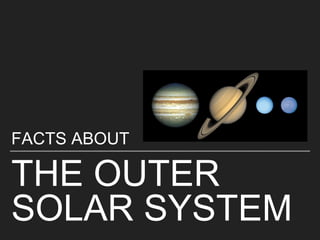
▸ Include Jupiter, Saturn, Uranus, and Neptune
▸ Nearly all of planets’ mass is made up of hydrogen and helium, similar
to composition of the sun
▸ No solid surface beneath outer layers—pressure from their thick
atmospheres liquefy insides
▸ Might have rocky cores
THE OUTER SOLAR SYSTEM
▸ Moons of outer planets have variety of compositions ranging from rocky
to icy to volcanic
▸ Rings of dust, rock, and ice encircle outer plants—rings of Saturn most
famous
COMETS IN THE OUTER
SOLAR SYSTEM
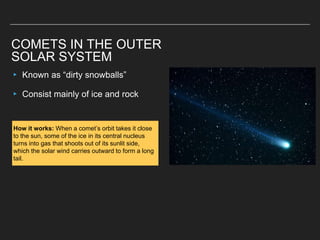
▸ Known as “dirty snowballs”
▸ Consist mainly of ice and rock
How it works: When a comet’s orbit takes it close
to the sun, some of the ice in its central nucleus
turns into gas that shoots out of its sunlit side,
which the solar wind carries outward to form a long
tail.
COMETS IN THE OUTER SOLAR SYSTEM
▸ Short-period comets that complete their orbits in less than 200 years are
thought to originate from the Kuiper belt
▸ Long-period comets that take more than 200 years to orbit are thought to
originate from more distant Oort Cloud
EXPLORATION OF THE
OUTER SOLAR SYSTEM
▸ Long-term missions to Jupiter
conducted by spacecrafts Juno and
Galileo
▸ Long-term mission to Saturn
conducted by Cassini spacecraft
▸ Only fly-by missions to Uranus and
Neptune by Voyager 2 in 1980s
▸ Scientists working on Uranus or
Neptune orbiter to be conducted in
2030s
EXPLORATION OF OUTER SOLAR
SYSTEM
Scientists also make observations from the ground to trace long-term
changes in weather and cloud formations in the “gas giants”.
TEST YOURSELF
▸ List the four planets of the outer solar system
▸ Describe the physical properties characteristic of a “gas giant”— gas
composition, beneath surface, inner core
▸ True or false: Comets can take more than 200 years to complete their
orbit
▸ True or false: On-planet missions by spacecraft have been made to
Uranus and Neptune

Outer solar system

  • 1.
  • 2.
    THE OUTER SOLAR SYSTEM ▸Include Jupiter, Saturn, Uranus, and Neptune ▸ Nearly all of planets’ mass is made up of hydrogen and helium, similar to composition of the sun ▸ No solid surface beneath outer layers—pressure from their thick atmospheres liquefy insides ▸ Might have rocky cores
  • 3.
    THE OUTER SOLARSYSTEM ▸ Moons of outer planets have variety of compositions ranging from rocky to icy to volcanic ▸ Rings of dust, rock, and ice encircle outer plants—rings of Saturn most famous
  • 4.
    COMETS IN THEOUTER SOLAR SYSTEM ▸ Known as “dirty snowballs” ▸ Consist mainly of ice and rock How it works: When a comet’s orbit takes it close to the sun, some of the ice in its central nucleus turns into gas that shoots out of its sunlit side, which the solar wind carries outward to form a long tail.
  • 5.
    COMETS IN THEOUTER SOLAR SYSTEM ▸ Short-period comets that complete their orbits in less than 200 years are thought to originate from the Kuiper belt ▸ Long-period comets that take more than 200 years to orbit are thought to originate from more distant Oort Cloud
  • 6.
    EXPLORATION OF THE OUTERSOLAR SYSTEM ▸ Long-term missions to Jupiter conducted by spacecrafts Juno and Galileo ▸ Long-term mission to Saturn conducted by Cassini spacecraft ▸ Only fly-by missions to Uranus and Neptune by Voyager 2 in 1980s ▸ Scientists working on Uranus or Neptune orbiter to be conducted in 2030s
  • 7.
    EXPLORATION OF OUTERSOLAR SYSTEM Scientists also make observations from the ground to trace long-term changes in weather and cloud formations in the “gas giants”.
  • 8.
    TEST YOURSELF ▸ Listthe four planets of the outer solar system ▸ Describe the physical properties characteristic of a “gas giant”— gas composition, beneath surface, inner core ▸ True or false: Comets can take more than 200 years to complete their orbit ▸ True or false: On-planet missions by spacecraft have been made to Uranus and Neptune