Our Objectives:
To identifyrelevant
terms and
concepts.
To identify physical
resources available
locally and where
we can find it .
State how our
resources are used.
The difference betweenthe types of
resources.
Nonrenewable Resources
Are resources which cannot be
replaced, restored or regrown e.g.
Minerals
Fossil fuels
Renewable resources
Are resources which can be
replaced.
Land
Water
Forest
Solar energy
5.
Natural
Resources in Our
Environment
Natural Resources in our environment falls
under the following categories:
Land - soil, mining, quarrying,
agriculture
Water - beaches and rivers.
Air - renewable and clean cheap
energy.
Sun - renewable and provides
clean
cheap energy.
Minerals - gold, silver, bauxite, fossil
fuels – nonrenewable.
Forest reserves.
6.
“
”
Earth provides enoughto
satisfy every man's needs, but
not every man's greed.”
Mahatma Gandhi
What do you understand by this statement? Write your thoughts in your note
book.
7.
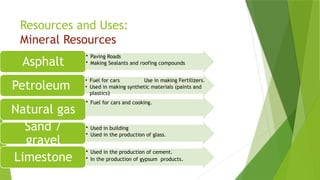
Resources and Uses:
MineralResources
• Paving Roads
• Making Sealants and roofing compounds
Asphalt
• Fuel for cars Use in making Fertilizers.
• Used in making synthetic materials (paints and
plastics)
Petroleum
• Fuel for cars and cooking.
Natural gas
• Used in building
• Used in the production of glass.
Sand /
gravel
• Used in the production of cement.
• In the production of gypsum products.
Limestone
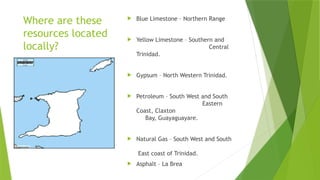
Where are these
resourceslocated
locally?
Blue Limestone – Northern Range
Yellow Limestone – Southern and
Central
Trinidad.
Gypsum – North Western Trinidad.
Petroleum – South West and South
Eastern
Coast, Claxton
Bay, Guayaguayare.
Natural Gas – South West and South
East coast of Trinidad.
Asphalt – La Brea
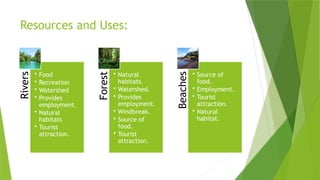
Resources and itsUses:
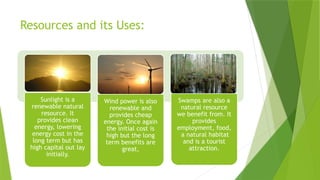
Sunlight is a
renewable natural
resource. It
provides clean
energy, lowering
energy cost in the
long term but has
high capital out lay
initially.
Wind power is also
renewable and
provides cheap
energy. Once again
the initial cost is
high but the long
term benefits are
great,
Swamps are also a
natural resource
we benefit from. It
provides
employment, food,
a natural habitat
and is a tourist
attraction.
12.
Agriculture as a
Resource
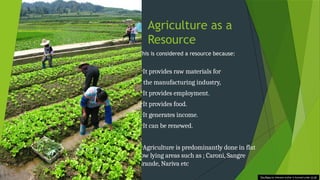
Thisis considered a resource because:
It provides raw materials for
the manufacturing industry,
It provides employment.
It provides food.
It generates income.
It can be renewed.
Agriculture is predominantly done in flat
low lying areas such as ; Caroni, Sangre
Grande, Nariva etc
This Photo by Unknown Author is licensed under CC BY
13.
Resources & TheEconomy.
Resources are important to the development of an economy.
What did we notice about these resources?
What do they seem to have in common?
They create …… JOBS ……. GOODS …….
INCOME.
This Photo by Unknown Author is licensed under CC BY
14.
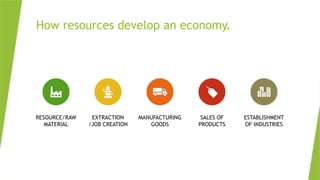
How resources developan economy.
RESOURCE/RAW
MATERIAL
EXTRACTION
/JOB CREATION
MANUFACTURING
GOODS
SALES OF
PRODUCTS
ESTABLISHMENT
OF INDUSTRIES
15.
THE INDUSTRIES
Service Industry
Tertiary
Sector
Workers.
Providesthe
services to
train,
market, sell
and invest
the money
from the
goods.
Manufacturing Industry
Secondary
Sector
Workers.
Converts
resources into
goods,
Extractive Industry
Primary Sector Workers
Removes resources from
the environment.
17.
Closure
Any questions?????
So, what did we learn today?
Take one minute and formulate 3 sentences to share with the class. Orally
share individually.