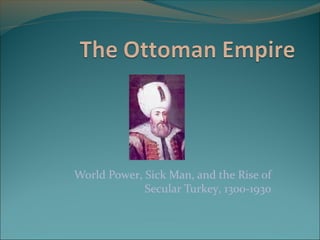
World Power, Sick Man, and the Rise of
             Secular Turkey, 1300-1930
Period of Growth
Succeeded Seljuk Turks as great Muslim power
 in Middle East.
Greatest Emperor was Suleyman (1494-1566).
Military conquests—Captured Belgrade in 1521;
 turned away from Vienna in 1529.
Ordered construction of Suleiman Mosque
Relied on Janissaries, soldiers who eventually
 displace Ottoman nobility.
Ottoman counterweight—France and
 Ottomans allied versus Austrian Habsburgs.
Suleiman Mosque in Istanbul; built between 1550 and 1567
Decline
Military Defeat—Lepanto in 1571; Vienna—1683
Russian expansion to Black Sea and Austrian
 expansion in Balkans
Weak Rulers: Selim (1566-1574) “The Glutton”;
 Ibrahim (1640-1648) drowned 280 concubines in the
 Bosphorus.
Internal disruptions—Janissaries revolt
Continued Decline
Revolts in the Balkans (Serbia in 1804; Greece in 1821
Failed Reforms—Selim III (1789-1807)—attempts to
 introduce European style military opposed by clerics
 and Janissaries.
1850s—Tanzimat reforms of bureaucracy fail due to
 military losses (Crimea) and continued Balkan revolts.
Why the Decline
Doctrine of Closed Revelation
European incursions (British Land Bridge to India;
 Russian and Habsburg expansionism; European
 devotion to Holy Land)
Pre-WWI Reform Movements
Prime Minister Midhat Pasha and the
 Constitution of 1876—unitary state, free press,
 freedom of conscience, equality before the law;
 and equitable taxation.
Sultan fired Midhat in 1877.
Russia defeats Ottomans in 1876-1877 war.
Young Turks emerge calling for Constitution of
 1876.
Struggle between Young Turks and Sultan over
 constitution interrupted by WWI.
Midhat Pasha, as PM
Sought to make
Ottoman State more modern
Through the Constitution
Of 1876.
Ottoman Dismemberment
Ottomans support Central Powers in WWI.
Treaty of Sevres/Lausanne break up Ottoman Empire.
France and Britain get Syria and Palestine; Truncated
 country of Turkey is created.
Turkey under Mustafa Kemal [1881-1938] (Ataturk)
 becomes secular Muslim State.
Ataturk’s Six Arrows
 Republicanis Reformism
  m            Nationalism
 Populism     Statism
 Secularism
WESTERNIZATION OF ISLAM
The State, a lay institution, religion a private matter
“Disestablishment” of Islam, Islamic piety to take the
 form of Reform Jewish piety
From Arabic to Turkish call to prayer
Islam, the test case for the whole traditional heritage
Sufism banned, Madrasa college suppressed
TURKISH INTERPRETATION OF RELIGION, ISLAM
  “The Golden Age” of Islam, common among
   non-Turks, limited to early history, in the
   remote past
  Islam proper ended with 1258 CE?
  For Turks Islamic history both recent and
   continuing
  Their reading of history is not fundamentally
   apologetics.
  Turks engage in “self-criticism”
  History un-terminated process with Turks as
   active participants
Ottomanempire

Ottomanempire

  • 1.
    World Power, SickMan, and the Rise of Secular Turkey, 1300-1930
  • 3.
    Period of Growth SucceededSeljuk Turks as great Muslim power in Middle East. Greatest Emperor was Suleyman (1494-1566). Military conquests—Captured Belgrade in 1521; turned away from Vienna in 1529. Ordered construction of Suleiman Mosque Relied on Janissaries, soldiers who eventually displace Ottoman nobility. Ottoman counterweight—France and Ottomans allied versus Austrian Habsburgs.
  • 4.
    Suleiman Mosque inIstanbul; built between 1550 and 1567
  • 5.
    Decline Military Defeat—Lepanto in1571; Vienna—1683 Russian expansion to Black Sea and Austrian expansion in Balkans Weak Rulers: Selim (1566-1574) “The Glutton”; Ibrahim (1640-1648) drowned 280 concubines in the Bosphorus. Internal disruptions—Janissaries revolt
  • 6.
    Continued Decline Revolts inthe Balkans (Serbia in 1804; Greece in 1821 Failed Reforms—Selim III (1789-1807)—attempts to introduce European style military opposed by clerics and Janissaries. 1850s—Tanzimat reforms of bureaucracy fail due to military losses (Crimea) and continued Balkan revolts.
  • 7.
    Why the Decline Doctrineof Closed Revelation European incursions (British Land Bridge to India; Russian and Habsburg expansionism; European devotion to Holy Land)
  • 8.
    Pre-WWI Reform Movements PrimeMinister Midhat Pasha and the Constitution of 1876—unitary state, free press, freedom of conscience, equality before the law; and equitable taxation. Sultan fired Midhat in 1877. Russia defeats Ottomans in 1876-1877 war. Young Turks emerge calling for Constitution of 1876. Struggle between Young Turks and Sultan over constitution interrupted by WWI.
  • 9.
    Midhat Pasha, asPM Sought to make Ottoman State more modern Through the Constitution Of 1876.
  • 10.
    Ottoman Dismemberment Ottomans supportCentral Powers in WWI. Treaty of Sevres/Lausanne break up Ottoman Empire. France and Britain get Syria and Palestine; Truncated country of Turkey is created. Turkey under Mustafa Kemal [1881-1938] (Ataturk) becomes secular Muslim State.
  • 12.
    Ataturk’s Six Arrows Republicanis Reformism m Nationalism Populism Statism Secularism
  • 13.
    WESTERNIZATION OF ISLAM TheState, a lay institution, religion a private matter “Disestablishment” of Islam, Islamic piety to take the form of Reform Jewish piety From Arabic to Turkish call to prayer Islam, the test case for the whole traditional heritage Sufism banned, Madrasa college suppressed
  • 14.
    TURKISH INTERPRETATION OFRELIGION, ISLAM “The Golden Age” of Islam, common among non-Turks, limited to early history, in the remote past Islam proper ended with 1258 CE? For Turks Islamic history both recent and continuing Their reading of history is not fundamentally apologetics. Turks engage in “self-criticism” History un-terminated process with Turks as active participants