Embedded Systems in Silicon
TD5102
Other Architectures
Henk Corporaal
http://www.ics.ele.tue.nl/~heco/courses/EmbSystems
Technical University Eindhoven
DTI / NUS Singapore
2005/2006
ACA 2003 2
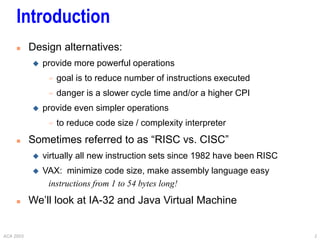
 Design alternatives:
 provide more powerful operations
 goal is to reduce number of instructions executed
 danger is a slower cycle time and/or a higher CPI
 provide even simpler operations
 to reduce code size / complexity interpreter
 Sometimes referred to as “RISC vs. CISC”
 virtually all new instruction sets since 1982 have been RISC
 VAX: minimize code size, make assembly language easy
instructions from 1 to 54 bytes long!
 We’ll look at IA-32 and Java Virtual Machine
Introduction
ACA 2003 3
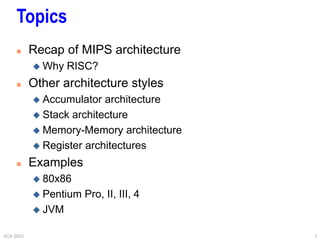
Topics
 Recap of MIPS architecture
 Why RISC?
 Other architecture styles
 Accumulator architecture
 Stack architecture
 Memory-Memory architecture
 Register architectures
 Examples
 80x86
 Pentium Pro, II, III, 4
 JVM
ACA 2003 4
Recap of MIPS
 RISC architecture
 Register space
 Addressing
 Instruction format
 Pipelining
ACA 2003 5
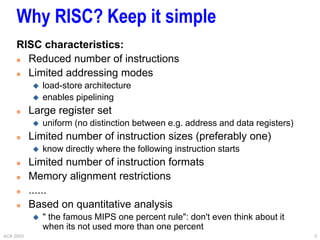
Why RISC? Keep it simple
RISC characteristics:
 Reduced number of instructions
 Limited addressing modes
 load-store architecture
 enables pipelining
 Large register set
 uniform (no distinction between e.g. address and data registers)
 Limited number of instruction sizes (preferably one)
 know directly where the following instruction starts
 Limited number of instruction formats
 Memory alignment restrictions
 ......
 Based on quantitative analysis
 " the famous MIPS one percent rule": don't even think about it
when its not used more than one percent
ACA 2003 6
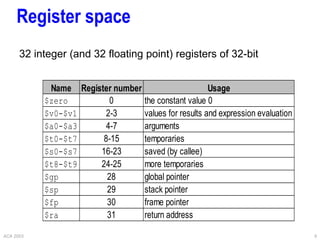
Register space
Name Register number Usage
$zero 0 the constant value 0
$v0-$v1 2-3 values for results and expression evaluation
$a0-$a3 4-7 arguments
$t0-$t7 8-15 temporaries
$s0-$s7 16-23 saved (by callee)
$t8-$t9 24-25 more temporaries
$gp 28 global pointer
$sp 29 stack pointer
$fp 30 frame pointer
$ra 31 return address
32 integer (and 32 floating point) registers of 32-bit
ACA 2003 7
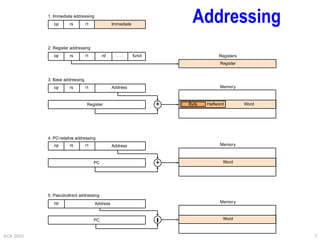
Addressing
Byte Halfword Word
Registers
Memory
Memory
Word
Memory
Word
Register
Register
1. Immediate addressing
2. Register addressing
3. Base addressing
4. PC-relative addressing
5. Pseudodirect addressing
op rs rt
op rs rt
op rs rt
op
op
rs rt
Address
Address
Address
rd . . . funct
Immediate
PC
PC
+
+
ACA 2003 8
Instruction format
Example instructions
Instruction Meaning
add $s1,$s2,$s3 $s1 = $s2 + $s3
addi $s2,$s3,4 $s2 = $s3 + 4
lw $s1,100($s2) $s1 = Memory[$s2+100]
bne $s4,$s5,L if $s4<>$s5 goto L
j Label goto Label
op rs rt rd shamt funct
op rs rt 16 bit address
op 26 bit address
R
I
J
ACA 2003 9
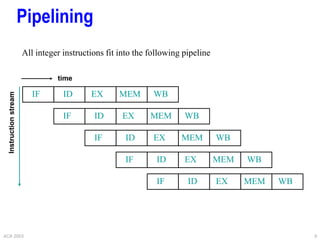
Pipelining
time
IF ID EX MEM WB
IF ID EX MEM WB
IF ID EX MEM WB
IF ID EX MEM WB
IF ID EX MEM WB
All integer instructions fit into the following pipeline
ACA 2003 10
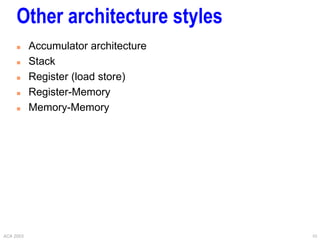
Other architecture styles
 Accumulator architecture
 Stack
 Register (load store)
 Register-Memory
 Memory-Memory
ACA 2003 11
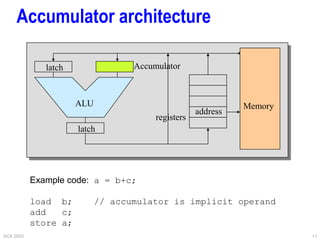
Accumulator architecture
Accumulator
ALU Memory
registers
address
latch
latch
Example code: a = b+c;
load b; // accumulator is implicit operand
add c;
store a;
ACA 2003 12
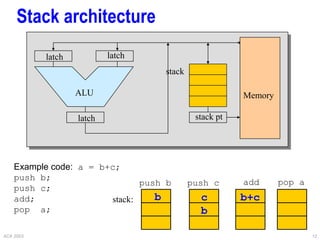
Stack architecture
Example code: a = b+c;
push b;
push c;
add;
pop a;
b
b
c b+c
push b push c add pop a
stack:
ALU Memory
stack
stack pt
latch
latch
latch
ACA 2003 13
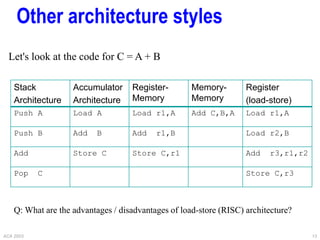
Other architecture styles
Stack
Architecture
Accumulator
Architecture
Register-
Memory
Memory-
Memory
Register
(load-store)
Push A Load A Load r1,A Add C,B,A Load r1,A
Push B Add B Add r1,B Load r2,B
Add Store C Store C,r1 Add r3,r1,r2
Pop C Store C,r3
Let's look at the code for C = A + B
Q: What are the advantages / disadvantages of load-store (RISC) architecture?
ACA 2003 14
Other architecture styles
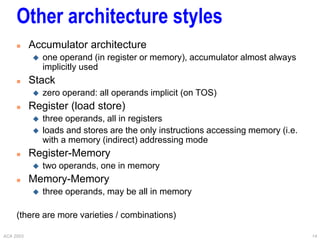
 Accumulator architecture
 one operand (in register or memory), accumulator almost always
implicitly used
 Stack
 zero operand: all operands implicit (on TOS)
 Register (load store)
 three operands, all in registers
 loads and stores are the only instructions accessing memory (i.e.
with a memory (indirect) addressing mode
 Register-Memory
 two operands, one in memory
 Memory-Memory
 three operands, may be all in memory
(there are more varieties / combinations)
ACA 2003 15
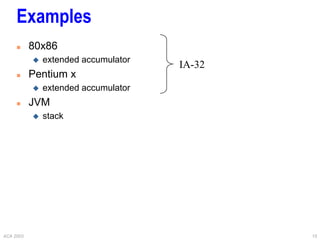
Examples
 80x86
 extended accumulator
 Pentium x
 extended accumulator
 JVM
 stack
IA-32
ACA 2003 16
A dominant architecture: x86/IA-32
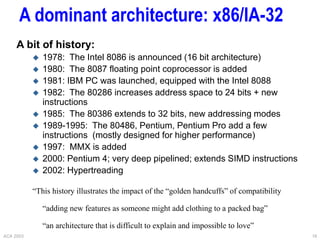
A bit of history:
 1978: The Intel 8086 is announced (16 bit architecture)
 1980: The 8087 floating point coprocessor is added
 1981: IBM PC was launched, equipped with the Intel 8088
 1982: The 80286 increases address space to 24 bits + new
instructions
 1985: The 80386 extends to 32 bits, new addressing modes
 1989-1995: The 80486, Pentium, Pentium Pro add a few
instructions (mostly designed for higher performance)
 1997: MMX is added
 2000: Pentium 4; very deep pipelined; extends SIMD instructions
 2002: Hypertreading
“This history illustrates the impact of the “golden handcuffs” of compatibility
“adding new features as someone might add clothing to a packed bag”
“an architecture that is difficult to explain and impossible to love”
ACA 2003 17
IA-32 Overview
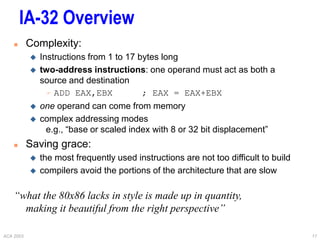
 Complexity:
 Instructions from 1 to 17 bytes long
 two-address instructions: one operand must act as both a
source and destination
 ADD EAX,EBX ; EAX = EAX+EBX
 one operand can come from memory
 complex addressing modes
e.g., “base or scaled index with 8 or 32 bit displacement”
 Saving grace:
 the most frequently used instructions are not too difficult to build
 compilers avoid the portions of the architecture that are slow
“what the 80x86 lacks in style is made up in quantity,
making it beautiful from the right perspective”
ACA 2003 18
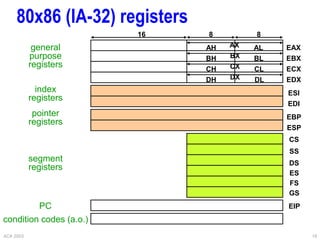
80x86 (IA-32) registers
AH AL
BH
CH
DH
BL
CL
DL
AX
BX
CX
DX
8
8
16
EAX
EBX
ECX
EDX
ESI
EDI
EBP
ESP
CS
SS
DS
ES
FS
GS
EIP
general
purpose
registers
index
registers
pointer
registers
segment
registers
PC
condition codes (a.o.)
ACA 2003 19
IA-32 Addressing Modes
Addressing modes: where are the operands?
 Immediate
MOV EAX,10 ; EAX = 10
 Direct
MOV EAX,I ; EAX = Mem[&i]
I DW 3
 Register
MOV EAX,EBX ; EAX = EBX
 Register indirect
MOV EAX,[EBX] ; EAX = Memory[EBX]
 Based with 8- or 32-bit displacement
MOV EAX,[EBX+8] ; EAX = Mem[EBX+8]
 Based with scaled index (scale = 0 .. 3)
MOV EAX,ECX[EBX] ; EAX = Mem[EBX + 2scale * ECX]
 Based plus scaled index with 8- or 32-bit displacement
MOV EAX,ECX[EBX+8]
ACA 2003 20
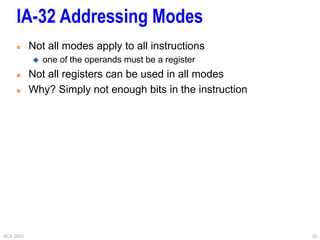
IA-32 Addressing Modes
 Not all modes apply to all instructions
 one of the operands must be a register
 Not all registers can be used in all modes
 Why? Simply not enough bits in the instruction
ACA 2003 21
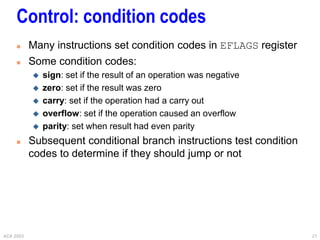
Control: condition codes
 Many instructions set condition codes in EFLAGS register
 Some condition codes:
 sign: set if the result of an operation was negative
 zero: set if the result was zero
 carry: set if the operation had a carry out
 overflow: set if the operation caused an overflow
 parity: set when result had even parity
 Subsequent conditional branch instructions test condition
codes to determine if they should jump or not
ACA 2003 22
Control
 Special instruction: compare
CMP SRC1,SRC2 ; set cc’s based on SRC1-SRC2
 Example
for (i=0; i<10; i++)
a[i]++;
MOV EAX,0 ; EAX = i = 0
_L: CMP EAX,10 ; if (i<10)
JNL _EXIT ; jump to _EXIT if i>=10
INC [EBX] ; Mem[EBX](=a[i])++
ADD EBX,4 ; EBX = &a[i+1]
INC EAX ; EAX++
JMP _L ; goto _L
_EXIT: ...
ACA 2003 23
Control
 Peculiar control instruction
LOOP _LABEL ; decrease ECX, if (ECX!=0) goto
_LABEL
 Previous example rewritten:
MOV ECX,10
_L: INC [EBX]
ADD EBX,4
LOOP _L
 Fewer instructions, but LOOP is slow
ACA 2003 24
Procedures/functions
 Instructions
 CALL AProcedure ; push return address on stack
; and goto AProcedure
 RET ; pop return address from stack
; and jump to it
 EBP is used as a frame pointer which points to a fixed
location within stack frame (to access locals)
 ESP is used as stack pointer
 Special instructions:
 PUSH EAX ; ESP -= 4, Mem[ESP] = EAX
 POP EAX ; EAX = Mem[ESP], ESP += 4
ACA 2003 25
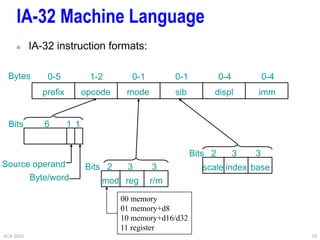
IA-32 Machine Language
 IA-32 instruction formats:
prefix opcode mode sib displ imm
0-5 1-2 0-1 0-1 0-4 0-4
6 1 1
Bytes
Bits
2 3 3
Bits
mod reg r/m
Source operand
Byte/word
2 3 3
Bits
scale index base
00 memory
01 memory+d8
10 memory+d16/d32
11 register
ACA 2003 26
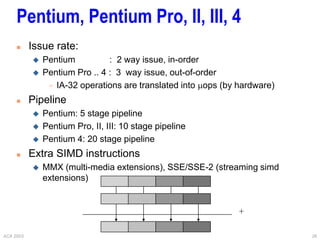
Pentium, Pentium Pro, II, III, 4
 Issue rate:
 Pentium : 2 way issue, in-order
 Pentium Pro .. 4 : 3 way issue, out-of-order
 IA-32 operations are translated into ops (by hardware)
 Pipeline
 Pentium: 5 stage pipeline
 Pentium Pro, II, III: 10 stage pipeline
 Pentium 4: 20 stage pipeline
 Extra SIMD instructions
 MMX (multi-media extensions), SSE/SSE-2 (streaming simd
extensions)
+
ACA 2003 27
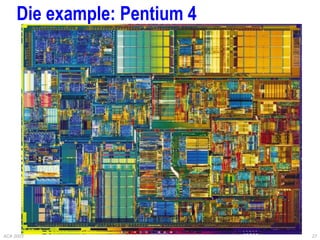
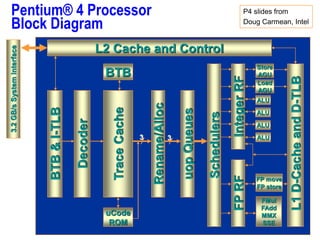
Die example: Pentium 4
ACA 2003 28
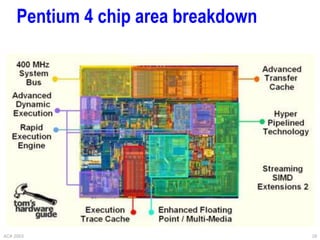
Pentium 4 chip area breakdown
ACA 2003 29
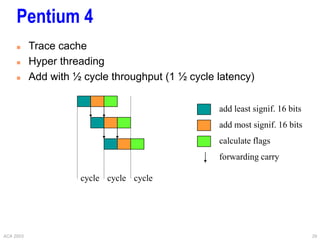
Pentium 4
 Trace cache
 Hyper threading
 Add with ½ cycle throughput (1 ½ cycle latency)
cycle cycle cycle
add least signif. 16 bits
add most signif. 16 bits
calculate flags
forwarding carry
Pentium® 4 Processor
Block Diagram
FP
RF
FMul
FAdd
MMX
SSE
FP move
FP store
3.2
GB/s
System
Interface
L2 Cache and Control
L1
D-Cache
and
D-TLB
Store
AGU
Load
AGU
Schedulers
Integer
RF
ALU
ALU
ALU
ALU
Trace
Cache
Rename/Alloc
uop
Queues
BTB
uCode
ROM
3 3
Decoder
BTB
&
I-TLB
L2 Cache and Control
P4 slides from
Doug Carmean, Intel
ACA 2003 31
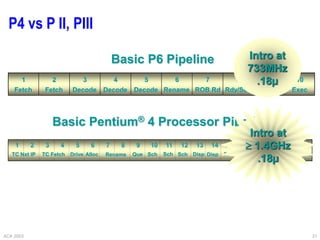
P4 vs P II, PIII
1 2 3 4 5 6 7 8 9 10
Fetch Fetch Decode Decode Decode Rename ROB Rd Rdy/Sch Dispatch Exec
Basic P6 Pipeline
Basic Pentium® 4 Processor Pipeline
1 2 3 4 5 6 7 8 9 10 11 12
TC Nxt IP TC Fetch Drive Alloc Rename Que Sch Sch Sch
13 14
Disp Disp
15 16 17 18 19 20
RF Ex Flgs Br Ck Drive
RF
Intro at
 1.4GHz
.18µ
Intro at
733MHz
.18µ
ACA 2003 32
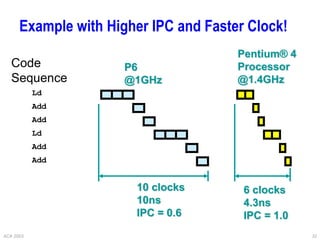
Example with Higher IPC and Faster Clock!
Code
Sequence
Ld
Add
Add
Ld
Add
Add
10 clocks
10ns
IPC = 0.6
6 clocks
4.3ns
IPC = 1.0
P6
@1GHz
Pentium® 4
Processor
@1.4GHz
ACA 2003 33
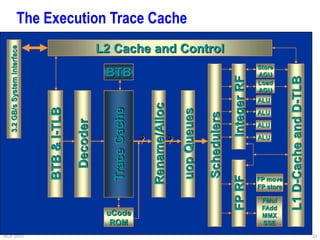
The Execution Trace Cache
L2 Cache and Control
L1
D-Cache
and
D-TLB
Trace
Cache
3 3
FP
RF
FMul
FAdd
MMX
SSE
FP move
FP store
3.2
GB/s
System
Interface
Store
AGU
Load
AGU
Schedulers
Integer
RF
ALU
ALU
ALU
ALU
Rename/Alloc
uop
Queues
BTB
uCode
ROM
Decoder
BTB
&
I-TLB
Trace
Cache
BTB
ACA 2003 34
Execution Trace Cache
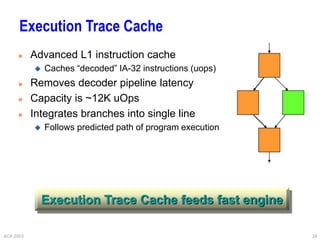
 Advanced L1 instruction cache
 Caches “decoded” IA-32 instructions (uops)
 Removes decoder pipeline latency
 Capacity is ~12K uOps
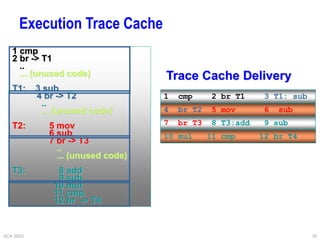
 Integrates branches into single line
 Follows predicted path of program execution
Execution Trace Cache feeds fast engine
ACA 2003 35
1 cmp
2 br -> T1
..
... (unused code)
T1: 3 sub
4 br -> T2
..
... (unused code)
T2: 5 mov
6 sub
7 br -> T3
..
... (unused code)
T3: 8 add
9 sub
10 mul
11 cmp
12 br -> T4
Execution Trace Cache
Trace Cache Delivery
10 mul 11 cmp 12 br T4
7 br T3 8 T3:add 9 sub
4 br T2 5 mov 6 sub
1 cmp 2 br T1 3 T1: sub
ACA 2003 36
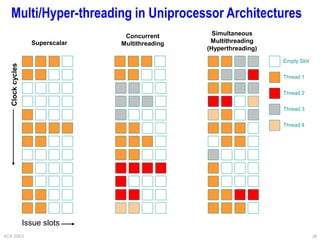
Multi/Hyper-threading in Uniprocessor Architectures
Superscalar
Simultaneous
Multithreading
(Hyperthreading)
Concurrent
Multithreading
Issue slots
Clock
cycles
Empty Slot
Thread 1
Thread 2
Thread 3
Thread 4
ACA 2003 37
JVM: Java Virtual Machine
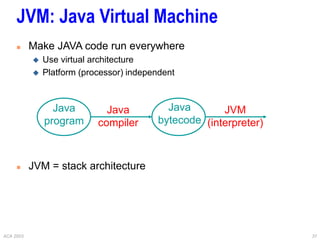
 Make JAVA code run everywhere
 Use virtual architecture
 Platform (processor) independent
Java
program
Java
bytecode
Java
compiler
JVM
(interpreter)
 JVM = stack architecture
ACA 2003 38
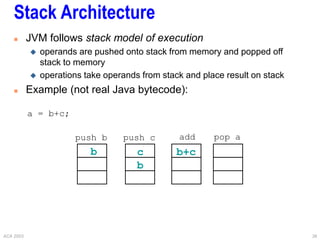
Stack Architecture
 JVM follows stack model of execution
 operands are pushed onto stack from memory and popped off
stack to memory
 operations take operands from stack and place result on stack
 Example (not real Java bytecode):
b
b
c b+c
a = b+c;
push b push c add pop a
ACA 2003 39
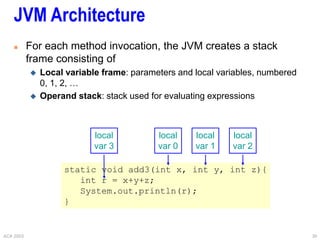
JVM Architecture
 For each method invocation, the JVM creates a stack
frame consisting of
 Local variable frame: parameters and local variables, numbered
0, 1, 2, …
 Operand stack: stack used for evaluating expressions
static void add3(int x, int y, int z){
int r = x+y+z;
System.out.println(r);
}
local
var 0
local
var 1
local
var 2
local
var 3
ACA 2003 40
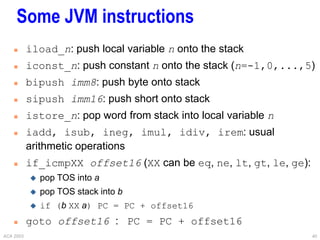
Some JVM instructions
 iload_n: push local variable n onto the stack
 iconst_n: push constant n onto the stack (n=-1,0,...,5)
 bipush imm8: push byte onto stack
 sipush imm16: push short onto stack
 istore_n: pop word from stack into local variable n
 iadd, isub, ineg, imul, idiv, irem: usual
arithmetic operations
 if_icmpXX offset16 (XX can be eq, ne, lt, gt, le, ge):
 pop TOS into a
 pop TOS stack into b
 if (b XX a) PC = PC + offset16
 goto offset16 : PC = PC + offset16
ACA 2003 41
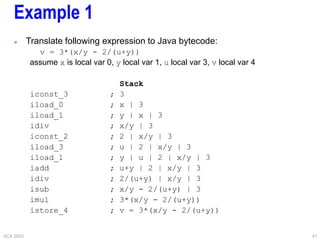
Example 1
 Translate following expression to Java bytecode:
v = 3*(x/y - 2/(u+y))
assume x is local var 0, y local var 1, u local var 3, v local var 4
Stack
iconst_3 ; 3
iload_0 ; x | 3
iload_1 ; y | x | 3
idiv ; x/y | 3
iconst_2 ; 2 | x/y | 3
iload_3 ; u | 2 | x/y | 3
iload_1 ; y | u | 2 | x/y | 3
iadd ; u+y | 2 | x/y | 3
idiv ; 2/(u+y) | x/y | 3
isub ; x/y - 2/(u+y) | 3
imul ; 3*(x/y - 2/(u+y))
istore_4 ; v = 3*(x/y - 2/(u+y))
ACA 2003 42
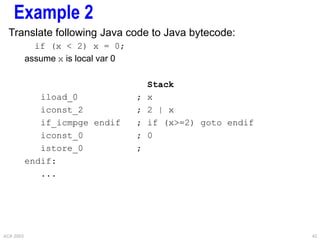
Example 2
Translate following Java code to Java bytecode:
if (x < 2) x = 0;
assume x is local var 0
Stack
iload_0 ; x
iconst_2 ; 2 | x
if_icmpge endif ; if (x>=2) goto endif
iconst_0 ; 0
istore_0 ;
endif:
...

other-architectures.ppt

  • 1.
    Embedded Systems inSilicon TD5102 Other Architectures Henk Corporaal http://www.ics.ele.tue.nl/~heco/courses/EmbSystems Technical University Eindhoven DTI / NUS Singapore 2005/2006
  • 2.
    ACA 2003 2 Design alternatives:  provide more powerful operations  goal is to reduce number of instructions executed  danger is a slower cycle time and/or a higher CPI  provide even simpler operations  to reduce code size / complexity interpreter  Sometimes referred to as “RISC vs. CISC”  virtually all new instruction sets since 1982 have been RISC  VAX: minimize code size, make assembly language easy instructions from 1 to 54 bytes long!  We’ll look at IA-32 and Java Virtual Machine Introduction
  • 3.
    ACA 2003 3 Topics Recap of MIPS architecture  Why RISC?  Other architecture styles  Accumulator architecture  Stack architecture  Memory-Memory architecture  Register architectures  Examples  80x86  Pentium Pro, II, III, 4  JVM
  • 4.
    ACA 2003 4 Recapof MIPS  RISC architecture  Register space  Addressing  Instruction format  Pipelining
  • 5.
    ACA 2003 5 WhyRISC? Keep it simple RISC characteristics:  Reduced number of instructions  Limited addressing modes  load-store architecture  enables pipelining  Large register set  uniform (no distinction between e.g. address and data registers)  Limited number of instruction sizes (preferably one)  know directly where the following instruction starts  Limited number of instruction formats  Memory alignment restrictions  ......  Based on quantitative analysis  " the famous MIPS one percent rule": don't even think about it when its not used more than one percent
  • 6.
    ACA 2003 6 Registerspace Name Register number Usage $zero 0 the constant value 0 $v0-$v1 2-3 values for results and expression evaluation $a0-$a3 4-7 arguments $t0-$t7 8-15 temporaries $s0-$s7 16-23 saved (by callee) $t8-$t9 24-25 more temporaries $gp 28 global pointer $sp 29 stack pointer $fp 30 frame pointer $ra 31 return address 32 integer (and 32 floating point) registers of 32-bit
  • 7.
    ACA 2003 7 Addressing ByteHalfword Word Registers Memory Memory Word Memory Word Register Register 1. Immediate addressing 2. Register addressing 3. Base addressing 4. PC-relative addressing 5. Pseudodirect addressing op rs rt op rs rt op rs rt op op rs rt Address Address Address rd . . . funct Immediate PC PC + +
  • 8.
    ACA 2003 8 Instructionformat Example instructions Instruction Meaning add $s1,$s2,$s3 $s1 = $s2 + $s3 addi $s2,$s3,4 $s2 = $s3 + 4 lw $s1,100($s2) $s1 = Memory[$s2+100] bne $s4,$s5,L if $s4<>$s5 goto L j Label goto Label op rs rt rd shamt funct op rs rt 16 bit address op 26 bit address R I J
  • 9.
    ACA 2003 9 Pipelining time IFID EX MEM WB IF ID EX MEM WB IF ID EX MEM WB IF ID EX MEM WB IF ID EX MEM WB All integer instructions fit into the following pipeline
  • 10.
    ACA 2003 10 Otherarchitecture styles  Accumulator architecture  Stack  Register (load store)  Register-Memory  Memory-Memory
  • 11.
    ACA 2003 11 Accumulatorarchitecture Accumulator ALU Memory registers address latch latch Example code: a = b+c; load b; // accumulator is implicit operand add c; store a;
  • 12.
    ACA 2003 12 Stackarchitecture Example code: a = b+c; push b; push c; add; pop a; b b c b+c push b push c add pop a stack: ALU Memory stack stack pt latch latch latch
  • 13.
    ACA 2003 13 Otherarchitecture styles Stack Architecture Accumulator Architecture Register- Memory Memory- Memory Register (load-store) Push A Load A Load r1,A Add C,B,A Load r1,A Push B Add B Add r1,B Load r2,B Add Store C Store C,r1 Add r3,r1,r2 Pop C Store C,r3 Let's look at the code for C = A + B Q: What are the advantages / disadvantages of load-store (RISC) architecture?
  • 14.
    ACA 2003 14 Otherarchitecture styles  Accumulator architecture  one operand (in register or memory), accumulator almost always implicitly used  Stack  zero operand: all operands implicit (on TOS)  Register (load store)  three operands, all in registers  loads and stores are the only instructions accessing memory (i.e. with a memory (indirect) addressing mode  Register-Memory  two operands, one in memory  Memory-Memory  three operands, may be all in memory (there are more varieties / combinations)
  • 15.
    ACA 2003 15 Examples 80x86  extended accumulator  Pentium x  extended accumulator  JVM  stack IA-32
  • 16.
    ACA 2003 16 Adominant architecture: x86/IA-32 A bit of history:  1978: The Intel 8086 is announced (16 bit architecture)  1980: The 8087 floating point coprocessor is added  1981: IBM PC was launched, equipped with the Intel 8088  1982: The 80286 increases address space to 24 bits + new instructions  1985: The 80386 extends to 32 bits, new addressing modes  1989-1995: The 80486, Pentium, Pentium Pro add a few instructions (mostly designed for higher performance)  1997: MMX is added  2000: Pentium 4; very deep pipelined; extends SIMD instructions  2002: Hypertreading “This history illustrates the impact of the “golden handcuffs” of compatibility “adding new features as someone might add clothing to a packed bag” “an architecture that is difficult to explain and impossible to love”
  • 17.
    ACA 2003 17 IA-32Overview  Complexity:  Instructions from 1 to 17 bytes long  two-address instructions: one operand must act as both a source and destination  ADD EAX,EBX ; EAX = EAX+EBX  one operand can come from memory  complex addressing modes e.g., “base or scaled index with 8 or 32 bit displacement”  Saving grace:  the most frequently used instructions are not too difficult to build  compilers avoid the portions of the architecture that are slow “what the 80x86 lacks in style is made up in quantity, making it beautiful from the right perspective”
  • 18.
    ACA 2003 18 80x86(IA-32) registers AH AL BH CH DH BL CL DL AX BX CX DX 8 8 16 EAX EBX ECX EDX ESI EDI EBP ESP CS SS DS ES FS GS EIP general purpose registers index registers pointer registers segment registers PC condition codes (a.o.)
  • 19.
    ACA 2003 19 IA-32Addressing Modes Addressing modes: where are the operands?  Immediate MOV EAX,10 ; EAX = 10  Direct MOV EAX,I ; EAX = Mem[&i] I DW 3  Register MOV EAX,EBX ; EAX = EBX  Register indirect MOV EAX,[EBX] ; EAX = Memory[EBX]  Based with 8- or 32-bit displacement MOV EAX,[EBX+8] ; EAX = Mem[EBX+8]  Based with scaled index (scale = 0 .. 3) MOV EAX,ECX[EBX] ; EAX = Mem[EBX + 2scale * ECX]  Based plus scaled index with 8- or 32-bit displacement MOV EAX,ECX[EBX+8]
  • 20.
    ACA 2003 20 IA-32Addressing Modes  Not all modes apply to all instructions  one of the operands must be a register  Not all registers can be used in all modes  Why? Simply not enough bits in the instruction
  • 21.
    ACA 2003 21 Control:condition codes  Many instructions set condition codes in EFLAGS register  Some condition codes:  sign: set if the result of an operation was negative  zero: set if the result was zero  carry: set if the operation had a carry out  overflow: set if the operation caused an overflow  parity: set when result had even parity  Subsequent conditional branch instructions test condition codes to determine if they should jump or not
  • 22.
    ACA 2003 22 Control Special instruction: compare CMP SRC1,SRC2 ; set cc’s based on SRC1-SRC2  Example for (i=0; i<10; i++) a[i]++; MOV EAX,0 ; EAX = i = 0 _L: CMP EAX,10 ; if (i<10) JNL _EXIT ; jump to _EXIT if i>=10 INC [EBX] ; Mem[EBX](=a[i])++ ADD EBX,4 ; EBX = &a[i+1] INC EAX ; EAX++ JMP _L ; goto _L _EXIT: ...
  • 23.
    ACA 2003 23 Control Peculiar control instruction LOOP _LABEL ; decrease ECX, if (ECX!=0) goto _LABEL  Previous example rewritten: MOV ECX,10 _L: INC [EBX] ADD EBX,4 LOOP _L  Fewer instructions, but LOOP is slow
  • 24.
    ACA 2003 24 Procedures/functions Instructions  CALL AProcedure ; push return address on stack ; and goto AProcedure  RET ; pop return address from stack ; and jump to it  EBP is used as a frame pointer which points to a fixed location within stack frame (to access locals)  ESP is used as stack pointer  Special instructions:  PUSH EAX ; ESP -= 4, Mem[ESP] = EAX  POP EAX ; EAX = Mem[ESP], ESP += 4
  • 25.
    ACA 2003 25 IA-32Machine Language  IA-32 instruction formats: prefix opcode mode sib displ imm 0-5 1-2 0-1 0-1 0-4 0-4 6 1 1 Bytes Bits 2 3 3 Bits mod reg r/m Source operand Byte/word 2 3 3 Bits scale index base 00 memory 01 memory+d8 10 memory+d16/d32 11 register
  • 26.
    ACA 2003 26 Pentium,Pentium Pro, II, III, 4  Issue rate:  Pentium : 2 way issue, in-order  Pentium Pro .. 4 : 3 way issue, out-of-order  IA-32 operations are translated into ops (by hardware)  Pipeline  Pentium: 5 stage pipeline  Pentium Pro, II, III: 10 stage pipeline  Pentium 4: 20 stage pipeline  Extra SIMD instructions  MMX (multi-media extensions), SSE/SSE-2 (streaming simd extensions) +
  • 27.
    ACA 2003 27 Dieexample: Pentium 4
  • 28.
    ACA 2003 28 Pentium4 chip area breakdown
  • 29.
    ACA 2003 29 Pentium4  Trace cache  Hyper threading  Add with ½ cycle throughput (1 ½ cycle latency) cycle cycle cycle add least signif. 16 bits add most signif. 16 bits calculate flags forwarding carry
  • 30.
    Pentium® 4 Processor BlockDiagram FP RF FMul FAdd MMX SSE FP move FP store 3.2 GB/s System Interface L2 Cache and Control L1 D-Cache and D-TLB Store AGU Load AGU Schedulers Integer RF ALU ALU ALU ALU Trace Cache Rename/Alloc uop Queues BTB uCode ROM 3 3 Decoder BTB & I-TLB L2 Cache and Control P4 slides from Doug Carmean, Intel
  • 31.
    ACA 2003 31 P4vs P II, PIII 1 2 3 4 5 6 7 8 9 10 Fetch Fetch Decode Decode Decode Rename ROB Rd Rdy/Sch Dispatch Exec Basic P6 Pipeline Basic Pentium® 4 Processor Pipeline 1 2 3 4 5 6 7 8 9 10 11 12 TC Nxt IP TC Fetch Drive Alloc Rename Que Sch Sch Sch 13 14 Disp Disp 15 16 17 18 19 20 RF Ex Flgs Br Ck Drive RF Intro at  1.4GHz .18µ Intro at 733MHz .18µ
  • 32.
    ACA 2003 32 Examplewith Higher IPC and Faster Clock! Code Sequence Ld Add Add Ld Add Add 10 clocks 10ns IPC = 0.6 6 clocks 4.3ns IPC = 1.0 P6 @1GHz Pentium® 4 Processor @1.4GHz
  • 33.
    ACA 2003 33 TheExecution Trace Cache L2 Cache and Control L1 D-Cache and D-TLB Trace Cache 3 3 FP RF FMul FAdd MMX SSE FP move FP store 3.2 GB/s System Interface Store AGU Load AGU Schedulers Integer RF ALU ALU ALU ALU Rename/Alloc uop Queues BTB uCode ROM Decoder BTB & I-TLB Trace Cache BTB
  • 34.
    ACA 2003 34 ExecutionTrace Cache  Advanced L1 instruction cache  Caches “decoded” IA-32 instructions (uops)  Removes decoder pipeline latency  Capacity is ~12K uOps  Integrates branches into single line  Follows predicted path of program execution Execution Trace Cache feeds fast engine
  • 35.
    ACA 2003 35 1cmp 2 br -> T1 .. ... (unused code) T1: 3 sub 4 br -> T2 .. ... (unused code) T2: 5 mov 6 sub 7 br -> T3 .. ... (unused code) T3: 8 add 9 sub 10 mul 11 cmp 12 br -> T4 Execution Trace Cache Trace Cache Delivery 10 mul 11 cmp 12 br T4 7 br T3 8 T3:add 9 sub 4 br T2 5 mov 6 sub 1 cmp 2 br T1 3 T1: sub
  • 36.
    ACA 2003 36 Multi/Hyper-threadingin Uniprocessor Architectures Superscalar Simultaneous Multithreading (Hyperthreading) Concurrent Multithreading Issue slots Clock cycles Empty Slot Thread 1 Thread 2 Thread 3 Thread 4
  • 37.
    ACA 2003 37 JVM:Java Virtual Machine  Make JAVA code run everywhere  Use virtual architecture  Platform (processor) independent Java program Java bytecode Java compiler JVM (interpreter)  JVM = stack architecture
  • 38.
    ACA 2003 38 StackArchitecture  JVM follows stack model of execution  operands are pushed onto stack from memory and popped off stack to memory  operations take operands from stack and place result on stack  Example (not real Java bytecode): b b c b+c a = b+c; push b push c add pop a
  • 39.
    ACA 2003 39 JVMArchitecture  For each method invocation, the JVM creates a stack frame consisting of  Local variable frame: parameters and local variables, numbered 0, 1, 2, …  Operand stack: stack used for evaluating expressions static void add3(int x, int y, int z){ int r = x+y+z; System.out.println(r); } local var 0 local var 1 local var 2 local var 3
  • 40.
    ACA 2003 40 SomeJVM instructions  iload_n: push local variable n onto the stack  iconst_n: push constant n onto the stack (n=-1,0,...,5)  bipush imm8: push byte onto stack  sipush imm16: push short onto stack  istore_n: pop word from stack into local variable n  iadd, isub, ineg, imul, idiv, irem: usual arithmetic operations  if_icmpXX offset16 (XX can be eq, ne, lt, gt, le, ge):  pop TOS into a  pop TOS stack into b  if (b XX a) PC = PC + offset16  goto offset16 : PC = PC + offset16
  • 41.
    ACA 2003 41 Example1  Translate following expression to Java bytecode: v = 3*(x/y - 2/(u+y)) assume x is local var 0, y local var 1, u local var 3, v local var 4 Stack iconst_3 ; 3 iload_0 ; x | 3 iload_1 ; y | x | 3 idiv ; x/y | 3 iconst_2 ; 2 | x/y | 3 iload_3 ; u | 2 | x/y | 3 iload_1 ; y | u | 2 | x/y | 3 iadd ; u+y | 2 | x/y | 3 idiv ; 2/(u+y) | x/y | 3 isub ; x/y - 2/(u+y) | 3 imul ; 3*(x/y - 2/(u+y)) istore_4 ; v = 3*(x/y - 2/(u+y))
  • 42.
    ACA 2003 42 Example2 Translate following Java code to Java bytecode: if (x < 2) x = 0; assume x is local var 0 Stack iload_0 ; x iconst_2 ; 2 | x if_icmpge endif ; if (x>=2) goto endif iconst_0 ; 0 istore_0 ; endif: ...

Editor's Notes