
Health Informatics: the  Relevance of Open Source and Multilevel Modeling Luciana T. Cavalini, MD, PhD Timothy W. Cook, MSc “ Multilevel Healthcare Information Modeling“ (MLHIM) Laboratory (UFF/UERJ) Associated to the National Institute of Science and Technology – Medicine Assisted by Scientific Computing
Introduction Healthcare is a dynamic and complex system The spatial changes are close
The time changes are fast
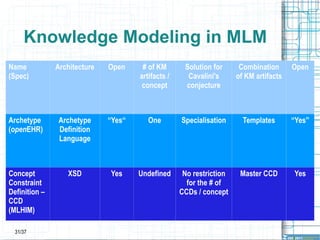
The number of basic concepts is 300,000+ Cavalini's conjecture: given a group of medical experts without any hierarchical relationship among them, the probability of them reaching 100% of agreement about any set of concepts from their domain tends to zero
Introduction A single monolithic system for the complete health record of a person “from cradle to grave” is not feasible
Integration projects that were successful in other businesses have been attempted in healthcare over the last 46 years, spending trillions of dollars, with a 100% failure rate
The result: healthcare is the less computerized business in economy
Introduction Electronic Health Records (EHR) have promised (and yet not delivered): ↓  waste of citizen's time in lines for appointments and referral
↓  waste of  staff time in search of critical information
↓  duplication of tests, medications and procedures
↑  early detection and prevention
↑  adherence to therapeutic protocols
↓   risk of adverse events and medical errors
↓  avoidable hospitalization and mortality
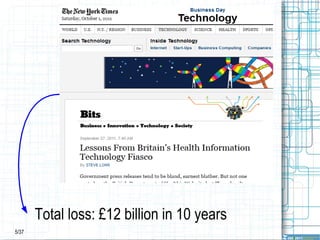
Total loss:  £ 12 billion in 10 years
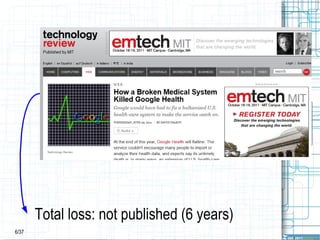
Total loss: not published (6 years)
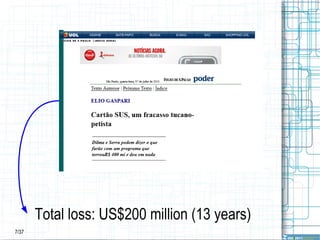
Total loss: US$200 million (13 years)
 
Introduction Currently, medical records have a chaotic mixture of old (paper) and new (computer) support medias
The electronic records already implemented seldom follow any of the ISO TC 215 recommendations or any other standardization
The mixture of incompatible systems runs across the entire system: from inside the hospitals up to the local, regional, national and international levels
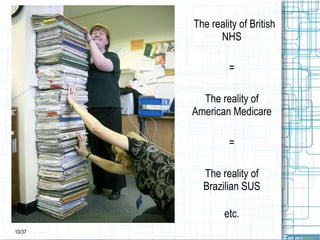
The reality of British NHS = The reality of American Medicare = The reality of Brazilian SUS etc.
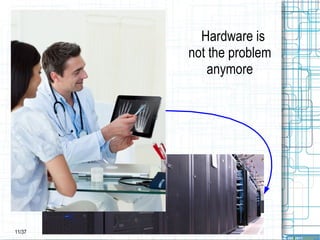
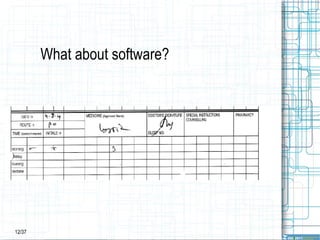
Hardware is not the problem anymore
What about software?
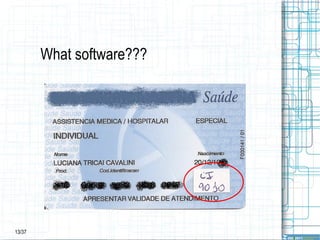
What software???
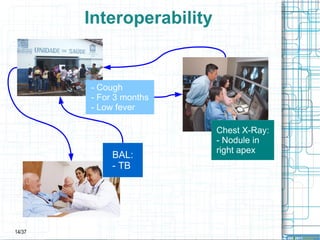
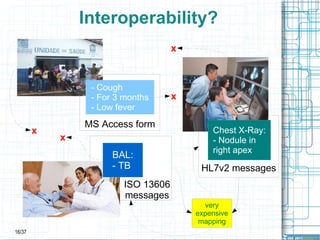
Interoperability
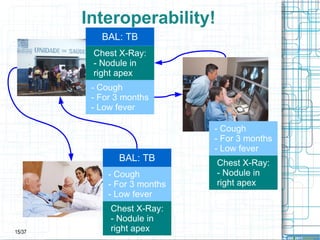
Interoperability!
Interoperability?
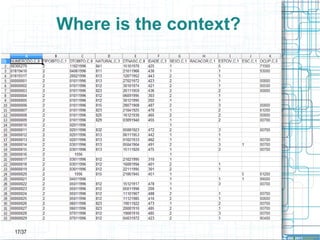
Where is the context?
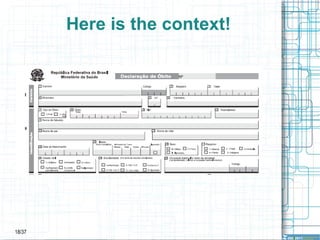
Here is the context!
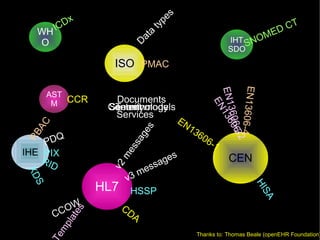
IHE HL7 IHTSDO ISO WHO CEN ASTM Documents Security Services Content models Terminology Thanks to: Thomas Beale (openEHR Foundation) SNOMED CT ICDx CDA EN13606-1 CCR v2 messages v3 messages Data types PDQ CCOW HSSP PIX HISA RID XDS PMAC EN13606-4 RBAC EN13606-3 EN13606-2 Templates
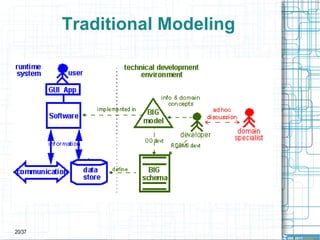
Traditional Modeling
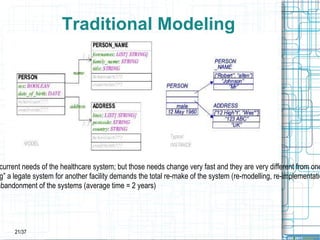
Traditional Modeling Information is modelled to “serve” the current needs of the healthcare system; but those needs change very fast and they are very different from one facility to another
Adding new concepts and “customizing” a legate system for another facility demands the total re-make of the system (re-modelling, re-implementation, re-test, re-deployment)
Unaffordable costs, frustrated users, abandonment of the systems (average time = 2 years)
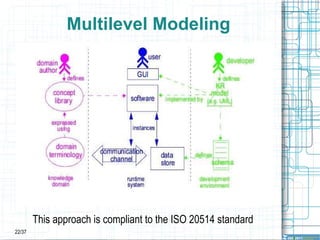
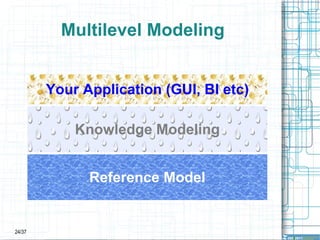
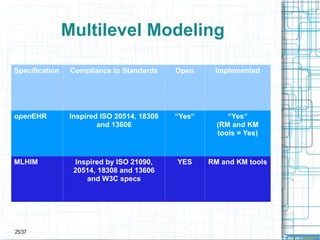
Multilevel Modeling This approach is compliant to the ISO 20514 standard
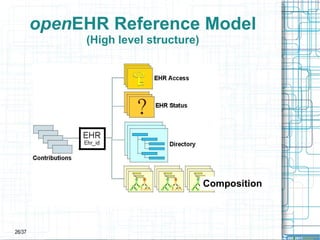
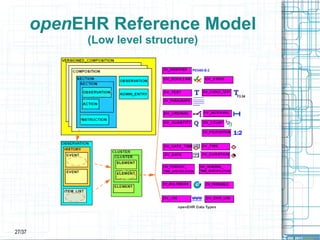
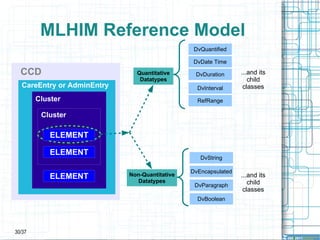
Multilevel Modeling Fundamental Principle: separation between the Reference Model and Knowledge Modeling

OSS 2011 Multi-Level Modelling Presentation