
How might we improve the safety
for seniors and disabled who is
using walker aid?
Luke Kao and Rubin Huang @ New York University
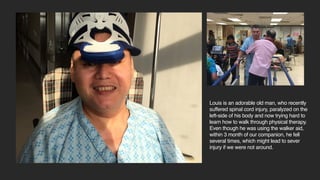
Louis is a senior citizen at Taipei, who
recently suffered spinal cord injury, paralyzed
on the left-side of his body and now trying
hard to learn how to walk through physical
therapy. Even though he was using the
walker aid, within 3 month of our companion,
he fell several times, which might lead to
sever injury if we were not around.
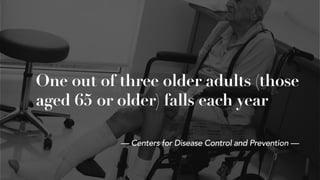
One out of three older adults (those
aged 65 or older) falls each year
— Centers for Disease Control and Prevention —
Canes, walker aids linked to higher
risk of falls
— Journal of Geriatric Physical Therapy 2015 —
Embrace is an internet-connected
walker aid that detects falling
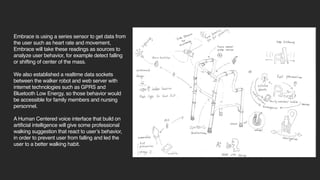
Embrace is using a series sensor to get data from
the user such as heart rate and movement,
Embrace will take these readings as sources to
analyze user behavior, for example detect falling
or shifting of center of the mass.
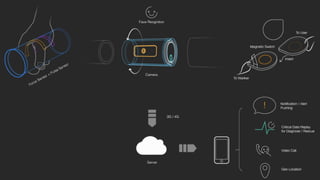
We also established a realtime data sockets
between the walker robot and web server with
internet technologies such as GPRS and
Bluetooth Low Energy, so those behavior would
be accessible for family members and nursing
personnel.
A Human Centered voice interface that build on
artificial intelligence will give some professional
walking suggestion that react to user’s behavior,
in order to prevent user from falling and led the
user to a better walking habit.
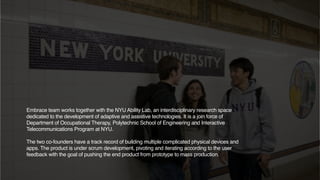
Embrace team works together with the NYU Ability Lab, an interdisciplinary research space
dedicated to the development of adaptive and assistive technologies. It is a join force of
Department of Occupational Therapy, Polytechnic School of Engineering and Interactive
Telecommunications Program at NYU.
The two co-founders have a track record of building multiple complicated physical devices and
apps. The product is under scrum development, pivoting and iterating according to the user
feedback with the goal of pushing the end product from prototype to mass production.

Project embrace

  • 1.
    How might weimprove the safety for seniors and disabled who is using walker aid? Luke Kao and Rubin Huang @ New York University
  • 2.
    Louis is asenior citizen at Taipei, who recently suffered spinal cord injury, paralyzed on the left-side of his body and now trying hard to learn how to walk through physical therapy. Even though he was using the walker aid, within 3 month of our companion, he fell several times, which might lead to sever injury if we were not around.
  • 3.
    One out ofthree older adults (those aged 65 or older) falls each year — Centers for Disease Control and Prevention —
  • 4.
    Canes, walker aidslinked to higher risk of falls — Journal of Geriatric Physical Therapy 2015 —
  • 5.
    Embrace is aninternet-connected walker aid that detects falling
  • 6.
    Embrace is usinga series sensor to get data from the user such as heart rate and movement, Embrace will take these readings as sources to analyze user behavior, for example detect falling or shifting of center of the mass. We also established a realtime data sockets between the walker robot and web server with internet technologies such as GPRS and Bluetooth Low Energy, so those behavior would be accessible for family members and nursing personnel. A Human Centered voice interface that build on artificial intelligence will give some professional walking suggestion that react to user’s behavior, in order to prevent user from falling and led the user to a better walking habit.
  • 8.
    Embrace team workstogether with the NYU Ability Lab, an interdisciplinary research space dedicated to the development of adaptive and assistive technologies. It is a join force of Department of Occupational Therapy, Polytechnic School of Engineering and Interactive Telecommunications Program at NYU. The two co-founders have a track record of building multiple complicated physical devices and apps. The product is under scrum development, pivoting and iterating according to the user feedback with the goal of pushing the end product from prototype to mass production.