Opensource GSM baseband
        firmware
Why ?
●   Free kernels, free OSes, free WiFi drivers, free
    GPU drivers, free RFID readers, free software
    radio, why not free cellphone firmware ?
●   Challenge the „secret sauce” vendor attitude
●   Cellphone network security research
●   Disruptive competition
●   Knowledge is power
Roadblocks
●   The cellphone chipset industry is very closed
    (even phone manufacturers don't get chipset
    programming information)
●   The cellphone network equipment industry is
    dominated by 4 major players (and even more
    closed)
●   There is no „padawan” learning path
●   GSM protocol stacks are not shipped in the
    mainline kernel
●   The government creeps in everywhere in the telco
    world
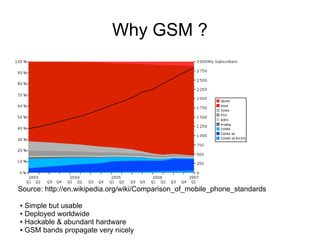
Why GSM ?


Source: http://en.wikipedia.org/wiki/Comparison_of_mobile_phone_standards

● Simple but usable
● Deployed worldwide

● Hackable & abundant hardware

● GSM bands propagate very nicely
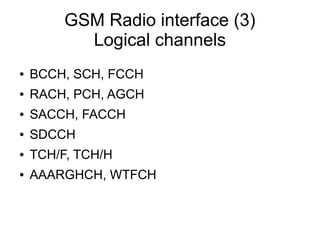
GSM Radio interface (3)
           Logical channels
●   BCCH, SCH, FCCH
●   RACH, PCH, AGCH
●   SACCH, FACCH
●   SDCCH
●   TCH/F, TCH/H
●   AAARGHCH, WTFCH
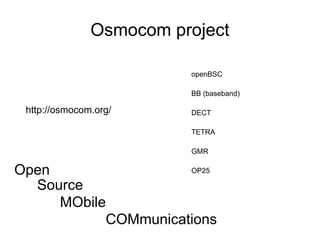
Osmocom project

                         openBSC

                         BB (baseband)

 http://osmocom.org/     DECT

                         TETRA

                         GMR

Open                 OP25

  Source
     MObile
           COMmunications
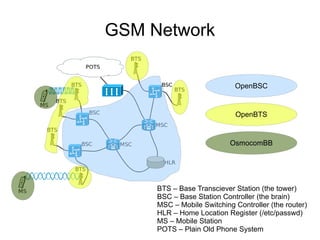
GSM Network

                            OpenBSC


                             OpenBTS


                           OsmocomBB


     BTS – Base Transciever Station (the tower)
     BSC – Base Station Controller (the brain)
     MSC – Mobile Switching Controller (the router)
     HLR – Home Location Register (/etc/passwd)
     MS – Mobile Station
     POTS – Plain Old Phone System
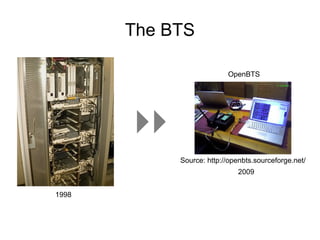
The BTS

                          OpenBTS


            Source: http://openbts.sourceforge.net/
                             2009


1998
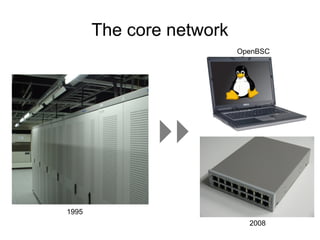
The core network
                          OpenBSC


1995
                            2008
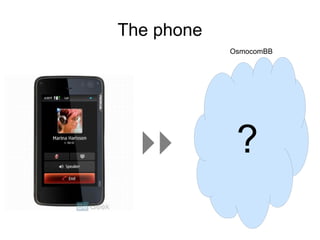
The phone
            OsmocomBB


             ?
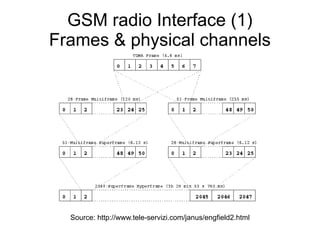
GSM radio Interface (1)
Frames & physical channels


  Source: http://www.tele-servizi.com/janus/engfield2.html
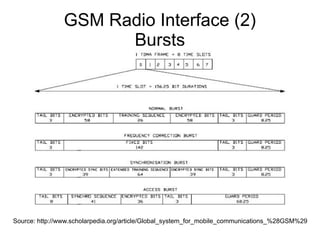
GSM Radio Interface (2)
                      Bursts


Source: http://www.scholarpedia.org/article/Global_system_for_mobile_communications_%28GSM%29
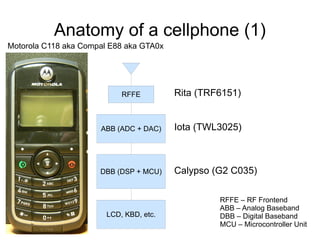
Anatomy of a cellphone (1)
Motorola C118 aka Compal E88 aka GTA0x


                            RFFE         Rita (TRF6151)


                      ABB (ADC + DAC)    Iota (TWL3025)


                      DBB (DSP + MCU)    Calypso (G2 C035)

                                                  RFFE – RF Frontend
                                                  ABB – Analog Baseband
                        LCD, KBD, etc.            DBB – Digital Baseband
                                                  MCU – Microcontroller Unit
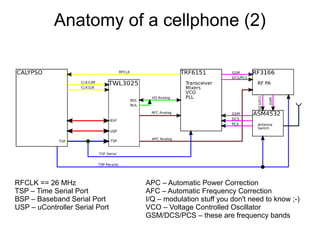
Anatomy of a cellphone (2)


RFCLK == 26 MHz                 APC – Automatic Power Correction
TSP – Time Serial Port          AFC – Automatic Frequency Correction
BSP – Baseband Serial Port      I/Q – modulation stuff you don't need to know ;-)
USP – uController Serial Port   VCO – Voltage Controlled Oscillator
                                GSM/DCS/PCS – these are frequency bands
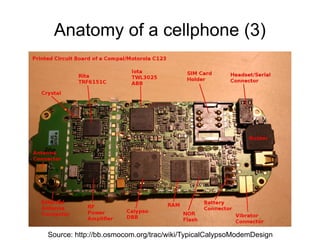
Anatomy of a cellphone (3)


Source: http://bb.osmocom.org/trac/wiki/TypicalCalypsoModemDesign
OsmocomBB features
●   Supports Calypso chipset, found inside:
    Motorola C115/C117 (Compal E87)
    Motorola C123/C121/C118 (Compal E88)
    Motorola C139/C140 (Compal E86)
    Motorola C155 (Compal E99)
    Openmoko GTA01/GTA02
●   Low-level RF drivers & synchronous TDMA
●   GSM Layer 2 (LAPDm) and Layer 3 (RR/MM/CC)
●   RS232-HDLC connection to PC for debugging
●   RX-only by default
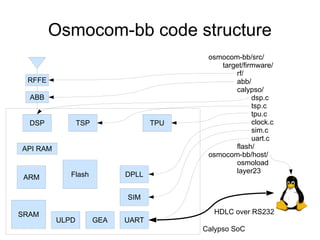
Osmocom-bb code structure
                                           osmocom-bb/src/
                                              target/firmware/
                                                  rf/
 RFFE                                             abb/
                                                  calypso/
  ABB                                                   dsp.c
                                                        tsp.c
                                                        tpu.c
  DSP            TSP                TPU                 clock.c
                                                        sim.c
                                                        uart.c
API RAM                                           flash/
                                           osmocom-bb/host/
                                                  osmoload
             Flash           DPLL                 layer23
 ARM

                             SIM

SRAM                                        HDLC over RS232
          ULPD         GEA   UART
                                          Calypso SoC
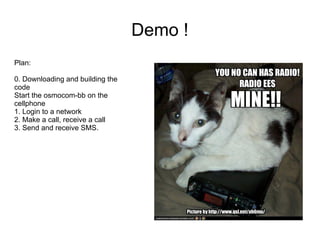
Demo !
Plan:

0. Downloading and building the
code
Start the osmocom-bb on the
cellphone
1. Login to a network
2. Make a call, receive a call
3. Send and receive SMS.
Where do we go from here ?
●   Handover support
●   GPRS support
●   Multi-SIM capability
●   More Calypso phones (http://www.myphone.pl ?)
●   Mediatek MTK6235 support – GSM L1 stack in
    the kernel possible
●   Compliance testing & certification
Backup slides
GSM sux, let's try WCDMA
●   What about Reverse engineering WCDMA
    baseband firmware ?
    http://events.ccc.de/congress/2011/Fahrplan/ev
    ents/4735.en.html
●   Maybe a SDR LTE base station ?
    http://bellard.org/lte/ (not public yet)
Other opensource radiocomm
               projects
●   OpenBSC
●   OpenDECT
●   OpenTETRA
●   OpenGMR
●   OpenOP25
●   Put your pet radio interface here

Osmocom

  • 1.
  • 2.
    Why ? ● Free kernels, free OSes, free WiFi drivers, free GPU drivers, free RFID readers, free software radio, why not free cellphone firmware ? ● Challenge the „secret sauce” vendor attitude ● Cellphone network security research ● Disruptive competition ● Knowledge is power
  • 3.
    Roadblocks ● The cellphone chipset industry is very closed (even phone manufacturers don't get chipset programming information) ● The cellphone network equipment industry is dominated by 4 major players (and even more closed) ● There is no „padawan” learning path ● GSM protocol stacks are not shipped in the mainline kernel ● The government creeps in everywhere in the telco world
  • 4.
    Why GSM ? Source:http://en.wikipedia.org/wiki/Comparison_of_mobile_phone_standards ● Simple but usable ● Deployed worldwide ● Hackable & abundant hardware ● GSM bands propagate very nicely
  • 5.
    GSM Radio interface(3) Logical channels ● BCCH, SCH, FCCH ● RACH, PCH, AGCH ● SACCH, FACCH ● SDCCH ● TCH/F, TCH/H ● AAARGHCH, WTFCH
  • 6.
    Osmocom project openBSC BB (baseband) http://osmocom.org/ DECT TETRA GMR Open OP25 Source MObile COMmunications
  • 7.
    GSM Network OpenBSC OpenBTS OsmocomBB BTS – Base Transciever Station (the tower) BSC – Base Station Controller (the brain) MSC – Mobile Switching Controller (the router) HLR – Home Location Register (/etc/passwd) MS – Mobile Station POTS – Plain Old Phone System
  • 8.
    The BTS OpenBTS Source: http://openbts.sourceforge.net/ 2009 1998
  • 9.
    The core network OpenBSC 1995 2008
  • 10.
    The phone OsmocomBB ?
  • 11.
    GSM radio Interface(1) Frames & physical channels Source: http://www.tele-servizi.com/janus/engfield2.html
  • 12.
    GSM Radio Interface(2) Bursts Source: http://www.scholarpedia.org/article/Global_system_for_mobile_communications_%28GSM%29
  • 13.
    Anatomy of acellphone (1) Motorola C118 aka Compal E88 aka GTA0x RFFE Rita (TRF6151) ABB (ADC + DAC) Iota (TWL3025) DBB (DSP + MCU) Calypso (G2 C035) RFFE – RF Frontend ABB – Analog Baseband LCD, KBD, etc. DBB – Digital Baseband MCU – Microcontroller Unit
  • 14.
    Anatomy of acellphone (2) RFCLK == 26 MHz APC – Automatic Power Correction TSP – Time Serial Port AFC – Automatic Frequency Correction BSP – Baseband Serial Port I/Q – modulation stuff you don't need to know ;-) USP – uController Serial Port VCO – Voltage Controlled Oscillator GSM/DCS/PCS – these are frequency bands
  • 15.
    Anatomy of acellphone (3) Source: http://bb.osmocom.org/trac/wiki/TypicalCalypsoModemDesign
  • 16.
    OsmocomBB features ● Supports Calypso chipset, found inside: Motorola C115/C117 (Compal E87) Motorola C123/C121/C118 (Compal E88) Motorola C139/C140 (Compal E86) Motorola C155 (Compal E99) Openmoko GTA01/GTA02 ● Low-level RF drivers & synchronous TDMA ● GSM Layer 2 (LAPDm) and Layer 3 (RR/MM/CC) ● RS232-HDLC connection to PC for debugging ● RX-only by default
  • 17.
    Osmocom-bb code structure osmocom-bb/src/ target/firmware/ rf/ RFFE abb/ calypso/ ABB dsp.c tsp.c tpu.c DSP TSP TPU clock.c sim.c uart.c API RAM flash/ osmocom-bb/host/ osmoload Flash DPLL layer23 ARM SIM SRAM HDLC over RS232 ULPD GEA UART Calypso SoC
  • 18.
    Demo ! Plan: 0. Downloadingand building the code Start the osmocom-bb on the cellphone 1. Login to a network 2. Make a call, receive a call 3. Send and receive SMS.
  • 19.
    Where do wego from here ? ● Handover support ● GPRS support ● Multi-SIM capability ● More Calypso phones (http://www.myphone.pl ?) ● Mediatek MTK6235 support – GSM L1 stack in the kernel possible ● Compliance testing & certification
  • 20.
  • 21.
    GSM sux, let'stry WCDMA ● What about Reverse engineering WCDMA baseband firmware ? http://events.ccc.de/congress/2011/Fahrplan/ev ents/4735.en.html ● Maybe a SDR LTE base station ? http://bellard.org/lte/ (not public yet)
  • 22.
    Other opensource radiocomm projects ● OpenBSC ● OpenDECT ● OpenTETRA ● OpenGMR ● OpenOP25 ● Put your pet radio interface here