U.S.Department of Labor 
www.osha.gov 
Injury and Illness 
Prevention Programs 
White Paper 
January 2012
OSHA INJ U RY AND I L LNE S S P R E V ENT ION P ROG R AMS WHI T E PA P E R 
Introduction/Executive Summary 
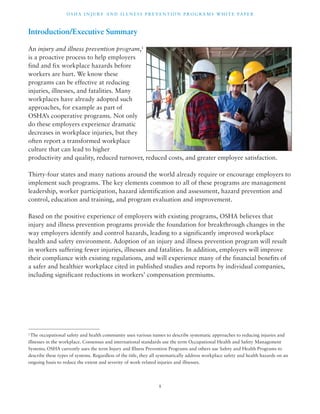
An injury and illness prevention program,1 
is a proactive process to help employers 
find and fix workplace hazards before 
workers are hurt. We know these 
programs can be effective at reducing 
injuries, illnesses, and fatalities. Many 
workplaces have already adopted such 
approaches, for example as part of 
OSHA’s cooperative programs. Not only 
do these employers experience dramatic 
decreases in workplace injuries, but they 
often report a transformed workplace 
culture that can lead to higher 
productivity and quality, reduced turnover, reduced costs, and greater employee satisfaction. 
Thirty-four states and many nations around the world already require or encourage employers to 
implement such programs. The key elements common to all of these programs are management 
leadership, worker participation, hazard identification and assessment, hazard prevention and 
control, education and training, and program evaluation and improvement. 
Based on the positive experience of employers with existing programs, OSHA believes that 
injury and illness prevention programs provide the foundation for breakthrough changes in the 
way employers identify and control hazards, leading to a significantly improved workplace 
health and safety environment. Adoption of an injury and illness prevention program will result 
in workers suffering fewer injuries, illnesses and fatalities. In addition, employers will improve 
their compliance with existing regulations, and will experience many of the financial benefits of 
a safer and healthier workplace cited in published studies and reports by individual companies, 
including significant reductions in workers’ compensation premiums. 
1The occupational safety and health community uses various names to describe systematic approaches to reducing injuries and 
illnesses in the workplace. Consensus and international standards use the term Occupational Health and Safety Management 
Systems; OSHA currently uses the term Injury and Illness Prevention Programs and others use Safety and Health Programs to 
describe these types of systems. Regardless of the title, they all systematically address workplace safety and health hazards on an 
ongoing basis to reduce the extent and severity of work-related injuries and illnesses. 
1
OSHA INJ U RY AND I L LNE S S P R E V ENT ION P ROG R AMS WHI T E PA P E R 
Background 
In the four decades since the Occupational Safety and Health Act (OSH Act) was signed into law, 
workplace deaths and reported occupational injuries have dropped by more than 60 percent. Yet 
the nation’s workers continue to face an unacceptable number of work-related deaths, injuries 
and illnesses, most of them preventable: 
• Every day, more than 12 workers die on the job – over 4,500 a year. 
• Every year, more than 4.1 million workers suffer a serious job-related injury or illness. 
An enhanced focus on prevention is needed to bring these numbers down. To accomplish this, an 
effective, flexible, commonsense tool is available that can dramatically reduce the number and 
severity of workplace injuries and illnesses: the injury and illness prevention program. This tool 
helps employers find hazards and fix them before injuries, illnesses or deaths occur. It helps 
employers meet their obligation under the OSH Act to “furnish to each of his employees 
employment and a place of employment which are free from recognized hazards that are causing 
or are likely to cause death or serious physical harm to his employees.” It also helps employers 
avoid the significant costs associated with injuries and illnesses in the workplace. 
Injury and illness prevention programs are not new, nor are they untested. Most large companies 
whose safety and health achievements have been recognized through government or industry 
awards cite their use of injury and illness prevention programs as their key to success. Convinced 
of the value, effectiveness, and feasibility of these programs, many countries around the world 
now require employers to implement and maintain them. These countries include Canada, 
Australia, all 27 European Union member states, Norway, Hong Kong, Japan and Korea. This 
initiative also follows the lead of 15 U.S. states that have already implemented regulations 
requiring such programs. 
How Does an Injury and Illness Prevention Program Work? 
Most successful injury and illness prevention programs include a similar set of commonsense 
elements that focus on finding all hazards in the workplace and developing a plan for preventing 
and controlling those hazards. Management leadership and active worker participation are 
essential to ensuring that all hazards are identified and addressed. Finally, workers need to be 
trained about how the program works and the program needs to be periodically evaluated to 
determine whether improvements need to be made. 
These basic elements – management leadership, worker participation, hazard identification and 
assessment, hazard prevention and control, education and training, and program evaluation and 
improvement – are common to almost all existing health and safety management programs. 
Each element is important in ensuring the success of the overall program, and the elements are 
interrelated and interdependent. 
2
OSHA INJ U RY AND I L LNE S S P R E V ENT ION P ROG R AMS WHI T E PA P E R 
When it comes to injury and illness prevention programs, every business is different, and one size 
certainly does not fit all. Employers who implement injury and illness prevention programs scale 
and adapt these elements to meet the needs of their organizations, depending on size, industry 
sector or complexity of operations. 
What Are the Costs of Workplace Injuries, Illnesses and Deaths to Employers, 
Workers and the Nation? 
The main goal of injury and illness prevention programs is to prevent workplace injuries, 
illnesses and deaths, the suffering these events cause workers, and the financial hardship they 
cause both workers and employers. 
Workplace incidents cause an enormous amount of physical, financial and emotional hardship 
for individual workers and their families. Combined with insufficient workers’ compensation 
benefits and inadequate medical insurance, workplace injuries and illnesses can not only cause 
physical pain and suffering but also loss of employment and wages, burdensome debt, inability 
to maintain a previous standard of living, loss of home ownership and even bankruptcy. When 
implemented effectively, injury and illness prevention programs can help workers and their 
families avoid these disruptive and sometimes calamitous impacts on their lives. 
At the same time, these programs will help 
employers avoid the substantial cost impacts 
and business disruptions that accompany 
occupational injuries, illnesses and deaths. One 
widely-cited source regarding estimates of the 
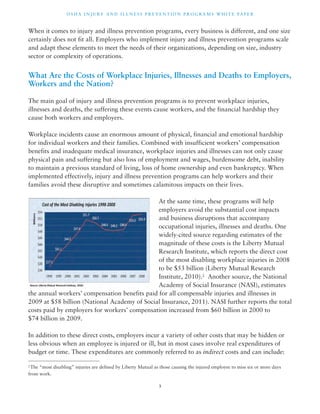
magnitude of these costs is the Liberty Mutual 
Research Institute, which reports the direct cost 
of the most disabling workplace injuries in 2008 
to be $53 billion (Liberty Mutual Research 
Institute, 2010).2 Another source, the National 
Academy of Social Insurance (NASI), estimates 
the annual workers’ compensation benefits paid for all compensable injuries and illnesses in 
2009 at $58 billion (National Academy of Social Insurance, 2011). NASI further reports the total 
costs paid by employers for workers’ compensation increased from $60 billion in 2000 to 
$74 billion in 2009. 
In addition to these direct costs, employers incur a variety of other costs that may be hidden or 
less obvious when an employee is injured or ill, but in most cases involve real expenditures of 
budget or time. These expenditures are commonly referred to as indirect costs and can include: 
2The “most disabling” injuries are defined by Liberty Mutual as those causing the injured employee to miss six or more days 
from work. 
3
OSHA INJ U RY AND I L LNE S S P R E V ENT ION P ROG R AMS WHI T E PA P E R 
• Any wages paid to injured workers for absences not covered by workers’ compensation; 
• The wage costs related to time lost through work stoppage; 
• Administrative time spent by supervisors following injuries; 
• Employee training and replacement costs; 
• Lost productivity related to new employee learning curves and accommodation of injured 
employees; and 
• Replacement costs of damaged material, machinery and property. 
OSHA has historically used the results of one study (Stanford University, 1981) that found the 
indirect costs can range from 1.1 (for the most severe injuries) to 4.5 (for the least severe injuries) 
times the direct costs.3 
“Establishing safety as a value rather than a priority 
tells our employees and our customers that safety is 
built into our culture, not something we do to merely 
comply with regulations. 
Our excellent safety performance over the past seven 
years has been a key factor in reducing our insurance 
cost. Our low EMR [Experience Modification Rate], 
incidents rates, and SHARP Management System have 
impressed our customers and, in many cases, was a key 
factor in selecting Parsons to perform their project.” 
– Charles L. Harrington, Chairman & CEO, Parsons Corp. 
Source: National Safety Council. 
4 
When workers are killed, are injured or 
become ill, there are substantial costs 
beyond those borne by employers. A variety 
of approaches can be used to estimate these 
costs. For example, Viscusi and Aldy (2003) 
provided estimates of the monetary value 
of each life lost. OSHA updated these 
estimates (to account for inflation) to 2010 
dollars, yielding a value of $8.7 million for 
each life lost. Multiplying this value by the 
4,547 workplace deaths reported by the 
Bureau of Labor Statistics for 2010, OSHA 
estimates the annual cost of known work-place 
fatalities to be nearly $40 billion. 
This estimate does not include the cost of non-fatal injuries, or of occupational illnesses like 
cancer and lung disease. These illnesses generally may occur many years or even decades after 
workers are exposed and are therefore seldom recorded in government statistics or employer 
surveillance activities. 
The human and economic costs of these conditions are indisputably enormous. Leigh et al. 
(1997) estimated that more than 60,000 workers die each year from occupational illnesses, and 
more than 850,000 develop new illnesses annually. Similarly, Steenland et al. (2003) estimated 
that between 10,000 and 20,000 workers die each year from cancer due to occupational 
exposures, and between 5,000 and 24,000 die from work-related Chronic Obstructive 
Pulmonary Disease. 
3For more details see OSHA’s Safety and Health Management Systems eTool, available at www.osha.gov/SLTC/etools/ 
safetyhealth/mod1_costs.html.
OSHA INJ U RY AND I L LNE S S P R E V ENT ION P ROG R AMS WHI T E PA P E R 
In summary, the number and costs of workplace injuries, illnesses and fatalities are unacceptably 
high. Injury and illness prevention programs have been proven to help employers and society 
reduce the personal, financial and societal costs that injuries, illnesses and fatalities impose. As 
described below, the thousands of workplaces that have implemented these programs in some 
form have already witnessed the resulting benefits, in the form of higher efficiency, greater 
worker productivity and lower costs. 
What Is the Evidence that Injury and Illness Prevention Programs 
Protect Workers and Improve the “Bottom Line”? 
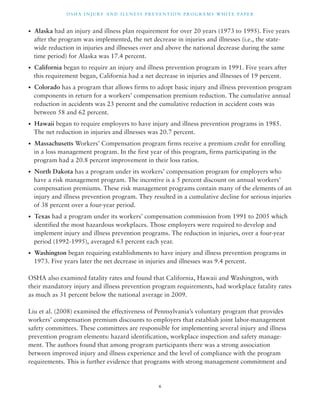
Numerous studies have examined the effectiveness of injury and illness prevention programs at 
both the establishment and corporate levels (e.g., Alsop and LeCouteur, 1999; Bunn et al., 2001; 
Conference Board, 2003; Huang et al., 2009; Lewchuk, Robb, and Walters, 1996; Smitha et 
al., 2001; Torp et al., 2000; Yassi, 1998). This research demonstrates that such programs are 
effective in transforming workplace culture; leading to reductions in injuries, illnesses and 
fatalities; lowering workers’ compensation and 
other costs; improving morale and communica-tion; 
5 
enhancing image and reputation; and 
improving processes, products and services. The 
studies also highlight important characteristics 
of effective programs, including management 
commitment and leadership, effective employee 
participation, integration of health and safety 
with business planning and continuous program 
evaluation. They suggest that programs without 
these features are not as effective (Shannon et 
al., 1996, 1997; Gallagher, 2001; Gallagher et 
al., 2003; Liu et al., 2008). 
Source: Huang et al., 2009. Data based on responses from 231 U.S. 
companies with 100 or more employees. 
One study (Smitha et al., 2001) focused on manufacturing facilities in 13 states with mandatory 
injury and illness prevention programs and/or mandatory health and safety committee require-ments. 
The authors found that both types of regulations were effective in reducing injury and 
illness incidence rates. Three of the four states with only safety and health program requirements 
experienced the greatest reductions in injury and illness rates following promulgation of these 
mandatory program regulations. 
OSHA examined the injury and illness prevention programs in eight states where the state 
had either required a program or provided incentives or requirements through its workers’ 
compensation programs. The successes of these state programs, which lowered injury and illness 
incidences by 9 percent to more than 60 percent, are discussed below:
OSHA INJ U RY AND I L LNE S S P R E V ENT ION P ROG R AMS WHI T E PA P E R 
• Alaska had an injury and illness plan requirement for over 20 years (1973 to 1995). Five years 
after the program was implemented, the net decrease in injuries and illnesses (i.e., the state-wide 
reduction in injuries and illnesses over and above the national decrease during the same 
time period) for Alaska was 17.4 percent. 
• California began to require an injury and illness prevention program in 1991. Five years after 
this requirement began, California had a net decrease in injuries and illnesses of 19 percent. 
• Colorado has a program that allows firms to adopt basic injury and illness prevention program 
components in return for a workers’ compensation premium reduction. The cumulative annual 
reduction in accidents was 23 percent and the cumulative reduction in accident costs was 
between 58 and 62 percent. 
• Hawaii began to require employers to have injury and illness prevention programs in 1985. 
The net reduction in injuries and illnesses was 20.7 percent. 
• Massachusetts Workers’ Compensation program firms receive a premium credit for enrolling 
in a loss management program. In the first year of this program, firms participating in the 
program had a 20.8 percent improvement in their loss ratios. 
• North Dakota has a program under its workers’ compensation program for employers who 
have a risk management program. The incentive is a 5 percent discount on annual workers’ 
compensation premiums. These risk management programs contain many of the elements of an 
injury and illness prevention program. They resulted in a cumulative decline for serious injuries 
of 38 percent over a four-year period. 
• Texas had a program under its workers’ compensation commission from 1991 to 2005 which 
identified the most hazardous workplaces. Those employers were required to develop and 
implement injury and illness prevention programs. The reduction in injuries, over a four-year 
period (1992-1995), averaged 63 percent each year. 
• Washington began requiring establishments to have injury and illness prevention programs in 
1973. Five years later the net decrease in injuries and illnesses was 9.4 percent. 
OSHA also examined fatality rates and found that California, Hawaii and Washington, with 
their mandatory injury and illness prevention program requirements, had workplace fatality rates 
as much as 31 percent below the national average in 2009. 
Liu et al. (2008) examined the effectiveness of Pennsylvania’s voluntary program that provides 
workers’ compensation premium discounts to employers that establish joint labor-management 
safety committees. These committees are responsible for implementing several injury and illness 
prevention program elements: hazard identification, workplace inspection and safety manage-ment. 
The authors found that among program participants there was a strong association 
between improved injury and illness experience and the level of compliance with the program 
requirements. This is further evidence that programs with strong management commitment and 
6
OSHA INJ U RY AND I L LNE S S P R E V ENT ION P ROG R AMS WHI T E PA P E R 
active worker participation are effective in reducing injury risk, while “paper” programs are, not 
surprisingly, ineffective. 
The literature on injury and illness prevention programs also includes numerous studies that 
attempt to identify the critical success features associated with superior health and safety 
performance. Gallagher (2001) concludes that management commitment and employee involve-ment 
are the keys to program success: “[R]ecurring findings across these studies were the critical 
role played by senior managers in successful health and safety management systems, and the 
importance of effective communication, employee involvement and consultation.” 
There are many benefits from developing a safety 
culture at your company - none of which is more 
valuable than employee loyalty. When employees know 
you care about their personal well-being and you prove 
that to them in their workplace, it increases morale, 
engagement, awareness, motivation and productivity.” 
– Daniel R. Nobbe, Plant Leader, Fiberteq LLC, 
Danville, IL. 
Source: National Safety Council. 
7 
Worker participation, a fundamental 
element of injury and illness prevention 
programs, makes an important contribution 
to an employer’s bottom line. When work-ers 
are encouraged to offer their ideas and 
they see their contributions being taken 
seriously, they tend to be more satisfied 
and more productive (Huang et al., 2006). 
Engaging employees in dialogue with 
management and each other about safety 
and health can lead to improved relation-ships 
and better overall communication, along with reduced injury rates. Improved employee 
morale and satisfaction translates to greater loyalty, lower absenteeism and higher productivity. 
This body of research, combined with studies of individual companies (see boxes, below, with 
Case Studies of Programs Implemented under OSHA’s Voluntary Protection Program (VPP) and 
Safety and Health Achievement Recognition Program (SHARP)) demonstrate clearly that injury 
and illness prevention programs are effective at the establishment level in dramatically reducing 
risk of workplace injury. This effect has also been detected in state-wide comparisons. 
Based on its review of the literature on the effectiveness of these programs and on the experience 
of the states that have implemented injury and illness prevention program requirements, OSHA 
estimates that implementation of injury and illness prevention programs will reduce injuries by 
15 percent to 35 percent for employers who do not now have safety and health programs. At the 
15 percent program effectiveness level, this saves $9 billion per year in workers’ compensation 
costs; at the 35 percent effectiveness level the savings are $23 billion per year.4 In addition to 
4 If injury and illness prevention programs achieve a 15 percent reduction in injuries and illnesses for employers who do not 
currently have safety and health programs, the overall reduction in injuries and illnesses for all employers including those that 
already have programs is estimated at 12.4 percent. Applying this 12.4 percent to NASI’s estimate of the $74 billion in direct 
workers’ compensation costs in 2009, workers’ compensation savings could be as high as $9 billion per year. With a 35 percent 
program effectiveness, the overall reduction in injuries and illnesses for all employers is estimated at 30.8 percent and workers’ 
compensation savings could reach $23 billion per year.
OSHA INJ U RY AND I L LNE S S P R E V ENT ION P ROG R AMS WHI T E PA P E R 
these workers’ compensation savings, employers could also save indirect costs incurred when an 
employee is injured or ill. Beyond the monetized benefits of injuries and illnesses averted, and 
lives saved, nonmonetized costs of workplace injuries and deaths include uncompensated lost 
wages, the loss of human capital assets, the loss of productivity, the cost of other government 
benefits required by injured workers or their survivors, the loss of government tax revenues, 
other business expenses, and other losses not compensated by workers’ compensation or other 
insurance. 
How Widespread are Injury and Illness Prevention Programs? 
8 
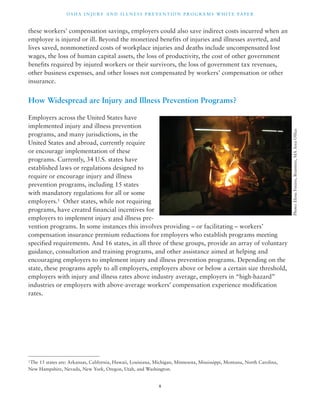
Employers across the United States have 
implemented injury and illness prevention 
programs, and many jurisdictions, in the 
United States and abroad, currently require 
or encourage implementation of these 
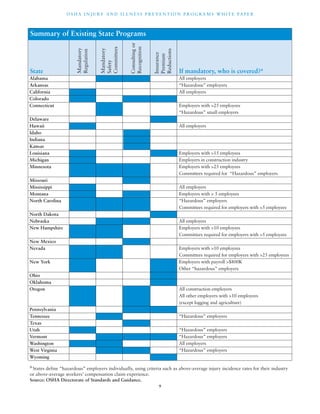
programs. Currently, 34 U.S. states have 
established laws or regulations designed to 
require or encourage injury and illness 
prevention programs, including 15 states 
with mandatory regulations for all or some 
employers.5 Other states, while not requiring 
programs, have created financial incentives for 
employers to implement injury and illness pre-vention 
programs. In some instances this involves providing – or facilitating – workers’ 
compensation insurance premium reductions for employers who establish programs meeting 
specified requirements. And 16 states, in all three of these groups, provide an array of voluntary 
guidance, consultation and training programs, and other assistance aimed at helping and 
encouraging employers to implement injury and illness prevention programs. Depending on the 
state, these programs apply to all employers, employers above or below a certain size threshold, 
employers with injury and illness rates above industry average, employers in “high-hazard” 
industries or employers with above-average workers’ compensation experience modification 
rates. 
5The 15 states are: Arkansas, California, Hawaii, Louisiana, Michigan, Minnesota, Mississippi, Montana, North Carolina, 
New Hampshire, Nevada, New York, Oregon, Utah, and Washington. 
Photo: Elena Finizio, Braintree, MA Area Office
OSHA INJ U RY AND I L LNE S S P R E V ENT ION P ROG R AMS WHI T E PA P E R 
9 
Summary of Existing State Programs 
State If mandatory, who is covered?a 
Alabama 
Arkansas 
California 
Colorado 
Connecticut 
Delaware 
Hawaii 
Idaho 
Indiana 
Kansas 
Louisiana 
Michigan 
Minnesota 
Missouri 
Mississippi 
Montana 
North Carolina 
North Dakota 
Nebraska 
New Hampshire 
New Mexico 
Nevada 
New York 
Ohio 
Oklahoma 
Oregon 
Pennsylvania 
Tennessee 
Texas 
Utah 
Vermont 
Washington 
West Virginia 
Wyoming 
Mandatory 
Regulation 
Mandatory 
Safety 
Committees 
Consulting or 
Recognition 
Insurance 
Premium 
Reductions 
All employers 
“Hazardous” employers 
All employers 
Employers with >25 employees 
“Hazardous” small employers 
All employers 
Employers with >15 employees 
Employers in construction industry 
Employers with >25 employees 
Committees required for “Hazardous” employers 
All employers 
Employers with > 5 employees 
“Hazardous” employers 
Committees required for employers with >5 employees 
All employers 
Employers with >10 employees 
Committees required for employers with >5 employees 
Employers with >10 employees 
Committees required for employers with >25 employees 
Employers with payroll >$800K 
Other “hazardous” employers 
All construction employers 
All other employers with >10 employees 
(except logging and agriculture) 
“Hazardous” employers 
All employers 
“Hazardous” employers 
a States define “hazardous” employers individually, using criteria such as above-average injury incidence rates for their industry 
or above-average workers’ compensation claim experience. 
Source: OSHA Directorate of Standards and Guidance.
OSHA INJ U RY AND I L LNE S S P R E V ENT ION P ROG R AMS WHI T E PA P E R 
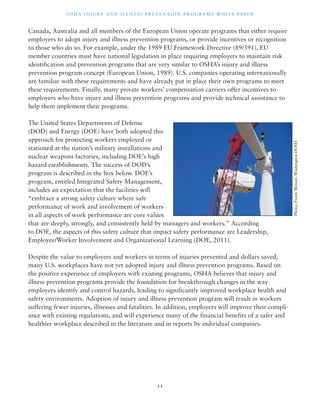
The more than 2,400 establishments that belong to OSHA’s Voluntary Protection Program have 
programs that are based on the same core elements found in the injury and illness prevention 
program that OSHA will be proposing. The same is true for OSHA’s Safety and Health Achieve-ment 
Recognition Program, in which more than 1,500 smaller employers are enrolled. Each year, 
dozens of organizations seeking international recognition for their safety and health program 
proudly submit applications to the National Safety Council for the Robert W. Campbell award 
(see text box). Case studies of past winners are available on the Campbell Award website. 
Recognizing Business Excellence in Safety and Health 
The Robert W. Campbell Award recognizes organizations that achieve business excellence by 
integrating environmental, health and safety (EHS) management into their business operating 
systems. The Award aims to: 
• Recognize businesses that uphold EHS as a key business value and link measurable 
achievement in EHS performance to productivity and profitability. 
• Establish a validated process by which industries can measure the performance of their 
EHS operations system against well-tested and internationally accepted key performance 
indicators. 
• Use a rigorous systematic review process to capture and evaluate the successes and lessons 
learned. 
• Share leading edge EHS management systems and best practices for educational purposes 
worldwide. 
The Award program is supported by a network of 22 Global Partners across five continents 
committed to promoting EHS as an integral component of business management worldwide. 
There are at least two industry consensus standards for injury and illness prevention programs. 
The American National Standards Institute (ANSI) and American Industrial Hygiene Association 
(AIHA) have published a voluntary consensus standard, ANSI/AIHA Z10 – 2005 Occupational 
Safety and Health Management Systems (ANSI/AIHA, 2005). The Occupational Health and 
Safety Assessment Series (OHSAS) Project Group, a consortium of selected Registrars, national 
standards bodies, professional associations and research institutes, has produced a similar 
document, OHSAS 18001 – 2007 Occupational Health and Safety Management Systems 
(OHSAS Project Group, 2007). These consensus-based standards have been widely accepted in 
the world of commerce and adopted by many businesses on a voluntary basis. 
1 0 
Source: www.campbellaward.org.
OSHA INJ U RY AND I L LNE S S P R E V ENT ION P ROG R AMS WHI T E PA P E R 
Canada, Australia and all members of the European Union operate programs that either require 
employers to adopt injury and illness prevention programs, or provide incentives or recognition 
to those who do so. For example, under the 1989 EU Framework Directive (89/391), EU 
member countries must have national legislation in place requiring employers to maintain risk 
identification and prevention programs that are very similar to OSHA’s injury and illness 
prevention program concept (European Union, 1989). U.S. companies operating internationally 
are familiar with these requirements and have already put in place their own programs to meet 
these requirements. Finally, many private workers’ compensation carriers offer incentives to 
employers who have injury and illness prevention programs and provide technical assistance to 
help them implement their programs. 
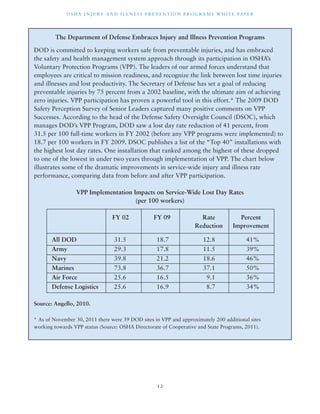
The United States Departments of Defense 
(DOD) and Energy (DOE) have both adopted this 
approach for protecting workers employed or 
stationed at the nation’s military installations and 
nuclear weapons factories, including DOE’s high 
hazard establishments. The success of DOD’s 
program is described in the box below. DOE’s 
program, entitled Integrated Safety Management, 
includes an expectation that the facilities will 
“embrace a strong safety culture where safe 
performance of work and involvement of workers 
in all aspects of work performance are core values 
that are deeply, strongly, and consistently held by managers and workers.” According 
to DOE, the aspects of this safety culture that impact safety performance are Leadership, 
Employee/Worker Involvement and Organizational Learning (DOE, 2011). 
Despite the value to employers and workers in terms of injuries prevented and dollars saved, 
many U.S. workplaces have not yet adopted injury and illness prevention programs. Based on 
the positive experience of employers with existing programs, OSHA believes that injury and 
illness prevention programs provide the foundation for breakthrough changes in the way 
employers identify and control hazards, leading to significantly improved workplace health and 
safety environments. Adoption of injury and illness prevention program will result in workers 
suffering fewer injuries, illnesses and fatalities. In addition, employers will improve their compli-ance 
with existing regulations, and will experience many of the financial benefits of a safer and 
healthier workplace described in the literature and in reports by individual companies. 
1 1 
Photo: Frank Wenzel, Washington DOSH
OSHA INJ U RY AND I L LNE S S P R E V ENT ION P ROG R AMS WHI T E PA P E R 
The Department of Defense Embraces Injury and Illness Prevention Programs 
DOD is committed to keeping workers safe from preventable injuries, and has embraced 
the safety and health management system approach through its participation in OSHA’s 
Voluntary Protection Programs (VPP). The leaders of our armed forces understand that 
employees are critical to mission readiness, and recognize the link between lost time injuries 
and illnesses and lost productivity. The Secretary of Defense has set a goal of reducing 
preventable injuries by 75 percent from a 2002 baseline, with the ultimate aim of achieving 
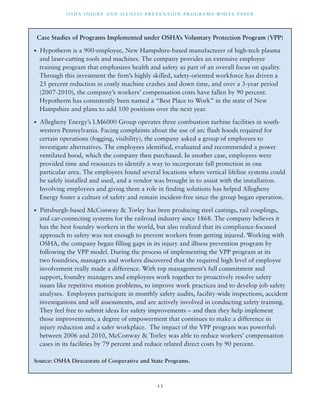
zero injuries. VPP participation has proven a powerful tool in this effort.* The 2009 DOD 
Safety Perception Survey of Senior Leaders captured many positive comments on VPP 
Successes. According to the head of the Defense Safety Oversight Council (DSOC), which 
manages DOD’s VPP Program, DOD saw a lost day rate reduction of 41 percent, from 
31.5 per 100 full-time workers in FY 2002 (before any VPP programs were implemented) to 
18.7 per 100 workers in FY 2009. DSOC publishes a list of the “Top 40” installations with 
the highest lost day rates. One installation that ranked among the highest of these dropped 
to one of the lowest in under two years through implementation of VPP. The chart below 
illustrates some of the dramatic improvements in service-wide injury and illness rate 
performance, comparing data from before and after VPP participation. 
VPP Implementation Impacts on Service-Wide Lost Day Rates 
(per 100 workers) 
FY 02 FY 09 Rate Percent 
1 2 
Reduction Improvement 
All DOD 31.5 18.7 12.8 41% 
Army 29.3 17.8 11.5 39% 
Navy 39.8 21.2 18.6 46% 
Marines 73.8 36.7 37.1 50% 
Air Force 25.6 16.5 9.1 36% 
Defense Logistics 25.6 16.9 8.7 34% 
Source: Angello, 2010. 
* As of November 30, 2011 there were 39 DOD sites in VPP and approximately 200 additional sites 
working towards VPP status (Source: OSHA Directorate of Cooperative and State Programs, 2011).
OSHA INJ U RY AND I L LNE S S P R E V ENT ION P ROG R AMS WHI T E PA P E R 
Case Studies of Programs Implemented under OSHA’s Voluntary Protection Program (VPP) 
• Hypotherm is a 900-employee, New Hampshire-based manufacturer of high-tech plasma 
and laser-cutting tools and machines. The company provides an extensive employee 
training program that emphasizes health and safety as part of an overall focus on quality. 
Through this investment the firm’s highly skilled, safety-oriented workforce has driven a 
25 percent reduction in costly machine crashes and down time, and over a 3-year period 
(2007-2010), the company’s workers’ compensation costs have fallen by 90 percent. 
Hypotherm has consistently been named a “Best Place to Work” in the state of New 
Hampshire and plans to add 100 positions over the next year. 
• Allegheny Energy’s LM6000 Group operates three combustion turbine facilities in south-western 
Pennsylvania. Facing complaints about the use of arc flash hoods required for 
certain operations (fogging, visibility), the company asked a group of employees to 
investigate alternatives. The employees identified, evaluated and recommended a power 
ventilated hood, which the company then purchased. In another case, employees were 
provided time and resources to identify a way to incorporate fall protection in one 
particular area. The employees found several locations where vertical lifeline systems could 
be safely installed and used, and a vendor was brought in to assist with the installation. 
Involving employees and giving them a role in finding solutions has helped Allegheny 
Energy foster a culture of safety and remain incident-free since the group began operation. 
• Pittsburgh-based McConway & Torley has been producing steel castings, rail couplings, 
and car-connecting systems for the railroad industry since 1868. The company believes it 
has the best foundry workers in the world, but also realized that its compliance-focused 
approach to safety was not enough to prevent workers from getting injured. Working with 
OSHA, the company began filling gaps in its injury and illness prevention program by 
following the VPP model. During the process of implementing the VPP program at its 
two foundries, managers and workers discovered that the required high level of employee 
involvement really made a difference. With top management’s full commitment and 
support, foundry managers and employees work together to proactively resolve safety 
issues like repetitive motion problems, to improve work practices and to develop job safety 
analyses. Employees participate in monthly safety audits, facility-wide inspections, accident 
investigations and self assessments, and are actively involved in conducting safety training. 
They feel free to submit ideas for safety improvements – and then they help implement 
those improvements, a degree of empowerment that continues to make a difference in 
injury reduction and a safer workplace. The impact of the VPP program was powerful: 
between 2006 and 2010, McConway & Torley was able to reduce workers’ compensation 
cases in its facilities by 79 percent and reduce related direct costs by 90 percent. 
Source: OSHA Directorate of Cooperative and State Programs. 
1 3
OSHA INJ U RY AND I L LNE S S P R E V ENT ION P ROG R AMS WHI T E PA P E R 
Are Injury and Illness Prevention Programs Too Complicated and 
Expensive for Small Businesses? 
For many small businesses, establishing an injury and illness prevention program may seem 
daunting. Any program based on formal structures can be difficult to establish in a small 
organization because of tight budgets. Yet simple, low-cost approaches have been shown to be 
effective in small businesses (Hasle and Limborg, 2006). Injury and illness prevention programs 
lend themselves to such low-cost approaches because they are highly flexible – the core elements 
can be implemented at a basic level suitable for the smallest business, as well as at a more 
advanced, structured level that may be needed in a larger, more complex organization. 
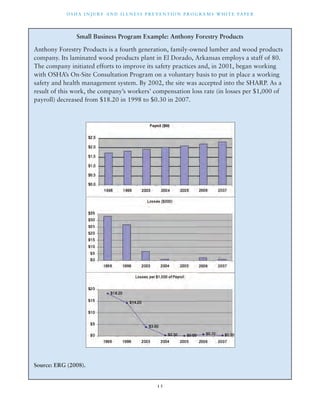
OSHA’s Safety and Health Achievement Recognition Program (SHARP), which recognizes small 
employers that operate exemplary injury and illness prevention programs, provides compelling 
evidence that such programs can and do work for small businesses. For example, the Ohio 
Bureau of Workers’ Compensation (2011) analyzed the policies of 16 SHARP employers over a 
12-year period from 1999 to 2010. The study compared the employers’ experience prior to and 
after achieving entry into the SHARP program. The preliminary results of the study show that 
the average number of claims for these employers decreased by 52 percent, the average claim cost 
decreased by 80 percent, the average lost time per claim decreased by 87 percent, and claims 
(per million dollars of payroll) decreased by 88 percent. 
An internal OSHA study of nine SHARP firms, ranging in size from 15 to 160 employees, found 
that the firms achieved the following as a result of their programs: 
• A reduction in the number of injuries and illnesses. 
• Improved compliance with regulatory requirements. 
• Improved business and cost savings including reduced workers’ compensation premiums, 
reduced administrative and human resources burden associated with filing injury and illness 
reports, managing workers’ compensation cases and training new employees. The companies 
also experienced improved efficiency in operations and material use, and improved 
productivity. They were able to leverage their limited health and safety resources. 
• An improved workplace environment with greater collective responsibility for workplace 
health and safety. 
• Improved reputation and image in the community including relationships and cooperation 
between employers and OSHA, between employers and employees, and among employers in 
the business community. 
1 4
OSHA INJ U RY AND I L LNE S S P R E V ENT ION P ROG R AMS WHI T E PA P E R 
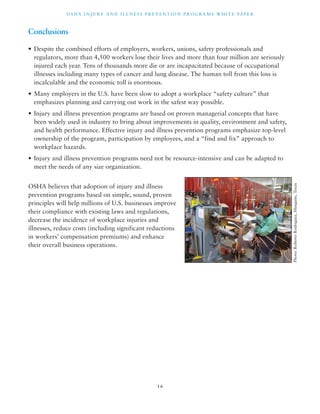
Small Business Program Example: Anthony Forestry Products 
Anthony Forestry Products is a fourth generation, family-owned lumber and wood products 
company. Its laminated wood products plant in El Dorado, Arkansas employs a staff of 80. 
The company initiated efforts to improve its safety practices and, in 2001, began working 
with OSHA’s On-Site Consultation Program on a voluntary basis to put in place a working 
safety and health management system. By 2002, the site was accepted into the SHARP. As a 
result of this work, the company’s workers’ compensation loss rate (in losses per $1,000 of 
payroll) decreased from $18.20 in 1998 to $0.30 in 2007. 
1 5 
Source: ERG (2008).
OSHA INJ U RY AND I L LNE S S P R E V ENT ION P ROG R AMS WHI T E PA P E R 
1 6 
Conclusions 
• Despite the combined efforts of employers, workers, unions, safety professionals and 
regulators, more than 4,500 workers lose their lives and more than four million are seriously 
injured each year. Tens of thousands more die or are incapacitated because of occupational 
illnesses including many types of cancer and lung disease. The human toll from this loss is 
incalculable and the economic toll is enormous. 
• Many employers in the U.S. have been slow to adopt a workplace “safety culture” that 
emphasizes planning and carrying out work in the safest way possible. 
• Injury and illness prevention programs are based on proven managerial concepts that have 
been widely used in industry to bring about improvements in quality, environment and safety, 
and health performance. Effective injury and illness prevention programs emphasize top-level 
ownership of the program, participation by employees, and a “find and fix” approach to 
workplace hazards. 
• Injury and illness prevention programs need not be resource-intensive and can be adapted to 
meet the needs of any size organization. 
OSHA believes that adoption of injury and illness 
prevention programs based on simple, sound, proven 
principles will help millions of U.S. businesses improve 
their compliance with existing laws and regulations, 
decrease the incidence of workplace injuries and 
illnesses, reduce costs (including significant reductions 
in workers’ compensation premiums) and enhance 
their overall business operations. 
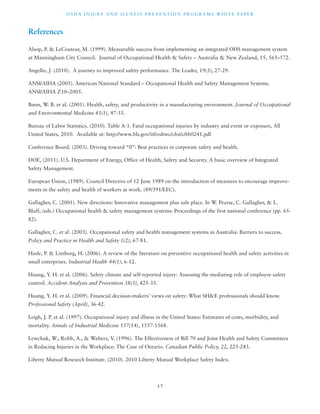
Photo: Roberto Rodriguez, Mesquite, Texas
OSHA INJ U RY AND I L LNE S S P R E V ENT ION P ROG R AMS WHI T E PA P E R 
1 7 
References 
Alsop, P. & LeCouteur, M. (1999). Measurable success from implementing an integrated OHS management system 
at Manningham City Council. Journal of Occupational Health & Safety – Australia & New Zealand, 15, 565–572. 
Angello, J. (2010). A journey to improved safety performance. The Leader, 19(3), 27-29. 
ANSI/AIHA (2005). American National Standard – Occupational Health and Safety Management Systems. 
ANSI/AIHA Z10–2005. 
Bunn, W. B. et al. (2001). Health, safety, and productivity in a manufacturing environment. Journal of Occupational 
and Environmental Medicine 43(1), 47-55. 
Bureau of Labor Statistics. (2010). Table A-1. Fatal occupational injuries by industry and event or exposure, All 
United States, 2010. Available at: http://www.bls.gov/iif/oshwc/cfoi/cftb0241.pdf 
Conference Board. (2003). Driving toward “0”: Best practices in corporate safety and health. 
DOE, (2011). U.S. Department of Energy, Office of Health, Safety and Security. A basic overview of Integrated 
Safety Management. 
European Union, (1989). Council Directive of 12 June 1989 on the introduction of measures to encourage improve-ments 
in the safety and health of workers at work. (89/391/EEC). 
Gallagher, C. (2001). New directions: Innovative management plus safe place. In W. Pearse, C. Gallagher, & L. 
Bluff, (eds.) Occupational health & safety management systems: Proceedings of the first national conference (pp. 65- 
82). 
Gallagher, C. et al. (2003). Occupational safety and health management systems in Australia: Barriers to success. 
Policy and Practice in Health and Safety 1(2), 67-81. 
Hasle, P. & Limborg, H. (2006). A review of the literature on preventive occupational health and safety activities in 
small enterprises. Industrial Health 44(1), 6-12. 
Huang, Y. H. et al. (2006). Safety climate and self-reported injury: Assessing the mediating role of employee safety 
control. Accident Analysis and Prevention 38(3), 425-33. 
Huang, Y. H. et al. (2009). Financial decision-makers’ views on safety: What SH&E professionals should know. 
Professional Safety (April), 36-42. 
Leigh, J. P. et al. (1997). Occupational injury and illness in the United States: Estimates of costs, morbidity, and 
mortality. Annals of Industrial Medicine 157(14), 1557-1568. 
Lewchuk, W., Robb, A., & Walters, V. (1996). The Effectiveness of Bill 70 and Joint Health and Safety Committees 
in Reducing Injuries in the Workplace: The Case of Ontario. Canadian Public Policy, 22, 225-243. 
Liberty Mutual Research Institute. (2010). 2010 Liberty Mutual Workplace Safety Index.
OSHA INJ U RY AND I L LNE S S P R E V ENT ION P ROG R AMS WHI T E PA P E R 
Liu, H. et al. (2008). The Pennsylvania Certified Safety Committee Program: An Evaluation of Participation and 
Effects on Work Injury Rates. RAND Working Paper WR-594-PA. 
National Academy of Social Insurance. (2011). Workers’ Compensation: Benefits, Coverage, and Costs, 2009. 
Ohio Bureau of Workers’ Compensation. (2011). Ohio 21(d) SHARP Program Performance Assessment. 
OHSAS Project Group. (2007). Occupational health and safety management systems – Requirements. OHSAS 
18001:2007. Published as a British Standards Institute standard. 
Shannon, H. et al. (1996). Workplace organizational correlates of lost-time accident rates in manufacturing. 
American Journal of Industrial Medicine, 29(3), 258-268. 
Shannon, H. et al. (1997). Overview of the relationship between organizational and workplace factors and injury 
rates. Safety Science, 26, 201-217. 
Smitha, M.W. et al. (2001). Effect of state workplace safety laws on occupational injury rates. Journal of 
Occupational and Environmental Medicine, 43(12), 1001-1010. 
Stanford University. (1981). Improving construction safety performance: The user's role (Technical report No. 260). 
Department of Civil Engineering. 
Steenland, K. et al. (2003). Dying for Work: The Magnitude of US Mortality from Selected Causes of Death 
Associated with Occupation. American Journal of Industrial Medicine, 43, 461-482. 
Torp, S. et al. (2000). Systematic health, environment, and safety activities: Do they influence occupational 
environment, behavior and health? Occupational Medicine, 50(5), 326-333. 
U.S. Department of Energy, Office of Corporate Safety Analysis. (2009a). Occupational Medicine Newsletter. 
Corporate safety: Health & safety is working! 
U.S. Department of Energy, Office of Health, Safety and Security (HSS). (2009b). A basic overview of the worker 
safety and health program (10 CFR 851). Outreach & Awareness Series to Advance DOE Mission. 
Viscusi, W. & Aldy, J. (2003). The value of a statistical life: A critical review of market estimates throughout the 
world. Journal of Risk and Uncertainty, 27, 5-76. 
Yassi, A. (1998). Utilizing Data Systems to Develop and Monitor Occupational Health Programs in a Large 
Canadian Hospital. Methods of Information and Medicine, 37, 125-129. 
1 8

Osha white paper-january2012sm

  • 1.
    U.S.Department of Labor www.osha.gov Injury and Illness Prevention Programs White Paper January 2012
  • 2.
    OSHA INJ URY AND I L LNE S S P R E V ENT ION P ROG R AMS WHI T E PA P E R Introduction/Executive Summary An injury and illness prevention program,1 is a proactive process to help employers find and fix workplace hazards before workers are hurt. We know these programs can be effective at reducing injuries, illnesses, and fatalities. Many workplaces have already adopted such approaches, for example as part of OSHA’s cooperative programs. Not only do these employers experience dramatic decreases in workplace injuries, but they often report a transformed workplace culture that can lead to higher productivity and quality, reduced turnover, reduced costs, and greater employee satisfaction. Thirty-four states and many nations around the world already require or encourage employers to implement such programs. The key elements common to all of these programs are management leadership, worker participation, hazard identification and assessment, hazard prevention and control, education and training, and program evaluation and improvement. Based on the positive experience of employers with existing programs, OSHA believes that injury and illness prevention programs provide the foundation for breakthrough changes in the way employers identify and control hazards, leading to a significantly improved workplace health and safety environment. Adoption of an injury and illness prevention program will result in workers suffering fewer injuries, illnesses and fatalities. In addition, employers will improve their compliance with existing regulations, and will experience many of the financial benefits of a safer and healthier workplace cited in published studies and reports by individual companies, including significant reductions in workers’ compensation premiums. 1The occupational safety and health community uses various names to describe systematic approaches to reducing injuries and illnesses in the workplace. Consensus and international standards use the term Occupational Health and Safety Management Systems; OSHA currently uses the term Injury and Illness Prevention Programs and others use Safety and Health Programs to describe these types of systems. Regardless of the title, they all systematically address workplace safety and health hazards on an ongoing basis to reduce the extent and severity of work-related injuries and illnesses. 1
  • 3.
    OSHA INJ URY AND I L LNE S S P R E V ENT ION P ROG R AMS WHI T E PA P E R Background In the four decades since the Occupational Safety and Health Act (OSH Act) was signed into law, workplace deaths and reported occupational injuries have dropped by more than 60 percent. Yet the nation’s workers continue to face an unacceptable number of work-related deaths, injuries and illnesses, most of them preventable: • Every day, more than 12 workers die on the job – over 4,500 a year. • Every year, more than 4.1 million workers suffer a serious job-related injury or illness. An enhanced focus on prevention is needed to bring these numbers down. To accomplish this, an effective, flexible, commonsense tool is available that can dramatically reduce the number and severity of workplace injuries and illnesses: the injury and illness prevention program. This tool helps employers find hazards and fix them before injuries, illnesses or deaths occur. It helps employers meet their obligation under the OSH Act to “furnish to each of his employees employment and a place of employment which are free from recognized hazards that are causing or are likely to cause death or serious physical harm to his employees.” It also helps employers avoid the significant costs associated with injuries and illnesses in the workplace. Injury and illness prevention programs are not new, nor are they untested. Most large companies whose safety and health achievements have been recognized through government or industry awards cite their use of injury and illness prevention programs as their key to success. Convinced of the value, effectiveness, and feasibility of these programs, many countries around the world now require employers to implement and maintain them. These countries include Canada, Australia, all 27 European Union member states, Norway, Hong Kong, Japan and Korea. This initiative also follows the lead of 15 U.S. states that have already implemented regulations requiring such programs. How Does an Injury and Illness Prevention Program Work? Most successful injury and illness prevention programs include a similar set of commonsense elements that focus on finding all hazards in the workplace and developing a plan for preventing and controlling those hazards. Management leadership and active worker participation are essential to ensuring that all hazards are identified and addressed. Finally, workers need to be trained about how the program works and the program needs to be periodically evaluated to determine whether improvements need to be made. These basic elements – management leadership, worker participation, hazard identification and assessment, hazard prevention and control, education and training, and program evaluation and improvement – are common to almost all existing health and safety management programs. Each element is important in ensuring the success of the overall program, and the elements are interrelated and interdependent. 2
  • 4.
    OSHA INJ URY AND I L LNE S S P R E V ENT ION P ROG R AMS WHI T E PA P E R When it comes to injury and illness prevention programs, every business is different, and one size certainly does not fit all. Employers who implement injury and illness prevention programs scale and adapt these elements to meet the needs of their organizations, depending on size, industry sector or complexity of operations. What Are the Costs of Workplace Injuries, Illnesses and Deaths to Employers, Workers and the Nation? The main goal of injury and illness prevention programs is to prevent workplace injuries, illnesses and deaths, the suffering these events cause workers, and the financial hardship they cause both workers and employers. Workplace incidents cause an enormous amount of physical, financial and emotional hardship for individual workers and their families. Combined with insufficient workers’ compensation benefits and inadequate medical insurance, workplace injuries and illnesses can not only cause physical pain and suffering but also loss of employment and wages, burdensome debt, inability to maintain a previous standard of living, loss of home ownership and even bankruptcy. When implemented effectively, injury and illness prevention programs can help workers and their families avoid these disruptive and sometimes calamitous impacts on their lives. At the same time, these programs will help employers avoid the substantial cost impacts and business disruptions that accompany occupational injuries, illnesses and deaths. One widely-cited source regarding estimates of the magnitude of these costs is the Liberty Mutual Research Institute, which reports the direct cost of the most disabling workplace injuries in 2008 to be $53 billion (Liberty Mutual Research Institute, 2010).2 Another source, the National Academy of Social Insurance (NASI), estimates the annual workers’ compensation benefits paid for all compensable injuries and illnesses in 2009 at $58 billion (National Academy of Social Insurance, 2011). NASI further reports the total costs paid by employers for workers’ compensation increased from $60 billion in 2000 to $74 billion in 2009. In addition to these direct costs, employers incur a variety of other costs that may be hidden or less obvious when an employee is injured or ill, but in most cases involve real expenditures of budget or time. These expenditures are commonly referred to as indirect costs and can include: 2The “most disabling” injuries are defined by Liberty Mutual as those causing the injured employee to miss six or more days from work. 3
  • 5.
    OSHA INJ URY AND I L LNE S S P R E V ENT ION P ROG R AMS WHI T E PA P E R • Any wages paid to injured workers for absences not covered by workers’ compensation; • The wage costs related to time lost through work stoppage; • Administrative time spent by supervisors following injuries; • Employee training and replacement costs; • Lost productivity related to new employee learning curves and accommodation of injured employees; and • Replacement costs of damaged material, machinery and property. OSHA has historically used the results of one study (Stanford University, 1981) that found the indirect costs can range from 1.1 (for the most severe injuries) to 4.5 (for the least severe injuries) times the direct costs.3 “Establishing safety as a value rather than a priority tells our employees and our customers that safety is built into our culture, not something we do to merely comply with regulations. Our excellent safety performance over the past seven years has been a key factor in reducing our insurance cost. Our low EMR [Experience Modification Rate], incidents rates, and SHARP Management System have impressed our customers and, in many cases, was a key factor in selecting Parsons to perform their project.” – Charles L. Harrington, Chairman & CEO, Parsons Corp. Source: National Safety Council. 4 When workers are killed, are injured or become ill, there are substantial costs beyond those borne by employers. A variety of approaches can be used to estimate these costs. For example, Viscusi and Aldy (2003) provided estimates of the monetary value of each life lost. OSHA updated these estimates (to account for inflation) to 2010 dollars, yielding a value of $8.7 million for each life lost. Multiplying this value by the 4,547 workplace deaths reported by the Bureau of Labor Statistics for 2010, OSHA estimates the annual cost of known work-place fatalities to be nearly $40 billion. This estimate does not include the cost of non-fatal injuries, or of occupational illnesses like cancer and lung disease. These illnesses generally may occur many years or even decades after workers are exposed and are therefore seldom recorded in government statistics or employer surveillance activities. The human and economic costs of these conditions are indisputably enormous. Leigh et al. (1997) estimated that more than 60,000 workers die each year from occupational illnesses, and more than 850,000 develop new illnesses annually. Similarly, Steenland et al. (2003) estimated that between 10,000 and 20,000 workers die each year from cancer due to occupational exposures, and between 5,000 and 24,000 die from work-related Chronic Obstructive Pulmonary Disease. 3For more details see OSHA’s Safety and Health Management Systems eTool, available at www.osha.gov/SLTC/etools/ safetyhealth/mod1_costs.html.
  • 6.
    OSHA INJ URY AND I L LNE S S P R E V ENT ION P ROG R AMS WHI T E PA P E R In summary, the number and costs of workplace injuries, illnesses and fatalities are unacceptably high. Injury and illness prevention programs have been proven to help employers and society reduce the personal, financial and societal costs that injuries, illnesses and fatalities impose. As described below, the thousands of workplaces that have implemented these programs in some form have already witnessed the resulting benefits, in the form of higher efficiency, greater worker productivity and lower costs. What Is the Evidence that Injury and Illness Prevention Programs Protect Workers and Improve the “Bottom Line”? Numerous studies have examined the effectiveness of injury and illness prevention programs at both the establishment and corporate levels (e.g., Alsop and LeCouteur, 1999; Bunn et al., 2001; Conference Board, 2003; Huang et al., 2009; Lewchuk, Robb, and Walters, 1996; Smitha et al., 2001; Torp et al., 2000; Yassi, 1998). This research demonstrates that such programs are effective in transforming workplace culture; leading to reductions in injuries, illnesses and fatalities; lowering workers’ compensation and other costs; improving morale and communica-tion; 5 enhancing image and reputation; and improving processes, products and services. The studies also highlight important characteristics of effective programs, including management commitment and leadership, effective employee participation, integration of health and safety with business planning and continuous program evaluation. They suggest that programs without these features are not as effective (Shannon et al., 1996, 1997; Gallagher, 2001; Gallagher et al., 2003; Liu et al., 2008). Source: Huang et al., 2009. Data based on responses from 231 U.S. companies with 100 or more employees. One study (Smitha et al., 2001) focused on manufacturing facilities in 13 states with mandatory injury and illness prevention programs and/or mandatory health and safety committee require-ments. The authors found that both types of regulations were effective in reducing injury and illness incidence rates. Three of the four states with only safety and health program requirements experienced the greatest reductions in injury and illness rates following promulgation of these mandatory program regulations. OSHA examined the injury and illness prevention programs in eight states where the state had either required a program or provided incentives or requirements through its workers’ compensation programs. The successes of these state programs, which lowered injury and illness incidences by 9 percent to more than 60 percent, are discussed below:
  • 7.
    OSHA INJ URY AND I L LNE S S P R E V ENT ION P ROG R AMS WHI T E PA P E R • Alaska had an injury and illness plan requirement for over 20 years (1973 to 1995). Five years after the program was implemented, the net decrease in injuries and illnesses (i.e., the state-wide reduction in injuries and illnesses over and above the national decrease during the same time period) for Alaska was 17.4 percent. • California began to require an injury and illness prevention program in 1991. Five years after this requirement began, California had a net decrease in injuries and illnesses of 19 percent. • Colorado has a program that allows firms to adopt basic injury and illness prevention program components in return for a workers’ compensation premium reduction. The cumulative annual reduction in accidents was 23 percent and the cumulative reduction in accident costs was between 58 and 62 percent. • Hawaii began to require employers to have injury and illness prevention programs in 1985. The net reduction in injuries and illnesses was 20.7 percent. • Massachusetts Workers’ Compensation program firms receive a premium credit for enrolling in a loss management program. In the first year of this program, firms participating in the program had a 20.8 percent improvement in their loss ratios. • North Dakota has a program under its workers’ compensation program for employers who have a risk management program. The incentive is a 5 percent discount on annual workers’ compensation premiums. These risk management programs contain many of the elements of an injury and illness prevention program. They resulted in a cumulative decline for serious injuries of 38 percent over a four-year period. • Texas had a program under its workers’ compensation commission from 1991 to 2005 which identified the most hazardous workplaces. Those employers were required to develop and implement injury and illness prevention programs. The reduction in injuries, over a four-year period (1992-1995), averaged 63 percent each year. • Washington began requiring establishments to have injury and illness prevention programs in 1973. Five years later the net decrease in injuries and illnesses was 9.4 percent. OSHA also examined fatality rates and found that California, Hawaii and Washington, with their mandatory injury and illness prevention program requirements, had workplace fatality rates as much as 31 percent below the national average in 2009. Liu et al. (2008) examined the effectiveness of Pennsylvania’s voluntary program that provides workers’ compensation premium discounts to employers that establish joint labor-management safety committees. These committees are responsible for implementing several injury and illness prevention program elements: hazard identification, workplace inspection and safety manage-ment. The authors found that among program participants there was a strong association between improved injury and illness experience and the level of compliance with the program requirements. This is further evidence that programs with strong management commitment and 6
  • 8.
    OSHA INJ URY AND I L LNE S S P R E V ENT ION P ROG R AMS WHI T E PA P E R active worker participation are effective in reducing injury risk, while “paper” programs are, not surprisingly, ineffective. The literature on injury and illness prevention programs also includes numerous studies that attempt to identify the critical success features associated with superior health and safety performance. Gallagher (2001) concludes that management commitment and employee involve-ment are the keys to program success: “[R]ecurring findings across these studies were the critical role played by senior managers in successful health and safety management systems, and the importance of effective communication, employee involvement and consultation.” There are many benefits from developing a safety culture at your company - none of which is more valuable than employee loyalty. When employees know you care about their personal well-being and you prove that to them in their workplace, it increases morale, engagement, awareness, motivation and productivity.” – Daniel R. Nobbe, Plant Leader, Fiberteq LLC, Danville, IL. Source: National Safety Council. 7 Worker participation, a fundamental element of injury and illness prevention programs, makes an important contribution to an employer’s bottom line. When work-ers are encouraged to offer their ideas and they see their contributions being taken seriously, they tend to be more satisfied and more productive (Huang et al., 2006). Engaging employees in dialogue with management and each other about safety and health can lead to improved relation-ships and better overall communication, along with reduced injury rates. Improved employee morale and satisfaction translates to greater loyalty, lower absenteeism and higher productivity. This body of research, combined with studies of individual companies (see boxes, below, with Case Studies of Programs Implemented under OSHA’s Voluntary Protection Program (VPP) and Safety and Health Achievement Recognition Program (SHARP)) demonstrate clearly that injury and illness prevention programs are effective at the establishment level in dramatically reducing risk of workplace injury. This effect has also been detected in state-wide comparisons. Based on its review of the literature on the effectiveness of these programs and on the experience of the states that have implemented injury and illness prevention program requirements, OSHA estimates that implementation of injury and illness prevention programs will reduce injuries by 15 percent to 35 percent for employers who do not now have safety and health programs. At the 15 percent program effectiveness level, this saves $9 billion per year in workers’ compensation costs; at the 35 percent effectiveness level the savings are $23 billion per year.4 In addition to 4 If injury and illness prevention programs achieve a 15 percent reduction in injuries and illnesses for employers who do not currently have safety and health programs, the overall reduction in injuries and illnesses for all employers including those that already have programs is estimated at 12.4 percent. Applying this 12.4 percent to NASI’s estimate of the $74 billion in direct workers’ compensation costs in 2009, workers’ compensation savings could be as high as $9 billion per year. With a 35 percent program effectiveness, the overall reduction in injuries and illnesses for all employers is estimated at 30.8 percent and workers’ compensation savings could reach $23 billion per year.
  • 9.
    OSHA INJ URY AND I L LNE S S P R E V ENT ION P ROG R AMS WHI T E PA P E R these workers’ compensation savings, employers could also save indirect costs incurred when an employee is injured or ill. Beyond the monetized benefits of injuries and illnesses averted, and lives saved, nonmonetized costs of workplace injuries and deaths include uncompensated lost wages, the loss of human capital assets, the loss of productivity, the cost of other government benefits required by injured workers or their survivors, the loss of government tax revenues, other business expenses, and other losses not compensated by workers’ compensation or other insurance. How Widespread are Injury and Illness Prevention Programs? 8 Employers across the United States have implemented injury and illness prevention programs, and many jurisdictions, in the United States and abroad, currently require or encourage implementation of these programs. Currently, 34 U.S. states have established laws or regulations designed to require or encourage injury and illness prevention programs, including 15 states with mandatory regulations for all or some employers.5 Other states, while not requiring programs, have created financial incentives for employers to implement injury and illness pre-vention programs. In some instances this involves providing – or facilitating – workers’ compensation insurance premium reductions for employers who establish programs meeting specified requirements. And 16 states, in all three of these groups, provide an array of voluntary guidance, consultation and training programs, and other assistance aimed at helping and encouraging employers to implement injury and illness prevention programs. Depending on the state, these programs apply to all employers, employers above or below a certain size threshold, employers with injury and illness rates above industry average, employers in “high-hazard” industries or employers with above-average workers’ compensation experience modification rates. 5The 15 states are: Arkansas, California, Hawaii, Louisiana, Michigan, Minnesota, Mississippi, Montana, North Carolina, New Hampshire, Nevada, New York, Oregon, Utah, and Washington. Photo: Elena Finizio, Braintree, MA Area Office
  • 10.
    OSHA INJ URY AND I L LNE S S P R E V ENT ION P ROG R AMS WHI T E PA P E R 9 Summary of Existing State Programs State If mandatory, who is covered?a Alabama Arkansas California Colorado Connecticut Delaware Hawaii Idaho Indiana Kansas Louisiana Michigan Minnesota Missouri Mississippi Montana North Carolina North Dakota Nebraska New Hampshire New Mexico Nevada New York Ohio Oklahoma Oregon Pennsylvania Tennessee Texas Utah Vermont Washington West Virginia Wyoming Mandatory Regulation Mandatory Safety Committees Consulting or Recognition Insurance Premium Reductions All employers “Hazardous” employers All employers Employers with >25 employees “Hazardous” small employers All employers Employers with >15 employees Employers in construction industry Employers with >25 employees Committees required for “Hazardous” employers All employers Employers with > 5 employees “Hazardous” employers Committees required for employers with >5 employees All employers Employers with >10 employees Committees required for employers with >5 employees Employers with >10 employees Committees required for employers with >25 employees Employers with payroll >$800K Other “hazardous” employers All construction employers All other employers with >10 employees (except logging and agriculture) “Hazardous” employers “Hazardous” employers “Hazardous” employers All employers “Hazardous” employers a States define “hazardous” employers individually, using criteria such as above-average injury incidence rates for their industry or above-average workers’ compensation claim experience. Source: OSHA Directorate of Standards and Guidance.
  • 11.
    OSHA INJ URY AND I L LNE S S P R E V ENT ION P ROG R AMS WHI T E PA P E R The more than 2,400 establishments that belong to OSHA’s Voluntary Protection Program have programs that are based on the same core elements found in the injury and illness prevention program that OSHA will be proposing. The same is true for OSHA’s Safety and Health Achieve-ment Recognition Program, in which more than 1,500 smaller employers are enrolled. Each year, dozens of organizations seeking international recognition for their safety and health program proudly submit applications to the National Safety Council for the Robert W. Campbell award (see text box). Case studies of past winners are available on the Campbell Award website. Recognizing Business Excellence in Safety and Health The Robert W. Campbell Award recognizes organizations that achieve business excellence by integrating environmental, health and safety (EHS) management into their business operating systems. The Award aims to: • Recognize businesses that uphold EHS as a key business value and link measurable achievement in EHS performance to productivity and profitability. • Establish a validated process by which industries can measure the performance of their EHS operations system against well-tested and internationally accepted key performance indicators. • Use a rigorous systematic review process to capture and evaluate the successes and lessons learned. • Share leading edge EHS management systems and best practices for educational purposes worldwide. The Award program is supported by a network of 22 Global Partners across five continents committed to promoting EHS as an integral component of business management worldwide. There are at least two industry consensus standards for injury and illness prevention programs. The American National Standards Institute (ANSI) and American Industrial Hygiene Association (AIHA) have published a voluntary consensus standard, ANSI/AIHA Z10 – 2005 Occupational Safety and Health Management Systems (ANSI/AIHA, 2005). The Occupational Health and Safety Assessment Series (OHSAS) Project Group, a consortium of selected Registrars, national standards bodies, professional associations and research institutes, has produced a similar document, OHSAS 18001 – 2007 Occupational Health and Safety Management Systems (OHSAS Project Group, 2007). These consensus-based standards have been widely accepted in the world of commerce and adopted by many businesses on a voluntary basis. 1 0 Source: www.campbellaward.org.
  • 12.
    OSHA INJ URY AND I L LNE S S P R E V ENT ION P ROG R AMS WHI T E PA P E R Canada, Australia and all members of the European Union operate programs that either require employers to adopt injury and illness prevention programs, or provide incentives or recognition to those who do so. For example, under the 1989 EU Framework Directive (89/391), EU member countries must have national legislation in place requiring employers to maintain risk identification and prevention programs that are very similar to OSHA’s injury and illness prevention program concept (European Union, 1989). U.S. companies operating internationally are familiar with these requirements and have already put in place their own programs to meet these requirements. Finally, many private workers’ compensation carriers offer incentives to employers who have injury and illness prevention programs and provide technical assistance to help them implement their programs. The United States Departments of Defense (DOD) and Energy (DOE) have both adopted this approach for protecting workers employed or stationed at the nation’s military installations and nuclear weapons factories, including DOE’s high hazard establishments. The success of DOD’s program is described in the box below. DOE’s program, entitled Integrated Safety Management, includes an expectation that the facilities will “embrace a strong safety culture where safe performance of work and involvement of workers in all aspects of work performance are core values that are deeply, strongly, and consistently held by managers and workers.” According to DOE, the aspects of this safety culture that impact safety performance are Leadership, Employee/Worker Involvement and Organizational Learning (DOE, 2011). Despite the value to employers and workers in terms of injuries prevented and dollars saved, many U.S. workplaces have not yet adopted injury and illness prevention programs. Based on the positive experience of employers with existing programs, OSHA believes that injury and illness prevention programs provide the foundation for breakthrough changes in the way employers identify and control hazards, leading to significantly improved workplace health and safety environments. Adoption of injury and illness prevention program will result in workers suffering fewer injuries, illnesses and fatalities. In addition, employers will improve their compli-ance with existing regulations, and will experience many of the financial benefits of a safer and healthier workplace described in the literature and in reports by individual companies. 1 1 Photo: Frank Wenzel, Washington DOSH
  • 13.
    OSHA INJ URY AND I L LNE S S P R E V ENT ION P ROG R AMS WHI T E PA P E R The Department of Defense Embraces Injury and Illness Prevention Programs DOD is committed to keeping workers safe from preventable injuries, and has embraced the safety and health management system approach through its participation in OSHA’s Voluntary Protection Programs (VPP). The leaders of our armed forces understand that employees are critical to mission readiness, and recognize the link between lost time injuries and illnesses and lost productivity. The Secretary of Defense has set a goal of reducing preventable injuries by 75 percent from a 2002 baseline, with the ultimate aim of achieving zero injuries. VPP participation has proven a powerful tool in this effort.* The 2009 DOD Safety Perception Survey of Senior Leaders captured many positive comments on VPP Successes. According to the head of the Defense Safety Oversight Council (DSOC), which manages DOD’s VPP Program, DOD saw a lost day rate reduction of 41 percent, from 31.5 per 100 full-time workers in FY 2002 (before any VPP programs were implemented) to 18.7 per 100 workers in FY 2009. DSOC publishes a list of the “Top 40” installations with the highest lost day rates. One installation that ranked among the highest of these dropped to one of the lowest in under two years through implementation of VPP. The chart below illustrates some of the dramatic improvements in service-wide injury and illness rate performance, comparing data from before and after VPP participation. VPP Implementation Impacts on Service-Wide Lost Day Rates (per 100 workers) FY 02 FY 09 Rate Percent 1 2 Reduction Improvement All DOD 31.5 18.7 12.8 41% Army 29.3 17.8 11.5 39% Navy 39.8 21.2 18.6 46% Marines 73.8 36.7 37.1 50% Air Force 25.6 16.5 9.1 36% Defense Logistics 25.6 16.9 8.7 34% Source: Angello, 2010. * As of November 30, 2011 there were 39 DOD sites in VPP and approximately 200 additional sites working towards VPP status (Source: OSHA Directorate of Cooperative and State Programs, 2011).
  • 14.
    OSHA INJ URY AND I L LNE S S P R E V ENT ION P ROG R AMS WHI T E PA P E R Case Studies of Programs Implemented under OSHA’s Voluntary Protection Program (VPP) • Hypotherm is a 900-employee, New Hampshire-based manufacturer of high-tech plasma and laser-cutting tools and machines. The company provides an extensive employee training program that emphasizes health and safety as part of an overall focus on quality. Through this investment the firm’s highly skilled, safety-oriented workforce has driven a 25 percent reduction in costly machine crashes and down time, and over a 3-year period (2007-2010), the company’s workers’ compensation costs have fallen by 90 percent. Hypotherm has consistently been named a “Best Place to Work” in the state of New Hampshire and plans to add 100 positions over the next year. • Allegheny Energy’s LM6000 Group operates three combustion turbine facilities in south-western Pennsylvania. Facing complaints about the use of arc flash hoods required for certain operations (fogging, visibility), the company asked a group of employees to investigate alternatives. The employees identified, evaluated and recommended a power ventilated hood, which the company then purchased. In another case, employees were provided time and resources to identify a way to incorporate fall protection in one particular area. The employees found several locations where vertical lifeline systems could be safely installed and used, and a vendor was brought in to assist with the installation. Involving employees and giving them a role in finding solutions has helped Allegheny Energy foster a culture of safety and remain incident-free since the group began operation. • Pittsburgh-based McConway & Torley has been producing steel castings, rail couplings, and car-connecting systems for the railroad industry since 1868. The company believes it has the best foundry workers in the world, but also realized that its compliance-focused approach to safety was not enough to prevent workers from getting injured. Working with OSHA, the company began filling gaps in its injury and illness prevention program by following the VPP model. During the process of implementing the VPP program at its two foundries, managers and workers discovered that the required high level of employee involvement really made a difference. With top management’s full commitment and support, foundry managers and employees work together to proactively resolve safety issues like repetitive motion problems, to improve work practices and to develop job safety analyses. Employees participate in monthly safety audits, facility-wide inspections, accident investigations and self assessments, and are actively involved in conducting safety training. They feel free to submit ideas for safety improvements – and then they help implement those improvements, a degree of empowerment that continues to make a difference in injury reduction and a safer workplace. The impact of the VPP program was powerful: between 2006 and 2010, McConway & Torley was able to reduce workers’ compensation cases in its facilities by 79 percent and reduce related direct costs by 90 percent. Source: OSHA Directorate of Cooperative and State Programs. 1 3
  • 15.
    OSHA INJ URY AND I L LNE S S P R E V ENT ION P ROG R AMS WHI T E PA P E R Are Injury and Illness Prevention Programs Too Complicated and Expensive for Small Businesses? For many small businesses, establishing an injury and illness prevention program may seem daunting. Any program based on formal structures can be difficult to establish in a small organization because of tight budgets. Yet simple, low-cost approaches have been shown to be effective in small businesses (Hasle and Limborg, 2006). Injury and illness prevention programs lend themselves to such low-cost approaches because they are highly flexible – the core elements can be implemented at a basic level suitable for the smallest business, as well as at a more advanced, structured level that may be needed in a larger, more complex organization. OSHA’s Safety and Health Achievement Recognition Program (SHARP), which recognizes small employers that operate exemplary injury and illness prevention programs, provides compelling evidence that such programs can and do work for small businesses. For example, the Ohio Bureau of Workers’ Compensation (2011) analyzed the policies of 16 SHARP employers over a 12-year period from 1999 to 2010. The study compared the employers’ experience prior to and after achieving entry into the SHARP program. The preliminary results of the study show that the average number of claims for these employers decreased by 52 percent, the average claim cost decreased by 80 percent, the average lost time per claim decreased by 87 percent, and claims (per million dollars of payroll) decreased by 88 percent. An internal OSHA study of nine SHARP firms, ranging in size from 15 to 160 employees, found that the firms achieved the following as a result of their programs: • A reduction in the number of injuries and illnesses. • Improved compliance with regulatory requirements. • Improved business and cost savings including reduced workers’ compensation premiums, reduced administrative and human resources burden associated with filing injury and illness reports, managing workers’ compensation cases and training new employees. The companies also experienced improved efficiency in operations and material use, and improved productivity. They were able to leverage their limited health and safety resources. • An improved workplace environment with greater collective responsibility for workplace health and safety. • Improved reputation and image in the community including relationships and cooperation between employers and OSHA, between employers and employees, and among employers in the business community. 1 4
  • 16.
    OSHA INJ URY AND I L LNE S S P R E V ENT ION P ROG R AMS WHI T E PA P E R Small Business Program Example: Anthony Forestry Products Anthony Forestry Products is a fourth generation, family-owned lumber and wood products company. Its laminated wood products plant in El Dorado, Arkansas employs a staff of 80. The company initiated efforts to improve its safety practices and, in 2001, began working with OSHA’s On-Site Consultation Program on a voluntary basis to put in place a working safety and health management system. By 2002, the site was accepted into the SHARP. As a result of this work, the company’s workers’ compensation loss rate (in losses per $1,000 of payroll) decreased from $18.20 in 1998 to $0.30 in 2007. 1 5 Source: ERG (2008).
  • 17.
    OSHA INJ URY AND I L LNE S S P R E V ENT ION P ROG R AMS WHI T E PA P E R 1 6 Conclusions • Despite the combined efforts of employers, workers, unions, safety professionals and regulators, more than 4,500 workers lose their lives and more than four million are seriously injured each year. Tens of thousands more die or are incapacitated because of occupational illnesses including many types of cancer and lung disease. The human toll from this loss is incalculable and the economic toll is enormous. • Many employers in the U.S. have been slow to adopt a workplace “safety culture” that emphasizes planning and carrying out work in the safest way possible. • Injury and illness prevention programs are based on proven managerial concepts that have been widely used in industry to bring about improvements in quality, environment and safety, and health performance. Effective injury and illness prevention programs emphasize top-level ownership of the program, participation by employees, and a “find and fix” approach to workplace hazards. • Injury and illness prevention programs need not be resource-intensive and can be adapted to meet the needs of any size organization. OSHA believes that adoption of injury and illness prevention programs based on simple, sound, proven principles will help millions of U.S. businesses improve their compliance with existing laws and regulations, decrease the incidence of workplace injuries and illnesses, reduce costs (including significant reductions in workers’ compensation premiums) and enhance their overall business operations. Photo: Roberto Rodriguez, Mesquite, Texas
  • 18.
    OSHA INJ URY AND I L LNE S S P R E V ENT ION P ROG R AMS WHI T E PA P E R 1 7 References Alsop, P. & LeCouteur, M. (1999). Measurable success from implementing an integrated OHS management system at Manningham City Council. Journal of Occupational Health & Safety – Australia & New Zealand, 15, 565–572. Angello, J. (2010). A journey to improved safety performance. The Leader, 19(3), 27-29. ANSI/AIHA (2005). American National Standard – Occupational Health and Safety Management Systems. ANSI/AIHA Z10–2005. Bunn, W. B. et al. (2001). Health, safety, and productivity in a manufacturing environment. Journal of Occupational and Environmental Medicine 43(1), 47-55. Bureau of Labor Statistics. (2010). Table A-1. Fatal occupational injuries by industry and event or exposure, All United States, 2010. Available at: http://www.bls.gov/iif/oshwc/cfoi/cftb0241.pdf Conference Board. (2003). Driving toward “0”: Best practices in corporate safety and health. DOE, (2011). U.S. Department of Energy, Office of Health, Safety and Security. A basic overview of Integrated Safety Management. European Union, (1989). Council Directive of 12 June 1989 on the introduction of measures to encourage improve-ments in the safety and health of workers at work. (89/391/EEC). Gallagher, C. (2001). New directions: Innovative management plus safe place. In W. Pearse, C. Gallagher, & L. Bluff, (eds.) Occupational health & safety management systems: Proceedings of the first national conference (pp. 65- 82). Gallagher, C. et al. (2003). Occupational safety and health management systems in Australia: Barriers to success. Policy and Practice in Health and Safety 1(2), 67-81. Hasle, P. & Limborg, H. (2006). A review of the literature on preventive occupational health and safety activities in small enterprises. Industrial Health 44(1), 6-12. Huang, Y. H. et al. (2006). Safety climate and self-reported injury: Assessing the mediating role of employee safety control. Accident Analysis and Prevention 38(3), 425-33. Huang, Y. H. et al. (2009). Financial decision-makers’ views on safety: What SH&E professionals should know. Professional Safety (April), 36-42. Leigh, J. P. et al. (1997). Occupational injury and illness in the United States: Estimates of costs, morbidity, and mortality. Annals of Industrial Medicine 157(14), 1557-1568. Lewchuk, W., Robb, A., & Walters, V. (1996). The Effectiveness of Bill 70 and Joint Health and Safety Committees in Reducing Injuries in the Workplace: The Case of Ontario. Canadian Public Policy, 22, 225-243. Liberty Mutual Research Institute. (2010). 2010 Liberty Mutual Workplace Safety Index.
  • 19.
    OSHA INJ URY AND I L LNE S S P R E V ENT ION P ROG R AMS WHI T E PA P E R Liu, H. et al. (2008). The Pennsylvania Certified Safety Committee Program: An Evaluation of Participation and Effects on Work Injury Rates. RAND Working Paper WR-594-PA. National Academy of Social Insurance. (2011). Workers’ Compensation: Benefits, Coverage, and Costs, 2009. Ohio Bureau of Workers’ Compensation. (2011). Ohio 21(d) SHARP Program Performance Assessment. OHSAS Project Group. (2007). Occupational health and safety management systems – Requirements. OHSAS 18001:2007. Published as a British Standards Institute standard. Shannon, H. et al. (1996). Workplace organizational correlates of lost-time accident rates in manufacturing. American Journal of Industrial Medicine, 29(3), 258-268. Shannon, H. et al. (1997). Overview of the relationship between organizational and workplace factors and injury rates. Safety Science, 26, 201-217. Smitha, M.W. et al. (2001). Effect of state workplace safety laws on occupational injury rates. Journal of Occupational and Environmental Medicine, 43(12), 1001-1010. Stanford University. (1981). Improving construction safety performance: The user's role (Technical report No. 260). Department of Civil Engineering. Steenland, K. et al. (2003). Dying for Work: The Magnitude of US Mortality from Selected Causes of Death Associated with Occupation. American Journal of Industrial Medicine, 43, 461-482. Torp, S. et al. (2000). Systematic health, environment, and safety activities: Do they influence occupational environment, behavior and health? Occupational Medicine, 50(5), 326-333. U.S. Department of Energy, Office of Corporate Safety Analysis. (2009a). Occupational Medicine Newsletter. Corporate safety: Health & safety is working! U.S. Department of Energy, Office of Health, Safety and Security (HSS). (2009b). A basic overview of the worker safety and health program (10 CFR 851). Outreach & Awareness Series to Advance DOE Mission. Viscusi, W. & Aldy, J. (2003). The value of a statistical life: A critical review of market estimates throughout the world. Journal of Risk and Uncertainty, 27, 5-76. Yassi, A. (1998). Utilizing Data Systems to Develop and Monitor Occupational Health Programs in a Large Canadian Hospital. Methods of Information and Medicine, 37, 125-129. 1 8